Under PM’s visionary leadership, the country’s health infrastructure has been transformed into a state-of-the-art system: J.P. Nadda

| Published on:

Bharatiya Janata Party National President Shri Jagat Prakash Nadda inaugurated New Facilities & laid the foundation Stone of Vishram Sadan AIIMS Bilaspur, where he also addressed the public gathering. During the event, Union Health and Family Welfare Minister Shri Mansukh Mandaviya, Union Information and Broadcasting Minister Shri Anurag Thakur, Former Himachal Pradesh CM Shri Jai Ram Thakur, Himachal Pradesh BJP President Shri Rajeev Bindal, Powergrid CMD Shri Ravindra Kumar Tyagi, AIIMS Bilaspur Director Shri Vir Singh Negi along with other officials and dignitaries were also in attendance. 

During the address, Bharatiya Janata Party National President Shri Jagat Prakash Nadda expressed gratitude during his visit to AIIMS Bilaspur. Acknowledging PM Shri Narendra Modi’s contributions, he highlighted the facility’s advancements, including a Liquid Medical Oxygen provision, advanced radiotherapy technology, and a new CT scan facility. Shri Nadda praised the government’s response to the COVID-19 pandemic, emphasizing the prompt establishment of oxygen plants. He credited PM Shri Narendra Modi for AIIMS achievements, noting its role in India’s healthcare progress.

Shri Jagat Prakash Nadda expressed his profound happiness and gratitude for having the opportunity to visit AIIMS Bilaspur. Shri Nadda acknowledged that AIIMS Bilaspur has benefited greatly from the efforts of Shri Mansukh Mandaviya and Minister of New and Renewable Energy Shri RK Singh, who have facilitated the establishment of numerous facilities at the institution. This AIIMS is a Dussehra and Diwali gift from Prime Minister Shri Narendra Modi to Bilaspur. Shri Nadda highlighted that the provision for a Liquid Medical Oxygen facility with a capacity of 40,000 liters, costing 4 crore, has been completed. State-of-the-art technology worth 30,000 crores has been installed for advanced radiotherapy in Radiation Oncology. Additionally, a CT scan facility has been established. Furthermore, a Vishram Sadan with a capacity of 300 beds has been recently inaugurated. Shri Nadda expressed gratitude towards the Health Ministry, particularly Shri Mansukh Mandaviya, as well as the Power Ministry and Powergrid for accepting his proposal and providing the necessary facilities.

BJP National President highlighted that under the leadership of Hon’ble Prime Minister Shri Narendra Modi, the country has experienced significant benefits and extensive progress across various sectors, including healthcare. He emphasized the unprecedented nature of the COVID-19 pandemic, which posed challenges globally due to the lack of knowledge regarding its cure and prevention methods. Shri Nadda pointed out the dilemma faced by leaders in Western countries who struggled to balance economic concerns with public health during the pandemic, leading to indecision regarding lockdown measures. But, Hon’ble Prime Minister Shri Narendra Modi exhibited exemplary leadership, navigating the nation through unparalleled challenges with remarkable resilience. In times of uncertainty, he provided reassurance to the people with the mantra “Jaan Hai toh Jahan Hai” (If there is life, there is the world). Recognizing the lack of critical healthcare infrastructure such as ICU beds and oxygen facilities, the Prime Minister meticulously prepared the nation for a two-month lockdown. Subsequently, within a span of 112 days, under his guidance, India successfully installed 2,500 oxygen plants with a collective capacity to produce 3000 tonnes of oxygen. Shri Nadda noted that it took 40 years for Tetanus medicine to become widely available, and Tuberculosis required 28 years to be recognized as a national program. Similarly, access to Diphtheria’s injection faced delays. The vaccine for Japanese Encephalitis was developed in Japan in 1906 and arrived in India a century later, in 2006.

Shri Jagat Prakash Nadda commended PM Shri Narendra Modi, highlighting that the first case of COVID-19 was identified on January 20, 2020. He emphasized that the Prime Minister promptly established a task force to address the alarming issue, resulting in the development of two indigenous vaccines within nine months. This led to the administration of 2.2 billion vaccine doses, including boosters, to Indians, and India supplied vaccines to another 100 countries, totaling nearly 300 million vaccine doses. Hence, it’s imperative to recognize the influence of leadership.

BJP National President Shri Jagat Prakash Nadda stated that the establishment of AIIMS is a realization of our collective dream, made possible solely by PM Shri Narendra Modi. Credit for this achievement belongs to him. Additionally, this is the same location where there were previously no auditoriums; now we have one. It was challenging to find hospitals, and ICUs, and during his tenure as the Health Minister of the state, establishing the trauma center was equally difficult. The establishment of AIIMS is not the sole achievement in the medical field. Over the last ten years, Chandigarh PGI has experienced exponential growth, with investments now tenfold. Just two days ago, AIIMS was inaugurated in Jammu & Kashmir. Furthermore, All India Medical Science is set to be inaugurated in Bathinda on February 25th by PM Shri Narendra Modi and an AIIMS will also be inaugurated in Rajkot as well, with 23 AIIMS and over 70 IIMs, this represents a dream realized. Shri Nadda highlighted the expansion of educational opportunities in India, with the establishment of NITs and IITs, and the upcoming inauguration of more IIMs. Shri Nadda emphasized that while school education is a birthright, professional education is a privilege bestowed by society, underscoring the importance of utilizing it effectively.

Shri Jagat Prakash Nadda mentioned that during his tenure as Health Minister, Shri Mansukh Mandaviya was the Minister of Chemicals and Fertilizers, and due to his efforts, the prices of stents could be reduced. Through the Jan Aushadhi scheme, medications were made more affordable for the public. Previously, Ayurveda did not receive as much attention from the public, but under the leadership of Honorable Prime Minister Shri Narendra Modi, Ayurveda and Yoga have gained significant importance at a practical level. Almost all citizens aged 30 years are undergoing health check-ups, which is being facilitated by the Bharatiya Janata Party government. This includes preventive, curative, alleviative, and rehabilitative measures, the government is working on all of them.

Shri Jagat Prakash Nadda highlighted the importance of Ayush, Yoga, and Ayurveda, noting their role in strengthening the immune system. Shri Nadda emphasized the significance of both yoga and Ayurveda, promoting a harmonious balance of body and soul. PM Shri Narendra Modi’s adoption of a holistic approach towards health policies was also acknowledged.

Hon’ble Bharatiya Janata Party  National President mentioned that under the leadership of Prime Minister Shri Narendra Modi, Ayushman Bharat, the world’s largest health scheme, was launched. The scheme has provided an annual health cover of 5 lakh to 55 crore people, covering nearly 40% of the Indian population. Shri Nadda also credited former CM Shri Jairam Thakur, for introducing the ‘Hind care’ medical facility in Himachal Pradesh, ensuring health coverage for every resident.

Shri Jagat Prakash Nadda expressed appreciation for Health Minister Shri Mansukh Mandaviya’s efforts in collaboration with PM Shri Narendra Modi to eradicate tuberculosis. While the World Health Organization has set a target for TB eradication by 2030, PM Shri Narendra Modi has aimed to achieve complete eradication by 2025. The government’s focus on efficiently distributing TB medicines has increased the success rate of tuberculosis cure to 80%. The number of drug-resistant TB centers has also risen significantly, from 127 to 792.

Shri Jagat Prakash Nadda highlighted advancements in medical infrastructure, noting an increase in the number of medical colleges from 387 to 706. The number of MBBS seats rose from 50,000 to 1 Lakh 9 thousand. Prior to 2014, there was one doctor for every 1000 patients, and this improved to 864 patients per doctor, surpassing WHO norms. Shri Nadda credited PM Shri Narendra Modi’s leadership for enhancing medical facilities in Himachal Pradesh, contributing to an improved quality of life in the state. Shri Nadda highlighted significant government investments, including 2000 crore rupees in the Bulk Drug Park in Una, Himachal Pradesh, and the establishment of a 350 crore rupees medical device park. He emphasized the crucial role of public participation in governance, stating “We get the government as we deserve.” Shri Nadda stressed that public involvement is vital for policy-making, implementation, and public welfare.

Shri Jagat Prakash Nadda underscored that AIIMS symbolizes a culture committed to saving lives by dedicating one’s own life. To promote this culture, the health ministry has decided to conduct nationwide recruitment and deploy staff to different areas to maintain regional balance. Shri Nadda also highlighted the government’s efforts to create a unified policy framework for AIIMS, ensuring equal policy matters and progress for every medical college. Shri Nadda emphasized that achieving this objective requires selecting the right type of leadership at the right time, a responsibility he urged the public to fulfill in the 2024 Lok Sabha elections.

PM addresses on occasion of 647th Birth Anniversary of Sant Guru Ravidas in Varanasi

| Published on:

The Prime Minister, Shri Narendra Modi today addressed the 647th Birth Anniversary of Sant Guru Ravidas in Varanasi. At the Sant Guru Ravidas Janmasthali temple at Seer Govardhanpur near BHU, the Prime Minister inaugurated the newly installed statue of Sant Ravidas in adjoining Ravidas Park. He also inaugurated various development works around Sant Ravidas Janmasthali worth about Rs 32 crores and laid the foundation stone for the Sant Ravidas Museum and beautification of the park worth about Rs 62 crore.

Addressing the gathering, the Prime Minister welcomed everyone to the birthplace of Sant Ravidas ji on his 647th birth anniversary. Noting the participation of devotees from around the country, the Prime Minister especially lauded the spirit of those coming to Kashi from Punjab and said that the Kashi started to resemble a mini Punjab. The Prime Minister expressed gratitude for revisiting Sant Ravidas ji’s birthplace and forwarding his ideals and resolve.

The Prime Minister expressed happiness that as the representative of Kashi, he got the opportunity to serve the followers of Sant Ravidas ji. The Prime Minister referred to the schemes for the upgradation of the Janamsthali of Sant Ravidas ji, including the development of the temple area, construction of approach roads, arrangements for worship, prasad etc. The Prime Minister also talked about the new statue of Sant Ravidas and laid the foundation stone of Sant Ravidas Museum.

The Prime Minister noted that today also marks the birth anniversary of the great saint and social reformer Gadge Baba and highlighted his contributions towards the upliftment of the deprived and poor. PM Modi informed that Baba Saheb Ambedkar was a huge admirer of Gadge Baba’s work and Gadge Baba was also influenced by Baba Saheb. The Prime Minister also bowed before Gadge Baba on his birth anniversary.

The Prime Minister said that Sant Ravidas’s teachings always guided him and he expressed gratitude to be in a position to serve the ideals of Sant Ravidas. He mentioned the recent foundation stone laying of Sant Ravidas Memorial in Madhya Pradesh.

“It is India’s history that a savior in the form of a saint, sage or great personality emerges at the time of need”, the Prime Minister emphasized, highlighting the Sant Ravidas ji was part of the Bhakti Movement that reenergized a divided and fragmented India. He said that Ravidas ji gave meaning to independence in society and also bridged the social divide. He raised his voice against untouchability, classism, and discrimination. “Sant Ravidas cannot be tied to the ideologies of opinion and religion”, he said, “Ravidas ji belongs to everyone and everyone belongs to Ravidas ji.”  He observed that the Vaishnav community also considers Sant Ravidas ji as their Guru as a disciple of Jagatguru Ramanand, and the Sikh community views him with great adoration. PM Modi underlined that those keeping faith in the Ganga and belonging to Varanasi derive inspiration from Sant Ravidas ji. He expressed delight that the present government is forwarding the teachings and ideals of Sant Ravidas ji while following the mantra of ‘Sabka Saath SabkaVikas’.

Elaborating on Sant Ravidas’s teaching on equality and cohesiveness, the Prime Minister said that equality comes with prioritizing deprived and backward communities and underlined the government’s efforts to take the benefits of government initiative to the people left behind in the development journey. Mentioning ‘the world’s biggest welfare schemes’ the Prime Minister listed free ration for 80 crore Indians. “Such a scheme at this scale is not there in any country of the world”, the Prime Minister said. He said that the construction of toilets under Swachh Bharat Mission benefitted the Dalits, backwards and SC/ST/OBC women the most. Similarly, the Jal Jeevan mission has taken piped water to more than 11 crore households in less than 5 years and cores of the poor are experiencing a sense of security with the Ayushman card.  He also touched upon the massive financial inclusion through Jan Dhan Accounts. Direct Benefit Transfer has resulted in huge benefits, one of them being the transfer of Kisan Samman Nidhi which is benefitting many dalit farmers. The Fasal Bima Yojana is also helping this segment, he said. PM Modi informed that the number of dalit youth getting scholarships has doubled since 2014 and dalit families received crores of rupees in assistance under PM Awas Yojana.

Prime Minister Modi noted that the intentions of the government towards the upliftment of dalits, the deprived and the poor are clear and that it is the reason behind India’s progress in the world today.  He said that the words of the saints illuminate the path in every era while also cautioning us. Quoting Ravidas ji, the Prime Minister explained most of the people remain entangled in the differences of caste and creed and this disease of casteism harms humanity. He further added that if someone provokes someone in the name of caste, it also causes harm to humanity.

The Prime Minister cautioned against the forces opposed to the welfare of the dalits. He said that such people do politics of dynasty and family under the garb of caste politics. He said dynasty politics prevents such forces from appreciating the rise of dalits and trials. “We have to avoid the negative mentality of casteism and follow the positive teachings of Ravidas ji”, the Prime Minister said.

Quoting Ravidas ji, the Prime Minister explained that even if one lives for a hundred years, they should work throughout their life because karma is a religion and work should be done selflessly. He said that this teaching of Sant Ravidas ji is meant for the entire country today. Highlighting that India is going through the Azadi Ka Amrit Kaal where a strong foundation has been laid for building a Viksit Bharat, the Prime Minister stressed on strengthening the foundation of VIksit Bharat in the next 5 years. He underlined that expanding the scope of campaigns to serve the poor and the deprived can only take place with the participation of 140 crore countrymen. “We have to think about the country. We have to strengthen the unity of the country by staying away from divisive ideas”, the Prime Minister concluded expressing confidence that the dreams of the citizens will come true with the grace of Saint Ravidas ji.

Chief Minister of Uttar Pradesh, Shri Yogi Adityanath and Chairman of Sant Guru Ravidas Janmsthan Temple Trust, Sant Niranjan Dass were present on the occasion among others.

PM participates in prize distribution ceremony of Sansad Sanskrit Pratiyogita at BHU, Varanasi

| Published on:

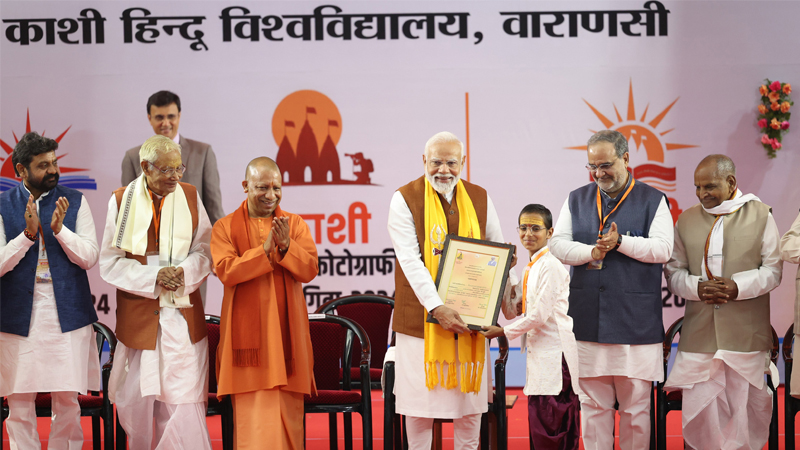
The Prime Minister, Shri Narendra Modi participated in the prize distribution ceremony of Sansad Sanskrit Pratiyogita at Swatantra Sabhagar, BHU, Varanasi today. He also unveiled the booklet on Kashi Sansad Pratiyogita and a coffee table book. The Prime Minister awarded the winners of Kashi Sansad Gyan Pratiyogita, Kashi Sansad Photography Pratiyogita and Kashi Sansad Sanskrit Pratiyogita and also distributed books, uniform sets, music instruments and merit scholarships to Sanskrit students of Varanasi. He also visited Kashi Sansad Photography Pratiyogita gallery and interacted with the participants with their photograph entries on the theme of “Sanwarti Kashi”.

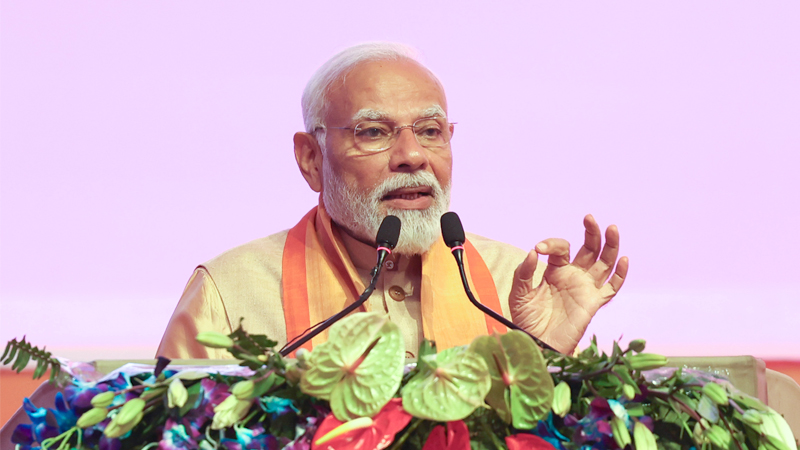
Addressing the gathering, the Prime Minister expressed delight in being present among the young scholars and said that the feeling is similar to taking a dip in the Ganga of knowledge. He lauded the efforts of the young generations who are strengthening the identity of the ancient city. He said that it is a matter of pride and contentment that the youth of India will take the country to new heights in the Amrit Kaal. “Kashi is the capital of eternal knowledge”, the Prime Minister said, underlining that it is a matter of pride for the entire nation that the capabilities and the form of Kashi are regaining its glory. He mentioned awarding the winners of  Kashi Sansad Gyan Pratiyogita, Kashi Sansad Photography Pratiyogita and Kashi Sansad Sanskrit Pratiyogita today and congratulated the winners. He also encouraged those who could not make it to the winners list. “No participant has been defeated or lagged, instead, everyone has learned from this experience”, the Prime Minister said, noting that all participants are worthy of praise. The Prime Minister thanked Shri Kashi Vishwanath Mandir Nyas, Kashi Vidvat Parishad and scholars for taking his vision as the MP of Kashi forward. He also noted that the coffee table books released today carry the story of the rejuvenation of Kashi in the last 10 years.

While acknowledging the progress of Kashi in the last 10 years, the Prime Minister was very clear that all of us are just instruments of the will of Lord Mahadev. He said with the blessing of Mahadev, ‘vikas ka damroo’ has been resonating in Kashi for the last 10 years. Talking about the projects worth crores of rupees, the Prime Minister said that before Shivratri and Rangbhari Ekadashi Kashi is celebrating the festival of development today. He said that everyone has seen the transformation through ‘Vikas ki Ganga’.

The Prime Minister said that “Kashi is not just a center of faith but it is a vibrant center of India’s eternal consciousness”. He said that India’s ancient prestige in the world was not based on economic prowess only but its cultural, spiritual and social richness was behind that. ‘Teerths’ like Kashi and Vishwanath Dham were the ‘Yagyashala’ of the nation’s development, he said, highlighting the connections of India’s knowledge tradition with the places of culture and spirituality. Illustrating his point through the example of Kashi the Prime Minister said that along with being the land of Shiva, Kashi is also a place of teachings of Buddha; birthplace of Jain Tirthankars as well as a place of enlightenment for Aadi Shankaracharya. He also highlighted the cosmopolitan allure of Kashi as people from all over the country and other parts of the world come to Kashi. “New ideals are born in a place of such diversity. New ideas nurture the possibility of progress.”, the Prime Minister added.

“Vishwanath Dham will give a decisive direction and take India to a bright future”, the Prime Minister said, recalling his address during the inauguration of Kashi Vishwanath Dham and reaffirming the belief today. He emphasized that the Vishwanath Dham corridor is witnessing a scholarly declaration today while also reviving the traditions of scriptures of justice. “Kashi can hear the classical tones as well as scriptural dialogues”, the Prime Minister said, underlining that it will encourage the exchange of ideas, preserve ancient knowledge and create new ideologies. He said that Kashi Sansad Sanskrit Pratiyogita and Kashi Sansad Gyan Pratiyogita are a part of such efforts where books, clothes and other necessary resources along with scholarships are being provided to thousands of youth who want to study Sanskrit. Teachers are also being assisted.  “Vishwanath Dham has also become a part of ‘Ek Bharat, Shreshtha Bharat’ campaigns like Kashi Tamil Sangamam and Ganga Pushkarulu Mahotsav”, Shri Modi said, noting that this center of faith is strengthening the resolve for social inclusion through tribal cultural events. Shri Modi informed that new research is also being done by the scholars of Kashi and by the Vidwat Parishad on ancient knowledge from the point of view of modern science. He also mentioned the temple trust making arrangements for free food at many places in the city. “New Kashi has emerged as an inspiration for the new India”, PM Modi said, highlighting how the center of faith can become a center of energy for social and national resolutions. He expressed confidence that the youth coming out from here will become the flag bearers of Indian knowledge, tradition and culture all over the world.

The Prime Minister said, “Among the languages ​​that have made the biggest contribution to the development of our knowledge, science and spirituality, Sanskrit is the most prominent. India is an idea, and Sanskrit is its chief expression. India is a journey, Sanskrit is the main chapter of its history. India is a land of unity in diversity, Sanskrit is its origin.” The Prime Minister recalled a time when Sanskrit was the main language of research in Astronomy, math, medicine, literature, music and arts. India got its identity through these disciplines, he said. He said recitation of Vedas in Kashi and Kanchi are the notes of ‘Ek Bharat Shreshtha Bharat’.

The Prime Minister said, “Today, Kashi is being seen as a model of heritage and development. Today the world is seeing how modernity expands around traditions and spirituality.”  He highlighted how Ayodhya is flourishing in the same way as Kashi after the Pran Pratishta of Ram Lalla in the newly built temple. PM Modi mentioned the International Airport in Kushinagar and highlighted the government’s efforts to develop modern infrastructure and facilities at places associated with Lord Buddha in the country. In the next 5 years, the Prime Minister emphasized that the country will give a new pace to development and create new patterns of success. “This is Modi’s guarantee, and Modi’s guarantee means guarantee of fulfillment of the guarantee. The Prime Minister asked that the best photographs of the exhibition, selected through voting, should be used as picture postcards for the tourists. He also suggested a sketching competition and the best sketches to be made into picture postcards. He reiterated his suggestion for a guide competition for creating ambassadors and interpreters of Kashi. The Prime Minister emphasized that the people of Kashi are its greatest strength and reiterated his resolve to help each and every Kashi resident as a servant and a friend.

Chief Minister of Uttar Pradesh, Shri Yogi Adityanath was present on the occasion along with Ministers of Government of Uttar Pradesh.

PM inspects the Shivpur-Phulwaria-Lahartara Marg in Kashi

| Published on:

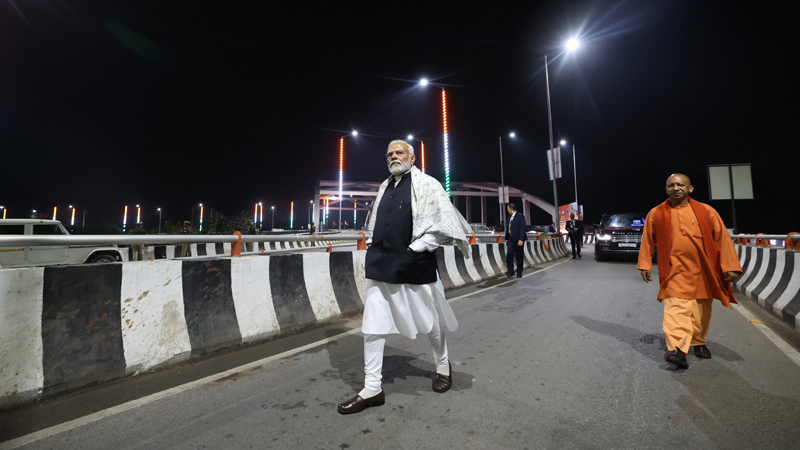
On his arrival to Varanasi after a long and packed day in Gujarat, the Prime Minister Shri Narendra Modi  went to inspect the Shivpur- Phulwaria- Lahartara marg at around 11pm on Thursday.

It was inaugurated recently. It is of great help to around 5 lakh people living around southern part, BHU, BLW, etc. who want to go towards airport, Lucknow, Azamgarh and Ghazipur.

It is built at a cost of Rs 360 crore. It is helping reduce traffic congestion. It is reducing distance of travel from BHU towards airport from 75 minutes to 45 minutes. Similarly it is reducing distance from Lahartara to Kachahri from 30 mins to 15 mins.

This project saw inter-ministerial coordination including from Railways and Defence to enhance ease of living for citizens of Varanasi.

The Prime Minister posted on X :

“Upon landing in Kashi, inspected the Shivpur-Phulwaria-Lahartara Marg. This project was inaugurated recently and has been greatly helpful to people in the southern part of the city.”

PM lays foundation stone for multiple development projects Rs 47,000 crores in Navsari, Gujarat

| Published on:

The Prime Minister, Shri Narendra Modi dedicated to the nation and laid the foundation stone for multiple development projects worth more than Rs 47,000 crores in Navsari Gujarat today. The projects encompass a wide range of sectors such as power generation, rail, road, textiles,  education, water supply, connectivity and urban development

Addressing the gathering, the Prime Minister underlined that this is his third program in Gujarat today and recalled being in the company of pashupalaks (cattle breeders) from Gujarat and stakeholders in the dairy industry earlier in the day. He also mentioned taking part in the Pran Pratishtha at Valinath Mahadev Temple in Mehsana. “Now, I am here in Navsari taking part in this festival of development”, the Prime Minister said, urging the people present on the occasion to turn on the flashlights in their mobile phones and become a part of this monumental festival of development. The Prime Minister congratulated the citizens for the development projects of today worth more than Rs 40,000 crores for Vadodara, Navsari, Bharuch and Surat among others in the sectors of textile, electricity and urban development.

Referring to the buzz around Modi Ki Guarantee, the Prime Minister underlined the certainty of the completion of guarantees given by him, a fact known to the people of Gujarat for a long time. He recalled ‘Five F’ which he used to talk about during his Chief Minister days – Farm, Farm to Fiber, Fiber to Factory, Factory to Fashion, Fashion to Foreign. He said that the goal was to have a full supply and value chain of textiles. “Today, the silk city of Surat is getting an expansion till Navsari”, the Prime Minister said, highlighting India’s capability to compete with the largest producers and exporters in the sector. Highlighting the role of Gujarat’s textile industry, the Prime Minister touched upon the unique identity of textiles manufactured in Surat. He emphasized that the completion of the PM MITRA Park will change the face of the entire region where an investment worth Rs 3,000 crores will be made solely in its construction. He said PM MITRA Park will create a value-chain ecosystem for activities such as cutting, weaving, ginning, garments, technical textiles and textile machinery while also giving a boost to employment. The Prime Minister informed that the Park will be equipped with houses for the workers, logistics park, warehousing, health facilities, and facilities for training and skill development.

Referring to the foundation stone laying of the Tapi River Barrage worth more than Rs 800 crores, the Prime Minister underlined that the water supply-related issues in Surat will be completely addressed, while also helping in preventing flood-like situations.

Underlining the importance of electricity in day-to-day life as well as in industrial development, the Prime Minister pointed out the time in Gujarat 20-25 years ago when power cuts were very frequent. Shri Modi also highlighted the challenges faced when he became the Chief Minister of Gujarat and mentioned the import of coal and gas as major obstacles. He also mentioned the minimum possibilities of generating hydroelectricity. The Prime Minister exclaimed, “Modi hai toh Mumkin hai” as he gave insights into the government’s effort to pull the state out of the electricity generation crisis, mentioning the encouragement of advanced technology and the push towards solar and wind energy generation which constitutes a huge amount of electricity generated in Gujarat today.

Elaborating on the nuclear generation of electricity, the Prime Minister talked about two new indigenous pressurized Heavy Water Reactors (PHWRs) at Kakrapar Atomic Power Station (KAPS) Unit 3 and Unit 4 that were dedicated to the nation today. He said these reactors are examples of Aatmnirbhar Bharat and will help in the development of Gujarat.

The Prime Minister highlighted the unprecedented development of South Gujarat with growing modern infrastructure. He told the gathering about the PM Suryaghar Scheme which will not only bring down the energy bills of the households but will become a medium of generating income also. The Prime Minister informed that the first bullet train of the country will pass through the region as the region will connect the big industrial centers of the country-Mumbai and Surat.

“Navsari is now getting recognition for its industrial development”, PM Modi said, noting that the entire West Gujarat including Navsari is well known for its agricultural advancements. Speaking about the government’s efforts to provide benefits to farmers in the region, Shri Modi highlighted the emergence of fruit cultivation and mentioned the world-famous Hapus and Valsari varieties of mango and chikoo (sapodilla) from Navsari. The Prime Minister informed that the farmers have received financial assistance worth more than Rs 350 crores under PM Kisan Samman Nidhi.

The Prime Minister reiterated his guarantee of empowering youth, poor, farmers and women. He said that the guarantee goes beyond just making schemes but extends to ensuring full coverage.

Mentioning the earlier neglect of tribal and coastal villages, the Prime Minister said that the current government has ensured every basic facility in the area from Umargam to Ambaji. At the national level too, more than 100 Aspirational Districts that were lagging in development parameters are moving ahead with the rest of the country.

“Modi’s guarantee begins where hope from others ceases to exist”, the Prime Minister said. He listed the assurances of Modi’s guarantee for pucca houses for the poor, free ration scheme, electricity, tapped water and insurance schemes for the poor, farmers, shopkeepers and laborers. “This is a reality today because it is Modi’s guarantee”, the Shri Modi added.

Addressing the pressing issue of sickle cell anemia in tribal regions, Prime Minister Modi emphasized the need for concerted efforts at the national level to eradicate this disease. Noting the state’s proactive measures to tackle sickle cell anemia during his Chief Minister Days, the Prime Minister also listed broader national efforts to effectively combat the disease. “We have now launched a National Mission to deliver freedom from sickle cell anemia,” Prime Minister Modi said, outlining the government’s comprehensive initiative aimed at eliminating the disease from tribal areas across the country. “Under this mission, screenings for sickle cell anemia are being conducted in tribal regions nationwide,” Prime Minister Modi stated. He also mentioned upcoming medical colleges in the tribal areas.

“Whether poor or middle-class, rural or urban, our government’s effort is to improve the standard of living for every citizen,” Prime Minister Modi emphasized, reaffirming the government’s commitment to inclusive development. Recalling the economic stagnation of earlier times, the Prime Minister said “Economic stagnation meant that the country had limited financial resources,” Prime Minister Modi explained, underscoring the adverse impact on rural and urban development during that period. He said that as the Indian economy has become the 5th largest economy up from 11th rank in 2014, this means that today India’s citizens have more money to spend and hence India is spending it. Therefore, today excellent connectivity infrastructure is being built even in small cities of the country. He mentioned accessible air travel from small urban centers and 4 crore pucca houses.

Throwing light on the success and scope of the Digital India initiative, the Prime Minister said, “Today, the world recognizes Digital India.” He emphasized that Digital India has transformed small cities with the emergence of new start-ups as well as youth in the field of sports. He touched upon the emergence of a neo-middle class in such small towns which will drive India to become the third largest economic power in the world.

The Prime Minister underlined the government’s emphasis on prioritizing development as well as heritage and noted that the region has been an important center of India’s faith and history, be it the freedom movement or nation-building. He also lamented the neglect towards the legacy of the region owing to the politics of nepotism, appeasement and corruption. On the contrary, the Prime Minister said, the echo of India’s rich heritage is being heard all over the world today. He mentioned the development of the Dandi Memorial at the site of the Dandi Salt Satyagraha and the construction of the Statue of Unity dedicated to the contribution of Sardar Patel.

Concluding the address, the Prime Minister said that the roadmap for the development of the country for the next 25 years is already in place. “In these 25 years, we will make a Viksit Gujarat and a Viksit Bharat”, PM Modi concluded.

Chief Minister of Gujarat, Shri Bhupendra Patel and Member of Parliament, Shri C R Patil were present on the occasion along with several MPs, MLAs and Ministers from Gujarat Government.

Background 

The Prime Minister dedicated to the nation several development projects including multiple packages of Vadodara Mumbai Expressway; multiple road projects in Bharuch, Navsari, and Valsad; rural drinking water supply project in Tapi; underground drainage project in Bharuch, among others. The Prime Minister also initiated work commencement for the construction of PM Mega Integrated Textile Region and Apparel (PM MITRA) Park in Navsari.

During the programme, the Prime Minister also laid the foundation stone of important projects including the construction of the Bharuch-Dahej access controlled expressway; multiple projects at S.S.G. Hospital, Vadodara; Regional science center in Vadodara; projects for railway gauge conversion in Surat, Vadodara and Panchmahal; multiple road projects in Bharuch, Navsari and Surat; several water supply schemes in Valsad, school and hostel building and other projects in Narmada district, among others.

The Prime Minister also dedicated to the nation and laid the foundation stone of several development projects of Surat Municipal Corporation, Surat Urban Development Authority, and Dream City.

The Prime Minister dedicated to the nation two new Pressurized Heavy Water Reactors (PHWRs) at Kakrapar Atomic Power Station (KAPS) Unit 3 and Unit 4. Built by the Nuclear Power Corporation of India Ltd (NPCIL), at a cost of more than Rs 22,500 crore, the KAPS-3 and KAPS-4 projects have a cumulative capacity of 1400 (700*2) MW and are the largest indigenous PHWRs. They are first-of-its-kind reactors and with advanced safety features comparable with the best in the world. Together, these two reactors will produce about 10.4 billion units of clean electricity per year and benefit consumers of multiple states like Gujarat, Maharashtra, MP, Chhattisgarh, Goa and UT of Dadra and Nagar Haveli and Daman and Diu.

PM lays foundation stone for multiple development projects worth Rs 13,500 crore in Mahesana, Gujarat

| Published on:

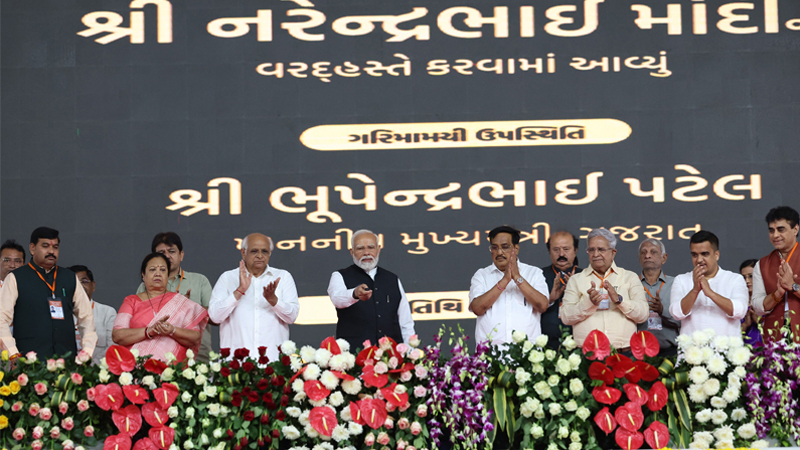
The Prime Minister, Shri Narendra Modi dedicated to the nation and laid the foundation stone for multiple development projects worth more than Rs 13,500 crores in Tarabh, Mahesana, Gujarat today. The projects encompass a wide range of sectors such as internet connectivity, rail, road, education, health, connectivity, research and tourism.

Addressing the gathering, the Prime Minister recalled 22nd January exactly one month ago when he got the opportunity to perform the Pran Pratishtha ceremony of Ram Lalla in Ayodhya. He also recalled the occasion of Basantpanchmi on 14th February when he inaugurated the first Hindu temple of the Gulf countries in Abu Dhabi. In Sambhal district of Uttar Pradesh, the Prime Minister mentioned laying the foundation stone for Kalki Dham. He also mentioned performing consecration and darshan and pooja at Valinath Mahadev Temple in Tarabh today.

For India and the world, the Prime Minister noted that Valinath Shiv Dham is a pilgrimage site but it is an auspicious seat of the Guru for the Rewari society and devotees from around the country.

The Prime Minister underscored the importance of the present moment in the development journey of India as both the ‘Dev Kaaj’ (divine works) and ‘Desh kaaj’ (national tasks) are going on at a rapid pace. “On the one hand, this auspicious event has taken place and development works worth 13,000 crore Rs were dedicated or foundation stones were laid, on the other”, he said. These rail, road, port, transport, water, security, urban development and tourism projects will increase ease of living and create new job opportunities for the youth of the region, he added.

Observing the presence of divine energy in the pious land of Mehsana, the Prime Minister said that it connects the people with the spiritual consciousness of thousands of years associated with Lord Krishna and Lord Mahadev. This energy, PM Modi said, connects the people with the journey of Gadipati Mahant Veeram-Giri Bapu ji as he paid tribute to him. He also bowed before Mahant Shri Jayaramgiri Bapu for forwarding the resolve of Gadipati Mahant Baldevgiri Bapu and accomplishing it. Highlighting his four-decade-old deep connection with  Baldevgiri Bapu ji, the Prime Minister recalled welcoming him to his residence on numerous occasions as the then Chief Minister of Gujarat to awaken the spiritual consciousness. He also recalled his demise in 2021 and emphasized that his departed soul would be blessing everyone today after the accomplishments of his resolve. “The centuries-old temple has been completed with the magnificence of the 21st century and the divinity of the ancient traditions”, the Prime Minister said as he highlighted the contributions and efforts of hundreds of craftsmen and shramjeevis. He lauded their efforts for the successful consecration of Valinath Mahadev, Hinglaj Mata ji and Lord Dattatreya today and congratulated them on the occasion

The Prime Minister said that these temples are more than a place of worship but are also symbols of our centuries-old civilization. The Prime Minister highlighted the role of temples in spreading knowledge in society. The Prime Minister praised the local religious Akhadas for taking forward the tradition of spreading knowledge and said that the organization of Pustak Parab and the construction of school and hostel have enhanced awareness and education among the people. “There can not be a better example of Dev Kaaj and Desh Kaaj, ” PM Modi added. He praised Rabari Samaj for nurturing such enlightened traditions.

The Prime Minister talked about the spirit of Sabka Saath Vikas ingrained in Valinath Dham and said in sync with this spirit, the government is committed to make the lives of every section better. “Goal of Modi’s guarantee is to transform the life of the person on the last pedestal of the society”, he said. He juxtaposed the coming of new temples with the construction of pucca houses for crores of poor, recalling dedication and foundation stone laying for 1.25 lakh houses recently. He also mentioned free ration for 80 crore citizens as ‘Bhagwan ka Prasad’, and piped water for 10 crore new families as ‘Amrit’.

The Prime Minister highlighted the government’s efforts towards the development of heritage sites in Gujarat apart from infrastructure development in the last two decades. He lamented the conflict created between development and heritage in India for decades, the auspicious Somnath Temple becoming a site of dispute, neglect of the site of Pavagadh, vote bank politics of the Sun Temple in Modhera, questioning the existence of Lord Ram and creating obstacles in the development of his temple. He also pointed out that the same people are still spreading negativity even though the entire nation is rejoicing in the temple built on Ram Lalla’s birthplace.

The Prime Minister emphasized, “Today, every effort being made in the New India is creating a legacy for the future generations. The new and modern roads and railway tracks that are being built today are the pathways of developed India only.” He said that today rail connectivity to Mehsana was strengthened. He remarked that doubling the rail line has improved the connectivity of Banaskantha and Patan with Kandla, Tuna and Mundra ports. He said that he laid the foundation stone of the runway one and a half years ago for Deesa Air Force Station runway.  “Whatever pledge Modi takes, he fulfills it, this runway of Deesa is an example of this. This is Modi’s guarantee”, the Prime Minister said.

Recalling the time period 20-25 years ago when opportunities were very limited in North Gujarat along with the scope of industrialization, the Prime Minister pointed out the challenges of cattle herders and the irrigation of the farmer’s fields. The Prime Minister highlighted the positive changes brought about by the present government and mentioned farmers growing 2-3 crops in a year and an increase in the water level of the entire area. Referring to the inauguration and foundation stone laying of the 8 projects related to water supply and water sources today worth more than Rs 1500 crores, the Prime Minister said that it will further help in solving the water problems of North Gujarat. He also lauded the farmers of North Gujarat for adopting modern technology like drip irrigation and the emerging trends of chemical-free natural farming. “Your efforts will increase the enthusiasm of farmers across the country”, he added.

Concluding the address, the Prime Minister highlighted the government’s emphasis on developing the country as well as preserving the heritage and conveyed his best wishes for today’s development projects.

Chief Minister of Gujarat, Shri Bhupendra Patel was present on the occasion along with several MPs, MLAs and Representatives of Gujarat Government.

Background

The Prime Minister dedicated to the nation, important projects including Bharat Net Phase-II – Gujarat Fibre Grid Network Limited, which will provide high-speed internet to more than 8000 gram panchayats; multiple projects for rail line doubling, gauge conversion, new broad-gauge line in districts of Mahesana and Banaskantha; multiple road projects in Kheda, Gandhinagar, Ahmedabad, and Mahesana; Main academic building of Gujarat Biotechnology University at Gandhinagar; multiple water supply projects in Banaskantha, among others.

During the programme, the Prime Minister laid the foundation stone for several important projects including a new district-level Hospital & Ayurvedic Hospital in Anand district; the development of Rinchhadiya Mahadev Temple and Lake at Ambaji region in Banaskantha; multiple road projects in Gandhinagar, Ahmedabad, Banaskantha, and Mahesana; Runway of Air Force Station, Deesa; Human and Biological Science Gallery in Ahmedabad; Gujarat Biotechnology Research Centre (GBRC) new building at GIFT city; multiple projects for improving water supply in Gandhinagar, Ahmedabad and Banaskantha, among others.

Press Statement by PM during the visit of Prime Minister of Greece to India

| Published on:

Your Excellency, Prime Minister Mitsotakis ,
Delegates from both countries ,
Friends from the media,

Namaskar!

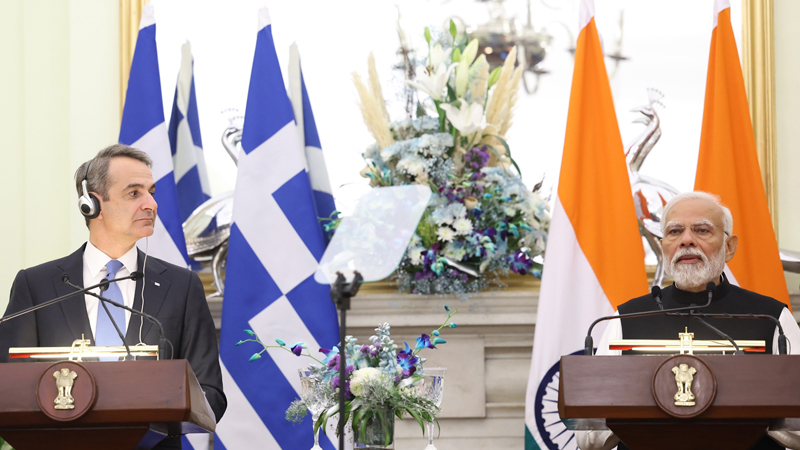
It gives me great pleasure to welcome Prime Minister Mitsotakis and his delegation to India. After my visit to Greece last year, his visit to India is a sign of the strengthening strategic partnership between the two countries. And the coming of the Prime Minister of Greece to India after such a long gap, after sixteen years, is a historic occasion in itself.

Friends,

Our discussions today were very significant and useful. It is a matter of joy that we are rapidly moving towards the target of doubling bilateral trade by 2030. We identified several new opportunities to give new energy and direction to our cooperation. There are many possibilities for closer cooperation between the two countries in the field of agriculture. And I am pleased that both sides are taking steps to implement the agreements reached in this area last year. We emphasized on increasing cooperation in many areas like Pharma, Medical Devices, Technology, Innovation, Skill Development, and Space.

We also discussed connecting the start-ups of both the countries. Shipping and Connectivity are topics of high priority for both the countries. We also discussed increasing cooperation in these areas.

Friends,

The growing cooperation in defence and security reflects our deep mutual trust. With the formation of a Working Group in this area, we will be able to increase mutual coordination on common challenges like defence, cyber security, counter-terrorism, and maritime security. New opportunities for co-production and co-development are being created in defence manufacturing in India, which can be beneficial for both the countries. We have agreed to link the defence industries of both the countries. India and Greece have common concerns and priorities in the fight against terrorism. We discussed in detail how to further strengthen our cooperation in this area.

Friends,

As two ancient and great civilizations, India and Greece have a long history of deep cultural and people-to-people ties. For almost two and a half thousand years, people of both the countries have been exchanging trade and cultural relations as well as ideas.

Today we identified several new initiatives to give a modern form to these relations. We discussed concluding the Migration and Mobility Partnership Agreement between the two countries as soon as possible. This will further strengthen our people-to-people relations.

We also emphasized on promoting cooperation between higher education institutions of the two countries. We have decided to prepare an Action Plan to celebrate the 75th anniversary of diplomatic relations between India and Greece next year. With this, we will be able to showcase the common heritage, and achievements of both the countries in science and technology, innovation, sports, and other fields on the global stage.

Friends,

In today’s meeting, we also discussed many regional and international issues. We agree that all disputes and tensions should be resolved through dialogue and diplomacy. We welcome Greece’s active participation and positive role in the Indo-Pacific. It is a matter of joy that Greece has decided to join the Indo-Pacific Oceans Initiative. There has also been agreement for cooperation in the Eastern Mediterranean region. Launched during India’s G-20 chairmanship, the IMEC corridor will contribute significantly to the development of humanity in the long run.

Greece can also become an important partner in this initiative. We agree to reform the UN and other global institutions so that they can be made contemporary. India and Greece will continue their efforts to contribute to global peace and stability.

Excellency,

This evening you will participate in the Raisina Dialogue as the Chief Guest. We are all eager to hear your address there. I thank you very much for your visit to India and our fruitful discussion.

DISCLAIMER – This is the approximate translation of Prime Minister’s Press Statement. Original Press Statement were delivered in Hindi.

PM to visit Gujarat and Uttar Pradesh on 22nd and 23rd February

| Published on:

Prime Minister will visit Gujarat and Uttar Pradesh on 22nd and 23rd February, 2024.

On 22nd February, at around 10:45 AM, in Ahmedabad, Prime Minister will participate in the Golden Jubilee celebration of Gujarat Cooperative Milk Marketing Federation (GCMMF). At around 12:45 PM, Prime Minister will reach Mahesana and perform pooja and darshan at Valinath Mahadev Temple. At around 1 PM, Prime Minister will participate in a public function in Tarabh, Mahesana where he will dedicate to nation and lay the foundation stone of multiple development projects worth more than Rs 13,500 crore. At around 4:15 PM, Prime Minister will reach Navsari, where he will dedicate to nation, lay the foundation stone and initiate work commencement of multiple development projects worth more than Rs 47,000 crore. At around 6:15 PM, Prime Minister will visit the Kakrapar Atomic Power Station.

On 23rd February, Prime Minister will participate in a programme for prize distribution to the winners of Sansad Sanskrit Pratiyogita at Swatantra Sabhagar, BHU, Varanasi. At 11:15 AM, Prime Minister will perform pooja and darshan at Sant Guru Ravidas Janmasthali. At 11:30 AM, Prime Minister will attend a public function commemorating the 647th birth anniversary of Sant Guru Ravidas. At 1:45 pm, Prime Minister will attend a public function where he will inaugurate and lay the foundation stone of multiple development projects worth Rs 13,000 crore in Varanasi.

PM in Gujarat

Prime Minister will participate in the Golden Jubilee celebration of Gujarat Cooperative Milk Marketing Federation (GCMMF). The Golden Jubilee celebration of GCMMF will witness participation of more than 1.25 lakh farmers at Narendra Modi Stadium, Motera, Ahmedabad. GCMMF is a testimony of the resilience of cooperatives, their entrepreneurial spirit and strong determination of farmers, which has made Amul the one of the strongest dairy brands in the world.

At the two public functions in Gujarat at Mahesana and Navsari, Prime Minister will dedicate to nation and lay the foundation stone of multiple development projects encompassing important sectors like road, rail, energy, health, internet connectivity, urban development, water supply, tourism, petroleum & natural gas, tribal development across Gujarat.

At public function in Tarabh, Mahesana, Prime Minister will dedicate to nation important projects including Bharat Net Phase-II – Gujarat Fibre Grid Network Limited, which will provide high-speed internet to more than 8000 gram panchayats; multiple projects for rail line doubling, gauge conversion, new broad-gauge line in districts of Mahesana and Banaskantha; multiple road projects in Kheda, Gandhinagar, Ahmedabad, and Mahesana; Main academic building of Gujarat Biotechnology University at Gandhinagar; multiple water supply projects in Banaskantha, among others.

During the programme, Prime Minister will also lay the foundation stone of several important projects including new district level Hospital & Ayurvedic Hospital in Anand district; development of Rinchhadiya Mahadev Temple and Lake at Ambaji region in Banaskantha; multiple road projects in Gandhinagar, Ahmedabad, Banaskantha, and Mahesana; Runway of Air Force Station, Deesa; Human and Biological Science Gallery in Ahmedabad;   Gujarat Biotechnology Research Centre (GBRC) new building at GIFT city; multiple projects for improving water supply in Gandhinagar, Ahmedabad and Banaskantha, among others.

At public function in Navsari, Prime Minister will dedicate to nation several development projects including multiple packages of Vadodara Mumbai Expressway; multiple road projects in Bharuch, Navsari, Valsad; rural drinking water supply project in Tapi; underground drainage project in Bharuch, among others. Prime Minister will also initiate work commencement for construction of PM Mega Integrated Textile Region and Apparel (PM MITRA) Park in Navsari.

During the programme, Prime Minister will also lay the foundation stone of important projects including construction of Bharuch-Dahej access controlled expressway; multiple projects at S.S.G. Hospital, Vadodara; Regional science centre in Vadodara; projects for railway gauge conversion in Surat, Vadodara and Panchmahal; multiple road projects in Bharuch, Navsari and Surat; several water supply schemes in Valsad, school and hostel building and other projects in Narmada district, among others.

Prime Minister will also dedicate to nation and lay the foundation stone of several development projects of Surat Municipal Corporation, Surat Urban Development Authority, and Dream City.

Prime Minister will dedicate to nation two new Pressurised Heavy Water Reactors (PHWRs) at Kakrapar Atomic Power Station (KAPS) Unit 3 and Unit 4. Built by the Nuclear Power Corporation of India Ltd (NPCIL), at a cost of more than Rs 22,500 crore, the KAPS-3 and KAPS-4 projects have cumulative capacity of 1400 (700*2) MW and are the largest indigenous PHWRs. They are first of its kind reactors and with advanced safety features comparable with the best in the world. Together, these two reactors will produce about 10.4 billion units of clean electricity per year and benefit consumers of multiple states like Gujarat, Maharashtra, MP, Chhattisgarh, Goa and UT of Dadra and Nagar Haveli and Daman and Diu.

PM in Varanasi

Since 2014, the Prime Minister has focused on transforming Varanasi and its adjoining areas by initiating a number of development projects catering to important sectors such as road, rail, aviation, tourism, education, health, drinking water, urban development, and sanitation. Taking another step in this direction, Prime Minister will inaugurate and lay the foundation stone of multiple development projects worth more than Rs 13,000 crore in Varanasi.

To further enhance road connectivity of Varanasi, Prime Minister will inaugurate and lay the foundation stone of multiple road projects including four laning of Ghargra-Bridge-Varanasi section of NH-233; four laning of Sultanpur-Varanasi section of NH-56, Package-1; six laning of phase-1 of Varanasi-Aurangabad section of NH-19; four laning of Package-1 Varanasi-Hanumana section on NH-35; and ROB on Varanasi- Jaunpur rail section near Babatpur.  He will also lay the foundation stone of construction of Varanasi-Ranchi-Kolkata Expressway Package-1.

For providing impetus to industrial development in the region, Prime Minister will inaugurate LPG Bottling Plant by HPCL in Sewapuri; Banas Kashi Sankul milk processing unit in UPSIDA Agro Park Karkhiyaon; various infrastructure work at UPSIDA Agro Park, Karkhiyaon; and silk fabric printing common facility centre for weavers.

Prime Minister will inaugurate multiple urban development projects in Varanasi including Urban waste to Charcoal Plant by NTPC at Ramana; upgradation of water supply network in sis-Varuna area; and online effluent monitoring and SCADA automation of STPs and Sewerage Pumping Stations. Prime Minister will also lay the foundation stone of multiple projects for beautification of Varanasi including the projects for rejuvenation of ponds and redevelopment of parks; and for design and development of 3-D Urban Digital map and database.

Prime Minister will also inaugurate multiple projects related to tourism and spiritual tourism in Varanasi. The projects include redevelopment of public facilities at five Padavs of Panchkoshi Parikrama Marg and Pavan Path with ten spiritual yatra; launching of electric catamaran vessel provided by Inland Waterways Authority of India (IWAI) for Varanasi & Ayodhya; and seven change rooms floating jetties and four community jetties. The Electric catamaran will enhance the tourism experience in Ganges with use of green energy. Prime Minister will also lay the foundation stone of thirteen community jetties of IWAI at various cities and quick pontoon opening mechanism at Ballia.

Providing impetus to the famous textile sector of Varanasi, Prime Minister will lay the foundation stone of the National Institute of Fashion Technology (NIFT) in Varanasi. The new institute will strengthen the education and training infrastructure of the textile sector.

Augmenting the health infrastructure in Varanasi, Prime Minister will lay the foundation stone of a new Medical College in Varanasi. He will also lay the foundation stone of National Centre of Ageing at BHU.  Prime Minister will inaugurate the Sigra Sports Stadium Phase-1 and District Rifle Shooting Range, a step towards strengthening the sports infrastructure in the city.

In the prize distribution ceremony at Swatantrata Sabhagar, Banaras Hindu University, Prime Minister will award the winners of Kashi Sansad Gyan Pratiyogita, Kashi Sansad Photography Pratiyogita and Kashi Sansad Sanskrit Pratiyogita. He will also distribute books, uniform sets, music instruments and merit scholarships to Sanskrit students of Varanasi. He will also visit Kashi Sansad Photography Pratiyogita gallery and interact with the participants with their photograph entries on the theme of “Sanwarti Kashi”.

At the Sant Guru Ravidas Janmasthali temple at Seer Govardhanpur near BHU, Prime Minister will inaugurate the newly installed statue of Sant Ravidas in adjoining Ravidas park. He will inaugurate various development works around Sant Ravidas Janmasthali worth about Rs 32 crore and lay the foundation stone for Sant Ravidas Museum and beautification of the park worth about Rs 62 crore.

Union Finance Minister chairs 28th meeting of FSDC in New Delhi

| Published on:

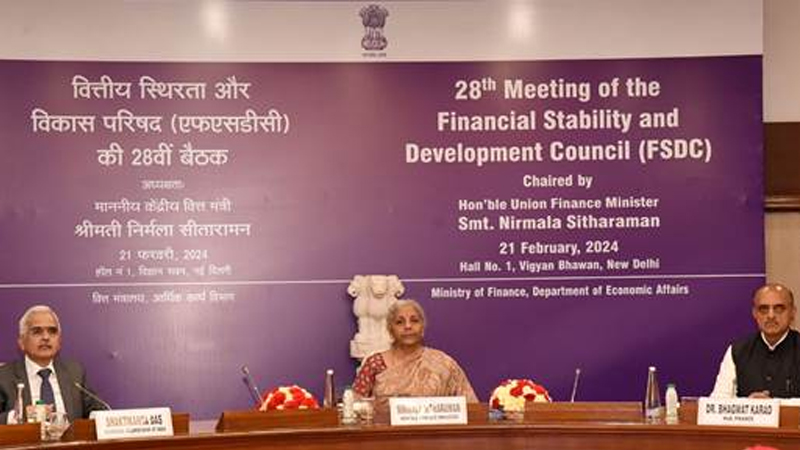
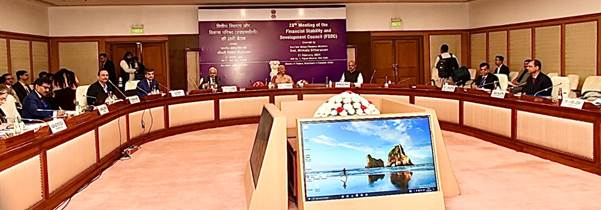
Union Minister for Finance and Corporate Affairs Smt. Nirmala Sitharaman chaired the 28th Meeting of the Financial Stability and Development Council (FSDC) in New Delhi, today.

The FSDC, inter alia, deliberated on issues related to macro financial stability and India’s preparedness to deal with them. The ongoing inter-regulatory issues were also discussed to support GIFT IFSC in its strategic role to become one of the world’s premier international financial centres and perform its envisioned role of facilitating foreign capital and financial services for the domestic economy.


The FSDC discussed various issues related to formulation of strategy for implementing the decisions of the FSDC and the Union Budget announcements. These, inter alia, included:

  • prescribing uniform KYC norms, inter-usability of KYC records across the financial sector, and simplification and digitalisation of the KYC process;
  • kickstarting fund-raising by social enterprises through social stock exchanges;
  • to arrest the harmful effects of unauthorised lending through online apps and measures to curb their further spread.

The FSDC considered the domestic and global macro-financial situation and emphasised that the members need to maintain constant vigilance and continue their proactive efforts towards detecting emerging financial stability risks and taking the necessary measures to maintain the resilience of the financial sector. The FSDC members also decided to strengthen inter-regulatory coordination to further develop the financial sector so that it continues to provide the requisite financial resources for inclusive economic growth.

The FSDC also took note of the activities undertaken by the FSDC Sub-Committee chaired by the Governor, RBI, and the action taken by members on the previous decisions of the FSDC.

The meeting was attended by Union Minister of State  for Finance Dr. Bhagwat Kishanrao Karad; Shri Shaktikanta Das, Governor, Reserve Bank of India (RBI); Dr. T.V. Somanathan, Finance Secretary and Secretary, Department of Expenditure, Ministry of Finance (MoF); Shri Ajay Seth, Secretary, Department of Economic Affairs, MoF; Dr. Vivek Joshi, Secretary, Department of Financial Services, MoF; Shri Sanjay Malhotra, Secretary, Department of Revenue, MoF;  Dr. Manoj Govil, Secretary, Ministry of Corporate Affairs (MCA); Shri S. Krishnan, Secretary, Ministry of Electronics and Information Technology; Dr. V. Anantha Nageswaran, Chief Economic Adviser, MoF; Ms. Madhabi Puri Buch, Chairperson, Securities and Exchange Board of India; Shri Debasish Panda, Chairperson, Insurance Regulatory and Development Authority of India; Dr. Deepak Mohanty, Chairperson, Pension Fund Regulatory and Development Authority; Shri Ravi Mital, Chairperson, Insolvency and Bankruptcy Board of India; Shri K. Rajaraman, Chairperson, International Financial Services Centres Authority, and the Secretary of the FSDC, Department of Economic Affairs, MoF.

PM addresses Viksit Bharat Viksit Uttar Pradesh program in Lucknow, Uttar Pradesh

| Published on:

The Prime Minister, Shri Narendra Modi addressed the Viksit BharatViksit Uttar Pradesh program in Lucknow today. He also launched 14000 projects across Uttar Pradesh worth more than Rs 10 lakh crores at the fourth groundbreaking ceremony of UP Global Investors Summit 2023 held in February 2023. The projects relate to sectors like Manufacturing, Renewable Energy, IT & ITeS, Food Processing, Housing & Real Estate, Hospitality and Entertainment, and Education among others.

Addressing the gathering, the Prime Minister said that today’s organization is a step towards the resolution of Viksit Bharat through the development of Viksit Uttar Pradesh. Noting the presence of lakhs of people from more than 400 constituencies of Uttar Pradesh through video conferencing, Prime Minister Modi welcomed them and expressed delight that citizens can now join in the program with the help of technology, something which was unimaginable 7-8 years ago. Pointing out the high crime rates in Uttar Pradesh earlier, the Prime Minister lauded the atmosphere of positivity in the state regarding investments and employment opportunities. “Today, Uttar Pradesh is witnessing investments worth lakhs of crores of rupees”, the Prime Minister said, expressing delight with the state’s progress since he is also a Member of Parliament from Varanasi. Speaking about the development projects of today, the Prime Minister said that it will change the face of Uttar Pradesh, and congratulated the investors as well as the youth.

Noting the seven years of double-engine government in Uttar Pradesh, the Prime Minister said that in this period ‘red carpet culture’ has replaced ‘red tape culture’. He said in the last 7 years crime decreased in UP and business culture flourished. “In the last 7 years an atmosphere of business, development and trust has developed in Uttar Pradesh”, the Prime Minister said. The double-engine government has proven the inevitability of change if there is a genuine desire for it, he added. He noted doubling of exports from the state during this period. He also praised the state’s strides in electricity generation and transmission. “Today, UP is a state with the maximum number of expressways, and international airports in the country. It is the state where the country’s first rapid rail is running”, said the Prime Minister pointing to the presence of a big chunk of Eastern and Western Peripheral Expressways in the state. Acknowledging the use of river waterways in the state, PM Modi praised the connectivity and ease of travel in the state.

The Prime Minister underlined that today’s development projects are not being assessed in terms of investment alone, but they present a holistic vision for a better future and a ray of hope for investors. Recalling his recent visit to UAE and Qatar, the Prime Minister noted the unprecedented positivity towards India all around the globe and said that every nation feels assurance and trust in India’s growth story. “Even though ‘Modi ki guarantee’ is being widely discussed around the country today, the world is seeing India as a guarantee for better returns”, the Prime Minister said. Reaffirming the belief of investors, the Prime Minister said that India has broken the trend of governments drifting away from investments when elections are knocking on the doors. “Investors around the globe trust the government’s policies and stability”, the Prime Minister remarked, noting the emergence of a similar trend in Uttar Pradesh.

The Prime Minister underscored the need for new thinking and direction for Viksit Bharat. He said that the earlier approach of keeping the citizens at a bare minimum existence and regional imbalance was not suitable for the development of the nation. Uttar Pradesh, he said, also suffered due to this approach. Now, he pointed out that the double-engine government is involved in making the life of every family as ease of living leads to ease of doing business. He said as 4 crore pucca houses were constructed under PM Awas, urban middle-class families were also provided assistance of Rs 7 thousand crore to realize their dream of owning a house. Through this, he informed, 25 lakh beneficiary families, including 1.5 lakh families from UP, received rebates in interest. Income tax reforms like raising the limit of exemption from 2 lakh in 2014 to 7 lakh now have helped the middle class.

Highlighting the government’s equal emphasis on Ease of Living and Ease of Doing Business, the Prime Minister said that the double-engine government strives to make every benefit available for every beneficiary. He touched upon the Viksit Bharat Sankalp Yatra which has benefitted lakhs of people from Uttar Pradesh by taking the benefits to the doorsteps of beneficiaries. “Modi ki guarantee vehicle has reached almost all villages and cities”, the Prime Minister said. The Prime Minister emphasized that the saturation of government schemes constitutes the truest form of social justice. “This is true secularism”, PM Modi said, pointing out the prevalence of corrupt practices and disparity during the previous government which led to tedious processes for the beneficiaries. “Modi’s guarantee that the government will not rest till every beneficiary gets what they deserve, be it pucca homes, electricity supply, gas connection or tapped water”, PM Modi added.

The Prime Minister reiterated “Modi is looking after those who were ignored by all earlier”. Elaborating on such segments the Prime Minister gave examples of 10,000 crore Rs worth of assistance to street vendors under the PM SVANidhi scheme. In UP, about 22 lakh street vendors received the benefits. He mentioned that beneficiaries of the scheme experienced 23,000 worth of extra annual income. He also informed that 75 percent beneficiaries of PM SVANidhi are from SC, ST, backward or tribal communities with half of them being women. “Earlier they had no guarantee for banks, today they have Modi’s guarantee”, he added. He said that this is the social justice of Jai Prakash Narain and Ram Manohar Lohiya’s dreams.

Speaking about the Lakhpati Didi Scheme, the Prime Minister stated that the policies and decisions of the double-engine government benefit both social justice and the economy. He also mentioned that more than 10 crore women have been associated with self-help groups and 1 crore women have become Lakhpati Didis so far. He also highlighted the government’s resolve to create 3 crore Lakhpati Didis which will strengthen the rural economy

The Prime Minister touched upon the strength of the small, micro and cottage industries of Uttar Pradesh and mentioned the expansion and support that was provided to the MSME sector of the state along with the benefits of projects like defence corridor. He further pointed out that local products of every district are being strengthened under One District One Product scheme. Similarly. 13,000 crore Rs PM Vishwakarma Scheme will connect lakhs of Vishwakarma families of UP with modern practices.

The Prime Minister highlighted the fast-paced functioning of the government and touched upon the toy manufacturing sector of India. He also informed about promoting the wooden toys manufactured in Varanasi as a Parliamentarian from the region. Shri Modi lamented the import of toys in India even though the people have been skilled at making toys for generations and the nation has a rich tradition. He pointed out the Indian toys market was overtaken by toys manufactured in foreign countries as Indian toys were not promoted and artisans were not given help to adapt to the modern world. Underlining his determination to change this, the Prime Minister recalled appealing to toy makers across the country to support the cause which led to a significant increase in the export of toys.

“UP has the potential to become India’s largest tourism hub”, the Prime Minister said, noting that every person in the country wants to visit Varanasi and Ayodhya today drawing lakhs of visitors and tourists. Due to this, the Prime Minister said, unprecedented opportunities are being created for small entrepreneurs, airline companies and hotel-restaurant owners here in UP. PM Modi also touched upon UP’s improved local, national and international connectivity and highlighted the recently initiated world’s longest cruise service via Varanasi.  He further added that Kumbh Mela is also going to be organized in 2025 making it very important for the state’s economy. He said that a large number of jobs are going to be created here in the tourism and hospitality sector in the coming times.

Throwing light on India’s focus on electric mobility and green energy, the Prime Minister highlighted the government’s emphasis on making India a global hub in such technology and manufacturing. “Our effort is that every house and every family in the country should become a solar power generator”, PM Modi said referring to the PM Suryaghar or Free Electricity Scheme where 300 units of electricity will be available free of cost and citizens will also be able to sell the excess electricity to the government. Shri Modi informed that under this scheme which is available for 1 crore families currently, Rs 30,000 to about Rs 80,000 will be deposited directly into the bank account of every family. He further explained that those generating 100 units of electricity every month will get assistance of Rs 30,000 while those generating 300 units or more electricity will get around Rs 80,000.

Prime Minister Modi also highlighted the government’s push towards the EV sector and mentioned the PLI scheme for manufacturing partners as well as tax exemptions on the purchase of electric vehicles. “As a result, about 34.5 lakh electric vehicles have been sold in the last 10 years”, he added,  “We are rolling out electric buses at a fast pace. Be it solar or EV, there are a lot of possibilities in both sectors in Uttar Pradesh.

Referring to the recent decision to confer Bharat Ratna to Chaudhary Charan Singh, PM Modi said “Honoring Chaudhary Saheb, the son of the soil of Uttar Pradesh, is an honor for crores of laboring farmers of the country.” He also talked about the earlier discriminatory practices with regard to the conferment of state regards. He praised Chaudhary Charan Singh’s contribution to the small farmers and said, “We are empowering the country’s farmers with the inspiration of Chaudhary Sahab”.

The Prime Minister reiterated the government’s commitment to supporting farmers in exploring new avenues in agriculture, stating, “We are assisting and encouraging farmers to take our country’s agriculture on a new path.” He emphasized the focus on natural farming and millets, citing the emergence of large-scale natural farming along the banks of the Ganges in Uttar Pradesh, which not only benefits farmers but also helps preserve the purity of our sacred rivers.

Addressing food processing entrepreneurs, Prime Minister Modi urged them to prioritize the mantra of “zero effect, zero defect” in their endeavors. He emphasized the importance of working towards a common goal of having Indian food products on dining tables across the globe, highlighting the success stories of products like Siddharth Nagar’s Kala Namak rice and Chandauli’s black rice, which are now being exported in significant quantities.

Highlighting the growing trend of millets as superfoods, Prime Minister Modi emphasized the need for investment in this sector, stating, “This is the right time for investment in superfoods like millets,” he said. The Prime Minister encouraged entrepreneurs to form partnerships with farmers, underscoring the government’s efforts in empowering small-scale farmers through Farmer Producer Organizations (FPOs) and cooperative societies, which present opportunities for mutually beneficial partnerships. “Benefit to farmers and agriculture is good for your business too”, PM Modi told the investors.

Reflecting on Uttar Pradesh’s pivotal role in driving the rural economy and agriculture-based economy of India, Prime Minister Modi called upon stakeholders to maximize the benefits of this opportunity. He expressed confidence in the capabilities of the people of Uttar Pradesh and the efforts of the double-engine government in laying the foundation for the state’s and the nation’s progress.

Governor of Uttar Pradesh, Smt Anandiben Patel, Chief Minister of Uttar Pradesh, Shri Yogi Adityanath, Union Minister for Defence, Shri Rajnath Singh, and Ministers from Uttar Pradesh Government were present on the occasion. The program was attended by about 5000 participants, including notable industrialists, representatives of top global and Indian companies, ambassadors and high commissioners and other distinguished guests.

PM lays foundation stone of Shri Kalki Dham Temple in Sambhal, Uttar Pradesh

| Published on:

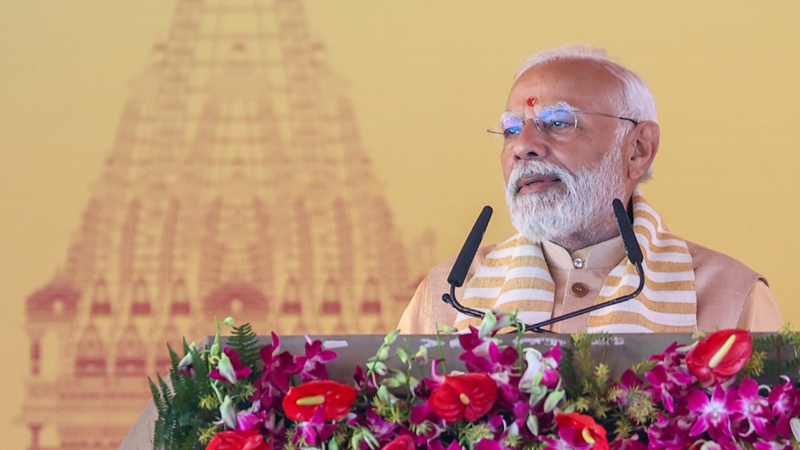
The Prime Minister, Shri Narendra Modi laid the foundation stone of Shri Kalki Dham Temple in Sambhal district, Uttar Pradesh today. The Prime Minister also unveiled the model of Shri Kalki Dham Temple. Shri Kalki Dham is being constructed by Shri Kalki Dham Nirman Trust whose chairman is Acharya Pramod Krishnam. The program is being attended by many saints, religious leaders and other dignitaries.

Addressing the gathering, the Prime Minister said that the land of Lord Shri Ram and Lord Shri Krishna is once again filled with devotion, emotion and spirituality today as the foundation stone of another significant pilgrimage is being laid. Shri Modi expressed gratitude on getting the opportunity in laying the foundation stone for Shri Kalki Dham Temple in Sambhal and also expressed confidence that it will emerge as a new center of India’s spirituality. PM Modi conveyed his best wishes to all citizens and pilgrims from around the world.

Mentioning the 18 year wait for the inauguration of the Dham, the Prime Minister said that it seems that there are many good works that have been left for him to accomplish. He said with the blessings of the people and the saints he will continue to clear unfinished tasks.

Noting that today is the Jayanti of Chhatrapti Shivaji Maharaj, the Prime Minister credited Shivaji Maharaj for today’s cultural revival, pride and confidence in our identity. The Prime Minister paid homage to Chhatrapti Shivaji Maharaj.

Throwing light on the architecture of the temple, the Prime Minister elaborated that it will have 10 garbh grihas where all 10 avatars of the Lord will be seated. Through these 10 avatars, PM Modi explained that the scriptures have presented all forms of the Lord including the human form. “In life, one can experience the consciousness of Lord”, the Prime Minister continued, “We have experienced Lord in the form of ‘Sinh (lion), Varah (boar) and Kachhap (tortoise)’”. He said that the establishment of the Lord in these form will present a holistic image of the people’s recognition of the Lord. The Prime Minister thanked the Lord for the blessings to give him the opportunity to lay the foundation stone of Shri Kalki Dham temple. The Prime Minister also bowed before all the saints present on the occasion for their guidance and also thanked Shri Acharya Pramod Krishnam.

The Prime Minister said that today’s event is another unique moment for India’s cultural renaissance. Referring to the consecration of Shri Ram Mandir at Ayodhya Dham and recent inauguration of the temple in Abu Dhabi, the Prime Minister said “What was beyond imagination has now become a reality”.

The Prime Minister underlined the value of such events coming in quick succession. He continued talking about the spiritual regeneration and mentioned Vishwanath Dham in Kashi, transformation of Kashi, Mahakaal Mahalok, Somnath and Kedarnath Dham. “We are moving with the mantra of ‘Vikas bhi Virasat Bhi’ – Heritage with Development” he said. He once again juxtaposed revival of spiritual centers with the high-tech urban infrastructure, temples with establishment of new medical colleges, return of artifact from abroad with foreign investment. He said this indicates that the circle of time has moved. He recalled his call from the Red Fort – ‘Yeh hai Samaya hai Sahi Samay Hai’ and emphasized the need for embracing this arrival.

Recalling the consecration ceremony of Shri Ram Janmabhoomi Temple in Ayodhya, the Prime Minister reiterated the beginning of a new ‘kaal chakra’ (circle of time) since 22 January, 2024 and highlighted impact of Shri Ram’s rule which lasted for thousands of years. Similarly, with Ram Lalla being seated now, India is beginning its new journey where the resolve for a Viksit Bharat in the Azadi Ka Amrit Kaal  is not merely a desire. The Prime Minister said, “India’s culture and tradition has lived through this resolve in every time period”. Speaking about Acharya Pramod Krishnam ji’s research and study about the forms of Shri Kalki, the Prime Minister highlighted the aspects and scriptural knowledge and informed that Kalki’s forms will determine the path of the future for thousands of years, similar to Lord Shri Ram.

“Kalki is the initiator of change in the kaal chakra and is also a source of inspiration”, the Prime Minister remarked. He said that Kalki  Dham is going to be a place dedicated  to the Lord which is yet to be incarnated. He highlighted that such a concept about the future was written in the scriptures hundreds of thousands of years ago. Shri Modi lauded Acharya Pramod Krishnam for taking forward these beliefs with full faith and also devoting their lives to it. He pointed out the long battle fought by Acharya ji with the previous governments for the establishment of Kalki temple and mentioned visits to the court for the same. Recalling his recent interaction with Acharya ji, the Prime Minister said that he had known him only as a political personality but came to know his dedication towards religion and spirituality. “Today, Pramod Krishnam ji has been able to start the temple’s  work with peace of mind”, the Prime Minister said expressing confidence that the temple will be a proof of the positive outlook of the present government towards a better future.

The Prime Minister said that India knows how to snatch victory from the jaws of defeat. He highlighted the resilience of Indian society in the face of a series of invitations. “In today’s India’s Amrit Kaal, the seed of India’s glory, height and strength is sprouting”, he added.  He further said that as the saints and religious leaders are constructing new temples, he has been tasked with the construction of the temple of the nation. “Day and night I am working for the grandeur and expansion of the glory of the temple of nation”, he added. “Today, for the first time, India is at a stage where we are not following but setting an example”, PM Modi emphasized. Listing the results of this commitment, the Prime Minister mentioned India turning into a hub of digital technology and innovation, India becoming 5th largest economy, success of Chandrayaan, modern trains like Vande Bharat and Namo Bharat, upcoming bullet train, a strong network of hi-tech highways and expressways. This accomplishment, the Prime Minister said, is making Indians feel pride and “this wave of positive thinking and confidence in the country is amazing. That is why today our capabilities are infinite, and the possibilities for us are also immense”.

PM Modi stressed that “a nation gets energy to succeed through collective”. He saw a grand collective consciousness in India today. “Every citizen is working with the spirit of Sabka Saath, Sabka Vikas, Sabka Vishwas aur Sabka Prayas”, He added.

The Prime Minister listed the efforts of the last 10 years – more than 4 crore pucca houses under PM Awas Yojana, 11 crore toilets, electricity to 2.5 crore families, piped water for more than 10 crore households, free ration for 80 crore citizens, subsidized gas cylinders for 10 crore women, 50 crore Ayushman Cards, Kisan Samman Nidhi for 10 crore farmers, free vaccine during the pandemic, Swachh Bharat.

The Prime Minister credited the citizens of the country for the speed and scale of the government’s work. He underlined that people of today are helping the poor avail the benefits of government schemes and taking part in the campaign for 100 percent saturation. He remarked that the spirit of service to the poor has come from India’s spiritual values which inspire ‘Nar mein Narayan’ (existence of God in the people). He reiterated his appeal to the country to the five principles of ‘building aViksit Bharat’ and ‘taking pride in our heritage’.

The Prime Minister said “whenever India takes big resolutions, divine consciousness definitely comes among us in some form or the other to guide it.” Referring to the philosophy of Gita, the Prime Minister stressed the need for relentless action. “In this ‘Kartavya Kaal’ for the next 25 years, we have to achieve the pinnacle of hard work. We have to work selflessly keeping service to the country at the forefront. What benefit the nation will get from our every effort, this question should come first in our mind. This question will offer solutions to the collective challenges of the nation” The Prime Minister concluded.

Chief Minister of Uttar Pradesh, Shri Yogi Adityanath, and Pithadheeshwar of Shree Kalki Dham, Acharya Pramod Krishnam were present on the occasion among others.

Government released comprehensive guidelines for effective disposal of C&D waste: Hardeep S Puri

| Published on:

Highlighting the vitality of construction industry for Indian economy, Shri Hardeep Singh Puri, Minister of Housing & Urban Affairs and Petroleum & Natural Gas, said that the construction industry is among the fastest growing industries in India. It is the second-largest employer in the country and has forward and backward linkages across 250 sectors of the economy. It is estimated that India will have the third-largest construction market globally by 2025, he said.

The Minister was addressing at the inauguration of National Workshop on “Recent Development with recycling and use of C&D waste in construction sector” here today. Ms. May-Elin Stener, Norwegian Ambassador to India; Shri Manoj Joshi, Secretary, Housing and Urban Affairs; and Shri Rajesh Kumar Kaushal, DG, CPWD were among the dignitaries present at the event.

The Workshop, organised by CPWD in collaboration with SINTEF Norway, gave an opportunity to the participants engaged in the Construction Sector to deliberate on various aspects of promoting the use of C&D recycle items in Construction Industry. Experts in the field of C&D recycle products/items are participating in the workshop for dissemination of their views and apprising the advantages on usage of above products in sustainable development.

Speaking on the occasion, Shri Puri, said that we are constructing built environment at a great speed. Quoting the statistics about country’s urbanisation demands, he said that India needs to add about 700-900 million sq. metres of commercial and residential space every year by 2030. If India is going to be a developed country by 2047, infrastructure will be a vital component in our ambition, he added.

Acknowledging the environmental considerations especially Construction and Demolition (C&D) waste associated with construction sector, the Minister, said that with increasing construction activity, it is imperative to find more efficient solutions to manage the C&D waste that will arise.

Talking about challenges and opportunities of C&D waste in India, Shri Puri said, construction and demolition waste is one of the largest solid waste streams in the world. He said that as per estimates, the construction industry in India generates about 150-500 million tonnes of C&D waste every year. This brings many challenges to the forefront such as unauthorised dumping, a lack of space for disposal, and improper mixing with biodegradable waste. In this context, he said, there is a huge demand for technologies that will support waste reduction and recycling waste material.

Highlighting the efforts of the Government towards sustainable waste management, the Minister noted that the urban missions which were launched in 2015 are shining examples of the government’s green vision to adopt sustainable methods of infrastructure creation and service delivery.

As regards solid waste management, Shri Puri said that solid waste processing has witnessed a significant rise from mere 17% in 2014 to more than 77 % in 2024. “Now, we are transferring these capabilities in other forms of waste management, including C&D waste, plastic waste, e-waste and bio-hazardous waste. The government has released elaborate guidelines on these issues.”, the Minister added.

He said, “Our government has released comprehensive guidelines across the value chain on effective disposal of C&D waste.”

Speaking on the strides made by the Ministry of Housing and Urban Affairs (MoHUA) in changing the mindset of all stakeholders towards C&D waste management, the Minister highlighted that MoHUA has advised all states, union territories and urban local bodies to collect data on C&D waste generation for every major city/town and promote the separation of C&D waste at source and establish institutional mechanisms for C&D waste collection.

Sharing his thoughts on effectiveness of Government in C&D waste processing, Shri Puri noted that the region of NCR alone generates 6,303 TPD of C&D waste per day and out of this, almost 78% of the waste is processed per day.

In his concluding remarks, the Minister urged the stakeholders to help the government devise better strategies for the effective utilisation of C&D waste.