 PrintFriendly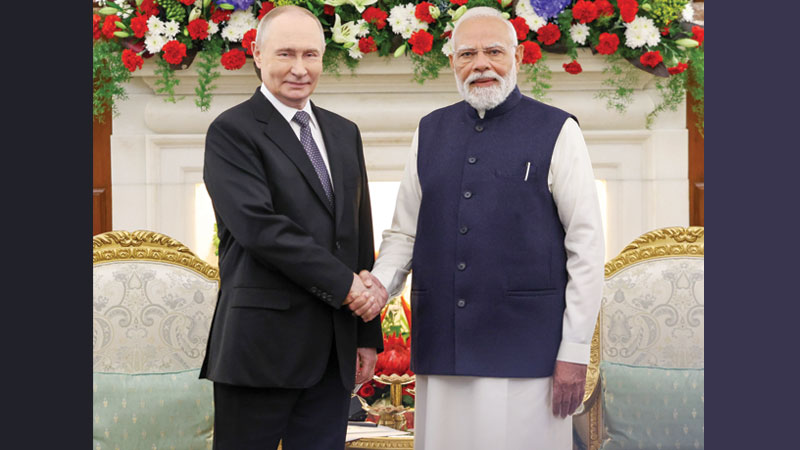
Russian President Shri Vladimir Putin visited India from 4–5 December 2025, marking his first trip to New Delhi since the Russia-Ukraine war began in 2022. His visit was centred on the 23rd India-Russia Annual Summit, celebrating 25 years of strategic partnership between the two countries. Putin was given a ceremonial welcome by Prime Minister Shri Narendra Modi, who personally received him at the airport and symbolically showed strong bilateral ties.
The leaders held high-level talks focusing on expanding trade, defence cooperation, energy ties and economic collaboration, including discussions on boosting bilateral trade and negotiating future cooperation frameworks. Mr. Putin later praised India’s “unity in diversity” model following the visit.
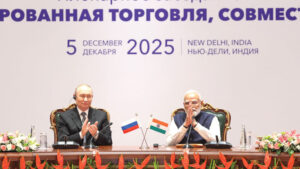
Prime Minister Shri Narendra Modi on 5 December delivered a comprehensive address at the India-Russia Business Forum in Bharat Mandapam, New Delhi, alongside Russian President H.E. Mr. Vladimir Putin. The event brought together business leaders, policymakers, and stakeholders from both countries, reflecting strong momentum in India-Russia economic engagement amid expanding bilateral ties.
In his address, Prime Minister Shri Modi warmly welcomed President Putin, delegates, and participants, emphasizing the deep mutual trust that forms the cornerstone of the India-Russia partnership. He stated that this trust is the “greatest strength of India-Russia relations,” serving as a guiding force for collaborative efforts and a launch-pad for future aspirations across sectors.
Key highlight of PM Modi’s address
–The reaffirmation of the ambitious bilateral trade target of USD 100 billion. This milestone could be achieved well before 2030.
–The Prime Minister highlighted significant reforms underway in India that enhance the ease of doing business, such as next-generation GST reforms, and opening strategic sectors—including defence, space, and civil nuclear—to private participation. He described these as transformative mindset reforms that have propelled India’s rapid advancement towards becoming the world’s third largest economy.
–Shri Modi spoke on the wide range of opportunities for economic collaboration.
–In logistics and connectivity, both leaders committed to advancing key initiatives such as the International North-South Transport Corridor, the Northern Sea Route, and the Chennai–Vladivostok Corridor, Which are expected to reduce transit time, lower costs, and access new markets.
–The Prime Minister also identified sectors ripe for India-Russia cooperation, including marine products, textiles, pharma and healthcare, automobile and EV manufacturing, and technology partnerships.
–In human capital and mobility, Modi underscored the role of India’s youth and skilled workforce.
–Shri Modi called for a new era of co-innovation, co-production, and co-creation. Come, Make in India, Partner with India and Together, let us make for the world.
During the meeting, leaders of both nations conducted wide-ranging consultations on political, economic, security and cultural cooperation. They highlighted that the partnership has remained resilient amid evolving global challenges and agreed to unlock its full potential across traditional and emerging areas of collaboration.
–On the economic front, both sides reaffirmed their commitment to expanding bilateral trade sustainably, with a revised trade target of USD 100 billion by 2030.
–The summit also advanced cooperation in energy, transport, and technology sectors, with plans to intensify joint efforts in the Russian Far East and Arctic, and to support infrastructure and logistics corridors, including the International North-South Transport Corridor.
–Both nations agreed to broaden cooperation in civil nuclear energy and space, expand military-technical ties with an emphasis on joint R&D and Make-in-India
initiatives, and deepen science, technology, and education links.
–People-to-people exchanges, cultural cooperation, and tourism were highlighted as key pillars of the partnership.
–The summit reaffirmed cooperation in multilateral fora like G20, BRICS, SCO, and the UN, including support for reforms and shared global priorities such as peace, security, and climate action.
Key Agreements & MoUs Signed During the Visit
MoUs and Agreements
–Migration and Mobility
–Health and Food safety
–Maritime Cooperation and Polar waters
–Fertilizers
–Customs and commerce
–Academic collaboration
–Media Collaboration
–For Cooperation and Collaboration on Broadcasting
Announcements
–Programme for the Development of Strategic Areas of India – Russia Economic Cooperation till 2030
–The Russian side has decided to adopt the Framework Agreement to join the International Big Cat Alliance (IBCA).
–Agreement for the exhibition between the National Crafts Museum and the Tsaritsyno State Museum Russia
–Grant of 30 days e-Tourist Visa on gratis basis to Russian nationals on reciprocal basis
–Grant of Group Tourist Visa on gratis basis to Russian nationals