

 PrintFriendly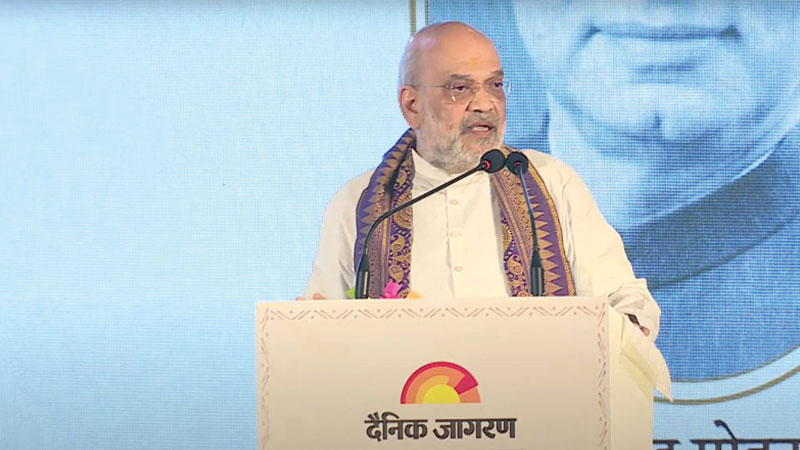
Union Home and Cooperation Minister Shri Amit Shah delivered an address on “Infiltration, Demographic Change, and Democracy” at the Narendra Mohan Smriti Lecture and Sahitya Srishti Samman ceremony in New Delhi on October 10, 2025. In his address, Shri Shah emphasized the link between illegal infiltration, resulting demographic shifts, and the potential threat to India’s democracy and national security. Shri Shah presented data from post-Independence censuses (1951-2011) to argue that changes in India’s religious demographics, particularly in border areas, are primarily driven by illegal immigration from countries like Bangladesh and Pakistan, rather than solely by fertility rates. He reiterated the government’s three-pronged approach- “Detect, Delete, and Deport” Policy to deal with illegal infiltrators. Excerpts:
Present on the stage, at today’s event are Shri Sanjay Gupta, Editor-in-Chief of Dainik Jagran, Shri Prasoon Joshi, about whom I would simply say that he is a distinguished and accomplished litterateur; even today, the writer within him remains alive, and all the eminent dignitaries and esteemed guests present here today, I extend my respectful greetings. Ram-Ram.
Narendra MohanJi stood firm and fearless against Emergency
Shri Sanjay Gupta has kept the theme of the speech on ‘Infiltration, Demographic Change and Democracy’. I am deeply honoured to be here today to deliver the Narendra Mohan Memorial Lecture, organised by Dainik Jagran. Much can be said about Shri Narendra Mohan Ji. Though I never had the privilege of meeting him personally, I have read and heard much about him.
During the Emergency, our nation’s democracy faced its sternest test. The true test of journalism came when newspapers hit the stands on the 27th, the day after the Emergency was imposed. Dainik Jagran, under Narendra Mohan Ji’s leadership, stood firm and fearless and he even went to jail for that. That resistance was not merely an act of defiance; it was a fight for the soul of Indian democracy. I therefore offer my heartfelt salutations to the memory of Shri Narendra Mohan Ji, a great soul who played many roles in life.
In the 1951 Census, Hindus made up 84% of the population, and Muslims constituted 9.8%. By 1971, the Hindu share had fallen to 82%, while the Muslim share rose to 11%
Friends, today I have been invited to share my thoughts on three interlinked subjects — infiltration, demographic change, and democracy. These three issues are deeply connected. I am aware that what I say today may not please everyone. But if I choose silence despite knowing the truth, I would be failing in my duty, and I cannot allow.
In 1951 Census, Hindus made up 84% of the population
Friends, our country conducted censuses in 1951, 1971, 1991, and 2011. What I am about to present is a factual analysis of those census reports, not my personal interpretation. Since Independence, India’s census has traditionally included a question on religion. I do not know the reasoning behind that 1951 decision, but it certainly wasn’t taken by my party, which did not even exist then. According to official records, in the 1951 Census, Hindus made up 84% of the population, and Muslims constituted 9.8%. By 1971, the Hindu share had fallen to 82%, while the Muslim share rose to 11%. In 1991, Hindus accounted for 81%, Muslims 12.12%; and by 2011, Hindus had declined to 79%, while Muslims increased to 14.2%. Now, you may wonder why I am referring only to these two religious groups. It is because I am speaking in the context of infiltration and will later explain how this relates to the historical partition of our country.
Between 1951 and 2011, the Hindu population percentage declined by about 4.5%, while the Muslim population rose at the rate of nearly 24.6%. This change cannot be explained merely by fertility rates; it is largely the consequence of cross-border infiltration.
In 1951, Hindus made up 13% of Pakistan’s population
When India was divided on religious lines, two new nations were created, Pakistan and what later became Bangladesh. The demographic shifts in our own border regions reflect the impact of illegal immigration from these areas. Let us also look at what happened in those neighbouring countries, which were once parts of undivided India.
In 1951, Hindus made up 13% of Pakistan’s population, with other minorities at 1.2%. Today, Hindus in Pakistan number just 1.73%. In Bangladesh, Hindus once comprised 22%, but that has now fallen to 7.9%. In Afghanistan, there were once around 220,000 Hindus and Sikhs, today, barely 150 remain.
I mention these figures not to make a Hindu–Muslim comparison, but to explain the crucial difference between infiltrators and refugees. The Hindus that decreased in number, they were not converted, many fled and sought refuge in India. Conversely, the rise in Muslim population here is not solely a result of natural growth; a large section entered India illegally over time.
Our Constitution guarantee protection to all citizens
At the time of Partition, it was agreed that people of all faiths would enjoy freedom of religion in both nations. India upheld this commitment — Articles 19 and 21 of our Constitution guarantee protection to all citizens. But Pakistan and later Bangladesh declared themselves Islamic republics, making Islam their state religion. This led to widespread persecution and oppression, forcing many Hindus to flee to India seeking safety.
At the time, India’s leaders had assured them, “The situation is turbulent now, do not come immediately. But whenever you wish to return, you will always be welcomed in India.” This was part of the Nehru–Liaquat Pact, signed by India’s Prime Minister himself.
Those who eventually came were accepted as refugees but not granted citizenship. Think about this: some arrived in 1965, some in 1971, 1981, 1991, even 2001, four generations have now passed, yet they remain stateless. Why? Because they happened to live on the other side when the partition line was drawn, a partition India never desired but was forced to accept.
Citizenship (Amendment) Act (CAA)
It was India’s solemn promise, made in 1951, that those displaced could return and would be accepted as citizens. But for decades, millions remained in limbo, without the legal rights of citizenship. When the Bharatiya Janata Party received a full majority and Shri Narendra Modi became Prime Minister, we brought forth the Citizenship (Amendment) Act (CAA) to correct this historic injustice, to finally grant citizenship to those refugees.
Yet, a widespread and misleading campaign was launched suggesting that CAA would take away citizenship from Muslims. Despite my repeated clarifications, often ignored by the media, the truth is simple: CAA cannot, and does not, strip anyone of their citizenship. It only grants citizenship to persecuted refugees. There is not a single provision in the Act that deprives Hindus, Muslims, Sikhs, or Christians of citizenship.
CAA was a rectification, an act of moral and historical correction for the errors that persisted from 1951 to 2014. The Modi government first gave such refugees long-term visas, then certificates of residence, and finally a path to full citizenship. In doing so, Prime Minister Modi performed what I would call a national act of redemption, fulfilling a promise first made by Jawaharlal Nehru himself. For generations, these refugees could not buy homes in their own names, secure government jobs, access public healthcare, or even receive ration benefits. What was the fault of these 2.5 crore or 3 crore people?
CAA was a rectification, an act of moral and historical correction for the errors that persisted from 1951 to 2014
Today, I ask through this platform, do they not deserve the same entitlements as every Indian? When the CAA was introduced, a politically motivated campaign was launched to malign it, and even riots took place. Yet, despite so much opposition, the CAA is in force and every genuine refugee in India now has the right to citizenship.
Difference between an infiltrator and a refugee
What was denied since 1951 has now been restored. Now some ask: what is the difference between an infiltrator and a refugee? I wish to clarify that today. A person who comes to India to preserve their faith, who exercises the right guaranteed by our Constitution, under Articles 19 and 21, and seeks refuge here to protect their religion, is a refugee.
Those fleeing to save their religion were not only Hindus, there were Buddhists, Sikhs, Christians as well, and the Citizenship Amendment Act (CAA) makes provision to grant citizenship to all such groups.
Who are the infiltrators?
But then a question arises: who are the infiltrators? Those are individuals who have not faced religious persecution but who enter our country illegally for economic reasons or other motives. If we were to allow everyone who wishes to come here to enter at will, our nation would, in effect, become an Dharamshala for all comers; the country cannot function like this. Not everyone has an unfettered right to enter.
Those who suffered injustices in the context of Partition and who were denied justice, they are welcome here. As the Home Minister of this country, I say with full conviction: insofar as India’s soil confers rights, so does it confer rights on the Hindus from Pakistan and Bangladesh.
If a person comes purely for economic reasons or other motives not related to persecution, then how can India accept them? Therefore, we must not place refugees and infiltrators on the same page. The Muslims who have chosen to live here and abide by our laws have not been disturbed; there has been no question raised about their citizenship.
Decadal population growth rate among our Muslim brothers in Assam was 29.6%
Friends, let me tell you what has happened in some regions. The 2011 Census of Assam was conducted during the Congress regime, not under our government. India’s so-called liberals and Congress cannot blame us for it. In that Census, the decadal population growth rate among our Muslim brothers in Assam was 29.6%.
That figure is impossible without any infiltration. In several districts of West Bengal, this growth rate even crossed 40%. To those who claim that infiltration is a myth, I want to ask them, how do you justify this? In some border districts, the growth rate touched 70%. I am only quoting the state average. This itself proves that infiltration has indeed been taking place.
In Parliament, especially MPs from Trinamool Congress and Congress accused me, saying, “Whatever happened earlier, happened. But is infiltration still happening today?” I told them, it is still happening. They asked, “Then whose responsibility is it? Isn’t the BSF under you?” I replied, yes, it’s my responsibility too. But come and see the border once. Along the Bangladesh border, there are countless streams, ocean-like rivers, dense forests, and hilly terrains where no proper border fencing exists. From such areas, infiltration cannot be completely prevented. The BSF intercepts people, stops them, even fires bullets, when necessary, but given the kind of topography and geography, it remains extremely difficult.
Then I asked them, where do these infiltrators go after crossing over? Naturally, they first enter border districts. When someone arrives in a village, wouldn’t the patwari (village land officer) know? Tell me, would the patwari not know? If even one patwari in West Bengal has ever filed a complaint in a police station, tell me. Has even one FIR been filed ever? Who issues Aadhaar cards? The Collector’s office in the district. All other things are based on Aadhaar. So, infiltration through such treacherous borders cannot be stopped by the Centre alone.
Do not link the issue of infiltration, demography, or the SIR with politics
I want to appeal to all political parties, do not link the issue of infiltration, demography, or the SIR (Special Intensive Revision) with politics. A time will come when even you will not remain untouched. This is not a political issue; it is a national one.
SIR is not being conducted for the first time, it has been carried out since 1951. It is the Election Commission’s constitutional responsibility to keep the political process clean. Unless we accept this, the Commission cannot function effectively
When someone enters the country illegally and the district administration fails to identify them, how can anyone stop this? We have borders too, in Gujarat, in Rajasthan. Why doesn’t infiltration happen there? The borders are there, the fences are there, the BSF is the same, so what’s the difference? The difference lies in intent. Infiltration must not be viewed politically, nor should it receive political protection.
Friends, those who fail to understand the difference between a refugee and an infiltrator are deceiving their own conscience. Let me remind you, during the 1970s, when Idi Amin ruled Uganda, many Indians fled persecution and came to India. Why did the then Congress government grant them refuge? Where else could they go? India was their natural place of shelter. That is why they were refugees. Political circumstances there had changed; they were persecuted, and we granted them asylum. Similarly, those who come here to protect their religion, their families, and the honour of their women, granting them refuge is our moral duty. It was a promise made by the Indian Union in 1951. Therefore, infiltrators and refugees must be viewed differently, their situations must be evaluated differently. When I recently visited Jharkhand, I observed a sharp decline in the tribal population. Why? Because of infiltration from Bangladesh.
SIR has been carried out since 1951
Friends, as the Election Commission conducts the SIR (Special Intensive Revision), the Congress party has gone into denial mode. Their definition of truth and falsehood has become extremely narrow. For them, whatever the Narendra Modi government says is false; and whatever imaginary lies they have are truth.
The SIR is not being conducted for the first time, it has been carried out since 1951. It is the Election Commission’s constitutional responsibility to keep the political process clean. Unless we accept this, the Commission cannot function effectively.
Our Constitution entrusts the Election Commission with ensuring free and fair elections. And that is possible only when the voter rolls reflect the true definition of a voter. Under the Representation of the People Act, the first qualification of a voter is clearly defined: the person must be an Indian citizen. If you wish to change that, bring a proposal in Parliament saying that anyone can vote in India. The second qualification is age—18 years. Now, to verify whether someone is 18 or not or to verify whether someone is an Indian citizen or not, you must ask them, that’s what the SIR does. They know this, yet they oppose it, because the deletions that occur affect their presumed vote banks.
In several areas, 30%, 20%, 15%, even 11% infiltrators have been detected. I want to tell everyone, the SIR, or the Voter List Purification Drive, must confirm two things: whether the person is 18 years old, and whether they are an Indian citizen. This is not merely the Commission’s right; it is its constitutional duty. No one should interfere in this process.
Friends, today in the context of the discussion on infiltration, I also wish to tell this house that 90% of the countries in the world are geopolitical nations. We are not a geopolitical nation; we are a geo-cultural nation. And if one wants to truly understand the soul of this geo-cultural nation, one must rise above the narrow confines of state boundaries. Why did we give refuge to some people? Why did we offer them asylum? Because this nation made a promise in 1951 and we are fulfilling that promise today.
Friends, when Partition happened, and I still firmly believe this, that dividing this country on the basis of religion was a historic blunder. You cut off two arms of Mother India and helped the conspiracy of the British to succeed. That should never have happened. In our country, many faiths have coexisted for centuries — Jainism and Buddhism have existed for thousands of years, Sikhism was established by the Tenth Guru. For centuries we have revered the Tenth Guru too. Never in our history was there a conflict in the name of religion. So how can national identity or citizenship be decided on religious grounds? Religion and nationality should have been kept separate. Because religion and nationality were not kept separate, all these disputes and divisions have arisen. Had the Nehru–Liaquat Pact of 1951 been properly implemented, the contemporary controversy over refugees and infiltrators would not exist.
Had the Nehru–Liaquat Pact of 1951 been properly implemented, the contemporary controversy over refugees and infiltrators would not exist
Friends, when infiltrators find their way into voter lists, they become part of our political decision-making process. From this stage, I want to ask every citizen of this country – should anyone other than the citizens of India have the right to decide who becomes the Prime Minister of this country? When you protect infiltrators, you corrupt our democracy and the very spirit of our sacred Constitution.
Detect, Delete and Deport
That is why the Bharatiya Janata Party, since the 1950s, has adopted the three principles – Detect, Delete, and Deport. We will detect infiltrators, we will ensure their names are deleted from voter lists, and we will send them back to their country. There should be no doubt about this. And I believe that the people of India should support the BJP on this “Three D” issue because these three Ds are meant to protect the soul of the nation, its culture, and its democracy.
In this country, there are crores of Muslims, Christians, Buddhists, and Sikhs living peacefully. No one has accused them of anything. They vote, they participate in elections, and their votes are welcomed.
The Hindu community, which forms the majority in this country, has itself kept us out of power for years, and that too is perfectly acceptable. We have lost elections in many states. Even after Atal ji’s six-year government, we lost the general election — the results came, and we accepted them. But the right to vote must belong only to those who are citizens of this country, those who are loyal to its culture, language, and democracy.
Friends, the SIR is not happening for the first time. I can understand that Rahul Gandhi ji may not know, but some senior Congress leaders should recall that his great-grandfather did it, his grandmother did it, his father did it. Then why oppose it now? I firmly believe that purifying the voter list is a sacred task and it will cleanse our democracy.
High-Power Demographic Change Mission
That is why, on this 15th August, Prime Minister Shri Narendra Modi announced from the ramparts of the Red Fort the creation of a High-Power Demographic Change Mission. This mission will undertake several important studies — it will scientifically assess demographic changes caused by illegal immigration, it will study the impact on the country’s religious and social life, it will analyse the possible causes of population shifts, it will examine abnormal settlement patterns and their long-term effects on society, and it will evaluate the burden these cause on border management. After all this research, it will submit its report to the Government of India.
I appeal earnestly to the people — do not get carried away by propaganda; go deep into the facts, dive into the truth. Until we — the citizens of this nation — become conscious of our own rights, no one in the world can protect us. The duty to safeguard citizens’ rights lies with the citizens themselves. Those who come from neighbouring countries because of religious persecution are not infiltrators; they are refugees, and refugees are welcome in India. They will receive citizenship —the law for that already exists. For infiltrators, however, only three paths remain: Detect, Delete, and Deport. This is what I wish to say.
Once again, my heartfelt thanks for giving me this platform, and I pay tribute to the sacred soul in whose memory this lecture has been organized.
Vande Matram!