
 PrintFriendly
In the 131st episode, broadcast on 22 February 2026, the Prime Minister Shri Narendra Modi addressed a wide range of national topics—highlighting technological advancements, cultural pride, social issues, inspiring stories of citizens, and national achievements. The address reflects the efforts of India to integrate modern innovation with traditional values, while fostering inclusive growth and citizen empowerment
The Prime Minister began by reflecting on the Global AI Impact Summit held in Delhi’s Bharat Mandapam, where world leaders, industry pioneers, innovators, and representatives from the startup ecosystem convened. He noted that the Summit marked a pivotal moment in shaping how artificial intelligence (AI) will be utilized globally. India showcased innovative AI products with deep social impact.
In the radio programme Prime Minister mentioned two things in particular. These two products at the summit greatly impressed leaders from around the world. The first product was at Amul’s booth. It explained how AI is helping us in the treatment of animals… and how farmers keep track of their dairy and animals with the help of 24×7 AI assistance.
And second AI-Enabled Cultural Preservation, exhibit showcased how technology is being used to preserve India’s ancient manuscripts—specifically the Sushrut Samhita, a foundational text of Indian traditional medicine. Using advanced imaging and AI transcription, this ancient text was digitised, made machine-readable, and intelligently translated into multiple languages. World leaders showed great enthusiasm for India’s approach to safeguarding and sharing its cultural heritage with global audiences.
The Prime Minister also highlighted that during the summit, India launched three “Made in India” AI models, underlining India’s growing role in the global AI landscape. These developments reflect the nation’s capability to merge technological innovation with cultural preservation and practical applications for societal benefit.
Indian Diaspora and Sports
Shifting focus, the Prime Minister spoke about India’s expanding global footprint, particularly in sports. He noted how the success of athletes of Indian origin representing foreign national teams evokes pride across India.
Organ Donation and Empowerment
One of the most poignant moments in the address was the Prime Minister’s tribute to the family of Aalin Sherin Abraham, a 10-month-old child from Kerala who passed away recently. In their grief, her parents made the compassionate decision to donate her organs, offering the gift of life to others. This act of generosity was highlighted as an example of extraordinary human spirit, inspiring citizens to support and advocate organ donation.
The Prime Minister expressed that increased awareness about organ donation is positively impacting medical research and life-saving interventions across India. He also shared moving stories of others, such as individuals who regained health and achieved remarkable feats after receiving organ transplants—illustrating the transformative power of medical science, compassion, and community cooperation.
Honouring National Heroes and Cultural Legacy
The address touched on the replacement of a statue of British architect Edwin Lutyens at Rashtrapati Bhavan with a statue of C. Rajagopalachari, India’s first Indian Governor-General. The decision reflects the ongoing effort to honour Indian leaders who played pivotal roles in shaping the nation. Alongside this, an exhibition on C. Rajagopalachari ji was announced, to be displayed during the Rajaji Utsav—celebrating his legacy and contributions.
Agriculture: Blending Tradition with Innovation
Agriculture featured prominently as the Prime Minister praised India’s farmers for marrying traditional farming practices with modern innovation. He highlighted inspirational stories such as that of Hirod Patel from Odisha, who diversified his farming activity to integrate fruits, vegetables, fish farming, and water management—signifying a new model of sustainable agriculture that increases productivity and income.
Similarly, he pointed to a village in Thrissur, Kerala, where 570 varieties of rice are grown together—symbolizing India’s rich agricultural biodiversity and commitment to preserving heritage crops. These examples reflect the evolving mindset of India’s farmers, who are embracing modernization while preserving traditional strengths.
Encouragement to Youth and Citizens
Towards the conclusion, the Prime Minister shared words of encouragement for students preparing for examinations, urging them to balance effort with confidence and not let stress dominate their mindset. He also urged citizens to embrace India’s festivals and cultural moments while promoting indigenous products—reinforcing self-reliance and national prid.
To fulfil the resolve of Viksit Bharat 2047,a long struggle still lies ahead: Nitin Nabin
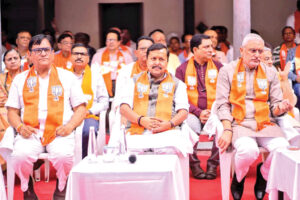
BJP National President Shri Nitin Nabin, listened to the 131st episode of Prime Minister Shri Narendra Modi Ji’s Mann Ki Baat programme along with party Karyakartas at the Baronet Heritage Haveli in Desai Pol, Ahmedabad, Gujarat on 22 February 2026. The BJP National President advised the Karyakartas to imbibe and apply the thoughts and messages shared by the Prime Minister Shri Narendra Modi in their personal lives and work culture. BJP National President emphasized strengthening the booth-level organization, fostering a culture of continuous dialogue with party Karyakartas, and contributing to the resolve of building a Viksit Bharat by 2047.
It was shared that in future visits to different states, listening to “Mann Ki Baat” at a heritage location would likely be preferred. The moment of interaction with Booth presidents, Mandal presidents, District presidents, and state-level office-bearers was described as especially meaningful. All participants expressed their views in Gujarati, and over the three-day visit, a growing understanding of the language also developed. This, it was observed, reflects the unique strength of Indian culture and languages, where emotions and expressions often convey meaning even beyond words. Shri Nitin Nabin mentioned that he had spent considerable time in Assam as well, where, during interactions with friends, he initially requested conversations in Hindi, but over time began to understand the emotions and meanings of the local language. This reflects the beauty of Indian languages, while vocabulary may be limited at first, an understanding of emotion and expression develops naturally when time is spent with people of a region. The “Mann Ki Baat” programme is not merely a medium for listening; Prime Minister Shri Narendra Modi also encourages informal interaction, refreshments, and collective discussions after the programme to further strengthen social bonding and organizational culture. There is a need to reinforce this tradition more strongly.