
 PrintFriendly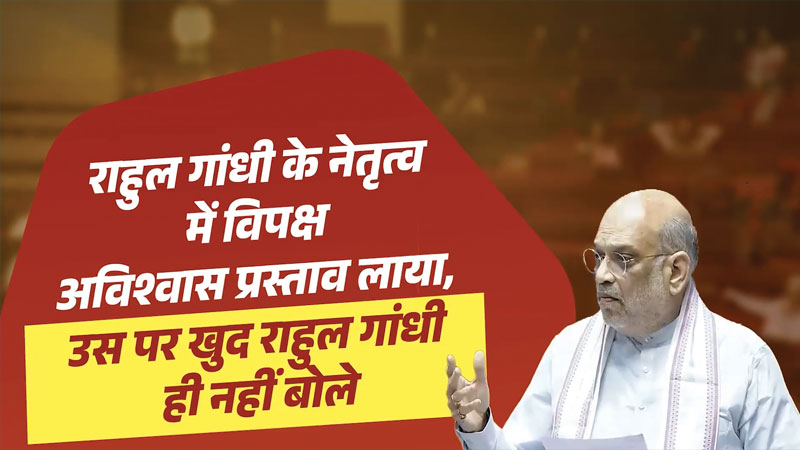
No-confidence motion in Lok Sabha
The Union Home and Cooperation Minister, Shri Amit Shah on 11 March 2026 while replying in the Lok Sabha, delivered a strong defense of the dignity, neutrality, and constitutional authority of the Speaker’s office. Emphasizing that the Lok Sabha represents the highest institution of India’s democracy, he expressed concern over the Opposition’s attempt to question the integrity of the Speaker, arguing that such actions undermine not only parliamentary traditions but also India’s global democratic reputation. He underscored that the Speaker functions as an impartial arbiter above partisan politics and highlighted the importance of adhering to parliamentary rules, mutual trust, and institutional respect for the smooth functioning of the House. Following is the synopsis of the speech:
This Lok Sabha is the supreme assembly of India’s democracy. Our democracy has established a global reputation; when the integrity of the guardian of this assembly is called into question, it casts doubts upon our democratic process—not merely within the country, but across the entire world. The office of the Speaker transcends partisan politics. The Constitution has, in essence, vested the Speaker’s office with the role of an impartial arbiter. Yet, the Opposition cast aspersions upon the very person entrusted with this role of arbitration. The House functions on the bedrock of mutual trust.
Sacred duty of the Speaker
This Lok Sabha has framed specific rules to govern the manner in which the Speaker conducts its proceedings. Within the House, Members are required to rise and speak in strict adherence to these rules. When Members disregard the rules governing the conduct of the Lok Sabha, it becomes the sacred duty of the Speaker—regardless of who the Member may be—to intervene, admonish them, and, if necessary, have them removed from the House. When the Speaker delivers a ruling, there may be occasions when we find it favorable, and other times when we do not. While everyone may agree on the right to express disagreement with a ruling, it is deeply unfortunate if the Opposition goes so far as to question the very integrity of that decision.
On three occasions, motions of no-confidence were brought against the Speaker of the Lok Sabha; however, while serving in the Opposition, the Bharatiya Janata Party never once moved a no-confidence motion against the Lok Sabha Speaker. We have consistently endeavored to uphold the dignity of the office of the Speaker. The primary duty of the Speaker of the Lok Sabha is to maintain order and decorum within this House. As I stand here today to speak on the motion of no- confidence against the Speaker, I cannot digress to deliver a lecture on Maoism.
Speaker possesses the authority to issue warnings
Whenever any Member rises to speak, they invariably address their remarks to the Speaker. In instances of disorder or indiscipline, the Speaker possesses the authority to issue warnings, to ‘name’ a Member, to order their removal, and even to suspend them. The Speaker is empowered to expunge unparliamentary words or remarks from the official proceedings. However, there is a plea often made here that, regardless of the language employed, it should be allowed to remain on record. Yet, the established list of unparliamentary expressions is binding upon all Members. The Speaker of the Lok Sabha is not merely a Presiding Officer; the Speaker serves as the very symbol of our legislative conscience and the dignity of our democracy. The Speaker may be removed from office only under extraordinary and grave circumstances. There are three categories of parliamentary majorities: a Simple Majority, an Effective Majority, and a Special Majority—which requires a two-thirds majority. To remove the Speaker, an ‘Effective Majority’ is required. The no-confidence motion that was tabled erroneously cited the year 2025 as the date of the proposal. Furthermore, they failed to attach a copy of the resolution. They anticipated that the Speaker would reject the motion on these grounds; however, when this discrepancy was brought to their attention, they withdrew the notice and submitted a fresh one.
No-confidence motion was submitted twice in violation of the established rule
In the second notice, with the exception of a single signature, all other signatures were photocopies. Despite the fact that the no-confidence motion was submitted twice in violation of the established rules, our Speaker, in a gesture of fairness, granted them an opportunity to rectify the notice. They show absolutely no regard for the rules, yet they subsequently complain that they are not being allowed to speak. I wish to highlight the extent of their sincerity—or lack thereof. I have listened to, as well as read, all the speeches with great attention. More than 80 percent of these speeches do not pertain to the conduct of the Speaker; they serve merely as a means to oppose the government. I would also like to make a few observations regarding the incumbent Speaker of the Lok Sabha. During the 16th Lok Sabha, a total of 331 sittings were held. The 17th Lok Sabha held 274 sittings, and up until the year 2025, a total of 103 sittings had taken place. The Budget Session held in 2025 recorded a productivity level of 118 percent. The Honorable Speaker extended the duration of the ‘Zero Hour’ to five hours. As many as 202 Members of Parliament were given the opportunity to raise questions. In 2019, a record 78 women were elected to Parliament. Our Honorable Speaker granted speaking rights to all 78 women MPs. The usage of regional languages within the House also increased, with speeches being delivered in approximately 14 different languages. Nearly 8,000 hours of audio-visual recordings have been digitized. We have made significant strides towards implementing the National e-Vidhan Application and transforming the entire Lok Sabha into a paperless institution. It was Mr. Birla who provided MPs with the opportunity to attend pre-session briefings regarding legislative bills. During the 17th Lok Sabha, the Congress party was allotted 157 hours and 55 minutes of time, despite having a strength of 52 members. On a *pro rata* basis, the Honorable Speaker effectively allotted the Congress party six times more time than the BJP. In the 18th Lok Sabha—as of yesterday—the Congress party had spoken for 71 hours, with a current strength of 99 members. In essence, even in the 18th Lok Sabha, the Congress party has been allotted twice as much time as the Bharatiya Janata Party.
The Leader of the Opposition complains that he is not allowed to speak; I would like to ask him: given that the Congress party was allotted 157 hours and 55 minutes of speaking time, who decides who gets to speak during that period? Is it for the Speaker to decide? No, it is for the Leader of the Opposition to decide. However, when the time comes to speak, he is often away—in Germany or in England—and only subsequently does he lodge a complaint.
Opposition frequently speaks of his rights
The Leader of the Opposition frequently speaks of his rights; I, however, would like to speak about his performance. During the 17th Lok Sabha, his attendance stood at 51 percent, whereas the national average was 80 percent; similarly, during the 15th Lok Sabha, his attendance was 43 percent against a national average of 76 percent. In the years 2014, 2015, 2017, and 2018, he did not participate in the discussion on the Motion of Thanks to the President’s Address. During the 16th Lok Sabha, he did not participate in the discussion on a single government bill. In the 17th Lok Sabha—specifically in the years 2019, 2020, and 2021—he did not participate in the discussion on the President’s Address. Furthermore, in the years 2019, 2020, 2022, and 2023, he did not participate in the discussion on the Union Budget. With the exception of a single instance, he did not participate in the discussion on any legislative bill.
In the 18th Lok Sabha, in the year 2025, he did not participate in the discussion on the Union Budget. Whenever a Budget Session or any other crucial parliamentary session commences, he embarks on a foreign tour—only to subsequently claim that he is being denied the opportunity to speak. The House, after all, is constituted through the collective participation of the Ruling Side, the Opposition, the Speaker, and His Excellency the President. You are critiquing the Speaker’s conduct; you ought to reflect upon your own conduct as well. What kind of behavior is this—rushing over to embrace the Honorable Prime Minister while he is seated on the Treasury Benches? It is unprecedented for a Member to blow a ‘flying kiss’ towards the Members of the ruling party. I feel hesitant even to speak of it. The motion brought against the Speaker of the Lok Sabha has been tabled solely because they are failing to achieve any electoral success whatsoever. They cast aspersions on the Election Commission, on the Supreme Court, on the Judiciary, and on various agencies—and now, they even cast doubt upon the Chair of the Speaker. This House appears to be in the majority; therefore, this Resolution should be rejected by a majority vote.