

 PrintFriendly
Special on the Punyatithi of Pt. Deendayal Upadhyaya (11 February)
-Pt. Deendayal Upadhyaya
Continuing from the previous edition…
Performance of Coalition Governments
On the administrative level, the coalition governments did present a better alternative to the Congress, but they did not over any comprehensive set of policies and programmes in substitution of the Congress’s. Actually, l thinks, they were not intended to. It is a matter of regret that some of the constituents of these coalitions failed to appreciate the ideological limitations under which such coalitions would
Actually, during the past 50 years or so we have been working with the parliamentary system of Government. It would be more fruitful if we try to mould this to suit our changing politics. Instead of conventions relevant to the two party democracy of the British Parliament
necessarily have to function, and tried to use these governments as instruments for the execution for their respective party policies. As the result of this partisan approach and lack of a sense of responsibility, these governments have been subject to internal strains, and have had always to work under a shadow of uncertainty. It must be recorded, however, that despite all these handicaps, despite the limited resources and rights of the States, and despite continuing Central machinations to topple non-Congress governments, these coalitions have during their brief term of office brought relief to the people in many matters. Of course, they who expected these governments to work miracles might have been disappointed.
If this coalition experiment has given birth to a sense of realism and a habit of objective political appraisal, that, in itself, would be a gain. Also, the formation of these Governments has been a commendable step in the direction of eradicating political untouchability. A readiness to appreciate an opponent’s view-point and a willingness on the part of different parties to work together inspite of variations of policy is an index of a democratic temperament and of the nation’s basic homogeneity. Whatever be the future of these coalition governments, I wish we are able to conserve this achievement.
Parliamentary Democracy on Trial
The strains inside these coalitions and the political instability resulting from the continued efforts to topple these Governments, or from their fall, have prompted many to suggest that the present cabinet form of Government are discarded in favour of the Presidential system. Shri Ashok Mehta has suggested that the system be introduced only at the State level. I really fail to understand why a distinction is sought to be made between the Centre and the States. Fact is that the systems of Government in Britain and in the U.S.A. have grown out of their history. Instead of trying merely to imitate the one or the other, let us try to evolve democratic practices suited to our own genius. Actually, during the past 50 years or so we have been working with the parliamentary system of Government. It would be more fruitful if
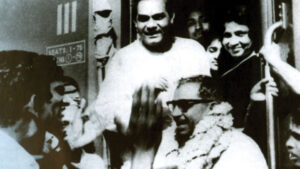
A glorious reception given to Pt. Deendayal Upadhyaya at Calicut Rly. Station on being elected as National President – 1967
we try to mould this to suit our changing politics. Instead of conventions relevant to the two party democracy of the British Parliament, let us develop conventions suited to the multi-party pattern of Indian politics so that the instability of the transition period can be avoided. A convention can be accepted, for instance, that no Government would resign except on the adoption of a no-confidence vote against it by the legislature. Another convention which might be evolved in conjunction with the above one is that if a majority of the members of a legislature request the Speaker that the House be convened; a meeting of the legislature would be invariably summoned.
Problem of Floor-Crossing
Floor-crossing by legislators is another issue which has occasioned much comment in the context of the formation and fall of Governments lately. Floor crossing is no new phenomenon. Quitting the Congress on the eve of elections and rejoining it after the elections has been a familiar feature of Indian politics and the birth of several parties and the dissolution of others can be traced to this feature. Even those who may not have left the Congress have been shifting their factional loyalty within the party very frequently. As a result of all this even though, outwardly, the Congress’s name has been a constant, Congress Ministries have been in a state of perpetual
Ninety-nine per cent of those guilty of floor- crossing are either Congressmen or ex-Congressmen. As the policies and programmes of parties crystallize on the basis of well defined principles, their organisations become stronger and political enlightenment of the masses grows and enables talent to exercise their vote on the basis of a party’s platform, this tendency of floor-crossing will automatically decline
instability and have often fallen too. After independence Congress and Congressmen have betrayed a singular idealism and direction. It is therefore that they have been inclined to behave thus. Ninety-nine per cent of those guilty of floor- crossing are either Congressmen or ex-Congressmen. As the policies and programmes of parties crystallize on the basis of well defined principles, their organisations become stronger and political enlightenment of the masses grows and enables talent to exercise their vote on the basis of a party’s platform, this tendency of floor-crossing will automatically decline.
It has been suggested that legislative steps be opportunistic floor-crossing. Rather than take recourse to law to control law-makers, it would be better to leave the matter to convention and the pressure of public opinion. After all, every legislator is responsible not only to his party but to his constituency and the country as well. It would not be easy to fit all these varied obligations of his into a rigid legal scheme. If, however, political parties could agree on a code of conduct in this regards opportunism can be suitably checked. Also, if instead of having electors vote for individual candidates on the British pattern, we could have the Lists System in which votes are cast for the party, many of the evils of present-day politics might be obviated. Perhaps, a synthesis of both these patterns on the lines of West Germany might suit us best.
(The above is the Presidential Address delivered by Pt. Deendayal Upadhyaya at the Bharatiya Jana Sangh Adhiveshan held in Calicut (now Kozhikode) in December 1967)