

 PrintFriendly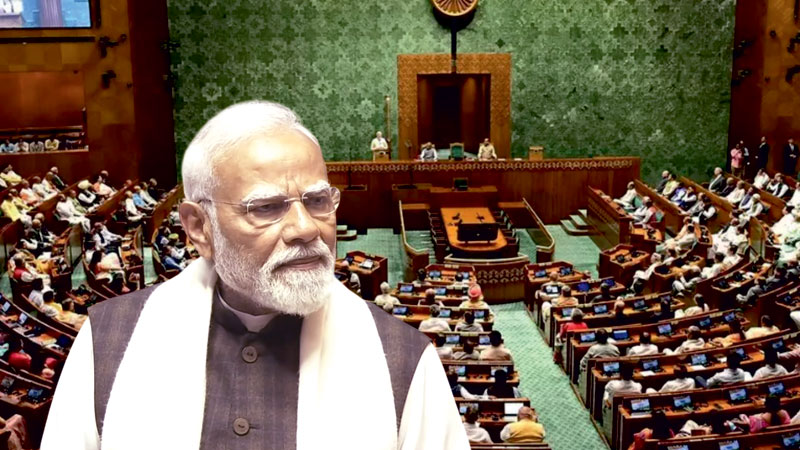
The Prime Minister, Shri Narendra Modi on 5 February, 2026 replied to the Motion of Thanks on the President’s Address in the Rajya Sabha. Addressing the House, the Prime Minister expressed gratitude for the President’s address, stating that it was his privilege to share his sentiments in support of the motion of thanks.
Prime Minister Shri Narendra Modi remarked that the past year has been one of rapid progress in the journey of a developed India, with transformation visible across every sector and among all sections of society, as the nation moves forward in the right direction with great speed. Shri Modi highlighted that the President presented these themes with sensitivity and clarity.
First quarter of the 21st century
Shri Modi emphasized that the President spoke in detail about the middle class, the lower middle class, the poor, villages, farmers, women, science, technology, and agriculture, presenting the voice of India’s progress in Parliament.
Shri Modi further remarked that the first quarter of the 21st century has concluded, and just as the second quarter of the last century was decisive in India’s freedom
While the richest nations of the world are aging, India is simultaneously reaching new heights of development and becoming increasingly youthful
struggle, this second quarter will be equally powerful and fast-paced in building a developed India. He said that every citizen feels the nation has reached a crucial stage, where there is no question of stopping or looking back, only moving forward with speed, achieving the goal, and breathing only after reaching it, and in this direction the country is advancing.
Rare confluence of favorable circumstances
Highlighting that India is currently witnessing a rare confluence of favorable circumstances, Prime Minister called it a highly auspicious alignment. He underlined that while the richest nations of the world are aging, India is simultaneously reaching new heights of development and becoming increasingly youthful, a nation with a growing young population. Shri Modi emphasized that the world’s attraction towards India has grown significantly, with global recognition of India’s talent pool. He noted that India possesses a vital pool of young talent with dreams, determination, and capability, which he described as a second blessing of strength.
The Prime Minister stated that India has emerged as a beacon of hope, providing solutions to global challenges, and pointed out the unique combination of high growth and low inflation in India’s economy, reflecting its resilience. He recalled that
Shri Modi expressed gratitude to the people for giving him the opportunity to serve, noting that much of his government’s energy has gone into correcting past mistakes and rebuilding India’s global image
when his government was given the opportunity to serve, India was counted among the ‘Fragile Five,’ and though the country was once the sixth largest economy at independence, it had slipped to eleventh, but today India is advancing rapidly towards becoming the third largest economy.
India is brimming with confidence
Shri Modi highlighted that in every sector—science, space, sports—India is brimming with confidence. He observed that in the post-COVID world, as global instability grows, a new world order is emerging, and impartial analysis shows a clear tilt towards India. The Prime Minister underscored that India has become the strong voice of the Global South on international platforms and is entering into “future-ready trade deals” with major countries. He noted that nine significant trade agreements have been signed recently, including the “Mother of all Deals” with the European Union involving 27 countries. He criticized past governments for leaving India in a state where no country was willing to engage in trade deals, contrasting it with the current scenario where developed nations are eager to partner with India.
Correcting past mistakes
Shri Modi expressed gratitude to the people for giving him the opportunity to serve, noting that much of his government’s energy has gone into correcting past mistakes and rebuilding India’s global image. He stressed that India is now driven by policy, not adhocism, and that the mantra of “Reform, Perform, Transform” has put the nation on the “Reform Express.” He detailed structural, process, and policy reforms aimed at strengthening manufacturing, empowering entrepreneurs, and ensuring value addition, declaring that India is now fully prepared to compete globally.
India’s global standing has changed
The Prime Minister began by highlighting how India’s global standing has changed in recent years. He remarked that global CEO forums now treat Indian entrepreneurs as equals, reflecting a newfound respect for India’s economic power. According to him, even delegations comprising leaders from various political parties have returned from abroad with a sense of pride, having witnessed firsthand the parity India now enjoys on the global stage. He attributed this transformation to the strength of India’s MSME sector, which he described as the backbone of the nation’s long-term economic resilience. Emphasizing that even aircraft components are now manufactured by India’s small enterprises, he said this reflects the global trust earned by Indian MSMEs.
He further pointed to the enthusiasm of major economies to deepen trade ties with India. Referring to trade agreements with the European Union and the United States, he said these deals have been widely praised internationally and have reinforced confidence in global economic stability. According to him, these agreements send a positive signal to the world that India is not merely participating in global trade but shaping its direction.
India’s youth
A significant portion of the Prime Minister’s speech focused on India’s youth. He stressed that the greatest beneficiaries of emerging opportunities will be the young people of the country—urban and rural, male and female, middle-class and economically weaker sections alike. He cautioned against fragmenting the idea of youth into categories and instead urged the nation to view them as a unified force. With global markets opening up, he said, Indian youth now have unprecedented opportunities across sectors. He expressed solidarity with them, assuring that the government stands shoulder to shoulder with young aspirants as they move forward with courage and confidence.
The Prime Minister also highlighted the rising international demand for Indian professionals, including caregivers and skilled workers. He noted that foreign companies are establishing recruitment offices in India to tap into its talent pool, demonstrating the immense trust the world places in Indian human resources.
Turning to domestic political discourse, the Prime Minister criticized the level of debate in the Rajya Sabha. He questioned whether some opposition leaders, despite having governed for decades, had failed to rise to the occasion in their arguments. He also criticized the ruling dispensation in West Bengal, alleging governance failures and accusing it of defending illegal infiltrators at the expense of Indian youth and tribal communities. He argued that such actions deprive young Indians of opportunities and undermine national security.
“Phone Banking”
The Prime Minister devoted considerable attention to reforms in the banking sector. He recalled that before 2014, “phone banking” allegedly allowed influential individuals to secure massive loans through political connections, while ordinary citizens struggled for access. He emphasized that more than half the population had never entered a bank branch. Upon assuming office, he said, his government undertook bold reforms, merging weak public sector banks with stronger ones and implementing measures to address non-performing assets (NPAs).
He stated that these reforms restored health to the banking system, enabling increased transactions and greater credit access for the poor. The Mudra Yojana, he noted, has disbursed over Rs 30 lakh crore in collateral-free loans, empowering youth and women entrepreneurs. He highlighted that 10 crore women have received financial assistance through self-help groups and that NPAs have dropped to historically low levels, strengthening the banking sector’s foundation.
The Prime Minister also addressed the transformation of public sector undertakings (PSUs). He remarked that institutions such as Life Insurance Corporation of India, State Bank of India, and Hindustan Aeronautics Limited were once portrayed as failing entities. However, through reforms and renewed focus, these institutions have recorded strong performances and are contributing significantly to initiatives like Make in India, generating employment and securing international orders.
Restoring dignity of farmers
Addressing farmers, he criticized earlier governments for neglecting small and marginal farmers. Through the PM Kisan Samman Nidhi scheme, he said, Rs. 4 lakh crore has been directly transferred to farmers’ accounts, empowering them economically and restoring dignity.
The Prime Minister then spoke about institutional reform, particularly the abolition of the Planning Commission and the creation of NITI Aayog. He described the Aspirational Districts Programme as a model of effective implementation that has drawn global attention. Citing Bastar in Chhattisgarh as an example, he said districts once labeled backward are now witnessing transformation in infrastructure, governance, and community participation.
Bold national security decisions
The Prime Minister also defended bold national security decisions, including the abrogation of Article 370 and decisive actions against terrorism. He asserted that his government’s guiding principle is that 140 crore Indians are the solution to challenges, not the problem. In contrast, he accused the opposition of harboring a mindset that views citizens with distrust.
He condemned incidents in Parliament that he described as disrespectful to constitutional offices and marginalized communities. He criticized remarks made against a Sikh Member of Parliament and referenced the life of Sadanandan Master as an example of resilience and service despite adversity.
Highlighting poverty alleviation efforts, he said 25 crore people have risen out of poverty in recent years. He noted that unmanned railway crossings have been eliminated, 18,000 unelectrified villages have been connected to power, and soldiers at the borders now receive improved equipment and resources.
India’s technological strides
The Prime Minister celebrated India’s technological strides, recalling skepticism around Digital India and UPI. Today, he said, India has over two lakh startups and has rolled out 5G at record speed. He highlighted advancements in green hydrogen, AI, quantum computing, and critical minerals, asserting that India will not remain dependent on others for strategic resources.
He concluded by reiterating that elections are temporary but the nation is eternal. His government, he said, plans not for short-term political gain but for the goal of a developed India by 2047. He called on citizens to prioritize quality and innovation so that “Made in India” becomes synonymous with excellence worldwide.
Expressing gratitude to Members of Parliament for their contributions to the President’s address, he reaffirmed his commitment to serving the nation and laying a strong foundation for future generations.