
 PrintFriendly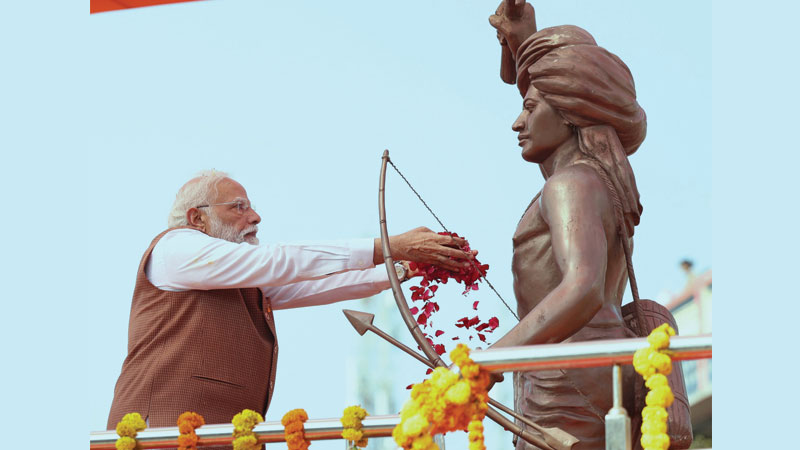
Prime Minister Shri Narendra Modi addressed the Janjatiya Gaurav Diwas programme on 15 November in Dediapada, Gujarat, commemorating the 150th birth anniversary of Dharti Aaba Bhagwan Birsa Munda. Marking the occasion, he inaugurated and laid the foundation stone of various infrastructure and development projects worth over Rs 9,700 crore. Calling the land of Maa Narmada sacred, he noted that this venue had recently hosted the 150th birth anniversary celebration of Sardar Patel, and with the grand tribute to Bhagwan Birsa Munda, the celebrations of Bharat Parv reached a meaningful culmination. The Prime Minister paid homage to Birsa Munda, Govind Guru, and Devmogra Mata, and highlighted their lasting spiritual and cultural influence on the tribal belt
Shri Narendra Modi recalled the deep cultural heritage of Dediapada and Sagbara, shaped by Sant Kabir’s teachings. As a Member of Parliament from Varanasi, the land of Sant Kabir, he expressed a personal connection and offered his respects. He informed that a number of developmental projects related to national progress and tribal welfare were launched during the event. Under PM-JANMAN and other schemes, one lakh families in the region have been provided permanent houses. The inauguration and foundation stone laying of several Eklavya Model Schools, Ashram Schools, and health, road, and transport projects marked a major step forward for regional development. He also announced the establishment of the Shri Govind Guru Chair at Birsa Munda Tribal University.
Janjatiya Gaurav Diwas
Highlighting the historic decision of 2021 to commemorate Birsa Munda’s birth anniversary as Janjatiya Gaurav Diwas, the Prime Minister emphasized that tribal pride and sacrifice have been integral to India’s civilizational journey. He recalled the valour of numerous tribal freedom fighters including Tilka Manjhi, Rani Gaidinliu, Sidho-Kanho, Alluri Sitarama Raju, Tantya Bhil, Veer Narayan Singh, Telanga Khadia, Rupchand Konwar, and Laxman Nayak. Gujarat too, he noted, has produced several tribal leaders such as Govind Guru, Raja Roopsingh Nayak, Motilal Tejawat, and Dashriben Chaudhary.
Shri Modi stressed the need to preserve this legacy for future generations through tribal museums and cultural institutions. He mentioned ongoing projects such as the large tribal museum at Rajpipla, the Shaheed Veer Narayan Singh Tribal Museum in Chhattisgarh, and the conversion of Birsa Munda’s prison in Ranchi into a museum.
Centre will study and preserve tribal dialects
Announcing the Shri Govind Guru Chair for Tribal Language Promotion, he highlighted that the centre will study and preserve tribal dialects including Bhil, Gamit, Vasava, Garasia, Santhal, Rathwa, and others. He emphasized that tribal languages, stories, and traditions are treasures of knowledge, philosophy, and environmental understanding.
Tribal welfare has been a top priority for the current government
Shri Modi expressed concern over the historical neglect faced by tribal communities, pointing out malnutrition, lack of healthcare, and poor connectivity under earlier governments. He said that tribal welfare has been a top priority for the current government, with a significant increase in the budget of the Ministry of Tribal Affairs. Recalling his tenure as Chief Minister of Gujarat, he described initiatives such as Kanya Kelavani Mahotsav and the expansion of education in tribal regions. Over the years, more than 10,000 schools, dozens of colleges, hostels, and two tribal universities have been established in the state. He noted the success of tribal youth, who are now excelling in fields like medicine, engineering, research, and sports.
Dharti Aaba Tribal Village Utkarsh Abhiyan
The Prime Minister highlighted major initiatives such as the PM-JANMAN scheme, Ayushman Bharat, Ayushman Arogya Mandir, and the Dharti Aaba Tribal Village Utkarsh Abhiyan, under which more than 60,000 tribal villages have benefitted from improved access to drinking water, telemedicine, education, and community-driven development. He emphasized efforts to strengthen minor forest produce markets, promote Shri Anna, and combat sickle cell disease. He also underscored the importance of local-language education under the National Education Policy.
Shri Modi reiterated the government’s commitment to ensuring political representation for tribal communities, pointing to the historic election of a tribal woman as President of India and the appointment of several tribal leaders as Chief Ministers and Governors.
The Prime Minister called upon citizens to work with the spirit of Sabka Saath, Sabka Vikas and ensure that no tribal community is left behind in development. He urged everyone to take inspiration from Bhagwan Birsa Munda and move forward with renewed strength and rootedness in Indian culture.
Bhagwan Birsa Munda’s personality and actions inspiring all of us: JP Nadda
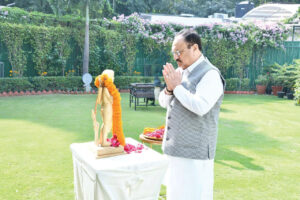
Today in New Delhi, I paid homage to ‘Dharti Aba,’ Bhagwan Birsa Munda Ji, by offering floral tributes at his statue on the occasion of his 150th birth anniversary.
With his valor and courage, he organized the tribal community and led a rebellion against the British rule. Bhagwan Birsa Munda Ji’s personality and actions in protecting “water, forest, and land” and tribal identity are inspiring to all of us.
Bhagwan Birsa Munda is the pride of the entire nation: AMit shah
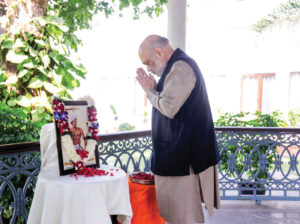
Bhagwan Birsa Munda is the pride of not only the tribal community but the entire nation. Today, the entire country is joyously celebrating his 150th birth anniversary and ‘Tribal Pride Day.’ We pay tribute to him and salute his unwavering commitment to the freedom movement and the protection of the motherland.