

 PrintFriendly
The story of Vande Mataram begins not in a battlefield but in the quiet resolve of a scholar, Shri Bankimchandra Chattopadhyay. In 1875, on the day of Jagaddhatri Puja (Kartik Shukla Navami or Aksaya Navami), he composed the hymn that would become Bharat’s eternal song of freedom. As he penned those sacred words, he was drawing from Bharat’s deepest civilizational roots, from the Atharvaveda’s declaration “Mata bhumih putroham prithivyah” to the Devi Mahatmya’s invocation of the universal Mother
In our nation’s history, there have been many defining moments when songs and art, in their diverse forms, preserved the emotions of the people and played a vital role in shaping movements. From the war cry of Chhatrapati Shivaji Maharaj’s army, to the patriotic hymns of freedom fighters, and to the collective chants of youth during the Emergency — songs have always inspired Bharat’s sense of pride and united its people.
So too, the story of Vande Mataram begins not in a battlefield but in the quiet resolve of a scholar, Shri Bankimchandra Chattopadhyay. In 1875, on the day of Jagaddhatri Puja (Kartik Shukla Navami or Aksaya Navami), he composed the hymn that would become Bharat’s eternal song of freedom. As he penned those sacred words, he was drawing from Bharat’s deepest civilizational roots, from the Atharvaveda’s declaration “Mata bhumih putroham prithivyah” to the Devi Mahatmya’s invocation of the universal Mother.
Bankim ji’s hymn was both prayer and prophecy. ‘Vande Mataram’ is not merely Bharat’s national song, nor just the soul of the freedom movement — it is, in fact, first proclamation of Cultural Nationalism as envisioned by Shri Bankimchandra
‘Vande Mataram’ is not merely Bharat’s national song, nor just the soul of the freedom movement — it is, in fact, first proclamation of Cultural Nationalism as envisioned by Shri Bankimchandra Chattopadhyay
Chattopadhyay. It reminded us that a nation is not just geography, it is geoculture. It is not merely territory, but tirtha, sacred land bound by memory, sacrifice, and motherhood.
Bankim ji was, as Shri Aurobindo later described, a Rishi of modern Bharat, who revived the soul of the nation through words. His Anandmath was not merely a novel but a mantra in prose, awakening a nation that had forgotten its divine strength. In one of his letters, Bankim ji wrote: “I don’t mind if all my works are dumped in the Ganges. This verse (Vande Mataram) alone will remain till eternity. This will be a great song and conquer the hearts of the people.”
Those words were prophetic. Written in colonial Bharat’s darkest hour, Vande Mataram became the dawn-song of awakening, a hymn that united cultural nationalism with civilizational pride. Only one born with devotion in every fibre of his being could have written such lines.
In 1896, Gurudev Rabindranath Thakur set Vande Mataram to tune and sang it at the Kolkata Congress session, giving it voice and immortality. The song spread across provinces, transcending language and region, from Tamil Nadu, where Shri Subramania Bharathi translated it into Tamil, to Punjab, where revolutionaries shouted it in defiance of the Raj.
In 1905, during the Bang Bhang movement, Bengal erupted. The British banned public recitation of Vande Mataram, yet, on April 14, 1906, at Barisal, thousands defied the order. When police lathicharged the peaceful assembly, men and women bled on the streets crying, “Vande Mataram!”
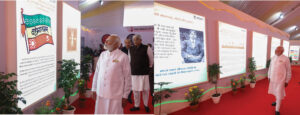
Prime Minister Shri Narendra Modi inaugurating the Smaranotsav organized in New Delhi on 07 November 2025 on the occasion of the completion of 150 years of ‘Vande Mataram’. ‘Vande Mataram’ reminds us of the freedom movement and inspires us to dedicate ourselves to the protection of the nation and devotion to Mother India
From there, Vande Mataram travelled with the revolutionaries of the Ghadar Party in California, echoed through the Azad Hind Fauj as Netaji’s soldiers marched from Singapore, and thundered in the Royal Indian Navy Mutiny of 1946, when Indian sailors raised both the tricolour and the chant of Vande Mataram atop British warships. From Khudiram Bose to Ashfaqulla Khan, from Rajguru to Tirupur Kumaran, the cry was the same. It was no longer just a song; it was Bharat’s collective heartbeat. As Mahatma Gandhi himself admitted, Vande Mataram had “the magic power to stir the most sluggish blood.” It had united moderates and revolutionaries, and, scholars and sailors. It was, as Aurobindo called it, “the mantra of Bharat’s rebirth.”
In his Mann Ki Baat address on October 26, Prime Minister Shri Narendra Modi reminded the nation of the inspiring history of Vande Mataram. Marking the 150th
In his Mann Ki Baat address on October 26, Prime Minister Shri Narendra Modi reminded the nation of the inspiring history of Vande Mataram. Marking the 150th anniversary of the national song, the Government of Bharat has decided to organize year-long programs from November 7 onward
anniversary of the national song, the Government of Bharat has decided to organize year-long programs from November 7 onward. These initiatives will carry the complete rendition of Vande Mataram to every corner of the nation, so that our youth may not only repeat its words, but rise with its spirit.
As we celebrate Bharat Parv and remember Sardar Patel’s birth anniversary, we recall how he gave shape to the spirit of Vande Mataram through the vision of Ek Bharat. The song is no longer just a remembrance of the past, it is a rallying call for the future. Vande Mataram today lives in the resolve of the nation, in the idea of Viksit Bharat 2047. It embodies Bharat’s civilizational confidence. Now, it is our responsibility to transform this spirit into a Atmnirbhar and Shreshth Bharat.
Vande Mataram is the song of freedom, the spirit of resilience, and the first mantra of Bharat’s awakening. Words born of the nation’s soul know no end, they live forever, echoing across generations. This chant shall live on, beyond eras and generations. It is time we understand our history and culture through our own Bharatiya perspective. Vande Mataram!
(The writer is Union Home and Cooperation Minister, GoI)