

 PrintFriendly
ECONOMIC SURVEY 2025-26
Union Minister for Finance and Corporate Affairs Smt. Nirmala Sitharaman tabled the Economic Survey 2025-26 in the Parliament on 29th January, 2026. The highlights of the Economic Survey are as follows.
At a time when the global economy is marked by fragmentation, uncertainty, and an uneven recovery, Bharat under the Modi Government stands out as a clear bright spot and a credible engine of global growth. With medium-term global growth projected at 3.2%, most major economies are still grappling with post-pandemic adjustments, supply-chain realignments, and persistent geopolitical tensions, leading to sharply divergent outcomes across regions.
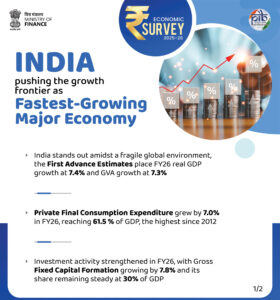
Against this challenging backdrop, Bharat’s projected growth of 7.4% in FY26 distinguishes it not as an economy merely navigating global headwinds, but as one that is shaping the growth narrative itself. More importantly, the Economic Survey points to a deeper structural shift: India’s medium-term potential growth rate has been revised upward to 7.0%, from 6.5% estimated three years ago. This upgrade does not refl ect a temporary rebound, but the cumulative gains from sustained structural reforms, expanded and higher-quality public infrastructure, healthier balance sheets across the economy, and productivity improvements enabled by Digital Public Infrastructure.
Victory Over Infl ation: Protecting Household Welfare
The Survey presents the past fi nancial year as a clear turning point in infl ation management, underscoring the Modi Government’s focus on household welfare and price stability. For much of the post-pandemic period, infl ation weighed heavily on day-to-day sentiment across economies. In FY26, that pressure eased decisively.
Headline retail infl ation averaged 1.7% during April–December FY26, the lowest average in the current CPI series, driven primarily by a broad moderation in food prices. As supply conditions improved and market functioning became smoother–through better arrivals, more effi cient distribution, and stronger supply management –price pressures in essential items, particularly vegetables and pulses, eased in a manner that households could immediately experience.
A notable achievement is that infl ation was controlled without sacrifi cing growth. Core infl ation remained stable, indicating that underlying demand-side pressures stayed contained even as economic activity remained fi rm. At a time when several economies continue to contend with persistent infl ation and a higher cost of living, India’s experience in FY26 demonstrates a healthier balance: infl ation has moderated while growth momentum has been sustained, protecting purchasing power and keeping consumption on track.
Buoyant Consumer Confi dence Anchoring Domestic Demand
Bharat’s growth narrative in FY26 has been driven overwhelmingly by the strength of domestic demand rather than reliance on external tailwinds. In a year marked globally by uncertainty and subdued trade, Bharat’s households have emerged as the principal anchor of economic momentum. Household consumption now accounts for 61.5% of GDP, its highest share since FY12, pointing to a structural strengthening of the economy’s internal growth engine. This is reinforced by performance on the ground: Private Final Consumption Expenditure grew by 7.5% in the fi rst half of FY26, refl ecting a broad-based expansion across both urban centres and rural regions.
From Consumption Spurts To An Investment-Led Growth Cycle
Bharat’s growth trajectory is increasingly anchored in a sustained investment cycle rather than short-lived consumption impulses. Gross Fixed Capital Formation rose by 7.8% in FY26 and the investment rate held steady at 30% of GDP, signalling durable capital formation. This investment engine has been powered by a decisive public capex push: Government capital expenditure rose by 92% between FY19 and FY22 from ₹3.07 lakh crore to ₹5.92 lakh crore, and the momentum continued with capital outlay rising by nearly 89% to ₹11.21 lakh crore in FY26 (BE). With a strong multiplier of 2.5 to 3.5, every ₹1 invested in infrastructure generates ₹2.5 to ₹3.5 of additional GDP over the medium term, making this strategy central to raising productivity and long-term growth potential.
Public Capex Crowding In Private Capital and Upgrading Connectivity
Bharat’s infrastructure build-out has triggered a powerful crowding-in effect, unlocking new streams of fi nancing and accelerating project delivery. While bank credit to infrastructure has rebounded, growing at 4.6% in October 2025, a deeper structural shift is underway. Non-Banking Financial Companies (NBFCs) have stepped up as critical fi nanciers, with credit to the commercial sector expanding at a blistering 43.3% CAGR between FY20 and FY25, far outpacing traditional bank credit. This diversifi cation signals a maturing fi nancial ecosystem ready to fund long-term growth.
Fiscal Prudence As The Anchor Of Macroeconomic Stability
Fiscal policy in the past fi nancial year marks a clear transition from pandemic-era accommodation to a framework anchored in stability, credibility, and medium-term discipline. The Union Government is fi rmly on track to achieve a fi scal defi cit of 4.4% of GDP, sustaining the consolidation trajectory without undermining growth momentum. The adjustment has been deliberately calibrated: it supports demand where needed while reinforcing confi dence in the fi scal path.
Education Linked To Jobs and Productivity: Skills, STEM, And Infrastructure Readiness
A key shift in the past decade has been moving education closer to economic priorities and employability outcomes. STEM and professional courses now account for ~43% of total enrolment, while skill-oriented and vocational programmes are the fastest-growing segment, indicating stronger alignment with labour-market needs. This has been underpinned by a major expansion in capacity and modernisation of infrastructure: universities increased from 760 (2014) to more than 1,150, colleges from 38,500 to more than 45,000, and India now has 14.9 lakh schools, with 95% electrifi ed and 55% internet-connected (up from <20% in 2016), strengthening the foundations for a job-ready education system.
Structural Transformation In Health: From Survival To Human Capital
In our pursuit of attaining growth, Bharat’s health trajectory represents a decisive shift from managing survival to building a productive human capital. The country has delivered a structural break in key mortality indicators since 1990, achieving an 86% reduction in maternal mortality and a 78% decline in under-fi ve mortality, signifi cantly outperforming global trends. This progress is anchored in a vast expansion of frontline capacity: infant mortality has fallen to 25 per 1,000 live births, supported by a network of over 1.82 lakh Ayushman Arogya Mandirs. With over 506 crore footfalls and 42 crore teleconsultations, this infrastructure has successfully embedded comprehensive primary care and wellness into the grassroots health system.