

 PrintFriendly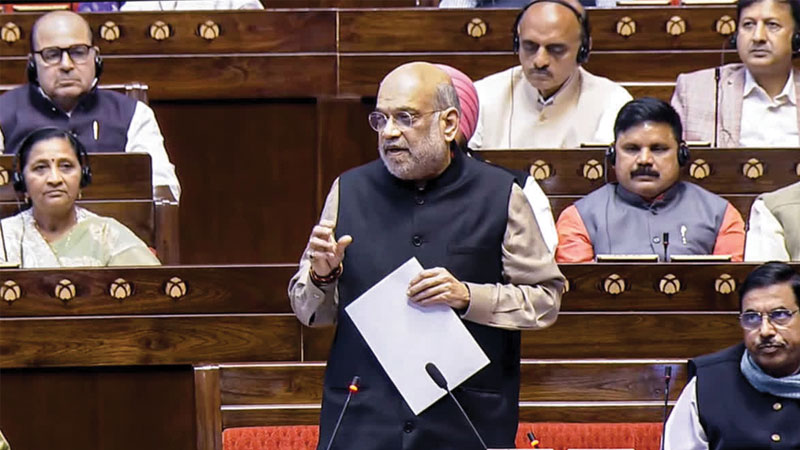
Union Home and Cooperation Minister Shri Amit Shah addressed the Rajya Sabha during the discussion on the national song ‘Vande Mataram’ on 09 December 2025. Shri Amit Shah stated that it is not merely a patriotic song, but a symbol of devotion, dedication and cultural nationalism towards Bharat Mata. During the freedom struggle, Vande Mataram inspired revolutionaries and soldiers, and it was accorded the status of a national song by the Constituent Assembly. Shri Shah, accusing the Congress, said that they try to politically diminish the glory of Vande Mataram. The Home Minister stated that on the occasion of the 150th year of Vande Mataram, special programmes, postal stamps, coins, exhibitions and collective singing are being organised across the country. Vande Mataram even today serves as a medium to inspire nation-building and instill patriotism among the youth
Shri Amit Shah said when the discussion on Vande Mataram was taking place in the House, some members questioned why there is a need to discuss this subject at all. The need for discussion on Vande Mataram and dedication towards it was not only relevant during the freedom movement, but will remain relevant during the building of a Viksit Bharat in 2047 as well. This immortal composition is a work that awakens devotion, dedication, and a sense of duty towards the motherland. Those who today fail to understand the necessity of discussing Vande Mataram need to reconsider their understanding. Some people think that because elections are coming in Bengal, therefore Vande Mataram is being discussed. They want to reduce its greatness by linking it to elections. It is true that Bankim Chandra Chattopadhyay was born in Bengal, the song was written there, and the background of Anand Math was also Bengal, but the rise of Vande Mataram was not limited only to Bengal. It became a source of inspiration for freedom fighters across the entire country and the whole world.
The Union Home Minister remarked that even today, when soldiers sacrifice their lives while defending the nation on the border, Vande Mataram is on their lips. Police and security personnel too remember this mantra at the moment of their supreme sacrifice. During the freedom struggle, Vande Mataram had become the voice that shattered the chains of slavery and inspired many revolutionaries to wish that even in their next birth they would be born in India and serve the nation. For generations, this song has inspired people to walk on the path of their culture and remain devoted to the nation.Through the discussion taking place in both Houses of Parliament, children, adolescents, youth and the coming generations will be able to understand the significance of Vande Mataram and adopt it as a source of inspiration in the rebuilding of the nation. On 7 November 1875, on Kartik Shukla Navami, the first public publication of Vande Mataram took place, which is known as Akshay Navami or Jagaddhatri Puja. Initially, it was regarded as an excellent literary creation, but gradually it became a symbol of patriotism, sacrifice and national consciousness, and a guiding force of the freedom movement. Highlighting the background of its composition, Union Home Minister said that between the culture that had resisted Islamic invasions for centuries and the new lifestyle imposed later by the British, Bankim Babu, through this song, re-established India’s original civilisation, cultural nationalism, and the tradition of worshipping the motherland.
British government imposed a ban
Shri Shah said at that time there was neither social media nor means of publicity. On the contrary, the British government imposed a ban on saying Vande Mataram, whipped people, and put them in jail. Yet this song crossed all restrictions and
The British government imposed a ban on saying Vande Mataram, whipped people, and put them in jail. Yet this song crossed all restrictions and spread from Kashmir to Kanyakumari, and became a mantra of renaissance
spread from Kashmir to Kanyakumari, and became a mantra of renaissance for those who held reverence for India’s culture. During the period of slavery, temples, universities, art centres, agricultural systems and education systems were destroyed, but no one could weaken the soul of Indian culture. What was needed was only to awaken that spirit, and that is exactly what Vande Mataram did. As this song spread across the country, it reached even the jails of Andaman and Nicobar neither the British nor their supporters could stop it. Vande Mataram revived a nation that had forgotten its divine power. Maharshi Aurobindo called it the mantra of India’s rebirth and also said that God had sent Bankim Babu into this world precisely to manifest this mantra needed for the country. His thought became the slogan of the freedom movement and the source of inspiration for generations.
This cultural foundation kept India united
When we look across the whole country, it becomes clear that the real force that unites India is our culture. This very cultural foundation is the mantra that strengthened the spirit of cultural nationalism through Vande Mataram. When the British imposed many restrictions on Vande Mataram, Bankim Babu wrote in a letter that he had no objection if his entire literary work was thrown into the river, because Vande Mataram would live for eternity. This song would find a place in people’s hearts and become the mantra of India’s reconstruction. Today it is clearly visible that Bankim Babu’s words have been proven true. Even though it happened late, today the entire nation is moving forward by embracing the spirit of cultural nationalism. We all consider ourselves the children of Bharat Mata and believe that this country is not just a piece of land but our mother and Vande Mataram is the expression of that very sentiment.
Deeply emotional depiction of Bharat Mata
Shri Shah highlighted that the composition of Vande Mataram presents a deeply emotional depiction of Bharat Mata. It describes Bharat Mata as the giver of water, fruits, and prosperity. The beauty of flowers that delights the mind is also associated with Bharat Mata. The forms of Saraswati, Lakshmi, and Durga have been portrayed as embodiments of Bharat Mata. Knowledge, prosperity, and the power of protection can be attained only through the grace of Bharat Mata, and that is why the sentiment of repeatedly offering salutations is expressed throughout the song. Bankim Babu described the valour of Durga, the abundance of Lakshmi, and the wisdom of Saraswati as blessings of Bharat Mata. Though he presented this thought nearly 150 years ago, its roots are much more ancient. In the Ramayana, even after conquering Lanka, Bhagwan Shri Ram did not abandon his motherland and said that “mother and motherland are greater even than heaven.” Acharya Shankar and Acharya Chanakya too placed the glorification of the motherland at the highest pedestal and connected our identity with the motherland. She is the one who gives us the opportunity to uplift our language, culture, and life. In the deep darkness of slavery, Bankim Babu revived this eternal sentiment. The proclamation of Vande Mataram
Maharshi Aurobindo described Vande Mataram not as a song, but as a symbol of India’s spiritual power. He said that Vande Mataram energises the body, purifies emotions and thoughts, and awakens consciousness. It is not merely an expression of patriotism, but an invocation of the divine power of Bharat Mata
awakened the spirit of Swaraj in the public mind and broke the mentality of servitude. Maharshi Aurobindo described Vande Mataram not as a song, but as a symbol of India’s spiritual power. He said that Vande Mataram energises the body, purifies emotions and thoughts, and awakens consciousness. It is not merely an expression of patriotism, but an invocation of the divine power of Bharat Mata.
Vande Mataram awakened India’s original Sanatan consciousness
Union Home Minister noted that Vande Mataram awakened India’s original Sanatan consciousness, and that is why most leaders of the freedom movement adopted it as the foundation of their struggle. Many revolutionaries, when walking towards the gallows, had Vande Mataram as their final words. Whether it was the call for the Swadeshi movement, the boycott of foreign goods, the message of national education, or the surge of patriotism, at every phase the nation heard and felt the invocation of Vande Mataram. During the Ghadar movement in Punjab, numerous pamphlets under the title Vande Mataram were distributed. In Maharashtra, during the Ganapati and Shivaji festivals, special editions on Vande Mataram were printed, sold, and circulated. In Tamil Nadu, Subramania Bharati translated it into Tamil and carried the revolutionary spirit to the shores of the Indian Ocean. In 1907, an English newspaper titled Vande Mataram was launched in Kolkata, edited by Maharshi Aurobindo. The British government considered it a dangerous nationalist journal and charged Aurobindo with sedition. He was sentenced, and ultimately the newspaper was banned. Congress conventions also honoured Vande Mataram. In 1896, Gurudev Rabindranath Tagore sang it for the first time at a Congress session, and in 1905, at the Varanasi session, Sarala Devi Chaudhurani rendered the full Vande Mataram. On 15 August 1947, the day the country became independent, Pandit Omkar Nath Thakur sang Vande Mataram on All India Radio at the request of Sardar Patel. With this sentiment in mind, during the final sitting of the Constituent Assembly, presided over by Dr. Rajendra Prasad, Vande Mataram was granted the same honour as the National Anthem and was declared the National Song of India.
Mentality of avoiding a discussion on Vande Mataram is not new
Shri Shah said the mentality of avoiding a discussion on Vande Mataram is not new. This year marks the 150th anniversary of Vande Mataram, and in our country, landmark years of any great creation are honoured with dignity. When Vande Mataram completed fifty years in 1937, the country was not yet independent. At that time, Jawaharlal Nehru restricted the song to only two stanzas. This was the beginning of the suppression of the glory of Vande Mataram, and the same approach later grew into a policy of appeasement that eventually paved the way for the Partition of India. Shri Shah further said that many people like him believe that if the decision to restrict Vande Mataram had not been taken, the country might not have been partitioned. Fifty years later, when Vande Mataram completed its centenary, not a word was spoken about honouring it because the country was under the Emergency. Millions of opposition workers and social activists were jailed, newspapers were shut down, and many artists’ voices were silenced on All India Radio. When Vande Mataram turned 100, the entire nation had virtually been turned into a detention camp.
Congress leadership remained absent
Shri Shah highlighted that on the occasion of the 150th anniversary of Vande Mataram, a discussion was held today in the Lok Sabha but both members of the Congress leadership remained absent. The same Congress, whose early sessions once began with personalities like Tagore singing Vande Mataram, now avoids even participating in this discussion. From Jawaharlal Nehru to the present Congress leadership, the resistance towards Vande Mataram has remained embedded in their mindset. A senior Congress leader even remarked that there was no need to discuss
The same Congress, whose early sessions once began with personalities like Tagore singing Vande Mataram, now avoids even participating in this discussion
Vande Mataram. The very song which Mahatma Gandhi described as being connected to the purest soul of the nation, and which Bipin Chandra Pal regarded as the expression of rashtra-dharma, was truncated by the Congress. Vande Mataram inspired India’s freedom movement even at the international stage and introduced India’s national consciousness to the world. When Shyamji Krishna Varma, Madam Bhikaji Cama and Veer Savarkar designed the tricolour flag of India, the only word inscribed on it in golden letters was “Vande Mataram.”
Shri Shah highlighted that the Bharatiya Janata Party was founded on the principle of cultural nationalism. The core ideology of the party has always been that India should progress on the strength of its original civilizational values not by drifting toward Western cultural influences. He stated that there was a time in Parliament when the singing of Vande Mataram had been discontinued. In 1992, BJP MP Ram Naik raised the issue through a short-duration discussion to resume the singing of Vande Mataram in the House. At the time, Leader of the Opposition Shri Lal Krishna Advani clearly urged the Speaker that the song accepted by the Constituent Assembly must indeed be sung in Parliament. Subsequently, the Lok Sabha unanimously restored the practice of singing Vande Mataram. Shri Shah added that even then some members refused to sing Vande Mataram. He said he has personally witnessed certain MPs walking out of the House before the song began. He said that today Congress leaders claim the party is being falsely accused, but he can confidently state that no member of the Bharatiya Janata Party has ever hesitated to stand with respect during the singing of Vande Mataram.
Union Home Minister noted that on the 130th birth anniversary of Bankim Chandra Chattopadhyay, the Department of Posts issued a special postal stamp. During the Har Ghar Tiranga campaign on the 75th anniversary of Independence, . Prime Minister Shri Narendra Modi Ji urged the public to chant Vande Mataram while hoisting the tricolour. The Government of India is celebrating 150 years of Vande Mataram in a grand manner throughout the year. The Union Cabinet approved its outline. Programmes have been scheduled at national and international levels. Prime Minister Shri Narendra Modi Ji inaugurated the year by offering floral tributes to Bharat Mata on 7 November 2025. Its first phase was completed in November. The second phase will be in January 2026, the third in August 2026, and the fourth in November 2026. The Central Government has released a commemorative postal stamp and a commemorative coin. He informed that a special presentation titled Vande Mataram Naad Ekam Roop Anekam has been prepared by 75 musicians. On 7 November, collective singing of Vande Mataram took place across the country. Its documentary and exhibition will be displayed at every district centre and, if required, at the tehsil level. He said that the exhibition will be delivered to crores of people through digital platforms. Special programmes are being broadcast on All India Radio, Doordarshan and FM channels. Discussions will be organised by the Press Information Bureau in various cities. Cultural evenings based on Vande Mataram will be held in all Indian embassies. Under the Vande Mataram – Salute to Mother Earth campaign, a tree plantation drive is underway. Vande Mataram will never become timeless. The time when it was composed, it was as necessary then as it is today. The same Vande Mataram that united the nation during the freedom struggle will become the inspiration in the Amrit Kaal to make the country developed and great.