

 PrintFriendly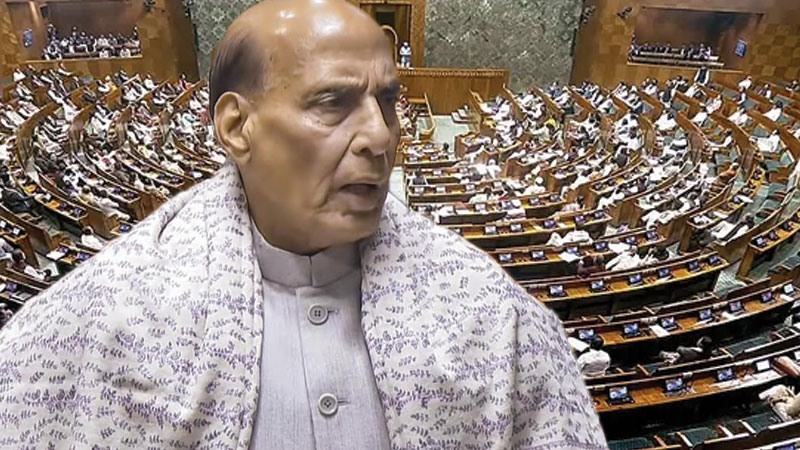
Defence Minister Shri Rajnath Singh spoke in Lok Sabha on Vande Mataram on 8 December 2025 during a special discussion marking the 150th anniversary of the national song. This discussion was part of a broader parliamentary session where leaders, including Prime Minister Shri Narendra Modi and others, addressed the significance of Vande Mataram and related issues like how Vande Mataram is linked to India’s history, present, and future. Shri Singh said the song Vande Mataram awakened our nation, which had been dormant and under the wraps for centuries together. During the movement against the partition of Bengal in 1905, Vande Mataram permeated through the hearts of the people. To awaken national consciousness, the Vande Mataram sect was also founded at that time
Shri Rajnath Singh said in April 1906, the British government banned the chanting of Vande Mataram in the Bengal province. People openly defied this order. Vande Mataram was not limited to Bengal only. Rather it had its wide and overlaying prevalence through the length and breadth of India ranging from north to south and east to west. People exchanged greetings pronouncing Vande Mataram. In London, Paris, Geneva, Canada, wherever there were Indians and they would chant Vande Mataram. “Vande Mataram” is not just a song; it is the essence of our nationalism. Today, as we celebrate the glorious journey of “Vande Mataram” for a century and a half, we must acknowledge the truth that “Vande Mataram” did not receive the degree of justice it actually deserved. The song has been marginalized. We hold the conviction that restoring the glory of “Vande Mataram” is both a need of the hour and a moral imperative. The injustice meted out to “Vande Mataram” was the beginning of the politics of appeasement. We have equal respect for the national anthem and the national song. The chanting of “Vande Mataram” is not against anyone, but an expression of our national pride. Under the leadership of Prime Minister Shri Narendra Modi, we have decided to celebrate the 150th anniversary of “Vande Mataram” with great pomp and show across the country.
The soul of India
Shri Rajnath Singh said this anniversary celebration is not a mere symbolism. This is a pledge to give Vande Mataram its due respect. The soul of India is its spiritual faith. That is why Bankim Chandra Chatterjee imagined Bharat Mata as the motherland. In the novel Anand Math, when one of his characters, Bhavananda, sings Vande Mataram, another, Mahendra, asks, “Who is mother?” Bhavananda replies, “We do not consider any other mother; our birthplace is the mother.” It is about time one went for an unbiased evaluation of its history. Everyone has heard two stanzas of Vande Mataram, but not much is known about the rest. Most of the stanzas of the original version have been forgotten. The first stanza that was removed contains Bankim Babu’s words in reference to Bharat Mata – “You are knowledge, you are dharma, you are the heart, you are the essence, you are the life force of my body.” This line of ‘Vande Mataram’ tells us that India is a civilisation that has never allowed spirituality to become a barrier. He made it clear that devotion to the Mother is not the worship of an idol.
It was not a slogan of any religion or sect
During the freedom movement, some members of the Congress had become so anxious to present themselves as secular that anything associated with Indian culture appeared to be communal to them. Because of their hostility towards Indian culture, Vande Mataram became its victim. Bengal has been the land where the foundations of India’s greatest social reforms and cultural renaissance were laid.
Bengal is the birthplace of saints like Chaitanya Mahaprabhu, Swami Ramakrishna Paramahansa, and Swami Vivekananda. Their presence made Bengal a radiant centre of spirituality, culture, and our civilisational consciousness. Bankim Chandra Chatterjee had said that Bengal belongs to both Hindus and Muslims. Some people misinterpreted the metaphors used in Vande Mataram. Maulana Raza-ul-Karim had maintained that the song should be viewed in its entirety. The truth is that Indian Muslims understood Bankim Chandra Chatterjee’s sentiment far more deeply and precisely than certain leaders of the Congress or the Muslim League. In our Sufi tradition, particularly in Punjab and Bengal, the spirit with which Vande Mataram was written is often evident. This song is the greatest example of unity in diversity. It was not a slogan of any religion or sect. It was the collective voice of the whole of India. Bankim Babu believed that an idol of God is merely a medium to understand the form of the Divine. We have always stood against injustice meted out to Vande Mataram. Even today, we will not make any compromise with its honour. The freedom movement had great leaders like Mahatma Gandhi, Bal Gangadhar Tilak, Rajendra Babu and Dr. Syama Prasad Mookerjee, who were proud of India’s civilization and culture. Post Independence, the Congress has always sacrificed India’s civilisation, culture, and even the Constitution of India at the altar of its narrow interests. The fundamental character of the original Constitution was altered through the First Constitutional Amendment in the year 1951. The Constitution was also completely changed through the 42nd Amendment. Distortion of the Constitution and its values continued even further. In the Shah Bano case, the Supreme Court pronounced a very progressive judgment. A law was passed in Parliament during the Congress regime to reverse that decision. Article 370 was not abrogated from Jammu and Kashmir for so many years because of the preponderance of politics of appeasement espoused by the power that be. The same set of people are constantly attacking the Election Commission under a conspiracy. This is not a simple criticism. It is part of a well-thought-out conspiracy.
Rejection of Vande Mataram was strategic
The demand for the construction of the Ram temple was a symbol of faith of crores of Indians, but some parties continuously opposed it due to Vote Bank politics. Considering all these things, I can say that the rejection of Vande Mataram was not religious, but strategic. Mahatma Gandhi had said that Vande Mataram has been deeply ingrained in my mind. He also said that there is no flaw in Vande Mataram. Dr. Rajendra Babu had said that Maa Durga does not mean an idol only, but it is another name of the country which is dear to all of us. Maulana Abdul Kalam Azad also found in it a beautiful combination of Islamic principles and Vedanta philosophy.
Give up the mentality of slavery
Now the time has come for the Congress to give up the mentality of slavery and accept the complete form of Vande Mataram. Pandit Nehru gave various arguments against Vande Mataram. According to him, Vande Mataram could not be played easily in an orchestra. This argument was merely a pretext. Classical musician Master Krishna Rao had refuted Nehru’s argument. Gurudev Rabindranath Tagore himself had composed the tune of Vande Mataram long ago, but Pandit Nehru had made up his mind against Vande Mataram. On 24 January 1950, the Constituent Assembly adopted the National Anthem. The discussion on the national anthem in the Constituent Assembly lasted less than 30 minutes. Perhaps those who did not want Vande Mataram to be the national anthem realized that if the discussion continued, what would be the national anthem of independent India? It was said that Vande Mataram would be given all the respect it deserves, but in reality, it has been relegated to second place. I urge all the Members of Parliament to come together and think over whether we can add a new fundamental duty for all citizens under Article 51A of the Constitution, wherein both Vande Mataram and the National Anthem are treated with the same degree of deference. It will be a perfect tribute to Vande Mataram, its author, and to Bankim Babu, the great nationalist thinker of Bengal. To conclude, I would like to assert that Vande Mataram is the eternal sound of love for the motherland. Vande Mataram gives courage to every soldier who, even today, faces every enemy for his motherland. Alongside, Vande Mataram is also the symbol of our unity and a resolution for independence.