

 PrintFriendly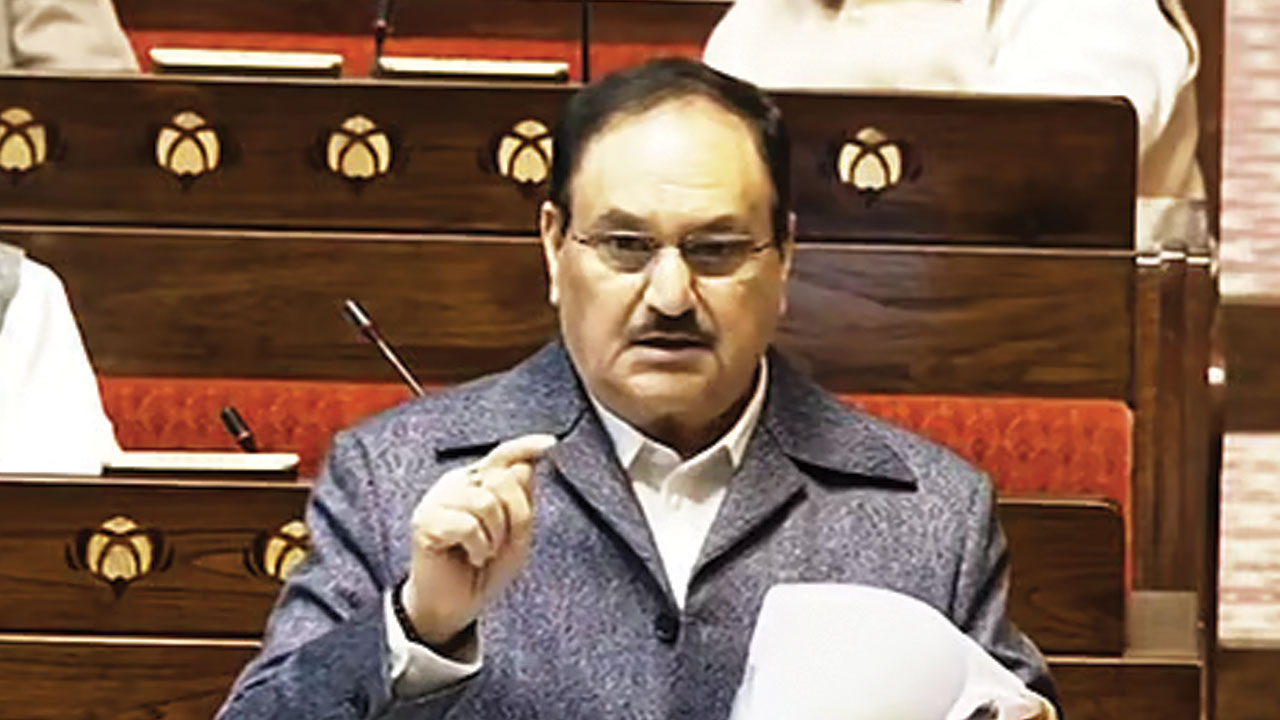
BJP National President’s address on the 150th anniversary of ‘Vande Mataram’
Bharatiya Janata Party National President and Union Minister Shri Jagat Prakash Nadda addressed the Rajya Sabha on December 11, 2025, during a discussion on ‘Vande Mataram.’ Shri Nadda stated that Vande Mataram is not merely a song, but the soul of India, the spirit of the freedom struggle, and the mantra of national resurgence.
Shri Jagat Prakash Nadda stated that in 1875, the British government attempted to impose its national anthem on India and sought to promote “God Save the Queen” in every school and public place. At that time, Bankim Chandra Chattopadhyay gifted the nation the song Vande Mataram, which was later included in his novel Anandamath in 1882.
Bankim Chandra composed Vande Mataram during a period when the British had adopted a deliberate policy to undermine and devalue Indian culture. Through this song, he envisioned Maa Bharati as the embodiment of knowledge and prosperity, symbolizing power, wealth, and learning through the goddesses Lakshmi, Durga, and Saraswati. He portrayed Maa Bharati standing like Goddess Chandi, waging a valiant battle against the enemies of the nation. The power of this mantra was so profound that the British authorities banned it. People were imprisoned merely for singing or even reciting Vande Mataram.
He stated that when Veer Vinayak Damodar Savarkar wrote an article on Vande Mataram, which was published in Bihari, he was punished for it. The charge sheet described the article as seditious and rebellious. Consequently, he was sentenced to two terms of life imprisonment and sent to the Andaman Islands (Kala Pani). Similarly, when Sri Aurobindo wrote six or seven articles on the same subject and published them in Hindu Prakash, he was also arrested, after which he moved to Puducherry.
The influence of Vande Mataram was not confined to North, Central, or East India; its resonance reached the South as well, including Tamil Nadu. The slogan of Vande Mataram echoed during the movements at Coral Mills and Tuticorin, and the song was sung even during the police firing on the public in Tirunelveli. When Khudiram Bose was hanged, his final words were Vande Mataram.
Shri Nadda, citing the 1937 Nehru Archives, stated that Jawaharlal Nehru had expressed reservations about certain aspects of Vande Mataram at that time. In September 1937, Nehru wrote to the Urdu writer Ali Sardar Jafri, criticizing the language of the song and arguing that it contained difficult vocabulary and did not align with the principles of modern nationalism and progress.
In 1937, Jawaharlal Nehru was serving as the President of the Indian National Congress, not as the Prime Minister. Around the same period, the Congress Working Committee adopted a resolution between October 26 and November 1, 1937, which stipulated that only the first two verses of Vande Mataram should be sung at national events, while the remaining verses should be used sparingly. The resolution stated that the later verses might contain ideas that could be considered offensive to certain religious or other communities.
The committee further recommended that organizers be given full freedom to sing other unobjectionable songs, while maintaining that only the first two verses of Vande Mataram be rendered at national functions.
He stated that what he had quoted clearly demonstrates that Vande Mataram has not been accorded due respect or its rightful place, and that this issue deserves serious consideration. He emphasized that he holds the national anthem, Jana Gana Mana, in the highest regard and has dedicated his life to upholding its dignity and honor.
He then questioned the extent of deliberation on the national anthem in the Constituent Assembly. While a committee was constituted on the national flag, which held detailed discussions and submitted a report, there was no similar discussion or debate on the national anthem.
Shri Nadda cited the events of January 24, 1950, noting that on the final day of the Constituent Assembly, when the three copies of the Constitution were signed, it was announced through a statement by Dr. Rajendra Prasad—without debate, discussion, or prior notice—that Jana Gana Mana would be the national anthem of India. It was also declared that Vande Mataram would be accorded the same respect as Jana Gana Mana.
He questioned how such a decision could be considered consistent with constitutional procedure or democratic practice, and argued that the matter should have been left to the members of the Constituent Assembly for deliberation and decision.
Shri Nadda read out a poignant and highly sensitive statement from that period. He stated that Jawaharlal Nehru was entirely responsible for the indifference and neglect shown towards Vande Mataram during the process of selecting India’s national anthem in the Constituent Assembly. Nehru, he said, had explicitly acknowledged this responsibility in a written reply.
A member had written to Sardar Patel, then Home Minister of India, seeking information on the steps being taken regarding the national anthem. In response, Jawaharlal Nehru replied to the letter addressed to Sardar Patel on August 25, 1948, stating that he himself was taking all decisions on the matter. Through this reply, the people of the country learned for the first time that the Indian government’s Cabinet, under Nehru’s leadership, had taken a temporary decision to project Jana Gana Mana as the national anthem outside the Constituent Assembly framework.
In his reply, Nehru also cited certain instances in support of his position. He mentioned that the tune of Jana Gana Mana had been played by a band from that region at the United Nations General Assembly in 1947, where it was appreciated by representatives of various countries, who even requested copies of the tune.
Shri Nadda questioned the authority under which Nehru had presented Jana Gana Mana as India’s national anthem on an international platform. At that time, Nehru had not yet become the Prime Minister of the country, nor had the Constituent Assembly taken any formal decision on the national anthem. He further asked from where Nehru had derived what he termed the “best constitutional practice” of first seeking international acceptance for a national anthem before it was formally adopted within the country, and why such a decision was taken prior to its acceptance by the nation itself.
He stated that during the three-year tenure of the Constituent Assembly, only nine minutes were formally devoted to the issue of the national anthem across 167 working days, despite repeated demands for a serious discussion by members such as Shri Hari Vishnu Kamath, Seth Govind Das, Shri Shiban Lal Saxena, Shri B. Das, and Shri Lakshmi Narayan Sahu. However, substantive debate on the matter was not permitted.
On November 15, 1948, Shri Shiban Lal Saxena proposed the inclusion of Vande Mataram in the Second Schedule of the Constitution, but the proposal was rejected. During this period, the question also arose as to whether a committee should be constituted for the national anthem, similar to the committee formed for the national flag.
Jawaharlal Nehru wrote to the Governor of Assam, Shri Prakash, stating that the decision of the Constituent Assembly should be awaited with regard to both the national flag and the national anthem, and that Vande Mataram was not considered suitable as the national anthem.
In a letter dated June 21, 1948, addressed to Shyama Prasad Mukherjee, Nehru explicitly stated that Vande Mataram was not feasible as the national anthem because its tune was not suitable for ceremonial occasions and band performances.
These facts, he argued, demonstrate that there was a marked difference in the process and decision-making regarding the selection of the national anthem and the treatment of Vande Mataram at that time, and that it is essential for the citizens of the country to be aware of this historical context.
He stated that he wished to clarify that the national anthem and the national song are distinct. Jawaharlal Nehru’s view was that the tune of Vande Mataram, despite its historical significance and emotional appeal, was not inherently suitable for foreign occasions and orchestral performances, and therefore did not receive adequate support at the time.
On October 15, 1937, Muhammad Ali Jinnah issued a fatwa against Vande Mataram at the Lucknow session. Instead of protesting against this, Nehru initiated an inquiry into the matter. Subsequently, on October 20, 1937, Nehru wrote to Subhas Chandra Bose, acknowledging that the background imagery and musical context of Vande Mataram in Anandamath could be perceived as provocative to the Muslim community.
Thereafter, Vande Mataram was reviewed at meetings of the Congress Central Executive Committee and in Bengal, but it was not accorded its due place or respect.
The Prevention of Insults to National Honour Act, enacted in 1971, prescribed penalties for insulting the national flag and the national anthem; however, it did not extend similar protection to the national song, Vande Mataram. Consequently, there was no statutory provision to ensure respect for Vande Mataram.
Shri Nadda stated that Vande Mataram is intrinsically linked to India’s nationalism and should be promoted in that spirit. He argued that it deserves the same respect and status as the national flag and the national anthem, and should be included in the Constitution.