 PrintFriendly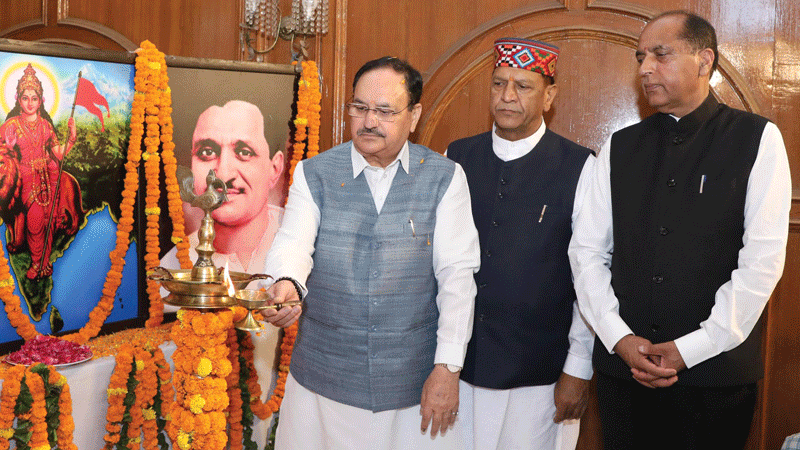
On the completion of 12 years of Modi Government, Union Minister Shri Jagat Prakash Nadda addressed a press conference in Shimla on 13 June 2026. Shri Nadda highlighted the significant achievements of the Modi government in economic growth, infrastructure development, social welfare, healthcare, technology, and global diplomacy and said the last twelve years under the leadership of Prime Minister Shri Narendra Modi have been a period of unprecedented transformation in India’s history.
Shri Nadda noted that Prime Minister Shri Modi has become the longest-serving Prime Minister in independent India, a milestone that reflects the trust and confidence reposed in him by the people through successive electoral mandates. He said this achievement is a testament to the Prime Minister’s commitment to public service and his ability to deliver results through decisive and transparent governance.
Highlighting India’s economic progress, Shri Nadda said the country has moved from being categorized among the “Fragile Five” economies to becoming the world’s fourth-largest economy and one of the fastest-growing major economies globally. Inflation has remained under control, foreign investment has increased significantly, and India’s economic fundamentals have strengthened. International institutions such as the IMF and World Bank have recognized India’s growing role in driving global economic growth.
One of the most notable reforms, according to Shri Nadda, has been the successful implementation of Direct Benefit Transfer (DBT). Through technology-enabled governance, benefits have reached citizens directly, eliminating leakages and corruption while improving transparency and accountability. This has ensured that welfare schemes effectively reach their intended beneficiaries.
The Modi government has also undertaken an unprecedented expansion of infrastructure. Massive investments in highways, railways, airports, digital connectivity, logistics corridors, and urban infrastructure have transformed the country’s development landscape. Initiatives such as Vande Bharat trains, expressways, metro networks, and PM Gati Shakti have improved connectivity and accelerated economic growth.
Shri Nadda emphasized that social welfare has remained at the centre of the government’s development agenda. Schemes providing housing, electricity, drinking water, toilets, healthcare, banking access, and cooking gas connections have improved the quality of life for millions of families. These efforts have particularly benefited the poor, marginalized, and rural populations.
Healthcare infrastructure has also witnessed substantial expansion. New AIIMS institutions, medical colleges, super-speciality facilities, and the Ayushman Bharat programme have significantly improved access to affordable healthcare services. The government has worked to strengthen both preventive and curative healthcare systems across the country.
Women’s empowerment has emerged as a major focus area under Prime Minister Modi’s leadership. Through initiatives promoting financial inclusion, entrepreneurship, education, healthcare, and political participation, women have gained greater opportunities and recognition. Shri Nadda highlighted that programmes aimed at empowering women have contributed significantly to social and economic development.