

 PrintFriendly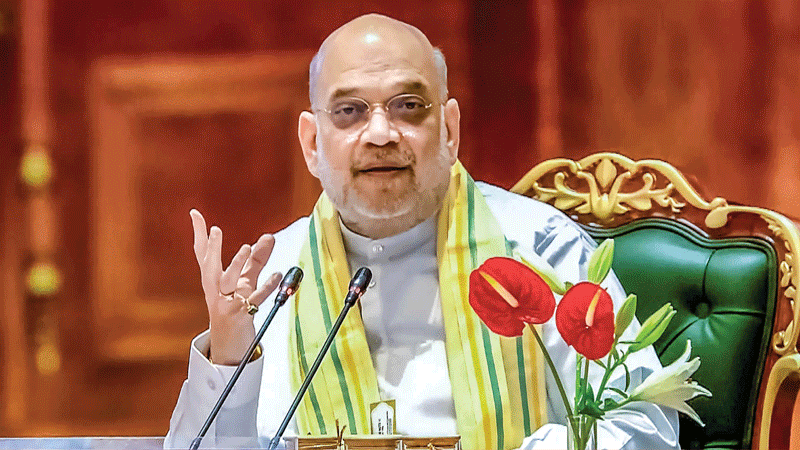
12 years of the NDA government
Union Home and Cooperation Minister Shri Amit Shah described Prime Minister Shri Narendra Modi becoming India’s longest-serving elected Prime Minister as a historic milestone in the nation’s democratic journey. Addressing the National Democratic Alliance meeting at Bharat Mandapam in New Delhi 10 June 2026, Shri Shah said that Prime Minister Shri Modi’s leadership has ushered in an era of political stability, decisive governance, economic growth, national security, and public welfare, laying the foundation for a confident, self-reliant, and globally respected India
Union Home and Cooperation Minister Shri Amit Shah noted that this achievement is particularly remarkable in the age of competitive politics, where electoral success depends on performance and public trust. Being repeatedly chosen by the people and leading the country continuously for such a long period reflects the confidence that citizens have placed in Prime Minister Shri Modi’s leadership. He said this period will be remembered as an era of stable governance, effective policymaking, and consistent implementation.
Elevated India’s stature on the global stage
Highlighting Prime Minister Shri Modi’s role during times of crisis, Shri Shah recalled how he transformed Gujarat following the devastating earthquake in Kutch. He said that the Prime Minister’s ability to lead from the front was again demonstrated during the COVID-19 pandemic, when he united the Central Government, State Governments, and 140 crore Indians in a collective effort to combat the crisis. Under his leadership, India emerged as one of the first nations to develop vaccines and became a global example of effective crisis management.
According to Shri Shah, Prime Minister Shri Modi has consistently placed India’s interests first in dealing with major international challenges, including geopolitical conflicts and regional tensions. His balanced and decisive foreign policy has elevated India’s stature on the global stage while ensuring national interests remain paramount.
The Home Minister emphasized that Prime Minister Shri Modi’s significance lies not merely in the duration of his tenure but in the transformative impact of his leadership. Over the past 25 years as Chief Minister and Prime Minister, he has earned widespread democratic acceptance and guided India through a period of unprecedented development.
PM Modi bowed before Parliament
Shri Shah recalled that upon becoming Prime Minister in 2014, Shri Narendra Modi bowed before Parliament, describing it as the temple of democracy, and later introduced himself to the nation as “Pradhan Sevak,” reinforcing the spirit of public service.
Constitution as his guiding principle
Shri Shah stated that Prime Minister Modi has governed with the Constitution as his guiding principle while embodying the ideals of service, humility, and nation-first governance. Taking office at a time marked by corruption, policy paralysis, and economic uncertainty, he developed long-term strategies that have transformed India’s governance architecture and restored public confidence in institutions.
Referring to the celebration of Azadi Ka Amrit Mahotsav, Shri Shah said Prime Minister Shri Modi successfully connected the younger generation with India’s freedom struggle, cultural heritage, and unsung heroes. More importantly, he transformed the concept of Amrit Kaal into a national mission by presenting the vision of a developed India by 2047. What began as a government initiative has evolved into a collective aspiration shared by 140 crore Indians.
India is increasingly driven by self-confidence
The Home Minister observed that Prime Minister Modi’s vision has helped eliminate the sense of inferiority that once affected the national psyche. Today, India is increasingly driven by self-confidence, ambition, and a belief in its own capabilities. The youth, in particular, have embraced the vision of a prosperous, secure, and globally influential India.
Shri Shah highlighted the growth of the NDA under Prime Minister Modi’s leadership, noting that it has evolved beyond a political alliance into a partnership committed to national development. He credited the Prime Minister’s leadership for strengthening governance across large parts of the country while expanding public welfare initiatives on an unprecedented scale.
He pointed to landmark welfare measures that have transformed the lives of millions. Over the past twelve years, access to electricity, sanitation, drinking water, housing, healthcare, banking services, and cooking gas has expanded dramatically. Welfare programmes have improved living standards, empowered women, and provided social security to the poorest sections of society. The emergence of millions of “Lakhpati Didis” reflects the success of women-centric development initiatives.
Aspirational Districts Programme
Shri Shah also praised the Aspirational Districts Programme, describing it as one of the most innovative governance reforms undertaken under Prime Minister Modi. Districts once considered backward are now competing to achieve excellence in governance and development. This transformation, he said, demonstrates the effectiveness of a performance-oriented governance model.
According to Shri Shah, Prime Minister Modi has also redefined Indian politics by shifting the focus from caste-based, dynastic, and appeasement-driven politics to development-oriented governance. Citizens increasingly evaluate governments on performance, delivery, and outcomes, strengthening the foundations of Indian democracy.
The Home Minister highlighted several landmark decisions taken during the Modi government, including the abrogation of Articles 370 and 35A, the abolition of triple talaq, implementation of the Citizenship Amendment Act, and major legal reforms through the Bharatiya Nyaya Sanhita and Bharatiya Nagarik Suraksha Sanhita. He also credited the government for significant progress in combating terrorism and Left-Wing Extremism through a policy of zero tolerance.
Shri Shah noted that India has undergone a remarkable economic transformation under Prime Minister Modi’s leadership. From being grouped among the “Fragile Five” economies, India has risen to become one of the world’s largest economies. Banking reforms, digital governance, foreign investment promotion, production-linked incentives, and the JAM Trinity have strengthened economic growth and transparency.
Women empowerment
Women empowerment has emerged as another defining feature of the Modi era. Through initiatives such as the Nari Shakti Vandan Act and expanded opportunities in defence, policing, science, entrepreneurship, and sports, women have gained greater participation in nation-building.
The Home Minister also emphasized India’s infrastructure revolution. Massive investments in highways, railways, airports, ports, metro systems, freight corridors, waterways, and digital connectivity have transformed the country’s development landscape. Programmes such as PM Gati Shakti have created a foundation for sustained economic growth.
In the fields of culture, heritage, and spirituality, Shri Shah highlighted the construction of the Ram Mandir, redevelopment of Kashi Vishwanath Dham, Mahakal Lok, and Kedarnath, as well as the successful hosting of the G-20 Summit, which showcased India’s civilizational heritage to the world.
India’s achievements
He further praised India’s achievements in space, innovation, semiconductor manufacturing, defence production, renewable energy, and emerging technologies. Missions such as Chandrayaan-3, Gaganyaan, the National Quantum Mission, and the India Semiconductor Mission have positioned India as an emerging technological leader.
Shri Amit Shah said Prime Minister Narendra Modi’s journey from a humble background to the highest office in the country represents the strength of Indian democracy. Completing 25 years in public office as Chief Minister and Prime Minister is a rare achievement in democratic politics. Through tireless dedication, personal integrity, and unwavering commitment to the nation, Prime Minister Modi has inspired millions and laid the foundation for a developed India by 2047. His leadership, Shri Shah asserted, will be remembered as a defining chapter in India’s modern history.