 PrintFriendly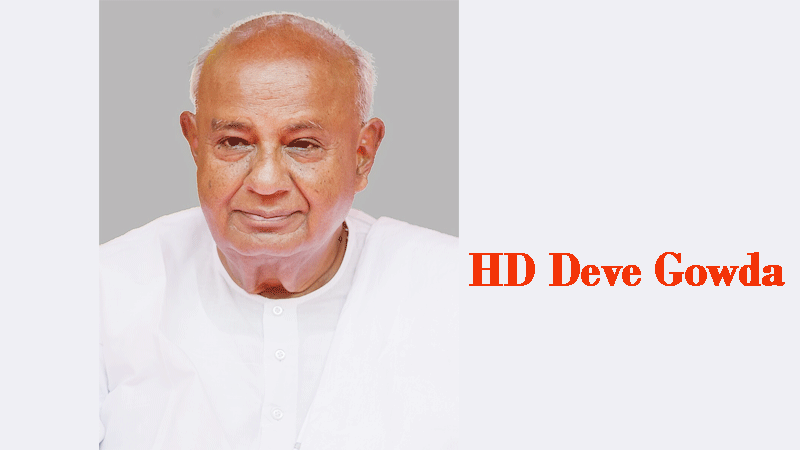
Former Prime Minister argues that Shri Modi, who’s surpassed Nehru’s record as longest-serving PM, has been uncompromising in protecting national interest
Modi is now India’s longest-serving, democratically elected prime minister. This surpasses Nehru’s record. More importantly, it speaks volumes about how democracy hasn’t just survived, but thrived in India.
Nehru was chosen to be the country’s first PM in 1947, under extraordinary circumstances, from among several equally talented and dedicated men. It was actually Gandhi’s moral command over the masses, which ensured his appointment. Nehru then carried both Gandhi’s blessings and the halo of the freedom movement, into the first general election in 1952.
At that time, Congress party was a monopoly. It faced no political competition. Although 53 political parties contested the general election, their presence and influence were minuscule. From there, to the time Modi was catapulted to the PM’s office for the first time in 2014, and the third time in 2024, India became a very different nation. Almost unrecognisable in terms of size, diversity, and economy.
It is very tempting, although not exactly prudent, to say that it was easier to be elected PM in 1952 than in 2014 or 2024. Even by the time I became PM in 1996, the circumstances as well as political parameters and competition had totally shifted.
The nation had become more questioning, more engaging, more mature.
There was no glowing halo to be claimed for PMs outside the Nehru-Gandhi dynasty. Others had no privilege, pedigree, or patronage available to be used as a springboard. In the case of Modi, and also myself, we did not even have the social and cultural capital that many other PMs have enjoyed.
I did not last long; my tenure was only about 11 months. And I wonder by what blessings Modi continues to be at the top with no signs of exhaustion, neither in him, nor in the people who have elected him. His stamina and his endurance in office are so distinctive.
Let us look at some interesting statistics that illustrate the enormity of changes since Nehru’s time. In terms of simple political competition, when the 1952 polls took place, there were, to repeat, just 53 parties in the fray, whereas Modi contested with 2,593 in 2024. The number of voters in Nehru’s time was 17cr, by 2014 it was 83cr. India’s population, which was 34cr in 1952, today stands at 146cr-plus.
Another aspect that has fascinated me is that Nehru’s cabinet didn’t really reflect the community, cultural, caste diversity of India. Even when Nehru was in his third and final term as PM, the cabinet remained filled with mostly upper caste men. Nehru had rejected the Kaka Kelkar Commission report, which had attempted to provide
There was no glowing halo to be claimed for PMs outside the Nehru-Gandhi dynasty. Others had no privilege, pedigree, or patronage available to be used as a springboard. In the case of Modi, and also myself, we did not even have the social and cultural capital that many other PMs have enjoyed
reservation for the depressed and backward classes.
The cabinet that Modi presides over now is spectacularly diverse. It has 27 OBCs, 10 SCs, and 5 STs. Representation of women, too, has gone up significantly. Modi also sincerely proposed to expand the strength of the Parliament, in April 2026, to give historic representation to women, and make ours a more perfect union. He has already ensured the passage of the Women’s Reservation Bill.
India today is a far more noisy and loud democracy than it was under Nehru. Caste awareness, constitutional rights, civic rights, gender awareness, environmental concerns etc have all exploded to new levels. India under Nehru was mostly illiterate.
Plus, people didn’t really know what to expect from a democratic govt. It was a new system. Today’s citizens, for the good of our nation and democracy, are more educated and enlightened. Nothing slips past their attention.
Nehru had to, at most, deal with half a dozen newspapers, but Modi has to endure the scrutiny of millions every single second, because of social media platforms, on which criticism can be unverified, unfair, and also terribly harsh and personal. Plus, he has to contend with round-the-clock criticism, and sometimes hostility, of mainstream press. In Nehru’s time, there was no television news.
I congratulate Modi for ensuring that India remains a robust democracy under his charge. His effort to also ensure that India remains the fastest growing economy, his welfarist policies, and his decisiveness during military conflicts also deserve special attention. He has been uncompromising when it comes to the nation’s interests.
Modi hasn’t just been the executive head, but also the chief counsellor of the nation, who has continuously, and empathetically, engaged with all manners and classes of people. I never miss his Mann Ki Baat radio programme. Or his awards list, in which great achievers are scouted and feted. Here too, he has tried to reach more people every square mile. There is no other PM who has used technology like him. All this could not have been done without selfless commitment.
Finally, Modi is successful because he has remained reflective. He has kept himself open to constant scrutiny.
(The Writer is former Prime Minister of India)