
 PrintFriendly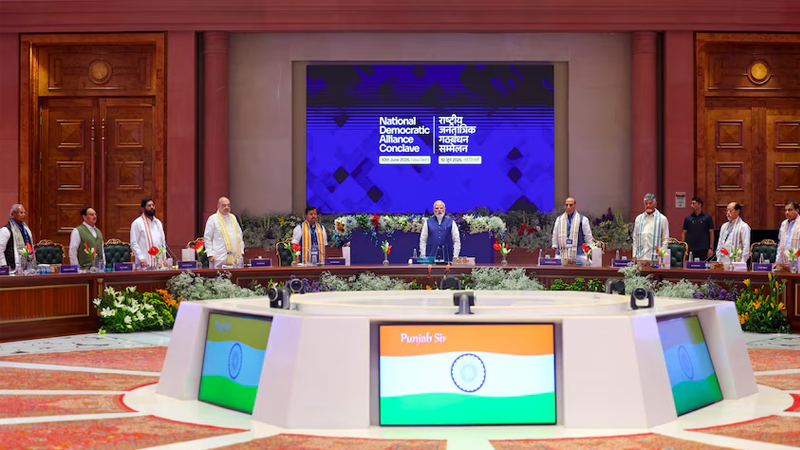
We, the National Democratic Alliance (NDA), express our heartfelt gratitude to the people of India and congratulate Prime Minister Shri Narendra Modi on becoming the longest-serving democratically elected Prime Minister of India in consecutive terms.
Today, on 10th June 2026, having completed 4,399 days in office, PM Modi surpasses a milestone that had stood for 62 years. In the intervening period, India witnessed 13 Prime Ministers, underscoring the exceptional nature of PM Modi’s accomplishment. He has won the confidence of the people repeatedly as his leadership is anchored in a deep commitment to fulfilling the aspirations (or Jan Akansha) of each and every Indian. His leadership epitomises delivery, accountability and integrity.
We are meeting at a time when the NDA Government at the Centre successfully completes of 12 years of serving the people. Under PM Modi’s leadership, the defining character of the last 12 years has been the seamless integration of people-centric development, participative democracy and performance-oriented governance. His governance model is responsive to citizens, innovative in its approach and transformative in its impact, in the true spirit of ‘Sabka Saath, Sabka Vikas, Sabka Vishwas, Sabka Prayas.’
Shri Narendra Modi is the first Prime Minister of India born after Independence, bringing to national leadership the perspective of those shaped by the aspirations of a free India. He is also the first non-Congress Prime Minister to complete two full terms in office and secure a third consecutive mandate from the people. PM Modi has formed a unique bond with the people of India through his tireless dedication, transformative vision and ability to translate aspirations into outcomes.
Great leadership is often forged in periods of uncertainty and challenge. In such moments, vision, resolve and the ability to inspire collective confidence acquire their greatest significance. History’s enduring leaders are those who confront the difficulties of their times and transform them into opportunities for national resurgence.
When PM Modi assumed office in May 2014, he inherited an economy and governance architecture facing serious challenges. Confidence in public institutions had been eroded by years of drift and uncertainty. The world was penning obituaries of India, grouping our nation among the ‘Fragile Five’ economies. Policy paralysis had become pervasive. The banking sector was in deep stress, non-performing assets had reached worrying levels and investment activity had slowed considerably.
PM Modi’s leadership has since brought about a remarkable transformation. From being among the ‘Fragile Five’, India has emerged as one of the world’s leading economies and is the fastest-growing major economy. Global confidence in India has reached unprecedented levels, as seen, for example, in the 15 trade deals (covering 38 nations) signed in recent times. The world agrees that if one wants investment, innovation and long-term growth, India is the place to be.
PM Modi has shown the will to pursue bold reforms. The Goods and Services Tax (GST), implemented through broad consensus, created a unified national market and fulfilled a long-standing national objective. Landmark labour reforms simplified and modernised outdated frameworks. Thousands of obsolete laws were repealed, reducing regulatory burden and improving ‘Ease of Living’ and ‘Ease of Doing Business.’
Due to a series of reforms, India’s banking sector witnessed a remarkable turnaround. Transparent recognition of bad loans, faster resolution, recapitalisation of banks and systemic reforms strengthened financial discipline and improved governance. The gross NPA ratio fell to the lowest level in several decades.
As a result, India began to dream again and dream big. The spirit of enterprise found new energy. Through initiatives such as Startup India, a vibrant innovation ecosystem emerged, making India one of the world’s leading startup hubs. New sectors such as semiconductors, renewable energy, electronics manufacturing, drones, space technology and advanced manufacturing are expanding rapidly. The rise of wealth creators is no longer confined to a few metro cities. Youth from Tier-II and Tier-III cities as well as rural India are leading the next wave of innovation and job creation.
We acknowledge the efforts of PM Modi towards making India a leader in technology, research and innovation. This significantly improved public service delivery, reduced leakages and brought transparency. It is under PM Modi’s leadership that India has emerged as a leader in the digital economy. Our UPI has revolutionised digital payments and is also popular globally.
Another area where our Yuva Shakti is dreaming big is sports. Thanks to PM Modi’s personal emphasis on strengthening a sporting culture, our youth is finding the right opportunity and support. As a result, India’s presence on global sporting stages continues to grow. A thriving sports economy is emerging, generating opportunities in coaching, sports science, manufacturing, event management and allied sectors.
In the past 12 years, India has witnessed one of the most ambitious infrastructure transformations in its history. Nowhere is this more visible than in the transformation of the railways, the lifeline of India. Railway station redevelopment under the Amrit Bharat Station Scheme is creating modern, accessible and passenger-friendly stations. Record electrification has made the railway network cleaner, faster and more efficient. New-generation trains such as Vande Bharat and Amrit Bharat are symbols of a confident and aspirational India, combining speed, comfort and indigenous innovation.
For decades, air travel was the preserve of a small privileged elite. Through initiatives such as UDAN and sustained investment in airport infrastructure, flying has now become accessible to crores of travellers. The number of operational airports has expanded dramatically, improving regional connectivity.
The infrastructure revolution has also transformed the experience of everyday travel. Across the country, modern bus terminals and multimodal transport hubs are being developed with facilities and standards once associated only with airports.
India’s infrastructure development was plagued by silos and delays earlier. Understanding the people’s impatience with this culture, PM Modi led from the front and brought in substantive changes. The PM Gati Shakti National Master Plan introduced a new approach to integrated infrastructure planning. PRAGATI, which completed 50 sessions a few months ago, has been a game-changer in expediting delayed projects. Development projects worth about Rs. 90 lakh crore have been accelerated through the PRAGATI ecosystem.
One of the defining features of PM Modi’s leadership has been the conviction that the fruits of development cannot be a luxury reserved for a privileged few, but a fundamental requirement for national development. There has been an emphasis on banking the unbanked, funding the unfunded, insuring the uninsured, housing the homeless, connecting the unconnected, reaching the unreached, empowering the underserved and mainstreaming the marginalised.
The clearest measure of governance is its impact on the lives of the poorest. Under PM Modi’s leadership, more than 25 crore Indians have risen out of multidimensional poverty, transforming lives at a scale unprecedented in independent India and reaffirming the NDA’s commitment to Antyodaya.
India’s Nari Shakti has continuously bestowed blessings upon PM Modi due to his emphasis on women-led development. The Beti Bachao, Beti Padhao movement brought national attention to the importance of the girl child. The support for Self-Help Groups enabled crores of women to become wealth creators. Through initiatives such as Drone Didi, women are being equipped with cutting-edge technology and livelihood opportunities. The passage of the Nari Shakti Vandan Adhiniyam was a historic step towards enhancing women’s participation in legislative institutions.
We compliment PM Modi for leading the most farmer-friendly government in Indian history. The PM-Kisan initiative provided direct income support to farmers. Crop insurance coverage expanded. The Government strengthened agricultural infrastructure, improved market access, promoted natural farming and invested in irrigation and rural development. Much-needed support has been given to allied areas such as fisheries, dairy, beekeeping. The two new ministries created by the NDA government, fisheries and cooperation, indicate the Government’s priorities.
We, the NDA family, would like to applaud the Central Government for its emphasis on reaching the last mile and ensuring that the benefits of development reach every citizen, irrespective of geography or socio-economic status. This commitment is particularly visible in the Pradhan Mantri Janjati Adivasi Nyaya Maha Abhiyan (PM-JANMAN), a first of its kind initiative which empowers Particularly Vulnerable Tribal Groups (PVTG) in some of the most remote habitations of the country. Housing, roads, healthcare, education, drinking water and livelihood opportunities are helping bring these communities to the mainstream of development.
Villages on the border, once described as the ‘last villages’ of the country, are today being proudly referred to as the ‘first villages’ of India, thanks to PM Modi. More than a shift in terminology, it’s a shift in mindset where border communities are recognized as the first custodians of India’s security and identity. Significant investments in connectivity and public services have improved the quality of life in these regions.
In this era of technology, mobile connectivity is essential to ensuring inclusive development. But for long, several parts of India were unconnected. We note with immense gladness the rapid expansion of mobile and digital connectivity to previously unconnected areas such as remote tribal regions, high-altitude border settlements, previously Maoist-affected areas and far-flung coastal areas. This has unlocked access to education, healthcare, financial services, governance and economic opportunities.
One of the fundamental principles of leadership is the recognition that a nation can realise its full potential only when every part, every region participates in its growth story. PM Modi’s commitment to balanced and inclusive development has unlocked the potential of regions that remained underserved for decades. For far too long, the immense potential of Eastern India remained underutilised despite its rich natural resources, cultural heritage and human capital. Under the NDA Government, renewed emphasis has been placed on strengthening infrastructure, connectivity, industry, agriculture and social development across the region. This transformation is equally visible in the Northeast. Once viewed through the prism of distance and neglect, the region has emerged as the ‘Ashtalakshmi’ of India’s development journey. Now, our Northeast is closer to the national mainstream than ever before.
PM Modi’s detail-oriented approach can be seen in two unique programmes. The Aspirational Districts Programme focuses attention on districts that historically lagged behind on key indicators. Building on its success, the Aspirational Blocks Programme is now taking this approach to a more granular level by focusing on blocks.
Development can flourish and national aspirations can be realised only when the nation is capable of defending its own interests. Over the last 12 years, India has demonstrated unprecedented resolve in combating terrorism. Whether through the surgical strikes, air strikes or the recent Operation Sindoor, India has made it clear that terrorism and those who support it will face a decisive response. The decades-long challenge of Left Wing Extremism has been eliminated through a combination of security measures, development initiatives and improved governance. At the same time, the NDA Government has pursued self-reliance in defence. Under the vision of Aatmanirbhar Bharat, India has significantly expanded indigenous defence manufacturing, strengthened domestic capabilities and encouraged innovation in strategic sectors.
For decades, the issue of ‘One Rank One Pension’ was neglected. The same people who first withdrew it were subsequently sitting on the demand to bring it back. PM Modi made a promise to our brave ex-servicemen that OROP will be implemented and fulfilled it in record time. It has positively impacted lakhs of ex-servicemen. Earlier, we kept hearing the phrase ‘defence reforms’ but action on the ground was limited. In one of the biggest reforms, the Government created the post of Chief of Defence Staff, strengthening India’s national security architecture. These measures have advanced greater coordination, long-term planning and jointness among the armed forces.
We, the NDA family, feel proud that India today stands taller on the global stage than ever before. 32 nations have conferred their top honours on PM Modi, reflecting global recognition of his leadership and impact. Today, India’s voice is heard with respect in international forums. India has emerged as a constructive and influential force in addressing climate change, global health, economic cooperation, energy security and regional stability. When humanity faced a once in a century pandemic of COVID-19, India showed global leadership by providing vaccines and medicines to the world.
PM Modi’s foreign policy outreach has made a mark in various ways. A nation like UAE, which houses a huge chunk of the diaspora should have witnessed maximum engagement. However, when PM Modi went to UAE in 2015, it was the first visit by an Indian PM in almost 35 years. Likewise, when PM Modi went to Nepal in 2014, it was the first visit by an Indian PM in 17 years, which was bewildering considering the longstanding civilisational ties. There are numerous such examples.
Today, India engages with the world with confidence and a strong sense of civilisational identity. The adoption of the International Day of Yoga by 190 nations stands as a recognition of India’s timeless wisdom and its relevance to the modern world. Hundreds of stolen artefacts and antiquities have returned home, reconnecting India with important chapters of its civilisational heritage. India’s successful efforts to promote millets or Shree Anna globally brought renewed attention to sustainable agriculture and nutritional security.
As the NDA celebrates 12 years of good governance, we also reflect on the remarkable journey of the Alliance itself.
Almost three decades ago, under the guidance of several leading lights like Atal Bihari Vajpayee Ji, LK Advani Ji, Dr. Murli Manohar Joshi Ji, George Fernandes Ji, Balasaheb Thackeray Ji, Sardar Parkash Singh Badal Ji, Sikandar Bakht Ji and several others, the NDA was formed to bring together diverse parties and people under the common mantra of India First.
The NDA has seamlessly harmonised regional aspirations with national priorities and institutionalised the spirit of cooperative federalism. States became partners in development. The relationship between the Centre and States was redefined through consultation, collaboration and shared responsibility. Having served as the Chief Minister of Gujarat for many years, PM Modi perfectly understands the importance of this facet of our polity.
Over the years, the NDA has expanded significantly.
Today, the NDA:
Governs states that together account for over three fourths of India’s population.
Has governments in almost three fourths of India’s territory.
Has governments in 7 of the top 10 states with the highest SC population.
Has governments in 8 out of 10 states with the highest ST population.
Since 2014, the NDA has expanded both in terms of parties and geography.
Since 2014, the NDA has formed governments for the first time in states such as Haryana, Tripura, Assam and West Bengal.
The NDA won historic mandates in states like Andhra Pradesh, Bihar and Maharashtra, where respected alliance partners are integral parts of the Government.
In Gujarat, the BJP has been winning every election since 1995.
In Uttar Pradesh, the BJP created history by being the first ever party in over four decades to return to power.
The NDA is in power in almost all the states of the Northeast, many of which have high tribal as well as Christian populations.
Indian politics often witnessed a phenomenon called anti-incumbency, where incumbent governments were defeated due to non-performance. We are happy to note that the NDA has ushered in an era of pro-incumbency.
It was only in 2024, after more than 60 years, that an alliance returned to power for a third consecutive term at the national level. This has happened due to the record support from the youth and women, who have given a strong stamp of approval to PM Modi’s leadership.
Today, India stands at a vital juncture. The world wants to invest in India and engage with our youth. Our strides across diverse fields are being noted. Our collective vision of Viksit Bharat by 2047 provides a clear direction for the future. The achievements of the last 12 years constitute a robust foundation upon which an even stronger, more prosperous and self-reliant India can be built.
The National Democratic Alliance expresses its deepest gratitude to the people of India for their continued trust and support. It congratulates Prime Minister Shri Narendra Modi for his visionary leadership and tireless dedication to public service. It also acknowledges the invaluable contribution of every NDA constituent party, every elected representative and every karyakarta who worked to translate this vision into reality.
With renewed commitment and confidence, the NDA resolves to continue working towards the goal of a Viksit Bharat.