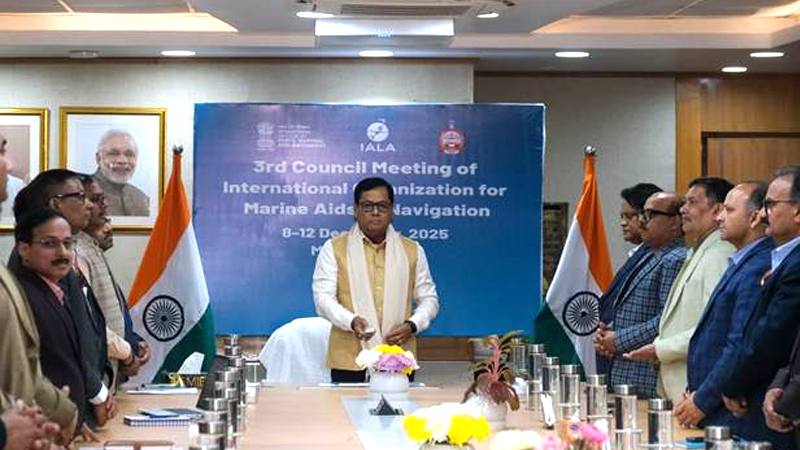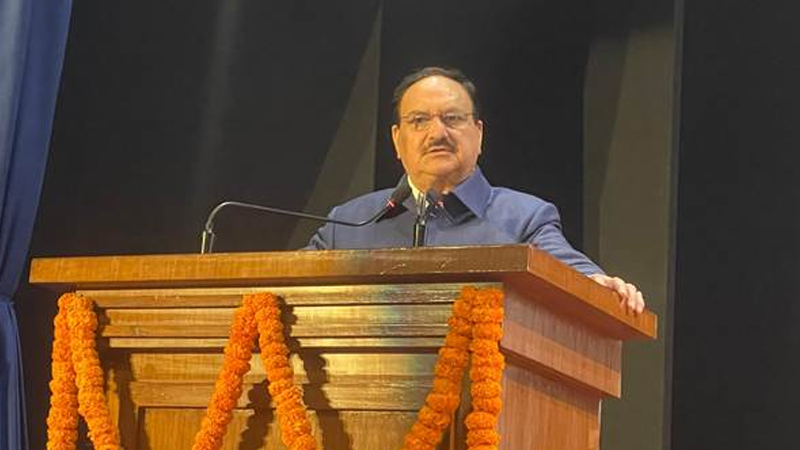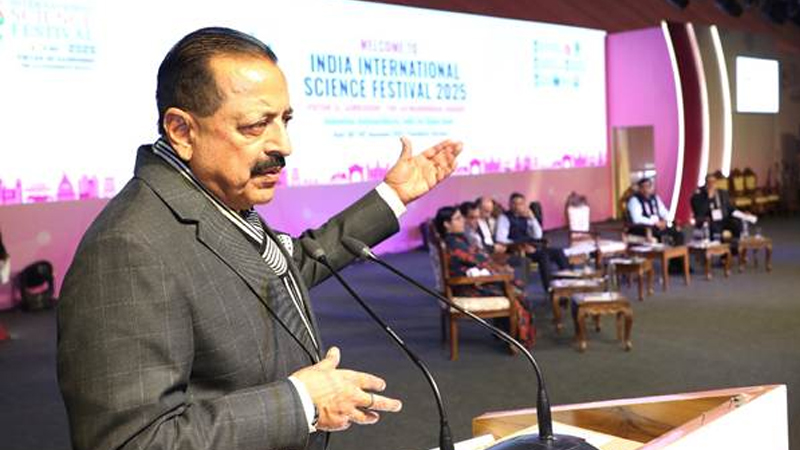

Dr. Jitendra Singh addresses Mauritius bureaucrats, highlights the common stake in ‘Blue Economy’

| Published on:

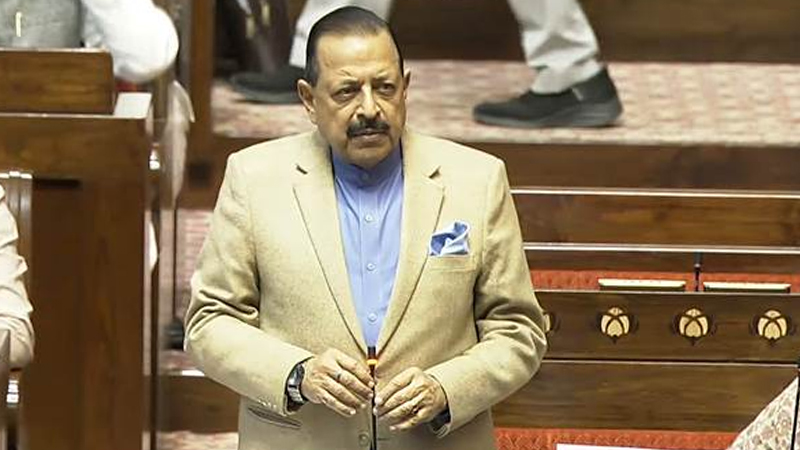
While addressing a visiting group of Mauritius bureaucrats here today, Union Minister Dr. Jitendra Singh highlighted common stake of the two countries in ‘Blue Economy’.

The Minister called for deeper cooperation between India and Mauritius in emerging areas such as fisheries, ocean technologies, and desalination, describing them as “new frontiers of sustainable growth and mutual prosperity” for both maritime nations.

Addressing senior Mauritius civil servants at the National Centre for Good Governance (NCGG) in New Delhi, he said India’s vast experience in marine resource management and ocean-based technologies could play a pivotal role in supporting Mauritius’s development goals.

Dr. Jitendra Singh, who was interacting with a delegation of 17 senior officials from 14 Mauritian ministries attending the 2nd Capacity Building Programme for Senior Civil Servants, spoke at length about India’s success in harnessing ocean resources through initiatives like the Deep Ocean Mission. He said India’s expertise in desalination—turning seawater into potable water—had already transformed island territories such as Lakshadweep and could offer practical solutions for Mauritius, which faces challenges of freshwater scarcity despite being surrounded by the ocean.

“Water, water everywhere, not enough to drink—this contradiction can be addressed through technology, said the Minister. Our desalination plants have successfully converted saline water into drinking water while generating green energy from the same process,” Dr. Jitendra Singh observed during the interaction.

The Minister also encouraged Mauritian officials to explore collaborative projects in the blue economy and marine research, suggesting that India’s Earth Sciences institutions and related agencies could work closely with Mauritian counterparts to develop a ten-year blueprint for ocean economy development. He emphasised that partnerships in ocean science, renewable energy, and digital governance could not only drive economic growth but also strengthen the resilience of island nations facing climate and resource pressures.

The programme, being held from November 10 to 15 at NCGG, is part of a long-term cooperation framework signed between India and Mauritius in March 2025, under which 500 Mauritian civil servants will be trained over five years. The current delegation, led by Dr. Dhanandjay Kawol, Senior Chief Executive of the Mauritian Ministry of Public Service and Administrative Reforms, represents one of the most senior batches to visit India under this initiative.

In their interventions, Mauritian participants acknowledged India’s support in critical infrastructure and governance reforms, including the establishment of the new Forensic Science Laboratory, renewable energy projects such as floating solar panels, and digitalisation efforts in education and social security. They also expressed interest in leveraging India’s technological expertise for performance-based budgeting, fiscal accountability, and public service efficiency.

Dr. Jitendra Singh noted that technology is a powerful enabler of transparency and accountability, helping governments build trust and deliver better outcomes. “Technology contributes to transparency, and transparency leads to transformation,” he said, underlining India’s journey toward digital governance over the past decade.

India and Mauritius share a unique bond rooted in history, culture, and people-to-people ties. Nearly 70 percent of Mauritians trace their ancestry to India, and cooperation between the two countries spans infrastructure, education, maritime security, and skill development. Dr. Jitendra Singh said that the ongoing collaboration in civil service capacity building represents a “fruitful investment in future governance,” one that will help both nations cultivate transparent, efficient, and citizen-centric administrative systems.

As the week-long programme continues, both sides are expected to explore potential projects in the blue economy, renewable energy, and desalination technology—sectors that, as Dr. Jitendra Singh noted, could “define the next decade of India–Mauritius partnership.”

Union Agriculture Minister presents ‘Plant Genome Saviour Awards’ to farmers in New Delhi

| Published on:

Union Minister for Agriculture & Farmers’ Welfare, and Rural Development, Shri Shivraj Singh Chouhan today participated in the ‘Plant Genome Saviour Awards Ceremony’, celebrating the Silver Jubilee of the Protection of Plant Varieties and Farmers’ Rights (PPV&FRA) Act, 2001 and the 21st Foundation Day of the PPV&FRA, held at C. Subramaniam Hall, Pusa Campus, New Delhi. On this occasion, the Union Minister felicitated select farmer awardees from across the country for their outstanding contributions to seed conservation and biodiversity.

Among the awardees were the Community Seed Bank of Telangana, Shiksha Niketan of Purba Bardhaman, West Bengal, Mithilanchal Makhana Producers’ Association, CRS-Na Dihing Tenga Unyan Committee of Assam, Shri Bhupendra Joshi of Uttarakhand, Shri T. Joseph of Kerala, Shri Lakshan Pramanik, Shri Ananthamurthy J, Shri Nakul Singh of Bihar, and Shri Narendra Singh of Uttarakhand, among others from various categories.

In his address, Union Agriculture Minister Shri Shivraj Singh Chouhan commended the Protection of Plant Varieties and Farmers’ Rights Authority (PPV&FRA) for its “remarkable achievements” over the past two decades. He said that Indian agricultural practices are among the oldest in the world, forming the very foundation of the nation’s civilisation. “Many indigenous crop varieties are vital for nutrition and ecological balance,” he said, noting that several traditional varieties were on the verge of extinction, and it was through the dedication of farmers that these seeds have been preserved.

The Union Minister emphasised that under the PPV&FRA Act, the government provides financial incentives of up to ₹15 lakh to promote the conservation of seed varieties. “Seed is the biggest capital of a farmer. It is our fundamental right. While promoting new and high-yielding varieties is essential, preserving traditional seeds is equally important. There must be a balance between the two,” he stated.

Highlighting the need for reforms, Shri Chouhan said that new suggestions received from various stakeholders will be considered and incorporated into future amendments of the PPV&FRA Act, wherever necessary.

He expressed concern that awareness of the PPV&FRA Act among farmers remains limited. “Even today, many farmers are unaware of the Act’s benefits. There are procedural complexities in registration that must be simplified. We also need to enhance transparency and ensure that the real benefits reach the grassroots,” he said.

The Union Minister stressed the need to strengthen coordination between the PPV&FRA and other related legislations, and called for the creation of a robust scientific database to preserve knowledge of indigenous varieties. “The farmers who conserve our seeds and biodiversity are the true custodians of our agricultural heritage. They must be recognized, empowered, and supported,” he added.

Minister of State for Agriculture and Farmers’ Welfare, Shri Bhagirath Choudhary, highlighted the natural and organic methods adopted by farmers to conserve plant and seed varieties, emphasising that the PPV&FRA has provided a strong institutional framework to advance such efforts. “Through this authority, conservation work is progressing rapidly, and this empowered system will continue to play a greater role in seed and plant protection while adding new chapters in farmers’ welfare,” he said.

Minister of State for Agriculture, Shri Ramnath Thakur, underlined the importance of conserving seeds of traditional crops such as ‘mandua’ (finger millet). He urged the Authority to undertake more proactive measures in this regard and also drew attention to the medicinal value of several indigenous crop species, calling for their preservation and research-based promotion.

The event was attended by Minister of State for Agriculture and Farmers’ Welfare Shri Bhagirath Choudhary, Minister of State for Agriculture Shri Ramnath Thakur, Secretary, Ministry of Agriculture and Farmers’ Welfare, Shri Devesh Chaturvedi, Director General of the Indian Council of Agricultural Research (ICAR), Dr. Mangi Lal Jat, Joint Secretary (Agriculture), Shri Ajit Kumar Sahu, Chairperson, PPV&FRA, Dr. Trilochan Mohapatra, and Registrar-General, PPV&FRA, Dr. D.K. Agarwal, along with senior officers and participating farmers from across India.

Background:

The Protection of Plant Varieties and Farmers’ Rights Authority (PPV&FRA) is a statutory body established under the Protection of Plant Varieties and Farmers’ Rights Act, 2001, under the Ministry of Agriculture & Farmers’ Welfare, Government of India. The Authority is headquartered in New Delhi.

The primary objectives of the PPV&FRA are to:

  • Grant intellectual property rights to plant breeders for their innovations in developing new plant varieties
  • Recognise and reward farmers and communities who conserve traditional varieties and biodiversity
  • Promote the protection of farmers’ rights to save, use, sow, resow, exchange, share, and sell farm-saved seed of registered varieties
  • Encourage research and innovation in plant breeding and agriculture
  • Maintain the National Register of Plant Varieties (NRPV) and ensure the documentation and conservation of valuable germplasm resources

The Authority also plays a pivotal role in safeguarding farmers’ traditional knowledge and ensuring equitable benefit sharing arising from the use of indigenous varieties. By bridging scientific innovation and traditional wisdom, the PPV&FRA has emerged as a key instrument in protecting India’s agricultural biodiversity, ensuring seed sovereignty, and promoting sustainable development.

Over the past 21 years, the PPV & FRA has registered thousands of new and traditional varieties, acknowledged the contribution of farmer communities, and incentivised conservation efforts through financial and institutional recognition.

The celebration of the Act’s Silver Jubilee and the Authority’s 21st Foundation Day marks a significant milestone in India’s journey toward inclusive, sustainable, and farmer-centric agricultural development. The Authority continues to advance the vision of a resilient and biodiverse agricultural ecosystem in alignment with the principles of Atmanirbhar Bharat (self-reliant India).

Prime Minister receives audience with the King of Bhutan

| Published on:

Prime Minister Shri Narendra Modi received today an audience with His Majesty the King of Bhutan, Jigme Khesar Namgyel Wangchuck in Thimphu. The two leaders exchanged views to further enhance and strengthen bilateral ties. They also held discussions on regional and global issues of mutual interest. His Majesty conveyed condolences on the loss of lives in the Delhi tragedy.

Prime Minister conveyed his appreciation for the guiding vision provided by the successive Druk Gyalpos (the Kings) in shaping the close ties of friendship and cooperation between the two countries. His Majesty the King conveyed appreciation for the invaluable support extended by the Government of India for Bhutan’s socio-economic development.

The two leaders prayed before the Holy Piprahwa Relics of Lord Buddha from India, currently enshrined at the Grand Kuenrey Hall, Tashichhodzong. The exposition of the Holy Piprahwa Relics in Thimphu coincides with His Majesty the Fourth King’s 70th birth anniversary and the Global Peace Prayer Festival organized by Bhutan for global peace and happiness.

Both the leaders jointly inaugurated the 1020 MW Punatsangchuu-II Hydroelectric Project, a milestone in the vibrant and growing mutually beneficial energy partnership between India and Bhutan which has brought significant benefits to the lives of ordinary people in both countries.

They also witnessed exchange of three MoUs in the fields of renewable energy, mental health services, and healthcare to further strengthen bilateral cooperation. On the occasion, the Government of India announced a concessional Line of Credit of INR 4000 crores for Bhutan to fund energy projects. List of MOUs and Announcements may be see here. ( Link )

PM addresses the event to mark the 70th birth anniversary of His Majesty the Fourth King of Bhutan

| Published on:

Prime Minister Shri Narendra Modi addressed the event to mark the 70th birth anniversary of His Majesty the Fourth King of Bhutan at Changlimethang Celebration Ground in Thimphu, Bhutan today. Prime Minister extended warm greetings to The King of Bhutan, His Majesty, Jigme Khesar Namgyel Wangchuck and the Fourth King, His Majesty, Jigme Singye Wangchuck. He respectfully acknowledged the esteemed members of the Royal Family, the Prime Minister of Bhutan, H.E. Mr. Tshering Tobgay, and other distinguished dignitaries present.

Prime Minister remarked that today is a significant day for Bhutan, for the Royal Family of Bhutan, and for all those who believe in world peace. He highlighted the deep emotional and cultural ties between India and Bhutan that have existed for centuries, and stated that participating in this important occasion was a commitment of both India and himself. However, Shri Modi noted that he arrived in Bhutan with a heavy heart, as the horrific incident that occurred in Delhi last evening has deeply disturbed everyone. He expressed his understanding of the grief of the affected families and affirmed that the entire nation stands with them. The Prime Minister shared that he was in constant contact throughout the night with all agencies involved in investigating the incident. He emphasized that Indian agencies will uncover the full conspiracy and assured that the conspirators behind the attack will not be spared. “All those responsible will be brought to justice”, declared the Prime Minister.

Highlighting that today, under the blessings of Guru Padmasambhava, Shri Modi noted that the Global Peace Prayer Festival is being held in Bhutan, alongside the sacred viewing of Lord Buddha’s Piprahwa relics. He noted that this occasion also marks the celebration of the 70th birth anniversary of His Majesty, The Fourth King, with the dignified presence of so many individuals reflecting the strength of India-Bhutan relations.

Emphasising that India draws inspiration from the ancient ideal of “Vasudhaiva Kutumbakam”—the world is one family, the Prime Minister reiterated India’s prayers for universal happiness through the mantra “Sarve Bhavantu Sukhinah” and invoked the Vedic verses calling for peace in the heavens, space, earth, water, herbs, vegetation, and all living beings. He stated that with these sentiments, India joins Bhutan in the Global Peace Prayer Festival, where saints from across the world are united in praying for global peace, and 140 crore Indians’ prayers are part of this collective spirit. Shri Modi shared that few may know that Vadnagar in Gujarat, his birthplace, is a sacred site linked to Buddhist tradition, and Varanasi in Uttar Pradesh, his workplace, is a pinnacle of Buddhist reverence. He remarked that attending this ceremony is therefore personally meaningful and added that the lamp of peace may illuminate every home in Bhutan and across the world.

Paying tribute to His Majesty The Fourth King of Bhutan, describing his life as a confluence of wisdom, simplicity, courage, and selfless service to the nation, Shri Modi noted that His Majesty assumed great responsibility at the young age of 16, nurturing the country with paternal affection and visionary leadership. The Prime Minister highlighted that during his 34-year reign, His Majesty advanced Bhutan by preserving its heritage while ensuring development. From establishing democratic institutions to fostering peace in border areas, His Majesty played a decisive role. The Prime Minister further emphasized that the concept of “Gross National Happiness” introduced by His Majesty has become a globally recognized parameter for defining growth. He remarked that His Majesty has demonstrated that nation-building is not solely about GDP, but about the welfare of humanity.

Shri Modi stated that His Majesty The Fourth King of Bhutan has played a pivotal role in strengthening the friendship between India and Bhutan. He noted that the foundation laid by His Majesty continues to nourish the flourishing ties between the two nations. On behalf of all Indians, the Prime Minister extended heartfelt greetings to His Majesty and wished him good health and a long life.

“India and Bhutan are not just connected by borders, they are  connected by cultures. Our relationship is one of values, emotions, peace and  progress”, emphasised Shri Modi. Recalling his first foreign visit to Bhutan after assuming office in 2014, the Prime Minister shared that the memories of that visit still fill him with emotion. He underlined the strength and richness of India-Bhutan relations, noting that both countries have stood together in times of difficulty, faced challenges jointly, and are now moving forward together on the path of progress and prosperity. Shri Modi remarked that His Majesty The King is leading Bhutan to new heights, and the partnership of trust and development between India and Bhutan stands as a significant model for the entire region.

Highlighting that as India and Bhutan advance rapidly, their energy partnership is propelling this growth, the Prime Minister noted that the foundation of the India-Bhutan hydropower collaboration was laid under the leadership of His Majesty The Fourth King. Both His Majesty The Fourth King and His Majesty The Fifth King have championed the vision of sustainable development and an environment-first approach in Bhutan. Shri Modi remarked that this visionary foundation has enabled Bhutan to become the world’s first carbon-negative country—an extraordinary achievement. He added that Bhutan ranks among the highest globally in per-capita renewable energy generation and currently produces 100% of its electricity from renewable sources. Expanding this capacity further, a new hydroelectric project exceeding 1,000 megawatts is being launched today, increasing Bhutan’s hydropower capacity by 40%. Additionally, work is resuming on another long-pending hydroelectric project. The Prime Minister emphasized that this partnership is not limited to hydro-electric power; India and Bhutan are now taking significant steps together in solar energy as well, with key agreements signed today.

Emphasizing that alongside energy cooperation, India and Bhutan are also focusing on enhancing connectivity, Shri Modi stated that “Connectivity Creates Opportunity, and Opportunity Creates Prosperity,” and under this vision, a decision has been made to connect the cities of Gelephu and Samtse to India’s vast railway network. The Prime Minister noted that upon completion, this project will significantly improve access for Bhutanese industries and farmers to India’s large market. He added that in addition to rail and road connectivity, both countries are rapidly advancing border infrastructure. Referring to the visionary Gelephu Mindfulness City initiative launched by His Majesty, the Prime Minister affirmed India’s full support for its development. He announced that India will soon establish an immigration checkpoint near Gelephu to further facilitate visitors and investors.

“The progress and prosperity of India and Bhutan are deeply interconnected”, exclaimed the Prime Minister, adding that in this spirit, the Government of India announced a support package of ₹10,000 crore last year for Bhutan’s Five Year Plan. He highlighted that this fund is being utilized across sectors—from roads to agriculture, financing to healthcare—enhancing the ease of living for Bhutanese citizens. Shri Modi further noted that India has taken several measures to ensure uninterrupted supply of essential items to the people of Bhutan. He further added that the scope of UPI payments is expanding in Bhutan, and efforts are underway to enable Bhutanese citizens to access UPI services when they visit India.

Emphasizing that the strongest beneficiaries of the robust India-Bhutan partnership are the youth of both nations, Shri Modi praised His Majesty’s exemplary work in promoting national service, voluntary service, and innovation, and highlighted His Majesty’s visionary efforts to empower youth through technology. The Prime Minister noted that Bhutanese youth are deeply inspired by this vision, and collaboration between Indian and Bhutanese youth is growing across multiple sectors including education, innovation, skill development, sports, space, and culture. He shared that young people from both countries are currently working together to build a satellite, calling it a significant achievement for India and Bhutan alike.

Prime Minister Shri Modi remarked that a major strength of India-Bhutan relations lies in the deep emotional bond between the peoples of both nations. He highlighted the recent inauguration of the Royal Bhutanese Temple in Rajgir, India, and noted that this initiative is now expanding to other parts of the country. Responding to the aspirations of the Bhutanese people, the Prime Minister announced that the Government of India is providing the necessary land for the construction of a Bhutanese temple and guest house in Varanasi. He emphasized that these temples are reinforcing the precious and historic cultural ties between India and Bhutan. Concluding his remarks, the Prime Minister expressed his hope that both countries continue on the path of peace, prosperity, and shared progress, and prayed for the continued blessings of Lord Buddha and Guru Rinpoche on both nations.

Union Home Minister Chairs High Level Security Review Meetings on Delhi Blast

| Published on:

Union Home Minister and Minister of Cooperation Shri Amit Shah chaired high level security review meetings in New Delhi with senior officials of the security agencies and the Ministry of Home Affairs on the Delhi car blast incident.

The first meeting was attended by the Union Home Secretary, Director Intelligence Bureau, Director General of the National Investigation Agency, and Commissioner of Police of Delhi. The Director General of Jammu and Kashmir joined the meeting via video conference. The second meeting was attended by Union Home Secretary, Director, Intelligence Bureau, Director General of the National Security Guards (NSG), Director General, National Investigation Agency (NIA), Director Forensic Science Services, Chief Director of Forensic Science Laboratory, Delhi and other senior officials.

After the meeting, the Union Home Minister in his post on ‘X’ said, “Chaired review meetings on the Delhi car blast with the senior officials. Instructed them to hunt down each and every culprit behind this incident. Everyone involved in this act will face the full wrath of our agencies.”

Prime Minister’s Statement prior to his departure to Bhutan

| Published on:

I will be visiting the Kingdom of Bhutan from 11-12 November 2025.

It would be my honour to join the people of Bhutan as they mark the 70th birth anniversary of His Majesty the Fourth King.

The exposition of the Sacred Piprahwa Relics of Lord Buddha from India during the organisation of the Global Peace Prayer Festival in Bhutan reflects our two countries’ deep-rooted civilisational and spiritual ties.

The visit will also mark another major milestone in our successful energy partnership with the inauguration of the Punatsangchhu-II hydropower project.

I look forward to meeting His Majesty the King of Bhutan, His Majesty the Fourth King, and Prime Minister Tshering Tobgay. I am confident that my visit will further deepen our bonds of friendship and strengthen our efforts towards shared progress and prosperity.

India and Bhutan enjoy exemplary ties of friendship and cooperation, rooted in deep mutual trust, understanding, and goodwill. Our partnership is a key pillar of our Neighbourhood First Policy and a model for exemplary friendly relations between neighbouring countries.

Need to build ecosystems to make creation & adoption of new tech seamless, swift and self-sustaining: Raksha Mantri

| Published on:

For India to move from a consumer to a creator of technology, Raksha Mantri Shri Rajnath Singh has underlined the need to not only acquire new innovations, but create the conditions where niche products thrive through sound processes, agile institutions, and a spirit of collaboration that unites the soldier, the scientist, the start-up & the strategist. He was delivering the inaugural address at the Delhi Defence Dialogue, organised by Manohar Parrikar Institute for Defence Studies and Analyses (MP-IDSA), on the theme ‘Harnessing New Age Technology for Defence Capability Development’, in New Delhi on November 11, 2025.

Raksha Mantri called for building systems and ecosystems that make the creation as well as adoption of new technology natural, swift & self-sustaining. “If our foundations are strong, our institutions agile, our minds open, and our collaboration seamless, then every new technological wave will not overwhelm us. It will propel us. We will not merely adapt to revolutions made elsewhere, but become the architects of revolutions born here,” he said.

While Shri Rajnath Singh stressed on absorbing and adapting to disruptive technologies such as Artificial Intelligence (AI), Machine Learning, Quantum Computing & Swarm Tech, he said the true test of advancement lies in how the apparatus functions. “The power of technology is not limited to devices or algorithms; it lies in its all-encompassing nature – the way it redefines every process, system, and decision that contributes to national security. Harnessing technology is not just about adding new tools; it is about making our institutions more agile, anticipatory & adaptive, and creating a defence architecture that learns continuously, responds instantly & evolves relentlessly in tune with the pace of change,” he stated.

Raksha Mantri asserted that high-speed data link, AI-driven algorithm, quantum computing and autonomous systems will achieve less without quick internal processes and robust human & institutional capacity to absorb and apply them effectively. He highlighted that much of defence readiness rests on “invisible technologies which include secure data architectures, encrypted networks, automated maintenance systems, and interoperable databases”.

Highlighting the Government’s efforts to make India a leader in technology, Shri Rajnath Singh stated that, today, the defence industrial base is expanding with renewed confidence and clarity, with the synergy among DRDO, Armed Forces, industry & academia creating a virtuous cycle of research, testing, field feedback, and innovation. He emphasised that India can no longer be content with merely catching up to global innovation, and there is a need to continue nurturing the culture of innovation, by encouraging collaboration over silos, and speed over procedural inertia. Technology leadership does not emerge from isolated brilliance, it grows from a national ecosystem that rewards ideas, tolerates failures, and celebrates breakthroughs, he said.

Raksha Mantri made special mention of initiatives such as the Innovations for Defence Excellence (iDEX) and the Technology Development Fund (TDF) that are nurturing a new generation of innovators who, he said, view national defence as a mission of national service. “They are the architects of a future where cutting-edge technologies from autonomous systems and quantum sensors to advanced materials and space-based surveillance will bear the imprint of Indian ingenuity. From young entrepreneurs, MSMEs to captains of Indian multinationals, individuals and companies have displayed the collective will to help achieve the mission of Viksit Bharat and Aatmanirbharta,” he said.

Shri Rajnath Singh underscored the essentiality to extend Aatmanirbharta beyond manufacturing indigenous systems to digital sovereignty – control over the algorithms, data, and chips that power platforms. “True strategic autonomy will come only when our code is as indigenous as our hardware. We are, therefore, encouraging secure, indigenous software stacks, trusted semiconductor supply chains, and home-grown AI models trained on Indian data. Amidst all the excitement about machines and algorithms, we must remember that technology is not meant to replace human judgement, but to amplify it. We must also invest in the ethical, psychological, and legal dimensions of these emerging technologies. India, as a civilisational power, can and must lead the conversation on responsible and humane use of military technology,” he said.

Shri Rajnath Singh pressed on the fact that technology must be seen not only as a force multiplier, but also as a resource optimiser. He endorsed to leverage technology and data analytics in the capital procurement process to improve decision-making and ensure optimal use of every resource. “In many advanced nations, the concept of life-cycle cost is deeply woven into their procurement frameworks. Recently, I have directed that we too must begin to assess these sustenance costs right at the inception stage of every procurement proposal. This will help us see the full picture, not only what we invest today, but what we must sustain tomorrow,” he said.

Raksha Mantri urged the Armed Forces to remain on the lookout for best global practices not just in technology related to equipment, but also those related to training, logistics, planning, and management systems. “It is far better to import best practices than to import the best equipment. Because once we perfect the process and once our systems are robust, adaptive, and transparent, we will not merely purchase excellence from abroad, we can produce it here at home. MP-IDSA can play a crucial role by studying, documenting, and disseminating such practices, and helping the Services adapt the best global practices to our national context,” he added.

Shri Rajnath Singh began his address by extending heartfelt condolences to those who lost their lives in the tragic accident in Delhi on November 10, 2025. He stated that the country’s leading investigative agencies are conducting a swift and thorough inquiry into the incident, and the findings of the investigation will soon be made public. He assured the nation that those responsible for this tragedy will be brought to justice and will not be spared under any circumstances.

Chief of Defence Staff General Anil Chauhan, DG, MP-IDSA Ambassador Sujan Chinoy, Ambassadors from friendly nations and civil & military officials were present on the occasion.

Prime Minister condoles the loss of lives in the blast in Delhi

| Published on:

The Prime Minister, Shri Narendra Modi has condoled the loss of lives in the blast in Delhi earlier this evening.”Condolences to those who have lost their loved ones in the blast in Delhi earlier this evening. May the injured recover at the earliest. Those affected are being assisted by authorities. Reviewed the situation with Home Minister Amit Shah Ji and other officials”, Shri Modi said.

The Prime Minister posted on X:

“Condolences to those who have lost their loved ones in the blast in Delhi earlier this evening. May the injured recover at the earliest. Those affected are being assisted by authorities. Reviewed the situation with Home Minister Amit Shah Ji and other officials.”

@AmitShah

Union Home Minister visited blast site near Delhi’s Red Fort and reviewed the situation

| Published on:

Union Home Minister Shri Amit Shah visited the blast site near Delhi’s Red Fort and reviewed the situation. The Home Minister obtained details of the situation from the Delhi Police Commissioner and other senior officials present at the site.

Union Home Minister also visited Lok Nayak Jai Prakash Hospital and met the injured. He also spoke to the doctors and inquired about the health of the injured.

The Union Home Minister said that a thorough investigation of the case has been initiated from every angle. He said that as soon as information about the incident was received, teams from the Delhi Police Special Cell, Crime Branch, NIA, NSG and FSL reached the spot, and our agencies are working to find out the cause of the blast.

CR5_9240.JPG

The Home Minister said that as soon as news of the blast came in, Prime Minister Shri Narendra Modi called and took stock of the incident. He added that the investigation is being carried out from all angles, and until the evidence collected from the scene is analysed, no possibility is being ruled out.

Congress-RJD protects infiltrators for vote bank politics: PM 

| Published on:

PM Modi today addressed large and enthusiastic gatherings in Sitamarhi and Bettiah, Bihar, seeking blessings in the sacred land of Mata Sita and highlighting the deep connection between faith and nation-building. Recalling the events of November 8, 2019, when he had prayed for a favourable Ayodhya verdict before heading for an inauguration the following day, he said he had now come to Sitamarhi to seek the people’s blessings for a Viksit Bihar.

He reminded voters that this election will shape the future of Bihar’s youth and urged them to vote for development and progress. He said, “The atmosphere here in Sitamarhi is loud and clear… ‘Nahi Chahiya ‘katta’ Sarkar, Phir Ek Baar, NDA Sarkar’!”

The PM celebrated Bihar’s skill and craft and said he carries Bihar’s art to the world. He recalled gifting Madhubani paintings during visits abroad and at the G20. He said he is proud of Bihar’s artisans and wants Bihar’s products to reach new markets. He highlighted how policies of the NDA have turned Bihar from a state that once imported fish into a state that now supplies fish to other states. He said the aim is to take makhana to global markets so small farmers benefit.

PM Modi warned voters about the politics of appeasement practiced by some opposition leaders. He criticised those who have belittled Chhath and shown disrespect to major faith traditions. He noted that Ayodhya is not only the home of Ram but also of Valmiki Maharshi, Nishadraj and Mata Shabari, and said the politics that insults our faith cannot serve Bihar’s interests. He accused Congress-RJD of protecting infiltrators for vote bank politics and warned that such policies threaten job security and women’s safety. He asked the people whether it is not necessary to remove infiltrators and assured them that every vote for the NDA will strengthen action against infiltration.

Addressing his final campaign rally in Bettiah before the second phase of voting, PM Modi remarked, “Whenever I have sought blessings from Bettiah and Champaran, you have always stood with me wholeheartedly. This time, my expectations from all of you are even higher. On November 11, in the second phase, ensure victory for every NDA candidate at every seat and every booth. The bigger the victory from Champaran, the greater and more decisive the NDA’s victory will be in Bihar.”

Slamming the RJD, PM Modi said, “You’ve seen their intentions. I saw a video from an RJD rally where a reporter asked a young boy why he was there. The child replied, ‘RJD makes people goons… and I want to become one.’ This isn’t from 15–20 years ago, this is from this very election. While we are building ITIs, engineering colleges, medical colleges. RJD and Congress are pushing Bihar’s youth towards crime and ‘rangdari’.”

Speaking about the GST Bachat Utsav, PM Modi said that before 2014, when the Congress government ran with RJD’s support, inflation was at its peak, people still remember songs like “Mehngai Dayan Khaye Jat Hai.” Today, however, essential items either have zero or very low GST, making daily-use goods much cheaper. In Bihar, people have saved thousands while buying scooters, motorcycles, fans, TVs and refrigerators. He said this shows Bihar’s youth and women are fully benefiting from the GST savings.

Coming down heavily on the RJD and Congress, PM Modi said, “Development is only possible when there is no corruption and no scams. But scams and corruption are the very identity of RJD and Congress. The top family of RJD is Bihar’s most corrupt family and the royal family of Congress is the country’s most corrupt family. The ‘naamdars’ parading here are out on bail in scams worth thousands of crores. Such corrupt leaders can only push Bihar towards ruin, not progress.”

PM Modi said, “I am returning from Bettiah with renewed confidence. I want everyone who has a mobile phone to take it out and switch on the flashlight. This light in your hands shows the path to a Viksit Bihar. It is a resolve that will never allow the darkness of the ‘lantern era’ to return.”

PM’s concluding remarks combined faith pride, cultural pride and a clear call for votes that guarantee security, development and dignity for Bihar. The rally echoed with support and confidence for a future of growth and stability.

PM addresses the National Conference on “Strengthening Legal Aid Delivery Mechanisms”

| Published on:

Prime Minister Shri Narendra Modi inaugurated the National Conference on “Strengthening Legal Aid Delivery Mechanisms” at the Supreme Court of India today. Addressing the gathering on the occasion, Shri Modi stated that being present among all attendees on this important occasion was truly special. He remarked that strengthening the legal aid delivery mechanism and the programme associated with Legal Services Day will provide new strength to India’s judicial system. The Prime Minister extended his best wishes to all for the 20th National Conference. He also greeted the dignitaries present, members of the judiciary, and representatives of the legal services authorities.

“When justice is accessible to all, delivered in a timely manner, and reaches every individual regardless of their social or financial background—that is when it truly becomes the foundation of social justice”, exclaimed the Prime Minister. He emphasized that legal aid plays a crucial role in ensuring such accessibility. He highlighted that from the national level to the taluka level, legal services authorities act as a bridge between the judiciary and the common citizen. Shri Modi expressed satisfaction that through Lok Adalats and pre-litigation settlements, lakhs of disputes are being resolved swiftly, amicably, and at low cost. He noted that under the Legal Aid Defence Counsel System initiated by the Government of India, nearly 8 lakh criminal cases have been resolved in just three years. These efforts, he remarked, have ensured ease of justice for the poor, the oppressed, the deprived, and the marginalized across the country.

Underlining that over the past 11 years, the government has consistently focused on enhancing Ease of Doing Business and Ease of Living, Shri Modi highlighted that more than 40,000 unnecessary compliances for businesses have been removed. Through the Jan Vishwas Act, over 3,400 legal provisions have been decriminalized, and more than 1,500 obsolete laws have been repealed. He remarked that long-standing laws have now been replaced with the Bharatiya Nyaya Sanhita.

“Ease of Doing Business and Ease of Living are truly possible only when Ease of Justice is also ensured. In recent years, several steps have been taken to enhance Ease of Justice and going forward, we will accelerate efforts in this direction”, reiterated the Prime Minister.

Noting that this year marks 30 years of the National Legal Services Authority (NALSA), the Prime Minister stated that over the past three decades, NALSA has worked to connect the judiciary with the country’s underprivileged citizens. He observed that those who approach legal services authorities often lack resources, representation, and at times, even hope. Providing them with hope and assistance, he said, is the true meaning of the word “service,” which is embedded in NALSA’s name. Shri Modi expressed confidence that every member of NALSA will continue to serve with patience and professionalism.

Announcing the launch of NALSA’s Community Mediation Training Module, Shri Modi said it revives the ancient Indian tradition of resolving disputes through dialogue and consensus. From gram panchayats to village elders, mediation has always been a part of Indian civilization. He remarked that the new Mediation Act is carrying forward this tradition in a modern form. The Prime Minister expressed confidence that this training module will help prepare resources for community mediations that will aid in resolving disputes, maintaining harmony, and reducing litigation.

Underscoring that technology is undoubtedly a disruptive force, but when it carries a pro-people focus, Shri Modi said it becomes a powerful tool for democratisation. He highlighted how UPI has revolutionised digital payments, enabling even the smallest vendors to become part of the digital economy. He noted that villages have been connected with lakhs of kilometres of optical fibre, and just a few weeks ago, nearly one lakh mobile towers were launched simultaneously in rural areas. He remarked that technology is now serving as a medium for inclusion and empowerment. The Prime Minister cited the eCourts project as a remarkable example of how technology can modernise and humanise judicial processes. From e-filing to electronic summons services, from virtual hearings to video conferencing, he said technology has simplified everything and made access to justice easier. He informed that the budget for the third phase of the eCourts project has been increased to over ₹7,000 crore, reflecting the government’s strong commitment to this initiative.

Emphasising the importance of legal awareness, the Prime Minister stated that a poor individual cannot access justice until they are aware of their rights, understand the law, and overcome fear of the system’s complexity. He affirmed that enhancing legal awareness among vulnerable groups, women, and the elderly is a priority. The Prime Minister acknowledged the continuous efforts made by legal institutions and the judiciary in this direction. He expressed confidence that youth, especially law students, can play a transformative role. Shri Modi suggested that if law students are encouraged to engage with the poor and rural communities to explain their legal rights and processes, they will gain direct insight into the pulse of society. He added that by working with self-help groups, cooperatives, Panchayati Raj institutions, and other strong grassroots networks, legal knowledge can be delivered to every doorstep.

Prime Minister highlighted another important aspect of legal aid that he frequently emphasizes: justice must be delivered in a language that is understood by the recipient. He stated that this principle must be considered at the time of drafting laws. When people comprehend the law in their own language, it leads to better compliance and reduces litigation. He stressed the need for judgments and legal documents to be made available in local languages. Shri Modi commended the Supreme Court’s initiative to translate over 80,000 judgments into 18 Indian languages. He expressed full confidence that this effort will continue at the High Courts and district courts as well.

Concluding his address, the Prime Minister urged all stakeholders in the legal profession, judicial services, and justice delivery system to envision the future of India’s justice delivery when the nation identifies itself as a developed country. He emphasized the need to collectively move in that direction. The Prime Minister congratulated NALSA, the entire legal fraternity, and all those associated with justice delivery and extended his best wishes to everyone for the event.

The Chief Justice of India, Justice Shri B.R. Gavai, Union Minister, Shri Arjun Ram Meghwal and other dignitaries were present at the event.

Background

The National Conference on “Strengthening Legal Aid Delivery Mechanisms” is a two-day Conference, organised by NALSA, deliberating on key aspects of the legal services framework such as the Legal Aid Defense Counsel System, panel lawyers, para-legal volunteers, permanent Lok Adalats and the financial management of legal services institutions.

PM flags off four new Vande Bharat Express trains from Varanasi

| Published on:

In a significant step towards expanding India’s modern rail infrastructure, Prime Minister Shri Narendra Modi flagged off four new Vande Bharat Express trains from Varanasi, Uttar Pradesh today. Addressing the gathering on the occasion, Shri Modi welcomed all the dignitaries and offered his respectful greetings to all families of Varanasi, the sacred city of Baba Vishwanath. He remarked on the extraordinary celebrations witnessed during Dev Deepawali and noted that today is also an auspicious occasion and extended his best wishes to everyone for this festival of development.

Noting that across the developed nations of the world, a major driver of economic growth has been robust infrastructure, Shri Modi highlighted that in every country that has achieved significant progress and development, infrastructure advancement has played a pivotal role. He stated that India too is rapidly striding on this path. In this context, the Prime Minister announced the launch of new Vande Bharat trains across various regions of the country. In addition to the Banaras–Khajuraho Vande Bharat, he flagged off the Firozpur–Delhi Vande Bharat, the Lucknow–Saharanpur Vande Bharat, and the Ernakulam–Bengaluru Vande Bharat. With these four new trains, the total number of operational Vande Bharat trains in the country has now exceeded 160. The Prime Minister extended his congratulations to the people of Varanasi and all citizens of India on the launch of these trains.

“Trains like Vande Bharat, Namo Bharat, and Amrit Bharat are laying the foundation for the next generation of Indian Railways”, underlined the Prime Minister, emphasising that this is a comprehensive campaign to transform Indian Railways. He described Vande Bharat as a train made by Indians, for Indians, and of Indians—one that fills every Indian with pride. He noted that even foreign passengers are astonished upon seeing Vande Bharat. Shri Modi highlighted that India has embarked on a mission to enhance its resources for a developed India, and these trains are poised to become milestones in that journey.

Highlighting that in India, pilgrimage has for centuries been regarded as a medium of national consciousness, Shri Modi emphasized that these journeys are not merely routes for divine darshan, but sacred traditions that connect with the soul of India. He cited Prayagraj, Ayodhya, Haridwar, Chitrakoot, and Kurukshetra as spiritual centers of the nation’s heritage. “These holy sites are now being connected through the Vande Bharat network; it marks a convergence of India’s culture, faith, and development journey. This is a significant step towards transforming heritage cities into symbols of national progress”, exclaimed the Prime Minister.

Highlighting the often-overlooked economic dimension of pilgrimage in India, the Prime Minister noted that over the past 11 years, developmental initiatives in Uttar Pradesh have elevated pilgrimage to a new level. Last year alone, 11 crore devotees visited Varanasi for darshan of Baba Vishwanath. Since the construction of the Ram Temple in Ayodhya, over 6 crore people have visited the temple of Ram Lalla. Shri Modi stated that these pilgrims have contributed thousands of crores of rupees to Uttar Pradesh’s economy. He remarked that this influx has provided sustained earning opportunities to hotels, traders, transport companies, local artists, and boat operators across the state. As a result, hundreds of youth in Varanasi are now launching new ventures—from transport services to Banarasi saree businesses. He affirmed that these developments have opened the doors of prosperity in Uttar Pradesh and in Varanasi.

Prime Minister stated that to realize the mantra of a developed India through a developed Varanasi, continuous infrastructure development is underway in the city. He highlighted that Varanasi is witnessing the establishment, expansion and qualitative improvement of quality hospitals, improved roads, gas pipeline networks, and internet connectivity. He mentioned that rapid progress is being made on the ropeway project, and sports infrastructure such as the Ganjari and Sigra stadiums is also in place. The Prime Minister emphasized that the goal is to make visiting, living in, and experiencing Banaras a special experience for everyone.

Noting that the government is consistently working to improve healthcare services in Varanasi, Shri Modi recalled the situation 10–11 years ago, he remarked that for serious illnesses, Banaras Hindu University (BHU) was the only option, and due to overwhelming patient numbers, many were unable to receive treatment even after waiting overnight. For diseases like cancer, people had to sell land and farms to seek treatment in Mumbai. The Prime Minister affirmed that his government has worked to reduce these concerns. He listed the Mahamana Cancer Hospital for cancer treatment, Shankar Netralaya for eye care, the advanced trauma center and Centenary Hospital at BHU, and the divisional hospital at Pandeypur as institutions that have become a boon for Varanasi, Purvanchal, and neighboring states. He added that due to Ayushman Bharat and Jan Aushadhi Kendras in these hospitals, lakhs of poor patients are saving crores of rupees. This has not only alleviated public anxiety but has also led to Varanasi being recognized as the health capital of the entire region.

Emphasizing the need to sustain the momentum and energy of Varanasi’s development so that the grandeur of the city continues to grow rapidly in prosperity, Shri Modi concluded by  expressed the vision that every visitor from across the world should experience a unique energy, enthusiasm, and joy in the sacred city of Baba Vishwanath.

Shri Modi also mentioned about meeting the students who were present at the flag-off event. He praised Shri Ashwini Vaishnaw for making it a practice to arrange competition among students during the launch of Vande Bharat trains. He commended the children for the paintings and poems presented at the competition, based on various themes like Viksit Bharat, Viksit Kashi, Surakshit Bharat. He also lauded their parents and teachers for the support, guidance and encouragement provided. The Prime Minister further proposed the idea of organising a Children’s literary meet and the 8-10 winners can be taken across India for other competitions. He further expressed pride of being a parliamentarian from Varanasi which has such talented children and congratulated them.

Chief Minister of Uttar Pradesh, Shri Yogi Adityanath, Union Minister Shri Ashwini Vaishnaw were present among other dignitaries at the event. Governor of Kerala, Shri Rajendra Arlekar, Union Ministers, Shri Suresh Gopi, Shri George Kurian, Shri Ravneet Singh Bittu and other dignitaries had connected through videoconferencing to the event.

Background

The flagging off of 4 new Vande Bharat trains marks another milestone in realizing the Prime Minister’s vision of providing citizens with easier, faster, and more comfortable travel through world-class railway services. The new Vande Bharat Express trains will operate on the Banaras–Khajuraho, Lucknow–Saharanpur, Firozpur–Delhi, and Ernakulam–Bengaluru routes. By significantly reducing travel time between major destinations, these trains will enhance regional mobility, promote tourism, and support economic activity across the country.

The Banaras–Khajuraho Vande Bharat will establish direct connectivity on this route and save about 2 hours 40 minutes compared to the special trains currently in operation. The Banaras–Khajuraho Vande Bharat Express will connect some of India’s most revered religious and cultural destinations, including Varanasi, Prayagraj, Chitrakoot, and Khajuraho. This link will not only strengthen religious and cultural tourism but also provide pilgrims and travelers with a fast, modern, and comfortable journey to the UNESCO World Heritage Site of Khajuraho.

The Lucknow–Saharanpur Vande Bharat will cover the journey in approximately 7 hours 45 minutes, saving nearly 1 hour of travel time. The Lucknow–Saharanpur Vande Bharat Express will greatly benefit passengers from Lucknow, Sitapur, Shahjahanpur, Bareilly, Moradabad, Bijnor, and Saharanpur, while also improving access to the holy city of Haridwar via Roorkee. By ensuring smoother and faster intercity travel across central and western Uttar Pradesh, this service will play a key role in enhancing connectivity and regional development.

The Firozpur–Delhi Vande Bharat will be the fastest train on this route, completing the journey in just 6 hours 40 minutes. The Firozpur–Delhi Vande Bharat Express will strengthen connectivity between the national capital and key cities in Punjab, including Firozpur, Bathinda, and Patiala. This train is expected to boost trade, tourism, and employment opportunities, contributing to the socio-economic development of border regions and fostering greater integration with national markets.

In Southern India, the Ernakulam–Bengaluru Vande Bharat will reduce travel time by over 2 hours, completing the journey in 8 hours 40 minutes. The Ernakulam–Bengaluru Vande Bharat Express will connect major IT and commercial hubs, providing professionals, students, and tourists with a faster and more comfortable travel option. The route will promote greater economic activity and tourism between Kerala, Tamil Nadu, and Karnataka, supporting regional growth and collaboration.