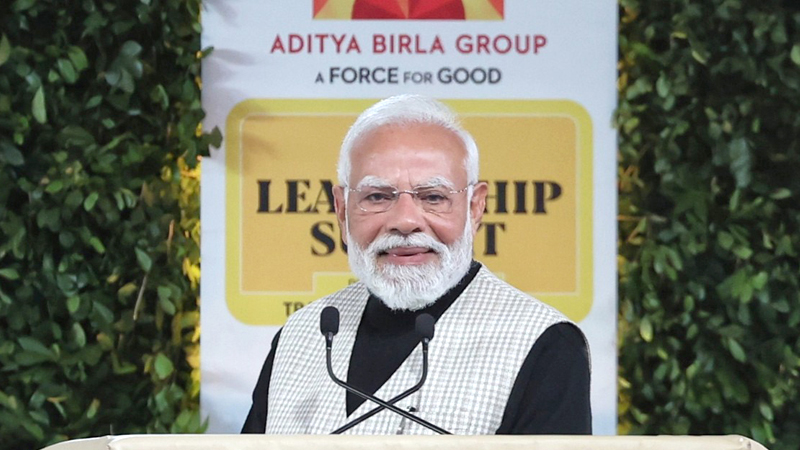
Prime Minister visits Shri LK Advani ji on his birthday

| Published on:

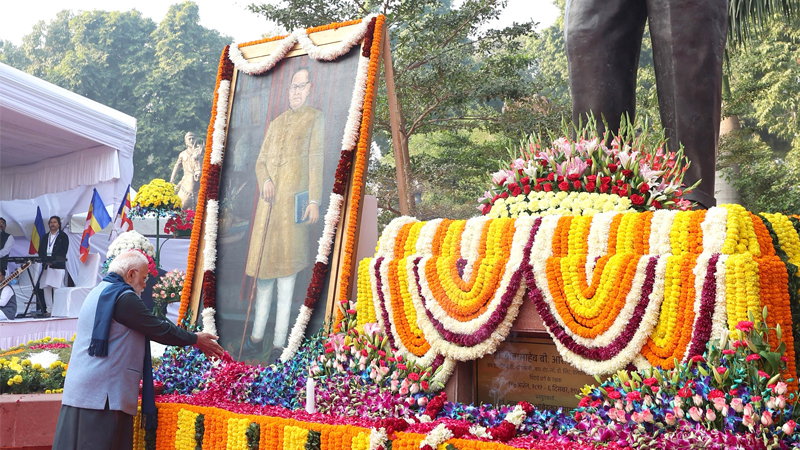
The Prime Minister, Shri Narendra Modi  went to Shri LK Advani Ji’s residence and greeted him on the occasion of his birthday, today. Shri Modi stated that Shri LK Advani Ji’s service to our nation is monumental and greatly motivates us all.

The Prime Minister posted on X:

“Went to Shri LK Advani Ji’s residence and greeted him on the occasion of his birthday. His service to our nation is monumental and greatly motivates us all.”

Record turnout in first phase shows Bihar has decided to retain the NDA government: PM

| Published on:

Continuing his high-voltage election campaign, PM Modi today addressed two massive public meetings in Aurangabad and Bhabua. He said that Bihar has created history in the very first phase of voting. The PM noted that yesterday’s polling recorded the highest turnout ever in the state, with nearly 65% voter participation. He remarked that this clearly shows that the people of Bihar have themselves taken the lead in ensuring the return of the NDA government.

PM Modi stated that the message from the first phase is crystal clear: Bihar will not allow the return of Jungle Raj. He said the youth of Bihar is not getting trapped in the false promises of RJD. Instead, they are placing their trust in the honest intentions and proven governance of the NDA. The Prime Minister added that RJD tried to spread confusion with hollow guarantees, but their claims are so weak that even the Congress does not stand behind them. The people, especially the youth, have rejected RJD’s lies outright.

PM Modi reiterated that the voters of Bihar have confidence in the track record of Narendra and Nitish, and are supporting NDA’s commitment to development, stability, and progress. He said that after the first phase, one thing is certain: “Phir Ek Baar, NDA Sarkar”.

Slamming the Congress, PM Modi reiterated that while soldiers had been demanding One Rank One Pension for four decades, the Congress kept misleading them with false promises. He said Congress showed only ₹500 crore on paper and claimed they would implement OROP, but even then they did not fulfill their promise to ex-servicemen.

PM Modi noted that he had given a clear guarantee to implement OROP, and his government delivered on that commitment. Taking a sharp dig, PM Modi said, “Congress and RJD were lying about ₹500 crore. That is their reality. Their politics stands on deception. We fulfilled what we promised.”

Criticizing the RJD-Congress, PM Modi said that when the NDA promises one crore new jobs, the youth trusts it because lakhs of transparent recruitments have already taken place. But everyone has also seen the track record of RJD-Congress, the same people who took land in exchange for jobs, are under investigation, and are out on bail. Those who ran Jungle Raj and sold jobs, he said, can never provide employment to Bihar’s youth.

PM Modi highlighted the stark difference between Jungle Raj and Sushasan Raj, saying that yesterday, every poor, Dalit, Mahadalit, backward and extremely backward voter cast their vote freely and peacefully. The PM reminded that Bihar has also seen the days of Jungle Raj when booths were looted, bullets were fired, bombs exploded and the voices of the poor and the marginalized were silenced. Today’s peaceful voting, he said, shows the clear change that good governance has brought.

PM Modi underlined that it is the NDA which gave 50% reservation to women in Panchayati Raj institutions and urban bodies, and 35% reservation to women in government jobs. He said the NDA also ensured women’s reservation in the Assembly and Parliament and is creating self-employment opportunities for women across Bihar.

He added that the NDA doesn’t just make announcements, it delivers. Under the Mukhyamantri Mahila Rozgar Yojana, ₹10,000 each has already been transferred to the accounts of 1.4 crore women, helping them buy sewing machines, start small trades and income activities. This is why women trust that the NDA will continue to support them at every step.

In his second rally at Bhabua, PM Modi warned that he is alerting everyone to the RJD’s dangerous plan, viral songs from their leaders promising ‘Aayengi Bhaiya ki Srakr, Banenge Rangdar’ are nothing but a call to revive kidnappings, extortion and lawlessness. He said these men won’t bring jobs; they will shake you down, drag people from their homes and run a reign of terror as their own songs glorify violence (“marab sixer ke 6 goli”). This, he urged, is the real face of Jungle Raj and the reason voters must reject them.

Hitting out at RJD-Congress, PM Modi said these Jungle Raj appeasers have gone a step further becoming a security cover for infiltrators. He warned their demand to extend free rations, health care and permanent houses to outsiders is unacceptable. “Do you want welfare meant for our poor given to outsiders too?” he asked.

He cautioned that a vote for them could mean back-door citizenship for infiltrators, threatening tribal lands and the livelihood of Mahadalits and the most backward. PM Modi urged voters to remember: one vote can stop infiltrators, one vote can protect your identity.

Signing off, PM Modi stated that the Congress and RJD only do politics of insult and abuse, reminding how the Congress’s ‘royal family’ called Chhath Puja a drama and even mocked the Mahakumbh, showing their contempt for the faith of the people. He urged voters to give them a fitting reply on 11th November, adding that NDA is heading towards its biggest victory yet.

Even today, the mindset of RJD people is still that of ‘jungle raj’: Jagat Prakash Nadda

| Published on:

Bharatiya Janata Party National President and Union Minister Shri Jagat Prakash Nadda addressed massive public rallies in Govindganj and Kalyanpur, Bihar on Friday. Criticizing the jungle raj under the rule of Lalu and Rabri, Shri Nadda stated that the RJD’s mindset remains the same even today, and if they return to power, the cycle of extortion, kidnappings, and murders will begin again. He also highlighted the unprecedented development works carried out under the NDA government. During the rallies, Maharashtra Deputy Chief Minister Shri Eknath Shinde, Govindganj MLA Shri Sunil Mani Tiwari, MP from Rajnandgaon, Govindganj candidate Shri Raju Tiwari, former Union Minister Shri Radha Mohan Singh, Kalyanpur candidate Shri Sachindra Prasad Singh, and several other leaders were present on stage. 

Shri JP Nadda highlighted that the sacred land of Champaran showed the country the path of the freedom movement and was the birthplace of the Satyagraha. The second phase of polling in Bihar is scheduled for the 11th, and the tremendous enthusiasm, energy, and overwhelming public support witnessed in Govindganj make it clear that this massive gathering will ensure the victory of Shri Raju Tiwari in the upcoming elections. This election is of great significance for Bihar. Shri Nadda mentioned that he has spent 20 years of his life in Bihar and has been a witness to both the state’s struggles and its journey of development. The Bharatiya Janata Party and the NDA have, through tireless efforts, brought Bihar’s boat of progress safely to shore, and it is now the collective responsibility of the people of Bihar to preserve this progress and carry it forward. This election is not just about Shri Sachindra Prasad Singh or the development of the Kalyanpur constituency. It is an election to accelerate Bihar’s progress on the path of development and to bring political stability to the state. If Bihar has moved from the era of lanterns to the era of LED lights, it is the result of the hard work of Chief Minister Shri Nitish Kumar and the blessings of Hon’ble Prime Minister Shri Narendra Modi Ji. This election is about ensuring a stable Bihar and reaffirming the state’s journey into the era of development.

BJP National President stated that, to truly appreciate the light, one must remember the pain of darkness; to experience the joy of development, one must understand the era of destruction. Just as one can value the beauty of a full-moon night only by recalling the darkness of a new moon, in the same way, to appreciate the blessings of Hon’ble Prime Minister Shri Narendra Modi Ji, the hard work of Shri Nitish Kumar, and the achievements of the double-engine government, one must also remember the days of Lalu’s jungle raj. Only then can we understand how far Bihar has come on the path of progress. Today, Bihar’s image has completely transformed, and the state is steadily advancing on the path of rapid development. The election on the 11th is an opportunity to further accelerate this journey, to ensure stability and continuity of the government. This election is a reaffirmation of Bihar’s resolve to sustain its pace of growth and prevent any disruption in its progress. Over the past 15–20 years, Bihar has undergone a remarkable transformation. Highways, expressways, and elevated roads are being built at an unprecedented pace. A six-lane expressway from Gorakhpur to Siliguri is under construction, which will connect directly to West Bengal within the next three to four years. Similarly, a 700-kilometre four-lane corridor is being developed from Raxaul through East Champaran, Sheohar, Samastipur, and Banka to Jharkhand and the Haldia port in West Bengal, at an estimated cost of ₹26,000 crore. The Bhagalpur–Buxar highway has been approved at a cost of ₹4,447 crore. A new 14-kilometre four-lane bridge parallel to the Mahatma Gandhi Setu is being constructed, while the old bridge is being expanded to four lanes. Likewise, the Patna–Purnia expressway, Patna–Ara–Sasaram expressway (₹3,712 crore), and the Darbhanga–Amas expressway are progressing rapidly.  The true meaning of “development” lies in the word “HIRA” where ‘H’ stands for Highways, ‘I’ for Internet, ‘R’ for Railways, and ‘A’ for Airports. This “HIRA,” is a blessing from Hon’ble Prime Minister Shri Narendra Modi Ji, which is propelling Bihar’s growth to new heights.

Shri JP Nadda asserted that under the Pradhan Mantri Gram Sadak Yojana, 31,000 villages have been connected with roads over the past ten years. Once, Lalu Prasad Yadav used to say that if roads were built, the police would also come, hence there was no need for roads. However, under the blessings of Hon’ble Prime Minister Shri Narendra Modi Ji and the dedicated efforts of Chief Minister Shri Nitish Kumar, Bihar is now marching confidently on the path of development. Today, villages enjoy 24-hour electricity, whereas earlier, power used to remain unavailable for 20–22 hours a day. During the RJD regime, Bihar witnessed an era of darkness and jungle raj. Back then, people used to receive electricity for merely two hours a day, and to charge mobile phones, they had to depend on local generators.  38,000 kilometres of optical fibre have been laid across Bihar, connecting 8,400 gram panchayats to the internet. Today, youths in every village are engaging in political discussions in Magahi, Bhojpuri, and Maithili through social media and digital platforms, a clear reflection of the changing and progressive face of Bihar. In the railway sector too, under the leadership of Hon’ble Prime Minister Shri Narendra Modi Ji, the budget allocation for Bihar has increased tenfold, giving a new momentum and direction to the state’s development journey.

Shri Nadda pointed out that today, the resonance of development in Bihar can be heard across both the railway and aviation sectors. Currently, 20 Vande Bharat trains are operating through Bihar, along with 26 Amrit Bharat Express trains. A total of 98 railway stations in the state are being redeveloped, including Bapudham Motihari and Raxaul stations, which will be equipped with airport-like modern facilities. The Hajipur–Sugauli railway line project is progressing rapidly and will be fully completed by 2027.  In the aviation sector too, Bihar has taken a significant leap forward. An international airport has been constructed in Kushinagar, Uttar Pradesh; 26 flights are operating from Darbhanga; and Patna’s Jayprakash Narayan Airport has been upgraded to international standards at a cost of ₹1,200 crore. Additionally, an international airport is under construction in Bihta at a cost of ₹1,400 crore, which has already been approved by the Government of India. All these achievements, he emphasized, have been made possible under the leadership of Hon’ble Prime Minister Shri Narendra Modi Ji. Development activities are progressing at a rapid pace across highways, internet connectivity, railways, and airports. An AIIMS is also being established in Darbhanga, ensuring that the people of Bihar will no longer need to travel to Delhi or Patna for advanced medical treatment.

Shri Jagat Prakash Nadda noted that Hon’ble Prime Minister Shri Narendra Modi Ji has successfully connected Bihar’s traditional and local identity with the global market. The establishment of the Makhana Board and the approval of ₹100 crore for its development have enabled Bihar’s makhana to reach international markets. Similarly, under the leadership of Hon’ble Prime Minister Shri Narendra Modi Ji, Madhubani’s world-renowned paintings and Muzaffarpur’s famous Litchis have gained global recognition. Bhagalpur’s silk has also earned international prestige, a result of the joint efforts of Hon’ble Prime Minister Modi Ji and Chief Minister Shri Nitish Kumar. The Tata Cancer Centre in Muzaffarpur, inaugurated in August, will prove extremely beneficial for the people of North Bihar. Under Chief Minister Shri Nitish Kumar’s Women Employment Scheme, financial assistance of ₹10,000 is being directly transferred to women’s bank accounts. Once the people elect Shri Raju Tiwari to the Assembly, within 10 days, ₹2 lakh will be transferred into the accounts of 75 lakh women to support self-employment. For the youth, a Youth Commission has been established, and the NDA government aims to provide one crore employment opportunities through government jobs, private sector roles, and self-employment. The pension amount for persons with disabilities, widows, and senior citizens has been tripled, and the honorarium of ASHA, Mamta, and Anganwadi workers has also been increased. Under the Pradhan Mantri Garib Kalyan Anna Yojana, around 8.7 crore beneficiaries are being provided 5 kg of wheat and rice and 1 kg of pulses free of cost every month, which has helped more than 4 crore people rise above the poverty line. Many public representatives used to write letters seeking financial help for patients suffering from cancer, kidney failure, or heart ailments who were unable to afford treatment. Often, such families had to sell their land or homes, and even suspend their children’s education to bear medical costs. When these issues were brought to the attention of Hon’ble Prime Minister Modi, he said, “Nadda, Kuch Bada Socho.” It was that vision which led to the creation of Ayushman Bharat, under which 62 crore citizens representing about 45% of India’s population who earlier lacked healthcare access, now receive an annual health cover of ₹5 lakh for serious illnesses. Every person above 70 years of age is entitled to free treatment worth up to ₹5 lakh per year, for life, under this scheme ensuring that no one is deprived of healthcare in their final years.

Shri Nadda asserted that today the people of Bihar are getting facilities for the treatment of serious diseases. This is the picture of a changing Bihar. Today, 5 crore 45 lakh people in Bihar are benefiting from the Ayushman Bharat scheme. Earlier, sisters had to bring water from ponds by carrying pots on their heads, but today the same sisters are receiving clean drinking water through the ‘Har Ghar Nal, Har Ghar Jal’ scheme. This facility has reached 95% of the households in Bihar, which is the result of the combined efforts of Hon’ble Prime Minister Shri Narendra Modi Ji and Chief Minister Shri Nitish Kumar. Under the Pradhan Mantri Kisan Samman Nidhi Yojana, 12 crore farmers across the country have benefited, and among them, 38 lakh farmers of Bihar are receiving ₹6000 per year directly into their bank accounts. When the people support and make Shri Raju Tiwari victorious on the 11th, then the next installment will not be ₹2000, but ₹3000, under which farmers will receive ₹9000 annually. Up to 125 units of electricity are being provided free of cost, and 1 crore 62 lakh people have benefited from this scheme. Today, 4 crore people in India have risen above the poverty line. Kalyanpur MLA Shri Sachindra Prasad Singh has opened a new Mother Dairy production unit in Kalyanpur, constructed a bridge over the Gandak River, and set up a medical center and a farmer service center in the area. Shri Radha Mohan Singh established a medical college in Motihari.

Shri Nadda stated that Shri Raju Tiwari is the State President of Lok Janshakti Party (RV). He is a hardworking and energetic leader who has a strong desire to work for the people. Shri Raju Tiwari has completed the construction of a PCC road from Daniyawan Chowk Bihar to Ojha Tola Bihar and has also carried out the construction of several other roads. He inaugurated a modern agricultural market in Areraj, providing new facilities to the farmers of the region. Shri Nadda appealed that the people of Bihar should give an opportunity to candidate Shri Raju Tiwari so that he can further accelerate the development of Govindganj and take it to new heights. The people of Bihar must always remember the jungle raj of Lalu Yadav. RJD means R for Rangdaari, J for Jungle Raj, and D for Dadagiri. This is the true identity of RJD  Rangdaari, jungle raj, and Dadagiri. This will not change because their very nature is based on Rangdaari, jungle raj and Jungle Raj. Lalu Yadav has never cared about the Yadav community; he only cares about his family Tejashwi Yadav, Misa Yadav, Rohini Yadav and works only for their benefit. The history of RJD is the history of jungle raj and scams. The people of Bihar remember the Shilpi Gautam incident. Shilpi’s body was found in the car of a close aide of Sadhu Yadav, and the entire case was covered up. If this was not a jungle raj, then what was it? Such a government must not be allowed to return. A Dalit IAS officer, B.B. Vishwas’s wife Champa Vishwas, his mother, sister and the family’s house-help were raped over a long period, and RJD leaders were involved, but the entire case was suppressed. The incidents of Siwan are also well known. Shahabuddin demanded ransom from Chanda Babu, and when he refused, two of his sons were murdered by pouring acid on them and burning them in a brick kiln. The third son was also killed. Instead of taking action, the police told Chanda Babu to leave Siwan if he wanted to stay alive. This was the true face of jungle raj. Even today, the mentality of RJD is the same. RJD has given a ticket to Osama, the son of Shahabuddin. This is the same mindset, the symbol of hooliganism and extortion. Their tendency remains the same today as it was before.

Shri Nadda noted that Ritlal Yadav is in Bhagalpur jail and is contesting elections from Danapur. RJD has given tickets to such criminals who commit crimes in broad daylight and receive political protection. During the RJD’s jungle raj, kidnappings used to take place, doctors and engineers were kidnapped, and kidnapping had become an industry. During that time, ransom amounts were decided at the residences of the then Chief Minister and ministers. The people of Bihar will not allow such a government to return again. During that period, scams took place one after another. Lalu Prasad Yadav had organized a rally in Patna called ‘Tel Pilawan, Lathiya Bhaajan’. People were gathered with sticks, applying oil on them and waving them in Gandhi Maidan. At that time, the Chief Minister of Bihar organising such a rally clearly sent the message that an atmosphere of fear and terror was to be created among the common people of Bihar. They ate the Alkatra, they ate the sand, they ate the lime, and even the fodder meant for cattle. Lalu Yadav has been sentenced to 36 years in the fodder scam. Lalu Yadav is convicted and is out on bail, Tejashwi is on bail, Rabri Devi is on bail. Their entire life will pass between jail and bail. The people of Bihar will not allow such corrupt individuals to return to power. Even today, the RJD leaders have not changed. Given a chance, they will bring back the same situation. Their slogans have already started again – Dunnaliya ghumayenge, katta chalayenge. Even on the stage, they made an innocent child say, When Tejashwi’s rule comes, we will roam around with guns. In the coming days, all such corrupt leaders will be sent to jail. Those who grabbed land in exchange for jobs are now talking about giving jobs to every family. If Tejashwi starts giving jobs to every family, then no land will remain in Bihar, everything will be grabbed by them. Tejashwi Yadav says he will give jobs to more than two crore families. If this happens, it will require ₹12 lakh crore, while the total budget of Bihar is only ₹3 lakh 17 thousand crore. This uneducated Tejashwi knows neither mathematics nor arithmetic. And when Congress leaders are asked how they will provide jobs, they respond by saying ask Tejashwi Yadav.

Shri JP Nadda highlighted that when elections are taking place in Bihar, Rahul Gandhi is talking about Haryana and is creating noise about SIR. Rahul Gandhi should remember that he himself changed the figures three times while speaking about the Deputy Chief Minister Shri Eknath Shinde in Maharashtra, first 10 lakh, then 12 lakh, then 7 lakh. This so-called educated leader does not even have the correct figures. If Rahul Gandhi says that there is irregularity in the voter list, then he should remember that since 1952, his own family has also conducted SIR. During the governments of his great-grandfather, grandmother and father, SIR was carried out. The SIR process took place in 2002 as well, and has now taken place in Bihar too. In Bihar, the votes of each infiltrator have been removed and will continue to be removed. First their names will be removed from the voter list, and then arrangements will be made to send them out of the country. In Bihar, the government will be of the people of Bihar, not of infiltrators. Shri Nadda appealed to the people to ensure the victory of the local candidates and to form an NDA government again in Bihar.

PM inaugurates year-long Commemoration of 150 Years of the National Song “Vande Mataram”

| Published on:

Prime Minister Shri Narendra Modi inaugurated the year-long commemoration of 150 Years of the National Song “Vande Mataram” in New Delhi today. Addressing the gathering on the occasion, Shri Modi remarked that Vande Mataram is not merely a word—it is a mantra, an energy, a dream, and a solemn resolve. He highlighted that Vande Mataram embodies the devotion and spiritual dedication to Maa Bharati. The Prime Minister stated that this one word connects us to our history, fills our present with confidence, and inspires our future with the courage to believe that no resolve is beyond fulfillment, and no goal is beyond our reach.

Describing the collective singing of Vande Mataram as a truly sublime experience, beyond the bounds of expression, Shri Modi noted that amidst so many voices, there emerged a singular rhythm, a unified tone, a shared thrill, and a seamless flow. He spoke of the resonance and waves of harmony that stirred the heart with energy. The Prime Minister stated that 7th November is a historic day as the nation celebrates 150 years of Vande Mataram. He affirmed that this sacred occasion will offer new inspiration and infuse fresh energy to our citizens. To mark this day in the pages of history, a special commemorative coin and postage stamp dedicated to Vande Mataram were released. Paying tributes to all the bravehearts and luminaries of India who dedicated their lives for Maa Bharati, Shri Modi extended congratulations to all present and conveyed his best wishes to every citizen on the completion of 150 years of Vande Mataram.

Noting that every song and every poem carries a core emotion and a central message, the Prime Minister posed the question—what is the essence of Vande Mataram? He affirmed that its essence is Bharat—Maa Bharati—the eternal idea of India. He elaborated that this idea began shaping itself from the dawn of human civilization, reading each era as a chapter, witnessing the rise of different nations, the emergence of various powers, the evolution of new civilizations, their journey from nothingness to greatness, and their eventual dissolution back into the void. He added that India observed the making and unmaking of history, the shifting geography of the world. From this infinite human journey, India learned, drew new conclusions, and based on them, shaped the values and ideals of its civilization, forging a distinct cultural identity. Shri Modi emphasized that India understood the balance between strength and morality, and thus emerged as a refined nation—like pure gold—immortal despite the wounds of the past.

Highlighting that the conception of India and the philosophical force behind it stand apart from the rise and fall of global powers, rooted in a distinct sense of independent existence, Shri Modi remarked that when this consciousness was expressed in written and rhythmic form, it gave rise to a creation like Vande Mataram. “That is why, during the colonial era, Vande Mataram became the proclamation of the resolve that India would be free, the chains of bondage would be broken by the hands of Maa Bharati, and her children would become the architects of their own destiny”, stated Shri Modi.

Recalling Gurudev Rabindranath Tagore’s words that Bankimchandra’s Anandamath is not merely a novel—it is a dream of a free India, the Prime Minister emphasized the profound significance of Vande Mataram in Anandamath, noting that every line, every word, and every emotion in Bankim Babu’s composition carries deep meaning. He stated that although the song was composed during the colonial era, its words were never confined by the shadows of those centuries of bondage. It remained free from the memories of subjugation, and that is why Vande Mataram remains relevant in every era and every age. Shri Modi quoted the first line of the song—“Sujalam Sufalam Malayaja Sheetalam Sasyashyamalam Mataram”—and interpreted it as a tribute to our motherland adorned with nature’s divine blessings.

Highlighting that this has been India’s identity for thousands of years, Shri Modi said its rivers, mountains, forests, trees, and fertile soil have always had the power to yield abundance. For centuries, the world listened to stories of India’s prosperity. Just a few centuries ago, India accounted for nearly one-fourth of the global GDP. However, he noted that when Bankim Babu composed Vande Mataram, India had drifted far from that golden era. Foreign invasions, plunder, and exploitative colonial policies had left the country suffering with poverty and hunger. Yet, Bankim Babu invoked the vision of a prosperous India, driven by his belief that no matter how great the challenges, India could revive its golden age. And thus, he gave the clarion call—Vande Mataram.

Prime Minister stated that during the colonial era, the British sought to justify their rule by portraying India as inferior and backward. He emphasized that the very first line of Vande Mataram powerfully dismantled this false propaganda. Therefore, Vande Mataram was not merely a song of freedom—it also presented to millions of Indians a vision of what a free India could be: the dream of a Sujalam Sufalam Bharat.

Shri Modi remarked that this day offers an opportunity to understand the extraordinary journey and impact of Vande Mataram. When Bankim Babu published Vande Mataram in Bangadarshan in 1875, some believed it was just a song. But soon, Vande Mataram became the voice of India’s freedom struggle—a chant on the lips of every revolutionary, an expression of every Indian’s emotions. He noted that there is hardly any chapter of the freedom movement where Vande Mataram was not present in some form. In 1896, Gurudev Rabindranath Tagore sang Vande Mataram at the Calcutta Session. In 1905, when Bengal was partitioned—a dangerous experiment by the British to divide the nation—Vande Mataram stood like a rock against those designs. The Prime Minister recalled that during the protests against the partition of Bengal, the streets echoed with one unified voice—Vande Mataram.

Recalling that even when bullets were fired at protestors during the Barisal session, the words on their lips remained—Vande Mataram, Shri Modi highlighted that freedom fighters like Veer Savarkar, working from abroad, greeted each other with Vande Mataram. Many revolutionaries, even while standing at the gallows, uttered Vande Mataram. The Prime Minister emphasized that countless such incidents, numerous dates in history, across a vast nation with diverse regions and languages, saw movements where one slogan, one resolve, one song resonated in every voice—Vande Mataram. He quoted Mahatma Gandhi’s 1927 remark that Vande Mataram presents before us a picture of an undivided India. He noted that Sri Aurobindo described Vande Mataram not just as a song, but as a mantra—one that awakens inner strength. The Prime Minister also mentioned that the flag designed by Bhikaji Cama bore the words Vande Mataram at its centre.

Underlining that while India’s national flag has evolved over time, from its earliest forms to the present-day tricolour, Shri Modi said, one thing has remained unchanged—whenever the flag is hoisted, the words that instinctively rise from every Indian’s heart are Bharat Mata ki Jai! and Vande Mataram!. He emphasized that as the nation celebrates 150 years of the national song Vande Mataram, it is also a tribute to the great heroes of the country. It is a tribute to the countless martyrs who embraced the gallows while invoking Vande Mataram, who endured the lash of whips while chanting Vande Mataram, who remained resolute on blocks of ice while reciting the mantra of Vande Mataram.

The Prime Minister declared that today, all 140 crore Indians pay homage to every known, unknown, and unsung individual who sacrificed their lives for the nation while uttering Vande Mataram, whose names were never recorded in the pages of history.

Quoting the Vedic verse, affirming that this land is our mother, this nation is our mother, and we are her children, Shri Modi stated that since the Vedic era, the people of India have worshipped the nation in this maternal form. He emphasized that this very Vedic thought infused new consciousness into the freedom struggle through Vande Mataram.

 The Prime Minister remarked that for those who view the nation merely as a geopolitical entity, the idea of considering the nation as a mother may seem surprising. But India is different. In India, the mother is the giver of birth, the nurturer, and when her children are in danger, she is also the destroyer of evil. He cited the lines from Vande Mataram, highlighting that Maa Bharati possesses immense power, guides us through adversity, and vanquishes enemies. The Prime Minister stated that the idea of the nation as mother, and the mother as a divine embodiment of strength, led to a freedom movement that resolved to include both men and women equally. He added that this vision enabled India to once again dream of a nation where women power stands at the forefront of nation-building.

Stating that Vande Mataram, while being the anthem of freedom’s martyrs, also inspires us to protect that very freedom, Shri Modi quoted lines from Bankim Babu’s original composition highlighting that Maa Bharati is the embodiment of Saraswati, the giver of knowledge; Lakshmi, the giver of prosperity; and Durga, the wielder of weapons and strength. The Prime Minister emphasized that the vision was to build a nation that stands at the forefront of knowledge, science, and technology; a nation enriched by the power of learning and innovation; and a nation that is self-reliant in matters of national security.

Noting that in recent years, the world has witnessed the emergence of India in its true form, the Prime Minister highlighted India’s unprecedented progress in the fields of science and technology and its rise as the fifth-largest economy in the world. He remarked that when adversaries dared to attack India’s security and honour through terrorism, the world saw that while New India embodies the spirit of Kamala and Vimala in service to humanity, it also knows how to become Durga—the wielder of ten weapons—for the destruction of terror.

Addressing another critical aspect related to Vande Mataram, emphasizing its importance, Shri Modi noted that the spirit of Vande Mataram had illuminated the entire nation during the freedom struggle. However, he expressed regret that in 1937, significant verses of Vande Mataram—its very soul—were separated. The song was fragmented. He asserted that this division sowed the seeds of the country’s partition. The Prime Minister questioned why such injustice was done to this great national mantra and stressed that today’s generation must understand this history. He warned that the same divisive mindset continues to pose a challenge to the nation even today.

Emphasising that we must make this century the century of India, the Prime Minister affirmed that the strength to achieve this lies within India and its people. He emphasized the need for self-belief to realize this resolve. Shri Modi cautioned that on this journey, we will encounter those who seek to mislead us and those with negative mindsets who will attempt to sow doubt and hesitation. At such moments, he urged the nation to recall the episode from Anandamath, where Bhavanand sings Vande Mataram and another character questions what one person alone can achieve. The inspiration from Vande Mataram then arises—how can a mother with crores of children and crores of hands ever be powerless? The Prime Minister stated that today, Bharat Mata has 140 crore children and 280 crore hands, with over 60 percent of them being youth. He highlighted that India possesses the world’s largest demographic advantage, which is the strength of our nation and Maa Bharati. Posing a question, Shri Modi asked what is truly impossible for us today? What could possibly stop us from fulfilling the original dream of Vande Mataram?

Underlining that today, as the vision of Atmanirbhar Bharat finds success, as the nation advances with the resolve of Make in India, and as we move steadily towards the goal of a developed India by 2047, Shri Modi remarked that every new achievement in this unprecedented era evokes the spontaneous chant—Vande Mataram! He highlighted that when India becomes the first country to reach the South Pole of the Moon, when the echo of New India reaches the farthest corners of space, every citizen proudly proclaims—Vande Mataram! The Prime Minister further remarked that when we see our daughters reaching the pinnacle in fields ranging from space technology to sports, when we witness them flying fighter jets, the slogan that rises from every proud Indian is—Vande Mataram!

Noting that today marks 11 years since the implementation of One Rank One Pension, Shri Modi stated that when our armed forces crush the nefarious intentions of the enemy, when terrorism, Naxalism, and Maoist insurgency are decisively defeated, our security forces proclaim—Vande Mataram!

Emphasising that this spirit of reverence for Maa Bharati will guide us toward the goal of a developed India, the Prime Minister expressed confidence that the mantra of Vande Mataram will continue to empower and inspire the countless children of Maa Bharati throughout this Amrit Kaal journey. Concluding, he once again extended his congratulations to all citizens on the completion of 150 years of Vande Mataram.

Union Minister, Shri Gajendra Singh Shekawat, Lieutenant Governor of Delhi, Shri Vinai Kumar Saxena, Chief Minister of Delhi, Smt Rekha Gupta were present among other dignitaries at the event.

Background

Prime Minister also released a Commemorative Stamp and Coin on the occasion. This programme marks the formal launch of a year-long nationwide commemoration from 7th November 2025 to 7th November 2026, celebrating 150 years of this timeless composition which inspired India’s freedom movement and continues to evoke national pride and unity.

The celebrations witnessed Mass Singing of the full version of “Vande Mataram” across public places with participation of citizens across all segments of society, in conjunction with the main programme.

The year 2025 marks 150 Years of Vande Mataram. Our national song “Vande Mataram”, by Bankimchandra Chatterji was written during the auspicious occasion of Akshaya Navami which was on 7th November in 1875. Vande Mataram first appeared in the literary journal Bangadarshan as part of his novel Anandamath. The song, invoking the Motherland as the embodiment of strength, prosperity and divinity, gave poetic expression to India’s awakening spirit of unity and self-respect. It soon became an enduring symbol of devotion to the nation.

Union Home Minister addresses a celebration in Patna, Bihar, marking 150 years of ‘Vande Mataram’

| Published on:

Union Home Minister and Minister of Cooperation Shri Amit Shah addressed a celebration in Patna, Bihar, marking 150 years of the national song ‘Vande Mataram. Shri Amit Shah also led the collective recitation of the Swadeshi pledge. The event was attended by Union Education Minister Shri Dharmendra Pradhan and several other dignitaries.

In his address on the occasion, Union Home Minister and Minister of Cooperation Shri Amit Shah said that today is a day of awakening Indian consciousness because 150 years ago, on this very day, great freedom fighter and renowned literary figure Bankim Chandra Chattopadhyay penned ‘Vande Mataram.’ He said that Bankim Chandra, through this song, gave the nation a great mantra of national consciousness, which later became the proclamation and guiding principle of India’s freedom struggle and, after independence, a reason to unite the country. Shri Shah added that under the leadership of Prime Minister Shri Narendra Modi, the collective efforts of the nation over the past 11 years have accomplished many tasks toward fulfilling the dreams of a great India envisioned by our freedom fighters.

Shri Amit Shah said that with the collective singing of ‘Vande Mataram’ today, a phased effort has begun to reawaken India’s consciousness over the next year. He emphasized that a nationwide campaign will be launched to align our lives with the mantra and spirit of ‘Vande Mataram.’ This campaign will be conducted in both physical and digital formats. Shri Shah announced that a social media campaign named ‘#VandeMataram150’ will be launched in all languages, encouraging people to write ‘Vande Mataram’ in all regional languages to strengthen national unity.

Union Home Minister said that on the occasion of the 150th anniversary of ‘Vande Mataram,’ the government has organized several programs. He said that various political parties, voluntary organizations, and people participating in the festival of reawakening the nation’s consciousness have also organized numerous events. He said that ‘Vande Mataram’ is, in a way, a part of the novel Anandamath, which later became the proclamation of the freedom movement. Shri Shah added that when the Indian hockey team collectively sang ‘Vande Mataram’ before the hockey final at the 1936 Berlin Olympics, it became certain that when our country attained independence, this song would not merely be a political slogan but would serve as an inspiration to keep the nation united and ignite patriotism forever.

Shri Amit Shah said that on August 15, 1947, at the behest of Sardar Patel, Pandit Omkarnath Thakur sang the complete ‘Vande Mataram,’ resonating with the first heartbeat of a free India. He said that on January 24, 1950, during the final session of the Constituent Assembly, Dr. Rajendra Prasad accepted ‘Vande Mataram’ as the national song, paving the way for its revered acceptance by the nation. He added that from that moment, ‘Vande Mataram’ became a song of national consciousness for all of us, and today marks the celebration of its 150th anniversary.

Union Home Minister and Minister of Cooperation said that we must also understand the period in which Vande Mataram was written. He said that in 1875, after the long subjugation under the Mughals, the era of British rule had begun. At that time, the First War of Independence had also failed, and there was apprehension in the minds of people across the country about whether our national consciousness would awaken again. Shri Shah said that at that time, Bankim Chandra Chatterjee composed this great hymn of national consciousness, which became the first proclamation of our cultural nationalism. He said that Vande Mataram makes it clear that India is not just a piece of land, but an idea and a culture that binds and unites all Indians.

Shri Amit Shah said that our party has always emphasized cultural nationalism, and the very consciousness of the idea of cultural nationalism must have been inspired by the song Vande Mataram. He said that many of our freedom-loving revolutionaries went to the gallows with a smile, chanting Vande Mataram. He added that the time has now come to build the India envisioned and desired by all those great souls. Shri Shah said that the period from today until 2047 is the time to draw inspiration from Vande Mataram and create a great India.

Union Home Minister said that today Prime Minister Shri Narendra Modi has also participated in the collective singing of Vande Mataram in Delhi. He said that at such a moment, all of us have resolved that the 150th anniversary of Vande Mataram also dedicated to swadeshi. He said that building a self-reliant India is not possible without swadeshi. Shri Shah urged the countrymen to take a pledge to adopt Swadeshi on the 150th anniversary of ‘Vande Mataram’. The Home Minister said that we should all resolve to join the process of making India a great nation by 2047 and take a pledge today to once again dedicate our lives to Bharat Mata.

Union Agriculture Minister addresses conference of 20,000 farmers in Maharashtra

| Published on:

Union Minister for Agriculture, Farmers’ Welfare, and Rural Development, Shri Shivraj Singh Chouhan today addressed a large congregation of 20,000 farmers at the Global Vikas Trust (GVT) Krishikul, Sirsala in Beed district, Maharashtra.

Before delivering his address at the main conference, Shri Chouhan held a face-to-face interaction with farmers, where they shared their experiences and discussed the positive changes brought about in their lives through the adoption of new agricultural innovations. Farmers apprised the Union Minister of their progress in silk farming, natural farming practices, and water conservation initiatives.

After an extensive discussion, Shri Chouhan lauded the work of the GVT team for their contribution towards the prosperity of farmers and congratulated them for pioneering new models that have helped enhance farmers’ income and living standards. He said that such success stories should be shared widely across other villages to inspire similar efforts. “The true objective of all our initiatives is to ensure the increase in farmers’ income. No farmer brother or sister should ever be compelled to take the tragic step of suicide,” the Union Minister said.

In his address to the large gathering of 20,000 farmers, Shri Chouhan said, “A farmer is not merely a cultivator but a provider of life — the ‘Annadaata’ of the nation.” He informed that, for the first time in the country, under the ‘Viksit Krishi Sankalp Abhiyan’, scientists from across India have stepped out of their laboratories and reached directly to the fields, interacting with farmers to ensure that the benefits of agricultural research and innovation reach the grassroots level.

The Union Minister emphasised that under the leadership of Prime Minister Shri Narendra Modi, the Central government is committed to ensuring the availability of high-quality seeds for all farmers. Referring to the recent erratic weather conditions, he said that excessive rainfall this year had severely damaged crops across several regions, affecting the livelihoods and future of farmers and their families. “However, both the Centre and the State governments are fully alert and committed to extending timely assistance to every affected farmer,” he assured.

Shri Chouhan announced that the State Government would provide immediate compensation to farmers for crop losses, and that additional financial aid would be extended through the National Disaster Response Fund (NDRF). “If the State Government seeks a special relief package from the Centre after conducting its damage assessment, the Government of India will leave no stone unturned to fulfil that request,” he said.

The Union Minister further asserted that under the Pradhan Mantri Fasal Bima Yojana, every rupee of compensation owed to farmers would be delivered. “If required, we will directly consult farmers to ensure that every single rupee of their rightful claim reaches them,” the Union Agriculture Minister said.

Referring to his recent review meeting with insurance companies in Delhi, Shri Chouhan said that he had personally interacted with farmers from Maharashtra to ensure the correctness of claim settlements and to identify and remove discrepancies. “Crop losses will be assessed by the State Government through the Crop Cutting Experiment, and compensation will be provided accordingly under the Fasal Bima Yojana,” he stated.

Addressing the growing challenges of climate change, Shri Chouhan said that erratic rainfall and drought patterns require the development of new seed varieties resilient to both excessive water and drought conditions. “We must develop climate-resilient seeds to safeguard farmers from such unpredictable weather,” he added.

Discussing fertiliser subsidy reforms, the Minister said the government is actively considering direct transfer of fertiliser subsidies to farmers’ bank accounts to ensure transparency and prevent leakages.

Highlighting the importance of cow-based and natural farming, Shri Chouhan cautioned against excessive dependence on chemical fertilisers and pesticides. “Overuse of fertilisers and chemicals is damaging our soil and reducing its productivity. To secure the future needs of our coming generations, we must move towards organic and sustainable farming,” he said.

The Union Minister urged farmers to diversify beyond traditional crops and adopt integrated approaches. “Along with conventional farming, farmers should cultivate fruits, flowers, vegetables, and adopt agroforestry practices. It is time to change our cropping pattern,” Shri Chouhan said.

On the issue of market linkages and intermediaries, the Agriculture Minister said that the government’s effort is to ensure fair prices for farmers. He suggested two practical measures: first, promoting cluster-based farming so that traders can procure directly from farmers; and second, developing village-level processing units. “We will work in close coordination with Union Minister for Food Processing Shri Chirag Paswan to promote local food processing and value addition,” Shri Chouhan said.

Touching upon water conservation, the Union Minister informed farmers that the central government had recently decided to utilise 65% of MGNREGA funds in drought-prone blocks for water conservation activities. “This will help strengthen irrigation facilities and mitigate drought conditions,” he said.

The Union Agriculture Minister also emphasised the need for integrated farming systems, combining agriculture with allied activities such as beekeeping, fisheries, and animal husbandry. “Given the small size of landholdings, these allied sectors can substantially supplement farmers’ incomes,” he noted.

Speaking about the Pradhan Mantri Awas Yojana – Gramin, Shri Chouhan said that under Prime Minister Modi’s leadership, 30 lakh houses have already been sanctioned to Maharashtra. “After the completion of the new survey, all remaining eligible families will also receive financial assistance for housing,” he assured.

He further warned of strict action against the manufacture of spurious fertilisers, seeds, and pesticides, saying that the government takes the issue very seriously. “A new Bill targeting those involved in the production and sale of fake fertilisers, seeds, and pesticides will be introduced in the upcoming Budget Session,” the Union Minister declared.

“Our farmers are the pride of our nation. Under the leadership of Prime Minister Modi, we are committed to ensuring that every farmer in India lives with dignity, prosperity, and self-reliance,” he said.

Concluding his address, Shri Shivraj Singh Chouhan extended greetings to all farmers and citizens on the occasion of the 150th anniversary of the National Song ‘Vande Mataram’.

A vote for NDA is a vote for Bihar’s stability and prosperity: PM

| Published on:

PM Modi addressed large public gatherings in Araria & Bhagalpur, Bihar, where people turned up in huge numbers to express their support for the NDA. Speaking with conviction, PM Modi said that the people of Bihar have already made up their minds – ‘Phir Ekbar, NDA Sarkar!’

In Araria, the PM said that behind this spirit of Bihar lie the hopes of mothers and sisters and the dreams of the youth. “Your dream is my resolve,” the PM declared, emphasizing that his hard work is dedicated to securing a better future for the children of Bihar. Reminding people of their vote’s power, he urged them to protect Bihar from those who had once pushed the state into jungle raj.

PM Modi launched a scathing attack on the RJD-Congress alliance, saying that from 1990 to 2005, Bihar witnessed 15 years of total ruin and no progress under jungle raj. “In those 15 years, the report card of development was zero,” he said. “No expressway, no bridge on the Kosi river, no tourist circuit, no sports complex, no medical college. Not a single IIT, IIM or National Law University was set up. That era only looted Bihar and destroyed the dreams of an entire generation.”

Outlining the NDA’s development roadmap, PM Modi said that the government’s mantra is education for all, healthcare for all, income for all, justice for all and irrigation for every farm. He shared details about the Kosi-Mechi link project worth thousands of crores aimed at reducing floods and ensuring irrigation for farmers. He spoke about initiatives like the National Makhana Board, record MSP for jute farmers and major support schemes that have empowered farmers and women alike.

Highlighting the success of women-led development, PM Modi said that under the Mukhyamantri Mahila Rojgar Yojana, more than 1.4 crore women have received financial support of ₹10,000 each directly in their bank accounts. “Bihar’s women have resolved to build a prosperous Bihar. They now stand as the strongest wall against any return of jungle raj,” he said.

In the Bhagalpur rally, PM Modi criticised RJD and Congress for never understanding the value of self-reliance or Swadeshi. “For them, ‘A se Apharan, F se Firauti! Their dictionary begins with corruption and ends with chaos,” he said, drawing laughter from the crowd. He reminded the people that the Congress can never erase the stain of the Bhagalpur riots — a dark reminder of its divisive and destructive politics.

Outlining NDA’s roadmap for progress, PM Modi said the government is working to make Bihar a hub for textiles, tourism and technology. “Bihar is known for its silk, and we want it to be known for semiconductors too,” he said, adding that the NDA has laid out a detailed plan to generate one crore new jobs. He highlighted massive infrastructure projects including the four-lane Vikramshila Bridge, the 7-km Kosi bridge, and the newly approved Buxar–Bhagalpur High-Speed Corridor which will boost connectivity and attract investment worth thousands of crores.

In his concluding remarks PM Modi promised a powerful mix of conviction, facts and connection with the people of Bihar. With loud chants of “Phir ek baar NDA Sarkar,” the rally echoed the spirit of a confident and forward-looking Bihar.

Prime Minister interacts with ICC Women’s World Cup 2025 champions

| Published on:

Prime Minister Shri Narendra Modi interacted with ICC Women’s World Cup 2025 champions at 7, Lok Kalyan Marg, New Delhi yesterday. The Indian team won against South Africa in the finals on Sunday, 2nd November 2025. Prime Minister remarked that it is a very significant day, as it marks both Dev Deepawali and Gurpurab and also conveyed his best wishes to all present.

Expressing gratitude to the Prime Minister, the Coach of the team, Shri Amol Mazumdar stated that it was an honour and privilege to meet him. He highlighted the hard work of the players as a campaign led by the daughters of the nation, praising their exceptional dedication over the past two years. He noted that the girls played every practice session with remarkable intensity and energy, and affirmed that their hard work had borne fruit.

Captain Harmanpreet Kaur recalled meeting the Prime Minister in 2017 without a trophy, and expressed deep honour in now presenting the trophy they had worked towards for years. She said the Prime Minister had doubled their joy and that it was a matter of great pride. She added that their aim is to keep meeting him in the future and continue taking team photographs with him.

Shri Modi acknowledged their achievement, stating that they had truly accomplished something great. He emphasized that cricket in India is not merely a sport but has become a part of people’s lives. He observed that when cricket goes well, the nation feels uplifted, and even a slight setback shakes the entire country. He noted how the team faced trolling after losing three consecutive matches.

Harmanpreet Kaur reiterated that in 2017, they had met the Prime Minister after losing the final, but he had motivated them to give their best whenever the next opportunity came. She expressed happiness at finally winning the trophy and having the opportunity to speak with him again.

Prime Minister invited Smriti Mandhana to share her thoughts. Smriti Mandhana recalled that in 2017, the team had not brought home a trophy, but she remembered asking the Prime Minister a question about dealing with expectations. She said his answer stayed with her and helped the team immensely over the next six to seven years, despite several heartbreaking World Cup losses. She remarked that it felt like destiny that India would host its first Women’s World Cup. She added that the Prime Minister has always been an inspiration, especially in the way women are now visible in every field—from ISRO launches to other national achievements—which she described as deeply motivational and empowering for them to perform better and inspire other girls. Shri Modi responded that the entire nation is watching and feeling proud, and that he genuinely wanted to hear their experiences. Smriti Mandhana said the best part of the campaign was that every player could go home and share their story, as no one’s contribution was any less. She reiterated that the Prime Minister’s earlier advice on handling expectations had always stayed in her mind, and his calm and composed demeanor was itself a source of inspiration.

Jemimah Rodrigues reflected on the team’s journey, stating that when they lost three matches, it became evident that a team is not defined by how many times it wins, but by how it rises after a fall. She affirmed that this team did that best, which is why it is a champion team. She further highlighted the unity within the team, calling it the best she has ever seen. She shared that whenever any player performed well, everyone celebrated as if they themselves had scored the runs or taken the wickets. Similarly, whenever someone was down, there was always a teammate who would place a hand on their shoulder and say, “Don’t worry, you’ll do it in the next match.” She further added that this spirit of support and togetherness truly defined the team.

Sneh Rana agreed with Jemimah Rodrigues, stating that while everyone stands together in moments of success, it is even more important to support each other during times of downfall. She emphasized that as a team and as a unit, they had decided that no matter what happens, they would never leave each other’s side and would always uplift one another. She affirmed that this was the best quality of their team.

Kranti Gaud added that Harmanpreet Kaur always encouraged everyone to keep smiling. She shared that if anyone appeared even slightly nervous, the team’s approach was to keep smiling so that seeing each other smile would help everyone stay cheerful and confident. Prime Minister asked if there was someone in the team who kept everyone laughing, to which Kranti responded that Jemimah Rodrigues played that role. Jemimah added that Harleen Kaur Deol also played an important part in bringing the team together.

Harleen Kaur Deol shared that she believes every team should have someone who keeps the atmosphere light. She said that whenever she notices someone sitting alone or feels she has some free time, she makes an effort to engage with others in small ways. She expressed that it brings her joy when people around her are happy.

Prime Minister Shri Narendra Modi asked if the team had done anything after arriving. Harleen Kaur Deol humorously shared that the others had indicated her for being too loud and told her to stay quiet. She then asked the Prime Minister about his skincare routine, saying he glows remarkably. The Prime Minister responded modestly, saying he had not paid much attention to that subject. A player remarked that it is the love of crores of Indians that makes him glow. The Prime Minister agreed, stating that such affection from society is indeed a great strength. He noted that he has completed 25 years in government, including as Head of Government, and that receiving such blessings even after such a long tenure has a lasting impact.

The Coach commented on the variety of questions being asked and the different personalities in the team. He shared that he has been their Head Coach for two years. He narrated a story from June in England, where they met King Charles. Due to protocol restrictions, only 20 people were allowed, so the support staff could not attend. All players and three skilled coaches were present. He told the support staff that he was extremely sorry, as the protocol only allowed 20 people. In response, the support staff said they didn’t need that photograph—they wanted one with Prime Minister Modi on 4 or 5 November. Today, that wish was fulfilled.

Harmanpreet Kaur shared that there were moments when it felt like setbacks were happening only to them, but those struggles were written to make them mentally and physically stronger. Prime Minister Shri Narendra Modi asked Harmanpreet what emotions she felt while sharing this, noting that it was deeply inspiring. The player responded that there was always a belief that one day they would lift the trophy, and that special feeling was present from day one in the team. The Prime Minister acknowledged the recurring challenges they faced and praised their courage and ability to instill confidence in others despite adversity. Harmanpreet credited all team members, highlighting their self-belief and consistent improvement in every tournament. She mentioned that over the past two years, they had worked extensively on mental strength, accepting that the past could not be changed. The Prime Minister remarked that this journey had taught them to live in the present. She agreed and said that was exactly why she had asked him what extra he does to inspire his team members—so they could strengthen their belief in staying present. She further affirmed that the guidance from the Prime Minister and their coaches had put them on the right path.

The Prime Minister then asked Deepti Sharma about her Dy Superintendent of Police (DSP) role during the day, joking that she must have been controlling everything. She replied that they had simply waited to meet him and enjoyed the moment. She recalled that in 2017, the Prime Minister had told her that a true player is one who learns to rise and move forward from failure. She said that Shri Modi’s words have always motivated her, and she regularly listens to his speeches. She added that his calm and composed handling of situations, even when many voices are raised, personally helps her in her game.

Shri Modi asked Deepti about her Hanuman Ji tattoo and how it helps her. She replied that she places more belief in Hanuman Ji than in herself, and whenever she faces difficulties, invoking his name gives her strength to overcome them. The Prime Minister noted that she also writes “Jai Shri Ram” on her Instagram account, to which she affirmed. He remarked that faith plays a significant role in life, offering the comfort of surrendering to a higher power. He then asked about her assertiveness on the field and whether there was truth to the perception of her dominance. She responded that it wasn’t exactly like that, but admitted there was a bit of fear associated with her throws, and teammates often joked to go easy. She appreciated that the Prime Minister personally asked about her tattoo and knew her Instagram tagline.

The Prime Minister then asked Harmanpreet Kaur about the ball she kept in her pocket after the win—whether it was a planned gesture or guided by someone. Harmanpreet replied that it was divine planning, as she hadn’t expected the final ball and catch to come to her, but when it did, it felt like the culmination of years of effort and waiting, and she decided to keep it. She added that the ball is still in her bag.

The Prime Minister turned to Shafali Verma, noting that she hails from Rohtak, a place known for producing wrestlers, and asked how she ended up in cricket. Shafali responded that wrestling and kabaddi are indeed prominent in Rohtak, but her father played a major role in her cricket journey. The Prime Minister asked if she had ever played traditional akhada sports, and she confirmed that she had not. She shared that her father had aspired to be a cricketer but couldn’t pursue the dream, so he passed on his passion to his children. She and her brother used to watch matches together, which sparked her deep interest in cricket and led her to become a cricketer.

Prime Minister Shri Narendra Modi recalled seeing her smile before taking a catch and asked about the reason. She replied that she was mentally calling the ball to come to her, and when it did, she couldn’t help but smile. The Prime Minister remarked that it seemed she was so confident the ball wouldn’t go anywhere else. She responded that had it gone elsewhere, she would have dived for it.

When asked to describe her emotions at that moment, Jemimah Rodrigues explained that it was during the semi-finals, and the team had often lost narrowly to Australia. Her sole focus was to win the match and play till the end. She emphasized that the team kept saying they needed one long partnership to turn the game, and that belief led to a collective team effort. Though she scored a century, she credited the win to contributions from Harmanpreet Kaur, Deepti, Richa, and Amanjot, whose impactful innings made the victory possible. She affirmed that everyone believed the team could do it—and they did.

Jemimah added that the Prime Minister was keen to know their experience of winning the World Cup, how it felt after losing three matches, and how they bounced back.

Kranti Gaud shared that winning the World cup was personally a proud feeling for her as well as for the people of her village. She shared that whenever she bowled, Harmanpreet Kaur would tell her she was the one to take the first wicket, which motivated her to deliver. Kranti also spoke about her elder brother’s love for cricket and admiration for the Prime Minister. Her brother couldn’t join an academy due to their father losing his job, but continued playing informally. Inspired by him, she began playing with boys using tennis balls. Her cricket journey formally began during a local leather ball tournament—the MLA Trophy—where she was asked to play in place of an unwell teammate. Despite her long hair, she was invited to join the team, and in her first match, she took two wickets and scored 25 runs, earning the Player of the Match award. That marked the beginning of her cricket career.

Prime Minister Modi noted that Shafali Verma got the opportunity to play in the last two games. Shafali confirmed, stating that she had been playing domestic cricket before being called up. She acknowledged that what happened with Pratika was unfortunate and not something any player would wish upon another. However, when she was called up, she showed confidence, and the entire team placed their trust in her. She was determined to help the team win, by any means necessary.

Pratika Rawal shared that after her injury, many in the team expressed their desire to win the World Cup for Pratika. Though she wasn’t officially in the squad and was the 16th player, she was brought on stage in a wheelchair and given full respect and honour. She described the team as a family, where every player is treated equally, and when such a unit plays together, it becomes very difficult to defeat them. She affirmed that the team truly deserved to win the final. The Prime Minister agreed, emphasizing that team spirit is crucial—not just on the field but also off it. He said that spending time together builds a bond, and knowing each other’s weaknesses and strengths helps in covering and supporting one another.

Shri Modi then remarked that one particular catch had become very famous. Amanjot Kaur responded that although she had taken many blinders before, none had gained such fame, and it felt good even after fumbling. The Prime Minister said that the catch became a turning point, and after taking it, she must have started seeing the trophy. Amanjot replied that she indeed saw the trophy in that catch, and was overwhelmed by the number of people who jumped on her in celebration.

The Prime Minister mentioned that Suryakumar Yadav had taken a similar catch previously and recalled retweeting a catch from one of the players, which he had found impressive.

Harleen Kaur Deol shared a memory from England, where they had been practicing such catches for a long time. She recalled missing a catch during fielding, after which Harmanpreet Kaur scolded her, saying that good fielders should not miss such catches. Jemimah, who was standing behind her, reassured her and said the catch was possible for her. She then promised to take a good catch within the next two overs, and right after that, the ball came and she fulfilled her promise. Shri Modi then jokingly remarked that the challenge had worked.

Prime Minister remarked that Richa Ghosh always seems to win wherever she plays. She responded that she wasn’t sure, but noted that Richa had won trophies in Under-19, senior-level, and WPL tournaments, and had hit many long sixes. She further shared that during her batting, especially while hitting sixes, she felt immense trust from teammates like Harmanpreet Kaur and Smriti Mandhana. The entire team believed in her ability to deliver in high-pressure situations where runs were needed but balls were few. That trust gave her confidence and reflected in her body language throughout every match.

Another player, Radha Yadav recalled that despite losing three matches, the best part was the unity in defeat—everyone backed each other and communicated openly, with genuine and pure support. She believed that this collective spirit is why they were blessed with the trophy. Prime Minister Shri Narendra Modi responded that it was their hard work that earned them the victory. He asked how she prepared herself for such performance. The player explained that the team had been playing quality cricket for a long time and had prepared for every situation—whether in terms of fitness, fielding, or skills. She emphasized that staying together made things easier, while working alone would have been very difficult. The Prime Minister mentioned hearing that she had spent her first prize money to support her father. She confirmed this, adding that her family had faced challenges, but her father and mother never let those difficulties affect her journey.

Sneh Rana spoke of years of hard work and shared how she regularly discussed strategies with their bowling coach, Aavishkar Salvi, to tackle specific batters. These strategies were coordinated with the captain, vice-captain, and head coach, and then replicated on the field. While not every match went as planned, they stayed motivated to improve in the next opportunity.

Uma Chetry admitted feeling overwhelmed speaking in front of the Prime Minister. He encouraged her to speak whatever came to mind. She then shared that her debut match was during the World Cup, and like every debut she had, it rained that day. She only kept wickets, but was extremely happy because debuting for India in a World Cup was a huge moment. She was excited to play for the country and determined to give her best to help India win. She felt most grateful that the entire team trusted her and constantly supported her with guidance and encouragement. The Coach highlighted that she is the first girl from the North East to play for India. Prime Minister Shri Narendra Modi acknowledged that she hails from Assam

Interacting with Renuka Singh Thakur, Prime Minister asked if she had seen peacocks upon arriving. The player replied that she had seen another peacock and shared that the only thing she could draw was a peacock, which she had sketched and kept. She added that she couldn’t draw anything else and was discouraged from attempting a bird next. The Prime Minister expressed deep respect for her mother, acknowledging her immense contribution in raising her daughter as a single parent and helping her progress through a difficult life. He asked the player to convey his personal greetings to her mother.

Arundathi Reddy, interacting with the Prime Minister, shared that her mother had sent a message for the Prime Minister, calling him her hero. She said her mother had called four to five times asking when she would meet her hero.

The Prime Minister asked what the players felt the country now expects from them after their success on the field. Smriti responded that every time they prepare for a World Cup, they believe that winning it would create a massive impact not just in women’s cricket but across women’s sports in India. She said it would start a revolution, and the team has the capacity to drive that change.

The Prime Minister remarked that they have great motivational power due to their success. He suggested that after returning home, they should visit the schools they studied in and spend a day interacting with students. He said the children would ask many questions and remember them for life, and that the experience would also motivate the players. Shri Modi then proposed selecting three schools and visiting one each year, adding that it would motivate the player as well as the students.

The Prime Minister emphasized the importance of contributing to the Fit India Movement, especially in addressing obesity. He advised reducing oil consumption by 10% at the time of purchase and said that hearing such messages from the players would have a strong impact. He encouraged them to advocate for Fit India, especially for daughters, and contribute actively.

Shri Modi expressed joy at having had the opportunity to interact with them, noting that while he had met some players before, many were meeting him for the first time. He said he always looks forward to meeting them and wished them good health.

Smriti Mandhana responded that they would definitely remember his words and pass on the message whenever they get the opportunity. She added that the entire team is always ready to support such messages and would come whenever called.

The Prime Minister concluded by saying that together, we must take the country forward and extended his best wishes to all.

India emerges as a global torchbearer linking economic growth with environmental sustainability: Dr. Jitendra Singh

| Published on:

Delivering the inaugural address at the Asian Conference on Geography (ACG 2025) at Jamia Millia Islamia, New Delhi, Union Minister of Science & Technology Dr. Jitendra Singh said that the conference is timely and crucial, as it addresses three deeply interconnected issues- climate change, urbanization, and sustainable resource management, that collectively determine the sustainability of our shared future.

Dr. Jitendra Singh, today said that India has emerged as a global torchbearer in linking economic progress with environmental sustainability, guided by the vision of Prime Minister Narendra Modi to achieve a net-zero target by 2070 and encourage a lifestyle in harmony with nature through the LiFE- Lifestyle for Environment movement.

The Minister lauded Jamia Millia Islamia for hosting the first-ever edition of this prestigious conference in India and commended Vice-Chancellor Prof. Mazhar Ali and the organizing team for bringing together international experts, academics, and students to deliberate on these global challenges.

Dr. Jitendra Singh observed that Asia lies at the centre of global transformation, marked by impressive industrial and economic dynamism, yet contributing to more than half of the world’s greenhouse gas emissions. Citing the IPCC Sixth Assessment Report, he cautioned that the region faces growing vulnerability to extreme weather events, including heatwaves, floods, and water stress, if emissions continue at current levels.

He highlighted that South Asia alone is home to over 750 million people exposed to severe climate hazards, from Himalayan glacier melt to coastal flooding and urban heat islands, emphasizing that Delhi, Dhaka, Bangkok, and Manila are among the most climate-vulnerable megacities projected by 2050.

Dr. Singh pointed out that urbanization, while a symbol of progress, has also emerged as a major challenge due to unplanned expansion, encroachment on floodplains, depletion of groundwater reserves, and rising pollution levels.

Referring to the 2014 Srinagar floods as an example, he said that such disasters are not merely natural, but often aggravated by human negligence and poor planning. He cited alarming statistics: nearly 80% of wastewater in developing Asian countries is discharged untreated, and urban India generates over 55 million tonnes of solid waste annually, growing at 5% per year.

Dr. Jitendra Singh stressed that waste-to-wealth technologies and circular economy initiatives are key to the future, where the very concept of “waste” will disappear. Sharing examples from Dehradun, he mentioned successful initiatives such as used cooking oil recycling, which not only supports environmental goals but also generates income at the community level.

He underlined that no government initiative can succeed without public participation, saying that “unless there is a social movement, no amount of policy or seminar will yield optimal results.” He credited the success of the Swachh Bharat Mission to the mass behavioural shift it inspired among citizens. Dr. Singh said that India’s commitment to sustainable development is enshrined in a robust framework of policy and governance.

The Minister cited the National Action Plan on Climate Change (NAPCC), State Action Plans, Smart Cities Mission, AMRUT, and Swachh Bharat Mission as key examples of how sustainability is being embedded into urban planning and governance. He noted that the LiFE initiative introduced by Prime Minister Modi has inspired a global movement towards responsible consumption, sustainable living, and environmental stewardship.

“India’s initiatives, from Green Hydrogen to Bio-Economy, Circular Economy, and Digital India, reflect our determination to harmonize economic growth with ecological balance,” he said. Highlighting the role of science and innovation, Dr. Singh said that scientific research and technology are at the heart of India’s sustainability agenda.

He mentioned the contributions of ISRO’s Earth Observation Missions, the National Geospatial Policy (2022), and the Survey of India’s drone-based mapping under the SVAMITVA programme, which have transformed planning and monitoring for climate resilience.

He also highlighted the crucial role of education, youth, and universities in shaping a sustainable future. Referring to the National Education Policy (NEP) 2020, he said that the new academic framework enables students to explore their true aptitudes and engage with interdisciplinary subjects like geography, which are vital for environmental understanding. “Empowering youngsters with the knowledge and tools for sustainability,” Dr. Singh said, “is the most powerful investment in our collective future.”

Noting that over 70% of India’s population is below 40, Dr. Singh urged that the language of climate action must be the language of youth; digital, creative, and inspiring. He suggested leveraging social media campaigns and short digital content to spread awareness on sustainable practices, adding humorously that even small actions like collecting used oil instead of discarding it can create economic and ecological value when done at scale.

Calling for stronger regional and international partnerships, Dr. Singh said that India has been at the forefront of global cooperation through initiatives such as the International Solar Alliance (ISA) and the Coalition for Disaster Resilient Infrastructure (CDRI). He reiterated that Asia, being both the most dynamic and most vulnerable region, must collaborate closely to ensure a resilient, low-carbon, and equitable future.

Expressing gratitude to Jamia Millia Islamia for organizing the conference, Dr. Jitendra Singh said that such platforms strengthen academic collaboration, policy dialogue, and youth engagement on pressing environmental challenges. He concluded by saying that “Climate is not just the concern of policymakers or scientists; it is a personal concern for every citizen, for our own health, our own well-being, and our children’s future.”

Bihar has moved from the era of lanterns to the era of LEDs: Jagat Prakash Nadda

| Published on:

Hon’ble Bharatiya Janata Party National President and Union Minister Shri Jagat Prakash Nadda addressed massive public rallies in Madhuban and Narkatiaganj, Bihar on Wednesday. During his address, Shri Nadda strongly criticized the era of crime, corruption, and jungle raj under the rule of Lalu Yadav and Rabri Devi. He appealed to the people of Bihar to ensure a resounding victory for all NDA candidates to prevent the return of jungle raj in the state. During the Madhuban rally, MP Smt. Lovely Anand, former MP Smt. Rama Devi, BJP Kisan Morcha National President Shri Rajkumar Chahar, JD(U) District President Smt. Manju Devi, BJP candidate from Madhuban Shri Rana Randhir Singh, and several other senior leaders were present. During the Narkatiaganj rally, BJP candidate from Narkatiaganj Shri Sanjay Pandey, JD(U) candidate from Sikta Shri Samriddh Verma, Lok Sabha MP Dr. Sanjay Jaiswal, Minister of State for Coal and Mines Shri Satish Chandra Dubey among other leaders were present. 

Shri Jagat Prakash Nadda asserted that under the leadership of Hon’ble Prime Minister Shri Narendra Modi Ji and through the hard work of Chief Minister Shri Nitish Kumar, Bihar is continuously moving forward and progressing on the path of development. The enthusiasm and excitement among the people are proof that they have decided to send Shri Rana Randhir Singh to the Assembly by making him victorious on the 11th. This election is not just about Shri Rana Randhir Singh, nor is it only about the development of the Madhuban region. This election is about accelerating Bihar’s progress on the track of development and bringing stability to the state. If Bihar has moved from the Lantern era to the LED era, it is the result of Chief Minister Shri Nitish Kumar’s hard work and the blessings of Hon’ble Prime Minister Shri Narendra Modi Ji. Today, Bihar is moving from darkness toward light, and this transformation is a symbol of a new pace of development. On the 11th, every voter must fulfill their responsibility. If one wants to enjoy the light, one must remember the tragedy of darkness. If one wants to enjoy the brightness of the full moon, one must remember the dark night of the new moon. Today, if we want to see Bihar on the path of good governance and development, we must remember the dark era of Lalu Yadav’s Jungle Raj to understand how Bihar is changing and moving forward today.

BJP National President highlighted that new dimensions of development are continuously being added, and today, the country is witnessing a major transformation in its development outlook. During the RJD’s rule, Bihar was in an era of darkness and jungle raj, when electricity was available for only two hours a day. People had to go to generator owners to charge their mobile phones, paying ₹1 each time. However, the situation has completely changed now. Today, Bihar receives 24-hour electricity, and up to 125 units are provided free of cost, benefiting 1.62 crore people. This marks a new era for Bihar. The NDA stands for “HIRA,” which means H for Highways, I for Internet, R for Railways, and A for Airports, the true symbols of development today. Highways, expressways, and elevated roads are being built across Bihar, and the state is rapidly moving toward a new age of growth and progress.

Shri Nadda remarked that from Buxar to Bhagalpur, highways and expressways worth ₹4,447 crore are being constructed, marking a major milestone in Bihar’s development. A 14.3-kilometer-long four-lane bridge is being built alongside the Mahatma Gandhi Setu over the Ganga River, which will make travel to Patna much easier. Similarly, this story of development extends to the Patna–Purnia Expressway, which has been designated as National Expressway No. 9. In addition, the Patna–Ara–Sasaram Expressway is being built at a cost of ₹3,712 crore, and work on the Darbhanga–Amas Expressway, costing over ₹5,000 crore, is progressing rapidly. Today, 31,000 villages across Bihar have been connected with pucca roads. Shri Nadda recalled that Lalu Yadav used to say roads should not be built because if roads come, the police will come, and if police come, they will take people away. That was the era of lanterns, darkness, and backwardness. But today’s Bihar has completely changed, every village is connected by roads, and the vehicle of development is moving forward with full speed.

Union Minister asserted that a new era of digital transformation has begun in Bihar. Under the leadership of Hon’ble Prime Minister Shri Narendra Modi Ji, 38,000 kilometers of optical fiber cable have been laid, and 8,350 panchayats have already been connected to the internet. This reflects the changing face of Bihar. Today, people in villages are using the internet, creating reels, uploading songs, and even expressing their opinions on elections through social media. No one could have imagined such a scene in rural Bihar. With the blessings of Hon’ble Prime Minister Shri Narendra Modi Ji and the efforts of Chief Minister Shri Nitish Kumar, Bihar’s railway budget has increased tenfold. Currently, 20 Vande Bharat trains pass through Bihar, and 26 Vande Bharat and Amrit Bharat Express trains originate from the state. Alongside this, 98 railway stations are being redeveloped. Bapu Dham Motihari and Raxaul stations are being transformed into state-of-the-art facilities modeled after airports. The first phase of the Patna Metro project is ready for inauguration, featuring a 4.3-kilometer elevated corridor. The Jayaprakash Narayan International Airport, constructed at a cost of ₹12,000 crore, has been completed and made operational, transforming the face of Patna. A new airport is being built in Bettiah at a cost of ₹14,000 crore, while 26 flights are currently operating from Darbhanga Airport. Additionally, work is underway on four new airports in Bihar, which will further enhance the state’s connectivity and development.

Shri Jagat Prakash Nadda stated that Bihar has witnessed rapid development, and to maintain this momentum, it is essential for all NDA candidates to secure victory. Shri Nadda urged the people to unite and support the NDA for the continued progress of the state. Under the Mukhyamantri Mahila Rojgar Yojna ₹10,000 is being transferred to the accounts of Jeevika Didis, and on the 14th, Chief Minister Shri Nitish Kumar will send an additional ₹2 lakh to their accounts so that they can become Atmanirbhar and advance in the field of self-employment. The honorarium of ASHA workers and the allowance for Mamta Didis have been increased, while pensions for the disabled, widows, and the elderly have been tripled to ensure a life of dignity for all. All these initiatives reflect the compassion and commitment of the sensitive government led by Hon’ble Prime Minister Shri Narendra Modi Ji and Chief Minister Shri Nitish Kumar. A “Youth Commission” has been constituted to provide employment and self-employment opportunities to one crore young people. The construction of the Ram-Janaki Path, connecting Madhuban, Sattarghat, Kesariya, Chakia, and Motihari, is progressing rapidly. Additionally, Hon’ble Prime Minister Shri Narendra Modi Ji inaugurated an LPG bottling plant and storage terminal worth ₹136 crore in Harsiddhi, East Champaran, which has created new avenues for industry and employment in the region.

BJP National President remarked that Hon’ble Prime Minister Shri Narendra Modi Ji, recognizing Chief Minister Shri Nitish Kumar’s vision and hard work, has initiated efforts to give Bihar’s local products international recognition. A campaign is underway to promote Muzaffarpur’s world-famous Shahi Litchi globally. The central government is extending special support to modernize and upgrade Sudha Dairy to world-class standards, thereby boosting Bihar’s dairy production capacity. Special encouragement is also being given to Bhagalpur’s silk and the traditional Madhubani paintings. Whenever Prime Minister Shri Narendra Modi Ji visits foreign countries, he often presents Madhubani paintings as gifts to heads of state, symbolizing India’s rich culture. This has brought global respect and recognition to Bihar’s artistic heritage. Efforts are also being made to bring Bhagalpur’s artisans and their craftsmanship to international markets, transforming both the image and destiny of the state. Bihar’s famous makhana has also earned international recognition. A “Makhana Board” has been established with an investment of ₹100 crore to further promote this sector. Today, makhana has become the new identity of North Bihar and has established its place in the global market. Under the Pradhan Mantri Garib Kalyan Anna Yojana, food provisions have been ensured for 8 crore 70 lakh people in Bihar, providing 5 kg of wheat or rice and 1 kg of pulses per person free of cost. Moreover, 3 crore 80 lakh families have risen above the poverty line, a testament to the transformation of Bihar. To further accelerate this progress, make Bihar a ‘Viksit’ state, and contribute to the vision of a Viksit Bharat, it is essential to ensure a resounding victory for all NDA candidates in the upcoming elections.

Union Health Minister stated that, with the blessings of Hon’ble Prime Minister Shri Narendra Modi Ji, he has received the opportunity to serve as the country’s Health Minister for the second time. Earlier, he also served as the Health Minister in the state. During that period, many people faced serious health-related problems. Public representatives often informed that in their areas, some patients had cancer, some required kidney transplants, and some needed bypass surgery, but they did not have the money for treatment. When such patients had to get treatment, they were forced to sell their land or house, and even their children’s education would get disrupted. When these concerns were shared with Hon’ble Prime Minister Shri Narendra Modi Ji, the Hon’ble  Prime Minister Shri Narendra Modi Ji  advised Shri Nadda to think big. The outcome of that vision is that today 62 crore people across the country, including 5 crore 45 lakh people from Bihar, are receiving free treatment up to ₹5 lakh every year, thanks to the leadership of the Hon’ble Prime Minister Shri Narendra Modi Ji. Now, no MP or MLA needs to plead for financial help for a patient’s treatment because every poor family has the Ayushman Bharat Card. Under this scheme, every person receives ₹5 lakh annually for the treatment of serious illnesses. This reflects the sensitive and welfare-oriented thinking of Hon’ble Prime Minister Shri Narendra Modi Ji, which has given the poor the confidence to live with dignity.

Shri Jagat Prakash Nadda stated that his childhood was spent in Bihar, and he clearly remembers how, in those days, women had to walk long distances to fetch water from ponds. Today, under the initiative of Hon’ble Prime Minister Shri Narendra Modi Ji, clean drinking water has been supplied to 1 crore 60 lakh households in Bihar under the “Har Ghar Nal, Har Ghar Jal” scheme. This is a transformation that everyone must recognize. Under the Pradhan Mantri Awas Yojana, 60 lakh houses have been approved in Bihar, out of which 37 lakh houses have already been completed. Hon’ble Prime Minister Shri Narendra Modi Ji has now set a national target of constructing 3 crore new houses, in which Bihar will also get a significant share, and more than 1 crore Pucca houses will be built in the state. In the coming time, under the leadership of Hon’ble Prime Minister Shri Narendra Modi Ji and the efforts of Chief Minister Shri Nitish Kumar, no one in Bihar will have to sleep under a thatched roof; everyone will have a solid roof over their head. The NDA government has created major opportunities for employment and self-employment for the youth, with a target to connect 1 crore young people to jobs and entrepreneurship. The government is also committed to making 1 crore women Lakhpati Didis, so that every household becomes economically strong. The Kisan Samman Nidhi, under which farmers earlier received ₹6000 annually, has now been increased to ₹9000 per year under the Karpuri Thakur Kisan Samman Nidhi. This will help increase farmers’ income and support their journey toward self-reliance. Under the leadership of Hon’ble Prime Minister Shri Narendra Modi Ji and Chief Minister Shri Nitish Kumar, Bihar is moving forward rapidly. Through measures like free ration, 125 units of free electricity, free treatment up to ₹5 lakh, 50 lakh Pucca houses, and various social security schemes, every section of society is being strengthened. This is the Bihar that is advancing firmly on the path of development, stability, and self-reliance.

BJP National President pointed out that Shri Rana Randhir Singh has long and rich political experience. He has been an MLA three times and has continuously worked for the development of his region. Shri Rana Randhir Singh got the Fenhara Block Office constructed at a cost of ₹30 crore and dedicated it to the public. Along with this, the Fenhara Police Station building was constructed at a cost of ₹6 crore. A modern health center has been built in Devkuliya at a cost of ₹26 crore, which is providing better healthcare facilities to the local people. An ITI College has been constructed in Madhubani at a cost of ₹30 crore so that the youth can get skill development and employment opportunities. Under the leadership of Shri Randhir Singh, 14 bridges have been constructed so far, and the road from Krishna Nagar to Fenhara is being built at a cost of ₹26 crore. This is just a “trailer” of the work done; the “full film” is yet to come. Shri Nadda appealed to the people of Madhuban to come together and elect Rana Randhir Singh with a strong majority and send him to the Assembly, so that this pace of development can continue and progress even faster.

Shri Nadda noted that until the people of Bihar truly understand what Gunda Raj and Jungle Raj mean, they will not realize the real essence of good governance. The rule of Lalu Yadav was the true example of jungle raj. In RJD, ‘R’ stands for Rangdari, ‘J’ stands for Jungle Raj, and ‘D’ stands for Dadagiri. Thus, RJD itself means rangdari, jungle raj, and dadagiri — and even today, their Dadagiri has not ended. The people of Bihar can never forget the Shilpi Gautam case, in which Sadhu Yadav and his men were directly involved, and the accused were set free — a prime example of jungle raj. The wife of an IAS officer, Champa Biswas, was raped, and her mother and sister were also assaulted — a heinous act committed by RJD leaders. The police shielded the criminals, which was the true identity of Jungle Raj. Chanda Babu’s three sons were brutally killed by being dipped in acid — another horrifying image of Jungle Raj. At that time, Shahabuddin’s terror gripped the entire region, and Lalu Yadav made such a person a Member of Parliament. All these incidents were true reflections of the Jungle Raj into which Bihar had been thrown.

Union Minister emphasized that the most corrupt family is that of Lalu Prasad Yadav. He was involved in the fodder scam, for which he has been sentenced to 36 years in jail and is serving his sentence. Rabri Devi is out on bail, Tejashwi Yadav is on bail, and Nisha Yadav is also on bail. Their lives revolve between jail and bail. Such people should not be allowed to move forward in politics, as society and the nation have no need for such politics. Lalu Prasad Yadav has no concern for the people of Bihar. For him, the Yadav community means only Nisha Yadav, Tejashwi Yadav, and Rabri Devi — that is, his own family. Lalu Yadav and Rabri Devi see no other Yadav beyond their family. It is the BJP that truly cares for society and the people. Lalu Yadav has joined hands with Rahul Gandhi. Rahul Gandhi, in opposing the Hon’ble Prime Minister Shri Narendra Modi Ji, has now started opposing the nation itself. He questioned the surgical strike, insulted the army, raised doubts about the air strike, and even questioned Operation Sindoor. Every time, Rahul Gandhi has insulted the nation and its armed forces. Whenever Rahul Gandhi goes abroad, he speaks ill of India and tarnishes the country’s image. Tejashwi Yadav remains a silent spectator on such occasions and never raises any objection. This is not an alliance but a “Lathbandhan” and “Thagbandhan” — an alliance formed to deceive the people. Shri Nadda appealed that the time has come to send such people home. For Bihar’s development and the welfare of its people, all NDA candidates should be elected to the Assembly with a huge majority — this will be in the best interest of Bihar and its citizens.

PM congratulates Amul and IFFCO for securing the 1st and 2nd ranks in the global ranking for cooperatives

| Published on:

The Prime Minister, Shri Narendra Modi has congratulated Amul and IFFCO, two of India’s leading cooperatives, for securing the 1st and 2nd ranks in the global ranking for cooperatives, respectively. “India’s cooperative sector is vibrant and is also transforming several lives. Our Government is taking numerous steps to further encourage this sector in the times to come”, Shri Modi stated.

The Prime Minister posted on X:

“Congratulations to Amul and IFFCO. India’s cooperative sector is vibrant and is also transforming several lives. Our Government is taking numerous steps to further encourage this sector in the times to come.”

Chief Minister of Assam meets the Prime Minister

| Published on:

Chief Minister of Assam, Shri Himanta Biswa Sarma met the Prime Minister, Shri Narendra Modi last evening in New Delhi.

The Prime Minister posted on X:

“Chief Minister of Assam, Shri @himantabiswa met Prime Minister @narendramodi last evening.”

@CMOfficeAssam