

 PrintFriendly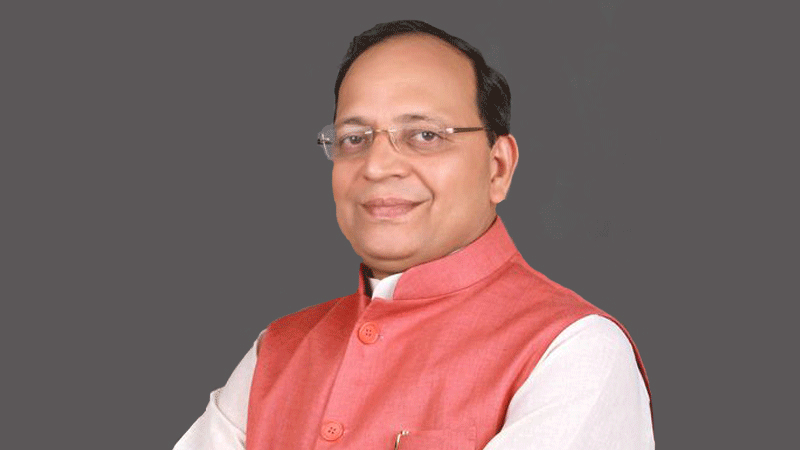
Atmanirbhar Bharat Sankalp Abhiyan: Interview
Bharatiya Janata Party launched the Atmanirbhar Bharat Sankalp Abhiyan from 25th September (Deendayal Upadhyaya Jayanti) to 25th December 2025 (Atal Bihari Vajpayee Jayanti) with the objective of strengthening public awareness and participation in building a self-reliant India. The nationwide campaign witnessed extensive activities organised from the Mandal level to the National level, ensuring broad public outreach.
Key initiatives under the campaign included Bharat Sankalp Sammelans held at Mandal, Vidhan Sabha and District levels, along with conferences of traders, industrialists, women entrepreneurs and MSME stakeholders. To further spread the message of Atmanirbharta, Rath Yatras, seminars, Swadeshi Sankalp programmes were organised in schools and colleges across the country.
On the occasion of Deepawali and other major festivals, a special social media campaign titled #SankalpForAtmanirbharBharat, along with a dedicated logo, was launched to encourage citizens to adopt and promote swadeshi products. This digital outreach played a crucial role in connecting the campaign with the youth and urban population.
As part of the grassroots outreach, stickers bearing the slogan “Har Ghar Swadeshi, Ghar Ghar Swadeshi” were affixed at households across the country to reinforce the message of self-reliance at the family level. In addition, the party organised Swadeshi Melas (local fairs) nationwide, providing a platform for local artisans, entrepreneurs and swadeshi product manufacturers to showcase their goods and directly connect with consumers. Through these diverse activities, the Atmanirbhar Bharat Sankalp Abhiyan successfully carried the message of self-reliance to the grassroots level and inspired public participation. On this outreach programme BJP National General Secretary and MP Shri Arun Singh talks to Kamal Sandesh’s Vipul Sharma, at the party headquarters in New Delhi. Excerpts of the interview:
What are the objectives of the Atmanirbhar Bharat Abhiyan?
The objective of the Aatmanirbhar Bharat Sankalp Abhiyan is to ensure that the mantra of “Har Ghar Swadeshi, Ghar Ghar Swadeshi” is embraced by every citizen and evolved into a mass movement. When people adopt Swadeshi (indigenous) products, India will move towards self-reliance, and through self-reliance, the resolve of building a ‘Viksit Bharat’ will be fulfilled.
Hon’ble Prime Minister Shri Narendra Modi has repeatedly appealed to the public in his speeches to embrace Swadeshi products—especially those that embody the spirit of India, are produced through the hard work of the nation’s youth, and are manufactured within the country. By choosing such products, citizens actively contribute to making India self-reliant. This not only strengthens the nation’s economic foundation but also generates large-scale employment opportunities.
In this direction, the Prime Minister’s ‘Vocal for Local’ campaign has been actively promoted. It is essential that we use local products as much as possible and encourage small and micro-industries, thereby strengthening the domestic economy and fostering sustainable growth.
What kind of activities were held during this campaign?
One of the most satisfying aspects of the Aatmanirbhar Bharat Sankalp Abhiyan was
that the Hon’ble Prime Minister displayed the “Har Ghar Swadeshi, Ghar Ghar Swadeshi” logo on the cover pages of his social media handles. Party office bearers and karyakartas followed this trend, making the campaign highly impactful and widespread.
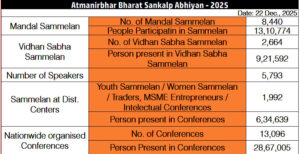
During the campaign, 17.1 million people filled up the Swadeshi Shapath Patra and took a pledge, with their raising right hand, to use only Indian-made, indigenous products. In addition, pledges were taken for environmental protection and the promotion of regional languages. Nearly 27 million “Har Ghar Swadeshi – Ghar Ghar Swadeshi” stickers were affixed to homes across the country.
A total of 13,443 Atmanirbhar Bharat conferences were organized nationwide, primarily at the assembly constituency level. Children from 53,062 schools and colleges participated by taking the Atmanirbhar Bharat and Swadeshi pledge. Shapath Patras were also signed at 4,063 railway stations and bus stands, while the campaign was further promoted through hoardings in public spaces.
Additionally, 2,030 conferences for young women entrepreneurs were organized. In many places, local artisans and small business owners were felicitated in recognition of their contribution to the Swadeshi movement. People responded with deep faith to Prime Minister Narendra Modi’s call, transforming the Abhiyan into a true mass movement.
Several NGOs also played a significant role. For instance, Amul affixed the “Har Ghar Swadeshi, Ghar Ghar Swadeshi” sticker on 25 million milk packets, ensuring the message reached households throughout the month. Many such initiatives received wholehearted support from the general public, industry, and civil society organizations. A special sticker reading “Garv Se Kaho Yeh Swadeshi Hai” was displayed in shops, and 827 Swadeshi fairs were organized to promote local products.
What were the main topics discussed during this campaign?
During the programmes organized under the ‘Atmanirbhar Bharat Sankalp Abhiyan’, the central focus of discussion was how India is becoming self-reliant under the leadership of Hon’ble Prime Minister Shri Narendra Modi. Deliberations highlighted India’s steady progress towards self-reliance across all sectors—be it defence, the Make in India initiative, green energy, or the economy.
Efforts were also made to raise public awareness about how every citizen can contribute to realizing the vision of a Viksit Bharat. Prime Minister Shri Narendra Modi addressed this theme through his ‘Mann Ki Baat’ radio programme as well as at public rallies across the country.
Union Home Minister Shri Amit Shah administered the pledge in Patna, while BJP National President Shri Jagat Prakash Nadda did so in Delhi. Governors, Chief Ministers, and ministers from several states also administered the pledge, further strengthening the nationwide outreach of the Abhiyan.
How relevant is the concept of self-reliance in the age of globalization?
Today, countries across the world are placing strong emphasis on self-reliance. From the United States to China, nations are prioritizing the attraction of industries and the generation of employment. The resolve to embrace indigenous products has been championed by great leaders at various times, from Mahatma Gandhi to Pandit Deendayal Upadhyaya.
The concept of Swadeshi (indigenous) promotes self-reliance, job creation, and economic self-sufficiency. To achieve the goal of a ‘Viksit Bharat’, it is essential that indigenous products become an integral part of our daily lives. This campaign and commitment are not time-bound; they will continue until the vision of a developed India is fully realized.