PM inaugurates Navi Mumbai International Airport, launches and dedicates various developmental projects

| Published on:

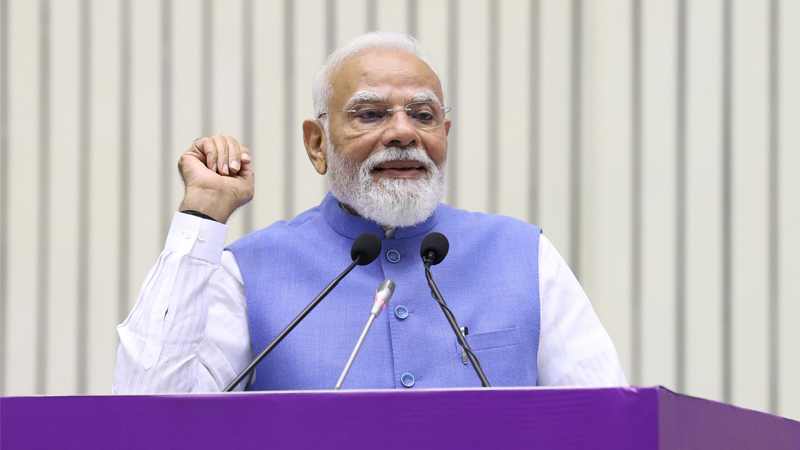
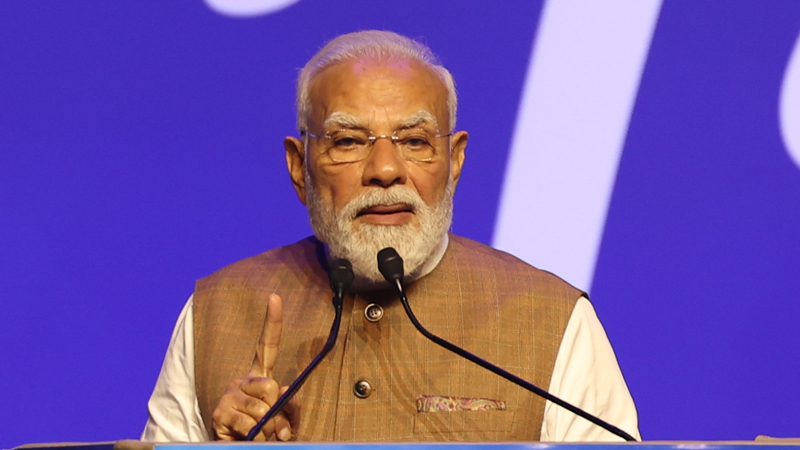
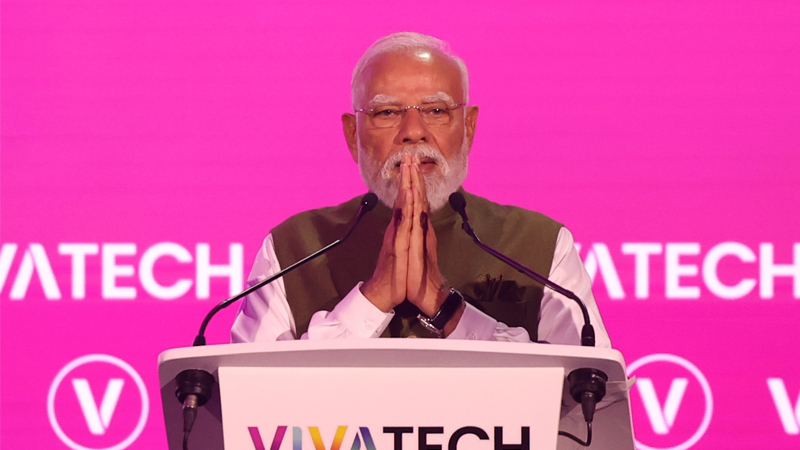
Prime Minister Shri Narendra Modi inaugurated the Navi Mumbai International Airport and also launched and dedicated various developmental projects in Mumbai, Maharashtra today. Welcoming all the dignitaries, Shri Modi extended warm greetings to all attendees. He noted the recent celebration of Vijayadashami and Kojagari Purnima, and conveyed his best wishes for the upcoming Diwali festival

Underscoring that Mumbai’s long wait has ended with the city now receiving its second international airport, the Prime Minister highlighted that this airport will play a major role in establishing the region as one of Asia’s largest connectivity hubs. He also remarked that Mumbai has now received a fully underground metro, which will make travel easier and save time for commuters. Shri Modi described the underground metro as a living symbol of a developing India and noted that in a bustling city like Mumbai, this remarkable metro has been constructed underground while preserving historic buildings. He extended his congratulations to the workers and engineers involved in the project.

Underlining that India offers countless opportunities for its youth, the Prime Minister highlighted the recent launch of the ₹60,000 crore PM Setu scheme aimed at linking numerous ITIs across the country with industry. He noted that starting today, the Maharashtra government has introduced new programs in hundreds of ITIs and technical schools. Through these initiatives, Shri Modi said, students will receive training in emerging technologies such as drones, robotics, electric vehicles, solar energy, and green hydrogen. He extended his best wishes to the youth of Maharashtra.

Shri Modi paid tribute to Maharashtra’s son, Lokneta Shri D. B. Patil, recalling his dedicated service to society and farmers. He remarked that Shri Patil’s spirit of service is an inspiration to all, and his life will continue to motivate those working in public life.

“Today, the entire nation is committed to fulfilling the resolve of a Viksit Bharat—an India defined by both speed and progress, where public welfare is paramount and government schemes simplify citizens’ lives”, emphasised Shri Modi remarking that over the past eleven years, this spirit has guided development efforts across every corner of the country. The Prime Minister highlighted that when Vande Bharat semi high-speed trains run on the tracks, when bullet train projects gain momentum, when wide highways and expressways connect new cities, when long tunnels are carved through mountains, and when tall sea bridges link distant shores, India’s speed and progress become visible. He affirmed that such advancements give new wings to the aspirations of India’s youth.

Shri Modi stated that today’s event continues the momentum of India’s development journey. He highlighted that the Navi Mumbai International Airport is a project that reflects the vision of a developed India. Built on the land of Chhatrapati Shivaji Maharaj, the airport is shaped like a lotus flower, symbolizing culture and prosperity. The Prime Minister remarked that this new airport will connect Maharashtra’s farmers to supermarkets in Europe and the Middle East, enabling fresh produce, fruits, vegetables, and fishery products to reach global markets swiftly. He noted that the airport will reduce export costs for nearby small and medium industries, boost investment, and lead to the establishment of new enterprises. He extended his heartfelt congratulations to the people of Maharashtra and Mumbai for the new airport.

Underlining that when there is a resolve to fulfill dreams and a strong will to deliver rapid development to citizens, results are inevitable, the Prime Minister highlighted that India’s aviation sector stands as a major testament to this progress. Recalling his 2014 address upon assuming office, Shri Modi reiterated his vision that even those wearing hawaii chappals should be able to travel by air. To realize this dream, it was essential to build new airports across the country. He affirmed that the government took this mission seriously and, over the past eleven years, new airports have been constructed one after another. In 2014, India had only 74 airports; today, the number has crossed 160.

Prime Minister stated that the construction of airports in smaller cities has provided residents with new options for air travel. To address financial constraints, the government launched the UDAN scheme, aimed at making air tickets affordable for the common citizen. He highlighted that over the past decade, millions of people have flown for the first time under this scheme, fulfilling their long-held dreams.

Emphasising that the construction of new airports and the UDAN scheme have provided convenience to citizens, Shri Modi highlighted that India has now become the world’s third-largest domestic aviation market. He remarked that Indian airlines are continuously expanding and placing orders for hundreds of new aircraft. This growth is creating new opportunities for pilots, cabin crew, engineers, and ground workers.

Pointing out that as the number of aircraft increases, the demand for maintenance and repair operations also rises, the PM highlighted that India is developing new facilities domestically to meet this need. He affirmed that the goal is to establish India as a major MRO (Maintenance, Repair, and Overhaul) hub by the end of this decade. He noted that this initiative is also creating numerous new employment opportunities for India’s youth.

“India is the youngest country in the world, and its strength lies in its youth”, exclaimed the Prime Minister, emphasising that every government policy is focused on creating maximum employment opportunities for young people. He remarked that increased investment in infrastructure leads to job creation, citing the ₹76,000 crore Vadhavan Port project as an example. He added that when trade expands and the logistics sector gains momentum, employment is generated.

Shri Modi affirmed that India is nurtured in values where national policy forms the basis of politics. For the government, every rupee spent on infrastructure is a means to enhance citizens’ convenience and capability. He contrasted this with a political stream in the country that prioritizes power over public welfare. He stated that such individuals obstruct development work and derail projects through scams and corruption, and that the nation has witnessed such misgovernance for decades.

Noting that the metro line inaugurated today serves as a reminder of the actions of certain previous administrations, Shri Modi recalled participating in its foundation stone ceremony, which had raised hopes among lakhs of Mumbai families for reduced hardships. However, he remarked that a subsequent government halted the project, causing the nation a loss of thousands of crores and prolonged inconvenience for several years. The Prime Minister highlighted that with the completion of this metro line, a journey of two to two-and-a-half hours will now take only 30 to 40 minutes. In a city like Mumbai, where every minute counts, he noted that citizens were deprived of this facility for three to four years, calling it nothing short of a grave injustice.

“For the past eleven years, the government has placed strong emphasis on improving ease of living for citizens”, said the Prime Minister,  underscoring that unprecedented investment is being made in facilities such as railways, roads, airports, metros, and electric buses. He cited projects like Atal Setu and the Coastal Road as examples of this development.

Shri Modi further remarked that efforts are underway to integrate all modes of transport to ensure seamless travel, eliminating the need for commuters to switch modes with difficulty. He affirmed that India is progressing towards the vision of One Nation, One Mobility. He noted that the Mumbai One App is another step in this direction, enabling citizens to avoid long queues for tickets. With this app, a single ticket can be used across local trains, buses, metros, and taxis.

Prime Minister stated that Mumbai, being India’s financial capital and one of its most vibrant cities, was targeted by terrorists in the 2008 attacks. He remarked that the government in power at the time sent a message of weakness and appeared to surrender before terrorism. Shri Modi referred to a recent revelation by a senior opposition party leader and former Home Minister, who claimed that after the Mumbai attacks, India’s armed forces were ready to strike Pakistan. He noted that the entire nation supported such action. However, according to the opposition leader, the government halted the military response due to pressure from a foreign country. The Prime Minister demanded that the opposition party clarify who influenced this decision, which he said undermined the sentiments of Mumbai and the nation. He asserted that the opposition party’s weakness emboldened terrorists and compromised national security, a cost the country paid with innocent lives.

“For our government, nothing is more important than the security of the nation and its citizens”, affirmed the Prime Minister, stating that today’s India responds with strength and strikes back within enemy territory, as witnessed and acknowledged globally during Operation Sindoor.

Shri Modi emphasized that empowering the poor, neo-middle class, and middle class is a national priority. He remarked that when these families receive access to facilities and respect, their capabilities grow, and the collective strength of citizens makes the nation stronger. He highlighted that recent next-generation reforms in GST have made several goods more affordable, further enhancing the purchasing power of the people. Citing market data, he noted that this Navratri season broke multi-year sales records, with record numbers of people purchasing scooters, bikes, televisions, refrigerators, and washing machines.

Affirming that the government will continue to take steps that improve citizens’ lives and strengthen the nation, Shri Modi urged everyone to embrace swadeshi and proudly say, “This is swadeshi”—a mantra that should resonate in every home and marketplace. He emphasized that when every citizen buys swadeshi clothes and shoes, brings home swadeshi products, and gives swadeshi gifts, the nation’s wealth remains within the country. This, he said, will generate employment for Indian workers and create jobs for the youth. The Prime Minister encouraged people to imagine the immense strength India will gain when the entire nation adopts swadeshi.

The Prime Minister concluded by stating that Maharashtra has always been at the forefront of accelerating India’s development. He affirmed that their governments at Union and State will continue working tirelessly to enhance the capabilities of every town and village in Maharashtra and extended his congratulations and best wishes to all for the development initiatives.

Governor of Maharashtra, Shri Acharya Devvrat, Chief Minister of Maharashtra, Shri Devendra Fadnavis, Union Ministers, Shri Ramdas Athawale, Shri Rammohan Naidu Kinjarapu, Shri Murlidhar Mohol, Japan’s Ambassador to India, Mr. Keiichi Ono were present among other dignitaries at the event.

Background

In line with his vision of transforming India into a global aviation hub, Prime Minister inaugurated the Phase 1 of Navi Mumbai International Airport (NMIA) built at a cost of around Rs. 19,650 crores.

The Navi Mumbai International Airport is India’s largest Greenfield airport project, developed under a Public–Private Partnership (PPP). As the second international airport for the Mumbai Metropolitan Region, NMIA will work in tandem with Chhatrapati Shivaji Maharaj International Airport (CSMIA) to ease congestion and elevate Mumbai into the league of global multi-airport systems. The airport, designed to be among the most efficient in the world with 1160 Ha area, will eventually handle 90 million passengers annually (MPPA) and 3.25 million metric tonnes of cargo.

Among its unique offerings is an Automated People Mover (APM), a transit system planned to connect all four passenger terminals for smooth inter-terminal transfers, as well as a landside APM linking the city-side infrastructure. In line with sustainable practices, the airport will feature dedicated storage for Sustainable Aviation Fuel (SAF), solar power generation of approximately 47 MW, and EV bus services for public connectivity across the city. NMIA will also be the first airport in the country to be connected by Water Taxi.

Prime Minister inaugurated Phase 2B of the Mumbai Metro Line-3, stretching from Acharya Atre Chowk to Cuffe Parade, constructed at an estimated cost of around Rs. 12,200 crore. With this, he will dedicate the entire Mumbai Metro Line 3 (Aqua Line) — to the nation with a total cost of over Rs. 37,270 crore, marking a major milestone in the city’s urban transport transformation.

As Mumbai’s first and only fully underground metro line, this project is set to redefine commuting across the Mumbai Metropolitan Region (MMR), offering a faster, more efficient, and modern transit solution for millions of residents.

The Mumbai Metro Line–3, spanning 33.5 km from Cuffe Parade to Aarey JVLR with 27 stations, will cater to 13 lakh passengers daily. The final Phase 2B of the project will provide seamless connectivity to South Mumbai’s heritage and cultural districts such as Fort, Kala Ghoda, and Marine Drive, along with direct access to key administrative and financial hubs including the Bombay High Court, Mantralaya, Reserve Bank of India (RBI), Bombay Stock Exchange (BSE), and Nariman Point.

The Metro Line-3 has been designed to ensure efficient integration with other modes of transport, including railways, airports, other metro lines, and monorail services, thereby enhancing last-mile connectivity and reducing congestion across the metropolitan region.

Prime Minister also launched “Mumbai One” – Integrated Common Mobility App for 11 Public transport Operators (PTO) across Metro, Monorail, Suburban railways and Bus PTOs. These include Mumbai Metro Line 2A & 7, Mumbai Metro Line 3, Mumbai Metro Line 1, Mumbai Monorail, Navi Mumbai Metro, Mumbai Suburban Railway, Brihanmumbai Electric Supply and Transport (BEST), Thane Municipal Transport, Mira Bhayander Municipal Transport, Kalyan Dombivali Municipal Transport and Navi Mumbai Municipal Transport .

Mumbai One App offers commuters a range of benefits, including integrated mobile ticketing across multiple Public Transport Operators, elimination of queueing by promoting digital transactions, and seamless multimodal connectivity through a single dynamic ticket for trips involving multiple transport modes. It also provides real-time journey updates on delays, alternative routes, and estimated arrival times, along with map-based information on nearby stations, attractions, and points of interest, and an SOS feature to ensure commuter safety. Together, these features enhance convenience, efficiency, and security, transforming the public transportation experience across Mumbai.

Prime Minister also inaugurated the Short-Term Employability Program (STEP), a pioneering initiative by the Department of Skill, Employment, Entrepreneurship, and Innovation in Maharashtra. The program will be rolled out across 400 Government ITIs and 150 Government Technical High Schools, marking a major step in aligning skill development with industry requirements to enhance employability. STEP will establish 2,500 new training batches, including 364 exclusive batches for women and 408 batches in emerging technology courses such as Artificial Intelligence (AI), Internet of Things (IoT), Electric Vehicles (EV), Solar, and Additive Manufacturing etc.

Prime Minister addresses the India Mobile Congress 2025

| Published on:

Prime Minister Shri Narendra Modi inaugurated the 9th edition of the India Mobile Congress (IMC) 2025, Asia’s largest telecom, media, and technology event, today at Yashobhoomi in New Delhi. Welcoming all dignitaries to the special edition of the India Mobile Congress, Shri Modi noted that numerous startups had presented on critical themes including Financial Fraud Prevention, Quantum Communication, 6G, Optical Communication, and Semiconductors. The Prime Minister remarked that witnessing presentations on such vital subjects reinforces the belief that India’s technological future rests in capable hands. He extended his best wishes for the event and all new initiatives.

Highlighting that the India Mobile Congress has evolved beyond mobile and telecom, emerging within a few years as Asia’s largest digital technology forum, the Prime Minister questioned how this success story was written and who drove it, and affirmed that it was shaped by India’s tech-savvy mindset, led by the youth and powered by the nation’s talent.

The Prime Minister remarked that innovators and startups have propelled this growth, made possible by a government that stands firmly with the country’s potential. He cited initiatives such as the Telecom Technology Development Fund and Digital Communications Innovations Square, through which startups are being funded. The Prime Minister stated that the government is financing test beds for technologies like 5G, 6G, advanced optical communications, and tera-hertz to enable product development. He emphasized that partnerships between startups and premier research institutes are being facilitated, and that with government support, Indian industry, startups, and academia are collaborating across sectors. He noted that India is advancing in every dimension—developing and scaling indigenous technologies, creating intellectual property through R&D, and contributing to global standards. He added that these efforts have positioned India as an effective platform on the global stage.

“India Mobile Congress and India’s success in the telecom sector reflect the strength of the Atmanirbhar Bharat vision”, exclaimed the Prime Minister, recalling how the idea of ‘Make in India’ was once mocked by skeptics who doubted India’s ability to produce technologically advanced products, citing delays of decades in adopting new technologies during earlier regimes. Shri Modi affirmed that the nation has responded decisively. He highlighted that the country which once struggled with 2G now has 5G coverage in nearly every district adding that electronics production has increased sixfold since 2014, mobile phone manufacturing has grown twenty-eight times, while its exports have surged by one hundred twenty-seven times. Over the past decade, the mobile phone manufacturing sector has generated millions of direct jobs. He cited recent data from a major smartphone company showing that 45 Indian firms are now part of its supply chain, creating approximately 3.5 lakh jobs—just from one company. The Prime Minister emphasized that numerous companies are manufacturing at scale across the country, and when indirect opportunities are added, the employment figures become even more substantial.

“India recently launched its Made-in-India 4G stack, marking a major indigenous achievement, with this India has now joined the list of five countries globally with this capability”, remarked Shri Modi calling it a significant step towards digital self-reliance and technological independence. He stated that through the indigenous 4G and 5G stack, India will not only ensure seamless connectivity but also deliver high-speed internet and reliable services to its citizens.

The Prime Minister informed that on the day of the 4G stack launch, nearly one lakh 4G towers were activated simultaneously across the country, enabling over two crore people to become part of India’s digital movement. He emphasized that many of these areas were remote and previously lagging in digital connectivity, and now internet access has reached all such regions.

Shri Modi highlighted another key feature of India’s Made-in-India 4G stack—its export readiness. He remarked that this indigenous stack will serve as a medium for India’s business outreach and contribute significantly towards achieving the ‘India 6G Vision 2030’.

Emphasising that India’s technology revolution has advanced rapidly over the past decade, and to match this speed and scale, a strong legal and modern policy foundation was long needed, the Prime Minister highlighted the enactment of the Telecommunications Act, which replaced the outdated Indian Telegraph Act and Indian Wireless Telegraph Act—laws that predated the birth of many present-day citizens. Shri Modi emphasized the necessity of establishing a new framework aligned with 21st-century approaches, which the government has successfully implemented. He remarked that the new law functions not as a regulator but as a facilitator adding that approvals have become easier, and Right-of-Way permissions are now granted more swiftly. As a result, Shri Modi stated, fibre and tower network expansion is accelerating, enhancing the ease of doing business, encouraging investments, and enabling industries to plan for the long term.

Prime Minister emphasized that cyber security is being accorded equal priority in the country. He stated that laws against cyber frauds have been made stricter, accountability has been enhanced, and grievance redressal mechanisms have been improved. He remarked that both industry and consumers are significantly benefiting from these measures.

Underlining that the world is increasingly recognizing India’s potential, the Prime Minister highlighted that India holds the position of the second-largest telecom market and the second-largest 5G market globally. Alongside market strength, India possesses manpower, mobility, and a progressive mindset. Shri Modi emphasized that when it comes to manpower, India demonstrates both scale and skill. He noted that India is home to the world’s largest youth population, and this generation is being trained at a massive scale. He remarked that India today has the fastest-growing developer population in the world.

Noting that the cost of one GB of wireless data in India is now lower than the price of a cup of tea, Shri Modi highlighted that India ranks among the leading nations in per-user data consumption, signifying that digital connectivity is no longer a privilege or luxury but an integral part of everyday life.

“India leads with a mindset focused on expanding industry and investment”, said Shri Modi, emphasising that the country’s democratic setup, the government’s welcoming approach, and ease of doing business policies have established India as an investor-friendly destination. He cited the success of India’s digital public infrastructure as proof of the government’s digital-first mindset. With full confidence, the Prime Minister declared, “This is the best time to invest, innovate and make in India!” He affirmed that from manufacturing to semiconductors, mobiles to electronics, and startups across sectors, India is brimming with possibilities and energy.

Recalling his recent Independence Day address from the Red Fort, where he declared the current year as one of major reforms and transformative change, the Prime Minister stated that the pace of reforms is accelerating, thereby increasing the responsibility of industry and innovators. He emphasized the crucial role of startups and young innovators, who are creating new pathways and opportunities through their speed and risk-taking abilities. Shri Modi expressed satisfaction that this year, the India Mobile Congress has invited over 500 startups, providing them with valuable opportunities to connect with investors and global mentors.

Reiterating that established players continue to play a growing role in the sector’s expansion, Shri Modi remarked that these players provide stability, scale, and direction to propel the nation’s economy forward, backed by strong research and development capabilities. “India will be empowered by the speed of startups and the scale of established players working together, emphasised the Prime Minister.

Emphasising that several critical areas within the industry require collaborative efforts from young startup innovators, academia, the research community, and policymakers, the Prime Minister expressed hope that platforms like the India Mobile Congress would serve as effective catalysts for such dialogue. He urged attention to global supply chain disruptions across mobile, telecom, electronics, and the broader technology ecosystem, stating that wherever global bottlenecks exist, India has the opportunity to offer solutions. Shri Modi cited the example of semiconductor manufacturing, where capacity was previously concentrated in a few countries, and the world now seeks diversification. He further affirmed that India has taken significant steps in this direction, with work underway on ten semiconductor manufacturing units across the country.

Prime Minister stated that in electronics manufacturing, global companies are seeking trusted partners who can deliver both scale and reliability. He emphasized that the world also needs dependable partners for the design and manufacturing of telecom network equipment, and posed a compelling question—why can’t Indian companies become reliable global suppliers and design partners?

Shri Modi remarked that in mobile manufacturing, components such as chipsets, batteries, displays, and sensors must increasingly be produced within the country. He noted that the world is generating more data than ever before, making issues of storage, security, and sovereignty critically important. The Prime Minister affirmed that by advancing work on data centers and cloud infrastructure, India has the potential to emerge as a global data hub. The Prime Minister concluded by expressing hope that the upcoming sessions will continue with the same approach and focus. He once again extended his best wishes to all participants for the entire India Mobile Congress programme.

Union Minister Shri Jyotiraditya Scindia, Dr. Chandra Sekhar Pemmasani were present among other dignitaries at the event.

Background

Organised jointly by the Department of Telecommunications (DoT) and the Cellular Operators Association of India (COAI), India Mobile Congress (IMC) 2025 will be held from 8th to 11th October under the theme “Innovate to Transform”, highlighting India’s commitment to leveraging innovation for digital transformation and societal progress.

IMC 2025 will showcase the latest advancements in telecom and emerging technologies, bringing together global leaders, policymakers, industry experts, and innovators. The event will focus on key themes including Optical Communications, Semiconductors in Telecom, Quantum Communications, 6G, and Fraud Risk Indicators, reflecting India’s strategic priorities in next-generation connectivity, digital sovereignty, cyber fraud prevention, and global technology leadership.

More than 1.5 lakh visitors from over 150 countries, 7,000+ global delegates, and 400+ companies are expected to participate. Over 1,600 new use-cases across areas such as 5G/6G, AI, smart mobility, cybersecurity, quantum computing, and green technology will be showcased through 100+ sessions and 800+ speakers.

IMC 2025 also underscores international collaboration, with delegations from Japan, Canada, the United Kingdom, Russia, Ireland, and Austria participating in the event.

Prime Minister greets Air Warriors and their families on Air Force Day

| Published on:

The Prime Minister, Shri Narendra Modi has extended greetings to all the courageous Air Warriors and their families on Air Force Day.

In a post on X, the Prime Minister said:

“Greetings to all the courageous Air Warriors and their families on Air Force Day. The Indian Air Force epitomises bravery, discipline and precision. They have played a vital role in safeguarding our skies, including during the most challenging situations. Their role during natural calamities is also very commendable. Their commitment, professionalism and indomitable spirit continue to make every Indian proud.

Dr. Jitendra Singh addresses the “Satcom” at India Mobile Congress 2025

| Published on:

India’s space economy is projected to reach about $44 billion by 2033, Union Minister of State for Science and Technology Dr. Jitendra Singh said, underlining that landmark reforms and private sector participation are powering the country’s emergence as a global space player.

The summit brought together key stakeholders from government, industry, and academia to deliberate on the future of satellite communications in India’s digital growth story.

Dr. Jitendra Singh emphasised that satellite communication will serve as the backbone of India’s digital infrastructure and play a decisive role in connecting remote regions where terrestrial networks face geographical barriers. With more than 70 per cent of new ATMs being installed in rural areas, he said satcom would be vital for ensuring financial inclusion and expanding digital services.

The Minister highlighted that India’s space economy, valued at $8.4 billion in 2022, is on track to expand nearly fivefold over the next decade. He credited reforms such as the creation of New Space India Limited (NSIL) and the establishment of IN-SPACe for dismantling decades of state monopoly and enabling private innovation. As a result, more than 300 space startups have emerged in just five years, making India the world’s fifth-largest space startup ecosystem.

India’s achievements have also been marked by cost-effective innovation. Chandrayaan-3’s historic soft landing near the Moon’s south pole in 2023 earned India global recognition, including the World Space Award, at roughly half the cost of comparable international missions. Commercially, India has launched 433 foreign satellites, generating over $190 million and €270 million in revenue.

Looking ahead, Dr. Jitendra Singh highlighted India’s long-term space roadmap. By 2035, India plans to set up its own Bharatiya Antariksh Station, while by 2040, an Indian astronaut is expected to land on the Moon and announce the vision of “Viksit Bharat 2047.” The roadmap also envisages launching more than 100 satellites over the next 15 years, most of them small satellites developed through government-private partnerships.

The Minister also spoke of how space technology is shaping governance. Programs like SVAMITVA have already provided land ownership rights to more than 2.4 crore rural property owners across 1.61 lakh villages through satellite mapping. Satellites are now integral to disaster management, daily forest fire monitoring, and agricultural yield assessments, in addition to powering flagship schemes like Gati Shakti for infrastructure planning and NavIC for navigation.

Dr. Jitendra Singh said India’s space diplomacy was strengthening through missions such as the upcoming Chandrayaan-5 in collaboration with Japan and the NASA-ISRO Synthetic Aperture Radar (NISAR) mission. Neighbouring countries, too, are increasingly dependent on Indian satellites for disaster management and communication support.

“Seventy per cent of our space technology is dedicated to development and ease of living, not just rocket launches,” Dr. Jitendra Singh said, adding that the convergence of space technology, digital infrastructure, and governance would serve as the digital nervous system of Viksit Bharat 2047.

Concluding his address, the minister said India’s cost-effective missions, expanding private partnerships, and ambitious space roadmap are positioning the country as a global leader. “India’s space sector has earned for the country an enduring space in the world arena,” he remarked.

The event featured keynote addresses by Dr. Pawan Goenka, Chairman of IN-SPACe, and Dr. V. Narayanan, Chairman of ISRO and Secretary, Department of Space, who highlighted India’s expanding role in the global space sector. The session concluded with a vote of thanks, marking a collaborative beginning to discussions on advancing universal connectivity through satellite networks.

Prime Minister expresses gratitude to people as he enters 25th year of serving as head of a government

| Published on:

The Prime Minister, Shri Narendra Modi has expressed gratitude to the people of India as he enters the 25th year of serving as the head of a government. Recalling his journey since taking oath as the Chief Minister of Gujarat on this day in 2001, the Prime Minister said that it has been his constant endeavour to improve the lives of people and contribute to the progress of the nation.

The Prime Minister said that he was entrusted with the responsibility of being Gujarat’s Chief Minister in very testing circumstances. The state was suffering due to a massive earthquake that year and had also faced a super cyclone, successive droughts and political instability in the preceding years. He said these challenges strengthened the resolve to serve people and rebuild Gujarat with renewed vigour and hope.

Shri Modi remembered his mother’s words when he took oath as Chief Minister, that he should always work for the poor and never take a bribe. He said he had assured people that whatever he does will be with the best intent and inspired by the vision to serve the very last person in the queue.

Reflecting on his tenure in Gujarat, the Prime Minister said that at the time, people believed the state could never rise again. Farmers complained of lack of power and water, agriculture was in the doldrums and industrial growth was stagnant. He said that through collective effort, Gujarat transformed into a powerhouse of good governance. The state, once drought-prone, became a top performer in agriculture, trading expanded into manufacturing and industrial capacities, and social as well as physical infrastructure received a boost.

The Prime Minister said that in 2013, he was given the responsibility of being the Prime Ministerial candidate for the 2014 Lok Sabha elections, when the nation was witnessing a crisis of trust and governance. He said the people of India gave a thumping majority to his alliance and an absolute majority to his Party, ushering in an era of renewed confidence and purpose.

The Prime Minister noted that over the last 11 years, India has achieved many transformations. Over 25 crore people have been lifted out of poverty, and the country has emerged as a bright spot among major global economies. He said that people across India, especially Nari Shakti, Yuva Shakti and hardworking Annadatas, have been empowered through path-breaking efforts and reforms.

He added that the popular sentiment today is to make India Aatmanirbhar across all sectors, reflected in the call of ‘Garv Se Kaho, Yeh Swadeshi Hai.’

Reiterating his gratitude to the people of India for their continuous trust and affection, the Prime Minister said that to serve the nation is the highest honour. Guided by the values of the Constitution, he reaffirmed his commitment to work even harder to realise the collective dream of a Viksit Bharat.

In a series of X post, the Prime Minister said;

“On this day in 2001, I took oath as Gujarat’s Chief Minister for the first time. Thanks to the continuous blessings of my fellow Indians, I am entering my 25th year of serving as the head of a Government. My gratitude to the people of India. Through all these years, it has been my constant endeavour to improve the lives of our people and contribute to the progress of this great nation that has nurtured us all.”

“It was in very testing circumstances that my Party entrusted me with the responsibility of being Gujarat CM. The state was suffering due to a massive earthquake in the same year. The preceding years had witnessed a super cyclone, successive droughts and political instability. Those challenges strengthened the resolve to serve people and rebuild Gujarat with renewed vigour and hope.”

“When I took oath as Chief Minister, I remember my Mother telling me – I do not have much understanding of your work but I only seek two things. First, you will always work for the poor and second, you will never take a bribe. I also told people that whatever I do will be with the best intent and will be inspired by a vision to serve the very last person in the queue.”

“These 25 years have been filled with many experiences. Together, we have made remarkable strides. I still recall that when I took over as CM, it was believed that Gujarat could never rise again. Common citizens, including farmers, complained about lack of power and water. Agriculture was in the doldrums and industrial growth was stagnant. From there, we all worked collectively to make Gujarat a powerhouse of good governance.”

“Gujarat, a drought-prone state became a top performing state in agriculture. The culture of trading expanded into robust industrial and manufacturing capacities. Regular curfews became a thing of the past. Social and physical infrastructure received a boost. It was very satisfying to be able to work with the people to achieve these outcomes.”

“In 2013, I was given the responsibility of being the Prime Ministerial candidate for the 2014 Lok Sabha elections. Those days, the nation was witnessing a crisis of trust and governance. The then UPA Government was synonymous with the worst form of corruption, cronyism and policy paralysis. India was seen as a weak link in the global order. But, the wisdom of the people of India gave our alliance a thumping majority and also ensured that our Party got an absolute majority, a first after 3 long decades.”

“Over the last 11 years, We The People of India have worked together and achieved many transformations. Our path breaking efforts have empowered people from all across India, especially our Nari Shakti, Yuva Shakti and hardworking Annadatas. Over 25 crore people have been removed from the clutches of poverty. India is seen as a bright spot among major global economies. We are home to one of the largest healthcare and social security schemes in the world. Our farmers are innovating and ensuring that our nation is self-reliant. We have undertaken extensive reforms and the popular sentiment is to make India Aatmanirbhar across all sectors, reflecting in the clarion call of ‘Garv Se Kaho, Yeh Swadeshi Hai.’”

“I once again thank the people of India for their continuous trust and affection. To serve our beloved nation is the highest honour, a duty that fills me with gratitude and purpose. With the values of our Constitution as my constant guide, I will work even harder in the times to come to realise our collective dream of a Viksit Bharat.”

Battlefield has changed, wars of tomorrow will be fought with algorithms, autonomous systems & AI: Raksha Mantri

| Published on:

“The battlefield has changed. The wars of tomorrow will be fought with algorithms, autonomous systems and artificial intelligence. Drones, anti-drone systems, quantum computing and directed-energy weapons will define the future. We have seen such a demo in Operation Sindoor as well,” stated Raksha Mantri Shri Rajnath Singh during ‘Raksha Navachar Samvaad: Interaction with iDEX Startups’, prior to the inauguration of the National Conference at Vigyan Bhawan on October 07, 2025. He urged innovators to think beyond existing solutions and develop technologies that redefine warfare. “We must not remain imitators or followers in technology we must become the creators and standard-setters for the world,” he added.

Highlighting the measurable progress in indigenisation, Shri Rajnath Singh stated that defence capital acquisitions from domestic sources have increased from Rs. 74,000 crore in 2021-22 to Rs. 1.2 lakh crore in 2024-25. He termed this shift as “not merely a statistical change but a change in mindset from dependence to confidence.” He also highlighted that under the Government’s Public Procurement Policy, at least 25% of annual procurement is reserved for Micro and Small Enterprises (MSEs), and over 350 items have been earmarked exclusively for them. “India’s self-reliance in defence has moved from being a slogan to becoming a movement. From policy to practice and from innovation to impact this transformation has been made possible by our innovators, startups, and young entrepreneurs,” underscored Raksha Mantri.

Shri Rajnath Singh encouraged startups to set higher benchmarks, underlining that India has more than 100 Unicorns today, but none in the defence sector, calling upon them to change that. “Let the first Defence Unicorn of India emerge from among you. It will be a matter of pride not only for you but for the entire nation,” he added. He reiterated the vision of Prime Minister Shri Narendra Modi that the government will continue to stand firmly behind innovators and startups and will be with them at every step from ideation to implementation.

Raksha Mantri lauded the collective effort of innovators for contributing to record-breaking achievements in defence production worth Rs. 1.5 lakh crore and exports exceeding Rs. 23,000 crore in the last financial year. “You are the architects of a new India that believes in designing, developing and producing for itself. The energy and innovation you bring are key to realising the Prime Minister’s vision of a technologically self-reliant India,” he highlighted.

Recalling the inception of iDEX in 2018, Shri Rajnath Singh described it as a transformational initiative that has democratised defence innovation in India. He stated that when iDEX was launched, the idea was simple yet powerful to connect the talent of India’s youth with the technological needs of the Armed Forces. “Today, in just seven years, more than 650 iDEX winners have emerged, and prototype procurements worth over Rs. 3,000 crore have been ensured. This marks a revolution in India’s defence innovation landscape,” he added.

Raksha Mantri highlighted that before iDEX, Indian talent was making remarkable contributions globally particularly in IT, telecom and space but was underutilised in defence. “Through iDEX, we ensured that India’s talent works for India’s security. Today, this initiative is not just a programme but a movement that is shaping the future of Indian defence manufacturing,” he underlined.

Shri Rajnath Singh underscored that the Government has taken several landmark steps to support startups and MSMEs through reforms in defence procurement, production and testing infrastructure. Citing examples, he stated that the new Defence Procurement Manual (DPM-2025) provides assured orders for five years, extendable by another five, giving innovators much-needed stability and predictability. He further added that reforms in the Defence Acquisition Procedure (DAP) are underway to simplify processes, accelerate trials, and ensure assured procurement for innovative solutions.

“Through iDEX, Technology Development Fund, Defence Testing Infrastructure Scheme and Self-Certification provisions, we are developing a comprehensive framework where innovation is encouraged, supported, and scaled. Our aim is to make India not just a defence manufacturer but a defence innovator for the world,” underlining Shri Rajnath Singh while ensuring commitment to strengthening the defence innovation ecosystem.

Commending the achievements of iDEX winners such as Refi M. Fiber and Gravity Systems, who were honoured for their role in Operation Sindoor, Shri Rajnath Singh stated that the innovations developed by Indian startups are now earning global appreciation. “It is a matter of great pride when our soldiers salute the innovation born out of India’s own soil. Several Indian startups are now showcasing their game-changing technologies at international platforms such as the Dubai Airshow 2025. The world is taking note of India’s innovation prowess,” he added.

The Raksha Mantri highlighted that the MoD is forging strategic alliances with the Department of Science & Technology, the Department for Promotion of Industry and Internal Trade, and leading financial institutions to facilitate end-to-end support for startups. “Our objective is to build an ecosystem where every idea gets the opportunity to grow into a viable product, every prototype gets the chance to scale into production, and every innovation contributes to India’s defence preparedness,” he stated.

Shri Rajnath Singh pointed out that defence manufacturing under Aatmanirbhar Bharat has now become one of the most promising sectors for private investment, R&D and employment generation. He underscored that a strong indigenous defence industry is not only a strategic necessity but an economic multiplier.

Raksha Mantri stated that the defence innovation journey of India is moving steadily from concept to creation and from vision to victory. He underlined the fact that the nation together will make India not only self-reliant but a global leader in defence technology. He also reaffirmed that India’s defence startup ecosystem will play a decisive role in shaping the nation’s secure and self-reliant future.

The event organised by iDEX under the aegis of Department of Defence Production (DDP), MoD also featured an exhibition showcasing cutting-edge defence innovations developed under iDEX and ADITI, where the Raksha Mantri interacted with the innovators and appreciated their technological breakthroughs. Panel discussions and experience-sharing sessions were held on themes including Scaling Defence Startups, Bridging Innovation and Production, and Accelerating Aatmanirbharta through R&D Collaboration.

Chief of Defence Staff General Anil Chauhan, Secretary of the DDR&D & Chairman DRDO Dr Samir V Kamat, Secretary (Defence Production) Shri Sanjeev Kumar along with senior officials from the MoD, DDP, innovators, startups, MSMEs, industry leaders, Armed Forces representatives and officials from various defence PSUs were also present on the occasion.

“Swachhta” campaign to include technology options and ‘waste to wealth’ methodologies: Dr Jitendra Singh

| Published on:

Union Minister of State (Independent Charge) for Science & Technology; Minister of State for Earth Sciences; PMO; Personnel, Public Grievances and Pensions; Department of Atomic Energy and Department of Space, Dr. Jitendra Singh today called for “Swachhta” campaign to include technology options and ‘waste to wealth’ methodologies.

The Minister said that awareness among citizens is vital so as to make Swachhta a norm, habit and inclusion in daily day to day life. Speaking on an initiative of AIIMS, where a van collects waste from labs and converts it into inert material and subsequently recycled making use of technology. Citing another example, he said that even in Kumbh, waste treatment was adopted, whereby waste-water after treatment was used for irrigation purposes. These above initiatives have enabled Swachhta to be viewed from the prism of utilising technology for becoming ‘self-reliant’.

Dr Jitendra Singh said that e-waste reprocessing and recycling enables ‘waste to wealth’ creation using varied methodologies. In this context, Dr Jitendra Singh emphasised that self-reliance by adopting Swachhta Campaign initiatives 5.0 is bringing about metamorphosis not only in cleaner and greener environment but also enabling people to inculcate healthy lifestyle and working methodology in the work environment. Cleaning of e-waste, reprocessing of cooking oil, technology enabled solution and digital innovation including e-filing, system-based dashboard development have enabled awareness creation.

The Union Minister cited that recycling of waste cooking oil provides the double benefit of utilising the by-product ‘ethanol’ produced in the process; at the same time, it avoids its reuse which may pose adverse effects as a health hazard. Dr Jitendra Singh emphasised that such ‘self-reliant’ initiatives would help India not to be dependent on import and strengthen our indigenous home-grown products and solutions.

On the occasion, Secretary DARPG, Shri V. Srinivas said that building upon past achievements, the DARPG is fully committed to ensuring the successful and impactful implementation of Special Campaign 5.0, assuring its dedication towards cleanliness, efficiency, transparency, and improved service delivery.

Pertinently, the Government of India has launched Special Campaign 5.0, to be observed from 2nd October to 31st October 2025, with a special focus on Swachhata (cleanliness) and reducing pendency across Government Ministries and Departments.


Prime Minister addresses Kaushal Deekshant Samaroh launching youth-focused initiatives

| Published on:

Prime Minister Shri Narendra Modi launched various youth-focused initiatives worth more than Rs.62,000 crore during Kaushal Deekshant Samaroh at Vigyan Bhawan in New Delhi today. Extending greetings to lakhs of students associated with ITIs across the country, as well as the students and teachers of Bihar, the Prime Minister recalled that a few years ago, the government initiated a new tradition of organizing large-scale convocation ceremonies for ITI students. He remarked that today marks another milestone in that tradition.

Prime Minister stated that today’s ceremony symbolizes the priority India accords to skill development. He announced the launch of two major initiatives for youth across the country in the fields of education and skill development. Shri Modi highlighted that under the ₹60,000 crore PM SETU scheme, ITIs will now be more robustly integrated with industries. He further informed that 1,200 skill labs have been inaugurated today across Navodaya Vidyalayas and Eklavya Model Schools nationwide.

Shri Modi shared that the initial plan for the event was to hold a convocation ceremony at Vigyan Bhawan. However, as he remarked, it turned into a grand celebration—“a case of gold adorned with embellishment”—with the proposal from Shri Nitish Kumar to elevate the occasion into a mega-festival. The Prime Minister highlighted that several schemes and projects have been dedicated to the youth of Bihar from this very platform. These include the establishment of a new Skill Training University in Bihar, expansion of facilities in other universities, the formation of a new Youth Commission, and the issuance of appointment letters for permanent government jobs to thousands of young individuals. He affirmed that these initiatives are a guarantee for a brighter future for Bihar’s youth.

Recalling the recent large-scale programme focused on employment and self-reliance for the women of Bihar, which witnessed participation from lakhs of sisters, Shri Modi remarked that today’s mega programme for youth empowerment in Bihar further reflects the priority their government accords to the youth and women of the state.

Emphasising that India is a nation of knowledge and skill, and this intellectual strength is its greatest asset, the Prime Minister remarked that when skills and knowledge align with national needs and contribute to fulfilling them, their impact multiplies manifold. He highlighted that the demand of the 21st century is to rapidly advance local talent, local resources, local skills, and local knowledge in accordance with the country’s requirements. Underscoring the significant role of thousands of ITIs in this mission, Shri Modi remarked that currently, ITIs offer training in nearly 170 trades, and over the past 11 years, more than 1.5 crore youth have been trained in these disciplines, gaining technical qualifications across diverse sectors. He noted with pride that these skills are imparted in local languages, enabling better understanding and accessibility. This year, over 10 lakh students participated in the All India Trade Test, and the Prime Minister had the opportunity to felicitate more than forty-five of them during the event.

Prime Minister expressed pride in the moment, noting that a large number of the awardees hail from rural and remote parts of India. He highlighted the presence of daughters and Divyang companions among them, and commended their hard-earned success through dedication and perseverance.

“India’s ITIs are not only premier institutions for industrial education but also serve as workshops for building an Atmanirbhar Bharat”, exclaimed the Prime Minister emphasising that the government is focused on both increasing the number of ITIs and continuously upgrading them. He noted that until 2014, there were only 10,000 ITIs in the country, but in the past decade, nearly 5,000 new ITIs have been established. Shri Modi highlighted that the ITI network is being prepared to meet current industry skill requirements and anticipate future demands over the next ten years. To strengthen this alignment, coordination between industry and ITIs is being enhanced. He announced the launch of the PM SETU scheme, which will benefit over 1,000 ITI institutions across India. Through this initiative, ITIs will be upgraded with new machinery, industry training experts, and curricula tailored to present and future skill demands. “The PM SETU scheme will also connect Indian youth with global skill requirements”, stated Shri Modi.

Noting that thousands of youth from Bihar have joined today’s programme, Shri Modi remarked that this generation may not fully grasp how the education system in Bihar was devastated two to two-and-a-half decades ago. Schools were not opened sincerely, nor were recruitments conducted. The Prime Minister emphasized that every parent wishes for their child to study and progress locally. However, due to compulsion, lakhs of children had to leave Bihar and migrate to places like Banaras, Delhi, and Mumbai. He identified this as the true beginning of migration.

Shri Modi remarked that reviving a tree whose roots have been infested is a formidable feat, and likened the condition of Bihar under opposition’s misgovernance to such a tree. He stated that fortunately, the people of Bihar entrusted Shri Nitish Kumar with the responsibility of governance, and the entire team of the coalition government worked collectively to restore the derailed systems. The Prime Minister affirmed that today’s programme offers a glimpse of that transformation.

Expressing satisfaction that Bihar has received a new Skill University during today’s Kaushal Convocation Ceremony, the PM noted that the government led by Shri Nitish Kumar has named the university after Bharat Ratna Jananayak Karpoori Thakur. Shri Modi highlighted that Bharat Ratna Karpoori Thakur dedicated his entire life to public service and the expansion of education, consistently advocating for the upliftment of the most disadvantaged sections of society. He affirmed that the Skill University named in his honour will serve as a powerful medium to advance that very vision.

Prime Minister stated that their governments at Center and State are consistently working to modernize Bihar’s educational institutions. He informed that infrastructure expansion has commenced at IIT Patna, and the modernization of several major educational institutions across Bihar has also begun. Shri Modi announced that the Bihta campus of NIT Patna has now been opened for talented students. Additionally, he highlighted that new academic infrastructure foundations have been laid at Patna University, Bhupendra Mandal University, Jai Prakash University in Chhapra, and Nalanda Open University.

Highlighting that alongside strengthening educational institutions, the government led by Shri Nitish Kumar is actively working to reduce the financial burden of education for Bihar’s youth, Shri Modi noted that efforts are being made to ensure students do not face difficulties in paying fees for higher education. He stated that the Bihar Government has been supporting students through the Student Credit Card scheme, and a major decision has now been taken to make the education loans under this scheme interest-free. Additionally, the Prime Minister announced that student scholarships have been increased from ₹1,800 to ₹3,600.

“India is among the world’s youngest nations, and Bihar is one of the states with the highest proportion of youth”, remarked the Prime Minister, emphasizing that when the potential of Bihar’s youth grows, the strength of the nation increases. He affirmed that their government is working with full commitment to further empower Bihar’s youth. Shri Modi further highlighted that compared to the Opposition government in the past, Bihar’s education budget has been increased manifold. Today, nearly every village and hamlet in Bihar has a school, and the number of engineering and medical colleges has also grown significantly. He informed that the Central Government has recently approved Kendriya Vidyalayas for 19 districts in Bihar. The Prime Minister recalled that there was a time when Bihar lacked international-level sports infrastructure, but today, national and international sports events are being held in the state.

Highlighting that over the past two decades, the Bihar Government has connected 50 lakh youth with employment opportunities within the state, Shri Modi noted that in recent years alone, nearly 10 lakh permanent government jobs have been provided to Bihar’s youth. He pointed to the education department as a prime example, where large-scale recruitment of teachers is underway. He informed that in the last two years, more than 2.5 lakh teachers have been appointed in Bihar, resulting in both employment for youth and a significant improvement in the quality of the education system.

Underlining that the Bihar Government is now working with new targets, Shri Modi highlighted that the state aims to create twice as many employment opportunities in the next five years as were generated over the past two decades. The Prime Minister affirmed that the resolve is clear—Bihar’s youth should find jobs and work within Bihar itself.

Prime Minister remarked that this is a time of double bonus for the youth of Bihar. He highlighted the ongoing GST Savings Festival across the country and shared that he was informed about the happiness among Bihar’s youth due to reduced GST on bikes and scooters. Many young individuals have even planned to make these purchases during Dhanteras. Shri Modi extended his congratulations to the youth of Bihar and the nation for the reduction in GST on most of their essential items.

“As skills grow, the nation becomes self-reliant, exports increase, and employment opportunities expand”, remarked the Prime Minister. He recalled that before 2014, India was labelled among the “Fragile Five” economies, marked by low growth and limited job creation. Today, India is progressing towards becoming a top-three global economy, with significant growth in manufacturing and employment. Shri Modi highlighted unprecedented growth in manufacturing and exports in sectors such as mobile phones, electronics, automobiles, and defence. He noted that this surge has led to remarkable job creation across large industries and MSMEs, greatly benefiting the youth, including those trained in ITIs. He emphasized that the Mudra Scheme has helped crores of young people start their own ventures. Additionally, the Prime Minister announced the implementation of the ₹1 lakh crore Pradhan Mantri Viksit Bharat Rozgar Yojana, which will assist approximately 3.5 crore youth in securing employment in the private sector.

Affirming that this is a time filled with opportunities for every youth in the country, the Prime Minister  emphasized that while alternatives may exist for many things, there is no substitute for skill, innovation, and hard work. The Prime Minister concluded by remarking with conviction that all these qualities reside within India’s youth, and their strength will become the strength of a Viksit Bharat and extended his heartfelt best wishes to all.

Union Minister Shri Jayant Chaudhary was present among other dignitaries at the event. Chief Minister of Bihar, Shri Nitish Kumar, Union Ministers, Shri Jual Oram, Shri Rajiv Ranjan Singh, Shri Sukanta Majumdar and other dignitaries had connected to the event through video conferencing.

Background

In a landmark initiative for youth development, Prime Minister Shri Narendra Modi unveiled various youth-focused initiatives worth more than Rs.62,000 crore in Vigyan Bhawan, New Delhi, giving a decisive push to education, skilling and entrepreneurship across the country. The programme also featured the Kaushal Deekshant Samaroh, the fourth edition of the National Skill Convocation, organized in accordance with the Prime Minister’s vision, where 46 All India Toppers from Industrial Training Institutes under the Ministry of Skill Development and Entrepreneurship were felicitated

Prime Minister launched PM-SETU (Pradhan Mantri Skilling and Employability Transformation through Upgraded ITIs), a centrally sponsored scheme with an investment of Rs.60,000 crore. The scheme envisages the upgradation of 1,000 Government ITIs across the country in a hub-and-spoke model comprising 200 hub ITIs and 800 spoke ITIs. Each hub will be connected to four spokes on average, creating clusters equipped with advanced infrastructure, modern trades, digital learning systems and incubation facilities. Anchor Industry Partners will manage these clusters, ensuring outcome-based skilling aligned with market demand. Hubs will also house innovation centres, training-of-trainers facilities, production units and placement services, while spokes will focus on expanding access. Collectively, PM-SETU will redefine India’s ITI ecosystem, making it government-owned but industry-managed, with global co-financing support from the World Bank and Asian Development Bank. In the first phase of the scheme implementation there will be special focus on ITIs in Patna and Darbhanga.

Prime Minister inaugurated 1,200 Vocational Skill Labs established in 400 Navodaya Vidyalayas and 200 Eklavya Model Residential Schools across 34 States and Union Territories. These labs will equip students, including those in remote and tribal areas, with hands-on training in 12 high-demand sectors such as IT, automotive, agriculture, electronics, logistics and tourism. Aligned with the National Education Policy 2020 and CBSE curriculum, the project also involves the training of 1,200 vocational teachers to deliver industry-relevant learning and create an early foundation for employability.

A special emphasis of the programme will be on transformative projects in Bihar, reflecting the state’s rich legacy and youthful demographic. Prime Minister launched Bihar’s revamped Mukhyamantri Nishchay Svyam Sahayata Bhatta Yojana, under which nearly five lakh graduate youth every year will receive a monthly allowance of Rs.1,000 for two years, along with free skill training. He will also launch the redesigned Bihar Student Credit Card Scheme, which will provide completely interest-free education loans of up to Rs.4 lakh, significantly easing the financial burden of higher education. More than 3.92 lakh students have already availed loans worth more than Rs.7,880 crore under the scheme. Further strengthening youth empowerment in the state, Bihar Yuva Ayog, a statutory commission for people between the ages of 18 and 45, was formally inaugurated by the Prime Minister to channelise and harness the energies of the state’s young population.

Prime Minister also inaugurated the Jan Nayak Karpoori Thakur Skill University in Bihar, envisioned to impart industry-oriented courses and vocational education to create a globally competitive workforce.

Taking forward the National Education Policy 2020 with the vision to make higher education avenues better, Prime Minister laid the foundation stone for new academic and research facilities in four universities of Bihar namely Patna University, Bhupendra Narayan Mandal University in Madhepura, Jai Prakash Vishwavidyalaya in Chapra and Nalanda Open University in Patna, under the PM-USHA (Pradhan Mantri Uchchatar Shiksha Abhiyan). Together, these projects, with a total allocation of Rs. 160 crore, will benefit more than 27,000 students by enabling modern academic infrastructure, advanced laboratories, hostels and multidisciplinary learning.

Prime Minister dedicated to the nation the Bihta campus of NIT Patna. With the capacity to host 6,500 students, the campus houses advanced facilities including a 5G use case lab, a Regional Academic Centre for Space established in collaboration with ISRO, and an Innovation and Incubation Centre that has already supported nine start-ups.

Prime Minister also distributed appointment letters to more than 4,000 newly recruited candidates in the Government of Bihar and released Rs. 450 crore in scholarships through Direct Benefit Transfer to 25 lakh students of Class 9 and 10 under the Mukhyamantri Balak/Balika Scholarship Scheme.

The initiatives launched are expected to create significant opportunities for India’s youth. By integrating education, skill development, entrepreneurship, and improved infrastructure, they aim to support a solid foundation for the country’s progress. With a special focus on Bihar, the state is likely to develop as a centre for skilled manpower, contributing to growth both regionally and nationally.

Union Finance Minister launches nationwide financial awareness campaign “आपकी पूँजी, आपका अधिकार” in Gandhinagar

| Published on:

The Union Finance Minister Smt. Nirmala Sitharaman launched the nationwide awareness campaign “आपकी पूँजीआपका अधिकार in Gandhinagar, Gujarat today. The campaign was launched in the presence of the State Finance Minister, Shri Kanubhai Desai.

Secretary, DFS, Shri M. Nagaraju, Executive Director of the Reserve Bank of India, whole-time members of IRDAI, SEBI, PFRDA, along with senior officials from the Government of India, the State Government, and representatives of leading financial institutions were also present in the event.

Speaking on the occasion, the Union Finance Minister Smt. Nirmala Sitharaman highlighted that the campaign carries a simple but powerful message that every rupee saved by citizens must return to them or their families.

“Unclaimed deposits, insurance proceeds, dividends, mutual fund balances, and pensions are not mere entries on paper; they represent the hard-earned savings of ordinary families — savings that can support education, healthcare, and financial security”, the Finance Minister added.

Further, the Union Finance Minister underlined the importance of the “3 A’s” — Awareness, Accessibility and Action — as the guiding principles of this campaign. Awareness aims to ensure that every citizen and community are informed about how to trace unclaimed assets. Accessibility focuses on providing simplified digital tools and district-level outreach. Action emphasizes time-bound and transparent claim settlements.

“Together, these three pillars will help bridge the gap between citizens and financial institutions, promoting community awareness and ensuring that every individual can reclaim their rightful savings with dignity and ease”, Smt. Nirmala Sitharaman said.

The Finance Minister also acknowledged the proactive role of regional rural banks, particularly, Gujarat Gramin Bank, and other financial institutions, in the recent KYC and re-KYC campaigns, noting that these efforts have strengthened the link between citizens and the formal financial system. “Undertaken across villages and towns, such initiatives have ensured that beneficiaries remain connected to their savings and entitlements, laying a strong foundation for the success of the current campaign”, the Union Minister said.

Smt. Sitharaman urged all institutions to carry forward the same dedication and outreach in this nationwide initiative on unclaimed financial assets, so that no citizen remains separated from their rightful money.

Smt. Nirmala Sitharaman also handed over certificates to beneficiaries who successfully reclaimed their unclaimed deposits from various institutions.

Speaking on the occasion, the  State Finance Minister of Gujarat, Shri Kanubhai Desai stated that the launch of this nationwide campaign from Gujarat is a matter of pride for the State and assured full support for its successful execution through active participation and outreach. “The unclaimed deposits are very useful for the education, empowerment and other financial needs of the beneficiaries”,  Sh. Kanubhai Desai stated.

The programme also included a message from the  Union Home Minister and Lok Sabha Member of Parliament from Gandhinagar, Shri Amit Shah. The Union Home Minister extended his greetings and encouraged citizens to actively participate in the campaign. The message underscored that the initiative goes beyond the return of unclaimed financial assets and embodies a collective effort towards strengthening public trust, dignity, and empowerment.

Speaking on the occasion, Secretary, DFS, Shri M. Nagaraju noted that as of August 2025, more than ₹75,000 crore of unclaimed deposits have been transferred to the RBI’s Depositor Education and Awareness Fund. Further, Sh. Nagaraju added that unclaimed insurance proceeds stand at over ₹13,800 crore, unclaimed balances in mutual funds amount to about ₹3,000 crore, and unpaid dividends worth more than ₹9,000 crore.

“Claims must be processed quickly, fairly and without unnecessary hurdles to citizens, so that they walk away with clarity and confidence”, Secretary, DFS added. Sh. Nagaraju said that the campaign aims to achieve the department’s long standing goal of financial empowerment of every citizen.

Nearly 172 crore shares have been transferred to the Investor Education and Protection Fund so far. The launch builds on India’s broader achievements in financial inclusion — from Jan Dhan Yojana and UPI to Direct Benefit Transfers – by ensuring that citizens not only gain access to financial services but also reclaim what rightfully belongs to them.

With the launch of “आपकी पूँजी, आपका अधिकार” Campaign from Gujarat, the Government reaffirmed its commitment to making financial inclusion meaningful, transparent, and accessible for every household.

To ensure wide participation, the campaign will be conducted across all States and Union Territories during October—December 2025. Digital demonstrations and helpdesks will assist citizens in tracing and claiming their unclaimed financial assets with ease, reflecting the Government’s commitment to citizen-centric governance and its broader vision of enhancing ease of living.

The campaign, coordinated by the Department of Financial Services (DFS), Ministry of Finance, brings together the Reserve Bank of India (RBI), the Securities and Exchange Board of India (SEBI), the Insurance Regulatory and Development Authority of India (IRDAI), the Pension Fund Regulatory and Development Authority (PFRDA), and the Investor Education and Protection Fund Authority (IEPFA), alongside banks, insurance companies, mutual funds, and pension institutions on a common platform.

Union Home Minister participates in the Bastar Dussehra festival in Jagdalpur, Chhattisgarh

| Published on:

Union Home Minister and Minister of Cooperation, Shri Amit Shah, participated in the Bastar Dussehra festival being organized in Jagdalpur, Chhattisgarh today. Prior to his address, Shri Shah visited and offered prayers at the renowned Danteshwari Temple. The Bastar Dussehra Festival was attended by several dignitaries, including Chhattisgarh Chief Minister Shri Vishnu Deo Sai and Deputy Chief Minister Dr. Vijay Sharma.

1.JPG

In his address, Union Home Minister and Minister of Cooperation Shri Amit Shah said that the 75-day-long Bastar Dussehra, the largest and most unique festival in the world, is not only a cultural event for the tribal community, Bastar, Chhattisgarh, or India but also for the entire world. Shri Shah mentioned that during his prayers at the Danteshwari Temple, he sought blessings for the security forces to gain the strength to make the Bastar region free from Naxalite violence by March 31, 2026. He debunked the misconception propagated by some in Delhi that Naxalism arose from a struggle for development, asserting that Naxalism itself is the primary reason for Bastar’s deprivation from progress. He highlighted that while every village in the country now has access to electricity, drinking water, roads, toilets, health insurance up to ₹5 lakh, and free grain distribution, with rice procurement at ₹3,100 per quintal, Bastar has lagged behind in this race for progress.

The Home Minister assured, on behalf of Prime Minister Shri Narendra Modi, that after March 31, 2026, Naxalites will no longer be able to hinder Bastar’s development or the rights of its people. Shri Shah said that the youth from Bastar who have misled into Naxalism belong to local villages. He appealed to the people of Bastar to convince these misguided youth to lay down their arms and join the mainstream to contribute to the region’s development.

Union Home Minister praised the Chhattisgarh government for formulating the country’s most effective surrender policy, noting that over 500 individuals have surrendered in the past month alone. He urged Naxalites to surrender and announced that every village which will be completely free of Naxalism would receive ₹1 crore from the Chhattisgarh government for development. Shri Shah emphasized that Naxalism has brought no benefits and has significantly reduced as a menace.

3.JPG

Shri Shah stated that both the Central and Chhattisgarh governments are fully committed to the development of Bastar and other Naxal-affected areas, with attractive policies in place. Over the past 10 years, Prime Minister Modi has provided approximately ₹4.40 lakh crore for Chhattisgarh’s development. The state is progressing at an unprecedented pace, with industries being established, educational institutions being built, healthcare facilities expanding, and small-scale industries being promoted.

Union Home Minister reiterated the appeal for Naxalites to surrender under the attractive surrender policy. However, he also warned that any attempt to disturb Bastar’s peace through violence would be met with a strong response from the armed forces, CRPF, and Chhattisgarh Police. He firmly stated that March 31, 2026, is the set date by which Naxalism will be completely eradicated from the country.

4.JPG

Union Home Minister Shri Amit Shah said that this year, tribals from across the country will participate in the Bastar Olympics. He stated that Bastar’s Pandum festival, cuisine, attire, art, and musical instruments have become a center of attraction not only in Bastar but worldwide. He emphasized that Prime Minister Shri Narendra Modi’s resolve is to preserve our culture, language, food, clothing, and musical instruments for centuries, not just for India but for the entire world. The Chhattisgarh government and the Government of India are fully committed to fulfilling this resolve.

Shri Amit Shah highlighted that the Muria Darbar, with its active participation, judicial system, preservation of tribal culture, and tradition of public dialogue since 1874, is no less than a global heritage. He said that the Muria Darbar is a source of inspiration and knowledge for the entire country.

5.JPG

Referring to the Swadeshi Mela organized by the Swadeshi Jagran Manch, Union Home Minister said that Prime Minister Shri Narendra Modi has long emphasized the importance of Swadeshi (indigenous products). The Swadeshi Jagran Manch has been promoting Swadeshi as a mass movement for many years. Now, PM Modi has called upon every household to pledge to use only Indian-made products. He urged every trader to ensure that their shops or shopping malls do not stock foreign goods. Shri Shah stated that if India’s 140 crore population embraces the Swadeshi pledge, no one can stop India from becoming the world’s top economic power.

Union Home Minister added that Prime Minister Modi has recently provided significant relief to mothers and sisters across the country, including Chhattisgarh, by granting substantial GST exemptions on 395 items. Almost all food and beverage items have been made tax-free, and daily-use items are taxed at only five percent. He said that such extensive tax reductions have never been seen before in the country. By adopting Swadeshi values, the nation’s economy will gain unprecedented momentum. Shri Shah mentioned that over 300 Swadeshi companies are participating in the Bastar Dussehra Festival. He added that the Swadeshi Walkathon has become an effective medium to give a new identity to the Swadeshi spirit, and Swadeshi fairs organized nationwide are further accelerating this movement.

6.JPG

Shri Amit Shah said that the 75-day Bastar Dussehra is a matter of pride, identity, and honor for all. He said that the chariot procession, which began in the 14th century, sparked cultural awakening in the region. Shri Shah mentioned that Bastar Dussehra and Muria Darbar work to unite tribal communities and bind the entire Bastar region together.

Union Home Minister said that the Modi government has launched several schemes to honor tribals. For the first time, Prime Minister Modi elevated a daughter of the tribal community, Smt. Draupadi Murmu, to the highest office of the country as President, a matter of great pride. He said that when Her Excellency Draupadi Murmu meets world leaders, it fills not only the tribal community but all Indians with pride. The elevation of a daughter from a poor family in Odisha to the highest democratic office is a matter of pride for all. Shri Shah added that PM Modi decided to celebrate the 150th birth anniversary of Lord Birsa Munda as Tribal Pride Year, establishing his birth anniversary as Tribal Pride Day. Prime Minister Modi has also approved over 15,000 PM Awas houses for those who surrendered after leaving Naxalism and for the families of those killed in Naxal violence in the seven districts of Bastar division.

ABF00629.JPG

Shri Amit Shah mentioned that Shri Pundi Ram Mandavi and Shri Hemchand Manjhi from Narayanpur district, and Shri Ajay Kumar Mandavi from Kanker, have been honored with Padma Awards. On the occasion of the Bastar Dussehra Festival, the 20th installment of the ‘Mahtari Vandan Yojana’ was distributed, providing ₹607 crore to 70 lakh mothers in Chhattisgarh. The Chief Minister Rural Bus Scheme was also launched, covering Bastar and Surguja divisions and including 250 villages.

Amit Shah inaugurates the Sabar Dairy Plant in Rohtak, Haryana

| Published on:

Union Home Minister and Minister of Cooperation Shri Amit Shah inaugurated the Sabar Dairy Plant in Rohtak, Haryana today. On this occasion, Chief Minister of Haryana Shri Nayab Singh Saini, Union Minister of State for Cooperation Shri Krishan Pal Gurjar, Union Minister Shri Rao Inderjit Singh, along with several other dignitaries were present.

9B7A0085 (1).JPG

In his address Union Home Minister and Minister of Cooperation Shri Amit Shah said that Prime Minister Shri Narendra Modi has fulfilled the decades-old demand of the farmers of the country to establish a separate Ministry of Cooperation, and the entire nation is grateful to him for this. He said that in the past four years, the Ministry of Cooperation, along with all the state governments of the country, has worked to strengthen the foundation of cooperatives. Union Minister of Cooperation Minister expressed confidence that by 2029, every panchayat in the country will have a cooperative society.

Shri Amit Shah said that today, through Sabar Dairy, the country’s largest plant for producing curd, buttermilk, and yogurt, built at a cost of about ₹350 crore, has been completed for the welfare of milk producers. He said that from Haryana itself, the entire demand for dairy products in the Delhi–National Capital Region (Delhi-NCR) will be fulfilled. Shri Shah further stated that Sabar Dairy, which began in Gujarat’s Sabarkantha district, has created vast opportunities for milk producers across 9 states. In Gujarat, Tribhuvan Bhai, Bhura Bhai, and Galba Bhai laid the foundation of dairies, and today, through cooperative dairies, 35 lakh women in Gujarat are carrying out annual business worth ₹85,000 crore.

CR3_2264 (1).JPG

Union Minister of Cooperation said that at the Sabar Plant, production will include 150 metric tonnes of curd, 10 metric tonnes of yogurt, 3 lakh liters of buttermilk, and 10,000 kilograms of sweets per day, which will pave the way for farmers’ prosperity. He added that today Sabar Dairy is serving farmers in Rajasthan, Haryana, Maharashtra, Punjab, Uttar Pradesh, and Bihar. He further said that under Amul’s leadership, extensive scientific work has been carried out in Gujarat on modern breeding technologies such as embryo transfer and sex-determination. These technologies should also be made available to livestock farmers in Haryana. Along with this, there is a need to promote beekeeping and organic farming in the state. He also mentioned that several successful experiments on biogas have been carried out in Gujarat, and such initiatives should also be implemented in Haryana.

Shri Amit Shah said that under the leadership of Prime Minister Shri Narendra Modi, India’s dairy sector has grown by 70 per cent in the last 11 years. Under Prime Minister Modi’s leadership, India’s dairy sector has become the fastest-growing dairy sector in the world. He stated that in 2014–15, the number of milching animals in India was 86 million, which has now increased to 112 million. Similarly, milk production has risen from 146 million tonnes to 239 million tonnes. The production of milk from indigenous cow breeds has increased from 29 million tonnes to 50 million tonnes. Shri Shah said that today about 8 crore farmers in India are connected with the dairy sector. He further added that farmers in our country have raised per capita milk availability in India from 124 grams to 471 grams. Union Minister of Cooperation said that in the last 11 years, many changes have taken place in India’s dairy sector, which have brought prosperity to our farmers.

CR5_9638 (1).JPG

Union Home Minister and Minister of Cooperation said that in terms of per capita milk availability, Haryana consistently ranks between first and third place every year. He added that due to the consistent policies during Prime Minister Modi’s tenure, today India stands proudly before the world as the largest milk producer. Shri Shah said that under White Revolution 2.0, more than 75,000 dairy societies will be established across the country in the coming days, and the government will also strengthen 46,000 dairy cooperative societies. He stated that our current milk processing capacity is 660 lakh liters per day, and our target is to increase this to 100 million liters by 2028–29. Once this goal is achieved, all the profits will directly benefit our farmer mothers and sisters engaged in milk production.

CR5_9887 (1).JPG

Shri Amit Shah said that recently, the Modi government has established three national cooperative societies for animal feed production, manure management, and the use of dead animal remains in the circular economy. He added that the Modi government has launched the National Gokul Mission, the National Artificial Insemination Program, the Animal Husbandry Infrastructure Development Fund, and the National Animal Disease Control Program. Shri Shah stated that in the coming days, India also aims to become self-reliant in the construction of dairy plants, and for this purpose, the Modi government is moving towards self-reliance in the dairy sector by accelerating dairy plant construction and related research and development by three times.

We did not ask the dharma of the terrorists, we targeted terror, not civilians or military establishments: Raksha Mantri

| Published on:

Raksha Mantri Shri Rajnath Singh while speaking at an event organised by Jain International Trade Community (JITO) in Hyderabad today, on October 03, 2025, recalled the 2016 Surgical Strikes, the 2019 Balakot Air Strikes, and Operation Sindoor in 2025 as strong demonstrations of India’s unwavering resolve to safeguard its citizens and territorial integrity. “Whenever India’s pride and dignity has been at stake, we have always made no compromises. When we responded to the Pahalgam terror attack, we did not ask the dharma of the terrorists -we targeted terror, not civilians or military establishments,” he said.

Shri Rajnath Singh emphasised that India’s growing military and economic strength is not meant to assert dominance over others, but to protect its cultural values, spiritual traditions, and the humane ideals taught by Lord Mahavira.

Highlighting the rapid strides made in the defence sector under the leadership of Prime Minister Shri Narendra Modi, Raksha Mantri said that India’s defence exports, which stood at approx. Rs 600 crore in 2014, have surged to over Rs 24,000 crore today. He expressed the confidence that defence exports would cross Rs 50,000 Crore by 2029. “From Tejas fighter jets to Akash missiles and Arjun tanks, our armed forces are increasingly being equipped with Made-in-India platforms,” he said.

Calling it a testimony of India’s journey towards Aatmanirbharta, Raksha Mantri spoke about the recent agreement to procure 97 Light Combat Aircraft from Hindustan Aeronautics Limited, with more than 64% indigenous content. “Today, India manufactures everything from toys to tanks. India is rapidly progressing towards becoming the world’s manufacturing hub. And the day is not far when India will emerge as the Factory of the World. And all this will be possible because the government’s intentions are clear and its policies are in the national interest,” he added.

In his address, Raksha Mantri also talked about the economic growth of India as the nation is currently the world’s fourth-largest economy. With an estimated GDP of $7.3 trillion by 2030, it is on track to become the third-largest economy. Citing the International Monetary Fund reports, he stated that, based on average growth rates, India is on track to become the world’s second-largest economy by Purchasing Power Parity (PPP) by 2038.

Raksha Mantri lauded the legacy of great Jain personalities such as Dr Vikram Sarabhai, Dr Dr. D.S. Kothari, Dr. Jagdish Chandra Jain, and Dr. Meenakshi Jain, whose work continues to inspire the nation. He also commended the government’s efforts to preserve India’s Jain heritage, including the repatriation of over 20 stolen idols of Tirthankaras from abroad, and the recognition of the Prakrit language – used in Jain scriptures – as a Classical Language of India. He urged the citizens to draw inspiration from the teachings of Lord Mahavira and the principles of Jain Dharma – especially non-violence, truth, and Aparigraha (non-possessiveness) – as India marches towards becoming a developed nation by 2047.