
Prime Minister celebrates Diwali on board the INS Vikrant

| Published on:

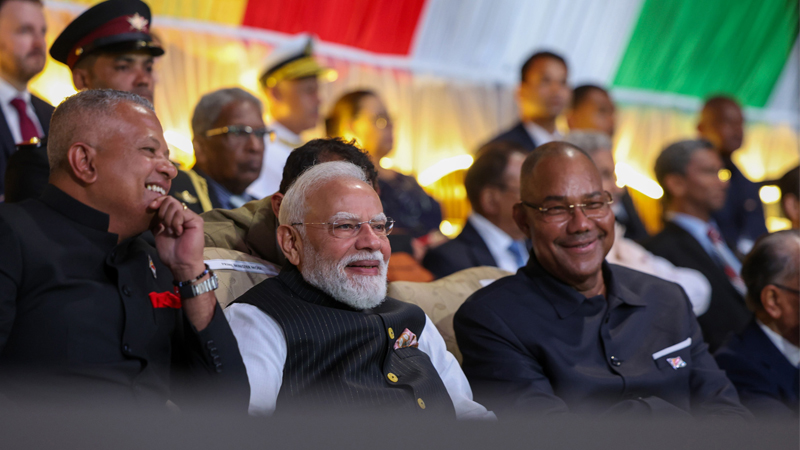
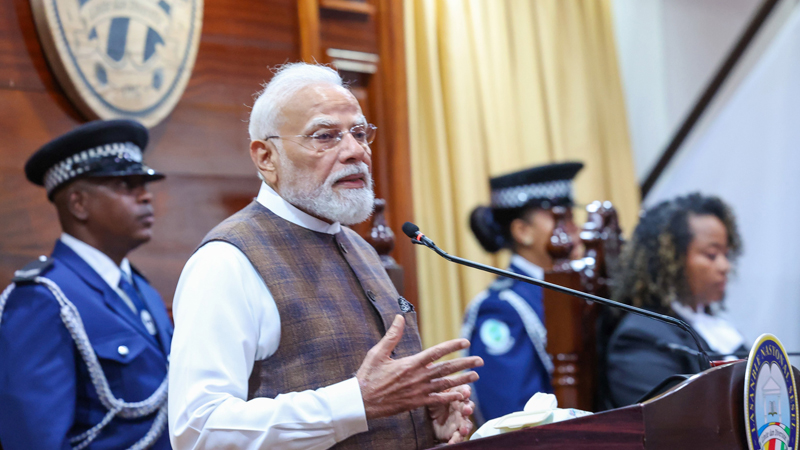
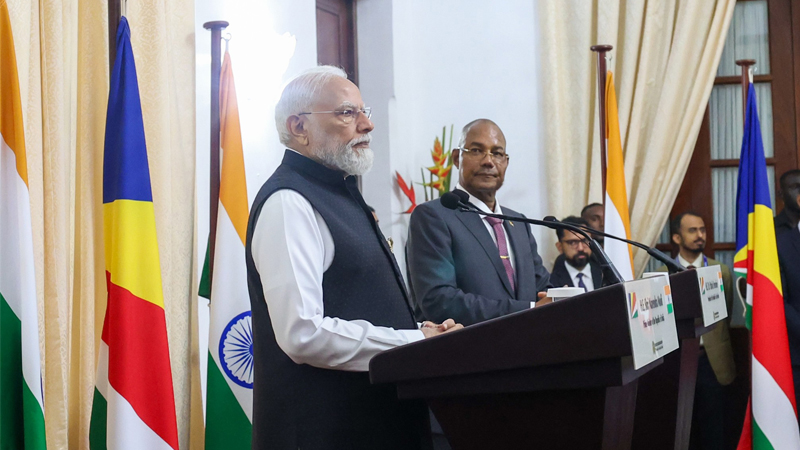
Prime Minister Shri Narendra Modi addressed the armed forces personnel during Diwali celebration on board the INS Vikrant today. Mentioning that today is a remarkable day, a remarkable moment, and a remarkable sight, Shri Modi highlighted that on one side lies the vast ocean, and on the other, the immense strength of Mother India’s brave soldiers. He noted that while one side presents the infinite horizon and boundless sky, the other side showcases the colossal might of INS Vikrant, embodying infinite power. The Prime Minister observed that the sparkle of sunlight on the sea resembles the lamps lit by valiant soldiers during Deepavali, forming a divine garland of lights. He expressed his privilege in celebrating this Diwali among the brave personnel of the Indian Navy.

Recalling his night spent aboard INS Vikrant, the Prime Minister stated that the experience is difficult to put into words. He described the deep night at sea and the sunrise as making this Diwali especially memorable in many ways. From INS Vikrant, the Prime Minister extended heartfelt Diwali greetings to all 140 crore citizens of the country.

Recalling the moment when INS Vikrant was handed over to the nation, Shri Modi stated that at the time, he had remarked—Vikrant is grand, immense, panoramic, unique and exceptional. “Vikrant is not merely a warship; it is a testament to 21st-century India’s hard work, talent, impact, and commitment”, emphasised the Prime Minister. He reminded that on the very day the nation received the indigenously built INS Vikrant, the Indian Navy renounced a major symbol of colonial legacy. He highlighted that inspired by Chhatrapati Shivaji Maharaj, the Navy adopted a new flag.

“INS Vikrant today stands as a powerful symbol of Aatmanirbhar Bharat and Made in India”, exclaimed the Prime Minister, emphasising that the indigenously built INS Vikrant, slicing through the ocean, reflects India’s military prowess. He recalled that just a few months ago, Vikrant’s very name had disrupted the sleep of Pakistan. The Prime Minister asserted that INS Vikrant is a warship whose name alone is enough to put an end to the enemy’s audacity.

Prime Minister expressed his special salute to the Indian Armed Forces on this occasion. He highlighted that the fear instilled by the Indian Navy, the extraordinary skill demonstrated by the Indian Air Force, and the bravery of the Indian Army, along with the exceptional coordination among all three services, compelled Pakistan to surrender swiftly during Operation Sindoor. He affirmed that all personnel involved are truly deserving of congratulations.

Shri Modi stated that when the enemy is in front and war is imminent, the side that possesses the strength to fight independently always holds the advantage. He emphasized that for the armed forces to be strong, self-reliance is essential. The Prime Minister expressed pride that over the past decade, India’s forces have steadily advanced towards self-reliance. He noted that the armed forces have identified thousands of items that will no longer be imported, resulting in most essential military equipment now being manufactured domestically. He highlighted that in the last 11 years, India’s defence production has more than tripled, crossing ₹1.5 lakh crore last year. Citing another example, Shri Modi informed the nation that since 2014, Indian shipyards have delivered over 40 indigenous warships and submarines to the Navy. He added that currently, on average, a new indigenous warship or submarine is being inducted into the Navy every 40 days.

“Missiles like BrahMos and Akash have proven their capabilities during Operation Sindoor. Several countries around the world are now interested in purchasing these missiles”, said the Prime Minister, emphasising that India is building the capacity to export weapons and equipment for all three armed forces. “India’s goal is to be counted among the world’s top defence exporters”, affirmed Shri Modi, stating that over the past decade, India’s defence exports have increased more than 30-fold. He credited this success significantly to the contributions of defence start-ups and indigenous defence units.

Prime Minister stated that India’s tradition regarding strength and capability has always been rooted in the principle—“Gyanaya Daanaya Cha Rakshanaya,” meaning our science, prosperity, and power are dedicated to the service and protection of humanity. He emphasized that in today’s interconnected world, where nations’ economies and progress depend heavily on maritime routes, the Indian Navy plays a crucial role in ensuring global stability. Shri Modi highlighted that 66 percent of the world’s oil supply and 50 percent of container shipments pass through the Indian Ocean. He noted that the Indian Navy is deployed as the guardian of the Indian Ocean to secure these routes. Additionally, through mission-based deployments, anti-piracy patrols, and humanitarian operations, the Indian Navy serves as a global security partner across the region.

“Indian Navy plays a significant role in ensuring the security and integrity of India’s islands”, emphasised the Prime Minister. He recalled the decision taken some time ago to hoist the national flag on every island of the country on 26th January. Shri Modi affirmed that the Navy fulfilled this national resolve, and today, the tricolour is being proudly hoisted by the Navy on every Indian island.

Prime Minister stated that as India progresses rapidly, efforts are being made to ensure that all nations of the Global South advance alongside. He highlighted that India is working on the ‘Mahasagar Maritime Vision’ and is becoming a development partner for many countries. He emphasized that whenever needed, India stands ready to provide humanitarian assistance anywhere in the world. From Africa to Southeast Asia, during times of disaster, the world views India as a global companion. Shri Modi recalled that in 2014, when neighbouring Maldives faced a water crisis, India launched ‘Operation Neer’, and the Navy delivered clean water to the country. In 2017, when Sri Lanka was struck by devastating floods, India was the first to extend a helping hand. In 2018, following the tsunami disaster in Indonesia, India stood shoulder to shoulder with the people of Indonesia in relief and rescue operations. Similarly, whether it was the destruction caused by an earthquake in Myanmar or the crises in Mozambique in 2019 and Madagascar in 2020, India reached out everywhere with a spirit of service.

Shri Modi stated that India’s armed forces have, from time to time, conducted operations to safely evacuate people stranded abroad. From Yemen to Sudan, whenever and wherever the need arose, their valour and courage have reinforced the trust of Indians living across the world. He emphasized that India has also saved the lives of thousands of foreign nationals through these missions.

“India’s armed forces have served the nation across all domains—land, sea, and air—and under every circumstance”, exclaimed Shri Modi highlighting that the Navy is deployed in the seas to safeguard India’s maritime boundaries and trade interests, while the Air Force remains committed to securing the skies. On land, from scorching deserts to icy glaciers, the Army, along with BSF and ITBP personnel, stand firm like a rock. He further acknowledged that across various fronts, personnel from SSB, Assam Rifles, CRPF, CISF, and intelligence agencies are steadfastly serving Mother India. The Prime Minister also commended the Indian Coast Guard for their vital role in national defence, noting their continuous coordination with the Navy to secure India’s coastline day and night. He affirmed that their contribution to this grand mission of national security is immense.

Prime Minister stated that due to the valour and courage of India’s security forces, the nation has achieved a major milestone—the eradication of Maoist terrorism. He highlighted that India is now on the verge of complete freedom from Naxal-Maoist extremism. Before 2014, around 125 districts were affected by Maoist violence; today, this number has reduced to just 11, with only 3 districts remaining significantly impacted. Shri Modi noted that over 100 districts have now fully emerged from the shadow of Maoist terror and are breathing freely for the first time and celebrating Diwali. He emphasized that millions of people, after generations of fear, are now joining the mainstream of development. In regions where Maoists once obstructed the construction of roads, schools, hospitals, and mobile towers, highways are now being built and new industries are emerging. He affirmed that this success has been made possible by the dedication, sacrifice, and bravery of India’s security forces. The Prime Minister expressed joy that in many such districts, people are celebrating Diwali for the first time. He added that record sales and purchases are being witnessed in these areas during the GST Bachat Utsav. In districts where Maoist terror once suppressed even the mention of the Constitution, the mantra of Swadeshi now resonates.

“India is progressing rapidly and fulfilling the dreams of 140 crore citizens. From the ground to space, achievements once considered beyond imagination are now becoming reality”, emphasised the Prime Minister, highlighting the momentum, the progress, the transformation, and the growing development and confidence of the nation. He affirmed that the armed forces play a vital role in this grand task of nation-building. Shri Modi remarked that the forces are not mere followers of the current; they possess the ability to guide its direction, the courage to lead time, the valour to cross the infinite, and the spirit to overcome the insurmountable. He declared that the mountain peaks where our soldiers stand firm will remain as victory pillars of India, and the mighty waves of the ocean beneath them will echo India’s triumph. Amidst this roar, one unified voice will rise—’Bharat Mata Ki Jai!’ With this enthusiasm and conviction, the Prime Minister concluded by once again extending heartfelt Diwali greetings to all.

PM addresses NDTV World Summit 2025 in New Delhi

| Published on:

The Prime Minister, Shri Narendra Modi addressed the NDTV World Summit 2025 in New Delhi today. Addressing the gathering, the Prime Minister welcomed all dignitaries. Extending Diwali greetings to all citizens, Shri Modi noted that the NDTV World Summit is being held in the midst of the festive atmosphere. He appreciated the theme of the session—“Unstoppable India”—and remarked that it is indeed apt, as India today is in no mood to stop. The Prime Minister affirmed, “India will neither stop nor pause, 140 crore Indians are moving forward rapidly, together”.

Prime Minister observed that in a world facing diverse roadblocks and speed breakers, the discourse around an “Unstoppable India” is both natural and timely. He sought to place this theme in the context of the situation eleven years ago and the present. Recalling the pre-2014 era, Shri Modi highlighted the nature of discussions that dominated such summits at the time. He pointed to concerns such as how India would withstand global headwinds, how it would exit the “Fragile Five” grouping, how long the nation would remain trapped in policy paralysis, and when the era of large-scale scams would come to an end.

Recalling that prior to 2014, concerns over women’s safety were widespread, and revelations about the unchecked spread of terrorist sleeper cells dominated discourse, Shri Modi noted that songs lamenting inflation, such as “Mehangai Dayan Khaye Jaat Hai,” were commonly heard. At that time, both citizens and the global community felt that India, entangled in a web of crises, would not be able to emerge. The Prime Minister asserted that over the past eleven years, India has shattered every doubt and overcome every challenge. He highlighted that India has transitioned from being part of the “Fragile Five” to becoming one of the top five global economies. Inflation is now below two percent, while the growth rate exceeds seven percent. “From chips to ships, the confidence of an Atmanirbhar Bharat is evident across sectors”, highlighted the Prime Minister emphasizing that India no longer remains silent after terrorist attacks; instead, it responds decisively through surgical strikes, air strikes, and operations like Sindoor.

Shri Modi urged the audience to recall the COVID-19 period, when the world was living under the shadow of life and death. He noted that global speculation was rife about how a country with such a large population would survive such a massive crisis. The Prime Minister stated that India proved every speculation wrong. He highlighted that India confronted the crisis head-on, developed its own vaccines swiftly, administered them in record time, and emerged from the crisis as the fastest-growing major economy.

Prime Minister stated that even before the impact of COVID-19 had fully subsided, conflicts began emerging across various parts of the world, with headlines dominated by news of war. He noted that once again, questions were raised about India’s growth prospects. Shri Modi affirmed that India once again disproved all speculations and continued to advance as the fastest-growing major economy. Over the past three years, India’s average growth rate has stood at an unprecedented and unexpected 7.8 percent. He informed that merchandise export data released two days ago shows a nearly 7 percent increase compared to the previous year. Last year, India achieved agricultural exports worth approximately ₹4.5 lakh crore. Amidst unstable ratings in many countries, S&P upgraded India’s credit rating after 17 years. The IMF too has revised India’s growth outlook upward. The Prime Minister highlighted that just a few days ago, Google announced a major investment of $15 billion in India’s AI sector. He added that significant investments are also being made in green energy and semiconductor sectors.

“India’s growth today is shaping global opportunities”, exclaimed Shri Modi citing the recent EFTA Trade Agreement as a major example, under which European nations have committed investments worth $100 billion in India. This, he noted, will lead to large-scale job creation. Referring to the recent visit of the Prime Minister of the United Kingdom and his close friend, H.E. Mr. Keir Starmer, who arrived with the largest-ever business delegation, Shri Modi remarked that this reflects the scale of opportunities the world sees in India. He highlighted that India’s trade with G-7 countries has increased by over sixty percent. “The world now views India as a reliable, responsible, and resilient partner”, affirmed Shri Modi, stating that from electronics to pharmaceuticals, and from automobiles to mobile manufacturing, a wave of investment is flowing into India. He emphasized that these investments are helping India become a nerve centre of the global supply chain.

Noting that a topic of discourse in the summit, “Edge of the Unknown,” may represent uncertainty for the world, but for India, it is a gateway to opportunity, Shri Modi emphasized that India has, for centuries, shown the courage to tread unknown paths. Saints, scientists, and navigators have consistently demonstrated that the “first step” marks the beginning of transformation. Whether in technology, vaccine development during the pandemic, skilled manpower, fintech, or the green energy sector, India has converted every risk into reform, every reform into resilience, and every resilience into revolution. The Prime Minister cited the recent remarks of the IMF Chief, who expressed great enthusiasm about the boldness of India’s reforms. He shared an example where global consensus doubted the feasibility of delivering digital identity at mass scale, yet India proved them wrong. Today, fifty percent of the world’s real-time digital transactions occur in India and India’s UPI is dominating global digital payment systems. Shri Modi underlined that outperforming every prediction and assessment has become India’s defining trait—and that is why India is unstoppable.

“The true strength behind India’s achievements comes from its people”, emphasised Shri Modi, stating that citizens can fully realize their potential only when the government does not exert pressure or interfere in their lives. He remarked that excessive government control acts as a brake, while greater democratization accelerates progress. The Prime Minister criticized the opposition party, which governed for sixty years, for consistently promoting the bureaucratization of policy and process. In contrast, he highlighted that over the past eleven years, his government has focused on democratizing both policy and process—an important factor behind the rise of an unstoppable India.

Citing the banking sector as an example, the Prime Minister recalled that in the 1960s, the then Prime Minister had justified the nationalization of banks by claiming it would extend banking services to the poor, farmers, and laborers. However, he asserted that in reality, the then ruling party distanced banks from the people, to the extent that the poor feared even approaching bank doors. As a result, the Prime Minister said, in 2014, more than half of India’s population did not have a bank account. Shri Modi clarified that this was not merely a lack of bank accounts—it meant that a large segment of the population was deprived of banking benefits and forced to borrow at high interest rates from the market, often pledging their homes and land.

Underlining that it was imperative to free the country from excessive bureaucratization, and their government has successfully achieved this, the Prime Minister highlighted the democratization and reform of the banking sector, including the opening of over 50 crore Jan Dhan accounts in mission mode. Today, every village in India has at least one banking touchpoint. Shri Modi remarked that digital transactions have made India one of the most financially inclusive nations globally. He criticized the opposition-led nationalization for creating a mountain of NPAs in banks and remarked that his government’s efforts of democratization has brought banks to record profitability. Over the past eleven years, loans worth lakhs of crores have been extended without bank guarantees to women self-help groups, small farmers, livestock rearers, fishermen, street vendors, and Vishwakarma partners.

Prime Minister cited the petroleum and gas sector as another example of transformation. He recalled that prior to 2014, under the prevailing mindset of bureaucratization, the opposition government was preparing to shut petrol pumps from 8 PM to 8 AM to avoid increasing fuel subsidies. In contrast, he highlighted the present scenario where petrol pumps operate round the clock without restrictions. The Prime Minister emphasized that India is now making unprecedented investments in alternative fuels and electric mobility.

Highlighting that during the opposition era, even obtaining a gas connection required recommendation letters from Members of Parliament, Shri Modi reflected the extent of bureaucratization in the system. In contrast, he stated that his government provided free gas connections to over 10 crore poor families—many of whom had never imagined access to such a facility. He affirmed that this is what true democratization of governance looks like.

Prime Minister remarked that during the era dominated by bureaucratic thinking, the opposition allowed public sector undertakings (PSUs) to stagnate, metaphorically locking them up and resting easy. He criticized the mindset that questioned the need for effort, assuming it bore no personal cost. The Prime Minister affirmed that his government changed this approach. Today, major PSUs such as LIC and SBI are setting new records in profitability.

Prime Minister emphasised that when government policies are rooted in democratization rather than bureaucratization, the morale of citizens rises. He criticized the opposition party for repeatedly chanting “Garibi Hatao” without delivering results, asserting that poverty did not decline under their governance. In contrast, he highlighted that his government’s democratized approach has lifted 25 crore poor citizens out of poverty over the past eleven years. This, he said, is why the nation places its trust in the current government and why India is unstoppable today.

Shri Modi affirmed that India now has a government dedicated to serving the poor and the deprived, giving priority to backward communities and working with full sensitivity to improve their lives. He noted that such efforts often go unnoticed in major discussions. As an example, he cited the recent launch of BSNL’s Made-in-India 4G stack, calling it a significant national achievement. He proudly stated that India is now among the top five countries globally with an indigenously developed 4G stack. The Prime Minister pointed out that BSNL, a public sector company once neglected by opposition, is now achieving new milestones. He added that the launch of the 4G stack was accompanied by BSNL activating nearly one lakh 4G mobile towers on the same day. As a result, millions of people living in remote forests and hilly regions—areas previously untouched by high-speed internet—are now receiving fast internet services.

Sharing a striking third dimension of India’s success that often goes unnoticed, Shri Modi emphasized that when advanced facilities reach remote regions, they transform lives. Citing the example of e-Sanjeevani, the Prime Minister illustrated how a family living in a distant hilly area, unable to take a sick member to the doctor due to bad weather, can now access medical consultation through the high-speed connectivity-based e-Sanjeevani service. Explaining further, Shri Modi said that through the e-Sanjeevani app, patients in remote areas can connect with specialist doctors directly from their phones. He informed  that over 42 crore OPD consultations have already been facilitated via e-Sanjeevani. On this very day of his address, Shri Modi said that more than one lakh people across the country had received assistance through the platform. The Prime Minister emphasized that e-Sanjeevani is not merely a service—it is a symbol of trust that help will be available in times of crisis. He described it as a powerful example of the transformative impact of democratizing public systems.

Shri Modi underscored that a sensitive government, committed to democracy and the Constitution, makes decisions and formulates policies that prioritize ease of living and financial savings for citizens. He highlighted that prior to 2014, 1 GB of data cost ₹300, whereas  now it costs only ₹10, resulting in annual savings of thousands of rupees for every Indian. Through the Ayushman Bharat scheme, the Prime Minister noted that poor patients have saved ₹1.25 lakh crore. Medicines at PM Jan Aushadhi Kendras are available at 80 percent discount, leading to savings of approximately ₹40,000 crore. Additionally, reduced prices of heart stents have enabled annual savings of ₹12,000 crore for poor and middle-class families.

Emphasising that honest taxpayers have directly benefited from his government’s reforms, the Prime Minister highlighted significant reductions in both income tax and GST, noting that this year, income up to ₹12 lakh has been made tax-free. He mentioned that the GST Bachat Utsav is currently in full swing, and recent sales have broken all previous records. The Prime Minister affirmed that these measures—on income tax and GST—are set to yield annual savings of approximately ₹2.5 lakh crore for Indian citizens.

Shri Modi acknowledged the widespread national and international appreciation for Operation Sindoor. He then shifted focus to another critical issue—Naxalism and Maoist terrorism—which he described as not only a major security concern but also deeply linked to the future of India’s youth. He stated that during opposition rule, the ecosystem of Urban Naxals had become so dominant that the rest of the country remained unaware of the extent of Maoist terrorism. While terrorism and Article 370 were widely debated, Shri Modi said that Urban Naxals occupied key institutions and actively worked to suppress discourse on Maoist violence. He noted that even recently, several victims of Maoist terrorism came to Delhi, yet the opposition ecosystem ensured that their plight received little attention.

Prime Minister described the grave situation that once prevailed across nearly every major state in India, where Naxalite and Maoist violence had taken deep root. He stated that while the Constitution was in force across the country, in the Red Corridor, there was no one to even invoke its name. Governments were elected, but in those regions, they held no real authority. The Prime Minister recounted how, after dusk, stepping outside became perilous, and even those responsible for providing security to the public had to move under protection themselves.

Highlighting the devastating impact of Maoist terrorism over the past 50–55 years, stating that thousands of lives were lost, including many security personnel and young citizens, Shri Modi emphasized that Naxalites obstructed the construction of schools and hospitals, and even bombed existing facilities. As a result, a vast region of the country and a large segment of the population remained deprived of development for decades. Shri Modi underscored that this prolonged neglect disproportionately affected tribal communities and Dalit brothers and sisters, who bore the brunt of this violence and underdevelopment.

“Maoist terrorism is a great injustice and a grave sin against the nation’s youth”, remarked the Prime Minister, affirming that he could not allow young citizens to remain trapped in such circumstances. Therefore, since 2014, his government has worked with full sensitivity to reintegrate misguided youth into the mainstream. The Prime Minister highlighted the results of these efforts: while 11 years ago, over 125 districts were affected by Maoist violence, today that number has reduced to just 11 districts. Of these, only three remain highly Naxal-affected.

Shri Modi stated that over the past decade, thousands of Naxalites have surrendered, sharing a recent statistic from the last 75 hours, during which 303 Naxalites laid down arms and surrendered. He added that these were not ordinary insurgents—some carried bounties of ₹1 crore, ₹15 lakh, or ₹5 lakh and a large cache of weapons was also recovered from them. The Prime Minister affirmed that these individuals are now returning to the mainstream of development and openly acknowledging that they were on the wrong path. He emphasized that they now move forward with faith in the Constitution of India.

Reflecting on how headlines once routinely reported incidents from Bastar, Chhattisgarh—then known as a stronghold of Naxalism, the Prime Minister highlighted the transformation, noting that today, tribal youth in Bastar are organizing the Bastar Olympics, a symbol of peace and progress. He stated that this Diwali, regions freed from Maoist terrorism will celebrate with renewed joy, lighting lamps of happiness. Shri Modi assured the people of India that the day is not far when India will be completely free from Naxalism and Maoist violence, adding that it’s a guarantee of their government.

“India’s journey toward becoming a developed nation is not merely a pursuit of growth; Development must walk hand in hand with dignity, where speed is matched by respect for citizens and innovation must aim not only for efficiency but also for empathy and compassion. India is progressing with this very mindset”, remarked the Prime Minister. He concluded by acknowledging the significant role of platforms like the NDTV World Summit in advancing this vision and expressed gratitude for the opportunity to present the nation’s perspective, and extended his best wishes to all participants of the event.

The Prime Minister of Sri Lanka, H.E. Dr. Harini Amarasuriya, Former Prime Minister of Australia, H.E. Mr. Tony Abbott, Former Prime Minister of the United Kingdom, H.E. Mr. Rishi Sunak, were present among other dignitaries at the event.

Prime Minister of Sri Lanka calls on PM

| Published on:

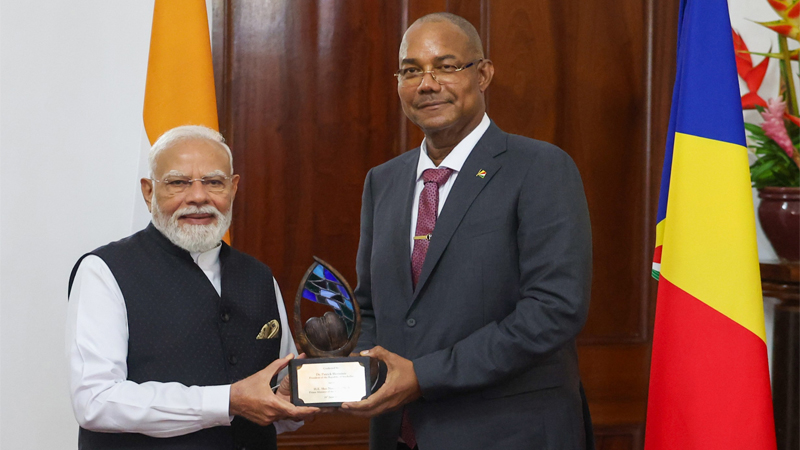
H.E. Dr. Harini Amarasuriya, Prime Minister of the Democratic Socialist Republic of Sri Lanka, called on Prime Minister Shri Narendra Modi today.

While extending a warm welcome, Prime Minister conveyed that her visit would impart fresh momentum to the historic and multi-faceted India–Sri Lanka ties.

Prime Minister recalled his State visit to Sri Lanka in April this year during which he held fruitful discussions with President Anura Kumara Disanayaka covering all areas of cooperation.

The two leaders discussed measures to strengthen cooperation in a number of areas, including education, technology, innovation development cooperation and welfare of our fishermen.

Highlighting the special ties between India and Sri Lanka, Prime Minister reaffirmed India’s commitment to work together in the shared development journey of the two countries.

Prime Minister conveyed his warm wishes to President Disanayaka, and said that he looked forward to their continued engagements.

India is not a Dharmshala; not a single infiltrator will be allowed to stay here: Amit Shah

| Published on:

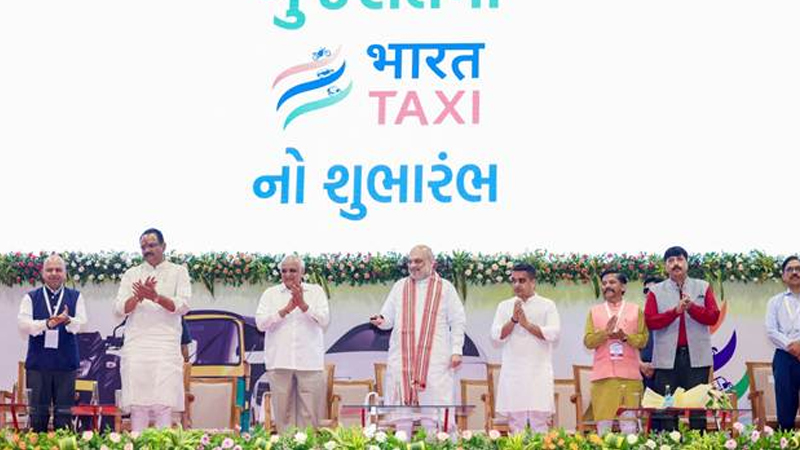
Union Home and Cooperation Minister Shri Amit Shah addressed the Intellectuals’ Meet in Patna, Bihar, on Friday. During the meet, Shri Shah reminded the audience of the “Jungle Raj” during Lalu Yadav’s rule in Bihar, saying that a state with a rich heritage was pushed centuries back by Lalu’s misrule. Shri Shah highlighted the development works carried out in Bihar under the leadership of Hon’ble Prime Minister Shri Narendra Modi Ji and Chief Minister Shri Nitish Kumar. During the event, Bihar BJP State President Shri Dilip Jaiswal, senior BJP leaders, MPs, former Union Minister Shri Ravishankar, and other leaders were present on the stage.

Union Home and Cooperation Minister Shri Amit Shah said that the land of Bihar has been the birthplace and workplace of great personalities like Mahatma Buddha, Chandragupta Maurya, Chanakya, Aryabhata, Emperor Ashoka, and Samudragupta. This is the same land from where eminent figures like Babu Jagjivan Ram, Jayaprakash Narayan, and Shri Krishna Babu emerged, who gave direction to India’s history. From this very land, the governance of the entire country continued for nearly 750 years. The stream of consciousness that flowed from here reached from Afghanistan to Lanka and from Saurashtra to Bengal. It was on this land that the Nalanda University was established as a globally renowned center of knowledge of its time, where people from all over the world came to study various disciplines. The administrative system of this land also provided financial support for four centuries to the world-famous Takshashila University, which extended up to Afghanistan. This was the very land from which significant works were produced in the fields of astronomy, geography, mathematics, Ayurveda, and many other branches of knowledge.

Union Home Minister stated that Bihar played a very significant role in the freedom movement. Whether it was the Champaran’s Satyagraha or freedom fighters like Rajendra Prasad, Babu Jagjivan Ram, and Jayaprakash Narayan, all emerged from this land and gave a decisive turn to India’s struggle for independence. After independence, when Indira Gandhi’s lust for power imposed an Emergency and attempted to crush democracy, it was from this very land of Bihar that Jayaprakash Narayan led the fight to protect democracy and emerged victorious. From independence to several decades thereafter, Bihar made remarkable contributions to the political, social, and historical life of the nation. We must reflect on what happened to this glorious land of Bihar, the state that once gave the country the President of the Constituent Assembly, the pioneer of social justice Babu Jagjivan Ram, and the leader who defended democracy, but gradually came to be called a ‘sick’ state. Even today, when talent is assessed across the country and the world, it is universally acknowledged that the intelligence of the youth of Bihar is among the finest not only in India but globally. By the grace of Maa Ganga, Bihar’s soil is fertile, water is available just fifty feet below, its people are hardworking, and in intelligence too, Bihar is second to none.

Shri Amit Shah asked, what exactly happened that Bihar was reduced to a “sick state”? Those who wish to restore Bihar to its former glory and prestige must reflect on this question. Which period was it when Bihar’s reputation declined and this glorious land came to be recognized as a backward state? One need not look too far the 15 years of Lalu Prasad Yadav’s “jungle raj” snatched away Bihar’s pride, prosperity, and learning. This Bihar, which has a historical legacy dating back to the Mahabharata era, lost all its dignity, grandeur, and excellence during just those 15 years of jungle raj. The youth sitting here should ask their elders what kind of governance was given by the Lalu-Rabri duo at that time. After being jailed in corruption cases, when bail was granted, some returned in processions riding on elephants. Such shamelessness has never been seen in our lifetime.

Shri Shah stated that during those 15 years, Bihar lagged behind in every respect administrative structure, national contribution, and opportunities. The major industries and factories that existed in Bihar at the time of Independence gradually left the state. Traders migrated, business collapsed, and Bihar sank into disorder. That 15-year rule pushed Bihar back by nearly half a century. Today, the same “jungle raj,” dressed in new clothes, with new faces and a new facade, is once again seeking a mandate from the people of Bihar. When the Lalu-Rahul company was in power, elections in Bihar had to be conducted in six phases because the security situation was so weak that polling across the state could not happen in one go. But today, as Bihar has become safe, elections are being conducted in just two phases. Earlier, in many districts of Bihar, polling used to end two hours early till 5 PM in Patna and 3 PM in Naxal-affected areas. But now the situation has completely changed. For the first time in years, elections are being held across Bihar till 5 PM because Naxalism has been eliminated. There is no longer any Naxalite influence in any police station of Bihar. All this has been made possible due to Chief Minister Shri Nitish Kumar’s 20 years of governance and 11 years of double-engine government under the leadership of Hon’ble Prime Minister Shri Narendra Modi Ji and Chief Minister Shri Nitish Kumar who together have gradually restored Bihar’s lost glory.

Union Home Minister stated that Bihar is now ready to move forward. Today, Bihar is prepared to reclaim its historic position in the nation’s politics, economy, education, and agriculture. BJP firmly believes that Bihar can achieve this because every Indian product reflects the hard work and sweat of Bihari labourers. The state is blessed with hardworking people, abundant water resources, fertile land, and unmatched intelligence. Bihar has always needed good governance, and over the past 20 years, Shri Nitish Kumar has provided exactly that. Under the leadership of Hon’ble Prime Minister Shri Narendra Modi Ji and Chief Minister Shri Nitish Kumar, the double-engine government has, in 11 years, successfully eradicated all the evils of Lalu’s 15-year jungle raj. Over the last 20 years, Shri Nitish Kumar and the NDA government have worked to fill the deep pit left by the 15 years of jungle raj under Lalu Prasad Yadav. Now, the period from the 21st to the 25th year marks the phase of building Bihar’s growth story and transforming it into a developed state. This phase is crucial for Bihar. Just as the people once gave a mandate to remove Lalu, the time has now come once again to give a mandate to stop him, because Bihar is determined to advance rapidly. The responsibility to ensure that Bihar’s progress remains uninterrupted, he said, lies particularly with the state’s intellectual class.

Shri Shah emphasized that his visit was not merely to seek votes but to urge Bihar’s intellectual class to guide public opinion, show the right path to the youth, mothers, sisters, and common citizens, and contribute to strengthening democratic values. In Bihar 1.0, Shri Nitish Kumar had laid the foundation of good governance, earning the title “Sushasan Babu.” This phase marked three major achievements: liberation from jungle raj, restoration of law and order, elimination of corruption, and the introduction of 50 percent reservation for women. This foundation was regarded as the greatest accomplishment of Bihar 1.0. Bihar 2.0 began with the establishment of the double-engine government under the leadership of Hon’ble Prime Minister Shri Narendra Modi Ji and Chief Minister Shri Nitish Kumar. During this phase, extensive infrastructure development took place across the state. Several new bridges were constructed over the Ganga River, an achievement once considered unimaginable. Power cuts, once common, have now become a thing of the past. Union Home Minister recalled how, in his youth, people in Bihar’s villages had to visit small generator or inverter shops to charge their mobile phones due to a lack of electricity. In Bihar 2.0, major projects such as the expansion of the Barauni Refinery, establishment of a dry port in Bihta, IIM in Bodh Gaya, IIIT in Bhagalpur, AIIMS in Darbhanga, and construction of four new airports have been completed. Thousands of kilometers of roads have also been built, significantly improving Patna’s connectivity within hours. Collectively, these developments have given a new direction to Bihar’s progress and growth.

Shri Amit Shah stated that Bihar is now poised for Bihar 3.0. If the people prevent the return of jungle raj, the state, under the leadership of Hon’ble Prime Minister Shri Narendra Modi Ji, will be transformed into an industrialized, employment-focused, and technologically advanced region. Addressing employment as Bihar’s biggest challenge, the NDA government plans to attract major investments, startups, data centers, and software companies. While land may be limited, the intellect and hard work of Bihari youth are unparalleled, making the state ideal for knowledge- and technology-driven investments.

Shri Shah asserted that such transformation cannot be achieved by Lalu Yadav or Rahul Gandhi; only Hon’ble Prime Minister Narendra Modi Ji possesses the vision to propel Bihar forward. The NDA government aims to make Bihar industrially strong and employment-oriented, providing youth with skill development and job opportunities within the state. Emphasizing Bihar’s historic legacy as the land of Nalanda, where the tradition of learning that reached Takshashila began, Bihar 3.0 focuses on delivering quality education directly linked to employment. The NDA government plans to make Bihar AI-enabled: educational institutions will integrate modern technologies, expand seats, and train youth in AI-based skills, positioning the state as a leader in the technological revolution. Data centers will be established alongside the revival of Bihar’s ancient heritage. Hon’ble Prime Minister Shri Narendra Modi Ji has revitalized Nalanda, and the vision is to attract students from around the world once again to this historic center of learning. Shri Shah emphasized that this goal is achievable with determination and capability, qualities he asserted exist only with the NDA government.

Shri Shah stated that Bihar must now enter a new era, one in which challenges like migration, poverty, and floods become a part of history. The NDA government is committed to creating a migration-free and flood-free Bihar. Hon’ble Prime Minister Shri Narendra Modi Ji, in the latest budget, announced measures for the flood management of the Koshi and other rivers originating from Nepal. Once implemented, these measures are expected to prevent the annual destruction worth thousands of crores caused by floods, while the waters of the Koshi will also irrigate previously dry fields. Shri Shah warned that Lalu Yadav and Rabri Devi aim to bring back jungle raj under new faces and appearances, but the people of Bihar will not allow it. He assured that the NDA government is fully prepared to prevent any return of jungle raj. Bihar 3.0 is envisioned as a phase where opportunities reach every household and development benefits every family, advancing not only Bihar but the entire Eastern India and Purvanchal region. Under this vision, Bihar is set to once again become India’s growth engine.

Shri Shah emphasized that the people of Bihar should base their decisions not on newspaper headlines but on ground realities observing, feeling, and evaluating the changes of the past 11 years. The work under the leadership of Hon’ble Prime Minister Shri Narendra Modi Ji stands as a clear example. He highlighted that while Manmohan Singh’s government left India’s economy at the 11th position globally, Hon’ble Prime Minister Shri Narendra Modi Ji  elevated it to the 4th position. Today, India is the fastest-growing economy in the world, with inflation at its lowest in the past four decades.

Union Home Minister said that Hon’ble Prime Minister Shri Narendra Modi Ji has strengthened the country economically, increased investment, accelerated production, and earned global respect for India. Hon’ble Prime Minister Shri Narendra Modi Ji has acted decisively not only on the economic front but also on national security. By abrogating Article 370 in Jammu and Kashmir, he strengthened the idea of India. In response to terrorist attacks like Uri, Pulwama, and Pahalgam, surgical strikes, air strikes, and Operation Sindoor sent a clear message to Pakistan that India will no longer remain silent. He ended triple talaq, giving respect to Muslim sisters, and through the G20 summit, brought glory to India on the world stage. The construction of the Shri Ram Mandir in Ayodhya ended a 550-year-long wait. Now, Hon’ble Prime Minister Shri Narendra Modi Ji intends to build a grand temple for Sita Mata in Punaura Dham as well. The 11-year record of the NDA government shows development in every sector, increased respect for India in every field, and progress toward global leadership. Bihar too must develop such leadership capacity to guide India. In education policy, AI revolution, animal husbandry, and agricultural economy, Bihar can lead the nation. Bihar has this potential; it only needs a government to provide direction. Now the pit has been filled, the land leveled, and a modern multi-storey building must be erected, the building of a developed Bihar. For this, NDA needs one more blessing from the people.

Shri Amit Shah stated that in 11 years, the Modi government has lifted 25 crore poor people above the poverty line. Every poor person got a bank account, every family received free treatment up to ₹5 lakh, every household got tap water and electricity, every farmer received the PM-Kisan Samman Nidhi, every hut got a toilet and a gas cylinder. Millions of people received housing, and one crore self-help group sisters were given ₹10,000 as seed money. This is a major campaign to make Bihar empowered, and the results are clearly visible. Under the leadership of Chief Minister Shri Nitish Kumar, Bihar’s GSDP increased 15 times over 20 years to reach ₹11 lakh crore. The state budget increased 13 times. The number of teachers rose from 2 lakh to 6 lakh, engineering colleges increased from 2 to 38, the education budget increased 18 times to ₹78,000 crore, and engineering seats increased 31 times to 14,500. Bihar has formulated an ethanol policy. During Lalu Ji’s 15-year rule, only ₹45,000 crore investment attempts were made, of which only ₹11,000 crore materialized. Today, a single effort is bringing ₹1,80,000 crore investment to Bihar. This is a clear indication that Bihar is now progressing rapidly. Now, Bihar only needs one more mandate, the blessing of the people, so that this progress does not stop and Bihar can become the hub of India’s development.

Senior BJP leader said that when they enumerate Bihar’s development figures, tremendous growth in GSDP, massive budget, historic investments in education, increase in colleges, expansion of engineering seats, and new medical colleges, what is the opposition saying? They are saying to let the infiltrators remain on the voter list. The campaign Rahul Gandhi has launched is, in fact, the “Ghuspaithiya Bachao Abhiyan.” Should the names of Bangladeshi infiltrators remain on Bihar’s voter list? What kind of absurd arguments are these, and will the people of Bihar accept such ideas? BJP fully supports the initiative of the Election Commission and will work to remove infiltrators from the voter lists not only in Bihar but across the country. This is not merely about poll process contamination; it is also a burden on our youths’ jobs, the food for the poor, education, and health systems. BJP’s policy is clear: India is not a dharmashala not a single infiltrator will be allowed to stay here. Rahul Gandhi can hold as many rallies as he wants, but as long as even a single BJP MP remains in Parliament, infiltrators will not be allowed to settle peacefully. He questioned the development agenda of Congress and its allies, asking whether their rallies aim at flood relief, education expansion, job creation, or poverty eradication. Instead, he said, they are conducting a “Ghuspaithiya Bachao Yatra” under the guise of working for Bihar’s welfare.

Shri Shah highlighted that the NDA government has already provided opportunities to youth through 35% reservation in government jobs. He referred to a recent video of Lalu Prasad Yadav’s son stating, “Har ghar mein ek sarkari naukri denge”. While initially suspected to be AI-generated, the statement was confirmed to be genuine. With approximately 2.8 crore households in Bihar and only around 20 lakh jobs provided so far, fulfilling such a promise would require creating 2.6 crore new jobs. At an average salary of ₹40,000 per month, this would cost about ₹12 lakh crore, while Bihar’s entire annual budget is only ₹3 lakh crore. Shri Shah questioned the feasibility of such a promise and whether Bihar’s youth could be misled by such claims. Emphasized that Bihar’s youth are discerning and will no longer fall for old political deceit. The era of Lalu Yadav, characterized by “Tel pilawan, lathi chalawan, booth darawan”, is over. Bihar has changed; it is now a new Bihar: aware, sensible, and progressing on the path of development.

Shri Amit Shah said that Bihar’s youth, whose talent he recognizes, have the potential to transform not just India but the entire world. Over the past 20 years, significant changes have been made for farmers from soil to irrigation, fertilizer to organic farming, seeds to insurance, farmer honor to credit cards, and FPOs to Farmer Prosperity Centers with visible results: Bihar ranks first in lychee, mushroom, and makhana; second in maize and close to becoming first; third in potato and mango; fourth in lentils and honey; and fifth in moong and sugarcane. When Shri Nitish Kumar first became Chief Minister, Bihar was 18th nationally and had no top-five rankings. This election is an opportunity to accelerate progress. He criticized parties like Congress and RJD for dynastic politics that disregard the capabilities of Bihar’s youth, pointing out RJD’s succession from Lalu Ji to his son to Tejashwi Ji’s son, and Congress’s line from Indira, Jawaharlal Nehru, Rajiv Gandhi, Sonia Gandhi to Rahul Gandhi. He questioned whether such dynastic politics can change governance, end corruption, or make India the world’s number one economy, emphasizing that it is now time for a “Politics of Performance,” where only those who perform govern. The youth must decide that governance should reward talent and opportunity, and that jungle raj, Naxalism, and scams like the fodder scam must not return. Building on Chief Minister Shri Nitish Kumar’s 20-year governance, Bihar should become strong and developed, contributing to the country and the world in every sector. Shri Shah concluded that only BJP and NDA, under Hon’ble Prime Minister Shri Narendra Modi Ji and Shri Nitish Kumar, can achieve this, and he appealed to the public to vote for NDA, free Bihar from jungle raj, and allow its leaders to continue Bihar’s development.

The NDA will not let Jungle Raj return to Bihar: Amit Shah

| Published on:

Hon’ble Union Home Minister and Minister of Cooperation and senior BJP leader Shri Amit Shah addressed a public Meeting in Taraiya, Bihar, on Friday. In his address, Shri Shah recalled the era of Jungle Raj and corruption in Bihar and sharply criticized Lalu Yadav and the RJD-Congress alliance. He stated that the NDA, along with Shri Nitish Kumar, has always fought against Jungle Raj and continues to do so. Given the current atmosphere in Bihar, the NDA is poised to form the government with the largest majority in the past twenty years. During the event, BJP candidate from Amnour constituency Shri Krishna Kumar Mantoo, BJP candidate from Taraiya constituency Shri Janak Singh, BJP Bihar President Dr. Dilip Jaiswal, BJP MP Shri Rajiv Pratap Rudy, BJP Senior Leader Shri Janardan Singh Sigriwal, BJP MLA Shri Sachidanand Rai among others were present.

Shri Shah began his address by bowing to the people of Saran and paying homage to BJP District President Shri Brijmohan Singh. He noted that Shri Brijmohan Singh had played a vital role in strengthening the BJP organization in Saran and conveyed his condolences to Brijmohan Singh’s family, friends, and party karyakartas on his passing. Shri Shah commenced his speech by offering prayers on the sacred, divine, and historic land of Saran, paying respects to the Taraiya Shiv Mandir, Thakurwadi Mandir, Panchmukhi Hanuman Mandir, and Mata Vaishno Devi Mandir. Shri Shah, while paying tribute to Loknayak Jayaprakash Narayan and Bhikhari Thakur, stated that any campaign that begins from the land of Saran always leads to victory. If the youth of Bihar are to be reminded of the ‘Jungle Raj’ under Lalu and Rabri’s rule twenty years ago, there can be no place better than the land of Saran. The NDA and Shri Nitish Kumar’s fight was earlier against ‘Jungle Raj’ and continues to be against the same ideology even today.

The Hon’ble Union Home Minister remarked that the kind of atmosphere prevailing in Bihar today indicates that the NDA is going to form the government with the biggest majority in the last twenty years. In Bihar, the NDA is contesting the elections under the leadership of Shri Nitish Kumar, and across the country under the leadership of the Hon’ble Prime Minister Shri Narendra Modi Ji. This time, the people of Bihar will have the opportunity to celebrate four Diwalis, the first because Prabhu Shri Ram returned after completing his exile, the second just concluded when Shri Nitish Kumar and the Hon’ble Prime Minister Shri Narendra Modi Ji transferred ₹10,000 into the accounts of every Jeevika Didi in Bihar. The NDA government ensured that the accounts of Bihar’s sisters do not remain empty during Chhath Maiya Puja and Diwali. The third Diwali was when the Hon’ble Prime Minister Shri Narendra Modi Ji implemented GST on 395 items, making it beneficial for everyone by reducing the GST rate to 5% and 0%. The fourth Diwali will be celebrated when the NDA achieves victory on 14th November with the biggest record, and Lalu, Rahul, and their company will be completely defeated. Addressing the people, Shri Shah said that to celebrate all four Diwalis in the land of Sampoorna Kranti, the NDA must win all 10 seats.

Shri Shah pointed out that, during Shri Nitish Kumar’s 20 years of governance, Bihar was freed from ‘Jungle Raj’, and in the past 11 years, the Hon’ble Prime Minister Shri Narendra Modi Ji has worked to channel the Ganga of development in Bihar. The 11 years of the Hon’ble Prime Minister Shri Narendra Modi Ji have been a blessing for the poor across the country. Eighty-one crore poor are receiving 5 Kgs of free grain, 42 crore poor are getting treatment up to ₹5 lakh under the Ayushman Bharat card, clean water is reaching 15 crore households through taps, 13 crore farmers have received the Kisan Samman Nidhi, 12 crore households have been provided toilets, and 10 crore mothers and sisters have received cylinders under the Ujjwala Yojana. The BJP government has undertaken several initiatives beyond imagination. For 550 years, Ram Lala had been seated in a humble hut, but the Hon’ble Prime Minister Shri Narendra Modi Ji performed the Bhoomi Poojan in 2019 and, through Prana Pratishtha, oversaw the construction of the Bhavya Ram Mandir. In Bihar, a magnificent temple of Maa Sita is also being built at Punaura Dham. Hon’ble Prime Minister Shri Narendra Modi Ji abrogated Article 370 in Kashmir, making it an integral part of India permanently.

The Hon’ble Union Home Minister stated that under the rule of Lalu Yadav and Congress, terrorists were indulging in bloodshed. Recently, when passengers were attacked in Pahalgam, under the leadership of the Hon’ble Prime Minister Narendra Modi Ji, Operation Sindoor was conducted, entering Pakistan to eliminate the terrorists. Hon’ble Prime Minister Shri Narendra Modi Ji connected the poor with facilities, secured the country, and carried out several works for Bihar as well. Earlier, the NDA government, under the leadership of Shri Nitish Kumar Ji and Hon’ble Prime Minister Shri Narendra Modi Ji, provided 125 units of free electricity to 1.67 crore families. Hon’ble Prime Minister Shri Narendra Modi Ji and Chief Minister Shri Nitish Kumar Ji tripled the pension for the elderly, widows, and differently-abled, raising the fixed amount to ₹1,100 and transferred ₹10,000 into the account of every Jeevika Didi. Now, it takes no more than five hours to reach almost every corner of Bihar. Before our government came to the Saran division, migration was common, and incidents of kidnapping and ransom were frequent. Now, several engineering and medical colleges have been established, along with the construction of roads and pathways. All these works have been carried out by the Bharatiya Janata Party and the NDA government.

Shri Shah stated that the public should remain alert and aware, as the name of Shahabuddin’s son is on the Rashtriya Janata Dal’s list. If the RJD still gives a ticket to Shahabuddin’s son, can Bihar remain safe? To keep Bihar safe, the combination of the Hon’ble Prime Minister Shri Narendra Modi Ji and Bihar’s Chief Minister Shri Nitish Kumar will have to be brought again. In this region, a six-lane bridge parallel to JP Setu is being constructed at a cost of ₹2,860 crore. A double-decker flyover is being built in Chhapra at a cost of ₹700 crore. Work is underway to construct a four-lane road from Chhapra to Gopalganj. The Mazi Baroli road connecting Chhapra, Siwan, and Gopalganj is being widened. The Chhapra-Sonpur-Hajipur corridor is also under construction. Engines manufactured at the Madhubani railway engine factory are being exported to African countries. The construction of a 500-bed modern medical college in Chhapra has been completed. A 50-bed sub-divisional hospital in Madhubani has been inaugurated, and the campus of a government medical college is under construction at a cost of ₹40 crore. The construction of Amba Bhavani Temple is underway at a cost of approximately ₹17 crore. Amidst this wave of development, if even one seat from these constituencies mistakenly goes to the RJD, Jungle Raj will return.

Shri Shah said that the people of the Chhapra division want development, not Jungle Raj. Lalu Prasad, Rahul, and their company cannot deliver development. The people of Bihar should trust the NDA; we will not allow Jungle Raj to return, and it will not be permitted in Bihar. Hon’ble Prime Minister Shri Narendra Modi Ji is determined to make Bihar a Viksit Bihar, and only an NDA government can achieve this. Rahul and Lalu’s company cannot do it. The people of Bihar should vote freely for all NDA parties and ensure their victory with a massive majority. Shri Shah, thanking the people of Saran, said that despite nominations, such a large number of people turned up, indicating that the NDA government is set to return to power in Bihar. Shri Amit Shah urged the people to vote for BJP candidates from the Taraiya and Amnour constituencies to ensure the formation of the NDA government in Bihar, strengthening the leadership of Shri Nitish Kumar and the Hon’ble Prime Minister Shri Narendra Modi Ji.

Raksha Mantri inaugurates 3rd Production Line of LCA Mk1A & 2nd Production Line of HTT-40 at HAL Nashik

| Published on:

Raksha Mantri Shri Rajnath Singh inaugurated the third Production Line of Light Combat Aircraft (LCA) Tejas Mk1A and the second Production Line of Hindustan Turbo Trainer-40 (HTT-40) at the Nashik facility of Hindustan Aeronautics Limited (HAL) on October 17, 2025. He also flagged-off the first LCA Mk1A produced at the facility.

In his address, Raksha Mantri described the flight of the state-of-the-art aircraft as a shining symbol of India’s growing Aatmanirbharta in defence. Highlighting the transformation of the defence sector in the last decade under the leadership of Prime Minister Shri Narendra Modi, he asserted that the country, which once imported 65-70% of critical military hardware, is now manufacturing 65% of the equipment on its own soil. He voiced the Government’s resolve of increasing domestic manufacturing to 100% in the times to come.

“When we came to power in 2014, we realised that without self-reliance, we can never be truly secure. In the beginning, we faced numerous challenges, the biggest being ‘limited defence preparedness’ and ‘import dependency’. Everything was limited to Government enterprises, and the private sector had no significant participation in the production ecosystem. In addition, there was not enough focus on defence planning, advanced technology, and innovation. This forced us to depend on other countries for critical equipment and cutting-edge systems, which increased costs & created strategic vulnerabilities. This challenge encouraged us to move forward in the direction of new thinking and reforms. The results are visible today. We not only reduced import dependency, but also strengthened our commitment to indigenisation. Whatever we used to buy from abroad, we are now manufacturing it domestically, be it fighter aircraft, missiles, engines and electronic warfare systems,” said Shri Rajnath Singh.

Listing out other feats achieved due to the Government’s consistent efforts, Raksha Mantri stated that annual defence production, which was worth Rs 46,429 crore in 2014-15, has surged to a record figure of over Rs 1.50 lakh crore in 2024-25, with exports touching an all-time high of Rs 25,000 crore from less than Rs 1,000 crore a decade ago. “We have now set a target of increasing defence manufacturing to Rs 3 lakh crore and exports to Rs 50,000 crore by 2029,” he added.

On the constantly-evolving nature of modern-day warfare, Shri Rajnath Singh underscored the importance of staying ahead of the curve as Artificial Intelligence, cyber warfare, drone systems & next-generation aircraft are shaping the future, and wars are being fought across multiple frontiers. “India must always stay ahead in this new race, and not lag behind,” he said, exhorting HAL to make its mark in the fields of next-generation aircraft, unmanned systems & civil aviation, and not limit itself to LCA Tejas or HTT-40.

As Raksha Mantri voiced the Government’s commitment towards inducting state-of-the-art, indigenous technologies, he appreciated the role of HAL in carrying forward the vision, terming the Defence Public Sector Undertaking as the backbone of India’s defence sector. While he praised HAL for providing operational support to the recently-decommissioned MiG-21, he also shed light on its valuable contribution during Operation Sindoor.

“In our security history, there have been only a few instances when the entire system has truly been tested simultaneously. Operation Sindoor was one such mission. Our forces not only demonstrated valor and commitment, but also displayed their confidence in indigenous platforms. HAL provided support at various operational sites 24 hours a day during the operation. It ensured the Indian Air Force’s operational readiness by carrying out prompt maintenance on fighter jets and helicopters. The Nashik team performed the crucial task of installing the BrahMos missile on the Su-30, which destroyed terrorist hideouts during the operation. This proved that when it comes to national security, we can make our own equipment and protect ourselves with it,” said Shri Rajnath Singh.

Raksha Mantri lauded HAL Nashik for playing a pivotal role in taking India’s defence manufacturing capabilities to newer heights for over six decades – from manufacturing and overhauling fighter jets such as MiG-21 & MiG-27 to becoming the production house of Su-30, terming the campus as a glowing symbol of self-reliance.

Shri Rajnath Singh pointed out that the ongoing construction of the LCA Tejas and HTT-40 aircraft is also the result of collaboration between various industry partners of the country. “This collaboration is proof that if the government, industries, and academia work together, no challenge is too big,” he said, acknowledging the trust placed by the Indian Air Force in aircraft such as Tejas and HTT-40.

On the joint Maintenance, Repair, and Overhaul facility for both civil and military aviation established in the Nashik division, Raksha Mantri exuded confidence that the initiative will create new employment opportunities in Nashik and surrounding areas. He also took note of the fact that the entire HAL complex is now paperless, digital, and completely sustainable. He called it a true symbol of New India’s technological leap.

Speaking on the occasion, Secretary (Defence Production) Shri Sanjeev Kumar described the inauguration of two production lines as a symbol of India’s growing technological confidence, industrial strength, and strategic foresight. “The event marks a new chapter in HAL’s journey, one that enhances our nation’s production capacity and strengthens the foundation of a robust, self-sustaining aerospace ecosystem.

The Secretary (DP) termed LCA Tejas Mk1 as not merely a fighter aircraft; but a statement of India’s design and manufacturing excellence – conceived, developed and produced indigenously through the collaboration of HAL, Aeronautical Development Agency, DRDO and the Indian Air Force. He added that the HTT-40, fully designed and developed by HAL, stands as a shining example of the company’s ability to conceptualise, design and deliver critical defence platforms completely indigenously.

CMD, HAL Dr DK Sunil termed the successful operationalisation of the LCA Mk1A and HTT-40 production from Nashik as a testament to HAL’s capacity for expansion. “HAL’s Nashik Division’s capacity to produce indigenous advanced fighters in addition to Su-30MKI has added momentum to our production efforts to meet delivery timelines. It has also resulted in the creation of around 1,000 jobs and the development of over 40 industry partners in and around Nashik, aligning with the Government’s goal of forging an effective Public-Private Partnership,” he added.

HAL Chief Test Pilot (fixed wing) Group Capt KK Venugopal (Retd) piloted the Tejas Mk1A sortie, which was followed by exhilarating aerial displays by Su-30MKI and HTT-40. The Tejas Mk1A also received a water cannon salute.

Background

HAL has operationalised the third LCA Mk1A production line in a record time of two years, fully equipping it with more than 30 structure assembly jigs for all major modules of the aircraft, including Centre Fuselage, Front Fuselage, Rear Fuselage, Wings and Air Intake. The line operates fully and can produce eight aircraft per annum. With the inauguration of the line, HAL will achieve a total production capacity of 24 aircraft per year.

HAL has established the second HTT-40 production line at Nashik. The assembly complex houses structure assembly shops for manufacturing Fuselages, Wings and Control Surfaces.

About HAL Nashik Division

The Division was established in 1964 for the license manufacture of MiG-21 fighter aircraft. The division has produced more than 900 aircraft and overhauled more than 1,900 military aircraft—from MiG-21 and MiG-27 to Su-30 MKI. With its extensive design, manufacturing, and integration capabilities, the division has successfully equipped the Su-30 MKI with additional indigenous armament, including the integration of BrahMos missiles.

It is a state-of-the-art facility that comprises a full gamut of aircraft manufacturing, overhaul, and design capabilities. The division has a legacy of providing full lifecycle support for its manufactured aircraft. Currently, the division is providing comprehensive Overhaul and Repair support for Su-30 MKI aircraft.

PM lays the foundation stone, inaugurates and dedicates to the nation development projects worth Rs 13,430 crore in Kurnool, AP

| Published on:

Prime Minister Shri Narendra Modi laid the foundation stone, inaugurated and dedicated to the nation multiple development projects worth around Rs 13,430 crore in Kurnool, Andhra Pradesh today. Addressing the gathering on the occasion, the Prime Minister offered salutations to Lord Narasimha Swamy of Ahobilam and Shri Mahanandishwara Swamy of Mahanandi. He also sought blessings from Guru Shri Raghavendra Swamy of Mantralayam for the wellbeing of all.

Reciting a verse from the Dwadasha Jyotirlinga Stotram—“Saurashtre Somnatham cha Srisaila Mallikarjunam”, Shri Modi highlighted that among the twelve Jyotirlingas, the names of Lord Somnath and Lord Mallikarjuna appear together at the beginning. “It is my fortune to have been born on the sacred land of Somnath in Gujarat, to have had the opportunity to serve the land of Baba Vishwanath in Kashi, and now to receive the blessings of Srisailam”, said Shri Modi. Following his visit to Srisailam, the Prime Minister paid tribute at the Shivaji Spurti Kendra and extended his respects to Chhatrapati Maharaj from the dais. He offered salutations to revered Shaivite saints such as Allama Prabhu and Akkamahadevi. He also paid homage to great freedom fighters including Shri Uyyalawada Narasimha Reddy Garu and Shri Hari Sarvottama Rao.

“Andhra Pradesh is a land of pride and rich culture, as well as a hub of science and innovation”, affirmed the Prime Minister, emphasising the state’s limitless potential and the boundless capabilities of its youth. He remarked that what Andhra Pradesh needed was the right vision and leadership. Today, with leaders like Chandrababu Naidu Garu and Pawan Kalyan Garu, Andhra Pradesh possesses visionary leadership along with full support from the Central Government, said the Prime Minister.

Highlighting that over the past sixteen months, Andhra Pradesh has witnessed rapid development, with unprecedented progress under their  Governments at the Union and state, Shri Modi noted that Delhi and Amaravati are working together towards accelerated growth. Shri Modi reaffirmed that by 2047, India will surely be a developed nation and the 21st century belongs to India and its 140 crore citizens. He announced the inauguration and foundation laying of several projects related to roads, electricity, railways, highways, and trade. These initiatives will strengthen connectivity across the state, boost industrial growth, and improve the ease of living for citizens. The Prime Minister emphasized that these projects will greatly benefit Kurnool and surrounding regions, and extended his congratulations to the people of the state.

Emphasising that energy security is essential for the development of any nation or state, the Prime Minister announced the launch of a transmission project worth approximately ₹3,000 crore in the power sector, which will further enhance the country’s energy capacity. He urged citizens not to forget past conditions amidst rapid development. Eleven years ago, Shri Modi said that under the opposition-led central government, per capita electricity consumption was less than 1,000 units, and the country faced challenges like blackouts. Thousands of villages lacked even basic electricity poles. He highlighted that today, from clean energy to total energy production, India is setting new records across all sectors. Electricity has reached every village, per capita consumption has increased to 1,400 units, and both industry and households are receiving adequate power supply, noted the Prime Minister.

The Prime Minister highlighted that Andhra Pradesh is a major hub of India’s energy revolution. He announced the launch of the Natural Gas Pipeline Project from Srikakulam to Angul, which will supply gas to approximately fifteen lakh households. He also inaugurated an LPG Bottling Plant in Chittoor, with a daily filling capacity of twenty thousand cylinders. This facility is expected to generate employment in the local transport and storage sectors and create new opportunities for the youth.

“Multi-modal infrastructure is developing rapidly across the country and we are focusing strongly on connectivity, from villages to cities and from cities to ports”, emphasised the Prime Minister. He further announced that the newly constructed highway between Sabbavaram and Sheelanagar will further enhance connectivity. In the railway sector, he remarked that a new era has begun with the launch of new rail lines and the construction of rail flyovers, which will improve passenger convenience and provide fresh momentum to industries in the region.

Stressing that the nation is committed to the goal of a developed India by 2047, and this resolve is being energized by the vision of Swarna Andhra, the Prime Minister remarked that Andhra Pradesh and its youth have always been at the forefront of technology, and under their governments at the Union and the state, this potential is being further harnessed and expanded.

“Today, the world is witnessing the speed and scale of progress in India and Andhra Pradesh”, said Shri Modi, highlighting that just two days ago, Google announced a major investment in Andhra Pradesh. He informed that Google is set to establish India’s first Artificial Intelligence Hub in the state. This new AI Hub will feature powerful AI infrastructure, data center capacity, large-scale energy sources, and an expanded fiber-optic network, noted the Prime Minister.

Announcing that Google’s AI Hub investment will include the development of a new International Subsea Gateway, the Prime Minister remarked that this gateway will comprise multiple international subsea cables reaching India’s eastern coast at Visakhapatnam. He stated that this project will establish Visakhapatnam as a major hub for AI and global connectivity, serving not just India but the entire world. He extended special congratulations to the people of Andhra Pradesh for this achievement.

Affirming that the development of Andhra Pradesh is essential for India’s progress, and the growth of Rayalaseema is vital for Andhra’s advancement, Shri Modi stated that the projects launched today on the soil of Kurnool will open new doors of employment and prosperity across every district of Rayalaseema, accelerating industrial development in the region.

The Prime Minister emphasized the need to establish new industrial corridors and hubs to accelerate Andhra Pradesh’s development. He stated that the government is developing Orvakal and Kopparthy as the new industrial identity of the state. Increasing investments in these regions are continuously generating new employment opportunities.

“Today, the world views India as the new manufacturing center of the 21st century, with the vision of Aatmanirbhar Bharat being the foundation of this success”, exclaimed the Prime Minister, emphasizing that Andhra Pradesh is emerging as a key contributor to the success of Aatmanirbhar Bharat. He remarked that previous governments neglected Andhra Pradesh’s capabilities, causing a setback to the entire nation. A state that could have propelled national progress was left to struggle for its own development. The Prime Minister expressed satisfaction that under their government, Andhra Pradesh’s trajectory is changing, with rapid growth in manufacturing. He announced the launch of an Advanced Night Vision factory in Nimmaluru, marking another step towards self-reliance in the defence sector. He added that this facility will enhance India’s capability to produce night vision equipment, missile sensors, and drone guard systems, and will elevate the country’s defence exports to new heights. He further remarked that the entire world had witnessed the success of Indigenous weapon systems during Operation Sindoor.

Expressing satisfaction that the Andhra Pradesh government has resolved to develop Kurnool as India’s drone hub, the Prime Minister stated that through the drone industry, several new sectors linked to futuristic technologies will emerge in Kurnool and across Andhra. He cited the success of drones in Operation Sindoor and affirmed that Kurnool will become a national strength in the drone sector in the coming years. Shri Modi reiterated the government’s vision of citizen-centric development, highlighting ongoing reforms aimed at simplifying citizens’ lives. He noted that income up to ₹12 lakh is now completely tax-free, and initiatives such as affordable medicines, low-cost healthcare, and Ayushman cards for senior citizens have ushered in a new chapter in ease of living.

The Prime Minister announced that significant GST reductions have been implemented from the first day of Navratri. He expressed happiness at witnessing the celebration of the GST Bachat Utsav under the leadership of Nara Lokesh Garu and commended the successful rollout of the “Super GST – Super Savings” campaign. He shared that next-generation GST reforms are expected to yield savings of over ₹8,000 crore for the people of Andhra Pradesh, enhancing the festive spirit. The Prime Minister urged that the GST Savings Festival be celebrated in alignment with the ‘Vocal for Local’ pledge. He concluded by stating that the dream of a developed India will be realized through a developed Andhra Pradesh, and once again congratulated the people of the state for the new projects.

The Governor of Andhra Pradesh, Shri Syed Abdul Nazeer, Chief Minister of Andhra Pradesh, Shri N. Chandrababu Naidu, Union Cabinet Ministers, Shri Rammohan Naidu Kinjarapu, Dr. Chandra Sekhar Pemmasani, Shri Bhupathi Raju Srinivasa Varma  were present among other dignitaries at the event.

Background

Prime Minister Shri Narendra Modi today laid the foundation stone, inaugurated and dedicated to the nation multiple development projects worth around Rs 13,430 crore. These projects span across key sectors including industry, power transmission, roads, railways, defence manufacturing, and petroleum and natural gas, reflecting the Government’s commitment to enhancing regional infrastructure, accelerating industrialisation, and driving inclusive socio-economic growth in the state.

The Prime Minister laid the foundation stone for the Transmission System Strengthening at Kurnool-III Pooling Station, at an investment of over Rs 2,880 crore. The project includes the construction of a 765 KV double-circuit Kurnool-III Pooling Station–Chilakaluripeta transmission line, which will increase transformation capacity by 6,000 MVA and enable large-scale transmission of renewable energy to support the nation’s growth.

The Prime Minister also laid the foundation stones for the Orvakal Industrial Area in Kurnool and the Kopparthy Industrial Area in Kadapa, with a total investment of over Rs 4,920 crore. Developed jointly by National Industrial Corridor Development and Implementation Trust (NICDIT) and Andhra Pradesh Industrial Infrastructure Corporation Ltd (APIIC), these modern, multi-sectoral industrial hubs feature plug-and-play infrastructure and a walk-to-work concept. They are expected to attract Rs. 21,000 crore in investments and generate approximately one lakh jobs, boosting industrial development and global competitiveness in Andhra Pradesh’s Rayalaseema region.

To enhance road infrastructure, the Prime Minister laid the foundation stone for the six-lane Greenfield Highway from Sabbavaram to Sheelanagar over Rs. 960 crore, aimed at easing congestion in Visakhapatnam and facilitating trade and employment. In addition, six road projects worth around a total of Rs. 1,140 crore will be inaugurated, including the four-laning of the Pileru–Kalur section, widening from Kadapa/Nellore border to CS Puram, the four-lane Rail over Bridge (ROB) between Gudivada and Nujella Railway Stations on NH-165, the major bridge across Papagni River on NH-716, the Kanigiri Bypass on NH-565, and the improvement of the bypassed section in N. Gundlapalli Town on NH-544DD. These projects will improve safety, reduce travel time, and strengthen regional connectivity across Andhra Pradesh.

The Prime Minister further laid the foundation stone and dedicated to the nation several key railway projects worth over Rs. 1,200 crore. The projects include the laying of the foundation stone for the Kottavalasa-Vizianagaram Fourth Railway Line and the Rail Flyover between Pendurti and Simhachalam North, and the dedication to the nation of the doubling of the Kottavalasa-Boddavara section and the Shimiliguda-Gorapur section. These projects will reduce congestion, ensure faster and safer journeys, facilitate smooth movement of passengers and freight, and promote industrial, trade, and tourism growth across the region, while generating employment opportunities for local communities.

In the energy sector, the Prime Minister dedicated the nation, Srikakulam–Angul Natural Gas Pipeline of GAIL India Limited, built at a total cost of around Rs 1,730 crore, spanning around 124 km in Andhra Pradesh and 298 km in Odisha. He also inaugurated Indian Oil’s 60 TMTPA (Thousand Metric Tonnes per annum) LPG bottling plant at Chittoor, Andhra Pradesh, established at an investment of around Rs.200 crore. The plant will serve over 7.2 lakh customers through 80 distributors across four districts of Andhra Pradesh, two districts of Tamil Nadu, and one district of Karnataka. It will play a critical role in ensuring reliable LPG supply for households and businesses in the region.

To strengthen defence manufacturing, the Prime Minister dedicated the Advanced Night Vision Products Factory at Nimmaluru, Krishna district, established by Bharat Electronics Limited at an investment of around Rs.360 crore. The facility will manufacture advanced electro-optical systems for the Indian Defence Forces, reinforcing self-reliance in defence production and promoting skilled employment in the region.

Lieutenant Governor of Puducherry meets the Prime Minister

| Published on:

Lieutenant Governor of Puducherry, Shri K. Kailashnathan met the Prime Minister, Shri Narendra Modi yesterday in New Delhi.

The Prime Minister’s Office posted on X:

“Lieutenant Governor of Puducherry, Shri K. Kailashnathan met PM @narendramodi yesterday.”

@LGov_Puducherry

Operation Sindoor is a glowing testimony to India’s growing indigenous prowess: Raksha Mantri

| Published on:

Operation Sindoor is a glowing testimony to India’s growing indigenous prowess which is a result of the Government’s relentless efforts to create a self-reliant defence manufacturing ecosystem within the country,” said Raksha Mantri Shri Rajnath Singh in Pune on October 16, 2025. He was elucidating the importance of possessing qualities such as faith and perseverance to the students of Symbiosis Skills and Professional University during their convocation ceremony.

Raksha Mantri told the students that when the Government commenced work to make India self-reliant in defence, it seemed difficult in the beginning, however, under Prime Minister Shri Narendra Modi’s leadership, no stone was left unturned to expand the domestic defence manufacturing, and the efforts began to yield positive results due to this resolve.

“We pledged to move towards transforming the defence sector because, since independence, we had been heavily dependent on other countries for weapons. We had become accustomed to purchasing weapons as we lacked the political will to manufacture in India, nor did we have the laws that promoted defence manufacturing. This required a change. It is our resolve that India manufactures indigenous weapons for its soldiers. The entire world witnessed the bravery of our soldiers during Operation Sindoor. They achieved the set objectives using large amount of Made-in-India equipment,” stated Shri Rajnath Singh.

Acknowledging the contribution of youth in defence manufacturing, Raksha Mantri stated that, in the last 10 years, annual defence production has increased from Rs 46,000 crore to a record Rs 1.5 lakh crore, of which approx. Rs 33,000 crore has been contributed by the private sector. He exuded confidence of achieving Rs 3 lakh crore defence manufacturing target and Rs 50,000 crore exports target by 2029.

Shri Rajnath Singh urged the students to move beyond academic achievement and strive to become creators, innovators and contributors to national development, emphasising that true success lies not merely in acquiring degrees but in applying knowledge meaningfully for the benefit of society.

Highlighting the importance of skill development in shaping India’s future, Raksha Mantri said: “We are no longer in the era of ‘What do you know?’. The world now asks, ‘What can you do?’ Knowledge that cannot be applied is incomplete. Skill is the bridge between learning and doing.”

Speaking about the impact of technology, particularly Artificial Intelligence (AI), Shri Rajnath Singh dispelled fears about job loss and human redundancy, stating that AI will not replace humans, but those who use AI will replace those who don’t. Technology must remain a tool, not a substitute for human sensitivity, values, and ethics, he said, while also addressing the challenges posed by social media and external pressures. He exhorted the youth to follow their own dreams rather than get caught in comparisons.

As India steps into its Amrit Kaal, aiming to become a developed nation by 2047, Raksha Mantri told the students that they too are entering the most decisive phase of their lives. “The next 20-25 years won’t just shape your careers, but also shape the destiny of the Nation. Let your ambition fuel the country’s transformation,” he said.

As part of the event, School of Defence and Aerospace Technology was inaugurated by Raksha Mantri and Maharashtra Chief Minister Shri Devendra Fadnavis. Other Ministers of the State Government and the Vice-Chancellor of the University were present on the occasion.

Union Home Minister addresses the conference on  “Extradition of Fugitives: Challenges and Strategies” in New Delhi

| Published on:

Union Home Minister and Minister of Cooperation, Shri Amit Shah, addressed the conference on ‘Extradition of Fugitives: Challenges and Strategies’ organised by Central Bureau of Investigation (CBI) as the Chief Guest in New Delhi today. The event was attended by several dignitaries, including the Union Home Secretary, Foreign Secretary, Director of the Intelligence Bureau, and Director of the Central Bureau of Investigation (CBI).

In his address, Union Home Minister and Minister of Cooperation Shri Amit Shah said that under the leadership of Prime Minister Shri Narendra Modi, our country is moving forward with confidence on the global stage. He emphasized that ensuring all dimensions of national security has become extremely crucial. He said that while maintaining a zero-tolerance policy against corruption, crime, and terrorism within the country, we must also adopt a zero-tolerance approach towards those operating such activities from beyond India’s borders. It is our responsibility to bring all such criminals under the purview of Indian laws and to create a robust mechanism for this purpose. The Home Minister said that this conference, with the provisions available under Interpol and three new criminal laws, is a concerted effort to enable the presence of a fugitive criminal before Indian courts and also provides a roadmap for achieving the same.  The Union Home Minister said that, acting on the suggestion he had made about a year and a half ago, the CBI has implemented the concept of fugitive extradition on the ground, and the organization deserves appreciation for this.

Shri Amit Shah said that it should be our collective resolve that no matter how cunning a criminal may be, the reach of justice must be even swifter. He said that under the leadership of Prime Minister Shri Narendra Modi, a strong India is moving forward to ensure not only border security but also the strengthening of the Rule of Law. The Home Minister emphasized that the two-day conference will ensure coordination among Global Operation, Strong Coordination, and Smart Diplomacy. He also said that the theme of the conference is extremely imprtant and relevant. The discussions and measures suggested during this conference will prove highly beneficial for national security, the country’s economic prosperity, and overcoming policy complexities. Shri Shah highlighted that the conference will feature meaningful discussions across seven sessions on various topics, including cyber technology, financial crimes, tracing the source and flow of funds, simplifying complex extradition processes, bringing fugitives back, creating a database of their geographical locations, and utilizing this mechanism through cooperation with international police.

Union Home Minister said that the issue of fugitive criminals is linked to the country’s sovereignty, economic stability, law and order, and national security. After a long time, a structured approach is being developed on this subject. He said that the time has come to ensure a system that adopts a ruthless approach and brings every fugitive before the Indian justice system in a time-bound manner. Shri Shah emphasized that two elements—assurance and ecosystem—are essential to apprehend any fugitive. He stressed the need to eliminate the assurance in the minds of fugitive criminals that the law cannot reach them. Moreover, the ecosystem of legal, financial, and political support must also be dismantled. The institutional nexus created by fugitives abroad must also be eradicated.

Shri Amit Shah said that the Indian extradition system requires two key elements—purpose and process. The Home Minister outlined that our extradition system should have five objectives: ensuring the reach of justice beyond borders, strengthening national security by making the identification system state-of-the-art and precise, enhancing our international credibility regarding law and judicial systems, protecting the economic system while involving other countries in our concerns, and gaining global acceptance for the Rule of Law. Shri Shah emphasized that by improving the process through seamless communication, a strategic approach, and organized execution, we can achieve this goal.

Union Home Minister and Minister of Cooperation said that with the cooperation of the CBI, every state must establish a unit dedicated for creating a mechanism for bringing back fugitives who have committed crimes and fled the state. He emphasized that this effort must be accelerated through a Whole of Government approach. He further said that after Shri Narendra Modi became the Prime Minister, many types of reforms have been implemented. In 2018, we introduced the Fugitive Economic Offenders Act, which empowered the government to seize the assets of economic fugitives located in India. Over the past four years, the government has recovered nearly 2 billion dollars under this law. He said that the Money Laundering Act has been made more stringent and robust, and between 2014 and 2023, assets worth about 12 billion dollars have been attached. The CBI has established a special Global Operation Centre at the international level to catch fugitives worldwide, which is coordinating in real time with police agencies across the globe. Shri Shah said that from January to September this year, more than 190 Red Corner Notices have been issued, which is the highest in the history of the CBI.  Under ‘Operation Trishul’, significant action has been taken, yielding effective results. Similarly, since the establishment of BHARATPOL in January 2025, encouraging outcomes have been achieved.

Shri Amit Shah said that the Modi government has replaced the 160-year-old colonial-era laws with three new criminal laws, which constitute the biggest reform of the 21st century. He said that after 2027, justice will be delivered in any case up to the level of Supreme Court within three years. The Home Minister said that Sections 355 and 356 of the Bharatiya Nagrik Suraksha Sanhita (BNSS) provide for Trial in Absentia. He said that this provision has been included in the law for the first time since India’s independence. Shri Shah explained that if a person is declared a fugitive, the court can proceed with the trial even in their absence, by appointing a lawyer to represent them. The Home Minister added that once a fugitive is convicted in absentia, it brings a significant change to that person’s status under international law. He emphasized that the provision of Trial in Absentia available under the BNSS should be used to the fullest extent, and trials of fugitives should proceed even in their absence.

Union Home Minister said that the actionable points emerging from this conference, along with BHARATPOL and the Trial in Absentia provisions, should be integrated to create a mechanism that exists within both the state police forces and all central agencies, with the CBI officially overseeing it. He emphasized the need to establish a robust system for sharing the database of fugitives with police forces across the entire country. Shri Shah further said that a focused coordination group should be set up within every state police force to deal with narcotics, terrorism, gangsters, and financial and cyber crimes. Shri Shah said that a focus group should be established within the police force of every state to coordinate on narcotics, terrorism, gangsters, and financial and cyber crimes. He added that the Intelligence Bureau (IB) and the CBI should work to strengthen and accelerate this focus group through the Multi Agency Centre (MAC). Shri Shah further said that every state police force should quickly set up an Expert Special Cell to ensure effective preparation of extradition cases. To guide these Special Cells, a dedicated division within the CBI should also be established to review extradition requests.

Shri Amit Shah said that the provision of Trial in Absentia should be used to the fullest extent, and every state should establish special prisons for fugitives in line with international standards. The Home Minister said that there is a need to develop coordination mechanisms and protocols between the passport issuance process and law enforcement agencies, so that when the process of issuing a Red Corner Notice begins against any passport holder, their passport can be red-flagged. Shri Shah further said that a special campaign should be launched to convert existing Blue Corner Notices into Red Corner Notices, and a dedicated cell for this purpose should be created in every state. He added that under the Multi Agency Centre (MAC), the CBI and IB should jointly establish a special task force to ensure smooth implementation of this entire process. The Home Minister emphasized that India cannot be truly secure until those residing abroad who harm the country’s economy, sovereignty, and security begin to fear the Indian justice system.

Bhupender Yadav represents India at the G20 Environment Ministers’ Meeting at Cape Town, South Africa

| Published on:

Extending gratitude to the Republic of South Africa for leadering efforts for advancing the theme ‘Solidarity, Equality, Sustainability’, Union Minister for Environment, Forest and Climate Change, Shri Bhupender Yadav, delivered India’s statement at the G20 Climate and Environmental Sustainability Working Group Ministerial Meeting, in Cape Town, South Africa today. The Minister called on the delegates to tread the path of building a world united in purpose, equal in right and resources, committed to the planet.

In his address, Shri Yadav expressed satisfaction that as Paris Agreement completes 10 years, all countries came together to determine their NDCs, work towards them, and in many cases, like India, started attaining their goals even before the designated timelines.

Reaffirming the gathering that India is always a part of the solution, the Minister urged that the G20 must act as a bridge between ambition and implementation, ensuring that every nation’s contribution is respected and every nation’s capacity is enhanced. “We must reaffirm the principles of ‘Common but differentiated responsibilities and Respective Capabilities’. Finance to developing countries to meet the vital environmental challenges needs to be honoured as an onerous duty rather than a mere promise because equality is not a privilege – it is a right”, he added.

Shri Yadav reminded that Prime Minister, Shri Narendra Modi, in his address last year at the G20 Summit, highlighted the relevance of going ‘back to the basics’ and the importance of integrating it with our ‘march to the future’. “Ecosystem-based solutions and futuristic technologies must converge to create a sustainable future. Knowledge sharing, capacity building, technology co-development and transfer will play a significant role in attaining sustainability”, he stated.

The Minister advocated a ‘whole-of-the-society’ approach and ‘pro-planet lifestyle choices’ of individuals shall be most relevant for achieving meaningful and tangible outcomes. “We sincerely appreciate and fully support the people-centric, holistic, integrated and collaborative approach proposed by the South African Presidency”, he concluded.

Press statement by PM during the Joint Press Statement with the President of Mongolia

| Published on:

Your Excellency President Khurelsukh,
Delegates from both countries,
Friends from the media

Namaskar!

Sain bain uu

It gives me great pleasure to welcome President Khurelsukh and his delegation to India.

The President of Mongolia is visiting India after six years, making this a very special occasion. This visit comes as India and Mongolia celebrate 70 years of diplomatic ties and 10 years of Strategic Partnership. To mark this, we have released a Joint Postal Stamp, highlighting our shared heritage, diversity, and strong civilizational bonds

Friends,

Today, our meeting began with a tree-planting ceremony under the “EK Ped Maa Ke Naam” campaign. President Khurelsukh planted a banyan tree in honor of his late mother, which will stand as a symbol of our deep friendship and our shared commitment to the environment, for generations to come.

Friends,

Ten years ago, during my visit to Mongolia, we elevated our partnership to a Strategic Partnership. Over the past decade, this partnership has grown stronger and deeper across every dimension.

Our defence and security cooperation is also steadily strengthening. We have launched several new initiatives, from training programs to the appointment of a Defense Attaché at the Embassy. India will also launch a new capacity-building program for Mongolia’s border security forces.

Friends,

Our approach to global issues is based on our shared values. We stand as close partners in international forums, supporting a free, open, inclusive, and rules-based Indo-Pacific. Together, we also work to amplify the voice of the Global South.

Friends,

The relationship between India and Mongolia is more than just a diplomatic relationship. It is a deep, soulful, and spiritual bond. The depth and scope of our partnership is reflected in our people-to-people ties.

Both our countries share the age-old bond of Buddhism, which is why we are also called spiritual siblings. Today, we made several important decisions to further strengthen this tradition and our historic ties. I am happy to announce that next year, the holy relics of two great disciples of Lord Buddha – Sariputra and Maudgalyayana – will be sent from India to Mongolia.

We will also send a Sanskrit teacher to Gandan Monastery to support in-depth study of Buddhist texts and continue the ancient tradition of knowledge. We have decided to soon launch a project to digitize one million ancient manuscripts. Nalanda University has played a vital role in Buddhism in Mongolia, and today we have agreed to strengthen this historic connection by linking Nalanda with Gandan Monastery.

Our relationship goes beyond the Central Governments. The MoU signed today between the Ladakh Autonomous Hill Development Council and Mongolia’s Arkhangai Province will give a fresh boost to our cultural ties.

Friends,

Even though we do not share a border, India has always considered Mongolia a close neighbour. We will continue to strengthen people-to-people ties. We have decided to provide free e-visas to Mongolian citizens. And we will sponsor the annual visit of young cultural ambassadors from Mongolia to India.

Friends,

India has been a strong and reliable partner in Mongolia’s development.

The Oil Refinery Project, supported by India’s $1.7 billion line of credit, will strengthen Mongolia’s energy security. It is India’s largest development partnership project globally, with over 2,500 Indian professionals working alongside their Mongolian counterparts to make it a reality.

We have also strengthened our cooperation in skill development. Through the Atal Bihari Vajpayee Centre of Excellence for IT and the India-Mongolia Friendship School, the aspirations of Mongolia’s youth are reaching new heights. These projects are a testament to the depth of our friendship.

Today, we are also announcing several projects aimed at improving the lives of ordinary people. We will continue these efforts, keeping the needs of the people of Mongolia at the forefront.

I am happy that our private sector is also exploring new possibilities of cooperation in areas such as energy, critical minerals, rare-earths, digital, mining, agriculture, dairy, and cooperatives.

Excellency,

Our relations are built on a solid foundation of trust and friendship between two ancient civilizations. They are nurtured by a shared cultural heritage, democratic values, and a shared commitment to development. I am confident that together we will take this strategic partnership to new heights.

Once again, I thank you for this historic visit and for your unwavering friendship and commitment to India.

Bayarla

Thank you very much.

DISCLAIMER: This is the approximate translation of Prime Minister’s statement. Original statement was delivered in Hindi.