
PM addresses Maritime Leaders Conclave at India Maritime Week 2025 in Mumbai

| Published on:

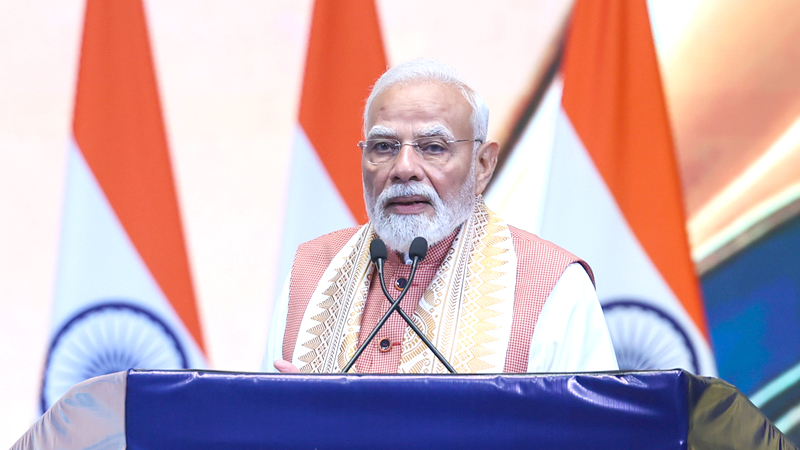
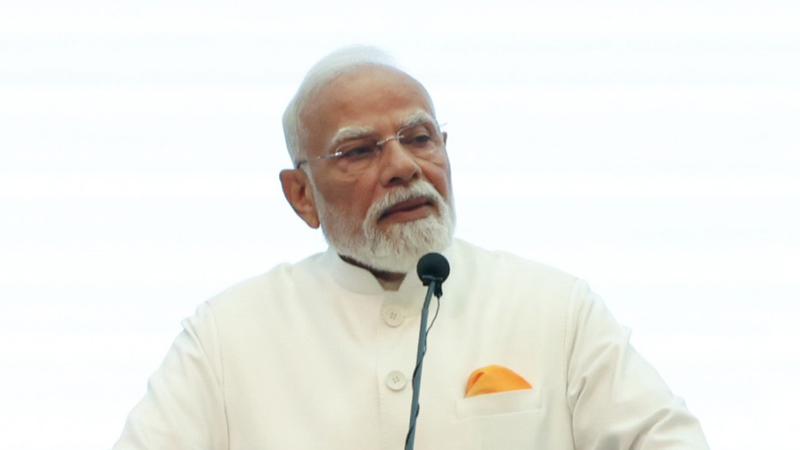
Prime Minister Shri Narendra Modi addressed the Maritime Leaders Conclave and chaired the Global Maritime CEO Forum at India Maritime Week 2025 in Mumbai, Maharashtra today. Speaking on the occasion, Prime Minister welcomed all participants to the Global Maritime Leaders Conclave. He remarked that the event began in Mumbai in 2016 and expressed happiness that it has now evolved into a global summit. Shri Modi highlighted that participation from over 85 countries sends a strong message. He noted the presence of CEOs of major shipping giants, startups, policymakers, and innovators, all gathered at the event. He further acknowledged the attendance of representatives from small island nations and stated that their collective vision has significantly enhanced the synergy and energy of the summit.

Noting that several projects related to the shipping sector have been launched at the conclave, Shri Modi highlighted that Memorandums of Understanding worth lakhs of crores of rupees have also been signed in the shipping sector. The Prime Minister remarked that this reflects the global confidence in India’s maritime capabilities, adding that the presence of participants at the event stands as a symbol of their common commitment.

“In the 21st century, India’s maritime sector is advancing with great speed and energy”, emphasised the Prime Minister highlighting that the year 2025 has been particularly significant for the sector and shared key achievements. He remarked that Vizhinjam Port, India’s first deep-water international trans-shipment hub, is now operational, noting that the world’s largest container vessel recently arrived at the port, marking a proud moment for every Indian. Shri Modi further stated that in 2024–25, India’s major ports have handled the highest cargo volumes ever, setting a new record. He announced that for the first time, an Indian port has launched a megawatt-scale indigenous green hydrogen facility, an achievement credited to Kandla Port. He added that another major milestone has been achieved at JNPT, where Phase 2 of the Bharat Mumbai Container Terminal has commenced. “This has doubled the terminal’s handling capacity, making it India’s largest container port”, said the Prime Minister, emphasizing that this was made possible due to the largest FDI in India’s port infrastructure and expressed special gratitude to partners from Singapore for their contribution.

Prime Minister stated that this year, India has taken major steps towards next-generation reforms in the maritime sector. “The colonial shipping laws, over a century old, have been replaced with modern and futuristic legislation suited for the 21st century”, said the Prime Minister, remarking that these new laws empower State Maritime Boards, strengthen safety and sustainability, and expand digitization in port management.

Further noting that under the Merchant Shipping Act, Indian laws have been globally aligned with international conventions, Shri Modi said, this alignment has enhanced trust in safety standards, improved ease of doing business, and reduced government intervention. He expressed confidence that these efforts will further boost the confidence of stakeholders and investors.

Prime Minister stated that the Coastal Shipping Act has been designed to simplify trade and strengthen supply chain security. He emphasized that the Act ensures balanced development along India’s extensive coastline. Highlighting the One Nation, One Port Process, which will standardize port-related procedures and significantly reduce documentation requirements, Shri Modi remarked that these reforms in the shipping sector are a continuation of India’s decade-long reform journey. Reflecting on the past ten to eleven years, he noted that the transformation in India’s maritime sector has been historic. Under the Maritime India Vision, more than 150 new initiatives have been launched, resulting in nearly doubling the capacity of major ports, substantial reduction in turnaround time, and a new momentum in cruise tourism. The Prime Minister added that cargo movement on inland waterways has increased by over 700 percent, with the number of operational waterways rising from three to thirty-two. He further stated that the net annual surplus of Indian ports has increased ninefold over the past decade.

“India’s ports are now counted among the most efficient in the developing world, and in many cases, are outperforming ports in the developed world”, exclaimed the Prime Minister. He shared key performance statistics, noting that the average container dwell time in India has reduced to less than three days, which is better than several developed nations. He highlighted that the average vessel turnaround time has dropped from ninety-six hours to just forty-eight hours, making Indian ports more competitive and attractive for global shipping lines. Shri Modi added that India has shown significant improvement in the World Bank’s Logistics Performance Index. He further emphasized India’s growing strength in maritime human resources, stating that the number of Indian seafarers has increased from 1.25 lakh to over 3 lakh in the past decade. Today, India ranks among the top three countries globally in terms of seafarer numbers.

Remarking that a quarter of the 21st century has passed, and the next 25 years are even more critical, Shri Modi emphasized that India’s focus is on the Blue Economy and Sustainable Coastal Development. He highlighted the government’s strong emphasis on green logistics, port connectivity, and coastal industrial clusters.

“Shipbuilding is now among India’s top priorities”, underscored the Prime Minister. Recalling India’s historical prominence in shipbuilding, he noted that the country was once a major global center in this field. He pointed out that not far from the venue lie the Ajanta Caves, where a Sixth Century painting depicts the design of a three-masted ship. The Prime Minister remarked that this design, seen in ancient Indian art, was adopted by other countries centuries later.

Underlining that ships built in India were once a vital part of global trade, Shri Modi noted that India later advanced in the ship-breaking sector and is now accelerating efforts to reach new heights in ship-making. He mentioned that India has granted infrastructure asset status to large ships, a policy decision that will open new avenues for all shipbuilders present at the event. He highlighted that this will provide new financing options, reduce interest costs, and ease access to credit. To propel this reform, the Prime Minister declared that the government will invest nearly ₹70,000 crore. This investment will enhance domestic capacity, promote long-term financing, support the development of greenfield and brownfield shipyards, build advanced maritime skills, and generate millions of jobs for youth. He added that this initiative will also unlock new investment opportunities for all stakeholders.

Prime Minister remarked that the land hosting the conclave is the land of Chhatrapati Shivaji Maharaj, who not only laid the foundation of maritime security but also asserted Indian strength across the trade routes of the Arabian Sea. He highlighted Shivaji Maharaj’s vision that the seas are not boundaries but gateways to opportunity, and stated that India is moving forward with the same thinking.

Emphasising India’s commitment to strengthening global supply chain resilience and noting that the country is actively building world-class mega ports, Shri Modi announced that a new port is being constructed in Vadhavan, Maharashtra at a cost of ₹76,000 crore. He added that India is working to quadruple the capacity of its major ports and increase its share in containerized cargo. The Prime Minister affirmed that all stakeholders present are key partners in achieving these goals and welcomed their ideas, innovations, and investments. He reiterated that India permits 100 percent FDI in ports and shipping, and that public-private partnerships are rapidly expanding. Under the “Make In India, Make For The World” vision, incentives are being provided, and states are being encouraged to attract investments. He urged investors from various countries to seize this moment to engage and expand in India’s shipping sector, stating that this is the right time.

Underlining India’s vibrant democracy and reliability as a defining strength, the Prime Minister remarked, “when the global seas are rough, the world looks for a steady lighthouse, India is well poised to play that role with strength and stability”. Amid global tensions, trade disruptions, and shifting supply chains, Shri Modi stated that India stands as a symbol of strategic autonomy, peace, and inclusive growth. He emphasized that India’s maritime and trade initiatives are integral to this broader vision. Citing the India–Middle East–Europe Economic Corridor as an example, he noted that it will redefine trade routes and promote clean energy and smart logistics.

Emphasising India’s focus on inclusive maritime development, the Prime Minister stated that this goal can only be achieved by empowering Small Island Developing States and Least Developed Countries through technology, training, and infrastructure. He highlighted the need for collective action to address climate change, supply chain disruptions, economic uncertainty, and maritime security. Shri Modi called upon all participants to move together towards peace, progress, and prosperity, and to build a sustainable future. Concluding his address, the Prime Minister extended his warm greetings and appreciation to all attendees for being part of the summit.

The Governor of Maharashtra, Shri Acharya Devvrat, Chief Minister of Maharashtra, Shri Devendra Fadnavis, Union Ministers, Shri Sarbananda Sonowal, Shri Shantanu Thakur & Shri Kirti Vardhan Singh were present among other dignitaries at the event.

Background

The Global Maritime CEO Forum, the flagship event of India Maritime Week 2025, will bring together CEOs of global maritime companies, major investors, policy-makers, innovators, and international partners to deliberate on the future of the global maritime ecosystem. The Forum will serve as a key platform for dialogue on sustainable maritime growth, resilient supply chains, green shipping, and inclusive blue economy strategies.

The Prime Minister’s participation reflects his deep commitment to an ambitious, future-oriented maritime transformation, aligned with the Maritime Amrit Kaal Vision 2047. This long-term vision, built on four strategic pillars — port-led development, shipping and shipbuilding, seamless logistics, and maritime skill-building — aims to position India among the world’s leading maritime powers. India Maritime Week 2025 serves as the Government of India’s premier global platform to translate this vision into action, bringing together leading stakeholders across shipping, ports, shipbuilding, cruise tourism, and blue economy finance.

Being organised from 27th to 31st October 2025, under the theme “Uniting Oceans, One Maritime Vision”, IMW 2025 will showcase India’s strategic roadmap to emerge as a global maritime hub and a leader in the Blue Economy. IMW 2025 will draw participation from over 85 countries, featuring more than 1,00,000 delegates,  500+ exhibitors and 350+ international speakers.

Prime Minister congratulates Japanese Prime Minister, H.E. Sanae Takaichi

| Published on:

The Prime Minister, Shri Narendra Modi had a warm conversation with the Prime Minister of Japan, H.E. Sanae Takaichi.

Shri Modi congratulated Prime Minister Takaichi on assuming office and conveyed his best wishes for her successful tenure.

The two leaders discussed their shared vision for further advancing the India–Japan Special Strategic and Global Partnership, with a particular focus on economic security, defence cooperation and talent mobility.

Both leaders agreed that stronger India–Japan relations are vital for global peace, stability and prosperity.

The Prime Minister wrote on X;

“Had a warm conversation with Sanae Takaichi, Prime Minister of Japan. Congratulated her on assuming office and discussed our shared vision for advancing the India-Japan Special Strategic and Global Partnership, with focus on economic security, defence cooperation and talent mobility. We agreed that stronger India–Japan ties are vital for global peace, stability and prosperity.

@takaichi_sanae”

The RJD tarnished Bihar’s image with corruption and crime: Rajnath Singh

| Published on:

Union Defence Minister Shri Rajnath Singh addressed public meetings in Hayaghat Assembly Constituency in Darbhanga and Barh Assembly Constituency in Patna, Bihar on Wednesday. Shri Rajnath Singh stated that the RJD had tarnished Bihar’s image with corruption and crime, whereas the BJP and NDA have practiced the politics of honesty, service, and development. He stated that Bihar must now decide whether it wants to move forward on the path of “development” or return to the days of “jungle raj.” Shri Rajnath Singh highlighted Bihar Chief Minister Shri Nitish Kumar’s 20 years of clean governance and the ₹15 lakh crore development investment Bihar received under Hon’ble Prime Minister Shri Narendra Modi Ji’s leadership. Union Defence Minister accused the Congress and RJD of engaging in politics of lies, dynasty, and corruption, emphasizing that Bihar needs politics of progress, not scams. He appealed to the people to give the NDA a decisive mandate to take Bihar forward on the path of a “Viksit Bharat.” During the Darbhanga rally, Hayaghat constituency candidate Shri Ram Chandra Prasad, former Rajasthan BJP President Shri Chandra Prakash Joshi, Jodhpur MLA  Shri Atul Bhansali, Barh Assembly candidate Dr. Siyaram Singh among other leaders were present.

Shri Rajnath Singh expressed gratitude for the warmth and enthusiasm with which people had welcomed and extended heartfelt greetings to everyone. Shri Singh described it as a privilege to have the opportunity to visit the land of the great poet Vidyapati, who brought honour to the Maithili and Sanskrit languages not only in India but across the world through his literary contributions. Recalling the spiritual and cultural significance of the region, he referred to it as the sacred land of Mata Sita’s sacrifice and penance, blessed by her grace, and the revered land of Ahilya, where the divine footsteps of Bhagwan Shri Ram once fell. No words could truly capture the immense importance and sanctity of this land.

Shri Rajnath Singh asked for support for Shri Ram Chandra, the Bharatiya Janata Party candidate, expressing gratitude that he had earlier been elected and sent to the Bihar Legislative Assembly. The Minister noted no one can truthfully point a finger and claim that Shri Ram Chandra’s record carries any mark of corruption. Maintaining integrity and decorum in Indian politics, he said, is not an easy task. Shri Rajnath Singh referred to how leaders from the RJD had brought disrepute to Bihar both in the country and Globally, with allegations so serious that a former Chief Minister spent years in jail and the entire family faces corruption charges. The Minister described this as a matter of deep sorrow and stated that one may compromise on many things in life, but never on honour, dignity, or self-respect.

Union Defence Minister asked the people of Bihar whether, when they travel outside the state, are they not reminded that a former Chief Minister spent years in jail for the fodder scam and that members of his family continue to face serious corruption charges? He questioned whether hearing such things makes one’s head rise in pride or bow in shame. Defence Minister urged the people to reflect upon this and to resolve that Bihar, which has recently celebrated the grand festival of Chhath, must now turn the upcoming elections into a festival of democracy. The election issue is clear whether Bihar should move towards becoming a Viksit Bharat or return to Jungle Raj. The choice, he said, rests with the people. Referring to the Hon’ble Prime Minister’s pledge to build a Viksit Bharat by 2047, he underlined that a developed India is possible only when Bihar becomes a Viksit Bihar. Responding to critics who question how India can become a developed nation by 2047, he said that honest intent and collective effort make such goals achievable. Addressing the media present, he welcomed open criticism if any of his statements were inaccurate, adding that politics should be conducted transparently and with accountability not by deceiving the people, but by meeting their gaze with honesty.

Shri Singh stated that in 2014, when Hon’ble Shri Narendra Modi Ji became the Prime Minister of India and the BJP-led NDA government came to power, India ranked 11th in terms of economic size. But within just 10 years, India has jumped from the 11th position to the 4th position in the global economy. This is nothing short of a miracle. No power in the world can stop India from becoming a prosperous and Viksit Bharat. Earlier, when India spoke on international platforms, no one took it seriously, but today, when India speaks, the entire world listens carefully and takes it seriously. This is today’s India under the leadership of Hon’ble Prime Minister Modi Shri Narendra Modi Ji.

Shri Rajnath Singh stated that Shri Nitish Kumar has served as the Chief Minister of Bihar for 20 years, but in all those 20 years, not a single allegation of corruption has been made against him. Living in a house of soot and still coming out spotless — is that a small thing? And as far as Hon’ble Prime Minister Shri Narendra Modi Ji is concerned, he has truly opened Delhi’s treasury for the development of Bihar. During the 10 years of the UPA government, when Congress was at the Centre and RJD in Bihar, only ₹2 lakh crore was given for Bihar’s development. But in just 11 years, Hon’ble Prime Minister Shri Narendra Modi Ji has provided ₹15 lakh crore for the development of Bihar. Bihar holds a special place in India from a cultural point of view. In every respect, some of the most capable and great personalities have been born here — whether in the field of literature or in the freedom struggle. Mata Sita also belongs to Bihar. Such is the sacred land of Bihar. 

Shri Rajnath Singh questioned why the Congress-led UPA government did not focus on Bihar’s development earlier. Today, Congress and RJD are trying to defeat the BJP-led NDA and remove Shri Nitish Kumar from power. Since they cannot accuse him of corruption, they make baseless claims that he should step down. But when it comes to leadership, it is the honest person who truly deserves the position. The RJD has released its election manifesto, stating that one member from every household will be given a government job. But is this possible? There are around 2 crore 80 lakh households in Bihar — can every household realistically be provided with a government job within five years? Shri Singh questioned Lalu Yadav, Tejashwi Yadav, and Rahul Gandhi — can politics not be done by speaking the truth? Is lying essential for political success? Is it necessary to deceive the public for electoral gain? Can politics not be done with honesty and transparency before the people? Why are they resorting to such blatant lies? Congress and RJD claim that Nitish Kumar has done nothing and that the NDA government has achieved nothing.

Shri Singh highlighted that Bihar’s GDP growth rate is 14%, making it the second-highest in the country. There is a clear difference between the Bihar of earlier times and today’s Bihar. Around 7,000 km of highways have been constructed. Bihar is perhaps the only state in India where women have been given 35% reservation. Under the Mukhyamantri Mahila Rojgar Yojana, ₹10,000 has been provided to 1 crore 21 lakh women. Shri Rajnath Singh highlighted that the NDA’s election manifesto is set to be released tomorrow, and whatever is mentioned in it will be followed word by word. In 2014, when the NDA contested elections and Shri Singh was the party’s national president, every promise made in the manifesto was fulfilled word by word within five years. During the second election manifesto, Hon’ble Prime Minister Shri Narendra Modi Ji again entrusted the responsibility of preparing it to Shri Singh, and once again, every promise was fulfilled word by word. For the third time as well, when the manifesto was prepared, Prime Minister Shri Narendra Modi Ji said, “Rajnath Singh Ji, you and your team should draft it,” having full faith that only implementable commitments would be included. Shri Singh emphasized that the NDA never misleads the people of the country or throws dust in their eyes.

Shri Rajnath Singh remarked that under the leadership of Shri Nitish Kumar, lakhs of youth in Bihar have been given jobs. Shri Singh questioned whether anyone could claim that Shri Nitish Kumar ever took even a single rupee from anyone. An honest leader deserves respect and dignity, and this decision now lies in the hands of the people. RJD and Tejashwi Yadav are misleading the public by claiming they will provide government jobs to one member of each of Bihar’s 2.8 crore households — a promise that is neither practical nor possible. If the NDA forms the government, efforts will be made to ensure that while not everyone may get a government job, every youth should get work and employment opportunities. With the collective support of the people, this goal can certainly be achieved. If every family in Bihar were to be given a government job, the expenditure would amount to approximately ₹12 lakh crore. Even if each person were to receive a monthly salary of ₹35,000 to ₹40,000, the total cost would exceed ₹12 lakh crore. Bihar’s total budget itself is around ₹3.25 lakh crore, so where will ₹12 lakh crore come from? Tejashwi Yadav and Rahul Gandhi are young, and it is their right to do politics, but they should not do politics by spreading lies.

Union Defence Minister stated that the NDA government has undertaken numerous initiatives for the upliftment of the backward and Dalit sections of society. He questioned Rahul Gandhi, asking why, even though a Backward Classes Commission was formed after independence, the Congress never gave it constitutional status. This was accomplished only by the Hon’ble Prime Minister Shri Narendra Modi Ji. The land of Bihar has produced great leaders like Karpoori Thakur, who, while serving as Chief Minister, never engaged in any corruption. He was a true people’s leader who dedicated his life to the rights of the poor, backward, and deprived sections of society. Yet, for so many years, no one honored him with the Bharat Ratna. Hon’ble Prime Minister Shri Narendra Modi Ji conferred the Bharat Ratna upon Karpoori Thakur Ji, recognizing his immense contribution. The NDA and BJP governments have also extended reservations for Scheduled Castes, Scheduled Tribes, and Other Backward Classes for another ten years. The government has taken concrete steps for the empowerment of every section of society. Over the past ten to eleven years, a new chapter of development has been written — more than 55,000 kilometers of roads have been constructed, electricity has reached over one and a half crore homes, and one and a half crore households have been provided with water connections. All this stands as evidence of the inclusive development and the commitment to Sabka Saath, Sabka Vikas under the leadership of Hon’ble Prime Minister Shri Narendra Modi Ji.

Shri Singh stated that under the Pradhan Mantri Awas Yojana, more than 57 lakh permanent houses have been constructed in Bihar, and over three crore houses are currently under construction. This work is being carried out with complete honesty and commitment. The Hon’ble Prime Minister Shri Narendra Modi Ji has achieved what the Congress governments could not accomplish in 40–50 years. For the first time since independence, under the leadership of Prime Minister Shri Narendra Modi Ji, the Central Government has achieved the historic feat of lifting more than 25 crore people above the poverty line. In Bihar too, a large number of people have been brought out of poverty. Under the Chief Minister Women Employment Scheme, more than 75 lakh women have been connected and provided financial assistance of ₹10,000 each. The NDA government has opened the doors of banks for farmers and the poor. Earlier, under the Congress and RJD governments, even if any assistance was provided, half of the money used to go into corruption. However, the Modi government has completely changed this approach. After becoming Prime Minister, the Hon’ble Shri Narendra Modi Ji clearly stated that controlling corruption would be the government’s top priority. Completely eradicating corruption may not be possible, but controlling it remains our firm commitment.

Shri Rajnath Singh mentioned that when he was the Home Minister and Prime Minister Shri Narendra Modi Ji was holding a meeting with officials, the Prime Minister had laid special emphasis on ensuring that every family had a bank account. When asked why, the Prime Minister explained that this would be the biggest strike against corruption. Today, the results are evident before everyone. Whether it is the PM Kisan Samman Nidhi, financial assistance for women, or schemes for the youth—every rupee released by the Centre reaches the beneficiaries directly into their bank accounts without any intermediaries. Not a single penny falls prey to corruption. When the intent is honest, even the biggest goals can be achieved. Neither the Prime Minister Shri Narendra Modi Ji nor the Chief Minister Shri Nitish Kumar can be questioned on their integrity.

Senior BJP leader said that today the nation’s head is held high across the world. Our neighbouring country Pakistan, whose conduct had become problematic, had earlier been struck by air strikes and surgical strikes twice, yet it did not relent. This time terrorists came from Pakistan and, in Pahalgam, Kashmir, killed innocent Indian citizens who were travelling with their families after asking about their religion. India is not a country that practices politics on the basis of caste, religion, or creed. India acted on the basis of justice and humanity and exercised restraint. When strikes were carried out against those terrorists under Operation Sindhur, it was ensured that ordinary Pakistani citizens would not be harmed. The decision was taken to target only the terrorists. India judged by actions, not by religion. And the terrorists were successfully eliminated. India is the only country in the world that has not only considered those living within its borders as its own but has also regarded everyone on this planet as a member of one global family. Through the message of Vasudhaiva Kutumbakam, India has conveyed to the entire world the spirit of universal brotherhood. Today, Naxalism in India is taking its last breaths.

Senior BJP leader said that they want to ensure free and fair elections. He stated that the Election Commission has followed the entire process properly and functioned impartially as a respected institution of democracy. He mentioned that Congress members have made allegations against the Election Commission, but those accusations are false. He questioned how democracy could function if such constitutional institutions are defamed. Referring to Rahul Gandhi, he said that some people were earlier making allegations, and now they are questioning why certain actions were taken. He emphasized that no one should be treated disrespectfully and that everyone should behave with humility. The Election Commission verified the voter list and names to ensure that fake entries were removed. He added that some people were trying to get illegal infiltrators to vote, which is not right, and asked whether such people should have the right to vote. Names of deceased individuals should not remain in the voter list. He cautioned that there should be no incidents of law and order violations, such as bomb explosions, and stressed that there must be no corruption. He stated that the laws enacted by the central government should not be disrespected, and no state has the authority to nullify them. He reiterated that there should be no discrimination, no one should be misled, and everyone should be treated equally.

Shri Rajnath Singh said that the Hon’ble Prime Minister Shri Narendra Modi Ji has ensured that the money sent by the Centre reaches every account equally, so that Muslim women and Muslim farmers also receive the same benefits. Some people in the country talk about caste and make disgraceful remarks. Opposition leaders spread lies that the amendments made to the Waqf Board would also be repealed. No one can abolish a law passed by Parliament. Earlier, there was a saying — “Na khata, na bahi, jo Lalu ji kahen wahi sahi”. That practice will not work anymore. Now, it will be “Jo janata kahegi wahi sahi”. Earlier, tenders were allotted over the phone, and even ransom for kidnapped children was collected through phone calls. Such people cannot serve the public with honesty. These people have been involved in serious corruption charges. If a senior leader faces allegations of corruption and the charges appear to be prima facie true, then no matter how high their position may be, they should resign immediately and not assume power until they are cleared of all charges. The Bharatiya Janata Party has always adhered to this principle. Shri Rajnath Singh cited the example of Shri Lal Krishna Advani, who resigned from Parliament as soon as false allegations were made against him and did not return until he was acquitted. He further stated that the Maithili language has now gained recognition not only at the national level but also internationally. Many people do not know that the first translation of the Constitution of India into Maithili was done under the BJP government. Appealing to the people of Bihar, he said that if they truly want development and politics based on performance, they should ensure a decisive victory for all NDA candidates.

Lalu Yadav and his allies want to snatch the title of “Jan Nayak” from Karpoori Thakur: Amit Shah

| Published on:

Hon’ble Union Home and Cooperation Minister and senior BJP leader Shri Amit Shah today addressed three massive rallies in Bihar at Alinagar Assembly (Darbhanga district), Rosera Assembly (Samastipur district), and Bhagwanpur (Bachhwara Assembly, Begusarai district). Shri Shah appealed to the people to ensure a resounding victory for BJP-NDA candidates and to bring back the NDA government in Bihar once again. At the Alinagar rally, Shri Shah sought blessings for BJP candidate and renowned folk singer Sushree Maithili Thakur from Alinagar, BJP candidate Shri Sujit Kumar from Gaura Bauram, JD(U) candidate Shri Vinay Kumar Chaudhary from Benipur, JD(U) candidate Shri Ishwar Mandal from Darbhanga Rural, and JD(U) candidate Shri Madan Sahni from Bahadurpur. In Rosera, he sought public support for BJP candidate Shri Virendra Paswan from Rosera, JD(U) candidate Shri Manjarik Mrinal from Warisnagar, JD(U) candidate Shri Rajkumar Rai from Hasanpur, and JD(U) candidate Smt. Raveena Kushwaha from Vibhutipur. At the Bhagwanpur rally in Begusarai, BJP candidate Shri Surendra Mehta from Bachhwara, BJP candidate Shri Rajneesh Kumar from Teghra, BJP candidate Shri Kundan Kumar from Begusarai, and JD(U) candidate Shri Rajkumar from Matihani, along with other senior leaders, were present. Union Minister Shri Krishan Pal Gurjar, BJP MP Shri Gopal Ji Thakur, MP Shri Ashok Yadav, and Rajya Sabha MP Smt. Dharmshila Gupta attended the Alinagar rally; Samastipur MP Smt. Shambhavi Choudhary and Haryana Cabinet Minister Shri Vipul Goel were present at Rosera, while Union Minister Shri Giriraj Singh attended the Bhagwanpur rally.


Shri Shah stated that Hon’ble Prime Minister Shri Narendra Modi Ji has honoured the land of Mithila and Bihar by conferring the Bharat Ratna upon Karpoori Thakur Ji. Similarly, by awarding the Padma Vibhushan to the late Swar Kokila Sharda Sinha Ji, Hon’ble Prime Minister Shri Narendra Modi Ji has paid tribute to the rich cultural and artistic heritage of Mithila. Shri Shah urged the people to vote on November 6 and ensure a resounding victory for all NDA candidates symbolised by the lotus, arrow, and helicopter across Darbhanga, Samastipur, and Begusarai. Shri Shah appealed to the people to take a firm resolve this time to ensure that NDA is victorious from every seat in Darbhanga, Samastipur, and Begusarai.


Addressing the public meeting in Alinagar, Union Home Minister stated that the party has chosen Mithila’s daughter and pride, Sushri Maithili Thakur, to contest the elections. As soon as Sushree Maithili entered the electoral field, the leaders of the Mahathagbandhan began spreading false propaganda and rumours against her. However, Lalu Prasad Yadav’s party must clearly understand that Sushree Maithili Thakur will certainly emerge victorious and will raise the pride of Mithila across the nation and the world through her powerful voice. The NDA government has carried out numerous works to honour Mithila, Maithili language was included in the Eighth Schedule of the Constitution, the Constitution was translated into Maithili, a postal stamp was issued on the Mithila “Paag”, Madhubani painting received the GI tag, the eternal Mithila Festival was launched in Gujarat, Swar Kokila Sharda Sinha Ji was honoured with the Padma Vibhushan, the Makhana Board was established, and the construction of the grand Sita Mata temple is also being carried out by the NDA government.


Shri Shah stated that for 550 years, Ram Lalla resided in a tent in Ayodhya. During these centuries, parties like the Congress, Mamata Banerjee’s TMC, BSP, and SP collectively created obstacles in the construction of the Ram Mandir. However, when the people of Darbhanga elected Shri Gopal Thakur in 2019 and Hon’ble Prime Minister Shri Narendra Modi Ji became the Prime Minister, the Bhavya Ram Mandir was finally built in Ayodhya with full pride and conviction. The Mandir of Ram Lalla has now been completed and it is time for a Bhavya Mandir of Sita Maiya to be built as well. The foundation for Sita Maiya’s Mandir, costing ₹850 crore, has been laid by Chief Minister Shri Nitish Kumar and the NDA government. Shri Shah assured the people of Mithilanchal that the Bharatiya Janata Party will transform all the sacred sites associated with Mata Sita into a unified pilgrimage circuit. The places where Mata Sita and Prabhu Shri Ram first met, where she was born, and where she spent her final years, all will be linked with grand temples to preserve her divine legacy as part of the Ram Circuit and the Ramayana Circuit. Devotees from across the world will visit the Sita Mata Temple in Sitamarhi and other holy sites of Mithilanchal. Travel convenience has also greatly improved, on the request of Shri Gopal Thakur, Hon’ble Prime Minister Shri Narendra Modi Ji ensured the construction of the Darbhanga Airport, which has now made Mithila more easily connected to the rest of the country and the world.


Union Home Minister stated that Madhubani painting is the soul of our culture, a tradition we proudly adorn on the walls of our homes. Hon’ble Prime Minister Shri Narendra Modi Ji has given this art a global identity. By presenting Madhubani paintings to the Vice President of Argentina and the President of South Korea, he ensured that the art of Mithila now adorns the walls of foreign courts with pride. Recently, Bihar got its second IT park, and a Bhavya Mandir of Mata Sita is also being built here. Kashmir has always been an integral part of India, and Article 370 should have been removed long ago. However, parties like the Congress and Lalu Prasad Yadav’s RJD kept it alive for 70 years. Hon’ble Prime Minister Shri Narendra Modi Ji, on 5 August 2019, abolished Article 370 permanently and fully integrated Kashmir into India. Earlier, terrorists would attack Indian soil, spill innocent blood, and escape unpunished. But under the Modi government, after the Uri, Pulwama, and Pahalgam attacks, terrorism was given a strong and decisive response, first through surgical strikes, then air strikes, and later Operation Sindoor, destroying terror bases inside Pakistan. Hon’ble Prime Minister Shri Narendra Modi Ji has established a new tradition of decisive action against terrorism in India. Shri Shah stated that the PFI’s terror network had spread even to Phulwari Sharif, and during the Congress rule, organizations like PFI enjoyed free rein without any action against them. But Hon’ble Prime Minister Shri Narendra Modi Ji banned PFI overnight, and through raids at over 100 locations, the entire network of the organization was dismantled and sent behind bars.


Shri Shah stated that the upcoming Bihar Assembly election was not about making someone an MLA or a minister, but about freeing Bihar from jungle raj. All five parties of the NDA had come together like the five Pandavas to contest the election. NDA’s victory in Bihar was assured because it had the support of Hon’ble Prime Minister Shri Narendra Modi Ji, the leadership of Shri Nitish Kumar, the youthful energy of Shri Chirag Paswan, the lifelong dedication of Shri Jitan Ram Manjhi, and the experience of Shri Upendra Kushwaha. Shri Shah stated that some people were trying to claim the legacy of Jan Nayak Karpoori Thakur Ji. Lalu Yadav should have understood that as long as the NDA existed, no one could touch the title of “Jan Nayak” given to Karpoori Thakur Ji. Lalu Yadav spent his entire life insulting and neglecting Karpoori Thakur Ji, and now sought votes in his name, but the people of Samastipur knew the truth well.


Union Home Minister stated that the NDA’s goal was to free Rosera and Samastipur from jungle raj and establish industries there. The people of Rosera had witnessed the dreadful days of jungle raj, when massacres took place and the humiliation of Dalits was a common occurrence. Hon’ble Prime Minister Shri Narendra Modi Ji had honoured the contribution of Dr. Babasaheb Bhimrao Ambedkar by declaring April 14 as Rashtriya Samrasta Diwas and November 26 as Constitution Day. In addition, memorials dedicated to Babasaheb were built at five key sites: his birthplace in Mhow, place of study in London, Dikshabhoomi in Nagpur, Mahaparinirvan Sthal in Delhi, and Chaitya Bhoomi in Mumbai. Those who today do politics in Babasaheb’s name were the same people who had once prevented Bihar’s own son, Babu Jagjivan Ram, from becoming the Prime Minister, and that was done by the Congress Party. For the development of Samastipur district, major projects such as the Amas–Darbhanga road, the Patna–Purnia Greenfield Expressway, and the Rosera–Hadiya Greenfield Expressway were being constructed, which would become milestones in the region’s economic growth.


Shri Shah stated that if the people made the mistake of bringing Lalu and his allies back to power, they would not keep PFI members in jail. However, the Bharatiya Janata Party promises that as long as even one BJP MP remains in Parliament, not a single PFI member will be allowed to walk free. Under the leadership of the Hon’ble Prime Minister Shri Narendra Modi Ji, India has not only become more secure, but its economy has also reached new heights. Hon’ble Prime Minister Shri Narendra Modi Ji reduced GST rates on 395 items, bringing them down from 28% and 18% to 0% and 5%. The Modi government has lifted India’s economy from the 11th position in the world to the 4th, and the 4th position is not the final goal; by 2027, India will become the world’s third-largest economy. Hon’ble Prime Minister Shri Narendra Modi Ji had carried out historic development works for Darbhanga. A 216-crore Somn Bypass was constructed, the Amas–Darbhanga and Purnia–Patna expressways were developed under the Bharatmala Project, and a new embankment and bridge were built over the Kamla River via Lota and Tatra, enabling road connectivity across the river for the first time since independence. The Darbhanga railway station is being redeveloped at a cost of ₹335 crore to reflect the city’s cultural identity, and a bypass rail line worth ₹253 crore has been built. A metro service is also coming to Darbhanga. The Amrit Bharat train from Darbhanga to Lucknow has already started, and soon another Amrit Bharat train will run from Sitamarhi to Ayodhya, strengthening Mithila’s cultural and economic link with the rest of the country.


Union Home and Cooperation Minister stated that the Darbhanga airport was built by the Modi government. A special cancer hospital with a capacity of 200 beds was also constructed in Darbhanga. Earlier, AIIMS was not planned to be built there, but the project began only after Darbhanga MP Shri Gopal Thakur went on a hunger strike. Now, people of Darbhanga no longer need to go to Patna or Delhi for treatment. No matter what the illness was, treatment could now be done at Darbhanga AIIMS itself. Many Jeevika didis used to ask how they could afford medical treatment. But no one needed to worry about money anymore, as Hon’ble Prime Minister Shri Narendra Modi Ji had made medical treatment worth up to ₹5 lakh free for every poor citizen. The Modi government provided free health insurance to 60 crore poor citizens across the country. Hon’ble Prime Minister Narendra Modi Ji fulfilled his promise of giving a home to every poor family. In the state, 8.52 crore poor people were getting 5 kg of free food grains every month, 87 lakh farmers were receiving annual assistance of ₹6,000, 44 lakh houses had already been built, and 30 lakh new houses had been approved. Under the Ujjwala Yojana, 1.17 crore mothers have been given free gas connections. Under the Ayushman Bharat Yojana, 3.53 crore people received free medical treatment worth up to ₹5 lakh. Through the Jal Jeevan Mission, clean drinking water reached 1.07 crore households. For Mithila’s pride, “Makhana,” Hon’ble Prime Minister Shri Narendra Modi Ji established a dedicated Makhana Board. The Western Kosi Canal Project was set to irrigate 50 lakh hectares of land in the Mithilanchal region. The Kosi River, which had been causing floods in Bihar since the time of Lord Ram, was now being managed through the construction of the Western Kosi Canal, an initiative by the Modi government to make the Mithilanchal region both prosperous and flood-free.


Shri Shah stated that recently, Chief Minister Shri Nitish Kumar has taken a historic decision to transfer ₹10,000 each into the accounts of 1 crore 25 lakh Jeevika Didis. This is just the beginning in the coming four years; every Jeevika Didi will receive a loan of up to ₹2 lakh so that the women of Bihar can become self-reliant and the economic backbone of their families. The BJP-JD(U) government has provided relief to every household in Bihar. Electricity up to 125 units has now been made free. The widow pension has been increased from ₹400 to ₹1,100, and the pension for senior citizens has also been raised from ₹400 to ₹1,100. The honorarium for ASHA workers has been increased from ₹1,000 to ₹3,000 per month, and soon 30,000 new ASHA workers will be appointed.  The NDA government has opened new doors of opportunity not only for women and the poor but also for the youth. Hon’ble Prime Minister Shri Narendra Modi Ji has given a clear message that the youth must now take the lead in politics. Under the leadership of the Hon’ble Prime Minister Shri Narendra Modi Ji, the Bharatiya Janata Party has decided to field 1 lakh young people as Panch, Sarpanch, Tehsil Panchayat, District Panchayat members, MLAs, and MPs. Now, a new vision, new energy, and new leadership in Indian politics will emerge through the BJP.


Union Home Minister stated that just yesterday, Lalu Ji appointed someone as in-charge, that person was asking who the BJP has given a ticket to and who has been given a chance for the first time. The BJP has given the ticket to a 25-year-old, talented and cultured young woman, Maithili Thakur, who has no political family background. This is possible only in the Bharatiya Janata Party. In parties like the RJD and Congress, such a thing can never happen because Lalu Yadav’s politics is limited to making his son the Chief Minister, while Sonia Gandhi’s dream is to make Rahul Gandhi the Prime Minister. Such people are not serving the public but are engaged in serving their own families. Those busy promoting their sons and daughters can never hear the voice of the people. Only the Bharatiya Janata Party is a party that does not believe in dynastic politics. If the youth and daughters of Bihar want opportunities in politics, only the BJP can provide them. He made it clear to Sonia Gandhi and Lalu Yadav that there is no vacancy for the posts of Prime Minister or Chief Minister in Delhi, the Hon’ble Prime Minister Shri Narendra Modi Ji holds the position, and in Bihar, the Chief Minister is Shri Nitish Kumar. Both these seats are already occupied.


Shri Shah stated that the NDA government has carried out numerous development works, but Lalu Yadav and Rabri Devi did nothing. They were involved in the fodder scam, land-for-jobs scam, hotel sale scam, flood relief scam, bitumen (Alkatra) scam, and AB Export scam. The Congress party, during its rule from 2004 to 2014, was responsible for scams and corruption worth ₹12 lakh crore. The Hon’ble Prime Minister Shri Narendra Modi ji invested ₹4 lakh crore in roads and bridges, ₹1 lakh crore in railways, over ₹2,000 crore in airports, and established a new airport at Purnia in addition to Darbhanga. Furthermore, ₹24,000 crore has been invested in power plants. Since the time of Adi Shankaracharya, Darbhanga has been the land of scholars in Mithilanchal, home to hundreds of manuscripts containing vast knowledge from around the world. A grand cultural museum of Mithila, worth ₹500 crore, will be built in Darbhanga to preserve manuscripts from across Bihar. The wisdom of scholars from Vidyapati to Ubhaya Bharati and Mandan Mishra will be compiled there, restoring Mithila’s legacy as a center of knowledge.  The Pran Pratishtha of the grand temple of Sita Maiya will be performed by the Hon’ble Prime Minister Shri Narendra Modi Ji himself. With this, the consecration ceremonies of both Sita Maiya and Ram Lalla in Ayodhya will be completed. Shri Shah appealed to the public to ensure all 10 out of 10 seats in Darbhanga go to Hon’ble Prime Minister Shri Narendra Modi Ji and Nitish Kumar to strengthen their hands. He urged people to vote first on November 6 and then have their meal and before 11 a.m., press the button on the symbols of the lotus and the arrow to completely wipe out Lalu Yadav and Rahul Gandhi.


Union Home Minister stated that Begusarai was once an industrial district, but over time, all industries were shut down. During the rule of Lalu and Rabri, Bihar’s land was drenched in heinous massacres, with bloodshed, ransom, rape, and kidnapping becoming the state’s grim identity. For fifteen years, the Lalu–Rabri regime devastated Bihar, and now, after two decades, efforts are being made to bring back the same “jungle raj” through the alliance of Tejashwi and Rahul. Several districts of Bihar were once affected by red terror, where Naxalites operated with impunity. Under the leadership of Hon’ble Prime Minister Shri Narendra Modi Ji, Bihar has become free from Naxalism, and by 2026, Naxalism will be completely eradicated from the country. Those who once spread Naxalism are now standing alongside Lalu Yadav. By aligning with leftist parties, Lalu promoted casteism and violence in Bihar.


Shri Shah noted that a few months earlier Rahul Gandhi had led a “Ghuspaithiya Bachao Yatra” and has now returned to Bihar. The people of Begusarai should decide whether Bangladeshi infiltrators ought to be included in the state’s electoral rolls. Both Lalu and Rahul have become protectors of Bangladeshi infiltrators, whereas the Bharatiya Janata Party and the NDA have pledged to identify and expel each infiltrator from Bihar’s soil.


Union Home Minister & Minister of Cooperation remarked that both the Congress and the RJD are family-run parties. Since its inception, RJD has been led solely by Lalu Yadav, who now intends to hand over the party’s leadership to his son. The Congress party is no different from Jawaharlal Nehru to Indira Gandhi, Rajiv Gandhi, Sonia Gandhi, and Rahul Gandhi; leadership has remained within a single family. Lalu Yadav wants his son to become the Chief Minister, and Sonia Gandhi wants her son to become the Prime Minister, but with both positions already occupied in Bihar and Delhi, their sons’ turn is not coming anytime soon.


Highlighting the ongoing development works in Begusarai, Shri Shah noted that the Raxaul–Haldia Greenfield Expressway passes through the district. A flyover worth ₹48 crore has been constructed at BT Chandni Chowk, while a ₹25 crore road widening project from Veer Kunwar Singh Chowk to Madhuri Dhala has been completed, and work on the elevated road in Begusarai is in progress. The Teghra–Mubarakpur road has been strengthened, and a six-lane bridge over the Ganga River at Ota–Simariya, built at a cost of ₹1,870 crore, has been inaugurated. The Rajendra Bridge at Simariya has been renovated at a cost of ₹100 crore. A 4-kilometre-long rail-cum-road Shri Krishna Setu connecting Munger and Sahebpur Kamal blocks has also been inaugurated. Additionally, a bridge over the Ganga Dhab River has been built for ₹22 crore, another over the Baya River for ₹7 crore, and the Begusarai railway station has been redeveloped at a cost of ₹250 crore. A medical college and hospital have been developed with an investment of ₹515 crore, an Ayurvedic college with ₹239 crore, and the Sadar Hospital has been upgraded as a district model hospital with ₹19 crore. Furthermore, an engineering college has been established in the name of Ramdhari Singh Dinkar, and a degree college also has been set up.

PM Urges Youth to Participate in Viksit Bharat Young Leaders Dialogue 2.0

| Published on:

The Prime Minister, Shri Narendra Modi, today called upon the youth of India to actively participate in the Viksit Bharat Young Leaders Dialogue 2.0, describing it as a valuable opportunity to contribute meaningfully to nation building.

The Prime Minister urged all young citizens to engage with this initiative and share their vision for a developed India. He encouraged youth to take part in this Dialogue, by first participating in a specially designed Quiz competition.

In his message on X, the Prime Minister stated:

“Viksit Bharat Young Leaders Dialogue 2.0 is a great opportunity for our youth to contribute towards nation building. The ideas and insights of our youth can show the way in building a Viksit Bharat.

The way to take part in this Dialogue is to first participate in this specially created Quiz competition. I urge you all to do so…

https://mybharat.gov.in/quiz

Union Home Minister inaugurates the ‘India Maritime Week – 2025’ in Mumbai

| Published on:

Union Home Minister and Minister of Cooperation Shri Amit Shah inaugurated the ‘India Maritime Week – 2025’ in Mumbai, Maharashtra today. On this occasion, Maharashtra Chief Minister Shri Devendra Fadnavis, Gujarat Chief Minister Shri Bhupendra Patel, Goa Chief Minister Dr. Pramod Sawant, Odisha Chief Minister Shri Mohan Charan Majhi, Maharashtra Deputy Chief Ministers Shri Eknath Shinde and Shri Ajit Pawar, and Union Minister for Ports, Shipping, and Waterways Shri Sarbananda Sonowal, along with many other distinguished dignitaries, were present.

In his address, Union Home Minister and Minister of Cooperation Shri Amit Shah stated that Mumbai is home to the world-famous Gateway of India. He said that this moment is India’s Maritime Moment, which is transforming the Gateway of India into the Gateway of the World. He said that over the past decade, Maritime Summits have proven that, based on the deep structural reforms implemented in the Maritime Economy, India has emerged as a powerful force and stands with full strength on the global maritime map.

Shri Amit Shah stated that India’s maritime strength and strategic location are evident from the fact that our coastline stretches over 11,000 kilometers. The 13 coastal states and Union Territories contribute approximately 60 percent to the GDP. He noted that the 23.7 lakh square kilometer Exclusive Economic Zone (EEZ) attracts investors and manufacturers worldwide, with around 800 million people residing in these maritime states. Shri Shah further said that the 38 countries in the Indian Ocean Region (IOR) contribute approximately 12 percent to global exports. Through this summit, we are showcasing this immense potential to global investors and champions of the maritime industry.

Union Home Minister stated that, leveraging its maritime position, democratic stability, and naval capabilities, India is playing the role of a bridge between the Indo-Pacific and the Global South, fostering development, security, and environmental progress. India’s maritime history spans nearly 5,000 years. He said that under the leadership of Prime Minister Shri Narendra Modi, India stands ready to create a new maritime history. The presence of representatives from over 100 countries at this conference is proof that India’s maritime tradition remains a focal point for global partnership and regional stability.

Shri Amit Shah stated that the Indian Maritime Week has emerged as the most prestigious Maritime Dialogue Platform in the Indo-Pacific region. This 2025 summit will significantly contribute to achieving the goal of securing India’s prominent position in the maritime industry by 2047. He said that this year’s edition will see participation from over 350 speakers from more than 100 countries, over 500 companies, and more than 1 lakh delegates. Additionally, it will create investment opportunities worth 10 lakh crore. The Home Minister emphasized that India believes not in competition but in mutual cooperation. Through mutual cooperation, we have developed a comprehensive roadmap to connect the entire country’s maritime industry with the global maritime industry.

Union Home Minister and Minister of Cooperation stated that Prime Minister Shri Narendra Modi’s maritime vision is based on three pillars: security, stability, and self-reliance. With the Maritime India Vision 2030, through initiatives like Sagarmala, Blue Economy, and Green Maritime Vision, we have set a goal to place India among the top five countries in the global shipbuilding industry. We are also constructing new mega and deep-draft ports. He mentioned that a target of 10,000 million metric tons per year has been set for port handling, and port transport has been fully digitized. Additionally, India is connected to connectivity projects such as the India-Middle East-Europe Economic Corridor, Eastern Maritime Corridor, and North-South Transport Corridor.

Shri Amit Shah stated that over the past 11 years, Prime Minister Modi has defined India’s maritime sector as a source of national strength, regional stability, and global prosperity, and several initiatives have been undertaken to achieve these three objectives. Today, two-thirds of global trade passes through the Indo-Pacific maritime route, and 90 percent of India’s trade is conducted via maritime routes. He said that Prime Minister Modi’s maritime policy has evolved into MAHASAGAR (Mutual And Holistic Advancement for Security And Growth Across Regions), which has become a symbol of India’s growing global footprint. Shri Shah emphasized that Prime Minister Modi’s vision of transforming “Sagar” into “Mahasagar” will propel India toward becoming a global leader in this sector by 2047. To achieve this, the Modi government has increased the budget sixfold, raising it from 40 million dollars to 230 million dollars today.

Union Home Minister stated that under the Sagarmala project, 839 projects worth 70 billion dollars have been identified for completion by March 2025, of which 272 projects worth 17 billion dollars have already been completed. The 5 billion dollar Great Nicobar Project is under construction, which will significantly enhance India’s maritime global trade. Additionally, with an investment of 200 million dollars, we are moving forward with constructing India’s largest dock at Cochin Shipyard. Furthermore, a Maritime Heritage Complex is being developed in Gujarat. Shri Shah said that to align with essential international laws, outdated Indian laws have also been reformed. In 2025, our Parliament passed the 117-year-old Indian Ports Bill, updated to reflect contemporary needs and a global perspective. Through the Major Port Authorities Act, 2021, we have paved the way for granting greater autonomy to ports and modernizing their institutional framework. He also mentioned that 106 new waterways have been declared under the National Waterways Act, 2016.

Shri Amit Shah stated that the Modi government has ensured the development of the Blue Economy to enhance security, coastal security, and the safety of fishermen. Over the past decade, coastal shipping has seen a 118 percent increase, and cargo handling has risen by 150 per cent. He noted that we have reduced Turn-Around-Time (TAT), bringing it closer to global standards. To promote a circular economy in the maritime sector and advance shipbuilding, policy decisions have been made. The Home Minister said that India’s goal is to build a Green Maritime Future that accelerates development while maintaining balance with nature. He added that India does not forget that Small Island States and many countries in the Global South depend on the sea for their livelihood and survival. For these nations, climate change is an existential issue, and India is moving forward with a vision to create a green, prosperous, and shared ocean, keeping this in mind.

Effective use of Made-in-India equipment during Operation Sindoor bolstered India’s reputation both regionally & internationally: Raksha Mantri

| Published on:

“The effective use of Made-in-India equipment by the Armed Forces during Operation Sindoor bolstered India’s reputation both regionally and internationally,” said Raksha Mantri Shri Rajnath Singh while urging the domestic industry, especially the private sector, to further accelerate the pursuit of self-reliance by focusing on innovation and R&D; technology-based manufacturing, production of individual subsystems and components, and dominating the supply and maintenance chains. He was addressing the Society of Indian Defence Manufacturers (SIDM) Annual Session, organised on the theme ‘Defence Self-Reliance: Strengthening National Security through Indigenous Industry’, in New Delhi on October 27, 2025.

Raksha Mantri asserted that the world witnessed the power of Akash missile system, BrahMos, AkashTeer Air Defence Control System and other indigenous equipment/platforms during Operation Sindoor, and the credit of the operation’s success goes to the brave Armed Forces as well as “Industry warriors” who worked on the front lines of innovation, design, and manufacturing. He described the Indian industry as one of the most important pillars of defence alongside the Army, the Navy and the Air Force.

“Although we gave a firm response with a firm resolve and our forces are fully prepared to defend the country’s borders, we must continue to introspect. Operation Sindoor should serve as a case study from which we can learn and chart our future course. This incident has once again shown us that anything can happen at our borders, anywhere, at any time. We need to be ready for a war-like situation, and our preparedness must be based on our own foundation,” said Shri Rajnath Singh.

Raksha Mantri emphasised that the present-day global uncertainties call for an in-depth assessment of every domain, with ‘indigenisation’ being the only way to deal with the challenges emanating from the constantly-evolving defence sector and the nature of warfare. “The established world order is weakening, and conflict zones are increasing in many regions. It has, therefore, become necessary for India to redefine its security and strategy,” he said.

Shri Rajnath Singh pointed out that the Government, led by Prime Minister Shri Narendra Modi, is creating a level-playing field to enhance defence manufacturing and strengthen the domestic ecosystem, and the industry must make full use of this opportunity. “We’re striving to ensure that the defence equipment is not just assembled in the country, but a real manufacturing base is established to create the equipment embodying the spirit of ‘Made in India, Made for the World’. Numerous initiatives such as the Quantum Mission, Atal Innovation Mission, and the National Research Foundation have been taken to develop a culture of innovation and R&D. Our industry must accomplish what has not yet been achieved in the country,” he said.

Highlighting the progress achieved due to the Government’s self-reliance efforts, Raksha Mantri stated that, before 2014, India was completely dependent on imports for its security needs, but today it is manufacturing the defence equipment on its own soil. “Our defence production, which was only around Rs 46,000 crore in 2014, has now increased to a record Rs 1.51 lakh crore, of which Rs 33,000 crore has been contributed by the private sector. Our defence exports, which were less than Rs 1,000 crore 10 years ago, have touched a record approx. Rs 24,000 crore. I’m confident that defence exports would reach Rs 30,000 crore by March 2026. We recently launched Defence Procurement Manual 2025 and work is underway to revise the Defence Acquisition Procedure 2020,” he said, urging the private sector to increase its contribution to the domestic defence manufacturing from the current around 25% to at least 50% in the next three years.

To further increase indigenisation, Shri Rajnath Singh urged the industry to strive towards dominating supply chains and maintenance chains while focusing on indigenous manufacturing of individual subsystems and components, and not just complete platforms. “In today’s times, when we purchase major equipment from abroad, its maintenance, repair, overhaul, and spare parts management have significant financial implications throughout its life cycle. This puts a strain on our resources and perpetuates dependence on other countries. As a platform contains a large number of components and inputs, indigenous manufacturing of these subsystems can help increase our indigenous content. We must ensure that ‘our soil, our shield’ becomes our first choice,” he said.

Raksha Mantri added that the objective should not be merely to assemble in India, but rather develop technology-based manufacturing within the country. “We must ensure that any technology transfer is effective and also serves as a means of empowering our indigenous industries,” he said.

Stating that no country can progress without innovation and R&D, Shri Rajnath Singh exhorted the industry to develop large-scale, end-to-end technological products as SIDM completes a decade next year. “Through iDEX and ADITI, our young innovators and industrialists are given challenges/problem statements. The industry should now take up a challenge to develop large-scale end-to-end technological products and bring them to us. We will discuss them and fill the gaps. Our effort is to collaborate with the private sector and move forward. If we work together, the entire landscape of the defence sector will transform,” he said, extending the Government’s full support.

Defence Secretary Shri Rajesh Kumar Singh, President SIDM Shri Rajinder Singh Bhatia, Director General SIDM Ramesh K, former SIDM President Shri SP Shukla, senior officials of Armed Forces & Ministry of Defence, Industry leaders and young entrepreneurs were present on the occasion.

Union Health Minister administers Integrity Pledge to officers and staff of Health Ministry

| Published on:

Union Minister for Health and Family Welfare, Shri Jagat Prakash Nadda, today administered and took the Integrity Pledge along with senior officers and staff of the Ministry to mark the observance of Vigilance Awareness Week 2025.

The Vigilance Awareness Week is being observed across the country from 27th October to 2nd November 2025 on the theme — “सतर्कता: हमारी साझा जिम्मेदारी” (“Vigilance: Our Shared Responsibility”). The observance aims to promote integrity, transparency, and accountability in public life, in accordance with the directives of the Central Vigilance Commission (CVC).

While administering the pledge, Shri Nadda emphasized the importance of institutionalising ethical practices and building a culture of vigilance at every level of governance. He stated, “A checklist of do’s and don’ts should be prepared in simple, layman’s terms so that people do not end up doing anything wrong in good faith or under compassionate consideration. Training and capacity building should be a regular exercise so that everyone remains aware and alert.”

As a prelude to Vigilance Awareness Week 2025, the Central Vigilance Commission (CVC) had earlier in the month of August this year issued a circular advising all organizations to undertake a three-month campaign on Preventive Vigilance from 18th August to 17th November 2025, focusing on five key areas namely, (i) Disposal of pending complaints (ii) Disposal of pending cases (iii) Capacity building programs (iv) Asset Management, and (v) Digital initiatives.

Senior officers, officials, and staff members of the Ministry of Health & Family Welfare participated in the pledge ceremony and reaffirmed their commitment to upholding ethical values, transparency, and accountability in public service.

Union Agriculture Minister inaugurates National Seeds Corporation’s state-of-the-art seed processing plant

| Published on:

Union Minister for Agriculture & Farmers’ Welfare and Rural Development, Shri Shivraj Singh Chouhan today inaugurated the newly established state of the art vegetable and flower seed processing and packaging unit of the National Seeds Corporation (NSC) at Pusa Complex, New Delhi. On this occasion, he also virtually inaugurated five NSC seed processing plants located at Bareilly, Dharwad, Hassan, Suratgarh and Raichur.

The vegetable seed processing plant at Beej Bhawan, Pusa, New Delhi, has a processing capacity of 1 tonne per hour, while the other five NSC plants have a capacity of 4 tonnes per hour each. These facilities are equipped with advanced technologies to ensure the availability of high-quality seeds to farmers and to enhance the quality of seed production across the country.

During the programme, Shri Chouhan also launched the ‘Seed Management 2.0’ system and an online seed booking platform for farmers. Through this platform, farmers will now be able to book their seed requirements online, ensuring greater transparency and accessibility. He emphasised that it is crucial for quality seeds to reach small and marginal farmers.

Shri Chouhan stated that the new facilities will ensure easy access to high-quality seeds, significantly improving agricultural productivity. “These new plants will fulfil farmers’ requirements, which is extremely important. During the recently conducted ‘Viksit Krishi Sankalp Abhiyan’, the maximum number of complaints received were related to spurious and substandard seeds. Hence, ensuring the supply of quality seeds is essential, and NSC has a vital role to play in this. The government is taking strict measures in this regard,” the Union Minister said.

Commending the NSC team, the Union Minister described this initiative as a major step towards a self-reliant agricultural system, adding that the role of NSC is not merely to earn a livelihood but to fill the nation’s grain reserves.

Shri Chouhan urged the corporation to undertake innovations in regional languages to make its services more accessible to farmers and curb the arbitrary practices of private companies. “Private players have their own role, but public corporations have their distinct importance. The functioning of State Seed Development Corporations also needs to be improved. Considering all these aspects, NSC should work with a clear roadmap,” he said.

The event was attended by Agriculture Secretary Shri Devesh Chaturvedi, NSC CMD and Additional Secretary, Ministry of Agriculture & Farmers’ Welfare, Smt. Maninder Kaur Dwivedi, Joint Secretary Shri Ajit Kumar Sahu, and senior officials from NSC and the Agriculture Ministry.

The National Seeds Corporation Limited is a Schedule ‘B’ – Mini Ratna Category-I Company, fully owned by the Government of India. Since its establishment in 1963, NSC has been playing a pivotal role in producing and supplying quality seeds to farmers across the country.

Prime Minister’s opening remarks during the 22nd ASEAN-India Summit

| Published on:

Your Excellency, Prime Minister and my friend Anwar Ibrahim,
Your Majesty,
Excellencies,

Namaskar.

I am delighted to have had the opportunity once again to join my ASEAN family.

I extend my heartfelt congratulations to Prime Minister Anwar Ibrahim for the successful chairmanship of ASEAN. I thank President Marcos of the Philippines for efficiently fulfilling the role of India’s country coordinator. And I warmly welcome Timor-Leste as the newest member of ASEAN.

On behalf of the people of India, I convey my deepest condolences to the Royal Family and the people of Thailand on the passing of the Queen Mother.

Friends,

India and ASEAN together represent nearly one-fourth of world’s population. We not only share geography; we are also bound by deep historical ties and shared values.

We are companions in the Global South. We are not only commercial partners but also cultural partners. ASEAN is a cornerstone of India’s Act East Policy. India has always fully supported ASEAN centrality and ASEAN’s outlook in the Indo-Pacific.

Even in this era of uncertainties, India-ASEAN Comprehensive Strategic Partnership has continued to make steady progress. And this strong partnership of ours is emerging as a robust foundation for global stability and development.

Friends,

The theme of this year’s ASEAN Summit is “Inclusivity and Sustainability.” This theme is clearly reflected in our joint efforts, whether it is digital inclusion or ensuring food security and resilient supply chains amid current global challenges. India fully supports these priorities and is committed to advancing them together.

Friends,

India has stood firmly with its ASEAN friends in every disaster. Our cooperation in HADR, maritime security, and the blue economy is growing rapidly. In view of this, we are declaring 2026 as “ASEAN-India Year of Maritime Cooperation.”

At the same time, we are steadily advancing our cooperation in education, tourism, science and technology, health, green energy, and cyber security. We will continue to work together to preserve our shared cultural heritage and strengthen people-to-people ties.

Friends,

The 21st century is our century, the century of India and ASEAN. I am confident that the ASEAN Community Vision 2045 and the goal of Viksit Bharat 2047 will build a bright future for all of humanity. Alongside all of you, India is committed to working shoulder to shoulder in this direction.

Thank you very much.

DISCLAIMER: This is the approximate translation of Prime Minister’s statement. Original statement was delivered in Hindi.

PM’s address in the 127th Episode of ‘Mann Ki Baat’

| Published on:

My dear countrymen,

Namaskar. Welcome to ‘Mann Ki Baat’. These days, the entire country is immersed in the festive spirit. All of us celebrated Diwali a few days ago, and now a large number of people are busy with Chhath Puja. Thekua is being prepared at homes, ghats are being decorated everywhere, and the markets are bustling. Everywhere, we are witnessing a confluence of devotion, affection, and tradition. The dedication and devotion with which women observe the Chhath Vrat is truly inspiring, in itself.

Friends,

The Mahaparva of Chhath is a reflection of the deep unity between culture, nature, and society. Every section of society comes together at the Chhath ghats. This sight is the most beautiful example of India’s social unity. No matter where you are; within the country or at any corner of the world… if you get the opportunity, do participate in the Chhath festival. Experience this unique feel for yourself. I bow to Chhathi Maiya. I extend my best wishes to all countrymen; especially the people of Bihar, Jharkhand, and Purvanchal, on the occasion of the Chhath Mahaparva.

Friends,

On this occasion of festivals, I had written a letter to all of you sharing my feelings. In the letter, I had mentioned the achievements of the country that have made this year’s festivals even more vibrant. In response to my letter, I have received messages from many citizens of the country. Indeed, ‘Operation Sindoor’ has filled every Indian with pride. This time around, lamps of joy were lit even in those areas where the darkness of Maoist terror once prevailed. People want the complete eradication of the Maoist terror that had jeopardized the future of their children.

There is also a lot of enthusiasm among people regarding the GST Bachat Utsav. This time, something equally pleasant was observed during the festivals. The purchase of indigenous goods in the markets has increased tremendously. In the messages people have sent me, they have mentioned what indigenous products they have purchased this time. Friends, in my letter, I had also urged for a 10 percent reduction in the consumption of edible oil, and people have displayed a very positive response to this as well.

Friends,

I have also received numerous messages regarding cleanliness and efforts towards that. I want to share with you some inspiring stories from different cities of the country.

In Ambikapur, Chhattisgarh, a unique initiative has been launched to clean up plastic waste from the city. Garbage Cafes are being run in Ambikapur. These are cafes where you get a full meal in exchange for plastic waste. If someone brings over one kilogram of plastic, they are provided with either lunch or dinner, and in lieu of half a kilogram of plastic, they get breakfast. These cafes are run by the Ambikapur Municipal Corporation.

Friends,

Similarly, engineer Kapil Sharma ji has done something remarkable in Bengaluru. Bengaluru is called the city of lakes, and Kapil ji has started a campaign to give a new life to the lakes here. Kapil ji’s team has rejuvenated 40 wells and 6 lakes in Bengaluru and surrounding areas. The special thing is that he has also involved corporates and local people in his mission.

His organization is also associated with tree plantation campaigns. Friends, Ambikapur and Bengaluru – these inspiring examples show that when you are determined, change is bound to take place.

Friends,

I want to share another example of an effort towards change. As you all know, just as there are forests in the mountains and plains, which bind the soil together, mangroves have a similar importance on the seashores. Mangroves grow in the salty water and marshy land of the sea and are an important part of the marine ecosystem. These mangroves prove very helpful when disasters like tsunamis or cyclones strike.

Friends,

Understanding the importance of mangroves, the Forest Department of Gujarat is running a special campaign. Five years ago, the Forest Department teams started planting mangroves near Dholera near Ahmedabad, and today, mangroves have spread over three and a half thousand hectares on the Dholera coast. The effect of these mangroves is visible throughout the area today. The number of dolphins in the ecosystem there has risen. Crabs and other aquatic creatures have also increased in number, compared to earlier. Not only that; migratory birds are also coming here in large numbers now. This has not only had a positive impact on the environment there, but it is also benefiting the fish farmers of Dholera.

Friends,

Apart from Dholera, mangrove plantation is also going on in full swing in Kutch, Gujarat. A ‘Mangrove Learning Centre’ has also been set up at Kori Creek.

Friends,

This is the very specialty of trees and plants. Irrespective of the place, they are useful for the betterment of every living being. That is why it is said in our scriptures –

धन्या महीरूहा येभ्यो,

निराशां यान्ति नार्थिनः ||

That is, Blessed are the trees & plants from whom, those who seek do not return disappointed. We too should plant trees wherever we live. We need to further promote the ‘एक पेड़ माँ के नाम’ campaign.

My dear countrymen,

Do you know what would be the most satisfying thing for me in the topics we discuss in ‘Mann Ki Baat’? I would say that the topics we discuss in ‘Mann Ki Baat’ inspire people to do something good, something innovative for society. This brings forth many aspects of our culture and our country.

Friends,

Many of you would remember that about five years ago, I discussed Indian breeds of dogs in this program. I had urged my fellow citizens and our security forces to adopt Indian breeds of dogs, as they adapt more easily to our environment and conditions. I am happy to say that our security agencies have made commendable efforts in this direction. BSF and CRPF have increased the number of Indian breed dogs in their contingents. BSF’s National Training Centre for dogs is located in Tekanpur, Gwalior. Here, special focus is being accorded to the Rampur Hound from Uttar Pradesh and the Mudhol Hound from Karnataka and Maharashtra. At this Centre, trainers are training the dogs more effectively with the help of technology and innovation. Training manuals for Indian breed dogs have been rewritten to bring to the fore their unique strengths. At the CRPF’s Dog Breeding and Training School in Bengaluru, Indian breeds such as Mongrels, Mudhol Hounds, Kombai, and Pandikona are being trained.

Friends,

Last year, the All India Police Duty Meet was held in Lucknow. At that time, a dog named Ria caught everyone’s attention. It is a Mudhol Hound trained by BSF. Ria won the first prize there, leaving behind several foreign breeds.

Friends,

Now the BSF has started the tradition of assigning Indian names to its dogs instead of foreign names. Our indigenous dogs have also displayed amazing courage. Last year, during a patrol in a Maoist-affected area of ​​Chhattisgarh, an indigenous dog of CRPF detected 8 kilograms of explosives. I congratulate BSF and CRPF for the efforts they have made in this direction. I am also looking forward to the 31st of October. It is the birth anniversary of the Iron Man, Sardar Patel. Every year, special ceremonies are held near the ‘Statue of Unity’ in Ekta Nagar, Gujarat, on this occasion. The Ekta Diwas Parade is also held there, and the capabilities of Indian dogs will be showcased again in this parade. You too, should definitely watch it if you get the chance.

My dear countrymen,

The 150th birth anniversary of Sardar Patel is a very special occasion for the entire country. Sardar Patel has been one of the greatest luminaries of the nation in modern times. His towering personality encompassed many qualities. He was an exceptionally brilliant student. He excelled in his studies both in India and Britain. He was also one of the most successful lawyers of his time. He could have earned even more fame in the field of law, but, inspired by Gandhiji, he completely dedicated himself to the freedom movement.

His contributions to numerous movements, from the ‘Kheda Satyagraha’ to the ‘Borsad Satyagraha’, are still remembered today. His tenure as the head of the Ahmedabad Municipality was also historic. He accorded top priority to cleanliness and good governance. We will all forever be indebted to him for his contributions as Deputy Prime Minister and Home Minister.

Friends,

Sardar Patel also laid a strong foundation for India’s bureaucratic framework. He made unparalleled efforts for the unity and integrity of the country. I urge all of you to participate in the Run For Unity being organized across the country on the 31st of October, Sardar Saheb’s birth anniversary, and not just participate alone, but along with others. This should become an opportunity for youth awakening; this run for unity will strengthen unity. This will be our true tribute to that great luminary who united India.

My dear countrymen,

You all know about my association with tea; but today I thought, why not discuss coffee in ‘Mann Ki Baat’! You may recall, last year we talked about Araku coffee in ‘Mann Ki Baat’. Some time ago, many people from Odisha also shared their feelings with me regarding Koraput coffee. They wrote to me saying that Koraput coffee should also be discussed in ‘Mann Ki Baat’.

Friends,

I have been told that Koraput coffee tastes amazing, and not only that; besides the taste, coffee cultivation is also benefiting people. There are people in Koraput who are cultivating coffee through their sheer passion. They were doing handsome jobs in the corporate world… but they liked coffee so much that they entered this field and are now successfully working in it. There also are many women whose lives have been pleasantly transformed by coffee.

They have gained both respect and prosperity through coffee. It has been rightly said:

कोरापुट कॉफी अत्यंत सुस्वादु |

एहा ओडिशार गौरव |

[i.e. Koraput Coffee is truly delectable!

This indeed is a pride of Odisha.]


Friends,

Indian coffee is becoming very popular all over the world. Be it Chikmagalur, Coorg and Hassan in Karnataka; the areas of Pulney, Shevaroy, Nilgiri and Annamalai in Tamil Nadu; the Biligiri region on the Karnataka-Tamil Nadu border; or the areas of Wayanad, Travancore and Malabar in Kerala – the diversity of Indian coffee is truly remarkable.

I have been told that our North-East is also progressing in coffee cultivation. This is further strengthening the identity of Indian coffee worldwide – that’s why coffee lovers say:

India’s coffee is coffee at its finest.

It is brewed in India and loved by the World.

My dear countrymen,

In ‘Mann Ki Baat’ now, let’s talk about a subject that is very close to everyone’s hearts. This subject is our national song – India’s national song, ‘Vande Mataram’. A song whose very first word evokes a surge of emotions in our hearts. ‘Vande Mataram’ – this one word contains so many emotions, so many energies. In simple terms, it makes us experience the maternal affection of Ma Bharati. It makes us aware of our responsibilities as children of Ma Bharati. If there is a moment of difficulty, the chant of ‘Vande Mataram’ fills 140 crore Indians with the energy of unity.

Friends,

Patriotism… love for Ma Bharati… if this is an emotion beyond words, then ‘Vande Mataram’ is the song that lends tangible voice form to that abstract feeling. It was composed by Bankim Chandra Chattopadhyay to infuse new life into an India weakened by centuries of servitude. ‘Vande Mataram’ might have been written in the 19th century, but its spirit is connected to the immortal consciousness of India that is thousands of years old.

The Vedas laid the foundation of the Indian civilization with the sentiment expressed as ” माता भूमिपुत्रो अहं पृथिव्या: ” Bankim Chandra Chattopadhyay, by penning ‘Vande Mataram’, enshrined that same relationship between the motherland and its children as a mantra in the universe of emotions.

Friends,

You might be wondering why I am suddenly referring to so much about Vande Mataram! Actually, just a few days from now, on the 7th of November, we will be entering the 150th year of the celebration of ‘Vande Mataram’. ‘Vande Mataram’ was composed 150 years ago, and in 1896, Gurudev Rabindranath Tagore sang it for the first time.

Friends,

Crores of countrymen have always felt an immense surge of national pride in the rendition of ‘Vande Mataram’. Our generations have seen a vibrant and magnificent image of India in the words of ‘Vande Mataram’.

सुजलाम्सुफलाम्मलयज शीतलाम्,

शस्यश्यामलाम्मातरम्!

वंदे मातरम्!

This is the very India we have to build. ‘Vande Mataram’ will always be our inspiration in these efforts. Therefore, we must also make the 150th year of ‘Vande Mataram’ memorable. We have to carry forward this stream of values ​​for the coming generations. In the times to come, there will be many programs related to ‘Vande Mataram’, many events will be organized in the country. I would like all of us countrymen to make efforts with a spontaneous spirit to glorify ‘Vande Mataram’. Please send me your suggestions with #VandeMatram150. #VandeMatram150. I will be waiting for your suggestions and we will all work together to make this occasion historic.

My dear countrymen,

As soon as we hear the name of Sanskrit, what comes to our mind is – our ‘religious texts’, ‘Vedas’, ‘Upanishads’, ‘Puranas’, scriptures, ancient knowledge and science, spirituality and philosophy. However, alongside all of these, at one time Sanskrit was also a language of communication. In that era, studies and research were conducted in Sanskrit. Dramatic performances were also staged in Sanskrit. But unfortunately, during the period of servitude and also after independence, Sanskrit has consistently suffered from neglect. On account of this, the younger generations’ interest in Sanskrit also kept on diminishing. But friends, times are changing, and so are the times for Sanskrit. The world of culture and social media has lent Sanskrit a new lease of life. These days, many young people are doing very interesting work related to Sanskrit.

If you go to social media, you will see many reels where young people are seen speaking in and about Sanskrit. Many even teach Sanskrit through their social media channels. One such young content creator is Bhai Yash Salunke. What’s special about Yash is that he is both a content creator and a cricketer. His reel on playing cricket while speaking in Sanskrit has been very popular.

Let’s listen –

Friends,

The work of two sisters, Kamala and Janhavi, is also fantastic. These two sisters create content on spirituality, philosophy, and music.

There is another young person’s channel on Instagram called ‘Sanskrit Chhatroham’. The young person who runs this channel not only provides information related to Sanskrit, but also makes humorous videos in Sanskrit. Young people really like these videos in Sanskrit. Many of you may have also seen Samashti’s videos. Samashti presents her songs in Sanskrit in myriad ways. Another young person is Bhavesh Bhimnathani. Bhavesh talks about Sanskrit shlokas, spiritual philosophy, and principles.

Friends,

Language is the carrier of the values ​​and traditions of any civilization. Sanskrit has fulfilled this duty for thousands of years. It is pleasing to observe that some young people are now fulfilling their duty towards Sanskrit as well.

My dear countrymen,

I will now take you into Flashback. Imagine, the early 20th century! At that time, there was no hope of freedom anywhere in sight. The British had crossed all limits of exploitation throughout India, and in that era, the period of repression was even more horrific for the patriotic people of Hyderabad. They were also forced to endure the atrocities of the cruel and merciless Nizam. There was no limit to the atrocities committed against the poor, the deprived, and the tribal communities. Their lands were snatched away, and heavy taxes were also imposed. If they protested against this injustice, even their hands were cut off.


Friends,

In such difficult times, a young man of about twenty years of age stood up against this injustice. Today, I am discussing that young man for a special reason. Before disclosing his name, I will tell you about his bravery. Friends, during that era, when even uttering a word against the Nizam was a crime, that young man openly challenged an officer of the Nizam named Siddiqui. The Nizam had sent Siddiqui to confiscate the farmers’ crops. But in this struggle against oppression, that young man killed Siddiqui. He also successfully managed to evade arrest. Escaping from the tyrannical police of the Nizam, that young man reached Assam, hundreds of kilometers away.

Friends,

The great personality I am talking about is Komaram Bheem. His birth anniversary was celebrated on the 22nd of October. Komaram Bheem did not live a long life; he only lived for 40 years, but during his lifetime, he left an indelible mark on the hearts of countless people, especially the tribal community. He instilled new strength in those fighting against the Nizam. He was also known for his strategic skills. He became a major challenge to the Nizam’s rule. He was killed by the Nizam’s men in 1940. I urge the youth to try to learn as much as possible about him.

Komaram Bheem’s…

ना विनम्र निवाली |

आयन प्रजल हृदयाल्लों

एप्पटिकी निलिचिवूँटारू |

Friends,

Next month, on the 15th, we will celebrate the Janajateeya Gaurav Diwas. This is the auspicious occasion of the birth anniversary of Bhagwan Birsa Munda. I respectfully pay my homage to Bhagwan Birsa Munda.

The work he did for the country’s independence and for the rights of the tribal community is unparalleled. It was my great fortune to have had the opportunity to visit Ulihatu, the village of Bhagwan Birsa Munda, in Jharkhand. I touched the soil of that land to my forehead in reverence.

Just like Bhagwan Birsa Munda and Komaram Bheem, there have been many other great luminaries in our tribal communities. I urge you to definitely read about them.

My dear countrymen,

I receive numerous messages from you for ‘Mann Ki Baat’. Many people discuss the talented persons in their vicinity in these messages. I am very happy to read that innovative ideas are being implemented even in our small cities, towns, and villages. If you know of such individuals or groups who are dedicated to transforming society with a spirit of service, do tell me about them. I will be waiting for your messages as always. We will meet again next month in another episode of ‘Mann Ki Baat’, with some new topics. Until then, I bid you adieu. Thank you all very much. Namaste.

Uttar Pradesh Chief Minister meets Prime Minister

| Published on:

The Chief Minister of Uttar Pradesh, Shri Yogi Adityanath met the Prime Minister, Shri Narendra Modi in New Delhi today.

The PMO India handle posted on X:

“Chief Minister of Uttar Pradesh, Shri @myogiadityanath met Prime Minister @narendramodi.

@CMOfficeUP”