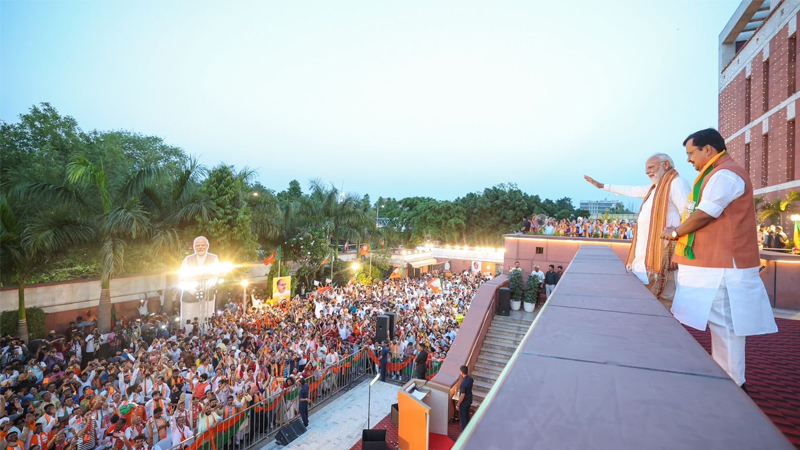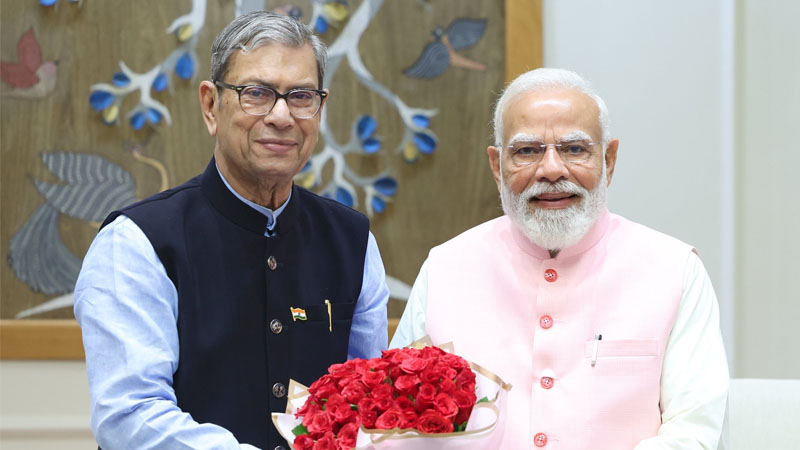

The Chief Minister of Delhi, Smt. Rekha Gupta, met with Prime Minister Shri Narendra Modi today.
The Prime Minister wrote on X:
“Chief Minister of Delhi, Smt. @gupta_rekha met Prime Minister @narendramodi.”
The Chief Minister of Delhi, Smt. Rekha Gupta, met with Prime Minister Shri Narendra Modi today.
The Prime Minister wrote on X:
“Chief Minister of Delhi, Smt. @gupta_rekha met Prime Minister @narendramodi.”
“Present-day warfare transcends borders, with national security encompassing economic, digital, energy, and even food security,” said Raksha Mantri Shri Rajnath Singh as he underscored the need of a robust military supported by prepared citizens capable of standing shoulder-to-shoulder to protect the nation under any circumstances. Virtually addressing the Raising Day celebrations and the Diamond Jubilee of Sainik School, Ghorakhal in Uttarakhand on March 21, 2026, he asserted that the nature of conflicts has undergone a paradigm shift as a nation can today be weakened through economic, cyber, space and information warfare, which demands every citizen to remain vigilant & prepared at all times.
While the Government, under the leadership of Prime Minister Shri Narendra Modi, is leaving no stone unturned to equip the defence forces with niche weapons & technologies, Raksha Mantri emphasised that the citizens, especially the youth, need to develop mental toughness and intellectual clarity through discipline & determination to help the nation tackle any and every situation. Referring to the concept of VUCA (Volatile, Uncertain, Complex and Ambiguous), he exhorted the students to develop their own version of VUCA i.e., Vision, Understanding, Courage and Adaptability, to navigate modern challenges effectively.
Highlighting the steps taken by the Government towards ensuring that a larger number of youth imbibe the values essential for nation-building, Shri Rajnath Singh stated that recently a decision was taken to establish 100 new Sainik Schools across the country in the Public-Private Partnership model. He added that another initiative includes increasing the number of vacancies within the National Cadet Corps (NCC). “Earlier, the NCC had an intake capacity of 17 lakh cadets; this has now been expanded to 20 lakh,” he said.
Raksha Mantri described the decision of admission of girls into Sainik Schools as historic and revolutionary, which is bolstering the country’s ‘Nari Shakti’. These girls will, in the times to come, become the torchbearers of ‘Nari Shakti’ and scale new heights across various sectors, he said.
Extending his greetings to students, faculty, alumni and their families on Sainik School, Ghorakhal completing 60 years of dedicated service to the nation, Shri Rajnath Singh expressed confidence that the students will continue to uphold the highest standards of discipline and dedication, bringing pride to their families, institution and the nation. “Over decades, the school has sent more than 800 students to the National Defence Academy and over 2,000 candidates to the Armed Forces through various entry schemes such as Combined Defence Services Examination and Air Force Common Admission Test. He hoped that the institution will continue to produce leaders who contribute meaningfully to nation-building. The distinguished alumni of the school, including General Officer Commanding-in-Chief, Western Command Lt Gen MK Katiyar, are a source of inspiration to the students, he added.
Union Minister of State (Independent Charge) for Science & Technology, Earth Sciences, and MoS PMO, Personnel, Public Grievances, Pensions, Atomic Energy and Space, Dr. Jitendra Singh said that India is steadily evolving into a robust pharma economy, which will not only accelerate future growth but also emerge as a significant contributor to the country’s overall GDP.
The minister emphasised that the growing strength of India’s pharmaceutical, medtech and manufacturing ecosystem is positioning the country as a key global manufacturing hub, particularly in high-quality, affordable healthcare solutions.
Delivering keynote address to a distinguished gathering at the “Healthcare Summit” organised by a leading English media house here, Dr. Jitendra Singh said that the discussions revolved around two central themes- “Made in India” and “Quality”. He highlighted that India’s healthcare and medtech ecosystem is undergoing a major shift, with a strong focus on global quality benchmarks, indigenous innovation, and integration of research with industry.
The Minister said that over the past decade, India has witnessed a remarkable transformation in healthcare, moving from a largely import-dependent system to one driven by indigenous capabilities. He recalled that earlier, critical medical devices, implants, and even advanced drugs were largely sourced from abroad, making treatment expensive and inaccessible for many. Today, India is developing its own antibiotics, vaccines, and advanced therapies, marking a decisive shift towards self-reliance.
Dr Jitendra Singh referred to the development of indigenous antibiotics and the rapid progress made during the COVID-19 pandemic, when India not only developed its own vaccines but also supplied them to several countries, reinforcing its role as a global healthcare partner. He said this transition reflects India’s growing credibility in both therapeutic and preventive healthcare.
The Minister also spoke about the emergence of cutting-edge technologies in India’s healthcare ecosystem, including gene therapy, with successful trials in conditions like haemophilia, as well as innovations in treatment for diseases such as sickle cell anaemia. He added that Indian institutions are now contributing to globally recognised research, with publications in leading international medical journals.
Highlighting the government’s push for quality standards, he said that “homegrown” products in India now match global benchmarks, with regulatory systems aligned to international standards. Through streamlined approval mechanisms and strengthened regulatory frameworks, indigenous medical devices such as stents, ventilators and diagnostic equipment are ensuring safety, efficacy, and affordability.
On the policy front, the Minister referred to initiatives like the Promotion of Research and Innovation in Pharma-MedTech (PRIP) scheme with an outlay of Rs 5,000 crore, aimed at transitioning India from low-cost manufacturing to high-value innovation. He also mentioned targeted support for the medical devices sector, including funding for common infrastructure, testing facilities and R&D clusters, which are reducing costs and enhancing competitiveness.
The Minister further said that initiatives like the Anusandhan National Research Foundation and the Maha MedTech Mission are strengthening the research ecosystem by connecting laboratories with clinical applications. The MedTech Mitra platform is enabling innovators to navigate regulatory pathways and access clinical trial networks more efficiently.
Dr. Jitendra Singh said that India currently holds around 1.5 per cent of the global medical device market but is working towards significantly expanding its share under the National Medical Device Policy 2023. He added that India aims to become one of the top global manufacturing hubs in this sector, reducing import dependence while boosting exports.
The Minister also highlighted the growing synergy between public and private sectors, stating that collaboration between industry, academia and government institutions has been institutionalised across sectors such as biotechnology, space, and healthcare. This integrated approach, he said, is essential in an era where scientific advancements are increasingly interdisciplinary.
Dr. Jitendra Singh said that with strong policy support, increased private sector participation and a focus on innovation-driven manufacturing, India is well on its way to becoming a preferred global destination for affordable, high-quality healthcare solutions, while also strengthening its position in the global bioeconomy and contributing significantly to national economic growth.
Prime Minister Shri Narendra Modi has extended his warmest greetings to everyone on the auspicious occasion of Navratri, praying for prosperity, health, and the fulfillment of the resolve for a Viksit Bharat.
The Prime Minister shared a Sanskrit Subhashitam on this occasion, highlighting the divine and benevolent grace of Goddess Shailaputri as the holy festival of Navratri commences. PM Modi also shared a devotional hymn dedicated to the Goddess on this occasion, noting that through the boundless mercy of the Goddess, the welfare of all citizens would be ensured, providing a powerful impetus to the collective goal of a developed India.
In a series of posts, the Prime Minister wrote on X:
“देशभर के मेरे परिवारजनों को नवरात्रि की हार्दिक मंगलकामनाएं। शक्ति की आराधना का यह दिव्य अवसर आप सभी के लिए सुख, सौभाग्य, समृद्धि और उत्तम स्वास्थ्य लेकर आए। शक्तिस्वरूपा मां दुर्गा की असीम कृपा से सबका कल्याण हो, जिससे विकसित भारत के हमारे संकल्प को भी नई ऊर्जा मिले। जय अंबे जगदंबे मां!”
“नवरात्रि के पहले दिन मां दुर्गा के प्रथम स्वरूप देवी शैलपुत्री की पूजा का विधान है। उनके आशीर्वाद से हर किसी के जीवन में संयम, शांति और सकारात्मक ऊर्जा का संचार हो, यही कामना है।
वन्दे वाञ्छितलाभाय चन्द्रार्धकृतशेखराम्।
वृषारूढां शूलधरां शैलपुत्रीं यशस्विनीम्॥”
I bow to Goddess Shailaputri, who fulfills all the wishes of her devotees, who is adorned with a crescent moon on her forehead, who rides a bull and who holds a trident in her hand. She is a glorious and revered goddess.
“जगतजननी मां दुर्गा के चरणों में कोटि-कोटि देशवासियों की ओर से मेरा नमन और वंदन! नवरात्रि के पावन पर्व पर देवी मां से विनती है कि वे हर किसी को अपने स्नेह और अनुकंपा का आशीर्वाद प्रदान करें। जय माता दी!”
Prime Minister Shri Narendra Modi addressed retiring Members of Rajya Sabha today. Expressing heartfelt gratitude for the chance to honor retiring colleagues, the Prime Minister noted that such occasions allow the House to rise above party lines and share a common sentiment. PM Modi remarked that whether members return or move into broader social service, their accumulated experience remains an asset to the nation. He observed that in the dynamic field of politics, the journey never truly ends as the future always holds new opportunities for seasoned leaders. “In politics, there are no full stops; your experience and contribution will forever remain a part of the nation’s life,” asserted Shri Modi.
Highlighting the best contributions of the outgoing members, the Prime Minister suggested that the new generation of MPs should look to veterans like Shri Deve Gowda, Shri Kharge, and Shri Sharad Pawar as role models. He praised Deputy Chairman Harivansh Ji for his soft-spoken conduct and his ability to maintain the House’s trust while handling complex crises. Shri Modi pointed out that such dedicated service reflects a deep commitment to the responsibilities entrusted by society. “There is much to learn from these senior leaders about staying entirely committed to the responsibilities given by society,” noted the Prime Minister.
Reflecting on the changing traditions of the House, PM Modi remarked that while the 24×7 media environment has made everyone more conscious, the legacy of humor and wit remains an essential part of parliamentary life. He highlighted that the departure of a group every two years allows for a continuous exchange of knowledge, ensuring that the House’s rich legacy is preserved by the incoming members. Shri Modi observed that this institutional continuity is a significant advantage that strengthens the democratic process. “The legacy here is a continuous process that enriches our parliamentary system,” remarked the Prime Minister.
Highlighting the unique institutional value of the Rajya Sabha, PM Modi pointed out that the parliamentary system gains immense strength from the concept of a “second opinion.” He noted that the transition of decisions between the two Houses adds a critical new dimension to the legislative process, ensuring more refined outcomes for the country. This democratic heritage, according to him, fosters a sense of openness and thoroughness in national decision-making. “This second opinion is a massive contribution to our democracy that we must cherish,” said Shri Modi.
The Prime Minister pointed out that the retiring cohort holds the rare distinction of having served in both the old and the new Parliament buildings during their tenure. He remarked that being part of the historic transition to the new House would serve as a fresh and significant memory in their public service careers. Shri Modi described the House as a “Great Open University” that provides members with a unique education in the complexities of national life. “The six years spent here are invaluable for shaping one’s contribution to the nation and for self-growth,” emphasized the Prime Minister.
Concluding the address, Shri Modi expressed confidence that the members’ vision and capacity have expanded manifold through their years of parliamentary experience. He noted that their invaluable contributions to nation-building would continue to be felt whether they serve within the formal system or through independent social work. PM Modi once again glorified the long and dedicated service of the retiring representatives, thanking them for their commitment. “I once again salute and glorify the contributions of all the retiring members,” emphasized Shri Modi.
Governor of Madhya Pradesh, Shri Mangubhai Patel met Prime Minister, Shri Narendra Modi in New Delhi today.
The Prime Minister’s Office posted on X;
“Governor of Madhya Pradesh, Shri Mangubhai Patel met Prime Minister @narendramodi.
@GovernorMP”
In a landmark step towards accelerating industrial growth, the Union Cabinet chaired by the Prime Minister Shri Narendra Modi has approved the Bharat Audyogik Vikas Yojna (BHAVYA), with an allocation of Rs.33,660 crore for developing 100 plug-and-play industrial parks across the country.
The scheme aims to develop world-class industrial infrastructure, unlocking manufacturing potential and driving India’s growth story.
Laying the Industrial Foundation for Viksit Bharat:
Building on the success of Industrial Smart Cities developed under the National Industrial Corridor Development Programme (NICDP) framework, BHAVYA will be implemented in partnership with states and private sector players.
From Approvals to Operations: A New Ease of Doing Business
At the heart of BHAVYA lies a strong push for deregulation and ease of doing business, with streamlined approvals, effective single-window systems, and investor-friendly reforms led by states.
The scheme will deliver plug-and-play industrial ecosystems, enabling industries to move from intent to production with speed and certainty. With pre-approved land, ready infrastructure, and integrated services, BHAVYA will significantly reduce entry barriers for investors.
Under the scheme, industrial parks ranging from 100 to 1000 acres will be taken up for development. Financial support of up to Rs. One crore per acre will be provided for:
Support for external infrastructure will also be provided up to 25% of the project cost, ensuring seamless connectivity and integration with existing networks.
Project selection will be undertaken through a challenge mode, ensuring that only high-quality, reform-oriented and investment-ready proposals are taken forward.
Future-Ready, Sustainable and Efficient Industrial Parks:
The industrial parks will be designed as futuristic and sustainable ecosystems:
These parks will set new benchmarks in industrial infrastructure, ensuring reliability, reducing inefficiencies, and enhancing productivity across sectors.
Driving Jobs, Investment and Economic Growth Across Regions:
BHAVYA is expected to drive large-scale job creation, generating substantial direct and indirect employment across manufacturing, logistics, and services, while catalysing significant investments.
The scheme will extend to all States and Union Territories, creating lakhs of employment opportunities across the country and accelerating industrial growth nationwide.
By fostering cluster-based development and enabling co-location of industries, suppliers, and service providers, BHAVYA will strengthen domestic supply chains, promote regional industrialization, and create new opportunities for millions of people.
The scheme will benefit:
The approval of BHAVYA represents a transformational step in India’s journey towards Atmanirbhar Bharat, reinforcing the country’s manufacturing capabilities, boosting exports, and laying the foundation for a resilient, inclusive, and globally competitive economy.
About NICDC:
National Industrial Corridor Development Corporation Limited (NICDC), under the Department for Promotion of Industry and Internal Trade (DPIIT), Ministry of Commerce and Industry, is spearheading the development of world-class greenfield industrial smart cities to enhance manufacturing competitiveness, attract investments, and generate employment. NICDC is currently implementing 20 projects across 13 states.
NICDC-led initiatives are built on the concept of plug-and-play industrial parks—ready-to-use ecosystems where land, utilities, approvals, and infrastructure are pre-developed, enabling industries to start operations quickly without delays related to land acquisition or infrastructure setup.
In a significant step towards strengthening farmer welfare and advancing the vision of Aatmanirbhar Bharat, the Cabinet Committee on Economic Affairs chaired by the Prime Minister Shri Narendra Modi has approved Minimum Support Price (MSP) funding of Rs.1,718.56 crore to the Cotton Corporation of India (CCI) for the cotton season 2023–24. This funding aims to provide direct price support to cotton farmers across the country.
The MSP operations are undertaken to safeguard the interests of cotton farmers, particularly during periods when market prices fall below the MSP. These interventions play a crucial role in stabilising cotton prices, preventing distress sales, and ensuring remunerative returns to farmers. By enhancing inclusivity in agricultural markets, MSP operations contribute significantly to the economic security of cotton-growing communities.
Cotton remains one of India’s most vital cash crops, sustaining the livelihoods of approximately 60 lakh farmers and supporting 400–500 lakh people engaged in allied activities, including processing, trade, and textiles.
During the 2023–24 cotton season, the area under cultivation was estimated at 114.47 lakh hectares, with production pegged at 325.22 lakh bales, accounting for nearly 25% of global cotton output. The Government of India fixes the MSP for seed cotton (kapas) based on the recommendations of the Commission for Agricultural Costs and Prices (CACP).
The Government has designated the Cotton Corporation of India as the central nodal agency for undertaking MSP operations in cotton. CCI procures all Fair Average Quality (FAQ) cotton from farmers without any quantitative ceiling, whenever market prices fall below MSP levels, thereby providing an assured safety net to farmers.
As part of its preparedness, CCI has established a robust procurement network across all 11 major cotton-growing States, with over 508 procurement centres operational in 152 districts, ensuring seamless and accessible procurement for farmers.
Further, CCI has undertaken several technology-driven and farmer-centric initiatives to enhance the efficiency and transparency of MSP operations. These include disseminating MSP-related information, implementing the Bale Identification and Traceability System (BITS), and launching the “Cott-Ally” mobile app, which enables better outreach and service delivery to farmers.
The Prime Minister spoke with HH Sheikh Mohamed bin Zayed Al Nahyan, President of the UAE, and conveyed advance Eid greetings. PM Modi and the President discussed the current situation in West Asia. The Prime Minister reiterated India’s strong condemnation of all attacks on the UAE that have resulted in loss of innocent lives and damage to civilian infrastructure.
The Prime Minister and the UAE President agreed on the importance of ensuring safe and free navigation through the Strait of Hormuz. Shri Modi emphasized that both nations will continue to work together for the early restoration of peace, security, and stability in the region.
The Prime Minister wrote on X;
“Spoke with my brother HH Sheikh Mohamed bin Zayed Al Nahyan, President of the UAE and conveyed advance Eid greetings.
We discussed the current situation in West Asia. Reiterated India’s strong condemnation of all attacks on the UAE that have resulted in loss of innocent lives and damage to civilian infrastructure.
We agreed on the importance of ensuring safe and free navigation through the Strait of Hormuz.
We will continue to work together for the early restoration of peace, security and stability in the region.”
Union Minister of State (Independent Charge) for Science & Technology, Earth Sciences, and MoS PMO, Personnel, Public Grievances, Pensions, Atomic Energy and Space, Dr Jitendra Singh today said that India, with its 1.4 billion population, holds the key to “Green World” transition.
In other words, India stands at a decisive stage in the global transition towards a green future and is well placed to play a leading role in shaping it, the Minister said.
Addressing the 10th Sustainable Business Futures Summit 2026, he said that with a significant share of the world’s population, India’s progress will play a key role in determining the success of global green transition. He said this presents both a responsibility and an opportunity for India to emerge as a major global driver of sustainable development powered by green technologies and clean energy systems.
Dr Jitendra Singh said that green infrastructure will be a central pillar of India’s future economic growth and its global leadership vision. He said the evolving global economy is moving towards recycling, regeneration and environmentally sustainable technologies, and India is aligning its development pathway with these emerging priorities.
Referring to India’s economic journey over the last decade, he said the country has witnessed a remarkable transformation, supported by a rapidly expanding innovation ecosystem. He said India is now among the leading startup ecosystems globally, with over two lakh startups, nearly half of which are emerging from Tier-II and Tier-III cities, reflecting a widespread shift in entrepreneurial aspirations across the country.
The Minister said that India is steadily expanding its clean energy ecosystem to support emerging sectors such as data centres and artificial intelligence, which require reliable, round-the-clock energy supply. In this context, he referred to the SHANTI Act (Sustainable Harnessing and Accelerating Nuclear Transformation of India), describing it as a landmark reform that opens the nuclear energy sector for wider participation, including private players, and enables new avenues for clean and dependable energy generation.
Dr Jitendra Singh said that India’s approach to green transition is based on an integrated strategy combining technological innovation, economic growth, and environmental sustainability. He said this includes development of next-generation energy systems, advanced energy storage, flexible and digitally enabled grids capable of integrating multiple energy sources such as solar, wind, nuclear and hydrogen, along with climate modelling, risk analytics, and advanced construction technologies.
Referring to the policy direction provided by Prime Minister Shri Narendra Modi, he said India has committed to achieving Net Zero emissions by 2070 and has also promoted the concept of Lifestyle for Environment (LiFE), which calls for sustainable living practices. He said this reflects India’s broader vision of responsible and inclusive growth aligned with global environmental priorities.
Dr Jitendra Singh also spoke about the growing emphasis on circular economy practices, stating that the idea of waste is being redefined through innovative waste-to-wealth initiatives across sectors, contributing to both sustainability and economic value creation.
He said that future infrastructure development must incorporate climate resilience, sustainable urban systems, clean mobility solutions, and water security, supported by coordinated efforts between government, industry, and research institutions.
Dr Jitendra Singh emphasized that the path forward requires strong collaboration, noting that the era of working in silos is over and that collective efforts will be essential to achieve long-term sustainability goals.
The Union Minister for Ports, Shipping and Waterways (MoPSW), Sarbananda Sonowal, along with senior officials of the Ministry, interacted with the brave crew members of Indian-flagged LPG carriers Shivalik and Nanda Devi, expressing the nation’s gratitude for their courage and unwavering sense of duty in ensuring the safe transit of critical LPG cargo here today.
The interaction, held via video conference, was attended by Vijay Kumar, secretary, Ministry of Ports, Shipping and Waterways; Shyam Jagannathan, director general of shipping; Capt. B.K. Tyagi, chairman and managing director, Shipping Corporation of India; Capt. Sukhmeet Singh and crew of Shivalik; and Capt. Dhiraj Kumar Agrawal along with the crew of Nanda Devi.
Addressing the seafarers, Sarbananda Sonowal said the interaction was a “heartfelt expression of the nation’s gratitude” to the crew, who ensured the safe delivery of vital LPG supplies despite operating in a high-risk maritime environment.
“It is a matter of immense pride to recognise the courage, dedication and professionalism of the crew of Shivalik and Nanda Devi. Your efforts ensured the safe passage of critical LPG cargo, strengthening India’s energy security,” Sarbananda Sonowal said.
The minister noted that both vessels remained stationed in a high-risk zone for nearly two weeks amid heightened security concerns before continuing their voyage to India. Sonowal said the crew demonstrated exceptional calmness, vigilance and professionalism under challenging conditions.
Earlier, the two Indian-flagged LPG carriers safely crossed the Strait of Hormuz before arriving India on March 16 and 17, as the government continues to closely monitor maritime operations in the Persian Gulf region amid the evolving geopolitical situation in West Asia. MT Shivalik and MT Nanda Devi — carrying approximately 92,712 metric tonnes of LPG, crossed the Strait of Hormuz early Friday (13 March, 2026).
“Seafarers are the unsung heroes of global trade. Far away from your homes and families, you ensure that essential cargo reaches its destination safely,” Sonowal said, highlighting the critical role played by maritime personnel in sustaining global supply chains.
The Union Minister further emphasised that the successful voyage of the two Indian-flagged vessels, fully manned by Indian seafarers, reflects the strength and resilience of India’s maritime workforce.
“Under the leadership of Prime Minister Narendra Modi, we are committed to strengthening the maritime sector and ensuring the safety, dignity and global recognition of our seafarers,” Sarbananda Sonowal said.
Sonowal also acknowledged the support of seafarers’ families, calling them a vital pillar behind their dedication and service. Congratulating the masters, officers and crew of both vessels, the minister said their achievement stands as an example of professionalism and commitment, and wished them safe voyages ahead.
The Directorate General of Shipping (DG Shipping) is closely monitoring the situation in coordination with ship owners, Recruitment and Placement Service License (RPSL) agencies and Indian diplomatic missions in the region. The Union Minister Sarbananda Sonowal is actively and directly monitoring the situation.
To ensure smooth maritime operations, the government is working closely with ports, shipping lines and logistics stakeholders to minimise any operational disruptions to maritime trade. Ports have been advised to extend relief measures where required, including concessions in anchorage, berth hire and storage charges.
Major ports are prioritising berthing for LPG vessels to ensure timely discharge of cargo and continuity in energy supply. Over the past few days, six LPG vessels have been received at major Indian ports. Additionally, ports are providing safe anchorage areas for vessels loaded with cargo bound for the Gulf region that are currently unable to transit due to prevailing conditions.
The ministry said it continues to monitor the maritime situation in close coordination with the Ministry of External Affairs, Indian missions abroad, shipping companies and other maritime stakeholders, with a focus on safeguarding the welfare of Indian seafarers and ensuring the resilience of India’s maritime logistics network.
Union Home Minister and Minister of Cooperation Shri Amit Shah today inaugurated various development projects of the Assam Government in Guwahati. On this occasion, Assam Chief Minister Shri Himanta Biswa Sarma and several other dignitaries were also present.
Addressing the gathering, Union Home Minister Shri Amit Shah said that this programme is important not only for Assam but for the entire Northeast. He said that about ten years ago, the condition of healthcare services across the Northeast was very poor. The opposition party that remained in power for years never cared about the health of the people, except for the financial health of their own families. Shri Shah said that since Shri Himanta Biswa Sarma became the Chief Minister of Assam, he has succeeded in bringing the state’s healthcare system on par with developed states such as Gujarat, Maharashtra, and Karnataka. A large number of government hospitals have been constructed in the state, several medical colleges have been established, and priority has been given to setting up government medical colleges so that children from poor families can also pursue medical education. In addition, hospitals equipped with the most advanced facilities in the country have been built to treat various critical diseases. He said that Chief Minister, Shri Himanta Biswa Sarma has also mobilized the strength of society along with the government in carrying out these initiatives.
Shri Amit Shah said that once in Delhi he had told the late Ratan Tata that the long waiting list for cancer treatment at the cancer hospital of AIIMS was not a good situation for the country. He said that he had given Ratan Tata a list of 13 places in the country from where cancer patients travel to Delhi for their treatment. Shri Shah said that it is a matter of great satisfaction that the Tata Trust has rendered a major service to cancer patients by establishing cancer hospitals at all those 13 locations. He further said that no government hospital in the country currently has a facility for Proton Therapy, an extremely advanced and expensive treatment technology. However, Assam is set to become the first state in the country to provide Proton Therapy in a government hospital, with an investment of ₹400 crore. He said that under the double-engine government, Assam has become a major hub for critical healthcare services, including cancer treatment.
Union Home Minister Shri Amit Shah said that it is very important for the country to have a comprehensive system of medical education, research and development, and to provide a platform where our children can conduct research on every kind of critical disease and serve patients not only in India but across the world. He said that today the Pragjyotishpur Medical College and Hospital (PMCH) has been inaugurated, which has been built at a cost of about ₹675 crore. Along with this, the Golaghat Cancer Centre built at a cost of ₹135 crore, the Tinsukia Cancer Centre built at a cost of ₹135 crore, the Diphu Medical College and Hospital built at a cost of ₹220 crore, the Barpeta Medical College and Hospital built at a cost of ₹284 crore, and the Jorhat Medical College and Hospital built at a cost of ₹310 crore have also been inaugurated. In addition, the foundation stone has been laid for the Six Mile Swasthya Bhavan at a cost of ₹218 crore and the Abhayapuri District Hospital at a cost of ₹115 crore. He said that through these initiatives, the Chief Minister has made a significant effort to make Assam a prosperous state in the healthcare sector in a single day. He added that even before completing his tenure, the Chief Minister has accomplished the task of making Assam self-reliant in the healthcare sector.
Shri Amit Shah said that Chief Minister Shri Himanta Biswa Sarma aims to make Assam a state where not a single patient has to go outside the state for treatment. At the same time, poor patients from Bengal and other Northeastern states should be able to come to Assam for treatment and return to their home states after receiving care. He said that efforts have been made to expand healthcare facilities for cancer and other diseases across every part of Assam, including Barak Valley, Upper Assam, Central Assam, and Lower Assam. He added that patients will no longer need to travel to Chennai, Mumbai, Karnataka, or Delhi, as they will be able to receive complete treatment at government hospitals near their homes. Union Home Minister and Minister of Cooperation Shri Amit Shah said that the opposition party had once resolved to build a healthy Assam during its time in power. A former Prime Minister of India was also elected as a Member of Parliament from Assam, yet no significant improvement was made in the state’s healthcare system. Shri Shah said that today he can proudly state that the current government of his party has completed the task of making Assam self-reliant in the fields of healthcare and medical education. Under the current government, Assam’s health budget has been increased from ₹4,000 crore to ₹9,000 crore, and the funds have been spent effectively at the ground level. Shri Shah further said that earlier there were only six medical colleges in Assam; now the number has increased to fourteen, and ten more are planned. In total, Assam will have 24 medical colleges instead of six. Earlier there were 726 medical seats, but now there are already 1,825 seats across the 14 colleges.
Shri Amit Shah said that the Assam Government provides good salaries to professors in medical colleges, due to which medical students prefer to become professors after completing their MD. He said that earlier there were only two cancer care hospitals, but now their number has increased to seventeen. He further said that earlier there was no health insurance scheme. The Prime Minister first launched the Ayushman Bharat Yojana, and Shri Himanta Biswa Sarma introduced a separate scheme by the Assam Government.
Union Home Minister said that the Assam Government has mobilized CSR funds from the corporate sector for expensive medical treatments. Through this, the state government pays the cost of treatment, and poor patients do not have to bear any expenses even for costly procedures. He said that the Assam Government’s approach is that a poor child should be able to become a doctor, the poor should receive proper treatment, a family’s earnings should not be wiped out due to illness, and no one should fall into debt because of medical expenses. He added that this is the kind of governance approach that should be followed, and it has been implemented here by the present government.
Union Home Minister said that Prime Minister Shri Narendra Modi has opened new horizons for the youth in many sectors. PM Modi’s dream is to create a platform where India’s youth can stand and compete with the youth of the world. Space, green hydrogen, green energy, AI, 5G followed by 6G, electronic equipment manufacturing, semiconductors—these emerging sectors will determine the direction of the global economy for the next 25 years. India has today become a founder member in these areas. For the first time in Assam, a semiconductor plant has been established at a cost of ₹27,000 crore. In engineering colleges, seats in civil and chemical engineering have been reduced and diverted to these disciplines.
Shri Amit Shah said that the Prime Minister Shri Narendra Modi organized the world’s largest AI summit in Delhi, which was attended by top CEOs of companies from 80 countries and heads of state from 22 countries. Numerous MoUs, training programs, and R&D collaborations took place. At that platform, workers of the opposition party attempted to defame India by removing their clothes. Shri Shah said that he himself has been in the opposition and has participated in dharnas and protests, but there is a time and place for such actions. Where people from across the world had come to see India and invest in it, they turned the platform into one for personal politics. He said that he wants to tell the opposition leader that while opposing Modi Ji and our party, you have ended up opposing India itself. The opposition leader displayed shameless behavior. Instead of apologizing, he said that the person who was protesting half-naked was his “Babbar Sher”. He stated that no responsible political party supports such actions.
Home Minister said that the opposition leader sometimes sits at the gates of Parliament eating tea and pakoras. He doesn’t seem to know what the appropriate place for breakfast is. He said that Parliament is the supreme institution of our democracy. Even holding a dharna there is not right, but you have gone two steps beyond a dharna. This is defaming India and our democracy in the eyes of the world. He said, I strongly condemn both these incidents that took place today on the directions of the opposition leader and with his own direct participation. No youth in the country will support this kind of activism. He added that our opposition is with the leader of opposition party. Oppose us as much as you have the strength to, but you don’t speak in Parliament; you run away from it. Where the world had come to witness India’s strength and the capability of its youth, you have diminished their opportunities there. The people of India will never forgive the opposition leader.