
PM addresses Veer Baal Diwas programme in New Delhi

| Published on:

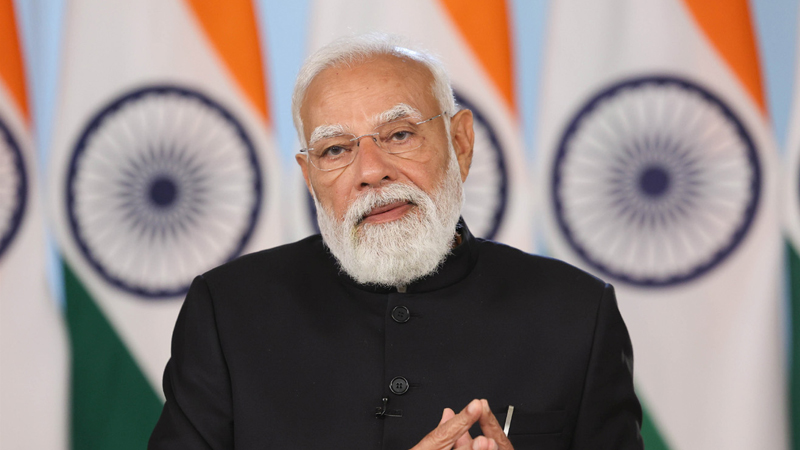
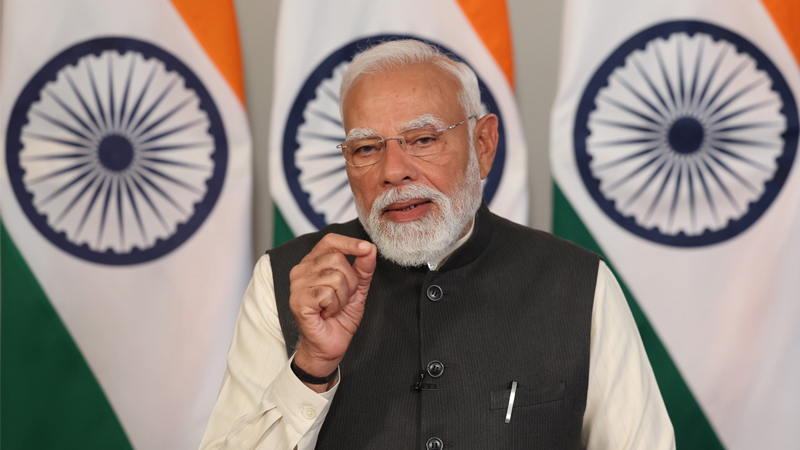
Prime Minister Shri Narendra Modi addressed the national programme marking ‘Veer Baal Diwas’ at Bharat Mandapam, New Delhi today. Speaking on the occasion, the Prime Minister welcomed guests from across the nation and addressed the children present, remarking that today the country is celebrating Veer Bal Diwas. He highlighted the beautiful presentation of Vande Mataram, noting that the dedication and effort of the performers was clearly visible.

Emphasizing that on this day, the nation remembers the brave Sahibzades, who are the pride of India and represent the pinnacle of indomitable courage and valor, Shri Modi stated that these Sahibzades broke the boundaries of age and stage, standing like a rock against the cruel Mughal empire, shaking the very existence of religious fanaticism and terror. The Prime Minister underlined that a nation with such a glorious past, whose young generations inherit such inspiring legacies, is capable of achieving anything.

Shri Modi remarked that whenever the day of 26th December arrives, he feels assured that the government has begun celebrating Veer Bal Diwas inspired by the valor of the Sahibzades. He highlighted that in the past four years, this new tradition has carried the inspiration of the Sahibzades to the younger generation and has created a platform for building courageous and talented youth. The Prime Minister stated that every year children who achieve remarkable feats in different fields for the nation are honored with the Pradhan Mantri Rashtriya Bal Puraskar (PMRBP), and this year too, 20 children from across the country have received the award. He further stated about the interaction with them, mentioning that some displayed extraordinary bravery, some contributed commendably in social service and environmental protection, some innovated in science and technology, while many others made contributions in sports, art, and culture. Shri Modi conveyed to the award winners that this honor is not only for them but also for their parents, teachers, and mentors whose efforts are being recognized, and extended best wishes to the winners and their families for a bright future.

Underlining that Veer Bal Diwas is a day filled with emotion and reverence, Shri Modi remembered Sahibzada Ajit Singh Ji, Sahibzada Jujhar Singh Ji, Sahibzada Zorawar Singh Ji, and Sahibzada Fateh Singh Ji, who at a very young age had to confront the greatest power of their time. He emphasized that their struggle was between the fundamental ideas of India and religious fanaticism, between truth and falsehood, with one side led by 10th Guru Shri Guru Gobind Singh Ji and the other by the cruel rule of Aurangzeb. The Prime Minister noted that although the Sahibzades were very young, Aurangzeb was determined to break the morale of Indians to force conversions, and thus targeted them. He stressed that Aurangzeb and his commanders forgot that Guru Gobind Singh Ji was no ordinary man but the embodiment of penance and sacrifice, and the Sahibzades inherited this legacy. He declared that despite the entire Mughal empire’s might, not one of the four Sahibzades wavered. The Prime Minister recalled the words of Sahibzada Ajit Singh Ji, which continue to echo his courage.

Recalling that only a few days ago the nation remembered Shri Guru Tegh Bahadur Ji on his 350th martyrdom day, with a special program held in Kurukshetra, Shri Modi remarked that it was wrong to think that Sahibzades, who drew inspiration from the sacrifice of Shri Guru Tegh Bahadur Ji, would fear Mughal atrocities. The Prime Minister highlighted that the courage and ideals of Mata Gujri, Shri Guru Gobind Singh Ji, and the four Sahibzades continue to give strength to every Indian and remain a source of inspiration. He emphasized that the saga of the Sahibzades’ sacrifice should have been on the lips of every citizen, but unfortunately, even after independence, the colonial mindset prevailed. He pointed out that this mentality was seeded by British politician Macaulay in 1835 and was not allowed to be eradicated even after independence, leading to decades of attempts to suppress such truths. Shri Modi asserted that India has now resolved to free itself from the colonial mindset, declaring that the memories of Indian sacrifices and valor will no longer be suppressed and the nation’s heroes and heroines will no longer be sidelined. He underlined that this is why Veer Bal Diwas is being celebrated with full devotion and spirit. He added that the government has not stopped there, noting that in 2035 it will be 200 years since Macaulay’s conspiracy, and with 10 years remaining, India will demonstrate complete liberation from the colonial mindset. The Prime Minister stressed that once the nation is free from this mindset, it will take greater pride in indigenous traditions and advance further on the path of self-reliance.

The Prime Minister remarked that a glimpse of the campaign to free the nation from the colonial mindset was recently visible in Parliament, where during the winter session, Members of Parliament delivered nearly 160 speeches in Indian languages apart from Hindi and English. He highlighted that around 50 speeches were in Tamil, more than 40 in Marathi, and about 25 in Bangla, noting that such a scene is rare in any parliament in the world and is a matter of pride for all. He emphasized that Macaulay had attempted to suppress India’s language diversity, but now, as the country frees itself from the colonial mindset, linguistic diversity is becoming a strength.

Addressing the youth present from the Yuva Bharat organization, Shri Modi remarked that they represent Gen Z and Gen Alpha, and it is their generation that will lead India to the goal of becoming a developed nation. He stated that he sees and understands their competence and confidence, and therefore places great trust in them. Quoting the adage, Shri Modi explained that even if a child speaks wisely, it should be accepted, meaning that greatness is not defined by age but by deeds and achievements. He underlined that young people can accomplish tasks that inspire others, and many have already demonstrated this. However, he stressed that these achievements should be seen only as a beginning, as there is much further to go, with dreams to be taken to the skies. Noting that this generation is fortunate, Shri Modi said today the nation stands firmly with their talent, unlike earlier times when youth feared even to dream due to an environment of despair. He remarked that today the country seeks out talent, provides platforms, and aligns the strength of 140 crore citizens with their aspirations. He highlighted that with the success of Digital India, the youth have the power of the internet and resources for learning, with missions like Startup India for those pursuing science, technology, and entrepreneurship, and Khelo India for those advancing in sports. He mentioned that only two days ago he participated in the Sansad Khel Mahotsav, underscoring the many platforms available to support youth progress. The Prime Minister urged them to remain focused, cautioning against being trapped in the glitter of short-term popularity, and emphasized that clarity of thought and principles is essential. He called upon them to learn from ideals and great personalities of the nation, and to ensure that their success is not limited to themselves but becomes the success of the country.

The Prime Minister remarked that new policies are being framed with a focus on youth empowerment, placing young people at the center of nation-building. He highlighted that through platforms like Mera Yuva Bharat, efforts are being made to connect youth, provide them opportunities, and develop leadership skills. Shri Modi emphasized that whether it is advancing the space economy, promoting sports, expanding fintech and manufacturing sectors, or creating opportunities for skill development and internships, youth remain at the core of every initiative. He further underlined that new opportunities are opening for youth in every sector.

Noting that India today faces unprecedented circumstances, being one of the youngest countries in the world, Shri Modi stated that the coming 25 years will determine the nation’s direction, and for the first time since independence, India’s capabilities, aspirations, and the world’s expectations are converging. He remarked that today’s youth are growing up in a time of greater opportunities than ever before, and the government is committed to providing better chances to harness their talent, confidence, and leadership.

Addressing the youth, the Prime Minister stressed that strong foundations for a developed India are being laid through significant reforms in the education policy. He explained that the new National Education Policy focuses on modern learning methods of the 21st century, emphasizing practical learning, encouraging children to think rather than memorize, instilling the courage to ask questions, and building problem-solving skills. Shri Modi noted that for the first time, meaningful efforts are being made in this direction, with multidisciplinary studies, skill-based learning, promotion of sports, and use of technology greatly benefiting students. The Prime Minister highlighted that across the country, millions of children are engaging in innovation and research through Atal Tinkering Labs, and even at the school level, students are being introduced to robotics, AI, sustainability, and design thinking. He added that alongside these efforts, the National Education Policy has provided the option of studying in the mother tongue, making learning easier and helping children better understand subjects.

The Prime Minister remarked that the brave Sahibzades did not look at how difficult the path was, but whether the path was right or not, and stressed that the same spirit is needed today. He expressed his expectation from the youth of India to dream big, work hard, and never let their confidence weaken. Shri Modi underlined that the future of India will shine through the future of its children and youth, whose courage, talent, and dedication will guide the nation’s progress. The Prime Minister concluded by affirming that with this faith, responsibility, and continuous momentum, India will keep advancing towards its future. He once again paid tribute to the Sahibzades and congratulated all the award-winning youth, extending his heartfelt thanks to everyone.

Union Ministers, Smt Annpurna Devi, Smt Savitri Thakur, Shri Ravneet Singh, Shri Harsh Malhotra were present among other dignitaries at the event.

Background

To mark Veer Baal Diwas, the Government of India is organising participative programmes across the country with the objective of informing and educating citizens about the extraordinary courage and supreme sacrifice of the Sahibzades, and to honour and commemorate the indomitable courage, sacrifice, and valour of the young heroes of India’s history. The activities will include storytelling sessions, recitations, poster-making and essay-writing competitions, among others. These will be conducted in schools, Child Care Institutions, Anganwadi centres, and other educational platforms, as well as through online activities on the MyGov and MyBharat portals.

On the occasion of the Prakash Purab of Sri Guru Gobind Singh Ji on 9th January 2022, the Prime Minister had announced that 26th December would be observed as ‘Veer Baal Diwas’, to commemorate the martyrdom of Sahibzadas Baba Zorawar Singh Ji and Baba Fateh Singh Ji, the sons of Sri Guru Gobind Singh Ji, whose unparalleled sacrifice continues to inspire generations.

Awardees of the Pradhan Mantri Rashtriya Bal Puraskar (PMRBP) were also present during the programme.

Union Health Minister reviews progress and initiatives of the Indian Pharmacopoeia Commission

| Published on:

Union Minister of Health and Family Welfare, Shri Jagat Prakash Nadda, today reviewed the progress and initiatives of the Indian Pharmacopoeia Commission (IPC), in the presence of Ms. Nivedita Shukla Verma, Secretary, Department of Chemicals and Petro-Chemicals (DoCP) and holding additional charge as Secretary, MoHFW.

Shri Nadda appreciated IPC’s sustained efforts in strengthening pharmacopoeial standards and pharmacovigilance activities, which contribute to the Government’s vision of Atmanirbhar Bharat and a Viksit Bharat, promoting self-reliance, scientific excellence, and robust healthcare standards.

During the review, Shri Nadda commended IPC for its pivotal role in ensuring the quality, safety, and efficacy of medicines, thereby protecting public health. He noted that the Indian Pharmacopoeia remains a critical scientific and regulatory reference, ensuring uniform standards of medicines across the country.

The Minister highlighted that “the Indian Pharmacopoeia is now recognised in 19 countries, reflecting growing international confidence in India’s regulatory and scientific capabilities.” He observed that “this recognition strengthens India’s position as the Pharmacy of the World and underscores the credibility of Indian pharmacopoeial standards globally.”

In addition to this, the 10th edition of the Indian Pharmacopoeia 2026 is scheduled to be launched by the Union Health Minister in the first week of January, 2026.

In the meeting, Shri Nadda emphasized IPC’s crucial role in implementing the Pharmacovigilance Programme of India (PvPI) to monitor adverse drug reactions and ensure patient safety, and appreciated its efforts to strengthen reporting systems and build capacity among healthcare professionals. He also lauded IPC’s contribution to Atmanirbhar Bharat through strengthening indigenous scientific expertise and regulatory standards, while supporting global public health. The Minister encouraged IPC to continue focusing on innovation, digitalisation, and global harmonisation of standards in line with the vision of Viksit Bharat, to ensure universal access to safe and quality medicines.

The details of the activities were presented by Dr. V. Kalaiselvan, Secretary-cum-Scientific Director (IPC) and he further reaffirmed the commitment to further strengthen pharmacopoeial and pharmacovigilance standards, enhancing international collaboration and contributing to national and global health objectives.

Shri Harsh Mangla, Joint Secretary, MoHFW and other senior officers of the Ministry were also present at the meeting.

Union Home Minister inaugurates ‘Anti-Terrorism Conference-2025’ in New Delhi

| Published on:

Union Home Minister and Minister of Cooperation Shri Amit Shah today inaugurated the ‘Anti-Terrorism Conference-2025’ in New Delhi. The two-day conference is being organized by the National Investigation Agency (NIA) under the Ministry of Home Affairs, Government of India. The Home Minister also unveiled NIA’s updated crime manual, Organised Crime Network Database and Lost/Looted and Recovered Weapon Database. The conference was attended by Union Ministers of State for Home Affairs Shri Nityanand Rai and Shri Bandi Sanjay Kumar, Union Home Secretary, Secretary R&AW, Director General of NIA and many other dignitaries. The conference is being attended by senior police officers from States/UTs, officers from Central agencies/Departments dealing with issues related to Counter Terrorism and experts from related fields such as law, forensics, technology etc.

In his address, Union Home Minister Shri Amit Shah said that under the Prime Minister Shri Narendra Modi’s vision of zero-tolerance against terrorism, this annual conference has become a platform to deal with emerging threats. He said that in last 3 years, we have moved forward in the direction of making this conference an annual tradition. He said that this conference is not merely a forum for discussion, but actionable points emerge here, and the NIA along with all related agencies of the states continuously work throughout the year towards their implementation. As a result, we are succeeding in building a strong anti-terrorism grid across the country. He added that this conference is not just a medium to reiterate India’s resolve for security. Shri Shah said that the objective of this conference is also to analyse all terrorist incidents that occurred in the country and the world in the past year, along with the intelligence received about them, and to enhance our counter-terrorism capabilities accordingly. He mentioned that the landscape of terrorism in the world is now changing due to the use of technology in terrorist incidents alongside technological advancements, and we too must prepare to prevent this. He said that it is the national responsibility of this conference to anticipate invisible future challenges and to prevent them.

Shri Amit Shah said that today, three new initiatives have been launched here. The updated crime manual prepared by the NIA was released today. He requested all Director Generals of Police from the states to form a team in their respective states and ensure that they study this manual for investigation and prosecution purposes. Shri Shah said that today, the weapons e-database has also been launched.

Union Home Minister said that today, a database on organized crime networks has also been released. He said that organized crime networks initially operate for the purpose of ransom and extortion, but when their leaders flee abroad and settle there, they automatically come into contact with terrorist organizations and then use the proceeds from ransom and extortion to spread terrorism within the country. He said that every state must, under the guidance of the NIA and CBI, with the cooperation of the IB, and by utilizing this database, eliminate it within their jurisdiction.

Union Home Minister and Minister of Cooperation said that the attack in Baisaran Valley was one that shook the entire country. Through this attack, the terrorists wanted to disrupt communal harmony in the country and deliver a blow to the new era of development and tourism that has begun in Kashmir. He said that based on extremely precise intelligence, our forces neutralized all three terrorists, delivering a stern message to Pakistan. He said that this is the first terrorist incident in which those who planned the terrorist act were punished by us through Operation Sindoor, and those who carried out the act with the weapons provided to them were neutralized through Operation Mahadev. The Home Minister said that at both ends, the Government of India, the Indian security forces, and the people of India have given a strong and befitting reply to Pakistan’s terrorist masters through our security forces and intelligence agencies. He stated that our team has conducted a complete and successful investigation of the Pahalgam terrorist attack, which agencies around the world will study in the coming days. He said that the results of the investigation into the Pahalgam terrorist attack will put Pakistan in the dock on international platforms.

Shri Amit Shah said that the Jammu and Kashmir Police conducted a very thorough investigation into the blast that occurred in Delhi. All our agencies did an excellent job in investigating the entire network. Shri Shah said that the investigations into the Pahalgam and Delhi blast cases are not ordinary policing but outstanding examples of watertight investigation. This is also a great example of how an alert officer can save the country from such a major crisis by remaining vigilant at all times.

Union Home Minister said that we have established a new standard of coordination, cooperation, and communication among the DGP Conference, Security Strategy Conference, N-CORD meetings, and the Anti-Terror Conference. He said that we cannot view these four pillars in isolation; running through them as a common thread is the Anti-Terrorism Conference. Shri Shah said that the NIA has worked very hard to create a common ATS structure and has sent it to the police forces of the states. He explained that when we establish a common ATS structure across the entire country, it provides us an opportunity for uniform preparation at every level. A common ATS structure for the police across the country is extremely important, and all Director Generals of Police from the states should implement it as soon as possible. He said that all states’ ATS units should get into the habit of using NIDAAN and NATGRID. He said that using NIDAAN and NATGRID in investigations ensures that cases are not investigated in isolation, but also brings to light the invisible links in the cases. He emphasized that the use of NATGRID should be made mandatory in certain types of investigations, and the use of NIDAAN should be made mandatory in certain types of cases.

Union Home Minister said that active participation in the Multi Agency Centre and the National Memory Bank should be ensured. He said that the common ATS structure and operational uniformity give us an advantage in prosecuting terrorists. Unless we achieve operational uniformity, we cannot make an accurate assessment of threats, make proper use of intelligence sharing, or carry out coordinated counter-actions. Shri Shah emphasized that we must ensure uniformity from investigation to prosecution and counter-action.

Union Home Minister and Minister of Cooperation Shri Amit Shah said that India is the world’s fourth largest economy. Due to the Indian Ocean, our geo-political position is also very important. He said that as our economy progresses further, our problems will increase in the same proportion. As the country’s economy advances, we will have to enhance our vigilance accordingly. Shri Shah said that the preparations to ensure the country’s internal security do not begin at our borders; rather, the preparation to secure the borders must start many miles away. Shri Amit Shah said that for cyber and information warfare, the misuse of economic networks, and the hybrid format of terrorism, we must develop a robust mechanism as a national grid—one that is vigilant and capable of swift, result-oriented action—and this can only be achieved through such conferences. He stated that building a multi-layer security model and working with a ruthless approach against terrorism—these are what can keep us secure in the coming days.

Union Home Minister Shri Amit Shah said that everyone should move forward with the principle of “Duty to Share” instead of “Need to Know”. Shri Shah said that the central agencies and state police have made good use of technology at their respective levels, but technology developed in silos and data collected in silos are like a gun without bullets. It is better if all data can communicate with each other and are created using the same technology. For this purpose, the Ministry of Home Affairs, NIA, and IB should hold discussions to develop a seamless national-level framework for technology and data, and should support the states in strengthening it.

Shri Amit Shah said that the database of terrorists and criminals should be made a core asset of the zero-terror policy. He expects the Director Generals of Police of the states to implement this database framework in letter and spirit. Shri Shah said that in the coming days, we are bringing a plan to launch a 360-degree assault on organized crime.

Union Home Minister said that we must move forward with Trial-in-Absentia without fear of the controversies associated with it. This will force fugitives to return to the country. Shri Shah said that all agencies of the Government of India, together with the state police, should form a ‘Team India’ that works effectively for national security. He reiterated that as India progresses forward, our challenges will continue to grow. In such a scenario, it is the responsibility of all of us to build a strong anti-terrorism grid for the country and for the coming generations of officers, so that they can firmly confront the challenges ahead.

Dr. Mandaviya Announces Major Upcoming Reforms for EPFO

| Published on:

Union Minister for Labour & Employment and Youth Affairs & Sports, Dr. Mansukh Mandaviya, today inaugurated the newly constructed Bhavishya Nidhi Bhawan of the Employees’ Provident Fund Organisation (EPFO), Regional Office, Vatva, Gujarat. The event took place in the august presence of Shri Dinesh Makwana, Member of Parliament, Ahmedabad (West); Dr. Hasmukhbhai Patel, Member of Legislative Assembly, Amraiwadi, Ahmedabad; and Shri Amulbhai Bhatt, Member of Legislative Assembly, Maninagar, Ahmedabad, alongside senior officers and public representatives.

Union Minister Dr. Mansukh Mandaviya, in his address emphasised that the new building is not merely physical infrastructure but an “Aastha Ka Kendra”, a symbol of trust. Highlighting EPFO’s role in nation building, he noted the organisation’s contribution in safeguarding the hard-earned savings of crores of workers. “EPFO today holds a fund corpus of ₹28 lakh crore and provides 8.25% annual interest. If workers’ money is with EPFO, it carries the guarantee of the Government of India,” he said. Calling the new office a “Shramik Ka Mandir,” he remarked, “Only when we work with integrity, rooted in values, will we truly honour the Shram Shakti of our nation.”

During the programme, the Union Minister announced a series of major reforms for strengthening EPFO services nationwide. He stated that all upcoming and several existing EPFO offices are being redeveloped into modern, technology-enabled, passport-seva-kendra-style single-window service centres, enabling citizens to resolve any EPF-related issue at any regional office across the country. Highlighting that a pilot is underway in Delhi, Dr. Mandaviya said that going ahead, a beneficiary would be able to get his/her issues addressed at any regional office, doing away with the need to approach a specific office he/she has been previously associated with.

Dr. Mandaviya further added that to enhance access for workers, especially first-time users and those unfamiliar with digital systems, the Government will soon introduce the mechanism of EPF Suvidha Providers. These Suvidha Providers will be authorised facilitators to guide members in accessing benefits and resolving their issues, thereby acting as a bridge between citizens and EPFO.

Noting that a significant volume of workers’ money remains locked in inoperative accounts, Dr. Mandaviya underlined that EPFO will now undertake mission-mode KYC verification for such accounts while launching a dedicated digital platform to enable simplified claim filing and hassle-free settlement to the rightful claimant. Additionally, he stated that going ahead, India’s Free Trade Agreements (FTAs), will incorporate social security protection provisions to ensure that Indian workers employed abroad are able to retain their PF contribution and access benefits even after their return to India, as seen in case of the India-UK FTA.

Dr. Mandaviya stated that under the leadership of Prime Minister Shri Narendra Modi, India has witnessed a transformational expansion of social security. “Before 2014, as per ILO, India had only 19% social security coverage. Today, this has risen to 64%, with international organisations like the International Labour Organisation (ILO) and International Social Security Association (ISSA) commending India’s progress. Today, 94 crore people are covered under social security protection, making India the second-largest in the world in social security coverage after China. By March 2026, India will ensure coverage for 100 crore citizens,” he said. He noted that this expansion reflects the Government’s unwavering commitment to a secure and dignified life for every worker.

Dr. Mandaviya emphasised that while the global economy continues to face challenges post-COVID, India stands resilient with a post-pandemic economic growth rate of 8.25%. “When the economy grows, income, consumption and manufacturing accelerate, leading to stronger employment generation. India’s unemployment rate today is only 3.2%, far lower than many countries,” he stated. Speaking on reforms, he said EPFO is continuously evolving with simplified and technology-led processes: settlements up to ₹5 lakh are now processed automatically, withdrawals up to 75% of EPF balance are permitted with ease, account transfers have been made seamless, and EPF-related issues can now be resolved at any EPFO regional office across the country, irrespective of the member’s home location.

During the event, the Union Minister also felicitated certain establishments that have contributed significantly to employment generation under the Pradhan Mantri Viksit Bharat Rozgar Yojana (PMVBRY). This initiative, announced by Prime Minister Narendra Modi in his Independence Day address this year, seeks to incentivize the creation of 3.5 crore jobs in the country over the next two years.

The EPFO Regional Office, Vatva has been catering to establishments and employees covered under the Employees’ Provident Funds and Miscellaneous Provisions Act, 1952 across six districts of Gujarat, namely Ahmedabad (partial), Anand, Kheda, Amreli, Botad and Bhavnagar. As of December 2025, the office had jurisdiction over 7,013 contributing establishments, 3,97,676 contributory members, and nearly 21,000 pensioners.

The newly constructed Bhavishya Nidhi Bhawan was built at an approximate cost of ₹10.12 crore, with a total built-up area of 1,723.46 square metres. The building incorporates modern and eco-friendly features such as a solar power plant, rainwater harvesting system, centralised air-conditioning, power back-up generator, and underground parking, keeping in view the needs of subscribers, pensioners, differently-abled persons, and employees of the organisation.

Strategically located near National Highway-48 (NH-48), Rabari Colony Metro Station, and BRTS CTM Bus Stop, the new facility is expected to provide enhanced accessibility, seamless connectivity, and a more efficient, citizen-centric service delivery environment for all stakeholders.

Dr. Jitendra Singh Underscores acceleration of technology transfer to upscale India’s industrial engagement

| Published on:

Dr. Jitendra Singh, Union Minister of State (Independent Charge) for Science & Technology, today underscored acceleration of technology transfer to upscale India’s industrial engagement.

Reviewing the scientific achievements and technological contributions of Chennai- and Hyderabad-based CSIR laboratories at a meeting held in Tirupati, the Minister said that stronger industry partnerships and faster translation of laboratory research into societal and commercial applications are critical to building an Atmanirbhar Bharat.

The review meeting focused on assessing recent accomplishments of the laboratories and their alignment with national priorities, against the backdrop of the sustained impetus provided by the Government of India to strengthen the country’s scientific and innovation ecosystem. Directors of CSIR laboratories presented their key achievements and outlined future pathways for impactful research, innovation, and industry collaboration.

Directors of CSIR laboratories- CSIR-Central Electrochemical Research Institute (CECRI), Karaikudi; CSIR-National Geophysical Research Institute (NGRI), Hyderabad; CSIR-Central Leather Research Institute (CLRI), Chennai; CSIR-Structural Engineering Research Centre (SERC), Chennai; CSIR-Centre for Cellular and Molecular Biology (CCMB), Hyderabad; and CSIR-Indian Institute of Chemical Technology (IICT), Hyderabad — participated in the meeting and presented their key achievements and way forward.

Collectively briefing the Minister, Dr. K. Ramesha, Director, CSIR-CECRI highlighted CSIR-CECRI’s work in electrochemical technologies, energy storage and clean energy, with indigenous efforts in sodium-ion batteries, metal recovery from spent batteries, green hydrogen production and CO₂ capture; Dr. Prakash, Director, CSIR-NGRI outlined CSIR-NGRI’s initiatives providing geophysical insights into Ladakh, geothermal energy exploration, mapping of critical minerals and development of a strain map of the Indian Plate, along with mission-mode programmes on Himalayan geo-hazards and heliborne surveys for the SLBC Tunnel project; Dr. P. Thanikaivelan, Director of CSIR-CLRI presented CSIR-CLRI’s development of the indigenous ‘Bha’ footwear sizing system, advanced defence gloves transferred to industry, touch-sensitive gloves for the Indian Air Force, pan-India gait studies and leather waste conversion into value-added products.

Dr. N. Anandavalli, Director, CSIR-SERC detailed CSIR-SERC’s focus on offshore renewable energy infrastructure, structural health monitoring, sustainable materials and disaster-resilient construction technologies including ERS, blast-resistant LSCC and bullet-proof security booths; Dr. Vinay Nandicoori, Director, CSIR-CCMB highlighted CSIR-CCMB’s achievements in genomics, diagnostics and biotechnology spanning human health, animal welfare and plant health; while Dr. D. Srinivasa Reddy, Director, CSIR-IICT briefed on CSIR-IICT’s advances in pharmaceuticals, vaccine adjuvants, new-generation refrigerants such as HFOs and its strong emphasis on translational research and industry collaboration.

Appreciating the collective efforts of the CSIR laboratories, Dr. Jitendra Singh emphasized the importance of need-based research and science-driven innovation for national development. He underlined the need for stronger industry partnerships, accelerated technology transfer, and enhanced focus on societal applications of research. The Minister also emphasised that CSIR laboratories must ensure due acknowledgement by the industries for the commercialisation of CSIR technologies. The Minister noted that CSIR continues to play a pivotal role in strengthening India’s scientific capabilities and supporting the vision of Atmanirbhar Bharat.

Prime Minister inaugurates Rashtra Prerna Sthal in Lucknow, UP

| Published on:

Prime Minister Shri Narendra Modi inaugurated the Rashtra Prerna Sthal in Lucknow, Uttar Pradesh to honour the life and ideals of Former PM Atal Bihari Vajpayee today. Speaking on the occasion marking Shri Vajpayee’s 101st Birth Anniversary, the Prime Minister remarked that today the land of Lucknow is becoming a witness to a new inspiration. He extended Christmas greetings to the nation and the world. Shri Modi highlighted that in India too, millions of Christian families are celebrating the festival today. He emphasized that this celebration of Christmas should bring happiness into everyone’s lives, which is the collective wish of all.

Highlighting that December 25 brings with it the remarkable occasion of the birth anniversaries of two great personalities of the nation, Shri Modi remarked that Bharat Ratna Atal Bihari Vajpayee ji and Bharat Ratna Mahamana Madan Mohan Malaviya ji dedicated their lives to safeguarding India’s identity, unity, and pride. The Prime Minister emphasized that both these stalwarts left an indelible mark on nation-building through their immense contributions.

Noting that December 25 also marks the birth anniversary of Maharaja Bijli Pasi ji, Shri Modi highlighted that the famous Bijli Pasi fort of Lucknow is not far from here and emphasized that Maharaja Bijli Pasi left behind a legacy of valor, good governance, and inclusiveness, which the Pasi community has carried forward with pride. He noted the coincidence that it was Atal ji who, in the year 2000, issued a postage stamp in honor of Maharaja Bijli Pasi. He paid respectful homage, offering salutations to Mahamana Malaviya ji, Atal ji, and Maharaja Bijli Pasi.

Shri Modi remarked that a short while ago he had the privilege of inaugurating the Rashtra Prerna Sthal, which symbolizes the vision that showed India the path of self-respect, unity, and service. He highlighted that the grand statues of Dr. Syama Prasad Mookerjee, Pandit Deen Dayal Upadhyay ji, and Atal Bihari Vajpayee ji stand tall, yet the inspiration they provide is even greater. Quoting lines of Atal ji, the Prime Minister emphasized that this Rashtra Prerna Sthal gives the message that every step, every effort must be dedicated to nation-building, and that collective effort alone will fulfill the resolve of a developed India. He extended congratulations to Lucknow, Uttar Pradesh, and the entire nation on this modern inspiration site. He noted that the land on which this Prerna Sthal has been built had, for decades, accumulated a mountain of garbage spread over more than 30 acres, which has been completely cleared in the last three years. The Prime Minister congratulated all the workers, artisans, planners associated with the project, and conveyed special appreciation to the Chief Minister and his entire team for their efforts.

Underlining that Dr. Syama Prasad Mookerjee played a decisive role in giving direction to the nation, the Prime Minister remarked that it was Dr. Mookerjee who rejected the provision of two constitutions, two emblems, and two prime ministers in India. He emphasized that even after independence, the arrangement in Jammu and Kashmir posed a major challenge to India’s integrity. Shri Modi stated with pride that it was their government that had the opportunity to bring down the wall of Article 370, and today the Constitution of India is fully implemented in Jammu and Kashmir.

Prime Minister further recalled that as the first Industry Minister of independent India, Dr. Mookerjee laid the foundation of economic self-reliance and gave the country its first industrial policy, thereby establishing the basis of industrialization in India. He remarked that today the same mantra of self-reliance is being taken to new heights, with Made in India products reaching across the world. Shri Modi pointed out that in Uttar Pradesh itself, a massive campaign of One District One Product is underway, strengthening small industries and small units. He further highlighted that alongside this, a major defense corridor is being built in Uttar Pradesh.  The Prime Minister noted that the BrahMos missile, whose power the world witnessed during Operation Sindoor, is now being manufactured in Lucknow. He emphasized that the day is not far when the defense corridor of Uttar Pradesh will be recognized globally for defense manufacturing.

Underscoring that decades ago Pandit Deendayal Upadhyay ji envisioned the dream of Antyodaya, the Prime Minister remarked that Deendayal ji believed India’s progress should be measured by the smile on the face of the last person in the queue. He emphasized that Deendayal ji spoke of Integral Humanism, where the body, mind, intellect, and soul all develop together. Shri Modi further stated that Deendayal ji’s dream has been adopted as his own resolve, and that Antyodaya has now been given a new dimension of saturation, meaning every needy person and every beneficiary is brought under the ambit of government welfare schemes. The Prime Minister underlined that when the spirit of saturation exists, there is no discrimination, and this is true good governance, true social justice, and true secularism. He remarked that today, millions of citizens of the country, without discrimination, are receiving for the first time pucca houses, toilets, tap water, electricity, and gas connections. He further highlighted that millions are receiving free ration and free medical treatment for the first time. The Prime Minister stressed that when efforts are made to reach the last person standing in the line, justice is being done to the vision of Pandit Deendayal ji.

“In the past decade, crores of Indians have overcome poverty”, emphasised Shri Modi, remarking that this was possible because their government prioritized those who had been left behind, those standing in the last line. He stated that before 2014, around 25 crore citizens were covered under social security schemes, whereas today nearly 95 crore Indians are within this protective shield, with a large number of beneficiaries in Uttar Pradesh as well. The Prime Minister gave the example that just as bank accounts were once limited to a few, insurance too was confined to the affluent. He emphasized that his government took the responsibility of extending insurance security to the last person. For this, the Pradhan Mantri Jeevan Jyoti Bima Yojana was launched, ensuring insurance of two lakh rupees at a nominal premium, and today more than 25 crore poor citizens are enrolled in this scheme. Similarly, he noted that the Pradhan Mantri Suraksha Bima Yojana for accident insurance has connected nearly 55 crore poor citizens, who earlier could not even think of insurance. Shri Modi remarked that it would surprise many to know that these schemes have already provided claims worth nearly 25,000 crore rupees to beneficiaries, meaning that in times of crisis this money has supported poor families.

The Prime Minister remarked that the birth anniversary of Atal ji is also a day to celebrate good governance. He highlighted that for a long time, slogans like poverty eradication were considered governance, but Atal ji truly brought good governance to the ground. Shri Modi emphasized that while today there is much discussion about digital identity, it was Atal ji’s government that laid its foundation. He noted that the special card initiative started at that time has today become world-renowned as Aadhaar. The Prime Minister further stated that the credit for accelerating the telecom revolution in India also goes to Atal ji. He highlighted that the telecom policy framed by his government made it easier to bring phones and internet to every household, and today India is among the countries with the highest number of mobile and internet users in the world.

Shri Modi remarked that Atal ji would be pleased that in the past 11 years India has become the world’s second-largest mobile phone manufacturer. He highlighted that Uttar Pradesh, the state from which Atal ji served as a Member of Parliament, is today the number one mobile manufacturing state in India.

The Prime Minister emphasized that Atal ji’s vision for connectivity gave early strength to 21st century India. He recalled that it was during Atal ji’s government that the campaign to connect villages with roads was launched, and the work on the Golden Quadrilateral highway expansion began.

Shri Modi further pointed out that since the year 2000, under the Pradhan Mantri Gram Sadak Yojana, nearly 8 lakh kilometers of rural roads have been built, of which about 4 lakh kilometers were constructed in the last 10–11 years. He noted that today expressways are being built at unprecedented speed across the country, and Uttar Pradesh is establishing its identity as an expressway state. The Prime Minister further highlighted that it was Atal ji who initiated the Delhi Metro, and today metro networks in more than 20 cities across the country are making life easier for millions of people. He remarked that the legacy of good governance created by their government is now being expanded and given new dimensions by their governments at the Centre and in the states.

Highlighting that the inspiration of Dr. Syama Prasad Mookerjee, Pandit Deendayal Upadhyay ji, and Atal Bihari Vajpayee ji, along with their visionary work and grand statues, form a strong foundation for a developed India, Shri Modi remarked that these statues today are filling the nation with new energy. He emphasized that it must not be forgotten how, after independence, there emerged a tendency to link every good work in India to a single family—whether books, government schemes, institutions, streets, or squares, all were associated with the glorification of one family, their names, and their statues. He stated that their party has freed the country from this old practice of being held hostage to one family. The Prime Minister underlined that his government is honoring every immortal child of Mother India and every contribution made in service of the nation. He gave examples, noting that today the statue of Netaji Subhas Chandra Bose stands proudly at Kartavya Path in Delhi, and the island in Andaman where Netaji hoisted the tricolor has now been named after him.

Mentioning that no one can forget how attempts were made to erase the legacy of Babasaheb Ambedkar, the Prime Minister stated that the opposition parties committed this sin in Delhi and Uttar Pradesh. He emphasized that their party ensured Babasaheb’s legacy was not allowed to be erased. He highlighted that today, from Delhi to London, Babasaheb Ambedkar’s Panchteerth are proclaiming his legacy.

The Prime Minister further recalled that Sardar Patel had united a country divided into hundreds of princely states, but after independence, efforts were made to diminish both his work and stature. He underlined that it was their party that gave Sardar Patel the respect he truly deserved. The Prime Minister noted that it was their government that built the world’s tallest statue of Sardar Patel and developed Ekta Nagar as a site of inspiration. He emphasized that every year, on 31st October, the nation now holds the main celebration of National Unity Day at this site.

Noting that for decades the contributions of tribal communities were not given due recognition, Shri Modi highlighted that it was his government that built the grand memorial of Bhagwan Birsa Munda and only a few weeks ago inaugurated the Shaheed Veer Narayan Singh Tribal Museum in Chhattisgarh. The Prime Minister emphasized that there are numerous such examples across the country, noting that in Uttar Pradesh the memorial of Maharaja Suheldev was constructed only after their government came to power. He stated that the site where Nishadraj and Lord Shri Ram met has now finally received due respect. The Prime Minister underlined that from Raja Mahendra Pratap Singh to the martyrs of Chauri Chaura, the contributions of the sons of Mother India have been remembered with full reverence and humility by their government.

Underlining that family-based politics has a distinct identity, filled with insecurity, Shri Modi said this compels such leaders to diminish others in order to make their own family appear larger and keep their influence intact. The Prime Minister stressed that this mindset introduced political untouchability in India. He pointed out that although many Prime Ministers served independent India, the museum in Delhi ignored several of them. He emphasized that it was their government that corrected this situation, and today when one visits Delhi, the grand Prime Ministers’ Museum welcomes them, where every Prime Minister of independent India, regardless of how short their tenure was, has been given due respect and rightful place.

The Prime Minister remarked that the Opposition and its allies always kept their party politically untouchable, but the values of their party teach respect for all. He highlighted that in the past 11 years, during their government, Shri Narasimha Rao ji and Shri Pranab Mukherjee ji were conferred the Bharat Ratna. The Prime Minister emphasized that it was his government which honored leaders like Shri Mulayam Singh Yadav ji and Shri Tarun Gogoi ji with national awards, something that could never be expected from opposition and their allies, under whose rule leaders from other parties only faced insult.

Underscoring that their governments at the Union and State have greatly benefited Uttar Pradesh, which is carving out a distinct identity in 21st century India, The Prime Minister, himself a Member of Parliament from Uttar Pradesh, expressed pride in saying that the hardworking people of the state are writing a new future. He recalled that once Uttar Pradesh was discussed in terms of poor law and order, but today it is discussed for development. Highlighting that Uttar Pradesh is rapidly emerging on the country’s tourism map, with the grand Ram Mandir in Ayodhya and the Kashi Vishwanath Dham becoming symbols of the state’s new identity in the world, the Prime Minister noted that modern constructions like the Rashtra Prerna Sthal further brighten the new image of Uttar Pradesh.

The Prime Minister concluded with the wish that Uttar Pradesh continues to achieve greater heights as a model of good governance, prosperity, and true social justice, and once again extended congratulations on the Rashtra Prerna Sthal.

Governor of Uttar Pradesh, Smt Anandiben Patel, Chief Minister of Uttar Pradesh, Shri Yogi Adityanath, Union Ministers, Shri Rajnath Singh, Shri Pankaj Chaudhary were present among others at the event.

Background

Driven by the vision of Prime Minister Shri Narendra Modi to honour the legacy of luminaries of independent India, Rashtra Prerna Sthal will serve a tribute to the life, ideals, and enduring legacy of one of India’s most revered statesmen, whose leadership left a profound impact on the nation’s democratic, political, and developmental journey.

Rashtra Prerna Sthal has been developed as a landmark national memorial and inspirational complex of enduring national significance. Constructed at an approximate cost of ₹230 crore and spread across an expansive area of 65 acres, the complex is envisioned as a permanent national asset dedicated to fostering leadership values, national service, cultural consciousness, and public inspiration.

The complex features 65-feet-high bronze statues of Dr. Syama Prasad Mookerjee, Pandit Deendayal Upadhyaya, and Former Prime Minister Shri Atal Bihari Vajpayee, symbolising their seminal contributions to India’s political thought, nation-building, and public life. It also houses a state-of-the-art museum designed in the form of a lotus-shaped structure, spread over approximately 98,000 square feet. The museum showcases India’s national journey and the contributions of these visionary leaders through advanced digital and immersive technologies, offering visitors an engaging and educational experience.

The inauguration of Rashtra Prerna Sthal marks an important step in preserving and promoting the ideals of selfless leadership and good governance, and is expected to serve as a source of inspiration for present and future generations.

Union Home Minister addresses Krishak Sammelan in Rewa, Madhya Pradesh

| Published on:

Union Home Minister and Minister of Cooperation Shri Amit Shah addresses Krishak Sammelan in Rewa, Madhya Pradesh, today. Chief Minister of Madhya Pradesh, Dr. Mohan Yadav and several other dignitaries were present on the occasion.

Union Home Minister and Minister of Cooperation, Shri Amit Shah said that Basavan Mama Govansh Van Vihar is a successful experiment in empowering small and marginal farmers through natural farming. He said that the model farm in Rewa region will not only guide millions of farmers but will also play a pioneering role in promoting natural farming. He said that we have forgotten the traditional practice of natural farming today. He said that natural farming is a method that utilizes cow dung and urine to create a system that not only maintains farmers’ income but also produces pure and healthy crops. He said that with just one Indian breed cow, natural farming is being done on 21 acres of land without the use of fertilizers and pesticides. Shri Shah said that natural farming will increase farmers’ income, conserve water and protect consumers from various diseases. He said that today, 40 lakh farmers in the country have adopted natural farming and their yield is increasing.

Shri Amit Shah said that through the Ministry of Cooperation, set up by Prime Minister Shri Narendra Modi, two large cooperatives have been set up to certify natural farming products. These cooperatives will take care of the certification of organic produce, testing in the world’s most advanced laboratories, packaging, marketing and export. He said that in the coming days, more than 400 laboratories across the country will provide farmers with certificates of both their farms and produce, being natural, which will increase their income by one and a half times. Shri Shah said that there is a huge market for organic products worldwide. He said that today the whole world believes that consumption of organic food is good for health. He said that to ensure that our farmers’ organic products reach markets around the world effectively, we need a system for certification, scientific testing, attractive packaging and marketing and we are making efforts to increase farmers’ income through all these means. He said that everyone should take a pledge to serve nature and plant at least five peepal trees, which provide the most oxygen.


Union Home Minister and Minister of Cooperation said that the Rewa region of Madhya Pradesh is gradually developing into a prosperous area. He said that today, Asia’s largest solar plant is located in Rewa and excellent four-lane roads have been developed connecting Rewa to Prayagraj or Jabalpur.

Shri Amit Shah said that today is the birth anniversary of former Prime Minister Shri Atal Bihari Vajpayee and Rewa was one of his favorite places. Shri Shah said that Atal Ji gave great importance to integrity and transparency not only in his party but also in the public life of the entire country. He said that Atal Ji belongs to the category of leaders who delivered on their promises. Shri Shah said that Leaders like Atal Ji are rare, whose words and life are both complementary to each other.

Union Home Minister addresses Abhyudaya Madhya Pradesh Growth Summit in Gwalior

| Published on:

Union Home Minister and Minister of Cooperation Shri Amit Shah today addressed the Abhyudaya Madhya Pradesh Growth Summit in Gwalior as the chief guest. On this occasion, Madhya Pradesh Chief Minister Dr. Mohan Yadav, Union Minister for Communications Shri Jyotiraditya Scindia, and several other dignitaries were present.

Union Home Minister Shri Amit Shah said that the beginning of structured industrial conclaves in the country started from Gujarat, when Shri Narendra Modi ji was the Chief Minister of the state. He said that Modi ji scientifically initiated the organization of the industrial summit named Vibrant Gujarat, which was highly successful and also brought investments to Gujarat.Madhya Pradesh Chief Minister Dr. Mohan Yadav has initiated regional investment conclaves for the balanced development of the state. He said that investment-related activities have now begun in all regions of Madhya Pradesh, which will prove beneficial for other states as well. Shri Shah said that the investment of ₹2 lakh crore happening today may seem small at first glance, but for any one region, it is a very significant achievement. For the people of that region, this investment is extremely important. If there is no balanced development in the state, the state cannot progress, because immense possibilities are hidden in every region. He said that cotton has been a very old produce of the farmers in the Malwa and Chambal regions, but due to not getting proper prices, cotton cultivation has greatly reduced. Now, through the PM MITRA Park, cotton has once again become a profitable crop.

Shri Amit Shah said that the biggest specialty of Madhya Pradesh is its geographical location. Half of India can be supplied from here at very low transportation costs, but itsoptimum utilization can happen only when industries are established symmetrically in Madhya Pradesh. Industries should be set up in districts bordering southern states, in areas adjacent to Delhi such as Gwalior, and also in regions bordering the west such as Dhar and Jhabua—only then will the benefit of the geographical location be fully realized. He said that Madhya Pradesh’s regional investment summits have laid the foundation for the all-round development of the state.

Union Home Minister Shri Amit Shah said that in Gwalior, the inauguration and foundation stone laying of 14 development works pertaining to Gwalior took place. Leaders of the opposition party turned Madhya Pradesh into a BIMARU state; Shivraj Singh ji removed that tag, and now Mohan Yadav ji is taking the state forward with new energy. As a result, Madhya Pradesh will definitely become a developed state. He said that excellent highways have been built in Madhya Pradesh, efforts have been made to supply water from Narmadariver to as many areas as possible, the irrigated area has increased by 17 percent, and by surpassing Punjab and Haryana, Madhya Pradesh has successfully won the ‘Krishi Karman’ Award consecutively seven times. He said that it is our party that has truly put Madhya Pradesh on the path of development.

CR3_6878.JPG

Shri Amit Shah said that to completely capitalize on Madhya Pradesh’s geographical location, a Multi-Modal Logistics Park is being developed in Indore, which is attracting companies engaged in production from across the country to set up their warehouses or hubs there. He said that at one time Madhya Pradesh was considered a negative state in the power sector, but today Madhya Pradesh has surplus electricity. In the field of cleanliness as well, Madhya Pradesh has left other states behind. Madhya Pradesh has the lowest operational cost for metro services among the states. The state has also performed well in the startup sector. Industries and startups have been established in every sector, including agriculture, food processing, minerals, mineral-based industries, renewable energy, logistics, textiles, pharmaceuticals, IT, and tourism. Approximately 50 percent of these startups are being run by women, which is an excellent example of women empowerment. He said that Madhya Pradesh has set a record by establishing 4 lakh 57 thousand new MSME units in just one year. As a result, in the matter of medium, small, and cottage industries, Madhya Pradesh is on its way to becoming a hub for the entire country, and through startups and innovation, it is poised to reach new heights.

Shri Amit Shah said that the PM MITRA Park has been built on the 5F vision, which also works to ensure farmers receive fair prices for their produce. It includes Farm to Fibre, Fibre to Factory, Factory to Fashion, and Fashion to Foreign—meaning the PM MITRA Park has arrangements right up to export. He said that the largest PM MITRA Park is in Madhya Pradesh, which will benefit the farmers. Shri Shah said that the textile and tourism industries are the sectors that generate the most employment, and infrastructure suitable for both these sectors is being developed in Madhya Pradesh. He said that Madhya Pradesh has also performed very well in Ease of Doing Business.

Union Home Minister and Minister of Cooperation Shri Amit Shah said that under the leadership of PM Modi, foundations are being laid in many new sectors, which will give the country the opportunity to become a global leader in these new areas in the coming days. He said that our foreign exchange reserves have crossed the record level of 700 billion dollars. We have made a late but impactful entry into the semi-conductor industry, and very soon we will not only become self-reliant in this sector but will also begin its exports. He said that through Digital India, we have achieved the fastest growth in the shortest time. He said that when Modi ji became Prime Minister, the number of internet users in the country was only 7 crore, which increased to 101 crore in September 2025. Now the number of broadband users has also reached approximately 99 crore. 4G connectivity is available in 95 percent parts of the country, and preparations are underway to provide 5G connectivity in 99 percent of the area. He said that through UPI, we have taken a giant leap in the field of digital transactions and FinTech. In the year 2024-25, nearly 50 percent of global digital transactions took place in India. In August 2025, by conducting 2000 crore digital transactions worth about Rs. 25 lakh crore, we have left the world behind. During the fight against Covid-19, a very large infrastructure was built for vaccine manufacturing and R&D. Today, 60 percent of the world’s vaccines are manufactured in India. We have performed well in the manufacturing sector; India is today the world’s second-largest mobile phone producer. Defence exports and defence manufacturing have also been restructured. In Ease of Doing Business, India was ranked 142nd in 2014; today it stands at 63rd position.The Insolvency and Bankruptcy Code has created a structured economic system.

CR5_4773.JPG

Union Home Minister and Minister of Cooperation Shri Amit Shah said that under the leadership of PM Modi, efforts have been made to make India first in the world in the field of infrastructure. During the previous government, there were 90 thousand kilometers of highways; now, 1.5 lakh kilometers of new highways have been built. Four-lane highways were previously 18,000 kilometers, now they have become 46,000 kilometers. Rural roads were previously 3 lakh 81 thousand kilometers, now they have become 7 lakh 84 thousand kilometers. Earlier, there were 74 airports; now their number is 163. Previously, there was not a single Vande Bharat train; now 164 Vande Bharat trains are being built, and the manufacturing of Vande Bharat train parts has also begun in Madhya Pradesh. Earlier, there was not a single Amrit Bharat station; now 1,337 have been built. Railway electrification was only 22 thousand kilometers; now it is 68 thousand kilometers. Metro-connected cities were previously five; now their number is 23. Earlier, optical fiber was available in only 100 gram panchayats; now it has reached 2 lakh 14 thousand panchayats.

Union Home Minister and Minister of Cooperation told the youth of Madhya Pradesh and the industrialists who have come to invest in the state that the geographical location of Madhya Pradesh is so attractive that crops can be grown by sowing seeds anywhere, but the land of Madhya Pradesh is so fertile that by sowing rupees here, one can earn crores. He said that when the state develops with regional balance, the greatest benefit goes to the people of the state and the industrial sector, because industries based on regional specialties are sustainable and, hence, successful.

On the 101st birth anniversary of former Prime Minister Atal Bihari Vajpayee, paying tribute to him, Union Home Minister Shri Amit Shah said that today the entire country is celebrating the birth anniversary of a great man of the era, a visionary, and the one who laid the foundation of modern India’s infrastructure—Atal ji. Shri Shah said that he is fortunate that today he is standing on the land where Atal ji spent his early life. Home Minister said that he is present on the very land whose soil shaped the young Atal into Atal Bihari. Atal ji not only helped this country preserve its cultural heritage but also dedicated his entire life to awakening the ‘self’ of the nation and advancing the journey from Swaraj (self-rule) to Susashan (good governance).

Shri Amit Shah said that when English dominated everything, Atal ji delivered a speech in Hindi at the United Nations, thereby winning the hearts of every Indian. Shri Shah said that the entire state of Madhya Pradesh is filled with tribal areas. Before Atal ji became Prime Minister, there was no separate department for tribals at the Centre, but during his tenure, the Government of India established the Ministry of Tribal Affairs, marking the beginning of a new journey for tribal welfare. When Atal ji became Prime Minister, investment in the country’s infrastructure was not considered a means to win elections. He said that Atal ji put an end to the outdated mindset that “elections are not won through investments in infrastructure,” and implemented the Golden Quadrilateral project. Under this scheme, six major highways connecting the country from all directions were constructed, paving the way for India to advance on the path of robust infrastructure.

Union Home Minister and Minister of Cooperation said that it was Atal ji who established before the entire world the principle that a nation can become a nuclear power even for the sake of peace. Despite opposition from around the world, he made India a nuclear-armed nation.The Home Minister said that when infiltrators entered during the Kargil conflict, there was immense pressure from the international community for India to go to global forums and negotiate with Pakistan. However, Atal ji firmly declared that we had already made efforts for peace, we had been deceived, and now there could be no talks with Pakistan until every single infiltrator was driven out of Indian territory. He said that the victory in Kargil is a testament to Atal ji’s resolute and determined leadership. Shri Shah said that Atal ji was a great orator, a sensitive poet, and a leader dedicated to the welfare of the people. He was regarded throughout his life as an “Ajatashatru” (one without enemies), and in the world of politics, to live and die without making enemies is a very great achievement. Even Atal ji’s opponents never spoke ill of him.

CR5_4856.JPG

Union Home Minister and Minister of Cooperation said that today is also the birth anniversary of Mahamana Pandit Madan Mohan Malaviya ji. He said that Pandit Malaviya ji, from the establishment of Banaras Hindu University to his role as a close associate of Gandhiji, and later through the creation of the Hindu Mahasabha, fearlessly propagated Hindu thought—which is the foundational idea of this country—across the nation without any hesitation. In later years, the same Banaras Hindu University produced many leaders for the country who advanced this very thought. The Home Minister said that today is also the death anniversary of Bharat Ratna C. Rajagopalachari. He paid tribute to C. Rajagopalachari as well.

Prime Minister pays tributes to Shri Atal Bihari Vajpayee ji at ‘Sadaiv Atal’

| Published on:

The Prime Minister, Shri Narendra Modi paid tributes at ‘Sadaiv Atal’, the memorial site of former Prime Minister, Atal Bihari Vajpayee ji, on his birth anniversary, today. Shri Modi stated that Atal ji’s  life was dedicated to public service and national service and he will always continue to inspire the people of the country.

The Prime Minister posted on X:

“पूर्व प्रधानमंत्री श्रद्धेय अटल बिहारी वाजपेयी जी की जयंती पर आज दिल्ली में उनके स्मृति स्थल ‘सदैव अटल’ जाकर उन्हें श्रद्धांजलि अर्पित करने का सौभाग्य मिला। जनसेवा और राष्ट्रसेवा को समर्पित उनका जीवन देशवासियों को हमेशा प्रेरित करता रहेगा।”

Prime Minister attends Christmas morning service

| Published on:

The Prime Minister, Shri Narendra Modi attended the Christmas morning service at ‘The Cathedral Church of the Redemption’ in Delhi, today.”The service reflected the timeless message of love, peace and compassion. May the spirit of Christmas inspire harmony and goodwill in our society”, Shri Modi stated.

The Prime Minister posted on X:

“Attended the Christmas morning service at The Cathedral Church of the Redemption in Delhi. The service reflected the timeless message of love, peace and compassion. May the spirit of Christmas inspire harmony and goodwill in our society.”

Assam has picked up a new momentum of development: PM

| Published on:

Prime Minister Shri Narendra Modi laid the foundation stone of Ammonia-Urea Fertilizer Project of Assam Valley Fertilizer and Chemical Company Limited at Namrup in Dibrugarh, Assam today. Addressing the gathering on the occasion, Shri Modi remarked that this is the land of great heroes like Chaolung Sukhapa and Mahaveer Lachit Borphukan. He highlighted the contributions of Bhimbar Deuri, Shaheed Kushal Kunvar, Moran King Bodousa, Malati Mem, Indira Miri, Swargadeo Sarbananda Singh, and the valiant Sati Sadhani. The Prime Minister stated that he bows to the sacred soil of Ujani Assam, this great land of valor and sacrifice.

Shri Modi observed that he could see people gathered in large numbers ahead, extending their affection. He especially highlighted the presence of mothers and sisters, noting that the love and blessings they brought were extraordinary. He remarked that many sisters had come carrying the fragrance of Assam’s tea gardens. The Prime Minister stated that this fragrance creates a unique feeling in his relationship with Assam. He bowed to all present and expressed gratitude for their affection and love.

Stating that today is a historic day for Assam and the entire North East, Shri Modi remarked that the long-awaited dream of Namrup and Dibrugarh has been fulfilled, as a new chapter of industrial progress begins in the region. He highlighted that just a short while ago he performed the bhoomi pujan of the Ammonia–Urea Fertilizer Plant, and before arriving in Dibrugarh, inaugurated the new terminal at Guwahati Airport. The Prime Minister noted that everyone is saying Assam has now caught a new pace of development. He emphasized that what is being witnessed today is only the beginning, and Assam must be taken much further ahead. He recalled the strength and role Assam held during the Ahom kingdom and asserted that in a developed India, Assam will play an equally powerful role. He underlined the start of new industries, the building of modern infrastructure, semiconductor manufacturing, new opportunities in agriculture, the advancement of tea gardens and their workers, and the growing potential in tourism, affirming that Assam is progressing in every sector. Shri Modi extended his best wishes for the modern fertilizer plant and congratulated the people for the new terminal at Guwahati Airport. He remarked that under their governments at Union and state, the synergy of industry and connectivity is fulfilling Assam’s dreams and inspiring the youth to dream bigger.

Emphasizing that in building a developed India, the nation’s farmers and annadatas have a crucial role, the PM stated that the government is working with farmers’ interests as the top priority and that farmer-friendly schemes are being extended to all. He highlighted that alongside agricultural welfare initiatives, it is essential to ensure a continuous supply of fertilizers to farmers. Shri Modi remarked that in the coming time, the new urea plant will guarantee this supply. He noted that around ₹11,000 crore will be invested in the fertilizer project, which will produce more than 12 lakh metric tonnes of fertilizer annually. He underlined that with production taking place locally, supply will be faster and logistic costs will be reduced.

Highlighting that the Namrup unit will generate thousands of new opportunities for employment and self-employment, Shri Modi remarked that with the plant becoming operational, many people will secure permanent jobs locally. He added that associated work such as repair, supply, and other related activities will also provide employment to the youth.

Shri Modi questioned why such farmer welfare initiatives are happening only after their government came to power. He noted that Namrup had long been a center of fertilizer production, and at one time the fertilizer produced here strengthened the fields of the North East and supported farmers’ crops. He recalled that even when fertilizer supply was a challenge in many parts of the country, Namrup remained a source of hope for farmers. However, he pointed out that the technology of the old plants became outdated over time and previous governments paid no attention. As a result, several units of the Namrup plant were shut down, leaving farmers across the North East distressed, their incomes hurt, and agricultural difficulties increasing. The Prime Minister asserted that today, their governments at Union and State are resolving the problems created by the previous ruling dispensation.

Prime Minister remarked that just like in Assam, fertilizer factories in many other states had also shut down. He recalled the difficult conditions farmers faced at that time, when they had to stand in long queues for urea, police had to be deployed at shops, and farmers were subjected to lathi charges. He stated that the opposition had worsened these conditions, while the present government is correcting them. He highlighted that during the previous ruling dispensation era fertilizer factories were closing, whereas the current government has started several plants in Gorakhpur, Sindri, Barauni, and Ramagundam. He added that the private sector is also being encouraged in this field. The Prime Minister emphasized that as a result of these efforts, India is moving towards self-reliance in the area of urea.

“In 2014 the country produced only 225 lakh metric tonnes of urea, whereas today production has reached nearly 306 lakh metric tonnes”, highlighted the Prime Minister, noting that India requires about 380 lakh metric tonnes of urea annually and the government is working swiftly to bridge this gap. He emphasized that the government is highly sensitive to the interests of farmers. Shri Modi remarked that even the urea imported at high prices from abroad is not allowed to burden farmers, as their government bears that cost through subsidies. He stated that Indian farmers receive a bag of urea for just ₹300, while the government pays nearly ₹3,000 to other countries for that same bag. He underlined that the remaining amount is covered by their government so that farmer brothers and sisters do not face any financial burden. He further urged the farmers to save soil by optimising the usage of Urea and other fertilizers.

Prime Minister Modi stated that today, from seed to market, their government stands firmly with farmers. He highlighted that money for farm work is being directly transferred into farmers’ accounts so they do not have to wander for loans. He remarked that so far, nearly ₹4 lakh crore has been sent to farmers’ accounts under the PM Kisan Samman Nidhi. The Prime Minister noted that this year alone, two schemes worth ₹35,000 crore have been launched to support farmers. He emphasized that the PM Dhan Dhanya Krishi Yojana and the Dalhan Atmanirbharta Mission will further promote agriculture.

Underlining that the government is working by keeping every need of farmers in mind, Shri Modi remarked that when crops are damaged due to adverse weather, farmers are supported through the crop insurance scheme. He highlighted that procurement arrangements have been improved to ensure farmers receive the right price for their produce. The Prime Minister affirmed that the government firmly believes the nation can progress only when farmers are strong, and every possible effort is being made towards this.

The Prime Minister noted that after the formation of the government at the Centre, livestock farmers and fish farmers were also included under the Kisan Credit Card facility, and they are benefiting greatly from it. He emphasized that through KCC, farmers have received assistance of more than ₹10 lakh crore this year. He added that the reduction of GST on bio-fertilizers has also provided significant relief to farmers. Shri Modi underlined that their government is actively encouraging natural farming, with the launch of the National Mission on Natural Farming that has already connected lakhs of farmers. He pointed out that in recent years, 10,000 Farmer Producer Organizations (FPOs) have been established across the country. He further highlighted that with special focus on the North East, the government has launched a mission related to oil palm, which will not only make India self-reliant in edible oils but also enhance the income of farmers in the region.

Highlighting that a large number of tea garden workers are present in this region, the PM stated that it was their government which facilitated the opening of Jan Dhan bank accounts for seven and a half lakh tea garden workers in Assam. He remarked that by being connected to the banking system, these workers now have the benefit of direct transfer of money into their accounts. The Prime Minister emphasized that the government is expanding facilities such as schools, roads, electricity, water, and hospitals in tea garden areas.

Underlining that the government is moving forward with the mantra of Sabka Saath, Sabka Vikas, and this vision has brought a major transformation in the lives of the poor, Shri Modi noted that in the past 11 years, 25 crore people have come out of poverty due to these efforts, and a neo-middle class has emerged in the country. He added that this has been possible because the living standards of poor families have continuously improved in recent years.

The Prime Minister pointed out that fresh data has come which symbolizes the changes taking place in India. He highlighted that earlier, among the poorest families in villages, only one in ten had a bike, whereas now nearly half the families in villages own a bike or a car. He remarked that mobile phones have reached almost every household, and items like refrigerators, once considered a luxury, have now become common, finding a place even in village kitchens. He noted that despite the spread of smartphones, the trend of owning televisions in villages has increased. Shri Modi emphasized that these changes did not happen on their own, but because the poor of the country are becoming empowered and even those living in remote areas are now benefiting from development.

Underscoring that their Governments at the Union & State are  governments for the poor, tribals, youth, and women, and is working to end decades of violence in Assam and the North East, Shri Modi underlined that the government has always kept Assam’s identity and culture paramount, highlighting symbols of Assamese pride on every platform. He pointed out that this is why the government proudly built a 125-foot statue of Mahaveer Lachit Borphukan, celebrated the birth centenary of Bhupen Hazarika, and promoted Assam’s art, crafts, and the Gamosa to global recognition. He mentioned that just a few days ago, when Russian President H.E. Mr. Vladimir Putin visited Delhi, he gifted him Assam’s black tea with great pride.

The Prime Minister asserted that every effort that enhances Assam’s dignity is given priority. He remarked that when they undertake such work, it causes the greatest discomfort to the opposition. He recalled that when the government conferred the Bharat Ratna on Bhupen Hazarika, opposition openly opposed it, with its national president commenting, ‘Modi was giving Bharat Ratna to singers and performers’. He added that even when a semiconductor unit was set up in Assam, opposition opposed it. The Prime Minister reminded that it was the opposition government that for decades denied land rights to the tea community brothers and sisters, whereas their government has given them land rights and a dignified life. He stated that the opposition continues to push anti-national thinking, seeking to settle Bangladeshi infiltrators on Assam’s forests and lands to strengthen its vote bank.

Prime Minister further stated that the Opposition has no concern for Assam, its people, or their identity, and is only interested in power and government. He remarked that the Opposition prefers illegal Bangladeshi infiltrators, settled them, and continues to protect them. He highlighted that this is why the Opposition opposes the purification of voter lists. Shri Modi emphasized that Assam must be safeguarded from the poison of Opposition’s appeasement and vote-bank politics. He assured the people that their party stands like a shield to protect Assam’s identity and honor.

Underlining that in building a developed India, Shri Modi said the role of Eastern India and the North East is continuously increasing, reiterating that Eastern India will become the growth engine of the nation’s development. He pointed out that the new Namrup unit is a symbol of this transformation, as the fertilizer produced here will not only serve Assam’s fields but also reach Bihar, Jharkhand, West Bengal, and Eastern Uttar Pradesh. He stressed that this is a significant contribution of the North East to the country’s fertilizer needs. The Prime Minister concluded by remarking that projects like Namrup demonstrate that in the coming time, the North East will emerge as a major center of self-reliant India and will remain as Asthalakshmi in true sense. He once again congratulated everyone on the new fertilizer plant.

Governor of Assam, Shri Lakshman Prasad Acharya, Chief Minister of Assam, Shri Himanta Biswa Sarma, Union Minister, Shri Sarbananda Sonowal were present among other dignitaries at the event.

Background

Prime Minister performed Bhoomipujan of the new brownfield Ammonia-Urea Fertilizer Project at Namrup, in Dibrugarh, Assam, within the existing premises of Brahmaputra Valley Fertilizer Corporation Limited (BVFCL).

Furthering Prime Minister’s vision of Farmers’ Welfare, the project, with an estimated investment of over Rs. 10,600 crore, will meet fertilizer requirements of Assam and neighbouring states, reduce import dependence, generate substantial employment and catalyse regional economic development. It stands as a cornerstone of industrial revival and farmer welfare.

The ‘Viksit Bharat: G Ram G’ Yojana is a step beyond MGNREGA: Shivraj Singh Chouhan

| Published on:

President Droupadi Murmu today gave her assent to the ‘Viksit Bharat: G Ram G’ Bill. With this, the Bill has now become an Act of law. Following the President’s approval, Union Minister for Rural Development, and Agriculture and Farmers’ Welfare, Shri Shivraj Singh Chouhan issued a statement explaining the details of the ‘Viksit Bharat: G Ram G Act’ and addressing the misconceptions being spread about it.

The Union Minister said that a deliberate attempt is being made to mislead the nation once again in the name of MGNREGA. “Rumours are being spread, whereas the truth is that the ‘Viksit Bharat: G Ram G Yojana’ is a progressive step forward from MGNREGA,” he stated.

According to Shri Chouhan, the new programme ensures a legal guarantee of 125 days of employment instead of the previous 100 days. The provision for unemployment allowance in case of non-availability of work has also been further strengthened. Additionally, if there is a delay in payment of wages, there is now a provision for additional compensation.

Highlighting the government’s commitment, the Union Minister said that a massive allocation of over ₹1,51,282 crore has been proposed for this scheme in the current year. This ensures adequate funds to provide employment and promote holistic rural development. The objective is to build developed, self-reliant, and poverty-free villages that are rich in employment opportunities.

Under this vision of ‘Viksit Bharat through Viksit Villages’, works related to water conservation, rural infrastructure, livelihood activities, and disaster mitigation will be prioritised. These works will create sustainable income sources while strengthening rural resilience and productivity.

Shri Chouhan further stated, “Along with the guarantee of 125 days of employment, special provisions have been made for small and marginal farmers so that they do not face difficulties during crucial agricultural seasons. This law stands firmly in favour of the poor, in support of progress, and in complete guarantee of employment for the workers. It carries forward the pledge to build developed villages as the foundation of a developed India.”

Explaining additional measures, the Union Minister said that another significant provision under this Act is the increase in the administrative expenditure cap from 6% to 9%. Out of the proposed ₹1,51,282 crore allocation, 9% amounts to about ₹13,000 crore. This increased administrative expenditure will ensure that those who facilitate the implementation of this scheme — including panchayat secretaries, employment assistants, and technical staff — receive timely and adequate remuneration. With assured financial support, these frontline teams will be better equipped to manage projects efficiently and ensure the highest quality of work delivery at the grassroots level.

The ‘Viksit Bharat: G Ram G Act’, according to the Union Minister, reflects the government’s deep commitment to inclusive growth, rural rejuvenation, and empowerment of workers. It aims to transform every village into a centre of productivity, dignity, and sustainability through guaranteed employment, fair wages, and community-driven assets.

“This law is for the rights of the poor and the prosperity of the nation,” Shri Chouhan affirmed. “It guarantees jobs to our workers and builds the foundation for a Developed India through empowered and prosperous villages.”

Concluding his remarks, Shri Shivraj Singh Chouhan appealed to citizens and all stakeholders to help spread the truth about the Act among the people. “Let us ensure that accurate information reaches every household and that no one falls prey to misinformation. ‘Viksit Bharat: G Ram G’ is not a replacement, but a stronger and more forward-looking continuation of the vision set forth under MGNREGA — a vision now expanded to achieve the dream of a truly Developed India.”