
PM’s remarks during release of Shrimad Vijayaratna Sunder Surishwarji Maharaj’s 500th book

| Published on:

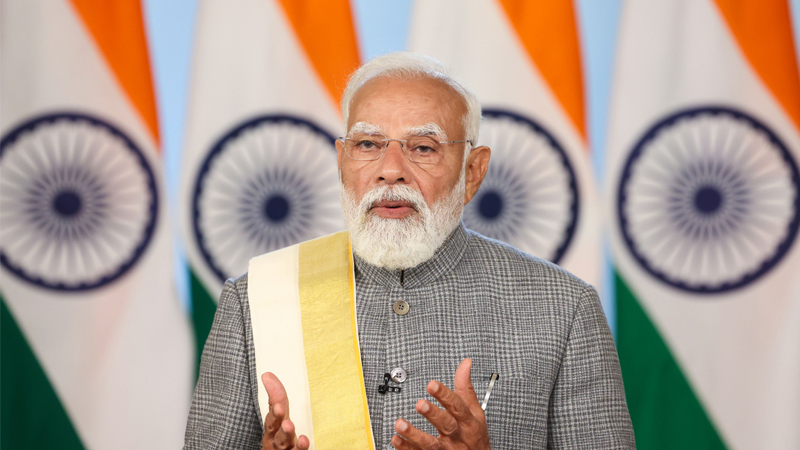
Prime Minister Shri Narendra Modi delivered his remarks during the release of Shrimad Vijayaratna Sunder Surishwarji Maharaj’s 500th book via video message today. Addressing the gathering, Shri Modi remarked that on this sacred occasion he first bows at the feet of revered Bhuwanbhanusurishwar Ji Maharaj, and paid respects to Prasantmurti Suvishal Gachchadhipati Pujya Shrimad Vijay Rajendrasurishwar Ji Maharaj, Pujya Gachchadhipati Shri Kalpatarusurishwar Ji Maharaj, Saraswati Kripapatra Param Pujya Acharya Bhagwant Shrimad Vijayaratnasundarsurishwar Ji Maharaj, and all the saints and sadhvis present at the ceremony. He acknowledged and congratulated all members of the Urja Mahotsav Committee.

The Prime Minister highlighted that today all are blessed to witness the release of the 500th book of Shrimad Vijayaratna Sundar Surishwar Ji Maharaj, who has not confined knowledge to scriptures but has demonstrated it in life. He emphasized that Maharaj’s personality is a unique blend of restraint, simplicity, and clarity, that when he writes his words carry depth of experience, when he speaks his voice carries the power of compassion, and even in silence he provides guidance. He noted that the subject of Maharaj’s 500th book, “Premnu Vishva, Vishvano Prem,” speaks volumes in itself, and expressed confidence that society, youth, and humanity will benefit from this creation. He stated that this special occasion and the Urja Mahotsav will infuse new energy of thought among people, and extended congratulations to all.

The Prime Minister remarked that Maharaj’s 500 works are like a vast ocean containing countless gems of thought, offering simple and spiritual solutions to humanity’s problems. He underlined that depending on time and circumstances, these different texts will serve as guiding lights. He highlighted that teachings of non-violence, non-possessiveness, and many-sidedness, along with love, tolerance, and harmony, as imparted by the Tirthankaras and earlier Acharyas, can be seen in modern and contemporary form in these writings. He stressed that especially today, when the world struggles with division and conflict, “Premnu Vishva, Vishvano Prem” is needed more than ever. He emphasized that this is not just a book but a mantra, introducing the power of love and showing the path to the peace and harmony the world seeks.

Shri Modi remarked that the Jain philosophy’s guiding principle is “Parasparopagraho Jivanam,” meaning every life is connected to another. He highlighted that when this principle is understood, our vision shifts from the individual to the collective, rising above personal aspirations to think of the goals of society, the nation, and humanity. He recalled that with this same spirit he had joined the Navkar Mantra Day, where all four sects had come together, and on that historic occasion he had made nine appeals, nine resolutions. He reiterated them today: the first resolution to save water, the second being Ek Ped Maa ke Naam, the third to pursue the mission of cleanliness, the fourth to be vocal for local, the fifth to embrace Bharat Darshan, the sixth to adopt natural farming, the seventh to follow a healthy lifestyle, the eighth to bring yoga and sports into life, and the ninth to commit to helping the poor.

“India today is among the youngest nations in the world, with its youth building a developed India while also strengthening cultural roots”, emphasised Shri Modi. He underlined that in this transformation, the guidance of saints like Maharaj Sahib, his literature, and his words play a vital role. The Prime Minister concluded by expressing gratitude once again and extended best wishes for Maharaj Sahib’s 500th book, stating his confidence that Maharaj’s thoughts will continue to illuminate India’s intellectual, moral, and human journey.

India’s Energy Transition Guided by ‘Vasudhaiva Kutumbakam’: Pralhad Joshi

| Published on:

Union Minister for New and Renewable Energy Shri Pralhad Joshi today delivered India’s national statement at the  16th Assembly of the International Renewable Energy Agency (IRENA) in Abu Dhabi, United Arab Emirates, reaffirming India’s strong commitment to a just, equitable, affordable and sustainable global energy transition.

Addressing the Assembly, the Union Minister stated that India’s approach to energy transition is guided by the principle of Vasudhaiva Kutumbakam- One Earth, One Family, One Future, and a long-term vision anchored in equity, inclusivity and policy stability. He reiterated India’s commitment to achieving 500 GW of non-fossil fuel installed power capacity by 2030 and Net Zero emissions by 2070.

Highlighting a major milestone, Shri Joshi informed that India has already achieved 50 per cent of its installed electricity capacity from non-fossil fuel sources in 2025, five years ahead of its Nationally Determined Contribution (NDC) target under the Paris Agreement. India’s renewable energy capacity has crossed 266 GW, placing the country among global leaders in renewable energy deployment.

The Union Minister underlined that as one of the world’s fastest-growing major energy markets, India is prioritising reliable and resilient power systems through accelerated deployment of energy storage solutions, grid modernisation, development of Green Energy Corridors and innovative bidding mechanisms such as hybrid and round-the-clock renewable energy projects. He also highlighted India’s efforts to strengthen clean energy supply chains and expand domestic manufacturing across solar, wind, batteries and electrolysers, contributing to both national self-reliance and diversified global supply chains.

Emphasising the people-centric nature of India’s energy transition, the Union Minister highlighted flagship programmes aimed at empowering households and farmers. Under the PM Surya Ghar: Muft Bijli Yojana, around 2.5 million households have benefitted from rooftop solar installations in less than two years, with a target to cover 10 million households by March 2027. Under the PM-KUSUM scheme, about 2.17 million farmers have benefitted through replacement of diesel pumps and solarisation of agricultural feeders.

The Union Minister noted that the global energy transition will require unprecedented investment and cooperation. India alone is expected to require around USD 300 billion by 2030, creating significant opportunities across renewable generation, storage, green hydrogen, grids and manufacturing. With stable policies and transparent markets, he said, India continues to remain one of the most attractive destinations for clean energy investment.

Calling for enhanced international cooperation, Shri Joshi stressed the importance of technology transfer, access to low-cost finance, capacity building and harmonisation of standards, particularly to support developing countries in scaling up renewable energy without compromising development aspirations.

Reaffirming India’s strong support for IRENA, he stated that India stands ready to share its experience, institutions and technical expertise and to work closely with all member countries, especially Least Developed Countries and Small Island Developing States, to accelerate the global renewable energy transition. Union Minister emphasised that India’s energy transition is not only about capacity addition, but about people, opportunity and a shared sustainable future.

Earlier, Union Minister Pralhad Joshi also participated in the High-Level Dialogue on “Reimagining Energy Futures: Bold Visions for Shared Prosperity” held on the sidelines of the assembly. He reaffirmed India’s commitment to a people-centric energy transition, driven by strengthened international cooperation on finance, technology and governance, with the objective of delivering shared prosperity for all. Emphasising that the energy transition must become a mass movement driven by equity and inclusion, the Minister said that India added nearly 50 GW of RE capacity in 2025.

The Union Minister congratulated the Dominican Republic on assuming the Presidency of the International Renewable Energy Agency (IRENA) and extended best wishes to the Vice Presidents, Kenya, Solomon Islands, Spain and Antigua and Barbuda, expressing confidence that their leadership will further strengthen multilateral cooperation and advance a sustainable and inclusive global energy transition.

The Union Minister also held a meeting with Dr. Amna bint Abdullah Al Dahak, Minister of Climate Change and Environment of the United Arab Emirates, to further strengthen India–UAE cooperation on climate action, clean energy and food security. During the interaction, the two sides reviewed the expanding partnership in renewable energy, investment and innovation, anchored in multiple Memoranda of Understanding signed between 2014 and 2024 and aligned with the UAE’s Net Zero 2050 goal. The discussions focused on enhancing collaboration in renewables, decentralised energy solutions, manufacturing, energy storage, technology cooperation and blended finance, with an emphasis on people-centric, scalable initiatives to enhance energy security, resilience and long-term sustainability.

About IRENA

The International Renewable Energy Agency (IRENA) is an intergovernmental organisation that supports countries in their transition to a sustainable energy future, and serves as the principal platform for international cooperation, a centre of excellence, and a repository of policy, technology, resource and financial knowledge on renewable energy.  Presently, IRENA has 170 Members (169 States and the European Union) and 14 states-in-accession. India is also one of the founder members of IRENA.

The 16th Session of the IRENA Assembly and related meetings is being held from 10 to 12 January 2026 in Abu Dhabi, United Arab Emirates. The Assembly session will focus on the theme of “Powering Humanity: Renewable Energy for Shared Prosperity. The Assembly session will gather global leaders and energy decision-makers to discuss strategies and underline necessary actions for the acceleration of renewable energy across countries, regions, and the world, driving economic inclusion, equity, and human wellbeing.

A healthy body is the foundation of strong leadership: Dr. Mansukh Mandaviya

| Published on:

Fit India’s flagship mass fitness movement, Sundays on Cycle (SoC), made a vibrant comeback in the national capital on Sunday, with more than 1000 people, including 500 Young Leaders, participating in a fitness festival, followed by a Cycle Rally, beating the 6 degree winter cold at 7 AM. The cycling rally was led by Union Minister of Youth Affairs & Sports and Labour & Employment, Dr. Mansukh Mandaviya, who was joined by tennis legend Leander Paes and Badminton legend Pullela Gopichand, along with up and coming international wrestler Shivani Pawar.

The Young Leaders from across the country who are here to participate in the four-day Viksit Bharat Young Leaders Dialogue 2026- a national platform meant to identify and promote youngsters who want to be part of public life – took centre stage as special invitees in the 56th edition of Fit India Sundays on Cycle. This edition was held across 15000 locations, with Bhopal  organising a mega event which was graced by Madhya Pradesh’s Minister of Youth Affairs and Sports, Shri Vishvas Kailash Sarang, who flagged off the cycling rally alongside actress Payal Rohatgi and a distinguished line-up of athletes, including Olympian judoka Garima Choudhary.

Speaking at the Delhi event, Dr. Mandaviya said, “A healthy body is the foundation of strong leadership. Cycling teaches us powerful leadership lessons—it tells us when to pedal fast, when to slow down, and most importantly, how to maintain balance to keep moving forward in life.”

Appreciating the Union Minister’s vision of launching the Sundays on Cycle initiative, Gopichand said, “It is motivating to see a Minister not just putting so much thought to make fitness a part of everyday life, but also leading the entire movement from the front. The fact that he himself participates in this event on Sunday morning after a hard week’s work speaks volumes about his commitment to creating a Fit India.” Echoing his sentiments, Gopichand added, “Today we have fun on our fingertips so we have forgotten to have fun in nature, to step out and be part of the outside world, so I appreciate those who have turned up here today.”

Speaking about the importance of creating community fitness campaigns such as Fit India, Leander Paes said, “No one can do fitness alone, you need to motivate each other and be part of the community because fitness is not just about having a strong body but also a fit mind which can be achieved when we participate in community events as this one. I congratulate the Union Sports Minister for creating something so unique, and the fact that this is happening parallely across the country is phenomenal.”

Adding to the festive atmosphere, the morning featured an enthusiastic Zumba session, calming yoga practices, and captivating electric Mallakhamb and rope-skipping performances by athletes, drawing loud applause from the crowd. Fit India Ambassadors Timsy Bector and Divya Ahuja joined in the fun and also shared important fitness tips for winter, stressing on the need for continued exercises and easy warm-ups at home, even for those who are aged and cannot step out of home.

In Bhopal, Sports Minister Shri. Vishvas Kailash Sarang echoed the mantra of ‘Fit India, Hit India’ given by Prime Minister Shri Narendra Modi. “I congratulate the Union Ministry of Youth Affairs and Sports and the Sports Authority of India for giving out the nationwide message of fitness through this cycling movement.”

Indian actress Payal Rohatgi, who attended the Bhopal event spoke of how an event like Fit India Sundays on Cycle is creating the much-needed awareness around fitness. “If our population imbibes this healthy lifestyle, we will get more sportspersons and Olympians in the long run. The fact that our Union Sports Minister is an avid cyclist and has consistently participated in the Sundays on Cycle event himself is incredible,” Rohatgi said.

Also present during the event were cricketer Aniket Umashankar Verma, junior hockey international Abdul Ahad, footballer Vishal Joon, canoe sprint athlete Jaspreet Singh, judokas Shraddha Kadubal Chopade, Yash Ganghas and young Pradhan Mantri Rashtriya Bal Puraskar awardee Yogita Mandavi. Their presence added sporting inspiration to an event that has steadily evolved into a people’s movement.

Indeed, the 56th edition dedicated to Young Leaders, who were joined by citizens, athletes and fitness enthusiasts, reinforces the message that physical fitness is integral to nation-building and leadership and that Fit India Sundays on Cycle has become an integral part of the Viksit Bharat journey. The Fit India Sundays on Cycle is supported by the Cycling Federation of India, Yogasana Bharat, My Bharat, Fit India Cycling Clubs as regular partners.

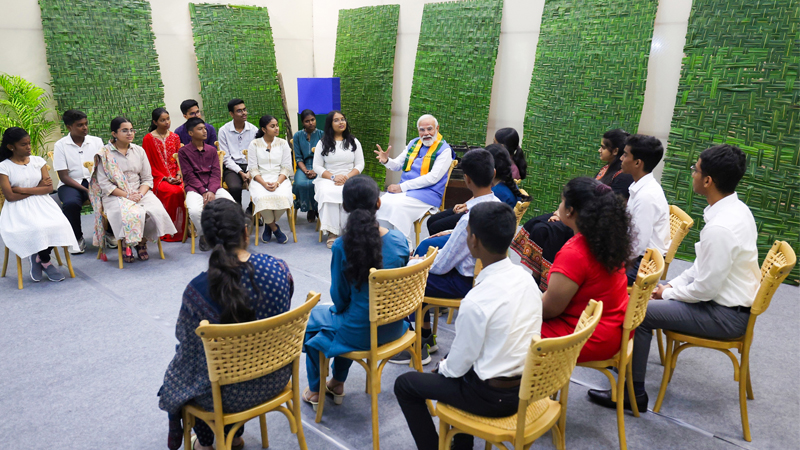
PM chairs Roundtable with Indian AI Start-Ups

| Published on:

Prime Minister Shri Narendra Modi chaired Roundtable with Indian AI Start-Ups at his residence at 7, Lok Kalyan Marg earlier today.

Ahead of the India AI Impact Summit 2026 to be held in India next month, 12 Indian AI start-ups who have qualified for the AI for ALL: Global Impact Challenge in the Summit attended the roundtable and presented their ideas and work.

These Start-ups are working in a diverse set of areas including Indian language foundation models, multilingual LLMs, speech-to-text, text-to-audio and text-to-video; 3D content using generative AI for e-commerce, marketing, and personalized content creation; engineering simulations, material research and advanced analytics for data-driven decision-making across industries; healthcare diagnostics and medical research, among others.

The AI Start-Ups commended India’s strong commitment to advancing the artificial intelligence ecosystem in the country. They highlighted the rapid growth and vast future potential of the AI sector, observing that the centre of gravity of artificial intelligence innovation and deployment is beginning to shift towards India. The leaders said that India now offers a robust and enabling environment for AI development, firmly placing the country on the global AI map.

During the meeting, Prime Minister highlighted the importance of artificial intelligence in bringing about transformation in society. He noted that India will host the India AI Impact Summit next month, through which the country will play a major role in the technology sector. He highlighted that India is making efforts to bring about a transformation with & leveraging AI.

Prime Minister emphasised that startups and AI entrepreneurs are the co-architects of India’s future and said that the country has immense capacity for both innovation and large-scale implementation. He added that India should present a unique AI model to the world that reflects the spirit of “Made in India, Made for the World.”

Prime Minister said that the world’s trust in India is the country’s biggest strength. He emphasised the need to ensure that Indian AI models are ethical, unbiased, transparent, and based on data privacy principles. He said startups should also work towards global leadership from India, and noted that India can promote affordable AI, inclusive AI, and frugal innovation globally. He also suggested that Indian AI models should be distinct and should promote local and indigenous content and regional languages.

The meeting was attended by CEOs, Heads and representatives of Indian AI start-ups including Avataar, BharatGen, Fractal, Gan, Genloop, Gnani, Intellihealth, Sarvam, Shodh AI, Soket AI, Tech Mahindra and Zenteiq. Union Minister for Electronics and Information Technology, Shri Ashwini Vaishnaw and Minister of State, Shri Jitin Prasada were also present during the meeting.

PM extends greetings to the nation on the commencement of Somnath Swabhiman Parv

| Published on:

Prime Minister Shri Narendra Modi today extended greetings to the nation on the commencement of Somnath Swabhiman Parv, recalling the timeless civilisational spirit that has kept Somnath alive in the hearts of millions for over a millennium.

Shri Modi noted that in January 1026, Somnath faced its first attack. Despite repeated assaults in subsequent centuries, the eternal faith of devotees and the civilisational resolve of Bharat ensured that Somnath was rebuilt time and again. He said, “Somnath Swabhiman Parv is about remembering the countless children of Bharat Mata who never compromised with their principles and ethos. However daunting the times were, their resolve remained unshaken and their commitment to our ethos unwavering.”

The Prime Minister shared glimpses from his previous visits to Somnath and invited citizens to join the celebration by sharing their own memories using #SomnathSwabhimanParv. He recalled the programme held on 31st October 2001, which marked 50 years since the rebuilt Somnath Temple opened its doors in 1951 in the presence of the then President Dr. Rajendra Prasad. The efforts of Sardar Vallabhbhai Patel, KM Munshi and several others were highlighted as pivotal in the temple’s reconstruction. The 2001 programme also coincided with the 125th Jayanti of Sardar Patel, and was attended by Prime Minister Atal Bihari Vajpayee, Home Minister Lal Krishna Advani, and several other dignitaries.

Looking ahead, Prime Minister Modi underscored that 2026 marks 75 years since the grand ceremony of 1951, when Somnath Temple was rededicated to the nation. He affirmed, “This milestone is not just about the temple’s reconstruction, but about the indomitable spirit of our civilisation that continues to inspire generations.”

In separate thread posts on X, Shri Modi wrote:

“Jai Somnath!

Somnath Swabhiman Parv begins today. A thousand years ago, in January 1026, Somnath faced its first ever attack. The attack of 1026 and the subsequent attacks couldn’t diminish the eternal faith of millions, nor break the civilisational spirit that rebuilt Somnath time and again.

I’m sharing some pictures from my previous visits to Somnath. If you have been there too, share them using #SomnathSwabhimanParv.”

“#SomnathSwabhimanParv is about remembering the countless children of Bharat Mata, who never compromised with their principles and ethos. However daunting the times were, their resolve remained unshaken and their commitment to our ethos unwavering.”

“Here are some glimpses of a programme held in Somnath on 31st October 2001. This was the year when we marked 50 years since the rebuilt Somnath Temple opened its doors in 1951 in the presence of the then President Dr. Rajendra Prasad. The efforts of Sardar Patel, KM Munshi and several others were noteworthy. It was also when the 125th Jayanti of Sardar Patel was being marked. The programme of 2001 was attended by then Prime Minister Atal Ji, Home Minister Advani Ji and several other dignitaries.

In 2026, we mark 75 years since the grand ceremony of 1951!”

PM receives a telephone call from Prime Minister of Israel

| Published on:

Prime Minister Shri Narendra Modi received a telephone call from the Prime Minister of Israel, H.E. Mr. Benjamin Netanyahu today.

The two leaders warmly exchanged New Year greetings and wished the people of both countries peace and prosperity.

They identified shared priorities to further strengthen the India-Israel Strategic Partnership in the year ahead, guided by shared democratic values, deep mutual trust and a forward-looking vision.

They reiterated their zero-tolerance approach towards terrorism in all its forms and manifestations and reaffirmed their commitment to fight this menace.

PM Netanyahu briefed PM on the implementation of the Gaza Peace Plan. PM reaffirmed India’s consistent support for efforts towards a just and durable peace in the region.

They also exchanged views on regional and global issues of mutual interest.

The two leaders agreed to remain in touch.

PM Invites Ideas from Students, Parents and Teachers for Pariksha Pe Charcha

| Published on:

As the Class X and XII Board Examinations approach, Prime Minister Shri Narendra Modi will once again interact with students, parents and teachers in the much-awaited annual programme, Pariksha Pe Charcha.

The Prime Minister has invited the nation’s #ExamWarriors to share their questions, ideas and experiences that can inspire others.

In a post on X, Shri Modi said:

“The Class X and XII Board Exams are approaching and so is this year’s #ParikshaPeCharcha!

Looking forward to interacting with students, parents and teachers on different aspects of exams, most notably ways to overcome exam stress, remaining calm, confident and appearing for exams with a smile.

I wish to hear from the #ExamWarriors be it their questions or their experiences which can motivate others…

https://innovateindia1.mygov.in/

Nitin Gadkari highlights agricultural waste can be converted into a valuable national resource

| Published on:

Union Minister for Road transport and Highways, Shri Gadkari Ji highlighted how agricultural waste can be converted into a valuable national resource. He noted that bio-bitumen is a transformative step towards the vision of Viksit Bharat 2047. By utilising agro-waste, it reduces pollution caused by crop burning and strengthens the circular economy. With 15% blending, India can save nearly ₹4,500 crore in foreign exchange and substantially reduce its dependence on imported crude oil.

Speaking at CSIR’s Technology Transfer Ceremony titled “From Farm Residue to Road: Bio-Bitumen via Pyrolysis,”. He says, Today marks a historic milestone in India’s road infrastructure, as the nation becomes the first in the world to commercially produce bio-bitumen. Union Minister Shri Nitin Gadkari Ji congratulated CSIR and its dedicated scientists, and thanked Union MoS Shri Jitendra Singh Ji for his constant support in achieving this pioneering breakthrough.

Shri Gadkari Ji further stated that this innovation will empower farmers, generate rural livelihoods, and boost the rural economy. Bio-bitumen, he said, truly reflects the Modi Government’s commitment to sustainable development, self-reliance, and environmentally responsible growth, paving the way for a cleaner and greener future.

Prime Minister Pays Tribute to 1000 Years of Somnath’s Resilience

| Published on:

Prime Minister Shri Narendra Modi today shared an Op-Ed marking the historic milestone of 1000 years since the first attack on Somnath in 1026 AD.

The Prime Minister emphasized that despite repeated assaults over centuries, Somnath continues to stand tall as a symbol of India’s enduring spirit. He noted that Somnath’s story is not merely about a temple, but about the unbreakable courage of countless children of Bharat Mata who safeguarded the nation’s culture and civilisation.

In separate posts on X, Shri Modi wrote:

“Jai Somnath!

2026 marks 1000 years since the first attack on Somnath took place. Despite repeated attacks subsequently, Somnath stands tall! This is because Somnath’s story is about the unbreakable courage of countless children of Bharat Mata who protected our culture and civilisation.

Here is my OpEd on this issue.

#SomnathSwabhimanParv

https://www.narendramodi.in/somnath-swabhiman-parv-a-1000-years-of-unbroken-faith-1026-2026

Uttar Pradesh Chief Minister meets Prime Minister

| Published on:

The Chief Minister of Uttar Pradesh, Shri Yogi Adityanath met the Prime Minister, Shri Narendra Modi in New Delhi today.

The PMO India handle posted on X:

“Chief Minister of Uttar Pradesh, Shri @myogiadityanath met Prime Minister @narendramodi.

@CMOfficeUP”

Lieutenant Governor of Ladakh meets Prime Minister

| Published on:

The Lieutenant Governor of Ladakh, Shri Kavinder Gupta met the Prime Minister Shri Narendra Modi today.

The PMO India handle on X wrote:

“Lieutenant Governor of Ladakh, Shri @KavinderGupta met Prime Minister @narendramodi.

@lg_ladakh”

Raksha Mantri commissions Indian Coast Guard Ship Samudra Pratap

| Published on:

Marking a major step forward in India’s pursuit of Aatmanirbharta in shipbuilding and maritime capability development, Raksha Mantri Shri Rajnath Singh commissioned Indian Coast Guard Ship (ICGS) ‘Samudra Pratap’, the first of two Pollution Control Vessels built by Goa Shipyard Limited (GSL), in Goa on January 05, 2026. With over 60% indigenous content, ICGS Samudra Pratap is India’s first indigenously designed pollution control vessel and the largest ship in the ICG fleet to date. The addition of ICGS Samudra Pratap will significantly enhance the ICG’s operational capability in pollution control, fire-fighting, maritime safety, and environmental protection. It will also strengthen its ability to conduct extended surveillance and response missions across India’s vast maritime zones.

Raksha Mantri described the vessel as an embodiment of India’s mature defence industrial ecosystem, which possesses the capability to handle complex manufacturing challenges effectively, adding that consistent efforts are being made to enhance the indigenous content in ships to 90%.

“ICGS Samudra Pratap has been specially designed for pollution control, but its role is not limited to this alone. As multiple capabilities have been integrated into a single platform, the ship will prove to be effective in coastal patrol, and strengthen maritime safety. It is a product of the modern approach adopted by the GSL to enhance flexibility and readiness to deal with present day maritime challenges,” said Shri Rajnath Singh.

Raksha Mantri commended the ICG for playing a multidimensional role – from marine pollution to coastal cleanliness, from search and rescue to maritime law enforcement. He added that, with the way the Coast Guard is fulfilling its duties, a clear message has been sent to the country’s adversaries that if they dare to cast an evil eye on India’s maritime borders or attempt any misadventure, they will be met with a bold and befitting response.

The ship is equipped with advanced pollution detection systems, dedicated pollution response boats, and modern firefighting capabilities. It also features a helicopter hangar and aviation support facilities, which can significantly increase its reach and effectiveness. Shri Rajnath Singh expressed confidence that due to these capabilities, the vessel will be able to operate stably even in rough sea conditions, providing a huge advantage in real-life operations.

Raksha Mantri termed marine environment protection as not just a strategic necessity, but a moral responsibility, amidst the challenges of climate change and global warming. He appreciated ICG for carrying out oil spill response, firefighting, and salvage operations, placing India in the category of select countries that possess advanced environmental response capabilities. “Through its quick detection, precise station-keeping, and efficient recovery systems, ICGS Samudra Pratap will further strengthen capabilities. It will ensure that pollution incidents are controlled in a timely manner, preventing damage to coral reefs, mangroves, fisheries, and marine biodiversity. This is directly linked to the sustainability of coastal communities and the blue economy,” he said.

Emphasising that a clean sea guarantees safe trade, safe lives, and a safe environment, Shri Rajnath Singh stated that platforms such as ICGS Samudra Pratap provide confidence that India not only understands its maritime responsibilities, but is fully prepared to fulfill them. He asserted that the commissioning of Samudra Pratap is linked to India’s Grand Maritime Vision. “We believe that marine resources are not the property of any one country, but a shared heritage of humanity. And when the heritage is shared, the responsibility of its protection is also shared. This is why India stands firmly on the world stage today with the principles of Peace, Stability, and Environmental Responsibility,” he said.

On the current period of Global Maritime Uncertainty, Raksha Mantri said that India has repeatedly proven that it secures not only its own interests, but also the peace and stability of the entire Indo-Pacific region. This approach makes India a Responsible Maritime Power, he added.

Shri Rajnath Singh reiterated Prime Minister Shri Narendra Modi-led Government’s commitment to continuously bolster the maritime sector, amidst the emerging technology-driven and multi-dimensional threats. “ICG cannot function solely as a reactionary force; it must emerge as a proactive force, and the Government will make every possible effort to support this endeavour. Whether it is the acquisition of new vessels, leasing of land to establish new units or matters related to manpower, we are striving to modernise the ICG in all aspects.

In a first, the ship will have two women officers. Acknowledging the ICG for rapidly moving towards an inclusive and gender-neutral work environment in line with the Government’s vision, Raksha Mantri dubbed it as a matter of pride that, today, women officers are being appointed as pilots, observers, air traffic controllers, logistics officers, and law officers, while being trained for hovercraft operations and being actively deployed in frontline ops. “Today, women are not only playing a support role, they are serving the nation as frontline warriors. The two women officers appointed to ICGS Samudra Pratap are the role models for future generations. The ICG will continue to be a source of opportunities and development for all,” he said.

Praising the self-reliance efforts of ICG, Shri Rajnath Singh said that the Government’s slogan of Aatmanirbharta has now become the way of working. “In sync with the Make-in-India and Aatmanirbhar Bharat initiatives, ICG has played a significant role in promoting indigenous assets. Today, the manufacturing, servicing, and repairing of our Coast Guard ships and aircraft are being done in India itself. It is a great achievement in itself,” he said.

To tackle present day challenges, Raksha Mantri underlined the importance for the ICG to move from a platform-centric force to the one that is intelligence-driven and integration-centric. He also pressed on the need to develop specialised career streams within the ICG in areas such as maritime law enforcement, environmental protection, and maritime cyber security.

Shri Rajnath Singh pointed out that, in recent years, the ICG established itself as a regional standard-setter, and it is, now, the time to take this role towards global leadership. “In the coming times, we will have to shape norms in the field of maritime governance, strengthen capacity-building initiatives, and promote cooperative frameworks. The ICG will have to elevate its operational doctrines, institutional practices, and technological innovations to such benchmarks that their best practices will be followed worldwide,” he said, exuding confidence that ICG will make significant contribution towards strengthening the defence sector.

Goa Chief Minister Dr Pramod Sawant, Defence Secretary Shri Rajesh Kumar Singh, Director General, ICG DG Paramesh Sivamani, Chairman & Managing Director, GSL Shri Brajesh Kumar Upadhyay, and officials of central & state governments were present on the occasion.

About ICGS Samudra Pratap

Samudra Pratap, meaning Majesty of the Seas, reflects the ICG’s resolve to ensure safe, secure, and clean seas while safeguarding the nation’s maritime interests. The ship has a displacement of 4,170 tons, length of 114.5 meters & speeds exceeding 22 knots. It is powered by two 7,500 kW diesel engines driving indigenously developed Controllable Pitch Propellers and gearboxes, offering superior manoeuvrability, flexibility and endurance of 6,000 nautical miles.

The vessel is equipped with state-of-the-art systems including side-sweeping arms, floating booms, high-capacity skimmers, portable barges, and a pollution control laboratory. The ship is also fitted with an External Fire-Fighting System (Fi-Fi Class 1) and integrates advanced systems such as Dynamic Positioning, Integrated Bridge System, Integrated Platform Management System, and Automated Power Management System to enhance automation and mission efficiency. Its armament includes a 30 mm CRN-91 gun and two 12.7 mm Stabilised Remote-Controlled Guns, supported by modern fire-control systems.

The ship will be based at Kochi under the operational control of the Commander, Coast Guard Region (West), through Coast Guard District Headquarters No. 4 (Kerala & Mahe).