India is a peace-loving nation, but it won’t spare those who cast an evil eye: Raksha Mantri

| Published on:

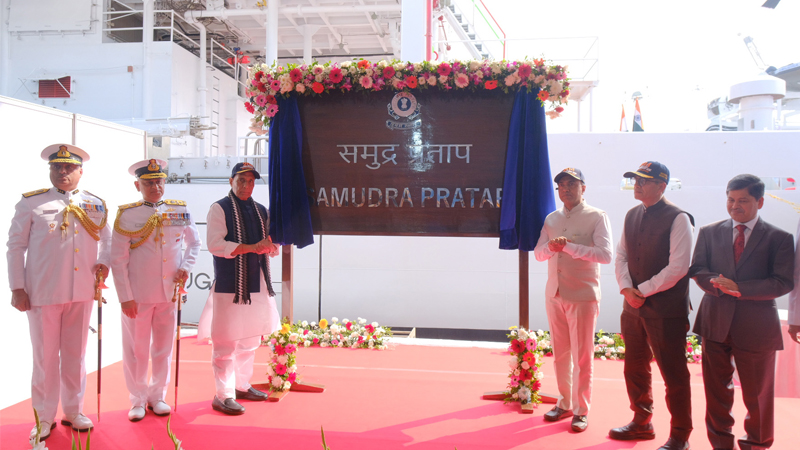
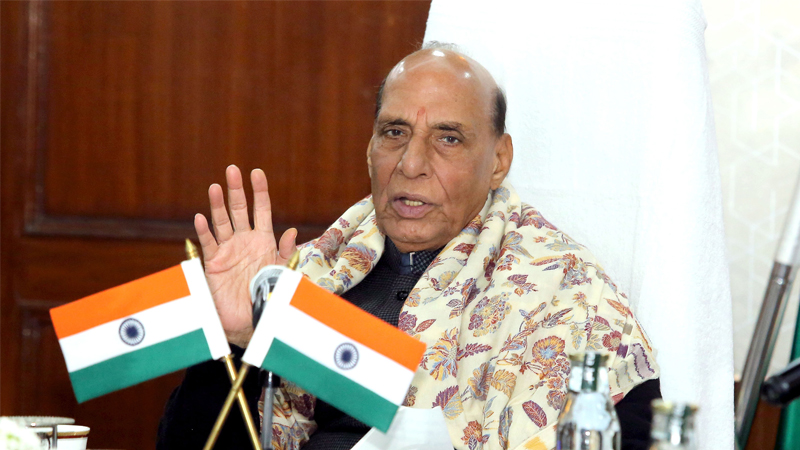
Operation Sindoor is proof that India gives a befitting reply to those who do not understand the language of peace and goodwill,” asserted Raksha Mantri Shri Rajnath Singh as he likened India’s action against terrorism to the strong will & leadership of Sardar Vallabhbhai Patel who, he said, always tried to resolve problems through dialogue, but never hesitated to choose a bold path as need so arose as in the case of the union of Hyderabad with India. Raksha Mantri was addressing Sardar Sabha in Vadodara, Gujarat on December 02, 2025, as part of the ‘Unity March’ organised by Mera Yuva (MY) Bharat under Ministry of Youth Affairs & Sports to commemorate the 150th birth anniversary of Sardar Vallabhbhai Patel.

Commending the courage and dedication of the Armed Forces for the successful execution of Operation Sindoor, Raksha Mantri said that the world is today acknowledging the bravery and capabilities of Indian soldiers. He added that the operation sent a clear message that “we’re a peace-loving nation which never provokes any country, but if provoked, does not spare those who try to cast an evil eye”.

Shri Rajnath Singh described Sardar Patel as a key contributor in uniting the nation, adding that his dream of ‘One India, Best India’ has been further strengthened under the leadership of Prime Minister Shri Narendra Modi. Referring to the abrogation of Article 370, he stated that the decision ensured the integration of Jammu & Kashmir into the country’s mainstream.

Raksha Mantri emphasised that the Government is following the path shown by Sardar Patel, as a result of which, India, once surrounded by doubts, is today communicating with the world on its own terms. He stated that, unlike the past, the world now listens to what India has to say on international platforms. “India is marching ahead towards becoming a major economic and strategic power. This is due to the immense contribution of Sardar Patel,” he added.

Voicing the Government’s unwavering resolve to safeguarding national interests ever since it came to power, Shri Rajnath Singh stated that before 2014, India was ranked 11th in the world in terms of economic size, and today, it has reached the fourth position, poised to soon join the top three economies. He added that the Government has been working with the goal of ‘Minimum Government, Maximum Governance’, while carrying forward Sardar Patel’s legacy of an independent nation through political and geographical unity. “Our government is binding India with a fabric of cultural, social, spiritual, and economic unity. We are moving forward with the vision of ‘Ek Bharat, Shreshtha Bharat’. We aim to build a Viksit Bharat by 2047,” he said.

Raksha Mantri added that the Government is carrying forward the national security vision of Sardar Patel who had emphasised on defence modernisation and indigenous production of weapons & ammunition. “Today, due to the ‘Make-in-India’ initiative, we are becoming Aatmanirbhar in defence production, while exporting military equipment to friendly countries. Our defence exports have increased nearly 34-fold in the last 11 years. We aim to achieve defence production worth Rs 3 lakh crore and defence exports worth Rs 50,000 crore by 2029,” he said.

Shri Rajnath Singh further stated that Sardar Patel’s entire life was a symbol of purity and honesty, and inspired by these high ideals, the Government aims to get the Constitution (130th Amendment) Bill 2025 passed in Parliament, which requires those in the highest positions to behave ethically against corruption. “This means that if a person in office is arrested under any serious charge and is not granted bail within 30 days, they will be automatically relieved from their post,” he said.

Raksha Mantri urged the youth to strive and realise the dream of a developed India, stating that maintaining the unity, integrity & sovereignty of the nation is a responsibility that Sardar Patel left to the future generations of the country. “It is our responsibility to keep the country and society united. We must pledge that we will not only inculcate the values of Sardar Patel with complete devotion and purity, but will also prepare future generations for them. This would be a true tribute to the legacy of Sardar Patel,” he said.

Governor of Punjab Shri Gulab Chand Kataria, Chief Minister of Uttarakhand Shri Pushkar Singh Dhami, Minister of Labour & Employment and Youth Affairs & Sports Dr Mansukh Mandaviya, Union Minister of State for Micro, Small and Medium Enterprises and Labour & Employment Smt Shobha Karandlaje and state-government officials were present on the occasion.

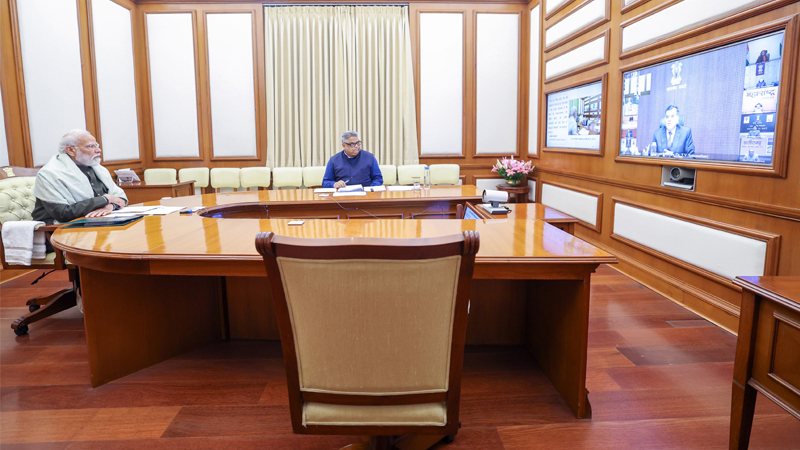
PM’s remarks during the Felicitation of Rajya Sabha Chairman Thiru C. P. Radhakrishnan

| Published on:

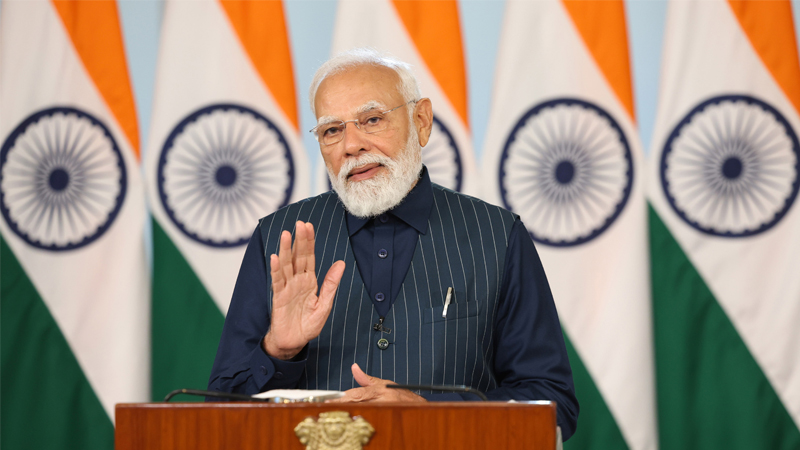
The Prime Minister, Shri Narendra Modi, welcomed the Vice President, Shri CP Radhakrishnan, as he presided over the Rajya Sabha for the first time today.  The Prime Minister described the day as a moment of pride for all Hon’ble Members of the Rajya Sabha. Extending a warm welcome to the Chairman, Shri Modi said, “On behalf of the House and on my own behalf, I extend my heartfelt congratulations to you, offer my greetings, and convey my best wishes. I also assure you that all the Hon’ble Members of this Upper House will always uphold the dignity of this esteemed institution and will remain ever mindful of maintaining your dignity as well. This is my firm assurance to you.”

Shri Modi expressed confidence that, as the Winter Session is set to deliberate on key national matters,  the Chairman’s leadership will further enrich the functioning of the Rajya Sabha.

The Prime Minister noted that Chairman Radhakrishnan, hailing from a farmer’s family, has devoted his entire life to social service. “Social service has been his constant identity. Politics was only one aspect, the spirit of service remained at the core of his life’s work,” Shri Modi said. The Prime Minister added that his longstanding commitment to public welfare serves as an inspiration for all who value service to society.

Reflecting on the Chairman’s extensive public career, the Prime Minister highlighted his achievements in transforming the Coir Board into a historically high-performing institution. He also acknowledged his dedicated service as Governor and Lieutenant Governor in Jharkhand, Maharashtra, Telangana, and Puducherry. The Prime Minister especially praised his deep engagement with tribal communities in Jharkhand, often travelling to remote villages and staying overnight in small settlements to understand people’s needs. “Your spirit of service only grew even while holding the office of Governor,” he remarked.

Sharing his personal observations from years of association, the Prime Minister said that Shri Radhakrishnan sets himself apart by rising above the constraints of protocol. “In public life, there is a special strength in living beyond protocol, and we have always seen that strength in you”, Shri Modi underscored. The Prime Minister mentioned that although Chairman Radhakrishnan was born in “Dollar City,” a place with its own strong identity, he chose to focus on the welfare of those in Dollar City who belonged to oppressed, marginalised, or underserved communities.

The Prime Minister shared that as a child, Shri CP Radhakrishnan had a near-death experience when he almost drowned in the pond at the Avinashi temple. He noted that the Chairman and his family often describe his survival as an act of divine grace. Referring to another life-threatening incident, the Prime Minister recounted the devastating bomb blast in Coimbatore that occurred shortly before Shri Lal Krishna Advani’s scheduled yatra. The blast claimed the lives of nearly 60 to 70 people, and the Chairman had narrowly escaped harm.

“These incidents, which he interprets as signs of divine intervention, strengthened his resolve to devote himself more fully to the service of society,” Shri Modi said. He added that transforming such life experiences into greater positivity and commitment reflects the Chairman’s remarkable character.

The Prime Minister shared that Chairman Radhakrishnan, during his first visit to Kashi, was deeply inspired by Maa Ganga’s blessings and took a personal vow to give up non-vegetarian food. This decision reflects his spiritual sensitivity and the inner inspiration he felt, rather than any judgment on dietary choices. “Your leadership qualities have been evident since your student life. Today, you are here to guide us all in the direction of national leadership. This is a matter of pride for all of us”, Shri Modi added.

Shri Modi recalled the Chairman’s courageous stance during the Emergency, when he confronted challenges to democracy despite limited resources, demonstrating an unwavering spirit and commitment. “Your struggle for democracy included implementing various public awareness programs. The way you inspired people has remained, and will continue to remain, a source of inspiration for all democracy enthusiasts”, Shri Modi added.

Noting his organizational acumen, the Prime Minister praised Chairman Radhakrishnan for enhancing every responsibility entrusted to him, embracing new ideas, fostering unity, and providing opportunities for younger leaders. “The people of Coimbatore elected you as their Member of Parliament, and even in the House, you consistently highlighted the development needs of your constituency, giving them due prominence before both the public and the Parliament”, Shri Modi noted.

The Prime Minister expressed confidence that Chairman Radhakrishnan’s vast experience as a parliamentarian, as Chairman of the Rajya Sabha, and now as Vice President, will serve as a guiding inspiration for the House and the nation.

PM’s remarks at the beginning of the Winter Session of 2025

| Published on:

The Prime Minister Shri Narendra Modi addressed the media before the start of the Winter Session of 2025 at the Parliament premises today. The Prime Minister emphasized that the session is not merely a ritual, but an important source of renewed energy for the nation’s ongoing journey toward rapid progress. “It is my firm belief that this session will infuse new energy into the efforts that are currently underway to accelerate the nation’s progress”, Shri Modi added.

The Prime Minister stated that India has consistently demonstrated the vibrancy and spirit of its democratic traditions. Citing the recent Bihar elections, he applauded the record voter turnout as a powerful affirmation of the nation’s democratic strength. He also highlighted the growing participation of women voters as a remarkable and encouraging trend that brings new hope and new confidence to the democratic process. He noted that as India’s democratic institutions grow stronger, the world is closely observing how this democratic framework is also reinforcing the nation’s economic capabilities. “India has proven that Democracy can deliver,” the Prime Minister affirmed. “The pace at which India’s economic conditions are reaching new heights inspires confidence and gives us new strength as we move toward the goal of a developed India”, Shri Modi underscored.

The Prime Minister urged all political parties to centre the session on national interest, constructive debate, and policy-driven outcomes. He emphasised that Parliament must remain focused on what it envisions for the nation and what it is committed to delivering. Calling upon the Opposition to fulfil its democratic responsibility, the Prime Minister encouraged them to raise meaningful and substantive issues. He cautioned parties not to allow frustration over electoral defeats to overshadow parliamentary proceedings. Underscoring that the session should not display arrogance arising from electoral victories, Shri Modi said, “The Winter Session must reflect balance, responsibility, and the dignity expected from public representatives”.

The Prime Minister highlighted the importance of informed debate, urging members to improve what is working well and offer constructive, accurate critique where needed, so that citizens are better informed. “This work is demanding, but it is essential for the nation,” he noted.

Expressing concern for first-time and younger MPs, he said many across party lines feel they are not receiving adequate opportunities to represent their constituencies or contribute to national development discussions. He urged all parties to ensure these MPs are given the platform they deserve. “The House, and the nation, must benefit from the insights and energy of the new generation,” he stated.

The Prime Minister also stressed that Parliament is a place for policy and delivery, not drama or slogan-shouting. “There is no shortage of places elsewhere for theatrics or slogans. In Parliament, our focus must be on policy, and our intent must be clear,” he said.

The Prime Minister highlighted the special significance of this session, marking the beginning of the new Hon’ble Chairman’s guidance of the Upper House. Extending his congratulations, he expressed confidence that the Chairman’s leadership would further strengthen parliamentary functioning.

The Prime Minister noted that GST reforms have created a strong atmosphere of trust among citizens, positioning them as next-generation reforms. He said the Winter Session is set to advance several important initiatives in this direction.

Expressing concern over recent parliamentary trends, Shri Modi said that in recent times, our Parliament is being used either as a warm-up ground for elections or as a place to vent frustration after electoral defeat. “The country has not accepted these methods. It is time for them to change their approach and strategy. I am even ready to offer them tips on how to perform better,” Shri Modi added.

“I hope we all move forward with these responsibilities in mind. And I assure the nation that the country has embarked on the path of progress”, Shri Modi reiterated. Affirming the nation’s determined march toward progress, he said, “The country is moving toward new heights, and this House will play a vital role in infusing new energy and strength into that journey.”

PM presides over 60th All India Conference of Director Generals/Inspector Generals of Police in Raipur

| Published on:

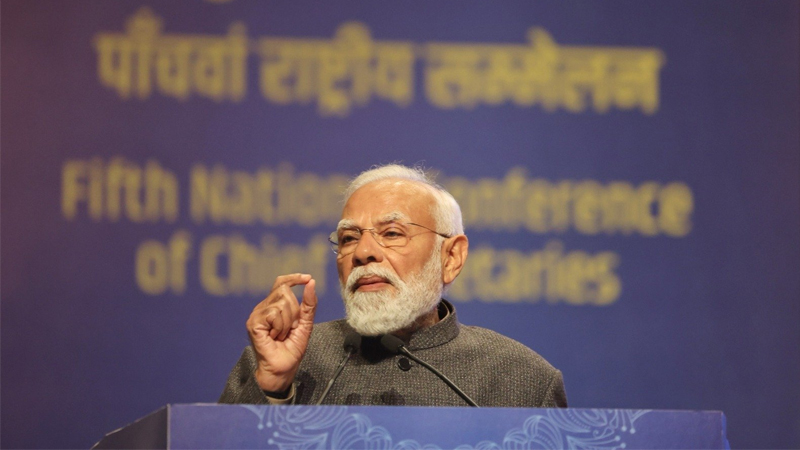
Prime Minister Shri Narendra Modi attended the 60th All India Conference of Director Generals/Inspector Generals of Police at the Indian Institute of Management, Raipur. The three-day Conference is themed ‘Viksit Bharat: Security Dimensions’.

Prime Minister stressed the urgent need to transform public perception of the police, particularly among the youth, by enhancing professionalism, sensitivity, and responsiveness. He highlighted the need to strengthen urban policing, reinvigorate tourist police, and increase public awareness regarding the newly enacted Bharatiya Nyay Sanhita, Bharatiya Sakshya Adhiniyam, and Bharatiya Nagrik Suraksha Sanhita, which replace the colonial-era criminal laws.

Prime Minister directed State and UT Police and the wider administration to adopt innovative strategies for integrating uninhabited islands, make effective use of databases integrated under NATGRID, and link these systems through Artificial Intelligence to generate actionable intelligence. He called for encouraging universities and academic institutions to undertake case studies on the use of forensics in police investigations, noting that enhanced forensic application would further strengthen the criminal justice system.

He reiterated the importance of establishing mechanisms for the regular monitoring of banned outfits, ensuring the holistic development of areas freed from Left Wing Extremism, and adopting innovative models to strengthen coastal security. The Prime Minister emphasised that tackling drug abuse requires a Whole-of-Government approach, bringing together enforcement, rehabilitation, and community-level intervention.

The Conference witnessed in-depth deliberations on a wide range of national security matters. Discussions were held on the long-term Roadmap for Policing towards Vision 2047, emerging trends in counter-terrorism and counter-radicalisation, leveraging technology to enhance women’s safety, strategies to bring back Indian fugitives based abroad, and strengthening forensic capabilities to ensure effective investigation and prosecution.

The Prime Minister underscored the need for stronger preparedness and coordination, urging Police Chiefs to reinforce mechanisms for effective disaster management covering cyclones, floods, and other natural emergencies, including the ongoing situation of Cyclone Ditwah. He emphasised that proactive planning, real-time coordination, prompt response, and a Whole-of-Government approach are essential to safeguard lives and ensure minimal disruption during such events.

In his address, the Prime Minister called upon the police leadership to realign the style of policing to meet the aspirations of a developing nation on the path to becoming a Viksit Bharat.

Prime Minister distributed the President’s Police Medals for Distinguished Service to officers of the Intelligence Bureau. He also presented awards to the three best-performing cities in urban policing, a recognition instituted for the first time to encourage innovation and improvement in urban policing.

The Conference was attended by the Union Home Minister, the National Security Advisor, Ministers of State for Home Affairs, and the Union Home Secretary. DGsP and IGsP from all States and Union Territories, as well as heads of CAPFs and Central Police Organisations, participated physically, while more than 700 officers of various ranks joined virtually from across the country.

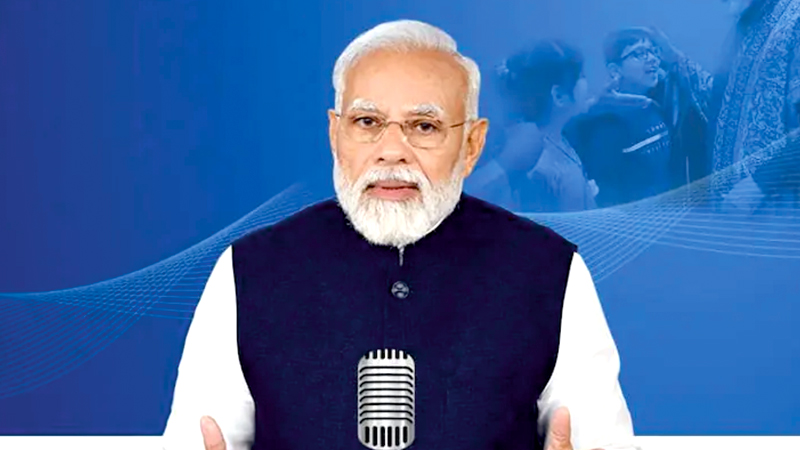
PM’s address in the 128th Episode of ‘Mann Ki Baat’

| Published on:

My dear countrymen,

Namaskar. Welcome once again to ‘Mann Ki Baat’. The month of November brought along many inspirations. Just a few days ago, on the 26th of November, a special program was organized in the Central Hall on ‘Constitution Day.’ The 150th anniversary of Vande Mataram marked a grand beginning to nationwide programs. On the25th of November, the Dharmadhwaja was hoisted at the Ram Mandir in Ayodhya. On the same day, the Panchajanya Memorial was inaugurated at Jyotisar in Kurukshetra.

Friends,

Just a few days ago, I inaugurated the world’s largest leap engine MRO facility in Hyderabad. India has taken this major step in the aircraft maintenance, repair, and overhaul sector. Last week, during a ceremony in Mumbai, INS ‘Mahe’ was inducted into the Indian Navy. Just last week, Skyroot’s Infinity Campus gave a new boost to India’s space ecosystem. This is a reflection of India’s new thinking, innovation, and youth power.

Friends,

The country has also achieved a major milestone in the agricultural sector. India has set a historic record with food grain production of 357 million tonnes. Three hundred and fifty-seven million tonnes! Compared to 10 years ago, India’s food grain production has increased by a 100 million tonnes. India has also accomplished glory in the world of sports. Just a few days ago, India was declared as the host of the Commonwealth Games. These achievements belong to the country; to her citizens. And ‘Mann Ki Baat’ is an excellent platform to celebrate such achievements of the people of the country; to bring to the fore the collective efforts of the people to the public.

Friends,

If there is dedication in the mind, faith in collective power and working as a team, and the courage to rise again after falling, success is assured in even the most difficult of tasks. Imagine the era when there were no satellites, no GPS system, no navigation facilities. Even then, our sailors used to sail in large ships and reach their destinations. Now, moving beyond the ocean, countries across the world are scaling the infinite heights of Space. The challenge is the same there too; there is no GPS system, no communication systems… so how will we move forward?

Friends,

A few days ago, a video on social media caught my attention. This video was that of a unique drone competition organized by ISRO. In this video, the youth of our country, especially our Gen-Z, were trying to fly drones in conditions similar to Mars. The drones would fly, remain balanced for a few moments, and then suddenly fall to the ground. Do you know why? Because the drones flying there had no GPS support at all. GPS is not possible on Mars, so the drones cannot receive any external signals or guidance. The drones had to fly with the help of their cameras and inbuilt software. That small drone had to recognize ground patterns, measure altitude, understand obstacles, and find a safe landing path. Therefore, the drones were falling down one after the other.

Friends,

In this competition, a team of young people from Pune achieved some success. Their drone also fell and crashed several times, but they did not give up. After several attempts, this team’s drone managed to fly for some time in the Martian environment.

Friends,

While watching this video, another scene came to my mind: the day Chandrayaan-2 went out of contact. That day, the entire country, and especially the scientists, were momentarily disappointed.

But friends, failure did not stop them. That very day they began scripting the story of Chandrayaan-3’s success. That is why, when Chandrayaan-3 successfully landed, it was not just the success of a mission. It was the success of the new confidence built after coming out of failure. I saw that same spark in the eyes of the young people seen in this video. Every time I see the dedication of our youth and the spirit of commitment of our scientists, my heart fills up with enthusiasm. This very dedication of the youth is one of the greatest strengths of Viksit Bharat.

My dear countrymen,

All of you are familiar with the sweetness of honey, but we often don’t realize how much hard work, traditions and such beautiful harmony with nature go into it.

Friends,

In the hilly areas of Jammu and Kashmir, honeybees produce a unique honey from wild basil, also known as sulai. This honey, white in colour, is called Ramban Sulai honey. A few years ago, Ramban Sulai honey received the GI tag. After that, this honey has been gaining recognition across the country.

Friends,

In Puttur, Dakshina Kannada district, the vegetation there is considered excellent for honey production. Here, a farmers’ organization named ‘Gramjanya’ is lending a new direction to this gift of nature. ‘Gramjanya’ has setup a modern processing unit… a lab, bottling, storage, and digital tracking facilities like these have been added. Now, this very honey as a branded product is reaching cities from the countryside. More than two and a half thousand farmers have benefited from this endeavour.

Friends,

An effort of an organization called ‘Shivganga Kalanjiya’ in Tumkuru district of Karnataka is also commendable. Each member is initially provided with two bee-boxes. By doing so, this organization has connected many farmers to its campaign. Now, the farmers associated with this organization jointly extract honey, package it well and deliver it to the local market. This is also earning them lakhs. A similar example is that of cliff-honey hunting in Nagaland. The Khiamni-Yangan tribe in Choklangan village of Nagaland has been engaged in honey extraction for centuries. There, bees build their dwellings not on trees but on high cliffs. Therefore, the task of honey extraction is also very risky. That’s why, the people there first speak to the bees politely, seek their permission. They tell them that they have come to collect honey, after which they extract the honey.

Friends,

Today, India is setting new records in honey production. 11 years ago, honey production in the country was 76 thousand metric tons. It has now increased to more than 1.5 lakh metric tons. Honey exports have also risen more than three-fold during the last few years. Under the Honey Mission program, Khadi Gramodyog has also distributed more than 2.25 lakh bee-boxes amongst the people. This has provided new employment opportunities to thousands of people…that is, the sweetness of the honey is increasing in myriad corners of the country. And this sweetness is also increasing the income of the farmers.

My dear countrymen,

All of us know that the battle of Mahabharata took place in Kurukshetra, Haryana. But now you can experience this battle literally, at the Mahabharata Experience Centre. The Mahabharata saga is being presented in 3D, using light and sound displays and digital techniques. When I visited Kurukshetra on the 25th of November, the experience at this Anubhav Kendra filled me up with joy.

Friends,

Attending the International Gita Mahotsav held at Brahma Sarovar in Kurukshetra was also very special for me. I was deeply impressed to see how people from all over the world are being inspired by the divine scripture, the Gita.

People from many countries around the world, including Europe and Central Asia, have participated in this festival. Earlier this month, it was the first time the Gita was performed on a public platform in Saudi Arabia. A memorable Gita Mahotsav was also held in Latvia, Europe. Artists from Latvia, Estonia, Lithuania, and Algeria participated enthusiastically in this festival.

Friends,

The spirit of peace and compassion has been paramount in India’s great culture. Imagine the Second World War, when a horrific atmosphere of destruction prevailed everywhere. During such difficult times, the great work done by Jam Saheb Maharaja Digvijay Singh ji of Nawanagar, Gujarat, continues to inspire us even today. At that time, Jam Sahib wasn’t thinking about any strategic alliance or war strategy. Rather, his concern was how Polish Jewish children were protected during the World War. He sheltered thousands of children in Gujarat and gave them a new life; which remains an example even today. A few days ago, a statue of Jam Sahib was unveiled in Moshav Nevatim in southern Israel. This was a very special honour. Last year, I had the privilege of paying my respects at Jam Sahib’s memorial in Warsaw, Poland. That moment will remain unforgettable for me.

My dear countrymen,

A few days ago, I visited Coimbatore to participate in a mega conference on natural farming. I was deeply impressed by the efforts being made in South India towards natural farming. So many young, highly qualified professionals are now adopting the field of natural farming. I spoke to farmers there and learnt about their experiences. Natural farming has been a part of India’s ancient traditions, and it is our duty to continuously promote it to protect Mother Earth.

Friends,

The confluence of the world’s oldest language and one of the world’s oldest cities is always a wonderful experience. I’m talking about the ‘Kashi Tamil Sangamam’. The fourth Kashi-Tamil Sangamam is commencing on the 2nd of December at Namo Ghat in Kashi. This year’s Kashi-Tamil Sangamam has a very interesting theme: Learn Tamil – Tamil Karkalam. The Kashi-Tamil Sangamam has become an important platform for all of those who are attached to the Tamil language. Whenever one speaks to the people of Kashi… they always say that they enjoy being a part of the Kashi-Tamil Sangamam. Here they get the opportunity to learn something new and meet new people. This time too, the people of Kashi are very eager to welcome their brothers and sisters from Tamil Nadu with full enthusiasm. I urge all of you to be a part of the Kashi-Tamil Sangamam.

Along with this, do consider other platforms as well, that strengthen the spirit of ‘Ek Bharat-Shrestha Bharat’.

Here I would like to reiterate:

Tamil Kalachaaram Uyarvanad

Tamil Moli Uyarvanad

Tamil Indiavin Perumidam |


(English Translation)

Tamil culture is great.

Tamil language is great.

Tamil is the pride of India

My dear countrymen,

Every Indian feels proud when India’s security eco-system is strengthened. Last week, INS ‘Mahe’ was inducted into the Indian Navy in Mumbai. Its indigenous design was widely discussed among some. At the same time, people in Puducherry and the Malabar Coast were delighted by its name itself. In fact, it is named ‘Mahe’ after the place Mahe, which has a rich historical heritage. Many in Kerala and Tamil Nadu noted that the warship’s crest resembles the traditional flexible sword of Urumi and Kalaripayattu. It is a matter of pride for all of us that our Navy is rapidly moving towards self-reliance. We will also be celebrating Navy Day on the 4th of December. This occasion is a special day to honor the indomitable courage and valour of our soldiers.

Friends,

For those interested in Navy-related tourism, there are many places in our country where they can learn a lot. Diu, a district near Somnath in Gujarat, is located on the western coast of the country. Diu houses the ‘Khukhri Memorial and Museum’ dedicated to ‘INS Khukri’. Goa whereas houses the ‘Naval Aviation Museum,’ a unique museum of its kind in Asia. INS Dronacharya in Fort Kochi houses the ‘Indian Naval Maritime Museum.’ Here, one can observe the maritime history of our country and the evolution of the Indian Navy.

The ‘Samudrika – Naval Marine Museum’ in Srivijayapuram, formerly known as Port Blair, is known for showcasing the rich history of the region. The Warship Museum on Rabindranath Tagore Beach in Karwar houses replicas of missiles and weapons. Also, Visakhapatnam has a submarine, helicopter, and aircraft museum associated with the Indian Navy. I urge all of you, especially those interested in military history, to make it a point to visit these museums.

My dear countrymen,

Winter has arrived, and so has the season for winter tourism. Many countries have made winter tourism a major pillar of their economy. Many countries have the world’s most successful winter festivals and winter sports models.

These countries have made experiences like skiing, snowboarding, snow trekking, ice climbing and family snow parks, part of their identity. They have also transformed their winter festivals into global attractions.

Friends,

Our country also possesses every potential for winter tourism. We have mountains, culture, and endless possibilities for adventure. I am delighted. These days, winter tourism in Uttarakhand is attracting a lot of people. Destinations like Auli, Munsyari, Chopta, and Deyara are gaining popularity during the winter season. Just a few weeks ago, the state’s first High Altitude Ultra Run Marathon was held at Adi Kailash, at an altitude of over 14,500 feet in Pithoragarh district. More than 750 athletes from 18 states across the country participated in it. The 60-kilometer-long “Adi Kailash Parikrama Run” began at 5 a.m. in the biting cold. Despite such cold, the enthusiasm of the people was palpable. While fewer than 2,000 tourists visited Adi Kailash until three years ago, this number has now increased to over 30,000.

Friends,

The Winter Games are also scheduled to be held in Uttarakhand in a few weeks. Athletes, adventure lovers, and sports enthusiasts from across the country are excited about this event.

Be it skiing or snowboarding, preparations for various snow-based sports have already begun. Uttarakhand has also focused on connectivity and infrastructure to promote winter tourism. A new policy has also been made regarding homestays.

Friends,

The ‘Wed in India’ campaign in Winters has its own pomp and craze. Whether it’s the golden winter sun or the blanket of fog descending from the mountains; the hills are also becoming very popular for destination weddings. Many weddings are now being held, especially on the banks of Ganga Ji.

Friends,

During these winter days, the Himalayan valleys become a part of an experience that lasts a lifetime. If you’re planning a trip this winter, be sure to keep the Himalayan valleys in mind.

Friends,

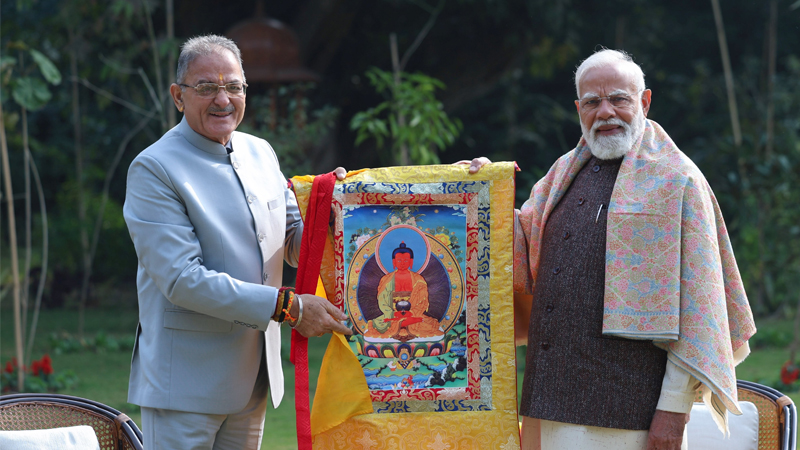
A few weeks ago, I visited Bhutan. Such trips provide opportunities for different types of interactions and discussions. During this trip, I met the King of Bhutan, the current King’s father, who has also been a King himself, the Prime Minister and others. In the course of the tour, I heard everyone mention one thing; everyone was expressing gratitude to Indians for sending Buddhist relics there… the sacred relics of Bhagwan Buddha. Whenever I heard that, my heart swelled with pride.

Friends,

Similar enthusiasm for the sacred relics of Bhagwan Buddha has been observed in many other countries. Just last month, these sacred relics were taken from the National Museum to Kalmykia, Russia. Buddhism holds special significance there. I was told that a large number of people, even from remote parts of Russia, came over to see them. The relics have also been taken to Mongolia, Vietnam, and Thailand. Huge enthusiasm has been witnessed everywhere. Even the King of Thailand visited to have Darshan. It is heartwarming to see such a deep connection to the sacred relics of Bhagwan Buddha across the world. It gives one joy to hear how such initiatives become a medium to connect people across the world.

My dear countrymen,

I always urge you all to carry forward the mantra of ‘vocal for local’. Just a few days ago, during the G-20 Summit, when it came to presenting gifts to several world leaders, I reiterated this sentiment ‘Vocal for Local’. In the gifts I presented to world leaders on behalf of my countrymen this sentiment was carefully kept in mind. During the G-20, I presented a bronze statue of Nataraja to the President of South Africa. This is a wonderful example of Chola-era craftsmanship, rooted in the cultural heritage of Thanjavur, Tamil Nadu.

The Prime Minister of Canada was presented with a silver horse replica. It showcases the exquisite craftsmanship of Udaipur, Rajasthan. The Prime Minister of Japan was presented with a silver Buddha replica. It showcases the intricacies of the renowned silver crafts of Telangana and Karimnagar. The Prime Minister of Italy was gifted a silver mirror with floral motifs. This also showcases the traditional metal craftsmanship of Karimnagar. I presented the Prime Minister of Australia with a brass urli, an exquisite craft from Mannar, Kerala. My aim was to make the world aware of Indian crafts, art, and traditions, and to provide a global platform to the talent of our artisans.

Friends,

I am happy that millions of people in the country have made the spirit of ‘vocal for local’ a part of their lives. This year, when you went to the market for festive shopping, you must have noticed one thing. People’s preferences, and the goods brought into their homes, clearly indicated that the country was returning to Swadeshi. People were willingly choosing Indian products. Even the minor most shopkeeper felt this change. This time, the youth also gave a boost to the ‘vocal for local’ campaign. A new round of shopping is about to begin in the coming days for Christmas and New Year.

I will remind you again, remember the mantra of ‘vocal for local’, buy only what is made in the country, sell only what bears the hard work by a citizen of the country.

My dear countrymen,

This month has been a super hit in terms of sports in India. This month began with the Indian women’s team winning the ICC Women’s World Cup. But even after that, more action has been seen on the field. Just a few days ago, the Deaf Olympics were held in Tokyo, where India won 20 medals, giving its best performance till date. Our women players also created history by winning the Kabaddi World Cup. Their excellent performance throughout the tournament won the hearts of every Indian. Our players also performed brilliantly in the World Boxing Cup Finals, where they won 20 medals. Friends, what’s being discussed even more is our women’s team winning the Blind Cricket World Cup. The remarkable thing is that our team won this tournament without losing a single match. The countrymen are very proud of every player of this team. Just two days ago, I met this team at the Prime Minister’s residence. Truly, this team’s courage and passion teaches us a lot. This victory is one of the greatest victories in our sports history, which will continue to inspire every Indian.

Friends,

Nowadays a new sporting culture of Endurance Sports is also rapidly emerging in our country. By Endurance Sports, I mean sports activities that test your limits. Until a few years ago, special events like Marathon and Bikethon were limited to a select few. But now, a lot has changed. I’ve been told that more than 1,500 endurance sports events are held across the country every month. Athletes travel far and wide to participate in these events.

Friends,

An example of endurance sports itself is the Ironman Triathlon. Imagine this! If you were told you had less than a day and you had to complete these three tasks: swim 4 kilometers in the ocean, cycle 180 kilometers, and run a marathon of approximately 42 kilometers, you might wonder how this would be possible. But people with a steely resolve successfully pull this off too. That’s why it’s called the Ironman Triathlon.

A similar event was recently held in Goa. Nowadays, people are actively participating in such events. There are many other competitions that are becoming very popular among our young friends. Many people are coming together to participate in programs like Fit India Sundays on Cycle. These are all ways to promote fitness.

Friends,

Meeting you every month is always a new experience for me. Your stories, your efforts, inspire me anew. The suggestions and experiences you share in your messages inspire us to incorporate India’s diversity into this program. When we meet next month, 2025 would be coming to an end. The cold will now intensify in most parts of the country. Please take special care of yourself and your family during the winter. Next month, we will definitely discuss some new topics and new personalities. Thank you very much. Namaskar.

Dr. Jitendra Singh Highlights India’s Strengthened Disaster Preparedness 

| Published on:

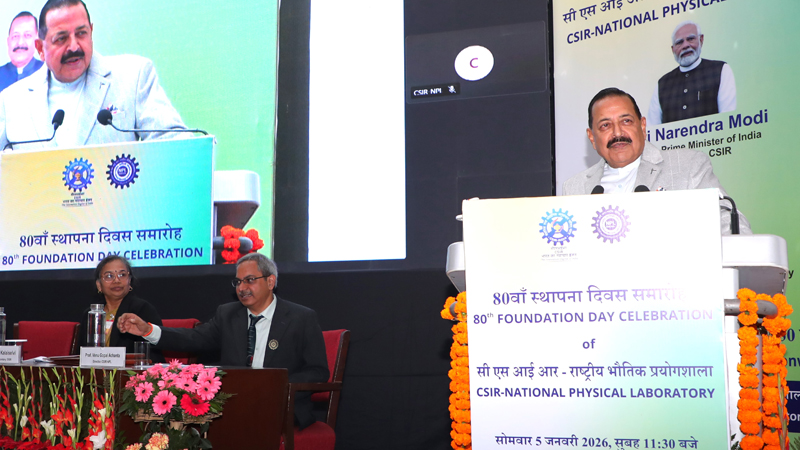
Union Minister of State (Independent Charge) for Science & Technology; Minister of State for Earth Sciences; and MoS PMO, Personnel, Public Grievances, Pensions, Atomic Energy and Space, Dr. Jitendra Singh announced here that in Uttarakhand, while three Weather Radars have already been installed at Surkanda Devi, Mukteshwar and Lansdowne, three more radars will soon be commissioned at Haridwar, Pantnagar and Auli, thus further strengthening real-time forecasting capability for the region.

Addressing the “World Summit on Disaster Management”, the Earth Sciences Minister described Uttarakhand as the most natural and appropriate venue for a global discussion on disaster resilience given its lived experiences, geographical sensitivities, and Himalayan ecosystem.

The summit was graced by Uttarakhand Chief Minister Shri Pushkar Singh Dhami, Member of Parliament Shri Naresh Bansal, NDMA Member Shri Agarwal, Secretary, Science and Technology Shri Nitish Kumar Jha, Chairman of Graphic Era University Prof. Kamal Ghanshala, DG Shri Durgesh Pant, SDMA Vice Chairman Shri Rohila, along with faculty, experts, and students.

Speaking on the occasion, Dr. Jitendra Singh said that Uttarakhand’s journey over the past 25 years, coinciding with its Silver Jubilee celebrations, has given the State a distinct identity in disaster response and governance. He recalled that the successful Silkyara Tunnel rescue operation, completed exactly two years ago, will remain a historic benchmark in global disaster management literature. He noted that future research on Himalayan disasters will invariably refer to Uttarakhand and to the leadership displayed by Chief Minister Pushkar Singh Dhami during critical moments. He emphasised that organising a global summit of this scale in a State that has both cultural richness and acute vulnerability gives the event profound symbolic significance.

The Minister highlighted that hydrometeorological hazards in Uttarakhand have risen sharply over the past decade, with the 2013 Kedarnath cloudburst and the 2021 Chamoli disaster marking decisive turning points. He said that scientific analyses point to a combination of climate change impacts, rapidly retreating glaciers, glacier-lake outburst risks, the fragile Himalayan Mountain system, deforestation, and man-made encroachments that obstruct natural drainage paths. He added that terms like “cloudburst” and “flash flood”, which were rarely used twenty-five years ago, have now become part of everyday vocabulary because of the growing frequency of such extreme events.

Dr. Jitendra Singh elaborated that the Government of India has significantly expanded Uttarakhand’s meteorological and disaster-monitoring infrastructure over the last ten years. He informed that 33 meteorological observatories, a network of radio-sonde and radio-wind systems, 142 automatic weather stations, 107 rain gauges, district-level and block-level rainfall monitoring systems, and extensive app-based outreach programmes for farmers have been established to improve early warning dissemination. He said that three weather radars have already been installed at Surkanda Devi, Mukteshwar and Lansdowne, and announced that three more radars will soon be commissioned at Haridwar, Pantnagar and Auli, further strengthening real-time forecasting capability for the region.

The Minister stated that India has initiated a specialised Himalayan climate study programme to analyse the conditions that trigger sudden cloudbursts, with the objective of generating predictive indicators for vulnerable districts. He mentioned that the “Nowcast” system, which provides a three-hour forecast and has been successfully used in major metros, is now being expanded across Uttarakhand to provide timely alerts to administrations and communities. He also highlighted the coordinated efforts of NDMA, the Ministry of Earth Sciences and several scientific institutions in developing advanced forest fire weather services, describing it as a whole-of-government and whole-of-science model for climate resilience.

Expressing concern over the lack of compliance in some regions with IMD alerts, Dr. Jitendra Singh highlighted the need for stricter administrative response. He recalled a recent incident in Jammu & Kashmir where a newly appointed IAS officer prevented a major tragedy by immediately shutting down the highway following a red alert issued by IMD, demonstrating how timely action can save lives. He said that land-use regulations issued jointly by NDMA, the Ministry of Environment and the Urban Development bodies must be implemented with absolute seriousness to prevent long-term ecological and infrastructural damage. He also warned that illegal mining along riverbeds and near newly constructed highways is becoming a dangerous man-made threat, eroding foundations and amplifying flash flood impacts, and urged communities to recognise that short-term gains often lead to long-term destruction.

Dr. Jitendra Singh also spoke about transforming Himalayan strengths into economic opportunity through agri-startups and CSIR-led value-addition models. Sharing successful experiences from Jammu & Kashmir, he said that several young professionals, including B.Tech and MBA graduates, have left private sector jobs to join CSIR-supported enterprises because of higher incomes and better market linkages. He urged CSIR to work closely with the Uttarakhand Government to replicate these proven livelihood models, which combine science, entrepreneurship, and local resource utilisation.

Highlighting India’s growing global role in disaster resilience, Dr. Jitendra Singh noted that India is increasingly offering its technical expertise and services to neighbouring countries. He recalled Prime Minister Shri Narendra Modi’s commitment at COP-26 to achieving Net Zero by 2070, and emphasised that disaster preparedness, climate adaptation, and early warning systems are integral to sustainable economic growth. Preventing economic loss, he said, is as important as generating new economic value, and disaster mitigation must therefore be seen as an economic as well as humanitarian priority.

Dr. Jitendra Singh congratulated Chief Minister Pushkar Singh Dhami, and all organisers for convening the World Summit on Disaster Management. He said the discussions and insights emerging from Uttarakhand will meaningfully contribute to the global narrative on disaster mitigation, climate adaptation, and resilient development, and reaffirmed the Government of India’s commitment to strengthening scientific capacity, forecasting accuracy and inter-agency coordination for vulnerable Himalayan regions.


PM addresses the 550th-year celebration of the Shree Samsthan Gokarn Partagali Jeevottam Math in Goa

| Published on:

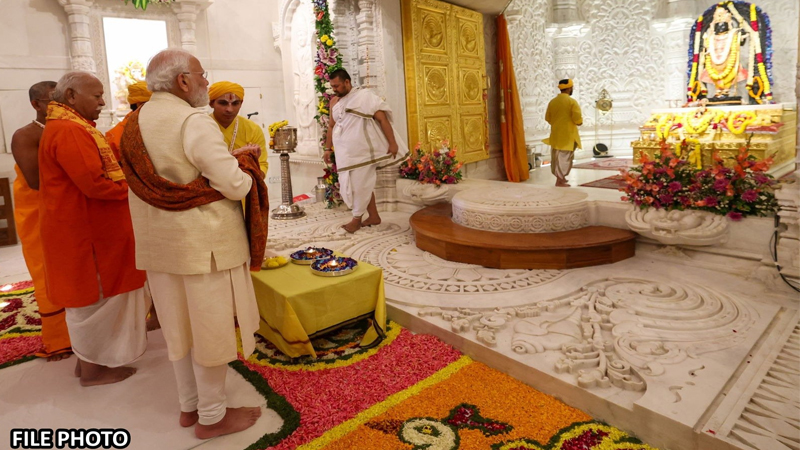
Prime Minister Shri Narendra Modi addressed the 550th-year celebration of the Shree Samsthan Gokarn Partagali Jeevottam Math in Goa today. Prime Minister remarked that on this sacred occasion his mind is filled with deep peace. He highlighted that sitting in the presence of saints is in itself a spiritual experience. Noting that the large number of devotees present here is further enhancing the centuries-old living strength of this Math, Shri Modi stated that he considers himself fortunate to be present among the people in this ceremony today. He mentioned that before coming here, he had the privilege of visiting the Ram Mandir and Veer Vitthal Mandir. He remarked that the peace and atmosphere there have deepened the spirituality of this ceremony.

“Shri Sansthan Gokarna Partagali Jeevottam Math is celebrating its 550th anniversary, a very historic occasion. In the past 550 years the institution has faced many upheavals, with changing eras, changing times, and numerous transformations in the country and society, yet the Math never lost its direction. Instead, the Math emerged as a guiding center for people, and its greatest identity is that while rooted in history, it has continued to move with the times”, remarked Shri Modi. He noted that the spirit with which the Math was established remains equally vibrant today, a spirit that connects sadhana with service and tradition with public welfare. The Prime Minister remarked that generation after generation, the Math has conveyed the understanding that the true purpose of spirituality is to provide stability, balance, and values to life. He emphasized that the 550-year journey of the Math is proof of the strength that sustains society even in difficult times. He extended his greetings on this historic occasion to the Mathadhipati Shrimad Vidyadhish Tirth Swamiji, all members of the committee, and every individual associated with the celebration.

Prime Minister Shri Modi remarked that when an institution stands on the foundation of truth and service, it does not waver with the changes of time but instead gives society the strength to endure. He highlighted that today, continuing this tradition, the Math is writing a new chapter. He noted that a grand 77-feet tall bronze statue of Lord Shri Ram has been installed here. He mentioned that just three days ago he had the privilege of hoisting the Dharma Dhwaja atop the magnificent Shri Ram Janmabhoomi Mandir in Ayodhya, and today he has the good fortune of unveiling the grand statue of Lord Shri Ram here. He further remarked that on this occasion a theme park based on the Ramayana has also been inaugurated.

Emphasising that the new dimensions associated with this Math are going to become permanent centers of knowledge, inspiration, and spiritual practice for future generations, the Prime Minister highlighted that the museum being developed here and the 3D theatre equipped with modern technology are preserving the tradition of the Math while connecting the new generation with its heritage. He noted that similarly, the Shri Ram Naam Jap Yajna and the Ram Rath Yatra, conducted over 550 days with the participation of millions of devotees across the country, have become symbols of collective energy of devotion and discipline in society. He emphasized that this collective energy is today spreading a new consciousness in every corner of the nation.

Prime Minister stated that the arrangements connecting spirituality with modern technology will continue to inspire future generations. He congratulated everyone for this construction. He highlighted that in this grand celebration, commemorative coins and postage stamps have also been released as symbols of this special occasion, dedicated to the spiritual power that has united society for centuries.

Highlighting that the continuous flow of strength to this Math has come from the great Guru tradition which established the divine foundation of Dvaita Vedanta, Shri Modi recalled that this Math, established in 1475 by Shrimad Narayan Tirth Swamiji, is an extension of that knowledge tradition whose original source is the unique Acharya, Jagadguru Shri Madhvacharya. He bowed in reverence to these Acharyas. He emphasized that it is also very significant that Udupi and Partagali are living streams of the same spiritual river, and that the Guru-shakti guiding the cultural flow of India’s western coast is the same. He remarked that for him it is a special coincidence to have had the privilege of participating in two programmes connected with this tradition on the same day.

Underlining it is a matter of pride that families associated with this tradition have, generation after generation, made discipline, knowledge, hard work, and excellence the foundation of their lives, Shri Modi highlighted that from trade to finance, and from education to technology, the talent, leadership, and dedication visible in them bears the deep imprint of this life vision. He noted that there are many inspiring stories of success among families and individuals connected with this tradition, and the roots of all these successes lie in humility, values, and service. Emphasizing that this Math has been the cornerstone in preserving these values, the Prime Minister expressed confidence that it will continue to energize future generations.

Highlighting another important feature of the historic Math – the spirit of service which has supported every section of society for centuries, Shri Modi recalled that centuries ago, when adverse circumstances struck this region and people had to leave their homes and seek refuge in new places, it was this Math that gave the community support, organized them, and established temples, monasteries, and shelters in new locations. Shri Modi stated that the Math protected not only religion but also humanity and culture, and over time its stream of service expanded further. He highlighted that today, from education to hostels, from elderly care to assistance for needy families, the Math has always dedicated its resources to public welfare. He noted that whether it is hostels built in different states, modern schools, or relief work during difficult times, every initiative is proof that when spirituality and service walk together, society gains both stability and inspiration to move forward.

Prime Minister remarked that there were times when temples and local traditions in Goa faced crises, and when language and cultural identity came under pressure, yet these circumstances did not weaken the soul of society but made it stronger. He highlighted that the unique feature of Goa is that its culture has preserved its original essence through every change and has also rejuvenated itself with time, with institutions like the Partagali Math playing a major role in this.

“Today India is witnessing a remarkable cultural renaissance, with the restoration of the Ram Mandir in Ayodhya, the grand redevelopment of Kashi Vishwanath Dham, and the expansion of Mahakal Mahalok in Ujjain, all reflecting the nation’s awareness that is reviving its spiritual heritage with new strength”, exclaimed Shri Modi. He noted that initiatives such as the Ramayana Circuit, Krishna Circuit, development works at Gaya Ji, and the unprecedented management of the Kumbh Mela are examples that show how today’s India is advancing its cultural identity with new resolve and confidence. He emphasized that this awakening inspires future generations to remain connected to their roots.

Underscoring that the sacred land of Goa has its own distinct spiritual identity, with a continuous flow of devotion, saintly tradition, and cultural practice for centuries, Shri Modi said that this land, along with its natural beauty, also carries the identity of ‘Dakshin Kashi,’ which has been further deepened by the Partagali Math. He stated that the Math’s connection is not limited to Konkan and Goa, but its tradition is linked to various parts of the country and also to the holy land of Varanasi. He noted with pride, as the Member of Parliament from Varanasi, that Acharya Shri Narayan Tirth, the founder, established a center in Varanasi during his travels in North India, thereby extending the spiritual stream of the Math from South to North. He remarked that even today the center established in Varanasi continues to serve society.

Emphasizing that as this sacred Math completes 550 years, Shri Modi said, we are not only celebrating history but also determining the direction of the future. He stated that the path to a developed India goes through unity, and when society comes together, when every region and every section stands united, the nation makes great leaps. PM underlined that the primary mission of Shri Sansthan Gokarna Partagali Jeevottam Math is to connect people, connect minds, and build a bridge between tradition and modernity, and therefore in the journey of a developed India, this Math plays the role of a major inspiration center.

Shri Modi remarked that wherever he has affection, he respectfully makes certain requests. He stated that as he has come among the people today, some thoughts naturally arise in his mind which he wishes to share. He highlighted that he wants to place nine appeals before them which, through their institution, can be conveyed to every citizen. He emphasized that these appeals are like nine resolutions. Shri Modi noted that the dream of a developed India will be fulfilled only when we consider the protection of the environment as our duty, as the earth is our mother and the teachings of the Math guide us to respect nature. He remarked that therefore the first resolution should be to conserve water, save water, and protect rivers. He stated that the second resolution should be to plant trees, highlighting that the nationwide campaign of “Ek Ped Maa ke Naam” is gaining momentum, and if the strength of this institution joins it, the impact will be even wider. He emphasized that the third resolution should be the mission of cleanliness, ensuring that every street, neighborhood, and city remains clean. Underlining that the fourth resolution should be to adopt Swadeshi, the Prime Minister noted that today India is moving forward with the mantra of Atmanirbhar Bharat and Swadeshi, and the country is saying “Vocal for Local,” a resolve that we too must carry forward.

Speaking about the fifth resolution, Shri Modi said it should be ‘Desh Darshan’, encouraging everyone to make efforts to know and understand different parts of the country. He highlighted that the sixth resolution should be to make natural farming a part of life. He stated that the seventh resolution should be to adopt a healthy lifestyle, to embrace ‘Shri Anna’–Millets and reduce oil consumption in food by 10 percent. He emphasized that the eighth resolution should be to adopt yoga and sports, and the ninth resolution should be to assist the poor in some form.

Prime Minister noted that the Math can transform these resolutions into collective public commitments. He remarked that the 550 years of experience of this Math teaches us that tradition keeps society moving forward only when it expands its responsibilities with time, and the energy the Math has given society over centuries must now be directed towards building the India of the future.

Highlighting that the spiritual glory of Goa is as distinctive as its modern development, the Prime Minister stated that Goa is among the states with the highest per capita income and contributes significantly to tourism, pharma, and the service sector. He noted that in recent years Goa has achieved new milestones in education and health, and that the central and state governments together are modernizing its infrastructure. He remarked that the expansion of highways, airports, and rail connectivity has made travel easier for both devotees and tourists. He emphasized that in the national vision of a developed India by 2047, tourism is a major component, and Goa stands as the finest example of this.

“India is passing through a decisive phase, where the strength of the youth, the nation’s growing self-confidence, and its inclination towards cultural roots are together shaping a new India”, emphasised the Prime Minister. He highlighted that the resolve of a developed India will be fulfilled only when spirituality, national service, and development move forward together. Concluding his address, Shri Modi stated that the sacred land of Goa and this Math are making an important contribution in this direction. He extended his heartfelt greetings once again to everyone on this sacred occasion.

Governor of Goa, Shri Pusapati Ashok Gajapathi Raju, Chief Minister of Goa, Dr. Pramod Sawant, Union Minister Shri Shripad Naik were present among other dignitaries at the event.

Background

On the occasion of ‘Sardha Panchashatamanotsava’, the 550th-year celebration of the Shree Samsthan Gokarn Partagali Jeevottam Math,  Prime Minister visited Math at Canacona, South Goa.

Prime Minister unveiled a 77 feet statue of Prabhu Shri Ram, made up of bronze at Shree Samsthan Gokarn Partagali Jeevottam Math and will also inaugurate ‘Ramayana Theme Park Garden’ developed by the Math.  Prime Minister also released the special postal stamp and a commemorative coin.

Shree Samsthan Gokarn Partagali Jeevottam Math is the first Gowd Saraswat Brahmin Vaishnava Math. It follows the Dvaita order, a system established by Jagadguru Madhvacharya in the 13th century AD. The Math is headquartered in Partagali, a small town in South Goa, on the banks of the river Kushavati.

PM addresses the Laksha Kantha Gita Parayana programme at Sri Krishna Matha in Udupi, Karnataka

| Published on:

Prime Minister Shri Narendra Modi addressed the Laksha Kantha Gita Parayana programme at Sri Krishna Matha in Udupi, Karnataka today. Speaking on the occasion, Prime Minister remarked that the satisfaction of the divine darshan of Lord Shri Krishna, the spiritual experience of the mantras of the Shrimad Bhagavad Gita, and the presence of so many revered saints and gurus is for him a supreme fortune. He highlighted that it is akin to attaining countless blessings.

Recalling that just three days ago he was on the land of Kurukshetra, the land of the Gita, Shri Modi said, today coming to this land blessed by Lord Shri Krishna and graced by the glory of Jagadguru Shri Madhvacharya Ji is for him an occasion of supreme contentment. He noted that on this occasion, when one lakh people recited the shlokas of the Bhagavad Gita together, people across the world witnessed the living divinity of India’s millennia-old spiritual heritage.

Prime Minister remarked that coming to the land of Karnataka and being among the affectionate people here always gives him a unique experience. Highlighting that visiting the sacred land of Udupi is always extraordinary, he  noted that though he was born in Gujarat, there has always been a deep and special connection between Gujarat and Udupi. Shri Modi recalled the belief that the idol of Lord Shri Krishna established here was earlier worshipped in Dwarka by Mata Rukmini, and later Jagadguru Shri Madhvacharya consecrated this idol in Udupi. He mentioned that just last year he had the divine experience of visiting Shri Dwarka Ji beneath the sea. He remarked that one can imagine the profound feeling he experienced upon having darshan of this idol, and stated that this darshan gave him immense spiritual joy.

Highlighting coming to Udupi is special for him for another reason, Shri Modi underlined that Udupi has been the karmabhoomi of the governance model of Jan Sangh and the Bharatiya Janata Party. He recalled that in 1968, the people of Udupi elected Jan Sangh’s V.S. Acharya to the municipal council, and with this Udupi laid the foundation of a new governance model. He noted that the cleanliness campaign which today is seen at the national level was adopted by Udupi five decades ago. He highlighted that whether it was providing a new model of water supply and drainage systems, Udupi had initiated such programmes in the 1970s. He remarked that today these campaigns have become part of national development and national priority, guiding the country forward.

Recalling the words from Ramcharitmanas, Shri Modi said, “In Kalyug, only through the chanting of the Lord’s name one attains liberation from the ocean of worldly existence”. He highlighted that in society, the recitation of mantras and the shlokas of the Gita has been happening for centuries, but when one lakh voices together recite these shlokas in unison, it creates a unique experience. The Prime Minister further noted that when so many people recite a sacred text like the Gita, when such divine words resonate together at one place, a special energy emerges that gives the mind and intellect a new vibration and a new strength. He remarked that this energy is the power of spirituality and also the power of social unity. He stated that today’s occasion of one lakh voices reciting the Gita has become an opportunity to experience a vast energy field and is also showing the world the strength of collective consciousness.

Remarking that on this day he especially bows to Param Pujya Shri Shri Sugunendra Tirtha Swamiji, who has divinely manifested the idea of Laksha Kantha Gita, the Prime Minister highlighted that by inspiring people across the world to write the Gita in their own hand, Swamiji has initiated the Koti Gita Lekhana Yajna, which has become a global mass movement of the Sanatan tradition. Shri Modi noted that the way India’s youth is connecting with the sentiments and teachings of the Bhagavad Gita is in itself a very significant development. He recalled that for centuries in India, the tradition has been to pass on the knowledge of the Vedas, Upanishads, and Shastras to the next generation, and remarked that this programme too has become a meaningful effort to connect the next generation with the Bhagavad Gita.

Informing that three days before coming here, he had also visited Ayodhya, Shri Modi highlighted that on 25th November, the auspicious day of Vivaha Panchami, the Dharma Dhwaja was established at the Shri Ram Janmabhoomi temple in Ayodhya. He noted that from Ayodhya to Udupi, countless devotees of Lord Ram have witnessed this most divine and grand celebration. He stated that the entire nation knows the significant role Udupi has played in the Ram Mandir movement. He recalled that decades ago, Param Pujya late Vishwesh Tirtha Swamiji gave direction to the entire movement, and the Dhwajarohan ceremony has become a festival marking the fruition of that contribution. He highlighted that for Udupi, the construction of the Ram Mandir is special for another reason, as in the new temple a grand gate has been built in the name of Jagadguru Madhvacharya Ji. He noted that Jagadguru Madhvacharya Ji, an ardent devotee of Lord Ram, had written a verse meaning Lord Shri Ram is adorned with six divine qualities, is the Supreme Lord, and is an ocean of immense strength and courage. He remarked that therefore, having a gate in the Ram Mandir complex named after him is a matter of great pride for the people of Udupi, Karnataka, and the entire nation.

Underscoring that Jagadguru Shri Madhvacharya is the pioneer of India’s Dvaita philosophy and a shining light of Vedanta, the Prime Minister highlighted that the system of Udupi’s Ashta Mathas created by him is a living example of institution building and the creation of new traditions. He noted that here there is devotion to Lord Shri Krishna, knowledge of Vedanta, and the resolve of serving food to thousands of people. He stated that in a way this place is a sacred confluence of knowledge, devotion, and service.

Shri Modi recalled that during the period when Jagadguru Madhvacharya was born, India was facing many internal and external challenges, and at that time he showed a path of devotion that could connect every section of society and every belief. He remarked that due to this guidance, even after centuries the Mathas established by him continue to serve millions of people every day. He highlighted that inspired by him, many great figures emerged in the Dvaita tradition who always advanced the work of dharma, service, and nation building. He stated that this eternal tradition of public service is the greatest heritage of Udupi.

Noting that the tradition of Jagadguru Madhvacharya gave energy to the Haridasa tradition, the Prime Minister highlighted that great saints like Purandar Das and Kanak Das brought devotion in simple, melodious, and accessible Kannada language to the masses. He noted that their compositions reached every heart, even the poorest sections of society, and connected them with dharma and Sanatan values, and these compositions remain equally relevant for today’s generation. He observed that even now, when the youth listen to Purandar Das’s composition “Chandrachooda Shiva Shankara Parvati” on social media reels, they are transported to a different spiritual emotion. The Prime Minister remarked that even today, when a devotee like him in Udupi has darshan of Lord Shri Krishna through a small window, it becomes an opportunity to connect with the devotion of Kanak Das. He stated that he feels very fortunate to have had the privilege of bowing to Kanak Das both today and earlier.

Highlighting that the teachings of Lord Shri Krishna are practical in every age, and the words of the Gita guide not only individuals but also the policies of the nation, Shri Modi recalled that in the Bhagavad Gita, Shri Krishna spoke of how we should work for the welfare of all. He remarked that throughout his life, Jagadguru Madhvacharya carried these sentiments and strengthened the unity of India.

Underscoring that behind the policies of Sabka Saath, Sabka Vikas, Sarvajan Hitaya, Sarvajan Sukhaya lies the inspiration of Lord Shri Krishna’s shlokas, Shri Modi highlighted that Lord Shri Krishna gives the mantra of helping the poor, and this very inspiration forms the basis of schemes like Ayushman Bharat and PM Awas. He stated that Lord Shri Krishna imparts the knowledge of women’s safety and empowerment, and it is this wisdom that inspired the nation to take the historic decision of the Nari Shakti Vandan Adhiniyam. He further remarked that Lord Shri Krishna teaches the principle of welfare for all, and this principle underpins India’s policies such as Vaccine Maitri, the Solar Alliance, and Vasudhaiva Kutumbakam.

Prime Minister Shri Modi remarked that Lord Shri Krishna delivered the message of the Gita on the battlefield and highlighted that the Bhagavad Gita teaches us that to establish peace and truth, the end of oppressors is also necessary. He stated that this is the core sentiment of the nation’s security policy. He noted that India speaks of Vasudhaiva Kutumbakam and also reiterates the mantra ‘Dharmo Rakshati Rakshitah’. He remarked that from the Red Fort, the message of Shri Krishna’s compassion is conveyed, and from the same ramparts the announcement of Mission Sudarshan Chakra is also made. Shri Modi explained that Mission Sudarshan Chakra means building a protective wall around the country’s key locations, its industrial and public sectors, which the enemy cannot breach, and if the enemy dares to show audacity, then India’s Sudarshan Chakra will destroy them.

Emphasising that in the action of Operation Sindoor, the nation has witnessed this resolve, the Prime Minister highlighted that in the terrorist attack at Pahalgam, many countrymen lost their lives, including people from Karnataka. He stated that earlier, when such terrorist attacks occurred, governments would sit idle, but this is a new India that neither bows before anyone nor wavers from its duty to protect its citizens. “India knows how to establish peace and also how to safeguard peace”, said the Prime Minister.

Shri Modi remarked that the Bhagavad Gita makes us aware of our duties and life commitments, and inspired by this, he urged everyone to adopt certain resolutions. He stated that these appeals are like nine resolutions which are very essential for our present and future. He added that once the community of saints blesses these appeals, nothing will stop them from reaching every citizen.

Prime Minister remarked that our first resolution should be to conserve water, save water, and protect rivers. He highlighted that our second resolution should be to plant trees, noting that the nationwide campaign of “Ek Ped Maa ke Naam” is gaining momentum, and if the strength of all the Mathas joins this campaign, its impact will be even wider. He stated that the third resolution should be to make an effort to improve the life of at least one poor person in the country. Shri Modi emphasized that the fourth resolution should be the idea of Swadeshi, and as responsible citizens we must all adopt Swadeshi. He remarked that today India is moving forward with the mantra of Atmanirbhar Bharat and Swadeshi, with our economy, our industries, and our technology standing firmly on their own feet. He underlined that therefore we must say with full force—’Vocal for Local’.

Speaking about the fifth resolution, Shri Modi urged that we must promote natural farming. He highlighted that the sixth resolution should be to adopt a healthy lifestyle, to include millets in our diet and reduce the intake of oil. He stated that the seventh resolution should be to embrace yoga and make it a part of life. The Prime Minister emphasized that the eighth resolution is to support the preservation of manuscripts, noting that much of India’s ancient knowledge is hidden in these manuscripts. He mentioned that the Government of India is working on the Gyan Bharatam Mission to preserve this knowledge, and people’s cooperation will help save this invaluable heritage.

Urging that the ninth resolution should be to visit at least 25 places in the country connected with our heritage, Shri Modi suggested that just three to four days ago the Mahabharata Experience Centre was inaugurated in Kurukshetra, Haryana. He appealed to people to visit this centre to witness the life philosophy of Lord Shri Krishna. Shri Modi also highlighted that in Gujarat, every year the Madhavpur Mela dedicated to the marriage of Lord Shri Krishna and Mata Rukmini is organized, which attracts people from across the country, especially from the North East, and urged everyone to make an effort to attend it next year.

Prime Minister Modi remarked that the entire life of Lord Shri Krishna and every chapter of the Gita conveys the message of action, duty, and welfare. He highlighted that for Indians, the period of 2047 is not only Amrit Kaal but also a duty-bound era for building a developed India. Shri Modi stated that every citizen, every Indian, has a responsibility, and every individual and institution has its own duty. He emphasized that in the fulfillment of these duties, the hardworking people of Karnataka have a very significant role. He remarked that every effort must be dedicated to the nation, and by following this spirit of duty, the dream of a developed Karnataka and a developed India will be realized. Shri Modi concluded by expressing the wish that the energy emanating from the land of Udupi continues to guide the resolve of a developed India. He extended his heartfelt greetings to every participant associated with this sacred occasion.

Governor of Karnataka, Shri Thaawarchand Gehlot, Union Minister, Shri Pralhad Joshi were present among other dignitaries at the event.

Background

Prime Minister visited Sri Krishna Matha in Udupi and participate the Laksha Kantha Gita Parayana programme—a devotional gathering of 100,000 participants, including students, monks, scholars, and citizens from various walks of life, who will recite the Srimad Bhagavad Gita in unison.

Prime Minister also inaugurated the Suvarna Teertha Mantapa, located in front of the Krishna sanctum, and dedicate the Kanaka Kavacha (golden cover) for the sacred Kanakana Kindi, a sacred window through which the saint Kanakadasa is believed to have had the divine darshan of Bhagwan Krishna. Sri Krishna Matha, Udupi, was established over 800 years ago by Sri Madhvacharya, the founder of the Dvaita philosophy of Vedanta.

India has become a voice of balance & responsibility in the current global environment: Raksha Mantri

| Published on:

“India’s economic growth, technological capabilities and principled foreign policy have made it a voice of balance & responsibility in the changing global environment, with countries across the Indo-Pacific and the Global South viewing us as a reliable partner,” said Raksha Mantri Shri Rajnath Singh at the Chanakya Defence Dialogue organised on the theme ‘Reform to Transform – Sashakt, Surakshit aur Viksit Bharat’, in New Delhi on November 28, 2025. He asserted that India is shaping global discussions of today with a sense of responsibility, strategic autonomy & confidence rooted in civilisational values, and the global trust it has earned is due to the path-breaking reforms, and its consistent stand for respect of sovereignty of nations and rules-based order.

Raksha Mantri emphasised that the geopolitical uncertainty and challenges such as terrorism, cross-border support to extremist elements, attempts to alter the status quo, maritime pressures, and even information warfare require constant vigilance & clarity of purpose, with reforms becoming a strategic necessity more than a choice. Reforms strengthen the adaptability of institutions, enhance the agility of the Armed Forces, and give the nation the confidence to shape its own destiny, he said, while enumerating the steps taken by Prime Minister Shri Narendra Modi-led Government to build a Sashakt, Surakshit and Viksit Bharat.

“We are strengthening border and maritime infrastructure to support security & connectivity. We are modernising our forces through new platforms, technologies, and structures. We are reforming procurement processes to ensure speed, transparency and accountability. Through Aatmanirbharta, we are building a defence industrial ecosystem that encourages innovation, supports industry, and reduces external dependencies. We are investing in start-ups, deep-tech capabilities, and R&D that will shape the battlefields of the future. We are ensuring that the interests and welfare of our soldiers, veterans and their families remain central to our decision-making,” stated Shri Rajnath Singh.

Advocating that resilience is as important as capability, Raksha Mantri stated that a resilient India can absorb shocks, adapt quickly, and continue moving forward irrespective of the circumstances. He described the Armed Forces as the strongest pillar of the nation’s resilience, stressing that their capability, readiness, restraint and firmness is a driving force that allows India to deal with its neighbourhood challenges while contributing to regional stability. “India believes in peace and dialogue, but when it comes to the sovereignty & security of the people, we do not compromise”, he said.

Shri Rajnath Singh added that the contribution of the Armed Forces goes far beyond defending the borders. “Our Armed Forces bring stability where it is needed most. They support civil authorities in times of disaster. They safeguard our maritime interests. They strengthen our international partnerships through joint exercises and peacekeeping. Their professionalism builds confidence – not only within India, but also among our friends around the world. That’s why reform and modernisation in the Armed Forces are not just administrative tasks; they are investments in India’s long-term future,” he said.


Raksha Mantri also underlined that the reforms undertaken by the Government are not isolated actions, but are helping to create a nation that strengthens global peace and human well-being. “When India advances on the path of strength, security and development, the world benefits in several ways: First, a stable India contributes to a stable global economy. Second, India’s digital public infrastructure offers a model of inclusive, transparent and secure governance for many nations. Third, India’s ethical approach to emerging technologies – whether AI, cyber or space – sets standards that others look to. Fourth, our commitment to peace, climate responsibility and humanitarian values adds moral weight to international cooperation,” he said.

As part of the event, Shri Rajnath Singh launched key Digitalisation and Green initiatives:

EKAM: AI as a Service – iDEX ADITI 2.0

Project Ekam is a strategic initiative to develop indigenous Artificial Intelligence (Al) solutions for the Armed Forces. The main highlight of this project lies in its ability to provide complete control over data security, tailored solutions to military terminology, operational doctrines and specific data sets. The project has developed the framework and platform for deployment and hosting of all open-source and indigenous AI models running on state-of-the-art Al applications and thus will be a game-changer for the defence forces.

Prakshepan

Prakshepan is a cutting edge Military Climatology Application for Indian Army developed in-house by Directorate General of Information Systems. It has been powered by scientific & technical collaboration from several ministries with agencies like India Meteorological Department, National Centre for Medium Range Weather Forecasting, Central Water Commission, North East Space Application Centre, Geological Survey of India and Defence Geospatial Research Organisation.

It has three prediction modules, viz Landslide Prediction, Flood Prediction and Avalanche Prediction. Beyond military applications, it will also be able to provide early warnings to civil administration in remote areas, contributing to national disaster resilience and capacity building.


AI Handbook for Military Leaders

The handbook is a direct response to the imperative to equip military leaders from tactical to strategic levels with the foundational knowledge necessary to navigate this new era. It is designed specifically for military leaders who are decision-makers, providing them with a cognitive map to leverage Al’s potential in Command, Control, Coordination, Communication, Combat Systems, Intelligence, Surveillance, and Reconnaissance, and autonomous platforms, while grounding their decisions in strategic reality.

The Book: Digitalisation 3.0 – From Boots to Bytes & Towards Al Readiness

Digitalisation 3.0 captures Indian Army’s transformation as it advances from traditional systems to a technologically empowered force through 100 applications, reflecting its commitment to indigenisation, innovation and Aatmanirbhar Bharat. The book is built around two key themes – Digital Sena From Books to Bytes and Towards Al Ready Indian Army.


E-inauguration of Green Hydrogen Microgrid Project

National Thermal Power Corporation has set up the Green Hydrogen Microgrid Project for the Indian Army at an elevation of 4,500m Mean Sea Level in Chushul, Ladakh. The objective is to replace fossil fuel DG sets from Army Establishments which are not connected to the Grid and reduce carbon emissions of 1500 Tonnes per annum among others.

Chief of the Army Staff General Upendra Dwivedi, Secretary (Defence Production) Shri Sanjeev Kumar, Secretary, Ministry of Earth Sciences Dr M Ravichandran, DG Centre for Land Warfare Studies (CLAWS) Lieutenant General Dushyant Singh (Retd), Chairman NTPC Shri Gurdeep Singh, attaches from foreign services, representatives of the diplomatic community, scholars from think-tanks & academia and civil and military officials were present on the occasion.

The Chanakya Defence Dialogue 2025, organised by the Indian Army, in collaboration with CLAWS, has brought together military leaders, global strategic experts, diplomats, industry leaders and young scholars to examine India’s security challenges and technological frontiers in an increasingly contested global landscape. The two-day event, which commenced on November 27, 2025, aims to create a comprehensive platform for strategic deliberation on India’s future security architecture.

Union Home Minister inaugurates three-day 60th DGsP/IGsP Conference in Raipur, Chhattisgarh

| Published on:

Union Home Minister and Minister of Cooperation Shri Amit Shah inaugurated the three-day 60th DGsP/IGsP Conference in Raipur, Chhattisgarh today.

In his address, the Union Home Minister and Minister of Cooperation Shri Amit Shah said that under the leadership of Prime Minister Shri Narendra Modi, the DGsP/IGsP Conference has emerged as a key forum for resolving the country’s internal security challenges – ranging from identifying problems and challenges to formulating strategies and policies. Referring to the actionable steps taken by the Modi Government for the complete elimination of Naxalism, Home Minister said that in the last seven years, the Central Government has strengthened the security grid by constructing 586 fortified police stations. As a result, the number of Naxal-affected districts has come down from 126 in 2014 to just 11 today. Union Home Minister expressed confidence that the country will be completely free from the menace of Naxalism before the next DGsP/IGsP Conference.

Shri Amit Shah said that the country has been facing the problem of Naxalism for the last 40 years. He said that the Modi Government has provided permanent solutions to the three hotspots which had become a festering wound for the nation — Naxalism, the North-East, and Jammu & Kashmir. He said that very soon these regions will become like the rest of the country. Highlighting the achievements of the Modi Government, Home Minister said that the National Investigation Agency (NIA) has been strengthened, the Unlawful Activities Prevention Act (UAPA) has been made more robust, three New Criminal Laws have been introduced, and strong laws have been enacted against narcotics and fugitive offenders. He further said that once the three New Criminal Laws are fully implemented, policing in India will become the most modern in the world.

Referring to the Modi Government’s action against terrorism and extremism, Union Home Minister Shri Amit Shah said that after the Centre banned the Popular Front of India (PFI), nationwide raids were conducted on their hideouts and arrests were made, which is an outstanding example of Centre-State coordination. He said that security forces and police are delivering strong blows to extremism, radicalisation and narcotics by focusing on three key aspects: accuracy of intelligence, clarity of objectives, and synergy in action. Shri Shah reiterated that we must launch a 360-degree attack on narcotics and organised crime and build such a system that drug traffickers and criminals do not get even an inch of space in this country. He said the time has now come for state police forces to work together with the Narcotics Control Bureau (NCB) and strike hard at narcotics gangs operating at state, national and international levels, and put their masterminds behind bars.

PM interacts with Indian Blind Women’s T20 World Cup Champions

| Published on:

Prime Minister Shri Narendra Modi interacted with the Indian Blind Women’s T20 World Cup Champions at 7, Lok Kalyan Marg, New Delhi yesterday. Shri Modi engaged warmly with the players, acknowledging their determination and encouraging them to continue their journey with confidence and resilience. He emphasized that those who move forward through hard work never fail, not only on the sports field but also in life. He noted that the players had created their own identity, which had strengthened their self-confidence.

Highlighting the significance of 150 years of Vande Mataram, Shri Modi observed that the team’s spirit reflects the values of unity and national pride. He appreciated the musical talent of one of the players who sang devotional verses, connecting it with his own association with Kashi.

In a light-hearted exchange, the Prime Minister compared the team’s versatility to politics, remarking that just as in politics individuals take on different roles such as minister, MLA, or MP, the players too were all-rounders.

The players shared personal stories of overcoming challenges, including societal prejudices and family hardships. One player recalled her late father’s dream of seeing her succeed and expressed that meeting the Prime Minister fulfilled that dream.

The Prime Minister reassured the team that their success is an inspiration not only for the differently-abled but for all citizens of India. He emphasized that their achievements demonstrate the strength and resilience of India’s youth. He expressed pride that the country is moving forward with such courage and determination in its children.

Shri Modi concluded the interaction by extending his best wishes to the team, lauding their role in raising India’s profile globally and motivating countless others through their dedication and spirit.

Prime Minister inaugurates Skyroot’s Infinity Campus in Hyderabad

| Published on:

Prime Minister Shri Narendra Modi inaugurated the Skyroot’s Infinity Campus in Hyderabad, Telangana via video conferencing today. Addressing the gathering on the occasion, the Prime Minister remarked that today the nation is witnessing an unprecedented opportunity in the space sector and highlighted that India’s space ecosystem is experiencing a major leap with the private sector taking flight. He emphasized that Skyroot’s Infinity Campus reflects India’s new thinking, innovation, and youth power, and underlined that the innovation, risk-taking ability, and entrepreneurship of the country’s youth are reaching new heights. Shri Modi stated that today’s program is a reflection of how India will emerge as a leader in the global satellite launch ecosystem in the coming times. He extended his best wishes to Shri Pawan Kumar Chandana and Shri Naga Bharath Daka, noting that the two young entrepreneurs are an inspiration for countless young space entrepreneurs across the country. He stressed that both of them trusted themselves, did not shy away from taking risks, and as a result the entire nation is witnessing their success today, with the country feeling proud of them.

Pointing out that India’s space journey began with limited resources but emphasized that the nation’s ambitions were never limited, Shri Modi remarked that from carrying rocket parts on a bicycle to developing the world’s most reliable launch vehicles, India has proven that the height of dreams is determined not by resources but by resolve. “ISRO has for decades given new wings to India’s space journey and stressed that credibility, capacity, and value have established India’s distinct identity in the sector”, exclaimed the Prime Minister.

Noting that in the changing times, Shri Modi remarked that the expansion of the space sector is evident, as it has become the foundation for communication, agriculture, marine monitoring, urban planning, weather prediction and national security. He stated that this is why historic reforms were undertaken in India’s space sector, with the government opening it to private innovation and preparing a new Space Policy. Shri Modi further remarked that efforts were made to connect startups and industry with innovation, and IN-SPACe was established to provide ISRO’s facilities and technology to startups. “In just the past six to seven years, India has transformed its space sector into an open, cooperative, and innovation-driven ecosystem”, emphasised the Prime Minister, stating that today’s program is a reflection of this transformation.

Emphasising that India’s youth always place national interest above all and make the best use of every opportunity, Shri Modi remarked that when the government opened the space sector, the country’s youth, especially the Gen-Z generation, came forward to take full advantage of it. He highlighted that today more than 300 space startups are giving new hopes to India’s space future, and noted that most of these startups began with small teams—sometimes two people, sometimes five, sometimes in a small rented room—with limited resources but with determination to reach new heights. “This spirit has given birth to the Private Space Revolution in India”, underlined the Prime Minister, stating that Gen-Z engineers, designers, coders, and scientists are creating new technologies, whether in propulsion systems, composite materials, rocket stages, or satellite platforms, and stressed that India’s youth are working in areas that were unimaginable just a few years ago. He remarked that India’s private space talent is establishing a distinct identity across the world and added that today, for global investors, India’s space sector is becoming an attractive destination.

Underscoring that the demand for small satellites is continuously increasing across the world and noted that launch frequencies are also rising, Shri Modi remarked that new companies are entering the field to provide satellite services and emphasized that space has now established itself as a strategic asset. He underlined that in the coming years the global space economy is set to grow manifold, and stressed that this represents a very significant opportunity for India’s youth.

“India possesses space sector capabilities that only a few countries in the world have, noting the presence of expert engineers, a high-quality manufacturing ecosystem, world-class launch sites, and a mindset that encourages innovation”, exclaimed the Prime Minister emphasizing that India’s space capability is both cost-effective and reliable, which is why the world has high expectations from the country. He remarked that global companies want to manufacture satellites in India, avail launch services from India, and seek technology partnerships with India, and therefore stressed that the nation must make the most of this opportunity.

The Prime Minister remarked that the changes being witnessed in the space sector are part of the broader startup revolution taking place in India. He highlighted that over the past decade, a new wave of startups has emerged across diverse sectors such as FinTech, AgriTech, HealthTech, ClimateTech, EduTech and DefenseTech, with India’s youth, particularly the Gen-Z generation, providing innovative solutions in every field. Lauding the Gen-Z generation of India, the PM said that their creativity, positive mindset and capacity building abilities can be a source of inspiration for the Gen-Z generation of the world. Shri Modi emphasized that India has now become the world’s third-largest startup ecosystem and noted that there was a time when startups were confined to a few big cities, but today they are emerging from small towns and villages as well. He underlined that the country now has more than 1.5 lakh registered startups, with many of them having achieved unicorn status.

Underscoring that India is no longer confined to apps and services and is now advancing rapidly towards deep-tech, manufacturing, and hardware innovation, the Prime Minister thanked the Gen-Z generation. He highlighted the semiconductor sector as an example, noting that the historic steps taken by the government are strengthening the foundation of India’s tech future. Shri Modi further emphasized that semiconductor fabrication units, chip manufacturing, and design hubs are developing across the country, and underlined that from chips to systems, India is building a strong electronics value chain. He stated that this is not only part of the resolve for self-reliance but will also make India a strong and reliable pillar of the global supply chain.

The Prime Minister remarked that the scope of reforms is continuously expanding and highlighted that just as space innovation was opened to the private sector, India is now moving towards opening the nuclear sector as well. He emphasized that a strong role for the private sector is being laid in this field, which will create opportunities in small modular reactors, advanced reactors, and nuclear innovation. He underlined that this reform will give new strength to India’s energy security and technological leadership.

Emphasising that the future will depend greatly on the research being carried out today, the Prime Minister underscored that the government is focused on providing maximum opportunities for youth in research. He highlighted the establishment of the National Research Foundation to support modern research and noted that the “One Nation, One Subscription” initiative has made access to international journals easier for all students. He underlined that the ₹1 lakh crore Research, Development, and Innovation Fund will provide significant support to youth across the country. Shri Modi stated that more than 10,000 Atal Tinkering Labs have already been set up to instill a spirit of research and innovation among students, and added that work is underway to establish 50,000 new labs in the coming days. He stressed that these efforts are laying the foundation for new innovations in India and declared that the coming era belongs to India, its youth, and its innovations. He recalled that a few months ago, on the occasion of Space Day, he had spoken about India’s space aspirations and affirmed that within the next five years India will take its launch capacity to new heights and create five new unicorns in the space sector. He remarked that the progress of the Skyroot team makes it certain that India will achieve every goal it has set.

The Prime Minister assured every young person, every startup, scientist, engineer, and entrepreneur that the government stands firmly with them at every step. He once again congratulated the entire Skyroot team and extended his best wishes to all those who are giving new momentum to India’s space journey. He concluded by calling upon everyone to make the 21st century the century of India, whether on Earth or in space.

Union Minister, Shri G Kishan Reddy was present among other dignitaries at the event.

Background

Indian space startup Skyroot’s Infinity Campus,  is a state-of-the-art facility with around 200,000 square feet workspace for designing, developing, integrating and testing multiple launch vehicles, with a capacity to build one orbital rocket every month.

Skyroot is India’s leading private space company, founded by Pawan Chandana and Bharath Dhaka, both alumni of Indian Institutes of Technology and former scientists of ISRO turned entrepreneurs. In November 2022, Skyroot launched its sub-orbital rocket, Vikram-S, becoming the first Indian private company to launch a rocket to space.

The rapid rise of private space enterprises is a testament to the success of the transformative reforms carried out by the Government in the last few years, reinforcing India’s leadership as a confident and capable global space power.