
PM Congratulates Indian Deaflympians on extraordinary performance at 25th Summer Deaflympics 2025 in Tokyo

| Published on:

The Prime Minister, Shri Narendra Modi, extended his heartiest congratulations to India’s Deaflympians, today, for their extraordinary performance at the 25th Summer Deaflympics 2025 held in Tokyo.

With a historic best-ever medal tally of 20 medals, including 9 Golds, our athletes have once again proven that determination and dedication can lead to outstanding results.

The Prime Minister complimented every athlete, coach, and support staff for their relentless efforts and commitment. He said that the entire nation is proud of their achievements, which have brought glory to India on the global stage.

Shri Modi in a post on X wrote:

“Heartiest congratulations to our Deaflympians for their extraordinary performance at the 25th Summer Deaflympics 2025 in Tokyo. With a historic best-ever medal tally of 20 medals including 9 Golds, our athletes have once again proven that determination and dedication can lead to outstanding results. Compliments to every athlete, coach and support staff. The entire nation is proud of you all!”

Raksha Mantri & his Indonesian counterpart co-chair 3rd India-Indonesia Defence Ministers’ Dialogue in New Delhi

| Published on:

Raksha Mantri Shri Rajnath Singh and Minister of Defense of Indonesia Mr Sjafrie Sjamsoeddin co-chaired the third India-Indonesia Defence Ministers’ Dialogue in New Delhi on November 27, 2025, reaffirming the long-standing strategic partnership and deepening bilateral defence cooperation.

The two Ministers recalled the visit of President of Indonesia Mr Prabowo Subianto to India as the Chief Guest of Republic Day Celebrations 2025. They affirmed that the productive and wide-ranging discussions between Prime Minister Shri Narendra Modi and President Subianto during the visit, and outcomes have led to further strengthening of the India-Indonesia Comprehensive Strategic Partnership. They also recalled the participation of 352 personnel from the Indonesian Armed Forces in the Republic Day Celebrations.

Key Outcomes & Highlights:

  • Strategic Outlook on Indo-Pacific Peace and Security: India and Indonesia reiterated the importance of maintaining a free, open, peaceful, stable, and prosperous Indo-Pacific, guided by international law and respect for sovereignty. Noting that the ASEAN Outlook on the Indo-Pacific and India’s Indo-Pacific Oceans Initiative share relevant fundamental principles, Indonesia reiterated that India remains a key partner in promoting peace and cooperation in the region. Both sides agreed to enhance cooperation through multilateral frameworks such as Indian Ocean Rim Association under India’s chairmanship. Both countries committed to enhancing practical cooperation in maritime domain awareness, cyber resilience, and joint operational readiness.
  • Defence Cooperation and Industry Collaboration: The Dialogue reaffirmed the strong foundation of bilateral defence cooperation, including the Defence Cooperation Agreement and the work of the Joint Defence Cooperation Committee. Indonesia appreciated India’s proposal to establish a Joint Defence Industry Cooperation Committee to further strengthen collaboration in areas such as technology transfer, joint R&D, certification harmonisation, and supply-chain linkages.

  • Military-to-Military Engagements: India and Indonesia highlighted the progress in joint exercises across land, maritime, and air forces, including Super Garuda Shield, Garuda Shakti, Samudra Shakti, MILAN, and upcoming Air Manoeuvre Exercises. Both sides agreed to continue officer exchanges, joint training programs, and visits to defence education institutions to promote interoperability and knowledge sharing.
  • Maritime Security and Multilateral Cooperation: Both countries reiterated their commitment to maritime security, including coordination in the Indian Ocean. Indonesia welcomed India’s initiatives, emphasising cooperation within ASEAN-led ASEAN Defence Ministers’ Meeting-Plus and other structures.

  • Defence Technology, Submarine Capability, and Medical Cooperation: India’s experience in submarine development and supply-chain management, including Scorpene-class programs, was acknowledged as highly valuable for Indonesia’s future plans. Both countries also discussed collaboration in defence medicine and pharmaceuticals, including joint research, technology transfer, and training programs to strengthen military health resilience.
  • Support for International Peace and Humanitarian Efforts: Both countries reaffirmed their commitment to a just and lasting peace in Palestine, and acknowledged opportunities for cooperation in humanitarian assistance, post conflict reconstruction, and multilateral peace efforts. Indonesia reaffirmed its readiness to contribute peacekeeping personnel to Gaza under UN Mandate.

PIC 3

India announced gifting of horses and ceremonial carriage to Indonesia from Indian Army’s Remount Veterinary Corps.

Both Ministers expressed their satisfaction with the Dialogue’s outcomes and the need to continue high-level exchanges, practical cooperation, and structured management across multiple areas of defence and security, thereby contributing to peace, stability, and prosperity in the Indo-Pacific region.

PIC 8

Union Agriculture Minister undertakes one-day visit to Punjab

| Published on:

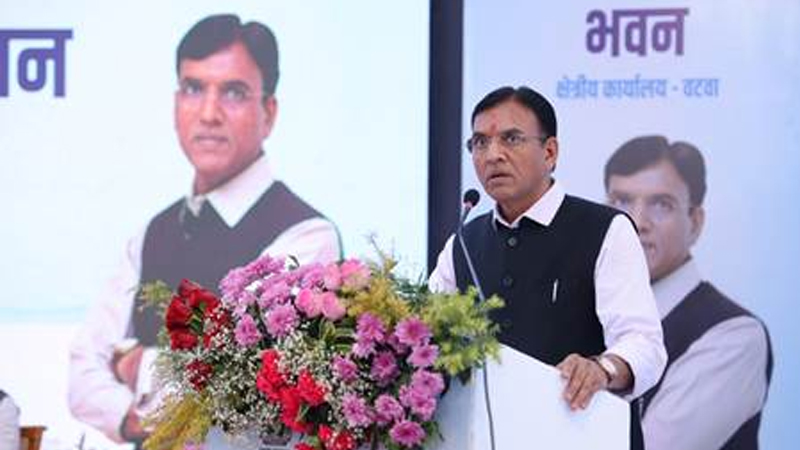
Union Minister for Agriculture & Farmers’ Welfare, and Rural Development, Shri Shivraj Singh Chouhan, is on a one-day visit to Punjab today. During the visit, the Union Minister met farmers, villagers and stakeholders in Ransih Kalan village of Moga and lauded them for their remarkable achievement of not burning stubble for the last six years and for exemplary stubble management, extending his congratulations to all.

Before the main event, the Union Minister spoke to the media and noted that incidents of stubble burning had worried the entire country. He said that while stubble burning may leave fields clean, it also destroys beneficial insects and creates serious pollution problems.

“I have come today to congratulate Punjab and take the state’s stubble management experiment to the entire country. Stubble burning incidents in Punjab have fallen by 83 per cent this year. Earlier, there used to be around 83,000 incidents of stubble burning; now they have reduced to nearly 5,000,” the Union Minister said.

Further, the Union Agriculture Minister said, “Farmer brothers and sisters ask what the alternative is if they do not burn stubble. How should they clear the fields for sowing wheat and other crops? Ransih Kalan village has experimented to answer these questions. Ransih Kalan has set an example. For the past six years, stubble has not been burnt here. Farmers here mix the stubble directly into the fields and carry out direct seeding.”

Addressing the main programme, Union Agriculture Minister Shri Chouhan said that a few days ago he had read about Ransih Kalan village. Here, stubble has not been treated as a burden, but turned into a boon. Ransih Kalan is an example of a village that believes in giving rather than asking. He said that as Union Agriculture Minister, he considers it essential to go to farmers and fields and interact directly with farmers, because without this it is not possible to work properly for farmers’ welfare.

The Union Minister said that after stubble burning, water has to be applied to the fields and then the land is prepared for sowing. In contrast, by following the management practices of Ransih Kalan, harvesting can be done with a Happy Seeder and the stubble can be mixed into the soil, after which direct seeding can be done without applying water. This saves both water and diesel. Stubble contains potash, which benefits the soil when mixed in. Weeds are reduced and soil moisture is retained. Mixing stubble into the fields increases soil organic carbon and reduces the need for fertilisers. The Union Minister said that the village sarpanch informed him that where earlier one and a half bags of DAP were used, now only one bag is needed, and instead of three bags of urea, only two bags are sufficient. This is clear evidence of cost savings.

The Union Minister said that he also inspected the fields, and mixing stubble into the soil has not affected crop quality or yield. The potential yield remains about 20 to 22 quintals per acre.

The Union Minister added that this experiment in stubble management is highly beneficial not only for wheat but also for potato cultivation. He said that a farmer informed him that where potash had to be applied earlier in potato fields, it is no longer required because the stubble itself meets the need for zinc and potash. As a result, potato size is bigger, quality improves and costs are reduced.

Shri Chouhan said that he also visited mustard fields. There too, several benefits of cutting stubble and mixing it into the soil were observed. Through this approach, farmers can increase profits in mustard cultivation as well, with less fertiliser and water while raising productivity.

The Union Minister described Ransih Kalan as a school from which much can be learnt. Under the leadership of the village sarpanch, commendable work has been done not only in stubble management but also in optimum use of leftover water in bottles, rainwater harvesting, plastic management, and the creation of lakes, parks and a library. The anti-drug campaign in the village is also a significant achievement. The Agriculture Minister said that the village has demonstrated exceptional development in multiple areas. Because of underground drainage, there is no problem of dengue and malaria in the village. The Union Minister praised Sarpanch Preet Inderpal Singh Mintu and said that his good work has given everyone a reason to feel proud.

Further, Agriculture Minister Shri Shivraj Singh said that from the sacred land of Ransih Kalan he wishes to send a message to farmers across India to adopt this successful stubble management model in their own areas. In this way, pollution can be reduced and the earth can be made more productive.

Shri Chouhan said that he has decided to sit with selected farmer brothers and sisters, discuss ideas with them and, under the leadership of Prime Minister Shri Narendra Modi, draw up five-year plans for transforming agriculture. A brainstorming meeting on this is proposed to be held on December 22–23. Similar efforts will also be undertaken in the field of rural development.

The Union Minister said that proposals also come from small farmers regarding purchase of machinery, and efforts are being made in this regard. He has directed the Director General of the Indian Council of Agricultural Research, Dr. M. L. Jat, to arrange for Custom Hiring Centres to function as centres of mechanisation as well, and to prepare a plan for mechanisation. He said that every small farmer cannot buy a machine, so it is necessary to create a system where, even if a farmer does not own a machine individually, work can be done using machinery available with a group. There should be a system in which farmers can meet their needs by hiring machines on rent.

Shri Chouhan also discussed the ‘Self-Reliance in Pulses Mission’ and said that the government is striving to increase pulse production through this initiative. Where pulses are grown, the government will provide subsidies to set up dal mills. The Union Minister said that the government has been procuring wheat and paddy and will certainly continue to do so in future. Along with this, the government will also procure whatever quantity of lentil, pigeon pea, black gram and chickpea farmers produce at MSP. Farmers will be given the full value of their sweat.

In conclusion, the Union Agriculture Minister said that Punjab is like a centre of knowledge. One feels like coming here again and again to learn. Punjab has taught the country a great deal in agriculture. He said he feels delighted to be in Punjab and that, under the Prime Minister’s leadership, every possible effort will be made for the development of Punjab.

Dr. Jitendra Singh Chairs High-Level Meeting to review “Mission Mausam”

| Published on:

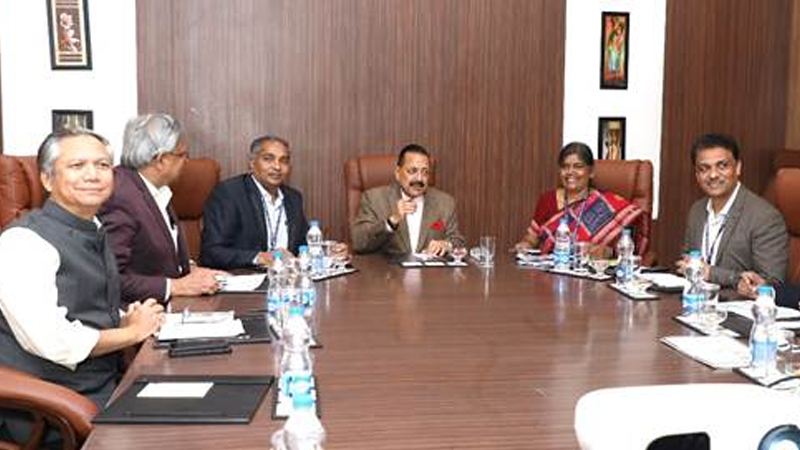
Union Minister of State (Independent Charge) for Science & Technology; Minister of State for Earth Sciences; MoS PMO, Personnel, Public Grievances, Pensions, Atomic Energy and Space, Dr. Jitendra Singh today chaired a high-level review meeting at the India Meteorological Department (IMD), Ministry of Earth Sciences, to assess the ongoing progress of procurement and installation activities under the ambitious ‘Mission Mausam’ initiative.

The Minister asked the concerned officers to expedite the timelines, more so because it was a flagship programme announced by none less than PM Sh Narendra Modi himself.

The meeting was attended by Secretary, Ministry of Earth Sciences, Dr. M. Ravichandran, along with senior officials and scientists from the Ministry and IMD. Officials presented a detailed status of ongoing procurement, infrastructure readiness, and the accelerated installation timelines of various observational and radar systems being rolled out across the country.

Dr. Jitendra Singh emphasised that Mission Mausam, dedicated to the nation by the Hon’ble Prime Minister, marks a major upgrade in India’s weather forecasting and climate monitoring capabilities. He underlined that the timely execution of procurement and installation activities is crucial for strengthening early warning systems, enhancing disaster preparedness, and delivering more accurate, location-specific forecasts.

The Minister directed IMD and MoES officials to ensure that procurement processes remain transparent, efficient, and aligned with global best practices. He also called for fast-tracking installations in priority regions and adopting advanced tracking mechanisms to monitor field-level progress.

Dr. Singh expressed confidence that with coordinated efforts between IMD and the Ministry, the targets set under Mission Mausam will be achieved well within the planned timeline.

PM addresses the 350th Shaheedi Diwas of Sri Guru Tegh Bahadur Ji at Kurukshetra, Haryana

| Published on:

Prime Minister Shri Narendra Modi addressed an event commemorating the 350th Shaheedi Diwas of Sri Guru Tegh Bahadur Ji at Kurukshetra in Haryana today. Speaking on the occasion, the Prime Minister remarked that today has come as a remarkable confluence of India’s heritage. He highlighted that in the morning he was in Ayodhya, the city of the Ramayana, and now he is in Kurukshetra, the city of the Gita. He stated that all are paying homage to Shri Guru Tegh Bahadur Ji on the occasion of his 350th martyrdom day. The Prime Minister acknowledged the presence of saints and the respected congregation at the event and expressed his reverent salutations to all.

Recalling that 5–6 years ago another remarkable coincidence had taken place, Shri Modi highlighted that on 9 November 2019, when the Supreme Court delivered its verdict on the Ram Mandir, he was at Dera Baba Nanak for the inauguration of the Kartarpur Corridor. The Prime Minister remarked that on that day he was praying for the path of Ram Mandir’s construction to be cleared and for the aspirations of crores of Ram devotees to be fulfilled. He stated that the prayers of all were answered as the verdict in favor of the Ram Mandir was delivered on the same day. The Prime Minister noted that now, when the Dharma Dhwaja has been established in Ayodhya, he has once again received the opportunity to seek blessings from the Sikh Sangat.

Shri Modi stated that a short while ago the ‘Panchajanya Memorial’ was inaugurated on the land of Kurukshetra. He highlighted that it was on this very soil that Lord Shri Krishna declared the protection of truth and justice to be the highest duty. Reciting Krishna’s words, Shri Modi said that giving one’s life for the path of truth and for one’s duty is supreme. He remarked that Shri Guru Tegh Bahadur Ji too considered the defense of truth, justice, and faith as his dharma, and he upheld this dharma by sacrificing his life. On this historic occasion, the Government of India has had the privilege of dedicating a commemorative postage stamp and a special coin at the feet of Shri Guru Tegh Bahadur Ji. The Prime Minister expressed his wish that the government continues to serve the Guru tradition in this manner.

The Prime Minister remarked that the sacred land of Kurukshetra is an important center of Sikh tradition. He highlighted that almost all Gurus of the Sikh tradition visited this land during their holy journeys. He recalled that when the Ninth Guru, Shri Guru Tegh Bahadur Ji, came to this sacred soil, he left a profound imprint of deep penance and fearless courage.

“Personalities like Shri Guru Tegh Bahadur Ji are rare in history, and his life, sacrifice, and character remain a great source of inspiration”, emphasised Shri Modi. He emphasized that during the period of Mughal invasions, Guru Sahib set an ideal of bravery. The Prime Minister noted that before the martyrdom of Shri Guru Tegh Bahadur Ji, Kashmiri Hindus were being forcibly converted to Islam by the Mughal aggressors. In this crisis, a group of the oppressed sought the support of Guru Sahib. The Prime Minister recalled that Guru Sahib had told them to clearly convey to Aurangzeb that if Shri Guru Tegh Bahadur himself accepted Islam, then they too would adopt the religion.

Shri Modi stated that these words reflect the pinnacle of Shri Guru Tegh Bahadur Ji’s fearlessness. He remarked that what was feared eventually happened, as the cruel Aurangzeb ordered Guru Sahib to be taken prisoner, but Guru Sahib himself declared his decision to go to Delhi. The Prime Minister highlighted that the Mughal rulers tried to lure him with temptations, yet Shri Guru Tegh Bahadur remained steadfast and refused to compromise on his faith and principles. He emphasized that in order to break his resolve and divert him from his path, the Mughals brutally executed his three companions — Bhai Dayala Ji, Bhai Sati Das Ji, and Bhai Mati Das Ji — before his eyes. The Prime Minister noted that even then Guru Sahib remained unwavering, his determination unbroken. He underscored that Guru Sahib did not abandon the path of dharma and, in a state of deep meditation, sacrificed his head in defense of faith.

The Prime Minister remarked that the Mughals did not stop there, as they attempted to dishonor the sacred head of Guru Maharaj. He highlighted that Bhai Jaita Ji, through his valor, carried the Guru’s head to Anandpur Sahib. The Prime Minister recalled the words of Shri Guru Gobind Singh Ji, meaning that the sacred tilak of faith was preserved, that people’s beliefs were protected from oppression, and for this Guru Sahib sacrificed everything.

Highlighting that today, the very land of Guru Sahib’s sacrifice stands as Delhi’s Sis Ganj Gurudwara, a living site of inspiration, Shri Modi emphasized that the pilgrimage of Anandpur Sahib is the power center of our national consciousness. The Prime Minister noted that the very form of India that remains today embodies the sacrifice and dedication of epochal figures like Guru Sahib. He underscored that it is because of this supreme sacrifice that Shri Guru Tegh Bahadur Sahib is revered as ‘Hind Di Chadar’.

“The tradition of our Gurus forms the foundation of the nation’s character, culture, and core spirit”, exclaimed Shri Modi, expressing satisfaction that in the past 11 years the government has established these sacred traditions and every Sikh celebration as national festivals. The Prime Minister highlighted that their Government had the privilege of celebrating the 550th Prakash Parv of Shri Guru Nanak Dev Ji, the 400th Prakash Parv of Shri Guru Tegh Bahadur Sahib Ji, and the 350th Prakash Parv of Shri Guru Gobind Singh Ji as festivals of India’s unity and integrity. He noted that people across the country, rising above their faiths, traditions, and beliefs, have participated in these celebrations.

Underscoring that their Government has had the privilege of giving the sacred sites associated with the Gurus the most magnificent and divine form, Shri Modi highlighted that over the past decade there have been many occasions when he personally became part of events linked to the Guru tradition. The Prime Minister recalled that some time ago, when three original forms of the Guru Granth Sahib arrived in India from Afghanistan, it became a moment of pride for every citizen.

Emphasising that the government has sought to connect every pilgrimage site of the Gurus with the vision of modern India, Shri Modi further noted that whether it was completing the work of the Kartarpur Corridor, constructing the ropeway project at Hemkund Sahib, or expanding the Virasat-e-Khalsa Museum at Anandpur Sahib, all these tasks have been undertaken with full devotion, keeping the glorious tradition of the Gurus as the guiding ideal.

Pointing out that everyone knows how the Mughals crossed all limits of cruelty even with the brave Sahibzadas, the Prime Minister highlighted that the Sahibzadas accepted being bricked alive but did not abandon their duty or the path of faith. The Prime Minister stated that in honor of these ideals, every year on 26 December, Veer Bal Diwas is observed. He emphasized that the government has also included the history of the Sikh tradition and the teachings of the Gurus in the national curriculum so that the ideals of service, courage, and truth become the foundation of the thinking of the new generation.

The Prime Minister expressed confidence that everyone must have had the sacred darshan of the ‘Joda Sahib’. He recalled that the first time his cabinet colleague and Union Minister, Shri Hardeep Singh Puri discussed these important relics with him, he had mentioned that his family had preserved the holy ‘Joda Sahib’ of Guru Gobind Singh Ji and Mata Sahib Kaur Ji for nearly three hundred years. Shri Modi highlighted that now this sacred heritage was being dedicated to the Sikh community across the nation and the world. He stated that thereafter, the holy ‘Joda Sahib’ underwent scientific examination with full respect and dignity so that it could be preserved for future generations. Taking all facts into account, the collective decision was made to dedicate the sacred ‘Joda Sahib’ to Takht Shri Patna Sahib, where Guru Maharaj spent a significant part of his childhood. The Prime Minister remarked that last month, as part of a sacred journey, the revered ‘Joda Sahib’ were carried from Delhi to Patna Sahib, and there he too had the opportunity to bow his head before them. He considered it the special grace of the Gurus that he was granted this chance of service, dedication, and connection with this sacred heritage.

Noting that the memory of Shri Guru Tegh Bahadur Sahib Ji teaches us how vast, generous, and humanity-centered India’s culture has been, Shri Modi highlighted that Guru Sahib validated the mantra of Sarbat da Bhala through his life. The Prime Minister stated that today’s event is not only a moment to honor these memories and lessons but also an important inspiration for our present and future. He recalled Guru Sahib’s teaching, meaning that one who remains steadfast even in adverse circumstances is the true wise one and the true seeker. The Prime Minister emphasized that with this inspiration we must overcome every challenge and take our nation forward, making India developed. He noted that Guru Sahib also taught us that we should neither frighten anyone nor live in fear of anyone. He remarked that this fearlessness strengthens society and the nation, and today India too walks on this principle. The Prime Minister underscored that India speaks of fraternity to the world while also defending its borders. He stated that while India desires peace, it never compromises on its security, with Operation Sindoor being the greatest example. Shri Modi affirmed that the whole world has witnessed that the new India neither fears, nor stops, nor bows before terrorism. He added that today’s India is moving forward with full strength, courage, and clarity.

The Prime Minister remarked that on this important occasion he wished to speak on a subject concerning society and youth, which was also a matter of concern for Guru Sahib — the issue of addiction and drugs. He highlighted that the habit of addiction has pushed the dreams of many young people into deep challenges. The Prime Minister stated that the government is making every effort to eradicate this problem from its roots, but emphasized that it is also a battle for society and families. He noted that at such a time, the teachings of Shri Guru Tegh Bahadur Sahib serve both as inspiration and as a solution. The Prime Minister recalled that when Guru Sahib began his journey from Anandpur Sahib, he connected numerous villages with the Sangat, expanding their devotion and faith while also transforming the conduct of society. He remarked that the people of these villages abandoned all forms of intoxicant cultivation and dedicated their future at the feet of Guru Sahib. Shri Modi emphasized that by following the path shown by Guru Maharaj, if society, families, and youth together wage a decisive battle against addiction, this problem can be eradicated from its roots.

The Prime Minister remarked that the teachings of Shri Guru Tegh Bahadur Sahib should become the foundation of peace in our conduct, balance in our policies, and trust in our society, and this is the essence of the occasion. He highlighted that the manner in which the martyrdom day of Shri Guru Tegh Bahadur is being observed across the country reflects how alive the Gurus’ teachings remain in the consciousness of society even today. The Prime Minister concluded by emphasising that with this spirit, these celebrations should serve as meaningful inspiration for the youth to take India forward and extended his greetings to all once again.

Governor of Haryana, Prof. Ashim Kumar Ghosh, Chief Minister of Haryana, Shri Nayab Singh Saini, Union Ministers, Shri Manohar Lal, Shri Rao Inderjit Singh, Shri Krishna Pal were present among other dignitaries at the event.

Background

Prime Minister inaugurated the newly constructed ‘Panchjanya’, constructed in honour of the sacred conch of Lord Krishna. Thereafter, he will visit the Mahabharata Anubhav Kendra, an immersive experiential centre where installations depict significant episodes from the Mahabharata, highlighting its enduring cultural and spiritual significance.

Prime Minister further participated in a special programme commemorating the 350th Shaheedi Diwas of Sri Guru Tegh Bahadur Ji, the revered ninth Sikh Guru. During the programme, the Prime Minister released a special Coin and Commemorative stamp marking the 350th Shaheedi Diwas of revered Guru. To honour the 350th Shaheedi Diwas of Guru Tegh Bahadur, the Government of India is observing a year-long commemoration.

PM addresses Shri Ram Janmabhoomi Mandir Dhwajarohan Utsav in Ayodhya

| Published on:

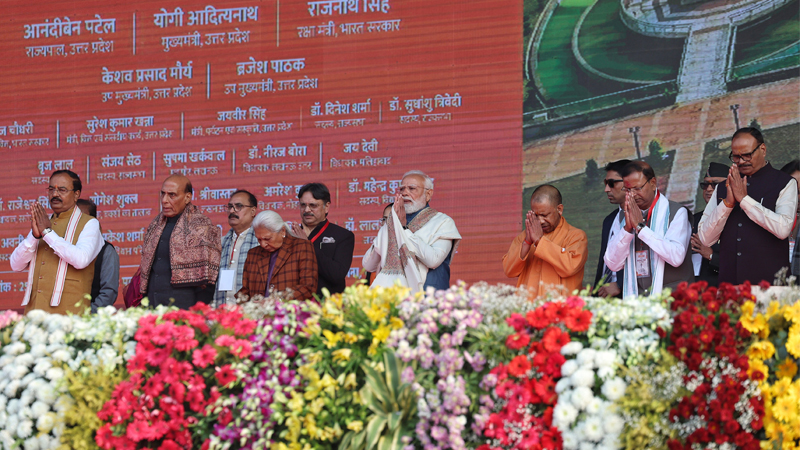
Marking a momentous occasion in the nation’s socio-cultural and spiritual landscape, Prime Minister Shri Narendra Modi ceremonially hoisted a saffron flag on the Shikhar of the sacred Shri Ram Janmbhoomi Temple in Ayodhya, Uttar Pradesh today. The  Dhwajarohan Utsav symbolises the completion of the temple’s construction and ushering in a new chapter of cultural celebration and national unity. Addressing a gathering on the occasion, the Prime Minister stated that today the city of Ayodhya is witnessing yet another pinnacle of India’s cultural consciousness. “Today the entire India and the entire world is filled with the spirit of Lord Shri Ram”, remarked Shri Modi, highlighting that in the heart of every devotee of Ram there is unique satisfaction, boundless gratitude, and immense transcendental joy. He emphasized that centuries‑old wounds are healing, centuries of pain are coming to an end, and centuries of resolve are attaining fulfillment today. He declared that this marks the culmination of a yajna whose fire remained ignited for 500 years, a yajna that never wavered in faith, never broke in belief even for a moment. He underlined that today the infinite energy of Lord Shri Ram’s sanctum and the divine glory of Shri Ram’s family have been enshrined in the form of this Dharma Dhwaja in the most divine and grand temple.

“This Dharma Dhwaja is not merely a flag, but the flag of the renaissance of Indian civilization”, stressed Shri Moi, explaining that its saffron color, the glory of the Solar dynasty inscribed upon it, the sacred Om depicted, and the engraved Kovidar tree symbolize the greatness of Ram Rajya. He affirmed that this flag is resolve, this flag is success, this flag is the saga of creation through struggle, this flag is the embodiment of dreams carried forward for centuries, and this flag is the meaningful culmination of the penance of saints and the participation of society.

Declaring that for centuries and millennia to come, this Dharma Dhwaja will proclaim the ideals and principles of Lord Ram, Shri Modi emphasized that it will call out victory belongs only to truth, not to falsehood. He highlighted that it will proclaim that truth itself is the form of Brahma and that in truth alone dharma is established. He remarked that this Dharma Dhwaja will inspire the resolve of what is spoken must be fulfilled. He underlined that it will convey the message affirming that in the world, karma and duty must hold primacy. He stated that it will express the wish meaning freedom from discrimination and suffering, and the presence of peace and happiness in society. He stressed that this Dharma Dhwaja will commit us to the resolve that we must build a society where there is no poverty, and no one is sad or helpless.

Recalling our scriptures, Shri Modi said those who, for any reason, cannot come to the temple but bow before its flag also attain equal merit. He emphasized that this Dharma Dhwaja is a symbol of the temple’s purpose, and from afar it will provide the vision of Ram Lalla’s birthplace while carrying Lord Shri Ram’s commands and inspirations to humanity for ages to come. He extended heartfelt greetings to crores of Ram devotees across the world on this unforgettable and unique occasion. He bowed to all devotees and expressed gratitude to every donor who contributed to the construction of the Ram Mandir. He saluted every worker, every artisan, every planner, and every architect associated with the temple’s construction.

“Ayodhya is the land where ideals transform into conduct”, emphasised the Prime Minister, stating that this is the city from where Shri Ram began his life’s journey. He highlighted that Ayodhya showed the world how an individual, through the strength of society and its values, becomes Purushottam. He recalled that when Shri Ram left Ayodhya for exile, he was Yuvaraj Ram, but when he returned, he came back as ‘Maryada Purushottam’. He emphasized that in Shri Ram’s becoming Maryada Purushottam, the knowledge of Maharshi Vashishtha, the initiation of Maharshi Vishwamitra, the guidance of Maharshi Agastya, the friendship of Nishadraj, the affection of Mother Shabari, and the devotion of Bhakt Hanuman all played an important role.

Emphasizing that the collective strength of society is essential for building a developed India, Shri Modi expressed happiness that the divine courtyard of the Ram Mandir is becoming a consciousness site of India’s collective power. He highlighted that seven temples have been built here, including the temple of Mata Shabari, which embodies the love and hospitality traditions of the tribal community. The Prime Minister further noted the temple of Nishadraj, which stands as a witness to friendship that worships not the means but the purpose and its sentiment. He pointed out that in one place there are Mata Ahalya, Maharshi Valmiki, Maharshi Vashishtha, Maharshi Vishwamitra, Maharshi Agastya, and Sant Tulsidas, whose presence alongside Ram Lalla offers devotees their darshan. He mentioned the statues of Jatayu Ji and the squirrel, which demonstrate the importance of even the smallest efforts in achieving great resolutions. He urged every citizen that whenever they visit the Ram Mandir, they must also visit the seven temples. He underlined that these temples, along with strengthening our faith, also empower the values of friendship, duty, and social harmony.

“Our Ram connects not through differences but through emotions”, affirmed Shri Modi stressing that for Shri Ram, a person’s devotion is more important than lineage, values are dearer than ancestry, and cooperation is greater than mere strength. He remarked that today we too are moving forward with the same spirit. He highlighted that in the past 11 years, women, Dalits, backward classes, tribals, the deprived, farmers, workers, and youth—every section of society—has been placed at the center of development. He emphasized that when every individual, every section, and every region of the nation is empowered, then everyone’s effort will contribute to the fulfillment of the resolve, and it is through these collective efforts that by 2047 a developed India will be built.

Reflecting on the historic occasion of Ram Lalla’s Pran Pratishtha, the Prime Minister had spoken of linking the nation’s resolve with Lord Ram and reminded that India’s foundation must be strengthened for the coming thousand years. He stressed that those who think only of the present commit injustice to future generations, and that we must think not only of today but also of the generations to come, for the nation existed before us and will continue even after us. He emphasized that as a vibrant society we must work with foresight, keeping in mind the coming decades and centuries, and for this we must learn from Lord Ram—understand His personality, imbibe His conduct, and remember that Ram signifies ideals, discipline, and the supreme character of life. Ram is the confluence of truth and valor, the embodiment of walking the path of dharma, the one who places the happiness of the people above all, the ocean of patience and forgiveness, the pinnacle of knowledge and wisdom, the firmness within gentleness, the highest example of gratitude, the chooser of noble company, the humility within great strength, the unwavering resolve of truth, and the alert, disciplined, and sincere mind. These qualities of Ram, he added, must guide us in building a strong, visionary, and enduring India.

“Ram is not merely a person but a value, a discipline, and a direction”, affirmed Shri Modi, declaring that if India is to become developed by 2047 and society is to be empowered, then Ram must be awakened within each of us, consecrated in our own hearts. He emphasized that there could be no better day than today to take such a resolve. He noted that 25 November has brought yet another extraordinary moment of pride in our heritage, symbolized by the Kovidar tree inscribed upon the Dharma Dhwaja. He explained that the Kovidar tree stands as a reminder that when we sever ourselves from our roots, our glory gets buried in the pages of history.

The Prime Minister recalled the episode when Bharat reached Chitrakoot with his army and Lakshman, from afar, recognized Ayodhya’s forces. Shri Modi stated the description by Valmiki that Lakshman told Ram that the radiant, towering flag resembling a great tree was Ayodhya’s, marked with the auspicious symbol of the Kovidar. He emphasized that today, as the Kovidar is once again consecrated in the courtyard of the Ram Mandir, it is not merely the return of a tree but the return of memory, the resurgence of identity, and the renewed proclamation of a proud civilization. The Kovidar reminds us that when we forget our identity, we lose ourselves, but when identity returns, the nation’s confidence also returns. He concluded that for the country to move forward, it must take pride in its heritage.

Emphasising that along with pride in our heritage, complete liberation from the mentality of slavery is equally important, the Prime Minister recalled that 190 years ago, in 1835, an English parliamentarian named Macaulay sowed the seeds of uprooting India from its roots and laid the foundation of mental slavery. He noted that in 2035, two hundred years will have passed since that event, and urged that the coming ten years must be dedicated to freeing India from this mentality. He lamented that the greatest misfortune is that Macaulay’s ideas had a widespread impact—India attained independence, but not freedom from inferiority complexes. He observed that a distortion took hold, where everything foreign was considered superior, while our own traditions and systems were seen only with fault.

Shri Modi further stressed that the mentality of slavery kept reinforcing the notion that India borrowed democracy from abroad and that even the Constitution was foreign-inspired, whereas the truth is that India is the mother of democracy and democracy is in our DNA. He pointed out that a village of Uttiramerur in northern Tamil Nadu, where a thousand-year-old inscription describes how governance was conducted democratically and how people elected their rulers even in that era. He noted that while the Magna Carta was widely praised, the knowledge of Lord Basavanna’s Anubhava Mantapa was kept limited. He explained that the Anubhava Mantapa was a forum where social, religious, and economic issues were publicly debated and decisions were taken through collective consensus. He lamented that because of the mentality of slavery, generations in India were deprived of this knowledge about their own democratic traditions.

The Prime Minister observed that the mentality of slavery had entrenched itself in every corner of our system. He reminded that for centuries the flag of the Indian Navy bore symbols that had no connection with India’s civilization, strength, or heritage. He emphasized that now every symbol of slavery has been removed from the naval flag and the legacy of Chhatrapati Shivaji Maharaj has been established. He underlined that this was not merely a change in design but a moment of transformation in mindset, a declaration that India will henceforth define its strength through its own symbols, not through the legacy of others.

Shri Modi added that the same transformation is visible today in Ayodhya. He stressed that it was this mentality of slavery that for so many years denied the essence of Ramatva. Shri Modi underlined that  Lord Ram, is in Himself a complete value system—from Raja Ram of Orchha to Bhakt Ram of Rameshwaram, from Shabari’s Prabhu Ram to Mithila’s Pahuna Ram Ji. Ram resides in every home, in every Indian heart, and in every particle of Bharat. Yet, he lamented, the mentality of slavery became so dominant that even Lord Ram was declared imaginary.

Asserting that if we resolve to free ourselves completely from the mentality of slavery within the next ten years, Shri Modi underlined that then such a flame of confidence will be ignited that no force will be able to stop the realization of the dream of Viksit Bharat by 2047. He emphasized that the foundation of India for the coming thousand years will be strong only when Macaulay’s project of mental slavery is entirely dismantled within the next decade. He highlighted that the Ram Lalla temple complex in Ayodhya is becoming ever more magnificent, and the work of beautifying Ayodhya continues apace. He declared that Ayodhya is once again becoming the city that will serve as an example for the world. He reflected that in the Treta Yuga, Ayodhya gave humanity its code of conduct, and in the 21st century, Ayodhya is offering humanity a new model of development. He further added that then Ayodhya was the center of discipline, and now Ayodhya is emerging as the backbone of a developed India.

The Prime Minister envisioned that in the future Ayodhya will embody a confluence of tradition and modernity, where the sacred flow of the Sarayu and the stream of development will run together. He emphasized that Ayodhya will showcase harmony between spirituality and artificial intelligence. He noted that Ram Path, Bhakti Path, and Janmabhoomi Path together present the vision of a new Ayodhya. He highlighted the grand airport and the magnificent railway station, with Vande Bharat and Amrit Bharat Express trains connecting Ayodhya to the rest of the country. He stressed that continuous work is being done to provide facilities to the people of Ayodhya and bring prosperity to their lives. He pointed out that since the Pran Pratishtha, nearly 45 crore devotees have visited for darshan, which has increased the income of people in Ayodhya and surrounding areas. He stated that once Ayodhya lagged behind on development parameters, but today it is emerging as one of the leading cities of Uttar Pradesh.

Underscoring that the coming era of the 21st century is very important, Shri Modi He highlighted that in the 70 years after independence India became the world’s 11th largest economy, but in the last 11 years alone India has risen to become the 5th largest economy. He stated that the day is not far when India will also become the world’s 3rd largest economy. He emphasized that the coming time is one of new opportunities and new possibilities, and in this crucial period the thoughts of Lord Ram will continue to inspire the nation. The Prime Minister explained that when Lord Shri Ram faced the great challenge of victory over Ravan, the chariot required valor and patience as its wheels, its flag was truth and good conduct, its horses were strength, wisdom, restraint and benevolence, and its reins were forgiveness, compassion and equality, which kept the chariot moving in the right direction.

The Prime Minister remarked that to accelerate the journey of a developed India, such a chariot is needed whose wheels are valor and patience, meaning the courage to face challenges and the perseverance to remain steadfast until results are achieved. He highlighted that the flag of this chariot must be truth and the highest conduct, signifying that policy, intent, and morality should never be compromised. He stated that the horses of this chariot must be strength, wisdom, discipline, and benevolence, meaning there should be power, intellect, restraint, and a spirit of serving others. He emphasized that the reins of this chariot must be forgiveness, compassion, and equality, meaning there should be no arrogance in success and respect for others even in failure. Shri Modi said with reverence that this moment is one of standing shoulder to shoulder, of increasing momentum, and of building a Bharat inspired by Ram Rajya. He concluded that this is possible only when national interest remains supreme over self-interest, and once again extended his heartfelt congratulations and best wishes to all.

Governor of Uttar Pradesh, Smt. Anandiben Patel, Chief Minister of Uttar Pradesh, Shri Yogi Adityanath, Sarsanghchalak of the Rashtriya Swayamsevak Sangh, Dr. Mohan Bhagwat were present among other dignitaries at the event.

Background

The programme is taking place on the auspicious Panchami of the Shukla Paksha in the month of Margashirsha, coinciding with the Abhijit Muhurat of Shri Ram and Maa Sita’s Vivah Panchami, a day symbolizing divine union. This date also marks the martyrdom day of Guru Tegh Bahadur Ji, the ninth Sikh Guru, who meditated in Ayodhya for 48 uninterrupted hours in the 17th century, further enhancing the spiritual significance of the day.

The right-angled triangular flag, measuring ten feet in height and twenty feet in length, bears the image of a radiant Sun symbolizing the brilliance and valour of Bhagwan Shri Ram,  with an ‘Om’ inscribed on it along with image of Kovidara tree. The sacred saffron flag will convey a message of dignity, unity, and cultural continuity, embodying the ideals of Ram Rajya.

The flag will rise atop a Shikhar constructed in the traditional North Indian Nagara architectural style, while the surrounding 800-metre Parkota,  a circumambulatory enclosure built around the temple, designed in the South Indian architectural tradition, showcases the temple’s architectural diversity.

The temple complex features 87 intricately carved stone episodes from the life of Bhagwan Shri Ram based on the Valmiki Ramayana on the outer walls of the main temple, and 79 bronze-cast episodes from Indian culture placed along the enclosure walls. Together, these elements provide a meaningful and educational experience to all visitors, offering deep insight into Bhagwan Shri Ram’s life and the cultural heritage of India.

Piyush Goyal addresses the National Conference of Trade Leaders

| Published on:

Union Minister of Commerce and Industry, Shri Piyush Goyal, addressed the National Conference of Trade Leaders, where he highlighted recent reforms aimed at strengthening ease of doing business and enhancing the welfare of workers.

Shri Goyal recalled the sacrifice of Guru Tegh Bahadur, whose legacy is being commemorated after nearly 350 years. He said that following the ideals he laid down would bring pride and honour to the nation and ensure a bright future for the country. He added that remembering the vision with which Guru Tegh Bahadur united the nation would continue to guide India’s progress.

The Minister stated that ease of doing business has been significantly improved through the Jan Vishvas Bill, which simplifies procedures and reduces compliance burdens. Responding to suggestions on the idea of “One Nation, One License, “he suggested that, as a pilot initiative, states such as Delhi and Maharashtra could consider creating a single online portal integrating state and municipal trade licences.

Shri Goyal also noted that the four recently enacted Labour Codes will provide substantial benefits to unorganised workers and gig workers. He said that these workers previously had to navigate numerous forms, inspections and complex regulations, whereas the new framework simplifies processes and ensures access to proper facilities, social security and better working conditions. He added that both employers and employees have welcomed these reforms.

The Minister encouraged traders to promote Swadeshi products. He said suppliers should clearly mention the manufacturing location on product packaging, and suggested that shops may display that they sell Swadeshi goods. He emphasised the importance of expanding the presence of “Made in India” products

PM Pays Tribute on the 350th Shaheedi Diwas of Sri Guru Teg Bahadur ji

| Published on:

On the 350th Shaheedi Diwas of Sri Guru Teg Bahadur Ji, the Prime Minister, Shri Narendra Modi, today paid tribute to his unmatched courage and supreme sacrifice

Shri Modi stated that Guru Teg Bahadur Ji’s martyrdom for the protection of faith and humanity will forever illuminate our society.

In a post on X, the Prime Minister said:

“On the 350th Shaheedi Diwas of Sri Guru Teg Bahadur Ji, we bow in reverence to his unmatched courage and sacrifice. His martyrdom for the protection of faith and humanity will forever illuminate our society.”

“ਸ੍ਰੀ ਗੁਰੂ ਤੇਗ ਬਹਾਦਰ ਜੀ ਦੇ 350ਵੇਂ ਸ਼ਹੀਦੀ ਦਿਵਸ ‘ਤੇ, ਅਸੀਂ ਉਨ੍ਹਾਂ ਦੀ ਬੇਮਿਸਾਲ ਹਿੰਮਤ ਅਤੇ ਕੁਰਬਾਨੀ ਨੂੰ ਨਮਨ ਕਰਦੇ ਹਾਂ। ਧਰਮ ਅਤੇ ਮਨੁੱਖਤਾ ਦੀ ਰੱਖਿਆ ਲਈ ਉਨ੍ਹਾਂ ਦੀ ਸ਼ਹਾਦਤ ਸਾਡੇ ਸਮਾਜ ਨੂੰ ਹਮੇਸ਼ਾ ਰੌਸ਼ਨ ਕਰੇਗੀ।”

Union Home Minister pays tribute to the Sri Guru Tegh Bahadur Ji on his 350th Martyrdom Day

| Published on:

The Union Home Minister and Minister of Cooperation, Shri Amit Shah paid tribute and respect to the ninth Guru of the Sikhism, ‘Hindi Ki Chadar’, Guru Tegh Bahadur Ji, on his 350th Martyrdom Day.

In a post on ‘X’, Shri Amit Shah said, On the 350th martyrdom day of the ninth Guru of the Sikhism, ‘Hind Ki Chadar’, Guru Tegh Bahadur Ji, I bow and pay my respects to him.

Union Home Minister said, Guru Tegh Bahadur Ji, within a single lifetime, engaged in deep spiritual practice, held sacred discourses, and protected our culture and faith from brutal invaders. He fought for the Kashmiri Pandits, challenged the tyrannical Mughal, and sacrificed everything for the sake of dharma. Remembering the saga of sacrifice of Guru Sahib Ji—filled with bravery, restraint, selflessness, and devotion—still fills the heart with pride and a renewed resolve for national protection.

Prime Minister’s statement during the G20 Summit: Session 1

| Published on:

Excellencies,

Namaskar!

At the outset, I extend my congratulations to President Ramaphosa for the excellent hosting of the G20 Summit and for the successful presidency.

Under South Africa’s presidency, commendable progress has been made on key areas such as skilled migration, tourism, food security, AI, digital economy, innovation, and women’s empowerment.

The historic initiatives undertaken at the New Delhi G20 Summit have been carried forward here.

Friends,

Over the past several decades, the G20 has provided direction to global finance and global economic growth. However, the parameters of growth on which the world has worked so far have left a large section of the population deprived of resources. They have also contributed to the over-exploitation of nature. Africa has been one of the greatest sufferers of these consequences. Today, as Africa hosts the G20 Summit for the first time, it is imperative for us to reconsider the parameters of development.

One pathway lies in India’s civilizational values, the pathway of Integral Humanism. This approach calls upon us to view the individual, society, and nature as an integrated whole. Only then can we achieve true harmony between progress and nature.

Friends,

Across the world, there are several communities that have preserved their traditional and eco-balanced ways of life. These traditions not only embody sustainability, but also reflect profound cultural wisdom, social cohesion, and deep reverence for nature.

India proposes the creation of a Global Traditional Knowledge Repository under the G20 framework. India’s own Indian Knowledge Systems initiative can serve as its foundation. This global platform will help transmit the collective wisdom of humanity to future generations.

Friends,

Advancing Africa’s development and empowering its young talent is in the interest of the entire world. Therefore, India proposes the G20–Africa Skills Multiplier Initiative. This initiative can operate under a ‘train-the-trainers’ model across various sectors. All G20 partners can finance and support this effort.

Our collective goal will be to prepare one million certified trainers in Africa over the next decade. These trainers will, in turn, help equip millions of young people with skills. This initiative will have a powerful multiplier effect. It will strengthen local capacity and significantly contribute to Africa’s long-term development.

Friends,

Addressing health emergencies and natural disasters is also our collective responsibility. Therefore, India proposes the establishment of a G20 Global Healthcare Response Team. This team would comprise trained medical experts from G20 countries and be prepared for rapid deployment in the event of any global health crisis or natural disaster.

Friends,

Another critical issue is drug trafficking, particularly the rapid spread of highly lethal substances like fentanyl. This has emerged as a serious challenge to public health, social stability, and global security. It also serves as a significant channel for financing terrorism.

To effectively address this global threat, India proposes the G20 Initiative on Countering the Drug–Terror Nexus. Under this initiative, we can bring together various instruments related to finance, governance, and security. Only then can the drug-terror economy be effectively weakened.

Friends,

India-Africa solidarity has always been strong. During the New Delhi Summit, the African Union becoming a permanent member of this group was a significant initiative. It is now essential that the spirit of this partnership extends beyond the G20. We must work together to ensure that the voice of the Global South is heard and strengthened across all global institutions.

Thank you very much.

DISCLAIMER: This is the approximate translation of Prime Minister’s statement. Original statement was delivered in Hindi.

Union Home Minister visits various stalls at the Ahmedabad International Book Fair

| Published on:

Union Home Minister and Minister of Cooperation Shri Amit Shah distributed books to children and visited various stalls at the Ahmedabad International Book Fair, held in Ahmedabad today.

In a post on ‘X’, Shri Amit Shah said that books are not only a source of knowledge but also an important medium for personality development. He said, today, I distributed books to children and visited various stalls at the Ahmedabad International Book Fair organized by AMC and National Book Trust (NBT).

Shri Shah said that this fair, featuring literary programs, folk song and poetry recitations and a start-up forum, will play a vital role in enriching children and youth intellectually by promoting reading and skill development.

India Capable of Leading Global Movement for ‘Planetary Stewardship’: Dr. Jitendra Singh

| Published on:

Union Minister of State (Independent Charge) for Science & Technology; Earth Sciences; MoS PMO, Personnel, Public Grievances, Pensions, Atomic Energy and Space, Dr. Jitendra Singh today said that India is capable of leading a global movement for “planetary stewardship” and called for a global coalition to address the pressing challenges of climate change, environmental degradation, emerging technologies, and planetary governance.

Addressing the panel discussion on “Climate Justice and Planetary Stewardship: Legal Frameworks for Existential Challenges” at the 26th International Conference of Chief Justices of the World at the World Unity Convention Centre, CMS Kanpur Road, Lucknow, Dr. Jitendra Singh emphasized that judges today stand at the crossroads of constitutional interpretation, scientific understanding, and moral responsibility, making their role pivotal in shaping the future of humanity.

Dr. Jitendra Singh said that the world is living through an era of “interconnected crises”- climate change, pandemics, cyber threats, ocean degradation, and rapid technological disruptions- none of which respect national boundaries. He stressed that these global threats demand global legal responses rooted in equity, integrity, and intergenerational justice.

The Minister noted that India, under Prime Minister Narendra Modi, has already positioned itself at the forefront of several future-facing missions- from the Deep Ocean Mission and National Quantum Mission to ambitious initiatives in cybersecurity, biotechnology, AI, and space reforms. These initiatives, he said, demonstrate India’s preparedness to contribute meaningfully to global environmental governance and technology regulation.

Calling attention to emerging legal challenges, such as privacy vs. surveillance, liberty vs. national security, ownership vs. data protection, and the rise of AI-generated misinformation- Dr. Jitendra Singh said that the judiciary will increasingly be called upon to interpret laws in domains that were unimaginable even two decades ago, including space debris and outer space mining, deep ocean resource exploitation, cross-border climate accountability, and the evolving landscape of cybersecurity and AI ethics.

Dr Jitendra Singh urged that India and the global community update existing legal frameworks, especially in areas like space and oceans, where traditional laws no longer address modern complexities. Highlighting the concept of intergenerational justice, he said that every legal decision on climate, energy, space, or environment affects not just current citizens but future generations:

“Climate change, ocean degradation, and space debris will outlast all of us-their consequences will be borne by the young boys and girls sitting here, and by the generations yet to come.”

The Minister called for embedding fiduciary duties into constitutions, treaties, and court judgments to protect the rights of future generations and uphold planetary stewardship.

Dr. Jitendra Singh advocated for an effective global environmental law and a Planetary Common Framework to govern oceans, polar regions, atmosphere, and outer space. He mentioned the possible need to update existing instruments to prevent militarization, unchecked resource extraction, and exploitation of shared planetary resources.

The Union Minister noted that just as illegal mining is now seen on the moon, similar risks exist in the deep ocean, which holds vast reserves of critical minerals. Without legal safeguards, he cautioned, future disputes and ecological damage could escalate.

The Minister observed that courts worldwide are increasingly enforcing environmental rights, net-zero commitments, and ecosystem protections. Litigation, he said, needs to be seen as a tool for accountability and policy reform, especially when governments lag on climate action.

The Minister praised the role of jurists in shaping climate jurisprudence and urged stronger judicial cooperation across nations- “Judges can no longer be judges only of a constitution, they are, in today’s age and time, judges of humanity’s shared future.”

Dr. Jitendra Singh expressed gratitude to CMS Director Dr. Bharti Gandhi and CMS President Dr. Roger Henry for hosting a conference of global significance, noting the institution’s long-standing contribution to education, civilizational values, and thought leadership. He appreciated the presence of distinguished chief justices, jurists, academicians, and students from across the world.

The Minister also acknowledged the contribution of panellists from diverse backgrounds, emphasizing that cross-domain dialogues, between scientists, astronauts, doctors, and jurists-enrich the global discourse on planetary governance.

Concluding his address, Dr. Jitendra Singh said the conference strengthens India’s aspiration to emerge as Vishwa Bandhu-a trusted global partner advancing justice, sustainability, and the welfare of mankind. He expressed confidence that the deliberations in Lucknow will set the stage for a global movement in larger collaboration for climate justice and planetary stewardship.

A person standing at a podiumAI-generated content may be incorrect.

A person standing at a podium with a microphoneAI-generated content may be incorrect.