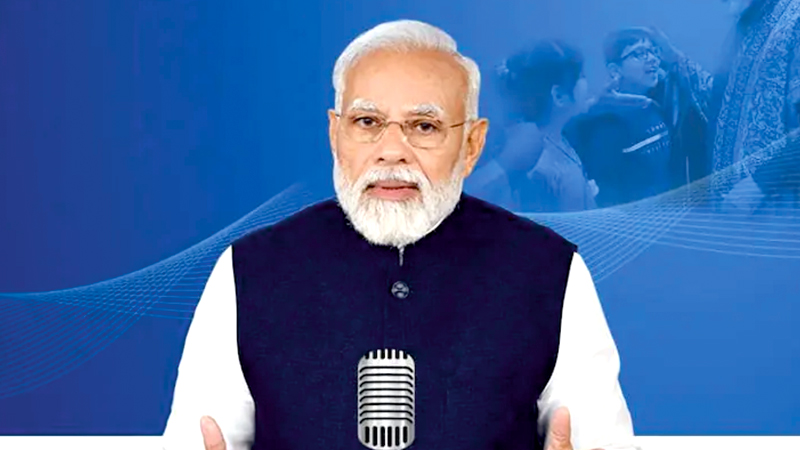
PM’s address in the 112th Episode of ‘Mann Ki Baat’

| Published on:

My dear countrymen, welcome to ‘Mann Ki Baat’. Warmest greetings. At this moment, the Paris Olympics are the flavour of the season in the whole world. The Olympics give our players a chance to hoist the tricolour on the world stage; give them a chance to do something for the country. Let us encourage our players… Cheer for Bharat!!

Friends, besides these Olympics in the world of sports, a few days ago, Olympics have also taken place in the world of mathematics… the International Mathematics Olympiad. In this Olympiad, students of India have performed exceptionally well. Our team performed her best in that and won four Gold and one Silver Medal. Youth from more than a 100 countries participate in the International Mathematics Olympiad and in the overall tally, our team has been successful in reaching the top five. The names of these students who have brought glory to the country are –

Aditya Venkat Ganesh from Pune, Siddharth Chopra from Pune itself, Arjun Gupta from Delhi, Kanav Talwar from Greater Noida, Rushil Mathur from Mumbai and Anando Bhaduri from Guwahati.

Friends, today I have specially invited these young winners in ‘Mann Ki Baat’. All of them are connected with us over the phone at the moment.

Prime Minister:- Namaste friends. I extend a warm welcome to all of you in ‘Mann Ki Baat’. How are all of you?

Students:- We are fine Sir.

Prime Minister:- Well friends, through ‘Mann Ki Baat’ the countrymen are very eager to know about the experiences of all of you. I will begin with Aditya and Siddharth. You are in Pune… first of all I will start with you. Share with us what you experienced during the Olympiad.


Aditya: I was interested in Maths since childhood. My teacher Om Prakash Sir taught me 6th standard Maths and he raised my interest in Maths, I got to learn and I got an opportunity.

Prime Minister: What does your friend have to say?

Siddharth: Sir, I am Siddharth, I am from Pune. I have just passed class 12th. This was my second time in IMO, I too was interested in Maths since childhood and when I was in 6th class with Aditya, Om Prakash Sir trained both of us and helped us a lot and now I am going to CMI for college and pursuing Maths & CS.

Prime Minister: Well, I have been told that Arjun is in Gandhinagar right now and Kanav is from Greater Noida itself. Arjun and Kanav, we discussed the Olympiad but if both of you tell us something related to your preparation and any special experience, our listeners would like it.

Arjun: Namaste Sir, Jai Hind, this is Arjun speaking.

Prime Minister: Jai Hind Arjun.

Arjun: I live in Delhi and my mother Mrs. Asha Gupta is a professor of physics in Delhi University and my father Mr. Amit Gupta is a chartered accountant. I am also feeling very proud that I am talking to the Prime Minister of my country and first of all I would like to give the credit of my success to my parents. I feel that when a member of a family is preparing for such a competition, it is not only the struggle of that member but the struggle of the whole family.

Essentially in our paper we have four and a half hours for 3 problems so one and a half hours for 1 problem – so we can understand how much time we have to solve a problem. So, we have to work really hard at home. We have to spend hours on problems, sometimes it takes a day or even three days to solve a problem. So, for that, we have to search for problems online.

We try the previous year’s problems and as we keep working hard, our experience increases, the most important thing is that our problem solving ability increases, which helps us not only in mathematics but in every sphere of life.

PM: Well, Kanav can you tell me if there is any special experience, any special thing in all this preparation which our young friends would really like to know?

Kanav Talwar: My name is Kanav Talwar. I live in Greater Noida, Uttar Pradesh and I am a student of class 11. Maths is my favourite subject. I have loved maths since childhood. During my childhood, my father used to make me solve puzzles. This increased my interest. I started preparing for Olympiad from 7th class. My sister has put in a huge contribution in this. My parents have also always supported me. This Olympiad is conducted by HBCSE. It is a 5 stage process. Last year, I did not make it to the team and I was very close to it and was very sad about not being able to make it. Then my parents taught me that either we win or we learn.

And the journey matters, not the success. So, I want to say this – ‘Love what you do and do what you love’. The journey matters, not the success. And we will keep succeeding, if we love our subject and enjoy the journey.

Prime Minister: So, Kanav, you are also interested in mathematics and you speak as if you are also interested in literature!

Kanav Talwar: Yes Sir! I used to do debates and orating as a child.

Prime Minister: Ok, now let us talk to Anando. Anando, you are in Guwahati right now and your friend Rushil is in Mumbai. I have a question for both of you. See, I keep doing “pareeksha pe charcha” and apart from discussing exams, I also keep interacting with students in other programs. Many students are so scared of maths that they get nervous on hearing the word. Tell me how to make friends with maths?

Rushil Mathur: Sir! I am Rushil Mathur. When we are young and we learn addition for the first time, we are taught carry forward. But we are never told why carry forward is done. When we study compound interest, we never ask the question where does the formula of compound interest come from? I believe that maths is actually an art of thinking and problem solving. And that is why I feel that if we all add a new question to mathematics, then the question is why are we doing this? Why does this happen like this? So I think this can raise people’s interest in mathematics a lot! Because when we are unable to understand something, we start fearing it. Apart from this, I also feel that everyone thinks that maths is a very logical subject. But apart from that, creativity is also very important in maths. Because only through creativity are we able to think of out of the box solutions, which are very useful in the Olympiad. And hence, Maths Olympiad also has very important relevance for increasing interest in Maths.

Prime Minister: Anando, would you like to say something?

Anando Bhaduri: Namaste PM ji, I am Anando Bhaduri from Guwahati. I have just passed 12th class. I used to take part in the local Olympiad here, in 6th and 7th class. My interest grew then… This was my second IMO. I found both the IMOs very good. I agree with what Rushil said. And I would also like to say that those who are afraid of maths need a lot of patience. Because the way we are taught maths… What happens is that a formula is given and it is memorized and then hundreds of questions are studied based on that formula. But it is not seen whether the formula is understood or not, just keep solving problems. The formula will be memorized and then what will you do if you forget the formula in the exam? Hence I will say understand the formula, as Rushil said, then study with patience. If you understand the formula properly you will not have to solve a 100 questions. You will be able to do it with one or two questions only and maths is not to be afraid of either.

Prime Minister: Aditya and Siddharth, when you were talking in the beginning, the conversation could not take place properly, now after listening to all these friends you certainly must be feeling that you too would like to say something. Can you share your experiences in a better way.

Siddharth: We interacted with people from many other countries, there were many cultures and it was very good to interact and connect with other students, and there were many famous mathematicians.

Prime Minister: Yes Aditya.

Aditya: It was a very good experience and they showed us around Bath city and showed us very nice views, took us to parks and also took us to Oxford University. So that was a very good experience.

Prime Minister: Ok friends, I really enjoyed talking to all of you.

And I wish you all the best, because I know that this kind of game requires a lot of focussed activity, you have to rack your brain, and sometimes even your family members get irritated – what is this guy doing endlessly… multiplication, division. But I wish you all the best. You have raised the glory and name of the country. Thank you friends.

Students: Thank you, thank you.

Prime Minister: Thank you.

Students: Thank you Sir, Jai Hind.

Prime Minister: Jai Hind – Jai Hind.

It was a pleasure talking to all of you students. Thank you very much to all of you for joining ‘Mann Ki Baat’. I am sure that after listening to these young stalwarts of maths, other youngsters will derive the inspiration to enjoy maths.

My dear countrymen, in ‘Mann Ki Baat’, I now want to share one topic, after listening to which, every Indian will feel proud. But before telling you about it, I would like to ask you a question. Have you heard the name Charaideo Maidam? If not, you will now hear this name again and again, and will tell others with great enthusiasm. Charaideo Maidam of Assam is being included in the UNESCO World Heritage Sites. In this list, it will be the 43rd site of India, but the first site from the Northeast.

Friends, the question arriving in your mind must be… what exactly is Charaideo Maidam, and why is it so special? Charaideo means a shining city on the hills. This was the first capital of the Ahom dynasty. The people of the Ahom dynasty traditionally kept the mortal remains of their ancestors and their valuables in the Maidam.

A Maidam is a mound-like structure, covered with soil on top, and has one or more rooms underneath. This Maidam is a symbol of reverence for the departed kings and dignitaries of the Ahom Empire. This way of showing respect to one’s ancestors is very unique. Community worshipping was also performed at this place.

Friends, other data about the Ahom Empire will surprise you even more. Starting from the 13th century, this empire lasted till the beginning of the 19th century. It is a great feat for an empire to sustain for such a long period. Perhaps the principles and beliefs of the Ahom Empire were so strong that it kept this dynasty alive for so long. I remember that on March 9 this year, I had the privilege of unveiling the tallest statue of the great Ahom warrior Lasit Borphukan, a symbol of indomitable courage and bravery. During this program, I had a distinct experience while following the spiritual tradition of the Ahom community. It is indeed a great feeling for me to have the privilege of paying respect to the ancestors of the Ahom community at Lasit Maidam. Charaideo Madam becoming a World Heritage Site now will mean that more tourists will visit the place. You must include this site in your future travel plans.

Friends, a country can progress only by taking pride in her culture. Many such efforts are being made in India as well. One such effort is – Project PARI. Now do not get confused by hearing PARI… this fairy does not pertain to heavenly imagination but is making the earth a heaven. PARI means Public Art of India | Project PARI, is becoming a great medium to bring emerging artists on one platform to popularise public art. You must have seen that beautiful paintings are made on the roadsides, on walls, in underpasses. These paintings and these artefacts are made by the same artists who are associated with PARI. This not only enhances the beauty of our public places, but also helps in making our culture more popular. For example, take the Bharat Mandapam in Delhi itself. Here you will find amazing art works from across the country. You can also see such beautiful public art on some underpasses and flyovers in Delhi. I would request art and culture lovers to also work more on public art. This will give us a pleasant feeling of being proud of our roots.

My dear countrymen, in ‘Mann Ki Baat’, now we will talk about ‘colours’ – colours that have filled the lives of more than 250 women of Rohtak district of Haryana with hues of prosperity. These women associated with the handloom industry used to run small shops and do odd jobs to earn their living. But everyone does have a desire to move ahead. So they decided to join the UNNATI Self Help Group and by joining this group, they received training in block printing and dyeing. These women who spread the magic of colours on clothes are earning lakhs of rupees today. The bed covers, sarees and dupattas made by them are in great demand in the market.

Friends, like these women of Rohtak, artisans in different parts of the country are engaged in making handloom popular. Be it the Sambalpuri saree of Odisha, the Maheshwari saree of MP, the Paithani of Maharashtra or the hand block prints of Vidarbha, the Bhutiko shawls and woollen clothes of Himachal or the Kani shawls of Jammu & Kashmir. The work of handloom artisans is spread across every corner of the country. And you must be aware that in a few days, on the 7th of August, we will celebrate the National Handloom Day. Nowadays, the way handloom products have made their place in the hearts of people is really very successful, tremendous. Now many private companies are also promoting handloom products and sustainable fashion through AI.

Kosha AI, Handloom India, D-Junk, Novatax, Brahmaputra Fables, many such start-ups are also engaged in making handloom products popular. I am also happy to see that many people are engaged in making such local products of their place popular. You too can upload your local products on social media with the name ‘Hashtag My Product My Pride’. This small effort of yours will change the lives of many people. Friends, along with handloom, I would also like to talk about Khadi. There must be many of you who never used Khadi products before, but today wear Khadi with great pride. I am also happy to tell you that the turnover of Khadi Village Industry has crossed Rs 1.5 lakh crore for the first time. Think about one and a half lakh crore rupees and do you know how much the sale of Khadi has increased? 400%. This rising sale of Khadi, handloom, is also creating a large number of new employment opportunities. Mostly, women are associated with this industry, so they are the ones who are benefiting the most. I urge you once more… you must have many types of clothes, and if you have not bought Khadi clothes till now, start from this year.

The month of August is round the corner… it is the month of attaining independence, it is the month of revolution. What better opportunity could there be than that to buy Khadi! My dear countrymen, in ‘Mann Ki Baat’ I have often discussed with you the challenge of the drug menace. Every family is worried that their child might get caught in the grip of drugs. Now to help such people, the government has opened a special centre, named – ‘Manas’. This is a very big step in the fight against drug abuse. A few days ago, the Helpline and Portal of ‘Manas’ was launched. The government has issued a toll-free number ‘1933’. Anyone can call on this number to get necessary advice or information related to rehabilitation. If anyone has any other information related to drugs, they can also share it with the Narcotics Control Bureau by calling on this number. All information shared with MANAS is kept confidential.

I urge all people, all the families, all the institutions engaged in making India ‘drugs free’ to make full use of the MANAS Helpline.

My dear countrymen, Tiger Day will be celebrated all over the world tomorrow. In India, Tigers have been an integral part of our culture. We all have grown up listening to stories of incidents related to tigers. In the villages around forests, everyone knows how to live in harmony with the tiger. In our country, there are many villages where there is no conflict between humans and tigers. But where such a situation arises, unprecedented efforts are being made for the protection of tigers there as well. One such effort of public participation is “Kulhadi Band Panchayat”. The “Kulhadi Band Panchayat” campaign that started from Ranthambor of Rajasthan is very interesting. The local communities themselves have taken an oath that they will not go to the forest with axes and will not cut trees. Due to this one decision, the forests here are becoming green once again, and a better environment is being created for the tigers.

Friends, Tadoba-Andhari Tiger Reserve of Maharashtra is one of the main habitats of tigers. The local communities here, especially our brothers and sisters of Gond and Mana tribes, have taken rapid strides towards eco-tourism.

They have reduced their dependence on the forest so that the activities of tigers can increase here. You will also be surprised at the efforts of the ‘Chenchu’ tribe living on the Nallamalai hills in Andhra Pradesh. As Tiger Trackers, they have gathered every bit of information on the movement of wild animals in the forest. Along with that, they also keep monitoring illegal activities in the area. Similarly, the ‘Baagh Mitr Karykram’ being undertaken in Pilibhit, Uttar Pradesh is also creating a buzz. Under this, local people are trained to work as ‘Tiger Friends’. These ‘Tiger Friends’ strictly ensure that there is no conflict between tigers and humans. Many such efforts are underway in different parts of the country. I have discussed only a few efforts here, but I am happy that public participation is proving very useful in tiger conservation. It is on account of such efforts that the tiger population in India is increasing every year. You will feel happy and proud to know that 70 percent of the tigers in the world are in our country. Imagine! 70 percent tigers!! – That is why there are many Tiger Sanctuaries in different parts of our country.

Friends, along with the increase in tiger population, the forest area in our country is also increasing rapidly. In that too, great success is being achieved through community efforts. In the last ‘Mann Ki Baat’ program, I discussed with you the program ‘Ek Ped Maa Ke Naam’. I am happy that a large number of people in different parts of the country are connecting with this campaign. A few days ago, a splendid programme was held in Indore, the city famous for cleanliness. More than 2 lakh saplings were planted here in a single day during the programme ‘Ek Ped Maa Ke Naam’. You must also join this campaign of planting trees in the name of your mother and take a selfie and post it on social media. By joining this campaign, you will feel that you have done something special for both your mother and Mother Earth.

My dear countrymen, the day 15th August is not far away. And now another campaign has been added to the 15th of August, ‘Har Ghar Tiranga Abhiyan’. For the last few years, everyone’s fervour for the ‘Har Ghar Tiranga Abhiyan’ remains high in the entire country. Be it the poor… the rich… small households, big households, everyone feels proud waving the Tricolor.

There is also a craze of taking selfies with the Tricolor and posting them on social media. You must have noticed that when the Tricolor flutters atop each house of the colony or society, within no time the Tricolor starts appearing on other houses as well. That is, ‘Har Ghar Tiranga Abhiyan’ – has become a unique festival in upholding the glory of the Tricolour. Now, various kinds of innovations related to that are also taking place. As the 15th of August approaches, various kinds of products are seen for displaying the Tricolour in homes, offices, cars. Some people even distribute the ‘Tricolour’ to their friends and neighbours. This joy, this enthusiasm with the Tricolour connects us with each other.

Friends, like earlier, this year too you must upload your selfie with the Tricolour on ‘harghartiranga.com’ and I want to remind you of something more. Every year before the 15th of August, you send me a lot of your suggestions. You must send me your suggestions this year as well. You can also send your suggestions on MyGov or NaMo App. I will try to cover as many suggestions as possible in the 15th August address.

My dear countrymen, it was very nice to connect with you in this episode of ‘Mann Ki Baat’. We will meet again next time, with new achievements of the country, with new efforts of public participation. You must keep sending in your suggestions for ‘Mann Ki Baat’. Many festivals are also on their way in the near future. Best wishes to you for all the festivals. Enjoy the festivals with your family. Keep up the energy to do something new for the country. Thank you very much. Namaskar.

PM celebrates Bronze Medal by Manu Bhaker in Women’s 10m Air Pistol event

| Published on:

The Prime Minister, Shri Narendra Modi has congratulated Manu Bhaker on winning the Bronze medal in Women’s 10m Air Pistol event at Paris Olympics 2024.

The Prime Minister posted on X:

“A historic medal! Well done, @realmanubhaker, for winning India’s FIRST medal at #ParisOlympics2024! Congrats for the Bronze. This success is even more special as she becomes the 1st woman to win a medal in shooting for India. An incredible achievement! #Cheer4Bharat”

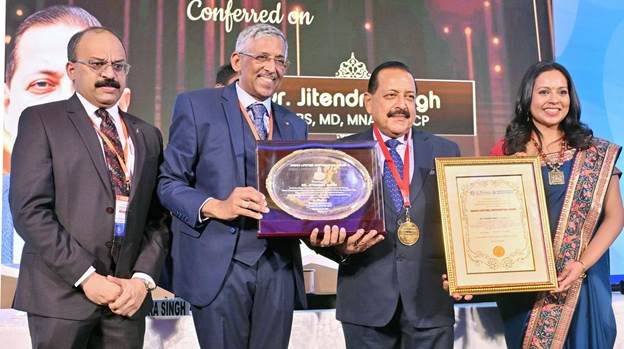
Dr. Jitendra Singh conferred the prestigious “Lifetime Achievement Award”

| Published on:

In a  ceremony to mark the International Meet of leading medical celebrities, professionals and Medicos from all over the country and abroad, Union Minister Dr. Jitendra Singh was conferred the prestigious “Lifetime Achievement Award” in recognition of his exemplary dedication to the advancement of diabetology, diabetes care and diabetes research which earned him acknowledgement across the country and overseas.

The citation read out by Dr V. Mohan, Chairman of Dr. Mohan’s Diabetes Speciality Centre and Madras Diabetes Research Foundation, Chennai, described Dr Jitendra Singh as a teacher Professor, researcher and practitioner of Diabetology, who rose from the grassroots to earned a name for himself as well as the State and country to which belongs. The citation further mentions that falling in the genre of the great Dr. B C Roy, Dr Jitendra Singh is another rare example of a nationally known Medical Professional, who proved equally successful in public life by being popularly elected to the House of People (Lok Sabha) for three consecutive terms with a decisive margin and also being among the few in the country and first in Jammu & Kashmir to find a berth in Union Council of Ministers consequently for the third term. Known for his clean image and impeccable integrity, Dr Jitendra Singh had earned the respect and love of three generations of colleagues who have worked with him.

The citation also mentions the unique distinction conferred on Dr Jitendra Singh as the Lifetime Pattern of RSSDI (Research Society for the Study of Diabetes in India), the largest academic association of Diabetologists.

The citation read out for Dr Jitendra Singh, during the ceremony, described him as a versatile personality, simultaneously known as an outstanding academician, researcher, Medical teacher, author and brilliant orator. The various awards received by him in the past include “Gold Medal for Oration” from Jawaharlal Institute of Postgraduate Medical Education & Research (JIPMER) Puducherry and coveted “Jamna Devi Gian Devi Award” for journalism.

The citation described Dr Jitendra Singh as an author of eight books and three Monograms on various aspects of Diabetes. He has written chapters on Diabetes in leading textbooks of Medicine and before becoming a Minister, he consecutively wrote a chapter on Diabetes in twelve successive editions of the prestigious “API Textbook of Medicine” published by the Association of Physicians of India.Among the Diabetes awareness books written by Dr Jitendra Singh, one of the books titled “Diabetes Made Easy” was included in the Best-seller section of the World Book Fair held at Pragati Maidan, New Delhi.

Dr. Jitendra Singh’s pioneering work on “Stress Diabetes in Kashmiri Migrants” was hailed by the World Health Organization (WHO). He was also a member of the DIPSY Group of researchers who finalised the “Guidelines for Management of Diabetes in Pregnancy” and the same Guidelines were then approved for referral by the WHO. As a teacher of Medicine and Diabetes, Dr Jitendra Singh has been a guide for the thesis to nearly two dozen scholars.

The citation also referred to Dr. Jitendra Singh’s contribution as a Parliamentarian and a Minister in the Government of India, and lauded his brilliant interventions and presentations in the Parliament. It also commended Dr. Jitendra Singh’s impressive handling of a number of Departments and Ministries under his charge in the Government of India. His hard work, focused approach and down-to-earth attitude had endeared to all cross sections of society, said the citation. The citation also described Dr Jitendra Singh as someone highly revered for his unassuming nature, practical and human approach, both in words and deeds, which makes him a “true son” of India.

Soon after rendering of the citation, when the Gold Medal for “Lifetime Achievement Award” was placed around the neck of Dr Jitendra Singh, the entire audience, comprising virtually the who’s who from different walks of life, stood up to accord a standing ovation and kept clapping endlessly for several minutes. The audience burst into cheers and applause when  the compere conducting the programme announced that Dr. Jitendra Singh owed his academic education to Chennai and happened to be an alumni of the prestigious Stanley Medical College.

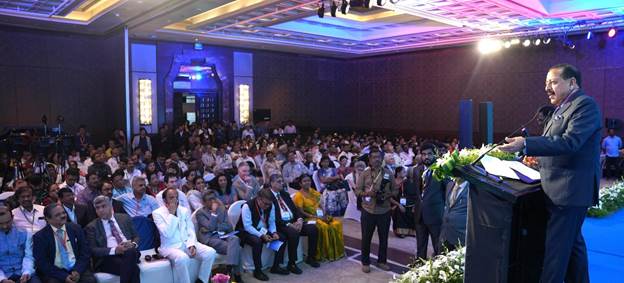
Bowing his head down in response to the standing ovation to the audience, an overwhelmed Dr Jitendra Singh, in his “acceptance speech”, said that the award was too big for him and he could accept it only with utmost modesty and humility at his command. He said, in a journey of nearly four decades, it was a divine blessing to grow under the shadow of some of the tallest medical professionals of the country and to rub shoulders with some of the most illustrious seniors and colleagues.

Dr. Jitendra Singh said, he will continue his endeavour to live upto the high expectations of his colleagues and prove worthy of the honour conferred on him.

Dr. Mansukh Mandaviya Interacts With Youth on Enhancing Effectiveness of MY Bharat Portal

| Published on:

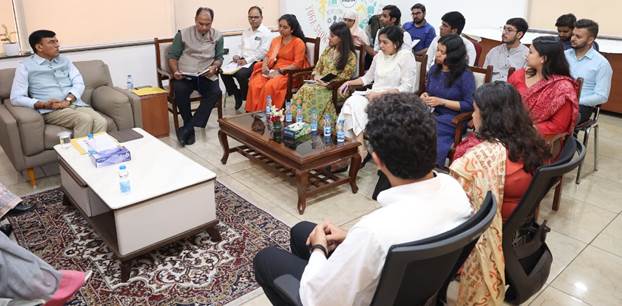
Union Minister of Youth Affairs & Sports and Labour & Employment, Dr. Mansukh Mandaviya in his continuous endeavour to increase the effectiveness of the MY Bharat Portal chaired an interactive session with the youth engaged in various sectors, including Indian youth delegates who had participated in BRICS Youth Summit in Russia, in New Delhi today.

This engagement is part of a series of meetings Dr. Mandaviya has held with youth groups across the country to make MY Bharat platform one stop solution for youth.

Recognizing the immense potential and energy that the youth bring to our nation, D. Mandaviya said, “Youth must embrace the responsibility to contribute towards the betterment of our country and realize the vision of a ‘Viksit Bharat’ by 2047”.

In his address, Union Minister highlighted the importance of aligning the My Bharat platform with activities that resonate with youth and provide them benefits. He stressed that these activities should be featured prominently on the My Bharat platform to maximize their impact.

The meeting provided an opportunity for the youth to share their suggestion and insights on MY Bharat portal with a view to enhance the effectiveness of MY Bharat Portal.

Union Minister informed the participants that the views and suggestions they shared would play a crucial role in improving the MY Bharat Portal. He emphasized that these contributions are vital for enhancing its outreach among the youth, ensuring the platform effectively addresses their needs and encourages greater engagement in national development initiatives.

The Union Minister appreciated the suggestions and ideas put forth by the youth and ensured that the same will be examined and worked upon for further enhancement of the portal. Secretary, Department of Youth Affairs along with other senior officials of the Ministry of Youth Affairs & Sports were also present in the meeting.

PM pays homage on Kargil Vijay Diwas and attends Shradhanjali Samaroh in Ladakh

| Published on:

The Prime Minister, Shri Narendra Modi paid homage to the bravehearts who made the supreme sacrifice in the line of duty on the occasion of 25th Kargil Vijay Diwas in Ladakh today. He also attended the Shraddhanjali Samaroh. The Prime Minister heard the Gaurav Gatha: Briefing on Kargil War by NCOs and visited Amar Sansmaran: Hut of Remembrance. He also visited the Veer Bhoomi.

The Prime Minister also witnessed the first blast of the Shinkun La Tunnel Project in Ladakh, virtually today. Shinkun La Tunnel Project consists of a 4.1 km long Twin-Tube tunnel to be constructed at around 15,800 feet on the Nimu – Padum – Darcha Road to provide all-weather connectivity to Leh.

Addressing the Shrddhanjali Samaroh, the Prime Minister said that the glorious land of Ladakh is witness to the 25th year anniversary of Kargil Vijay Diwas. “Kargil Vijay Diwas reminds us that the sacrifices made for the nation are immortal”, PM Modi remarked. Even though months, years, decades and centuries pass by, the Prime Minister underlined that the lives laid down to protect the nation’s borders cannot be erased. “The nation is forever indebted and deeply grateful to the mighty superheroes of our armed forces”, PM Modi added.

Recalling the days of Kargil war, the Prime Minister said he was fortunate to be amidst the soldiers back then, adding that he still remembers how our soldiers carried out a difficult operation at such a height. “I salute the brave sons of the country who made the supreme sacrifice to protect the motherland,” Shri Modi said.

“In Kargil, we not only won the war, we presented an incredible example of ‘truth, restraint and strength”, Prime Minister Modi remarked. The Prime Minister threw light on Pakistan’s deceit at the time when India was making all efforts to maintain peace. “ Falsehood and terror were brought down to their knees by truth”, he added.

Condemning terrorism, the Prime Minister said that Pakistan has always faced defeat in the past. “Pakistan has not learnt anything from its past and has continued to wage war in the garb of terrorism and proxy wars to stay relevant,” Shri Modi continued. The Prime Minister asserted that the nefarious intentions of terrorists will never be fulfilled. “Our bravehearts will trample all the terror attempts,” he added.

“India will overcome all challenges that come in the way of development, be it  Ladakh or Jammu & Kashmir”, the Prime Minister reiterated. He reminded that in a few days from now on 5th of August, the abrogation of Article 370 will complete 5 years and the Jammu & Kashmir of today is talking about a new future full of dreams. The Prime Minister gave examples of progress and mentioned holding G20 meetings in the UT, government’s focus on infrastructure development and tourism, cinema halls opening up, and tazia procession being initiated after three and a half decades. “This heaven on earth is swiftly moving in the direction of peace and prosperity”, the Prime Minister added.

Underlining the developments taking place in Ladakh, the Prime Minister said through Shinkun La Tunnel, the union territory will remain connected with the whole country throughout the year, in every season. “This tunnel will open doors of new possibilities for the development and better future of Ladakh.” Congratulating the people of Ladakh, the Prime Minister said that this tunnel will further make their lives easier as the numerous hardships faced by them due to the region’s extreme weather will be eased.

The Prime Minister highlighted the government’s priorities towards the people of Ladakh and mentioned making efforts personally for the safe evacuation of citizens from the Kargil region from Iran during the Covid-19 pandemic. He recalled a quarantine zone being established in Jaisalmer where they were tested before being sent to Ladakh. Underlining the government’s efforts to boost ease of living and provide more services for the people of Ladakh, the Prime Minister mentioned an approximate six-time increase in the budget from Rs 1100 crores to Rs 6000 crores in the last 5 years. “Be it roads, electricity, water, education, power supply, employment, every direction of Ladakh is transforming”, PM Modi said, highlighting the application of holistic planning for the first time. He gave examples of more than 90 percent coverage of drinking water in Ladakh households under the Jal Jeevan Mission, the upcoming Sindhu Central University for quality higher education for the youth of Ladakh, work to establish a 4G network in the entire Ladakh region, and ongoing work for 13-kilometer long Zojila tunnel for all-weather connectivity on NH 1.

Referring to the ambitious targets for the border areas, the Prime Minister informed that the Border Road Organization (BRO) has completed more than 330 projects including Sela Tunnel, showcasing New INdia’s capabilities and direction.

Emphasizing the importance of upgrading military technologies, the Prime Minister said in the changing global scenarios, our defence force needs the latest weapons and equipment along with a modern working style and arrangements. Shri Modi said that the defence sector had felt the necessity to upgrade in the past as well, but unfortunately, this issue was not given much importance. “However, in the last 10 years, Defence reforms have been prioritized, making our forces more capable and self-reliant,” he added.  Shri Modi further said that today a major stake in defence procurement is being given to the Indian defence industry, adding that 25 per cent has been reserved for the private sector in the defence and research development budget. “As a result of these efforts, India’s defence production has crossed 1.5 lakh crore.” The Prime Minister further said that today, India is making its mark as an arms exporter as well, contrary to its past image of a country that was counted as an arms-importing one. Shri Modi expressed happiness that our force has now decided to stop importing more than 5000 weapons and military equipment.

Lauding the defence forces for the reforms in the defence sector, the Prime Minister dwelled at length on Agnipath Scheme as one of the crucial reforms. Referring to the long pending concern for the average age of the Indian focus being above the global average, the Prime Minister said that in the past there was no willpower to deal with this critical concern which is being addressed now through the Agnipath Scheme. “Purpose of Agnipath is to keep forces young and continuously battle-ready”, the Prime Minister asserted, lamenting the blatant politicization of this sensitive subject. He criticized the past scams and past unwillingness for the modernization of the Air Force Fleet. “The truth is that the Agnipath scheme will increase the strength of the country and the country will also get capable youth. Announcements have been made to give priority to Agniveers in the private sector and paramilitary forces as well”, he said.

Rejecting the propaganda about the intention of saving pension burden as the main reason behind Agnipath Scheme, the Prime Minister reminded that pension burden of the soldiers being recruited today will come up after 30 years, therefore, this can not be the reason behind the scheme. “We have respected this decision taken by the armed forces because for us the security of the country is more important than politics”, he added.

The Prime Minister pointed out that those misleading the youth of the nation today had no regard for the armed forces in the past. Recalling the false promises made by past governments on One Rank One Pension, the Prime Minister underlined that it was the present government that implemented the scheme where ex-servicemen were given more than Rs 1.25 lakh crores. He further pointed out the neglect of past governments and said, “These are the same people who did not build a war memorial for the martyrs even after 7 decades of independence, did not provide enough bulletproof jackets to our soldiers deployed on the border and kept ignoring Kargil Vijay Diwas.”

Concluding the address, the Prime Minister said, “The victory of Kargil was not the victory of any government or any party. This victory belongs to the country, this victory is the heritage of the country. This is a festival of pride and self-respect of the country.” He saluted the brave soldiers on behalf of the entire country and conveyed his best wishes to all the countrymen on 25 years of Kargil victory.

Lieutenant Governor of Ladakh, Brig (Dr) B D Sharma, Union Minister of State for Defence, Shri Sanjay Seth, Chief of Defence Staff, Gen Anil Chauhan and the Chiefs of Army Staff of the three armed forces were present on the occasion.

Background

Shinkun La Tunnel Project consists of a 4.1 km long Twin-Tube tunnel which will be constructed at an altitude of around 15,800 feet on the Nimu – Padum – Darcha Road to provide all-weather connectivity to Leh. Once completed, it will be the highest tunnel in the world. Shinkun La tunnel will not only ensure swift and efficient movement of our armed forces and equipment but also foster economic and social development in Ladakh.

PM expresses happiness as Assam’s Charaideo Maidam added to UNESCO World Heritage list

| Published on:

The Prime Minister, Shri Narendra Modi has expressed his happiness and pride as Assam’s Charaideo Maidam added to UNESCO World Heritage list. Shri Modi said that it is a matter of immense joy and pride for India.

The Moidams at Charaideo showcase the glorious Ahom culture, which places utmost reverence to ancestors, Shri Modi further added.

Responding to the X post of UNESCO about aforementioned UNESCO World Heritage list, the Prime Minister said;

“A matter of immense joy and pride for India!

The Moidams at Charaideo showcase the glorious Ahom culture, which places utmost reverence to ancestors. I hope more people learn about the great Ahom rule and culture.

Glad that the Moidams join the #WorldHeritage List.”

PM remarks on the Budget 2024-25

| Published on:

The Prime Minister, Shri Narendra Modi lauded the Union Budget 2024-25 presented by the Union Minister for Finance, Smt Nirmala Sitharamanin in the Lok Sabha today.

Remarking on the Union Budget 2024-25, the Prime Minister congratulated all citizens for this year’s Budget which is bound to take the nation to new heights of development. He said that Union Finance Minister, Smt Nirmala Sitharaman and her entire team are worthy of congratulations.

“Union Budget 2024-25 will empower every section of society”, the Prime Minister said, “It will take the poor farmers from villages on the path to prosperity.” Noting the emergence of a neo-middle class after 25 crore people were lifted out of poverty, the Prime Minister said that this budget adds continuity to their empowerment and provides countless employment opportunities. “This Budget brings a new scale to education and skill development”, he said. PM Modi underlined that the budget with its new schemes is aimed at strengthening the lives of the middle class, tribal section, dalits and backward classes. He further emphasized that this year’s Budget would ensure economic partnerships of women while also laying down a new path for small businesses and MSMEs. “The Union Budget gives a fillip to manufacturing as well as infrastructure”, PM Modi said underlining that it would give new strength to economic growth while maintaining continuity.

Reiterating the government’s commitment to employment and self-employment, the Prime Minister noted the success of the PLI scheme and highlighted the Employment Linked Incentive scheme which will create crores of jobs. Under the scheme, the first salary of the first job of a youth will be borne by the government. He also mentioned provisions for higher education and the scheme for internships for 1 crore youth. “Working in the top companies under the scheme, the young interns will find new avenues of possibilities”, the Prime Minister said.

Emphasizing the commitment to creating entrepreneurs in every city, every village and every household, the Prime Minister talked about raising the limit of collateral-free loans under the Mudra Loan from Rs 10 lakhs to 20 lakhs which will greatly benefit small businessmen, women, dalits, backwards and deprived.

Asserting the commitment to make India the manufacturing hub of the world, the Prime Minister emphasized the links of MSME with the middle class of the country and its employment potential for the poor segment. To create big strength for small industries, the Prime Minister informed about the new scheme announced in the Budget that will increase the ease of credit for MSMEs. “The announcements in the Budget will take manufacturing and exports to every district”, he said, “e-Commerce, export hubs and food quality testing will give new momentum to One District-One Product programme.”

The Prime Minister underlined that the Union Budget 2024-25 brings numerous opportunities for India’s startup and innovation ecosystem. He gave examples of a one thousand crore rupees corpus fund to vitalize the space economy and the abolition of the angel tax.

“Record high capex will become a driving force of the economy”, the Prime Minister said, mentioning the development plans for 12 new industrial nodes, new satellite towns and transit plans for 14 big cities. He said that it would enable the development of new economic hubs in the country and create numerous jobs.

Highlighting the record defence exports, the Prime Minister mentioned that this year’s Budget consists of numerous provisions to create an ‘aatmanirbhar’ defence sector. He said that the world’s attraction towards India is constantly on the rise thereby, opening up new avenues for the tourism industry. He underlined the emphasis on tourism in this year’s Budget and said that the tourism industry brings numerous opportunities for the poor and the middle-class

PM Modi said that in the last 10 years, the government has ensured tax relief for the poor and the middle class, while decisions were made in this year’s budget to reduce income tax, hike standard deduction and simplify TDS rules. He said that these reforms would allow taxpayers to save more money.

The Prime Minister stated that the overall development of the eastern region of India will get new momentum and energy through the ‘Purvodaya’ vision. “New impetus would be given to the development of important infrastructures like highways, water projects and power projects in eastern India”, he added.

The Prime Minister said, “A big focus of this Budget is the nation’s farmers”. After the world’s biggest grain storage scheme now Vegetable Production Clusters are being introduced which will help both the farmers and the middle class. He further emphasized, “It is the need of the hour for India to become self-reliant in the agricultural sector. Therefore, measures have been announced to help farmers increase the production of pulses and oilseeds.”

Touching upon the major schemes regarding poverty alleviation and empowerment of the poor, the Prime Minister informed about 3 crore houses for the poor and Janjatiya Unnat Gram Abhiyan which will link 5 crore tribal families to basic facilities with a saturation approach. Furthermore, Gram Sadak Yojna will connect 25 thousand new rural areas with all-weather roads, benefitting all states.

The Prime Minister asserted that “today’s budget has brought new opportunities, new energy, new employment and self-employment opportunities. It has brought better growth and a bright future.” The Prime Minister concluded by underlining the Budget’s potential for being a catalyst for making India the third largest economy in the world and for laying the strong foundation for the Viksit Bharat.

A significant step towards realizing the aspirations of a dynamic and self-reliant India: Jagat Prakash Nadda

| Published on:

Hon’ble BJP National President and Union Minister Shri Jagat Prakash Nadda expressed that the first Union Budget for 2024-25 in the third term of the Hon’ble Prime Minister Shri Narendra Modi Ji stands as a testament to India’s commitment to inclusive growth, sustainable development, and economic resilience. This visionary budget addresses the nation’s immediate needs while also establishing a robust framework for long-term prosperity by prioritizing infrastructure development, technological innovation, and social welfare. The budget paves the way for a more prosperous and equitable India, with forward-looking policies and strategic investments poised to accelerate growth, create jobs, and enhance the quality of life for all citizens. 

Shri Nadda described the budget as a significant step towards realizing the aspirations of a dynamic and self-reliant India. He congratulated Hon’ble Prime Minister Shri Narendra Modi Ji, Union Finance Minister Smt Nirmala Sitharaman and their team for delivering a budget focused on the needs of villages, the poor, farmers, women, youth, Dalits and Adivasis, and serving the aspirations of all sections of society. The budget demonstrates India’s economic and financial stability and highlights the resilience of the Indian economy in the face of external challenges.

Hon’ble BJP National President stated that the government continues to empower people in rural areas, women and weaker sections of society to ensure they are part of India’s homogeneous growth journey. The Indian economy has undergone profound positive transformation in the last decade. Under the dynamic leadership of Hon’ble Prime Minister Shri Narendra Modi Ji, the economy has gained new vigor, with the benefits of development reaching the people at the bottom level of society. 

Shri Nadda highlighted the optimism surrounding India and noted that the budget places great emphasis on the development of youth and women, support for poor farmers, better credit for MSMEs, infrastructure development, and a boost for religious tourism. The 4.9% fiscal deficit indicates continued fiscal consolidation. The establishment of twelve plug and play industrial parks in 100 cities, bonus for first-time jobs, a focus on energy security, and urban housing as priority areas.

BJP National President Shri JP Nadda stated that employment will be bolstered by internships in top companies, while rural development receives a substantial investment of ₹2.66 lakh crore. He emphasized improved working conditions for women, enhanced agricultural productivity with high-yield crop varieties, and tax relief for the salaried class under new tax slabs. The Indian economy is on the right track, moving towards ‘Viksit Bharat.’ Shri Nadda expressed gratitude to Hon’ble Prime Minister Shri Narendra Modi Ji, Union Finance Minister Smt Nirmala Sitharaman and her team for delivering a people-friendly budget.

Union Home Minister hails the Budget 2024-25 as pro-people and pro-development

| Published on:

Union Home Minister and Minister of Cooperation, Shri Amit Shah hailed the Budget 2024-25 as pro-people and pro-development. Shri Amit Shah congratulated Prime Minister Shri Narendra Modi and Finance Minister Smt. Nirmala Sitharaman for this visionary budget.

In a series of posts on X platform, Shri Amit Shah said that “The Budget 2024–25 not only exemplifies Bharat’s newfound sense of purpose, hope and optimism under the PM Modi Ji-led government but also fortifies them. Harnessing the power of Bharat’s youth, Nari Shakti and farmers, the budget fuels the nation’s pace on the path of emerging as a developed nation by ushering in a new era of employment and opportunities. My heartfelt gratitude to PM Shri Narendra Modi and FM Smt. Nirmala Sitharaman for the pro-people and pro-development visionary budget.

Home Minister further said that “The Budget 2024–25 reiterates PM Shri Narendra Modi Ji’s unwavering commitment to driving economic growth by bolstering India’s entrepreneurial power and ease of doing business. It also provides relief to taxpayers by simplifying the tax assessment rules.”

Shri Shah said that welfare of farmers has always been at the centre of schemes and policies of our government under the leadership of Modi Ji. He said that the announcement made of Rs.1.52 lakh crore to boost productivity in the agriculture sector in today’s budget is going to prove to be a game-changer for the agriculture sector. He added that decisions like certifying 1 crore farmers for natural farming, setting up 10,000 bio-input centres, building digital public infrastructure for agriculture, crop survey of Kharif crops in 400 districts and creation of a strategy for oilseeds will help the agriculture sector move rapidly towards becoming self-reliant.

Home Minister and Minister of Cooperation said that Modi ji is working to strengthen the rural economy by continuously expanding the cooperative sector. He added that the announcement of the formulation of ‘National Cooperative Policy’ in the budget will work to empower the cooperative movement in the country and strengthen its reach at the grassroots level. Shri Shah said that fisheries cooperatives will get new momentum with the facility of financing through NABARD for shrimp farming, processing and export. Shri Shah expressed his gratitude to Modi ji on behalf of all the cooperative sisters and brothers for these decisions.

Shri Shah said that “Mirroring Modi Ji’s trust in our MSMEs, the Budget 2024–25 instils a new power booster into the sector. With a sprawling range of export hubs, credit guarantees, bank credit during the stress period, and new SIDBI units in clusters, the sector will transform Bharat into a perpetual machine for manufacturing while scripting a new era of Atmanirbharta for the nation, employment and prosperity for the middle class.”

Union Home Minister said that “The Budget 2024–25 stands out for the healing touch it serves to the people of the states affected by floods. Providing much-needed relief to flood-affected Bihar, Assam, Himachal Pradesh, Uttarakhand, and Sikkim, the budget sets out to reshape the dreams of people by rejuvenating the affected areas and making adequate provisions for flood prevention. My heartfelt gratitude to Modi Ji for the warm-hearted decision.”

Shri Amit Shah said that in order to give new impetus to the development of the eastern region of the country, the ‘Purvodaya’ scheme has been announced in this budget for Bihar, Jharkhand, West Bengal, Odisha and Andhra Pradesh. He added that this scheme will give new energy to infrastructure, human resources, employment and economic development opportunities in these regions and they will play an important role in building a developed and self-reliant India.

Home Minister said that the upliftment and empowerment of the tribal society has been one of the priorities of the Modi government. He said that today in the budget, the government has announced the launch of ‘PM Janjati Unnat Gram Abhiyan’ for the all-round development of the tribal society. Shri Shah added that about 5 crore tribal brothers and sisters of 63,000 villages will be benefited from this campaign. He said that this will not only connect these villages to the mainstream of development, but they will also become ideal villages by providing excellent infrastructure and fulfillment of other requirements.

Shri Amit Shah said that “Under the leadership of PM Shri Narendra Modi ji Bharat has seen a golden era of infrastructure development in the last ten years. The Budget 2024-25 further advances this vision with a comprehensive initiative for infrastructure building. The allocation of Rs.11,11,111 crore and interest-free loans of Rs.1.5 lakh crore to the states for infrastructure investments will build a Bharat powered by world-class infrastructure and create millions of jobs.”

Union Home Minister said that under the leadership of Modi Ji, Central Government is constantly working towards giving new heights to the strength and courage of Nari Shakti and the allocation of more than Rs.3 lakh crore to promote women-led development in this budget is a reflection of this. Shri Shah expressed his gratitude to Prime Minister Modi Ji for decisions like setting up hostels and crèches for the convenience of working women, increasing the market access of women self-help group entrepreneurs, increasing the limit of Mudra loan from Rs.10 lakh to Rs.20 lakh and encouraging states to reduce stamp duty on properties purchased by women.

Shri Amit Shah said that this Budget will go down in history for coupling Bharat’s economic growth with the torque of the nation’s youth power. He said that the budget provides for a massive fund of Rs.2 lakh crore to train 4.10 crore youth in a wide range of skills while envisioning another game-changing move of providing world-class training to 1 crore youth through internships in Fortune 500 companies.

Shri Amit Shah said that in this budget, the central government has given a new dimension to the dreams of the middle class by giving them financial relief. He added that whether it is tax exemption or easing its rules, providing housing to middle class families under the ‘Pradhan Mantri Awas Yojana’ or the decision to give relief in medicines to cancer patients; this budget is going to make the life of the middle class even easier.

Home Minister said that the ground-breaking employment-linked initiatives announced in the Union Budget will contribute to job creation in the formal sector. He said that the initiatives involving the Provident Fund scheme and incentives for new joinees are likely to create 2.90 crore jobs and will play a decisive role in turning Bharat’s formal sector into a job-creating engine.

Shri Amit Shah said that the PM Awas Yojana is fulfilling the dream of crores of poor people to have their own house. He said that today, in the budget, this scheme was further expanded and 3 crore additional houses were announced in rural and urban areas. Shri Shah said along with this, the decision to provide the facility of rental houses with dormitory type accommodation for industrial workers will support the lives of the poor, middle class families and workers.

Home Minister Shri Amit Shah thanked PM Modi for inspiring Bharat’s entrepreneurial spirit by increasing the limit of PM Mudra loans from Rs.10 lakh to Rs.20 lakh. He said that this decision will not only enhance Bharat’s ease of doing business further but will also initiate new youths to the path of becoming job givers.

SUMMARY OF THE UNION BUDGET 2024-2025

| Published on:

Despite global economy remaining under the grip of policy uncertainties, India’s economic growth continues to be the shining exception and will remain so in the years ahead. Minister of Finance and Corporate Affairs Smt Nirmala Sitharaman, while presenting the Union Budget 2024-25 in Parliament today said that India’s inflation continues to be low, stable and moving towards the 4 per cent target. Core inflation (non-food, non-fuel) currently is 3.1 per cent and steps are being taken to ensure supplies of perishable goods reach market adequately.

Interim Budget

The Finance Minister said that as mentioned in the interim budget, the focus is on 4 major castes, namely  ‘Garib’ (Poor), ‘Mahilayen’ (Women), ‘Yuva’ (Youth) and  ‘Annadata’ (Farmer).

Budget Theme

Dwelling on the Budget theme, Smt Sitharaman said, turning attention to the full year and beyond, in this budget, we particularly focus on employment, skilling, MSMEs, and the middle class. She announced the Prime Minister’s package of 5 schemes and initiatives to facilitate employment, skilling and other opportunities for 4.1 crore youth over a 5-year period with a central outlay of 2 lakh crore. This year, 1.48 lakh crore has been allocated for education, employment and skilling.

Budget Priorities

The Finance Minister said, for pursuit of ‘Viksit Bharat’, the budget envisages sustained efforts on the following 9 priorities for generating ample opportunities for all.

  1. Productivity and resilience in Agriculture
  2. Employment & Skilling
  3. Inclusive Human Resource Development and Social Justice
  4. Manufacturing & Services
  5. Urban Development
  6. Energy Security
  7. Infrastructure
  8. Innovation, Research & Development and
  9. Next Generation Reforms

Priority 1: Productivity and resilience in Agriculture

The Finance Minister announced that the government will undertake a comprehensive review of the agriculture research setup to bring the focus on raising productivity. New 109 high-yielding and climate-resilient varieties of 32 field and horticulture crops will be released for cultivation by farmers.

In the next two years, 1 crore farmers across the country will be initiated into natural farming supported by certification and branding.

10,000 need-based bio-input resource centres will be established.

For achieving self-sufficiency in pulses and oilseeds, government will strengthen their production, storage and marketing and to achieve ‘atmanirbharta’ for oil seeds such as mustard, groundnut, sesame, soybean, and sunflower.

Government, in partnership with the states, will facilitate the implementation of the Digital Public Infrastructure (DPI) in agriculture for coverage of farmers and their lands in 3 years.

Smt Sitharaman announced a provision of 1.52 lakh crore for agriculture and allied sector this year.

Priority 2: Employment & Skilling

The Finance Minister said that the government will implement 3 schemes for ‘Employment Linked Incentive’, as part of the Prime Minister’s package. These will be based on enrolment in the EPFO, and focus on recognition of first-time employees, and support to employees and employers.

Government will also facilitate higher participation of women in the workforce through setting up of working women hostels in collaboration with industry, and establishing creches.

Referring to the Skilling programme, the Finance Minister announced a new centrally sponsored scheme, as the 4th scheme under the Prime Minister’s package, for skilling in collaboration with state governments and Industry. 20 lakh youth will be skilled over a 5-year period and 1,000 Industrial Training Institutes will be upgraded in hub and spoke arrangements with outcome orientation.

She also announced that the Model Skill Loan Scheme will be revised to facilitate loans up to
7.5 lakh with a guarantee from a government promoted Fund, which is expected to help 25,000 students every year.

For helping the youth, who have not been eligible for any benefit under government schemes and policies, she announced a financial support for loans upto 10 lakh for higher education in domestic institutions. E-vouchers for this purpose will be given directly to 1 lakh students every year for annual interest subvention of 3 per cent of the loan amount.

Priority 3: Inclusive Human Resource Development and Social Justice

Talking about the Saturation approach, the Finance Minister emphasised that implementation of schemes meant for supporting economic activities by craftsmen, artisans, self-help groups, scheduled caste, schedule tribe and women entrepreneurs, and street vendors, such as PM Vishwakarma, PM SVANidhi,  National Livelihood Missions, and Stand-Up India will be stepped up.

Purvodaya

Government will formulate a plan, Purvodaya, for the all-round development of the eastern region of the country covering Bihar, Jharkhand, West Bengal, Odisha and Andhra Pradesh.  This will cover human resource development, infrastructure, and generation of economic opportunities to make the region an engine to attain Viksit Bharat.

Pradhan Mantri Janjatiya Unnat Gram Abhiyan

The Finance Minister announced that for improving the socio-economic condition of tribal communities, government will launch the Pradhan Mantri Janjatiya Unnat Gram Abhiyan by adopting saturation coverage for tribal families in tribal-majority villages and aspirational districts covering 63,000 villages and benefitting 5 crore tribal people.

More than 100 branches of India Post Payment Bank will be set up in the North East region to expand the banking services.

She said, a provision of 2.66 lakh crore for rural development including rural infrastructure was made this year.

Priority 4: Manufacturing & Services

Support for promotion of MSMEs

Smt Sitharaman said, this budget provides special attention to MSMEs and manufacturing, particularly labour-intensive manufacturing. A separately constituted self-financing guarantee fund will provide, to each applicant, guarantee cover up to 100 crore, while the loan amount may be larger. Similarly, Public sector banks will build their in-house capability to assess MSMEs for credit, instead of relying on external assessment. She also announced a new mechanism for facilitating continuation of bank credit to MSMEs during their stress period.

Mudra Loans

The limit of Mudra loans will be enhanced to  ₹ 20 lakh from the current  ₹ 10 lakh for those entrepreneurs who have availed and successfully repaid previous loans under the ‘Tarun’ category.

MSME Units for Food Irradiation, Quality & Safety Testing

Financial support for setting up of 50 multi-product food irradiation units in the MSME sector will be provided.  Setting up of 100 food quality and safety testing labs with NABL accreditation will also be facilitated. To enable MSMEs and traditional artisans to sell their products in international markets, E-Commerce Export Hubs will be set up in public-private-partnership (PPP) mode .

Internship in Top Companies

The Finance Minister said that as the 5th scheme under the Prime Minister’s package,  government will launch a comprehensive scheme for providing internship opportunities in 500 top companies to 1 crore youth in 5 years.

Priority 5: Urban Development        

Urban Housing

Under the PM AwasYojana Urban 2.0, housing needs of 1 crore urban poor and middle-class families will be addressed with an investment of  ₹ 10 lakh crore. This will include the central assistance of ₹ 2.2 lakh crore in the next 5 years.

Water Supply and Sanitation

In partnership with the State Governments and Multilateral Development Banks, government  will promote water supply, sewage treatment and solid waste management projects and services for 100 large cities through bankable projects.

PM SVANidhi

She added that building on the success of PM SVANidhi Scheme in transforming the lives of street vendors, Government envisions a scheme to support each year, over the next five years, the development of 100 weekly ‘haats’ or street food hubs in select cities.

Priority 6: Energy Security

The Finance Minister said, in line with the announcement in the interim budget, PM Surya Ghar Muft Bijli Yojana has been launched to install rooftop solar plants to enable 1 crore households obtain free electricity up to 300 units every month. The scheme has generated remarkable response with more than 1.28 crore registrations and 14 lakh applications.

Nuclear energy is expected to form a very significant part of the energy mix for Viksit Bharat.

Priority 7: Infrastructure

The Finance Minister underlined that significant investment the Central Government has made over the years in building and improving infrastructure has had a strong multiplier effect on the economy. Government will endeavour to maintain strong fiscal support for infrastructure over the next 5 years, in conjunction with imperatives of other priorities and fiscal consolidation. 11,11,111 crore for capital expenditure has been allocated this year, which is 3.4 per cent of our GDP.

Pradhan Mantri Gram SadakYojana (PMGSY)

The Finance Minister announced that Phase IV of PMGSY will be launched to provide all-weather connectivity to 25,000 rural habitations which have become eligible in view of their population increase.

For Irrigation and Flood Mitigation in Bihar, through the Accelerated Irrigation Benefit Programme and other sources, government will provide financial support for projects with estimated cost of 11,500 crore such as the Kosi-Mechi intra-state link and 20 other ongoing and new schemes including barrages, river pollution abatement and irrigation projects.  Government will also provide assistance to Assam, Himachal Pradesh, Uttarakhand and Sikkim for flood management, landslides and related projects.

Priority 8: Innovation, Research & Development

The Finance Minister said that government will operationalize the Anusandhan National Research Fund for basic research and prototype development and set up a mechanism for spurring private sector-driven research and innovation at commercial scale with a financing pool of 1 lakh crore in line with the announcement in the interim budget.

Space Economy

With our continued emphasis on expanding the space economy by 5 times in the next 10 years, a venture capital fund of 1,000 crore will be set up.

Priority 9: Next Generation Reforms

Economic Policy Framework

The Finance Minister said that the government will formulate an Economic Policy Framework to delineate the overarching approach to economic development and set the scope of the next generation of reforms for facilitating employment opportunities and sustaining high growth.

Labour related reforms

Government will facilitate the provision of a wide array of services to labour, including those for employment and skilling. A comprehensive integration of e-shram portal with other portals will facilitate such one-stop solution. Shram Suvidha and Samadhan portals will be revamped to enhance ease of compliance for industry and trade.

Government will develop a taxonomy for climate finance for enhancing the availability of capital for climate adaptation and mitigation.

Foreign Direct Investment and Overseas Investment

The rules and regulations for Foreign Direct Investment and Overseas Investments will be simplified to (1) facilitate foreign direct investments, (2) nudge prioritization, and (3) promote opportunities for using Indian Rupee as a currency for overseas investments.

NPS Vatsalya

NPS-Vatsalya, a plan for contribution by parents and guardians for minors will be started. On attaining the age of majority, the plan can be converted seamlessly into a normal NPS account.

New Pension Scheme (NPS)

The Finance Minister said that the Committee to review the NPS has made considerable progress in its work and a solution will be evolved which addresses the relevant issues while maintaining fiscal prudence to protect the common citizens.

Budget Estimates 2024-25

The Finance Minister informed that for the year 2024-25, the total receipts other than borrowings and the total expenditure are estimated at 32.07 lakh crore and 48.21 lakh crore respectively. The net tax receipts are estimated at 25.83 lakh crore and the fiscal deficit is estimated at 4.9 per cent of GDP.

She said, the gross and net market borrowings through dated securities during 2024-25 are estimated at 14.01 lakh crore and 11.63 lakh crore respectively.

Smt Sitharaman emphasised that the fiscal consolidation path announced by her in 2021 has served economy very well, and the government will aim to reach a deficit below 4.5 per cent next year.

PART B

Apart from giving relief to four crore salaried individuals and pensioners of the country in the direct taxes, Union Budget 2024-25 seeks to comprehensively review the direct and indirect taxes in the next six months, simplifying them, reducing tax incidence and compliance burdens and broadening the tax nets. The Budget proposes comprehensive rationalization of GST tax structure along with review of the Custom Duty rate structure to improve the tax base and support domestic manufacturing. A comprehensive review of Income – Tax Act is targeted at reducing disputes and litigations and to make the act lucid, concise and easy to read. Minister of Finance and Corporate Affairs Smt. Nirmala Sitharaman said that simplification of tax regimes without exemptions and deductions for corporate and personal income tax has been appreciated by tax payers as over 58 per cent of corporate tax came from simplified tax regime in 2022-23 and more than two third tax payers have switched over to the new personal income tax regime.

Budget 2024-25 increased standard deduction of salaried employees from ₹ 50,000/- to ₹ 75,000/- for those opting for new tax regime. Similarly, deduction on family pension for pensioners enhanced from ₹ 15,000/- to ₹ 25,000/-. Assessments now, can be reopened beyond three years up to 5 years from end of year of assessment, only if, the escaped income is more than ₹ 50 Lakh. The new tax regime rate structure is also revised to give a salaried employee benefits up to ₹ 17,500/- in income tax.

Income Slabs Tax Rate
0 – 3 Lakh rupees NIL
3 – 7 Lakh rupees 5 per cent
7 – 10 Lakh rupees 10 per cent
10 – 12 Lakh rupees 15 per cent
12 – 15 Lakh rupees 20 per cent
Above 15 Lakh rupees 30 per cent

Table 1: New Tax Regime Tax Structure

To promote investment and foster employment, Budget has given boost to entrepreneurial spirit and start-up ecosystem, abolishing angel tax for all classes of investors. Further, a simpler tax regime for foreign shipping companies operating domestic cruises is proposed looking at the tremendous potential of cruise tourism. Foreign mining companies selling raw diamonds in the country can now benefit from safe harbor rates which will benefit the diamond industry. Further, corporate tax rate on foreign companies reduced from 40 to 35 per cent to attract foreign capital.

Budget further simplified the direct tax regime for charities, TDS rate structure and capital gains taxation. The two tax exemption regimes for charities will be merged into one. 5 per cent TDS on many payments to be merged into 2 per cent TDS and 20 per cent TDS on repurchase of units by mutual funds or UTI stands withdrawn. TDS rate on e-commerce operators reduced from 1 per cent to 0.1 per cent. Now credit of TCS will be given on TDS deducted from salary. Budget decriminalized delay of payment of TDS up to the due date of filing of TDS statement. Standard Operating Procedure soon for simplified and rationalized compounding guidelines for TDS defaults.

On Capital gains, short term gains shall henceforth attract a rate of 20 per cent on certain financial assets. Long term gains on all financial and non-financial assets to attract 12.5 per cent rate. Limit of exemption of capital gains has been increased to 1.25 Lakh per year to benefit lower and middle-income classes. Listed financial assets held for more than a year and unlisted assets (financial and non-financial) held for more than two years to be classified as long term assets. Unlisted bonds and debentures, debt mutual funds and market linked debentures will continue to attract applicable capital gains tax.

Acknowledging that GST has decreased tax incidence on common man and terming it as a success of vast proportions, Union Finance Minister Smt Nirmala Sitharaman said that GST has reduced compliance burden and logistics cost for trade and industry. Now the Government envisages further simplifying and rationalizing the tax structure to expand it to remaining sectors. Budget also proposed to further digitalise and make paperless the remaining services of Customs and Income Tax including rectification and order giving effect to appellate orders over the next two years.

Custom duties have been revised to rationalize and revise them for ease of trade and reduction of disputes. Giving relief to cancer patients, Budget fully exempted three more cancer treating medicines from custom duties, namely, Trastuzumab Deruxtecan, Osimertinib and Durvalumab. There will be reduction in Basic Customs Duty (BCD) on X-ray machines tubes and flat panel detectors. BCD on mobile phones, Printed Circuit Board Assembly (PCBA) and mobile chargers reduced to 15 per cent. To give a fillip to processing and refining of critical minerals, Budget fully exempted custom duties on 25 rare earth minerals like lithium and reduced BCD on two of them. Budget proposed to exempt capital goods for manufacturing of solar panels. To boost India’s seafood exports, BCD on broodstock, polychaete worms, shrimps and fish feed reduced to 5 per cent. Budget will foster competitiveness of Indian leather and textiles articles of export. BCD reduced from 7.5 per cent to 5 per cent in Methylene Diphenyl Diisocyanate (MDI) used for manufacture of spandex yarn. Custom duties on gold and silver reduced to 6 per cent and on platinum to 6.4 per cent. BCD on ferro nickel and blister copper removed, while, BCD on ammonium nitrate increased from 7.5 to 10 per cent to support existing and new capacities in pipeline. Similarly, BCD on PVC flex banners increased from 10 to 25 per cent considering the hazard to environment. To incentivize domestic manufacturing, BCD on PCBA of specific telecom equipments increased from 10 to 15 per cent.

For dispute resolution and dispose-off backlogs, Union Finance Minister proposed Vivad se Vishwas Scheme, 2024 for resolsution of certain income tax disputes pending in appeal. The monetary limits for filing appeals related to direct taxes, excise and service tax in High Courts, Supreme Courts and tribunals has been increased to ₹ 60 Lakh, ₹ 2 Crore and ₹ 5 Crore, respectively. Further to reduce litigation and provide certainty in international taxation, scope of safe harbour rules to be expanded and transfer pricing assessment procedure to be streamlined.

HIGHLIGHTS OF THE UNION BUDGET 2024-25

| Published on:

The Union Minister of Finance and Corporate Affairs Smt. Nirmala Sitharaman presented the Union Budget 2024-25 in Parliament today. The highlights of the budget are as follows:

Part-A

Budget Estimates 2024-25:

    • Total receipts other than borrowings: `32.07 lakh crore.
    • Total expenditure: `48.21 lakh crore.
    • Net tax receipt: `25.83 lakh crore.
    • Fiscal deficit: 4.9 per cent of GDP.
  • Government aims to reach a deficit below 4.5 per cent next year.
  • Inflation continues to be low, stable and moving towards the 4% target; Core inflation (non-food, non-fuel) at 3.1%.
  • The focus of budget is on EMPLOYMENT, SKILLING, MSMEs, and the MIDDLE CLASS.

Package of PM’s five schemes for Employment and Skilling

  •  Prime Minister’s Package of 5 Schemes and Initiatives for employment, skilling and other opportunities for 4.1 crore youth over a 5-year period.
    1. Scheme A – First Timers: One-month salary of up to `15,000 to be provided in 3 installments to first-time employees, as registered in the EPFO.
    2. Scheme B – Job Creation in manufacturing: Incentive to be provided at specified scale directly, both employee and employer, with respect to their EPFO contribution in the first 4 years of employment.
    3. Scheme C – Support to employers: Government to reimburse up to `3,000 per month for 2 years towards EPFO contribution of employers, for each additional employee.
    4. New centrally sponsored scheme for Skilling
      • 20 lakh youth to be skilled over a 5-year period.
      • 1,000 Industrial Training Institutes to be upgraded in hub and spoke arrangements.
    5. New Scheme for Internship in  500 Top Companies  to 1 crore youth in 5 years

Nine Budget Priorities in pursuit of ‘Viksit Bharat’:

    1. Productivity and resilience in Agriculture
    2. Employment & Skilling
    3. Inclusive Human Resource Development and Social Justice
    4. Manufacturing & Services
    5. Urban Development
    6. Energy Security
    7. Infrastructure
    8. Innovation, Research & Development and
    9. Next Generation Reforms

Priority 1: Productivity and resilience in Agriculture

  • Allocation of  `1.52 lakh crore for agriculture and allied sectors.
  • New 109 high-yielding and climate-resilient varieties of 32 field and horticulture crops to be released for cultivation by farmers.
  • 1 crore farmers across the country to be initiated into natural farming, with certification and branding in next 2 years.
  • 10,000 need-based bio-input resource centres to be established for natural farming.
  • Digital Public Infrastructure (DPI) for Agriculture to be implemented for coverage of farmers and their lands in 3 years.

Priority 2: Employment & Skilling

  • As part of the Prime Minister’s package, 3 schemes for ‘Employment Linked Incentive’ to be implemented – Scheme A – First Timers; Scheme B – Job Creation in manufacturing;  Scheme C – Support to employers.
  • To facilitate higher participation of women in the workforce,
    • working women hostels and crèches to be established with industrial collaboration
    • women-specific skilling programmes to be organized
    • market access for women SHG enterprises to be promoted

Skill Development

  • New centrally sponsored scheme for Skilling under Prime Minister’s Package for 20 lakh youth over a 5-year period.
  • Model Skill Loan Scheme to be revised to facilitate loans up to
    `7.5 lakh.
  • Financial support for loans upto `10 lakh for higher education in domestic institutions to be provided to youth who have not been eligible for any benefit under government schemes and policies.

Priority 3: Inclusive Human Resource Development and Social Justice

Purvodaya

  • Industrial node at Gaya to be developed along the Amritsar-Kolkata Industrial Corridor.
  • Power projects, including new 2400 MW power plant at Pirpainti, to be taken up at a cost of  `21,400 crore.

Andhra Pradesh Reorganization Act

      • Special financial support through multilateral development agencies of `15,000 crore in the current financial year.
      • Industrial node at Kopparthy along Vishakhapatnam-Chennai Industrial Corridor and at Orvakal along Hyderabad-Bengaluru Industrial Corridor.

Women-led development

  • Total allocation of more than `3 lakh crore for schemes benefitting women and girls.

Pradhan Mantri Janjatiya Unnat Gram Abhiyan

  • Socio-economic development of tribal families in tribal-majority villages and aspirational districts, covering 63,000 villages benefitting 5 crore tribal people.

Bank branches in North-Eastern Region

  • 100 branches of India Post Payment Bank to be set up in the North East region.

Priority 4: Manufacturing & Services

Credit Guarantee Scheme for MSMEs in the Manufacturing Sector

  • A credit guarantee scheme without collateral or third-party guarantee in term loans to MSMEs for purchase of machinery and equipment.

Credit Support to MSMEs during Stress Period

  • New mechanism to facilitate continuation of bank credit to MSMEs during their stress period.

Mudra Loans

  • The limit of Mudra loans under ‘Tarun’ category to be enhanced to `20 lakh from `10 lakh for those who have successfully repaid previous loans.

Enhanced scope for mandatory onboarding in TReDS

  •  Turnover threshold of buyers for mandatory onboarding on the TReDS platform to be reduced from `500 crore to `250 crore..

MSME Units for Food Irradiation, Quality & Safety Testing

  • Financial support to set up 50 multi-product food irradiation units in the MSME sector .

E-Commerce Export Hubs

  • E-Commerce Export Hubs to be set up under public-private-partnership (PPP) mode for MSMEs and traditional artisans to sell their products in international markets.

Critical Mineral Mission

  • Critical Mineral Mission to be set up for domestic production, recycling of critical minerals, and overseas acquisition of critical mineral assets.

Offshore mining of minerals

  • Auction of the first tranche of offshore blocks for mining, building on the exploration already carried out.

Digital Public Infrastructure (DPI) Applications

  • Development of DPI applications in the areas of credit, e-commerce, education, health, law and justice, logistics, MSME, services delivery, and urban governance.

Priority 5: Urban Development

Transit Oriented Development

  • Formulation of Transit Oriented Development plans and strategies to implement and finance 14 large cities above 30 lakh population.

Urban Housing

  • Investment of  `10 lakh crore, including the central assistance of `2.2 lakh crore in next 5 years,  under PM Awas Yojana Urban 2.0 proposed to address the , housing needs of 1 crore urban poor and middle-class families.

Street Markets

  • New scheme to support the development of 100 weekly ‘haats’ or street food hubs every year for the next 5 years in select cities.

Priority 6: Energy Security

Energy Transition

  • Policy document on ‘Energy Transition Pathways’ to balance the imperatives of employment, growth and environmental sustainability to be brought out.

Pumped Storage Policy

  • Policy for promoting pumped storage projects for electricity storage to be brought out.

Research and development of small and modular nuclear reactors

  • Government to partner with private sector for R&D of Bharat Small Modular Reactor and newer technologies for nuclear energy, and to set up Bharat Small Reactors.

Advanced Ultra Super Critical Thermal Power Plants

  • Joint venture proposed between NTPC and BHEL to set up a full scale 800 MW commercial plant using Advanced Ultra Super Critical (AUSC) technology.

Roadmap for ‘hard to abate’ industries

  • Appropriate regulations for transition of ‘hard to abate’ industries from the current ‘Perform, Achieve and Trade’ mode to ‘Indian Carbon Market’ mode to be put in place.

Priority 7: Infrastructure

Infrastructure investment by Central Government

  • `11,11,111 crore (3.4 % of GDP) to be provided for capital expenditure.

Infrastructure investment by state governments

  • Provision of `1.5 lakh crore for long-term interest free loans to support states in infrastructure investment.

Pradhan Mantri Gram SadakYojana (PMGSY)

  • Launch of phase IV of PMGSY to provide all-weather connectivity to 25,000 rural habitations.

Irrigation and Flood Mitigation

  • Financial support of  `11,500 crore to projects such as the Kosi-Mechi intra-state link and other schemes in Bihar.
  • Government to provide assistance to Assam, Himachal Pradesh, Uttarakhand and Sikkim for floods, landslides and other related projects.

 Tourism

  • Comprehensive development of Vishnupad Temple Corridor, Mahabodhi Temple Corridor and Rajgir.
  • Assistance for development of temples, monuments, craftsmanship, wildlife sanctuaries, natural landscapes and pristine beaches of Odisha.

Priority 8: Innovation, Research & Development

  • Anusandhan National Research Fund for basic research and prototype development to be operationalised.
  • Financing pool of  `1 lakh crore for spurring private sector-driven research and innovation at commercial scale.

Space Economy

  • Venture capital fund of  `1,000 crore to be set up for expanding the space economy by 5 times in the next 10 years.

Priority 9: Next Generation Reforms

Rural Land Related Actions

  • Unique Land Parcel Identification Number (ULPIN) or Bhu-Aadhaar for all lands
  • Digitization of cadastral maps
  • Survey of map sub-divisions as per current ownership
  • Establishment of land registry
  • Linking to the farmers registry

Urban Land Related Actions

  • Land records in urban areas to be digitized with GIS mapping.

Services to Labour

  • Integration of e-shram portal with other portals to facilitate such one-stop solution.
  • Open architecture databases for the rapidly changing labour market, skill requirements and available job roles.
  • Mechanism to connect job-aspirants with potential employers and skill providers.

NPS Vatsalya

  • NPS-Vatsalya as a plan for contribution by parents and guardians for minors.

PART B

Indirect Taxes

GST

  • Buoyed by GST’s success, tax structure to be simplified and rationalised to expand GST to remaining sectors.

Sector specific customs duty proposals

Medicines and Medical Equipment

  • Three cancer drugs namely TrastuzumabDeruxtecan, Osimertinib and Durvalumab fully exempted from custom duty.
  • Changes in Basic Customs Duty (BCD) on x-ray tubes & flat panel detectors for use in medical x-ray machines under the Phased Manufacturing Programme.

Mobile Phone and Related Parts

  • BCD on mobile phone, mobile Printed Circuit Board Assembly (PCBA) and mobile charger reduced to 15 per cent.

Precious Metals

  • Customs duties on gold and silver reduced to 6 per cent and that on platinum to 6.4 per cent.

Other Metals

  • BCD removed on ferro nickel and blister copper.
  • BCD removed on ferrous scrap and nickel cathode.
  • Concessional BCD of 2.5 per cent on copper scrap.

Electronics

  • BCD removed, subject to conditions, on oxygen free copper for manufacture of resistors.

Chemicals and Petrochemicals

  • BCD on ammonium nitrate increased from 7.5 to 10 per cent.

Plastics

  • BCD on PVC flex banners increased from 10 to 25 per cent.

Telecommunication Equipment

  • BCD increased from 10 to 15 per cent on PCBA of specified telecom equipment.

Trade facilitation

  • For promotion of domestic aviation and boat & ship MRO, time period for export of goods imported for repairs extended from six months to one year.
  • Time-limit for re-import of goods for repairs under warranty extended from three to five years.

Critical Minerals

  • 25 critical minerals fully exempted from customs duties.
  • BCD on two critical minerals reduced.

Solar Energy

  • Capital goods for use in manufacture of solar cells and panels exempted from customs duty.

Marine products

  • BCD on certain broodstock, polychaete worms, shrimp and fish feed reduced to 5 per cent.
  • Various inputs for manufacture of shrimp and fish feed exempted from customs duty.

Leather and Textile

  • BCD reduced on real down filling material from duck or goose.
  • BCD reduced, subject to conditions, on methylene diphenyl diisocyanate (MDI) for manufacture of spandex yarn from 7.5 to 5 per cent.

Direct Taxes

  • Efforts to simplify taxes, improve tax payer services, provide tax certainty and reduce litigation to be continued.
  • Enhance revenues for funding development and welfare schemes of government.
  • 58 per cent of corporate tax from simplified tax regime in FY23, more than two-thirds taxpayers availed simplified tax regime for personal income tax in FY 24.

Simplification for Charities and of TDS

  • Two tax exemption regimes for charities to be merged into one.
  • 5 per cent TDS rate on many payments merged into 2 per cent TDS rate.
  • 20 per cent TDS rate on repurchase of units by mutual funds or UTI withdrawn.
  • TDS rate on e-commerce operators reduced from one to 0.1 per cent.
  • Delay for payment of TDS up to due date of filing statement decriminalized.

Simplification of Reassessment

  • Assessment can be reopened beyond three years upto five years from the end of Assessment Year only if the escaped income is ₹ 50 lakh or more.
  • In search cases, time limit reduced from ten to six years before the year of search.

Simplification and Rationalisation of Capital Gains

  • Short term gains on certain financial assets to attract a tax rate of 20 per cent.
  • Long term gains on all financial and non-financial assets to attract a tax rate of 12.5 per cent.
  • Exemption limit of capital gains on certain financial assets increased to ₹ 1.25 lakh per year.

Tax Payer Services

  • All remaining services of Customs and Income Tax including rectification and order giving effect to appellate orders to be digitalized over the next two years.

Litigation and Appeals

  • ‘Vivad Se Vishwas Scheme, 2024’ for resolution of income tax disputes pending in appeal.
  • Monetary limits for filing direct taxes, excise and service tax related appeals in Tax Tribunals, High Courts and Supreme Court increased to ₹60 lakh, ₹2 crore and ₹5 crore respectively.
  • Safe harbour rules expanded to reduce litigation and provide certainty in international taxation.

Employment and Investment

  • Angel tax for all classes of investors abolished to bolster start-up eco-system,.
  • Simpler tax regime for foreign shipping companies operating domestic cruises to promote cruise tourism in India.
  • Safe harbour rates for foreign mining companies selling raw diamonds in the country.
  • Corporate tax rate on foreign companies reduced from 40 to 35 per cent.

Deepening tax base

  • Security Transactions Tax on futures and options of securities increased to 0.02 per cent and 0.1 per cent respectively.
  • Income received on buy back of shares in the hands of recipient to be taxed.

Social Security Benefits.

  • Deduction of expenditure by employers towards NPS to be increased from 10 to 14 per cent of the employee’s salary.
  • Non-reporting of small movable foreign assets up to ₹20 lakh de-penalised.

Other major proposal in Finance Bill

  • Equalization levy of 2 per cent withdrawn.

Changes in Personal Income Tax under new tax regime

  • Standard deduction for salaried employees increased from ₹50,000 to ₹75,000.
  • Deduction on family pension for pensioners enhanced from ₹15,000/- to ₹25,000/-
  • Revised tax rate structure:
0-3 lakh rupees Nil
3-7 lakh rupees 5 per cent
7-10 lakh rupees 10 per cent
10-12 lakh rupees 15 per cent
12-15 lakh rupees 20 per cent
Above 15 lakh rupees 30 per cent
  • Salaried employee in the new tax regime stands to save up to ₹ 17,500/- in income tax.

PM addresses media before the Parliament session

| Published on:

The Prime Minister Shri Narendra Modi gave a statement to the media before the start of the Budget Session.

Speaking on the occasion, the Prime Minister reiterated the pride in the fact that after a gap of 60 years a government has come for the third consecutive year. Placing of the Budget by a third term government is being seen by the nation as a glorious event, said the Prime Minister. The Prime Minister said that the Budget is a milestone budget of the Amrit Kaal and the government is working to realize the guarantees given over a period on the ground. “This Budget will set the direction of the next five years of the current government and will lay a strong foundation for the dream of Viksit Bharat by 2047”, he added.

He highlighted that India is the fastest growing country among the major economies with about 8 percent growth in the last three consecutive years. Today, opportunities are at the peak due to positive outlook, investment and performance, he said.

Noting that all the battles have now been fought among political parties and that the citizens have elected the government after the conclusion of the Lok Sabha elections, the Prime Minister urged all Members of Parliament to come together and fight for the country for the next 5 years. He also urged all political parties to rise up above their organizations and commit to the nation by making use of  the dignified platform of the Parliament for the next four and a half years. “Go to the battlefields of election in January 2029. Till then, the only priority should be the country, its poor, farmers, women and the youth”, he exhorted. He added that no stone will be left unturned to realize the dreams and resolutions of a Viksit Bharat in 2047.

The Prime Minister lamented that due to the negative approach of some political parties, many Parliamentarians could not get any opportunity to put forward their views and the issues pertaining to their constituencies. He appealed to all the parties to give opportunities to all members, especially the first time members, to present their views. Shri Modi reminded the people about the efforts to muzzle the elected government and the Prime Minister’s speech in the Parliament. “This has no place in democratic traditions’, PM Modi asserted.

The Prime Minister reminded the Parliamentarians that the people of the country have given their mandate to serve the county and not the agendas of political parties.“This House is not meant for political parties, this House is meant for the country. It is not meant to serve the Parliamentarians but 140 crore citizens of India”, he emphasized. Concluding the address, the Prime Minister expressed the belief that all Members of Parliament will contribute towards fruitful discussions. He added that the country requires positive views that take it forward. “Views that oppose are not bad, instead it is negative views that hamper development”, he added, concluding with confidence that this temple of democracy will be used to fulfil the dreams and aspirations of the common citizens.