FM addresses  G20 Webinar on ‘Strong, Sustainable, Balanced and Inclusive Growth’ in New Delhi

| Published on:

Union Minister for Finance and Corporate Affairs Smt. Nirmala Sitharaman delivered the inaugural address at the G20 webinar on ‘Strong, Sustainable, Balanced and Inclusive Growth’, in New Delhi, today. The seminar was organised by the Ministry of Finance in association with the Ministry of Commerce and Industry, and the Ministry of Labour and Employment.
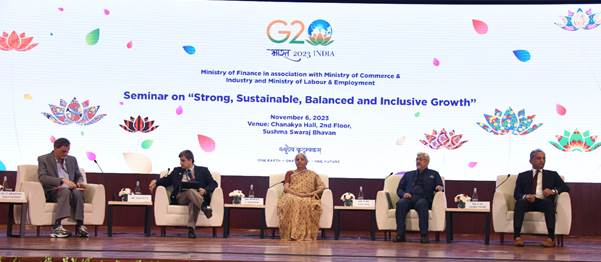
The G20 Leaders adopted the G20 New Delhi Leaders’ Declaration (NDLD) during the G20 Summit that was held in Delhi on September 9-10, 2023. One of the key themes of the NDLD was actions towards achieving Strong, Sustainable, Balanced and Inclusive Growth (SSBIG).

In her inaugural address, Smt. Sitharaman said, “The unanimously agreed G20 New Delhi Leaders’ Declaration (NDLD) addresses some of the pressing challenges confronting the global economy and also provides policy guidance for a future built on people-focused principles and trust-based partnerships.”

On the issue of skill gaps, the Union Finance Minister said that NDLD recognises that well-integrated and adequately skilled workers benefit origin and destination countries alike and also emphasises the importance of addressing skill gaps globally and provides comprehensive policy guidance in this respect.

Smt. Sitharaman underlined the G20 policy priorities for addressing skill gaps globally, facilitating cross-country comparability and mutual recognition of skills and qualifications and comprehensive tool kits for upskilling and reskilling, the areas that the NDLD has addressed.

Concluding her address, the Union Finance Minister said, “Drawing inspiration from India’s successful implementation of the India Stack, the G20 Policy Recommendations for Advancing Financial Inclusion through Digital Public Infrastructure (DPI) was endorsed in the New Delhi Leaders’ Declaration. These recommendations provide guidance on developing well-structured DPIs, establishing risk-managed regulatory frameworks, promoting strong governance, and ensuring that DPIs serve everyone. DPI is also embedded within the G20 New Financial Inclusion Action Plan for 2024-26.”

With India now the co-chair of the Global Partnership for Financial Inclusion, which is tasked with the implementation of the Action Plan, we will have a key role in building on the foundational work done during the Presidency year, Smt. Sitharaman added.

The seminar discussed and deliberated on the outcomes of the New Delhi Leaders Declaration 2023 with a focus on three issues: ‘Unlocking Trade for Growth’, ‘Preparing for the Future of Work’ and ‘Financial Inclusion and Productivity Gains through Digital Public Infrastructure for Strong and Sustainable Growth: The Way Forward’. These themes are key building blocks in the path towards achieving global economic recovery and inclusive growth.

The Panel Discussion on Unlocking Trade for Growth focused on the ‘Jaipur Call for Action for enhancing MSMEs access to information’, one of the outcomes from the Indian Trade and Investment Working Group (TIWG) Presidency. This outcome, endorsed by G20 Ministers and welcomed by Leaders in New Delhi Leaders’ Declaration, aims to solve the access to information problem faced by MSMEs and help them better integrate in the global trade. The panel deliberated on the profound impact that successful implementation of Jaipur Call for Action will have on increasing the level of participation of Indian MSMEs in exports and on potential challenges that could come in its way going ahead.
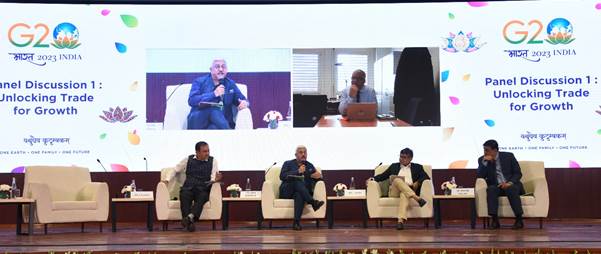
This discussion was moderated by Shri. Sunil Barthwal, Secretary, Department of Commerce and the panel comprised of Mr. Mondher Mimouni, Director, International Trade Centre, Geneva; Shri Prashant Kumar Singh, Director and CEO, Government e-Marketplace; Shri T. Koshy, MD & CEO, ONDC and Dr. Deepak Mishra, Director & Chief Executive, ICRIER, New Delhi.

The focus of the discussion was on how the ‘Jaipur Call for Action’ outcome is pathbreaking and going to change the future course of trade for MSMEs. International Trade Centre, the implementing agency for this outcome, shared its views on how valuable the implementation be, not only in Indian context but also for rest of the world. The discussion emphasised that the implementation would help streamline the export process, reduce trade costs and complement the ongoing initiatives of the Government of India to empower Indian MSMEs.

Addressing global skill gaps to prepare for a brighter ‘Future of Work’, Ministry of Labour and Employment (MoLE) organised a panel discussion as a follow-up to the 2023 G20 Leaders’ Summit and the New Delhi Leaders’ Declaration, to set a course for the future. The G20 Employment Working Group (EWG) and G20 Labour and Employment Ministers adopted policy priorities that included commitments to address Global skill gaps, as endorsed in the 2023 New Delhi Leaders’ Declaration.
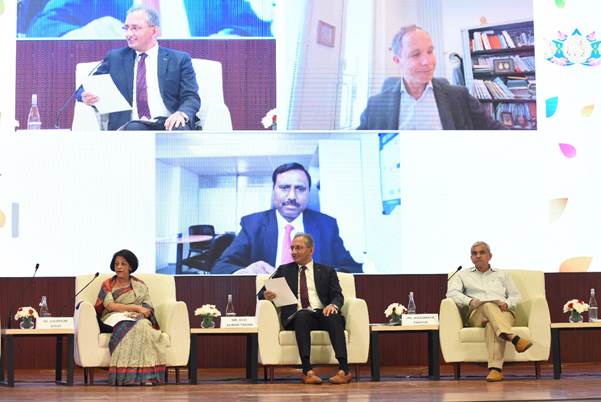
The distinguished panel was moderated by Shri Atul Kumar Tiwari, Secretary, Ministry of Skill Development & Entrepreneurship. The expert panel comprised of Mr. Srinivas B Reddy, Chief of Skills, and Employability Branch at ILO Geneva; Ms. S. Singh from the Confederation of Indian Industry; Mr. Mark Keese, Head of Skills and Employability Division at the Organisation for Economic Co-operation and Development; and Shri Hiranmay Pandya, President of Bharatiya Mazdoor Sangh.

The central theme of the conversation revolved around the pressing issue of worldwide skill deficits, emphasising the need for strategic planning and collaborative efforts efficiently bridge these gaps. The suggested approaches encompassed activities such as global skill gap assessment, strengthening national statistical data, extending the coverage of the ILO and OECD Skills for Jobs Databases to G20 nations, and striving to establish a global reference system that classifies occupations based on skill and qualification requirements, aligning the workforce with the ever changing global economy. The panellists underscored the significance of cooperation and alliance among all involved parties and stakeholders.

During the panel discussion on ‘Financial Inclusion and Productivity Gains through Digital Public Infrastructure for Strong and Sustainable Growth: The Way Forward’, discussions were held against the backdrop of the G20 Leaders’ endorsement of the G20 Policy Recommendations for Advancing Financial Inclusion and Productivity Gains through Digital Public Infrastructure (DPI).
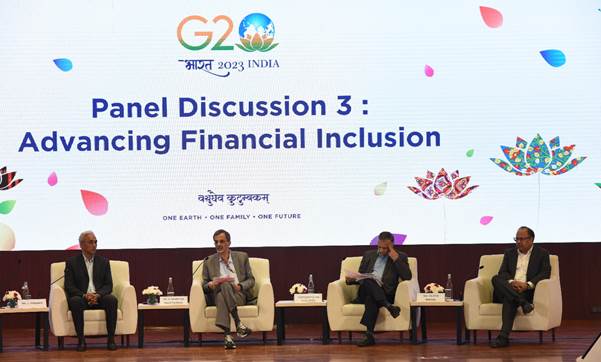
G20 leaders recognised the significant role of digital public infrastructure in helping to advance financial inclusion in support of inclusive growth and sustainable development. The Leaders also endorsed the G20 2023 Financial Inclusion Action Plan (FIAP), that will be implemented from 2024-2026.

Dr. V. Anantha Nageswaran, Chief Economic Adviser, Government of India, moderated the discussion and the expert panellists included Shri S. Ramann, Chairman and Managing Director, SIDBI; Shri Rajesh Bansal, Chief Executive Officer of RBI Innovation Hub; and Professor Sachin Chaturvedi, Director General, Research, and Information System for Developing Countries (RIS).

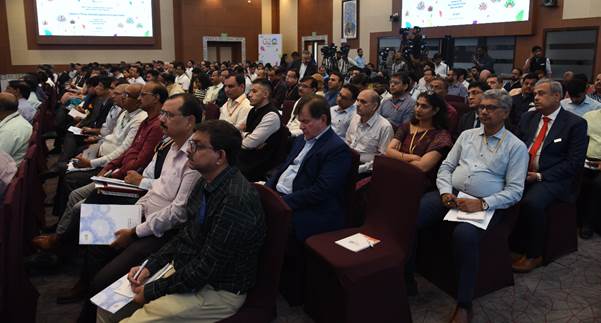
The discussion gathered ideas and fostered discussions on the way forward in leveraging innovative approaches, including DPI, to advance financial inclusion and growth on a global scale. Eminent thinkers, policymakers, and experts conveyed valuable insights and strategies with the potential to shape the future of financial inclusion at the event.

Dr. Nageswaran underscored the significance of the DPI approach to fast pace the global financial inclusion efforts and, therefore, achieve inclusive and sustained growth. The discussion examined possibilities for governments, regulators, and private entities to work together in creating, innovating, and enhancing a secure digital financial services environment. Additionally, it delved into the significant potential of Digital Public Infrastructure (DPI) within the framework of the recently embraced G20 policy recommendations concerning DPI’s role in advancing financial inclusion and productivity gains. The conversation also explored the prospects for leveraging DPI’s potential, both in the public and private sectors, to achieve robust, sustainable, and equitable growth within G20 nations and beyond.
Centre launches sale of ‘Bharat’ Atta at an MRP of Rs. 27.50/Kg

| Published on:

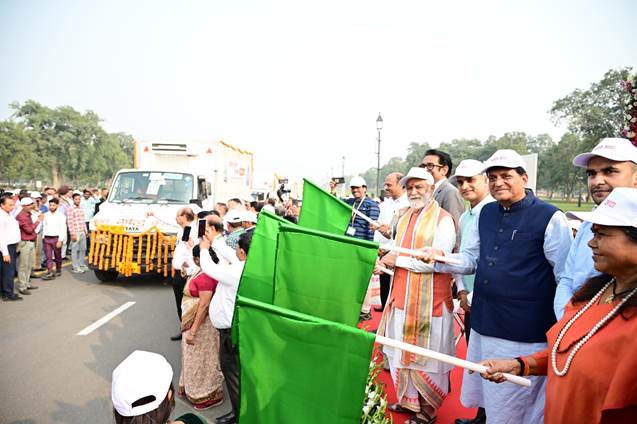
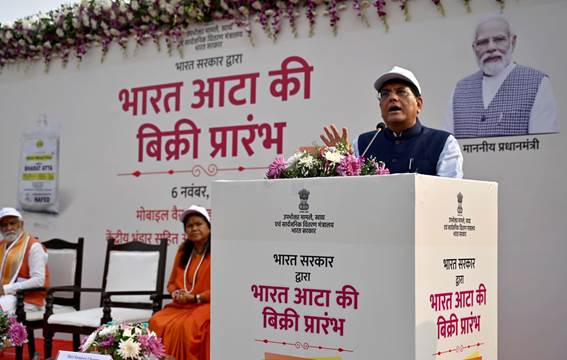
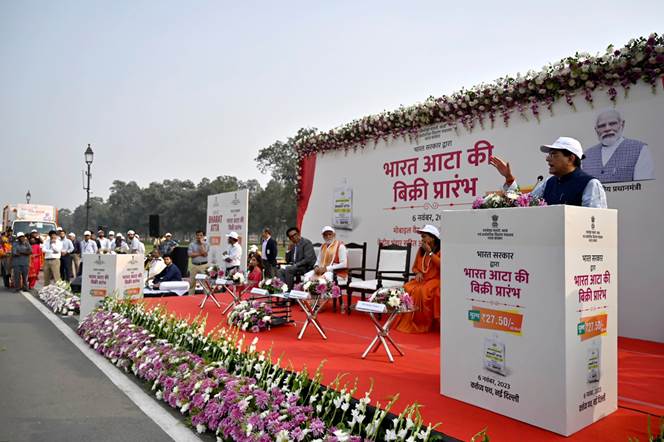
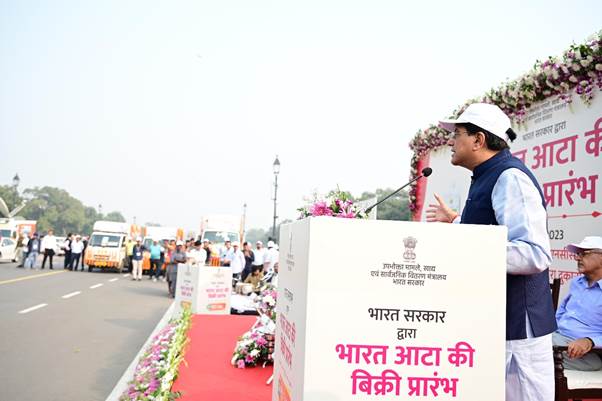
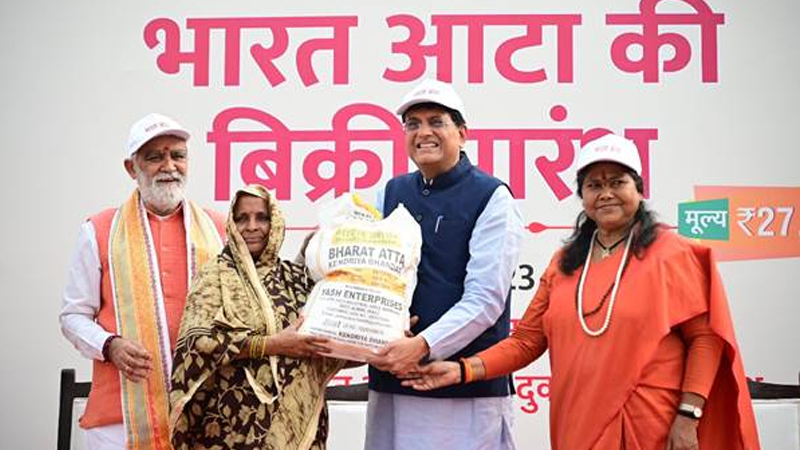
The Union Minister for Consumer Affairs, Food and Public Distribution, Textiles and Commerce and Industry, Shri Piyush Goyal flagged off 100 mobile vans for sale of wheat flour (Atta) under ‘Bharat’ brand, today from Kartavya Path, New Delhi. The atta will be available at an MRP not exceeding ₹ 27.50/Kg.  This is the latest among a series of steps taken by the GoI for the welfare of ordinary consumers. The launch of retail sale of ‘Bharat’ brand Atta will increase supplies in the market at affordable rates, and will help in continued moderation of prices of this important food item.

‘Bharat’ Atta will be available at all physical and mobile outlets of Kendriya Bhandar, NAFED and NCCF from today and will be expanded to other co-op/retail outlets.

2.5 LMT of wheat @ Rs.21.50/kg has been allocated for Semi-Government and cooperative organizations i.e. Kendriya Bhandar, NCCF and NAFED under Open Market Sale Scheme [OMSS (D)] for converting to atta and offer it for sale to the public under ‘Bharat Atta’ brand at an MRP not exceeding ₹ 27.50/Kg.

Speaking on the occasion, Shri Goyal said that Centre’s intervention has stabilised price of essential commodities. He said that various measures were taken in the past with regard to Tomato and Onion to cool off prices. In addition, the Centre is also providing Bharat Dal at Rs. 60 per kg through Kendriya Bhandar, NAFED and NCCF to provide relief to consumers.

He added that all these efforts have also benefitted farmers a great deal. Shri Goyal said that the produce of farmers is being purchased by the Centre and thereafter, is being provided to the consumers at a subsidised rate. He stressed that Centre’s intervention has led to stabilise prices of various commodities. He said that Prime Minister, Shri Narendra Modi has the vision to help the consumers as well as the farmers.

BACKGROUND:

The Government of India has taken a series of steps to stabilize the prices of essential food grains while also ensuring fair price to the farmers.

Bharat Dal (Chana dal) is already being sold by these 3 agencies @ Rs.60 per kg for 1kg pack and Rs.55 per kg for 30 kg pack from their physical and/or retail outlets, along with onions @ Rs.25 per kg. Now, with the launch of sale of ‘Bharat’ Atta, consumers can get Atta, dal as well as onions from these outlets at fair and affordable prices.

Policy interventions of GoI aim to benefit farmers as well as consumers. For the farmers, GoI fixes MSP (Minimum Support Price) of foodgrains, pulses as well as coarse grains and millets. Nationwide procurement operations are undertaken to implement the PSS (Price Support Scheme) which ensures the benefit of MSP to farmers. In RMS 23-24, 262 LMT of wheat was procured from 21.29 lakh farmers at the declared MSP of Rs.2125 per quintal. The total value of procured wheat was Rs.55679.73 crores. In KMS 22-23, 569 LMT of rice was procured from 124.95 lakh farmers at the declared MSP of Rs. 2060 per quintal for Grade ‘A’ paddy. The total value of procured rice was Rs. 1,74,376.66 crores.

The procured wheat and rice is offered completely free of cost under Pradhan Mantri Garib Kalyan Anna Yojana (PMGKAY) through a network of about 5 lakh FPS in the country to about 80 crore PDS beneficiaries. Further, about 7 LMT of coarse grains/millets were also procured at MSP and distributed under TPDS/Other Welfare Schemes in 22-23.

Many measures are taken for the benefit of ordinary consumers who are not covered under TPDS. Sale of ‘Bharat Atta’, ‘Bharat Dal’ and tomatoes and Onions at affordable and fair prices is one such measure. So far, 59183 MT dal has already been sold, benefitting ordinary consumers.

Food Corporation of India (FCI) is conducting Nationwide weekly e-auctions for sale of wheat under OMSS(D). Only wheat processors (Atta chakkis /roller flour mills) can participate in these weekly e-auctions. FCI is offering FAQ and URS Wheat for sale @Rs. 2150 and 2125 per quintal respectively, in accordance with the prices fixed by Government.  Traders are not allowed to participate in the e-auction as the intent of the Government is to ensure that purchased wheat is directly processed and released to ordinary consumers at affordable prices. Each bidder can take upto 200 MT in the weekly e-auction. FCI is offering 3 LMT of wheat for sale in the weekly e-auctions under OMSS(D). So far, 65.22 LMT of wheat has already been released into the open market by FCI as per Government directions.

Government of India has significantly increased the total amount of wheat to be offered for sale under OMSS (D) to 101.5 LMT till March 2024, instead of 57 LMT till December 2023 as part of a series of measures taken to moderate wheat prices. A significant decision has been taken to  offload a further quantity of upto 25 LMT (over and above 101.5 LMT) of wheat from the buffer stock, if needed, by 31.3.2024.

Export of wheat has already been banned in order to ensure sufficient domestic availability of this commodity. Government has also imposed limits on stock holding of wheat by different categories of entities like wholesalers/traders, processors, retailers and big chain retailers, to prevent hoarding. Stock holding of wheat is being monitored on a regular basis, so as to ensure that wheat/atta is released into the market by traders, processors and retailers on a regular basis, and there is no stockpiling/hoarding.  These steps are taken to check increase in the market prices of wheat by increasing its supplies.

Government has also banned export of non- basmati rice and imposed a floor price of USD 950 for export of Basmati rice. Under OMSS(D) FCI is offering 4 LMT of rice for sale in the weekly e auctions, to increase availability of rice in the domestic market. FCI is offering Rice for sale @Rs. 29.00-29.73/ Kg  in accordance with the prices fixed by Government.

Government has shown unwavering commitment for welfare of sugarcane farmers as well as domestic consumers. On one hand, with payment of more than ₹ 1.09 lakh crores to farmers, more than 96% cane dues of last sugar season have already been paid leading to the lowest cane dues pendency in the sugar sector history. On the other hand, Indian consumers are also getting one of the cheapest sugar in the world. While global sugar prices are touching 13 years high with increase of about 40% in one year, retail prices of sugar in India have just 2% inflation in last 10 years and less than 5% inflation in last one year.

Government of India is closely monitoring the domestic retail prices of edible oils to ensure that the full benefits of decrease in international prices is passed on to the end consumers. Government has taken following measures in order to control and ease the prices of edible oils in the domestic market: –

  • The Basic Duty on Crude Palm Oil, Crude Soyabean Oil and Crude Sunflower Oil was reduced from 2.5% to Nil. Further, the Agri-cess on these Oils was brought down from 20% to 5%.  This duty structure has been extended upto 31st March, 2024.
  • The Basic Duty on Refined Soybean oil and Refined Sunflower Oil was reduced to 17.5% from 32.5% and the Basic Duty on Refined Palm Oils was reduced from 17.5% to 12.5% on 21.12.2021. This duty has been extended up to 31st March, 2024.
  • In order to maintain availability, the Government has extended the free import of Refined Palm Oils till further orders.
  • In the latest initiative taken by the Government, the import duty on Refined Sunflower Oil and Refined Soybean Oil has been reduced from 17.5% to 12.5% with effect from 15.06.2023.


The international prices of major Edible oils such as Crude Soybean Oil, Crude Sunflower Oil, Crude Palm Oil and Refined Palm Oils are showing a decreasing trend since last year. Due to continuous efforts made by the Government to ensure that the decrease in the international prices of edible oils get passed on fully in the domestic market, the retail prices of Refined Sunflower Oil, Refined Soybean Oil and RBD Palmolien have decreased by 26.24%, 18.28% and 15.14% as on 02.11.2023 respectively over a year.

Department of Consumer Affairs monitors the daily retail and wholesale prices of 22 essential food commodities through 545 price monitoring centres set up in 34 States/UTs. The daily report of prices and indicative price trends are duly analysed for taking appropriate decisions for release of stocks from the buffer to cool down prices, imposition of stock limits to prevent hoarding, changes in trade policy instruments like rationalization of import duty, changes in import quota, restrictions on exports of the commodity etc.

Price Stabilization Fund (PSF) has been set up  to check the volatility in the prices of agri-horticultural commodities in order to mitigate the hardships faced by consumers. The objectives of PSF are (i) to promote direct purchase from farmers/farmers’ associations at farm gate/mandi; (ii) to maintain a strategic buffer stock to discourage hoarding and unscrupulous speculation; and (iii) to protect consumers by supplying such commodities at reasonable prices through calibrated release of stock. The consumers and farmers are the beneficiaries of the PSF.

Since the inception of Price Stabilisation Fund (PSF) corpus in 2014-15 till date, the Government has provided budgetary support of Rs.27,489.15 crore for providing working capital and other incidental expenses for the procurement and distribution of agri-horticultural commodities.

Currently, under the PSF, dynamic buffer stock of pulses (Tur, Urad, Moong, Masur and Gram) and onion are being maintained. The calibrated release of stocks from pulses and onion buffer have ensured availability and affordability of pulses and onion to the consumers and purchase for such buffer has also contributed to providing remunerative prices to farmers of these commodities.

In order to check the volatility in prices of tomato and make it available to the consumers at affordable prices, the Government had procured tomatoes under Price Stabilisation Fund and is made it available at a highly subsidised rate to consumers. The National Cooperative Consumers Federation (NCCF) and National Agricultural Cooperative Marketing Federation (NAFED) has procured tomato from mandis in Andhra Pradesh, Karnataka and Maharashtra and making it available at affordable prices in major consuming centres in Delhi-NCR, Bihar, Rajasthan, etc. after subsidizing the price to the consumers. The tomatoes have been disposed initially at retail price of Rs.90/- per kg which has been reduced successively to Rs.40/kg for the benefit of consumers.

In order to check the volatility in prices of onion, the Government maintains onion buffer under the PSF. The buffer size has been increased year after year from 1.00 LMT in 2020-21 to 2.50 LMT in 2022-23. The onions from the buffer are released in major consumption centres during the lean season from September to December in a calibrated and targeted manner to cool down prices. The onion buffer target for 2023-24 has been enhanced further to 5 LMT. The disposal of onion from the buffer in major markets where prices have increased has commenced. As on 28.10.2023, about 1.88 LMT has been dispatched to destination markets for disposal. Further, Government has decided to procure 2 LMT additional Onion for PSF buffer during 2023-24 over and above 5.00 LMT already procured. The Govt. has imposed Minimum Export Price (MEP) of $800 per ton on onion on 28.10.2023 to check price rise and improve supplies in the domestic market.

To augment domestic availability and moderate the prices of pulses, import of tur and urad have been kept under ‘Free Category’ till 31.03.2024 and import duty on masur has been reduced to zero till 31.03.2024. Import duty of 10% on tur has been removed to facilitate smooth and seamless imports.

To prevent hoarding, stock limits has been imposed on tur and urad under the Essential Commodities Act, 1955 till 31.12.2023.

Stocks of chana and moong from the Price Support Scheme (PSS) and Price Stabilisation Fund (PSF) buffer are continuously released in the market to moderate prices. Chana is also supplied to the States at a discount of Rs.15/kg for welfare schemes.

Further, the government introduced the mechanism to convert chana stock into chana dal for retail disposal under the brand name of “Bharat Dal” at highly subsidized rate of Rs.60/kg for 1kg pack and Rs.55/kg for 30kg pack in order to make pulses available to consumers at affordable prices by converting chana stock of the government into chana dal. Bharat Dal is being distributed through retail outlets of NAFED, NCCF, HACA, Kendriya Bhandar and Safal. The chana dal, under this arrangement, is also made available to state governments for supplies under their welfare schemes, police, jails, and also for distribution through the retail outlets of state government-controlled cooperatives and corporations.

GoI stands committed to ensure the welfare of its farmers, PDS beneficiaries as well as ordinary consumers by ensuring minimum support prices for farmers, free rations (wheat, rice and coarse grains/millets) under PMGKAY for Antyodaya and Priority households and fair and affordable rates of wheat, atta, dal and onions/tomatoes as well as sugar and oil, for ordinary consumers.

Dharmendra Pradhan co-chairs 1st Australia India Education and Skill Council meeting (AIESC) in Gandhinagar

| Published on:

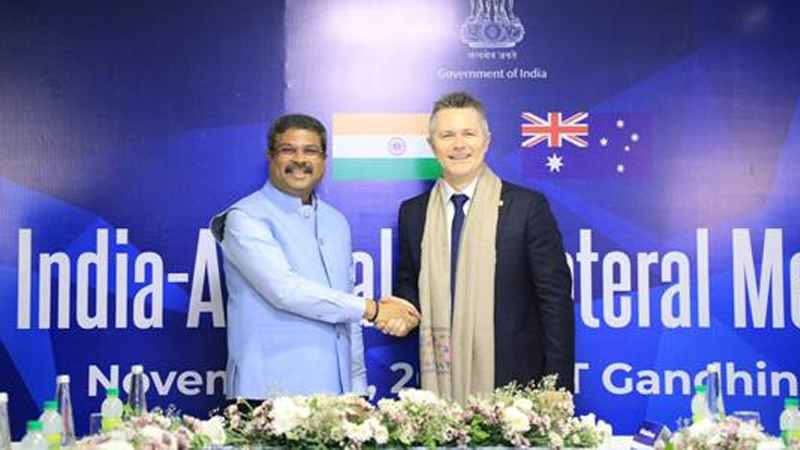
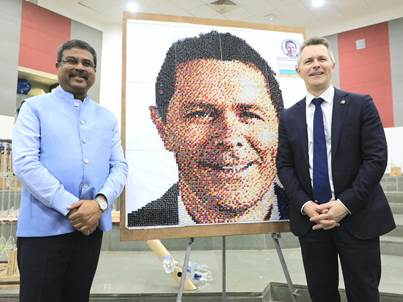
Union Minister for Education and Skill Development, Shri Dharmendra Pradhan held a bilateral meeting with his Australian Counterpart, HE Jason Clare, MP, Education Minister today.

Shri Pradhan extended a warm welcome to Australian Minister for Education HE Jason Clare, MP. This is Minister Clare’s second visit to India this year. Shri Pradhan said that the frequent meetings are a testament to the growing strength and dynamism of India-Australia knowledge partnership. He expressed his happiness for the steady progress in the areas of mutual recognition of qualifications, establishment of joint working group, joint skill collaborations, collaboration between HEIs for joint degrees, study in India, internationalisation of India’s education, visa-related issues for Indian students and research scholars, among others.

Both the Ministers comprehensively reviewed the bilateral cooperation in education and skilling and agreed to further strengthen knowledge and skilling partnerships for greater mobility, employability and prosperity of people in both our countries.

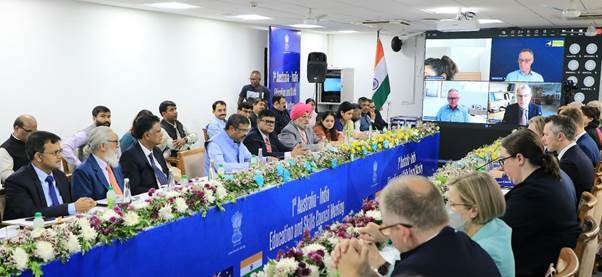
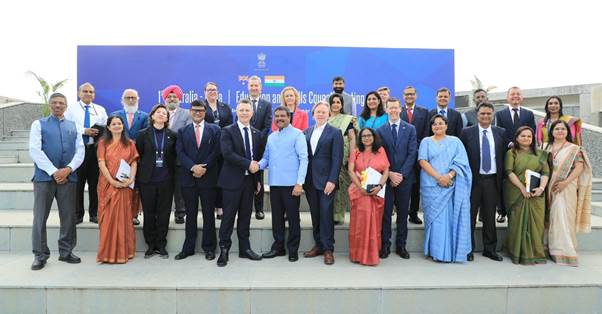
Shri Pradhan co-chaired the 1st Australia India Education and Skill Council meeting with Australian Ministers HE Jason Clare, MP, Education Minister and HE Brendan O’Connor, Skills & Training Minister in Gandhinagar.

The AIESC, earlier the Australian India Education Council (AIEC), is a bi-national body established in 2011 to guide the strategic direction of the education, training and research partnerships between the two countries. The scope of this forum was enhanced in alignment with the national priorities of both countries to bring focus on promoting internationalisation, two-way mobility and collaboration in the domains of education as well as the skill ecosystem. This is for the first time that education and skilling is being brought under the same institutional forum.

During the meeting, Shri Pradhan highlighted 2023 as a landmark year for Australia and India, particularly for cooperation in the areas of education and skill development. The inaugural Australia-India Education and Skills Council meeting will act as a catalyst in charting new roadmaps for building stronger knowledge bridges, advancing  mutual priorities in education and skill development, boosting people-to-people linkages and establishing the knowledge vertical as one of the strongest pillars of India – Australia ties, he stated.

He further said that education and skills as a primary and priority area of our bilateral engagements reflects PM Shri Narendra Modi’s and Australian PM, HE Anthony Albanese’s  commitment to strengthening knowledge bridges. The immensely successful inaugural Australia-India Education and Skills Council meeting has paved the way for ‘more cooperation, more collaboration and more mobility’ in identified priority areas, he added.

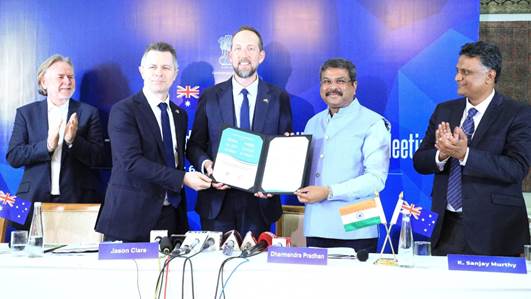
He informed that 5 MoUs between Australian and Indian HEIs have been exchanged today to facilitate greater research collaborations in areas like, agriculture, water management, critical minerals, healthcare, AI, renewable energy and climate change. This is going to create more opportunities for advancing educational, research and innovation priorities, student and faculty exchanges, more twining programs/dual degrees, he added.

Shri Pradhan further said that focused on outcome-oriented roadmap for the decade, AIESC will be the key for envisioning a brighter future for both Australia and India. He also thanked the Australian Ministers and their team for taking this platform to the next level of engagement where Indian students and skilled workers can explore better and more meaningful avenues for their careers and livelihood.

HE Mr. Jason Clare, MP in his address mentioned how the future of the countries will be shaped with the help of meaningful partnership in the areas of education and skilling. He mentioned the 450 existing research partnerships between the two countries. He also commented that collaboration at the governmental, institutional and industry levels will further strengthen the tie-up and benefit both countries.

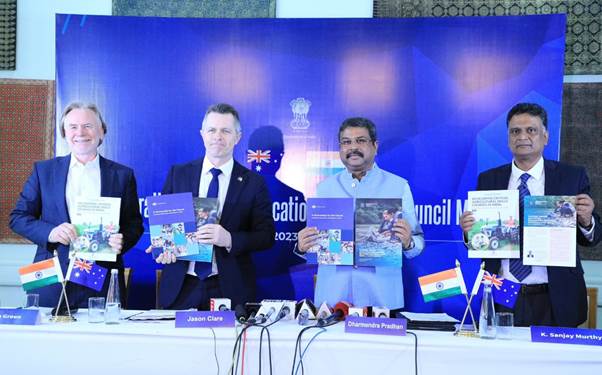
Shri Dharmendra Pradhan and HE Mr. Jason Clare, MP also addressed a joint Press Conference after the completion of the 1st Australia-India Education and Skills Council Meeting (AIECS). Secretary, Higher Education, Ministry of Education, Shri K Sanjay Murthy and Australia’s High Commissioner to India, Mr. Philip Green, OAM were also present at the Press conference.

The Ministers welcomed the imminent opening of the campuses of University of Wollongong and Deakin University at the Gujarat International Finance Tec-City (GIFT City). Ministers also welcomed ongoing Institutional collaboration in research, between top Indian Institutes like the IITs with top Australian Universities.

Both the Ministers reaffirmed their joint commitment to implement qualification recognition arrangements under the Mechanism for the Mutual Recognition of Qualifications and acknowledged the work done by the Australia-India Qualifications Recognition Steering Committee.  Regarding research collaborations, Shri Pradhan mentioned that India is working on the Phase III of the Scheme for Promotion of Academic and Research Collaboration (SPARC) Programme and priority areas would include joint projects in critical minerals, rare earths and other mutually agreed priority areas.  India has earmarked 2.5 million USD for Joint Research Projects with Australia.

Details of the MoUs exchanged are as follows:

  1. Innovative Research Universities consortium campus:

The Innovative Research Universities (IRU) is a coalition of 7 public universities across Australia: Flinders University, James Cook University, La Trobe University, Murdoch University, Griffith University, University of Canberra, and Western Sydney University. The objective of the IRU’S MOU is to provide a framework for closer cooperation between parties in strengthening the Australia-India education partnership. Under the MOU, participating members will work together to explore the potential for a consortium approach to in-country delivery of degrees in India and expand in-country access to Australian higher education for Indian students.

  1. Deakin University and National Skills Development Corporation (NSDC):

In partnership with India’s National Skills Development Corporation (NSDC), Deakin University has developed the ‘Global Job Readiness Program’ (GJRP) to address skills shortages in India. This 30-hour program will be delivered online and aims to upskill 15 million Indians over three years. The GJRP focuses on skills in highest demand among employers. Its mission is to produce a program to address the gap in life and workplace skills that Indian employers regularly point to as a hindrance to business and ensure the program is both affordable and accessible to the majority of India’s youth.

  1. Deakin University and IIT Gandhinagar:

With the establishment of Deakin University’s campus at GIFT City, the key objective through the alliance with IIT Gandhinagar is to provide support for a quality higher education and research ecosystem in the local region.The partnership will focus on collaboration in science and innovation, mobility, faculty exchange, and joint doctoral programs. It will also promote collaboration for bilateral funding opportunities and knowledge exchange through joint grant proposals, conferences and workshops. The collaboration with Deakin will provide an opportunity for IIT Gandhinagar students to transfer into higher studies and research at Deakin University both in Australia and at GIFT City. The collaboration will enable Deakin University to broaden its engagement in India through a high-quality partnership.

  1. Monash University and Indian Institute of Technology Hyderabad:

This MoU is for collaboration on academic and research activities in the area of critical minerals and other areas of mutual interest. The MoU includes the exchange of academic materials, scholars and students and cooperative seminars, workshops and other academic activities.

5. Monash University and International Center of Excellence in Mining (ICEM):

This MoU aims to foster research and innovation collaboration between Monash and iCEM to in support of the mining and mineral development sector in India. A focus will be cooperation in reducing the impact of mining on climate change, increasing its efficiency and on enhancing capabilities in critical minerals and rare earth elements.

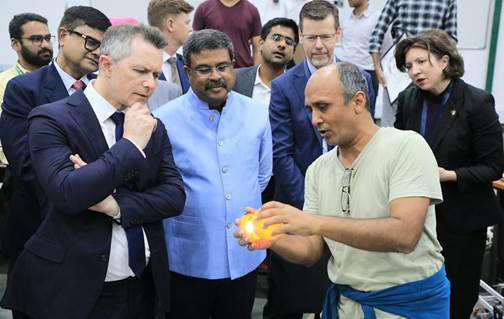
Later in the day, both the Ministers and other delegates visited the Centre for Creative Learning, IIT Gandhinagar, which is a space that nurtures scientific temper and the inherent creativity in students and teachers. Centre for Creative Learning has added new dimensions to joyous and experiential learning by encouraging creative arts, toy-based activities and DIY techniques as a pedagogy. Igniting the spark of curiosity and creativity CCL is making science and math fun for children.

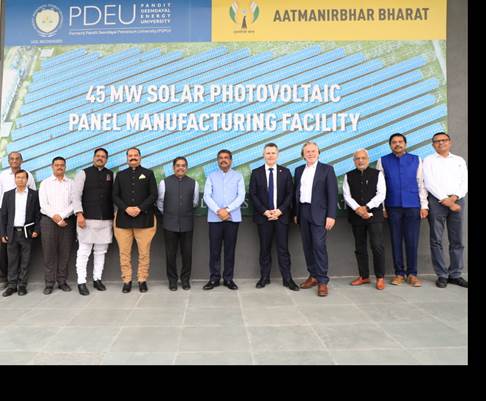
They also visited Pandit Deendayal Energy University (PDEU) and Vidya Samiksha Kendra (VSK).

PM inaugurates World Food India 2023

| Published on:

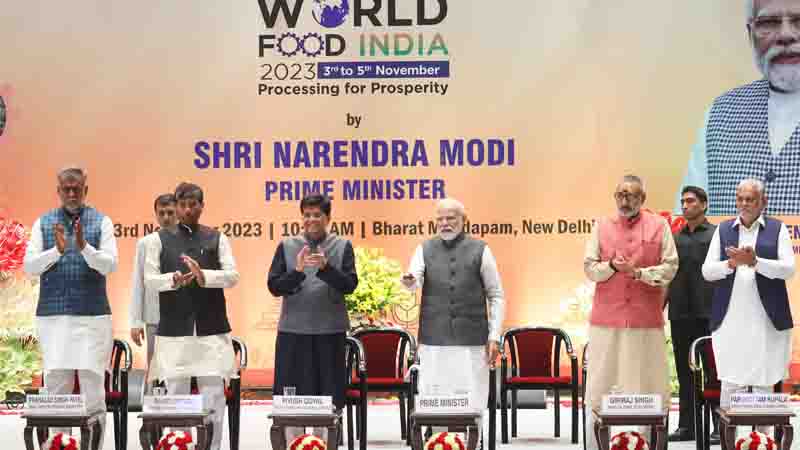
The Prime Minister, Shri Narendra Modi inaugurated the second edition of the Mega food event ‘World Food India 2023’ at Bharat Mandapam, Pragati Maidan, in New Delhi today. He disbursed Seed Capital Assistance for over one lakh SHG members to strengthen Self Help Groups. Shri Modi also took a walkthrough of the exhibition showcased on the occasion. The event aims to showcase India as the ‘food basket of the world’ and celebrate 2023 as the International Year of Millets.

Addressing the gathering, the Prime Minister hailed the technology and startup pavilion and food street showcased on the occasion and said that the fusion of technology and taste will pave the way for the economy of the future. In the changing world of today, the Prime Minister highlighted one of the prime challenges of food security and underlined the significance of World Food India 2023.

Prime Minister Modi underlined that the outcomes of World Food India are a huge example of India’s food processing sector being recognized as the ‘sunrise sector’. In the last 9 years, the Prime Minister informed that the sector has attracted foreign direct investment of more than Rs 50,000 crores as a result of the government’s pro-industry and pro-farmer policies. Throwing light on the PLI scheme in the food processing sector, the Prime Minister said that it is providing huge assistance to the new players in the industry. He mentioned that work is underway on thousands of projects under the Agri-Infra Fund for post-harvest infrastructure with an approximate investment of more than Rs 50,000 crores while processing infrastructure in the fisheries and animal husbandry sector is also being encouraged with an investment of thousands of crores.

“The investor-friendly policies by the government are taking the food sector to new heights”, Shri Modi remarked. In the last 9 years, the Prime Minister informed that the share of processed foods in India’s agricultural exports has grown from 13 percent to 23 percent, making an overall increase of 150 percent of exported processed foods. “Today, India stands at the 7th position with an overall export value of more than 50,000 million USD in agricultural produce”, he informed. He underlined that there is no sector in the food processing industry where India has not shown unprecedented growth and said that it is a golden opportunity for every company and start-up associated with the food processing industry.

Prime Minister Modi credited the consistent and dedicated efforts by the government behind the speedy and rapid growth in India’s food processing industry. He mentioned the creation of Agri-Export Policy for the first time in India, the development of nationwide logistics and infrastructure, the creation of more than 100 district-level hubs connecting the district to the global markets, increase in the number of Mega Food Parks from 2 to more than 20, and India’s food processing capacity increasing from 12 lakh metric tonnes to more than 200 lakh metric tonnes, which is a 15 time increase in the last 9 years. The Prime Minister gave examples of agricultural produce that are being exported from India for the first time and mentioned black garlic from Himachal Pradesh, dragon fruit from Jammu & Kashmir, soya milk powder from Madhya Pradesh, Karkitchoo apples from Ladakh, Cavendish banana from Punjab, Gucchi Mushrooms from Jammu, and Raw honey from Karnataka.

Noting the rapid urbanization of India, the Prime Minister drew attention to the increasing demand for packaged food creating unexplored opportunities for farmers, start-ups and small entrepreneurs. Shri Modi emphasized the need for ambitious planning to make full use of these possibilities

The Prime Minister underlined the three main pillars of India’s growth story in the food processing sector – small farmers, small industries, and women. He highlighted the effective usage of Farmer Produce Organizations or FPOs as a platform to increase the participation and profits of small farmers. “We are making 10 thousand new FPOs in India, out of which 7 thousand have already been made”, he informed. He noted the increased market access and availability of processing facilities for farmers and also informed that about 2 lakh micro enterprises are being organized in the food processing industry to increase the participation of Small Scale Industries. “Schemes like ‘One District One Product’- ODOP are also giving a new identity to small farmers and small industries”, he added.

Throwing light on the path of women-led development in India, the Prime Minister highlighted the increasing contributions of women to the economy thereby benefiting the food processing industry. He informed that more than 9 crore women in India are associated with self-help groups today. Underlining that women have taken the lead in food science in India for thousands of years, the Prime Minister said that the food variety and food diversity in India is a result of the skills and knowledge of Indian women. He stated that women have been running the market of many products like pickles, papads, chips, murabba etc. from their homes. “Indian women have the natural ability to lead the food processing industry”, Shri Modi remarked as he informed that cottage industries and self-help groups are being promoted at every level for women. PM Modi mentioned disbursing seed capital worth crores of rupees to more than 1 lakh women on today’s occasion.

“There is as much food diversity in India as there is cultural diversity. India’s food diversity is a dividend for every investor in the world”, the Prime Minister remarked. Noting the increased interest in curiosity towards India, the Prime Minister emphasized that the food industry around the world has a lot to learn from the food traditions of India. He said that India’s sustainable food culture is the result of thousands of years of its development journey. Throwing light on the evolution of India’s sustainable food culture over thousands of years, the Prime Minister underlined that India’s ancestors linked food habits with Ayurveda. “In Ayurveda, it is said ‘Rita-Bhuk’ i.e. eating according to the season, ‘Mit Bhuk’ i.e. balanced diet, and ‘Hit Bhuk’ i.e. healthy foods, these are important parts of India’s scientific understanding”, he explained. He also noted the perpetual impact of trade in food grains, especially spices from India on the world. Speaking about Global Food Security, the Prime Minister stressed the need for the food processing industry to understand and implement the ancient knowledge of sustainable and healthy food habits. Shri Modi acknowledged the world celebrating 2023 as the International Year of Millets. “Millets are a part of India’s ‘superfood bucket’ and the government has identified it as Shri Anna”, Shri Modi said. Even though millets were given great priority in most civilizations for centuries, the Prime Minister pointed out that it had made its way out of the food habit in many countries including India in the last few decades, thereby causing huge damage to global health, sustainable farming as well as sustainable economy. “On India’s initiative, an awareness campaign regarding millets has started in the world”, the Prime Minister said expressing confidence that millets reach every corner of the world similar to the impact of International Yoga Day. He mentioned dishes made from millets for dignitaries visiting India during the recent G-20 summit as well as the availability of processed food items made from millets in the market. Prime Minister Modi urged the dignitaries on the occasion to discuss ways to increase the share of Shri Anna and prepare a collective roadmap for the benefit of the industry and the farmers.

Shri Modi said that the G-20 group has emphasized sustainable agriculture, food security and nutrition security in the Delhi declaration, and highlighted the role of all partners associated with food processing. He stressed moving the food distribution program towards a diversified food basket and eventually minimizing post-harvest losses. He also stressed reducing wastage by making use of technology. He urged to increase the processing of perishable products to reduce wastage, thereby benefiting farmers and preventing price fluctuations. Concluding the address, the Prime Minister underlined the need to strike a balance between the interests of farmers and consumers’ satisfaction. He expressed confidence that the conclusions drawn here will lay the foundation of a sustainable and food-secure future for the world.

Union Minister for Consumer Affairs, Food and Public Distribution, Shri Piyush Goyal, Union Minister for Food Processing Industries, Shri Pashupati Kumar Paras, Union Minister for Rural Development, Shri Giriraj Singh, Union Minister of State for Animal Husbandry, Dairying and Fisheries, Shri Parshottam Rupala, and Union Minister of State for Food Processing Industries, Shri Prahlad Singh Patel were present on the occasion among others.

Background

To strengthen Self Help Groups, the Prime Minister disbursed Seed Capital Assistance for over one lakh SHG members. This support will help SHGs gain better price realization in the market through improved packaging and quality manufacturing. The Prime Minister also inaugurated Food Street as part of World Food India 2023. It will feature regional cuisines and royal culinary heritage, wherein over 200 chefs will participate and present traditional Indian cuisine, making it a unique culinary experience.

The event aims to showcase India as ‘food basket of the world’ and celebrate 2023 as the International Year of Millets.  It will provide a networking and business platform for government bodies, industry professionals, farmers, entrepreneurs and other stakeholders to engage in discussions, establish partnerships, and explore investment opportunities in the agri-food sector. CEOs roundtables will focus on investment and Ease of Doing Business.

Various pavilions will be set up to showcase the innovation and strength of the Indian food processing industry. The event will host 48 sessions focusing on various aspects of the food processing industry, emphasizing financial empowerment, quality assurance and innovations in machinery and technology.

The event is poised to host participants from over 80 countries, including CEOs of prominent food processing companies. It will also feature a Reverse Buyer Seller Meet, with over 1200 overseas buyers from over 80 countries. The Netherlands will serve as the partner country, while Japan will be the event’s focus country.

Indian consumers are now demanding high quality goods and services: Piyush Goyal

| Published on:

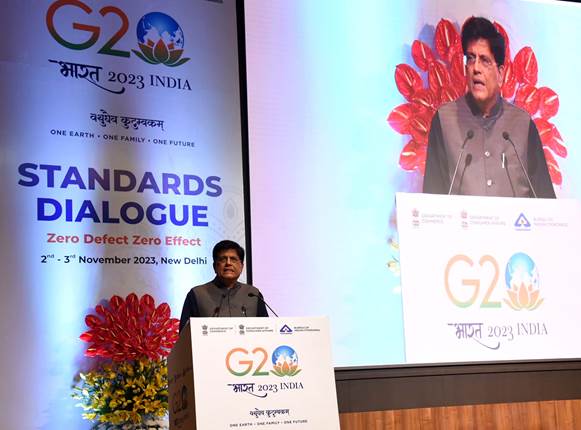
Union Minister for Consumer Affairs, Food and Public Distribution, Textiles and Commerce and Industry, Shri Piyush Goyal has said that Indian consumers are now demanding high quality goods and services and to ensure that, the Government is giving help and reasonable time to producers to adapt to new quality standards and ensure that India becomes recognized as a provider of good quality products.

He was speaking at the concluding session of ‘G20 Standards Dialogue’ at Bharat Mandapam in New Delhi today.

Shri Goyal said that it is important to ensure harmonization of standards with international bodies, to help India adopt standards that are globally accepted. He mentioned that India needs to get out of the mindset of two standards of everything. Our effort is that every product that is made in India will be a high quality product, Shri Goyal said.

Shri Goyal said that if consumers pick up a product in India they should be assured of high quality. He said that developed nations have a lot to share in this regard, and therefore, a robust framework should be created through regular engagements like G20 Standards Dialogue, for the countries who need it. He said that in next few years India will upgrade it’s standards ecosystem like test labs and hopefully have mutual recognition agreements with other countries as well so that quality is achieved for a better and prosperous future for Mother Earth and every citizen of the world.

Shri Goyal said that the theme of the Dialogue ‘Zero Defect, Zero Effect’ was articulated by Hon’ble Prime Minister, Shri Narendra Modi about 9 years ago. He said that PM is an evangelist for sustainability and has been on the forefront to create an awareness within the country and internationally about the need for collective action. He said that it’s his vision that sustainability becomes one inclusive paradigm.

Shri Goyal stressed that even common man recognizes the importance of sustainable growth and every citizen recognizes that growth will have to be inclusive so that no one is left behind. He said that United Nations Sustainable Development Goals are also the core elements to provide the roadmap, on standards and on sustainability.

“And I’m sure the goal for Zero Hunger, the goal for health and wellness, the goal for a better quality of life for every citizen will be important for all of us to keep in mind when we debate on this important subject-Affordable Clean Energy,” Shri Goyal said.

The Union Minister said that the Affordable Clean Energy is an integral part of sustainable growth where India is look at recycling, reuse, and overall at ensuring how ‘waste can be kept to a bare minimum’, which is absolutely unavoidable. “That is the road forward. That is the pathway before us,” he said adding on that government desire only to act as a facilitator and not as a disrupter of the processes.

He said that if India produce the products and provide good services, the world is its stage.

Dharmendra Pradhan and H.E. Sultan Ahmed bin Sulayem, Chairman & CEO of DP World witness signing of agreement between NSDC International and We One, DP World

| Published on:

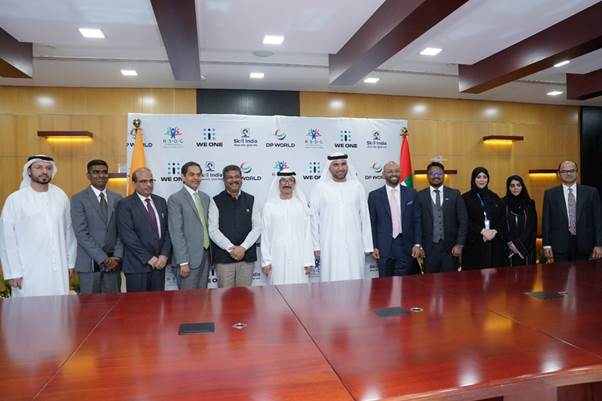
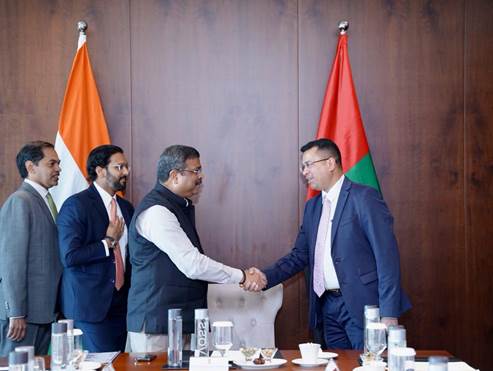
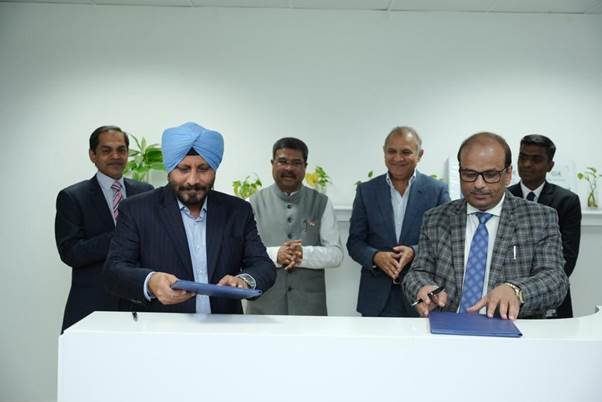
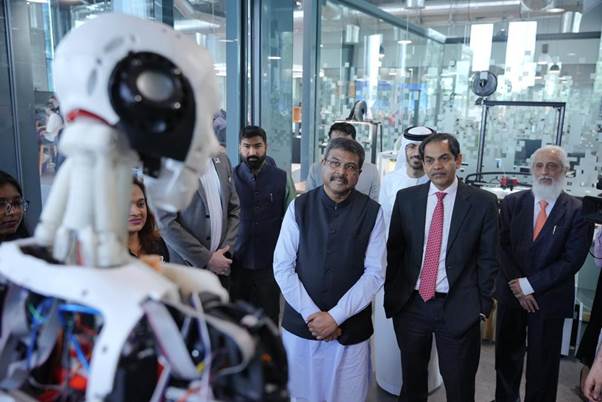
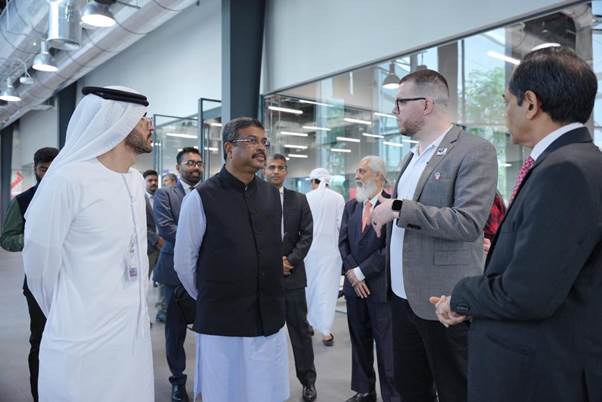
Union Minister for Education and Skill Development & Entrepreneurship, Shri Dharmendra Pradhan met H.E. Sultan Ahmed bin Sulayem, Group Chairman & CEO of DP World in Dubai, where they witnessed signing of an agreement between NSDC International and We One, a subsidiary of DP World for long term recruitment of skilled manpower. They also discussed opportunities for collaboration.

Speaking on the occasion Shri Pradhan said that the agreement will create more avenues for global talent mobility, skilling and connecting Indian youth to relevant overseas employment opportunities. India is a reservoir of wide-range of talent, he added. Shri Pradhan reaffirmed commitment to fulfil aspirations of India’s youth and prepare them to drive economic prosperity, not only for India but also for global economies. in the presence of Shri Sunjay Sudhir, the Ambassador of India to the UAE and Consul General of India to Dubai, Shri Satish Kumar Sivan, CEO, NSDC, Shri Ved Mani Tiwari along with other senior officials.

NSDC International, is an enabler for global skilling solutions and We One, part of DP World, is a global leader in providing smart end-to-end logistics solutions.They   signed an agreement today which aimed at supporting the skill development and employment opportunities for the front-line workforce.

The signing event comes in continuation of a Memorandum of Understanding inked in May 2022 between NSDC International and Hindustan Ports (a DP World Company) to establish the Skill India International Centre in Varanasi, as a global centre of excellence for skills. In line with this, DP World collaborated with NSDC to set up the Skill India International Centre at Varanasi, which provides front-line workforce with services such as skill training, counselling, mobilisation, pre-departure orientation, foreign language training, placement and immigration and post-placement support.

Shri Pradhan also had a fruitful meeting with teams of VFS Global and Transworld today. He commended the insightful conversations on working together to connect India’s youth with overseas opportunities, strengthening the training infrastructure in India as well as collaborations for building capacities in skill development. Creating more opportunities for skilling, apprenticeship and employment and making our youth future-ready is a priority of PM Shri Narendra Modi’s government, he added. He appreciated both VFS Global and Transworld Group for their keenness to be an active partner of India in securing futures, empowering youth and in making the skill landscape more vibrant.

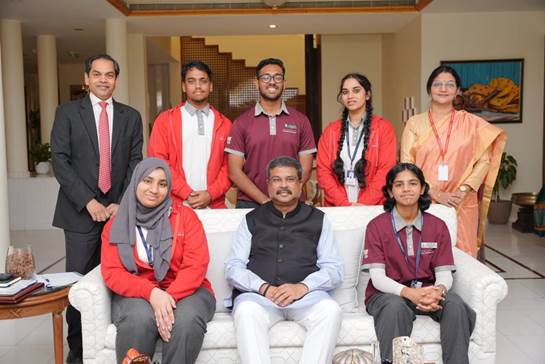
The Minister, yesterday, held an interaction with Principals of all 105 CBSE-affiliated schools functioning in the UAE. He was happy to learn that all these schools are aligned to the vision of NEP 2020 and are implementing it on ground. Shri Pradhan highlighted great insights on ways in which Indian schools abroad can integrate global best practices to cater to the needs of our students and teachers.

Of the 5-lakh Indian students studying in CBSE-affiliated Indian schools in the GCC, more than 2.50 lakh students are there in the UAE, he added. He shared that in the wake of the long-pending demand of these schools, CBSE India has decided to open a regional office in Dubai for better administration and for the benefit of the Indian diaspora.

Shri Pradhan said that academic community and our diaspora are permanent ambassadors of our culture, values and knowledge systems. He expressed his confidence that ,going forward, education will be a key pillar of friendship and our CBSE-affiliated schools in the UAE will play a stellar role in further cementing our trusted friendship.

The Minister also held a meeting with EFS Facilities Services Group, Group CEO & Co-founder Mr. Tariq Chauhan. The Minister expressed his happiness to know about Shri Tariq Chauhan’s plans to partner India in strengthening the skill ecosystem as well as facilitating international mobility of Indian workforce. The Minister was happy to note that EFS Group remains committed to intensify institutional engagements to make India’s skilling ecosystem more aspirational as well as skill, up-skill and empower India’s talented youth.

Shri Pradhan also witnessed the signing of an MoU between EFS Facilities Services Group and NSDC for facilitating international mobility of India’s workforce with a specific focus on GCC countries.

Speaking on the occasion Shri Pradhan said that the MoU will pave the way for deepening engagements in the areas of curriculum development as well as developing joint skilling programmes and co-branded skilling institutions to up-skill workforce with industry-ready skills and make them future-ready for global opportunities, particularly in GCC countries.

PM addresses contingent of Indian athletes who participated in Asian Para Games 2022

| Published on:

The Prime Minister, Shri Narendra Modi interacted with and addressed India’s Asian Para Games contingent at Major Dhyan Chand National Stadium, in New Delhi today. The programme is an endeavor by the Prime Minister to congratulate the athletes for their outstanding achievement at the  Asian Para Games 2022 and to motivate them for future competitions.

Addressing the para-athletes, the Prime Minister said that he always looks forward to meeting them and sharing their experiences. “You bring along new hopes and renewed enthusiasm whenever you come here”, the Prime Minister said. He emphasized that he is here only for one thing and that is to congratulate the para-athletes on their successes. He underlined that he was not only following the developments at the Para Asian Games very closely but also living through it. He lauded their contributions and also congratulated their coaches and their families. Shri Modi expressed gratitude on behalf of 140 crore citizens of the country.

Underling the extremely competitive nature of sports, the Prime Minister also dwelled on the internal competition of the athletes within themselves as they compete with each other. He acknowledged the highest level of practice and dedication of the athletes. “All of you present here, some came back winners, some wiser but none came back defeated”, the Prime Minister said. “There is no losing in sports, only winning or learning”, the Prime Minister underlined as he highlighted the learning process involved in sports. He also noted the selection from 140 crore citizens as a huge achievement for the para-athletes. “Your success inspires the entire nation and also instills a feeling of pride among the citizens”, Shri Modi said, noting the record-breaking success in terms of the total medal count of 111.

The Prime Minister related with the athletes for their record-breaking performance and recalled the feeling when he was congratulated by Shri Atal Bihari Vajpayee for record electoral performance in Lok Sabha from Gujarat. “These 111 medals are not just numbers but 140 crore dreams”, he added. He informed that the number is three times the number of medals won in 2014 while the number of gold medals is ten times more and India moved from 15th place in medal tally to top 5.

The Prime Minister highlighted India’s recent achievements in the field of sports during the past few months and said, “Your success at the Para Asian Games is the icing on the cake”. He mentioned the Gold Medal at the World Athletics Championship in Budapest in August, the Badminton Men’s Team’s first gold medal at the Asian Games, first medal by Women’s Pair in Table Tennis, Thomas Cup victory by Men’s Badminton Team, record 107 medals including 28 gold medals at Asian Games, and the most successful medal tally at the Asian Para Games.

Recognizing the special nature of Para Games, the Prime Minister said that a sports victory by a divyang is not a matter of inspiration in sports only but it is a matter of inspiration in life itself. “Your performance can re-energise any person howsoever deep in the grip of despondency”, PM Modi said. The Prime Minister highlighted the progress of India as a sporting society and its sporting culture. “We are trying to organize the 2030 Youth Olympics and the 2036 Olympics”, he said.

The Prime Minister said that there are no shortcuts in sports and said that players rely on their own capabilities but a little help has a multiplier effect. He stressed the need for collective support of families, society, institutions and other supporting ecosystems. He mentioned changing the outlook towards sports in the families.

“Society has started recognizing sports as a profession, unlike earlier times”, the  Prime Minister remarked. He highlighted the transformation in approach by the present government from ‘athletes for the government’ to ‘government for the athletes’ and credited the sensitivity of the government towards the success of athletes. “When the government recognizes the dreams and struggles of the athletes, its impact can be witnessed in its policies, approach and thinking”, PM Modi emphasized. He lamented the lack of policies, infrastructure, coaching facilities and monetary assistance for the athletes by the previous governments and said that it had become a huge hurdle in attaining success. In the past 9 years, the Prime Minister said that the nation has grown out of the old system and approach. He mentioned that 4-5 crores are being spent on various athletes today. “Government’s approach today is athlete-centric”, the Prime Minister said as he underlined that it is removing obstacles and creating new opportunities for them. “Potential plus Platform is equal to Performance. Performance gets a boost when potential finds the needed platform”, he remarked and mentioned the Khelo India Scheme which catapulted the athletes to success by identifying them on the grassroots levels and nurturing their talent. He also mentioned the TOPS Initiative and a Disability Sports Training Center.

The Prime Minister said that the athletes’ resilience in the face of difficulties is their greatest contribution to the nation. He said that you have overcome insurmountable obstacles. This inspiration is recognized everywhere, the Prime Minister mentioned the praise for para-athletes on social media platforms.  Every section of society is drawing inspiration from the para-athletes. “Your participation in every tournament is the victory of human dreams. This is your biggest legacy. And that is why I am confident that you will work hard like this and keep making the country proud. Our government is with you, the country is with you”, the Prime Minister said.

The Prime Minister concluded by reiterating the power of resolve. He said that as a nation we don’t stop at any milestone and rest on our laurels. “We have reached among the top 5 economies, I emphatically say that we will be among the top 3 economies within this decade and in 2047 this nation will become Viksit Bharat”, he said.

Union Minister for Youth and Sports Affairs, Shri Anurag Singh Thakur, President of Paralympics Committee of India, Smt. Deepa Malik, Union Minister for Tribal Affairs, Shri Arjun Munda and Union Minister of State for Youth Affairs & Sports, Shri Nisith Pramanik were present on the occasion.

Background

India won a total of 111 medals including 29 gold medals in the Asian Para Games 2022. The total medal tally at the Asian Para Games 2022 witnessed a 54% increase over the previous best performance (in 2018), and the 29 gold medals won were almost twice as won in 2018.

The programme was attended by the athletes, their coaches, officials from the Paralympic Committee of India & Indian Olympic Association, representatives from National Sports Federations, and officials from the Ministry of Youth Affairs and Sports.

India and Australia deeply engaged in every area of collaboration in Science & Technology: Dr Jitendra Singh

| Published on:

Union Minister Dr Jitendra Singh today said that India and Australia are deeply engaged in every area of collaboration in Science & Technology.

Lauding Australia for providing Earth Station tracking facility for Gaganyaan, India’s first human space mission scheduled for launch in 2025, Dr Jitendra Singh said there is scope for wider collaboration in sectors including Space Research and Biotechnology. He offered Industry tie-ups in StartUps including Agritech, Aroma Mission and Lavender cultivation.

This was stated by the Union Minister of State (Independent Charge) Science & Technology; MoS PMO, Personnel, Public Grievances, Pensions, Atomic Energy and Space, when a high-level Australian delegation led by its High Commissioner to India, Philip Green called on him in New Delhi today.

Dr Jitendra Singh said, India has emerged as a pioneer in addressing issues of Climate Change, as envisioned by the Prime Minister Shri Narendra Modi during the G20 New Delhi Summit. At India’s initiative, the Global Biofuels Alliance was set up on the sidelines of the G20 Summit and India is ready to share its expertise with Australia in Clean Energy and Semiconductors, he said.

Dr Jitendra Singh said, in the wake of the Covid pandemic, India ramped up its vaccine production and now our Department of Biotechnology has taken leads in Preventive Healthcare. The National Research Foundation (NRF) will work as a thinktank, pooling resources of Industry, Academia, non-scientific Academia and CSIR, he said, adding, it will also decide on foreign collaboration.

The Australian High Commissioner urged Dr Jitendra Singh for an early resolution of Round 15 of proposals under the Australia-India Strategic Research Fund (AISRF). Over 360 projects, fellowships and workshops have been supported till now in areas of importance to Australia and India. Dr Jitendra Singh assured that India will expedite meetings to resolve pending issues at the earliest.

The two sides identified Green Energy (including Hydrogen, Solar, etc. and Energy Storage Solutions), Environment and Clean Technologies (Carbon capture, conversion, sequestration and utilisation), Strategic and critical minerals, Next-Gen Sustainable Mining and advanced Manufacturing, Sustainable Infrastructure, Marine Technologies and Affordable Healthcare as Priority areas for cooperation.

The delegations also agreed to enhance researcher/student exchange programmes for connecting the youth, setting up of Joint technology incubation centres for initial/growth phase of tech development and enhancing involvement of Industry in R&D – 2+2 (Research Institutions + Industry) mode projects for co-development and upscaling of technologies.

Dr Jitendra Singh said, from just 4 Startups in the Space sector a few years ago, India now has over 150 Space StartUps, some of the pioneering ones now worth hundreds of crore rupees. He proposed that IN-SPACe work with Australia Space Agency (ASA) and facilitate joint projects with the Space Startups.

ASA is extending full support including conducting of site survey (on behalf of ISRO) at Cocos Island in June 2021. In January 2022, ISRO and ASA signed the Implementing Arrangement to formalise this cooperation. ISRO officials visited Cocos Island in August 2023 and carried out a frequency survey at the proposed site.

The Indian delegation included Secretary, DST, Prof. Abhay Karandikar, Secretary, CSIR, Dr (Mrs) N. Kalaiselvi, Secretary, DBT, Dr Rajesh S. Gokhale as well as senior officers of ISRO and Department of Atomic Energy.

Dharmendra Pradhan meets UAE Education Minister H.E. Dr. Ahmad Al Falasi in Abu Dhabi

| Published on:

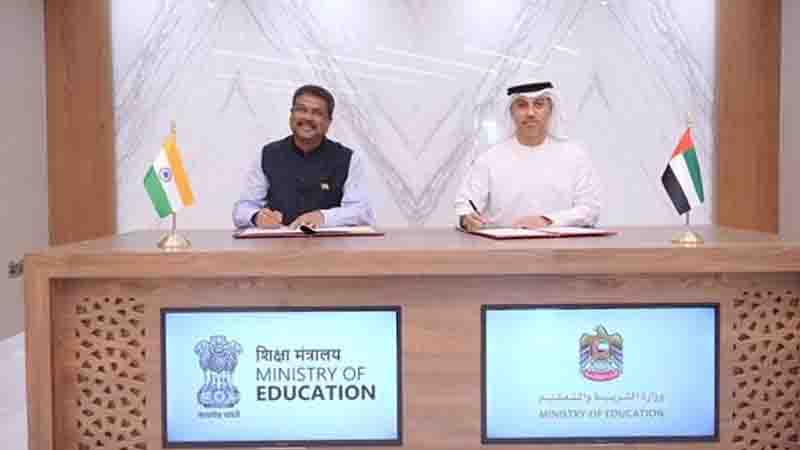
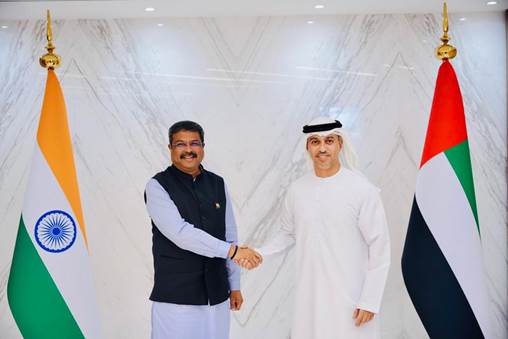
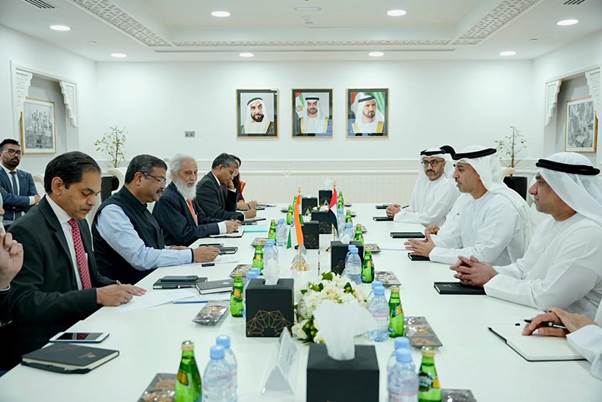
Union Education and Skill Development & Entrepreneurship Minister Shri Dharmendra Pradhan today met Minister of Education UAE, H.E. Dr. Ahmad Al Falasi in Abu Dhabi. The Ministers signed an MoU to strengthen existing educational cooperation facilitating student and faculty mobility and various other initiatives. The Minister also visited 42 Abu Dhabi, a School for Disruptive Learning. The Minister is on a 3-day visit to UAE. The visit will be fostering collaboration, participation and synergy in critical areas of mutual interest in the education and the skill domain.

During his meeting with his UAE counterpart, Shri Pradhan said that UAE being a Global Economic hotspot and India being a Global Talent hotspot, both sides should work together to build a knowledge bridge to cement our civilizational connect.

The Ministers reviewed the bilateral engagements in education and skill development, particularly the progress on points discussed during our meeting on the sidelines of the 4th EdWG as a part of the G20 India. They expressed satisfaction on the progress made with respect to mutual recognition of academic and skill qualifications, recognition of Indian institutes in the UAE among others and underscored the need for continued work in this area. The Ministers expressed their commitment to strengthen institutional mechanisms and speed up processes for smooth student and workforce mobility.

Shri Dharmendra Pradhan thanked H.E Dr. Ahmed Belhoul for the support to schools that follow India curriculum in the UAE. Also, discussed ways to facilitate student exchange programs between India and the UAE.

During the meeting, a significant MoU was signed by the Ministers. The MoU aims to strengthen the existing cooperation in the field of educational institutions in both countries, by facilitating student and faculty mobility, joint research programmes, designing courses, organising and participation in conferences, lectures, symposia, courses, scientific and educational exhibitions in areas of mutual interest held in both countries.

  • It will also facilitate in exchange of information in the following areas:
  • Regulations, legal structures and best practices in general and higher education in both countries.
  • Framework and policies in general and higher education including national qualifications frameworks in order to facilitate mutual recognition of qualifications between both the countries.
  • Frameworks, policies in the areas of gifted and talented skills development and counselling and well-being.
  • Facilitation of academic collaboration between Higher Education Institutions in both the countries for offering Twinning, Joint Degree and Dual Degree Programmes.
  • Cooperation in the field of Capacity Development of Technical and Vocational Education and Training (TVET) teaching staff has been envisaged under this MoU.
  • MoU will facilitate creation of a Joint Working Group is chaired by a representative of the Ministry of Education from India and UAE. The JWG shall meet at least once a year alternately to review the implementation of this memorandum.

Shri Pradhan also visited 42 Abu Dhabi, a coding school with deep focus on encouraging innovation, creativity and peer-to-peer learning through project-based and gamified curriculum. Shri Pradhan said that a first-of-its-kind school in the GCC, 42 Abu Dhabi’s thrust on removing barriers to education for realising the vision of a tech-enabled future is laudatory. Open 24/7 all throughout the year, it provides perfect flexibility to learners to also learn and earn as per their schedules. He highlighted that flexibility and learning while earning is also a key recommendation of NEP 2020. Incorporating such progressive pathways is a way forward to empower India’s talented youth and workforce, he added.

Shri Pradhan had an insightful interaction with students and faculty at Abu Dhabi Indian School (ADIS). Shri Pradhan said that one of the largest schools in Abu Dhabi catering to the Indian community, ADIS is nurturing Indian students and instilling in them the culture, values and ethos of both India and the UAE. These students are future global citizens and ambassadors of India and its civilisational ethos, he added.

Later in the evening, the Minister interacted with members of Odia Community. He received a warm welcome from the Indian diaspora in UAE.

GST revenue collection for October 2023 is second highest ever at Rs. 1.72 lakh crore

| Published on:

The gross GST revenue collected in the month of October, 2023 is ₹ 1,72,003 crore out of which ₹ 30,062 crore is CGST, ₹ 38,171 crore is SGST, ₹ 91,315 crore (including ₹ 42,127 crore collected on import of goods) is IGST and ₹ 12,456 crore (including ₹ 1,294 crore collected on import of goods) is cess.

The government has settled ₹ 42,873 crore to CGST and ₹ 36,614 crore to SGST from IGST. The total revenue of Centre and the States in the month of October, 2023 after regular settlement is ₹72,934 crore for CGST and ₹ 74,785 crore for SGST.

The gross GST revenue for the month of October, 2023 is 13% higher than that in the same month last year. During the month, revenue from domestic transactions (including import of services) is also 13% higher than the revenues from these sources during the same month last year. The average gross monthly GST collection in the FY 2023-24 now stands at Rs. 1.66 lakh crore and is 11% per cent more than that in the same period in the previous financial year.

The chart below shows trends in monthly gross GST revenues during the current year. The table below shows the state-wise figures of post settlement GST revenue of each State till the month of October 2023.

Chart: Trends in GST Collection

Table: SGST & SGST portion of IGST settled to States/UTs

April-October (Rs. in crore)

  Pre-Settlement SGST Post-Settlement SGST[1]
State/UT 2022-23 2023-24 Growth 2022-23 2023-24 Growth
Jammu and Kashmir 1,318 1,762 34% 4,299 4,817 12%
Himachal Pradesh 1,341 1,546 15% 3,368 3,302 -2%
Punjab 4,457 4,903 10% 11,378 13,115 15%
Chandigarh 351 389 11% 1,227 1,342 9%
Uttarakhand 2,805 3,139 12% 4,513 4,890 8%
Haryana 10,657 11,637 9% 18,291 20,358 11%
Delhi 8,000 9,064 13% 16,796 18,598 11%
Rajasthan 8,832 9,859 12% 19,922 22,571 13%
Uttar Pradesh 15,848 18,880 19% 38,731 42,482 10%
Bihar 4,110 4,731 15% 13,768 15,173 10%
Sikkim 179 297 66% 489 629 29%
Arunachal Pradesh 282 378 34% 932 1,155 24%
Nagaland 125 177 42% 564 619 10%
Manipur 166 210 27% 812 659 -19%
Mizoram 105 168 60% 488 573 18%
Tripura 242 299 23% 847 928 9%
Meghalaya 265 353 33% 841 988 17%
Assam 2,987 3,428 15% 7,237 8,470 17%
West Bengal 12,682 13,799 9% 22,998 24,607 7%
Jharkhand 4,329 5,152 19% 6,466 7,128 10%
Odisha 8,265 9,374 13% 11,031 12,723 15%
Chhattisgarh 4,285 4,773 11% 6,421 7,656 19%
Madhya Pradesh 6,062 7,384 22% 15,418 18,100 17%
Gujarat 21,644 24,005 11% 32,943 36,322 10%
Dadra and Nagar Haveli and Daman and Diu 381 372 -3% 709 606 -15%
Maharashtra 48,870 58,057 19% 74,612 84,712 14%
Karnataka 20,165 23,400 16% 37,924 42,657 12%
Goa 1,111 1,307 18% 2,024 2,299 14%
Lakshadweep 6 16 162% 18 66 259%
Kerala 7,016 8,082 15% 17,450 18,370 5%
Tamil Nadu 20,836 23,661 14% 34,334 37,476 9%
Puducherry 271 288 6% 695 833 20%
Andaman and Nicobar Islands 112 125 12% 287 311 8%
Telangana 9,538 11,377 19% 21,301 23,478 10%
Andhra Pradesh 7,347 8,128 11% 16,441 18,488 12%
Ladakh 81 121 49% 311 377 21%
Other Territory 97 140 44% 281 685 144%
Grand Total 2,35,167 2,70,777 15% 4,46,167 4,97,562 12%

PM lauds inclusion of Kozhikode as ‘City of Literature’ and Gwalior as the ‘City of Music’ in UNESCO’s Creative Cities Network

| Published on:

The Prime Minister, Shri Narendra Modi has lauded the inclusion of  Kozhikode as ‘City of Literature’ and Gwalior as the ‘City of Music’ in UNESCO’s Creative Cities Network. Shri Modi congratulated the people of Kozhikode and Gwalior on this remarkable achievement.

Prime Minister Modi said that India’s cultural vibrancy shines brighter on the global stage with Kozhikode’s rich literary legacy  He also underlined Gwalior’s commitment to preserving and enriching its musical heritage and said that it is being echoed across the world.

Quoting posts on X by Union Minister for Culture, Shri G Kishan Reddy, the Prime Minister said;

“India’s cultural vibrancy shines brighter on the global stage with Kozhikode’s rich literary legacy and Gwalior’s melodious heritage now joining the esteemed UNESCO Creative Cities Network.

Congratulations to the people of Kozhikode and Gwalior on this remarkable achievement!

As we celebrate this international recognition, our nation reaffirms its commitment to preserving and promoting our diverse cultural traditions.

These accolades also reflect the collective efforts of every individual dedicated to nurturing and sharing our unique cultural narratives.”

PM participates in program marking culmination of Meri Maati Mera Desh campaign’s Amrit Kalash Yatra

| Published on:

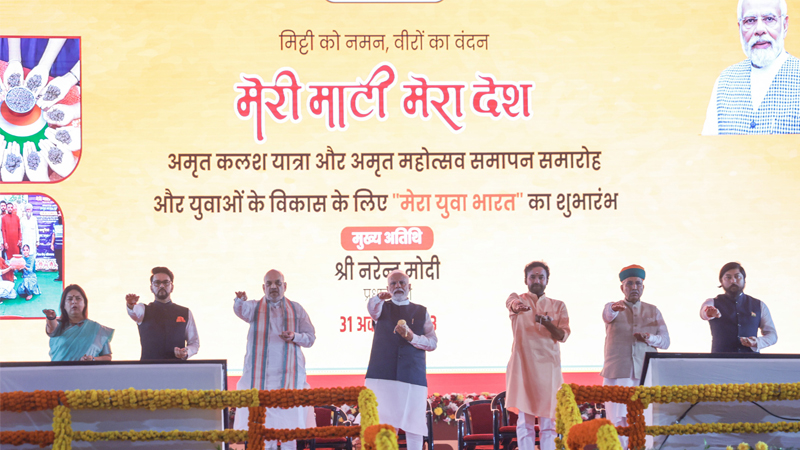
The Prime Minister, Shri Narendra Modi participated in the programme marking the culmination of Meri Maati Mera Desh campaign’s Amrit Kalash Yatra at Kartavya Path in New Delhi today. The programme also marks the closing ceremony of Azadi Ka Amrit Mahotsav. During the program, the Prime Minister laid the foundation stone of Amrit Vatika and Amrit Mahotsav Memorial and launched ‘Mera Yuva Bharat’ – MY Bharat platform for youth of the country.

Shri Modi also presented the Azadi Ka Amrit Mahotsav Awards to the top 3 performing States or Union Territories as well as Ministries or Departments. The top 3 performing states or union territories are Jammu and Kashmir, Gujarat and Haryana and Rajasthan for the joint third position, while the top 3 performing ministries are Ministry of External Affairs, Ministry of Defence, and Ministry of Railways and Ministry of Education for the joint third position.

Addressing the gathering, the Prime Minister remarked that Kartavya Path is witnessing the Mahayagya on the occasion of Sardar Saheb’s birth anniversary. Recalling 12th March 2021 when the initiation of Azadi Ka Amrit Mahotsav was inspired by Mahatma Gandhi’s Dandi Yatra, the Prime Minister observed the conclusion of Azadi Ka Amrit Mahotsav on 31st October 2023, the birth anniversary of Sardar Patel. Drawing an analogy to the Dandi March Yatra which saw the participation of every Indian, the Prime Minister drew attention to the Azadi Ka Amrit Mahotsav creating a new record of people’s participation. “Dandi March reignited the flame of independence while Amrit Kaal is turning out to be the resolution of the 75-year-old journey of India’s development journey”, Shri Modi emphasized. He underlined that the 2 year long celebrations of Azadi Ka Amrit Mahotsav are coming to a conclusion with the ‘Meri Maati Mera Desh’ Abhiyan. He also noted the foundation stone laying of Smarak which will remind the future generations of today’s historic organization. He also congratulated the states, union territories and ministries that were recipients of the best-performing awards.

He pointed out that as we bid goodbye to a grand celebration, we are initiating a new resolution with MY Bharat. “MY Bharat organization is going to play a big role in nation-building in the 21st century”, PM Modi said.

Pointing to the collective strength of Indian youth, the Prime Minister said “Meri Mati Mera Desh Abhiyan is a live example of how the youth of India can organize and achieve every goal.”  PM Modi highlighted the countless youth participation from every nook and corner of the country and said that 8500 Amrit Kalash have reached the Kartavya Path from all over the country and crores have Indians have taken Panch Pran pledge and have uploaded selfies on the campaign website.

Explaining why soil was used as an element for the culmination of Azadi Ka Amrit Mahotsav, the Prime Minister cited the words of a poet and said that it is the soil of the land where civilizations have flourished, humans have progressed and it holds the imprint of eons. “India’s soil has consciousness. It has a life form that has prevented the downfall of civilization”, Shri Modi said, noting how a multitude of civilizations have collapsed while India still stands strong. “The soil of India creates an affinity for the soul towards spirituality”, he said as he highlighted the numerous sagas of India’s valor and touched upon the contributions of Shaheed Bhagat Singh. Highlighting how every citizen is deeply rooted to the soil of the motherland, the Prime Minister said, “What is life if it is not repaying the debts of the soil of India.” He underlined that soil from the thousands of ‘Amrit Kalash’ that have arrived in Delhi will remind everyone of the sentiment of Kartavya or duty and inspire each one to accomplish the resolve of a Viksit Bharat. He urged everyone to contribute towards nation-building.

The Prime Minister said that the Amrit Vatika which will be established with saplings from all over the country will teach the coming generation about ‘Ek Bharat Shreshtha Bharat’. The Prime Minister told the audience about the artwork Jan, Janani, Janambhoomi in the New Parliament Building which has been made by 75 women artists from the soil of all the states.

The Prime Minister said that the most positive impact of the Azadi Ka Amrit Mahotsav (AKAM) which ran for about 1000 days has been on the young generation of India. He said that today’s generation has not experienced slavery and he is also the first Prime Minister born in free India. He said that AKAM has reminded the people that there was not a single moment during the foreign rule when there was no movement for freedom and no section or region was untouched by these movements.

The Prime Minister said, “Amrit Mahotsav has, in a way, added the missing pages of history for future generations.” He said the people of India made Amrit Mohotsav a people’s movement. He said the success of Har Ghar Tiranga is the success of every Indian. People came to know about the contribution of their families and villages in the freedom struggle. He said that a district-wise database of the freedom fighters has been created.

The Prime Minister highlighted India’s achievements during AKAM and mentioned India’s rise to the top 5 economies in the world, the successful landing of Chandrayaan 3, the organization of G20 Summit, historic record of bagging more than 100 medals at the Asian Games and Asian Para Games, inauguration of New Parliament building, passage of Nari Shakti Vandan Adhiniyam, new records in exports, agricultural produce,  expansion of the Vande Bharat train network, initiation of Amrit Bharat Station campaign, country’s first Regional Rapid train Namo Bharat, creation of more than 65,000 Amrit Sarovars, launch and expansion of made in India 5G, and launch of PM Gatishakit Masterplan to improve connectivity.

The Prime Minister emphasized, “During the Azadi Ka Amrit Mahotsav, the country completed the journey from Rajpath to Kartavya Path. We also removed many symbols of slavery.” He mentioned Netaji Subhash Bose’s statue at the India Gate, New insignia of the Navy, inspiring names for the islands of Andaman and Nicobar, the declaration of Janjatiya Gaurav Diwas, Veer Baal Diwas in the memory of Sahibzaade and the decision to commemorate Vibhajan Vibhishika Diwas on 14 August every year.

“The end of something always signifies the beginning of something new”, the Prime Minister said, explaining a Sankrit Shlok. He noted the launch of MY Bharat with the conclusion of Amrit Mahotsav and said, “MY Bharat is a proclamation of the youth power of India.” He underlined that it will become a great medium to bring every youth of the country on one platform and ensure greater participation towards nation-building. He informed about the launch of MY Bharat website and said that the various programs that are being run for the youth will be included on the platform. Prime Minister Modi urged the youth to connect with it as much as possible, fill India with new energy, and take the country forward.

Concluding the address, the Prime Minister said that India’s independence is the fulfillment of the common resolutions of every citizen and urged to protect it with unity. Noting the resolve to make India a developed country by 2047, he said that this special day will be remembered by the nation upon the completion of 100 years of independence. “We will have to fulfill the resolve we took, the promises we made to the coming generation”, the Prime Minister said urging to intensify the efforts. “The contribution of every Indian is important to achieve the goal of being a developed country. Come, let us start a new journey of the Amrit Kaal of Viksit Bharat through Amrit Mahotsav”, he concluded.

Union Minister for Home Affairs, Shri Amit Shah, Union Minister for Information & Broadcasting, Shri Anurag Singh Thakur and Union Minister for Culture, Shri G Kishan Reddy were present on the occasion among others.

Background

Meri Maati Mera Desh

Meri Maati Mera Desh campaign is a tribute to the Veers and Veeranganas who have made the supreme sacrifice for the country. In the spirit of Jan Bhagidari, the campaign comprises many activities and ceremonies conducted across the country at Panchayat/Village, Block, Urban Local Body, State and National levels. The activities included building of Shilaphalakam (Memorial) to express heartfelt gratitude to all the bravehearts who have made the supreme sacrifice; ‘Panch Pran’ pledge taking by the people at Shilaphalakam; planting of saplings of indigenous species and developing ‘Amrit Vatika’ (Vasudha Vandhan) and felicitation ceremonies for honoring the freedom fighters and the families of deceased freedom fighters (Veeron ka Vandan), among others.

The campaign became a massive success, with over 2.3 lakh Shilaphalakams built in 36 States/UTs; nearly 4 crore Panch Pran pledge selfies uploaded; 2 Lakh plus ‘Veeron ka Vandan’ programs nationwide; more than 2.36 crore indigenous saplings have been planted; and 2.63 lakh Amrit Vatikas created under the Vasudha Vandan theme across the country.

‘Meri Maati Mera Desh’ campaign also includes the Amrit Kalash Yatra, which comprises a collection of mitti (soil) and rice grains from over 6 lakh villages in rural areas and from wards in urban areas, which is sent to block level (where mitti of all villages in the block is mixed) and then to the state capital. The mitti from the state level is sent to the National Capital, accompanied by thousands of Amrit Kalash Yatris.

Yesterday, the Amrit Kalash Yatra witnessed all the states and UTs represented by their respective blocks and Urban Local bodies putting mitti from their Kalash in one giant Amrit Kalash in the spirit of ‘Ek Bharat Shreshtha Bharat’.  The Amrit Vatika and Amrit Mahotsav Memorial, whose foundation stone was laid by the Prime Minister, will be built from the soil collected from every part of the country.

Meri Maati Mera Desh campaign was envisaged as a culminating event of ‘Azadi Ka Amrit Mahotsav’. Azadi Ka Amrit Mahotsav began on 12th March 2021 to celebrate 75 years of India’s independence. It has since witnessed more than two lakh programmes organized throughout the country with enthusiastic public participation.

MY Bharat

‘Mera Yuva Bharat’ – MY Bharat is being established as an autonomous body to serve as a one-stop whole-of-government platform for the youth of the country. In line with the Prime Minister’s vision to provide equitable opportunities to every youth of the country, MY Bharat will leverage technology to provide an enabling mechanism across the entire spectrum of the Government so that they can realize their aspirations and contribute to the building of ‘Viksit Bharat’. The aim of MY Bharat is to inspire youth to become community change agents and nation builders and enable them to act as the ‘Yuva Setu’ between the Government and the citizens. In this sense, ‘MY Bharat’ will provide a major boost to ‘Youth Led development’ in the country.