₹1,62,712 crore gross GST revenue collected during September 2023

| Published on:

The gross GST revenue collected in the month of September, 2023 is ₹1,62,712 crore out of which CGST is ₹29,818 crore, SGST is ₹37,657 crore, IGST is ₹83,623 crore (including ₹41,145 crore collected on import of goods) and cess is ₹11,613 crore (including ₹881 crore collected on import of goods).

The government has settled ₹33,736 crore to CGST and ₹27,578 crore to SGST from IGST. The total revenue of Centre and the States in the month of September, 2023 after regular settlement is ₹63,555 crore for CGST and ₹65,235 crore for the SGST.

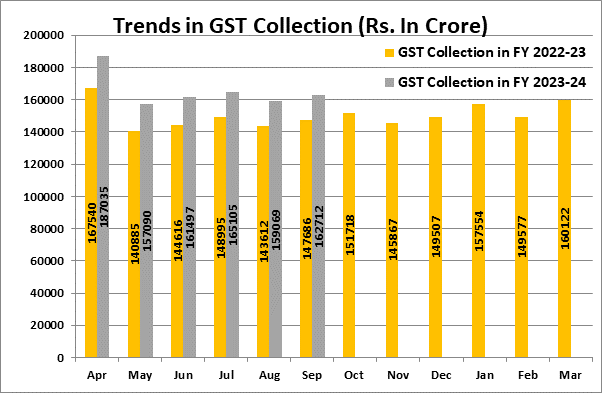
The revenues for the month of September, 2023 are 10% higher than the GST revenues in the same month last year. During the month, the revenues from domestic transactions (including import of services) are 14% higher than the revenues from these sources during the same month last year. It is for the fourth time that the gross GST collection has crossed ₹1.60 lakh crore mark in FY 2023-24.

The gross GST collection for the first half of the FY 2023-24 ending September, 2023 [₹9,92,508 crore] is 11% higher than the gross GST collection in the first half of FY 2022-23 [₹8,93,334 crore]. The average monthly gross collection in FY 2023-24 is ₹1.65 lakh crore, which is 11% higher than average monthly gross collection for first half of FY 2022-23 where it was ₹1.49 lakh crore.

The chart below shows trends in monthly gross GST revenues during the current year. Table-1 shows the state-wise figures of GST collected in each State during the month of September 2023 as compared to September 2022. Table-2 shows the state-wise figures of post settlement GST revenue of each State till the month of September 2023.

Chart: Trends in GST Collection

PM launches ‘Sankalp Saptaah’, a week-long programme for Aspirational Blocks

| Published on:

The Prime Minister, Shri Narendra Modi launched a unique week-long programme for Aspirational Blocks in the country called ‘Sankalp Saptaah’ at Bharat Mandapam, New Delhi today. He also launched the Aspirational Blocks Programme Portal and inaugurated the exhibition showcased on the occasion.

The Prime Minister also interacted with 3 Block Level Officers.

Interacting with Ms Ranjana Agarwal, School teacher from Baheri, Bareilly, Uttar Pradesh the Prime Minister asked about the most impactful idea from the Chintan Shivirs organized in her block. Ms Ranjana Agarwal mentioned the all-round development programme of the block and highlighted the importance of all stakeholders coming on the same platform to turn the government schemes into a mass movement. The Prime Minister also enquired about the changes implemented to improve the learning outcome of schools. Ms. Agarwal mentioned opting for activity-based learning instead of the traditional teaching methods and gave examples of organizing Bal Sabhas, music lessons, sports and physical training etc. She also mentioned smart classrooms and the use of technology to improve the quality of education. She informed about the availability of smart classrooms in all of the 2,500 schools in her district. The Prime Minister said that one of the primary conditions of Viksit Bharat is the quality education of the children. He said that he is overwhelmed by the dedication and involvement of the teachers. This is the way to ‘Samarpan se Siddhi’.

Dr. Sajied Ahmed, Veterinary, Assistant Surgeon from Mankote, Poonch, Jammu & Kashmir explained the problems of migrating tribal animal husbandry folks and told about the ways of limiting problems and damage during the migration. He told the Prime Minister his personal experiences. The Prime Minister asked about the difference between classroom knowledge and experience on the ground. The Doctor told about the sturdy local breeds that were ignored in the classroom. The Prime Minister was informed about the vaccination campaign for foot and mouth disease and he was told about the massive uptake of the vaccine in the area. The Prime Minister narrated his closeness with the Gurjars of the region as they always reminded him of the habitants of Kutch.

Upon interacting with Shri Mikehenchard Ch Momin, Jr. Rural Development Officer from Resubelpara, Ngh (Garo Region), Meghalaya, the Prime Minister inquired about the solutions to the difficulties faced due to the extreme weather conditions in the region. Shri Momin mentioned issuing preliminary orders to stock up on essential goods and creating a team to monitor the progress. Upon the Prime Minister’s inquiry about the changes in the quality of the output brought by the introduction of regional designs and owner-driven construction in PM-Awas (Gramin) to improve Ease of Living, Shri Momin replied in the affirmative. When the Prime Minister asked about the production and marketing of cashews produced in the region, Shri Momin said that cashew produced in the region is of top quality throughout the nation and mentioned MNREGA and self-help groups being used to encourage its production. Shri Momin also urged the Prime Minister to set up more cashew processing units in the region. Shri Modi also touched upon the popularity of music in the region to increase awareness. The Prime Minister underlined the critical role of Gram Panchayat in the Aspirational Block and District programme.

Addressing the gathering, the Prime Minister noted the venue -Bharat Mandapam and the gathering – people who are taking care of development in the far-flung areas. It is an indication of the government’s thinking that such a gathering is taking place at the venue of the G20 summit, where people deciding the direction of world affairs, gathered just a month ago, he said. The Prime Minister welcomed the ground-level change makers. “For me, this gathering is no less than G20”, Shri Modi stressed.

He said that this programme is a symbol of the success of Team Bharat and the spirit of Sabka Prayas. This programme is important for India’s future and ‘Sankalp se Siddhi’ is inherent in this.

The Prime Minister said, “In any list of the top 10 programmes of Independent India, the Aspirational District Programme will figure in golden letters”. The Aspirational District Programme has transformed the lives of about 25 crore people in 112 districts, he said. The success of this programme became the basis of the Aspirational Blocks programme, he added, mentioning the global accolades for the programme. The Prime Minister underlined that the Aspirational Blocks programme is bound to be a huge success not only because the scheme is unprecedented, but also because the people working towards it are prodigious.

Recalling his interaction with the 3 Block Level Officers a while ago, the Prime Minister highlighted his self-confidence increases manifold after witnessing the morale of those working on the ground level. Shri Modi emphasized that he wishes to work alongside the ground-level officers as a member of their team and expressed confidence that the goals of the programme will be achieved before time. Prime Minister Modi underlined that the programme will be meticulously monitored by him not because he wants to test their skills but because the successes on the ground level give him more energy and enthusiasm to work tirelessly. “The progress chart of the Aspirational District programme became an inspiration for me”, he added.

Noting the completion of 5 years of the Aspirational District Programme, the Prime Minister expressed happiness about the third party evaluation of the programme. Mentioning the simple strategy of the programme, the Prime Minister said that these are the lessons in meeting the challenging tasks of governance. Emphasizing the importance of holistic development, the Prime Minister said that all parts and regions of the country should be looked after. “Absence of all-encompassing development, touching everyone, benefitting all may show numerical development but basic development does not take place. That is why it is important that we should move while covering every grassroots parameter”.

The Prime Minister urged the Secretaries of departments present on the occasion to work in two new directions – Rapid development of every state and handholding of backward districts.  He asked them to identify 100 blocks in the country that are lagging behind in their respective departments and work towards improving the conditions. He insisted that all parameters of development would change once the 100 identified blocks move above the country’s average. He suggested that all departments from the center emphasize the development of the blocks which have room for improvement. Highlighting the role of state governments, the Prime Minister suggested identifying the 100 most backward villages and creating a model to improve them which can be further replicated to develop the next 1000 villages.

Referring to the Pran of making India a developed nation by 2047, the Prime Minister said that being developed does not mean developed metro cities and backward villages. “We don’t follow that model, we wish to move with 140 crore people”, he said. He mentioned the healthy competition among districts during the Aspirational Districts programme and gave the example of Kutch district in Gujarat which was once considered a place for punishment posting for officers but has now become the most respectable place with the dedication and diligence of officers who were posted there after the earthquake. He credited the young officers for the developments carried out in the aspirational districts of the country. For the Aspirational Block programme, the Prime Minister suggested the state government encourage young officers by promoting those who become successful at the block level.

The Prime Minister also talked about the shift to outcome from just output orientation of the government’s budget. This has brought about a qualitative change, he said. Speaking from his vast experience of governance, the Prime Minister said that the budget is not the only factor of change. He highlighted optimum utilization of resources and convergence as the basis of development without budget. He said convergence and complementarities of schemes should be leveraged.

The Prime Minister also talked about the fallacy of overreliance on results on the good performing aspects and pushing resources towards them. “Pushing resources into abundance leads to wastage while if it is given to the areas of needs, utilization is much better. Resources should be distributed equally with a special focus on the needy areas”, he said.

Prime Minister Modi stressed the need to come out of the mentality of reliance on the government and highlighted the strength of the society to accomplish great tasks. Speaking about the necessity of ‘Jan Bhagidari’, the  Prime Minister underlined the need for a leader in every sector. He highlighted the aspect of team spirit being inculcated in the ‘Sankalp Saptaah’ programme which will lead to the emergence of leaders and new ideas for Jan Bhagidari. He gave the example of society coming together to support one another during a natural calamity.  He also touched upon doing things collectively at the block level to induce the spirit of people’s participation and gave examples of celebrating anniversaries of regional institutions and distributing food to school children on such occasions to eradicate malnutrition. “Jan Bhagidari or people’s participation has tremendous potential in finding solutions to problems”, Shri Modi emphasized.

Similarly, the Prime Minister illustrated the power of social participation by elaborating on the role of diaspora in the rising global profile of the country as their activism has supported the government’s diplomatic efforts. The Prime Minister asked the delegates to make maximum use of the Sankalp Saptah. He asked them to pool resources and concentrate efforts for maximum impact. This will remove silos and infuse a whole of the government approach. While acknowledging the role of technology in communication, the Prime Minister said that there is no alternative to physical presence and we should not compromise with that as we get to know the strengths of the place when we visit there. He said that sitting with colleagues for a week during the ‘Sankalp Saptaah’ will make them aware of the strengths and needs of each other and will improve team spirit.

The Prime Minister asked the delegates to focus on 5 parameters and get good results. This will increase their confidence. With this gradual address of problems, the block will become a source of aspiration for others, he said. “112 districts that were Aspirational Districts have now become inspirational districts. I am sure within a year at least 100 aspirational blocks will become inspirational blocks”, he concluded.

Shri Suman Bery, Vice Chairman, NITI Aayog was present on the occasion among others.

Background

‘Sankalp Saptaah’ is linked to the effective implementation of the Aspirational Blocks Programme (ABP). The Prime Minister launched the nationwide programme on January 7, 2023.  It aims to improve governance at the block level in order to enhance the quality of life of citizens. It is being implemented in 500 Aspirational Blocks across 329 districts in the country. Chintan shivirs were organized at village and block levels across the country to implement the Aspirational Blocks Programme and to prepare an effective block development strategy. The ‘Sankalp Saptaah’ is a culmination of these chintan shivirs.

‘Sankalp Saptaah’ will be observed in all of the 500 Aspirational Blocks. Each day in ‘Sankalp Saptaah’, from 3rd October till 9th October 2023, is dedicated to a specific development theme on which all Aspirational Blocks will work. The themes for the first six days include ‘Sampoorna Swasthya’, ‘Suposhit Pariwaar’, ‘Swachhta’, ‘Krishi’, ‘Shiksha’, and ‘Samridhi Diwas’.  The last day of the week i.e. October 9, 2023, will be a celebration of the work conducted during the entire week, as ‘Sankalp Saptaah – Samavesh Samaroh’.

The inaugural programme will witness the participation of about 3,000 panchayat and block-level people’s representatives and functionaries from across the country in Bharat Mandapam. In addition, nearly two lakh people including block and panchayat level functionaries, farmers, and persons from other walks of life, will join the programme virtually.

Union Home Minister inaugurates and laid the foundation stone of various development works of AMC and AUDA in Gandhinagar

| Published on:

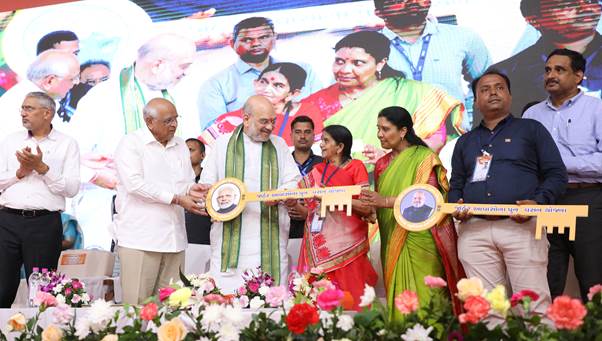
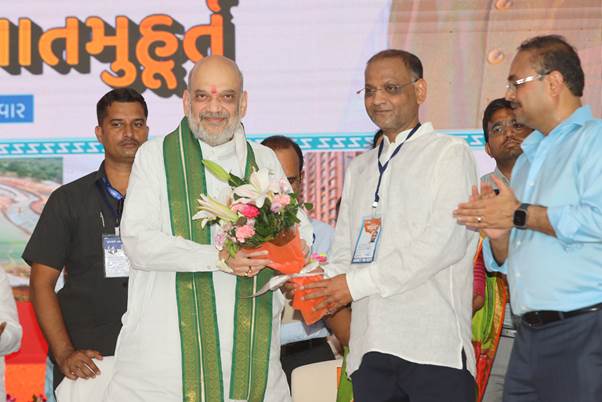
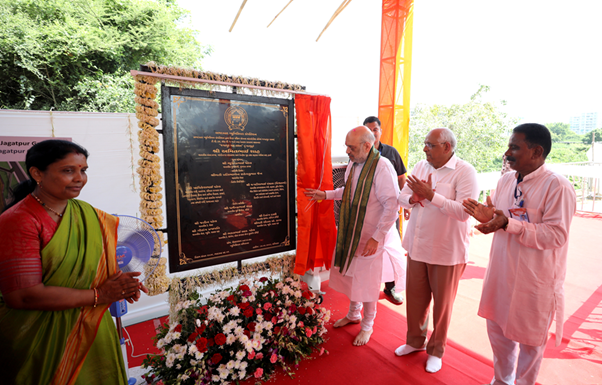
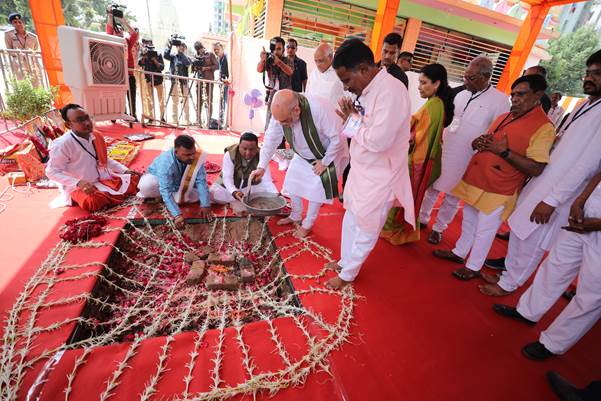
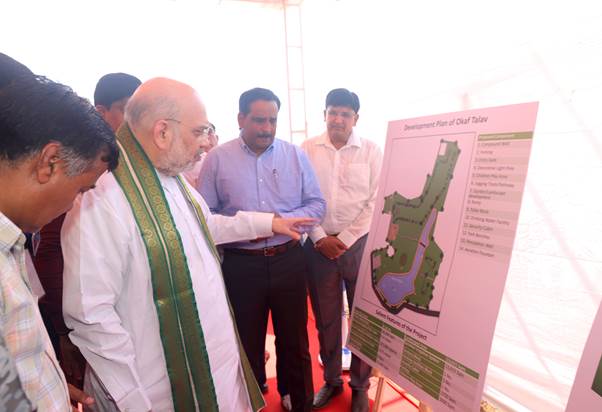
Union Home Minister and Minister of Cooperation Shri Amit Shah inaugurated and laid the foundation stone of various development works of Ahmedabad Municipal Corporation (AMC) and Ahmedabad Urban Development Authority (AUDA) worth about Rs 1651 crore in Gandhinagar, the capital of Gujarat today. Shri Amit Shah also laid the foundation stone of renovation works of ponds in Sarkhej, Bhadaj village, Ognaj, Jagatpur village and Tragad. Many dignitaries including Gujarat Chief Minister Shri Bhupendra Patel were also present on this occasion.

Union Home Minister said in his address that there is no ward in Gandhinagar Lok Sabha constituency where development works have not been undertaken. He said that Ahmedabad Municipal Corporation and Gujarat Government have proactively initiated development works even before public demand. Expressing his gratitude to Ahmedabad Municipal Corporation and Gujarat Chief Minister Shri Bhupendra Patel for this, Shri Shah said that they have made a tradition of giving even before the people ask. He said that in the last 52 months, development works worth Rs 17,544 crore have been done in Gandhinagar Lok Sabha constituency. Shri Shah said that today 39 projects of AMC and AUDA have been inaugurated and initiated at a cost of approximately Rs 1650 crore. Out of these projects, 18 schemes were inaugurated and bhumi pujan of 21 schemes was done.

Shri Amit Shah said that Prime Minister Shri Narendra Modi has increased the prestige of India across the world in the last three months. Prime Minister Modi ji has done four very important works like New Parliament, Chandrayaan, G20 and Nari Shakti Vandan Act in just three months. He said that perhaps one such work could be done in 50 years whereas Modi ji completed 4 such works within 3 months. This shows that the Central Government under the leadership of Prime Minister Shri Narendra Modi is committed to making India first in the world.

Home Minister said that after becoming the Prime Minister, Shri Narendra Modi has rejuvenated ISRO and has inspired the scientists to take India to the top position in the field of space. As a result, India and the whole world saw the tricolor flying on Chandrayaan, which is a matter of great pride for all of us. Shri Shah said that under the leadership of Shri Narendra Modi, India successfully organized the G20 conference. Many countries had organized the G20 conference before India, but the heads of state of all the countries believe that the way India has organized the G20, it will remain a challenge for all the countries for the next 25 years. By making possible, the passing of the Delhi Declaration unanimously, Prime Minister Shri Narendra Modi has given a message to the entire world. Along with adding the African Union to G20, Shri Narendra Modi has also given the message that India stands with developed countries and developing countries too.

Union Home Minister and Minister of Cooperation said that Prime Minister Shri Narendra Modi has set a wonderful example of how “Matrashakti Vandana” can be done with humility. Prime Minister Shri Narendra Modi has provided 33 percent reservation to women in state assemblies and Lok Sabha through the Nari Shakti Vandan Act. He said that the contribution of women is very important in policy formation and law making. For years this bill was hanging, stuck and wandering. Prime Minister Shri Narendra Modi created a new Parliament, inaugurated it on the day of Ganesh Chaturthi and brought the Nari Shakti Vandan Bill as the first bill in the new Parliament. Shri Shah said that Prime Minister Shri Narendra Modi has given legal form to the culture of respect for women and mothers that we have inherited from the ancient culture of India.

Union Home Minister and Minister of Cooperation said that Prime Minister Shri Narendra Modi has brought many schemes. Among these, the recently launched Vishwakarma Scheme is very special. He said that crores of people in the country do different types of small businesses and without them the development of the country is not possible. Under Vishwakarma Yojana, Prime Minister Shri Narendra Modi has made arrangements for skilling such people, making them experts, giving them toolkits and provide loans up to Rs 3 lakh for buying machines. For the first time after independence, Prime Minister Shri Narendra Modi has done the visionary work of including more than 20 small working communities in a government scheme by starting Vishwakarma Yojana. Shri Shah said that Prime Minister Shri Narendra Modi has taken a big step through Vishwakarma Yojana to bring the society which is doing very important work but lagging behind in development, at par with others.

Shri Amit Shah appealed to the people present to plant at least 3 trees around their house so that the environment of Gujarat becomes more clean and beautiful in the coming days. He expressed gratitude to Chief Minister of Gujarat Shri Bhupendra Patel, Ahmedabad Mayor Smt. Pratibha Jain and all the officials of AUDA for inauguration and foundation stone laying of various development works worth about Rs 1650 crore in Gandhinagar Lok Sabha constituency.

Dharmendra Pradhan launches the Bharatiya Bhasha Utsav and two-day Technology & Bharatiya Bhasha Summit

| Published on:

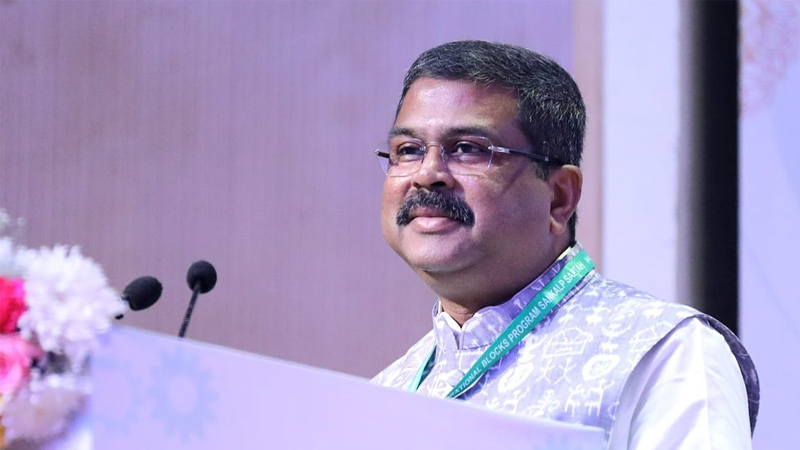
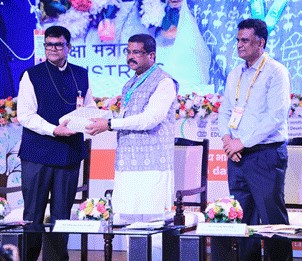
Union Minister for Education and Skill Development & Entrepreneurship Shri Dharmendra Pradhan launched the Bharatiya Bhasha Utsav and inaugurated the two-day Technology & Bharatiya Bhasha Summit on 30th September 2023 at New Delhi. The summit aims to facilitate a seamless transition from the current education ecosystem to one rooted in Bharatiya languages, in line with the NEP-2020 vision and to set the course for a technologically enriched future for Bharatiya languages in education. An exhibition was also set up to showcase Bharatiya Bhasha technology products, and their applications by the industries, government organizations and start-ups. An inspiring moment was the presentation of a significant book by various officials to dignitaries, symbolizing the rich literary heritage of Bharatiya languages.

2023-09-30 15:40:31.203000

Students of Kendriya Vidyalaya shared their experiences in 22 different languages.

While addressing the summit Shri Pradhan mentioned, that India, being one of the oldest civilizations in the world has an extremely close and inseparable relationship with technology. Scholars from across the globe have come for centuries to understand the Indian knowledge, he added. He emphasized that the fusion of Indian languages and technology will open doors to limitless possibilities for the talent pool of the country.

He also mentioned that through technology, contextualization of the Indian knowledge System will be possible. He hoped that the discussions to be held during the summit on language for technology, language in technology, and language through technology would create a strong ecosystem for Indian languages. He mentioned the significant contributions of Indian resources in the global medical sector. He also highlighted that one-third of the world’s coders are of Indian origin, which is a testament to the nation’s prowess in technology and innovation.

Shri Sanjay Kumar, while speaking to the audience, referred to the discussions held at the Sankalp Saptaah by Prime Minister Shri Narendra Modi that with the right kind of Policies (Niti) and leadership (Netritya) any goals can be achieved. He mentioned how NEP2020 has formally included Foundational Literacy and Numeracy (FLN) for the first time. Refinement of thought comes from the development of language, and NEP 2020 has recognised it and included it in its policies that must be taken to the students, he added. He urged everyone, especially the students, to use technologies, such as regenerative AI, to surpass the language barriers.

Shri Sridhar Vembu delivered the keynote address in which he emphasized the importance of learning languages in order to master skills such as developing computer codes that need an understanding of structures.

The summit, organized as part of the Bharatiya Bhasha Utsav, encompasses three pivotal thematic sessions: (i) Technology FOR Bharatiya Languages; (ii) Technology IN Bharatiya Languages; and (iii) Technology THROUGH Bharatiya Languages. Today, two technical sessions will be held under the theme of Technology FOR Bharatiya Languages. In these sessions, speakers and experts discussed ways and means to leverage technology for Bharatiya languages. The role of technology in the teaching-learning process of Bharatiya languages, the use of Machine Learning, Language modelling for speech recognition, Unicode standardization for Bharatiya language scripts, and other important aspects were also discussed in detail during these sessions. Both sessions were followed up with intense discussions among the audience and the speakers.

These themes will emphasize the integration of technology in promoting Bharatiya Bhasha, including its role in teaching, training, examination, and translating educational materials. The summit aims to facilitate a seamless transition from the current education ecosystem to one rooted in Bharatiya Languages, in line with the vision of NEP-2020.

During the summit, key discussions will be held on agendas like “Leverage Technology for Bharatiya Languages”, “Operating Systems and Software Localization”, “Search Engine Localization” and more. A comprehensive roadmap for realizing the vision of education in Bharatiya Languages will be charted, with active participation from stakeholders across various sectors, including academia, students, research scholars, edutech and infotech industry professionals, technical experts, media representatives, and freelancers.

The Government of India has proposed to celebrate the birthday of renowned Tamil poet and freedom fighter Mahakavi Chinnaswami Subramania Bharati as Bharatiya Bhasha Divas (11 December). The Bharatiya Bhasha Utsav, which started on 28th September 2023 will run for 75 days and will culminate on 11th December 2023. During this, various events related to Bharatiya languages will be held in schools and higher education institutions.

Secretary, Higher Education, Ministry of Education, Shri K Sanjay Murthy; Secretary, School Education & Literacy, Ministry of Education, Shri Sanjay Kumar; Secretary, Shri Sridhar Vembu, Chairman of the Board of Governors of IIIT-DM, Kanchipuram and CEO of Zoho Corporation; Chairman, AICTE, Prof. T.G. Sitharam; Chairman, Bhartiya Bhasha Samiti, Shri Chamu Krishna Shastri; Chairman, UGC, Prof. M. Jagadesh Kumar; Chairperson NETF, Shri Anil Sahasrabudhe; Director, Central Institute of Indian Languages, Prof. Shailendra Mohan; Chairperson, National Council for Vocational Education & Training, Dr. Nirmaljeet Singh Kalsi; Secretary, Ministry of Tribal Affairs, Sh. Anil Kumar Jha; eminent dignitaries, educationists, technology and language experts, and officials of the Ministry of Education, Ministry of Skill Development & Entrepreneurship, NCERT, UGC, AICTE, Central Institute of Indian Languages, CBSC, KVS, NVS, etc. were present at the event.

The summit is jointly organized by the Ministry of Education (MOE), Ministry of Skill Development and Entrepreneurship (MSDE), and their constituent institutions, such as the Central Institute of Indian Languages (CIIL), University Grants Commission (UGC), National Educational Technology Forum (NETF), All India Council for Technical Education (AICTE), National Centre for Vocational & Technical Education (NCVTE), National Council for Teachers Education (NCTE), Bharatiya Bhasha Samiti (BBS), and others. With active participation from stakeholders across various sectors, including academia, students, research scholars, edutech and infotech industry professionals, technical experts, media representatives, and freelancers, a comprehensive roadmap for realizing the vision of education in Bharatiya Languages will be charted during the two-day Summit.

For more information and registration details, please visit the Summit website: https://technology-bharatiyabhasha.aicte-india.org

Rejuvenation of railway stations across the country is the priority of our government: PM

| Published on:

The Prime Minister, Shri Narendra Modi has lauded the ongoing work for the redevelopment of Gwalior Railway Station.

Sharing a post on X by Union Minister for Railways, Shri Ashwini Vaishnaw, the Prime Minister said;

“बहुत खूब! देशभर के रेलवे स्टेशनों का कायाकल्प करना हमारी सरकार की प्राथमिकता है। अत्याधुनिक सुविधाओं के साथ ग्वालियर रेलवे स्टेशन के विकसित होने से यात्रियों का सफर बहुत आसान होने वाला है।”

PM urges citizens to join Shramdaan on Oct 1, 2023

| Published on:

The Prime Minister, Shri Narendra Modi has urged citizens to join the Shramdaan, a cleanliness initiative as part of Swachh Bharat on 1st October 2023 at 10 AM.

Sharing a post on X by Swachh Bharat Urban, the Prime Minister said;

“1st October at 10 AM, we come together for a pivotal cleanliness initiative.

A Swachh Bharat is a shared responsibility, and every effort counts. Join this noble endeavour to usher in a cleaner future.”

PM has worked to give a new direction and strength to the country’s economy in the last 9 years: Amit Shah

| Published on:

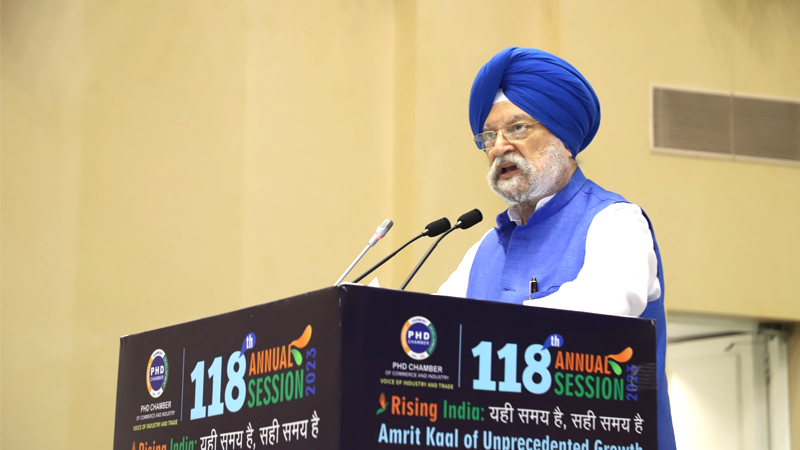
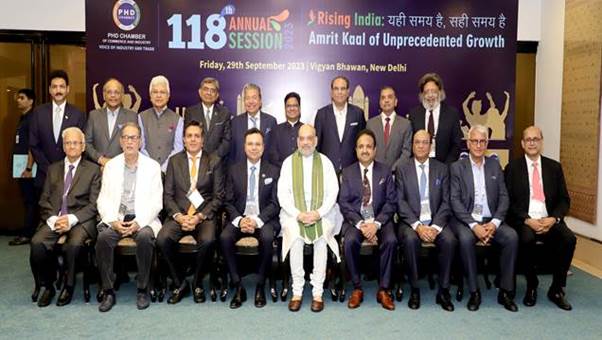
Union Home Minister and Minister of Cooperation Shri Amit Shah addresses the 118th annual session of the PHD Chamber of Commerce and Industry on ‘Rising India: Amrit Kaal of Unprecedented Growth’ as the chief guest in New Delhi, today.
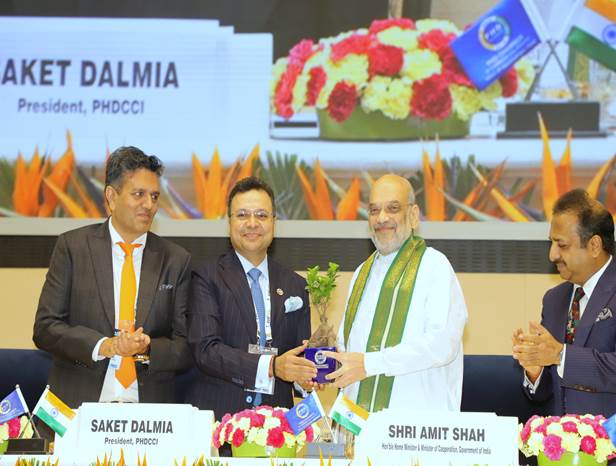
In his address, Shri Amit Shah said that after the G20 meeting held in India under the leadership of Prime Minister Shri Narendra Modi, a new energy has been infused not only in trade and industry but across every sector in the country. He said that the success of G20, Chandrayaan, Mission Aditya and 33 percent reservation for women in Lok Sabha and state assemblies, have infused a new energy in the entire nation. He said that today’s program is being held at the initiation of Amritkaal. From independence till now, the country has embarked on a 75-year journey, achieving numerous milestones in every field. Shri Shah said that the biggest achievement in these 75 years has been that we as a country have succeeded in deepening the roots of democracy. He added that India has shown the world that governance in terms of policy is a continuous process.

Union Home Minister and Minister of Cooperation said that during the celebration of the Azadi ka Amrit Mahotsav, Prime Minister Shri Narendra Modi had said that along with celebrating the achievements of the past 75 years, it is essential to set goals and realize where the country would be in 2047, when India marks 100 years of independence. He said that this is why Prime Minister Modi has termed the journey from 75 to 100 years as the “Amrit Kal,” signifying that it’s a time to make resolutions and achieve them (Sankalp se Siddhi). He added that we aim to build the India of Prime Minister Shri Narendra Modi’s dreams so that when the country celebrates its centenary of independence, India will lead in every field globally. He said that India is the youngest, most populous, and has the most engineers, doctors, and technocrats in the world. It is a country with democracy, teamwork, and under the leadership of Prime Minister Shri Narendra Modi, good policies are being formulated.
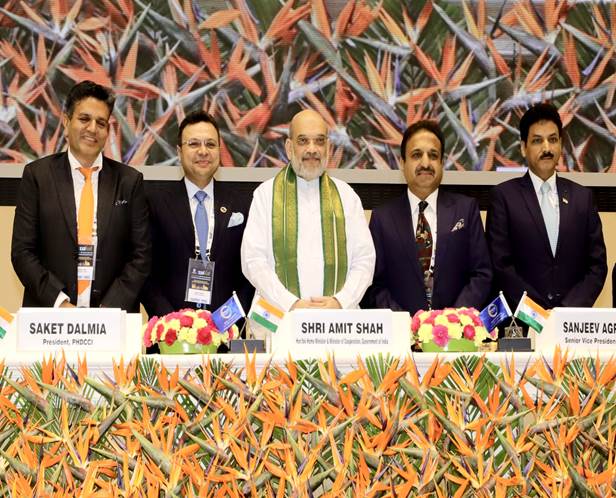
Shri Amit Shah said that the PHD Chamber of Commerce and Industry should play a crucial role in determining the shape and direction of the country’s trade and industry in the coming years. He added that the theme of today’s program is very relevant to the contemporary times. The PHD Chamber of Commerce and Industry represents over 1.5 lakh small and large industries across the country and in a way is considered as the Voice of Industry and Trade. He said that Prime Minister Shri Narendra Modi has set goals to make India a fully developed nation by 2047, achieve a $5 trillion economy for India by 2026, and become the world’s third-largest economy by 2027. To achieve these three goals, the industry will need to play a significant role. Trade and industry are the heart of the country’s economy from where the entire economy gets a boost. Due to the changes brought about by Prime Minister Shri Narendra Modi’s policies, there is talk of “India’s Moment” everywhere, and India is being recognized as a “Vibrant Spot” globally. He added that in the previous quarter, our economy grew at a rate of 7.8%, and we have also been successful in maintaining inflation at a minimum level for 40 months.

Union Home Minister said that as per the principle of “Vasudhaiva Kutumbakam” advocated by Prime Minister Shri Narendra Modi, India is leading the world in solving global problems across all sectors. Now the world is looking towards India in all areas including fight against terrorism, solar alliance, green energy etc. and many of our initiatives are guiding the world today. He said that in the last 9 years, under the leadership of Prime Minister Shri Narendra Modi, India has made efforts and achieved success in transforming the country in every sector. Prime Minister Shri Narendra Modi’s 9 years of governance has been marked by promises, performance, and results. He added that sincere efforts have been made to fulfill the promises made in 2014, which are now yielding excellent results. While India remained the 11th largest economy in the world for 10 years, under Prime Minister Shri Narendra Modi’s leadership, we have broken this stagnation in the past 9 years, emerging as the 5th largest economy, and we are now set to become the world’s third-largest economy by 2027. He said that the estimated GDP growth rate for the fiscal year 2023-24 is 6.1%, and with this achievement, India will emerge as the country with the highest growth rate across the G20. He said that the Production-Linked Incentive (PLI) Scheme has turned the dream of “Make in India” into a reality across 14 sectors. Now, India has emerged as a lucrative destination for manufacturing on a global scale, and companies from around the world want to invest in India, creating numerous opportunities for us.

Shri Amit Shah said that during the period from 2004 to 2014, it was often said that the country had succumbed to policy paralysis. However, in the last nine years, we have formulated several policies, and as a result, we have achieved success in improving our GDP from $2.03 trillion to $3.75 trillion. In 2013-14, our per capita income was Rs. 68,000, which has now increased to Rs. 1,80,000 rupees in 2022-23. In 2014, the capital expenditure was Rs. 3.9 lakh crores, and the Union government, under the leadership of Prime Minister Shri Narendra Modi, has increased it to Rs. 10 lakh crores by 2023. He said that we live in a federal structure, and unless the concept of Team India is followed, comprehensive development of this country is not possible. Prime Minister Shri Narendra Modi has promoted the concept of Team India, and the Union government has increased the allocation to the states from Rs. 30 lakh crores, during 2004 to 2014, to Rs. 100 lakh crores in the nine years from 2014 to 2023. Between 2004 and 2014, tax collection was Rs. 19 lakh crores, which has now increased to Rs. 70 lakh crores in the nine years from 2014 to 2023. While the country had only 74 airports in 70 years after independence, today, there are 148 operational airports. Between 2004 and 2014, 610 kilometers of railway lines were laid, but in the last nine years, we have laid 6,565 kilometers of railway lines. In 2014, there were a total of 91,000 kilometers of national highways in the country, but in the last nine years, we have constructed 50,000 kilometers of national highways. Today, the industry cannot be imagined without the internet in the country. Earlier, the cost per GB of internet was Rs. 270, which is now available at a rate of Rs. 10 per GB. In 2014, there were only 4 unicorn startups in the country. Today, with 115 unicorn startups, India is at the forefront globally. In 2014, there were 350 startups, and today, more than one lakh startups are contributing to our economy. Between 2004 and 2014, FDI in the country was $45 billion, which has now crossed $85 billion.

Union Home Minister and Minister of Cooperation said that our export of toys was 96 million dollars, the Modi government has done the work of increasing it to 326 million dollars by 2022. He said that no one could have believed that GST could ever be implemented, but our dream of implementing GST came true and due to the approach of Team India, only one decision in the GST Council was taken by voting, all other decisions were taken unanimously, irrespective of party politics. Shri Shah said that due to political culture of collaborative thinking developed by Prime Minister Modi, GST collection has reached Rs 1.87 lakh crore in April, 2023 and the monthly average GST collection is Rs 1.69 lakh crore. Our foreign exchange reserves were $309 billion, today they stand at $593 billion. He said that today our exports have increased, to create a favourable environment for trade and industry by increasing ease of doing business, more than 39,000 compliance requirements have been abolished under various laws and the work of converting 3400 legal provisions from criminal to civil has been done by the Narendra Modi government. He said that there cannot be a better environment than this in the country for trade and industry. Shri Shah said that in 2013-14, there were 127 crores digital transactions in the country, which increased to 12,735 crores in 2022. India alone accounts for 40% of real-time digital payments in the world. In 2014, there were 50 crore people in India who did not have a single bank account in their family. By providing them bank accounts, Prime Minister Modi has done the work of connecting 50 crore people with the country’s economy. He said that if we look at the infrastructure, earlier 11 kilometers of road was being built in a day, now 37 kilometers are built in a day. Vande Bharat has changed entire concept of rail travel, earlier there was metro in 3 cities, now it is in 27 cities, more than 10 lakh electric vehicles are on the road. Under Bharatnet, earlier only 30,000 kilometers of cable was laid, Modi ji has done the work of providing optical fibre to every panchayat by laying 6,20,000 kilometers of optical fibre cables. Internet connections have increased by 230% in the last 8 years and by 2027, the capitals of the eight North-Eastern states will be connected to the country by rail, road and air.

Shri Amit Shah said that we have also revived the Land Port Authority and today trade worth Rs 42,000 crore has been conducted with all our neighbouring countries through Land Port Authority. He said that from 2004 to 2014 this country experienced policy paralysis. He stated that after becoming Prime Minister in 2014, Shri Narendra Modi framed many policies including National Policy on Electronics, Make in India, Startup India, Skill India, GST, Digital India, UDAN Scheme, National Quantum Mission, National Education Policy. He said that India is going to become the best education destination in the next 10 years for all the students around the world. Shri Shah said that this is the first education policy after independence which no one has opposed. We have made fundamental changes in the Indian Space Policy, framed the Drone Policy, and have made radical changes in the entire health structure through Ayushman Bharat, we have worked to strengthen our urban sector through the Smart City Policy, commercial coal mining has opened up many possibilities for the exploration of our resources, Green India National Mission is attracting the entire world today and through Swachh Bharat, we have made a huge improvement in the health of the country by building more than 11 crore toilets in the country.
Union Home Minister said that India has secured its place in all the sectors which will impact the world economy in the next 25 years. Sectors like green hydrogen, semiconductor, electric vehicle, solar energy, defence, drones, space, mining and green fuel ethanol are going to impact the world economy for the next 25 years. In the last 9 years, Modi government has successfully laid a foundation in all these areas and now we have to make a place for ourselves in the world by performing in all these areas. He said that Prime Minister Modi has worked with a vision to lay a strong foundation for India in all areas affecting the world economy for the coming 25 years. Shri Shah said that the next 25 years are very important for our trade and industry. The time has come to change both the size and scale of the Indian industry and PHD Chamber of Commerce should think in the direction of this initiative. He said that our companies will have to work towards becoming multinational and now the need of the hour is for Indian companies to become multinational. Along with this, we will also have to increase investment in R&D. Today we are at first place in the world in production of pulses, milk and jute production and if there is any country that produces the maximum number of railway engines, it is India. Apart from this, today we are at second place in the world in mobile handset production, cement, steel and cotton production and we have also reached second place in tea production. We have reached the third position in startups and motor vehicles. This shows that if we decide, we deliver.

Shri Amit Shah said that we have skilfully brought our banking sector out of NPA. A Credit Guarantee Fund Trust of Rs. 9000 crore has also been created to promote MSMEs. He said that Prime Minister Shri Narendra Modi has developed a Team India approach, and it does not mean the Government of India and the State Governments. Every farmer of the country and every small and big industry together form Team India, and only then we will be able to reach our goal in 2047. He said that today the Amritkaal is beginning, it is time to take a resolution and make a road map for Sankalp Se Siddhi, that is why this is the time, the right time.

Nitin Gadkari inaugurates 3 NH projects worth Rs 3695 Crore in Washim, Maharashtra

| Published on:

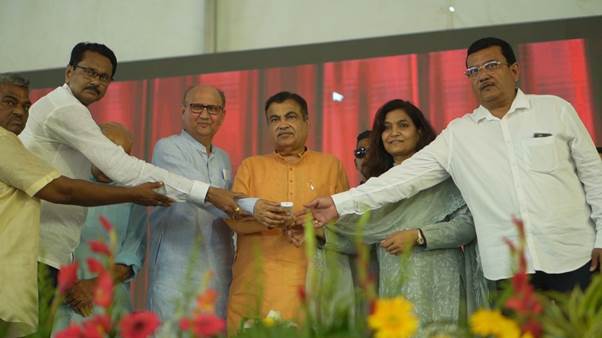
Union Minister for Road Transport and Highways Shri Nitin Gadkari inaugurated  3 National Highways (NH) projects worth Rs 3695 Crore in Washim, Maharashtra.

In the last 9 years 227 km of highway network has been constructed in Washim district connecting Vidarbha and Marathwada. The 4-lane National Highway 161 from Akola in Maharashtra to Sangareddy in Telangana becomes important in strengthening the trade relations between the two states.

Divided into a total of 3 packages, the first package on the highway from Akola to Medshi or 48 km  costing Rs 1,259 crore has four air pools, 10 underpasses and 85 culverts. The second package from Medshi to Washim or 45 km  costing Rs 1,394 crore includes 13 bus shelters, 6-lane ROB and Washim city bypass. Also, under the third package from Pangre to Warangafata or 42 km  and costing Rs 1042 crore, the main bridge over Kayadhu river, Kalamanuri and Akhara-Balapur city bypass are included.

Many important places in Akola, Washim, Nanded and Hingoli districts will now be connected. It will be easy and accessible to reach religious and tourist places like Shegavche Gajanan Maharaj Temple, Akola Shahnoor Fort, Antriksh Jain Temple, Eighth Jyotirling Aundha-Naganath, Sant Namdev Maharaj Sansthan, Narsi and Takht Sachkhand Gurudwara in Nanded. The Highway facilitates business opportunities in Telangana and Maharashtra leading to employment growth.

In the construction work of Sadar National Highway 161 under the ‘Amrit Sarovar’ scheme, ponds in Savargaon Barde, Jhodga Khurd, Chivra, Amani, Saikheda or other villages were opened and the soil and sand obtained from it was used for construction of the road.

StartUps are the torch-bearers of India’s Amrit Kaal journey over the next 25 years: Dr Jitendra Singh

| Published on:

Union Minister of State (Independent Charge) Science & Technology; MoS PMO, Personnel, Public Grievances, Pensions, Atomic Energy and Space, Dr Jitendra Singh today said, StartUps are the torch-bearers of India’s Amrit Kaal journey over the next 25 years.

Addressing the Agri-Tech Start-up Conclave titled “ATMAN-2023”, Dr Jitendra Singh called for wider synergy among the Research, Academia, StartUps and Industry for having a win-win proposition not only for innovative product development, but also for effective national and global branding and marketing.

Dr Jitendra Singh was happy to note that in the last 10 years, over 142 Deep-Tech Start-ups sprung up in Agriculture Sector and informed that 60 more will be added today during the Atman Conclave, a True Sangam of four IITs– Ropar, Bombay, Indore and Kharagpur, came together to address the agricultural challenges facing the country.

Dr Jitendra Singh described Atman as a unique initiative as the ATMAN partners are working together as a team to provide an exclusive platform for the agricultural startups and innovations and some of these technologies have been displayed and demonstrated at the Expo organized during the programme. “The event was organized to help potential startups with financial and technical assistance with promising ideas, innovations, and technologies for proof of concept, prototype development, product trials, and market entry. The Technology Innovation Hubs at IITs Bombay, Ropar, Indore and Kharagpur are collectively offering a total fund of Rs 20 Crore to provide financial support to the tune of Rs 50 lakhs to each startup,” Dr Singh explained.

Dr Jitendra Singh pointed out that in line with the clarion call by the Prime Minister Shri Narendra Modi“Jai Jawan, Jai Kisan, Jai Vigyan and Jai Anusandhan” the four Technology Innovation Hubs are developing advanced deep technologies to transform agriculture. These can enable data-driven decision-making, automation, and precision in farming practices, ultimately contributing to the modernization and improvement of the agricultural sector, he added.

Dr Jitendra, however, pointed out that the agriculture sector in India faces numerous challenges such as climate change, fragmented landholdings, and resource constraints. He said, by introducing suitable technological interventions, India can modernize its agricultural practices to enhance productivity, reduce waste, and improve the overall efficiency of the sector.

Dr Jitendra Singh re-emphasized that it is high time to bring technological interventions in the agricultural sector—India’s traditional sector, to modernise it, cater to the challenges, drive towards sustainability and address global food security.

Referring to the success of CSIR led Lavender Mission, which has changed the lives of many farmers, Dr Jitendra Singh underlined that Prime Minister in the 99th Edition of Mann ki Baat, appreciated the efforts of the Council of Scientific & Industrial Research- Indian Institute of Integrative Medicine (CSIR-IIIM) in supporting farmers in the cultivation of Lavender in the Bhaderwah, Doda district, J&K under CSIR-Aroma Mission. He said, “Farmers had been engaged in traditional maize cultivation for decades, but some farmers thought of doing something different. They turned to floriculture, that is, the cultivation of flowers. Today, around two and a half thousand farmers are cultivating Lavender here. They have also been handheld through the Aroma Mission of the Central Government. This new cultivation has greatly increased the income of the farmers.”

Dr Jitendra Singh said, about three to four thousand persons engaged with Lavender cultivation and earning lakhs of rupees by selling and marketing Lavender Oil. He also added that 70 percent of this youth brigade are not even graduates, but they have innovative bent of mind and risk-taking capacity to move away from low income generating maize cultivation to Lavender.

In his address, Secretary, Department of Biotechnology, Dr Rajesh Gokhale said, Science, Technology and Innovations have assumed a new dimension in the last 6-7 years and hoped that STI solutions will witness a big lewap in the Agri Sector in coming days.

Dr Akhilesh Gupta, Senior Adviser at the Department of Science and Technology (DST)informed that four of the Technology Innovation Hubs which are among the 25 innovation hubs set up under the National Mission on Interdisciplinary Cyber Physical Systems (NM-ICPS) of DST are demonstrating 20 key agri-tech technologies at ATMAN

The ATMAN 2023 programme, was planned to promote Innovation and Entrepreneurship and support the AgriTech Startup Ecosystem to increase the number, success rate, and impact of Agri Tech startups. It has brought in the participation of stakeholders from government, industry, and academia, as well as farmer producer organizations and NGOs taking forward DST’s unwavering commitment to advancing AgriTech innovation in India.

India is keen to increase share of manufacturing in GDP from 17% to 25%: Hardeep S Puri

| Published on:

“Global supply chains are realigning. India is emerging as an alternative supply source given its raw materials, low labour costs, growing manufacturing knowhow, and entrepreneurial ability”, said Shri Hardeep Singh Puri, Minister of Petroleum & Natural Gas and Housing & Urban Affairs at an event today. He was addressing the 118th Annual Convention of PHD Chamber of Commerce and Industry (PHDCCI).

Speaking about India’s manufacturing aspirations, Shri Hardeep Singh Puri said that the manufacturing sector currently comprises 17% of the nation’s GDP and over 27.3 million workers. He said that the Prime Minister’s clarion call for ‘Make in India, Make for the World’ at the World Economic Forum this year was a signal that India is ready and keen to increase the share of manufacturing to 25% by 2025.

The minister said that Economic reforms and policies such as GST, IBC, asset monetization, labour law reforms, PLI, National Infrastructure Pipeline, and Gati Shakti mission for multimodal connectivity, have fixed many structural deficits.

Referring to the strong industrial base of India, the Union Minister highlighted that India is second-largest producer of steel; second-largest producer of cement; and second-largest producer of coal. Talking about the infrastructure, the country has second-largest construction of built environment; fourth-largest railway network; and second-largest road network.  Noting about the automobile industry the Minister said that India is largest producer of two-wheelers and fourth-largest producer of four-wheelers.

Shri Hardeep Singh Puri said that Performance-linked Incentives (PLI) scheme has revolutionised manufacturing in 14 strategic sectors. He said that there has been an increase of 76% in FDI in manufacturing sector due to PLI schemes. Over the next five years, the PLI schemes are expected to create 60 lakh additional jobs.

Speaking about the transformational impact of PLI, the Minister said that there was a 20% value addition in mobiles manufacturing within a period of 3 years, and a 139% increase in exports of smartphones.

During the event, the Minister also spoke about the transition witnessed by energy sector in recent years. He said that India is simultaneously pursuing both traditional fuel exploration and energy transition.

The minister said that India aims to increase its net geographic area under exploration from 8% (0.25 million sq. kms.) to 15% (0.5 million sq. kms.) by 2025.

India is a global exporter of petroleum products, and boasts the fourth-largest refining capacity globally, he added.

Referring to the significant milestones achieved in biofuel revolution, he noted that the ethanol blending that has increased from 1.53% in 2013-14 to 11% in 2023.

He said that India has also launched the National Green Hydrogen Mission with an allocation of Rs. 19,744 crores to develop a green hydrogen ecosystem.

Talking about India’s journey towards green energy transition, he said that India is supporting electric vehicles through PLI, and alternative fuel stations will be established at 22,000 retail outlets by May 2024.

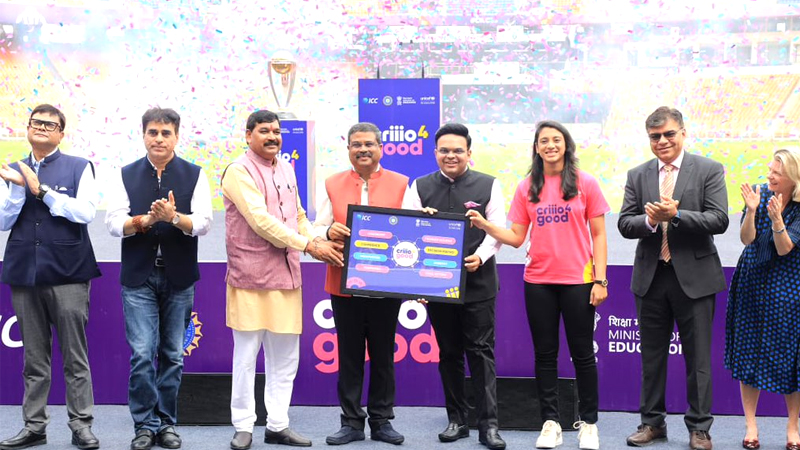
Dharmendra Pradhan launches CRIIIO 4 GOOD modules to advance gender equality and empower young people

| Published on:

Union Minister for Education and Skill Development & Entrepreneurship Shri Dharmendra Pradhan launched ‘CRIIIO 4 GOOD’, a new online, life skills learning modules, to promote gender equality among girls and boys. The programme was launched in association with the International Cricket Council, UNICEF, and the Board of Control for Cricket in India at the Narendra Modi Stadium, Ahmedabad. Minister for Tribal Development, Primary, Secondary and Adult Education, Government of Gujarat, Dr. Kuber Dindor; Minister of State, Parliamentary Affairs, Primary, Secondary and Adult Education, Higher Education, Shri Praful Pansheriya; Representative of UNICEF, Ms. Cynthia McCaffrey; Honorary Secretary, Board of Control for Cricket in India, Shri Jay Shah; Indian cricketer and Celebrity Supporter for ICC-UNICEF CRIIO 4 GOOD initiative, Smt. Smriti Mandhana; Secretary, Department of School Education & Literacy, Ministry of Education, Shri Sanjay Kumar; officials of the Ministry of Education and UNICEF, and over 1000 children were also present for the event.


While speaking at the event, Shri Pradhan highlighted NEP 2020’s emphasis on gender parity and equal opportunities as a fundamental principle. Through CRIIIO 4 GOOD, the power of sports and the popularity of cricket can be used as a medium to empower the girl child and spread awareness about gender equity, he added. He mentioned how the country witnessed history in the making with the passage of Nari Shakti Vandan Adhiniyam and taking India to the forefront of women-led development.

Smt. Smriti Mandhana shared the first learning modules of CRIIIO 4 GOOD with over 1000 school children at the stadium. The modules are highly engaging, and they use the power of cricket to talk about essential life skills and gender equity, among girls and boys in a fun, interactive way.

‘CRIIIO 4 GOOD’ is a series of 8 cricket-based animation films to promote gender parity, equip girls with life skills and encourage their participation in sports. Using the popularity and passion of cricket young audiences, ICC and UNICEF released these modules to inspire children and youth to adopt critical life skills and appreciate the importance of gender equality. The programme can be accessed free of cost on criiio.com/criiio4good in three languages: English, Hindi and Gujarati.

The themes of the eight modules are: leadership, problem-solving, confidence, decision-making, negotiation, empathy, teamwork and goal setting and are visualized through state-of-the-art animation using cricketing examples. In-depth research into local nuances has made these films real and relatable.

Green initiatives in construction sector will be taken to achieve the vision of PM to make the country carbon neutral by 2070: Nitin Gadkari

| Published on:

Union Minister for Road Transport and Highways Shri Nitin Gadkari said green initiatives in construction sector will be taken to achieve the vision of Prime Minister Shri Narendra Modi to make the country carbon neutral by 2070.

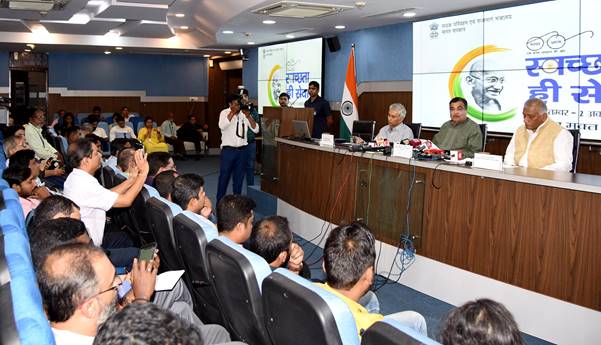
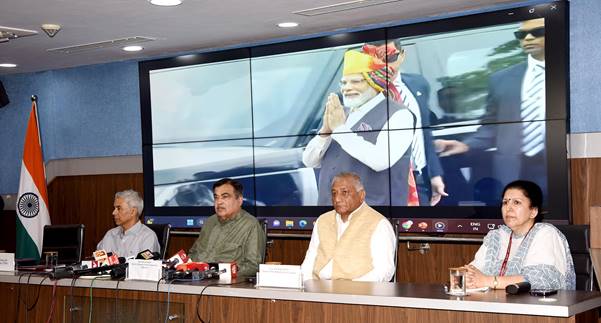
Addressing a press conference in New Delhi today he said under the leadership of Prime Minister all steps will be taken for making the country clean and garbage free. He said in the ongoing Swachta hi seva fortnight several programs including cleanliness drive along national highways ,wayside amenities, Dhabas, Toll plazas have been planned at 13000 locations and work has been completed in almost 7000 locations.

Shri Gadkari said disposal of Solid Waste generated on daily basis is the major environmental challenge being faced in urban areas across Country. He said about 10000 ha of land is locked in dump sites. He said Ministry is working on solutions to utilize urban solid waste in Highway Construction. He said creating  wealth from waste is possible through technology and visionary leadership.

Talking about the Alternate bio fuels in the country Shri Gadkari said he has been a strong proponent of creating an Ethanol Economy and has been pushing for large scale up-take of Ethanol to boost the agricultural growth by 6%.  He said the objective is to make Ethanol Economy of Rs. 2 Lakh Crore. He said with the launch of  World’s First BS-6 Compliant Flex Fuel Strong Hybrid Vehicle in Delhi  Flex Engines will be operating on 100% ethanol and  the savings would surpass Rs. 1 Lakh Crore for the Economy . He said the IOCL plant in Panipat converts agricultural waste, like rice straw, into ethanol and biobitumen.

The Minister said with advancements in bio-ethanol production technologies, 1 ton of rice can yield approximately 400 to 450 liters of ethanol, symbolizing a significant stride towards sustainability and energy independence .

Shri Gadkari said by 2025 there will be a mandate to use 1% Sustainable Aviation Fuel with prospective plans to escalate to 5% blending in India in  future. Indian Oil is establishing a plant in Panipat with a capacity to produce 87,000 tonnes of Sustainable Aviation Fuel ,he added.

Shri Gadkari said in India the telecom sector operates approximately 6 lakh mobile towers. Traditionally, these towers have been reliant on diesel generator sets for power, with one tower consuming around 8,000 liters of diesel annually.

He said this cumulatively results in a staggering consumption of 250 crore liters of diesel, costing around Rs. 25,000 crore every year. The Minister said the integration of ethanol as a fuel for these generator sets offers a sustainable alternative to diesel and  the market has already developed a Generator Set on 100% ethanol . He said he is pushing the GenSet industry to only operate on Ethanol based Generators in the time to come.

Shri Gadkari said  Hydrogen is the fuel for the future and the most important way through which India can become a net exporter of energy .