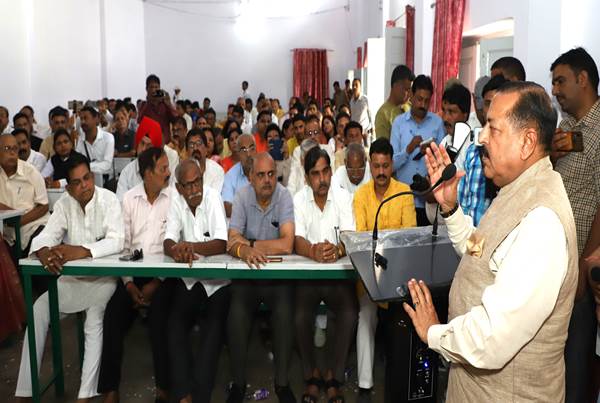

Mansukh Mandaviya addresses Global Vaccine Research Collaborative Discussion on Vaccine Research and Development

| Published on:

“The COVID-19 pandemic has demonstrated the importance of global collaboration in vaccine research and development. As we continue to navigate this once-in-a-century public health crisis, we realize the importance of research to accelerate vaccine development, particularly for emerging pathogens.” This was stated by Dr. Mansukh Mandaviya, Union Minister for Chemicals & Fertilizers and Health & Family Welfare as he addressed the Global Vaccine Research Collaborative discussion on “Vaccine Research and Development: Building Consensus for Future Health Emergencies Prevention, Preparedness, and Response’ a co-branded event under India’s G20 Presidency organized by Dept. of Pharmaceuticals, Govt of India on the sidelines of the 3rd G20 Health Working Group Meeting, in Hyderabad today.

Speaking on the occasion, Dr Mandaviya said that the Global Vaccine Research Collaborative could be a much-needed mechanism to advance vaccine R&D for emerging pathogens. “As we embark on this critical mission, we must leverage the collective expertise of our global health community and strengthen our pandemic preparedness efforts”, he said. He further stated that “International cooperation is essential to advance vaccine development for emerging pathogens, and the G20 can serve as a vital platform to facilitate collaboration between governments, research organizations, pharmaceutical companies, and other stakeholders.”

Highlighting India’s leadership in vaccine R&D for several decades, with experience in developing, producing, and distributing vaccines for diseases such as polio, small pox, and measles, the Union Minister said that India, as a leading player in vaccine production and distribution, can play a critical role in building greater global collaboration towards this goal. “The development and deployment of effective vaccines can help to mitigate the impact of pandemics, and we must prioritize research efforts to achieve this objective”, he said.

Elaborating on India’s initiatives to boost vaccine production and distribution, the Union Minister stated that “the government has provided financial incentives and streamlined regulatory processes to encourage vaccine manufacturers to increase their production capacity. It has also taken steps to ensure the availability of vaccines in rural areas by leveraging the existing infrastructure of primary health centers and other healthcare facilities”.

Reiterating India’s commitment to advancing health priorities, including pandemic preparedness, access to medicines and vaccines, and universal health coverage, Dr Mandaviya said that “we must leverage India’s experience in these fields and accelerate vaccine development, especially for emerging and pandemic-potential pathogens” He further added that “India’s leadership in the production and distribution of COVID-19 vaccines is a testament to our commitment to global health security.” “We recognize that vaccine equity is essential, and we are committed to ensuring that everyone, regardless of their income or nationality, has access to life-saving vaccines”, he further added.
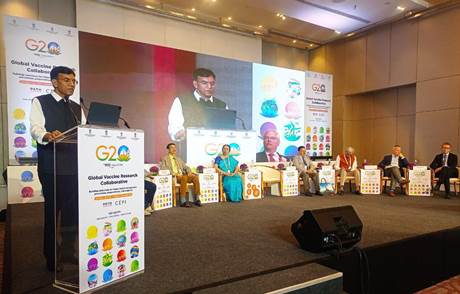
Union Health Secretary, Shri Rajesh Bhushan stated that creating a global vaccine collaborative has to be seen in the context of pandemic prevention, preparedness, response as well as the potential emergence of a harmonized medical countermeasure platform. Highlighting that India has traditionally been a world leader in generics and biosimilars and major Indian vaccine manufacturers contribute more than 50% of the global vaccine supply, he stated that the COVID-19 pandemic underlined the need for reducing the timeline of vaccine manufacturing from decades to less than a year. “The need is for institutionalizing the learnings gained during the pandemic into a system which will straddle countries, span across continents and which will ensure that learnings of the pandemic are made available to all in an equitable manner”, he added.

Accentuating the need for the Global Vaccine Research Collaborative, Smt. S Aparna, Secretary, Dept. of Pharmaceuticals stated that the COVID-19 pandemic highlighted that vaccine inequity takes the form of an acute shape with some countries receiving COVID vaccines after 18 months of being introduced in the world. She stated that “the idea behind the Global Vaccine Research Collaborative is to address this gap and enable equitable access to vaccines at the global stage”. “It will also help in optimizing valuable resources and avoid duplication”, she further stated.

Shri Jayesh Ranjan, Principal Secretary, Govt of Telangana highlighted that 9 billion vaccine doses are produced in Hyderabad every year which is equivalent to one-third of total vaccines produced every year. He stated that India’s first indigenous COVID-19 vaccine, COVAXIN was entirely researched and produced in Hyderabad while other world-renowned vaccines like Sputnik also have a part of its R&D done in Hyderabad. Highlighting these achievements, he invited global vaccine manufacturers to collaborate with domestic firms and set up R&D and production centres in the city.
Background:

The Department of Pharmaceuticals is working with Program for Appropriate Technology in Health (PATH) and Coalition for Epidemic Preparedness Innovations (CEPI) to convene and build consensus among various stakeholders from G20 Member States as well as the special invitee countries for a proposed Global Vaccine Research Collaborative. This initiative will focus on addressing major gaps in research for vaccine development before the next pandemic, establishing a structure and principles for better vaccine R&D preparedness and creating a mechanism for improving coordination and fostering an enabling environment for vaccine R&D.

This event set the tone for the discussions leading up to the 3rd G20 Health Working Group meeting, which will begin tomorrow onwards. The recommendations and principles arrived at the discussions today will be carried forward and inform further discussions at the Health Working Group meetings.

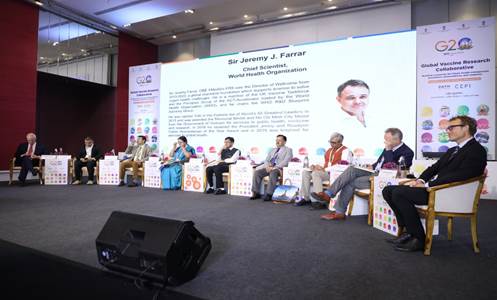
Dr Rajiv Bahl, Secretary, Dept. of Health Research; Sir Jeremy J Farrar, Chief Scientist, WHO; Dr Soumya Swaminathan, Former Chief Scientist, WHO; Mr Nikolai Gilbert, President and CEO, PATH; Dr Richard Hatchett, CEO, CEPI; Shri N Yuvaraj, Joint Secretary, Union Health Ministry; representatives from the G20 member countries, special invitee countries, international organizations, forums and partners like WHO, World Bank, USAID, WEF etc., and senior officers of the Union Government were present.

PM addresses 350th year of Chhatrapati Shivaji Maharaj’s Coronation Day

| Published on:

The Prime Minister, Shri Narendra Modi addressed the 350th year of Chhatrapati Shivaji Maharaj’s Coronation Day via video message today.

Addressing the gathering, the Prime Minister remarked that the coronation day of Chhatrapati Shivaji Maharaj in the Azadi Ka Amrit Mahotsav has brought along new consciousness and new energy for everyone. He said that the coronation of Chhatrapati Shivaji Maharaj is a special chapter of the historic period three hundred and fifty years ago and the great tales of self-governance, good governance and prosperity inspire everyone even today. “National welfare and public welfare have been the basic elements of Shivaji Maharaj’s governance”, the Prime Minister underlined. He noted that a grand event has been organized in the courtyard of Raigarh Fort at the first capital of Swarajya and the day is fondly celebrated as a festival all over Maharashtra. The Prime Minister informed that such events will be held throughout the year in Maharashtra and also congratulated the Maharashtra government for the planning and execution.

The Prime Minister stated that when the coronation of Chhatrapati Shivaji Maharaj took place three hundred and fifty years ago, the spirit of Swarajya and nationalism were included in it. He said that Shivaji Maharaj always gave paramount importance to upholding the unity and integrity of India. Today, the Prime Minister said, the reflection of the thoughts of Chhatrapati Shivaji Maharaj can be seen in the vision of Ek Bharat, Shrestha Bharat.

Underling the responsibility of leaders of keeping the citizens motivated and confident, the Prime Minister remarked that one can imagine the confidence levels of the country at the time of Chhatrapati Shivaji Maharaj. He mentioned that the confidence of the citizens was at the lowest due to hundreds of years of slavery where invasions and exploitation by invaders coupled with poverty made the society weak. “An attempt was made to break the morale of the people by attacking our cultural centers”, the Prime Minister said as he highlighted that Chhatrapati Shivaji Maharaj not only fought the invaders but also instilled the belief in the public that self-governance is a possibility. “Shivaji Maharaj inspired people for nation-building by ending the mentality of slavery”, Shri Modi said.

The Prime Minister pointed out that there have been many rulers in history who are known for their dominance in the military but their administrative ability was weak and similarly many rulers who were known for their excellent governance, but their military leadership was weak. However, the Prime Minister said, the personality of Chhatrapati Shivaji Maharaj was magnificent as he established ‘Swaraj’ as well as ‘Suraj’. The Prime Minister highlighted that Shivaji Maharaj gave an example of his military leadership by conquering forts and defeating enemies at a very young age, while on the other hand, as a king, he also showed the way of good governance by implementing reforms in public administration. The Prime Minister further elaborated that on the one hand, he protected his kingdom and culture from invaders, while on the other, he put forward a comprehensive vision of nation-building. “Chhatrapati Shivaji Maharaj is completely different from other heroes of history because of his vision”, the Prime Minister said as he highlighted his public welfare character of governance which assured that people live with self-respect. Along with this, the Prime Minister continued, Chhatrapati Shivaji Maharaj also sent out a strong message to those who tried to hurt Swaraj, religion, culture and heritage which boosted confidence among the people and propagated the spirit of self-reliance. The Prime Minister further added that it resulted in boosting respect for the nation. Be it farmer welfare, women empowerment, or making governance accessible to the common man, the Prime Minister underlined that his system of governance and his policies are equally relevant even today.

The Prime Minister remarked that various aspects of Chhatrapati Shivaji Maharaj’s personality impact us today in one way or the other. He informed that recognizing India’s maritime potential, the expansion of the Navy and his management skills are inspiration for everyone even today. The Prime Minister also mentioned the forts built by him which are still standing proudly in the middle of the ocean, despite bearing the brunt of strong waves and tides. The Prime Minister also touched upon his expansion of the kingdom and mentioned that he built forts from the seashores to the mountains. During that period, the Prime Minister noted that his arrangements related to water management put the experts in awe. Throwing light on the inspiration derived from Shivaji Maharaj, the Prime Minister underlined that India freed the Navy from a trace of slavery last year as the flag of the Indian Navy with the identity of British rule has been replaced by the emblem of Shivaji Maharaj. “Now, this flag is symbolizing the pride of new India in the seas and skies”, Shri Modi added.

“The bravery, ideology and justice of Chhatrapati Shivaji Maharaj have inspired many generations. His bold style of action, strategic skills and peaceful political system are an inspiration for us even today”, the Prime Minister remarked. Concluding the address, the Prime Minister expressed pride that the policies of Chhatrapati Shivaji Maharaj are discussed in many countries of the world where research is carried out on it. Shri Modi also mentioned that the statue of Chhatrapati Shivaji Maharaj was installed in Mauritius a month ago. “Completion of 350 years of the coronation of Chhatrapati Shivaji Maharaj in the Azadi Ka Amrit Kaal is an inspiring occasion. Even after so many years, the values established by him are showing us the way forward”, the Prime Minister concluded emphasizing that the journey of 25 years of Amrit Kaal must be completed on the basis of these values. “This journey will be to build the India of Chhatrapati Shivaji Maharaj’s dreams will be the journey of Swaraj, good governance and self-reliance. This will be the journey of a developed India”, the Prime Minister concluded.

India is a resurgent power regaining its place on global economic map under PM Modi’s leadership: Raksha Mantri

| Published on:

“India is not an emerging but a resurgent power which is regaining its place on the global economic map under the leadership of Prime Minister Shri Narendra Modi,” said Raksha Mantri Shri Rajnath Singh at an event in New Delhi on June 02, 2023. He began his address by stating that until the 17th century, India had a remarkably strong economy, constituting over a quarter of the world’s GDP, but it lost its glory due to a weak military and political slavery.

The Raksha Mantri asserted that the Government is working on both these fronts to ensure that India regains its old glorious status. He stated that no stone is being left unturned to create a strong, young & tech-savvy Armed Forces on the back of robust defence industry which indigenously manufactures state-of-the-art weapons/equipment, while efforts are also being made to get rid of the colonial mind-set.

“A strong military not only secures the borders, but also protects the culture & economy of a country. The goal is to build a strong, self-reliant and prosperous nation, which caters to its own needs as well as the requirements of friendly countries. This is an era of renaissance. It is time to re-establish India as a global superpower,” Shri Rajnath Singh said.

Citing a report by Morgan Stanley, the Raksha Mantri said that after naming India among the ‘Fragile 5’ economies in 2013, the investment firm recently stated that the country will be the third largest economy by 2027. He termed it as a testament to the growth of the Indian economy in recent years. He was of the view that the phrase ‘emerging power’ can be used for India in the immediate perspective, but for the long term, he views it as a resurgent power, which is regaining its place on the world economic map.

Shri Rajnath Singh listed out a number of reforms undertaken by the Government to facilitate the economic growth of the country. These include direct tax reforms, GST and steps to enhance ease of doing business. There has been a revolutionary transformation in all sectors and foreign investors today see India as an attractive destination, he said.

On the transformative changes brought about in the defence sector in the last few years, the Raksha Mantri stated that a number of steps have been taken to achieve complete ‘Aatmanirbharta’ in manufacturing of weapons and technologies. The major decisions include notification of four positive indigenisation lists of 411 items on behalf of the Armed Forces & four other lists of 4,666 items for DPSUs, besides setting up of Defence Industrial Corridors in Uttar Pradesh & Tamil Nadu.

Shedding light on the positive results achieved due to the Government’s efforts, Shri Rajnath Singh stated that a record over Rs one lakh crore defence production and all-time high defence exports of almost Rs 16,000 crore in Financial Year 2022-23 are proof of the massive growth of the defence sector. He added that the start-up friendly ecosystem created by the Government has led to the creation of over 100 unicorns in the country, with the defence R&D and manufacturing sector witnessing a significant increase in the number of start-ups.

The Raksha Mantri also shared his insights on the Prime Minister’s vision for India to be a developed nation by 2047, which he voiced during his 2022 Independence Day address from the ramparts of Red Fort. The Government is focusing on all sectors, including health, education, road transport, railways and border development to realise the Prime Minister’s vision, he said.

Shri Rajnath Singh spelt out his vision for India@2047, which includes a robust government machinery; help to every person in need; social harmony; equal participation of women and an ecosystem which creates more & more employment opportunities. He also called for further increasing the capacity of the economic infrastructure to ensure a high quality life to the country’s population, while developing the abilities of the youth. He envisioned growth with an efficient market economy, where people have freedom to start any business/job.

The Raksha Mantri added that emphasis should be laid to maintain the standard of life of those who unfortunately are unable to fulfill their dreams due to physical/mental illness or family reasons. “We need to build a welfare state. A state with high quality nutrition, housing, education and healthcare for its people. For this ‘social safety net’, both public and private sectors need to work together,” he said. He visualised an India, where the citizens take pride in their culture and civilization, respect values and traditions and welcome new ideas.

Shri Rajnath Singh also envisioned a developed India which ensures that universal values ​​like democracy, religious freedom, dignity and world peace are established across the globe. “Together, let us dream of an India where people have the same feeling of nation building; where all Indians work together without any discrimination. Let us dream of an India where people are judged not by their caste and religion, but by their knowledge and character; where every Indian has access to human rights and has commitment towards their duties. Let us dream of an India which is strong enough to defend itself and be ready to stand against any injustice anywhere in the world,” he said.

Focus of the Modi Govt in the last 9 years has not been just to create employment but also to build entrepreneurship : Dr Jitendra Singh

| Published on:

Union Minister of State (Independent Charge) for Science and Technology, MoS PMO, Department of Atomic Energy and Department of Space and MoS Personnel, Public Grievances and Pensions, Dr Jitendra Singh has said that StartUp jump in 9 years is a major success story of Prime Minister Narendra Modi led government.
Addressing a youth congregation here, Dr Jitendra Singh said that before 2014 there were just about 350 StartUps, but after Prime Minister Narendra Modi gave the clarion call from the ramparts of the Red Fort in his Independence Day address in 2015 and rolled out special StartUp scheme in 2016, there was a quantum jump and India today has the world’s third largest StartUp ecosystem in the world, boasting 92,683 Startups with more than 115 unicorns (billion-dollar enterprises).

The Minister said, in the year 2022 alone, 26,542 entities were recognised as Startups by the Department for Promotion of Industry and Internal Trade (DPIIT)as startups.A NASSCOM study says tech start-ups created 23 lakh direct and indirect jobs in the year 2017-2021. Besides, startups have self-reported creation of a million jobs directly and many more indirectly since the launch of Startup India in 2016 when the total jobs created stood a meagre 10.
Dr Jitendra Singh, India’s youth today is gradually coming out of the government job mindset and is ready to take the plunge and create new opportunities in niche sectors, in turn creating scores of job opportunities. Interacting with Youth beneficiaries of Central Government schemes in Sambhal, Uttar Pradesh, he said that the focus of the government in the last 9 years has not been just to create employment but also to build entrepreneurship.
Dr Jitendra Singh said, besides Startup India, the Modi Government also launched the StandUp India scheme on 5th April, 2016 to facilitate bank loans from Scheduled Commercial Banks (SCBs) between Rs.10 lakh to Rs.1 Crore to at least one Scheduled Caste (SC) or Scheduled Tribe (ST) and one woman per bank branch for setting up a greenfield enterprise in trading, services or manufacturing sector. The scheme is expected to benefit at least 2.5 lakh borrowers.
Dr Jitendra Singh said PM Modi wants our youth to become new entrepreneurs, new producers and create a complete network of start-ups by these new entrepreneurs across the whole country. PM Modi has a dream to make India Number One in the world of StartUp. PM Modi is of the firm belief that in the coming days “Start-up India” and “Stand-up India” will be there or the future of the country.

Dr Jitendra Singh said Indian Startups raised $44 billion in 2021, with over $ 33 billion going towards deals worth more than $5 million. Many Indian startups are domiciled outside India – despite having the majority of their market, personnel and founders in India. These “externalised” or “flipped” startups constitute a large number of India’s unicorns.

Dr Jitendra Singh said PM Modi also opened the doors of the space sector to private sector participation, as a result today ISRO is working with nearly 150 private Startups. Similarly, before 2014, India’s Bio-economy was valued at $10 billion. Now it’s over $80 billion. Biotech Startups have grown 100 times in the last 8 years from 52 odd startups in 2014 to 5,300 plus in 2022.

Dr Jitendra Singh advised the budding StartUp entrepreneurs to look beyond the IT, Computer and Communications sectors to the most unexplored and the richest farm sector, which is awaiting a huge Tech revolution after the Green revolution. Calling for promoting Agri-tech start-ups in a big way, the Minister said, Agriculture is one of the important pillars of the Indian economy as 54 percent of the Indian population depends directly on agriculture and it accounts for around 20 percent of GDP. He said that before 2014, no one knew about Aroma Mission or Purple revolution. But today Lavender cultivation has led to the boom of Agri tech StartUps. The Central Government’s Aroma Mission, ably supported by CSIR, is changing the mindset of farmers and more and more of them are taking up the cultivation of aroma crops like lavender, lemon grass, rose and marigold for extracting costly oils to be used in many industries. He said, the oils selling about Rs 9,000 per litre are used in making incense sticks and also being used for room sprays, cosmetics and therapeutics.

Dr Jitendra Singh said the Aroma Mission is attracting Start-ups and agriculturists from across the country, and during Phase-I CSIR helped cultivation on 6,000 hectares of land and covered 46 Aspirational districts across the country. More than 44,000 persons have been trained and several crores of farmers’ revenue generated. In the second Phase of Aroma Mission, it is proposed to engage over 45,000 skilled human resources with the aim of benefitting more than 75,000 farming families across the country.

The Agriculture Budget, which was less than Rs.25,000 crore in 2014, has now been increased to more than Rs.1.25 lakh crore, he said.To unlock the growth potential of the agriculture and allied sector, the Government has introduced the Rs.1 lakh crore Agricultural Infrastructure Fund. It is a financing facility operational from the year 2020-21 to 2032-33 for the creation of post-harvest management infrastructure and community farm assets.This year’s budget has also made an important announcement about the provision of Accelerator Funds for Agri-Tech Startups, we are not only building digital infrastructure, but we are also preparing funding avenues. Now it is the turn of our young entrepreneurs, they should move forward with enthusiasm and achieve their goals. It should also be kept in mind that 9 years ago there were very few Agri Startups in the country, but today they are more than 3,000. Agri-start-ups supported under the programme are at various stage of implementation from idea to scaling and growth stage. These agri-startups are working in different areas of agriculture & allied sectors for improving the farming practices such as precision agriculture, farm mechanization, agri logistics & supply chain, waste to wealth, organic farming, animal husbandry, dairy & fisheries, etc.

Dr Jitendra Singh said, in the last nine years, the Modi Government has launched and implemented several welfare schemes to empower every Indian. The results of such irreversible empowerment can be seen in programmes like MUDRA Yojana and Stand Up India, which are creating a large pool of young entrepreneurs from marginalised groups. More than half of the 40 crore loans given under MUDRA have been given to SC/ST/OBC entrepreneurs.

Dr Jitendra Singh said about 34.5 lakh street vendors got loans through PM SVANidhi while loans of over Rs.7,351 crore were disbursed to SC & ST beneficiaries under Stand Up India scheme.

The success of the Modi government’s prioritization of creating new formal jobs for the youth can be seen in the massive rise in new Employee Provident Fund Organisation accounts. Consistent efforts to transform India into an attractive investment hub, assisting MSMEs and programmes such as Production Linked Incentive Scheme for domestic production have contributed towards creating employment opportunities for young Indians.4.78 crore new EPFO subscribers were added between 2017 and January 2023 – each is one formal job, including 1.2 crore new EPFO accounts added in 2021-22, despite the pandemic.

As India entered the Amrit Kaal marking the 75th year of Independence, Dr Jitendra Singh said, the Youth is the centre of focus of the Modi Government by empowering the Amrit-Peedhi. The National Education Policy (NEP) of 2020 overhauled the existing education system after over thirty years. Since its launch, more than 1.37 crore youngsters have received skill training under the PM Kaushal Vikas Yojana, thereby improving their employment prospects. Loans of over Rs.7,351 crore have been disbursed to SC & ST beneficiaries under Stand-Up India programme. 23 lakh direct and indirect jobs have been created by tech Startups in 2017-21. Rozgar Mela, a recruitment drive for 10 lakh Central government jobs has been launched by the government. The youth are also being given an opportunity to serve in the Armed Forces under the Agnipath scheme.

“The focus has not been just to create employment but also to build entrepreneurship, transforming the youth from job seekers to job creators,” he said.

Nitin Gadkari inaugurates two National Highway projects in Vadodara, Gujarat

| Published on:

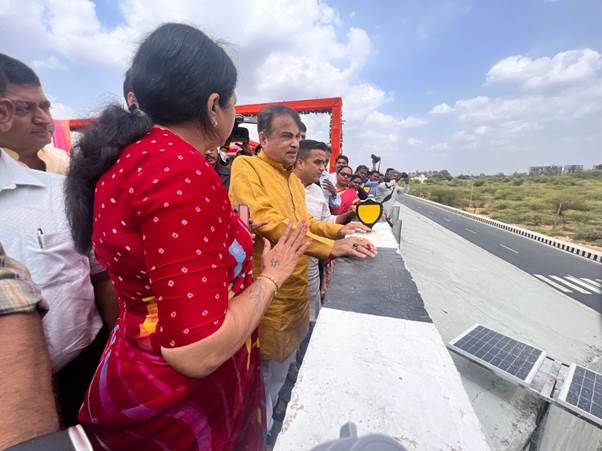
Union Minister for Road Transport and Highways Shri Nitin Gadkari inaugurated two National Highway projects in Vadodara, Gujarat today at a cost of Rs.48 crore the, Bhumi Pujan of these projects was done a year and a half ago on the birthday of Hon’ble Prime Minister.

Shri Gadkari said improvement work has been done near Dumad Chowkdi of Ahmedabad-Vadodara section of National Highway 48. He said this project of about 3 km length has been inaugurated at a cost of Rs 27.01 crore. The Minister said in this, new service roads, vehicular underpasses and RCC crash barriers have been built, which will solve the problem of traffic jam and make the journey more safe.

Shri Gadkari said the length of the second project costing Rs 17 crore to be dedicated to the nation is about 1 km. He said in this project, underpass and service road have been constructed near National Highway 48 Dena Junction of Vadodara. The Minister said under this project, solar powered street lights have been used for the first time on National Highway 48. Polymer Modified Bitumen has been used in the underpass and service road surface which will give it greater strength and better resistance to cracks, he added.

PM to flag off Goa’s first Vande Bharat Express on 3rd June

| Published on:

Prime Minister Shri Narendra Modi will flag off Goa’s first Vande Bharat Express from Madgaon railway station, on 3rd June at 10:30 AM via video conferencing.

Realising Prime Minister’s vision of ‘Make in India’ and Aatmanirbhar Bharat, the state-of-the-art Vande Bharat Express will improve the connectivity in the Mumbai – Goa route and provide the people of the region the means to travel with speed and comfort. The train will be the 19th Vande Bharat train to run in the country.

The train will run between Mumbai’s Chhatrapati Shivaji Maharaj Terminus and Goa’s Madgaon station. It will cover the journey in approximately seven and half hours which will help save about one hour of journey time, when compared with the current fastest train connecting the two places.

The indigenously made train, equipped with world class amenities and advanced safety features including KAVACH technology, will also boost tourism in both states.

PM calls on His Majesty Norodom Sihamoni, The King of Cambodia

| Published on:

Prime Minister Shri Narendra Modi met His Majesty Norodom Sihamoni, the King of Cambodia, who is on his maiden State visit to India from 29-31 May 2023, at the Rashtrapati Bhavan today.

Prime Minister and His Majesty, King Sihamoni underscored the deep civilizational ties, strong cultural and people-to-people connect between both countries.

Prime Minister assured His Majesty of India’s resolve to strengthen the bilateral partnership with Cambodia across diverse areas including capacity building. His Majesty thanked the Prime Minister for India’s ongoing initiatives in development cooperation, and conveyed his appreciation and best wishes for India’s Presidency of G-20.

Raksha Mantri interacts with Indian diaspora in Nigeria during his visit to Abuja

| Published on:

Raksha Mantri Shri Rajnath Singh interacted with the Indian diaspora in Nigeria, at an event organised by the Indian High Commission in Abuja on May 29, 2023. The event was attended by the Indian community not just from Abuja, but also from other cities of Nigeria such as Lagos.

The Raksha Mantri spoke about the increasing importance of India on the world stage owing to its fast-expanding economy and progressive government actions. The members of the community erupted in joy when the Raksha Mantri highlighted the growing stature of the Indian diaspora abroad. He appreciated the positive contribution made by the Indian community in Nigeria and expressed confidence that they will continue to keep the Indian flag flying high.

Shri Rajnath Singh emphasised on the Government’s focus on ‘Aatmanirbharta’ and the significant progress made in defence exports in recent years towards achieving the objective of ‘Make in India, Make for the World’. He also lauded the capabilities of the Armed Forces in effectively countering any threat or challenge from adversaries.

Later, the Raksha Mantri interacted with the senior Nigerian dignitaries, including the Chief Justice and Acting Minister of Defence, at the dinner hosted by the Indian High Commissioner.

Shri Rajnath Singh was in Abuja to attend the swearing-in ceremony of the President of Nigeria Mr Bola Tinubu. Nigeria is home to more than 50,000 Indians. Indian owned/operated companies and businesses are among the largest employers in Nigeria.

FM chairs 2nd meeting of Apex Monitoring Authority of NICDIT

| Published on:

Union Finance and Corporate Affairs Minister, Smt. Nirmala Sitharaman today chaired the 2nd meeting of the Apex Monitoring Authority constituted to review the activities of National Industrial Corridor Development and Implementation Trust (NICDIT). Union Minister of Commerce & Industry, Consumer Affairs, Food and Public Distribution & Textiles, Shri Piyush Goyal and Union Minister of Ports, Shipping and Waterways & Ministry of Ayush, Shri Sarbananda Sonowal also attended the meeting.

The Apex Monitoring Authority comprises of Finance Minister as Chairperson, Minister-in- charge, Ministry of Commerce & Industry, Minister of Railways, Minister of Road Transport & Highways, Minister of Shipping, Vice Chairman, NITI Aayog, and Chief Minister(s) of States concerned. Chief Ministers from four states, viz. Gujarat, Haryana, Uttarakhand, and Maharashtra; Ministers from 9 States viz. Bihar, Uttar Pradesh, Madhya Pradesh, Andhra Pradesh, Kerala, Punjab, Jharkhand, Karnataka, and Rajasthan besides senior officials from all the states attended the meeting.

Smt. Nirmala Sitharaman at the very outset, thanked the State Chief Ministers and Ministers for their continued support and cooperation in the development of NICDIT projects and appreciated the efforts made by the NICDIT team in the successful implementation of its projects.

She emphasized upon the need to ensure continued coordination between the Central and the State Governments and said they should work collectively as ‘Team India.’ Union Finance Minister stated that “FIRE Corridors = F – Freight; I – Industrial; R – Railways; E – Expressways” will ignite industrialization & economic development in India.

The Finance Minister stated that the rapidity with which the infrastructure is being developed since 2014 needs to be maintained. She urged the State Governments and NICDIT to maintain the same momentum for realizing the vision of Prime Minister Shri Narendra Modi of a Developed India by 2047.

She urged all the States to tie up loose ends and move forward and resolve all pending issues through greater exchange and sharing of information to expedite the progress of works in the respective States.

Shri Piyush Goyal emphasized upon the financial viability of the projects. He urged the States for faster allotment of lands at reasonable rates. He stated that States should adopt innovative models and offer package deals etc. for faster investments. He said that electricity rates should be affordable and consistent as high rates of electricity are a deterrent to the industry.

Union Commerce and Industry Minister urged the State Governments to expedite acquisition of contiguous, litigation encumbrance free land and grant early environmental clearances for the NICDIT projects. He further stated that States should focus on expediting the finalization and execution of the Shareholders Agreements and State Support Agreements.

He directed NICDC to foreclose the projects where the State Government is not able to provide committed land in a time bound manner and to conceive projects in other states that are willing to offer land to expedite investments in their respective states.

He concluded by saying, India is making rapid strides towards Aatmnirbharta and continuous support from States will be the best contribution in this nation building process.

Shri Sarbananda Sonowal stated that the development of economic zones in and around ports may also be looked into. This was followed by a special address by Shri Suman K Bery, Vice Chairperson, NITI Aayog.

The meeting started with a brief overview of the National Industrial Corridor Programme by the Secretary, DPIIT & Chairman, NICDC, Shri Rajesh Kumar Singh who talked about the status of land allotment and investment mobilized till date in his welcome address.

Smt. Sumita Dawra, Special Secretary- Logistics, DPIIT and CEO & MD, NICDC presented action taken on the directions of the 1st meeting and further spoke about the recent developments in the industrial corridor projects and gave a brief overview about the projects which are in the pipeline. During the presentation, she highlighted the adoption of PM’s GatiShakti National Master Plan in Industrial Corridor projects. Smt. Dawra also apprised that as per the directions of the Union Finance Minister in the previous meeting, Round Table Conferences, Roadshows & meetings with international associations are being organised at different places with the support of States & SPVs.

Chief Ministers/Ministers of Industries/Senior Officials of the respective states spoke about the projects which are/or will be undertaken in their jurisdiction and the steps they are taking to ease the land allotment process and to give faster clearances. They assured that all possible support will be extended to the projects under NICDIT for early implementation on the ground.

The meeting proved to be a valuable platform for key stakeholders to discuss and exchange ideas on the progress, challenges, and future strategies related to the National Industrial Corridor Development Program. It presented an opportunity to align efforts, foster collaboration, and accelerate the development of industrial infrastructure across the country. Further steps to be taken into consideration for the advancement of the National Industrial Corridor Development Programme were the main points of discussion during the meeting of Apex Authority.

The National Industrial Corridor Development Program aims to establish a network of industrial corridors that will serve as engines of economic growth, promote industrialization, and create employment opportunities across India. The program focuses on developing world-class infrastructure, attracting investments, and fostering sustainable industrial development.

PM shares website link showcasing development journey under the Government

| Published on:

The Prime Minister has shared the website link showcasing development journey under the Government in the past 9 years. Shri Modi has invited everyone to visit the website and witness how people have benefited from various Government schemes.

The Prime Minister tweeted:

“9 years of unwavering dedication to the nation’s growth.

I invite everyone to visit this site nm-4.com/9yrsofseva to get a glimpse of our development journey. It also gives an opportunity to highlight how people have benefited from various Government schemes. #9YearsOfSeva “

PM shares articles on 9 Years of Government

| Published on:

The Prime Minister, Shri Narendra Modi has shared articles on 9 Years of Government. 

The Prime Minister’s Office tweeted:

“Nine years of hope, aspiration and trust, writes Former President, Shri Ram Nath Kovind Ji”

Sharing a tweet by Union Finance Minister Smt Nirmala Sitharaman, the Prime Minister’s Office tweeted;

“Union Finance Minister Nirmala Sitharaman Ji elaborates how the Government has overcome the challenge of change.

Sharing a tweet by Union Minister of External Affairs Dr S Jaishankar, the Prime Minister’s Office tweeted;

“Must Read!

EAM Dr S Jaishankar writes, “India is perceived as a responsible development partner, a First Responder, and a voice of the Global South.”

PM flags off Assam’s first Vande Bharat Express connecting Guwahati to New Jalpaiguri

| Published on:

The Prime Minister, Shri Narendra Modi flagged off  Assam’s first Vande Bharat Express via video conferencing today. The Vande Bharat Express will connect Guwahati with New Jalpaiguri Guwahati and the journey will take 5 hrs 30 mins. The Prime Minister also dedicated 182 Route kilometers of newly electrified sections and inaugurated a newly constructed DEMU/MEMU shed at Lumding in Assam

Addressing the gathering, the Prime Minister said that today is a huge day for the connectivity of the Northeast as three development works are being accomplished together. Firstly, the Prime Minister elaborated, Northeast is getting its first Vande Bharat Express today where this is the third Vande Bharat Express which connects West Bengal. Secondly, approximately 425 kilometers of railway tracks in Assam and Meghalaya have been electrified. And, thirdly, a new DEMU/MEMU shed has been inaugurated in Lumding in Assam. The Prime Minister congratulated the citizens of the entire Northeast along with Assam, Meghalaya and West Bengal on this momentous occasion.

The Prime Minister said that the Guwahati -New Jalpaiguri Vande Bharat train will strengthen the centuries-old ties between Assam and West Bengal. This will increase ease of travel and provide huge benefits to students and will increase job opportunities arising out of tourism and business. He said that this Vande Bharat will provide connectivity to Maa Kamakhya Temple, Kaziranga, Manas National Park, and Pobitora Wildlife Sanctuary. Furthermore, the Prime Minister pointed out that it will enhance travel and tourism in Shillong, Cherrapunji in Meghalaya and Tawang and Pasighat in Arunachal Pradesh.

Throwing light on the 9 years of the NDA government in power, the Prime Minister remarked that the nation has witnessed numerous accomplishments and unprecedented development towards a new India in these years. He highlighted the newly inaugurated magnificent Parliament House of independent India and said that it will connect the thousand-year-old democratic history of India with its prosperous democracy of the future. Referring to past governments, the Prime Minister pointed out that the scams of before 2014 had broken all records where the maximum impact was felt by the poor and the states which lagged behind in development. “Our government has prioritized the welfare of the poor”, the Prime Minister remarked as he gave examples of houses, toilets, tapped water connections, electricity, gas pipelines, the development of AIIMS, infrastructure boost to roads, railways, airways, airways, waterways, ports and mobile connectivity. He underlined that the government has worked at full strength to achieve these goals. Noting that infrastructure makes people’s lives easier, creates employment opportunities and becomes a basis for development, the Prime Minister mentioned that the infrastructure development pace in India is being discussed all over the globe. This infrastructure, the Prime Minister said, strengthens and empowers the poor, backward, dalits, adivasis and other deprived sections of the society.  “Infrastructure is for everyone and it does not discriminate”, the Prime Minister said as he underlined that this form of development is the pure form of social justice and secularism.

The Prime Minister said that the biggest beneficiaries of the infrastructure push have been the states of Eastern and Northeastern India. He said that earlier, the people of the Northeast remained deprived of even the basic facilities for decades. He said that a large number of villages and families which did not have electricity, telephone or good rail road air connectivity until 9 years ago were from the Northeast.

The Prime Minister presented rail connectivity in the region as an example of work with a service spirit. The rail connectivity in the northeast is proof of the government’s speed, scale and intention, the Prime Minister said. The Prime Minister said that even in colonial times Assam, Tripura and Bengal were connected with railways, even though, with an intention to loot the natural resources of the region. However, even after Independence, the expansion of railways in the region was ignored and finally fell on the current government after 2014.

Shri Modi said that he has given the highest priority to Northeast people’s sensitivities and facilities. This change has been widely felt, he added. He informed that before 2014, the average railways budget for the Northeast was about 2500 crore rupees which has grown to more than 10 thousand crores this year, a four-fold increase.  Now capitals of Manipur, Mizoram, Nagaland, Meghalaya and Sikkim are being connected to the rest of the country, “Very soon all capital cities of the Northeast are going to be connected with a broad gauge network”,  he said, “One lakh crore rupees are being spent on these projects.”

“The scale and speed of the development works of the government has been unprecedented”, the Prime Minister remarked as he noted that new rail lines are being laid in the Northeast at three times the pace than before and the doubling of rail lines is taking place 9 times faster than before. The Prime Minister mentioned that the work for doubling of rail lines began in the last 9 years and the government is working towards saturation at a very fast pace.

The Prime Minister credited the pace of development which led to many remote areas of the Northeast being connected with railways. He informed that Nagaland got its second railway station after almost 100 years. Now, the Prime Minister said, Vande Bharat Semi High-speed trains and Tejas Express are running on the same path where once stood a narrow gauge line capable of low speeds. He also mentioned the Vista Dome coaches of the Indian Railways which have become a center of attraction for tourists.

“Indian Railway has become a medium of connecting hearts, societies and opportunities to the people along with speed”, the Prime Minister remarked as he highlighted the first transgender tea stall at Guwahati Railway Station. He stated that it is an attempt to give a life of respect to those who expect better behaviour from society. Under the ‘One Station, One Product’ scheme, the Prime Minister highlighted that stalls have been set up at railway stations in the Northeast which give emphasis to Vocal for Local thereby providing a new market for local artisans, artists, and craftsmen. He also gave the example of Wi-Fi facilities provided at hundreds of stations in the Northeast. “It is only with this combination of sensitivity and speed that Northeast will move forward on the path of progress and pave the way towards a developed India.

Background

The state-of-the-art Vande Bharat Express will provide the people of the region with the means to travel with speed and comfort. It will also boost tourism in the region. Connecting Guwahati with New Jalpaiguri, the train will help save about an hour of journey time, when compared with the current fastest train connecting the two places. Vande Bharat will cover the journey in 5 hrs 30 mins, while the current fastest train takes 6 hrs 30 mins to cover the same journey.

The Prime Minister dedicated 182 Route kilometers of newly electrified sections. This will help provide pollution-free transportation with trains running at higher speeds and reduced running time of trains. It will also open the doors for trains running on electric traction to enter Meghalaya.

The Prime Minister also inaugurated a newly constructed DEMU/MEMU shed at Lumding in Assam. This new facility will be helpful for maintaining DEMU rakes operating in this region, leading to better operational feasibility.