Kisan Credit Card is making life easier for our hardworking farmers: PM

| Published on:

The Prime Minister, Shri Narendra Modi has said that Kisan Credit Card is making life easier for our hardworking farmers and that is its main purpose as well.

In a tweet thread MP from Hathras, Shri Rajveer Diler talked about facilities provided by Kisan Credit Card to the Farmers.

Replying to the tweet thread by Hathras MP, the Prime Minister tweeted;

“यह देखकर बहुत खुशी हो रही है कि किसान क्रेडिट कार्ड ने हमारे परिश्रमी अन्नदाताओं का जीवन आसान बनाया है। यही इसका मूल उद्देश्य भी तो है!”

PM to visit Telangana, Tamil Nadu and Karnataka on 8th and 9th April

| Published on:

Prime Minister Shri Narendra Modi will visit Telangana, Tamil Nadu and Karnataka on 8th and 9th April, 2023.

On 8th April, 2023, at around 11:45 AM, Prime Minister will reach Secunderabad Railway Station and flag off Secunderabad-Tirupati Vande Bharat Express. At around 12:15 PM, Prime Minister will attend a public function at Parade Ground in Hyderabad, where he will lay the foundation stone of AIIMS Bibinagar, Hyderabad. He will lay the foundation stone of five National Highway projects.  He will also lay the foundation stone of redevelopment of Secunderabad Railway Station and dedicate to the nation other development projects related to railways.

At around 3 PM, Prime Minister will reach Chennai Airport, where he will inaugurate the New Integrated Terminal Building of Chennai Airport. At 4 PM, Prime Minister will flag off the Chennai-Coimbatore Vande Bharat Express at MGR Chennai Central Railway Station. He will also inaugurate and flag off other Railway projects during the Programme. At 4:45 PM, Prime Minister will participate in the celebrations commemorating the 125th Anniversary of Sri Ramakrishna Math in Chennai. At 6:30 PM, Prime Minister will preside over a public programme at Alstrom cricket ground, Chennai, where he will inaugurate and lay the foundation stone of road projects.

On 9th April, 2023, at around 7:15 AM, Prime Minister will visit Bandipur Tiger Reserve. He will also visit the Theppakadu Elephant camp in Mudumalai Tiger Reserve. At around 11 AM, Prime Minister will inaugurate the programme ‘Commemoration of 50 years of Project Tiger’ organised at Karnataka State Open University, Mysuru.

PM in Telangana

Prime Minister will inaugurate and lay the foundation stone of projects worth over Rs. 11,300 crores in Telangana.

Secunderabad-Tirupati Vande Bharat Express, connecting IT City, Hyderabad with the Abode of Lord Venkateswara, Tirupati, is the second Vande Bharat train to be started from Telangana within a short span of three months. The train will reduce the travel time between the two cities by almost three and half hours and will be particularly beneficial for pilgrim passengers.

The redevelopment of Secunderabad Railway Station, to be done at a cost of Rs. 720 crores, is being planned such that it will undergo a massive makeover with world-class amenities and aesthetically designed iconic station building. The redeveloped station would be having double-level spacious roof plaza with all passenger amenities at one place along with multimodal connectivity for providing seamless transfer of passengers from rail to other modes among others.

During the Programme, Prime Minister will flag-off 13 new Multi-Modal Transport Service (MMTS) services in the suburban section of Hyderabad – Secunderabad twin city region, providing commuters with a fast, convenient and comfortable travel option. He will also dedicate to the nation the doubling and electrification of Secunderabad–Mahabubnagar project. The project stretching for a distance of over 85 kms has been completed at a cost of nearly Rs. 1,410 crores. The project will provide seamless connectivity and assist in enhancing the average speed of trains.

At the public programme at Parade Ground Hyderabad, Prime Minister will lay the foundation stone of AIIMS Bibinagar, Hyderabad. This is a testimony of the Prime Minister’s vision of strengthening health infrastructure across the country. AIIMS Bibinagar is being developed at the cost of more than Rs. 1,350 crore. The establishment of AIIMS Bibinagar is an important milestone in providing comprehensive, quality and holistic tertiary care health services to the people of Telangana at their doorstep.

During the Programme, Prime Minister will also lay the foundation stone of National Highway projects worth more than Rs. 7,850 crore. These road projects will strengthen the road connectivity of both Telangana and Andhra Pradesh, and will aid in the socio-economic development of the region.

PM in Tamil Nadu

Prime Minister will inaugurate the New Integrated Terminal Building (Phase- 1) of Chennai International Airport, developed at the cost of Rs. 1260 Crore. The addition of this new Integrated terminal building will increase the passenger serving capacity of the airport from 23 Million Passengers Per Annum (MPPA) to 30 MPPA. The new terminal is a striking reflection of the local Tamil culture, incorporating traditional features such as the Kolam, Saree, Temples, and other elements that highlight the natural surroundings.

At a function at MGR Chennai Central Railway Station, Prime Minister will flag off Chennai-Coimbatore Vande Bharat Express. Prime Minister will flag off the Express service between Tambaram and Sengottai. He will also flag off a DEMU service from Thiruthuraipoondi – Agasthiyampalli, which will benefit commuters from Coimbatore, Tiruvarur and Nagapattinam districts.

Prime Minister will also inaugurate the 37 Km gauge conversion section between Thiruthuraipoondi and Agasthiyampalli, which has been completed at a cost of Rs 294 Crores.  This will benefit the movement of edible and industrial salt from Agasthiyampalli in Nagapattinam district.

Prime Minister will participate in the celebrations commemorating the 125th Anniversary of Sri Ramakrishna Math in Chennai. Swami Ramakrishnananda had started Sri Ramakrishna Math in Chennai in 1897. Ramakrishna Math and Ramakrishna Mission are spiritual organisations engaged in various forms of humanitarian and social service activities.

At the public programme at Alstrom cricket ground, Chennai, Prime Minister will inaugurate and lay the foundation stone of road projects worth about Rs 3700 crore. The projects include inauguration of 7.3 km long Elevated Corridor in Madurai City and 24.4 km long four lane road of National Highway 785. Prime Minister will also lay the foundation stone of construction of road projects of National Highway-744. The project worth more than Rs. 2400 Crore will boost inter-state connectivity between Tamil Nadu and Kerala and ensure a convenient journey for pilgrims visiting Meenakshi Temple in Madurai, Andal Temple in Srivilliputhur and Sabarimala in Kerala.

PM in Karnataka

Prime Minister will visit Bandipur Tiger Reserve in the morning and interact with frontline field staff and Self Help Groups involved in conservation activities. He will also visit the Theppakadu Elephant camp in Mudumalai Tiger Reserve and interact with mahouts and kavadis of the elephant camp. The Prime Minister will also interact with Field Directors of tiger reserves that have scored highest in the recently concluded 5th cycle of Management Effectiveness Evaluation exercise.

Prime Minister will launch the International Big Cats Alliance (IBCA). In July, 2019 Prime Minister had called for an Alliance of Global Leaders to obliterate demand and firmly curb poaching and illegal Wildlife trade in Asia. Taking the message of the Prime Minister forward, the alliance is being launched. IBCA will focus on protection and conservation of seven major big cats of the world, viz. Tiger, Lion, Leopard, Snow Leopard, Puma, Jaguar and Cheetah, with membership of the range countries harbouring these species.

Prime Minister will also inaugurate the programme ‘Commemoration of 50 years of Project Tiger’.  During the programme, he will release the publications ‘Amrit kaal ka vision for tiger conservation’, summary report of 5th cycle of Management Effective Evaluation of Tiger Reserves, declare tiger numbers and release summary report of All India Tiger Estimation (5th cycle). A commemorative coin on completion of 50 years of Project Tiger will also be released by the Prime Minister.

PM marks 7 years of Stand Up India

| Published on:

The Prime Minister, Shri Narendra Modi has acknowledged the role that Stand Up India  initiative has played in empowering the SC/ ST communities and ensuring women empowerment. Stand Up India completes 7 years today.

The Prime Minister tweeted :

“Today we mark #7YearsofStandUpIndia and acknowledge the role this initiative has played in empowering the SC/ ST communities and ensuring women empowerment. It has also boosted the spirit of enterprise our people are blessed with.”


RISC-V is becoming a global movement, in which India will play a leading role: Rajeev Chandrasekhar

| Published on:

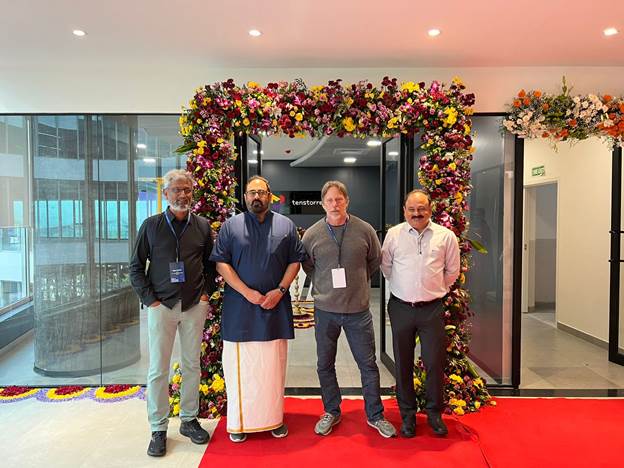
Union Minister of State for Skill Development & Entrepreneurship and Electronics & IT Shri Rajeev Chandrasekhar today said Indian startups using RISC-V have tremendous opportunities for developing products, devices and AI solutions with global companies like Tenstorrent evincing interest for collaborations.

The RISC-V, an open-source instruction set architecture (ISA) is being increasingly used for innovations, particularly when it comes to emerging and rapidly developing AI solutions. “RISC-V is becoming a global movement with India as a leading player,” the Minister said, while addressing the RISC-V Technology Conference on ‘Nerds Talking To Nerds’, organised by Tenstorrent at Bengaluru in Karnataka.

“We are living in extremely interesting times for technology space and in the next five years, centres of gravity will be rebuilt around newer geopolitics and newer talent pools. Young Indians are going to shape the future of Semicon design and build and create new products, new devices and new solutions,” he said.

https://static.pib.gov.in/WriteReadData/userfiles/image/image002G425.jpg

Shri Rajeev Chandrasekhar, himself a former chip designer, welcomed the move by legendary chips designer Jim Keller’s decision to set up his startup Tenstorrent’s office in India, saying, “I am happy that within a year of the launch of the 1st Semicon India Conference by Prime Minister Shri Narendra Modi, global semicon leaders like Jim Keller are moving to India and catalysing future design startups in the country. The time and place for RISC-V is India and Bengaluru is the capital of RISC-V innovation,” he said.

Sarbananda Sonowal flags off Maritime Awareness Walkathon on the occasion of ‘National Maritime Day’

| Published on:

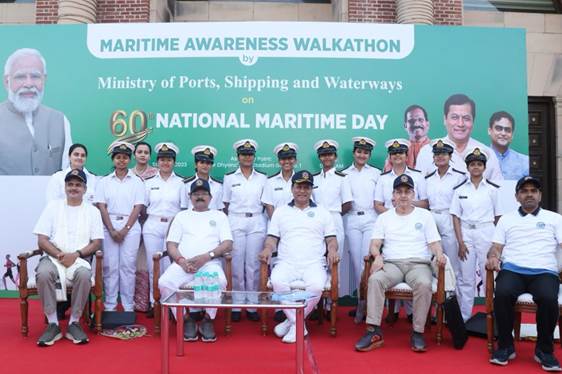
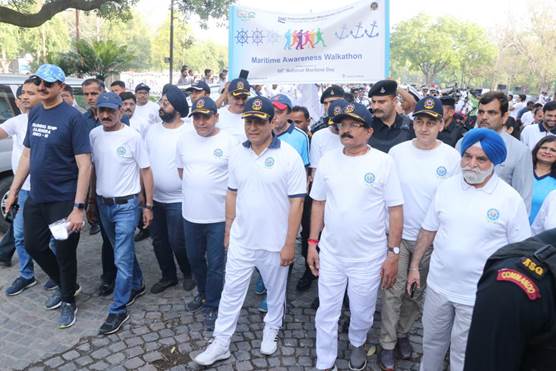
On the occasion of the 60th National Maritime Day, Union Minister of Ports, Shipping and Waterways  (MoPSW) & Ayush, Shri Sarbananda Sonowal flagged off the ‘Maritime Awareness Walkathon’ in here today. The walkathon was flagged off in the presence of Shri Shripad Y. Naik, Minister of State, MoPSW; Shri Sudhansh Pant, IAS, Secretary, MoPSW; Shri Sanjeev Ranjan, IAS, Chairman, National Shipping Board; Shri Rajesh Kumar Sinha, IAS, Additional Secretary, MoPSW; Capt. Rajendra Poswal, Nautical Surveyor, Chairman National Maritime Day and various other dignitaries.

During the event Shri Sarbananda Sonowal greeted people and paid respect, saluting seafarers, port workers and all those associated with the maritime sector for their determination and hard work.

Highlighting the importance of the maritime sector for India’s economic growth, Shri Sarbananda Sonowal said, “Shipping is the lifeline and the route of the prosperity of the nation. This is the first National Maritime Day which we are celebrating during Amrit Kaal. In India’s Amrit Kaal, shipping will open new boundaries to lead the building of Aatmanirbhar Bharat.”

“The vision of Amrit Kaal under the dynamic leadership of Prime Minister Shri Narendra Modi is for creation of excellent employment opportunities for the youth. We have to work hard to make shipping a fast-growing sector so that India can become a world leader in maritime infrastructure as well as a lead player in the maritime economy,” said Shri Sonowal.

“Women seafarers are also playing a vital role in the maritime sector. I am thankful for their tremendous contribution,” he added.

On April 5, 1919, for the first time, the Indian company Scindia Steam Navigation Company Limited’s ship namely S.S. Loyalty went from India to London to trade. In his memory, the Ministry of Ports, Shipping and Waterways celebrates 5th April every year as National Maritime Day.

National Maritime Day is dedicated to the pivotal role of maritime trade in the development of the Indian economy and its strategic location in global trade.

PM meets with His Majesty the King of Bhutan, Jigme Khesar Namgyel Wangchuck

| Published on:

The Prime Minister, Shri Narendra Modi met with His Majesty the King of Bhutan, Jigme Khesar Namgyel Wangchuck in New Delhi at his residence.

The Prime Minister tweeted:

“Pleased to receive His Majesty the King of Bhutan, Jigme Khesar Namgyel Wangchuck. We had a warm and productive meeting. Deeply value our close friendship and the vision of successive Druk Gyalpos in guiding India-Bhutan relations to new heights.”

PM addresses 5th International Conference on Disaster Resilient Infrastructure

| Published on:

The Prime MInister, Shri Narendra Modi today addressed the 5th International Conference on Disaster Resilient Infrastructure (ICDRI) 2023 via a video message.

The Prime Minister said that CDRI arose from a global vision that in a closely connected world, the impact of disasters will not just be local.Therefore, “our response has to be integrated not isolated”, he said. He noted that in just a few years, over 40 countries from advanced and developing countries, large or small or from global South or Global North have become part of the CDRI. He found it encouraging that apart from governments, global institutions, private sectors and domain experts are also involved.

The Prime Minister outlined some priorities for discussion for disaster resilience infrastructure in the context of this year’s theme of ‘Delivering Resilient and Inclusive Infrastructure’. The Prime MInister said “Infrastructure is not only about returns but also about reach and resilience. Infrastructure must leave none behind and serve the people even during times of crisis.” The Prime Minister stressed the need for a holistic view of infrastructure as social and digital infrastructure are as important as transport infrastructure.

Along with quick relief, the Prime Minister emphasized the need to focus on early restoration of normalcy too. “Resilience is built in the times between one disaster and another. Studying past disasters and learning lessons from them is the way”, he added.

Shri Modi underlined the intelligent use of local knowledge of building infrastructures that can with-stand disasters. Modern technology with local insights can be great for resilience. Further, if documented well, local knowledge may become a global best practice, the Prime Minister said.

The Prime Minister noted the inclusive intent of some of the CDRI initiatives. He mentioned the Infrastructure for Resilient Island States initiative or IRIS benefitting many island nations. He remarked on the Infrastructure Resilience Accelerator Fund that was announced last year. This 50 million dollar fund has generated immense interest among developing nations. “The commitment of financial resources is key to the success of initiatives”, the Prime Minister emphasized.

Mentioning India’s G20 presidency, the Prime Minister informed about inclusion of the CDRI in many working groups. ‘The solutions you explore here will receive attention at the highest levels of global policy-making’, he said

Referring to the scale and intensity of the recent disasters like the earthquakes in Türkiye and Syria, the Prime Minister concluded by underlining the importance of CDRI’s work and its importance.

Logistics has become the centerpiece of India’s policy: Piyush Goyal

| Published on:

Union Minister of Commerce and Industry, Consumer Affairs, Food and Public Distribution and Textiles, Shri Piyush Goyal said that logistics has become the centerpiece of India’s policy making in its journey towards becoming a developed nation and a leader in international trade. He also said that express delivery of services has transformed through innovative ideas under the leadership of Prime Minister Shri Narendra Modi.

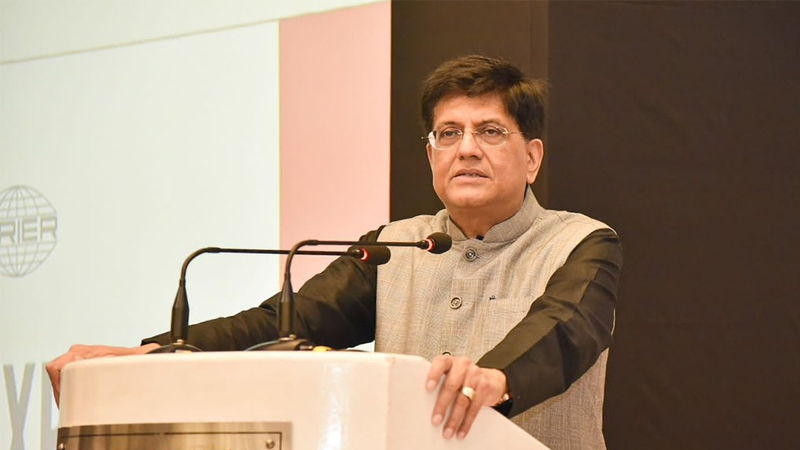
During his address at the ICRIER Release of the Report on Express Delivery Services in New Delhi, the Minister praised the Indian Council for Research on International Economic Relations (ICRIER) for a report which aims to improve the overall logistics system by partnering with industry and government. He said that ICRIER acts as a bridge between government and industry. He added that it must work with industry experts on the roadmap for fruitful realization and implementation of the recommendations of the report.

The Minister noted that the growth in overall exports over the last two years despite challenges like inventory pileup, high raw material costs, freight issues, and the COVID-19 pandemic’s impact is commendable. He said that the government is making a conscious effort to change the mindset of looking at things from the old perspective and living in hesitations of history. It is the result of these efforts that the overall exports from India in 2022-23 are expected to be about US$ 765 billion, he said.

The Minister said that the government is focused on taking digital connectivity across the length and breadth of the country, with 4G and broadband internet reaching almost every corner of the country. He observed that the seamless digital connectivity enabled India to deliver services on time during the COVID period by facilitating work from home. He said that this express delivery of services through an expansive digital network created over the last 8 years must be duplicated in the logistics sector for timely delivery of goods.

He said that Express Delivery Services is yet to come to terms with the huge potential India holds. The Minister noted that scale, efficiency, and building blocks through technology must be utilized to bring down the cost in logistics. He said that the government is taking steps in this direction through massive infrastructure development through PM GatiShakti for smarter and faster planning and implementation of projects, Unified Logistics Interface Platform and dedicated freight corridors.

He highlighted that when the Prime Minister said that India can be the trusted partner to the world at the G20 Summit, the message went out that India is ready to do business with its transparent and rule based ecosystem and its highly talented and committed human resource. The Minister said that trust, transparency, and talent will help us in our trade.

He said that the Prime Minister’s vision for India is big and bold, and the entire world is looking up to India with hope and confidence that the country can deliver. He appreciated the role played by youth in the startup sector and encouraged them to think big and work towards making India a developed country.

The Minister said that the Prime Minister’s innovative ideas, including transporting liquid medical oxygen by trains and empty containers by air transport during the COVID-19 pandemic, led to a significant reduction in delivery time and saved numerous lives. He emphasized the importance of speed in determining the success of India and called for newer ideas and ways of doing work in the spirit of togetherness for the country.

PM recalls the noble teachings of Bhagwan Mahavir on Mahavir Jayanti

| Published on:

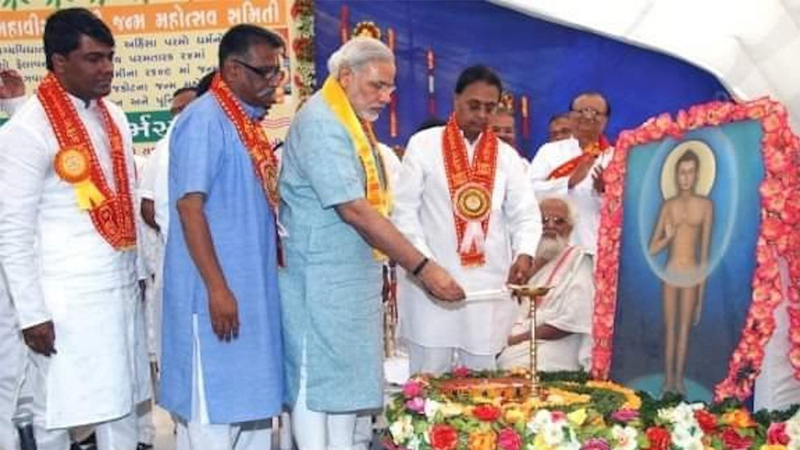
The Prime Minister, Shri Narendra Modi, bowing to Bhagwan Mahavir on Mahavir Jayanti said that Bhagwan Mahavir showed the way to build a peaceful, harmonious and prosperous society.

The Prime Minister tweeted;

“Today is a special day, when we recall the noble teachings of Bhagwan Mahavir. He showed the way to build a peaceful, harmonious and prosperous society. Inspired by him, may we always serve others and also bring a positive difference in the lives of the poor and downtrodden.”

PM inaugurates Diamond Jubilee Celebrations of Central Bureau of Investigation in New Delhi

| Published on:

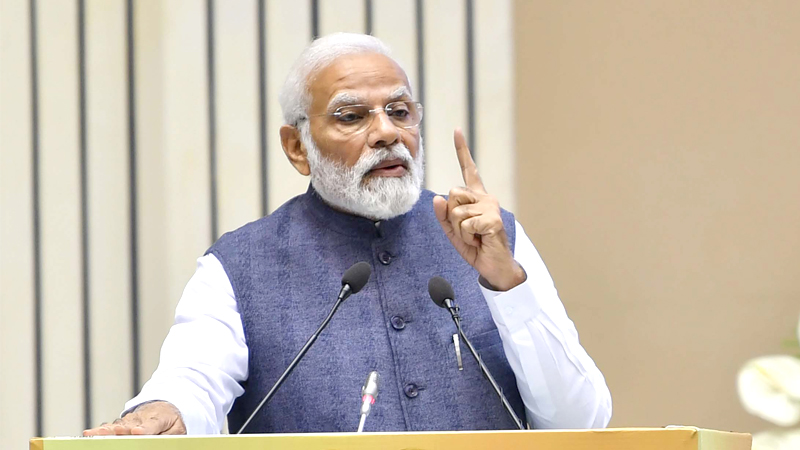
The Prime Minister, Shri Narendra Modi inaugurated the Diamond Jubilee Celebrations of the Central Bureau of Investigation (CBI) at Vigyan Bhawan in New Delhi today. The Central Bureau of Investigation was established by a resolution of the Ministry of Home Affairs, Government of India dated 1st April 1963.

During the programme, an Investiture Ceremony for recipients of the President’s Police Medal for Distinguished Service and Gold Medal for Best Investigating Officers of CBI was also held wherein the Prime Minister conferred medals to the awardees. The Prime Minister also inaugurated the newly constructed office complexes of CBI at Shillong, Pune and Nagpur. He released a Postage Stamp and  Commemorative Coin marking the Diamond Jubilee Celebration year of CBI and also launched the Twitter handle of CBI. He also released the updated Administration Manual of CBI, an Almanac on Bank Frauds – case studies and learning, In pursuit of justice – Supreme Court Judgements in CBI Cases and a handbook on International Police cooperation for the exchange of foreign located intelligence & evidence.

Addressing the gathering, the Prime Minister congratulated everyone on the occasion of the Diamond Jubilee Celebrations of CBI and said that the organization has completed a journey of 60 years as the premier investigating agency of the country. Noting that these six decades have marked many achievements for the organization, the Prime Minister emphasized that a collection of Supreme Court judgements for matters relating to CBI has also been launched today which gives us a glimpse of the history of CBI. In some cities, the Prime Minister said, be it new offices, the Twitter handle or other facilities have also been launched today that will play a key role in strengthening CBI. “Through their work and skills, CBI has instilled trust among the common citizens of the country”, the Prime Minister said. He noted that even today when an unsolvable case comes, a common accord emerges asking for the case to be handed over to CBI. Giving examples, the Prime Minister mentioned that at times protests erupt in cities for a case to be handed over to CBI. Even at the Panchayat level when a matter arises, the Prime Minister said, a mutual voice amongst the citizens demands a CBI inquiry. “CBI’s name is on everyone’s lips. It is like a brand for truth and justice”, the Prime Minister remarked as he noted the extraordinary feat of winning the trust of the common populace. The Prime Minister congratulated everyone who has been associated with CBI in this journey of 60 years.

The Prime Minister congratulated the awardees and asked the Bureau to keep upgrading themselves. He said that the proposed Chintan Shivir should learn from the past and plan for the future keeping in mind the momentous time of Amrit Kaal during which cores of Indians have taken a pledge to achieve a Viksit Bharat. The Prime Minister stressed that a Viksit Bharat is not possible without professional and efficient institutions and this puts a huge responsibility on CBI.

The Prime Minister complimented CBI for earning an impede of multi-dimensional and multi-disciplinarian investigative agency and mentioned its expanded sphere. The Prime Minister emphasized that mainly, CBI’s chief responsibility is to rid the country of corruption. “Corruption is not an ordinary crime, it snatches the rights of the poor, it begets many other crimes, corruption is the biggest obstacle in the path of justice and democracy”, he said. He said corruption in the government system hampers democracy and the first casualty are the dreams of the youth as in such circumstances a certain type of ecosystem flourishes killing talent. Corruption, the Prime Minister continued, promotes nepotism and a dynastic system which erodes the nation’s strength, seriously hampering development.

The Prime Minister recalled that unfortunately, India got a legacy of corruption at the time of Independence and lamented the fact that instead of removing it, some people kept nourishing this malady. He remembered the scene of the scams and the prevailing sense of impunity just a decade ago. This situation led to the destruction of the system and an atmosphere of policy paralysis brought the development to stand still, he said.

After 2014, the Prime Minister reiterated that the priority of the government was to instill faith in the system and for this, the government started taking action against black money and benami property in mission mode and started inflicting damage on the corrupt as well as the reasons behind the corruption. He recalled bringing transparency in the processes of issuing government tenders and also highlighted the difference in 2G and 5G spectrum allocations. The Prime Minister emphasized that GeM (Government eMarketplace) Portal has been established to ensure transparency in making purchases in every department of the Central Government.

The Prime Minister said today’s Internet banking and UPI stand in stark contrast to the earlier ‘phone banking’ malaise. The Prime Minister highlighted the efforts of recent years to bring the banking sector to an even keel. He mentioned the Fugitive Economic Offenders Act which has so far enabled the confiscation of 20 thousand crore worth of properties of fugitive offenders.

Throwing light on one of the decades-old ways of looting the government’s treasury, the Prime Minister pointed out that the corrupt would go to an extent of looting the aid sent out to beneficiaries of government schemes. Be it rations, homes, scholarships, pensions or any other government scheme, the Prime Minister said, the original beneficiary would feel conned every single time. “Even a Prime Minister once said, for every rupee sent out to the poor, only 15 paise reaches them”, Shri Modi said. Giving the example of Direct Benefit transfer, the Prime Minister said that the government has so far transferred 27 lakh crores to the poor and also pointed out that based on the one rupee 15 paise theory, 16 lakh crores would have already disappeared. The Prime Minister remarked that beneficiaries are getting their full entitlement with the trinity of Jan Dhan, Aadhaar, and Mobile where more than 8 crore fake beneficiaries have been removed from the system. “Due to DBT, about 2.25 lakh crore rupees of the country have been saved from going into the wrong hands”, the Prime Minister said.

The Prime Minister recalled the corruption in recruitments in the name of interviews. He said that is why interviews were abolished in Group C and Group D services at the center. Similarly, Urea related scams were tackled by neem-coating of urea. The Prime Minister also remarked on growing transparency in the defence deal and emphasis on aatmnirbharta in the defence sector.

The Prime Minister dwelled at length on the problems created by delays in the investigation such as delay in punishment of the culprit and harassment of the innocent. He stressed the need for speeding up the process, adopting best international practices and capacity building of the officers to clear the way of holding the corrupt accountable quickly.

The Prime Minister made it clear that “Today there is no dearth of political will to take action against corruption in the country.” He asked officers to take action without hesitation against the corrupt, however powerful. He asked them not to be deterred by the history of the power of the corrupt and the ecosystem created by them to tarnish the investigative agencies. “These people will keep distracting you, but you have to focus on your work. No corrupt person should be spared. There should be no laxity in our efforts. This is the wish of the country, this is the wish of the countrymen. The country, law and constitution are with you”, the Prime Minister emphasized.

The Prime Minister stressed the need to eliminate silos between different agencies for better results. He reiterated that joint and multidisciplinary investigation will be possible only in an environment of mutual trust. Referring to international transactions and the movement of people, goods & services on a large scale even outside geographical boundaries, the Prime Minister said that India’s economic power is growing while those who create obstacles are also increasing. The Prime Minister warned that attacks on India’s social fabric, its unity and brotherhood, its economic interests and its institutions will also increase. “Corruption money will be spent on this”, he said as he stressed the need to understand and study the multinational nature of crime and corruption. Stressing the need to further expand the use of forensic science in investigations, the Prime  Minister noted that even though crimes are becoming global due to modern technology, it is also the solution.

The Prime Minister emphasized the need for an innovative approach to deal with cyber crimes. He suggested associating tech-enabled entrepreneurs and youngsters and better utilizing tech-savvy young officers in the department. He complimented CBI for compiling 75 processes and systems in the bureau that can be abolished and asked them to work on this in a timely manner. He asked that the process of evolution of the institution should continue tirelessly.

Union Minister of State for Ministry of Personnel, Public Grievances & Pensions, Shri Jitendra Singh, National Security Advisor to PM, Shri Ajit Doval, Cabinet Secretary, Shri Rajiv Gauba and Director of CBI Shri Subodh Kumar Jaiswal were present on the occasion.

Our government is committed for the respect and empowerment of women: PM

| Published on:

The Prime Minister, Shri Narendra Modi said that our government is committed for the respect and empowerment of women. Shri Modi also said that “Mahila Samman Bachat Patra” launched by India Post is the best example of this.

Ministry of Finance issued the Gazette Notifications for Mahila Samman Savings Certificates, 2023 and has been made available in 1.59 lakh post offices with immediate effect. The scheme was announced in the 2023-24 Budget by the Union Finance Minister to commemorate ‘Azadi Ka Amrit Mahotsav’ and is a significant step towards financial inclusion and empowerment of the women, including the girls.

In reply to the tweet thread by India Post, the Prime Minister tweeted;

“महिलाओं के सम्मान और सशक्तिकरण के लिए हमारी सरकार प्रतिबद्ध है और ‘‘महिला सम्मान बचत पत्र’’ इसका बेहतरीन उदाहरण है।

1st Ministerial-Level Meeting of India – Netherlands Joint Working Group Held In New Delhi

| Published on:

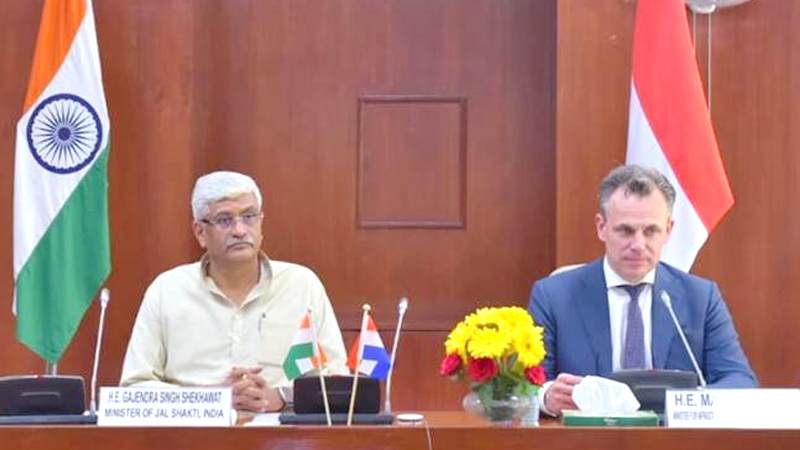
The 1st Ministerial-level meeting of the Joint Working Group between India and the Netherlands was held today in New Delhi in the august presence of the Union Minister for Jal Shakti Mr. Gajendra Singh Shekhawat and the Minister of Infrastructure and Water Management, Government of Netherlands, Mr. Mark Harbers. In April 2021 during a virtual meeting between the Prime Ministers of India and the Netherlands ‘Strategic Water Partnership’ was launched. On 29th March 2022, the ‘Strategic Water Partnership’ was signed by Mr. Gajendra Singh Shekhawat, Union Minister for Jal Shakti and Mr. Mark Harbers, Minister of Infrastructure and Water Management. The Partnership provides the necessary impetus to expand the bilateral water cooperation and is a joint effort of Indian and Netherlands Governments, recognizing the importance of Sustainable Development Goals, water safety, water availability and water quality for wellbeing and sustainable development of the present and future generations.

In his opening remarks, the Union Minister for Jal Shakti Shri Gajendra Singh Shekhawat welcomed the guests and said that during the virtual summit between the Prime Ministers of India and the Netherlands in April 2021, the two leaders had a detailed review of the entire spectrum of bilateral relationship and agreed on instituting a ‘Strategic Partnership on Water’ to further deepen the Indo-Dutch cooperation in the water sector. He said that the cooperation was enhanced by the decision to upgrade the Joint Working Group (JWG) on water to the Ministerial-level. The Netherlands is engaged with various States and Municipalities including in the states of Uttar Pradesh, Delhi Gujarat, Punjab, West Bengal, Tamil Nadu, Kerala and Maharashtra in various water resources project. “I am happy to note that both the groups – the Joint Working Group and the Bilateral Technical Group have been able to narrow down to the few areas of intervention under the collaboration which are industrial pollution abatement through multi-stakeholder platform for pollution prevention and effective waste management of textile cluster in Panipat, Haryana, Water as Leverage and Namami Gange, Water as Leverage in Chennai, Room for River Project – Flood Management project with Kerala, Pilot project in the doab of Arnair and Koratalair river and capacity development programmes,” the Union Minister said.

Mr. Shekhawat added that the Indo-Dutch cooperation has progressed on various front since the signing of the ‘Strategic Water Partnership’. “Along with these collaborations, we also thank the Netherlands government for supporting some submission made at the United Nations Water Conference 2023 in New York that includes River-Cities Alliance for river sensitive cities and technologically-driven nature-based solutions for river rejuvenation,” the Minister added. Shri Shekhawat expressed satisfaction over the fact that multi-stakeholder consultative approach is being adopted which has helped in developing comprehensive plans for the water sector. He said that it is now time to act on the plans quickly.

Mr. Mark Harbers expressed his happiness on the fact that India and the Netherlands are contributing constructively to the Water Action Agenda and said that water is a key enabler for prosperity, equality and sustainability. “We need to prepare and cooperate globally to address the emerging climate and environmental challenges,” he said, adding, “The challenges of both our countries such as spatial and temporal variations in rainfall, pollution etc. are similar and the basis of our coming together are these shared challenges.”

The extensive list of activities started in recent years between India and the Netherlands exemplifies that we have come together through the ‘Strategic Water Partnership’. “I wish a very interesting, constructive and productive 1st Ministerial-level Joint Working Group meeting,” Mr. Harbers said, adding that a strong cooperation is imperative to find proper solutions to the similar climate and environmental issues staring at the world.

Both the Ministers showed optimism towards the results presented under the interventions in the industrial pollution abatement project through multi-stakeholder platform for textile cluster in Panipat, Haryana.
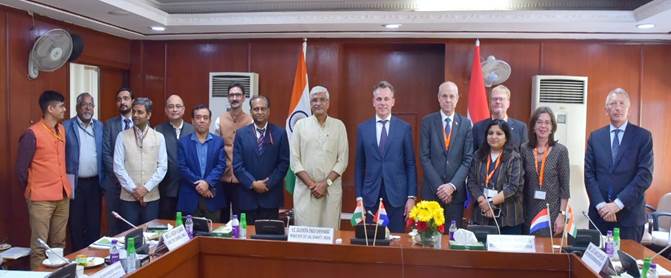
Welcoming the delegations, Shri G. Asok Kumar gave a brief overview and journey of the India-Netherlands cooperation in the water sector and called the 1st Ministerial-level meeting of the Joint Working Group the “culmination” of the efforts started with the visit of Dutch Prime Minister Mr. Mark Rutte to India in 2015 followed by the visit of the Hon’ble Prime Minister of India Shri Narendra Modi to the Netherlands in June 2017 to mark the 70th anniversary of the diplomatic relationship between India and the Netherlands. “The visit provided a significant boost to the bilateral ties and a Memorandum of Understanding (MoU) was signed between the Ministry of Water Resources, India & Ministry of Infrastructure & Environment of Netherlands in June 2017 to strengthen the collaboration between the two countries in the field of water, delta management and water technology.

Joint Secretary (EW), Ministry of External Affairs, Mr. Sandeep Chakravorty while making intervention desired that the activities under the framework may also be carried to other geographical areas including Bangladesh, Nepal, Indonesia and Africa.

The work plan of the Joint Working Group includes three Action Plans on bilateral water cooperation with: 1. Ministry of Jal Shakti in particular National Mission for Clean Ganga, Ministry of Irrigation, Kerala and Ministry of Irrigation and Waterways, West Bengal.

Action Plan Jal Shakti/NMCG – The Netherlands consists of five program areas including Sustainable water quality management, Urban water management, Monitoring and decision making, Living with and valuing of water, Resilient water systems and Sustainable Water Quality Management. This program area will support the efforts of NMCG and other governmental organizations in India to improve the water quality of the water systems. It will cover water quality issues in a river basin, e.g. Ganga basin, and might also cover knowledge needs of state governments and other institutions involved in water quality management. Urban water management will bring together the on-going activities of the River Cities Alliance (RCA) in India and the Water as Leverage (WaL) program initiated by the Netherlands. The core objective of RCA is to provide the member cities with a platform to discuss and exchange information on aspects that are vital for sustainable management of urban rivers.

Under the Monitoring and Decision making program, efforts will be made to make proper use of the data, collected at different levels, available in India. Some of this data is made public, other data is classified or kept for internal use only. The challenge is use this hydrological data for decision making, investments or operational purposes.

Living with and valuing water component relates to the Aviral Ganga (Unrestricted Flow) and Arth Ganga (economy and livelihood) components of Namami Ganga. Aviral Ganga and Arth Ganga in India are based on the same principles as several concepts in the Netherlands such as Living with Water and Building with Nature. Resilient water systems is oriented at achieving water security at local and basin level and making the water systems resilient to cope with variable conditions.

Action Plan Kerala – The Netherlands will focus on knowledge exchange and capacity building. Related to river basement management knowledge exchange will be on Integrated Water Resource Management. 1. Integrated Water Resource Management (IWRM) – Materialize IWRM concept in Kerala; – Address the challenges in integrated river basin management; – Mitigation of urban flooding and sharing institutional mechanisms; – Utilize Nature Based Solutions, such as ‘Room for the River’ and ‘Living with Water’.

Action West Bengal – The Netherlands action plan is divided in two periods: 1. Exploratory phase (2022 – 2023) of Capacity building to be conversant with dike design and construction as per state-of-the-art international good practices, an outline for holistic master plan, including a strategy towards a healthy river basin; basic understanding of coastal zone management.

The aim of the Strategic Water Partnership is to further intensify and expand on-going bilateral cooperation through involving policy experts, academia, knowledge institutes, private companies and communities/stakeholders and combining resources, expertise, knowledge skills. The Partnership adds strategic direction to the cooperation in order to maximize the benefits for both countries. The character of the Strategic Water Partnership is knowledge cooperation in which each partner will finance its own expenses arising from the cooperation. Knowledge exchange will mainly take place by interaction between Indian and Netherlands experts and officials.

The Netherlands delegation included Mr. Luit-Jan Dijkhuis, Ministry of Infrastructure and Water Management, Ms. Jet van Paassen, Social Media Advisor, Ministry of Infrastructure and Water Management, Mr. Thorsten Wege, Senior Policy Coordinator, International Affairs, Ms. Odilia Knap, Deputy Director, International Affairs, Mr. Joost Geijer, Head of Economic Affairs at the Netherlands Embassy and Ms. Nishi Chandra Pant, Senior Policy Officer, Netherlands Embassy.

The Indian delegation comprised of Mr. G. Asok Kumar, Director General, National Mission for Clean Ganga, Mr. Prabhat Kumar Mishra, Principal Secretary, Irrigation & Waterways Department, West Bengal, Mr. Kushvinder Vohra, Chairman, Central Water Commission and Shri Subodh Yadav, Joint Secretary, Department of Water Resources, River Development and Ganga Rejuvenation, Ministry of Jal Shakti, Mr. Sandeep Chakraborty, Joint Secretary (EW), Ministry of External Affairs, Mr. D.P. Mathuria, Executive Director (Technical), NMCG, Mr. Sunil Kumar, Chairman, Central Groundwater Board, Mr. R. Priyesh, Chief Engineer, Kerala, Smt. Sreedevi P., Chief Engineer, Kerala, Mr. Sudhir Kumar, Director NIH and Mr. Dheeraj Joshi, DS, NMCG.