PM addresses Post Budget Webinar on ‘PM Vishwakarma Kaushal Samman’

| Published on:

The Prime Minister, Shri Narendra Modi, addressed a Post Budget Webinar on the subject of ‘PM Vishwakarma Kaushal Samman’. It is the last and final of a series of 12 post-budget webinars organized by the government to seek ideas and suggestions for effectively implementing the initiatives announced in the Union Budget 2023.

Addressing the gathering, the Prime Minister said that for the last three years, a tradition of a post Budget dialogue with the stakeholders has emerged. He expressed happiness that all stakeholders have participated productively in these discussions. He noted that instead of discussing the making of the Budget, the stakeholders have discussed the best possible ways of implementing the provisions of the Budget. The Prime Minister remarked that the series of post-budget webinars is a new chapter where the discussions held inside the Parliament by Parliamentarians are being held by all stakeholders where getting valuable suggestions from them makes for very useful practice.

The Prime Minister said that today’s webinar is dedicated to the skill and expertise of the crores of Indians. Referring to skilling and creating job opportunities for crores of youth through Skill India Mission and Kaushal Rozgar Kendra, the Prime Minister emphasized the need for a specific and targeted approach. PM Vishwakarma Kaushal Samman Yojana or PM Vishwakarma, the Prime Minister said is a result of this thinking. Explaining the need for the scheme and the rationale of the name ‘Vishwakarma’, the Prime Minister talked about the exalted status of Lord Vishwakarma in the Indian ethos and a rich tradition of respect for those who work with their hands with implements.

The Prime Minister said while a few sectors’ artisans received some attention, many classes of artisans such as carpenters, ironsmiths, sculptors, masons and many others that are an integral part of society have been adapting to the changing times to fulfill the needs of the society that were ignored.

“Small artisans play an important role in the production of local crafts. PM Vishwakarma Yojana focuses on empowering them”, the Prime Minister said. He informed that skilled craftsmen were contributing in their own ways towards exports in ancient India. He lamented that this skilled workforce was neglected for a long time and their work was considered non-significant during the long years of slavery. Even after India’s independence, the Prime Minister pointed out that there was no intervention from the government to work for their betterment and as a result, many traditional ways of skill and craftsmanship were abandoned by the families so that they could make a living elsewhere. The Prime Minister underlined that this working class have conserved their craft of using traditional methods for centuries and they are making a mark with their extraordinary skills and unique creations. “Skilled craftsmen are symbols of the true spirit of self-reliant India and our government considers such people as Vishwakarma of new India.” He explained that PM Vishwakarma Kaushal Samman Yojana is initiated especially for them where the central focus remains on those skilled craftsmen from villages and towns who create a living by working with their own hands.

Focussing on the social nature of human beings, the Prime Minister said that there are streams of social life which are essential for the existence and thriving of society. These tasks, despite the growing influence of technology, remain relevant. PM Vishwakarma Yojana focuses on such scattered artisans, he said.

Referring to Gandhi ji’s concept of Gram Swaraj, the Prime Minister highlighted the role of these professions in village life along with agriculture.  “Empowering every section of the village for its development is essential for India’s development journey”, he said. The Prime Minister said similar to the benefit to street vendors through the PM SVANidhi scheme, PM Vishwakarma Yojana will benefit the artisans.

The Prime Minister stressed the need to reorient the skill infrastructure system according to the needs of Vishwakarma. He gave the example of Mudra Yojana where the government is providing loans worth crores of rupees without any bank guarantee. He pointed out that this scheme must provide maximum benefit to our Vishwakarma and also mentioned the need for  digital literacy campaigns to Vishwakarma Saathis on priority.

Mentioning the continued attraction of hand-made products, the Prime Minister said that the government will provide holistic institutional support to every Vishwakarma of the country. This will ensure easy loans, skilling, technical support, digital empowerment, brand promotion, marketing and raw material. “The objective of the scheme is to develop traditional artisans and craftsmen while preserving their rich tradition”, he said.

“Our aim is that Vishwakarmas of today can become entrepreneurs of tomorrow. For this, sustainability is essential in their business model”, The Prime Minister said. The Prime Minister emphasized that the needs of the customers are also being taken care of as the government is keeping its eye out not only on the local market but also targeting the global market. He requested all the stakeholders do a hand-holding of Vishwakarma colleagues, increasing their awareness and thereby helping them in moving forward. For this you have to go to the ground, you have to go among these Vishwakarma companions.

The Prime Minister highlighted that artisans and craftsmen can be strengthened when they become a part of the value chain and pointed out that many of them can become suppliers and producers for our MSME sector. Noting that they can be made an important part of the economy with the help of tools and technology, the Prime Minister said that industry can increase production by linking these people with their needs where skill and quality training can be provided. The Prime Minister emphasized better coordination between the Governments that will help in the financing of projects by banks. “This can be a win-win situation for every stakeholder. Corporate companies will get quality products at competitive prices. Banks’ money will be invested in schemes which can be trusted. And this will show the widespread effect of the schemes of the government”, the Prime Minister said. He also highlighted that startups can also create a huge market for craft products through the e-commerce model apart from helping them with better technology, design, packaging and financing. The Prime Minister expressed confidence that the partnership with the private sector will be further strengthened through PM-Vishwakarma so that the innovation power and business acumen of the private sector can be maximized.

The Prime Minister concluded by requesting all the stakeholders to prepare a robust blueprint. He emphasized that the government is trying to reach the people in the remote parts of the country and many of them are getting the benefits of the government schemes for the first time. Most of the artisans are from dalit, adivasi, backward communities or are women and to reach and provide benefit to them a practical strategy will be needed. “For this, we will have to work in a time-bound mission mode”, the Prime Minister concluded.

Narendra Singh Tomar inaugurates seed processing and storage facility at IGFRI, Jhansi

| Published on:

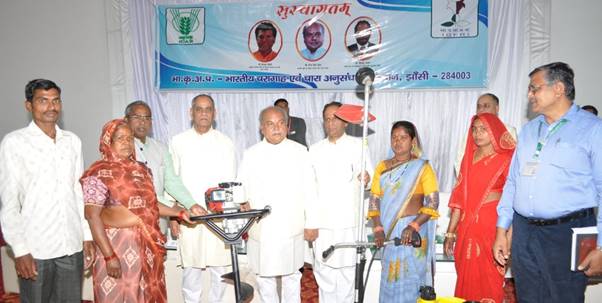
Union Agriculture and Farmers Welfare Minister Shri Narendra Singh Tomar inaugurated the seed processing and storage facility at Indian Grassland and Grassland Research Institute, Jhansi, an institution under the Indian Council of Agricultural Research (ICAR). Women’s farmers conference was also organized on this occasion.

On this occasion, Director General of ICAR, Dr. Himanshu Pathak, Chancellor of Rani Lakshmi Bai Central Agricultural University, Jhansi, Dr. Panjab Singh and Vice Chancellor Dr. A.K. Singh were present. Shri Tomar also observed the techniques and reviewed activities of the University with Dr. Amresh Chandra, Director of the Indian Grassland and Grassland Research Institute. Apart from the institute headquarters, 3 units of this type of seed processors have been installed at the regional research centers located at Dharwad and Srinagar, which have been funded by the Ministry of Agriculture for Rs 3.7 crore. During the Women’s Farmers Conference, agricultural equipments worth Rs 50 lakhs were distributed to the beneficiary women farmers under the Scheduled Caste sub-project run at the institute/centres.

Shri Tomar appreciated the efforts of the institute for the empowerment of farmers and women farmers through the Scheduled Caste sub-Project and praised the scientists of the institute for the development of more than 300 fodder crop varieties and various techniques developed by the institute. He emphasized on taking the various researches of the institute to the maximum number of farmers. Mentioning about the various welfare schemes being run by the Government of India for the benefit of farmers, Shri Tomar called for more efforts towards adequate availability of water and fodder in the country.

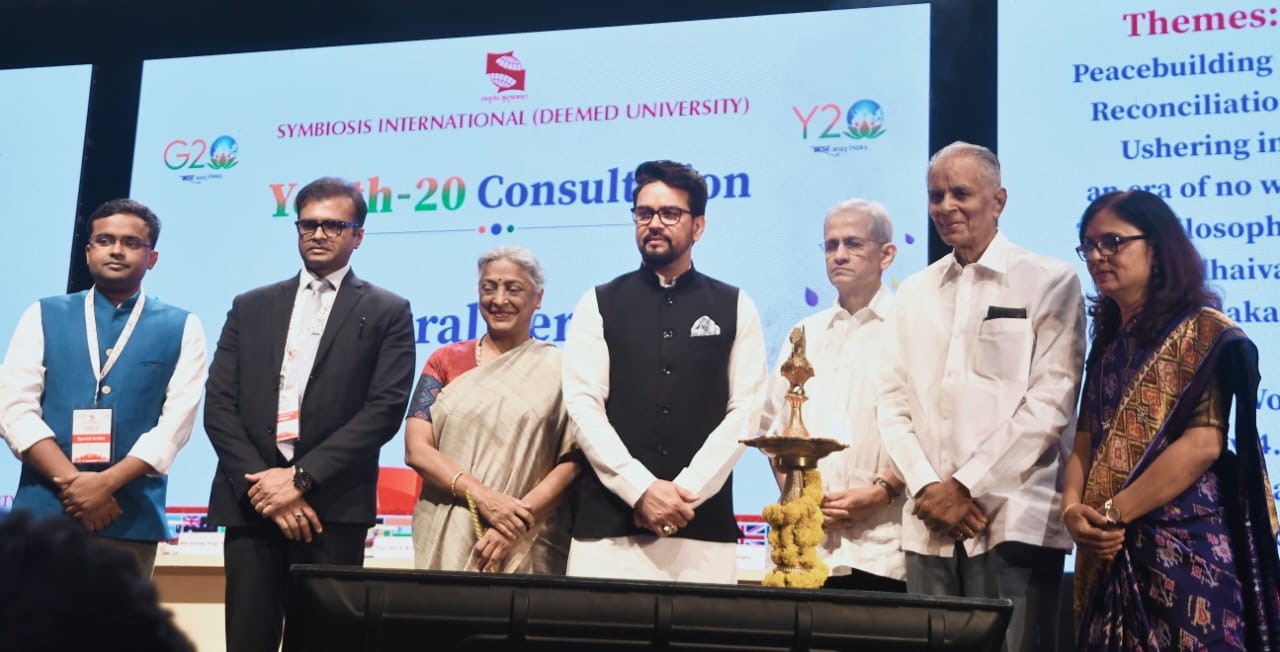
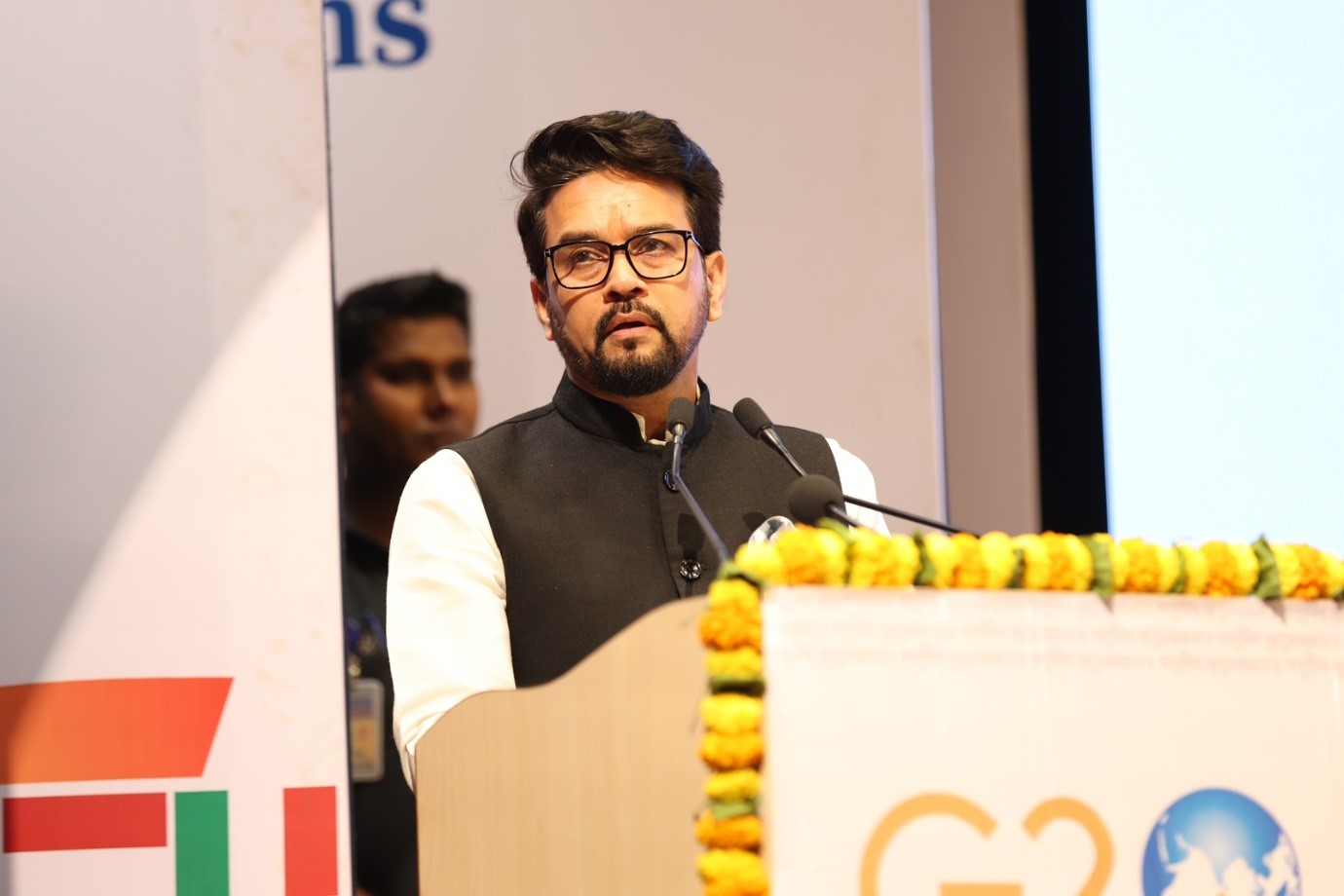
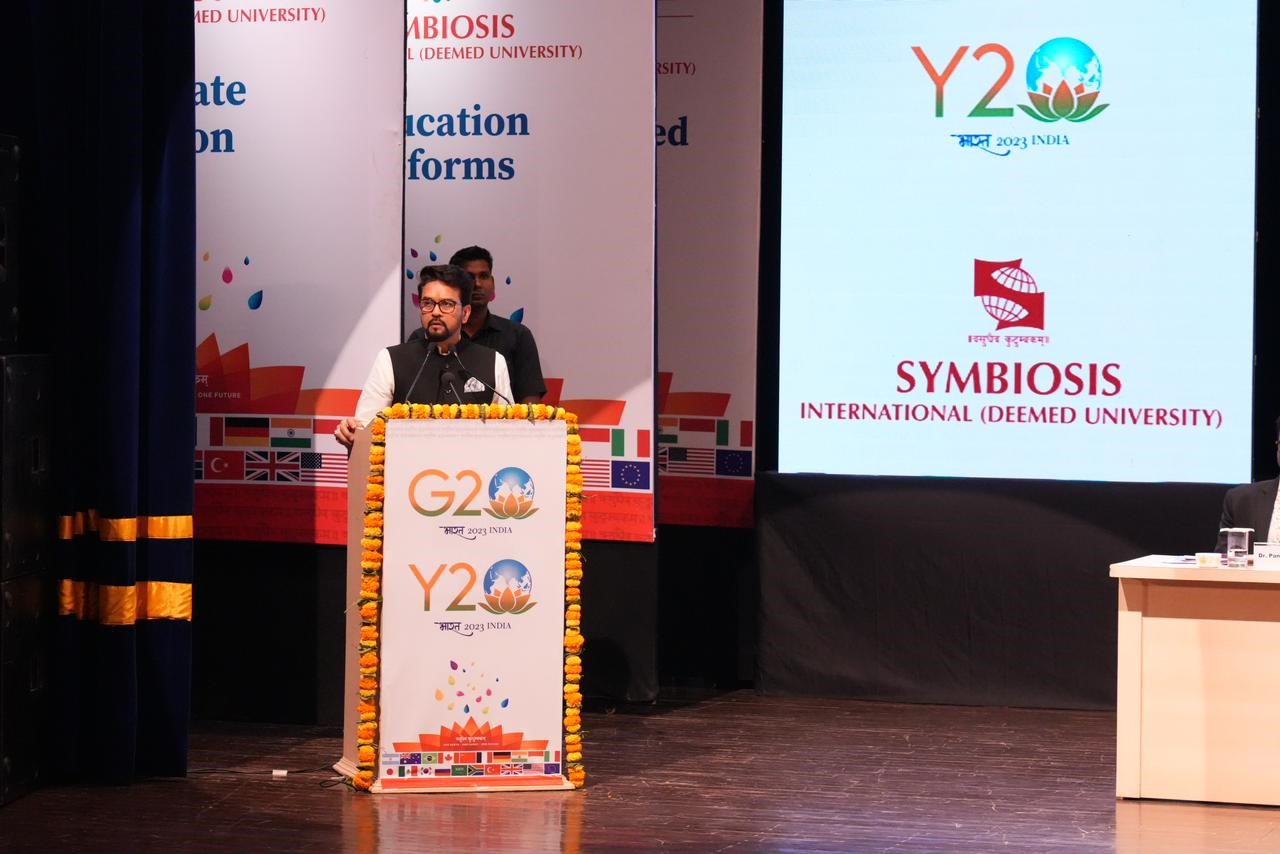
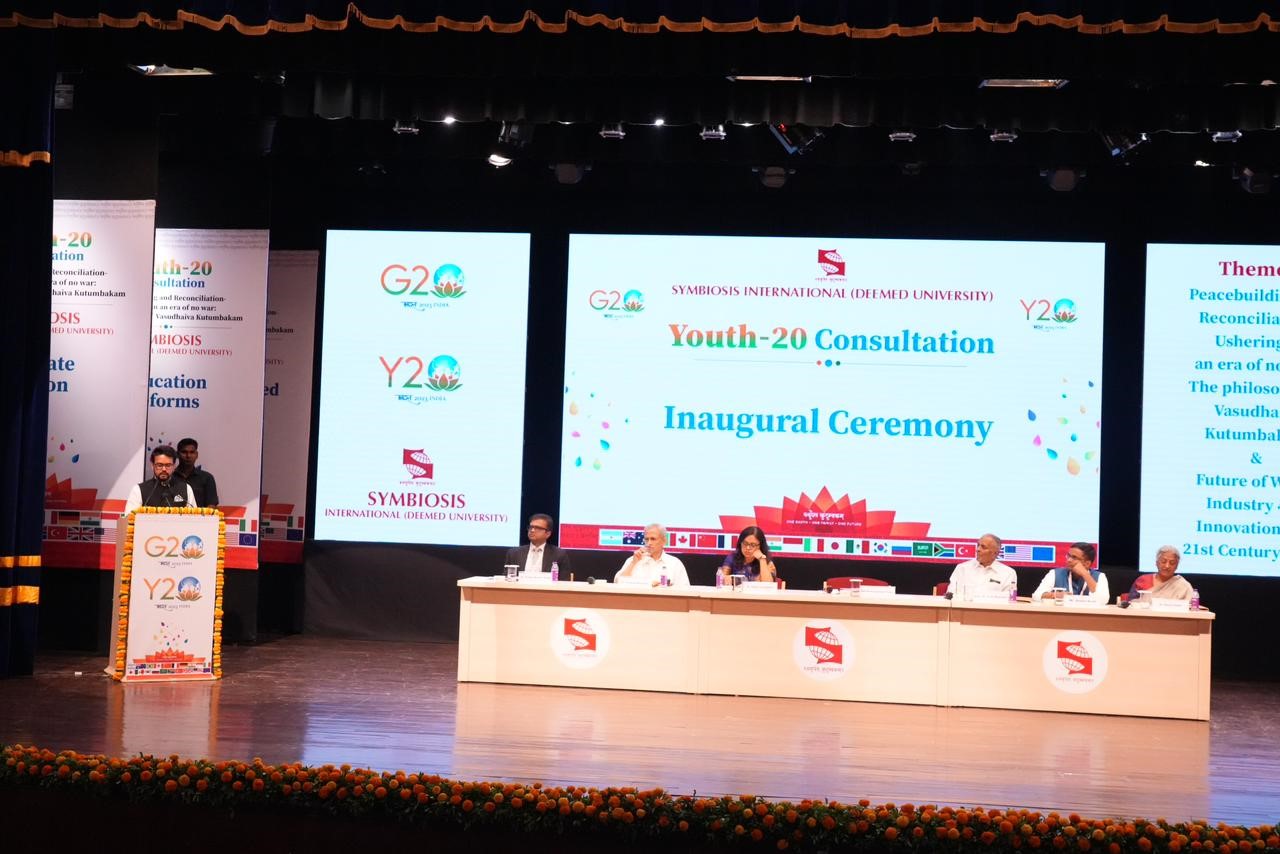
Anurag Singh Thakur inaugurates the fourth Y20 Consultation Meeting in Pune

| Published on:

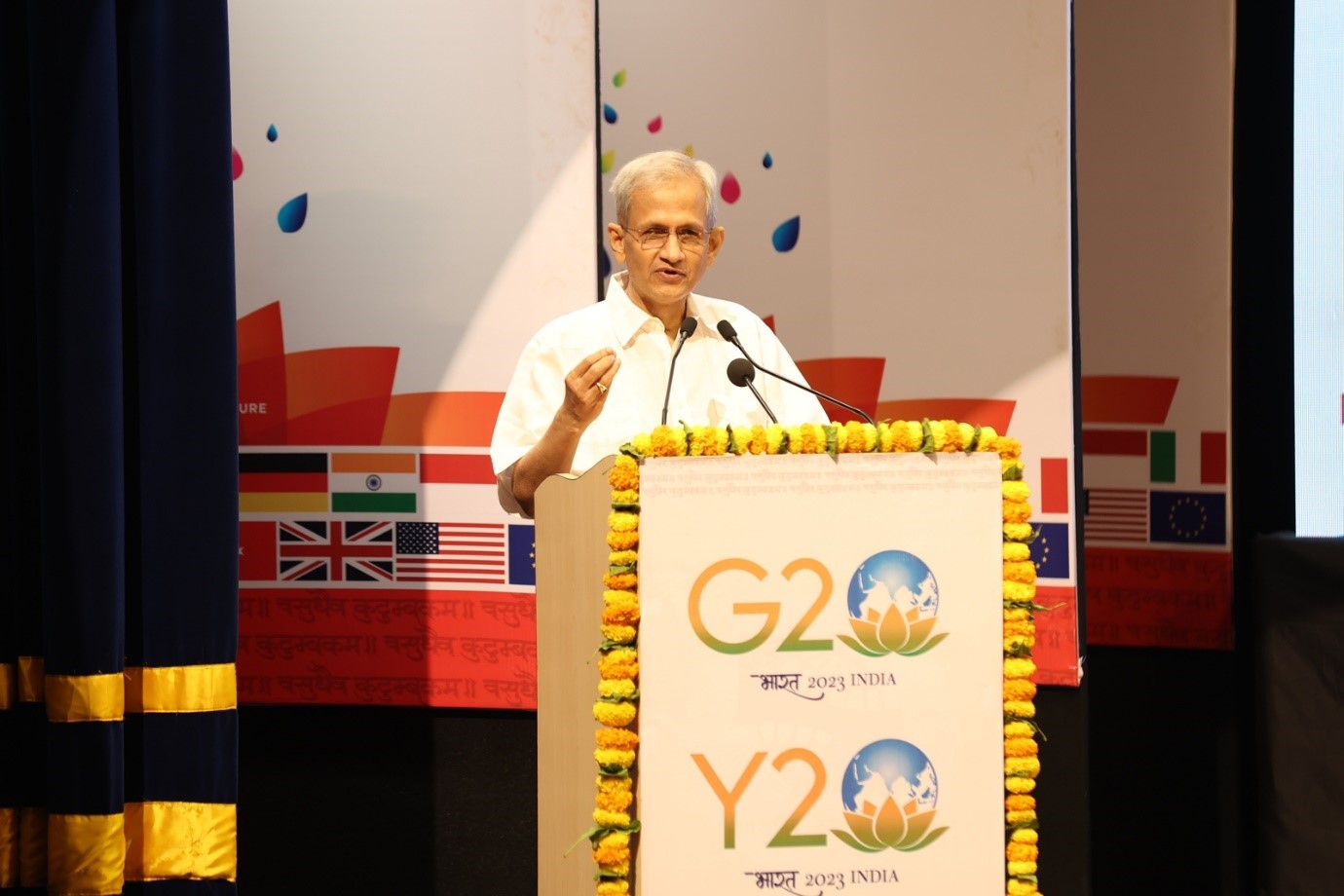
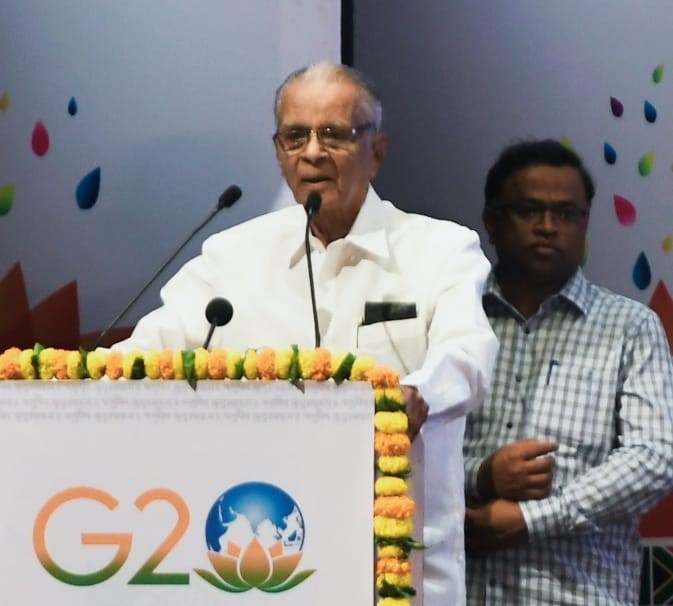
The fourth Y20 Consultation Meeting was held at the Symbiosis International University (SIU) in Pune today, in collaboration with Ministry of Youth Affairs and Sports, Government of India. Union Minister for Youth Affairs & Sports and Information & Broadcasting, Anurag Singh Thakur was the Chief Guest for the inauguration ceremony. Dr. Sundeep Waslekar, President, Strategic Foresight Group was the Keynote Speaker. Also present on the occasion were Prof. (Dr.) S. B. Mujumdar, Founder & President, Symbiosis, and Chancellor, SIU, Dr. Vidya Yeravdekar, Pro Chancellor, SIU, Mr. Pankaj Singh Director, Ministry of Youth Affairs and Sports,  Anmol Sovit, Chair Y20 India and Rajani Gupte, Vice Chancellor, SIU.

Speaking on the occasion, Union Minister for Youth affairs & Sports and Information & Broadcasting, Anurag Singh Thakur, said “I am delighted to be in Pune, a city known for its thriving manufacturing industry, which is home to some of the world’s largest automobile engineering and electronics companies. Pune’s reputation as the cultural capital of Maharashtra and a leading education hub cannot be overstated. With over 10 universities and 100 institutes, the city has been a beacon of knowledge and culture for generations, attracting students and scholars from across the world. Institutions like Symbiosis provide quality education to thousands of students across the globe. There could not be a better place to organize this Y20 event. Such institutions sow and nurture the seeds of change.”

Delighted at the wide participation for the event he stated, “For this Consultation, I am glad that we have representation from more than 44 countries, and 97 students from those countries. We also have 72 students who are the winners of 36 such events, from various parts of Maharashtra.”

Speaking on the importance of contribution of young people in the development of India and the world the Minister states, “Young people are equal stakeholders in the present, their role is today, now and here. Look around, India is making headlines across the world, of being the world’s fastest growing large economy. From being among fragile five economies in 2014, we are now among the first five economies of the world. In a span of eight years, we have become third globally among startups, with over 77000 startups and more than 107 unicorns. Whether it is social media led social causes or billion dollar startups, our youth are leading from the front. The pathbreaking stories of our youth serve as inspiration for people all over the world to follow their passions and make positive impact in their respective fields.”

Referring to India’s G20 Presidency and the Y20 summit, the Minister expressed, “India’s hosting of the prestigious G20 is a great honour for us.  It is a privilege for me and our Department as well to host the prestigious Y20 summit. This presents an extraordinary opportunity to engage the collective efforts of the world’s youth on issues which matter to them the most. India’s role in this summit is not limited to speaking, it also aims for youth to be heard and actively shape the global agenda. Accordingly, the Y20 summit 2023 has identified five key themes which will serve as guiding light for our youth. These priority areas point to the urgency with which the world has to reconcile with the reality of changing times in our quest to survive and thrive.”

Speaking on the theme for today’s Consultation Meeting, he said, “Today’s consultation is on the theme Peacebuilding and Reconciliation: Ushering in an era of no war. The vantage point from which we view this issue will determine how India responds in the decades ahead. Whether it is the ongoing conflict between two countries, the far-reaching impact of pandemic, or the persistent economic and political instability, these issues raise concerns about regional and global security and highlight urgent need for effective collaboration and coordinated action.”

Emphasising on the importance of multilateralism he said, “At WTO, we see that no one is supporting multilateralism in a big way. We really need to talk about multilateral institutions and how these could be more useful for the globe, and not for specific countries alone. The need for peace and reconciliation has never been more apparent. As we strive towards a world where warfare is no longer a viable choice. India has been a believer in a culture which promotes dialogue, development and diplomacy. That is the message from India, our diplomatic approach rooted in Vasudhaiva Kutumbakam is characterized by Ahimsa.”

On India’s role in peace building he said, “India has played an active role in promoting peace and reconciliation on global stage. We have been a strong advocate for disarmament, non proliferation and have contributed to UN Peacekeeping efforts.

Reflecting on newer emerging dimensions to war he said, “It is important to reflect on questions which define peace in the 21st century. We must break away from traditional notions of peace and war. Is the absence of a border-related war the true meaning of era of peace, or is there more to it? How will we tackle the war of words on social media, the clutter, the noise, which is disrupting our social media space? Is the nature of the platform such that it feeds such content when posted? How will you meet the challenges faced by lifestyle choices which have unleashed a war on your health? How will you reclaim your peace, space and sense of happiness in an age where we are constantly connected and disrupted by technology? How will we respond to global emergencies, will we beat the repercussions of climate change and food scarcity on a war footing? As we look to the moon again and Mars one day, how will we as civilization respond to injustice beyond our borders on our planet? Will we look away to find peace or promote the values we believe in? Is peace just a symbol? Is it the absence of violence? And what makes a society, community and nation peaceful, asked the Minister.

In conclusion, the Minister said, “The active involvement of young minds present here will lead us to a deeper understanding of the challenges we face as a society and humanity,  and the ways to resolve them at the Y20 discussion forum. As per the dream of Swami Vivekananda, we have to ensure that the 21st century is ours. We are going from Amrit Kaal to Swarnim Kaal. The youth have a crucial role to play in this journey of ours.”

Addressing the audience in his Keynote Address, Dr Sundeep Waslekar, President, Strategic Foresight Group, said, “Young people will craft the future. What happens to our society and planet will be decided by what young people think. Today a world without war is not a utopian dream but a pragmatic reality. It has taken twelve thousand years for the civilization to evolve. All this may disappear in a global war.  Young people have a tremendous responsibility to ensure a peaceful world. Only the philosophy of Vasudhaiva Kutumbakam can ensure that.”

Founder and President – Symbiosis and Chancellor, SIU, Prof (Dr.) S. B Mujumdar expressing his hope for evolution of a global family said, “Symbiosis  began with an aim to bring foreign and Indian students together. Education, is the only means of doing that. It will promote international understanding between Indian and foreign students. A day will come when nations with different boundaries will come together, live together and understand each other. There will be no war. I do believe that Vasudhaiva Kutumbakam is the ultimate human destiny. We at Symbiosis try to translate this to reality through education.”

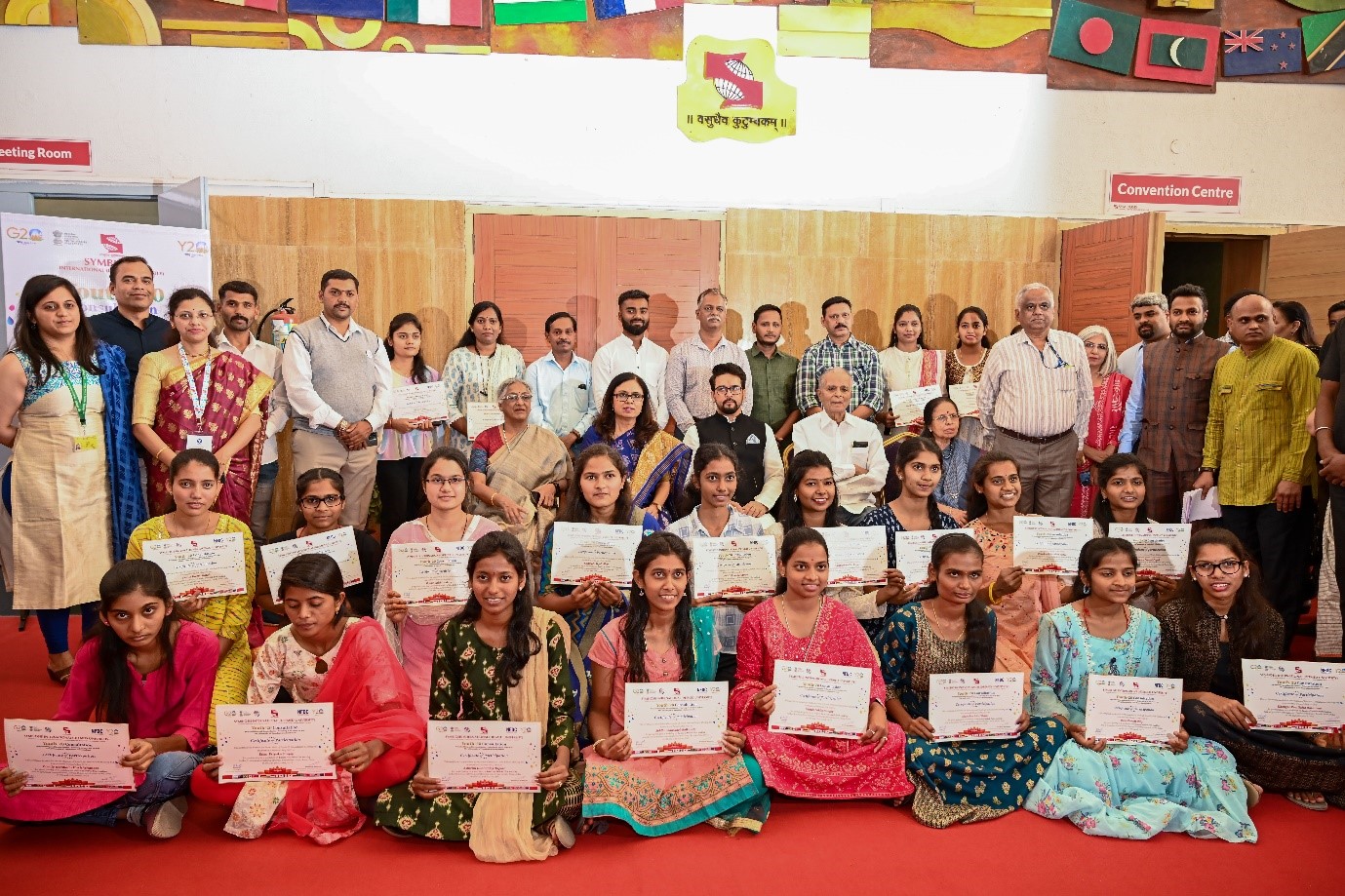
On the side-lines of the Consultation Meeting and with an endeavour to celebrate the spirit of International Women’s Day, certificates of participation were given to twenty-five women between the age group of 18-35 who participated in a Mobile Film Making workshop held on the 9th and 10th of March at Symbiosis Institute of Media and Communication. The workshop was organised by a collaboration between Symbiosis Institute of Mass Communication, Press Information Bureau, Mumbai, and National Film Development Corporation, Ministry of Information and Broadcasting, Government of India. The young women participants belong to rural areas around Pune adopted by Symbiosis International University under its outreach program.

Y20 encourages youth as future leaders to raise awareness of global issues, exchange ideas, argue, negotiate, and reach consensus. The G20 rotating presidency bears the responsibility of hosting the youth summit, which usually takes place some weeks prior to the traditional forum to know what the youths are thinking and incorporate their suggestions in their own policy proposals. It is an attempt to create a connecting point between G20 governments and their local youth. The Y20 India Summit in 2023 would exemplify India’s youth-centric efforts and provide an opportunity to showcase its values and policy measures to the youth across the globe. Find out more about the Y20 during India’s presidency here.

The G20 or Group of Twenty is an intergovernmental forum comprising 19 countries and the European Union. It works to address major issues related to the global economy, such as international financial stability, climate change mitigation, and sustainable development. You learn more about G20 by clicking here.

India assumed the G20 Presidency on 1st of December this year from Indonesia and will convene the G20 Leaders’ Summit for the first time in the country in 2023. A nation deeply committed to democracy and multilateralism, India’s G20 Presidency would be a watershed moment in her history as it seeks to play an important role by finding pragmatic global solutions for the wellbeing of all, and in doing so, manifest the true spirit of ‘Vasudhaiva Kutumbakam’ or the ‘World is One Family’.

Arjun Ram Meghwal inaugurates exhibition “Women and Nation Building: 1857 to the Republic”

| Published on:

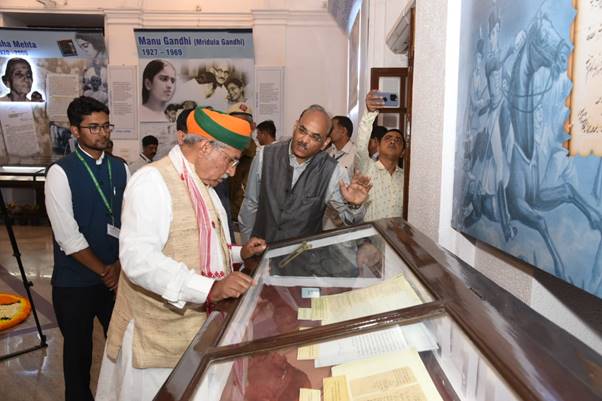
On the occasion of 133rd Foundation Day of National Archives of India  Shri Arjun Ram Meghwal inaugurated the   exhibition “Women and Nation Building: 1857 to the Republic” at National Archives of India, New Delhi today.

On the occasion Shri Arjun Ram Meghwal said it was the idea of Prime Minister Shri Narendra Modi to highlight unsung heroes of the freedom struggle  in which women   played an important part . He said that the  exhibition highlights the contributions of women in nation building  and freedom struggle from 1857 in an interesting manner. Citing examples of Durgawati Devi and Kasturba Gandhi ,Shri Arjun Ram Meghwal said that the exhibition throws light on important and unknown aspects of their contribution.

This exhibition is an endeavor to showcase the contribution of women in the process of nation building. Whether it was India’s struggle for freedom from the oppressive colonial rule, eradication of social evils such as child-marriage and untouchability, facilitating education of the female, or framing of the Constitution for Independent India – women had always been at the forefront and left their indelible footprints on the road from the first war of Indian independence to the proclamation of Indian Republic.

The Exhibition  presents a selection of original documents drawn from the attics of the archival repository, i.e., official files of the government, private papers of eminent personalities, as well as from the rich collection of rare books held in the NAI Library.

The Exhibition includes contributions of known, lesser-known as well as unknown and unsung women in the process of Indian nation building. This encompasses a journey of over 93 years, from 1857 to 1950. These women leaders came from variegated backgrounds and belonged to diversified professions. They were recognized as: freedom fighters, soldiers (INA), social reformers, educationists, and litterateurs.

The exhibition will remain open for public viewing till 30 April 2023 from 10: 30 am to 5:00pm on each day including Saturday, Sunday and National Holidays.

The National Archives of India is an attached office under the Ministry of Culture.  National Archives of India has at present in its repositories a collection of over 18.00 cr. pages of Public Records, which include files, volumes, maps, bills assented to by the President of India, treaties, rare manuscripts, oriental records, private papers, cartographic records, important collection of Gazettes and Gazetteers, Census records, assembly and parliament debates, proscribed literature, travel accounts etc. A major chunk of Oriental records is in Sanskrit, Persian, Odia, etc.

PM praises Central Railway for achieving 100% electrification of entire Broad Gauge Network

| Published on:

The Prime Minister, Shri Narendra Modi has complimented to the entire team of Central Railway for achieving 100% electrification of entire Broad Gauge Network.

Responding to the tweet by Central Railway, the Prime Minister tweeted;

“Outstanding feat. Compliments to the entire team.”

PM inaugurates 3rd Session of National Platform for Disaster Risk Reduction

| Published on:

The Prime Minister Shri Narendra Modi today inaugurated the 3rd Session of the National Platform for Disaster Risk Reduction (NPDRR) in New Delhi.  The main theme of the 3rd session of this platform is “Building Local Resilience in a Changing Climate”.

During the event, the Prime Minister felicitated awardees of the Subhash Chandra Bose Aapda Prabandhan Puraskar. The winners of the 2023 Puraskar are Odisha State Disaster Management Authority (OSDMA) and the Lunglei Fire Station, Mizoram. The Prime Minister also inaugurated the exhibition for showcasing innovative ideas, initiatives, tools and technologies in the field of Disaster Risk Reduction. The Home Minister, Shri Amit Shah, Minister of State Shri Nityanand Rai were among those present on the occasion.

Speaking on the occasion, the Prime Minister noted the global appreciation for the work of the Indian rescue team in Türkiye and Syria recently which has made every Indian proud.  The Prime Minister said that the way India has expanded the technology and human resources related to disaster management has served the country well. He said that these awards have been instituted in order to strengthen and promote the disaster management system and also infuse healthy competition. The Prime Minister lauded both awardees.

The Prime Minister said that the theme of event “Building Local Resilience in a Changing Climate” is familiar for Indian tradition as this element is clearly visible in the wells, architecture, and old cities. He said, In India, the system, solutions and strategy of disaster management has always been local. He gave an example of Bhunga houses of Kutch which survived the earthquake to a large extent. The Prime Minister stressed the need to evolve local models of housing and town planning as per new technologies. “Enriching local technology and material with the new technology is the need of the hour. When we link the examples of local resilience with future technology, only then we will be able to do better in the direction of disaster resilience”. He added.

The Prime Minister underlined that the lifestyle of yesteryears was very comfortable and it was experience that taught us how to deal with natural calamities of drought, flood and incessant rain. He pointed out that it was natural for previous governments to place disaster relief with the agricultural department. He recalled that when natural calamities like earthquakes struck, it was dealt at the local level with the help of local resources. However, the Prime Minister said, it is a small world that we live in today where learning from experiences and experiments of one another has become a norm. On the other hand, he also noted that the outbreak of natural calamities have also increased in number. Drawing the analogy to the single physician in a village who would treat everyone, the Prime Minister shed light on the fact that we have specialist doctors for every ailment in today’s day and age. Similarly, the Prime Minister stressed the need to develop a dynamic system to deal with natural calamities. He highlighted that by studying natural calamities of the past century, an accurate assumption can be made while also stressing on revising these methods in due time, be it material or system.

“Recognition and Reform are the two main components for strengthening disaster management”, the Prime Minister underlined. He explained that recognition will help in identifying the possible threats posed by natural calamities and when it will strike in the future, while reform is a system where the threats of a possible natural calamity is minimized. He suggested improving the system by  making it more capable in a time bound manner and emphasized the approach of long term thinking instead of short-cut. He recalled the hundreds of fatalities caused due to cyclones hitting West Bengal and Odisha in the previous years, but with the changes in time and strategies, India is now capable of dealing with cyclones where damage to life and property is minimized. “We cannot stop natural calamities but we can definitely minimize its effects by putting better strategies and systems in place”, the Prime Minister remarked as he emphasized on adopting a proactive approach rather than a reactive one.

The Prime Minister talked about the poor state of disaster management in the years after Independence. He informed that even after five decades, there was no law regarding disaster management. Gujarat was the first such state that came out with the state disaster management act in 2001. The then Central Government enacted Disaster Management Act on the basis of this act. After that, the National Disaster Management Authority came into existence.

The Prime Minister emphasized the need to strengthen disaster management governance in the local bodies. “We will have to institutionalize planning and review local planning. Underlining the need for overhaul of the complete system, the Prime Minister called to work on two levels. First, disaster management experts will have to focus more on public participation. He stressed a continuous process of making people aware about the dangers of earthquakes, cyclones, fire and other calamities. It is important to impart awareness about  proper process, drill and rules in this regard. “You will get success only by following the mantra of Local Resilience by Local participation”, he said while asking the stakeholders to use train ‘Yuvak Mandals’ and ‘Sakhi Mandals’ at village and neighborhood levels. He asked to further strengthen the mechanisms of Apada Mitr, NSS-NCC, Army veterans and need to ensure equipment in the community centers for the first response as timely start of the rescue work can save many lives.

On the second level, the Prime Minister asked for a real time registration and monitoring system using technology. He said, “Knowledge on aspects like age of the houses, drainage, resilience of our electricity and water infrastructure will help in taking proactive steps.” The Prime Minister talked about the discussion on the hospital fires during his recent review meeting on the heatwave and how regular review of fire preparedness of the hospital can save lives.

The Prime Minister noted the increase in fire incidents in dense urban areas such as a hospital, factory, hotel or multi-storey residential building in the past few years especially with the increasing heat. He highlighted the challenges of having to work very systematically in densely populated areas where reaching by a vehicle is a difficult task and insisted on finding a solution for this. The Prime Minister stressed on constantly increasing the skill set of our firefighters in order to extinguish the fire in high rise buildings while also making sure that there are enough resources to extinguish the industrial fires that start.

The Prime Minister focussed on the need for continuous modernization of local skills and equipment. He asked to explore the possibility of providing equipment that changes forest fuel into biofuel to women of self help groups to increase their income and reduce fire incidence. He also talked about creating a force of specialists for industries and hospitals where chances of gas leaks are high. Similarly, highlighting the need to make Ambulance networks future ready, the Prime Minister asked to explore the use of AI, 5G and Internet of Things (IoT) in this regard. He also asked the stakeholders to look into the use of drones, gadgets for alerting, and personal gadgets that can help in locating people buried under debris. He requested the experts to study the work of global social bodies that are creating new systems and technologies and adopt best practices.

Concluding the address, the Prime Minister underlined that India reacts quickly to the disasters coming around the world and also responds and takes initiative for resilient infrastructure. He informed that more than 100 countries of the world have joined the Coalition for Disaster Resilient Infrastructure formed under India’s leadership.The Prime Minister expressed confidence that today’s discussions will lead to lots of suggestions and solutions and thereby lead to emergence of actionable points for the future. “Tradition and technology are our strength, and with this strength, we can prepare the best model related to disaster resilience not only for India but for the entire world” the Prime Minister concluded.
NPDRR is a multi-stakeholder platform constituted by the Government of India to facilitate dialogue, sharing experiences, views, ideas, action-oriented research & explore opportunities in the area of Disaster Risk Reduction.

PM addresses Post Budget Webinar on “Economic Empowerment of Women”

| Published on:

The Prime Minister, Shri Narendra Modi, addressed a Post Budget Webinar on the subject of “Economic Empowerment of Women”. It is the 11th of a series of 12 post-budget webinars organized by the government to seek ideas and suggestions for effectively implementing the initiatives announced in the Union Budget 2023.

The Prime Minister expressed happiness that the country has seen this year’s Budget as an auspicious beginning for achieving the target of Vikasit Bharat by 2047. “The budget has been seen and tested from the point of view of future Amrit Kaal. It is a good sign for the country that the citizens of the country are also looking at the next 25 years by linking them with these goals,” he said.

The Prime Minister reiterated that in the last 9 years, the country has moved with a vision of women-led development. He continued that India has taken these efforts to the global stage as it is figuring prominently in the G-20 meeting presided over by India. This year’s budget will give new momentum to these efforts of women led development, he said.

The Prime Minister underlined the Nari Shakti’s strengths of determination, will power, imagination, ability to work for goals and extreme hard work as reflection of ‘Matru Shakti’. He said these qualities are playing a major role in increasing the speed and scale of India in this century.

The Prime Minister said that today, the results of efforts for women empowerment are visible and we are feeling a revolutionary change in the social life of the country. He said that that number of women compared to men is increasing, and the number of girls studying up to high school and beyond has tripled in the last 9-10 years. Girls’ enrolment in Science, Technology, Engineering and Maths is at 43 percent today, more than countries like America, UK and Germany. In fields like medical, sports, business or politics, not only the participation of women has grown but they are leading from the front.

The Prime Minister touched upon the fact that 70 percent Mudra loan beneficiaries are women. Similarly, women benefit from  schemes for promotion of collateral free loans under SVANidhi and promotion schemes in  animal husbandry, fisheries,  village industries, FPOs and sports.

Shri Modi said “The reflection of how we can take the country forward with the help of half of the country’s population and how we can increase the potential of women power is visible in this budget.” He mentioned Mahila Samman Saving Certificate Scheme where women are to get 7.5 percent interest. “80 thousand crore rupees for PM Awas Yojna is also a step in the direction of women empowerment as most of the 3 crore houses are in the name of women”, Shri Modi said. The Prime Minister emphasized the empowering aspect of PM Awas in a scenario where, traditionally, women had no property in their name.  “PM Awas has given women a new voice in economic decisions of the household”, he said.

The Prime Minister informed about the announcement for the support to the Self Help Groups for creating new unicorns among SHGs. The Prime Minister illustrated the strength of the country’s vision for women empowerment with changing scenarios. Today 1 out of 5 non-farm businesses is run by a woman. More than 7 crore women have joined Self Help Groups in the last 9 years. Their value creation can be understood by their capital requirement as these Self Help Groups have taken loans worth 6.25 lakh crore.

The Prime Minister pointed out that these women are contributing not only as small entrepreneurs but also as capable resource persons. He mentioned the Bank Sakhi, Krishi Sakhi and Pashu Sakhi programs that are scaling new dimensions of development in villages.

The Prime Minister dwelled on the transformation in the cooperative sector and role of women in the sector. “More than 2 lakh multi-purpose cooperatives, dairy cooperatives and fisheries cooperatives are to be formed in the coming years. A target has been set to connect 1 crore farmers with natural farming. Women farmers and producer groups can play a big role in this,” the Prime Minister said.

Shri Modi elaborated on the role of women self help groups in promotion of Shree Anna. He said more than 1 crore tribal women with traditional experience in Shree Anna are part of these Self Help groups. “We have to tap the opportunities related to marketing of Shree Anna to processed foods made from it. In many places, government organizations are helping to process minor forest produce and bring it to the market. Today, so many self-help groups have been formed in remote areas, we should take it to a wider level”, he said.

Stressing the need for skill development, the Prime Minister said the Vishwakarma Scheme brought in this Budget will play a major role and will act as a bridge and its opportunities need to be leveraged for women empowerment. Similarly, GeM and e-commerce are becoming ways of expanding women’s business opportunities, there is a need to prioritize new technologies in the training that is being given to the self help groups.

The Prime Minister reiterated that the country is moving with the spirit of ‘Sabka Saath, Sabka Vikas, Sabka Vishwas and Sabka Prayas. He said as the daughters of the country can be seen in national security roles and flying Rafale aircrafts, and when they become entrepreneurs and take decisions and risks, thinking about them changes. He mentioned the recent election of two women MLAs in Nagaland for the first time, one of them took oath as minister too. “India can move forward only by raising the levels of  the respect of women and the sense of equality. I call upon all of you to move forward with the determination to remove every obstacle coming in the way of all women-sisters-daughters”, he said.

The Prime Minister concluded by quoting from the article of the President Smt Droupadi Murmu, which she wrote on the International Women’s day. The President wrote “It is up to us, each of us, to hasten the progress. Thus, today, I wish to urge each of you to commit yourself to one change, in your family, neighbourhood or workplace – any change that would bring a smile on a girl’s face, any change that would improve her chances of moving ahead in life. That is one request, as I said before, straight from the heart.”

Union Home Minister unveils various development works worth of about Rs 154 crore in Gujarat

| Published on:

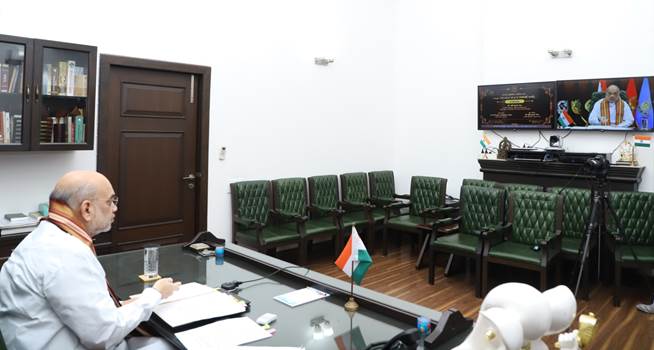
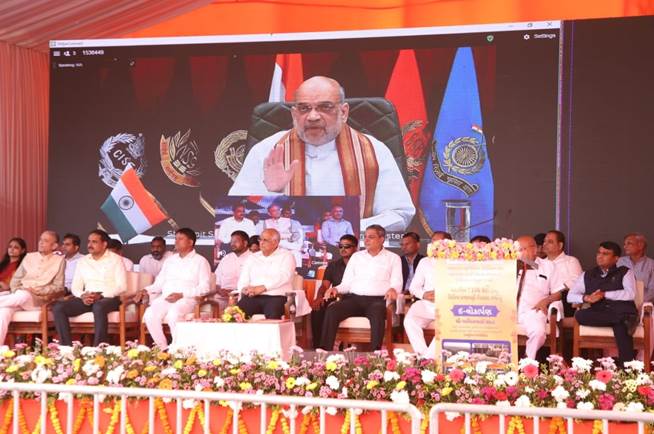
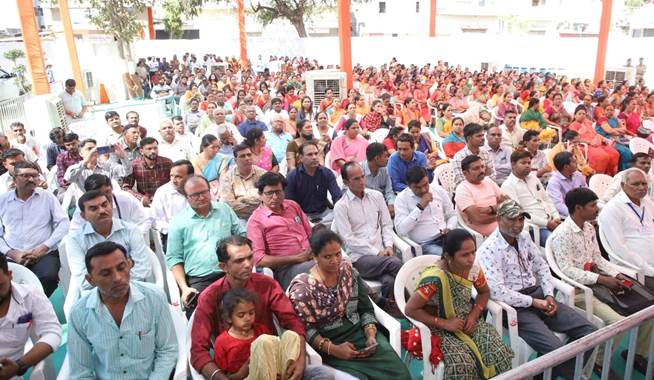
Union Home Minister and Minister of Cooperation, Shri Amit Shah unveiled various development works worth of about Rs 154 crore of Ahmedabad Municipal Corporation and Ahmedabad Urban Development Authority, through video conferencing, today. These development works includes smart schools at Chandkheda, Sabarmati, Shela, Thaltej and Sarkhej. Along with this, Senior Citizen Park at Chandkheda and Nawadaj at a cost of Rs 62 lakh, pedestrian subway near Ahmedabad-Viramgam broad gauge line at a cost of Rs 4.39 crore, 5 Anganwadis at a cost of Rs 40 lakh, overbridge at Sanathal Junction of Sardar Patel Ring Road built at a cost of Rs 97 crore are also inaugurated. Several dignitaries including Chief Minister of Gujarat Shri Bhupendra Patel were present on the occasion.

https://static.pib.gov.in/WriteReadData/userfiles/image/image00110WZ.jpg

Shri Amit Shah said that today is very important because today is the birth anniversary of Chhatrapati Shivaji Maharaj who had given a new definition of self-respect in the country on the basis of Swaraj, Swadharma and Swabhasha. Shri Shah said that at the age of just 15 years, Shivaji Maharaj  had built a Hindu empire with a strong resolve in front of the Mughal rulers. He said that today is also the death anniversary of Savitribai Phule who put a lot of emphasis on women’s education for women empowerment. Mahatma Jyotiba and Savitribai Phule both worked towards various reforms for women.

https://static.pib.gov.in/WriteReadData/userfiles/image/image002ERM1.jpg

The Union Home Minister and Minister of Cooperation said that several development works worth Rs 154 crore have been inaugurated today, among which the biggest work is the inauguration of a new overbridge at Sanathal Junction on Sardar Patel Ring Road at a cost of around Rs 100 crore. He said that today the need for this overbridge has increased due to rapid industrial development in Sanand GIDC and nearby area and its spread in entire rural area of Ahmedabad.

Shri Amit Shah said that today a very important work for drainage has been completed in Shela village. This will hugely benefit the people of Shela from the point of view of cleanliness and health. He said that apart from this, under Mukhyamantri Awas Yojana, 468 families have got houses in Bavla Nagar today. He said that under the leadership of Shri Prime Minister Shri Narendra Modi, the double engine government of Gujarat has resolved that no one should remain homeless in the entire Gujarat. Shri Shah said that today under Ahmedabad Municipal Corporation, smart schools have also been inaugurated in Chandkheda, Sabarmati, Shela, Thaltej and Sarkhej. He said that the Prime Minister Shri Narendra Modi has kept the concept of smart school in the new education policy, the aim of which is to provide a platform to the talents of the children at the level of primary education itself, so that their all-round development can be ensured. He said that smart schools are not just a concept but a way to bring change in the lives of children. There will definitely be a qualitative change in the education of children through these schools.

The Union Home Minister and Minister of Cooperation, said that today a Senior Citizen Park has also been inaugurated in Chandkheda under AUDA. Apart from this, work of underpass under the Viramgam broad gauge line has also completed, so that the general public will get relief from the problem of traffic.

Shri Amit Shah said that under the leadership of Primary Education Committee of Ahmedabad Municipal Corporation, the Municipal Corporation has made many commendable efforts in the last 6 years to improve the quality of education for 459 municipal schools and about 1.70 Lakh children studying in these schools. He said that today all the schools under the Municipal Board have started making smart schools and soon all the children of the area will be able to get the benefit of studying in smart schools.

https://static.pib.gov.in/WriteReadData/userfiles/image/image004ZDUT.jpg

The Union Home Minister and Minister of Cooperation said that the Government led by Prime Minister Shri Narendra Modi at the centre and Government of Gujarat led by Chief Minister Shri Bhupendra Patel are working together to make Gandhinagar a developed Lok Sabha constituency in every sector.

Our goal is to overcome the challenges of Amrit Kaal : Narendra Singh Tomar

| Published on:

Union Agriculture and Farmers Welfare Minister Shri Narendra Singh Tomar has said that the Indian Council of Agricultural Research (ICAR) is the largest and most comprehensive research institute in the world. The progress made by the institute so far is commendable. Be it achieving production targets, increasing productivity or meeting the challenge of producing climate-resilient crops, our agricultural scientists have played a vital role in every field. Consolidating upon the traditional farming since ancient times, along with the hard work of farmers, the research of scientists has proved to be a milestone in the progress witnessed in the agriculture sector. So far this journey has been satisfactory, but it is our aim to overcome the challenges during the Amrit Kaal to bring the country in the comity of developed nation by the year 2047.

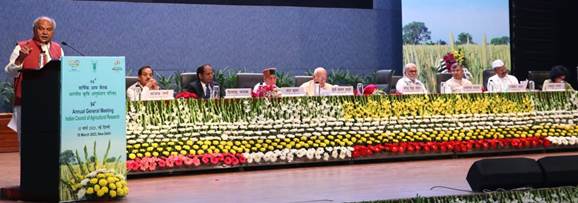
Union Minister Shri Tomar said this while addressing the 94th Annual General Meeting of the Indian Council of Agricultural Research (ICAR) Society. He said that India’s supremacy in the Agriculture sector is increasing all over the world, along with this the expectations from us are also rising. The target is to build a New India by 2047. New India needs new science, research, new skills and innovation because tomorrow belongs to New India. For this, the Government of India, under the leadership of Prime Minister Shri Narendra Modi, is working on the basis of new principles. ‘Sabka Saath, Sabka Vikas, Sabka Vishwas, Sabka Prayas’ is our main mantra, without leaving anyone behind, keep marching towards the goal. Former Prime Minister Lal Bahadur Shastri had given the slogan – ‘Jai Jawan, Jai Kisan’. The then Prime Minister Atal Bihari Vajpayee added ‘Vigyan’ to this slogan and our current Prime Minister Shri Narendra Modi ji has also added ‘Anusandhan’ to it. It has become a mantra for us – ‘Jai Jawan, Jai Kisan, Jai Vigyan and Jai Anusandhan’.

Shri Tomar said that the overall and balanced development of the country is being taken forward. When it comes to overall development, the Agriculture sector is like the backbone of the country. It is our responsibility to develop it. Various challenges like Climate Change are before us today. We are also facing the challenge of damage caused to the standing crops of the farmers due to natural disasters. In New India, we have to reach out to all the farmers with new technology and research. The income of the farmers has to be raised, prosperity has to be brought to their homes and the villages and the Agriculture sector has to be made prosperous, all of which has to be accomplished jointly.

The Union Agriculture Minister said that Rs. 4 lakh crore worth of agricultural exports has been achieved, which is the highest ever. In the coming times, our products of Natural and Organic Farming are going to become more popular in the world. There is a need to work with the belief that our exports will increase further in the future. Along with this, our concern has to be to ensure the quality of the production meets the global benchmark. The government’s emphasis is on Natural Farming. Prime Minister Shri Modi urges that we should promote Natural Farming i.e. cow based farming. Let the focus be on ‘waste to wealth’. We should strive to improve the quality and hygiene of our products. The Agriculture Minister said that the year 2023 has been declared as the International Year of Millets (Shree Anna). The Prime Minister is going to formally launch the programme on 18th March. The International Year of Millets is not just an event but a big project to increase the production, productivity and market of Shree Anna. The consumption and popularity of Shree Anna is also increasing through the programs being organized across the country. With the popularity of Shree Anna gaining across the world, when the consumption will increase, then the responsibility of supplying it will also rest with India since we are the largest producer of Shree Anna. Scientists need to pay attention to this aspect too.

In his address, the Union Minister for Fisheries, Animal Husbandry and Dairying, Shri Parshottam Rupala praised the commendable effort put forth by ICAR in developing indigenous vaccine Lumpi-ProVac for defence against the Lumpy Skin Disease afflicting a large cattle population in the country.

Speaking on the occasion, Member, NITI Aayog Shri Ramesh Chand expressed satisfaction that our foodgrains production growth rate is faster than the country’s population growth rate and that the momentum should accelerate. He called upon the ICAR to focus its efforts on the 12 crops witnessing declining production over the years, including Cotton that supports the Textiles Industry also, besides Soyabean, Tur & Urad pulses and Oilseeds particularly Safflower. Pointing out that the consumption of Millets per person has declined from 24% to 6% over the years, Dr. Ramesh Chand said we must ensure Millets remains the staple diet of the poor since it is rich in iron and prevents anemia.

Presenting a detailed report on the achievements of ICAR during the FY 2022-23, Director General of ICAR and Secretary, DARE Dr. Himanshu Pathak said the ICAR released 323 varieties of field crops, including 266 climate resistant variants. A number of vaccines were developed by the ICAR Institutes including the H9N2 Influenza Vaccine for Chickens and vaccine for prevention of SARS-CoV2 infection in animals, he said.

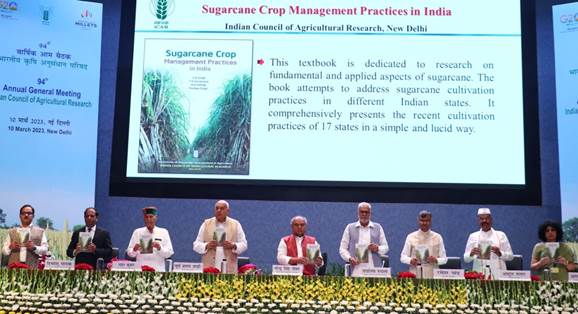
Union Minister of State for Agriculture and Farmers Welfare, Shri Kailash Choudhary (through video conference), Uttar Pradesh Agriculture Minister Shri Surya Pratap Shahi, Maharashtra Agriculture Minister Shri Abdul Sattar, Himachal Pradesh Agriculture and Animal Husbandry Minister Shri Chander Kumar, Secretary, ICAR Shri Sanjay Garg and other members and senior officers were present. On this occasion, Union Minister Shri Tomar also released some publications. During the AGM, some members also presented their suggestions.

Rajeev Chandrasekhar holds consultations with stakeholders on the proposed Digital India Bill (DIB)

| Published on:

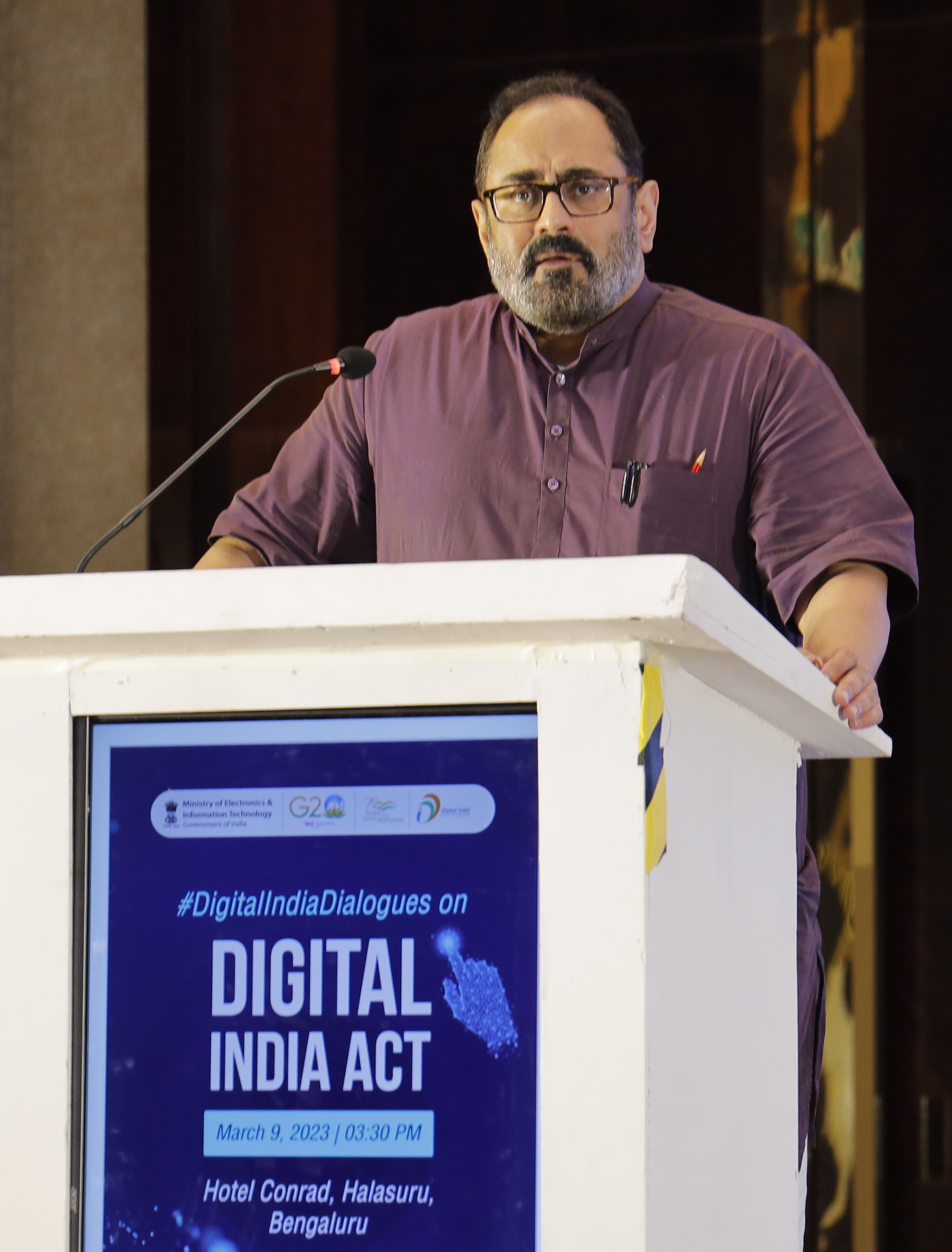
Union Minister of State for Skill Development & Entrepreneurship and Electronics & IT Shri Rajeev Chandrasekhar has held consultations with stakeholders on soon-to-be introduced Digital India Bill — a future ready legislation that aims to catalyse India’s ambition of being in the leading pack of nations that would shape the future technologies.

For the first time design, architecture and goals of a Bill are being discussed with stakeholders at its pre-introduction stage. These consultations are part of the Digital India Dialogues, in line with Prime Minister Shri Narendra Modi’s consultative approach to law and policy making.

Making a presentation on the objectives and goals of the Bill, Shri Rajeev Chandrasekhar said the proposed Bill aims to help India achieve the goal of becoming a trillion-dollar digital economy and be a significant trusted player in the Global Value Chains for digital products, devices, platforms and solutions.

Shri Rajeev Chandrasekhar said that the proposed Digital India Act aims to help develop India as a globally competitive innovation and entrepreneurial ecosystem while at the same time protecting the rights of its citizens.

Stating that the tech ecosystem in general and Internet in particular has evolved significantly after Information Technology Act (IT Act) came into being in 2000, Shri Rajeev Chandrasekhar said that the new law has to be evolvable and consistent with changing market trends, disruption in technologies, and keep in mind protection of digital nagriks from user harm.

“Internet that began as a force of good has today become vulnerable to various types of complex user harms like catfishing, cyber stalking, cyber trolling, gaslighting, phishing, revenge porn, cyber-flashing, dark web, women and children, defamation, cyber-bullying, doxing, salami slicing, etc and there is an urgent need for a specialised and dedicated adjudicatory mechanism for online civil and criminal offences,” the Minister observed.

Reiterating that the DIB is an attempt by the Government to bring in global standard cyber laws, Shri Rajeev Chandrasekhar said, “We want to ensure the Internet is Open, Safe, Trusted & Accountable and accelerate the growth of innovation and technology and create a framework for accelerating digitalisation of Government and to strengthen democracy and governance.”

Shri Rajeev Chandrasekhar thereafter listed down some of the guiding principles for the proposed legislation, which include managing the complexities of internet and rapid expansion of the types of intermediaries addressing the risks of emerging technologies, protecting citizen rights, managing and setting guardrails for the varied intermediaries on the internet.

The Minister also spoke of promoting free market access and fair-trade practices and ease of doing business and ease of compliance for Startups and delivery of public services through online and mobile platforms in a simple, accessible, interoperable and citizen friendly manner in the same thread. Terming the bill as future ready, Shri Rajeev Chandrasekhar said, “The new law should evolve through rules that can be updated and address the tenets of Digital India and designed on a principles & rule-based approach’ to regulation.”

The proposed law, in addition to many aspects of the digital ecosystem, will deal in detail with the question of user harm on the internet. Shri Rajeev Chandrasekhar said, “The internet can be a responsible space and illegal content certainly does not find any place on the Indian internet.”

After the minister’s presentation, he had an interactive discussion with the various stakeholders who included industry representatives, lawyers, Intermediaries, consumer groups amongst others and invited their inputs on it.


PM and Australian PM witness part of 4th Commemorative Test Match of Border-Gavaskar Trophy

| Published on:

The Prime Minister, Shri Narendra Modi and Prime Minister of Australia, Mr Anthony Albanese witnessed part of the 4th Commemorative Cricket Test Match of Border-Gavaskar Trophy at Narendra Modi Stadium in Ahmedabad, Gujarat today.

Replying to a tweet by Prime Minister of Australia, Mr Anthony Albanese, the Prime Minister tweeted:

“Cricket, a common passion in India and Australia! Glad to be in Ahmedabad with my good friend, PM Anthony Albanese to witness parts of the India-Australia Test Match. I am sure it will be an exciting game!”

Upon arriving, the Prime Minister and the Australian counterpart, Mr Anthony Albanese were felicitated by the Secretary of the Board of Control for Cricket in India. Shri Jay Shah and President BCCI, Shri Roger Binny, respectively. The Prime Minister and the Prime Minister of Australia also witnessed a cultural performance, Unity of Symphony by singer Ms Falgui Shah.

The Prime Minister handed over the Test Cap to the captain of Team India, Shri Rohit Sharma while the Australian PM handed over the Test Cap to the Australian captain, Mr Steve Smith. This was followed by the Prime Minister and the Australian PM taking a guard of honour in a golf cart before the huge crowd in the stadium.

The two team captains proceeded down to the pitch for the toss while the Prime Minister and Australian counterpart moved towards the Friendship Hall of Fame for a walkthrough. Former Indian Team coach and player, Shri Ravi Shastri accompanied the Prime Ministers of both nations and explained the rich cricketing history between India and Australia.

This was followed by the two team captains accompanying the respective Prime Ministers of both nations to the field of play. The two captains introduced the team to the respective Prime Ministers followed by the national anthem of India and Australia. The Prime Minister and the Australian Prime Minister then moved to the President’s Box to view the test match between the two cricketing giants.

Raksha Mantri holds telephonic conversation with his Australian counterpart

| Published on:

Raksha Mantri Shri Rajnath Singh held a telephonic conversation with Deputy Prime Minister & Minister for Defence of Australia Mr Richard Marles on March 09, 2023. Both the Ministers reaffirmed their commitment towards further strengthening the bilateral defence relationship. The telecon was reflective of the trust and friendship the two countries share especially in matters related to defence and security.

India and Australia are pursuing a Comprehensive Strategic Partnership and the defence cooperation between the two countries has been consistently deepening in recent years.