Prime Minister meets with the President of Ghana

| Published on:

Prime Minister Shri Narendra Modi today met with the President of Ghana, H.E. Dr. John Dramani Mahama. Upon arrival at Jubilee House, he was received by President Mahama. This State Visit of Prime Minister to Ghana is the first such visit in three decades.

The two leaders met in restricted and delegation level formats and held wide-ranging talks. They agreed to elevate the relationship to a Comprehensive Partnership. Both leaders reaffirmed the warm and time-tested ties between India and Ghana and discussed ways to expand cooperation in key areas including trade & investment, agriculture, capacity building, digital technology, infrastructure, and people-to-people ties. They welcomed the growing bilateral trade and Indian investments in Ghana. The leaders also discussed strengthening defence and security partnership. They committed to further strengthening development cooperation partnership—especially through India-supported infrastructure and capacity-building projects. India offered to share its experiences in the fields of health, pharma, digital public infrastructure, UPI and skill development. Prime Minister conveyed India’s deep commitment to voicing the concerns of the Global South and thanked Ghana for its solidarity on this account. Prime Minister also thanked President Mahama for taking care of the 15,000 strong Indian community in Ghana.

The two leaders discussed global issues of mutual interest, including UN reforms. Prime Minister thanked President Mahama for his support and solidarity in the wake of Pahalgam terror attack. The two sides agreed to strengthen global fight against terrorism. Prime Minister congratulated Ghana on its growing international profile, including its term on the UN Human Rights Council and the election of Ghana’s Foreign Minister as the Commonwealth Secretary-General. Both leaders reiterated their commitment to democratic values, South-South cooperation, and a shared vision for sustainable development and global peace.

Following the delegation level talks, four MoUs in the fields of Culture, Standards, Ayurveda and Traditional Medicine, and Joint Commission Mechanism for engagement between Foreign Ministries were exchanged. President Mahama hosted a State Banquet in honour of Prime Minister. Thanking him for his gracious hospitality, Prime Minister invited President Mahama to visit India at a mutually convenient time.

Departure Statement by PM on the eve of visit to Ghana, Trinidad & Tobago, Argentina, Brazil, and Namibia

| Published on:

Today, I embark on a five-nation visit to Ghana, Trinidad & Tobago, Argentina, Brazil, and Namibia from 2 to 9 July 2025.

At the invitation of President H.E.  John Dramani Mahama, I will visit Ghana on 2-3 July. Ghana is a valued partner in the Global South and plays an important role in the African Union and the Economic Community of West African States. I look forward to my exchanges aimed at further deepening our historical ties and opening up new windows of cooperation, including in the areas of investment, energy, health, security, capacity building and development partnership. As fellow democracies, it will be an honour to speak at the Parliament of Ghana.

On 3-4 July, I will be in the Republic of Trinidad & Tobago, a country with which we share deep-rooted historical, cultural and people-to-people connect. I will meet President H.E. Mrs. Christine Carla Kangaloo, who was the Chief Guest at this year’s Pravasi Bhartiya Divas, and Prime Minister H.E. Mrs. Kamla Persad-Bissessar, who has recently assumed office for the second term. Indians first arrived in Trinidad and Tobago 180 years ago. This visit will provide an opportunity to rejuvenate the special bonds of ancestry and kinship that unite us.

From Port of Spain, I will travel to Buenos Aires. This will be the first bilateral visit by an Indian Prime Minister to Argentina in 57 years. Argentina is a key economic partner in Latin America and a close collaborator in the G20. I look forward to my discussions with President H.E. Javier Milei, whom I also had the pleasure of meeting last year. We will focus on advancing our a mutually beneficial cooperation, including in the areas of agriculture, critical minerals, energy, trade, tourism, technology, and investment.

I will attend the BRICS Summit in Rio de Janeiro on 6-7 July. As a founding member, India is committed to BRICS as a vital platform for cooperation among emerging economies. Together, we strive for a more peaceful, equitable, just, democratic and balanced multipolar world order.  On the sidelines of the Summit, I will also meet several world leaders. I will travel to Brasilia for a bilateral State Visit, the first by an Indian Prime Minister in nearly six decades. This visit will provide an opportunity to strengthen our close partnership with Brazil, and work with my friend, President H.E. Luiz Inácio Lula da Silva, on advancing the priorities of the Global South.

My final destination will be Namibia, a trusted partner with whom we share a common history of struggle against colonialism. I look forward to meeting President H.E. Dr. Netumbo Nandi-Ndaitwah and chart a new roadmap for cooperation for the benefit of our peoples, our regions and the wider Global South. It will be a privilege to also address the Joint Session of Namibian Parliament as we celebrate our enduring solidarity and shared commitment for freedom and development.

I am confident that my visits to the five countries will reinforce our bonds friendship across the Global South, strengthen our partnerships on both sides of the Atlantic, and deepen engagements in the multilateral platforms such as BRICS, the African Union, ECOWAS and the CARICOM.

GST stands out as a landmark reform that has reshaped India’s economic landscape: PM

| Published on:

The Prime Minister Shri Narendra Modi has remarked that eight years since GST was introduced, it stands out as a landmark reform that has reshaped India’s economic landscape. “By reducing the compliance burden, it has greatly improved the Ease of Doing Business, particularly for small and medium enterprises”, Shri Modi stated.

The Prime Minister posted on X:

“Eight years since it was introduced, GST stands out as a landmark reform that has reshaped India’s economic landscape.

By reducing the compliance burden, it has greatly improved the Ease of Doing Business, particularly for small and medium enterprises.

GST has also served as a powerful engine for economic growth, while fostering true cooperative federalism by making states equal partners in this journey to integrate India’s market.”

PM lauds 10 years of the Digital India initiative

| Published on:

The Prime Minister, Shri Narendra Modi has lauded the successful completion of 10 years of the Digital India initiative. He remarked that a decade later, we stand witness to a journey that has touched countless lives and ushered in a new era of empowerment. “India has made many strides in digital payments, powered by the collective resolve of 140 crore Indians” Shri Modi stated.

Sharing a thread on X by MyGovIndia, the Prime Minister wrote:
“Today is a historic day as we mark #10YearsOfDigitalIndia!

Ten years ago, Digital India began as an initiative to transform our nation into a digitally empowered and technologically advanced society.

A decade later, we stand witness to a journey that has touched countless lives and ushered in a new era of empowerment. India has made many strides in digital payments, powered by the collective resolve of 140 crore Indians. Sectors like health and education have also benefitted from this initiative.

This thread offers a glimpse of the transformation and its scale!”

Union Home Minister addresses the programme “A Golden Year of Trust in the Justice System” in New Delhi

| Published on:

Union Home Minister and Minister of Cooperation, Shri Amit Shah, today addressed the programme “A Golden Year of Trust in the Justice System” held in New Delhi to mark the successful completion of one year of the new criminal laws, as the chief guest. On this occasion, several dignitaries including the Lieutenant Governor of Delhi Shri V.K. Saxena, Chief Minister Smt. Rekha Gupta, the Union Home Secretary, and the Director of the Intelligence Bureau were present.

Shri Amit Shah said that an exhibition on the new criminal laws was also inaugurated today. He mentioned that when this exhibition was earlier held in Chandigarh, Prime Minister Shri Narendra Modi had instructed the Union Home Secretary, Shri Govind Mohan, to organize this exhibition in every state across the country. The aim was to ensure that journalists, senior police officers, members of bar associations, all judicial officers, and especially school and college students could view it and learn about the new criminal laws. Shri Shah congratulated the Union Home Secretary and his entire team for organizing this important exhibition.

Union Home Minister Shri Amit Shah said that the three new criminal laws introduced under the leadership of Prime Minister Shri Narendra Modi will be affordable, accessible, and approachable, while also making the judicial process simpler, more consistent, and transparent. He said that under PM Modi’s leadership, a golden era of governance based on social, economic, and political justice is about to begin. He further said that under the leadership of Prime Minister Shri Narendra Modi, in the coming days, our criminal justice system will enter a new era, which will definitely instill a strong sense of trust among the people that justice will be delivered promptly. He said that the new laws will replace the fear of ‘What will happen if I file an FIR’ with the confidence that ‘Filing an FIR will lead to immediate justice.’

Shri Amit Shah said that the new criminal laws will fundamentally transform the Indian criminal justice system in the coming days. He stated that earlier, the biggest problem with our justice system was that no one knew when justice would be delivered. The Home Minister said that after the full implementation of these laws in nearly three years, justice in the country will be delivered all the way up to the Supreme Court starting from filing of the FIR. He explained that these laws impose strict timelines on the three key pillars responsible for delivering justice to citizens—the police, prosecution, and judiciary. Shri Shah added that the new laws specify deadlines for completing investigations within 90 days, filing charge sheets, framing charges, and delivering judgments.

Union Home Minister said that the new laws also include several technology-based provisions which, once implemented, will leave no opportunity for offenders to escape punishment by availing the benefit of doubt. He said that after the new criminal justice system is fully implemented, the conviction rate in our country will improve significantly, and criminals will definitely be punished. Shri Shah said that after the full implementation of all three new laws, with the use of technology, our justice system will become the most modern justice system in the world.

Shri Amit Shah said that after studying the justice systems of nearly 89 countries and legally incorporating the use of technology from them, these provisions have been included in the new laws. The Modi government has created these laws from an Indian perspective. He stated that the previous laws were made by the British in the Parliament of England to prolong their rule, whereas the new criminal laws have been made under the leadership of Prime Minister Shri Narendra Modi by a government elected by the people of India, for the benefit of Indian citizens. The Home Minister said that the purpose of the old laws was to extend British rule and protect their property, while the purpose of the new laws is to protect the life, property, and all constitutionally guaranteed rights of Indian citizens.

Union Home Minister and Minister of Cooperation said that now with the replacement of IPC with Bharatiya Nyay Sanhita 2023 (BNS), CRPC with Bharatiya Nagarik Suraksha Sanhita 2023 (BNSS) and Indian Evidence Act with Bharatiya Sakshya Adhiniyam 2023 (BSA), it shows that the goal of these laws is not punishment but justice. He said that this is going to be a golden opportunity for India’s Nyay Yatra. Now the change is not on paper as crores of rupees have been spent by the Government of India and state governments on the incorporation of technology in these laws. Shri Shah said that we have made forensic examination mandatory in every crime attracting a punishment of 7 years or more and now National Automated Fingerprint Identification System (NAFIS) is also being used in a very good way. Similarly, in the case of POCSO, DNA matching will not let any perpetrator to escape conviction.

Shri Amit Shah said that in the last one year, about 14 lakh 80 thousand policemen, 42 thousand employees posted at jails, more than 19 thousand judicial officers and more than 11 thousand public prosecutors have been trained. He said that we have held continuous review meetings in the last one year and 23 states and union territories have completed 100 per cent capacity building. Notification of e-evidence and e-summons has been issued in 11 states and union territories, Nyay Shruti has been notified in 6 states and union territories and community service as punishment has been notified in 12 states and union territories. He said that among all the states and union territories, Delhi government has done the best in implementing these laws quickly.

Union Home Minister said that in the implementation of the new laws, small loopholes have been filled by conducting intensive consultations and a lot of work has been done with a multi stakeholder approach. Shri Shah said that he himself held 160 meetings on these laws. He said that in 2019 we had sought suggestions from all the Governors, Lieutenant Governors, Chief Ministers, Administrators, Chief Justices, Bar Council and Law Universities and BPR&D also sought suggestions from all IPS officers. He said that after this, a committee was formed and these laws were implemented by reading each section and considering all the suggestions.

Shri Amit Shah said that a separate chapter has been added in these laws on crimes against children and women. For the first time, terrorism has been defined and organised crime has also been defined and provision for stringent punishment has been made. He said that a provision for Director of Prosecution has also been made in the new laws which will greatly increase the conviction rate.

Union Home Minister and Minister of Cooperation said that the police and the Home Ministry alone cannot do all this. For the successful and effective implementation of the new laws, awareness and the public’s knowledge of their rights is very important. Shri Shah said that whenever these laws are analyzed, they will be regarded as the biggest reform since Independence, because there can be no greater reform than making the justice system — which protects the rights of the people — transparent, citizen-centric, and time-bound.

Cabinet Approves Employment Linked Incentive (ELI) Scheme

| Published on:

The Union Cabinet chaired by the Prime Minister, Shri Narendra Modi, has approved the Employment Linked Incentive (ELI) Scheme to support employment generation, enhance employability and social security across all sectors, with special focus on the manufacturing sector.  Under the Scheme, while the first-time employees will get one month’s wage (up to Rs 15,000/-), the employers will be given incentives for a period to two years for generating additional employment, with extended benefits for another two years for the manufacturing sector.  The ELI Scheme was announced in the Union Budget 2024-25 as part of PM’s package of five schemes to facilitate employment, skilling and other opportunities for 4.1 Crore youth with a total budget outlay of Rs 2 Lakh Crore.

With an outlay of Rs 99,446 Crore, the ELI Scheme aims to incentivize the creation of more than 3.5 Crore jobs in the country, over a period of 2 years.  Out of these, 1.92 Crore beneficiaries will be first timers, entering the workforce.  The benefits of the Scheme would be applicable to jobs created between 01st August 2025 and 31st July, 2027.

The Scheme consists of two parts with Par A focused on first timers and Part B focused on employers:

Part A: Incentive to First Time Employees:

Targeting first-time employees registered with EPFO, this Part will offer one-month EPF wage up to Rs 15,000 in two installments.  Employees with salaries up to Rs 1 lakh will be eligible.  The 1st installment will be payable after 6 months of service and the 2nd installment will be payable after 12 months of service and completion of a financial literacy programme by the employee. To encourage the habit of saving, a portion of the incentive will be kept in a savings instrument of deposit account for a fixed period and can be withdrawn by the employee at a later date.

The Part A will benefit around 1.92 crore first time employees.

Part B: Support to Employers:

This part will cover generation of additional employment in all sectors, with a special focus on the manufacturing sector.  The employers will get incentives in respect of employees with salaries up to Rs 1 lakh.  The Government will incentivize employers, up to Rs 3000 per month, for two years, for each additional employee with sustained employment for at least six months.  For the manufacturing sector, incentives will be extended to the 3rd and 4th years as well.

Establishments, which are registered with EPFO, will be required to hire at least two additional employees (for employers with less than 50 employees) or five additional employees (for employers with 50 or more employees), on a sustained basis for at least six months.

The incentive structure will be as under:

EPF Wage Slabs of Additional Employee (in Benefit to the Employer (per additional employment per month)
Up to Rs 10,000* Upto Rs 1,000
More than Rs 10,000 and up to Rs 20,000 Rs 2,000
More than Rs 20,000 (upto salary of Rs 1 Lakh/month) Rs 3,000

 *Employees with EPF wages up to Rs. 10,000 will get a proportional incentive.

This part is expected to incentivize employers for the creation of additional employment of nearly 2.60 crore persons.

 Incentive Payment Mechanism:

All payments to the First Time Employees under Part A of the Scheme will be made through DBT (Direct Benefit Transfer) mode using Aadhar Bridge Payment System (ABPS).  Payments to the Employers under Part B will be made directly into their PAN-linked Accounts.

With ELI Scheme, the government intends to catalyse job creation in all sectors, particularly in manufacturing sector, besides incentivizing youth joining the workforce for the first time.  An important outcome of the Scheme will also be formalization of the country’s workforce by extending social security coverage for crores of young men and women.

PM’s address in the 123rd Episode of ‘Mann Ki Baat’

| Published on:

My dear countrymen, Namaskar. Welcome to ‘Mann Ki Baat’… Greetings to all of you. At this moment, you all must be full of the energy of yoga and memories of ‘International Yoga Day’. This time as well, on the 21st of June, crores of people across the country and the world participated in the ‘International Yoga Day’. Do you remember, it began 10 years ago. Now, over these 10 years, this event is turning grand with every passing year. This is also an indication that more and more people are adopting yoga in their daily lives. We have seen so many attractive pictures of ‘Yoga Day’ this time. Three lakh people performed yoga together on the beach of Visakhapatnam. Another amazing visual emerged from Visakhapatnam itself… more than two thousand adivasi students performed 108 Surya Namaskars for 108 minutes. Imagine how much discipline, how much dedication there must have been! A grand glimpse of yoga was also witnessed on our naval ships. In Telangana, three thousand divyang friends participated in a yoga camp together.

They showed how yoga is also a medium of empowerment. People of Delhi connected yoga with the resolve of a clean Yamuna and performed yoga on the banks of the Yamuna. In Jammu and Kashmir, people also did yoga on the Chenab Bridge, which is the world’s highest railway bridge. The snowy peaks of the Himalayas and ITBP soldiers… yoga was seen there too; courage and sadhana were hand in hand. The people of Gujarat also created history anew. In Vadnagar, 2121 (twenty one hundred & twenty one) people did Bhujangasana together and created a new record. Pictures of yoga came in from New York, London, Tokyo, Paris; every big city of the world… and one thing was special in every picture – peace, stability and balance.

This time the theme was also very special, ‘Yoga for One Earth, One Health’. This is not just a slogan; it is a direction which makes us realize the essence of ‘Vasudhaiva Kutumbakam’. I am sure, the grandeur of this year’s Yoga Day will certainly inspire more and more people to adopt yoga.

My dear countrymen,

When someone embarks on a pilgrimage, the first feeling that comes to mind is, “Chalo Bulawa Aaya Hai…” i.e. Let’s proceed amid the Divine Call… This very feeling is the soul of our religious pilgrimages. These pilgrimages are a means of disciplining the body, purifying the mind; mutual love and brotherhood, and connecting with God. Apart from these, there is another great aspect of these pilgrimages. These religious pilgrimages are also a great ritual of opportunities for the spirit of service. When any pilgrimage takes place, more people engage in serving the pilgrims than the number of people who undertake the pilgrimage. Bhandaaras and langars i.e. Free Food Distribution, are set up at various places. People set up drinking water stalls on the roadsides. Medical camps and facilities are arranged with a spirit of service. A lot many people arrange for dharamshalas and accommodation for the pilgrims at their own expense.

Friends,

After a long time, the Kailash Mansarovar Yatra has had an auspicious re-start. Kailash Mansarovar, that is the abode of Lord Shiva. Kailash is considered the centre of faith and devotion in every tradition; be it Hindu, Buddhist or Jain.

Friends,

The holy Amarnath Yatra is going to commence on the 3rd of July, and the holy month of Sawan is also just a few days away. Just a few days ago, we have also witnessed the Rath Yatra of Lord Jagannath ji. Be it Odisha, Gujarat or any other corner of the country, lakhs of devotees participate in this Yatra. From North to South, East to West, these Yatras are a reflection of the spirit of ‘Ek Bharat-Shrestha Bharat’. When we conclude our religious journey with devotion, complete dedication and complete discipline, we also get rewarded with its fruits. I extend my best wishes to all the fortunate devotees going on the Yatras. I also commend those, who are engaged in making these Yatras successful and safe with a spirit of service.

My dear countrymen,

I now want to tell you about two such achievements of the country, which will fill you up with pride. Global institutions are discussing these achievements. WHO i.e. ‘World Health Organization’ and ILO i.e. International Labour Organization have heaped praises on these achievements of the country. The first achievement is related to our health. Many of you must have heard about an eye disease – Trachoma. This infection spreads through bacteria.

There was a time when this ailment was common in many parts of the country. If not taken care of, this disease gradually used to lead to loss of eyesight. We resolved to eradicate Trachoma from its roots. And I am very happy to share with you that WHO has declared India Trachoma free. India now has become a Trachoma free country. This is the result of the hard work of lakhs of people who fought this disease tirelessly; without a break. This success belongs to our health workers.

Therefore, the ‘Swachh Bharat Abhiyan’ also helped in eradicating it. The ‘Jal Jeevan Mission’ also contributed a lot to this success. Today, when clean water is reaching every home through taps, the risk of such ailments has reduced. ‘World Health Organisation’ WHO has also appreciated the fact that along with tackling the disease, India has also got rid of its root causes.

Friends,

Presently, most of the populace in India is taking advantage of one social protection benefit or the other and recently a very important report of the International Labour Organisation – ILO has come out.

It has been mentioned in this report that more than 64% (sixty-four percent) of the population of India is now definitely availing of some social protection benefit or the other. Social Security is one of the biggest coverages in the world. Today, around 95 crore people of the country are getting the benefit of some or the other social security schemes; whereas, till 2015, the government schemes were reaching less than 25 crore people.

Friends,

In India, from health to social security, the country is moving ahead with the feeling of saturation in every field. This is also a great picture of social justice. These successes have instilled a belief that the coming times will be even better; India will become even stronger at every step.

My dear countrymen,

With the power of public participation, big crises can be confronted. I will play an audio for you… in this audio you will get an idea of ​​the magnitude of that crisis. How grave that crisis was… listen to it first… understand it.

Audio Clip – Morarji Bhai Desai

After all, the oppression that happened for two years, the oppression had started 5-7 years ago. But it has reached its peak in the last 2 years, when emergency was imposed on people and people were treated inhumanly. People’s right to freedom was snatched away, newspapers were left without freedom. Courts were made completely powerless. And the way more than one lakh people were put in jail and then arbitrary rule continued, it is difficult to find its traces in the history of the world.

Friends,

This is the voice of the former Prime Minister of the country, Shriman Morarji Bhai Desai. He spoke about the Emergency in a brief but very clear manner. You can imagine what that period was like! Those who imposed Emergency not only murdered our constitution but also had the intention to keep the judiciary as their slave. During this period, people were tormented on a large scale. There are many such examples of this, which can never be forgotten. George Fernandez Sahib was tied in chains.

Many people were subjected to severe torture. Under MISA, anyone could be summarily arrested. Students too were harassed. Freedom of expression was also stifled. Thousands of people who were arrested during that period were subjected to such inhumane atrocities. But it is the strength of the people of India… they did not bow down, did not break down and did not accept any compromise with democracy. Finally, the people at large won – the Emergency was lifted and those who imposed the Emergency were defeated. Babu Jagjivan Ram ji had put forth his views in a very strong manner in this regard.

Audio Clip – Babu Jagjivan Ram

Sisters and Brothers, the last election was not an election. It was a great campaign of the people of India… To change the circumstances of that time… to turn the tide of dictatorship and to strengthen the foundation of democracy in India.

We should also listen to what Atal ji had said in his own distinct style then –

Audio Clip – Atal Bihari Vajpayee

Sisters and brothers, whatever happened in the country cannot be called just an election. A peaceful revolution has taken place. The wave of people’s power has thrown the killers of democracy into the dustbin of history.

Friends,

Just a few days ago, the imposition of Emergency on the country completed its 50 years. We countrymen have observed the ‘Samvidhan Hatya Diwas’. We should always remember all those people who fought the Emergency with fortitude. This inspires us to remain constantly vigilant to keep our Constitution strong and enduring.

My dear countrymen,

Imagine a picture. The morning sun is touching the hills, the light is slowly moving towards the plains, and with that light, a troupe of football lovers is advancing. The whistle blows and in a few moments, the ground reverberates with applause and slogans. People’s enthusiasm is increasing with every pass, every goal. You must be wondering… what a beautiful world is that?

Friends,

This picture is the reality of Bodoland, a major region of Assam. Bodoland today stands out in the country with a new face, a new identity. The energy and confidence that the youth here have, is most visible on the football field. In the Bodo Territorial Area, the Bodoland CEM Cup is being organized. This is not just a tournament; it has become a celebration of unity and hope. More than three thousand seven hundred teams, about seventy thousand players, and even among them, a large number of our daughter’s participation! These statistics tell the story of a big change in Bodoland. Bodoland is now increasingly casting its glow on the sports map of the country.

Friends,

There was a time when struggle itself was the identity of this place. Then the avenues for the youth here were limited. But today there are new dreams in their eyes and the courage of self-reliance in their hearts. The football players hailing from here are now making their mark at a high level. Halicharan Narzary, Durga Boro, Apurba Narzary, Manbir Basumatari – these are not just the names of football players – they are the identity of that new generation who catapulted Bodoland from the field to the national stage.

Many of them practiced with limited resources; many forged their way through difficult circumstances, and today many young children of the country kickstart their dreams, inspired by their names. If we have to expand our capability, first of all we have to focus on our fitness and wellbeing. By the way, friends, do you remember one of my suggestions for fitness, for reducing obesity! Reduce 10% oil in food, reduce obesity. When you’ll be fit, you will be more super hit in life.

My dear countrymen,

Just as our India is known for its regional, linguistic and cultural diversity; in the same way, the diversity of arts, crafts and skills is also a great quality of our country. Whichever area you visit, you will get to know about some local specialities of that place. We often talk about such unique products of the country in ‘Mann Ki Baat’. One such product is Eri Silk of Meghalaya. It has received the GI Tag a few days ago. Eri Silk is like a heritage for Meghalaya. The tribes here, especially the people of the Khasi community, have preserved it for generations and have also enriched it with their skills. This silk has many specialities that make it different from other fabrics. Its most special feature is the way it is made. The silkworms that make this silk are not killed to obtain it, hence it is also called Ahimsa Silk.

Nowadays, the demand for such products is rising rapidly in the world, which do not involve violence and do not have any ill effect on nature, hence, Eri Silk of Meghalaya is a perfect product for the global market. Another special feature is that, this silk keeps you warm in winters and cool in summers. This quality makes it suitable for most places. The women of Meghalaya are now taking this heritage forward on a larger scale through Self Help Groups. I congratulate the people of Meghalaya on Eri Silk getting the GI-Tag. I would also appeal to all of you to try out clothes made from Eri Silk… and yes, you must always remember Khadi, handloom handicraft, Vocal for Local. If customers buy only products made in India and traders sell only products made in India, the ‘Atmanirbhar Bharat Abhiyan’ will be infused with new energy.

My dear countrymen,

The mantra of ‘Women Led Development’ is ready to create a new future for India. Our mothers, sisters, daughters are today lending a new direction not only for themselves but for the entire society. You will also feel good when you come to know about the success of the women of Bhadrachalam in Telangana. These women once used to work as labourers in the fields. They used to work hard all day for their livelihoods.

Today the same women are making biscuits from millets, i.e. Shreeanna. These biscuits, named ‘Bhadradri Millet Magic’, are reaching right from Hyderabad to London. These women of Bhadrachalam joined a Self Help Group and received training.

Friends,

These women have done another commendable work. They started making ‘Giri Sanitary Pads’. In just three months, they prepared 40,000 pads and delivered them to schools and nearby offices – that too at a very low price.

Friends,

The achievement of the women of Kalaburgi in Karnataka is also excellent. They have made jowar roti a brand. In the cooperative that they have formed, more than three thousand rotis are being made every day. The aroma of these rotis is no longer limited to the village. A special counter has been opened in Bengaluru. Orders are coming over online food platforms. Kalaburgi roti is now reaching the kitchens of big cities. This has had a great impact on these women, their income is increasing.

Friends,

These stories from different states have different faces. But their glow is the same. This is the glow of self-confidence, of self-reliance. One such face is Suma Uike from Madhya Pradesh. Suma ji’s efforts are very commendable. She took training in mushroom farming and animal husbandry by joining the Self Help Group in Katangi block of Balaghat district. Thus she found her the path to self-reliance. When Suma Uike’s income increased, she also expanded her work. This journey that started with a tiny effort has now reached ‘Didi Canteen’ and ‘Thermal Therapy Centre’. In every corner of the country, countless such women are changing their fate and that of the country.

My dear countrymen,

During the last few days, many people from Vietnam sent me their messages through various mediums. There was reverence and affability in every line of these messages. Their feelings were heartwarming. They were expressing their gratitude to India for enabling darshan of the holy relics of Bhagwan Buddha. The emotions in their words were more than any formal thanks.

Friends,

Originally these sacred relics of Bhagwan Buddha were discovered at Nagarjunakonda of Palnadu district in Andhra Pradesh. This place has a deep connection with Buddhism. It is said that once upon a time, people from far-off places including Sri Lanka and China used to come to this place.

Friends,

Last month these holy relics of Bhagwan Buddha were taken from India to Vietnam. They were kept for public darshan at 9 different places there. In a way, this initiative of India became a national festival for Vietnam. You can imagine that in Vietnam, which has a population of about 10 crore people, more than 1.5 crore people had a darshan of the holy relics of Bhagwan Buddha. The pictures and videos that I saw on social media made me realize that devotion has no limits. Be it rain or the scorching sun, people stood in queues for hours. Children, the elderly, differently-abled people, everyone was overwhelmed. The President of Vietnam, Deputy Prime Minister, senior ministers, everyone paid obeisance. The feeling of respect among the people there for this pilgrimage was so deep that the Vietnamese government requested to extend it for another 12 days and India gladly accepted it.

Friends,

The thoughts of Bhagwan Buddha have the power to bind countries, cultures and people together. Earlier, the holy relics of Bhagwan Buddha were taken to Thailand and Mongolia, and the same feeling of reverence was felt there as well. I urge all of you to definitely visit Buddhist sites in your state. It will be a spiritual experience, as well as a wonderful opportunity to connect with our cultural heritage.

My dear countrymen,

This month we all celebrated the ‘World Environment Day’. I received thousands of your messages. Many people told me about those friends who had set out alone to save the environment and then the whole society joined them. This contribution of everyone is becoming a great strength for our earth. Mr. Ramesh Kharmale of Pune… knowing about his work will inspire you a lot. When people take rest at the end of the week, Ramesh ji and his family set out with pick axe and spade. Do you know where to? Towards the hills of Junnar. Be it sunshine or a steep climb, their ascent does not stop. They clear bushes, dig trenches to retain water and sow seeds. They dug 70 trenches in just two months.

Ramesh ji has made many small ponds, planted hundreds of trees. He is also getting an Oxygen Park built. The result is that birds have started returning here, wildlife is getting a new breath.

Friends,

Another beautiful initiative for the environment has been seen in Ahmedabad city of Gujarat. Here the Municipal Corporation has started the ‘Mission for Million Trees’ campaign. The target is – to plant lakhs of trees. A special aspect about this campaign is ‘Sindoor Van’. This forest is dedicated to the bravehearts of Operation Sindoor. Sindoor saplings are being planted in the memory of those brave people who have sacrificed everything for the country. Here, another campaign is being given a new impetus – ‘Ek Ped Maa Ke Naam’. Under this campaign, crores of trees have been planted in the country. You too must take part in such campaigns going on in your village or city. Plant trees, save water, serve the earth, because when we save nature, we actually protect our future generations.

Friends,

A village in Maharashtra has also set a great example. ‘Patoda’ is a Gram Panchayat in Chhatrapati Sambhaji Nagar district. This is a Carbon Neutral village Panchayat. In this village, no one throws garbage outside their house. There is a complete system of collecting garbage from every house. Here, dirty water is also treated. No water goes into the river without being cleaned. Here, last rites are performed with cow dung cakes and a tree is planted in the name of the deceased with that ash. The cleanliness in this village is also worth seeing. When small habits become a collective resolve, a big change is certain.

My dear friends,

At this moment, everyone’s eyes are also on the International Space Centre. India has scripted a new history. Yesterday I’ve also spoken to Group Captain Shubhanshu Shukla. You must have also heard my conversation with Shubhanshu. Shubhanshu still has to stay at the International Space Centre for a few more days. We will talk more about this Mission, but in the next episode of ‘Mann Ki Baat’.

It is time now to bid adieu to you in this episode. But friends, before leaving I want to remind you of a special day. On the 1st of July, the day after tomorrow, we honour two very important professions – Doctors and CAs. Both of them are such pillars of society, which make our lives better. Doctors are the protectors of our health and CAs (Chartered Accountants) are the guides of economic life. My best wishes to all the Doctors and Chartered Accountants.

Friends,

I always wait for your suggestions. The next episode of ‘Mann Ki Baat’ will be enriched through your suggestions. We will meet again with new thoughts, new inspirations and new achievements of our countrymen. Thank you very much, Namaskar.


Union Home Minister inaugurates the headquarters of the National Turmeric Board in Telangana

| Published on:

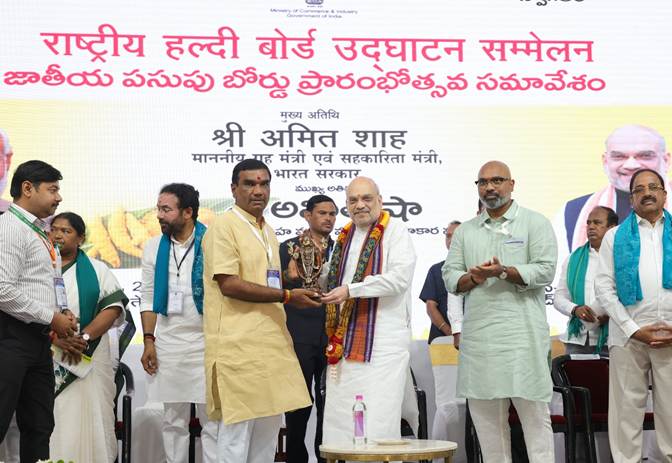
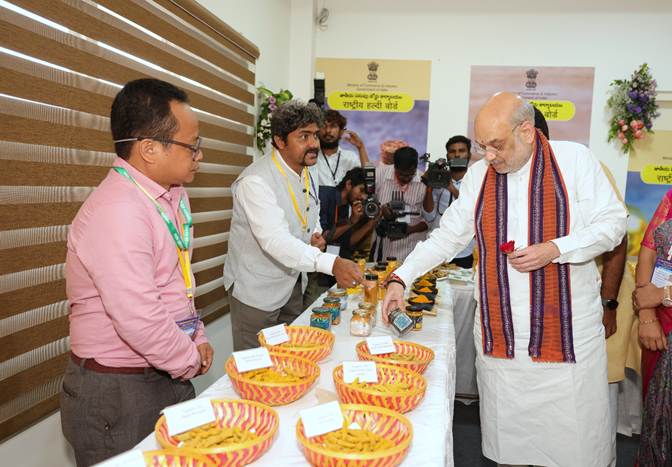
Union Home Minister and Minister of Cooperation Shri Amit Shah today inaugurated the headquarters of the National Turmeric Board in Nizamabad, Telangana. On this occasion, Union Minister of Coal and Mines Shri G. Kishan Reddy, Union Minister of State for Home Shri Bandi Sanjay Kumar, and several other dignitaries were present.

In his address, Union Home Minister and Minister of Cooperation Shri Amit Shah stated that Prime Minister Shri Narendra Modi has fulfilled the 40-year-old demand of millions of turmeric farmers across the country, especially in Telangana, by establishing the National Turmeric Board. He said that the promise made by the Prime Minister to turmeric farmers across the country, particularly in Telangana and Nizamabad, is being fulfilled today. He noted that Nizamabad has been known as the turmeric capital for decades, and farmers here have been cultivating turmeric for centuries, yet it has not reached global markets. Shri Shah added that with the formation of the National Turmeric Board, Nizamabad’s turmeric will reach many countries in the world within the next 3-4 years.

Shri Amit Shah said that once the National Turmeric Board begins functioning formally, turmeric farmers will be freed from the influence of middlemen. He said that the National Turmeric Board will establish a complete chain for turmeric packaging, branding, marketing, and export. He highlighted that turmeric is anti-viral, anti-cancer, and anti-inflammatory, and due to its medicinal properties, it is known worldwide as a wonder drug. He added that turmeric is a remarkable medicine, and consuming even a small amount can eliminate multiple diseases from the human body simultaneously. He further noted that the production and marketing of GI-tagged organic turmeric have also been initiated.

Union Home Minister stated that the Government of India has set a target of achieving one billion dollars in turmeric exports by 2030 and all necessary preparations already in place. He said that the National Turmeric Board will work to ensure that the maximum value of turmeric reaches its farmers, promote the consumption of turmeric in international markets, and publicize the medicinal properties of Indian turmeric in potential markets. It will also ensure that the quality and safety standards of Indian turmeric meet global benchmarks, arrange appropriate packaging, and provide training and skill development to farmers on how to harvest turmeric to avoid any export-related obstacles. Shri Shah added that research and development on the health benefits of turmeric will be conducted to showcase it to the world.

Shri Amit Shah stated that Nizamabad, Jagtial, Nirmal, and Kamareddy districts in Telangana are among the top turmeric-producing districts in India. He mentioned that in 2025, turmeric farmers received a price of 18,000 to 19,000 rupees per quintal for turmeric, and efforts will be made to ensure farmers receive an additional 6,000-7,000 rupees per quintal in the next three years. Shri Shah noted that in 2023-24, turmeric was cultivated on 3 lakh hectares of land in India, resulting in a production of 10.74 lakh tonnes. He added that Prime Minister Modi has established National Cooperative Exports Limited to benefit farmers involved in exports and National Cooperative Organics Limited for those engaged in organic farming. He emphasized that Prime Minister Modi has fostered a culture of fulfilling promises during his tenure, and the promise made in 2023 has been fulfilled today.

PM interacts with Group Captain Shubhanshu Shukla aboard the International Space Station

| Published on:

The Prime Minister, Shri Narendra Modi interacted with Group Captain Shubhanshu Shukla, the Indian Astronaut, who became the first Indian to go to the International Space Station, via videoconferencing today. The Prime Minister remarked that although Shubhanshu Shukla is presently the farthest from the Indian motherland, he remains closest to the hearts of all Indians. He noted that Shubhanshu’s name itself carries auspiciousness, and his journey marks the beginning of a new era. Shri Modi stated that while it was a conversation between two individuals, it embodied the emotions and enthusiasm of 140 crore Indians. He said that the voice speaking to Shubhanshu carried the collective zeal and pride of the entire nation and extended his heartfelt congratulations and best wishes to Shubhanshu for hoisting India’s flag in space. Shri Modi enquired about Shubhanshu’s well-being and whether all was fine aboard the space station.

Responding to the Prime Minister, astronaut Shubhanshu Shukla thanked for best wishes on behalf of 140 crore Indians  and stated that he is in good health and deeply moved by the love and blessings he has received. He described his time in orbit as a profound and novel experience, one that reflects not just his personal journey but also the direction in which India is advancing. The astronaut noted that his 400-kilometre journey from Earth to orbit is symbolic of the aspirations of countless Indians. Recalling his childhood, he shared that he never imagined becoming an astronaut, but under the Prime Minister’s leadership, today’s India enables the realisation of such dreams. Shubhanshu called it a great achievement and said he felt immense pride in representing his country in space.

The Prime Minister remarked, with a touch of humour, that although Shubhanshu is in space where gravity is nearly absent, every Indian can see how grounded he remains. He asked whether the carrot halwa that Shubhanshu carried from India had been shared with his fellow astronauts. Shubhanshu Shukla shared that he brought along several traditional Indian delicacies to the space station, including carrot halwa, moong dal halwa, and aam ras. He expressed his intent to offer his international colleagues a taste of India’s rich culinary heritage. He informed the Prime Minister that they all sat together and enjoyed the dishes, which were very well received. He noted that his fellow astronauts appreciated the flavours so much that some even expressed a desire to visit India in the future to experience these dishes on Indian soil.

Stating that circumambulation, or parikrama, has been a revered Indian tradition for centuries, the Prime Minister said that Shubhanshu now had the rare honour of performing parikrama of Mother Earth herself. He inquired which part of the Earth Shubhanshu might be orbiting over at that moment. Responding to that, the astronaut said while he did not have the exact location at that instant, just a short while earlier, he had seen through the window that they were passing over Hawaii. He shared that they complete 16 orbits a day—witnessing 16 sunrises and 16 sunsets from space—an experience that continues to amaze him. He informed that although they are currently travelling at a speed of nearly 28,000 kilometres per hour, that velocity isn’t perceptible inside the spacecraft. However, he reflected that this great momentum symbolically mirrors the pace at which India is advancing today.

Shubhanshu Shukla, responding to the Prime Minister, shared that the first thought which struck him upon entering orbit and witnessing the vastness of space was the view of Earth itself. He said that from space, one cannot see borders—there are no visible boundaries between nations and what stood out most was the sheer unity of the planet. He noted that when we look at maps, we compare the sizes of countries, including India, and often see a distorted picture because we’re flattening a three-dimensional world onto paper. But from space, Shubhanshu said, India appears truly grand—majestic in scale and spirit. He further described the overwhelming sense of oneness he experienced—a powerful realisation that aligns perfectly with India’s civilisational motto of “unity in diversity.” He shared that from above, Earth looks like a single home shared by all, reminding humanity of the harmony and connection we inherently share.

Highlighting that Shubhanshu Shukla was the first Indian to be on board the International Space Station, the Prime Minister enquired him about the contrast between his rigorous preparation on Earth and the actual conditions aboard the space station. The  Astronaut shared that despite knowing about zero gravity and the nature of experiments in advance, the reality in orbit was entirely different. He remarked that the human body becomes so accustomed to gravity that even the smallest tasks in microgravity become unexpectedly complex. He humorously noted that during the conversation, he had to strap his feet down—otherwise, he’d just float away. Simple acts like drinking water or sleeping become significant challenges in space, he added. Shubhanshu explained that one can sleep on the ceiling, on the walls, or wherever—since orientation becomes fluid. Adjusting to this altered environment takes a day or two, but he described the experience as a beautiful harmony of science and wonder.

On being asked whether meditation and mindfulness had benefited him, Shubhanshu Shukla wholeheartedly agreed with the Prime Minister’s reflection that ‘science and spirituality are twin pillars of India’s strength’. He affirmed that India is already progressing rapidly, and his mission represents only the first step in a much larger national journey. Looking ahead, he envisioned many more Indians reaching space, including establishing India’s own space stations. Shubhanshu emphasised the vital role of mindfulness in such an environment. Whether during rigorous training or the high-pressure moments of launch, mindfulness helps in maintaining inner calm and clarity. He shared that staying mentally centered is crucial for making sound decisions in space. Quoting a profound Indian adage, he said, one cannot eat while running—underscoring that the calmer one is, the better choices one makes. Shubhanshu added that when science and mindfulness are practiced together, they greatly aid adaptation to such challenging environments, physically and mentally.

The Prime Minister asked whether any of the space experiments being conducted would benefit the agriculture or health sector in the future. Shubhanshu Shukla shared that, for the first time, Indian scientists have designed seven unique experiments which he has taken to the space station. He informed that the first experiment, scheduled for that day, focuses on stem cells and explained that in the absence of gravity, the body experiences muscle loss, and the experiment seeks to test whether specific supplements can prevent or delay this loss. He highlighted that the outcome of this study could directly help elderly people on Earth who face age-related muscle degeneration. Shubhanshu further stated that another experiment focuses on the growth of microalgae. He remarked that though microalgae are small in size, they are highly nutritious. He noted that if methods can be developed to grow them in larger quantities based on the findings in space, it could significantly aid food security on Earth. He underlined that one major advantage of conducting experiments in space is the accelerated pace of biological processes, enabling researchers to obtain results much faster than on Earth.

The Prime Minister observed that following the success of Chandrayaan, a renewed interest in science and a growing passion for space exploration has emerged among India’s children and youth. He remarked that Shubhanshu Shukla’s historic journey is further strengthening that resolve. Shri Modi stated that today’s children no longer just look at the sky—they now believe they too can reach it. He emphasised that this mindset and aspiration form the true foundation of India’s future space missions. The Prime Minister asked Shubhanshu Shukla what message he would like to convey to the youth of India.

Shubhanshu Shukla, responding to the PM, addressed the youth of India and acknowledged the bold and ambitious direction in which the country is headed. He emphasised that achieving these dreams requires the participation and commitment of every young Indian. He remarked that there is no single path to success—each individual may walk a different road—but the common factor is perseverance. He urged the youth to never stop trying, stating that no matter where one is or which route one chooses, refusing to give up ensures that success will come—sooner or later.

The Prime Minister stated that he was confident Shubhanshu Shukla’s words would greatly inspire the youth of India. He remarked that, as always, he never ends a conversation without assigning some “homework.” He emphasised that India must move forward with Mission Gaganyaan, build its own space station, and achieve the landing of an Indian astronaut on the Moon. He asserted that Shubhanshu’s experiences in space would be immensely valuable for these future missions. Shri Modi expressed trust that Shubhanshu was diligently recording his observations and learnings during the mission.

Shubhanshu Shukla affirmed that throughout his training and current mission, he has absorbed every learning like a sponge. He stated that the lessons gained during this experience will prove to be highly valuable and important for India’s upcoming space missions. He expressed confidence that upon returning, he will apply these insights with full dedication to accelerate mission execution. He shared that his international colleagues on the mission had inquired about their chances of participating in Gaganyaan, which he found encouraging, to which he responded to them with optimism, saying, “Very soon.” Shubhanshu reiterated that this dream would be realised in the near future, and he is fully committed to applying his learnings 100 percent towards achieving it swiftly.

Expressing confidence that Shubhanshu Shukla’s message would inspire the youth of India, Shri Modi fondly recalled meeting Shubhanshu and his family before the mission, and observed that they, too, were filled with emotion and enthusiasm. He conveyed his joy in speaking with Shubhanshu and acknowledged the demanding responsibilities he carries—especially while working at a speed of 28,000 kilometres per hour. The Prime Minister affirmed that this marked the first chapter in the success of India’s Gaganyaan mission. He remarked that Shubhanshu’s historic journey was not limited to space alone, but would accelerate and strengthen India’s progress toward becoming a developed nation. “India is opening new frontiers in space for the world and that the country will now not just soar, but also build launchpads for future flights”, stated Shri Modi. He invited Shubhanshu to speak freely from the heart—not as a response to a question, but as an expression of whatever sentiments he wished to share, adding that he—and the entire nation—were eager to listen.

Shubhanshu Shukla thanked the Prime Minister and reflected on the depth of learning throughout his training and journey to space. He acknowledged his personal sense of accomplishment, but emphasised that this mission represents a much larger collective achievement for the country. He addressed every child and youth watching, encouraging them to believe that building a better future for themselves contributes to building a better future for India. He remarked that “the sky has never been the limit”—not for him, not for them, and not for India. He urged young people to hold onto this belief, as it would guide them forward in illuminating their own and the nation’s future. Shubhanshu expressed heartfelt emotion and joy at having had the opportunity to speak with the Prime Minister—and through him, with 140 crore citizens. He shared a moving detail: the Indian national flag visible behind him had not been present at the International Space Station before. It was hoisted only after his arrival, making the moment profoundly meaningful. He said it gave him immense pride to see India now present aboard the International Space Station.

Shri Modi extended his heartfelt wishes to Shubhanshu Shukla and all his fellow astronauts for the success of their mission. He conveyed that the entire nation awaits Shubhanshu’s return and urged him to take care of himself. He encouraged Shubhanshu to continue upholding the honour of Maa Bharati and offered countless good wishes on behalf of 140 crore citizens. The Prime Minister concluded by  expressing deep gratitude for the immense effort and dedication that brought Shubhanshu to such heights.

PM addresses the Centenary Celebrations of Acharya Shri Vidyanand Ji Maharaj

| Published on:

The Prime Minister Shri Narendra Modi addressed the Centenary Celebrations of Acharya Shri Vidyanand Ji Maharaj in Vigyan Bhawan, New Delhi today. Addressing the gathering on the occasion, the Prime Minister remarked that the nation is witnessing a momentous occasion in India’s spiritual tradition, highlighting the sanctity of the centenary celebrations of Acharya Shri Vidyanand Ji Muniraj. He stated that this event, imbued with the immortal inspiration of the revered Acharya, is creating an extraordinary and uplifting atmosphere. The Prime Minister extended his greetings to all attendees and expressed gratitude for the opportunity to be present at the event.

Noting that today holds special significance for another reason, Shri Modi recalled that on 28 June 1987, Acharya Shri Vidyanand Ji Muniraj was formally conferred the title of ‘Acharya’. He emphasised that this was not merely a title, but the beginning of a sacred stream that connected Jain tradition with thought, discipline, and compassion. The Prime Minister remarked that as the nation celebrates the centenary of Acharya Vidyanand Ji Muniraj, the date serves as a reminder of that historic moment. Paying respects to Acharya Shri Vidyanand Ji Muniraj, Shri Modi wished that  may everyone be showered with Acharya’s blessings.

“The centenary celebration of Shri Vidyanand Ji Muniraj is not an ordinary event, it carries the memory of an era and echoes the life of a great ascetic”, remarked the Prime Minister, highlighting that to commemorate this historic occasion, special commemorative coins and postage stamps have been released. Shri Modi specially acknowledged and saluted Acharya Shri Pragya Sagar Ji, noting that under his guidance, millions of followers are walking the path shown by the revered Guru. Shri Modi mentioned that on this occasion, he has been conferred the title of ‘Dharm Chakravarti’ and humbly expressed that the Indian tradition teaches one to accept whatever is received from saints as a blessing. He therefore accepted the title with humility and dedicated it at the feet of Mother India.

Reflecting on the profound emotional connection shared with the divine soul whose words have served as guiding principles throughout life, the Prime Minister noted that speaking about such a revered figure naturally stirs deep emotions. He expressed that rather than speaking about Shri Vidyanand Ji Muniraj, he wished they could have had the privilege to listen to him once more. Shri Modi remarked that encapsulating the journey of such a great personality in words is no easy task. He stated that Acharya Vidyanand Ji Muniraj was born on 22 April 1925, on the sacred land of Karnataka, and was given the spiritual name ‘Vidyanand’. He highlighted that Acharya’s life was a unique confluence of knowledge and bliss. His speech carried profound wisdom, yet his words were so simple that anyone could understand them. Mentioning that Acharya Vidyanand Ji authored over 150 texts, undertook thousands of kilometres of barefoot journeys, and connected millions of youths with discipline and cultural values through his tireless efforts, the Prime Minister described Acharya Shri Vidyanand Ji Muniraj as a ‘visionary of the era’. He expressed his fortune in having the opportunity to personally experience the spiritual aura of the Acharya and receive his guidance and blessings over time. He stated that at this centenary celebration, he could still feel the same affection and closeness from the revered Acharya.

“India is the world’s most ancient living civilization, our country has endured for thousands of years because its ideas, philosophical thought, and worldview are eternal”, stated Shri Modi. He noted that this enduring vision is rooted in the wisdom of sages, seers, saints, and Acharyas. He highlighted that Acharya Shri Vidyanand Ji Muniraj stood as a modern beacon of this timeless tradition. The Prime Minister observed that the Acharya possessed deep expertise in numerous subjects and demonstrated excellence in many domains. He praised the Acharya’s spiritual intensity, extensive knowledge, and command over languages such as Kannada, Marathi, Sanskrit, and Prakrit. Highlighting Acharya’s contributions to literature and religion, his devotion to classical music, and his steadfast commitment to national service, the Prime Minister  said that there was no dimension of life in which the Acharya did not set exemplary standards. He underscored that Acharya Vidyanand Ji was not only a great musician but also a fierce patriot and freedom fighter, and a steadfast Digambar Muni who embodied complete detachment. He described him as both a reservoir of knowledge and a source of spiritual bliss. Shri Modi emphasised that the journey from Surendra Upadhyay to Acharya Shri Vidyanand Ji Muniraj was a transformation from an ordinary man to a transcendent soul. He called it an inspiration that the future is not bound by the limitations of the present life, but rather shaped by one’s direction, purpose, and resolve.

Remarking that Acharya Shri Vidyanand Ji Muniraj did not limit his life to spiritual practice alone but he transformed his life into a medium for social and cultural reconstruction, the Prime Minister underlined that through the establishment of the Prakrit Bhavan and several research institutions, the Acharya carried the flame of knowledge to newer generations. He stated that the Acharya also gave rightful recognition to Jain history. By authoring seminal texts such as ‘Jain Darshan’ and ‘Anekantvad’, he deepened philosophical thought and promoted inclusivity and breadth of understanding. The Prime Minister noted that from temple restoration to the education of underprivileged children and broader social welfare, every endeavour of the Acharya reflected a synthesis of self-realisation and public good.

Recalling that Acharya Vidyanand Ji Maharaj once said that life becomes truly spiritual only when it becomes a means of selfless service, Shri Modi said that this thought is deeply rooted in the essence of Jain philosophy, and intrinsically linked to the spirit of India. “India is a nation defined by service and guided by humanity”, exclaimed the Prime Minister, noting that while the world tried for centuries to quell violence with violence, India introduced the world to the power of non-violence. He emphasised that the Indian ethos has always prioritised the spirit of service to humanity above all.

“India’s spirit of service is unconditional—beyond self-interest and inspired by selflessness”, remarked Shri Modi, emphasising that this principle guides the nation’s governance today. He cited initiatives like the PM Awas Yojana, Jal Jeevan Mission, Ayushman Bharat Yojana, and free food grain distribution for the underprivileged as reflections of this ethos, aimed at uplifting those at the last rung of society. He highlighted that the government is committed to achieving saturation in all schemes, ensuring that no one is left behind and that progress is truly inclusive. The Prime Minister affirmed that this resolve is inspired by Acharya Shri Vidyanand Ji Muniraj’s ideals and remains a shared national commitment.

“The teachings and words of the Tirthankaras, monks, and Acharyas remain timeless and relevant in every era. Today, the principles of Jainism—such as the five Mahavratas, Anuvrat, Triratnas, and the Six Essentials—are more important than ever before”, stated the Prime Minister. He noted that eternal teachings, too, must be made accessible to the common person according to the needs of the time. Shri Modi highlighted that Acharya Shri Vidyanand Ji Muniraj dedicated his life and work to this cause. “Acharya ji launched the ‘Vachanamrit’ movement to present Jain scriptures in colloquial language, he also used devotional music to convey profound spiritual concepts in a simple and accessible manner for the masses”, said Shri Modi. Quoting from one of Acharya’s bhajans, the Prime Minister remarked that such compositions are spiritual garlands made from the pearls of wisdom. He added that this effortless faith in immortality and the courage to gaze toward the infinite are what make Indian spirituality and culture truly exceptional.

Highlighting that the centenary year of Acharya Shri Vidyanand Ji Muniraj is a year of continuous inspiration, Shri Modi emphasised the responsibility to not only imbibe the spiritual teachings of the Acharya in personal life but also to carry forward his work for the welfare of society and the nation. He highlighted Acharya Vidyanand Ji’s pivotal role in reviving the ancient Prakrit language through his literary works and devotional compositions. The Prime Minister noted that Prakrit is one of India’s oldest languages and the original medium of Bhagwan Mahavir’s teachings, in which the Jain Agamas were composed. He remarked that due to cultural neglect, the language had started fading from common use. Shri Modi further stated that the efforts of saints like Acharya Vidyanand Ji have now become national efforts. He recalled that in October 2024, the government granted Prakrit the status of a classical language. He mentioned the digitisation drive launched to preserve India’s ancient manuscripts, which includes a significant number of Jain scriptures and texts related to Acharyas. The Prime Minister further noted that the government is promoting the use of mother tongues in higher education. Reaffirming his address from the Red Fort, he reiterated the resolve to free the nation from the mindset of colonialism and to advance with both development and heritage in tandem. Shri Modi stated that this commitment guides the ongoing development of India’s cultural and pilgrimage sites. He recalled that in 2024, the government organised large-scale celebrations to mark the 2,550th Nirvana Mahotsav of Bhagwan Mahavir, which was inspired by Acharya Vidyanand Ji Muniraj and blessed by saints like Acharya Shri Pragya Sagar Ji. Remarking that in the times ahead, the nation must undertake more such large-scale efforts to enrich its cultural heritage, the Prime Minister affirmed that, like the current programme, all such initiatives will be guided by the spirit of Jan Bhagidari with the mantra of Sabka Saath, Sabka Vikas, Sabka Prayas.

Shri Modi stated that his presence on the occasion naturally evoked the memory of Navkar Mantra Diwas, during which nine resolutions were also shared. He expressed happiness that a large number of citizens are earnestly working to fulfil these pledges and added that the teachings of Acharya Shri Vidyanand Ji Muniraj strengthen these commitments. Reiterating the nine resolutions, the Prime Minister stated the first resolution is to conserve water. He urged everyone to recognise the value of every drop, calling it both a responsibility and a duty towards Mother Earth. The second resolution is ‘Ek Ped Maa ke naam’, to plant a tree in the name of one’s mother and nurture it just as mothers nurture us, making each tree a living blessing from the mother. The third resolution emphasises that cleanliness is not for display—it reflects inner non-violence. He added that every street, neighbourhood, and city must be kept clean with collective participation. ‘Vocal for Local’ being the fourth resolution, Shri Modi urged citizens to choose and promote products made by fellow Indians, rich with the sweat and soil of the country. The fifth resolution is to explore and understand India, while it is good to see the world, one must also deeply know, experience, and cherish India. The Prime Minister outlined the sixth resolution to adopt natural farming, stating the need to free Mother Earth from harmful chemicals and promote organic farming across villages. Maintaining a healthy lifestyle being the seventh resolution, the Prime Minister advised mindful eating, inclusion of millets in traditional Indian meals, and reducing oil consumption by at least ten percent to combat obesity and boost vitality. The eighth resolution is to embrace yoga and sports as part of daily life. Shri Modi stated the ninth resolution as to help the poor, underlining that holding the hand of the underprivileged and aiding them in overcoming poverty is the truest form of service. The Prime Minister expressed confidence that by working on these nine resolutions, citizens would also reinforce the teachings of Acharya Shri Vidyanand Ji Muniraj.

“India’s vision for the Amrit Kaal is deeply rooted in the nation’s consciousness and enriched by the wisdom of its saints”, stated Shri Modi, highlighting that 140 crore citizens are actively working to realise the Amrit resolutions and build a developed India. He remarked that the dream of a developed India means fulfilling the aspirations of every Indian. The Prime Minister noted that this vision draws inspiration from Acharya Shri Vidyanand Ji Muniraj, and that walking the path shown by him, internalising his teachings, and making nation-building the foremost duty of life is a collective responsibility. Shri Modi concluded by expressing confidence that the sanctity of the occasion would further strengthen these commitments and paid his respectful tribute to Acharya Shri Vidyanand Ji Muniraj.

Union Minister for Culture and Tourism, Shri Gajendra Singh Shekawat and revered Saints were present among other dignitaries at the event.

Background

The Centenary Celebrations of Acharya Vidyanand Ji Maharaj marks the formal commencement of a year-long national tribute, being organised by Government of India, in collaboration with Bhagwan Mahaveer Ahimsa Bharti Trust to honour the 100th birth anniversary of Acharya Vidyanand Ji Maharaj, a revered Jain spiritual leader and social reformer. The year-long celebration will include cultural, literary, educational, and spiritual initiatives across the country, aimed at celebrating his life and legacy and spreading his message.

Acharya Vidyanand Ji Maharaj authored more than 50 works on Jain philosophy and ethics. He played an instrumental role in the restoration and revival of ancient Jain temples across India and worked for education, especially in Prakrit, Jain philosophy, and classical languages.

PM extends greetings on the occasion of Lord Jagannath’s Rath Yatra

| Published on:

The Prime Minister Shri Narendra Modi today extended greetings on the auspicious occasion of Lord Jagannath’s Rath Yatra.

In separate posts on X, he wrote:

“भगवान जगन्नाथ की रथ यात्रा के पवित्र अवसर पर सभी देशवासियों को मेरी ढेरों शुभकामनाएं। श्रद्धा और भक्ति का यह पावन उत्सव हर किसी के जीवन में सुख, समृद्धि, सौभाग्य और उत्तम स्वास्थ्य लेकर आए, यही कामना है। जय जगन्नाथ!”

“ପବିତ୍ର ରଥଯାତ୍ରା ଉପଲକ୍ଷେ ହାର୍ଦ୍ଦିକ ଶୁଭେଚ୍ଛା ।

ଜୟ ଜଗନ୍ନାଥ!”

Raksha Mantri meets Russian Defence Minister on the margins of SCO Defence Ministers’ Meeting

| Published on:

Raksha Mantri Shri Rajnath Singh held a bilateral meeting with the Russian Defence Minister Mr Andrey Belousov on the margins of the Shanghai Cooperation Organisation (SCO) Defence Ministers’ Meeting in Qingdao, China on June 26, 2025. The two Ministers held in-depth discussions on a range of subjects covering current geopolitical situations, cross-border terrorism and Indo-Russian defence cooperation.

The Russian Defence Minister highlighted the long-standing Indo-Russian relations which have stood the test of time and expressed solidarity with India on the horrendous and cowardly terrorist act of 22nd April in Pahalgham, Jammu & Kashmir.

It was one of the most important recent meetings between the leaders of the two nations, being held in the backdrop of Operation Sindoor and the consequent necessity of augmenting defence production, especially in critical items such as air defence, air-to-air missiles, modern capabilities, and upgrades of air platforms. Supply of S-400 systems, Su-30 MKI upgrades, and procurement of critical military hardware in expeditious timeframes were some of the key takeaways of the meeting.