PM chairs fourth National Conference of Chief Secretaries in Delhi

| Published on:

Prime Minister Shri Narendra Modi addressed the 4th National Conference of Chief Secretaries in Delhi earlier today. The three day Conference was held in Delhi from 13 to 15 December, 2024.

Prime Minister observed that the greater benefit of this Conference was that Team India had come together for discussion with an open mind and work together for a Viksit Bharat.

Prime Minister observed that Pro-People Pro-active Good Governance (P2G2) is at the core of our work through which we can achieve the vision of Viksit Bharat.

The Conference included discussions around the overarching theme of ‘Promoting Entrepreneurship, Employment and Skilling – Leveraging the Demographic Dividend’.

Prime Minister appreciated the advent of Start-ups especially in Tier 2/3 cities. He asked States to encourage such innovations and work towards providing an environment where start-ups can flourish.  He urged States to identify locations suitable for entrepreneurs in smaller cities and take initiative to connect them with the banking system, provide logistics and facilitate them.

Prime Minister also asked the States to simplify the compliances which often lead to harassment of citizens. He urged the participants that States should reform the governance model in such as way as to encourage citizen participation or Jan Bhagidari. The Prime Minister also said that it is important to focus on reform, perform, and transform, and it is also important to inform the people about the various initiatives of the government.

Talking about Circular Economy, PM  appreciated that the GOBARdhan programme is now being seen as a big energy resource. He observed that this initiative converts waste into wealth while also making the aged cattle an asset rather than a liability.

PM directed the States to explore concepts of Viability Gap Funding for recycling of E-waste. This is particularly important as with increasing data and technology driven society, digital waste will further increase. Converting this e-waste into a useful resource will lessen our dependence on import of such material.

In the health sector, PM urged that under the Fit India Movement obesity should be taken as  a big challenge in Bharat. He said that only a fit and healthy India can be a Viksit Bharat. He also opined that Bharat can be made TB-mukt by end of 2025. He added that the ASHA and Anganwadi workers can play a big role in delivering this goal.

PM observed that the old manuscripts were Bharat’s treasure and technology should be used to digitize it. States should take steps towards it. While appreciating that PM GatiShakti has been a key enabler for good governance, he also said that PM GatiShakti must be regularly updated and indicators for environmental impacts, disaster prone areas must also be included in it.

Talking about Aspirational Districts and Blocks Programme, PM said that competent officers posted in these blocks and districts can bring about massive changes at the ground level. It would also lead to immense socio-economic benefits.

Talking about development of cities, PM strongly encouraged for human resources development in order to develop cities as centres of economic growth. He emphasized on developing institutions for specialization in urban governance, water and environment management. With increasing urban mobility, he also stressed on providing adequate urban accommodation which would in turn lead to better productivity in the manufacturing sector in new industrial hubs.

Prime Minister also paid salutations to Sardar Vallabhbhai Patel describing him as an inspiration for all civil servants. Citing that today is his death anniversary and this year is also his 150th birth anniversary, PM Modi said that next two years should be celebrated and we should work towards achieving his dream of India.

To make every Indian an active participant in achieving the goal of Viksit Bharat, he urged them to follow the example of the freedom movement. As men, women and children from all walks of life participated in the freedom struggle despite their different circumstances, ideological differences and different means, similarly every Indian must work towards making Viksit Bharat by 2047. Citing that India became independent 25 years after Dandi March which was a massive revolution in those times, Prime Minister said that similarly if we decide that we shall become Viksit Bharat by 2047, we too will become Viksit for sure.

The three day Conference emphasised on special themes which included Manufacturing, Services, Rural Non-farm, Urban, Renewable Energy, and Circular Economy.

Discussion during the Conference

The sessions deliberated to work around subjects which would help in collaborative action in promoting entrepreneurship, enhancing skilling initiatives, and creating sustainable employment opportunities for both rural and urban populations thereby helping in the transition of India from middle income to high income country. These initiatives can emerge as the driving wheels for the economy with women-led development as the foundation.

During the conference, it was discussed that a multifaceted approach is required to harness the potential of India’s service sector especially in smaller cities. This involves a combination of policy interventions, infrastructure development, skill enhancement, and a focus on creating a business-friendly environment. Emphasis on skilling and formalization of the informal sector was also discussed. Similarly in the rural non-farm sector, it was discussed that rural entrepreneurship should be promoted through specific skilling courses. It was also felt that women and marginalized groups’ participation in non-farm employment should also be encouraged through special incentives.

The Conference also deliberated on PRAGATI platform which has ultimate goal to drive systemic change and to accelerate completion of infrastructure project through rigorous reviews.

The Conference had a Special Session on Frontier Technologies which represents convergence of various fields and can help in providing solutions to global challenges. It also could provide India an opportunity to lead in this arena and have a trajectory of inclusive and sustainable growth. In another special session on Karmayogi, it was observed that it can help States in democratization of learning, citizen-centric programmes thereby strengthening the capacity building ecosystem.

The Conference was attended by Chief Secretaries, senior officials of all States/Union Territories, domain experts and senior officers in the centre.

Union Home Minister presents ‘President’s Colour’ to the Chhattisgarh Police in Raipur

| Published on:

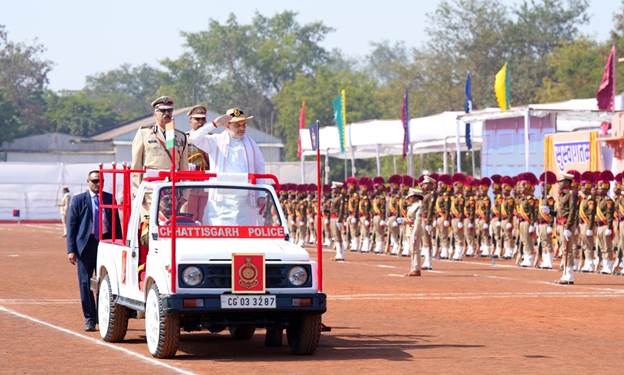
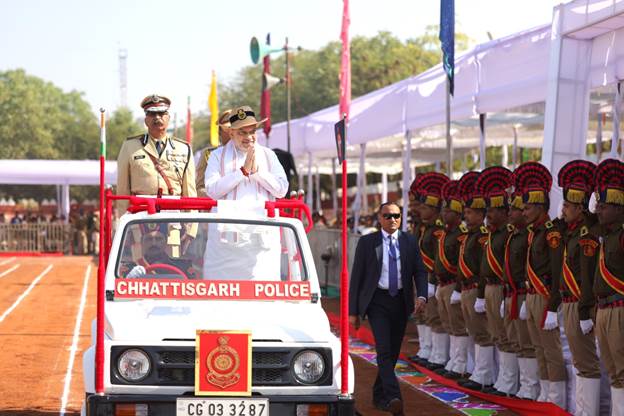
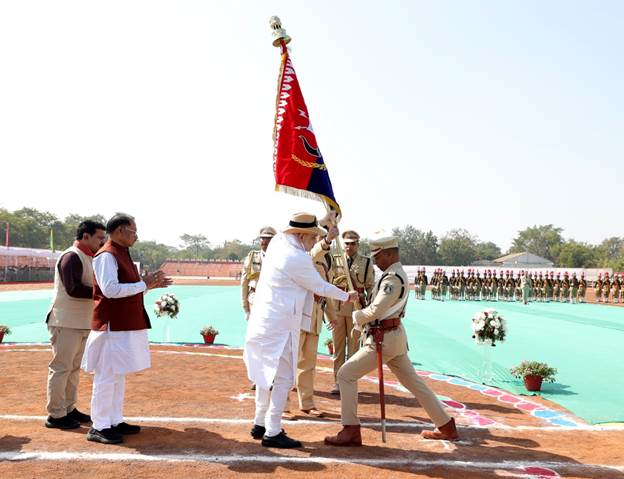
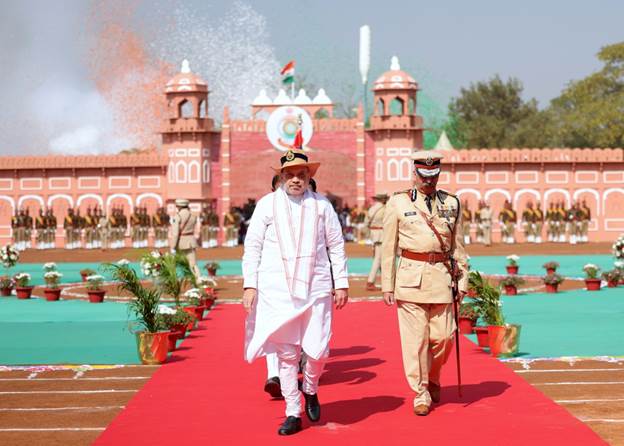
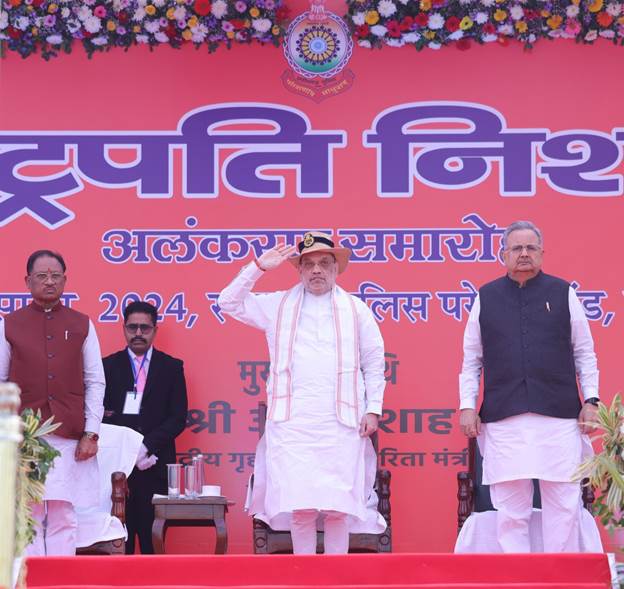
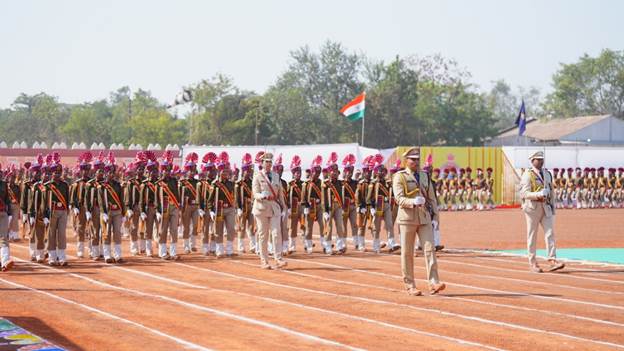
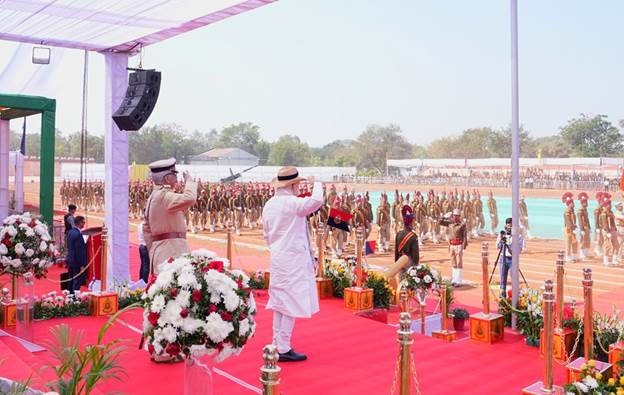
Union Home Minister and Minister of Cooperation Shri Amit Shah presented the prestigious ‘President’s Colour’ to the Chhattisgarh Police in Raipur today, marking the first day of his visit to the state. The ceremony was graced by several prominent dignitaries, including Chhattisgarh Chief Minister Shri Vishnu Deo Sai and Deputy Chief Minister Shri Vijay Sharma.

ABF00076.JPG

In his address, Union Home Minister and Minister of Cooperation Shri Amit Shah highlighted the immense pride associated with receiving the ‘President’s Colour’, a recognition of great distinction for any armed force. He commended the Chhattisgarh Police for earning this honour within just 25 years of its establishment, reflecting the trust it has garnered from the President. Shri Shah lauded the Chhattisgarh Police as one of the finest forces in the country, renowned for its passion, courage, valour, and dedication. He emphasized that receiving the ‘President’s Colour’ during its silver jubilee year is a testament to the force’s relentless hard work, commitment, bravery, and deep connection with the public. He further praised the Chhattisgarh Police for its exemplary service in maintaining law and order, combating Naxalism, advancing the campaign for a drug-free India, ensuring public safety, and improving the quality of life for the state’s citizens. Shri Shah acknowledged the force’s unwavering dedication and its pivotal role in fostering peace and security in Chhattisgarh.

Union Home Minister Shri Amit Shah stated that today marks the death anniversary of Sardar Vallabhbhai Patel. He remarked that it was Sardar Patel’s unparalleled courage and determination that unified the nation. Shri Shah further noted that Prime Minister Shri Narendra Modi fulfilled Sardar Patel’s unfinished mission by abrogating Article 370, thereby permanently integrating Kashmir with India. He added that the entire nation is paying tribute to Sardar Patel today with deep gratitude.

IMG_6212.JPG

Shri Amit Shah said that the longstanding demand for the creation of Chhattisgarh was fulfilled by Shri Atal Bihari Vajpayee. The Home Minister expressed confidence that under the leadership of Prime Minister Shri Narendra Modi, Chhattisgarh will be completely free of Naxalism by March 31, 2026. He emphasized that the Modi government is committed to eradicating Naxalism not only from Chhattisgarh but also from other states across the country. He acknowledged the bravery of the Chhattisgarh Police in advancing towards this goal and highlighted the significant achievements made in the fight against Naxalism over the past year.

072A1109.JPG

Union Home Minister Shri Amit Shah stated that under the leadership of Prime Minister Narendra Modi, significant progress has been made in the fight against Naxalism over the past year. Security forces have neutralized 287 Naxalites, arrested 1,000, and facilitated the surrender of 837 Naxalites. He noted that among those neutralized, 14 were top-ranking Naxal leaders. Shri Shah highlighted that for the first time in four decades, the death toll of civilians and security personnel due to Naxal violence has fallen below 100, attributing this to the Modi government’s stringent policies against Naxalism. He further stated that over the last decade under PM Modi’s leadership, Naxalism has been effectively curbed, resulting in a 73% reduction in security personnel casualties and a 70% decline in civilian deaths compared to the previous decade. The Home Minister also commended the Chhattisgarh Police for joining forces with other security agencies to deliver a decisive blow to Naxalism in the past year. Additionally, he pointed out that several developmental projects have been carried out in Chhattisgarh under the leadership of Prime Minister Modi.

IMG_6199.JPG

Shri Amit Shah stated that the first ‘President’s Colour’ was awarded to the Indian Navy in 1951, and today, any armed force must complete 25 years of service to be eligible for this prestigious honour. He expressed gratitude to the President of India for recognizing and honoring the 25 years of service, dedication, sacrifice, and commitment of the Chhattisgarh Police.

IMG_6170.JPG

Union Home Minister and Minister of Cooperation stated that under the leadership of Prime Minister Shri Narendra Modi, the Central Government and the State Government are committed to completely eliminating Naxalism from Chhattisgarh by March 31, 2026. He urged Naxalites to abandon the path of violence, join the mainstream of society, and contribute to the development of Chhattisgarh by moving forward on the path of progress. He also highlighted that the Chhattisgarh Government has implemented an excellent surrender policy, which provides for the rehabilitation of every Naxalite who surrenders.

ABF00372.JPG

Shri Amit Shah stated that the Chhattisgarh Police has achieved significant success in combating organized crime and narcotics with determination. He highlighted that between January 1, 2024, and September 30, 2024, around 1,100 narcotics cases were registered, leading to the seizure of 21,000 kilograms of cannabis, 6,000 kilograms of opium, and approximately 195,000 tablets of illicit drugs. Additionally, 1,400 individuals were arrested in connection with these cases. He further noted that Chhattisgarh has been at the forefront in the effective implementation of the PITNDPS (Prevention of Illicit Trafficking in Narcotic Drugs and Psychotropic Substances) Act.

WhatsApp Image 2024-12-15 at 16.49.19.jpeg

Union Home Minister expressed confidence that every officer and personnel of the Chhattisgarh Police will play a pivotal role in realizing the vision of a developed Chhattisgarh and a prosperous Bastar. He further stated that Chhattisgarh’s significant contribution will be etched in golden letters in the journey towards building a developed India by 2047 under the leadership of Prime Minister Modi.

Union Home Minister told the personnel of the Chhattisgarh Police that the ‘President’s Colour’ is not merely a decoration but a symbol of service, sacrifice, and dedication. He stated that this insignia serves as a reminder of the countless challenges that must be faced with resilience. Shri Amit Shah emphasized that the ‘President’s Colour’ is not only an honor but also a responsibility, and every officer of the Chhattisgarh Police will uphold this responsibility and will not take a step back in fulfilling their duty.

PM pays tributes to Sardar Vallabhbhai Patel on his death anniversary

| Published on:

The Prime Minister Shri Narendra Modi paid tributes to Sardar Vallabhbhai Patel on his death anniversary today. He remarked that Shri Patel’s personality and work will continue to be an inspiration for the citizens for the unity, integrity of the nation and the achievement of the resolution of a developed India.

In a post on X, Shri Modi wrote:

“देश के लौह पुरुष सरदार वल्लभभाई पटेल को उनकी पुण्यतिथि पर शत-शत नमन। उनका व्यक्तित्व और कृतित्व राष्ट्र की एकता, अखंडता और विकसित भारत के संकल्प की सिद्धि के लिए देशवासियों की प्रेरणाशक्ति बना रहेगा।”

PM addresses Lok Sabha during special discussion on 75th anniversary of adoption of Constitution

| Published on:

The Prime Minister, Shri Narendra Modi addressed the Lok Sabha special discussion on 75th anniversary of adoption of Constitution today. Addressing the House, Shri Modi remarked that it was a matter of pride and honor for all the citizens of India and all the people across the globe who respect democracy that we are celebrating this festival of Democracy. Thanking the foresight, vision and efforts of the framers of our constitution in this remarkable and momentous journey of 75 years of our Constitution, he said that it was time to celebrate the festival of Democracy after successful completion of 75 years.  Shri Modi was pleased that even the members of parliament were involving themselves in this celebration and expressing their views, he thanked and congratulated them for the same.

Terming the achievement of 75 years as an extraordinary feat, the Prime Minister expressed pride that the Constitution had overcome all the predicted possibilities for India, soon after its independence and the subsequent challenges to bring us all to this far. He expressed deep gratitude towards the constitution makers and the crores of citizens for this great achievement. Shri Modi remarked that the citizens of India had passed every test in successfully adopting and living the values of the Constitution as envisioned by its makers. He said therefore it was the citizens who truly deserved all the accolades.

Shri Modi remarked that the constitution makers never supported the view that India was born in 1947 or the constitution would come to effect from 1950, rather believed and were proud of the great tradition and heritage of India and its democracy. He added that India’s democracy and republic past has always been remarkable and has been an inspiration for the world and therefore, he added that  “India is known as the mother of democracy”. Shri Modi underlined that we are not just a great democratic country but also the creators of democracy.

Quoting Rajarshi Purushottam Das Tandon from the constitutional debates, the Prime Minister said that “It is after centuries, such an eventful meeting is called for, which reminds me of our great past and the earlier times when we were independent and intellectuals used to discuss and deliberate meaningful issues in the sabhas”. He then quoted Dr. S. Radhakrishnan and said “ The system of Republic is not a new idea for this great nation for we have had this system since the beginning of our history”. He then quoted Babasaheb Dr. Ambedkar and said “ It is not that India is aware of democracy, there was a time when there were multiple republics in India”.

The Prime Minister lauded the role of the women during the process of  making of the constitution and also empowering it further. He added that there were fifteen respected and active members in the Constituent Assembly and they had further strengthened the process of drafting the constitution by giving their original thoughts, views and ideas. Recalling that each one of them were from diverse backgrounds, Shri Modi emphasized that the thoughtful suggestions given by the women members had a profound impact on the constitution. The Prime Minister also expressed pride that suffrage rights were given to women right from the time of independence as compared to many other countries of the world which took decades for the same. He added that with the same spirit, India during its presidency of the G-20 summit put forward the vision of  Women-led development in front of the world. Shri Modi also noted the successful enactment of the Narishakti Vandan Adhiniyam by all the parliamentarians and added that the Government had taken steps to ensure increased political participation of the women.

Shri Modi emphasized that at the core of every major policy decision is women and expressed happiness that it was a great coincidence that during the completion of 75 years of constitution, the post of President of India was held by a tribal woman. He added that it was a true expression of the spirit of our constitution. The Prime Minister highlighted that the representation and the contribution of women is constantly increasing in the parliament as well as in the council of Ministers. “The representation and contribution of women, be it in the field of social, political, education, sports or any other, has been bringing pride to the country”, exclaimed Shri Modi and that every Indian was proud of women’s contributions in the field of science and technology, especially in the space sector. He added that the Constitution was the greatest inspiration for this.

Reiterating that India was progressing rapidly, Shri Modi remarked that soon India will be the third largest economy in the world. He added that it was the combined resolve of 140 crore Indians to ensure that India is developed by 2047. He further added that Unity of India was the most important necessity for this resolution to be achieved. The Prime Minister noted that our Constitution is also the foundation of unity of India. Recalling that the process of framing the constitution comprised great freedom fighters, authors, thinkers, social activists, educationists and professionals from other diverse fields, Shri Modi said that all of them were highly sensitive of the fact of Unity of India.

Prime Minister Shri Narendra Modi expressed dissatisfaction, stating that post-independence, the framers of the Constitution had unity in their hearts and minds. However, after independence, due to distorted mentalities or selfishness, the greatest blow was dealt to the core spirit of the nation’s unity. The Prime Minister highlighted that unity in diversity has been India’s hallmark and emphasized that we celebrate diversity, and the country’s progress lies in celebrating this diversity. However, those with a colonial mindset, who could not see the good in India, and those who believed India was born in 1947, sought contradictions in this diversity. The Prime Minister remarked that instead of celebrating this invaluable treasure of diversity, efforts were made to sow poisonous seeds within it, aiming to harm the nation’s unity. Shri Modi urged everyone to make the celebration of diversity an integral part of our lives, and that will be the true tribute to Dr. B.R. Ambedkar.

Prime Minister Shri Narendra Modi highlighted that over the past 10 years, the government’s policies have consistently aimed to strengthen the unity of India. He added that Article 370 was an obstacle to the nation’s unity and acted as a barrier. Shri Modi emphasised that the unity of the country was a priority, in line with the spirit of the Constitution, and hence, Article 370 was abrogated.

Shri Modi emphasized the need for favorable conditions in India to advance economically and attract global investment. He added that discussions on GST had been ongoing for a long time in the country. The Prime Minister remarked that GST has played a significant role in economic unity and acknowledged the contributions of the previous government and noted that the current government had the opportunity to implement it, advancing the concept of “One Nation, One Tax.”

Touching upon the importance of how ration cards have been a valuable document for the poor in our country and the difficulties encountered by a poor person when he/she moved from one state to another, Shri Modi said that they were not entitled to any benefits. He  emphasized that every citizen should have equal rights, regardless of where they are in this vast country. And added that to strengthen this sense of unity, the government had reinforced the concept of “One Nation, One Ration Card.”

The Prime Minister emphasized that providing free healthcare to the poor and common citizens significantly enhances their ability to fight poverty. He highlighted that while healthcare is accessible where they work, it should also be available when they are away and facing life-threatening situations. The Prime Minister remarked that to uphold the principle of national unity, the government introduced the “One Nation, One Health Card” initiative through Ayushman Bharat. He noted that even a person from a remote area of Bihar working in Pune can receive necessary medical services with an Ayushman card.

Shri Modi highlighted that there were times when one part of the country had electricity while another part was in darkness due to supply issues. He remarked that during the tenures of the previous governments, India was often criticized globally for its power shortages. The Prime Minister emphasized that to uphold the spirit of the Constitution and the mantra of unity, the government implemented the “One Nation, One Grid” initiative. He noted that today, electricity can be seamlessly supplied to every corner of India.

Touching upon the infrastructure development in the country, the Prime Minister emphasized that the government is focusing on balanced development to strengthen national unity. He added that whether it is the North East, Jammu and Kashmir, the Himalayan regions, or the desert areas, the government had undertaken efforts to empower infrastructure comprehensively. He noted that this initiative aims to eliminate any sense of distance due to lack of development, thereby fostering unity.

Emphasising the digital divide between the “haves” and “have-nots”,  Shri Modi highlighted that India’s success story in Digital India is a source of great pride globally. He added that the democratization of technology has been a key factor in this success. Shri Modi remarked that guided by the vision of the framers of the Constitution, the government has worked to extend optical fiber to every panchayat in India to strengthen national unity.

The Prime Minister remarked that the Constitution expects unity, and in this spirit, the importance of mother tongue has been recognized. He noted that suppressing the mother tongue cannot culturally enrich the nation’s populace. Shri Modi remarked that the New Education Policy has given significant importance to mother tongue, enabling even the poorest children to become doctors and engineers in their native languages. He added that the Constitution supports everyone and mandates addressing their needs. Shri Modi highlighted that several classical languages were given their rightful place and respect. He mentioned that the “Ek Bharat Shreshtha Bharat” campaign is strengthening national unity and instilling cultural values in the new generation.

Highlighting that the Kashi Tamil Sangamam and Telugu Kashi Sangamam have become significant institutionalized events, Shri Modi emphasized that these cultural initiatives strengthen societal bonds. He added that the importance of India’s unity is recognized in the core principles of the Constitution, and this should be acknowledged.

The Prime Minister remarked while the Constitution is celebrating its 75th anniversary, milestones like 25, 50, and 60 years also hold significance. Reflecting on history, he remarked that during the 25th anniversary of the Constitution, it was torn apart in the country. The Prime Minister highlighted that the Emergency was imposed, constitutional arrangements were dismantled, the country was turned into a prison, citizens’ rights were snatched, and press freedom was locked down. The Prime Minister said that democracy was strangled, and the sacrifices of the Constitution’s framers were attempted to be buried.

Shri Modi noted that under the leadership of Atal Bihari Vajpayee, the nation celebrated the 50th anniversary of the Constitution on November 26, 2000. The Prime Minister remarked that Atal Vajpayeeji, as Prime Minister, delivered a special message to the nation, emphasizing the importance of unity, public participation, and partnership. He noted that Shri Vajpayee’s efforts were aimed at living the spirit of the Constitution and awakening the public.

The Prime Minister said that during the 50th anniversary of the Constitution, he had the privilege of becoming the Chief Minister through the constitutional process. He highlighted that during his tenure as Chief Minister, the 60th anniversary of the Constitution was celebrated in Gujarat. He added that for the first time in history, the Constitution was placed in a special arrangement on an elephant, and a Constitution Gaurav Yatra was conducted. Shri Modi emphasized that the Constitution holds great significance, and today, as it completes 75 years, he recalled an incident in the Lok Sabha where a senior leader questioned the need for celebrating Constitution Day on November 26, given that January 26 already existed.

Shri Modi expressed happiness about the special session, noting that it would have been beneficial to discuss the power and diversity of the Constitution, which would have been valuable for the new generation. However he remarked that everyone had their own constraints, their own misgivings in various forms, with some revealing their failures. The Prime Minister emphasized that it would have been better if discussions had risen above partisan sentiments and focused on the national interest, which would have enriched the new generation.

The PM expressed special respect for the Constitution, stating that it was the spirit of the Constitution that enabled many people like him to reach where they are today. He highlighted that without any background, it was the power of the Constitution and the blessings of the people that brought them here. Shri Modi noted that many individuals in similar situations have reached significant positions because of the Constitution. He added that it is a great fortune that the country has shown immense faith, not just once, but three times. He remarked that this would not have been possible without the Constitution.

Shri Modi noted that from 1947 to 1952, India did not have an elected government but a temporary, selected one, with no elections held. He highlighted that before 1952, the Rajya Sabha was not formed, and there were no state elections, meaning there was no mandate from the people. He added that despite this, in 1951, without an elected government, an ordinance was issued to amend the Constitution, attacking freedom of expression. The Prime Minister emphasized that this was an insult to the Constitution’s framers, as such matters were not addressed in the Constituent Assembly. He remarked that when the opportunity arose, they hammered down on freedom of expression, which was a grave insult to the Constitution’s creators. The Prime Minister said that what could not be achieved in the Constituent Assembly was done through the back door by a non-elected Prime Minister, which was a sin.

PM highlighted that in 1971, a Supreme Court decision was overturned by amending the Constitution, clipping the wings of the judiciary. Shri Modi noted that the amendment stated that Parliament could alter any article of the Constitution without judicial review, stripping the courts of their powers. He added that this enabled the then government to curtail fundamental rights and control the judiciary.

The Prime Minister noted that during the Emergency, the Constitution was misused, and democracy was strangled. He emphasized that in 1975, the 39th Amendment was passed, preventing any court from challenging the elections of the President, Vice President, Prime Minister, and Speaker, and this was applied retrospectively to cover past actions.

Further deliberating that during the Emergency, Shri Modi noted that people’s rights were taken away, thousands were imprisoned, the judiciary was strangled, and press freedom was locked down. He remarked that the idea of a committed judiciary was fully enforced. The Prime Minister noted that Justice H.R. Khanna, who had ruled against the then Prime Minister in a court case, was denied the position of Chief Justice of India despite his seniority. He emphasized that this was a violation of constitutional and democratic processes.

Recalling the Supreme Court’s judgment in the Shah Bano case provided justice to an Indian woman based on the Constitution’s dignity and spirit, Shri Modi noted that the Supreme Court granted an elderly woman her rightful due, but then-Prime Minister negated this spirit, sacrificing the Constitution’s essence. The Prime Minister remarked that Parliament passed a law to overturn the Supreme Court’s decision once again.

The Prime Minister remarked that for the first time in history, the Constitution was deeply wounded. He added that the framers of the Constitution envisioned an elected government and Prime Minister. However, a non-constitutional entity, the National Advisory Council, which did not take any oath, was placed above the Prime Minister’s Office (PMO). The Prime Minister noted that this entity was given an unofficial status above the PMO.

Shri Modi highlighted that under the Indian Constitution, the people elect the government, and the head of that government forms the Cabinet. Recollecting an incident when a decision made by the Cabinet was torn up in front of journalists by arrogant individuals who disrespected the Constitution, Shri Modi said that these individuals habitually played with the Constitution and did not respect it. He added that it was unfortunate that the then Cabinet would then change its decision.

The Prime Minister noted that while Article 370 is well-known, very few are aware of Article 35A. He emphasized that Article 35A was imposed without parliamentary approval, which should have been sought. The Prime Minister remarked that the Parliament, the primary guardian of the Constitution, was bypassed, and Article 35A was imposed on the country, leading to the situation in Jammu and Kashmir. He highlighted that this was done through a Presidential order, keeping the Parliament in the dark.

Shri Modi noted that during Atal Bihari Vajpayee’s government, it was decided to build a memorial in Dr. Ambedkar’s memory but this work was neither initiated nor allowed for the next 10 years. The Prime Minister emphasized that when his government came to power, out of respect for Dr. Ambedkar, they constructed the Dr. Ambedkar Memorial on Alipur Road and completed the work.

Recollecting that in 1992, during the tenure of Shri Chandra Shekhar, it was decided to establish the Ambedkar International Centre near Janpath in Delhi, Shri Modi said this project remained on paper for 40 years and was not executed. He highlighted that it was only in 2015, when his government came to power, that the work was completed. The Prime Minister noted that even the awarding of the Bharat Ratna to Dr. B.R. Ambedkar was done a long time later after independence.

Shri Modi underlined that the 125th birth anniversary of Dr. B.R. Ambedkar was celebrated globally in 120 countries and during Dr. Ambedkar’s birth centenary, a memorial was reconstructed in Mhow, Dr. Ambedkar’s birthplace.

Lauding Dr. B.R. Ambedkar, a visionary committed to bring the marginalized sections of society into the mainstream, Shri Modi remarked that  Dr. Ambedkar believed that for India to develop, no part of the country should remain weak. He added that this concern led to the establishment of the reservation system. The Prime Minister noted that those engaged in vote bank politics attempted to introduce various measures under the guise of religious appeasement within the reservation system, causing significant harm to the SC, ST, and OBC communities.

The Prime Minister remarked that the previous Governments strongly opposed reservations and  emphasized that Dr. B.R. Ambedkar introduced reservations for equality and balanced development in India. The Prime Minister remarked that the Mandal Commission report was shelved for decades leading to delay in the reservation for OBCs. The Prime Minister noted that if reservations had been granted earlier, many OBC individuals would be serving in various positions today.

Touching upon the extensive discussions on whether reservations should be based on religion during the drafting of the Constitution, Shri Modi said that the constitution framers concluded that for the unity and integrity of a country like India, reservations based on religion or community were not feasible. He added that it was a well-considered decision, not an oversight. Shri Modi remarked that the previous Governments introduced reservations based on religion, which goes against the spirit of the Constitution. He noted that despite some implementations, the Supreme Court has struck down such measures. The Prime Minister remarked that it is clear that there is an intention to provide reservations based on religion, which is a shameless attempt to hurt the sentiments of the Constitution’s framers.

Discussing the Uniform Civil Code (UCC) as a burning issue which was not overlooked by the Constituent Assembly, the PM said that the Constituent Assembly engaged in extensive discussions on the UCC and decided that it would be best for the elected government to implement it. He added that this was the directive of the Constituent Assembly. The Prime Minister remarked that Dr. Ambedkar advocated for the UCC, and his words should not be misrepresented.

Shri Modi highlighted that Dr. B.R. Ambedkar strongly advocated for the abolition of personal laws based on religion. Quoting K.M. Munshi, a member of the Constituent Assembly, who stated that a Uniform Civil Code (UCC) is essential for national unity and modernity, Shri Modi said that the Supreme Court has repeatedly emphasized the need for a UCC and has directed governments to implement it as soon as possible. He emphasized that, in keeping with the spirit of the Constitution and the intentions of its framers, the government is fully committed to establishing a secular civil code.

Reciting an incident of the past, the Prime Minister questioned how those who do not respect their own party’s constitution can respect the country’s Constitution.

Shri Modi noted that in 1996, the BJP emerged as the largest party, and the President, respecting the Constitution, invited them to form the government. However, the government lasted only 13 days because they chose to honor the Constitution. He emphasized that Shri Atal Bihari Vajpayee did not opt for bargaining but respected the Constitution and resigned after 13 days. He added that in 1998, the NDA government faced instability, but Vajpayee’s government, dedicated to the spirit of the Constitution, preferred to lose by one vote and resign rather than accept unconstitutional positions. He emphasized that this is their history, values, and tradition. On the other hand, he noted that during the cash-for-votes scandal, money was used to save a minority government, turning the spirit of Indian democracy into a marketplace where votes were bought.

Shri Modi remarked that after 2014, the NDA was given the opportunity to serve, strengthening the Constitution and democracy. He highlighted that they launched a campaign to rid the country of old ailments. The Prime Minister noted that over the past 10 years, they had also made constitutional amendments, for the unity and integrity of the country, for its bright future, and with full dedication to the spirit of the Constitution. The PM remarked that the OBC community had been demanding constitutional status for the OBC Commission for three decades. He highlighted that they amended the Constitution to grant this status, taking pride in doing so. The Prime Minister emphasized that standing with the marginalized sections of society is their duty, which is why the constitutional amendment was made.

The Prime Minister underscored that there was a large section of society that, regardless of caste, could not access opportunities due to poverty and could not progress. Noting that this dissatisfaction was growing, and despite demands, no decisions were made, Shri Modi remarked that they amended the Constitution to provide 10% reservation for economically weaker sections of the general category. He emphasized that this was the first reservation amendment in the country that faced no opposition, was accepted with love by everyone, and was passed unanimously by Parliament. The Prime Minister remarked that this was because it strengthened social unity and aligned with the spirit of the Constitution.

Shri Modi highlighted  that they have also made constitutional amendments, but these were to empower women. He remarked that they amended the Constitution for the unity of the country. Shri Modi highlighted that Dr. B.R. Ambedkar’s Constitution could not fully apply to Jammu and Kashmir due to Article 370, while the Government wanted Dr. Ambedkar’s Constitution to be implemented in every part of India. He added that they amended the Constitution to strengthen national unity and to pay tribute to Dr. Ambedkar. The Prime Minister remarked that they removed Article 370, and now the Supreme Court of India has also upheld this decision.

Touching upon the amendment of the Constitution to remove Article 370, Shri Modi highlighted that they also enacted laws to fulfill the promise made by Mahatma Gandhi and other senior leaders at the time of partition, to care for minorities in neighboring countries during times of crisis. He emphasized that they introduced the Citizenship Amendment Act (CAA) to honor this commitment and said that they proudly stand by this law, as it aligns with the spirit of the Constitution and strengthens the nation.

Shri Modi remarked that the constitutional amendments made by his government were aimed at correcting past mistakes and paving the way for a brighter future. He highlighted that time will tell if they stand the test of time. The Prime Minister emphasized that these amendments were not driven by selfish power interests but were acts of virtue for the nation’s benefit. He noted that this is why they confidently address any questions raised.

Noting that numerous speeches and topics have been raised regarding the Constitution, each with its own political motivations, the PM said that the Constitution is most sensitive to the people of India, “We the People,” and is meant for their welfare, dignity, and well-being. He noted that the Constitution guides us towards a welfare state, ensuring a dignified life for all citizens.

Highlighting that after so many years of independence, many families did not have access to a toilet to live with dignity, Shri Modi said that the campaign to build toilets was a dream for the poor, and they took it up with full dedication. He added that despite being mocked, they remained steadfast because the dignity of ordinary citizens was their priority. The PM emphasized that women had to go for open defecation either before sunrise or after sunset, and this did not bother those who only saw the poor on TV or in newspaper headlines. The Prime Minister remarked that those who do not understand the life of the poor would not commit such injustices. Shri Modi questioned that eighty percent of the people in this country were deprived of clean drinking water, despite the Constitution aimed to ensure basic human amenities for everyone.

The Prime Minister remarked that millions of mothers in the country used to cook on traditional stoves, causing their eyes to turn red from the smoke, which was equivalent to inhaling the smoke of hundreds of cigarettes. He highlighted that this not only affected their eyes but also deteriorated their health. Shri Modi remarked that even after 70 years of independence until 2013, the discussion was about whether to provide nine or six cylinders, while his government ensured the delivery of gas cylinders to every household because they prioritized providing basic amenities to every citizen.

Discussing the healthcare sector, Shri Modi remarked that a single illness can ruin a poor family who works hard day and night to escape poverty and educate their children, their plans and efforts. He highlighted that they implemented the Ayushman Bharat scheme to provide free treatment to 50-60 crore citizens, respecting the spirit of the Constitution. The Prime Minister noted that this scheme ensures healthcare for all, including those above 70 years of age, from any section of society.

Touching upon the free ration provided to the poor, Shri Modi highlighted that 25 crore people have successfully overcome poverty.  He added that only those who have emerged from poverty understand the importance of support. He highlighted that just as a patient is advised to take care after being discharged from the hospital to avoid relapse, it is essential to support the poor to prevent them from falling back into poverty. The Prime Minister noted that this is why they provide free ration, to ensure that those who have been lifted out of poverty do not return to it, and to help those still in poverty to rise above it. He emphasized that mocking this effort is unjust, as it is crucial for maintaining the dignity and well-being of the citizens.

Remarking that only slogans were made in the name of the poor, and banks were nationalized in their name, Shri Modi highlighted that until 2014, 50 crore citizens in the country had never seen the inside of a bank. He added that they had opened bank accounts for 50 crore poor citizens, thus opening the doors of banks for them. The Prime Minister noted that a former Prime Minister once said that out of ₹1 sent from Delhi, only 15 paise reached the poor. He emphasized that they have shown the way by ensuring that today, out of ₹1 sent from Delhi, all 100 paise are deposited directly into the accounts of the poor. The Prime Minister remarked that they have demonstrated the proper use of banks. He added that those who were previously not allowed to even approach the doors of banks can now avail loans without any guarantee. He highlighted that this empowerment of the poor is a testament to the government’s dedication to the Constitution.

The Prime Minister noted that the slogan “Garibi Hatao” (eradicate poverty) remained just a slogan because the poor were not freed from their difficulties. He emphasized that their mission and commitment are to liberate the poor from these hardships, and they are working day and night to achieve this. The Prime Minister remarked that he stands for those who have no one to support them.

Touching upon the struggles encountered by the Divangs, Shri Modi said that they have now provided accessible infrastructure for differently-abled individuals, allowing their wheelchairs to reach train compartments. He added that this initiative was driven by their concern for the marginalized sections of society. He emphasized that while disputes over language were taught, great injustice was done to differently-abled individuals. The Prime Minister remarked that sign language systems varied across states, causing difficulties for the differently-abled. He highlighted that they have created a common sign language, which is now benefiting all differently-abled individuals in the country.

The Prime Minister said that the nomadic and semi-nomadic communities had no one to look after their welfare. He added that their Government established a welfare board for their well-being, as these people are a priority under the Constitution. The Prime Minister noted that street vendors, who work tirelessly from morning to night, often face hardships, including renting their carts and borrowing money at high interest rates. He emphasized that the government introduced the PM SVANidhi scheme to provide collateral-free loans to street vendors. The Prime Minister remarked that due to this scheme, street vendors have reached the third round of loans, gaining respect and expanding their businesses.

Noting that there is no one in this country who does not need the services of Vishwakarma artisans, Shri Modi highlighted that a significant system had been in place for centuries, but the welfare of Vishwakarma artisans was never addressed. The Prime Minister noted that they have created a plan for the welfare of Vishwakarma artisans, including provisions for bank loans, new training, modern tools, and innovative designs. He emphasized that they have strengthened this initiative to support the Vishwakarma community.

Shri Modi highlighted that the government had ensured rights for transgender individuals under the Indian Constitution and has enacted laws to protect their rights and provide them with a dignified life.

Recalling during his stint as the Chief Minister of Gujarat, there was not a single science stream school in the entire tribal belt from Umargam to Ambaji, the Prime Minister noted that without science stream schools, it was impossible for tribal students to become engineers or doctors. He emphasized that they established science stream schools and universities in the area, addressing the educational needs of the tribal community.

The Prime Minister expressed gratitude to the President for guidance in creating the PM Jan Man Yojana, which focuses on the development of the most backward tribal communities. He highlighted that these small groups, often overlooked in vote politics, have now received attention and support through this scheme. The Prime Minister remarked that he is committed to finding and supporting even the most marginalized individuals.

Shri Modi noted that over 60 years, 100 districts were identified as backward, and this label became a punishment posting for responsible officers. He emphasized that they changed this situation by introducing the concept of Aspirational Districts, regularly monitoring 40 parameters online. The Prime Minister remarked that today, Aspirational Districts are matching the best districts in their states and some are even reaching the national average. He highlighted that no region should be left behind, and they are now focusing on developing 500 blocks as Aspirational Blocks.

Highlighting that the tribal community existed during the times of Ram and Krishna, yet no separate ministry was created for them even after decades of independence, the Prime Minister noted that it was the government of Atal Bihari Vajpayee that first established a separate ministry for tribal affairs and allocated a budget for their development and expansion. Speaking on the welfare of the fishermen, Shri Modi said that for the first time their government created a separate ministry of fisheries and a separate budget was given for their welfare. He said care was taken of this section of the society.

With regard to the small farmers of the country, the Prime Minister remarked that cooperation is an important part of their life. Highlighting concerns of small farmers, he said a separate cooperative ministry was created to give strength to the life of the small farmer by making the cooperative sector responsible, strong and empowering. Emphasising the importance of a skilled workforce, Shri Modi said the whole world is yearning for a workforce today. He said if we want to get a demographic dividend in the country, then this work force of ours should be skilled. He added that a separate skill ministry was created so that the youth of the country are prepared according to the needs of the world and they move forward with the world.

Talking about the North-East, the Prime Minister said our North-East was neglected due to less votes or seats there. He said it was Atal Ji’s government which for the first time made DONER Ministry for the welfare of the North-East and today because of it one can see the development of the North-East in  building of  railways, roads, ports, airports.

The Prime Minister underlined the importance of land records and problems faced therein even today in  the most prosperous of the countries. He said all efforts were made by the government to provide for Ownership of the lands, so that every common man in the village has the land records of his house, the ownership papers of his house so that loans from the bank can be taken and there is no fear of illegal occupation.

Shri Modi said due to all these works, the efforts  made in the last 10 years have strengthened the poor with a new self-confidence and in such a short time 25 crore people have been successful in defeating poverty. He said all this could be possible because we are working under the direction of the constitution.

The Prime Minister said  Sabka Saath, Sabka Vikas, is not a mere slogan, It is our article of faith and hence we have implemented government schemes without discrimination. He said the Government is striving for saturation of schemes so that 100% of the beneficiaries  get the benefit. He added that if there is any true secularism then it is in saturation and if there is any true social justice then this saturation, that is the 100% benefit should be given to the person who is entitled to it, without any discrimination. He said this is true secularism and true social justice.

Speaking about the spirit of the Constitution as the medium to give direction to the country, the Prime minister said  politics is at the center as the driving force of the country. He said we should think about what should be the direction of our democracy, our politics in the coming decades.

Shri Modi questioned some parties about their political selfishness and sense of power whether  they ever thought about it themselves and said that he meant this for all the parties. He said these are the thoughts of his mind which he wanted to put before this House.

The Prime Minister emphasized that all political parties should make efforts to attract the youth of the country, to strengthen the democracy and to bring the youth of the country forward. He said bringing youth in politics is the need of the country’s democracy and reiterated that 1 lakh such youth should be brought into the country’s politics, who do not have any political family background. He said  the country needs new energy and young people who come with new resolutions and dreams and when we are celebrating 75 years of the Constitution of India we should move ahead in that direction.

Recalling his words about our duties in the Constitution from the Red Fort, Shri Modi said it was unfortunate that it was not understood that while the Constitution has determined rights of the citizens it also expects duties from them. He said  the essence of our civilization is Dharma, our Duty, Quoting  Mahatma Gandhi ji he said that Mahatma ji  had said that he had  learnt from his uneducated but learned mother that the rights emerge from how  we perform our duties. Shri Modi said he would like to take Mahatma ji’s words forward and say that if we follow our fundamental duties then no one can stop us from making a developed India. He said that 75 years of the Constitution should give more strength to our dedication towards duty, our commitment and the need of the hour is that the country should move forward with a sense of duty.

The Prime Minister said inspired by the spirit of the Constitution for the future of India he  wanted to place 11 resolutions before the House. The first resolution is that whether it is a citizen or the government, everyone should perform their duties. The second resolution is that every sector, every society should get the benefit of development, Sabka Saath Sabka Vikas. The third resolution is that there should be zero tolerance towards corruption, there should be no social acceptance of the corrupt. The fourth resolution is that the citizens of the country should take pride in following the laws of the country, the rules of the country, and the traditions of the country. The fifth resolution is to get rid of the mentality of slavery, there should be pride in the heritage of the country. The sixth resolution is that the politics of the country should be freed from nepotism. Seventh resolution, the constitution should be respected, the constitution should not be used as a weapon for political gain. Eighth resolution, in  keeping the spirit of the constitution, reservation should not be snatched from those who are getting it and every attempt to give reservation on the basis of religion should be stopped. Ninth resolution, India should become an example for the world in women led development. Tenth resolution, development of the nation through the development of the state, this should be our mantra of development. Eleventh resolution, the aim of Ek Bharat Shreshtha Bharat should be paramount.

The Prime Minister said If we all move forward together with this resolution  then with everyone’s efforts, We the people, can fulfil  the dream of a developed India. He said when the dream of 140 crore countrymen is fulfilled and the country starts moving with the resolution, then it brings the desired results. Shri Modi said he had  immense respect for 140 crore countrymen and  faith in their strength, he had immense faith in the youth power of the country, in the women power of the country. Concluding his remarks the Prime Minister said  that we should move forward with the resolve that when the country  celebrates 100 years of independence in 2047, it will be celebrated as  Viksit Bharat.

PM inaugurates and launches multiple development projects worth around Rs 5500 crore at Prayagraj, Uttar Pradesh

| Published on:

The Prime Minister, Shri Narendra Modi today inaugurated and launched multiple development projects worth around Rs 5500 crore at Prayagraj,Uttar Pradesh. Addressing the gathering, the Prime Minister bowed in devotion to Prayagraj, the auspicious land of Sangam, and paid his respects to the saints and sadhus attending the Mahakumbh. Shri Modi  expressed gratitude towards the employees, shramiks and safai karmacharis who have made the Mahakumbh a grand success with their hard work and dedication. Reflecting on the magnificent scale and size of the Mahakumbh, the Prime Minister said that it is one of the largest gatherings in the world where lakhs of devotees are welcomed daily for the Mahayajna lasting 45 days and a whole new city is set up for the occasion. “A new history is being written on the land of Prayagraj”, the Prime Minister exclaimed. The Prime Minister underlined that the organization of Mahakumbh next year would take the spiritual and cultural identity of the nation to new peaks and said that such a ‘MahaYagya’ of unity would be discussed around the world. He conveyed his best wishes to the people for a successful organization of the Mahakumbh.

“India is a land of sacred sites and pilgrimages”, exclaimed Shri Modi. He added it was a land of rivers like Ganga, Yamuna, Saraswati, Kaveri, Narmada and many other innumerable rivers. Describing Prayag as the confluence, collection, congregation, combination, influence and a  power of the sacred flow of these rivers, the importance of many pilgrimage sites and their greatness, the Prime Minister said that Prayag was not just a confluence of three rivers, but more than that. Explaining the importance, he remarked that it has been told about Prayag that it is a pious time when the sun enters the house of Makar, then all the divine powers, nectar, sages and saints descend down to Prayag. He added that Prayag was one such place without which the Puranas would be left incomplete. He further noted that Prayag was one such place which was praised in the verses of the Vedas.

“Prayag is a place where there are holy places and virtuous areas at every step”, exclaimed Shri Modi. Throwing light on the cultural and spiritual significance of Prayagraj, the Prime Minister recited a Sanskrit shloka and explained, “The effect of the Triveni, the glory of Venimadhav, the blessings of Someshwar, the land of penance of Rishi Bhardwaj, the special place of Lord Nagaraj Vasu ji, the immortality of Akshayvat and the grace of God – This is what makes our Teertharaj Prayag.” He further explained that Prayagraj is a place where all four elements of ‘Dharma’, ‘Arth’, ‘Kama’ and ‘Moksha’ are available. “Prayagraj is not just a geographical piece of land, it is a place to experience spirituality”, the Prime Minister said, expressing gratitude towards the citizens for getting to visit Prayagraj. He recalled taking a holy dip in the Sangam during the last Kumbh and also mentioned getting the opportunity today. Speaking about his darshan and pooja earlier in the day at Hanuman Mandir and Akshayvat, the Prime Minister informed about the development of Hanuman Corridor and Akshayvat Corridor for easy access by devotees and also mentioned inquiring about the redevelopment project of Saraswati Koop. Shri Modi also congratulated the citizens for the development projects of today worth thousands of crores.

“Maha Kumbh is a living identity representing our legacy of the divine festival of our faith, spirituality and culture”, exclaimed Shri Modi. He added that every time, the mega event symbolises the divine gathering of religion, knowledge, devotion and art. Reciting a sanskrit shloka, the Prime Minister explained that a holy dip in the sangam is equivalent to visiting crores of pilgrimage places. He added that an individual taking a holy dip is rid of all his sins. The Prime Minister remarked that this eternal flow of faith has never stopped despite reigns by various emperors and kingdoms or even during the despotic rule of the British and the major reason behind this was that Kumbh is not driven by any  external forces. He added that Kumbh represented the consciousness of the inner soul of man, the consciousness which comes from within and draws people from every corner of India to the banks of Sangam. He further added that people from villages, towns, cities set out towards Prayagraj and such a power of congregation and mass gathering is rarely seen anywhere else. Shri Modi said that once an individual comes to Mahakumbh, everyone becomes one, be it saints, sages, wise men, or common people and the difference of caste and  sects ends. He added that crores of people get connected with one goal and one idea. The Prime Minister remarked that this time during the Maha Kumbh, crores of people from different states with different languages, castes, beliefs would gather at Sangam and be in unison. He added that this was his belief why Maha Kumbh was the MahaYagya of unity, where every kind of discrimination is sacrificed and every Indian who takes a dip in the confluence here represented a beautiful picture of Ek Bharat, Shreshta Bharat.

Shri Modi emphasized the significance of Kumbh in India’s cultural and spiritual tradition, highlighting how it has always been a platform for deep discussions among saints on critical national issues and challenges. He said that when modern communication channels did not exist in the past, Kumbh became a foundation for significant social changes where saints and scholars gathered to discuss the nation’s welfare and deliberated on both present and future challenges, thereby providing new direction and energy to the country’s thought process. Even today, the Prime Minister said, Kumbh retains its importance as a forum where such discussions continue, sending positive messages across the nation and inspiring collective thought on national welfare. Even though the names, milestones and paths of these gatherings may vary, the Prime Minister said that purpose and journey remains the same. He underlined that the Kumbh continues to be a symbol of ongoing national discourse and a beacon for future progress.

The Prime Minister pointed out the past neglect of Kumbh and religious pilgrimages by previous governments, stating that despite the significance of these events, devotees faced difficulties. He attributed this to a lack of connection with India’s culture and faith and also reassured the citizens of the deep respect for India’s traditions and faith under the current government, both at the Centre and state level. He said that the governments at both center and state, considers it a responsibility to provide facilities for pilgrims attending Kumbh. The Prime Minister  informed that thousands of crores have been allocated for various projects, with both Centre and state governments working together to ensure smooth preparations. He highlighted the special emphasis on improving connectivity to Prayagraj from cities like Ayodhya, Varanasi, Raebareli, and Lucknow, ensuring ease of travel for pilgrims. The Prime Minister praised the collective efforts of multiple government departments in preparing for the grand event, demonstrating the ‘Whole of the Government’ approach in action.

The Prime Minister emphasized that the government is focused on both development and enriching India’s heritage. He mentioned various tourist circuits being developed across the country and gave examples of Ramayana Circuit, Krishna Circuit, Buddhist Circuit, and Tirthankar Circuit. Touching upon schemes like Swadesh Darshan and PRASAD, the Prime Minister said that the government is expanding facilities at pilgrimage sites. He highlighted the transformation of Ayodhya with the construction of the grand Ram Mandir which has elevated the entire city. He also mentioned projects like Vishwanath Dham and Mahakal Mahalok that have gained global recognition. In Prayagraj, the Prime Minister said, the Akshay Vat Corridor, Hanuman Mandir Corridor, and Bharadwaj Rishi Ashram Corridor reflect this vision, while sites like Saraswati Koop, Patalpuri, Nagvasuki, and Dwadas Madhav Mandir are also being revitalized for pilgrims.

The Prime Minister highlighted that Prayagraj, the land of Nishadraj, held a significant place in Lord Ram’s journey to becoming Maryada Purushottam. He added that the episode of Lord Ram and Kevat continues to inspire us where Kevat washed Lord Ram’s feet and helped him cross the river with his boat, symbolizing devotion and friendship. He further added that this event conveyed that even the Lord can seek help from his devotee. Shri Modi remarked that the development of Shringverpur Dham is a testament to this friendship and the statues of Lord Ram and Nishadraj will continue to convey the message of harmony to future generations.

Prime Minister Shri Narendra Modi underlined the significant role of cleanliness in making the grand Kumbh a success. He noted that the Namami Gange program has been accelerated to ensure proper sanitation and waste management in Prayagraj and initiatives such as appointing Ganga Doot, Ganga Prahari, and Ganga Mitras have been launched to raise awareness. The Prime Minister informed that more than 15,000 sanitation workers will ensure the cleanliness of the Kumbh this time. He expressed his gratitude to these workers in advance and acknowledged their dedication in providing a spiritual and clean environment for crores of devotees. The  Prime Minister gave the analogy of Lord Krishna who picked up used plates and sent out the message that every work is important, and said that the sanitation workers will add to the greatness of this event with their actions. He recalled the appreciation received for cleanliness during the 2019 Kumbh and how he showed his gratitude by washing the feet of the sanitation workers, which remains a memorable experience for him.

Shri Modi emphasized that the Kumbh Mela brings a significant expansion in economic activities, which often goes unnoticed. He added that even before the Kumbh, economic activities in the region were rapidly increasing. The Prime Minister remarked that a temporary city will be set up on the banks of the Sangam, for approximately one and a half months which would witness millions of people visiting daily. He added that a large number of people would be required to maintain order in Prayagraj during this period. Shri Modi said that over 6,000 boatmen, thousands of shopkeepers, and those assisting with religious rituals and holy dips will see an increase in their work, which would create numerous employment opportunities. He added that to maintain the supply chain, merchants will need to bring goods from other cities. The Prime Minister underlined that the impact of Kumbh would also be felt in the surrounding districts. He added that pilgrims coming from other states will use train or air services, further boosting the economy. Shri Modi emphasised that the Kumbh will not only strengthen society but also contribute to the economic empowerment of people.

Shri Modi noted the significant advancements in technology that will shape the upcoming Maha Kumbh 2025. He pointed out that compared to previous years, smartphone users have increased and data is much cheaper than in 2013. He said that with user-friendly apps available, even those with limited tech knowledge can utilize them easily, referring to the launch of ‘Kumbh Sahayak’ chatbot, marking the first use of AI and chatbot technology for Kumbh, capable of communicating in eleven Indian languages. He suggested leveraging data and technology to engage more people, such as organizing photography competitions that capture the essence of Kumbh as a symbol of unity. These photographs shared widely on social media, would create an immense visual canvas, blending countless emotions and colors. Additionally, he proposed organizing contests focused on spirituality and nature, which would further enhance the appeal of Kumbh, especially among the youth.

Prime Minister Modi expressed confidence that the collective and spiritual energy emerging from the Maha Kumbh will further strengthen the nation’s resolve towards a developed India. He wished for the Kumbh Snan to be a historic and unforgettable event and prayed for the welfare of humanity through the holy confluence of the Ganga, Yamuna, and Saraswati rivers. Extending his best wishes, he welcomed all pilgrims to the sacred city of Prayagraj.

The Governor of Uttar Pradesh, Smt. Anandiben Patel, the Chief Minister of Uttar Pradesh, Shri Yogi Adityanath, Deputy Chief Ministers Shri Keshav Prasad Maurya and Shri Brajesh Pathak  were present among other dignitaries.

Background

The Prime Minister Shri Narendra Modi today travelled to Prayagraj and performed pooja and darshan at Sangam Nose and then Pooja at Akshay Vata Vriksh followed by darshan and pooja at Hanuman Mandir and Saraswati Koop. The PM also undertook a walkthrough of Mahakumbh exhibition site and

The Prime Minister inaugurated various projects for Mahakumbh 2025. It includes various rail and road projects like 10 new Road Over Bridges (RoBs) or flyovers, permanent Ghats and riverfront roads, among others, to boost infrastructure and provide seamless connectivity in Prayagraj.

In line with his commitment towards Swachh and Nirmal Ganga, the Prime Minister also inaugurated projects of interception, tapping, diversion and treatment of minor drains leading to river Ganga which will ensure zero discharge of untreated water into the river. He also inaugurated various infrastructure projects related to drinking water and power.

The Prime Minister inaugurated major temple corridors which include Bharadwaj Ashram corridor, Shringverpur Dham corridor, Akshayvat corridor, Hanuman Mandir corridor among others. These projects will ensure ease of access to devotees and also boost spiritual tourism. The Prime Minister launched the Kumbh Sah’AI’yak chatbot that will provide details to give guidance and updates on the events to devotees on Mahakumbh Mela 2025.

PM pays homage to martyrs of the 2001 Parliament attack

| Published on:

The Prime Minister Shri Narendra Modi today paid homage to those martyred in the 2001 Parliament attack.

In a post on X, he wrote:

“Paid homage to those martyred in the 2001 Parliament attack. Their sacrifice will forever inspire our nation. We remain eternally grateful for their courage and dedication.”

Maharashtra Chief Minister meets Prime Minister

| Published on:

The Chief Minister of Maharashtra, Shri Devendra Fadnavis met the Prime Minister Shri Narendra Modi today.

The Prime Minister’s Office handle on X wrote:

“Chief Minister of Maharashtra, Shri @Dev_Fadnavis, met Prime Minister @narendramodi.

@CMOMaharashtra”

Jal Jeevan Mission is furthering women empowerment, especially in our rural areas: PM

| Published on:

The Prime Minister today emphasised that Jal Jeevan Mission was furthering women empowerment, especially in our rural areas. He added that with clean water at their doorstep, women could now focus on skill development and self-reliance.

Sharing a video post on X, he wrote:

“A good perspective on how Jal Jeevan Mission is furthering women empowerment, especially in our rural areas.

With clean water at their doorstep, women can now focus on skill development and self-reliance.”

India and EU aiming for a balanced, ambitious, comprehensive and mutually beneficial FTA: Piyush Goyal

| Published on:

The Union Minister of Commerce and Industry Shri Piyush Goyal interacted with Ambassadors of the European Commission delegation, Austria, Belgium, Bulgaria, Czech Republic, Estonia, Italy, Ireland, Latvia, Lithuania, Malta, Poland, Portugal, Romania, Slovak Republic, Spain and Sweden. The meeting was attended by Minister of State for Commerce and Industry Shri Jitin Prasada, Commerce Secretary, Secretary, DPIIT and other senior officials.

Talking about growing proximity and rising trade between India and the EU, Shri Goyal said that both sides are aiming for a balanced, ambitious, comprehensive and mutually beneficial Free Trade Agreement ( FTA). The FTA negotiations, after 9 rounds of intense engagement, need political directions to arrive at a commercially meaningful deal while understanding the sensitivities of each other. The Minister further underlined that any sustainability discussions must appreciate the principle of Common But Differentiated Responsibility(CBDR) and implementation of such measures should take into account differing paths of development. He added that the Indian economy is expected to grow at 7-8% annually to become the third largest economy in the world over the next few years.  Thereafter, rapid and exponential growth would help India’s GDP to reach the milestone of $35 Trillion by 2047. Acknowledging the large and untapped economic potential, the European side underscored that both sides would gain tremendously by integrating the two economies and building resilience in their supply chains. The interaction also accorded an opportunity to discuss progress in the India-EU Trade and Technology Council. India is the only country, other than the United States, with which the EU has such a mechanism.

India’s bilateral trade in goods with the EU was USD 137.41 billion in 2023-24, making it the largest trading partner of India for goods. In addition, the bilateral trade in services, in 2023, between India and the EU was estimated at US$ 51.45 billion. The trade agreement with the EU would help India in further expanding and diversifying its exports of goods and services while securing the value chains. India is seeking to forge balanced agreements with major world economies to increase its market share in global trade.

PM interacts with participants of Smart India Hackathon 2024

| Published on:

The Prime Minister, Shri Narendra Modi interacted with young innovators at the Grand Finale of Smart India Hackathon 2024 today, via video conferencing. Addressing the gathering on the occasion, the Prime Minister reminded about reiterating ‘Sabka Prayas’ from his addresses from the Red Fort. He said that the India of today can progress at a fast pace with ‘sabka prayas’ or everyone’s effort and that today’s occasion is an example. “I have been eagerly waiting for the Grand Finale of Smart India Hackathon”, the Prime Minister said highlighting that he gets an opportunity to learn and understand something new when he is among young innovators. Pointing out his high expectations with the young innovators, the Prime Minister said they have the perspective to look at India of the 21st century differently. Therefore, Shri Modi said, your solutions are also different and when a new challenge arrives, you come up with new and unique solutions. The Prime Minister recalled being part of Hackathons in the past and said that he has never been disappointed with the output. “You have only emboldened my belief”, he said, underlining that the solutions provided in the past are being put to use in various Ministries. Shri Modi expressed eagerness to know more about the participants and began the interaction.

The Prime Minister interacted with Sayeeda from ‘Big Brains Team’ from nodal center NIT, Srinagar who worked on a problem statement of building a tool called ‘Virtual Reality Friend’ from the Ministry of Social Justice and Empowerment, which would cater to children with autism spectrum disorder and intellectual disability. She informed that the children would use the tool as an interactive skills enhancer which will act as ‘friend’ to such Divyangjan who can use it on their smartphones, laptops etc. She added that it is an AI powered Virtual reality solution which would assist them in their day to day activities like learning language or conversing with people etc. Upon enquiring the impact of the tool on social life of Divyang Children by Shri Modi, Ms. Sayeeda said they would be able to learn what is right or wrong during their social interaction and how to approach people with the help of the tool in a simulative environment which could be then applied in real life. Sayeeda informed the Prime Minister that her 6 member team was diverse in terms of technical knowledge and geographical location including a member who is non- Indian. Shri Modi enquired whether any of the team members had interacted with children with special needs to understand their difficulties, to which Sayeeda replied that one of the team member’s relative was suffering from autism and they had also interacted with centers dealing with children affected by autism to address their challenges. Another team member of ‘Big Brains Team’, Mr. Mohammed Ali, a student from Yemen, pursuing his Bachelors in Engineering in Computer Science and Engineering thanked the Prime Minister and the Government for a great initiative like Smart India Hackathon. He further invited international students to be a part of such great initiatives in times to come. The Prime Minister congratulated and thanked the team for understanding the needs and difficulties of Divyang Children and every child had the right to grow and prosper and nobody was left behind in the society. He added that new solutions would be necessary to overcome such challenges and said that their solution would be helpful to lakhs of children and although the solution was being developed locally, it would be needed at Global level too and its impact would be global. Shri Modi highlighted that solutions which would fit the needs of India would suffice the needs of any country in the Globe. He congratulated the entire team for their novel effort.

The team leader of ‘Hack Dreamers’ with their nodal center in IIT Kharagpur informed the Prime Minister about their problem statement of cyber security given by the National Technical Research Organization owing to the rising cyber-attacks in India. She informed that more than 73 million cyber attacks took place in the country in 2023 alone which is the third largest in the world and further briefed the Prime Minister about an innovative and scalable solution. A team member explained that the solution differs from the multiple antivirus engines used in the world and provides an offline architecture design and thread direction by parallelly scanning for viruses in efficient ways by maintaining the system in safe mode. The Prime Minister recalled speaking about cyber fraud in his recent Mann Ki Baat address and stated that a large population is affected by such malice. He also expressed the need to constantly upgrade with the latest technology as cyber threats are constantly evolving at a fast pace. Noting that India is one of the leading digital economies in the world and the nation is digitally connecting on different scales, the Prime Minister said that the threats of cybercrime are constantly on the rise. Therefore, the Prime Minister said, the solutions to cybercrime are crucial for India’s future. He conveyed his best wishes to the participants and said that such solutions can be extremely beneficial to the government as well. Shri Modi also acknowledged the enthusiasm of the team members.

Team Code Bro from Gujarat Technical University informed the Prime Minister about working on the problem statement provided by ISRO – ‘Enhancing the darker images from the South Pole of the Moon. A team member explained the name of the solution as ‘Chand Vadhani’ which not only enhances images but also comprises a decision-making skill. It detects craters and boulders while also performing real-time site selection. The Prime Minister enquired if the participants got an opportunity to interact with those working in the space technology domain, especially in Ahmedabad which is home to a huge space center. Upon the Prime Minister’s enquiry about getting a better understanding of the Moon’s geological and environmental conditions, a team member replied in the affirmative and said that it would aid the lunar exploration. Another team member further explained the use of a machine learning model consisting of two architectures namely dark net and photo net. The Prime Minister underlined that the world is looking at India’s space journey with hope and said that the inclusion of talented youth further strengthens the belief. He remarked that the young innovators are proof that India would expand its role in the global space technology power and conveyed his best wishes to all participants.

Team leader of Mystic Originals from Wellingkar Institute of Management Development and Research, Mumbai informed about tackling a security challenge provided by Bharat Electronics Limited namely Micro Doppler based target classification which helps in distinguishing if a given object is a bird or a drone. She explained that a bird and a drone appear the same on the radar and can lead to false alarms and other potential security threats, especially in sensitive areas. Another team member delved into the details and explained that the solution makes use of Micro Doppler signatures which are the unique patterns generated by different objects, similar to unique fingerprints in human beings. Upon the Prime Minister’s enquiry if the solution could identify the speed, direction and distance, a team member replied that it would be achieved soon. Noting that drones have various positive uses, the Prime Minister pointed out that some forces are using drones to harm others and this has become a security challenge. Upon the Prime Minister’s enquiry if the solution provided is capable of dealing with such a challenge, a team member explained the process and said that it is a compact solution which could be used on cost-effective devices and is also adaptive to different environments. Another team member who hails from a border area in Rajasthan informed that the frequency of enemy drones in the sky increased rapidly after the Pulwama attack and the anti-drone defence system would be activated any time of the night. He said that this problem statement was chosen as the citizens faced a lot of difficulties. The Prime Minister highlighted the use of drones in various sectors of the country and gave the example of the Namo Drone Didi scheme. He also mentioned the use of drones for the transportation of medicines and essential supplies to remote areas in the country, whereas enemies use them for smuggling firearms and drugs across the border. The Prime Minister expressed happiness that the young innovators are working with extreme seriousness to tackle such issues of national security. He said that their innovation can give new dimensions to the export of defence technology. The Prime Minister conveyed his best wishes and acknowledged that one of the team members who hails from the border areas can understand the issue in detail and the need for solutions. He also urged them to keep updated with the latest technology as those making use of rogue drones are implementing new technology with each passing day. The Prime Minister also praised their efforts.

Team leader of Nirvana One from New Horizon College of Engineering, Bangalore informed the Prime Minister about the problem statement provided by the Ministry of Jal Shakti regarding reducing river pollution and improving river rejuvenation. Another team member said that the river Ganga was chosen for this project due to its cultural and spiritual significance. She informed that the project began as a result of the research carried out on Namami Gange and National Mission for Clean Ganga. She further added that a decision support system was created with the help of available data to aid the lives of the people living on the river bank. The team leader informed that 38 key locations were identified and local models were created with the help of Federated learning which interacts with a mother model, thereby increasing the accuracy. He also mentioned creating an advanced dashboard for every stakeholder. Upon the Prime Minister about how those attending the Mahakumbh could make use of the innovation, the team leader replied that the data analysis would help in performing disinfection at the personal level while also ensuring good health. He informed about providing different portals for industrial effluent monitoring, sewage treatment infrastructure, biodiversity management etc. For the drinking water supply chain, he informed the Prime Minister that a particular spike in pollutants can be backtracked to the industry causing it and keeping a check on grossly polluting industries. The Prime Minister said that the project is extremely critical from an ecological standpoint and expressed happiness that the team is working on such sensitive issues. He conveyed his best wishes to the team.

Thanking all the participants of the SIH, the Prime Minister said it was great to talk to all of them. Shri Modi remarked that the world of the future is going to be driven by knowledge and innovation and youth were India’s hope and aspiration in changing situations. He added that their perspective, thinking and energy were different. Stressing that everyone’s aim was the same, the Prime Minister underscored that India should become the most innovative, progressive and prosperous country in the world. He added that the world was acknowledging that India’s strength was its youth power who are innovative and India’s tech power. He further added that the strength of India was clearly visible in all of them at the Smart India Hackathon. Shri Modi was pleased that Smart India Hackathon had become an excellent platform to make the youth of India globally the best. He noted that since the inception of Smart India Hackathon, about 14 lakh students had participated and had formed 2 lakh teams and worked on about 3 thousand problems. He further added that more than 6400 institutions were associated with it while hundreds of new start-ups were born because of the hackathon. The Prime Minister noted that more than 7 thousand ideas were submitted by students in 2017 while the number of these ideas had increased to more than 57 thousand this year. This, he said, showed how the youth of India had come forward to solve the challenges of its country.

Informing that many solutions from the last seven hackathons were proving to be very useful for the people of the country today, the Prime Minister stressed that the hackathons had provided solutions to many big problems and cited an example from the 2022 hackathon, where a team of youth had worked on a system to measure the intensity of cyclones, which had now been integrated with the technology developed by ISRO. The PM cited another example where a team had created a Video Geotagging App, ensuring easy collection of data, which was now being used in space-related research. He added that another team worked on a real-time blood managing system that could provide details of the blood banks present there at the time of a natural disaster, which is helping agencies like NDRF a lot today. Citing another success story of Hackathon, Shri Modi said a few years ago, another team created a product for Divyangjans which is proving to be helpful in reducing difficulties in their lives. He added that till date hundreds of such successful case studies serve as an inspiration for youngsters participating in hackathon. The Prime Minister said that hackathons showed how the youth of the country are working with the government for the development of the country to deal with the challenges facing the country. He added that it was giving them a sense of ownership towards solving the problems of the country and the development of the country. Shri Modi expressed confidence that the country is on the right track to become a developed India. He lauded the eagerness and commitment with which the youth were finding innovative solutions to the problems of India.

Stressing the need to think out of the box for every challenge in the country’s aspirations in today’s time, Shri Modi emphasized the need to incorporate out-of-the-box thinking in our habits in every sector. Highlighting the speciality of this Hackathon, the PM said its process is important as well as the product. Adding that there was a time when only the government used to claim to solve the country’s problems, Shri Modi said, however, today, through such Hackathons, students, teachers and mentors are also being connected to solutions. He stressed that this was India’s new governance model and ‘Sabka Prayas’ is the life force of this model.

Emphasizing that the generation of the next 25 years of the country is the Amrit generation of India, the Prime Minister said that the youth had the responsibility of building a developed India while the Government was committed to providing every needful resource at the right time. Adding that the Government was working on different layers in different age groups, the PM said that the Government had implemented the new National Education Policy to nurture scientific mindset in students and opened more than 10 thousand Atal Tinkering Labs to ensure that the next generation of the country gets resources for innovation in schools. Highlighting that these labs were becoming the center of new experiments now, he said that research was being done by more than one crore children. He added that more than 14 thousand PM Shri Schools were working on 21st Century Skills and the Government had established Incubation Centers at the college level to further improve the innovative thinking of students. Shri Modi remarked that advanced Robotics and AI Labs were also being used for practical learnings, while Jigyasa platform was created to solve the queries of the youth where they had the opportunity to directly connect and talk to scientists.

The Prime Minister underlined that today, apart from training, the youth were also being given financial help through the Startup India campaign and being given tax exemption. He added that Mudra loan of up to Rs 20 lakh was also arranged to set up their business. Shri Modi informed that technology parks and new IT hubs were being built across the country for new companies while the Government has created a research fund of Rs 1 lakh crore. He added that the government was standing with the youth at every stage of their career while working according to their needs. Emphasizing that the Hackathons were not just a formal event but also giving new opportunities to our youth, Shri Modi said that it was the process of evolving into a permanent institution, a part of their Pro-People Governance Model.

Prime Minister Modi emphasized the importance of focusing on emerging sectors to position India as an economic superpower. He highlighted that sectors like digital content creation and gaming, which were not well-developed a decade ago, are now rapidly evolving in India. These sectors are opening up new career paths and giving young people opportunities to explore and experiment. The government is actively supporting the curiosity and conviction of the youth by removing obstacles through reforms. He also mentioned the recent National Creators Award aimed at recognizing the efforts and creativity of content creators. PM Modi pointed out the government’s efforts to promote sports as a viable career option with initiatives like Khelo India and the TOPS scheme which are helping athletes prepare for major competitions, from village-level tournaments to the Olympics. Furthermore, the National Centre of Excellence for Animation, Visual Effects, Gaming, Comics, and Extended Reality is already making an impact with gaming emerging as a promising career choice.

The Prime Minister highlighted the government’s recent decision to launch the One Nation-One Subscription scheme, which has garnered global praise. This initiative provides access to international journals for India’s youth, researchers, and innovators, ensuring that no young person is deprived of valuable information. Under this scheme, the government is subscribing to prestigious journals, enabling widespread access to knowledge. PM Modi emphasized the benefit this will bring to participants in hackathons and the broader goal of empowering Indian youth to compete with the world’s best minds. He reiterated that the government’s mission aligns with the vision of the youth, ensuring they have all the necessary support and infrastructure to succeed.

Shri Modi reiterated his announcement of bringing one lakh youth in the country’s politics who have no history of  family members in politics, which he said was imperative for India’s future and added that different ways were being worked out in this direction. Shri Modi announced that “Viksit Bharat Young Leaders Dialogue” would be held in January 2025, where crores of youth from across the country will participate and give their ideas for a developed India. He added that youth and their ideas will be selected and a Young Leaders Dialogue would be organized in New Delhi with them on 11-12 January, on the occasion of Swami Vivekananda’s birth anniversary.  Announcing that he would also participate in it along with eminent personalities from the country and abroad, Shri Modi urged all the youth connected with SIH to join “Viksit Bharat Young Leaders Dialogue”. He added that this would give them another great opportunity to join Nation Building.

Shri Modi encouraged participants in the Smart India Hackathon to see the upcoming time as both an opportunity and a responsibility. He urged teams to not only focus on solving India’s challenges but also work on global issues more effectively. PM Modi expressed his hope that by the next hackathon, there would be examples of solutions addressing global crises. He affirmed the nation’s belief and pride in the capabilities of its innovators and problem solvers, wishing them success and extending his gratitude.

Background

The 7th edition of the Smart India Hackathon (SIH) began concurrently at 51 nodal centres nationwide on 11th December 2024. The Software Edition will run nonstop for 36 hours, while the Hardware Edition will continue from 11th to 15th December 2024. Like past editions, the student teams will work on either the problem statements given by Ministries or Departments or Industries or submit their ideas in the Student Innovation Category against any of the 17 themes linked to sectors of national importance. These sectors are – Healthcare, Supply chain and Logistics, Smart Technologies, Heritage and Culture, Sustainability, Education and Skill Development, Water, Agriculture and Food, Emerging Technologies, and Disaster Management.

Some of the interesting problem statements of this year’s edition include ‘Enhancing Images of Darker Regions on the Moon’ presented by ISRO, ‘Developing a real-time Ganga Water Quality Monitoring system using AI, satellite data, IoT, and dynamic models’ presented by Ministry of Jal Shakti, and ‘Developing a Smart Yoga Mat integrated with AI’ presented by Ministry of AYUSH.

This year, more than 250 problem statements have been submitted by 54 Ministries, Departments, State Governments, PSUs, and Industries. A 150% increase has been recorded in internal hackathons at the institute level, growing from over 900 in SIH 2023 to around 2,247 in SIH 2024, making this the largest edition so far. More than 86,000 teams have participated in SIH 2024 at the institute level and around 49,000 student teams (each consisting of 6 students and 2 mentors) have been recommended by these institutes for the national level round.

PM releases compendium of complete works of great Tamil poet Subramania Bharati

| Published on:

The Prime Minister, Shri Narendra Modi released the compendium of complete works of great Tamil poet and freedom fighter Subramania Bharati at 7, Lok Kalyan Marg, New Delhi today. Paying his tributes to the great Tamil Poet Subramania Bharati on his birth anniversary, Shri Modi said today was a great opportunity for India’s culture and literature, memories of India’s freedom struggle and for the pride of Tamil Nadu. He added that the grand culmination of the publication of the works of Mahakavi Subrahmania Bharati was done today.

The Prime Minister lauded the extraordinary, unprecedented and tireless work of six decades for the compilation of ‘Kaala Varisaiyil Bharathiyar Padaippugal’ in 21 volumes. He added that the hard work of Seeni Vishwanathan ji was such a penance, which will benefit many generations to come. Shri Modi remarked that Shri Vishwanathan’s penance reminded him of Maha-Mahopadhyay Pandurang Vaman Kane, who had spent 35 years of his life in writing the History of Dharmashastra. The Prime Minister expressed confidence that the work of Shri Seeni Vishwanathan will become a bench-mark in the academic world and congratulated him and his colleagues for his seminal work.

Referring to ‘Kaala Varisaiyil Bharati Padaippugal’, the Prime Minister said that the volume does not merely comprise the works of Bharatiji, but it also includes insightful background information about his literature or literary journey and an in-depth philosophical analysis of his creations. Each volume includes commentary, explanations and detailed annotations. Shri Modi said, “This edition will prove to be of great help to research scholars and intellectuals in understanding the depth of Bhartiji’s thoughts while providing a perspective into the time period he belonged to.”

Extending warm wishes on the Gita Jayanti, the Prime Minister hailed Shri Subramania Bharati for his profound faith in the teachings of the Gita and an equally deep understanding of its wisdom. “He translated Gita into Tamil, providing a simple and accessible interpretation of its profound message,” Shri Modi said, adding that the occasion of Gita Jayanti, birth anniversary of Subramania Bharati ji and the publication of his works is nothing short of a remarkable confluence akin to the ‘Triveni.’

Referring to the concept of ‘Shabda Brahma’ from Indian philosophy, the Prime Minister said India has always regarded words as more than a medium of expression, highlighting their limitless power. “The words of the sages and thinkers reflect the essence of their contemplations, experiences and spiritual practices, making it our responsibility to preserve them for future generations.” Shri Modi said that this tradition of compiling significant works remains relevant today. For example, the writings of Maharishi Vyasa, systematically preserved in the Puranas, still resonate. Mentioning a few examples, he said that Complete Works of Swami Vivekananda, Dr. Babasaheb Ambedkar’s Writings and Speeches, and Deen Dayal Upadhyay’s Complete Works have greatly contributed to society and academia. Shri Modi further added that efforts are going on to translate the Thirukkural into multiple languages, which will exemplify India’s dedication to preserving and promoting its literary heritage, adding that he got an opportunity to release the Thirukkural in Tok Pisin during the visit to Papua New Guinea and its Gujarati translation at his official residence.

Lauding Subramania Bharati as a great thinker who worked with an eye on the needs of the country, Shri Modi said that he worked in every direction that the country needed at that time. He added that Bharathiyar was not just the heritage of Tamil Nadu and Tamil language, but a thinker whose every breath was dedicated to the service of Maa Bharati who dreamt of the rise and pride of India. The Prime Minister underlined that the Government worked continuously with a sense of duty to spread the contribution of Bharathiyar ji to the people. He added that in 2020, despite the whole world being affected by the Covid pandemic, the Government ensured the celebrations of the 100th death anniversary of Subramania Bharati in a very grand manner. He further added that he himself was a part of the International Bharati Festival. Shri Modi stressed that he had constantly presented the vision of India to the world through the thoughts of Mahakavi Bharati within India and abroad. Highlighting Kashi as the living and a spiritual bond between himself and Subramania Bharati, the Prime Minister noted that the time spent and the relationship of Subramania Bharati had become a part of Kashi’s heritage. He added that Shri Bharati came to Kashi to gain knowledge, and stayed there forever and many members of his family still lived in Kashi. Recounting that Bharathiyar was inspired to groom his magnificent moustache while living in Kashi, Shri Modi remarked that Bharathiyar wrote many of his works while living in Kashi. The Prime Minister, representing as the Member of Parliament from Varanasi, welcomed the sacred work and added that it was the good fortune of the Government that a chair dedicated to the contribution of Mahakavi Bharathiyar was established in Banaras Hindu University.

Paying tribute to the legendary poet and visionary that Shri Subramania Bharati was, the Prime Minister highlighted his unparalleled contributions to India’s cultural, intellectual and social fabric. He said, “Subramania Bharati was a personality who graces this world perhaps once in centuries. Despite a life of only 39 years, he left an indelible mark on our nation.” Shri Modi said that through his powerful words, he not only envisioned freedom but also awakened the collective consciousness of the people, which is deeply reflected in a couplet penned by him that continues to resonate with us till this date: “Endru thaniyum indha sudhandhira thaagam? Endru madiyum engal adimayin moagam?”, meaning when will this thirst for freedom be quenched? when will our infatuation with servitude end? Lauding Bharati ji’s contributions to journalism and literature, Shri Modi said, “Bharati Ji revolutionized journalism by launching India Weekly in 1906, the first Tamil newspaper to feature political cartoons. His poetry, such as Kannan Pattu, reflects his profound spirituality and deep empathy for the marginalized. His appeal for clothing donations for the impoverished demonstrates how his work inspired action and philanthropy.” Calling him an eternal source of inspiration, Shri Modi lauded his fearless clarity and his timeless vision for a better future that always urged the masses to strive for freedom, equality and compassion.

Lauding Shri Bharathiyar as a man with a foresight, the Prime Minister remarked that even in  times when the society was embroiled in other difficulties, Bharathiar was a staunch supporter of youth and women empowerment and also had immense faith in science and innovation. He added that Bharatiyar had envisioned a communication which would reduce distance and connect the entire country. Reciting lines of Subramania Bharati, ‘”Kashi Nagar, Pulavar Pesum, Urai thaan, Kanchiyil, Kaetpadharkoar, Karuvi Seivoam’; meaning there should be a device through which one can listen to what the saints of Banaras are saying while sitting in Kanchi. The Prime Minister emphasized that Digital India was turning these dreams into reality by connecting India from south to north and east to west. He added that apps like Bhashini had also eliminated all the language related problems. Shri Modi remarked that there was a sense of respect and pride  towards every language of India with a good intention to preserve every language of India, which leads to a way in which service is done for every language.

Praising the literary contributions of Shri Bharati, the Prime Minister termed his work a priceless heritage for the ancient Tamil language. “Subramania Bharati’s literature is a treasure for the Tamil language, one of the oldest languages in the world. When we spread his literature, we are also serving the Tamil language. And in doing so, we are preserving and promoting our nation’s ancient heritage,” he said. Emphasising the efforts made in the past decade to elevate the status of Tamil, Shri Modi said, “In the last 10 years, the country has worked with dedication to honour the pride of Tamil,” adding that he had the privilege to represent the glory of Tamil at the United Nations. “We are also opening Thiruvalluvar Cultural Centers around the world,” he noted.

The Prime Minister expressed confidence that the compilation of poet Subramania Bharati’s works would significantly contribute to the promotion of the Tamil language. “Together, we will achieve the goal of a developed India and fulfill Bharati ji’s dreams for our nation,” he said. Shri Modi concluded the address by congratulating everyone involved in the compilation of and publication of the works.

The Union Minister for Culture, Shri Gajendra Singh Shekawat,  Union Ministers of State, Shri Rao Inderjit Singh, Shri L. Murugan,  Litterateur Shri Seeni Vishwanathan, Publisher Shri V. Srinivasan were present among the dignitaries.

Background

Subramania Bharati’s writings instilled patriotism in people, brought the essence of Indian culture and spiritual heritage of the country to masses in a language that the masses can relate to. The 23-volume set compendium of his complete works has been compiled and edited by Seeni Viswanathan and published by Alliance Publishers. It contains details of the editions, explanations, documents, background information and philosophical presentation, among others, of the writings of Subramania Bharati.

Prime Minister extends greetings on Gita Jayanti

| Published on:

The Prime Minister Shri Narendra Modi extended his warm wishes on the occasion of Gita Jayanti today.

Shri Modi also shared a short video clip highlighting the significance of the holy scripture.

The Prime Minister posted on X:

“समस्त देशवासियों को गीता जयंती की अनंत शुभकामनाएं। भारतीय संस्कृति, अध्यात्म और परंपरा के मार्गदर्शक दिव्य ग्रंथ के उद्गम दिवस के रूप में मनाया जाने वाला यह पावन उत्सव हर किसी को कर्मयोग की राह दिखाए। जय श्री कृष्ण!”