Raksha Mantri urges people to contribute generously to Armed Forces Flag Day Fund

| Published on:

Raksha Mantri Shri Rajnath Singh has exhorted the people to come forward and contribute generously to the Armed Forces Flag Day (AFFD) Fund, terming it as the collective responsibility of the country to ensure the welfare of the soldiers, both serving & retired, as well as their families. In a video message on X on the occasion of AFFD on December 07, 2024, Raksha Mantri described the day as an opportunity for the citizens to recognise the indomitable courage, sacrifice & dedication of the soldiers and reaffirm the resolve to fulfill the responsibilities towards these bravehearts.

“Our Armed Forces act as an impregnable security shield, which is ever-ready to protect us in every situation – not just external threats, but also during natural disasters. Their sacrifice and discipline of our soldiers is a source of inspiration for every Indian,” said Shri Rajnath Singh.

Reiterating the Government’s commitment towards the welfare of the ex-servicemen, Raksha Mantri stated that all efforts are being made to cater to the needs of the veterans and their families. He urged the people to play their part, emphasising that their contribution can prove to be crucial for the soldiers and their kin. For the welfare of society, it is the duty of every citizen to earn with a hundred hands and donate with a thousand hands, he said.

The AFFD is celebrated every year to honour the fallen heroes and the personnel in uniform who fight valiantly on the borders to protect the motherland. The Department of Ex-Servicemen Welfare, Ministry of Defence has been working for the welfare and rehabilitation of war widows, wards of fallen soldiers and ex-Servicemen, including disabled ones by providing financial assistance for their identified personal needs such as penury grant, children’s education grant, funeral grant, medical grant and orphan/disabled children grant.

Contributions can be made to the Fund by cheque/DD/ NEFT/RTGS drawn in the following bank accounts:

S No Bank Name & Address Account Number IFSC Code
1. Punjab National Bank


Sewa Bhawan, RK Puram


New Delhi-110066

3083000100179875 PUNB0308300
2. State Bank of India


RK Puram


New Delhi-110066

34420400623 SBIN0001076
3. ICICI Bank


IDA House, Sector-4, RK Puram


New Delhi-110022

182401001380 ICIC0001824

PM inaugurates the Ashtalakshmi Mahotsav

| Published on:

The Prime Minister, Shri Narendra Modi inaugurated the Ashtalakshmi Mahotsav at Bharat Mandapam in New Delhi today. Welcoming all the dignitaries to the event, Shri Modi remarked that it was the Mahaparinirvana Divas of Babasaheb Dr B R Ambedkar. He added that the Constitution drafted by Babasaheb Ambedkar, which completed 75 years, is a great inspiration to all the citizens. Shri Modi paid homage to Babasaheb Ambedkar on behalf of all the citizens of India.

Noting that Bharat Mandapam had been a witness to many national and international events over the past 2 years including the successful organization of G20 meeting, Shri Modi remarked that today’s event was even more special. He added that the event had made the entire Delhi glisten with diverse shades of North-East India. Adding that the first Ashtalakshmi Mahotsav will be celebrated over the next 3 days, Shri Modi said the event would display the potential of entire North-East India to the country and the world. He added that the event would witness many business agreements and also display various products from the North-East along with the culture, cuisine and other attractions. He further added that the event would also inspire the people from the achievements of various achievers, including Padma awardees who were present. Terming the event as unique and first of its kind, Shri Modi said the event would open doors to huge investment opportunities in North East India. He added this was a great opportunity for the farmers, workers and craftsmen along with the investors across the world. Remarking that exhibitions at the event displayed the diversity and the potential of North-East India, Shri Modi congratulated and gave his best wishes to the organizers of Ashtalakshmi Mahotsav, people of North-East India and the investors.

The Prime Minister said that in the last 100 to 200 years, everyone witnessed the rise of the Western world and the Western region has had an influence on the world at every level – economic, social and political. He added that India too had incidentally seen the influence of Western region and its role in its growth story. Shri Modi remarked that after the West-centric period, the 21st century belongs to the East, that is Asia and India. Shri Modi expressed his firm belief that in the times to come, India’s growth story also belongs to Eastern India, and Northeast in particular. He added that in the past decades, India had seen the emergence of big cities like Mumbai, Ahmedabad, Delhi, Chennai, Bengaluru, Hyderabad. Shri Modi stressed that in the coming decades, India will see the new potential of cities like Guwahati, Agartala, Imphal, Itanagar, Gangtok, Kohima, Shillong and Aizawl and events like Ashtalakshmi would play a major role in that.

Touching upon the Indian tradition, the Prime Minister said that Goddess Lakshmi is called the goddess of happiness, health and prosperity. Listing the eight forms of the Goddess Lakshmi, he added that all eight forms are worshipped whenever Goddess Lakshmi is worshipped. Similarly, Shri Modi said that Ashtalakshmi of eight states was present in the Northeast of India namely Assam, Arunachal Pradesh, Manipur, Meghalaya, Mizoram, Nagaland, Tripura and Sikkim. He added that the eight forms of Asthalakshmi are represented in these eight states of the North East.

Remarking that the first form was Adi Lakshmi, Shri Modi said that the Adi culture is strongly spread in every state of our North East. Noting that every state of the North East India celebrated its own tradition and culture, the Prime Minister listed Cherry Blossom Festival of Meghalaya, Hornbill Festival of Nagaland, Orange Festival of Arunachal, Chapchar Kut Festival of Mizoram, Bihu of Assam, Manipuri Dance and added that there was such great diversity in the North East India.

Discussing the second form of Goddess Lakshmi – Dhan Lakshmi, the Prime Minister said the North East was blessed with abundant natural resources with a great confluence of minerals, oil, tea gardens and bio-diversity. He added that there was a huge potential of renewable energy and this blessing of “Dhan Lakshmi” was a boon for the entire North East.

Highlighting that the third form of Goddess Lakshmi – Dhanya Lakshmi was very kind to the North East, Shri Modi said that the North East was famous for natural farming, organic farming and millets. He expressed that India was proud of Sikkim being the first fully organic state of India. Shri Modi remarked that Rice, bamboo, spices and medicinal plants grown in the North East bore witness to the power of agriculture there. He added that the North East had a major role to play in the solutions that today’s India wants to give to the world related to healthy lifestyle and nutrition.

Talking about the fourth form of Asthalakshmi – Gaja Lakshmi, Shri Modi described that Goddess Gaja Lakshmi was seated on a lotus with elephants around her. He noted that the North East had vast forests, national parks like Kaziranga, Manas-Mehao and other wildlife sanctuaries. He further added that there were amazing caves and attractive lakes. Shri Modi remarked that the blessings of Gajalakshmi have the power to make the North East the most spectacular tourist destination in the world.

The Prime Minister highlighted that the North East was known for creativity and skill which was represented by the fifth form of Asthalakshmi – Santan Lakshmi, which meant productivity and creativity. He added that the skill of handlooms and handicrafts like Muga Silk of Assam, Moirang Phi of Manipur, Wankhei Phi, Chakheshang Shawl of Nagaland would win everyone’s heart. He further added that there were dozens of such Geographical Indication (GI) tagged products which showcased the crafts and creativity of the North East.

Discussing the sixth Lakshmi of Ashtalakshmi -Veer Lakshmi which symbolises the confluence of courage and power, Shri Modi highlighted that North East was a symbol of the power of women. He cited the example of the Nupi Lan movement of Manipur which showed women power. Shri Modi said that the way in which women of North East raised their voice against slavery will always be recorded in golden letters in the history of India. He added that brave women from the folk tales to our freedom struggle like Rani Gaidinliu, Kanakalata Barua, Rani Indira Devi, Lalnu Ropiliani have inspired the entire country. Shri Modi said that even today, the daughters of North East were enriching this tradition. He added that the entrepreneurship of the women of North East gave a great strength to the entire North East, which had no parallel.

Remarking that the seventh Lakshmi of Ashtalakshmi – Jai Lakshmi meant one who bestows fame and glory, the Prime Minister said that today, the North East had a major stake in the expectations from the whole world towards India. He added that while India is focusing on global connectivity of its culture and trade,  the North East is the one which connects India with the infinite opportunities of South Asia and East Asia.

Touching upon the eighth Lakshmi of Ashtalakshmi – Vidya Lakshmi, symbolising knowledge and education, Shri Modi noted that many major centers of education in the creation of modern India were in the North East like IIT Guwahati, NIT Silchar, NIT Meghalaya, NIT Agartala, and IIM Shillong. He added that the North East had already got its first AIIMS while the country’s first National Sports University was being built in Manipur. He noted that the North East had given many great sports persons like Mary Kom, Baichung Bhutia, Mirabai Chanu, Lovelina, Sarita Devi to the country. Shri Modi remarked that today, the North East had also started to move forward in technology-related start-ups, service centers and industries like semiconductors with thousands of youth working in these. He added that the region was becoming a major center of education and skills for the youth.

“Ashtalakshmi Mahotsav is a celebration of the better future of the North East”, exclaimed the Prime Minister. He added that it was a celebration of the new dawn of development, which would give impetus to the mission of Viksit Bharat. Shri Modi remarked that today there was great enthusiasm for investment in the North East and in the last decade, everyone had witnessed an amazing journey of development of the North East Region. Terming the journey was rather not an easy one, Shri Modi said that the Government had taken every possible step to connect the states of the North East with India’s growth story. Adding that the development in the north east was poor by the previous governments due to lesser number of seats and votes, Shri Modi highlighted that it was Shri Atal Bihari Vajpayee’s government that for the first time created a separate ministry for the development of the North East.

Emphasising that in the last decade, the Government had worked tirelessly to reduce the distance between Delhi and people of North East, Shri Modi said that the Union ministers had visited the North East states more than 700 times and have spent a long time with the people there which had created an emotional connect between the government and the North East and its development. This, he said, had given an amazing pace to the development there. Citing a policy made in the 1990s to speed up the development of the North East, under which, more than 50 ministries of the central government had to invest 10 percent of their budget in the North East, Shri Modi highlighted that his Government had given much greater grants in the last 10 years as compared since 1990’s. He added that in the last decade alone, more than Rs 5 lakh crore was spent in the North East under the above scheme which showed the priority of the current government towards the North East.

The Prime Minister noted that the Government had started many special schemes for the North East like PM-DevINE, Special Infrastructure Development Scheme and North East Venture Fund. He added that these schemes had created many new employment opportunities. Shri Modi noted that the Government had also started the Unnati Scheme to promote the industrial potential of the North East. He said that when a better environment is created for new industries, new jobs would also be created. Remarking that the semiconductor sector was new for India, Shri Modi said the Government chose Assam to give impetus to this new sector. He added that when such new industries are set up in the North East, investors from the country and the world would explore new possibilities there.

“We are connecting the Northeast with the trinity of Emotion, Economy and Ecology”, said Shri Modi. He added that the Government was not just building infrastructure in the North East, but also laying a strong foundation for the future. Remarking that the biggest challenge for the North East was connectivity in the past decades with lack of train facilities to many states, Shri Modi said that their government focused a lot on physical infrastructure and social infrastructure after 2014. This, he added, led to tremendous improvement in both the quality of infrastructure and the quality of life of the people in the North East. Shri Modi said the Government also accelerated the implementation of projects pending for many years. Citing the example of the Bogi-Beel bridge, Shri Modi said that now the journey between Dhemaji and Dibrugarh could be done in just one or two hours, as compared to a whole day journey before the completion of the long pending Bogi-Beel bridge.

“About 5 thousand kilometers of national highway projects have been completed in  the last decade”, said Shri Modi. He added that the projects like Sela tunnel in Arunachal Pradesh, the India-Myanmar-Thailand trilateral highway, the border roads in Nagaland, Manipur and Mizoram had expanded a strong road connectivity. Recollecting that India presented the vision of India-Middle East-Europe Corridor (I-MAC) to the world during the G-20 last year, Shri Modi said I-MAC would connect India’s North East with the world.

Touching upon the rail connectivity of North East which had increased manifold, the Prime Minister said that the work of connecting all the capitals of the states of North East by rail was about to be completed. He added that the first Vande Bharat train had also started its operation in the North East. Shri Modi highlighted that in the last ten years, the number of airports and flights in the North East had almost doubled. He added that work was underway to build waterways on the Brahmaputra and Barak rivers while water connectivity was also improving from the Sabroom Landport.

Noting that the work was progressing rapidly on mobile and gas pipeline connectivity, Shri Modi remarked that every state of North East was being connected to the North East Gas Grid and more than 1600 km long gas pipeline was being laid. He added that the Government was also focusing on internet connectivity with more than 2600 mobile towers being installed in the states of North East. He further noted that more than 13 thousand kilometers of optical fiber was laid in the North East. Shri Modi was pleased that 5G connectivity had reached all the states of North East.

Highlighting the unprecedented work done in the social infrastructure in the North East, the Prime Minister remarked that Medical colleges were expanded along with construction of Modern facilities for the treatment of diseases like cancer. He added that under the Ayushman Bharat Yojana, lakhs of patients in the North East had received free treatment. Shri Modi emphasised that the government had implemented the Ayushman Vaya Vandana Card, which would ensure free treatment to senior citizens above the age of 70 years.

Shri Modi said that apart from connectivity of the North East, the Government had also emphasized on its tradition, textile and tourism. He added that the benefit of this is that the people are now coming forward in large numbers to explore the North East. Adding that the number of tourists visiting the North East has also almost doubled in the last decade, Shri Modi said that new businesses and employment opportunities had risen due to the increase in investment and tourism. He added that from infrastructure to integration, from connectivity to closeness, from economic to emotional, this entire journey has taken the development of the North East to new heights.

The Prime Minister stressed that the youth of the Ashtalakshmi states are a great priority of the Government of India and they have always wanted development. Emphasising that there was an unprecedented public support for permanent peace seen in every state of the North East in the last decade, Shri Modi said it was due to the efforts of the central and state governments, thousands of youth had left the path of violence and adopted a new path of development. He added that in the last decade, many historic peace agreements have been signed in the North East and the border disputes between the states had also progressed in a very cordial manner. This, he said, had reduced the cases of violence in the North East to a great extent. Adding that AFSPA had been removed from many districts, Shri Modi remarked that together, we should write a new future for Ashtalakshmi and the government is taking every step for this.

The Prime Minister desired that the products of North East should reach every market of the world and in this direction the products of every district were being promoted under the One District One Product campaign. He added that one can see many products of the North East in the exhibitions at the rural haat bazaar in AshthaLakshmi Mahotsav. “I promote the mantra of Vocal for Local for the products of North East”, exclaimed Shri Modi. He said that he tried to present the products from the North East to the foreign guests and this would give recognition to the wonderful art and craft of the North East at the international level. Shri Modi urged the citizens to make the products of North East a part of their lifestyle.

Shri Modi extended an invitation to the people to attend the Madhavpur Mela to be held in Porbandar, Gujarat. He added that the Madhavpur Mela symbolised the celebration of the marriage of Lord Krishna and Goddess Rukmini, a daughter of the North East. He urged all the people in the North East to join the Mela in 2025. Concluding his speech, Shri Modi expressed confidence that with the blessings of Lord Krishna and Ashtalakshmi, India will definitely see the North East setting a new paradigm of development in the 21st century.

The Union Minister for the Ministry of Development of North Eastern Region, Shri Jyotiraditya M. Scindia, Chief Minister of Assam, Shri Himanta Biswa Sarma, Chief Minister of Tripura, Dr. Manik Saha, Chief Minister of Meghalaya, Shri Conrad Sangma, Chief Minister of Sikkim, Shri Prem Singh Tamang and Union Minister of State for Ministry of Development of North Eastern Region Dr. Sukanta Majumdar  were present among other dignitaries at the event.

Background

Ashtalakshmi Mahotsav is a three-day cultural festival, being celebrated for the first time from 6th to 8th December at Bharat Mandapam in New Delhi. It highlights the vast cultural tapestry of Northeast India, bringing together an array of traditional arts, crafts, and cultural practices.

To promote economic opportunities in areas such as traditional handicrafts, handlooms, agricultural products, and tourism, the Mahotsav features a variety of events. The festival also has artisan exhibitions, Grameen haats, state specific pavilions and technical sessions on key areas crucial to the development of the northeastern region. Key events include Investors Roundtable and buyer-seller meets designed to be a unique opportunity to build and strengthen networks, partnerships, and joint initiatives boosting economic growth of the region.

The Mahotsav has Design conclave and Fashion shows displaying the rich handloom and handicraft traditions of Northeast India at the national stage. Highlighting the region’s rich cultural heritage, the festival also showcases vibrant musical performances and indigenous cuisines of Northeast India.

Dharmendra Pradhan launches PMeVIDYA DTH 24×7 Channel

| Published on:

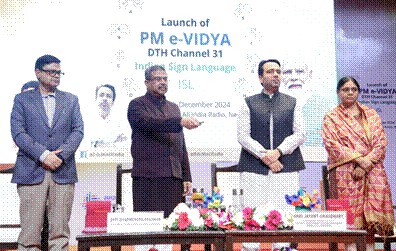
Union Minister for Education Shri Dharmendra Pradhan launched the PMeVIDYA DTH 24×7 Channel No. 31 for Indian Sign Language (ISL) today in New Delhi. Union Minister of State for Skill Development and Entrepreneurship (Independent Charge) and Minister of State for Education, Shri Jayant Chaudhary also graced the event. Shri Sanjay Kumar, Secretary, Department of School Education and Literacy and Department of Higher Education; Prof. Dinesh Prasad Saklani, Director, NCERT; Smt. A Srija, Economic Adviser, DoSEL; and Dr. Sharanjeet Kaur, Chairperson, Rehabilitation Council of India (RCI) were also present at the event.

2024-12-06 18:06:39.860000

In his address, Shri Pradhan highlighted the transformational impact of the expansion of the recognized disabilities from 7 to 21, making the legal framework more comprehensive. He noted that the National Education Policy 2020 (NEP) has prioritized the education of Children with Special Needs (CwSN), reflecting a shift towards a more inclusive education system.

Highlighting the importance of ISL, Shri Pradhan stated that sound is not the only medium for communication; alternative forms, such as sign language, play a critical role in ensuring equal opportunities for all. He called for the development of ISL to global standards and its widespread adoption, envisioning more and more individuals learning ISL to support the hearing-impaired population in India. This, he added, would help create employment opportunities as well.

Shri Pradhan also pointed to ISL’s influence in cultural expressions like dance and drama and cited examples of extraordinary individuals, to highlight the immense potential within the differently abled community. He called Channel 31 a bridge to facilitate communication and unlock this potential, making society more inclusive and progressive.

He urged stakeholders to popularize Channel 31 and ensure its reach across India, as a gateway for the world to Indian Sign Language, adding that it sets a benchmark for emerging economies. This initiative, he noted, reaffirms India’s commitment to constitutional rights, ensuring equal access to education and resources for all citizens.

Shri Pradhan concluded by emphasizing that Indian Sign Language has the potential to set global benchmarks, create large-scale job opportunities, and lead India towards a more inclusive future.

Shri Jayant Chaudhary, in his address, applauded this initiative and described it as a milestone in the country’s developmental journey toward inclusivity. He congratulated the PM eVidya Team for their commendable work. He noted that the People with Disability Act has been replaced by the Rights of Persons with Disabilities Act, reflecting the government’s focus on developing a rights-oriented framework. He emphasised the importance of identifying disabilities among school children to ensure they receive proper support, preventing any adverse impact on their learning outcomes or dropout rates. He also appreciated the effort to standardise regional languages for Indian Sign Language (ISL), with over 10,000 words standardised so far. Shri Chaudhary urged everyone to subscribe to the channels and make an effort to learn the language. He further highlighted the importance of using tools to address hearing impairment without stigma, enabling individuals with hearing disabilities to participate equally with everyone.

Shri Sanjay Kumar, in his address, commended this new and innovative initiative, highlighting how it aligns with two of the five pillars of the National Education Policy 2020—inclusiveness and accessibility. He pointed out the successful categorization of 21 types of disabilities through NCERT’s Prashast App and emphasized the importance of recognizing Indian Sign Language (ISL) as a language. He stressed the need to learn ISL to facilitate effective communication with the HI community and foster progress. He expressed his gratitude to Shri Dharmendra Pradhan for motivating the Ministry to ensure that no child is left behind and to integrate all children into the school system. Shri Sanjay Kumar also remarked on the significant work being done by regional institutes to develop ISL-based content, stating that this content would be included in the channel to make it both engaging and beneficial for the audience.

This critical initiative supports the objectives of the National Education Policy (NEP) 2020, which recommends promotion of Indian Sign Language to foster a more inclusive educational environment. Para 4.22 of NEP states that ‘Indian Sign Language (ISL) will be standardized across the country, and National and State curriculum materials developed, for use by students with hearing impairment. Local sign languages will be respected and taught as well, where possible and relevant.’

An exclusive PM e-Vidya channel devoted to the promotion of the Indian Sign Language has been conceptualised to promote ISL as a language as well as a school subject, so that the larger population has access to learning the language. This 24×7 Channel will disseminate learning content for school children (Central & State Curriculum), teachers, teacher educators and other stakeholders in the area of career guidance, skill training, mental health, class-wise curricular content, communication skills, as well as promotion of Sign Language as a language subject, just like verbal languages like Hindi, English etc., for all. The content will also be available on YouTube.

The programme witnessed participation from Hearing Impaired (HI) children, HI achievers, special educators, ISL certified interpreters and organisations working for mainstreaming the Hearing-Impaired community. The Ministers and other dignitaries also visited the exhibition stalls set up by ISLRTC, NCERT, Vidyanjali, and NIOS. The HI students rendered National Anthem in Sign Language and presented a skit as well during the event. A short film on HI achievers was also shown at the event.

India’s youth are the nation’s true wealth: Dr. Mansukh Mandaviya

| Published on:

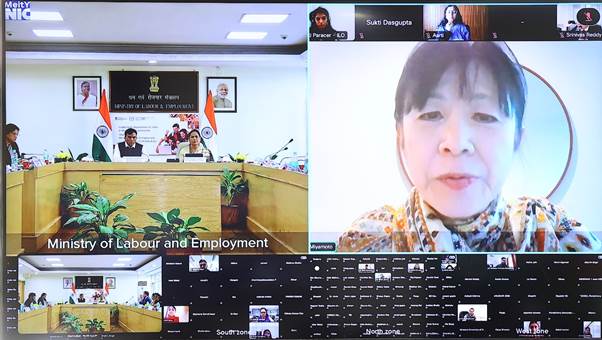
Union Minister for Labour & Employment Dr. Mansukh Mandaviya participated in a webinar on “Employment Opportunities for Youth in International Organisations” virtually in New Delhi Today. The webinar was organised by Ministry of Labour and Employment in collaboration with the United Nations India, International Labour Organization (ILO) and University Grants Commission.

The event attracted more than 1100 students from 42 top institutions across Delhi/NCR, specializing in law, business, management, and related fields. The webinar was also live-streamed across the country, reaching a wider audience of young aspirants.

In his address, Dr. Mandaviya highlighted that India’s youth are the nation’s true wealth, with their talent and skills being recognised and appreciated globally. He emphasised that Indian professionals are contributing significantly to fulfilling global workforce needs.

Union Minister encouraged participants to consider internships or volunteering opportunities with international organisations. He noted that such experiences enhance skills, broaden perspectives, and prepare youth for diverse career challenges.

Dr. Mandaviya also urged participants to utilise the National Career Service (NCS) Portal, which has over 37 lakh registered establishments seeking talented individuals. He described the portal as a valuable resource for aspiring youth to find national and international career opportunities.

Sushri Shobha Karandlaje, Union Minister of State for Labour & Employment and Micro Small and Medium Enterprises highlighted that young people are a major resource for development, key agents of social change and the driving force of economic development and technological innovation.

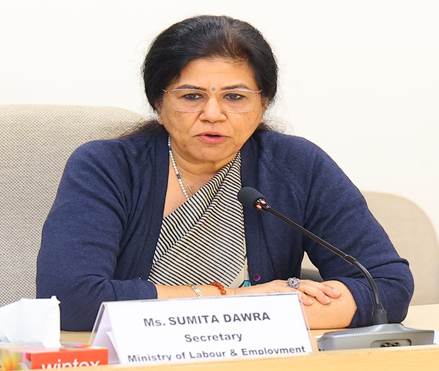
Ms. Sumita Dawra, Secretary (Labour and Employment), underscored the unique potential of the country’s unprecedented demographic dividend. She further shared Ministry’s plans to expand this initiative by organizing more such webinars, to ensure greater reach and impact amongst the youth across the country and those studying abroad.

The webinar also featured addresses by distinguished speakers, including the Mr. Shombi Sharp, UN Resident Coordinator in India, Ms. Michiko Miyamoto, Director of the ILO Country Office for India. It was highlighted that 26 UN agencies are engaging more than 4000 personnel in India.

During the webinar, UN and ILO experts shared key insights on skills, and qualifications required for availing job opportunities in international organisations. The experts informed about various opportunities in the UN system, such as internships, volunteering programs, consultancies, and young professionals’ programs, explaining the application processes and the competencies required. Further, UN Jobs Portal was explained, with detailed step-by-step guidance for navigating the portal and applying for various positions available.

A key feature of the webinar was a panel discussion featuring senior Indian experts working with the ILO at Geneva Headquarters. Ms. Sukti Das Gupta, Director and Mr. Srinivas B. Reddy, Chief of Skills & Employability shared their experiences and career journeys, offering valuable advice to aspiring students. The queries of students were addressed by the panellists in detail in this interactive webinar.

The webinar successfully equipped students with essential information on global career opportunities, marking a significant step towards realizing their aspirations in international organizations.

PM pays homage to Dr. Babasaheb Ambedkar on his Mahaparinirvan Diwas

| Published on:

The Prime Minister, Shri Narendra Modi has paid homage to Dr. Babasaheb Ambedkar on his Mahaparinirvan Diwas, today. Prime Minister Shri Narendra Modi remarked that Dr. Ambedkar’s tireless fight for equality and human dignity continues to inspire generations.

In a X post, the Prime Minister said;

“On Mahaparinirvan Diwas, we bow to Dr. Babasaheb Ambedkar, the architect of our Constitution and a beacon of social justice.

Dr. Ambedkar’s tireless fight for equality and human dignity continues to inspire generations. Today, as we remember his contributions, we also reiterate our commitment to fulfilling his vision.

Also sharing a picture from my visit to Chaitya Bhoomi in Mumbai earlier this year.

Jai Bhim!”

PM congratulates Devendra Fadnavis on taking oath as Maharashtra’s CM

| Published on:

The Prime Minister, Shri Narendra Modi has congratulated Shri Devendra Fadnavis on taking oath as Chief Minister of Maharashtra. He also congratulated Shri Eknath Shinde and Shri Ajit Pawar on taking oath as Deputy Chief Ministers. Shri Modi assured all possible support from the Centre in furthering development in Maharashtra.

The Prime Minister posted on X:

“Congratulations to Shri Devendra Fadnavis Ji on taking oath as Maharashtra’s Chief Minister.

Congratulations to Shri Eknath Shinde Ji and Shri Ajit Pawar Ji on taking oath as the Deputy Chief Ministers of the state.

This team is a blend of experience and dynamism, and it is due to this team’s collective efforts that the Mahayuti has got a historic mandate in Maharashtra. This team will do everything possible to fulfil the aspirations of the people of the state and to ensure there is good governance.

I assure all possible support from the Centre in furthering development in Maharashtra.”

Prime Minister receives Their Majesties the King and Queen of Bhutan

| Published on:

Prime Minister Shri Narendra Modi received His Majesty the King of Bhutan, Jigme Khesar Namgyel Wangchuck and Her Majesty the Queen of Bhutan, Jetsun Pema Wangchuck in New Delhi today. Prime Minister extended his greetings to Their Majesties and fondly recalled the exceptionally warm hospitality accorded by the Government and the people of Bhutan during his State visit in March 2024.

Prime Minister and His Majesty the King expressed satisfaction at the excellent state of bilateral relations, encompassing development cooperation, clean energy partnership, trade and investment, space and technology cooperation, and people-to-people ties. They reaffirmed their commitment to further strengthening this exemplary partnership across all sectors.

The leaders reviewed the progress in enhancing economic connectivity between the two countries, and exchanged ideas on the Gelephu Mindfulness City initiative, a visionary project spearheaded by His Majesty to catalyse Bhutan’s development and strengthen linkages with adjoining border areas in India.

Prime Minister reiterated India’s strong commitment to the economic development in Bhutan, highlighting the doubling of India’s development support to Bhutan for its 13th Five Year Plan period. His Majesty the King expressed gratitude to the Prime Minister and the people of India for steadfast support of Bhutan’s aspirations for happiness, progress and prosperity.

The meeting was followed by a lunch hosted by Prime Minister in honour of His Majesty the King and Her Majesty the Queen.

The meeting underscored the tradition of regular high-level exchanges between India and Bhutan, reflecting the spirit of mutual trust, cooperation and profound understanding that underpins the bilateral relations between the two countries.

Dharmendra Pradhan inaugurates ICSSR Research Internship Programme

| Published on:

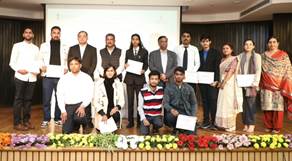
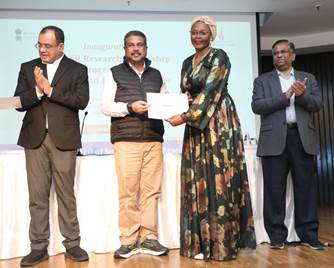
Union Minister for Education, Shri Dharmendra Pradhan, inaugurated the Indian Council of Social Science Research (ICSSR) Research Internship Programme in Social and Human Sciences today in New Delhi. He also distributed appointment letters to the ICSSR Research Interns. Shri Pradhan also distributed prizes to the winners of the National Argumentative Essay Writing Competition on “Simultaneous Elections in India: One Nation, One Election” to the UG, PG and Doctoral Students. Prof. Dhananjay Singh, Member Secretary, ICSSR; Prof. Deepak K. Srivastava, Chairman, ICSSR; academicians, Heads of Institutes, scholars and students were also present at the event.

Image


Image

Shri Pradhan, while speaking at the occasion, said that the internship presents a unique opportunity to postgraduate students of social sciences and will strengthen social science research, which is pivotal to achieving social progress, embracing technological disruptions and driving economic growth and aligned to the national objective of Viksit Bharat. He further said that the nature of jobs is changing rapidly with technologies like AI driving this change, and research in the area of social sciences will play a pivotal role in ensuring that technological disruptions aid social development.

Shri Pradhan also said that the National Education Policy 2020 has recognized the need for quality social science research, which plays a pivotal role in shaping societies. ICSSR internship program is yet another step towards fostering individual growth and creating a pool of skilled researchers who can contribute to areas like policy research, data analysis, and social innovation, he said.

The Minister said that India is a living ancient civilization, which has embraced modernity while retaining its basic character. He added that robust social science research plays an important role in ensuring civilizational sustenance and growth and expressed confidence that this initiative will strengthen the civilizational ethos of Bharatiyata and pave the way for the future.

With the introduction of the NEP 2020, there is an increased focus on internships which is being used to award credits to students pursuing undergraduate (UG) and postgraduate (PG) programmes through the National Credit Framework (NCrF). ICSSR internship program is yet another step towards fostering individual growth and creating a pool of skilled researchers who can contribute to areas like policy research, data analysis, and social innovation.

The Internship Programme at ICSSR has been designed with a fundamental objective to match education with research skills to prepare young social scientists and a humanist for the changing dynamics of employability and ensure their meaningful contribution towards national development. The uniqueness of the Internship Programme is the integration of modern education and skills with traditional knowledge and techniques.

Taking inspiration from the vision of Prime Minister Shri Narendra Modi that Anusandhan is a critical component of Bharat’s development and that “skill development and employment are essential needs in India,” ICSSR has embarked on this mission to provide essential skills to the youth for conducting quality research in Social and Human Sciences. This internship focuses on bridging the gap between academic knowledge and employability skills. It aims to foster research skills, including ideation, data collection, experimentation, and report presentation. Interns shall gain hands-on experience in research tools, methodologies, and real-world applications by working with experienced and successful mentors from universities, research think tanks, industry and community. The programme aims to be multidisciplinary, with the selected candidates representing different domains of social and human sciences such as Statistics, Population Studies, Sociology, Applied Psychology, Public Health and Policy, International Relations, Development Studies, Language Studies, Anthropology etc.

The advertisement for the Research Internship Programme received a very positive response with more than 3600 applications. After following a rigorous selection process and ensuring inclusivity, ICSSR has selected 40 candidates from different parts of the nation to be appointed as interns. The Internship Programme would involve national and international workshops on skills required for research studies on the 17 Sustainable Development Goals (SDGs) of the UN firmly reiterated and newly contextualised by Bharat in the highly successful G-20 presidency declaration.

PM Modi receives Foreign Minister of Kuwait

| Published on:

Foreign Minister of Kuwait H.E. Abdullah Ali Al-Yahya called on Prime Minister Shri Narendra Modi today.

Recalling his meeting with Crown Prince of Kuwait, His Highness Sheikh Sabah Khaled Al-Hamad Al-Sabah in September in New York, PM expressed satisfaction at the growing momentum in bilateral relations.

They discussed measures to enhance cooperation in trade, investment, energy, technology, culture and strong people to people ties.

PM thanked the leadership of Kuwait for taking care of the one million strong Indian community living in Kuwait.

PM expressed confidence  that the close cooperation between India and the Gulf Cooperation Council would be further strengthened under Kuwait’s ongoing Presidency of the GCC. They exchanged views on the situation in West Asia and expressed support for early return of peace, security and stability in the region.

Prime Minister accepted the  invitation of the Kuwait Leadership to visit the country at the earliest opportunity.

“Mission Mausam” to be a game-changer for India’s weather forecast capabilities: Dr. Jitendra Singh

| Published on:

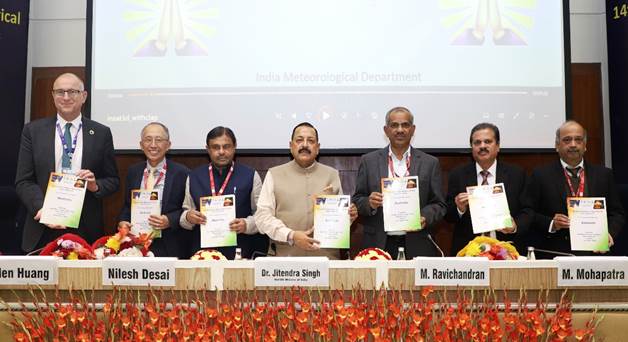
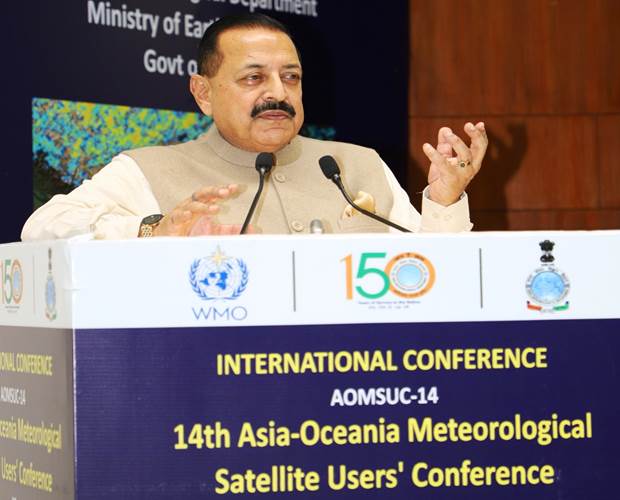
Union Minister of State (Independent Charge) for Science and Technology; Earth Sciences and Minister of State for PMO, Department of Atomic Energy, Department of Space, Personnel, Public Grievances and Pensions, Dr. Jitendra Singh, while inaugurating the 14th Asia-Oceania Meteorological Satellite Users’ Conference, hailed “Mission Mausam” as a transformative initiative set to be a game-changer for India’s weather forecast capabilities India’s approach to climate and weather forecasting.

The conference is being attended attended by eminent scientists and experts from across the region, underscored India’s growing stature in meteorological research and its commitment to global collaboration.

Dr. Jitendra Singh highlighted the significance of Mission Mausam, calling it the first comprehensive scientific initiative by the Government of India dedicated exclusively to addressing climate-related challenges. “Under Prime Minister Narendra Modi’s visionary leadership, this mission is a reflection of India’s aspiration to play a pivotal role in tackling global climate issues,” he remarked, adding that the initiative has captured international attention for its innovative approach and potential impact.

WhatsApp Image 2024-12-04 at 5.50.33 PM.jpeg


The Minister noted that India’s advancements in satellite technology and weather forecasting have made it a leader in the Asia-Oceania region. He emphasized the integration of artificial intelligence (AI), machine learning, and geoinformatics in forecasting, which has significantly improved accuracy. India, through its satellite capabilities like the GSAT series, is also providing critical meteorological data to neighbouring countries, reinforcing the Neighbourhood First policy.

Dr. Jitendra Singh congratulated the India Meteorological Department (IMD) on its 150th year of establishment, calling it a landmark moment in the nation’s scientific journey. He expressed pride in hosting the 14th Asia-Oceania Meteorological Satellite Users’ Conference in India for the first time, coinciding with this historic milestone.

WhatsApp Image 2024-12-04 at 5.50.32 PM.jpeg

The Minister highlighted the Asia-Oceania Meteorological Satellite Users’ Conference (AOMSUC-14) as a crucial platform for fostering regional and international collaboration in satellite meteorology. He emphasized the participation of major satellite operators, including the Japan Meteorological Agency, China Meteorological Administration, and Korea Meteorological Administration, as a testament to the growing unity in addressing climate and weather challenges. “India is proud to contribute through ISRO and IMD, sharing our expertise and resources for a sustainable and resilient future,” he remarked.

Dr. Jitendra Singh outlined India’s remarkable journey in satellite meteorology, from relying on international data to becoming self-reliant with indigenous satellite programs. The Bhaskara and INSAT satellite series have revolutionized weather forecasting, enabling real-time cyclone tracking, improved monsoon predictions, and timely disaster alerts. With advanced platforms like INSAT-3DR and GSAT-30, and the upcoming GISAT series, India is set to further enhance its capabilities in weather monitoring and disaster preparedness.

The Minister applauded the capacity-building initiatives under AOMSUC, which ensure that developing nations benefit from advancements in satellite meteorology. Training sessions and technical support enable countries across the Asia-Oceania region to utilize cutting-edge technology for disaster risk reduction and climate adaptation. He called for greater integration of emerging technologies, such as AI and private-sector satellite data, to push the boundaries of innovation in meteorological science.

Dr. Jitendra Singh noted a significant 40-50% improvement in severe weather forecast accuracy over the last decade, highlighting its impact on reducing loss of life during cyclones and extreme weather events. IMD’s efforts, coupled with satellite data integration, have not only strengthened India’s disaster management but have also supported neighboring countries in South Asia and the Indian Ocean region, reinforcing India’s leadership in meteorological services.

Dr. Jitendra Singh recalled India’s rapid strides in the space sector since the establishment of ISRO in 1969 and the launch of initiatives like the South Asia Satellite, which provides weather and disaster forecasts to regional nations. “From being reliant on rudimentary weather predictions, India has evolved into a nation setting benchmarks in meteorological research and applications,” he said.

The Minister proposed fostering deeper regional and global collaborations, inviting experts and stakeholders to explore synergies in areas such as climate modelling, disaster forecasting, and sustainable resource management. He lauded the conference as a vital platform for knowledge sharing, advancing technology, and integrating best practices to combat the growing challenges posed by climate change.

Dr. Jitendra Singh concluded by emphasizing the need for increased public engagement and awareness of India’s meteorological achievements. “We must bridge the gap between scientific advancements and public perception, ensuring that the value of accurate weather forecasting and climate research is recognized by all,” he asserted.

PM dedicates to the nation the successful implementation of three new criminal laws

| Published on:

The Prime Minister, Shri Narendra Modi dedicated to the nation the successful implementation of three transformative new criminal laws—Bharatiya Nyaya Sanhita,  Bharatiya Nagarik Suraksha Sanhita  and Bharatiya Sakshya Adhiniyam today at Chandigarh. Addressing the gathering, Shri Modi remarked that the identity of Chandigarh was associated with the Goddess Maa Chandi, a form of power which establishes truth and justice. He added that the same philosophy was the basis of the whole format of Bharatiya Nyaya Sanhita and  Bharatiya Nagarik Suraksha Sanhita. The Prime Minister said that the coming into effect of Bharatiya Nyaya Sanhita, inspired by the spirit of the Indian Constitution, was an illustrious moment as the nation was at the important juncture of moving ahead with the resolution of Viksit  Bharat as well as commemorating the completion of 75 years of Indian Constitution. He added that it was a concrete effort towards fulfilling the ideals that our Constitution envisioned for the citizens of the country. Shri Modi said that he had just got a glimpse of how the laws will be enforced by a live demonstration of the same. The Prime Minister urged the people to visit the live demo of the laws. He extended his warm greetings to all the citizens on the occasion of successful implementation of three new criminal laws. He also congratulated all the stakeholders of the administration of Chandigarh.

The Prime Minister underscored that the process of making the country’s new Nyay Sanhita has been as comprehensive as the document itself. He added that it involved the hard work of the nation’s many great constitution and legal experts. Shri Modi noted that the Ministry of Home Affairs had asked for suggestions in January 2020. He added that there were  suggestions of many Chief Justices of the Supreme Court along with support from the Chief Justices of many High Courts of the country. He said that many stakeholders including the Supreme Court, 16 High Courts, Judicial Academies, Law Institutions, Civil Society Organizations and many intellectuals were involved in debates and discussions and used their vast experience over years to give their suggestions and ideas for the new Sanhitas. He further added that there were deliberations on the needs of the nation in today’s modern world. Shri Modi also noted that there was intensive brainstorming over the challenges faced by the Judicial System in the seven decades of Independence along with looking into the practical aspect of each and every law. He added that even the futuristic aspect of the Nyay Sanhita was worked upon. All these intensive efforts, he said, had given us the current form of the Nyay Sanhita. Shri Modi expressed his gratitude to the Honorable Supreme Court, High Courts – Punjab and Haryana High Court, in particular and all the honorable Judges for their concerted efforts towards the new Nyay Sanhita. He also thanked the Bar for coming forward and taking its ownership. Shri Modi expressed confidence that this Nyay Sanhita of India, made with everyone’s cooperation, would prove to be a milestone in India’s judicial journey.

Noting that the Criminal laws were made by the Britishers in the pre-Independence era as means of oppression and exploitation, Shri Modi said that Indian Penal Code (IPC) was introduced in 1860 consequent to the country’s first major freedom struggle in 1857. He added that a few years later, the Indian Evidence Act was introduced and then the first structure of CRPC came into existence. Shri Modi remarked that the idea and purpose of these laws was to punish Indians and enslave them. He expressed that it was unfortunate that even decades after independence, our laws revolved around the same penal code and penal mindset. He further added that despite changes in the laws from time to time, their character remained the same. Shri Modi underscored that this mindset of slavery had impacted India’s progress to a great extent.

Emphasizing that the country should now come out of that colonial mindset, the Prime Minister urged that the strength of the nation should be used in nation building, which necessitated national thinking. He recalled that during the Independence day speech this year, he had pledged to the country to get rid of the mentality of slavery. Shri Modi underlined that with the implementation of the new Nyay Sanhitas, the country had taken another step forward in that direction. He added that the Nyaya Sanhita was strengthening the spirit of ‘of the people, by the people, for the people’, which is the basis of democracy.

Remarking that the Nyay Sanhita was woven with the ideas of equality, harmony and social justice, Shri Modi said despite everyone being equal in the eyes of the law, the practical reality was different. He added that the poor were afraid of the laws, stepping into the court or a police station even. The Prime Minister remarked that the new Nyaya Sanhita would  work to change the psychology of the society. He added that every poor person will have faith that the law of the country is a guarantee of equality. This, he said, embodied the true social justice assured in our Constitution.

The Prime Minister underlined that Bharatiya Nyaya Sanhita and  Bharatiya Nagarik Suraksha Sanhita had sensitivity towards every victim. He stressed that it was imperative for the citizens of the country to know its details. Urging the gathering to see the live demo there, Shri Modi stressed that the live demo shown at Chandigarh today should be promoted and broadcast by the police of every state. The laws involved provisions such as within 90 days of the complaint, the victim will have to be given information regarding the progress of the case and this information will reach him directly through digital services like SMS. He added that a system had been created to take action against the person who obstructs the work of the police and a separate chapter was introduced to ensure the safety of women including their rights and safety at workplace, home and society. Shri Modi remarked that the Nyay Sanhitas ensured that the law stands with the victim. He added that in heinous crimes against women like rape, charges would be framed within 60 days from the first hearing and  it was also made mandatory to pronounce the verdict within 45 days of the completion of the hearing along with no adjournments for more than twice in any case.

“Citizen First is the basic mantra of Nyay Sanhita”, exclaimed Shri Modi and added that these laws were becoming the protectors of civil rights and the basis of ‘ease of justice’. Noting that it was very difficult to get an FIR registered earlier, Shri Modi remarked that now Zero FIR was legalized and now a case could be registered from anywhere. The Prime Minister also noted that the victim had been given the right to be given a copy of the FIR and now any case against the accused would be withdrawn only when the victim agrees. He added that now the police would not be able to detain any person on their own and informing his/her family members had been made mandatory in the Nyay Sanhita. Highlighting Humanity and Sensitivity as the other important aspects of new Nyaya Sanhita, Shri Modi said that now the accused could not be kept in jail for a very long time without punishment and now in the case of a crime punishable with less than 3 years, arrest can also be made only with the consent of the higher authority. He added that the Provision of mandatory bail was also made for minor crimes. Elaborating further, the Prime Minister noted that in ordinary crimes, the option of Community Service was also kept in place of punishment. This, he said, will give the accused new opportunities to move forward in a positive direction in the interest of society. Shri Modi underlined that the new Nyay Sanhita was also very sensitive towards first time offenders and  after the implementation of the Nyay Sanhita, thousands of such prisoners were released from jails, who were imprisoned due to old laws. He added that the new Nyay Sanhitas will further strengthen the empowerment of civil rights.

Emphasising that the first criterion of justice was timely justice, the Prime Minister said that the country had taken a big leap towards speedy justice by introducing the new Nyay Sanhita. He added that priority was given to file chargesheets and give verdicts quickly in the Nyay Sanhita by setting time limits for completing each stage in any case. Remarking the newly implemented Nyay Sanhita needed time to mature, Shri Modi was pleased that  in such a short span of time, the results received from different parts of the country were highly satisfactory. He cited the examples of Chandigarh where a vehicle theft case was completed in just 2 months and 11 days and accused in case of spreading unrest in an area was also sentenced by the court after a complete hearing in just 20 days. He further cited examples of speedy justice in Delhi and Bihar and added that these speedy verdicts showed the power and impact of the Bharatiya Nyay Sanhita. Shri Modi emphasised that this change showed that changes and results were ascertained when there was a government dedicated to the interests of ordinary citizens and solving their problems. He further urged that these verdicts should be discussed as much as possible in the country so that every Indian knows how his power for justice has increased. He added that this would also make the criminals wary of the old and non-existent delayed justice system.

“Rules and laws are effective only when they are relevant to the times”, said Shri Modi. Adding that today the methods of crime and criminals had changed which necessitated the introduction of new laws which are modern. Noting that digital evidence can be kept as an important evidence and Videography of the entire process had been made mandatory to ensure that evidence is not tampered with during investigation, Shri Modi said that useful tools like e-Saksha, Nyay Shruti, Nyay Setu, e-Summon Portal were developed to implement the new laws. He added that now summons can be served directly on the phone by the court and the police through electronic mediums. He further added that Audio-video recording of witness statements could also be done. Noting that the Digital evidence would also be valid in the court now, Shri Modi said it will become the basis of justice and would prevent unnecessary wastage of time till the criminal is caught. He noted that these changes were equally important for the security of the country and Integration of digital evidence and technology would also help us fight against terrorism. He added that terrorists or terrorist organizations would not be able to take advantage of the complexities of the law under the new laws.

Highlighting that the new Nyay Sanhitas will increase the productivity of every department and speed up the country’s progress, Shri Modi emphasized that it will help in curbing corruption which surged due to legal hurdles. He added that most foreign investors did not want to invest in India earlier because of the fear of long and delayed justice. He further added that when this fear ends, investments would increase, thereby strengthening  the country’s economy.

Noting that the law of the country was for the citizens, the Prime Minister said, therefore, legal processes should also be for the convenience of the public. Highlighting the lacunae in the Indian Penal Code and the fear of the law for the honest people as against the criminals, Shri Modi said the new Nyay Sanhitas had freed the people from such troubles. He added that the Government had abolished more than 1500 old laws of British rule.

Shri Modi urged that there was a need to broaden our perspective so that the law becomes a medium of citizen empowerment in our country. He added that there were many laws which lacked discussions and deliberations. Citing the example of abrogation of Article 370 and Triple Talaq, Shri Modi said there were a lot of discussions on it. He added that these days, the law related to the Waqf Board was also being debated. The Prime Minister stressed that there was a necessity to give the same importance to those laws which were made to increase the dignity and self-respect of the citizens. He cited the example of implementation of the Rights of Persons with Disabilities Act, 2016, which not only empowered the Divyangs, but  was also a campaign to make the society more inclusive and sensitive. He added that the Nari Shakti Vandan Act was going to lay the foundation for a similar kind of big change. Similarly, he added, the laws related to transgenders, Mediation Act, GST Act, were made, on which positive discussions have been necessary.

“The strength of any country is its citizens, and the law of the country is the strength of the citizens”, exclaimed the Prime Minister. This would encourage people to be law-abiding and this loyalty of the citizens towards the law is a big asset of the nation, said Shri Modi. He added that it was the responsibility of all of us to ensure that the trust of the citizens should not be shattered. Shri Modi urged every department, every agency, every officer and every policeman to know the new provisions of the Nyay Sanhita and understand their spirit. He urged the state  governments to work actively to ensure that the Nyay Sanhita are implemented effectively, so that their impact was visible on ground. He also urged the citizens to be as aware of these new rights as possible. Remarking that there was a need to work together for this, the Prime Minister added that the more effectively the Nyay Sanhita are implemented, we would be able to give a better and brighter future to the country, which would determine the life of our children and determine our service satisfaction. Concluding the speech, Shri Modi expressed confidence that all of us would work together in this direction and increase our role in nation building.

Governor of Punjab and Administrator of Union Territory of Chandigarh, Shri Gulab Chand Kataria, Union Minister for Home Affairs and Cooperation, Shri Amit Shah and Rajya Sabha MP Shri Satnam Singh Sandhu were present among other dignitaries at the event.

Background

Prime Minister Narendra dedicated to the nation the successful implementation of three transformative new criminal laws—Bharatiya Nyaya Sanhita,  Bharatiya Nagarik Suraksha Sanhita  and Bharatiya Sakshya Adhiniyam today at Chandigarh.

The conceptualisation of the three laws was driven by the vision of the Prime Minister to remove colonial era laws which had continued to exist post independence, and to transform the judicial system by shifting focus from punishment to justice. Keeping this in mind, the theme of this programme is “Secure Society, Developed India- From Punishment to Justice”.

The new criminal laws, which were implemented nationwide on July 1, 2024, aim to make India’s legal system more transparent, efficient, and adaptable to the needs of contemporary society. These landmark reforms mark a historic overhaul of India’s criminal justice system, bringing in new frameworks to tackle modern-day challenges such as cybercrime, organized crime and ensuring justice for victims of various offenses.

The programme showcased the practical application of these laws, demonstrating how they are already reshaping the criminal justice landscape. A live demonstration was also held, simulating a crime scene investigation where the new laws were put into action.

Prime Minister marks 9 years of Sugamya Bharat Abhiyan

| Published on:

The Prime Minister, Shri Narendra Modi today marked 9 years of Sugamya Bharat Abhiyan. He reiterated the Government’s commitment to further boosting accessibility, equality and opportunity for Divyang sisters and brothers. Lauding the fortitude and accomplishments of Divyang sisters and brothers, Shri Modi remarked that it made us all proud.

Responding to a series of posts on X by MyGovIndia and Modi Archive handles, Shri Modi wrote:

“Today, we mark #9YearsOfSugamyaBharat and reiterate our commitment to further boosting accessibility, equality and opportunity for our Divyang sisters and brothers.”

“The fortitude and accomplishments of our Divyang sisters and brothers make us proud. A very vibrant example is India’s success in the Paralympics. It illustrates the ‘Can Do’ spirit of persons with disabilities. #9YearsOfSugamyaBharat

“An unforgettable memory indeed! #9YearsOfSugamyaBharat

“A clear indication of our commitment to empowering persons with disabilities can be seen in the historic passage of the Rights of Persons with Disabilities Act of 2016. #9YearsOfSugamyaBharat