Piyush Goyal attends series of meetings and interaction with stakeholders on first day of Australia visit

| Published on:

On the first day of his visit to Australia, Shri Piyush Goyal, Union Minister for Commerce & Industry had several productive engagements with various stakeholders in Sydney today, September 23, 2024.

The Minister attended a business roundtable hosted by the Business Council of Australia in which prominent Australian and Indian CEOs participated. The Minister invited Australian business leaders to explore the opportunities presented by the high and sustained economic growth in India.

The Minister also met senior representatives from the Australian pension funds. Discussions focused on the robust policies and reform agenda of the Government of India which have boosted investor confidence. The Minister encouraged greater investments into the emerging sectors in the Indian market viz renewable energy, manufacturing, education, fintech, agritech etc.

The Minister had a productive meeting with Ms Tania Constable, CEO of the Minerals Council of Australia regarding ways to strengthen collaboration in the critical minerals sector between India and Australia. The Minister also met Mr. Joel Katz, Managing Director of the Cruise Lines International Association to explore opportunities for enhancing coastal tourism in India. The Minister interacted with Mr. Robin Khuda, Founder & CEO of AirTrunk and discussed India’s digitalisation growth and the significant potential for collaboration in the data infrastructure sector between India and Australia.

The Centre for Australia-India Relations hosted a lunch in honour of the Minister with members of their Director network.

The Minister interacted with the representatives of the Indian community at a reception hosted by the Consulate General of India at Sydney Cricket Ground. He offered prayers at the BAPS Swaminarayan temple in Parramatta and recalled his previous visit to the temple in 2022. The event was attended inter-alia by Hon Dr Andrew Charlton MP, Chair of Parliamentary Friends of India and Hon Warren Kirby, Member of NSW legislature and Co-chair of NSW Parliamentary Friends of India.

Before proceeding to Adelaide on 24th September 2024, the Minister’s official bilateral engagements include the reception hosted in his honour by Australia-India Business Council (AIBC) and NSW Parliamentary Friends of India in the Parliament of New South Wales. A number of political dignitaries and prominent business representatives are expected to attend the event.

Prime Minister attends Quad Cancer Moonshot event

| Published on:

Prime Minister Shri Narendra Modi participated in the Quad Cancer Moonshot event hosted by President Joseph R Biden Jr., on the sidelines of the Quad Leaders’ Summit in Wilmington, Delaware.

Speaking on the occasion, Prime Minister deeply appreciated this thoughtful initiative of President Biden aimed at preventing, detecting and treating cervical cancer. He stated that the program would go a long way in providing affordable, accessible and quality health-care to people in Indo-Pacific countries. He noted that India was also undertaking a mass cervical cancer screening program in the country. Talking of India’s health security efforts, he mentioned that the country has developed a cervical cancer vaccine and is working on an AI based treatment protocol for the disease.

As India’s contribution to the Cancer Moonshot initiative, Prime Minister, in keeping with India’s vision of ONE WORLD, ONE HEALTH, announced the dedication of a grant of US $7.5 million to cancer testing, screening, and diagnostics in the Indo-Pacific region. Prime Minister also announced that India will provide support for radiotherapy treatment and capacity building for cancer prevention in the Indo-Pacific. He also mentioned that Indo-Pacific countries will be benefiting from the supply of 40 million doses of vaccine from India under GAVI and QUAD programs. Prime Minister noted that when the Quad acts, it is not just for nations, it is for the people and that is the true essence of its human-centric approach.

India will also offer technical assistance to interested countries in the Indo-Pacific region on DPI for cancer screening, care and continuum through its US$ 10 million contribution to WHO’s-Global Initiative on Digital Health.

Through the Cancer Moonshot initiative, the Quad leaders committed to work together to address gaps in the cervical cancer care and treatment ecosystem in the Indo-Pacific countries. A Joint Cancer Moonshot Fact Sheet was released on the occasion.

Prime Minister’s meeting with the Quad Leaders

| Published on:
PM’s meeting with the Prime Minister of Australia

​Prime Minister Shri Narendra Modi and Prime Minister of Australia H.E. Mr. Anthony Albanese met on the sidelines of the 6th Quad Leaders’ Summit in Wilmington, USA. This was their ninth in-person interaction since May 2022.

The two leaders discussed strengthening bilateral cooperation across a wide range of areas such as political and strategic, defence and security, trade and investments, education and research, climate change and renewable energy, and people-to-people ties. The Prime Ministers also exchanged views on regional and global issues of mutual interest. They acknowledged that the frequency of high-level contacts has imparted a strong momentum to bilateral relations.

Both leaders renewed their commitment to strengthening cooperation in the multilateral fora and reiterated their commitment to take the India-Australia Comprehensive Strategic Partnership to even greater heights.

PM’s meeting with the Prime Minister of Japan

Prime Minister Shri Narendra Modi met H.E. Mr. Fumio Kishida, Prime Minister of Japan in USA on 21 September 2024 on the sidelines of Quad Leaders’ Summit, in Wilmington, Delaware.

The two Prime Ministers warmly recalled their many interactions, especially since their first Annual Summit in March 2022. Prime Minister thanked Prime Minister Kishida for his unwavering dedication and leadership in enabling advances in the India-Japan Special Strategic and Global Partnership over the last few years.

The two leaders noted that the India-Japan Special Strategic and Global Partnership is in its 10th year and expressed satisfaction at the progress made in the relationship. The two Prime Ministers reviewed the multi-faceted relationship between the two countries and exchanged views to deepen cooperation further, including defense and security ties and B2B and P2P collaborations.

Prime Minister bid farewell to Prime Minister Kishida and wished him success and fulfillment in his future endeavours.

PM attends the sixth Quad Leaders’ Summit in Wilmington, Delaware

| Published on:

Prime Minister Shri Narendra Modi participated in the sixth Quad Leaders’ Summit in Wilmington, Delaware on 21 September 2024, hosted by the President of the United States of America, H.E. Mr. Joseph R. Biden, Jr. Prime Minister of Australia, H.E. Mr. Anthony Albanese and Prime Minister of Japan, H.E. Mr. Fumio Kishida also participated.

In his address, Prime Minister thanked President Biden for hosting the Summit and for his personal commitment to strengthen the Quad as a force for global good. Prime Minister stated that at a time when the world is ridden with tensions and conflicts, the coming together of Quad partners, with shared democratic ethos and values, is important for humanity. He emphasized that the group stood for upholding the international order based on the rule of law, respect for sovereignty and territorial integrity, and with a commitment to pursue peaceful resolution of disputes. He further stated that a free, open, inclusive and prosperous Indo-Pacific was a shared objective of the Quad partners. He underlined that the Quad was here to stay, to assist, to partner and to complement the efforts of Indo-Pacific countries.

Reiterating that the Quad remains to be a “force for global good,” the Leaders made the following announcements to address the development priorities of the Indo-Pacific region and of the global community as a whole:

* “Quad Cancer Moonshot”, a groundbreaking partnership to save lives in the Indo-Pacific region by combating cervical cancer.

* “Maritime Initiative for Training in the Indo-Pacific” (MAITRI) to enable Indo-Pacific partners to maximize tools provided through IPMDA and other Quad initiatives.

* First-ever “Quad-at-Sea Ship Observer Mission” in 2025 to improve interoperability and advance maritime safety.

* “Quad Ports of the Future Partnership” which will harness the Quad’s collective expertise to support sustainable and resilient port infrastructure development across the Indo-Pacific.

* “Quad Principles for Development and Deployment of Digital Public Infrastructure” in the region and beyond.

* A “Semiconductor Supply Chains Contingency Network Memorandum of Cooperation” to enhance resilience of Quad’s semiconductor supply chains.

* Collective Quad effort to boost energy efficiency, including deployment and manufacturing of high-efficiency affordable cooling systems in the Indo-Pacific region.

* India’s establishment of a space-based web portal for Mauritius, to support the concept of open science for space-based monitoring of extreme weather events and climate impact.

* A new sub-category under the Quad STEM Fellowship, announced by India, for students of the Indo-Pacific region to pursue a 4-year bachelor’s level engineering programme at a Government of India funded technical institute.

The Leaders welcomed the next hosting of the Quad Leaders’ Summit by India in 2025. To take the Quad agenda forward, they adopted the Quad Wilmington Declaration.

PM’s Opening Remarks at the QUAD Leaders’ Summit

Your Excellencies,
President Biden,
Prime Minister Kishida,
and
Prime Minister Albanese.

At the outset of my third term, it gives me great pleasure to participate in today’s QUAD Summit alongside my friends. There could be no better place to celebrate the 20th anniversary of QUAD than President Biden’s own city, Wilmington. As Amtrak Joe, you have been associated with this city and “Delaware”, you have fostered a similar bond with the QUAD.

Under your leadership, the first Summit took place in 2021, and in such a brief time, we have unprecedentedly expanded our collaboration across all fronts. Your personal involvement has been instrumental in this achievement. I extend my heartfelt gratitude to your unwavering commitment to QUAD, your leadership, and your contribution.

Friends,

Our meeting is taking place at a time when the world is surrounded by tensions and conflicts. In such a situation, it is crucial for the QUAD to unite around our shared democratic values for the greater good of humanity. We are not against anyone. We all support a rules-based international order, respect for sovereignty and territorial integrity, and the peaceful resolution of all issues.

Free, open, inclusive, and prosperous Indo-Pacific is our shared priority and shared commitment. We have collaboratively undertaken numerous positive and inclusive initiatives in areas such as Health, Security, Critical and Emerging Technologies, Climate Change, and Capacity Building. Our message is unequivocal: QUAD is here to stay, to assist, to partner, and to complement.

Once again, I would like to extend my greetings to President Biden and all my fellow colleagues. We look forward to hosting the QUAD Leaders’ Summit in India in 2025.

Thank you very much.

DISCLAIMER – This is the approximate translation of Prime Minister’s remarks. Original remarks were delivered in Hindi.

PM meets with President of USA in Wilmington, Delaware

| Published on:

Prime Minister Shri Narendra Modi met with the President of the United States of America, H.E. Mr. Joseph Biden on the sidelines of the Quad Summit in Delaware today. In a special gesture, President Biden hosted the meeting at his home in Wilmington.

Prime Minister conveyed his appreciation for the unparalleled contributions made by President Biden in giving impetus to the India-US partnership. He warmly recalled his State visit to the USA in June 2023 and President Biden’s visit to India in September 2023 for the G-20 Leaders’ Summit. Prime Minister noted that the visits have imparted greater dynamism and depth to the India-US partnership.

Prime Minister emphasized that India and the USA today enjoy a comprehensive global strategic partnership that covers all areas of human endeavor, driven by shared democratic values, convergence of interests and vibrant people-to-people ties.

The two leaders discussed ways to further enhance bilateral cooperation in areas of mutual interest and exchanged views on global and regional issues including the Indo-Pacific region and beyond. They expressed confidence in the strength and continuing resilience of the relationship and their belief in its significance for all areas of human endeavor between the two countries.

Prime Minister’s departure statement ahead of his visit to the United States of America

| Published on:

Today, I am embarking on a three day visit to the United States of America to participate in the Quad Summit being hosted by President Biden in his hometown Wilmington and to address the Summit of the Future at the UN General Assembly in New York.

I look forward joining my colleagues President Biden, Prime Minister Albanese and Prime Minister Kishida for the Quad Summit. The forum has emerged as a key group of the like-minded countries to work for peace, progress and prosperity in the Indo-Pacific region.

My meeting with President Biden will allow us to review and identify new pathways to further deepen India-US Comprehensive Global Strategic Partnership for the benefit of our people and the global good.

I am eagerly looking forward to engaging with the Indian diaspora and important American business leaders, who are the key stakeholders and provide vibrancy to the unique partnership between the largest and the oldest democracies of the world.

The Summit of the Future is an opportunity for the global community to chart the road ahead for the betterment of humanity. I will share views of the one sixth of the humanity as their stakes in a peaceful and secure future are among the highest in the world.

PM addresses National PM Vishwakarma Program in Wardha, Maharashtra

| Published on:

The Prime Minister, Shri Narendra Modi addressed the National PM Vishwakarma Program in Wardha, Maharashtra today. The Prime Minister launched the ‘Acharya Chanakya Skill Development ’ scheme and ‘Punyashlok Ahilyadevi Holkar Women Startup Scheme’. He released certificates and loans to PM Vishwakarma beneficiaries and also released a commemorative stamp dedicated to mark one year of progress under PM Vishwakarma. Shri Modi laid the foundation stone of PM Mega Integrated Textile Regions and Apparel (PM MITRA) Park at Amravati, Maharashtra. The Prime Minister took a walkthrough of the exhibition showcased on the occasion.

Addressing the gathering, the Prime Minister recalled the Vishwakarma Puja celebrations two days ago and said that today the festival of successful completion of one year PM Vishwakarma scheme is taking place here in Wardha. He underlined that today is special as Mahatma Gandhi had started the campaign against untouchability in 1932 on this day. He remarked that the completion of one year PM Vishwakarma today and its celebrations from the land of Wardha, the sadhanasthali of Shri Vinova Bhave and the karma bhoomi of Mahatma Gandhi, makes the occasion a confluence of the achievement and inspiration to bring new energy to the resolve of Viksit Bharat. He stated that through PM Vishwakarma Yojna, the government has resolved to create a better future through skill development and ‘shram to samriddhi’ (hard work to prosperity), and the ideals of Mahatma Gandhi will become a medium to turn it into a reality. The Prime Minister congratulated everyone associated with PM Vishwakarma Yojna on the occasion.

The Prime Minister underlined that the foundation stone of the PM MITRA park was laid today. He highlighted that today’s India was working to take its textile industry to the pinnacle of world’s markets. He added that India’s target was to reestablish the centuries old fame and recognition of India’s textile industries. Shri Modi remarked that PM MITRA park in Amaravati was another big step in this direction. He congratulated the people of Amaravati for this achievement.

The Prime Minister highlighted that Wardha in Maharashtra was chosen for the first year anniversary of PM Vishwakarma Yojana as it was not just another Government program but it was a scheme to make use of the age-old traditional skills as a roadmap to propel India to be a developed country. Pointing out that our age-old traditional skills were the basis of many glorious chapters of India’s prosperity, he said that our art, engineering, science and metallurgy was unmatched in the entire world. “We were the world’s largest textile manufacturer”, highlighted Shri Modi. “There was no match to pottery and the buildings designed back in the day”, added the Prime Minister. Carpenter, blacksmith, goldsmith, potter, sculptor, cobbler, carpenter-mason and many such professionalists used to be the foundation of India’s prosperity and spread this knowledge and science to every home, said Shri Modi. Remarking that the Britishers hatched many conspiracies to wipe out these indigenous skills, Shri Modi said from this very land of Wardha, Gandhiji promoted rural industry. He expressed displeasure over the misfortune of the country that successive governments after independence did not give this skill the respect it deserved. Remarking that the erstwhile governments constantly neglected the Vishwakarma community by forgetting to respect crafts and skills, he pointed out that consequently India started lagging behind in the race of progress and modernity.

Highlighting that the present government resolved to bring new energy to traditional skills after 70 years of independence, the Prime Minister mentioned that ‘Samman, Samarthya, Samridhi’, (“Respect, capability and prosperity) make for the spirit of PM Vishwakarma Yojna”. The Prime Minister said our objective is respect for the traditional crafts, empowerment of artisans and prosperity for Vishwakarmas.

The Prime Minister drew attention to the large-scale and unprecedented collaborations of different departments to make PM Vishwakarma a success and informed that more than 700 districts, 2.5 lakh gram panchayats, 5000 urban local units are giving momentum to the scheme. In the last year, Shri Modi added, more than 20 lakh people with 18 different traditional skills have been connected to PM Vishwakarma Yojna. Skill training and upgradation have been provided to more than 8 lakh artisans and craftsmen with the introduction of modern machinery and digital tools. More than 60,000 people have received skill training in Maharashtra alone. Prime Minister Modi informed that more than 6 lakh Vishwakarmas have been provided with modern equipment to help boost productivity and the quality of produce, an e-voucher of Rs 15,000, and loans up to Rs 3 lakh without guarantee to expand their businesses. The Prime Minister expressed satisfaction that loans worth Rs 1400 crore have been given to Vishwakarmas within a year.

Noting the contributions of the SC, ST and OBC communities towards traditional skills, the Prime Minister lamented the neglect faced by them during the previous governments and said it is the present government that put an end to the system of anti backward mentality. He shed light on the statistics of the previous year and said that the SC, ST and OBC communities are taking the maximum benefit of Vishwakarma Yojana. Expressing his desire for the people of the Vishwakarma community to not only remain mere artisans but become entrepreneurs and business owners, the Prime Minister mentioned providing MSME status to the work done by Vishwakarmas. He spoke about efforts like One District One Product and Ekta Mall where traditional products are being marketed to make Vishwakarmas a part of the supply chain of big companies.

PM Modi touched upon ONDC and GEM which have become a medium for artisans and craftsmen to expand their businesses. He underlined that the societal class which lagged in economic progress will now play a crucial role in the world’s third-largest economy. “Skill India Mission is strengthening it further”, he said.  Under the skill development program, Shri Modi informed that crores of youth in the country have received training according to today’s needs. Underlining that India’s skills are being recognized around the world with programs like Skill India, Shri Modi informed with pride that India won multiple awards at a huge event on world skills organized in France earlier this year.

“Textile industry is one with immense industrial possibilities in Maharashtra”, emphasized the Prime Minister. He pointed out that the area of ​​Vidarbha had been a big center for the production of high quality cotton, however the successive governments had  pushed the cotton farmers into misery due to petty politics and corruption in the name of farmers.Shri Modi highlighted that the work to solve the problem progressed rapidly when Devendra Fadnavis  government was formed in 2014. He added that a textile park was built in Nandgaon Khandeshwar of Amravati, where no industry was ready to invest, however, today it was developing successfully becoming a big industrial center for Maharashtra.

Highlighting the pace of the work being done on PM Mitra Park, Shri Modi remarked that the willpower of the double engine government was displayed. “7 PM MITRA Parks will be established across India”, exclaimed Shri Modi. He said that the vision included a complete cycle of Farm to Fibre, Fibre to Fabric, Fabric to Fashion, Fashion to Foreign, meaning that the high-quality fabric would be made from Vidarbha’s cotton and the clothes made out of the fabric according to fashion will be exported to foreign countries. He explained further that this would stop the losses incurred by farmers and enable them to fetch good prices for their crops as there will be value addition. Highlighting that there was a possibility of an investment of 8-10 thousand crores from PM Mitra Park alone, Shri Modi said that it would help create more than one lakh new employment opportunities for the youth in Vidarbha and Maharashtra along with a boost to other industries as well. He added that New supply chains would be created which will help the country’s exports leading to an increase in income. Shri Modi also emphasized that Maharashtra was gearing up for the modern infrastructure and connectivity needed for this industrial progress. He added that this included new highways, expressways, Samruddhi Mahamarg along with expansion of water and air connectivity. “Maharashtra has geared up for a new industrial revolution”, exclaimed Shri Modi.

Acknowledging the role of Maharashtra’s farmers in driving the state’s multi-dimensional progress, he emphasized that the prosperity of the nation is closely tied to the happiness of farmers. He added that the double-engine government is committed to working together to enhance farmers’ prosperity. Shri Modi highlighted the significant steps taken under the PM-Kisan Samman Nidhi scheme where the Central government provides Rs 6,000 annually to farmers and the Maharashtra government adds the same amount thereby increasing the farmers’ income by Rs 12,000 annually. The Prime Minister also spoke about the initiative to provide crop insurance at just Rs 1 and waive electricity bills for farmers. Focusing on the region’s irrigation challenges, Prime Minister Modi pointed out that the efforts initiated during the previous term of the present government in the state had been delayed by the following administration. Today, the Prime Minister informed that the present state government has revived and accelerated these projects. He mentioned the recently approved Van-Ganga and Nal-Ganga river-linking project worth Rs 85,000 crore which aims to bring irrigation to 10 lakh acres of land across Nagpur, Wardha, Amravati, Yavatmal, Akola, and Buldhana districts.

“Our government is committed to addressing the demands of farmers in Maharashtra”, the Prime Minister remarked, mentioning a reduction in export tax on onions from 40% to 20% aimed at providing immediate relief to the onion farmers in the region. Shri Modi also discussed the steps taken to protect domestic farmers from the impact of imported edible oils and said, “We have imposed a 20% tax on the import of edible oils and increased the customs duty on refined soybean, sunflower, and palm oil from 12.5% to 32.5%,” adding that this move will particularly benefit soybean farmers across Maharashtra. He expressed optimism that these efforts will soon yield positive results for the agricultural sector. Prime Minister Modi also cautioned against falling for false promises and mentioned the farmers of Telangana who are still struggling for loan waivers today. He urged the farmers of Maharashtra to stay vigilant and avoid being misled by deceptive promises.

PM Modi also cautioned against the forces intending to create a division in society and those who insult Indian traditions and culture on foreign lands. He recalled Ganesh Utsav becoming a festival of unity in India during the freedom struggle under the leadership of Lokmanya Tilak where people from every society and class came together in celebration. He urged the citizens to stand with tradition and progress and the agenda of respect and development.  “Together we will protect Maharashtra’s identity and boost its pride. We will fulfill the dreams of Maharashtra”, Shri Modi concluded.

Governor of Maharashtra, Shri C P Radhakrishnan, Chief Minister of Maharashtra, Shri Eknath Shinde, Union Minister for Medium, Small and Micro Enterprises, Shri Jitan Ram Manjhi, Union Minister of State for Skill Development and Entrepreneurship, Shri Jayant Chaudhary, and Deputy Chief Ministers of Maharashtra, Shri Devendra Fadnavis and Shri Ajit Pawar were present on the occasion among others.

Background

During the programme, the Prime Minister released certificates and loans to PM Vishwakarma beneficiaries. Symbolizing the tangible support extended to artisans under this Scheme, he also distributed credit under PM Vishwakarma to 18 beneficiaries under 18 trades. As a tribute to their legacy and enduring contribution to society, he released a commemorative stamp dedicated to mark one year of progress under PM Vishwakarma.

The Prime Minister laid the foundation stone of PM Mega Integrated Textile Regions and Apparel (PM MITRA) Park at Amravati, Maharashtra. The 1000 acre park is being developed by Maharashtra Industrial Development Corporation (MIDC) as the State Implementation Agency. Government of India had approved the setting up of 7 PM MITRA Parks for the Textile industry. PM MITRA Parks are a major step forward in realizing the vision of making India a global hub for textile manufacturing and exports. It will help create world-class industrial infrastructure that would attract large-scale investment including foreign direct investment (FDI) and encourage innovation and job creation within the sector.

The Prime Minister launched the ‘Acharya Chanakya Skill Development’ scheme of the Government of Maharashtra. Skill development training centers will be established in renowned colleges across the state to provide training to youth aged 15 to 45, enabling them to become self-reliant and access various employment opportunities. Around 1,50,000 youths across the state will receive free skill development training each year.

The Prime Minister also launched ‘Punyashlok Ahilyadevi Holkar Women Startup Scheme’. Under the scheme, early-stage support will be given to women-led startups in Maharashtra. Financial assistance up to ₹25 lakh will be provided.  25% of the total provisions under this scheme will be reserved for women from backward classes and economically weaker sections as specified by the government. It will help women-led startups become self-reliant and independent.

Ayushman Bharat is the world’s largest publicly funded health coverage program: Jagat Prakash Nadda

| Published on:

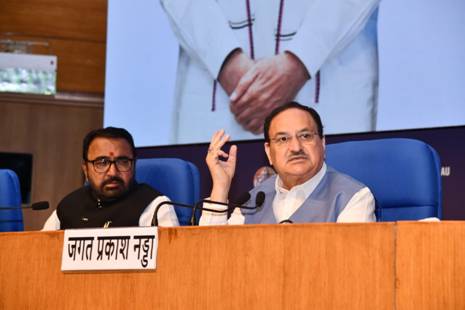
Union Minister of Health and Family Welfare, Shri Jagat Prakash Nadda highlighted the key achievements of the Union Health Ministry in the first 100 days of the government at a press conference, here today. Union Ministers of State for Health and Family Welfare, Shri Prataprao Ganpatrao Jadhav and Smt. Anupriya Singh Patel were also present.
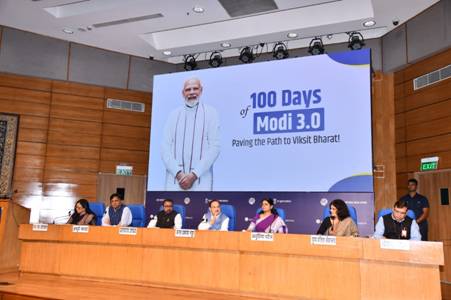
The Union Health Minister noted that around Rs.15 lakh crores of investment have been made in the last 100 days with speed and scale across different ministries. He noted that the Ministry of Health and Family Welfare has launched several key initiatives aimed at enhancing healthcare delivery and access in India. The following are some of the achievements made in the last 100 days across different health schemes:

Ayushman Bharat PM-JAY:

Shri Nadda said that the recent announcement of expansion of the Ayushman Bharat PMJAY scheme to include all senior citizens, irrespective of income group, aged 70 years and above will potentially benefit around 6 crore individuals across 4.5 crore families. Highlighting that Ayushman Bharat is the world’s largest publicly funded health coverage program, Shri Nadda informed that the expanded scheme will be implemented from October this year.

U-WIN Portal:

Another significant advancement is the U-WIN Portal which has been developed for full digitization of vaccination services for complete vaccination record of pregnant women and children from birth to 17 years under the Universal Immunization Programme. The citizen-centric services of the digital platform include ‘Anytime Access’ and ‘Anywhere’ vaccination services, Self-Registration by citizens using the U-WIN web-portal or the U-WIN citizen mobile application, automated SMS alerts, universal QR-based eVaccination Certificate and utility to create their Ayushman Bharat Health Account (ABHA) ID for themselves and Child ABHA ID for their children. The portal is in 11 regional languages including Hindi.
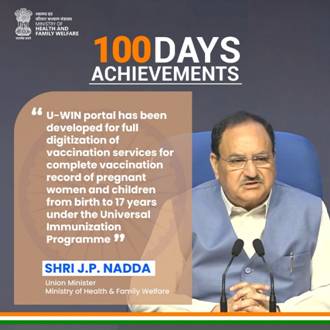
Stating that “the U-WIN portal has been developed for full digitization of vaccination services for complete vaccination record of pregnant women and children from birth to 17 years under the Universal Immunization Programme”, he informed that the portal is already operational on pilot basis. As on 16th September 2024, 6.46 crore beneficiaries have been registered, 1.04 crore vaccination sessions have been held and 23.06 crore administered vaccine doses have been recorded on the portal.

New TB Treatment Regimen & Made-in-India TB Diagnostics:

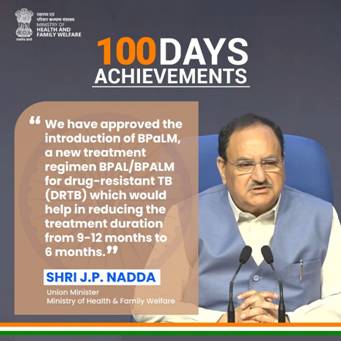
A shorter and more efficacious treatment regimen is now available for use under the National TB Elimination Programme (NTEP) which would help in reducing the treatment duration from 9-12 months to 6 months. It has been validated along with Health Technology Assessment (HTA) by ICMR. Shri Nadda informed that the Union Health Ministry in consultation with the State/UT governments is preparing a detailed rollout plan for logistics and training of health professionals for the introduction of this new regimen early next year. He also highlighted the expected reduction in duration of the treatment regimen in approximately 75,000 DRTB cases across the country.
In order to ensure country wide coverage for TB and Drug Resistance diagnosis by ‘state of the art’ molecular methods, a new indigenous diagnostic system (Patho detect) has been validated by ICMR, along with field feasibility. Shri Nadda stated that it would lead to reduction in turn-around times for test results, thereby reducing morbidity and mortality of TB patients.

Deployment of BHISM Cubes:

BHISHM Cubes are portable and rapidly deployable modular medical facility intended to provide emergency lifesaving clinical care in event of disaster/public health emergencies. Union Health Minister stated that BHISM cubes have the capacity to handle about 200 cases of diverse nature in emergency situations such as trauma, bleeding, burns, fractures, etc. In the 1st Phase, BHISHM Cubes will be placed in 25 AIIMS and Institutes of National Importance (INIs) for rapid deployment in the respective region in case of disaster / health emergencies. States may also deploy at strategic locations subsequently. India has gifted four BHISHM Cubes to Ukraine during the Hon’ble Prime Minister’s visit to the country recently.

Use of Drone Services:

Drones service aid in rapid, cost-effective and safe delivery of medical supplies and samples in hard-to-reach and tough terrains. Fifteen (15) AIIMS/INIs/NE institutions have been identified for Drone Services. Drone trials and trainings have been completed in 12 institutes. Shri Nadda said that drones provide safe, accurate reliable pickup & delivery of medicines, vaccines, blood, diagnostic specimens & other life-saving items to difficult-to-reach facilities.
Medical Education:

Increase in Medical Colleges:

The Union Health Minister said that the increase in medical colleges and MBBS and PG seats would lead to increase in the availability of doctors in the healthcare system.

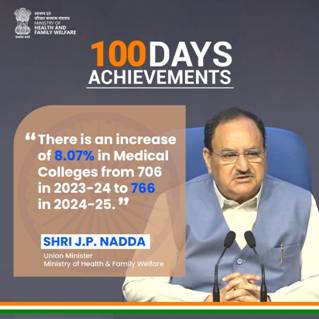
There is an increase of 8.07% in Medical Colleges from 706 in 2023-24 to 766 in 2024-25. There has been 98% increase in medical colleges from 387 in 2013-14 to 766 in 2024-25. During the same period, 379 new medical colleges have been established and, presently there are 766 (Govt: 423, Pvt: 343) medical colleges in the Country.

Increase in MBBS seats:

There is an increase of 6.30 % in MBBS seats from 1,08,940 in 2023-24 to 1,15,812 in 2024-25. MBBS Seats increased by 64,464 (i.e., 125%) from 2013-14 (51,348 seats) to 2024-25 (11,5812 seats).
Increase in PG seats:

There is an increase of 5.92% in PG seats from 69,024 in 2023-24 to 73,111 in 2024-25. During the last ten years, the number of PG seats increased by 39,460 (i.e., 127%) from 2013-14 (31,185 seats) to 2024-25 (73,111 seats).

Operationalization of National Medical Register:

National Medical Register (NMR) is a comprehensive dynamic database for all allopathic (MBBS) registered doctors in India. NMR is linked with Aadhaar ID of the doctors that ensures the individual’s authenticity.
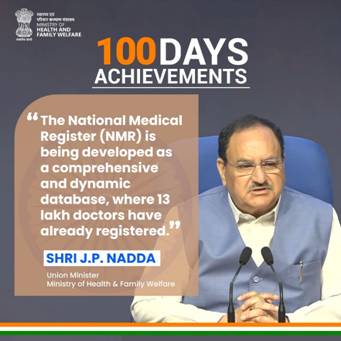
Shri Nadda said that NMR being a key component of the country’s Ayushman Bharat digital mission, it would be part of Healthcare Professional Registry (HPR). He further said that NMR will ensure provision of data covering details of around 13 lakh doctors in the country – State-wise, those who have left the country, those who have lost their license to practice, or details of doctors who have lost their lives.

National Quality Assurance Standards (NQAS):

Virtual National Quality Assurance Standards (NQAS) Assessment of Ayushman Arogya Mandir -Sub Centre:

NQAS are set of standards designed to ensure and improve the quality of healthcare services in District Hospitals, Community Health Centres, Ayushman Arogya Mandir – Primary Health Centre, Ayushman Arogya Mandir – Urban Primary Health Centre and Ayushman Arogya Mandir – Sub Health Centre.

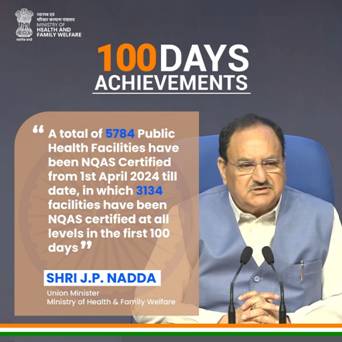
Shri Nadda said that as on 31st August 2024, 13,782 Public Health Facilities are NQAS Certified. A total of 5,784 Public Health Facilities have been NQAS Certified from 1st April 2024 till date, in which 3,134 facilities (including 2,734 Ayushman Arogya Mandir – Sub Centers) have been NQAS certified at all levels in the first 100 days.
The virtual National Quality Assurance Standards assessments for Ayushman Arogya Mandir-Sub Centres commenced on August 1st after requisite trainings. 58 assessments have been done, with 104 more assessments scheduled to take place by end of September, 2024. “This will give an impetus to ensuring Quality standards for all levels of public health care facilities improving comprehensive primary healthcare of citizens” Shri Nadda said.

National Quality Assurance Standards for Integrated Public Health Laboratories:

Release of NQAS for IPHLs spread across district level health facilities is aimed at improving the quality and competence of management and testing systems in IPHLs. This will positively impact the reliability of test results and enhance the quality of diagnostics & patient care.

Establishment of AIIMS in Darbhanga:

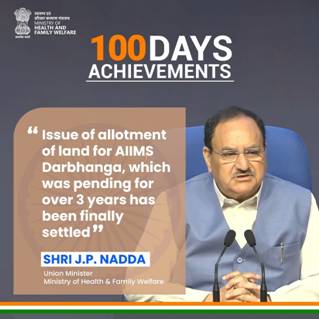
Union Cabinet has approved setting up of new AIIMS at Darbhanga on 15.09.2020 at an estimated cost of Rs. 1264 Crore. Shri Nadda  stated that the issue of allotment of land for AIIMS Darbhanga, which was pending for over 3 years has been finally settled and the Government of Bihar has allotted and since handed over 150.13 acres of land on 12.8.2024 required for AIIMS Darbhanga. He further noted that AIIMS institutions would serve to fill the gap in affordable tertiary healthcare services and reduce out of pocket expenditure.
Completion of Super Specialty Blocks:

Completion of construction works of Super Specialty Blocks (SSB) has been taken up as upgradation projects of existing Government Medical Colleges under PMSSY of four Government Medical Colleges in Bihar, these include:

  • Jawaharlal Nehru Medical College, Bhagalpur
  • Anugrah Narayan Magadh Medical College, Gaya
  • Sri Krishna Medical College, Muzaffarpur
  • Darbhanga Medical College and Hospital.

The launch of Super Specialty Blocks in Government Medical Colleges (Bihar) would serve to fill the gap in affordable tertiary healthcare services and reduce out of pocket expenditure, Shri Nadda highlighted.

Launch of Food Import Rejection Alerts:

The Union Minister also highlighted the introduction of the Food Import Rejection Alerts (FIRA), an online portal designed to notify the public and relevant food safety authorities about food import rejections at Indian borders and training of food street vendors by the FSSAI. The portal has been launched today at the second edition of the Global Food Regulators Summit 2024 hosted by FSSAI at Bharat Mandapam.
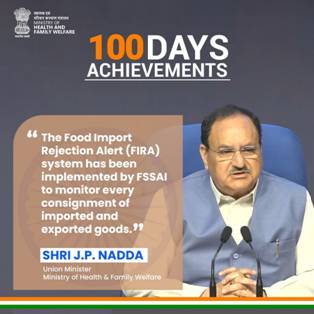
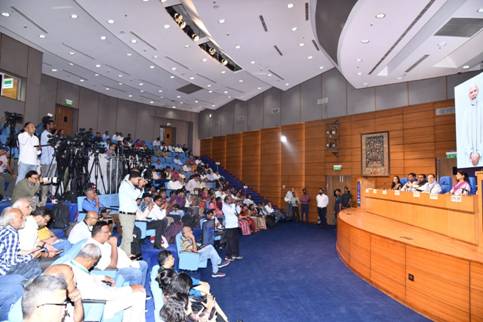
Shri Apurva Chandra, Union Health Secretary, Ministry of Health and Family Welfare; Smt. Punya Salila Srivastava, Officer on Special Duty, Ministry of Health and Family Welfare; Smt. LS Changsan, Addl. Secretary, Ministry of Health and Family Welfare; Shri Dhirendra Ojha, Principal DG, PIB, Ministry of Information and Broadcasting and senior officials of the Union Health Ministry were present on the occasion.
Union Home Minister interacts with victims of Naxalite violence from Chhattisgarh in New Delhi

| Published on:

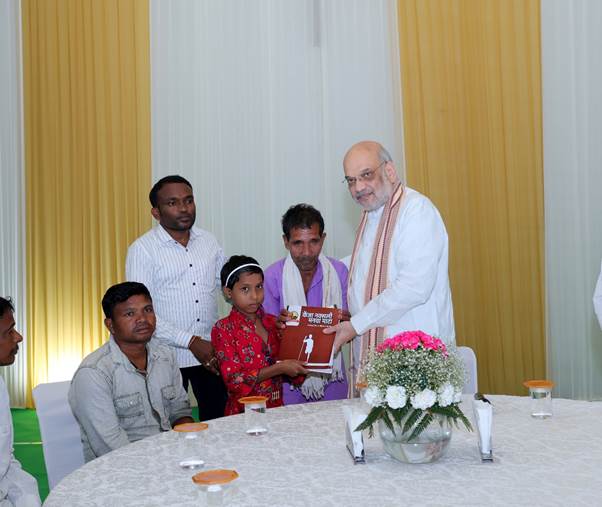
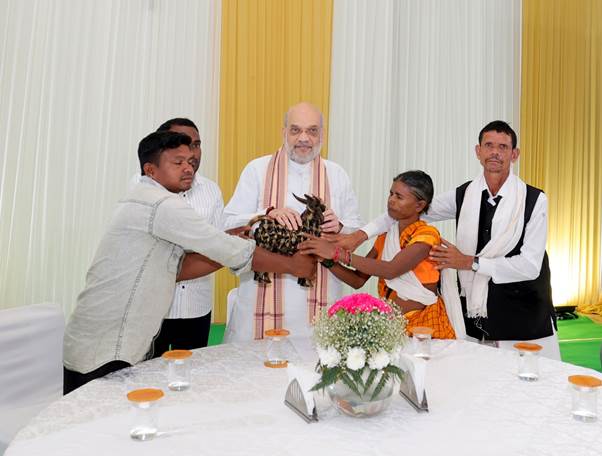
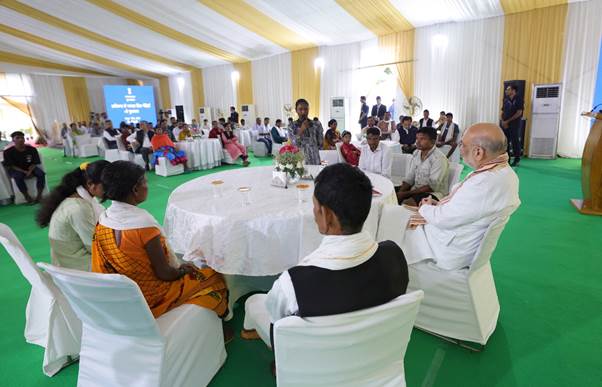
Union Home Minister and Minister of Cooperation, Shri Amit Shah interacted with victims of Naxalite violence from Chhattisgarh at his residence in New Delhi. These included 55 people affected by Naxalite violence from LWE-affected areas of Chhattisgarh under the aegis of Bastar Peace Committee.

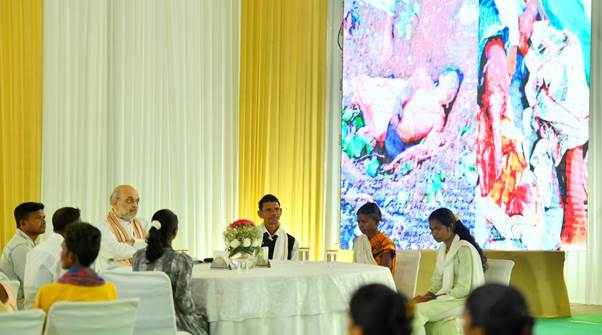
The Bastar Peace Committee also screened a documentary, highlighting the plight of people affected by Naxalism in Chhattisgarh. Some of the victims shared their plight with the Home Minister.

While interacting with the people suffering from Naxalite violence, Union Home Minister Shri Amit Shah said that under the leadership of Prime Minister Shri Narendra Modi, central govt is committed to completely eliminate Naxalism by March, 2026. He said that Due to the policies of Modi government, Left Wing Extremism has now been restricted to few districts in Chhattisgarh. Shri Shah said that Naxalism is a threat to both, humanity and the internal security of the country.

Shri Amit Shah further stated that under the leadership of Prime Minister Shri Narendra Modi, the Government of India and the Government of Chhattisgarh will bring a comprehensive scheme for the overall development of people affected by LWE in the next three months. He said that through this plan, people affected by Left Wing Extremism across the country, including Chhattisgarh, will benefit from healthcare facilities, employment opportunities, and other welfare schemes.

Union Home Minister said that through developmental schemes in Left Wing Extremism affected areas, the Modi government has given a message to the Naxalites that the one who saves is greater than the one who kills. Union Home Minister said that those advocating the human rights of Naxalites should also consider the human rights of those who suffer because of Naxalism.

Home Minister appealed to Left Wing Extremists to abjure the path of violence and join the mainstream of society. He expressed confidence that with the complete elimination of Left Wing Extremism by March 2026, Bastar will once again become beautiful, peaceful and developed.

Congress, NC, PDP are responsible for ruining of Jammu & Kashmir: PM Modi

| Published on:

Prime Minister Narendra Modi addressed massive gatherings at Srinagar and Katra in Jammu & Kashmir, emphasizing the region’s rapid development and progress. “This is the new Jammu and Kashmir,” he said, highlighting the large turnout of young people, the elderly, mothers, and sisters. “Our goal is the rapid development of Jammu and Kashmir,” he added.

PM Modi congratulated the people of Jammu and Kashmir on the successful first phase of voting in seven districts, which took place without the shadow of terrorism. “This is a matter of happiness and pride for all of us, that so many people came out to vote,” he said, citing voting percentages of over 80% in Kishtwar, 71% in Doda, 70% in Ramban, and 62% in Kulgam. “Today, the world is watching how the people of Jammu and Kashmir strengthen India’s democracy. For this, I congratulate the people of Jammu and Kashmir,” PM Modi added.

PM Modi criticized the three families that have ruled Jammu and Kashmir, saying they have “crushed both democracy and the cultural essence of Kashmir.” He accused them of depriving the people of their rightful entitlements and promoting violence and chaos. However, he noted that the youth of Jammu and Kashmir are now challenging these families and rising against them.

“The three families were responsible for the ruin of Jammu and Kashmir. These people have been rattled from Delhi to Srinagar. These three families think that no one can question them. They believe that grabbing power and looting you is their birthright. These families have always deprived the people of Jammu and Kashmir of their rightful entitlements, and this has been their political agenda. They only gave Jammu and Kashmir violence and chaos. But now, Jammu and Kashmir will no longer be under the grip of these three families. Now, the youth of Jammu and Kashmir are challenging them. The same youth they held back are now rising against them,” said the Prime Minister.

Taking a sharp dig at Congress and PDP, PM Modi said, “They sold hatred for decades to keep their political shops running. The same fires that burned schools in Kashmir were stoked by their market of hatred. They did not build new schools and gave shelter to those who set schools on fire. You remember the time when even the schools that survived the fires couldn’t operate for months. Our youth were kept away from education, while these three families rejoiced in handing them stones. For their selfish gains, they ruined the future of our children.”

The Prime Minister highlighted his government’s efforts to provide education and employment opportunities to the youth. “In the past five years, around 50,000 children whose education had been interrupted were re-enrolled in school,” he said. Additionally, 250 schools are being upgraded to PM Shri Schools, and numerous degree colleges, and engineering and polytechnic colleges have been built.

“These three families have crushed both democracy and the cultural essence of Kashmir. Think about what they did in the 1980s. They treated the politics of Jammu and Kashmir as their fiefdom. They did not want anyone else to rise politically, otherwise, why would they have halted the elections for Panchayats, BDCs, and DDCs? They feared that new leaders would emerge and challenge their family rule,” said PM Modi highlighting Congress, NC and PDP’s misrule in the state.

Underscoring the government’s dedication to the development and progress that Jammu and Kashmir achieved, PM Modi said, “The Kashmir Valley is now connected by rail. This will benefit apple farmers and other fruit and vegetable growers. Your produce will reach major markets across the country at lower costs. Increased connectivity will boost the tourism sector, and new factories, industries, and businesses will be established here.”

PM Modi emphasized the improved security situation in Jammu and Kashmir, citing the successful organization of events like the G-20 summit, sports car racing, and Khelo India Winter Games. He also highlighted the increased connectivity, including the rail link to the Kashmir Valley, which will benefit farmers and boost tourism.

The Prime Minister outlined the BJP’s plans for the poor, farmers, youth, and women, including increased financial support and access to free healthcare. He also reiterated the party’s commitment to restoring Jammu and Kashmir’s statehood. He said, “In Jammu and Kashmir, we are focused only on development and rapid progress. Today, new playgrounds have been built for children. The new Habba Kadal Bridge, the renovated Zero Bridge and Abdullah Bridge, the Wayil Bridge in Ganderbal, the beauty around Dal Lake and Jhelum, electric buses running on the streets of Srinagar, and the bustling Polo View market, all these are signs of the new and improved Jammu and Kashmir.”

During his second address in Katra, Jammu and Kashmir, PM Modi emphasized the need for change, citing the failures of Congress, NC, and PDP in the region over the years. “These elections are about choosing the future of Jammu and Kashmir. They are about building a stronger and newer Jammu and Kashmir,” said PM Modi. He added that the Congress-NC-PDP alliance represents “Three families who have inflicted wounds and caused pain to this region for decades” and called for an end to their political legacy.

Referring to recent remarks made by Congress leaders, the Prime Minister remarked, “Congress has always been willing to gamble with our faith and culture for a few votes.” He criticized the Congress’ stance on religious traditions, labelling it a reflection of their “Naxalite ideology” and foreign influences. Also, PM Modi showcased the BJP government’s achievements in the region, highlighting infrastructure projects, including the construction of the Chenab Bridge, which is now an iconic symbol of Jammu’s progress. “You entrusted this task to Modi and the BJP. Today, this magnificent bridge is not only a convenience but also an attraction,” he said, adding that it is now internationally recognized, with people talking about it in the same breath as Paris’ Eiffel Tower.

Highlighting the boost to tourism, PM Modi spoke of the large influx of tourists and pilgrims to the region, including the 95 lakh pilgrims who visited Mata Vaishno Devi last year. He noted, “This has benefited small shopkeepers, fruit vendors, farmers, and auto and taxi drivers alike.” PM Modi also celebrated the recent GI tag given to Udhampur’s ‘Kaladi,’ a local cheese, which will increase demand and provide new opportunities for local farmers and weavers. “I am happy that during the BJP government, Udhampur’s “Kaladi’ received a GI tag,” said the Prime Minister.

PM Modi reiterated his commitment to providing better opportunities for the youth of Jammu and Kashmir, referencing the successes of para-athletes from the region. The Prime Minister reaffirmed the BJP’s stance on Article 370, condemning efforts by Congress, NC, and PDP to restore the provision. He emphasized, “We will not let Pakistan’s agenda be implemented in Jammu and Kashmir. No power in the world can bring back Article 370.”

In his closing remarks, PM Modi assured voters that the BJP remains committed to making Jammu and Kashmir a state again, a promise made in Parliament. He called on the people to support the BJP on September 25.

BJP National President launches ‘Sankalp Patra’ for the Haryana Assembly Election

| Published on:

Hon’ble National President of Bharatiya Janata Party Shri Jagat Prakash Nadda released the party’s manifesto for the upcoming assembly elections at the state media center in Rohtak, Haryana on Thursday. Shri Nadda highlighted the development work done by the Modi government in Haryana over the past 10 years. During the event, Haryana CM Shri Nayab Singh Saini, State BJP President Shri Mohan Lal Badoli, former Haryana CM and Union Minister Shri Manohar Lal Khattar, Union Ministers Shri Rao Inderjit Singh and Shri Krishan Pal Gurjar among other leaders were present.

Shri Nadda stated that the Congress has diminished the significance of the manifesto in the eyes of the people. For them, the manifesto is merely a formality and a tool for deceiving the public. 10 years ago, Haryana was characterized by a culture where jobs were secured through bribery and influence by ‘Parchi aur Kharchi’. The employment scam embroiled many leaders from the ruling party, some of whom faced legal punishment. Haryana was also notorious for land scams at the time, where farmers’ lands were forcibly acquired at minimal prices and resold at massive profits. The real manifesto of Congress was embodied in these land scams, where farmers were exploited and the government, at that time, was synonymous with corruption.

BJP National President stated that the party is dedicated to the vision of ‘Nonstop Haryana,’ with both the leadership and workers committed to ensuring that this momentum continues. He highlighted the seriousness of their Sankalp Patra by emphasizing, “We have fulfilled every promise we made in the Sankalp Patra, fulfilled even those we didn’t promise and will deliver on every future promise as well.”

BJP National President Shri Nadda highlighted the significant changes Haryana has undergone in recent years. In 2014, the state’s per capita income was ₹1.37 lakh, which has now almost doubled to ₹3 lakh. In terms of exports, Haryana’s figures have soared from ₹6,000 crore to over ₹2.5 lakh crore. The number of medical colleges has increased from 7 to 15, and medical seats have risen from 700 to more than 2,185, nearly tripling. Additionally, while only 538 villages had 24-hour electricity before 2014, today, 5,800 villages enjoy a 24-hour electricity supply.

Shri Nadda emphasized that farmers have a significant role in Haryana. Whereas Congress leaders engage in politics under the guise of caring for farmers, merely shedding crocodile tears. Under the Congress government, crop compensation in Haryana was ₹1,158 crores, whereas during the Bharatiya Janata Party’s administration, it soared to ₹12,500 crores—an increase of ten times. The crop damage compensation was previously ₹6,000 per acre, which has been increased two and a half times to ₹15,000 per acre during the BJP government. The old age pension has been tripled, it used to be ₹1,000 and is now ₹3,000. MSP was previously available for only 8 crops, while the Congress party didn’t provide MSP for more than 8 crops over the years. The BJP government has ensured MSP for 24 crops. The BJP has delivered on its promises and exceeded expectations.

BJP National President Shri Nadda highlighted that the BJP has fully implemented the manifestos from 2014 and 2019 before presenting itself to the people of Haryana. The BJP initiated a culture of accountability through report cards. Ten years ago, did any leader ever present their data or report card to the public? Today, however, the BJP is putting its report card before the people of Haryana. Under the ‘Har Khet Ko Pani’ scheme, every field has been fully irrigated. This represents the transformation of Haryana. The BJP has worked to change the image and fate of farmers. Additionally, interest-free agricultural loans will be provided to 300,000 farmers. Additionally, a plate of food will be provided for farmers in the mandis at a cost of ₹10.

Shri Nadda emphasized that significant infrastructure developments have taken place. The Delhi-Sonipat Regional Rapid Transport System has been launched and India’s first elevated railway line has been constructed in Rohtak. An airport has been built in Hisar, with air services to Delhi, Jaipur, Jammu and Dehradun now operational. Additionally, over 1,000 sports nurseries have been established and the Haryana Startup Mission has also been initiated.

BJP National President Shri Nadda highlighted that several initiatives have been implemented for the developmental welfare of women. The annual income limit for the Vivah Shagun Yojana has been increased to ₹1.8 lakh to enable more women to benefit from the scheme. Hon’ble Prime Minister Shri Narendra Modi Ji has quadrupled tax devolution for Haryana, providing ₹76,000 crores. Grant-in-aid has also been raised to ₹70,000 crores, a 3.5 times increase. Additionally, under the smart city projects, ₹15,000 crores have been allocated to Faridabad and Karnal. The Haryana government has made arrangements to ensure that every household receives a water supply under the Jal Jeevan Mission, fulfilling its commitments.

Shri Nadda stated that the development of infrastructure in Haryana is visible. Today, the foundation stone for IIT Delhi has been laid and an extended building program for the AIIMS cancer center has been initiated in Jhajjar. A yoga and naturopathy center has also been opened in Jhajjar. Additionally, work has started on AIIMS Rewari and the metro project in Gurgaon has commenced with an investment of ₹5,450 crores. Under the HIRA (Highways, Internet, Railways, Airports) initiative Haryana has seen significant development. The Delhi-Mumbai Expressway, Delhi-Katra Expressway, Ambala-Kotputli Corridor and Amritsar-Bhatinda-Jamnagar Expressway all pass through Haryana, contributing greatly to transformative development in the state.

BJP National President Shri Nadda highlighted that India’s railways have been fully electrified and the railway budget has been increased nine times than before. The Western Dedicated Freight Corridor has been initiated from Rewari and over 6,000 villages have been connected with optical fiber. Hisar Airport has also been operationalized. The Sankalp Patra is a commitment from the party that will be fulfilled when they form the government again. In line with this, the party has decided to provide financial assistance of ₹2,100 per month under the Lado Laxmi Yojana. On the lines of IMT Kharkhoda, the Haryana government plans to establish 10 most-modern industrial cities, providing employment opportunities to over 50,000 youths from nearby villages. The Chirayu Ayushman scheme’s coverage will be increased from ₹5 lakh to ₹10 lakh annually, with an additional ₹5 lakh provision for people over 70 years old. The MSP for 24 crops will be maintained and 2 lakh youths will be offered government jobs transparently, without any cost. Furthermore, 5 lakh youth will be given alternative employment opportunities and 5 lakh houses will be constructed for people belonging to BPL in both urban and rural areas.

Shri Nadda mentioned that government hospitals will offer free dialysis and both government and private hospitals will provide free health checkups. Olympic nurseries will be developed in each district. Under the Har Ghar Grihini Yojana, BPL families will continue to receive LPG cylinders for ₹500, while college girl students will be given scooters under the Awwal Balika Yojana. The BJP will also guarantee jobs to youths recruited under the Agniveer scheme in Haryana. Lastly, the construction of the Orbital Rail Corridor along the KMP expressway will be completed. 

BJP National President Shri Nadda announced that Vande Bharat trains will be started from Palwal, Jhajjar, Bahadurgarh and Kharkhoda to Chandigarh and Mathura. Under the Rapid Rail Transport System, rapid rail services will start from Delhi to Palwal, Dharuhera, Rohtak and Panipat with Central government assistance. Intercity Metro services will also be extended from Bata Chowk to Sector 56, Gurugram. A separate welfare board will be established for 36 backward communities, offering them financial assistance. The social monthly pension will be increased based on a scientific DA-pension formula. OBC, SC and ST students will receive full scholarships to pursue medical and engineering degrees. Additionally, the Haryana government will provide a ₹25 lakh interest-free loan for entrepreneurs from backward communities to promote their business ventures

BJP National President Shri Jagat Prakash Nadda emphasized that Haryana will be developed as a Global Education Hub, integrating artificial intelligence into the education model to ensure advanced learning. He also announced the creation of an international safari over 10,000 acres of Aravali jungles in South Haryana to boost tourism. BJP has presented 20 key Sankalps to the public and will continue to advance the state’s progress under the motto of ‘Nonstop Haryana.‘ Shri Nadda urged the public to support the BJP to ensure the government’s continued commitment to development in the state.

India is now seen as a preferred security partner in Indian Ocean Region: Raksha Mantri

| Published on:

Raksha Mantri Shri Rajnath Singh addressed the second edition of Naval Commanders’ Conference ‘24 in New Delhi on September 19, 2024. He commended the Indian Navy for playing a crucial role in promoting peace and prosperity in the Indian Ocean, terming the region as valuable & sensitive in view of the economic, geopolitical, trade and security aspects.

Pointing out that India was once a landlocked country with sea shores, but now it can be seen as an island country with land borders, the Raksha Mantri lauded the Indian Navy’s readiness towards safeguarding the maritime interests of the country, which has resulted in establishing its credibility as the first responder in the region.

“A large part of the world’s trade passes through the region, which makes it valuable. At the same time, incidents like piracy, hijacking, drone attacks, missile attacks and disruption of sea cable connections in the seas make it extremely sensitive. Our Navy has made a significant contribution in protecting the economic interests of all stakeholder nations of Indo-Pacific and in smooth movement of goods in the Indian Ocean region. Its anti-piracy operations are garnering appreciation not only in India but also globally. India is now seen as a preferred security partner in this entire region. Whenever need be, we will ensure security in the region,” Shri Rajnath Singh said.

The Raksha Mantri asserted that the Indian Navy’s growing strength in the Indo-Pacific region should not be taken for granted and called upon the Commanders to continue introspection from time to time, and be prepared for every situation in today’s volatile global scenario. He emphasised on the need of a strong naval capability to protect the economic, trade, transport and overall national interests.

Shri Rajnath Singh reiterated Prime Minister Shri Narendra Modi-led Government’s endeavour to make the Indian Navy more potent by inducting state-of-the-art ships, submarines etc. for its capability development, with focus on being Aatmanirbhar. He highlighted that 64 ships and submarines are currently under construction in Indian shipyards, and orders have been placed for 24 additional platforms.

The Raksha Mantri added that, in the last five years, more than two-third of the Navy’s modernisation budget has been spent on indigenous procurement, resulting in accelerated development of the domestic defence ecosystem. While Shri Rajnath Singh praised the Navy’s indigenisation efforts, he exhorted the Commanders to explore ways to further strengthen the resolve of achieving ‘Aatmanirbharta’. He exuded confidence that the vision to transform the Navy from a ‘Buyer’ into a ‘Builder’ will be helpful in making it fully self-reliant by 2047.

The Raksha Mantri also spoke on the significance of jointness and optimum utilisation of resources. He stated that while Indian Navy and Indian Coast Guard have their own strengths, mandates & ways of working, there is need for more coordination to strengthen the maritime security of the country.

On the occasion, Shri Rajnath Singh also attended a Tech Demo, organised as part of the event. Various agencies, including Navy’s premier R&D organisation Weapons & Electronics Systems Engineering Establishment showcased indigenous solutions, including Autonomous Systems, domain awareness, software defined radios and other niche tech initiatives. Chief of Defence Staff General Anil Chauhan, Chief of the Naval Staff Admiral Dinesh K Tripathi, Defence Secretary Shri Giridhar Aramane and other senior civil & military officials were present on the occasion.

The conference is the apex-level biannual event facilitating deliberations on significant strategic, operational and administrative issues among the Naval Commanders. Held against the backdrop of evolving geopolitical and geostrategic dynamics, regional challenges and complexity in maritime security situation in West Asia, the conference plays a crucial role in shaping future course of the Indian Navy.

The conference, as a pivotal platform, upholds the Navy’s commitment to safeguard India’s maritime interests and the Navy’s status as a ‘combat ready, credible, cohesive and future ready force’.