BJP is only party that expands its work by following democratic processes in letter and spirit: PM Modi

| Published on:

Prime Minister Narendra Modi attended and addressed the BJP Rashtriya Sadasyta Abhiyan at BJP headquarters in New Delhi. He emphasized the party’s ongoing commitment to fostering a new political culture in India.

Addressing the event, PM Modi outlined the distinctiveness of the BJP in the Indian political landscape, underscoring its adherence to democratic values and internal democracy. “From the days of the Bharatiya Jana Sangh to the present, we have strived to bring a new political culture to the country,” PM Modi stated.

He highlighted that for any political organization entrusted with power by the people, it is essential to embody and nurture democratic values internally. “BJP is the only party that expands its work by following democratic processes in letter and spirit, as per the constitution of our party, continuously making itself capable of living up to the hopes and aspirations of the common people,” said PM Modi.

Reflecting on the historical journey of the BJP, PM Modi recalled the early days when party workers, with unwavering dedication, would paint lotus symbols on walls, signifying their commitment and belief. “We are those people who painted lotus on the walls with devotion because we believed that the lotus painted on the walls will someday be painted on the hearts too,” said PM Modi. Even today, in some states, Bharatiya Janata Party workers live the same life and fight for their ideals, he added.

Mentioning the 33% reservation for women in assemblies and Parliament, PM Modi also suggested that the Sadasyta Abhiyan should focus on including individuals who can help maximize the success of women candidates in the Party.

While concluding his address, PM Modi underscored the commitment and emotion behind the ‘Sadasyta Abhiyan’, and said, “This ‘Sadasyta Abhiyan’ isn’t just a ritual. It’s an expansion of our family. It isn’t a game of numbers. It doesn’t matter the numbers we achieve. This membership drive is an ideological and emotional movement.


BJP is the only party that operates in strict adherence to its organizational constitution: Jagat Prakash Nadda

| Published on:

On the occasion of the launch of Rashtriya Sadasyata Abhiyan 2024 at the “Sangthan Parv” by Hon’ble Prime Minister Shri Narendra Modi, BJP National President Shri Jagat Prakash Nadda addressed the program at BJP Central Office on Monday. Shri Nadda outlined the phases of the campaign and reaffirmed to achieve the target of membership drive. Hon’ble Prime Minister Shri Narendra Modi ji was the first to take membership of BJP under this campaign through a missed call. The event was graced by prominent leaders including Hon’ble Prime Minister Shri Narendra Modi Ji, Defense Minister Shri Rajnath Singh, Home Minister Shri Amit Shah, and other officials.

Shri Nadda on this auspicious occasion of ‘Sangathan Parv’ welcomed Hon’ble PM Shri Narendra Modi Ji, Defence Minister Shri Rajnath Singh, Union Home Minister Shri Amit Shah, and all other leaders and the Karyakartas across the nation. Shri Nadda praised Hon’ble PM Shri Narendra Modi Ji, referring to him as the ‘Pradhan Sevak’ of the nation, who has led 140 crore people with dedication and selflessness in administration. He emphasized that even with such a commitment to governance, Hon’ble PM Shri Narendra Modi Ji remains ideal for all, reminding everyone that ‘Sangathan Sarvopari hai’ (the organization comes first). 

 BJP National President Shri Nadda highlighted that Hon’ble PM Shri Narendra Modi Ji has always prioritized the needs of the organization, ensuring his presence and support even during his busiest days. His commitment and dedication have been instrumental in the continuous development and growth of the party. Under the leadership of Shri Amit Shah, when he served as the National President of the party, the BJP prioritized the Membership Program. He emphasized that the organization would modify its approach to include a larger number of individuals eager to join and work with the BJP. Several workshops were held in different parts of the country, including remote areas, to engage with a broader audience. During these workshops, it was decided that the party would introduce a digital membership program. The membership program ran for over six months, and as a result, the BJP surpassed its milestone goal of enrolling 10 crore members.

 Shri Nadda observing the dedication of the Karyakartas and the immense support from the people for the Prime Minister and their commitment to the BJP, expressed confidence that the party will once again to achieve the target of membership drive. There are over 1,500 small and large political parties in India, each operating in its unique style. However, the BJP is the only party that operates in strict accordance with the values embedded in our constitution. Even after reaching 18 crore members, each party member must renew their membership every six years as mandated by Article 9 of the constitution. With the current membership drive underway, members will once again renew their association with the party, and we anticipate surpassing the 10 crore membership mark.

BJP National President Shri Nadda highlighted that the BJP is the only party where the membership drive operates from state and district to Shakti Kendra, booth, and Mandal levels. The BJP functions democratically, declaring that after the first and second phases of the membership drive, there will be an active membership phase. Following this, elections will be conducted at the Mandal, district, state, and central levels. This approach ensures transparency, which is why, upon reaching 10 crore members, the party announced the dates for the electoral process at each booth.

 Shri Nadda stated that the first phase of the membership drive, led by Hon’ble Prime Minister Shri Narendra Modi Ji, starts today and will conclude on September 25. The second phase will run from October 1 to October 15. Active membership registration will take place from October 16 to October 31, and only active members will be eligible to contest in the elections, as per the constitution. The membership drive aims to surpass 10 crore members. Over the past month, BJP Karyakartas have meticulously planned the drive, deciding whether it will be digital or involve physical slips. Shri Nadda outlined the comprehensive planning behind the membership campaign. Following the national workshop on August 17, state-level workshops took place from August 19 to 21. District-level workshops were conducted in 777 districts, with approximately 11,486 workshops completed at the divisional level. By August 31, workshops had also been held at over 4 lakh booths.

 BJP National President Shri Nadda mentioned that there are floods in many states, and agitations are ongoing in various regions, so the membership drive in these areas will begin with some delay. However, this is an ongoing process. BJP membership will be available through multiple channels, including missed calls, WhatsApp, the official website, QR codes, the Namo App, and party slips. With these efforts, BJP aims to surpass the target of over 10 crore members. Shri Nadda assured the Hon’ble Prime Minister Shri Narendra Modi Ji that just as the Prime Minister is tirelessly working towards the goal of a Viksit Bharat, every party karyakrtas will fully contribute to making this program a reality and fulfilling the resolution of a Viksit Bharat.

The BJP is the only party that has consistently maintained the tradition of conducting a membership campaign: Amit Shah

| Published on:

On the occasion of the launch of Rashtriya Sadasyata Abhiyan 2024 at the “Sangthan Parv” by Hon’ble Prime Minister Shri Narendra Modi, Senior BJP Leader and Union Home Minister & Minister of Cooperation Shri Amit Shah addressed the program at Central office on Monday. During the address, Shri Shah stated that in the BJP, a worker is not just a member but a vibrant entity, a carrier of ideology, a nurturer of work culture, and a link between the government and the organization, ensuring that the government remains connected with the people. The BJP is not only the largest political party in the world but also the most unique. It is the only party that conducts its membership drive every 6 years. Hon’ble Prime Minister Shri Narendra Modi ji was the first to take membership of BJP under this campaign through a missed call. During the event, Hon’ble Prime Minister Shri Narendra Modi Ji, BJP National President Shri Jagat Prakash Nadda, Union Defence Minister Shri Rajnath Singh, and other party leaders and officials were present on stage.

Shri Shah stated that today is an auspicious day for all BJP karyakartas and well-wishers of the Bharatiya Janata Party across the country. With the Hon’ble Prime Minister Shri Narendra Modi Ji renewing his membership today, the BJP’s 2024 membership drive will once again commence. BJP is not only the largest political party in the world but also the most unique among political parties. Today, there are over 1,500 parties on India’s political map, yet none of them conduct their membership drives in a democratic, open and consistent manner every six years. Only the BJP has upheld this tradition and continually advanced it. 

Senior BJP Leader Shri Shah emphasized that BJP karyakartas will renew their membership from the start to the conclusion of the membership drive. Many well-wishers of the Bharatiya Janata Party will become party karyakartas and gradually integrate into the party. In BJP, a karyakarta is not just a member but a vibrant entity, a carrier of ideology, a nurturer of work culture and a link between the government and the organization. This connection ensures that the government remains consistently connected with the people.

Shri Shah stated that the dream of building a strong and prosperous India will be fulfilled due to the connection BJP karyakartas have with the people. This journey began in 1950 when the BJP was a small entity. From being a small unit to becoming the nation’s largest party, the BJP has challenged its opponents in every election with the chant of “Bharat Mata Ki Jai.” This enthusiasm comes only from a vibrant organization. At the start of the membership drive, a workshop was held where I stated that the BJP’s membership drive should be all-encompassing and inclusive. No booth should be left untouched. Inclusivity means that the membership drive should move forward with the goal of including every individual from every age group, community, caste, and religion into the BJP. A strategic plan has been created for the membership drive, and just like in 2014, the BJP will surpass the goal of the membership drive. 

Senior BJP Leader Shri Shah stated that the BJP has always moved forward with a clear ideology and began its work in politics based on that ideology. Bharatiya Janata Party has faced many years of struggle, witnessed several defeats, endured crushing losses, and also experienced victories, but the party has consistently continued its work. In the past 10 years, under the leadership of Hon’ble Prime Minister Shri Narendra Modi Ji, the BJP government has provided 60 crore poor people with houses, electricity, ration, gas and health services up to ₹5 lakh. Whether it’s rural development, urban development, energy, space, digitization, strengthening infrastructure, internal and external security, healthcare, or introducing a new education policy, the country has achieved new heights in every field over the last decade and secured its place in the world. This is a matter of pride for all BJP karyakartas. Over the past 10 years, under the leadership of Hon’ble Prime Minister Shri Narendra Modi Ji, many long standing issues in the country have been resolved. Whether it’s the construction of the Ram Mandir, the abrogation of Article 370, the introduction of the UCC, the abolition of triple talaq, or the creation of the Kashi Vishwanath Corridor, all these tasks have been accomplished under the leadership of Hon’ble Prime Minister Shri Narendra Modi Ji.

Shri Shah stated that in the history of the BJP, it was under the leadership of Hon’ble Prime Minister Shri Narendra Modi Ji that the work of building the organization and institutionalizing membership was done. In the 1980s, when Shri Narendra Modi was the Organization Secretary in Gujarat, slips were not registered. Hon’ble Prime Minister Shri Narendra Modi Ji traveled day and night for 45 days during that time to institutionalize the membership drive. Every member’s data was registered, and the organization in Gujarat was strengthened. Energizing the organization is the responsibility of all party workers and office bearers.

Senior BJP Leader Shri Shah remarked that today, BJP National President Shri Jagat Prakash Nadda has set the party’s membership target publicly. The membership drive will be completed, a new organization will be established and then the campaign for ‘Bharat Vijay’ and ‘Bhajpa Vijay’ will begin once again. Hon’ble Prime Minister Shri Narendra Modi Ji has presented the vision of ‘Mahan Bharat Viksit Bharat’, with the dream of making India the foremost in every sector by the centenary of our independence. Everyone must work together to expand the BJP family by reaching every street, home, village, city, mountain, forest and island, and by engaging with every corner of the country. Every karyakarta should bring new energy to the party and familiarize people with the party’s work culture.  

Shri Shah expressed confidence that the crores of BJP karyakartas will make this campaign successful and realize the dream of ‘Mahan Bharat Viksit Bharat’, as envisioned by Hon’ble Prime Minister Shri Narendra Modi Ji, through the organization’s efforts.

Rajasthan Chief Minister calls on Prime Minister

| Published on:

Chief Minister of Rajasthan, Shri Bhajanlal Sharma called on the Prime Minister, Shri Narendra Modi today.

The Prime Minister’s Office posted on X:

“Chief Minister of Rajasthan, Shri Bhajanlal Sharma, met Prime Minister Narendra Modi.”

PM addresses Economic Times World Leaders Forum in New Delhi

| Published on:

The Prime Minister, Shri Narendra Modi addressed the Economic Times World Leaders Forum in New Delhi today.

Addressing the gathering, the Prime Minister expressed confidence that wonderful discussions would have taken place at the Economic Times World Leaders Forum for the bright future of the country and underlined that these discussions are happening at a time when the world has its trust in India.

The Prime Minister remarked that India is writing a new success story today and the impact of reforms can be witnessed through the performance of the economy. He emphasized that India has at times performed better than expectations. The Prime Minister pointed out that India’s economy grew 90 percent during the last 10 years while the global economy grew 35 percent. He credited this to achieving sustained growth as promised and assured that it will continue in the future.

Highlighting the all-round changes brought about by the government for the betterment of the people in the past years, the Prime Minister stated that the efforts have touched upon the lives of crores of citizens. “It is the Government’s resolve to deliver good governance to the people”, PM Modi said, “Reform, Perform and Transform has been our mantra.” The Prime Minister said that the people of India have witnessed the government’s spirit of service and the achievements of the country in the past 10 years. Therefore, the Prime Minister said, the people of India are filled with new beliefs. Belief in themselves, the progress of the nation, policies, decisions and intentions of the government, he added. Throwing light on the elections taking place in different parts of the world, the Prime Minister stated that people have voted for change in most cases, while governments of several countries had to face difficulties. On the contrary, he said that Indian voters for the first time in 60 years gave a hattrick to any government. The Prime Minister reiterated that the aspirational youth and the women of India have voted for continuity, political stability and economic growth as he thanked them for their support.

“India’s progress is becoming part of global headlines”, underlined the Prime Minister. Although statistics have their own importance, Shri Modi remarked that it was equally relevant to see how many lives have been transformed. He added that the secret of India’s future is hidden in the latter. “25 crore people have moved out of poverty in the last decade and have created a Neo-Middle Class”, emphasized Shri Modi. He further added that the speed and scale of this was historic and had never happened in any democratic society in the world previously. Shri Modi explained that this change was possible due to a change in the Government’s approach towards the poor. He added that despite having aspirations and fighting spirit, the poor faced many obstacles like a lack of basic facilities. The Prime Minister remarked that the Government chose the avenue of empowerment of the poor by removing their obstacles and supporting them. This path, he said, had led to the transformation of the lives of the poor with benefits such as digital transactions and guarantee-free loans. He added that today many poor are becoming entrepreneurs and with the help of connectivity and devices, they are now becoming ‘better-informed citizens’. Shri Modi emphasized that the people who are moving out of poverty have a strong desire for progress and their aspirations have led to the development of new infrastructure. He added that while their creativity was carving out new paths of innovation, their skills were shaping the direction of the industry, their needs were shaping the direction of the market and their income growth was boosting demand in the market. “The neo-middle class of India is proving to be the biggest force for the country’s progress”, praised Shri Modi.

Recalling the day of the election results when the Prime Minister had spoken about working at three times the pace in the government’s third term, he assured that the intentions are even stronger today. He underlined that the government, just like citizens, is filled with new beliefs and hope. Noting that the government’s third term is yet to complete 100 days, PM Modi highlighted the emphasis on modernizing physical infrastructure, expanding social infrastructure and carrying forward with reforms. In the last 3 months, the Prime Minister said, the government has taken many big decisions for the poor, youth, women and farmers. Listing the recent achievements, the Prime Minister mentioned 3 crore pucca houses for the poor, Unified Pension Scheme, 1 lakh crore fund for expansion of agricultural infrastructure, launch of better quality variants of multiple seeds for farmers, PM Package worth Rs 2 lakh crore which directly benefits more than 4 crore youth, and 11 lakh new Lakhpati Didis from rural backgrounds. Referring to Lakhpati Didi program, Shri Modi said that it has played a huge role in the financial empowerment of women.

Prime Minister Modi mentioned visiting Palghar in Maharashtra yesterday to lay the foundation stone for Vadhvan Port worth more than Rs 75,000 crore. He also spoke about the decision to develop 12 new industrial cities with an investment of Rs 30,000 crore three days ago, construction of 9 high-speed corridors worth more than Rs 50,000 crore and expansion of Pune, Thane and Bangalore Metro with Rs 30,000 crore. He informed that the construction of one of the world’s highest tunnels has started in Ladakh.

The Prime Minister mentioned marking a significant milestone in India’s infrastructure development by flagging off three new Vande Bharat trains today. Emphasizing the transformative approach of the government, he stated, “For us, infrastructure is not just about increasing the length, width, and height; it is a means to improve the ease of living for the citizens of India.” The Prime Minister highlighted the evolution of Indian Railways, noting that while train coaches have always been built. He said that modern trains like Vande Bharat have been introduced which offer both speed and comfort. “The launch of these new trains is part of a broader vision to revolutionize the country’s transport infrastructure, aligning with the needs of a rapidly modernizing nation”, he said.

Expanding on the government’s commitment to upgrading the country’s connectivity, Shri Modi remarked, “Roads were built in the country before, but we are laying down a network of modern expressways across India.” He further elaborated on the efforts to enhance air connectivity, particularly in smaller cities and explained that airports existed before, but the government is connecting tier-2 and tier-3 cities with air connectivity and bringing the benefits of modern transport to all corners of India.

The Prime Minister also spoke about the PM Gati Shakti National Master Plan, which aims to break the silos in government departments and create a unified, coordinated approach to infrastructure development. “These efforts are generating significant employment opportunities and are having a profound positive impact on our economy and industry,” he said, underscoring the broader economic benefits of the government’s initiatives.

Looking forward, Shri Modi declared that the third decade of the 21st century is like a lift-off decade for India. He stressed the collective responsibility in driving this momentum, ensuring that the benefits of development reach all citizens across the nation. Addressing stakeholders from India’s economy and the private sector, he emphasized the pillars that will drive India’s progress towards becoming a developed nation, noting, “These pillars are not only the foundation of India’s prosperity but also pillars of global prosperity.” As India continues to see an increase in opportunities across various sectors, the Prime Minister reaffirmed the government’s support for all initiatives that contribute to the country’s long-term vision. He expressed the need to take a giant leap and said that the government is working on a long-term vision

“Making India a global manufacturing hub is the aspiration of every Indian”, underlined Shri Modi. He added that this was also the expectation of the world from India and today a revolution was in force in the country towards this. The Prime Minister highlighted that today MSMEs were getting the much-needed support in the country as compared to the past. Listing the initiatives undertaken, Shri Modi said that plug-and-play industrial parks and economic corridors were being built while the production of critical minerals was being promoted. He further added that the success which PLI schemes have achieved in India was unprecedented.

Recounting the period before slavery, the Prime Minister said that a major basis of India’s prosperity was our knowledge system, which is also an important pillar of developed India. He emphasized that the government is making industry and academia partners to make India a hub of skill, knowledge, research and innovation. Shri Modi further added that a lot of emphasis has been given to this in this year’s budget, which was reflected in the research fund of Rs 1 lakh crore. Highlighting the huge amounts of money spent on studying abroad by children of middle-class families, Shri Modi said the Government was taking measures such as opening campuses of top foreign universities in India to help people from excessive expenditure. Shri Modi emphasized that about 1 lakh new MBBS-MD seats were created in the last decade as compared to 80 thousand in the first 7 decades after independence. He also reminisced about the announcement made during this year’s Independence Day speech of creating 75 thousand new medical seats in the next 5 years. This, he said, would make India a crucial center of health and wellness in the world in the near future.

Prime Minister Modi outlined the nation’s commitment to becoming the ‘Global Food Basket’ and emphasized the goal stating the government’s resolve that every dining table in the world should have at least one food product made in India. To realize this vision, the Prime Minister said, the government is simultaneously promoting organic and natural farming practices, along with enhancing the quality of India’s dairy and seafood products. Reflecting on India’s recent achievements, Shri Modi highlighted the global celebration of the International Year of Millets, initiated by India. “Who is the largest producer of millets in the world? It’s India,” he proudly noted, emphasizing the superfood’s dual benefits for both nature and progress. The Prime Minister expressed his satisfaction with India’s growing presence among the top global food brands, signifying the country’s rising stature in the food industry.

Shifting focus to another crucial pillar of Viksit Bharat, the Prime Minister underscored the importance of the green energy sector. He threw light on India’s success at the G-20 where the Green Hydrogen Initiative received support from all countries and further announced India’s ambitious target to develop a capacity for producing 5 million tons of green hydrogen by 2030, along with generating 500 gigawatts of renewable energy by the same year.

Prime Minister Modi underscored the role of tourism as a strong pillar of India’s growth, alongside technology, which has already accelerated the nation’s progress. “India is striving to become the top destination for tourists across all segments worldwide,” he declared, emphasizing the ongoing efforts to enhance India’s historical and cultural sites and develop small beaches. He also highlighted the ‘Dekho Apna Desh, People’s Choice’ campaign, where citizens are voting to identify India’s top tourist destinations which will then be developed in mission mode. “This initiative will generate significant employment opportunities,” he added.

The Prime Minister also emphasized the importance of inclusive global development, particularly for the Global South. Reflecting on India’s G-20 Presidency, he stated, “India amplified the voice of the Global South and helped empower our African friends.” He envisioned a future where the Global South holds the greatest potential, with India acting as a voice for these nations in the spirit of global brotherhood. “We seek a world order that ensures inclusive development for all, especially the Global South,” he asserted.

Recognizing the dynamic nature of the world, Shri Modi highlighted the adaptability of the Indian government’s policies and strategies. “Our focus is on the future. We are preparing the country today for the challenges and opportunities of tomorrow,” he said, citing initiatives like the Green Hydrogen Mission, Quantum Mission, Semiconductor Mission, and Deep Ocean Mission. The Prime Minister spoke about the government’s recent allocation of Rs 1,000 crores to boost space technology, emphasizing, “Today’s India is a land of opportunities, and we believe the future of India will be even brighter”, he added.

In his concluding remarks, Prime Minister Modi reiterated India’s resolve to become Viksit Bharat by 2047. He encouraged all citizens and stakeholders to actively participate in this journey and expressed his keenness to see more companies in India becoming global brands. “We want India to lead in every sector worldwide”, he said. He assured, “We promise to facilitate, reform and provide a stable policy regime and growth. You should promise to innovate, perform, create positive disruptions and focus on high quality.” Urging everyone to think big and collaborate in writing India’s success stories, he said, “Today’s India respects wealth creators. A prosperous India can pave the way for global prosperity. He urged to remember the mantras of innovation, inclusion and international cooperation and appealed to every Indian living in the country and abroad, “Let’s walk this path together, for in India’s prosperity lies the prosperity of the world.” He concluded by expressing confidence that this goal can be achieved.

PM flags off three Vande Bharat trains via video conferencing

| Published on:

The Prime Minister, Shri Narendra Modi flagged off three Vande Bharat trains via videoconferencing today. Realizing the Prime Minister’s vision of ‘Make in India’ and Aatmanirbhar Bharat, the state-of-the-art Vande Bharat Express will improve connectivity on three routes: Meerut—Lucknow, Madurai—Bengaluru, and Chennai—Nagercoil. These trains will boost connectivity in Uttar Pradesh, Tamil Nadu and Karnataka.

Addressing the occasion, the Prime Minister said that a new chapter is being written in the development journey of India from the North to the South as Madurai—Bengaluru, Chennai—Nagercoil and Meerut—Lucknow Vande Bharat trains are being flagged off today. The Prime Minister underlined that the nation is inching towards the goal of Vikist Bharat with the modernization and expansion of Vande Bharat trains in the country. Referring to the three new Vande Bharat trains being flagged off today, the Prime Minister said that these have provided connectivity to important cities as well as historic towns in the country. “Temple City Madurai is now connected with IT City Bengaluru”, PM Modi said that this would not only ease connectivity, especially during the weekends or festive period but also be very beneficial for pilgrims. The Chennai—Nagercoil route would hugely benefit students, farmers and IT professionals. Shri Modi noted the growth of tourism in places connected to Vande Bharat trains and said that it signifies the growth of businesses and employment opportunities in the region. He congratulated the citizens on the three new Vande Bharat trains.

The Prime Minister underlined that the rapid development of Southern states is imperative to accomplish the goal of Viksit Bharat. “Southern India is the land of immense talent, resources and opportunities”, PM Modi remarked, noting that the development of Tamil Nadu along with the entire Southern India is the government’s priority. He said that the development journey of railways is an example of the government’s commitment. He informed that more than Rs 6000 crore has been allocated for Tamil Nadu’s rail budget this year, 7 times more than in 2014. He further added that the total number of Vande Bharat trains in Tamil Nadu would go up to 8 after today. Similarly, a budget of more than Rs 7000 crore has been allocated for Karnataka in this year’s Budget which is 9 times more than in 2014. 8 Vande Bharat Trains are connecting Karnataka today, he added.

The Prime Minister drew parallels from the budgets of the past and said that the multiple-fold increase has further strengthened the rail traffic in the states of Southern India including Tamil Nadu and Karnataka. He stated that railway tracks are being improved, electrification of railway tracks is taking place, and railway stations are being modernized. He further added that it has increased Ease of Living of the people and also made way for Ease of doing business.

Highlighting the introduction of the new Vande Bharat train on the Meerut-Lucknow route, Shri Modi congratulated the people of western Uttar Pradesh for the same. He added that the region of Meerut and western Uttar Pradesh, the land of revolution, was today witnessing a new revolution of development. The Prime Minister underlined that while RRTS has helped connect Meerut with the national capital New Delhi, now the distance to the state capital Lucknow has also been reduced with the introduction of Vande Bharat. “National Capital Region (NCR) is becoming an example of how PM Gatishakti’s vision will change the country’s infrastructure with modern trains, network of expressways, and expansion of air services”, exclaimed Shri Modi.

“Vande Bharat is the new face of modernization of Indian Railways”, PM Modi remarked. He highlighted the demand for Vande Bharat in every city and every route and said that the advent of high-speed trains has instilled confidence in the people to expand their business and employment and also their dreams. He informed, “Today, 102 Vande Bharat rail services are being operated across the country and more than 3 crore people have traveled in these trains so far”. He emphasized that these numbers are not only proof of the success of Vande Bharat trains but also a symbol of the aspirations and dreams of India.

The Prime Minister underlined that modern rail infrastructure is a strong pillar of the vision of Viksit Bharat. Outlining the rapid progress in the sector, the Prime Minister mentioned doubling and electrification of rail lines, running of new trains and construction of new routes. He informed that more than Rs 2.5 lakh crore has been allocated to the railways in this year’s budget and the government is connecting Indian Railways with high-tech services to transform its old image. Speaking about expansion plans, the Prime Minister said that Amrit Bharat trains are also being expanded along with Vande Bharat. He further added that the sleeper version of Vande Bharat is to be flagged off very soon. He also spoke about Namo Bharat trains being run for the convenience of people and Vande Metro will soon be started to tackle the traffic problems within cities.

The Prime Minister remarked that Indian cities have always been identified by their railway stations. He added that with the Amrit Bharat Station Yojana, there is improvement of the railway stations, while giving a new identity to the cities. Shri Modi said, “More than 1300 railway stations in the country are being renovated with some being built like airports”. Further, he added that even the smallest stations are being developed with state-of-the-art facilities, which would result in increasing the Ease of Travel.

“When connectivity infrastructure like railways, roadways and waterways is strengthened, the country strengthens”, the Prime Minister remarked, adding that it benefits the common citizens of the country be it the poor or the middle class. He noted that the poor and the middle class are being empowered today as the country witnesses the development of modern infrastructure. He gave examples of an increase in employment opportunities and new opportunities reaching the villages with the expansion of infrastructure. PM Modi also credited cheap data and digital infrastructure for the advent of new possibilities in villages. “When hospitals, toilets, and pucca houses are built in record numbers, even the poorest of the poor get the benefit of the country’s development. When infrastructure like colleges, universities and industry grows, it also increases the possibility of the progress of the youth”, the Prime Minister emphasized. He further added that 25 crore people have been able to come out of poverty in the last 10 years due to many such efforts.

Concluding the address, the Prime Minister said that the Railways have worked hard to raise hopes of resolving decades-old problems over the years. He acknowledged that India has a long way to go in this direction and pledged to not stop until Indian Railways guarantees a comfortable journey for everyone, be it the poor or the middle class. He expressed confidence that the infrastructural development in the country will play a major role in ending poverty. “I once again congratulate the people of Tamil Nadu, Karnataka and Uttar Pradesh for the three new Vande Bharat trains”, Shri Modi concluded.

Union Minister for Railways, Shri Ashwini Vaishnaw, Governor of Uttar Pradesh, Smt Anandi Ben Patel, Governor of Tamil Nadu, Shri R N Ravi and Chief Minister of Uttar Pradesh, Shri Yogi Adityanath among others were virtually present on the occasion.

Background

The Meerut City – Lucknow Vande Bharat will help passengers save around 1 hour in comparison to the current fastest train between the two cities. Likewise, the Chennai Egmore – Nagercoil Vande Bharat and Madurai – Bengaluru Vande Bharat trains will cover the journey saving more than 2 hours and around 1 hour 30 mins respectively.

These new Vande Bharat trains shall provide the people of the region with the world-class means to travel with speed and comfort and will cater to three states – Uttar Pradesh, Tamil Nadu, and Karnataka. The introduction of these Vande Bharat Express trains will herald a new standard of rail service to meet the needs of regular travelers, professionals, business and student communities in immense measure.

PM inaugurates National Conference of District Judiciary in New Delhi

| Published on:

The Prime Minister, Shri Narendra Modi inaugurated the National Conference of District Judiciary at Bharat Mandapam in New Delhi today. The Prime Minister also unveiled the stamp and coin commemorating 75 years of the establishment of the Supreme Court of India. The two-day Conference, organized by the Supreme Court of India, hosts five working sessions to deliberate and discuss the issues related to the District Judiciary such as Infrastructure and Human Resources, Inclusive Courtrooms for all, Judicial Security and Judicial Wellness, Case Management and Judicial Training.

The Prime Minister began his address by recalling his visit to the Platinum Jubilee celebrations of Rajasthan High Court a few days ago and expressed gratitude for being present at the National Conference of District Judiciary being organized today as part of the 75th year celebrations of the Supreme Court of India. Shri Modi underlined that the Supreme Court of India’s journey of 75 years does not merely associate with one institution but is also a journey of India’s Constitution, its values and the journey of India evolving as a democracy. The Prime Minister highlighted the crucial role of the makers of the Constitution and the entire judicial system in this journey. He also mentioned the role of crores of citizens of India who entrusted this judicial system. “People of India have never shown disbelief towards the Supreme Court of India or the judiciary”, PM Modi exclaimed. Therefore, the Prime Minister said, the journey of 75 years of the Supreme Court of India emboldens India’s glory as the Mother of Democracy. It strengthens the cultural proclamation of Satya Mev Jayate, Naanritam. Noting that the nation has completed 75 years of its independence and is about to celebrate 75 years of the Constitution, Prime Minister Modi said that the occasion is filled with pride and inspiration. He congratulated all fraternities of the judicial system and the citizens of India on the occasion and also conveyed his best wishes to those taking part in the National Conference of District Judiciary.

“Judiciary is considered as the Guardian of our Democracy”, underlined the Prime Minister. Terming it as a huge responsibility in itself, Shri Modi lauded the efforts of the Honorable Supreme Court in efficiently discharging its responsibilities in this direction. Shri Modi remarked that the Judiciary upheld the spirit of justice since Independence and praised the Judiciary for playing an important role in protecting the Constitution even during the troubled times of Emergency.  He further added that the Supreme Court also protected against the attacks on fundamental rights and whenever the question of national security arose, the judiciary protected the unity and integrity of India by keeping the national interest paramount. For all these achievements, Shri Modi congratulated all the distinguished persons of the judiciary for these memorable 75 years.

Throwing light on the efforts in the past 10 years to facilitate justice, the Prime Minister mentioned the work being done for the modernization of courts at the mission level and highlighted the contributions of the Supreme Court and the judiciary. He said that the National Conference for District Judiciary is another example of this and recalled the organization of ‘All India District Court Judges Conference’ by the Supreme Court and the Gujarat High Court. Noting the importance of such events for initiating ease of justice, PM Modi highlighted the issues to be discussed in the next two days and gave examples of management of pending cases, human resources and improvement of the legal fraternity. Prime Minister Modi expressed happiness that a session on Judicial Wellness is also being organized in the next two days. “Personal wellness is the most important requirement of social well-being. This will help us to prioritize health in our work culture”, he added.

“Developed India, New India – is the desire and dream of 140 crore citizens in today’s Azadi ka Amrit Kaal”, emphasized the Prime Minister. He added that New India meant a modern India with thinking and determination. Shri Modi underlined that the Judiciary was a strong pillar of this vision and the District Judiciary in particular, being the base of our Indian Judicial system. He remarked that the District judiciary was the first touch point for justice for a common citizen of the country. Therefore, he emphasized that it was of utmost priority that the first centers of justice should be capable and modern in every way. Expressing confidence, Shri Modi said that the national conference and the discussions will help in fulfilling the expectations of the country.

Underlining that the standard of living of common citizens, determined by the ease of living, is the most meaningful parameter of development for any country, the Prime Minister said that simple and easy access to justice is imperative to ease of living. He said that it can be made possible only when the district courts are equipped with modern infrastructure and technology. Pointing out the pendency of about 4.5 crore cases in the district courts, PM Modi said that work has been carried out at multiple levels in the last decade to eliminate this delay in justice. He informed that the country has spent about Rs 8,000 crore for the development of judicial infrastructure. He further added that 75 percent of the funds spent on judicial infrastructure in the last 25 years took place only in the last 10 years. “In these 10 years, more than 7.5 thousand court halls and 11 thousand residential units have been prepared for the District Judiciary”, he added.

Underlining the importance of e-Courts, Shri Modi said that the intervention of technology has not only accelerated the judicial processes but also has rapidly reduced the problems of people ranging from lawyers to complainants. The Prime Minister highlighted that the courts were being digitized in the country and the e-Committee of the Supreme Court was playing an important role in all these efforts.

The Prime Minister noted that the third phase of the e-Courts project was approved in 2023. He added that India was moving towards creating a unified technology platform, which incorporated emerging technologies like Artificial Intelligence and Optical character recognition. Shri Modi highlighted that such technological platforms would help analyze pending cases and predict future cases as well. He added that technology would integrate and speed up the work of various departments like Police, forensics, jail and court. “We are moving towards a justice system which will be completely future-ready”, Shri Modi remarked.

Prime Minister Modi highlighted the crucial role of policies and laws along with infrastructural and technological advancements in the transformational journey of the nation. Therefore, Shri Modi said, the nation has made such big and important changes in the legal framework for the first time in 70 years of independence. Referring to the new Indian judicial system in the form of Bhartiya Nyaya Sanhita, the Prime Minister said that the spirit of these laws is ‘Citizen First, Dignity First and Justice First’. He pointed out that India’s criminal laws have been freed from the colonial mindset of rulers and slaves. He gave the example of repealing a colonial-era law like sedition. Throwing light on the idea behind the Nyaya Sanhita to not punish citizens but to protect them, PM Modi mentioned the implementation of stricter laws for crimes against women and children, and provisions of community service for punishment for minor crimes for the first time. Shri Modi also spoke about Bhartiya Sakshya Adhiniyam and said that electronic and digital records have been recognized as evidence under the new laws. He also mentioned the Bhartiya Nagrik Suraksha Sanhita and said that a system is in place to send summons in electronic mode to reduce the burden of pending cases on the judiciary. The Prime Minister also urged to take necessary steps to train the district judiciary in this new system under the guidance of the Supreme Court. He also suggested judges and lawyer colleagues become a part of this campaign. “Our lawyers and bar associations have an important role in making the public familiar with this new system”, he added.

Drawing the attention of the gathering against the burning issue, the Prime Minister emphasized that atrocities against women and the safety of children were a serious concern in the society today. Shri Modi highlighted that many strict legislations were enacted for the safety of women in the country. He added that in 2019, the government had planned to establish fast-track special courts. Explaining further, he said that there was a provision for a deposition center for important witnesses under the fast-track special courts. He further emphasized the important role of District Monitoring Committees under fast-track special courts, consisting of the District Judge, District Magistrate and Superintendent of Police. He added that the committee’s role was important in creating coordination between various aspects of the Criminal Justice System. Shri Modi stressed on the need to make these committees more active. He added that the quicker the decisions in cases related to atrocities against women, the greater will be the assurance of safety for half the population.

Concluding the address, the Prime Minister expressed confidence that the discussions taking place will yield valuable solutions for the country and will strengthen the path to ‘Justice to all’.

The Chief Justice of India, Justice D Y Chandrachud, Hon’ble Judges of the Supreme Court, Justice Sanjeev Khanna and Justice B R Gavai, Union MoS (Independent Charge) for Law & Justice, Shri Arjun Ram Meghwal, Attorney General of India, Shri R Venkataramani, President of Supreme Court Bar Association, Shri Kapil Sibbal and Chairman of Bar Council of India Shri Manan Kumar Mishra were present on the occasion among others.

PM lays foundation stone of Vadhvan Port worth around Rs 76,000 crore in Palghar, Maharashtra

| Published on:

The Prime Minister, Shri Narendra Modi inaugurated and laid the foundation stone of multiple development projects in Palghar, Maharashtra today. The projects of today include laying the foundation stone of Vadhvan Port at a cost of around Rs 76,000 crore, and inauguration and laying the foundation stone of 218 fisheries projects worth around Rs 1,560 crore. Shri Modi launched the national rollout of Vessel Communication and Support system at a cost of around Rs 360 crore. The Prime Minister also laid the foundation stone for important fishery infrastructure projects including development, upgradation and modernization of fishing harbours, fish landing centers and construction of fish markets. He handed out transponder sets and Kisan Credit Cards to fishermen beneficiaries.

The Prime Minister began his address by paying tribute to Sant Senaji Maharaj on his punya tithi. Shri Modi spoke from his heart and recalled the time in 2013 when he was nominated for the post of Prime Minister and mentioned visiting the Raigarh Fort as the first thing to pray before the Samadhi of Chhatrapati Shivaji Maharaj. He said that he was blessed with the same ‘bhakti bhav’ with which he revered his master and took on the new journey to serve the nation. Referring to the unfortunate incident in Sindhudurg, the Prime Minister underlined that Shivaji Maharaj is not merely a name, a revered king or a great personality but a God. He tendered his humble apology by bowing at the feet of Shri Shivaji Maharaj and said that his upbringing and his culture make him different from those who intend to disrespect the great son of the land,  Veer Savarkar, and trample the feeling of nationalism. “People of Maharashtra should remain wary of those who disrespect Veer Savarkar and feel no remorse for it”, the Prime Minister said. Shri Modi underlined that the first thing he did after visiting Maharashtra was to apologize to his God, Chhatrapati Shivaji Maharaj. He also asked for forgiveness from all those who worship Shivaji Maharaj.

Hailing the day as historic in both the state and the country’s development journey, the Prime Minister said his government has taken major steps for the growth of Maharashtra in the last 10 years as “a Viksit Maharashtra is the most crucial element of the resolution of a Viksit Bharat .” Referring to the state’s historic maritime trade, Shri Modi said the state has the potential and resources to grow due to its coastal proximity, holding immense possibilities for the future. “The Vadhvan Port will be the country’s largest container port and will be counted among the world’s deep water ports. It will become an epicenter of trade and industrial development for Maharashtra and India,” he said. The Prime Minister congratulated the people of Palghar, Maharashtra and the entire nation for the Vadhvan Port Project.

Recalling the recent decision by the government to develop the Dighi Port Industrial Area, the Prime Minister said that it is an occasion of double happiness for the people of Maharashtra. He informed that the industrial area will be developed in Raigarh, the capital of Chhatrapati Shivaji Maharaj’s empire. Therefore, the Prime Minister said, Dighi Port will become an identity of Maharashtra and a symbol of Chhatrapati Shivaji Maharaj’s dreams. He stated that it will encourage tourism and eco-resort.

Congratulating the entire fishermen community, Prime Minister Modi said that foundation stones for projects related to the fishermen worth more than Rs 700 crore have been laid today and projects worth more than Rs 400 crore have also been inaugurated all across the country. He mentioned Vadhvan Port, the development of Dighi Port Industrial Area and multiple schemes for fisheries and said that all development work has been made possible by the blessings of Mata Mahalakshmi Devi, Mata Jivdani and Bhagwan Tungareshwar.

Referring to India’s golden age, the Prime Minister held that there was a time when Bharat used to be counted among the most strong and prosperous nations due to its maritime capabilities. “People of Maharashtra are well-versed in this potential. Chhatrapati Shivaji Maharaj took India’s maritime capabilities to new heights with his policies and strong decisions for the development of the country,” Shri Modi said, adding that even the entire East India Company could not stand in front of Darya Sarang Kanhoji Yaganti. The Prime Minister said that the previous governments failed to pay heed to Bharat’s rich past. “This is New India. It learns from history and recognizes its potential and pride”, the Prime Minister remarked, adding that New India is creating new milestones in maritime infrastructure by leaving behind every trace of the shackles of slavery.

The Prime Minister emphasized that development on India’s coast has gained unprecedented speed in the last decade. He gave examples of modernizing ports, developing waterways, and efforts to encourage ship-building in India. “Lakhs of crore of rupees have been invested in this direction”, PM Modi highlighted that the results can be witnessed through the doubled handling capacity of most ports in India, an increase in private investments and a significant reduction in the turnaround time of ships. The Prime Minister underlined that it has benefitted the industries and businessmen by bringing the costs down, while new opportunities are being created for the youth. “Facilities for sailors have also increased”, he added.

“Entire world is looking towards Vadhvan Port today”, the Prime Minister said as he highlighted that very few ports in the world can match Vadhvan Port’s depth of 20 meters. He underlined the port would transform the economic landscape of the entire region due to railway and highway connectivity.  He mentioned that it would create opportunities for new businesses and warehousing owing to its connectivity to the dedicated Western Freight Corridor and proximity to the Delhi-Mumbai Expressway. “Cargo will flow in and out of the region throughout the year, thereby benefiting the people of Maharashtra”, he added.

“Development of Maharashtra is a huge priority for me”, PM Modi said, highlighting the gains made by Maharashtra through ‘Make in India’ and ‘Atmanirbhar Bharat Abhiyan’ programs. Noting Maharashtra’s key role in India’s progress, the Prime Minister lamented the efforts by those trying to stall development.

Lamenting the efforts of the previous government for stalling the Vadhvan Port project for almost 60 years, the Prime Minister said that India required a new and advanced port for maritime trade but the work in this direction did not start until 2016. It was only after Devendra Fadnavis came to power that this project was taken seriously and it was decided to create a port in Palghar by 2020. However, the project again got stalled for 2.5 years due to a change in government, he said. The Prime Minister informed that an investment of several lakh crore of rupees is estimated in this project alone and about 12 lakh job opportunities will be created here. He also questioned the previous governments for not allowing this project to proceed.

The Prime Minister emphasized that the fishermen community of India are the most important partner when it comes to ocean-related opportunities. Recalling his conversation with the beneficiaries of the PM Matsya Sampada scheme, the Prime Minister highlighted the transformation of the sector in the last 10 years owing to government schemes and its spirit of service. Informing that India is the second-largest fish-producing country in the world, the Prime Minister pointed out that in 2014, 80 lakh tonnes of fish were produced in the country compared to 170 lakh tonnes of fish today. “Fish production has doubled in just 10 years”, he exclaimed. He also stated India’s growing seafood exports and gave the example of shrimp export worth more than Rs 40 thousand crore today compared to less than Rs 20 thousand crore ten years ago. “Shrimp export has also more than doubled today”, he added, crediting its success to the Blue Revolution Scheme which helped in creating lakhs of new employment opportunities.

Throwing light on the government’s efforts to boost women’s participation in the fisheries sector, the Prime Minister mentioned assisting thousands of women under PM Matsya Sampada Yojna. He spoke about advanced technologies and satellites and mentioned the launch of the Vessel Communication System today which will become a blessing for the fishermen community. Shri  Modi declared that the government plans to install 1 lakh transponders on vessels used by fishermen to establish uninterrupted connectivity with their families, boat owners, fisheries department and coast guards. This, the Prime Minister said, will help fishermen communicate in times of emergency, cyclones or any untoward incidents through the help of satellites. “It is the government’s priority to save lives during any emergency”, he assured.

The Prime Minister informed that more than 110 fishing ports and landing centers are being built for the safe return of fishermen’s vessels. Giving examples of cold chain, processing facilities, loan schemes for boats and PM Matsya Sampada Yojana,  the Prime  Minister said that the government is paying more attention to the development of coastal villages while fishermen government organizations are also being strengthened.

The Prime Minister stated that the present government has always worked for those belonging to the backward classes and gave opportunities to the deprived, whereas the policies formed by previous governments always held the fishermen and tribal community at the margins with not even a single department for the welfare of tribal communities in such large tribal-dominated areas in the country. “It is our government which created separate ministries for both fishermen and tribal communities. Today, the neglected tribal areas are availing benefits of PM JanMan Yojana and our tribal and fishermen communities are making a huge contribution towards the development of our country,” Shri Modi remarked.

The Prime Minister lauded the state government for its women-led development approach and said that Maharashtra is laying the path of women empowerment for the nation. Referring to women doing an excellent job in many high positions in Maharashtra, the Prime Minister mentioned Sujata Saunik who is guiding the state administration as Chief Secretary for the first time in the state’s history of the state, DGP Rashmi Shukla leading the state police force, Shomita Biswas leading as the head of the state’s Forest Force and Suvarna Kewale handling the responsibility as the head of the state’s Law Department. He also mentioned Jaya Bhagat taking charge as Principal Accountant General of the state, Prachi Swaroop leading the Customs Department in Mumbai and Ashwini Bhide as the MD of Mumbai Metro. Referring to women in Maharashtra in the field of higher education, the Prime Minister mentioned Lieutenant General Dr Madhuri Kanitkar, the Vice Chancellor of Maharashtra Health University, and Dr Apoorva Palkar, the first Vice Chancellor of Maharashtra’s Skills University. “Successes of these women are proof that women power of the 21st century is ready to give a new direction to society”, Shri Modi remarked adding that this woman power is the biggest foundation of Viksit Bharat.

Concluding the address, the Prime Minister said that this government works with the belief of ‘Sabka Saath, Sabka Vikas, Sabka Vishwas.’ Shri Modi expressed confidence that the state will reach new heights of development with the help of the people of Maharashtra.

Governor of Maharashtra, Shri C P Radhakrishnan, Chief Minister of Maharashtra, Shri Eknath Shinde, Deputy Chief Ministers of Maharashtra, Shri Devendra Fadnavis and Shri Ajit Pawar,  Union Minister for Ports, Shipping and Waterways, Shri Sarbananda Sonowal and Union Minister of Fisheries, Animal Husbandry and Dairying, Shri Rajiv Ranjan Singh were present on the occasion among others.

Background

The Prime Minister laid the foundation stone of Vadhvan Port. The total cost of this project is around Rs 76,000 crore. It aims to establish a world-class maritime gateway that will boost the country’s trade and economic growth by catering to large container vessels, offering deeper drafts, and accommodating ultra-large cargo ships.

Vadhvan Port, located near Dahanu town in Palghar district, will be one of India’s largest deep-water ports and will provide direct connectivity to international shipping routes, reducing transit times and costs. Equipped with state-of-the-art technology and infrastructure, the port will feature deep berths, efficient cargo handling facilities, and modern port management systems. The port is expected to generate significant employment opportunities, stimulate local businesses, and contribute to the overall economic development of the region. The Vadhvan Port project incorporates sustainable development practices with a focus on minimizing environmental impact and adhering to stringent ecological standards. Once operational, the port will enhance India’s maritime connectivity and further strengthen its position as a global trade hub.

The Prime Minister also inaugurated and laid the foundation stone of 218 fisheries projects worth around Rs 1,560  crore, aimed at bolstering the sector’s infrastructure and productivity across the nation. These initiatives are expected to generate more than five lakh employment opportunities in the fisheries sector.

The Prime Minister launched the National Roll Out of Vessel Communication and Support system at a cost of around Rs. 360 crore. Under this project, 1 lakh transponders will be installed in a phased manner on mechanized and motorized fishing vessels in 13 coastal States and Union Territories. The vessel communication and support system is indigenous technology developed by ISRO, which will help in establishing two-way communication while fishermen are at sea and also help in rescue operations as well as ensure the safety of our fishermen.

Other initiatives inaugurated by the Prime Minister included the development of fishing harbours and Integrated Aquaparks, alongside the adoption of advanced technologies such as the Recirculatory Aquaculture System and Biofloc. These projects will be implemented across multiple states to provide crucial infrastructure and high-quality inputs to enhance fish production, improve post-harvest management, and create sustainable livelihoods for millions involved in the fisheries sector.

The Prime Minister also laid the foundation stone for important fishery infrastructure projects including development, upgradation and modernization of fishing harbours, fish landing centers and construction of fish markets. This is expected to provide necessary facilities and hygienic conditions for post-harvest management of fish and seafood.

PM addresses Global Fintech Fest (GFF) 2024 in Mumbai, Maharashtra

| Published on:

The Prime Minister, Shri Narendra Modi, addressed the Global Fintech Fest (GFF) 2024 at the Jio World Convention Centre in Mumbai, Maharashtra today. The Prime Minister also took a walkthrough of the exhibition showcased on the occasion. GFF is jointly organized by the Payments Council of India, the National Payments Corporation of India and the Fintech Convergence Council and it aims to showcase India’s strides in Fintech and bring together key stakeholders of the sector.

Addressing the gathering, the Prime Minister said that the economy and the markets of the nation are in a celebratory mood at a time when the nation is also going through a festive period, and the organization of Global Fintech Fest is happening in the city of dreams, Mumbai. The Prime Minister extended a warm welcome to all the dignitaries and guests. Speaking about his experiences and interactions at the exhibition before the commencement of the program, Shri Modi said that one can witness a whole new world of innovations of the youth and possibilities of the future. He congratulated all those involved in the successful organization of the Global Fintech Fest (GFF) 2024.

Hailing Bharat’s fintech innovation, the Prime Minister said, “Earlier foreign guests visiting India used to be amazed by its cultural diversity, now they are amazed by its fintech diversity as well.” Shri Modi held that Bharat’s fintech revolution is widespread for one to witness right from the moment of their arrival at the airport to street food and shopping experience. “In the last 10 years, the industry has received a record investment of more than 31 billion USD along with witnessing a startup growth of 500 percent,” he underlined, highlighting affordable mobile phones, inexpensive data and Jan Dhan Bank accounts starting with zero balance for bringing in a revolution. “Today, the total number of broadband users in the country has increased from 60 million to 940 million,” Shri Modi said, further highlighting that there is hardly any 18-year-old in the country without an Aadhaar, a digital identification. “Today, more than 530 million people in the country have Jhan Dhan accounts. In a way we have connected a population equivalent to that of the entire European Union to banks in just 10 years,” he added.

The Prime Minister underlined that the trinity of Jan Dhan, Aadhaar and Mobile have broken down the mentality of ‘Cash is King’ and made way for approximately half of the digital transactions in the world taking place in India. “India’s UPI has become a major example of Fintech in the world” the Prime Minister said adding that it has enabled 27 X 7 banking services in every village and city in all weather conditions. Recalling the Covid pandemic, the Prime Minister said that India was one of the handful of nations in the world where the banking system remained uninterrupted.

The Prime Minister highlighted the 10th anniversary of Jan Dhan Yojna a few days ago and said that it has become a huge medium for women empowerment. He informed that more than 29 crore bank accounts have been set up for women so far opening up new opportunities for savings and investments. He further added that the largest microfinance scheme, Mudra Yojna, was launched on the philosophy of Jan Dhan accounts and has disbursed a credit of Rs 27 trillion so far. “70 percent of the beneficiaries of this scheme are women”, Shri Modi informed. He further explained that Jan Dhan accounts are also used in connecting self-help groups with the banking system and have benefited 10 crore rural women. “Jan Dhan Program has laid strong foundations of financial empowerment of women”, PM Modi remarked.

Cautioning about the dangers of a parallel economy for the world, the Prime Minister remarked that Fintech has played an impactful role in denting such a system and credited the emergence of transparency. He said that digital technology has introduced transparency in India and gave the example of the implementation of Direct Benefit Transfer used in hundreds of government schemes that has prevented leakages in the system. “Today, people can see the benefits of aligning with the formal banking system”, the Prime Minister reiterated.

Noting the changes brought in by the fintech industry in the country, the Prime Minister said that it has not only transformed the technological front of Bharat but also made a widespread social impact by closing the gap between urban and rural India together. Shri Modi further highlighted that the same banking services which earlier used to take a whole day, creating hindrances for the farmers, fishermen and middle-class families, are now easily accessible on mobile phones with the help of fintech.

Underlining the role of Fintech in democratizing financial services, the Prime Minister gave examples of readily available loans, credit cards, investments and insurance. He said that Fintech has made access to credit easy and inclusive, and gave the example of PM SVANidhi scheme that has enabled street vendors to avail collateral-free loans and further expand their business with the help of digital transactions. He also mentioned easy access to the share markets and mutual funds, investment reports and opening demat accounts. Referring to the rise of Digital India, the Prime Minister highlighted that services such as remote healthcare services, digital education and skill learning would not be possible without fintech. “India’s Fintech revolution is playing a big role in improving the Dignity of Life and Quality of Life”, Shri Modi added.

The Prime Minister held that the feats achieved by India’s fintech revolution are not just about innovations, but also about adoption. Applauding the people of India for adopting the speed and scale of this revolution, Shri Modi also hailed the role of the Digital Public Infrastructure (DPI) for bringing in this transformation, adding that amazing innovations have been made in the country to create trust regarding this technology.

Referring to the modern-day concepts of Digital Only Banks and Neo-Banking, the Prime Minister said, “The 21st-century world is changing at a fast pace and while the journey from currency to QR (quick response) codes took us a while, we have been witnessing innovations daily.” Hailing the Digital Twins technology, Shri Modi said it is going to change the way the world has been assessing risk management, evaluating fraud detection and providing customer experience. Noting the advantages of Open Network for Digital Commerce (ONDC), the Prime Minister said it is making online shopping inclusive and connecting small businesses and enterprises to bigger opportunities. Today, account aggregators are using data for smooth functioning of companies, the liquid and cash flow of small institutions are improving due to trade platforms and a digital voucher like e-RUPI is being used in many forms, Shri Modi said, adding that these products are equally useful for other countries of the world.

“India has called for a global framework for AI”, the Prime Minister said, noting that the use of sound boxes along with QR codes is one such innovation. He also urged India’s fintech sector to study the government’s Bank Sakhi program and highlighted the efforts of the daughters in spreading banking and digital awareness in every village thereby giving a new market to fintech.

The Prime Minister underlined that the government is making all necessary changes on the policy level to assist the Fintech sector and gave examples of doing away with Angel Tax, allocating Rs 1 lakh crores to encourage research and innovation in the country and implementing the Digital Personal Data Protection Act. Expressing the need to put an end to cyber fraud, the Prime Minister urged the regulators to initiate huge steps to boost digital literacy. He said that it is equally important to ensure cyber fraud does not come in the way of the growth of fintech and startups in the country.

“Sustainable economic growth is India’s priority today”, the Prime Minister said. He emphasized that the government is creating robust, transparent and efficient systems to strengthen financial markets with advanced technologies and regulatory frameworks. He mentioned supporting sustainable growth with green finance and saturation of financial inclusion.

Concluding the address, the Prime Minister expressed confidence that India’s Fintech ecosystem will play a huge role in providing a quality lifestyle to the people of India. “I am confident that India’s Fintech ecosystem will enhance the Ease of Living of the entire world. Our best is yet to come”, the Prime Minister said. The Prime Minister expressed the belief that he would be present in the 10th edition of GFF, five years later. Before the conclusion of the event, the Prime Minister posed for a selfie with the gathering and explained that with the use of AI, anybody who finds themselves in the photograph can get access to it by visiting the photo section of NaMo app and uploading their selfie.

Governor of Reserve Bank of India, Shri Shaktikanta Das and Chairman of GFF,  Shri Kris Gopalakrishnan were present on the occasion among others.

Background

The Payments Council of India, the National Payments Corporation of India and the Fintech Convergence Council are jointly organizing the Global Fintech Fest. Around 800 speakers, including policymakers, regulators, senior bankers, industry captains, and academicians, from India and various other countries will address more than 350 sessions at the conference. It will also showcase the latest innovations in the fintech landscape. Over 20 thought leadership reports and white papers will be launched at GFF 2024, offering insights, and in-depth industry information.

Farmers’ products will be delivered to the global market through ‘Bharat’ brand: Amit Shah

| Published on:

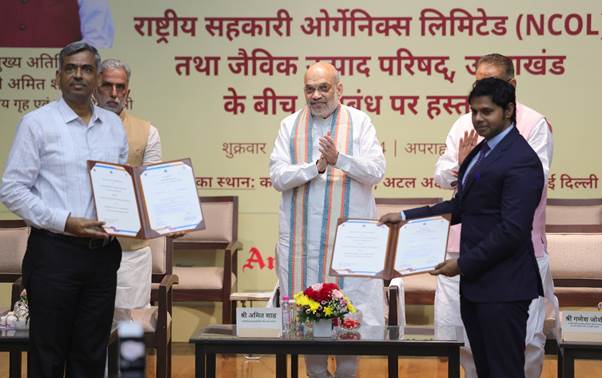
A Memorandum of Understanding (MoU) between National Co-operative Organics Limited (NCOL) and Uttarakhand Organic Commodity Board (UOCB) was signed in New Delhi today in the presence of Union Home Minister and Minister of Cooperation Shri Amit Shah. Many dignitaries including Union Minister of State for Cooperation, Shri Krishna Pal Gurjar, Agriculture and Farmers Welfare Minister, Govt of Uttarakhand, Shri Ganesh Joshi and Secretary, Ministry of Cooperation, Dr. Ashish Kumar Bhutani, were present on the occasion.

In his address during the event, Shri Amit Shah said that Prime Minister Shri Narendra Modi had set a target to prepare the vast cultivable land of this country for organic farming. He said that today the movement for organic farming has reached an important stage. Shri Shah said that Cooperatives have an important role in Prime Minister Shri Narendra Modi’s vision of making India the world’s largest organic food producing country.

Union Minister of Cooperation said that Prime Minister Modi had set the goal of doubling the income of farmers of the country and one of the two important points was to promote organic farming. Shri Shah said that today there is an awareness about organic products all over the world and there is a huge global market for the same. When we increase India’s share by tapping this market, the share of our farmers in the profitable business of organic products and their income also increases.

Shri Amit Shah said that the health of the citizens of the country is also linked with organic farming. He said that the chemicals that enter our body through the use of fertilizers cause many types of diseases. He added that this has also reduced the quality of the land, so much so, that in many states the land has started becoming as hard as cement, due to which the risk of floods has also increased. Shri Shah said that on the contrary, with organic farming, the groundwater level increases, water is saved, production increases and the health of the consumer improves as well. Despite all these benefits, organic farming was not duly promoted.

Union Minister of Cooperation underlined that, earlier, there was no mechanism to check the quality of organic products and farmers did not get high prices. Also, there was hesitation in using these products. Shri Shah said that to solve this issue, the Modi government established the National Co-operative Organics Limited (NCOL). He said that Amul and NCOL together will establish a network of international level laboratories across the country which will examine both, organic land and products. He said that both these recognized institutions will provide reliable organic products to consumers as ‘Bharat’ and ‘Amul’ brands.

Shri Amit Shah said that now with the formation of NCOL, within a few years, we will ensure that all the profits from organic products directly go to the bank accounts of the producing farmers. He stated that it is possible only in a cooperative set up. Shri Shah said that in another 2 -3 years, products of ‘Bharat’ brand will cover all types of vegetarian food.

Union Minister of Cooperation said that the organic products of Bharat brand are reliable in terms of quality and organic property, and are inexpensive as the motive of cooperatives is not making money. He said all profits from the organic products is going to increase the income of farmers of the country. He added that all these objectives will be met through NCOL and soon ‘Bharat’ brand will become a trusted brand.

Shri Amit Shah called upon farmers engaged in organic farming across the country to join with the NCOL. He said that all the organic rice, pulses and wheat produced by the farmers will be purchased by the government. He said that in a short time, NCOL will create a smooth mechanism to send the profits directly to the bank accounts of the farmers. He said that a similar experiment in the dairy sector is successfully taking place all over the country today and crores of farmers are getting the profit of their dairy products directly in their bank accounts through cooperatives.

Union Home Minister and Minister of Cooperation urged the farmers of Uttarakhand to make their farms completely organic and encourage other fellow farmers towards natural farming. He said that farmers of Uttarakhand should make their fields completely organic and stop using fertilizers.

Shri Amit Shah said that Prime Minister Modi has set a target of making India the world’s largest producer of organic food. For this, the Modi government has also created a cooperative society for the export of farmers’ products, i.e. the National Cooperative Export Limited (NCEL). Shri Shah said that NCEL will take the ‘Bharat’ brand, being developed by NCOL, to the global market.

India has become the biggest voice of the Global South: Rajnath Singh

| Published on:

Self-reliance in every sector is the first condition for a strong economy and the nation is making giant strides towards realising Prime Minister Shri Narendra Modi’s vision of ‘Aatmanirbhar Bharat’. This was stated by Raksha Mantri Shri Rajnath Singh at an event in Thiruvananthapuram, Kerala on August 30, 2024. He asserted that a raft of measures have been taken by the Government to create a robust production base and an ecosystem for defence R&D and innovation.

Some of the steps taken by the Ministry of Defence, that the Raksha Mantri enumerated, include setting up of Defence Industrial Corridors in Uttar Pradesh & Tamil Nadu and issuance of five Positive Indigenisation Lists of more than 5,500 items. He added that GE-414 engines will now be made in India, which marks a remarkable progress in the country’s engine-making capability. He referred to his recent US visit, stating that he had fruitful discussions with the US defence companies and they are excited to join the ‘Make In India’ programme.

Shri Rajnath Singh stressed that there was a time when the country relied on other countries to meet the defence needs, and about 65-70% of defence equipment was being imported. But this has changed today, he said, highlighting that 65% is being manufactured on the Indian soil and only 35% is being imported.

The Raksha Mantri added that the annual defence production has crossed Rs 1.27 lakh crore and the target is to reach Rs 1.75 lakh crore in this fiscal year. He exuded confidence that the Ministry of Defence will achieve a target of Rs three lakh crore worth of defence production by 2029.

“Today, we are also exporting defence equipment made in India. In Financial Year 2023-24, India’s defence exports crossed Rs 21,000 crore. Our target is to increase defence exports up to Rs 50,000 crore by 2029,” Shri Rajnath Singh said.

On India’s growing stature on the international stage, the Raksha Mantri mentioned about Prime Minister Shri Narendra Modi’s recent visits to Russia & Ukraine, saying that he is the only global leader who was listened to by both the countries. “India has today become the biggest voice of the Global South. Every country considers and listens to India’s opinion on significant issues. The Prime Minister was recently bestowed with Russia’s highest civilian honour by President Vladimir Putin. With this, Russia has joined 16 countries that have given their highest civilian honour to our Prime Minister. These countries also include Muslim nations like UAE, Saudi Arabia, Afghanistan, Maldives and Bahrain,” he said.

Shri Rajnath Singh emphasised that the country has witnessed ‘Epochal Changes’ in the last ten years – from economic reforms to major social transformation, from cultural revival to significant political changes. He credited the people for playing the most important role in this change along with the government. “The last 10 years will go down in history as the decade of change and our Prime Minister & government will always be recognised as the biggest ‘Change Makers’. India is on a cusp of major change. It will usher India into an age of unprecedented development, prosperity, social harmony and growth,” he added.

The Raksha Mantri spoke on the growth in India’s economy since 2014. “India’s economy was earlier among the ‘Fragile Five’. Today, it is being recognised all over the world as one of the ‘Fabulous Five’. During the last fiscal year, India’s economic growth rate was 8.2%. It was more than the growth rate of 7% the year before. For two consecutive years, India has been the fastest-growing economy out of all the world’s major economies. In the last ten years, from the 11th position, India has become the fifth largest economy. Investment firm Morgan Stanley estimates show that India will become the third largest economy by 2027,” he said.

Shri Rajnath Singh pointed out that despite the fast pace of growth, inflation is well under control in India. He cited the recent data released in July, which shows that retail inflation rate has been recorded at 3.54 per cent, the lowest in the last five years. “Before 2014, the number of start-ups used to be less than 1,000. Now, it has increased to more than one lakh. Today, India is the third largest start-up ecosystem in the world and every 10th unicorn is in India. India’s start-up ecosystem is expected to receive around $1 billion in new funding this year, 25% higher than last year,” he added.

Identifying good governance as Government’s priority, the Raksha Mantri stated every policy and programme is founded on the principles of stability, consistency, and continuity to ensure good governance. He added that productive expenditure in the form of highest capital expenditure; unprecedented investment in welfare schemes; end of wasteful expenditure and financial discipline have been the focus areas of the Government.

Shri Rajnath Singh emphasised that the efficacy and efficiency of the government was seen during the COVID-19 pandemic. “Our government ensured that life-saving resources and medicines were timely and promptly available. During the lockdown, we ensured food security by making free-of-cost ration available to the poor. Made in India vaccines were taken as a priority. We ensured the availability of these vaccines to each citizen promptly without any delay,” he said.

The Raksha Mantri described the success of ‘Swachh Bharat Abhiyan’ and ‘Open Defecation Free India’ as the best examples of ‘positive change’ brought by the Government led by Prime Minister Shri Narendra Modi. He also referred to the initiatives such as Pradhan Mantri Jan Dhan Yojana and Deen Dayal Upadhyaya Gram Jyoti Yojana which fulfil the needs and necessities of the people.

Shri Rajnath Singh also enumerated the efforts being made towards gender parity and women empowerment through schemes such as Beti Bachao, Beti Padhao & Nari Shakti Vandan Adhiniyam. He also mentioned about the abolition of the practice of Triple Talaq, reflecting the Government’s will and determination to end such a discriminatory practice.

The Raksha Mantri termed the health, safety and welfare of women as the Government’s priority. “Considering the atrocities and crimes against women in the country, despite all the changes, it seems that a lot remains to be done. Our government has adopted a strict attitude towards crimes against women, but many states are not making sincere efforts in this direction. The recent heart-wrenching incident in Kolkata is very tragic and disgraceful. We have amended the law to provide for the capital punishment for heinous crimes like rape. This law should be implemented with strictness,” he said.

Highlighting the growing role of women in the Armed Forces, Shri Rajnath Singh stated that many obstacles to the entry of women into the military have been removed. “We have ensured increased participation of women in all the three wings of the Armed Forces. Permanent Commission for women has been allowed. One of the most prestigious military training institutes, National Defence Academy, has also been opened for women. Our government is marching ahead with the vision of women empowerment and women-led development,” he said.

IFS Officer Trainees of 2023 Batch call on PM

| Published on:

The Officer Trainees of the 2023 Batch of Indian Foreign Service (IFS) called on Prime Minister Shri Narendra Modi at his residence at 7, Lok Kalyan Marg earlier today. There are 36 IFS Officer Trainees in the 2023 batch from 15 different States and UTs.

The Officer Trainees praised the success of foreign policy under the leadership of the Prime Minister and sought suggestions and guidance from him on their upcoming new assignments. Prime Minister suggested that they should always carry with them the culture of the country with pride and dignity and try to showcase it wherever they are posted. He talked about overcoming colonial mindset in all spheres of life, including personal conduct, and instead carry themselves as proud representatives of the country.

Prime Minister also discussed how the perception of the country is changing on the world stage. He said that now we engage with the world on equal footing, with mutual respect and dignity. He talked about how India handled the Covid pandemic in comparison to other nations. He also mentioned about the country’s onward march to become the third largest economy.

Prime Minister also suggested the Officer Trainees to expand their engagement with the Indian diaspora when posted abroad.