FM delivers keynote address at G-20 Finance Track seminar on ‘Global Economy: Challenges, Opportunities and the Way Forward’

| Published on:

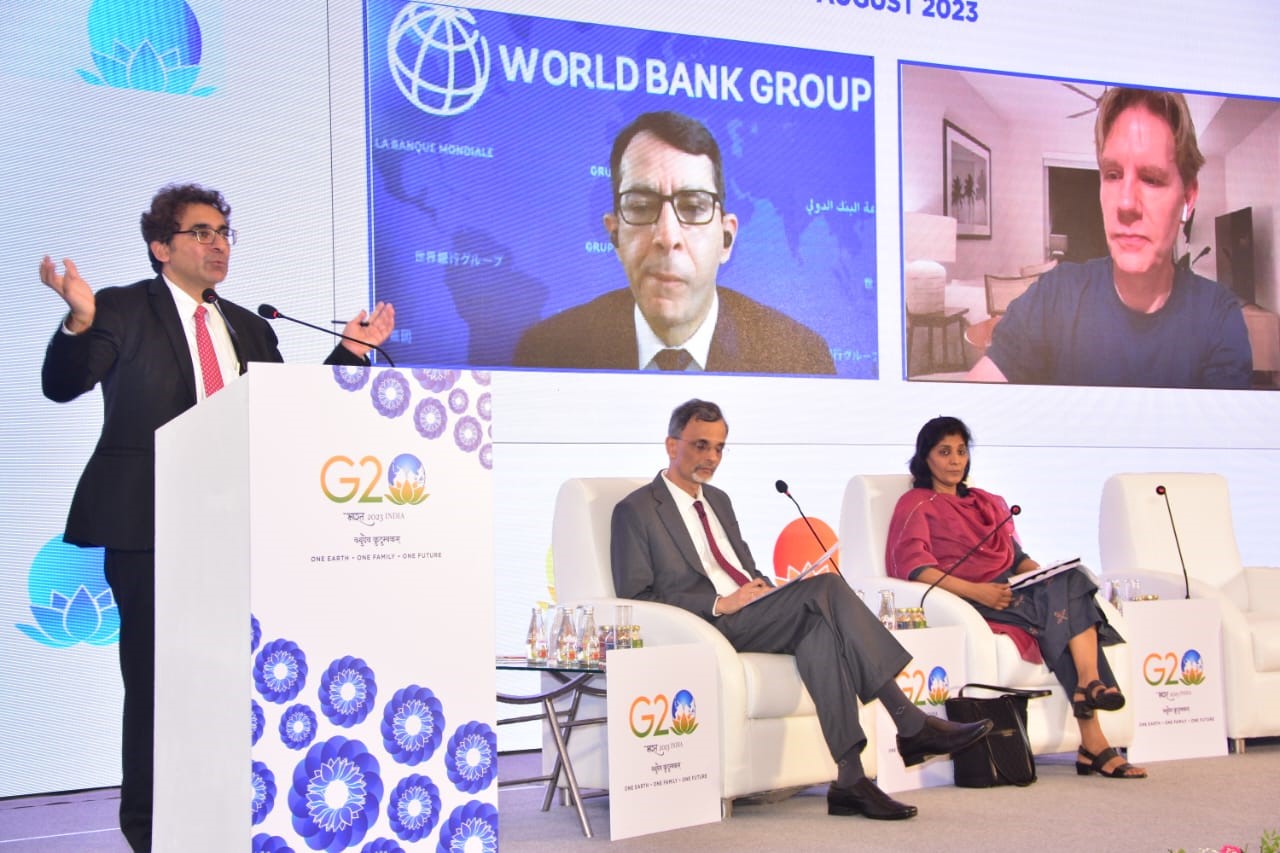
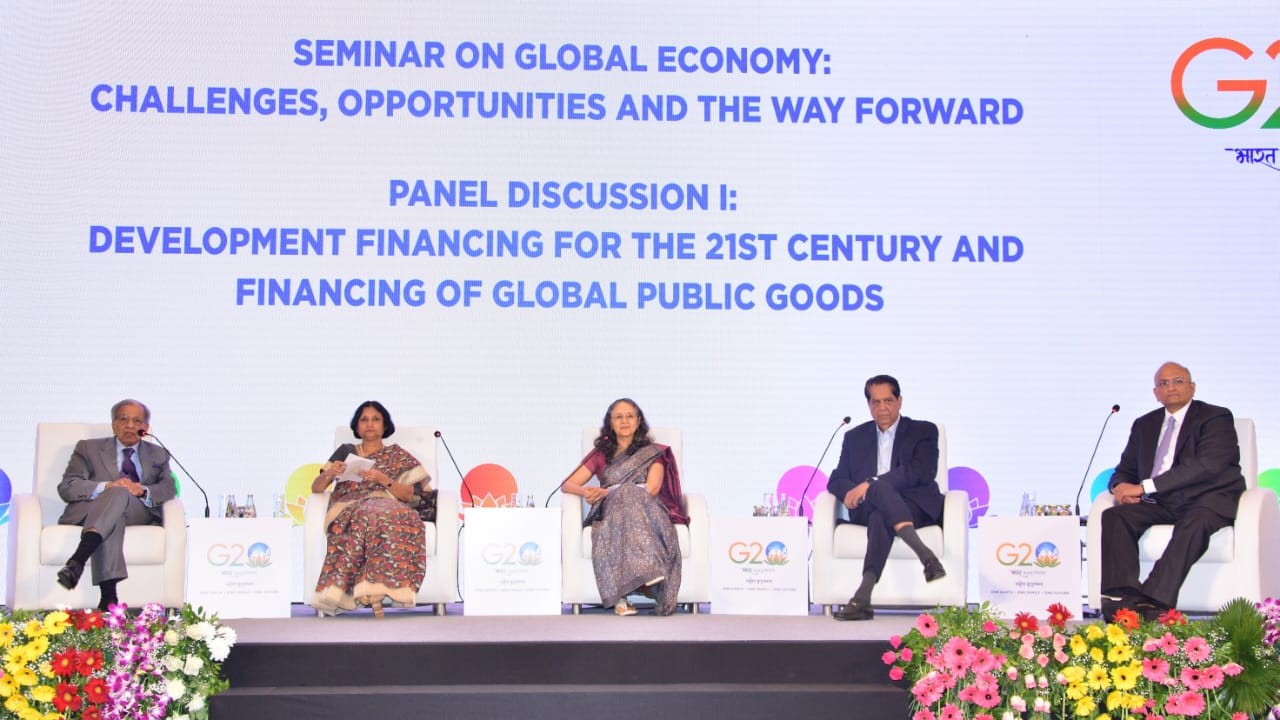
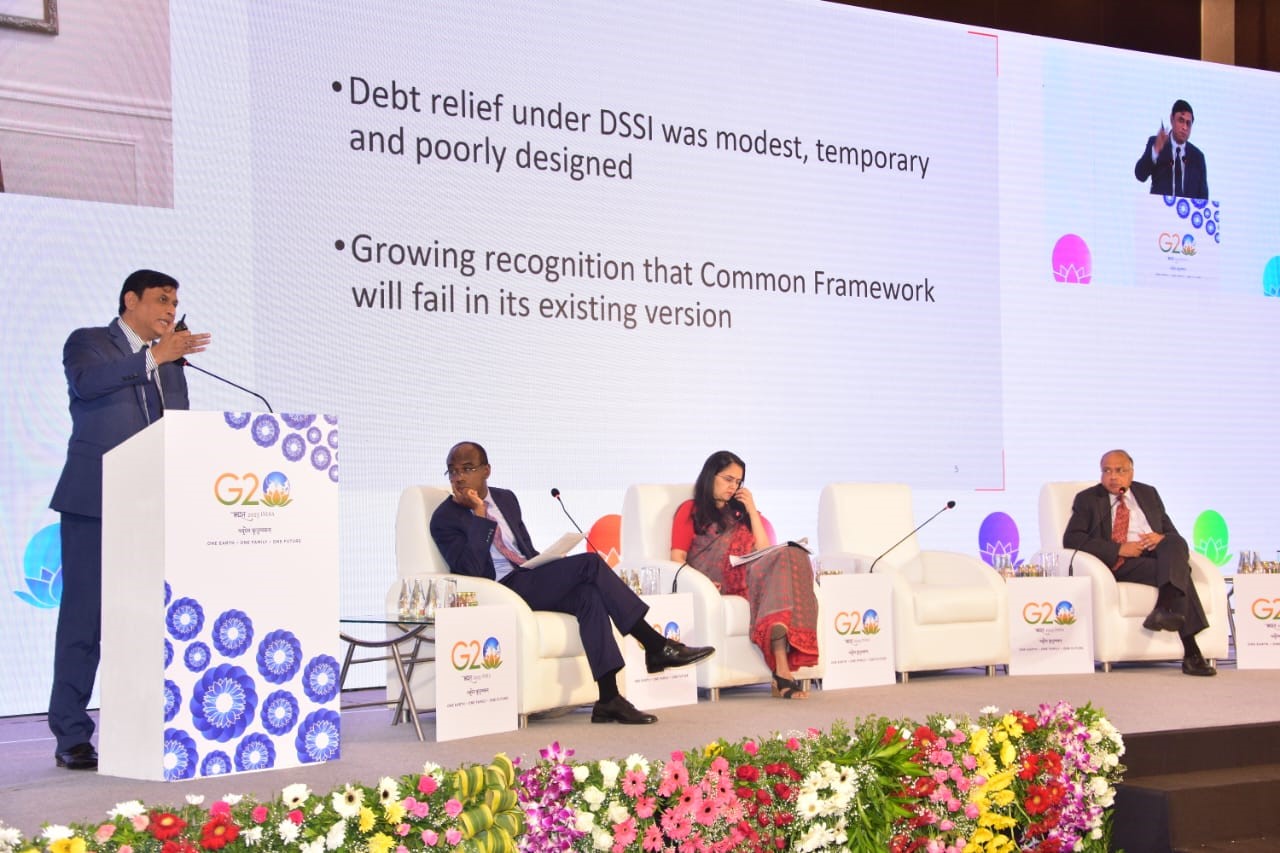
A common thread in India’s G20 Presidency agenda is ‘How to prepare for a better tomorrow for all’, stated Union Finance and Corporate Affairs Minister Nirmala Sitharaman today. The finance track has seen the delivery of a sizeable number of outcomes, most of which will contribute towards addressing the present and emerging global economic challenges. India has piloted a huge amount of work in various tracks in more than eight months since India assumed G-20 Presidency, she added. “So far we have ensured that geo-political differences do not supersede the core G20 mandate of international co-operation”, she further said. The Union Finance Minister was delivering the keynote address virtually, in a seminar on ‘Global Economy: Challenges, Opportunities and the Way Forward’ jointly organized by the Department of Economic Affairs, Ministry of Finance and Reserve Bank of India, under the aegis of Finance Track of India’s G-20 Presidency, in Mumbai today.  The seminar organized as a part of the International Financial Architecture (IFA) and the Frameworks Working Group under India’s G-20 Presidency, in run-up to the G-20 Leaders’ Summit in September 2023, had three sessions on: ‘Development financing for the 21st century and financing of Global Public Goods’, ‘Managing Global Debt Vulnerabilities’ and ‘Key Global Risks: Inflation, Financial Stability and Climate Change’.
The Finance Minister stated that primary focus of the Indian G-20 Presidency in 2023 has been to strengthen Multilateral Development Banks (MDBs), to address the shared global challenges of the 21st century which they are facing. But, MDBs are also facing increasing demands from donor and borrowing countries to expand their lending operations beyond their core development mandates. However, MDBs are not currently equipped to address this rising demand for their resources adequately, she added. The Finance Minister said, another issue discussed in the G-20 Finance Track is ‘Escalation of Debt Issues in Vulnerable Economies’, which poses significant economic risks to their sustainable development. The Indian G-20 Presidency has given great importance to the management of global debt vulnerabilities, demonstrating a commitment to voicing the concerns of the Global South, she stated. Finance Minister also stated that, under the G-20 India Presidency, the digital public infrastructure has been integrated into G-20 discussions with member countries recognizing its capacity to enhance productivity and to accelerate financial inclusion.

Finance Minister also stated that “the upcoming synthesis paper developed by the IMF and the FSB, coupled with a roadmap will be instrumental in shaping future regulatory measures for crypto- assets”.

Strengthening Multilateral Development Banks:    

Speaking about the issues faced by MDBs, Finance Minister said, after decades of integration, the global economy is starting to witness increasing fragmentation and unravelling multilateralism and that is affecting the MDBs.

Finance Minister Nirmala Sitharaman said, the Indian G-20 Presidency had set up an Independent Expert Group on Strengthening MDBs. The Expert Group, in the Volume-I of their Report has proposed a triple agenda, comprising three crucial recommendations for the MDBs, which are as follows:

i) To tackle global challenges, alongside their core mission of poverty reduction and shared prosperity

ii) To triple their sustainable lending level by 2030

iii) To enhance their financial strength to capital adequacy improvements and general capital increases.

Finance Minister Nirmala Sitharaman said that, implementing these recommendations within each MDB’s governance framework can significantly enhance their capacity to address diverse financing challenges in the future with a focus on the priorities of the Global South

The Vol. II of the Report is expected to be submitted before the 4th Working Group and Ministerial Meeting of the G-20 Finance Track in October, 2023.

Escalation of Debt Issues in Vulnerable Economies:

Finance Minister said, “We have made significant efforts in providing momentum for debt treatment for some countries”. She urged the international community to collaborate and find stronger ways to coordinate debt restructuring for low income, vulnerable and middle income countries facing debt distress.

Finance Minister Nirmala Sitharaman further said, G-20 also stresses on the criticality of debt vulnerability in low and middle income countries through an effective, comprehensive and systematic approach. By restructuring existing debts and enhancing access to affordable finance, the international community can contribute to releasing financial resources in debtor countries to shield vulnerable populations from economic hardships.

Digital Public Infrastructure (DPI):

In her address, the Finance Minister also said, unlocking the full potential of digital progress for all is essential for a fair and inclusive future in this era of technological transformation. She said, despite notable advancements, disparities in access, usage and quality of financial services persists among vulnerable populations and micro, small and medium enterprises.

Finance Minister further said, G-20 policy recommendations for advancing financial inclusions and productivity gains through DPI, meticulously developed under India’s leadership have garnered unanimous acceptance across G-20 members. These can guide both G-20 and non-G-20 countries in harnessing DPI for inclusive and robust growth. “We are striving to lay the foundation for a robust regulatory landscape that encourages innovative, while ensuring macro-economic and financial stability”, the Minister added.

Infrastructure Financing:

Nirmala Sitharaman also stated, Indian G-20 Presidency has also emphasized innovative financial models to mobilize private sector investments and address infrastructure financing gaps which is crucial for building future cities. “We have laid the groundwork for G-20 principles for financing cities of tomorrow. This framework holds the potential to guide MDBs and other development financing institutions, in their planning and financing of sustainable urban infrastructure”, she said.

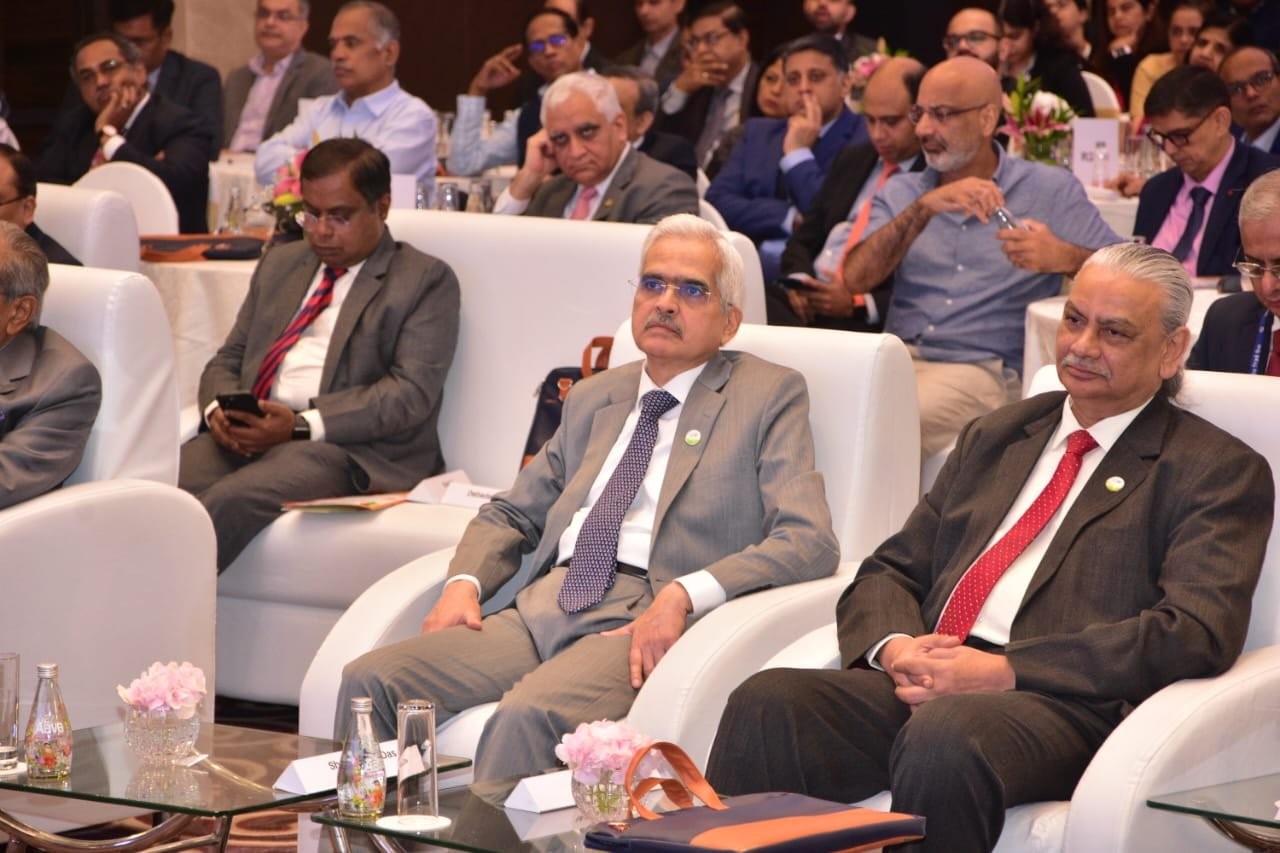
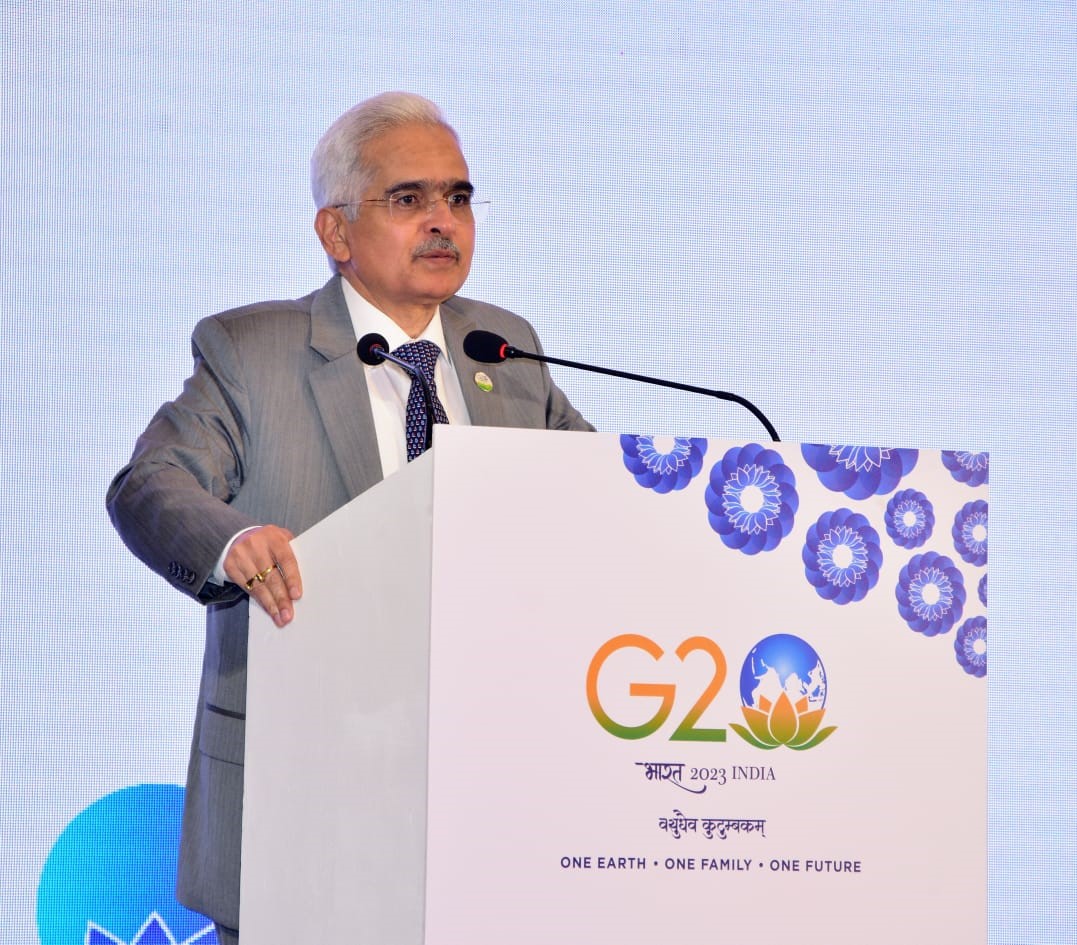
RBI Governor Shaktikanta Das in his closing remarks said, today’s panel discussion topics are priorities under India’s G-20 Presidency. Policymakers across the world today are grappling with multifarious and intertwined challenges in ensuring post-pandemic recovery in the face of elevated inflation, financial market vulnerabilities, reduced policy headroom and geo-political tensions. In this milieu, India’s G-20 Presidency aims at enhancing global cooperation to face such challenges, he stated.

Click here to read RBI Governor’s Closing Remarks
The Chief Economic Advisor, Ministry of Finance, Dr. V. Anantha Nageswaran highlighted the key emerging challenges in the global policy landscape and how Indian G-20 Presidency under the theme of One Earth, One Family, One Future, has worked towards steering the global economy towards a strong, sustainable and balanced inclusive growth.
NML has a pivotal role to play in making medical education accessible to all via digital platform: Dr Bharati Pravin Pawar

| Published on:

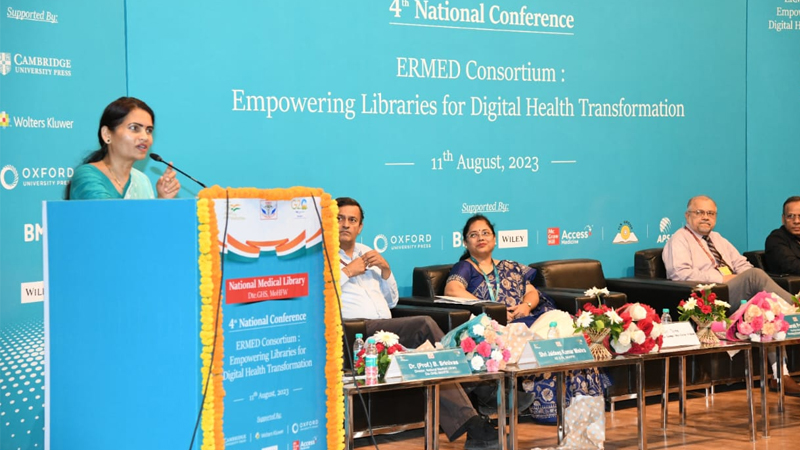
Dr Bharati Pravin Pawar, Union Minister of State for Health and Family Welfare inaugurated the National Conference on The Electronic Resources in Medicine (ERMED) Consortium: Empowering Libraries for Digital Health Transformation at National Media Library, here today.

ERMED stands for collaborative excellence and transformative impact within the medical landscape of India and for its unwavering commitment to cater to the diverse information needs of the medical fraternity. ERMED consortium access facility has been extended to 74 selected government institutes including 14 AIIMS and even AYUSH Research Colleges/ Extend it to institutions as well.

Accentuating the importance and impact of NML, Dr Bharati Pravin Pawar stated that “now faculty, research students living in remote areas are also taking advantage of the eResources of NML, the metadata of books and journals of NML that have been uploaded on NIC’s cloud software eGranthalaya and is easily searchable by information searchers. NML’s e-resources such as eBooks, eJournals, clinical cases, high resolution images etc. are available through Electronic Resources in Medical (ERMED) consortium with member institutions.” The pursuit of knowledge is beneficial not only for patient care but also for personal and professional development,she added.

Dr Bharati Pravin Pawar emphasized that under the visionary leadership of Prime Minister Shri Narendra Modi, in the last 9 years, the government has taken several steps to increase the number of seats in various medical institutions/colleges in the country, as a result of which the number of undergraduate seats which were 51,348 before 2014 has increased to more than 1,07,948 as of today, i.e. 110 % has increased. Similarly, since 2014, the number of PG seats in the country has increased by 117 per cent to 67,802 seats. It means that in the coming times, NML has pivotal role to play in making medical education accessible to all via digital platform, she said.

She also highlighted the continuous innovations and new developments in the field of treatment, diagnostic methods and technologies. “Continuous learning allows health care professionals to stay updated with the latest developments and integrate them into their practices, ensuring the best possible care for patients”, she stressed. It also broadens our intellectual horizons, fosters critical thinking, and enriches our understanding of the human body and its complexities, she further added. The more health care professionals learn and refinetheir skills, the better they are at providing accurate diagnosis, effective treatment, and optimal patient care, the Union Minister pointed out. Dr Bharti Pravin Pawar further added, “As healthcare providers, we have an ethical duty to provide the highest quality care to our patients. Continuous learning ensures that we meet this responsibility by offering the latest and most effective treatments available.”

The Union Minister of State suggested that more medical eResources should be included in the ERMED consortium that is accessible to all. “The world of medicine is constantly evolving, driven by groundbreaking discoveries, new technologies, and advances in patient care. In this fast changing scenario, the importance of lifelong learning cannot be underestimated. Medicine is a field of precision and compassion, where the lives of individuals depend on the knowledge, skill, and expertise of health care professionals”, she further stated.

“Continuous learning is not just an option but a responsibility that every healthcare professional must shoulder. This empowers us to provide the highest level of care, contribute to medical progress and maintain the trust and confidence of our patients”, Dr Bharti stated. She urged everyone to embrace the spirit of lifelong learning and commit ourselves to excellence in the dynamic and noble field of medicine.

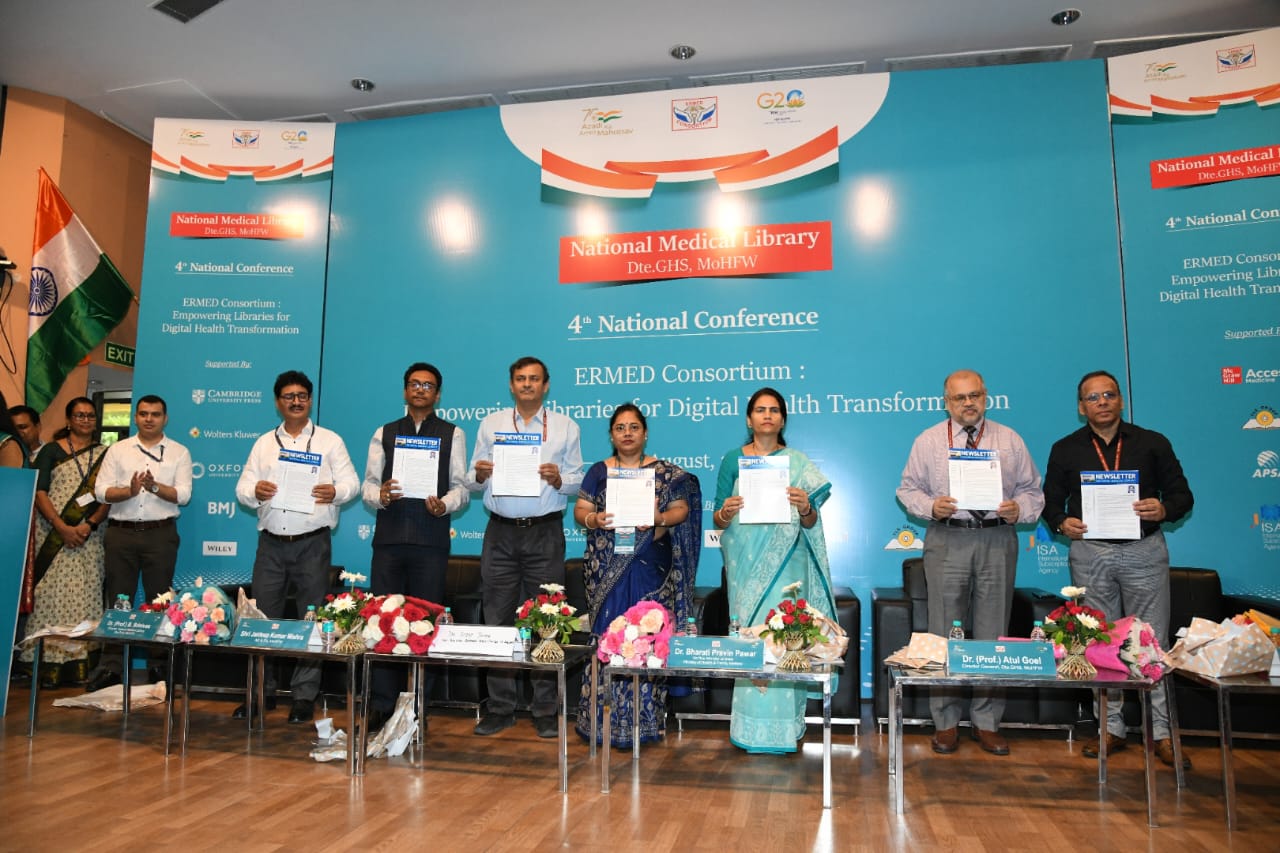
The occasion also witnessed the launch of NML-ERMED Souvenier.

Shri Jaideep Kumar Mishra, AS &FA, Union Health Ministry, Dr Atul Goel, DGHS and Dr B. Srinivas, ADG (ME) were also present.

PM replies to Motion of No Confidence in Lok Sabha

| Published on:

The Prime Minister, Shri Narendra Modi replied to the Motion of No Confidence in Lok Sabha today.

Addressing the House, the Prime Minister said that he has come to express immense gratitude towards each and every citizen of India for repeatedly showing their trust in the government. He recalled commenting that it is not a floor test for the government but for those who introduced it in the house in 2018 when the opposition brought a no-confidence motion. “When we went to polls in 2019, the people had declared no confidence in them with utmost strength”, the Prime Minister said as he underlined that both NDA and the BJP won more seats. In a way, the Prime Minister said, the no-confidence motion introduced by the opposition is lucky for the government. He also expressed confidence that the NDA and the BJP will break all records and come out victorious in 2024 with the blessings of the people.

The Prime Minister said it would have been better if the opposition had participated with due seriousness since the beginning of the session. He mentioned that important legislations were passed in the past few days and they should have been discussed by the opposition who gave preference to politics over these key legislations. “There were many bills that were linked with the fishermen, data, poor, deprived and tribals but the opposition has no interest in them. This was a betrayal of the expectations of the people. They have proven that for them, the party is above the country”, he said. The Prime Minister said that the country is watching the opposition and they have always disappointed the people.

The Prime Minister pointed out that a time comes in the life of a nation when it breaks free from the old shackles and moves forward with new energy and determination. “This time period of the 21st century is a time of fulfilling all our aspirations. Whatever is shaped during this time period will impact the country for the next thousand years. Therefore, we have a huge responsibility and we should have a single focus- development of the country and full dedication to realize the dreams of the countrymen”, he emphasized. He said that the strengths of our people and youth can take us to our destination.

He continued, that in 2014 and later, due to the track record the country chose a full majority government as they knew where lies the capability of realizing their dreams. “We have given the youth of India a government free of scams. We have given them courage and the opportunity to fly in the open sky. We have repaired India’s standing in the world and have taken them to new heights”, he stressed. “Opposition have made an unsuccessful attempt to break the confidence of the people in the garb of No Confidence Motion”, he said. Shri Modi mentioned the growth in the startup ecosystem, record foreign investment, and new peaks of exports and said, “Today a trust has arisen in the heart of the poor to fulfill their dreams.” He also talked about the NITI report about 13.5 crore people coming out of poverty.

The Prime Minister mentioned an IMF working paper which states that India has almost eradicated extreme poverty. Quoting the IMF, the Prime Minister said that the Indian DBT Scheme and other social welfare schemes are a ‘logistical marvel’. He also quoted the WHO which states that the Jal Jeevan Mission is helping save 4 lakh lives in the country and the Swacch Bharat Abhiyan helping save 3 lakh lives. “These are the poor people of the country who reside in urban slums”, he added. Quoting UNICEF on the Swachh Bharat Abhiyan, the Prime Minister said that it is helping the poor families of the country save Rs 50,000 per year.

Criticizing the ostrich approach of the opposition the Prime Minister said that they are not able to see the trust of people as they are so steeped in distrust. The Prime Minister said that the opposition’s bad language and constant nitpicking works like a ‘Kala Tika (to ward off bad omen).

The Prime Minister said that all the target institutions of the opposition’s criticism invariably shine and called it the ‘opposition’s secret boon’. “Whoever they wish bad for, ends up doing well”, he said.

The Prime Minister recalled the attitude of the opposition towards the developments in the banking sector and said that they tried their best to spread misinformation and confuse the people. However, the Prime Minister interjected, the net profit of the public sector banks increased twofold. He also touched upon the phone banking scam which pushed the country towards an NPA crisis and said that the country has revived itself from this and is now moving forward. Shri Modi also gave an example of HAL which was severely attacked by the opposition. He said HAL is touching new heights of success and has registered the highest-ever revenue. Throwing light on the ills spoken by the opposition about LIC, the Prime Minister said that LIC is growing stronger with each passing day.

“The opposition does not believe in the capabilities and dedication of the nation”, the Prime Minister remarked as he recalled saying a few days ago that in his third term, India will become the third largest economy in the world. As a responsible opposition, the Prime Minister said that they should have questioned the government on their roadmap to achieve this goal or at least provided suggestions but that was not the case. He called out the laxity of the opposition which claims that nothing needed to be done to become the third-largest economy in the world. The Prime Minister said that such an approach by the opposition indicates the lack of policies, intentions, vision, the know-how of world economics and the understanding of the capabilities of India.

The Prime Minister underlined how India sank into poverty and was on the verge of bankruptcy in 1991. However, after 2014 India found a place in the top 5 economies of the world. He said that this was achieved through the mantra of ‘Reform, Perform and Transform’ with definite planning and hard work. This will continue and necessary reforms will be done, he added. “In 2028, when you will bring a No Confidence Motion, the Country will be among the top 3”, he told the House.

Continuing the distrusting approach of the opposition, the Prime Minister talked about their lack of faith in the campaigns like Swachh Bharat, Jan Dhan Account, Yoga, Ayurveda, Startup India, Digital India and Make in India.

The Prime Minister highlighted the infiltration of militants in Kashmir during the Congress rule and that the then government would agree with Pakistan and continue peace talks simultaneously. He also touched upon their association with Hurriyat instead of the Kashmiri populace. Speaking about the Surgical Strike, the Prime Minister mentioned how the opposition chose to believe the narrative spun by the enemy instead of trusting the government on the issue.

“The opposition is quick to trust those who speak ill of the country”, the Prime Minister said and mentioned a misinformed report by a foreign agency that touted a nation dealing with food insecurity ahead of India in certain parameters. He said that the opposition latches on to such misinformed reports and tries to defame the country at every opportunity it gets. He also gave the example of the Made-in-India Corona vaccine and said that the opposition did not trust it but instead looked towards foreign-made vaccines. He underlined that the opposition does not trust the capabilities of India and its people and similarly, the level of confidence for the opposition in the eyes of the people is at an extreme low.

The Prime Minister also said that cosmetic changes of alliance building cannot fool the people of the country and a simple change of name will not change the fortune of the opposition alliance. “They have taken the help of NDA to survive but added two ‘I’s of arrogance, first for the ego of 26 parties and second ‘I’ for the ego of one family. They even splintered India into I.N.D.I.A.”, he said. “Opposition believes in changing names but they can’t change their work culture”, he emphasized. Referring to the divisive comment of a Minister from the Tamil Nadu Government, the Prime Minister reiterated his faith in the state and said that Tamil Nadu is a state where a stream of patriotism flows continuously. The Prime Minister dwelled on the fascination of the opposition with names and mentioned how every scheme and key marker was named after the members of the one family. The Prime Minister called I.N.D.I.A, a ‘Ghamndia’ coalition (arrogant coalition) and underlined the contradictions among the partners.

Shri Modi emphasized that the freedom fighters and founding fathers of the country always opposed dynasty politics.  Dynasty system damages the common citizen. Key leaders suffered due to the dynasty politics, he said. He said many portraits of stalwarts who were victims of this type of politics found a place in the Parliament only in the later years of non-Congress governments. He also mentioned the Statue of Unity and Pradhanmantri Sangrahalaya. The Museum is dedicated to all Prime Ministers and rises above party politics.

The Prime Minister reiterated that even though the people of India elected a full majority government twice after 30 years, the opposition is perturbed by a ‘Garib ka Beta’ who is sitting on the Prime Minister’s chair. He pointed out that the misuse of aircrafts and naval vessels in the past by the opposition is now rectified for the transportation of vaccines and bringing back those stuck in foreign lands.

The Prime Minister warned against the politics of freebies and cited the situation in the neighboring countries as an example of the havoc that such politics can bring. He lamented the tendency of winning elections through reckless assurances and people are being put under tremendous pressure as development projects are being shelved.

The Prime Minister said that the opposition was never interested in discussing the Manipur situation. He said that the Home Minister explained the issues in great detail with patience and without any politics. The explanation by the Home Minister was an effort to convey the concern of the country and the nation, it was an attempt to convey the House’s confidence to Manipur. It was an honest effort to discuss and find ways.

Speaking about the Manipur issue, the Prime Minister said that the violence in Manipur is saddening. “Crimes against women are unacceptable and the Central Government and the State Government will work to ensure that the guilty are punished. I assure the people of India on the basis of our effort we are making that there will be peace in Manipur in the coming times”, the Prime Minister said. He assured the people of Manipur, the mothers and daughters of Manipur that the nation stands by them and the House stands by them. He also assured that the Government will leave no stone unturned so that Manipur gets back on the track of development.

 The Prime Minister registered a strong protest against the use of objectionable language for Maa Bharati in the House and said that these are the people responsible for the Partition and who even berated Vande Mataram. Shri Modi also mentioned the Kachchatheevu issue as an example of the failure of the opposition.

The Prime Minister mentioned three incidents regarding the Northeast. First, on 5th March 1966, when the Airforce was used to attack people in Mizoram. Second, a radio transmission by then Prime Minister Nehru in 1962 when the people of Northeast were left to fend for themselves during the Chinese invasion. He also cited Ram Manohar Lohia’s allegation about the neglect of the region. The Prime Minister informed that in the current government, the Ministers have done 400 night stays in various district headquarters of the Northeast and the Prime Minister himself has visited 50 times. “I have an emotional attachment with the Northeast. Even before becoming PM, I have traveled across the region”, Shri Modi said.

The Prime Minister reiterated that the situation in Manipur is being presented in a way that the conflict arose only recently but the root cause of all issues in Manipur is Congress and its politics. “Manipur is filled with rich Indian culture and heritage. Manipur is the land of innumerable sacrifices”, he said. He recalled the time of Congress government in the state when every institution operated at the beck and call of extremist organizations and putting up a photograph of Mahatma Gandhi in government offices was forbidden. He also mentioned the bombing of the statue of Netaji Subhas Chandra Bose at the Museum of Azad Hind Fauj in Moirang. He further recalled when singing the National Anthem was forbidden in the schools of Manipur and a campaign was initiated to burn the books from libraries. The Prime Minister gave several examples of extremist activities in the region during the Congress rule and mentioned temples shutting their doors at 4 in the evening, the bombing of the Iskcon temple in Imphal that led to loss of lives, and protection money paid to the extremists by government officers.

The Prime Minister said that in the coming days, the Northeast is going to be a center of development. He said he is aware of the fact that movements in the global system will bring change in South-East Asia and ASEAN countries and what impact will that have on the Northeast. That is why, the Prime Minister said,  “Our government has given first priority to the development of the Northeast.” Shri Modi talked about the investment in the infrastructure in the Northeast and mentioned how modern highways, railways and airports are becoming the identity of the Northeast. “Agartala got connected with rail connectivity for the first time, Goods train reached Manipur for the first time, for the first time modern train like Vande Bharat ran in the region, first greenfield airport was constructed in Arunachal Pradesh, Sikkim got connected with air travel, for the first time AIIMS opened in the Northeast, National Sports University is being opened in Manipur and Indian Institute of Mass Communication in Mizoram for the first time Northeast’s participation increased in the Council of Ministers, and for the first time, a woman represented Nagaland in the Rajya Sabha.   For the first time so many people from the Northeast were honoured with Padma Awards and a hero like Lachit Burfukan was celebrated on Republic Day and a Museum with the name of Rani Gaidinliu was established”, he said.

“For us, Sabka Saath Sabka Vishwas is not a slogan but is an article of faith, a commitment”, said the Prime Minister adding “I assure the people of the country that I will devote every particle of the body and every moment to the service of the countrymen.”

The Prime Minister emphasized, “Parliament is not a platform for a Party. Parliament is the revered highest body for the country. Therefore, it is imperative that Parliamentarians have certain seriousness for this. So much of resources are being devoted here. Every second here should be utilized for the country.” He added that with a lack of seriousness, one can do politics but the country can not be run.

In the last 9 years, the Prime Minister said that the trust of the common citizens is soaring to new heights and every Indian is filled with confidence. “The India of today does not crumble under pressure. The India of today does not bend, does not tire and does not stop”, Shri Modi said. He urged the citizens to move forward with trust and resolution and said that it is the trust of the common people that inspires the world to believe in India. He credited the growing trust of the world in India to the growth of confidence in the common citizens.

In the past few years, the Prime Minister said that the government has succeeded in laying strong foundations for Viksit Bharat. He expressed confidence that it is this foundation which will lead India to become a developed nation by the year 2047. He underlined that the nation has come out of worse situations together and urged the political parties to not misuse the land of Manipur for petty politics. “We must empathize with the pain and suffering and do our best for recovery. This is the way forward”, the Prime Minister appealed.

PM to visit Madhya Pradesh on 12th August

| Published on:

Prime Minister Shri Narendra Modi will visit Madhya Pradesh on 12th August, 2023.  At around 2:15 PM, he will reach Sagar district, where he will perform Bhoomi Poojan at Sant Shiromani Gurudev Shri Ravidas ji Memorial Sthal. At around 3:15 PM, Prime Minister will participate in a public programme at Dhana where he will lay the foundation stone for Sant Shiromani Gurudev Shri Ravidas ji Memorial.

Honouring prominent saints and social reformers has been a special hallmark of the work done by the Prime Minister. Driven by his vision,   Sant Shiromani Gurudev Shri Ravidas ji Memorial will be constructed in an area of more than 11.25 acres and at a cost of more than Rs. 100 crores. The magnificent memorial will have an impressive art museum and gallery to showcase the life, philosophy and teachings of Sant Shiromani Gurudev Shri Ravidas ji. It will also have facilities for devotees visiting the memorial like Bhakt Niwas, Bhojanalay etc.

During the programme, Prime Minister will dedicate to the nation and lay the foundation stone of rail and road sector projects worth more than Rs. 4000 crores.

Prime Minister will dedicate to the nation the project marking the completion of the doubling of the Kota-Bina rail route. The project, which has been built at an estimated cost of more than Rs. 2475 crores, passes through Kota and Baran District in Rajasthan, and Guna, Ashoknagar and Sagar District in Madhya Pradesh. The additional rail line will increase capacity for better mobility and will help improve train speed along the route.

Prime Minister will lay the foundation stone of two road projects at a cost of more than Rs. 1580 crores. These include a four-laning road project connecting Morikori – Vidisha – Hinotiya and a road project that will connect Hinotiya to Mehluwa.

PM lauds all those working towards protecting the habitat of lions on occasion of World Lion Day

| Published on:

The Prime Minister, Shri Narendra Modi has lauded the dedication of all those working towards protecting the habitat of lions on the occasion of World Lion Day.

The Prime Minister tweeted:

“World Lion Day is an occasion to celebrate the majestic lions that captivate our hearts with their strength and magnificence. India is proud to be home to the Asiatic Lions and over the last few years there has been a steady rise in the lion population in India. I laud all those working towards protecting the habitat of lions. May we continue to cherish and protect them, ensuring they thrive for generations to come.”

Arunachal Rang Mahotsav is a celebration of Arunachal Pradesh’s rich cultural tapestry and aligns

| Published on:

The Prime Minister, Shri Narendra Modi has expressed delight on Arunachal Rang Mahotsav being celebrated in different parts of India including Delhi, Mumbai, Kolkata and Guwahati.

Sharing a tweet by Chief Minister of Arunachal Pradesh, Shri Pema Khandu, the Prime Minister tweeted:

“Arunachal Rang Mahotsav is more than just a programme; it’s a celebration of Arunachal Pradesh’s rich cultural tapestry. It aligns with the principles of Ek Bharat Shreshtha Bharat. Good to see this programme being held in different parts of India including Delhi, Mumbai, Kolkata and Guwahati.”

Coastal Aquaculture Authority (Amendment ) Bill, 2023 clear by both Houses of Parliament

| Published on:

The Coastal Aquaculture Authority (Amendment ) Bill, 2023 passed by the both Houses of the Parliament of India. The Government intends to reiterate that the coastal aquaculture and activities connected therewith are permitted activities within the CRZ under the CRZ notifications. The Amendment Bill provides that the registration granted under Coastal Aquaculture Authority Act shall prevail and be treated as valid permission under CRZ Notification with the express intention of enabling lakhs of small marginal aquaculture farmers to avoid the possible need for obtaining CRZ clearances from multiple agencies.

Specific exemption has been granted under the CAA Act, through this amendment for the establishment of aquaculture units like hatcheries, Brood stock multiplication centres (BMC) and Nucleus Breeding Centres (NBC) within the No Development Zone (NDZ) [200m from the HTL] of Coastal Regulation Zone (CRZ).

The principal Act has a provision of imprisonment for a period up to 3 years for carrying out coastal aquaculture without registration. This appears to be a very harsh punishment for an offence of purely civil nature and hence the amendment bill replaces the same with suitable civil instruments such as penalty in line with the principle of decriminalizing civil transgressions.

The Amendment Bill provides for broad basing “coastal aquaculture” to comprehensively cover all activities of coastal aquaculture under the purview of this Act and to remove the ambiguity existing in the Principal Act between the farm and other verticals of coastal aquaculture. This is likely to ensure that no coastal aquaculture activity is left out of the ambit of the Act and operate in an environmentally hazardous manner.

In 2005, coastal aquaculture activity was essentially shrimp farming. Now newer forms of environment friendly coastal aquaculture such as cage culture, seaweed culture, bi-value culture, marine ornamental fish culture, pearl oyster culture etc. have come up which can be done in coastal areas and mostly within CRZ. These activities also have the potential for generating huge revenue and creating large scale employment opportunities for coastal fisher communities especially fisherwoman and hence need to be promoted which can be done by bringing them within the ambit of Coastal Aquaculture Authority Act.

The Government intends to promote ease of doing business in coastal aquaculture by fine tuning some of the operational procedures of Coastal Aquaculture Authority. The present amendment provides for effecting changes to the certificate of registration in case of changes in ownership or size of the activity and for providing new certificate in case of mutilation, damage or loss of certificate etc. It also provides for condoning the delay in applying for renewal of registration with compounded fee which was absent in the principal Act.

Many of the administrative matters such as the powers of Member Secretary of the CAA and normal functioning of the Authority in the absence of Chairperson which were ambiguous have been suitably resolved under the Amended Act for administrative efficiency and accountability.

The Amendments expressly empower the Authority to appoint Committees which can contain experts, stake holders and public representatives for the efficient discharge of its duties and performance of its functions under Act.

Disease prevention is key to success of coastal aquaculture. Hence, Government intends to create facilities that produce genetically improved and disease-free stocks for use in coastal aquaculture. Such facilities, that is Hatcheries, Brood stock Multiplication centers and Nucleus Breeding Centers can be established only in areas having direct access to seawater and the Government intends to enable and facilitate them. Simultaneously, Government also intends to prevent use of antibiotics and pharmacologically active substances in coastal aquaculture by making express provisions in the Act.

Government envisages introducing global best practices such as mapping and zonation of aquaculture areas, Good Aquaculture Practices, quality assurance and safe aquaculture products, and to facilitate ease of doing business without diluting the core principles of environment protection through introducing suitable provisions in the Act. These will promote production and productivity, traceability, increased competitiveness and entrepreneurship along the value chain and exports in coastal aquaculture sector in a sustainable manner and will lead to sustained raise in incomes and employment in rural areas along the coast.

The Amendment Bill has new provisions for empowering the Coastal Aquaculture Authority to better regulate the activities connected with coastal aquaculture for coastal environment compliance. The amendment bill provides for fixing or adopting the standards for emission or discharge of effluents from coastal aquaculture units, making the owner liable to pay the cost of demolition and cost of damage to the environment, if any, as assessed by the Authority in the true spirit of Polluter Pays Principle and prohibits coastal aquaculture in the ecologically sensitive areas or the geo-morphological features.

With improvements in technology and culture practices, polluting potential of shrimp culture has declined substantially. The sector is now poised to take the next big leap in the form of diversification of species and area expansion with policy space provided through these amendments in the Coastal Aquaculture Authority Act 2005.

Background:

The Coastal Aquaculture Authority Act was enacted in 2005 with an aim to protect coastal environment, while promoting orderly growth of costal aquaculture farming in coastal areas in a manner consistent with it. The rapid and sustainable, environment friendly development of coastal aquaculture in the coastal states/UTs without causing any environmental hazard has been made possible due to the systems and procedures set in place by Coastal Aquaculture Authority under the provisions of the Act. The Act provisions have also ensured continued operation of coastal aquaculture within Coastal Regulatory Zone (CRZ) area subject to restrictions imposed by the Authority.

This in turn has facilitated creation of millions of jobs, self-employment opportunities, enhanced incomes to aquafarmers, catalyzed growth of businesses and entrepreneurship in aquaculture including development of a vibrant aquaculture support industry. As a result, today, coastal aquaculture is one of the major success stories crafted by diverse and hardworking small farmers and educated youth of 2-4 hectares land holding around the fulcrum of vibrant policy support of government.

During the last 9 years, the shrimp production of the country increased by 267% from 3.22 lakh tons in 2013-14 to a record 11.84 lakh tons (provisional figures) in 2022-23. India’s seafood exports doubled from Rs 30,213 crore in 2013-14 to Rs 63,969 crore in 2022-23 with shrimp contributing the lion’s share of exports i.e. Rs. 43,135 crore. Shrimp exports have more than doubled with an increase of 123% from Rs. 19,368 crore in 2013-14 to Rs 43,135 crore in 2022-23 with USA being the largest importer. In fact, the states of Andhra Pradesh, Gujarat, Odisha and Tamil Nadu have contributed substantially to the growth of coastal aquaculture shrimp production and export.

Though the principal Act has specifically excluded Coastal aquaculture from the purview of CRZ notification, there have been ambiguities and interpretations to the contrary as the CRZ notification 1991 was referred to by the legal entities and courts. Further, Section 13(8) of the Principal Act which prohibits coastal aquaculture within the “No Development Zone” of the Coastal Regulation Zone (CRZ) has been misinterpreted to be applicable to the hatcheries as well.

Hence, aquaculture farmers and stakeholders have been requesting to remove the ambiguities and amend some of the provisions of the Coastal Aquaculture Authority Act to make this legislation progressive and decrease the regulatory burden.

All the necessary initiatives taken in last 9 years for rail safety have yielded good results : Arjun Munda

| Published on:

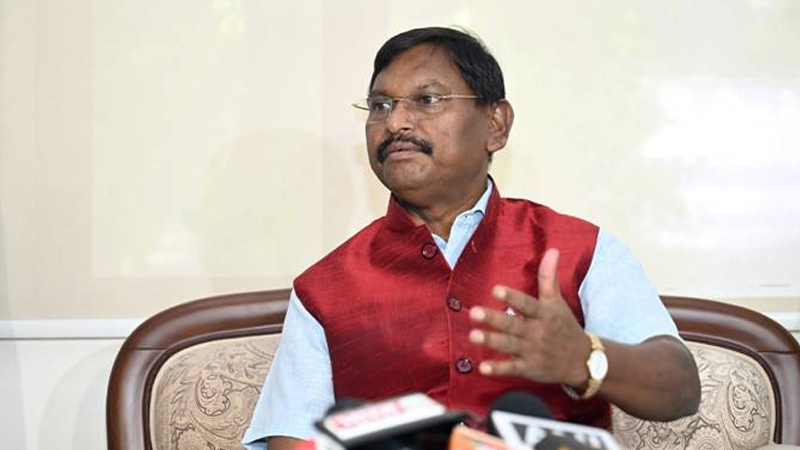
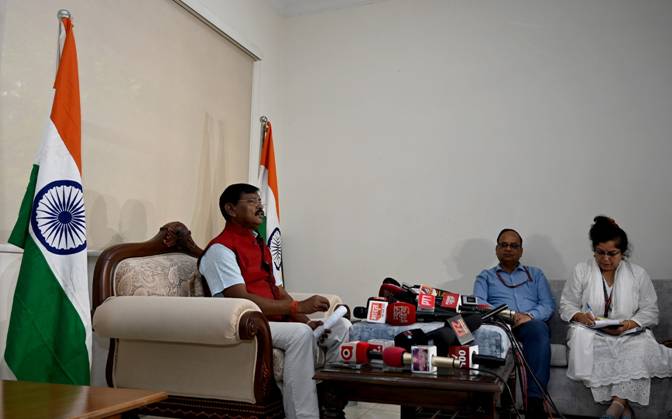
Union Minister for Tribal Affairs Shri Arjun Munda today said that the Government has taken several important critical steps to improve railway safety. Shri Arjun Munda said that Indian Railways is the lifeline of the country and plays an important in  Indian economy as well as provides an easy means of transportation for the people throughout the country. He was briefing media  on the measures taken by the Government in the past 9 years  to step up  Railway Safety,   in New Delhi today. He also said that Government’s priority is to ensure safety of railways and those travelling by it and for this all the necessary initiatives have been  taken in last 9 years and these have yielded good results .

Shri Arjun Munda said that Government has taken many important steps in terms of expansion projects, new projects in North East, Central India and other projects connecting different parts of  India to meet the growing  requirements of the people and the economy.

Briefing the media about the number of train accidents, he said there is a steep decline in the number of consequential train accidents from 473 in 2000-01 to 48 in 2022-23.

He also  informed that the average number of consequential train accidents during the period, 2004-14 was 171 per annum, while the average number of consequential train accidents during the period, 2014-23 declined to 71 per annum. He said railways has constituted an important fund for enhancing Railway Security by the name of Rashtriya Rail Sanraksha Kosh (RRSK) which has been introduced in 2017-18 for replacement/renewal/upgradation of critical safety assets, with a corpus of 1 lakh crore for five years. From 2017-18 till 2021-22, a Gross expenditure of Rs. 1.08 lakh crore was incurred on RRSK works.

He also said that Electrical/Electronic Interlocking Systems with centralized operation of points and signals have been provided at 6427 stations up to 31.05.2023 to eliminate accidents due to human failure.

He further informed that Interlocking of Level Crossing (LC) Gates has been provided at 11093 level Crossing Gates up to 31.05.2023 for enhancing safety at LC gates.

Shri Arjun Munda said that Complete Track Circuiting of stations to enhance safety for verification of track occupancy by electrical means has been provided at 6377 stations up to 31.05.2023.

Briefing the media, he also said that, locomotives are equipped with Vigilance Control Devices (VCD) to ensure alertness of Loco Pilots. Loco pilots are able to get timely alerts and ensure safety of the passengers.

Shri Arjun Munda said that Retro-reflective sigma boards are provided on the mast which is located two OHE masts prior to the signals in electrified territories to warn the crew about the signal ahead when visibility is low due to foggy weather. He said all these measures have given good results.

He said that the current government has taken safety and security measures for the common people and  railways contribution to economy has been ensured through all these measures including food  and energy security in the country.

Click here for details on measures for Railway Safety

Executive Director, Rail safety, Shri Ashok Nakra gave a detailed presentation on the subject to the media.

Click here for the detailed presentation

PM pays tributes to the freedom fighters who took part in the Quit India Movement

| Published on:

he Prime Minister, Shri Narendra Modi has paid tributes to the freedom fighters who took part in the Quit India Movement. Shri Modi said that under the leadership of Gandhi Ji, Quit India Movement played a major role in freeing India from colonial rule. Shri Modi also shared his thought through a video message on this occasion.

In a tweet, the Prime Minister said;

“Tributes to the greats who took part in the Quit India Movement. Under the leadership of Gandhi Ji, this Movement played a major role in freeing India from colonial rule. Today, India is saying in one voice:

Corruption Quit India.

Dynasty Quit India.

Appeasement Quit India.”

PM addresses National Handloom Day Celebration in New Delhi

| Published on:

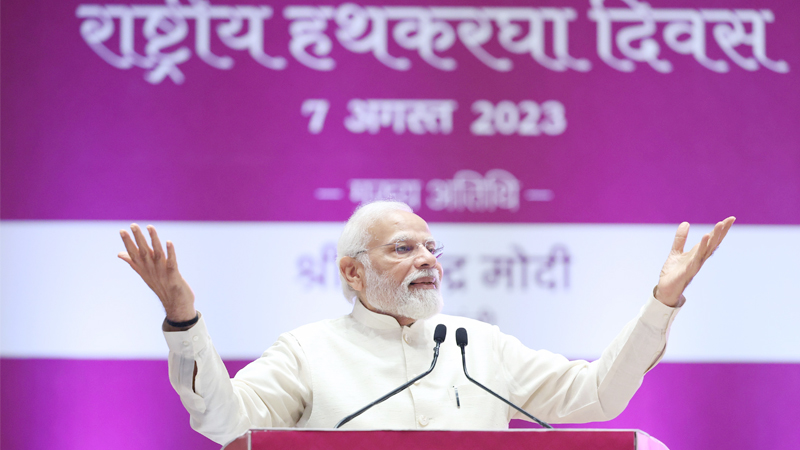
The Prime Minister, Shri Narendra Modi addressed the National Handloom Day Celebration at Bharat Mandapam in Pragati Maidan, New Delhi today and launched the e-portal ‘Bhartiya Vastra evam Shilpa Kosh – A Repository of Textiles & Crafts’ developed by the National Institute of Fashion Technology. The Prime Minister also visited the exhibition showcased on the occasion and interacted with the weavers.

Addressing the gathering, the Prime Minister recalled how the exhibitors used to showcase their products in a tent in an exhibition held in Pragati Maidan before the inauguration ceremony of Bharat Mandapam took place. In the magnificence of Bharat Mandapam, the Prime Minister highlighted the contribution of the handloom industry of India and said that the confluence of old and new defines the new India of today. “The India of today is not just ‘Vocal for Local’ but also providing a global platform to take it to the world”, he said. Throwing light on his conversations with the weavers before the start of today’s program, the Prime Minister noted the presence of various handloom clusters from across the country in today’s grand celebrations and welcomed them.

“August is the month of ‘Kranti’”, the Prime Minister remarked. He underlined that this is the time to remember every sacrifice that was made for India’s independence. Highlighting the Swadeshi Movement, the Prime Minister said that it was not only limited to boycotting foreign-made textiles but a source of inspiration for the independent economy of India. He said that it was a movement to connect the weavers of India with the people, and this was the inspiration behind the government choosing this day as National Handloom Day. In the last few years, the Prime Minister underlined that unprecedented work has been done for the expansion of the handloom industry as well as the weavers. “There is a new revolution in the country about Swadeshi”, Shri Modi remarked. He expressed pride in the success of India through the achievements of its weavers.

The Prime Minister emphasized that one’s identity is related to the clothes they wear and highlighted the diverse clothing that can be seen on the occasion. He said that it is also an occasion to celebrate India’s diversity through the clothes of different regions. “India possesses a beautiful rainbow of clothing”, the Prime Minister said as he observed the diversity in clothing ranging from the tribal communities in far-fetched areas to people living in the snow-clad mountains, and from people in the coastal regions to those living in the desert as well as the clothing available in the markets of India. He recalled urging the need to enlist and compile the diverse clothing of India and expressed delight that it has come to fruition today with the launch of ‘Bhartiya Vastra evam Shilpa Kosh’.

Noting that India’s textile industry was well-founded in the past centuries, the Prime Minister lamented that no concrete efforts were made to strengthen it after independence. “Even Khadi was left in a moribund state”, he said, adding that those wearing Khadi were looked down upon. After 2014, the Prime Minister said, the government is striving to change this circumstance and the thinking behind it. The Prime Minister recalled urging the citizens to buy Khadi products during the early phase of the Mann Ki Baat program which resulted in more than a 3 fold rise in the production of Khadi in the last 9 years. He also noted that the sale of Khadi clothes has increased by 5 times and its demand in foreign nations is also increasing. Shri Modi also recalled meeting the CEO of a huge fashion brand during his visit to Paris who informed him about the growing attraction towards Khadi and Indian handloom.

The Prime Minister informed that the turnover of Khadi and village industries was only around Rs 25-30 thousand crores nine years ago. but today it has reached more than one lakh thirty thousand crore rupees. He mentioned that the additional Rs 1 lakh crore has reached those associated with the handloom sector in the villages and the tribals. The Prime Minister cited the Niti Aayog Report which states that 13.5 crore have come out of poverty in the last 5 years and acknowledged the contribution of the growing turnover for the same. “With the spirit of Vocal for Local, the citizens are buying indigenous products wholeheartedly and it has become a mass movement”, Shri Modi said. He also reiterated the need to repeat the Swadeshi resolution to support the weavers and handicraftsmen in the upcoming festivities of Raksha Bandhan, Ganesh Utsav, Dussehra and Deepavali.

The Prime Minister expressed satisfaction that the schemes implemented for the textile sector are becoming a major means of social justice as he pointed out that lakhs of people are engaged in handloom work in villages and towns across the country. Noting that most of these people come from dalit, backward, pasmanda and tribal societies, the Prime Minister said that the efforts of the government have led to an increase in employment in large numbers along with a boost to income. He gave examples of schemes for electricity, water, gas connection, Swacch Bharat and said that they have received the maximum benefits from such campaigns. “Free ration, pucca house, free treatment up to Rs.5 lakh, this is Modi’s guarantee”, the Prime Minister said as he underlined that the present government has put an end to the decades-long wait of the weaver community for basic amenities.

The Prime Minister emphasized the government not only strives to keep the traditions associated with the textile sector alive but also attract the world in a new avatar. That’s why, the Prime Minister said, the government is emphasizing the education, training and income of those associated with this work and giving wings to the aspirations of the children of weavers and handicraftsmen. He mentioned a scholarship up to Rs 2 lakh in textile institutes for skill training of the children of weavers. Shri Modi informed that more than 600 handloom clusters have been developed in the last 9 years and thousands of weavers have been trained. “It is the constant endeavor of the government to make the weavers’ work easier, increase their productivity and improve the quality and designs. He also mentioned that computer-operated punching machines are also being provided to them which enables the creation of new designs at a fast pace. “Warp-making is also becoming easier with motorized machines. Many such equipment, many such machines are being made available to the weavers”, he said. He also mentioned that the government is providing raw materials like yarn to handloom weavers at concessional rates and also bearing the cost of transporting the raw material. The Prime Minister also touched upon the Mudra Yojana and said that it has now become possible for weavers to get loans without guarantee.

The Prime Minister recalled his association with the weavers of Gujarat and also highlighted the contributions of the handloom industry of the entire Kashi region which is his constituency. He pointed out the challenges of supply chain and marketing faced by the weavers in selling their products and mentioned that the government is giving emphasis on the marketing of handmade products by organizing exhibitions throughout the country just like Bharat Mandapam. Shri Modi informed that a daily allowance is also provided along with a free stall. The Prime Minister also appreciated the startups and the youth of India that have brought innovation in techniques and patterns as well as marketing practices for products made by cottage industries and handlooms and said that one can witness its bright future. Speaking about ‘One District One Product’ scheme, the Prime Minister said that special products from every district are being promoted. “Special stalls are also being set up at railway stations of the country for the sale of such products”, he said. He also mentioned the upcoming Ekta Mall being developed in every capital city of the states by the government to promote handicrafts and products made from handlooms from every state and district under one roof which will benefit those associated with the handloom sector. Shri Modi also touched upon the Ekta Mall at the Statue of Unity which gives an opportunity for the tourists to experience the unity of India and buy products from any state under a single roof.

Speaking about the various gifts that the Prime Minister presents to the dignitaries during his visits abroad, he said that it is not only appreciated by them but also creates a deep impact when they find out about those who manufacture it.

Speaking about the GeM Portal or Government e-Marketplace, the Prime Minister said that even the smallest artisan, craftsman, or weaver can sell their goods directly to the government and informed that about 1.75 lakh organizations related to handloom and handicrafts are linked to the GeM portal today. “Efforts are on to ensure that our brothers and sisters in the handloom sector get the benefits of Digital India”, he added.

“The government is working with a clear strategy to provide the world’s biggest market to its weavers”, the Prime Minister remarked. He said that huge companies of the world are coming forward to take the products of India’s MSMEs, weavers, artisans and farmers to the markets across the world. He threw light on the direct discussions with the leaders of several such companies who have big stores, retail supply chains, online presence and shops all over the world. He mentioned that such companies have now resolved to take the local products of India to every nook and corner of the globe. “Be it millets or handloom products, these big international companies will take them to the markets across the world”, he said. He emphasized that the products will be made in India and the supply chain will be used by these multinational companies.

Directing his address to those associated with the textile industry and fashion world, the Prime Minister stressed the need to increase the scope of our thinking and work apart from the steps taken to become one of the top-3 economies of the world. He underlined that ‘Sabka Prayas’ (everyone’s effort) will be required to make India’s handloom, Khadi and the textile sector as the world champions. “Be it a worker, a weaver, a designer or an industry, everyone will have to make dedicated efforts”, he said. He also stressed the need to connect the skill of the weavers with the scale and technology. Throwing light on the rise of a neo-middle class in India, the Prime Minister observed that a huge young consumer class is being formed for every product and it presents a huge opportunity for textile companies. Therefore, the Prime Minister said, it is also the responsibility of these companies to strengthen the local supply chain and invest in it. He denounced the approach of importing textiles if ready-made clothes are available outside India. He emphasized investing in the local supply chain and preparing it for the future and said that the big players in the sector must not make excuses as to how it will happen with such short notice. “If we want to take advantage in the future, then we have to invest in local supply chain today. This is the way to build a developed India and realize the dream of a 5 trillion dollar economy”, he said. He further added that the Swadeshi dream of our freedom fighters will be achieved only by following this path. “Those who weave the dreams of an Atmanirbhar Bharat and provide strength to ‘Make in India’ consider Khadi to be not just clothing but a weapon”, the Prime Minister exclaimed.

Speaking about the relevance of the 9th of August, the Prime Minister said that the date has been a witness to the biggest movement of India – the Quit India movement under the leadership of Pujya Mahatma Gandhi who sent the message of Quit India to the British. Shortly after this, the Prime Minister said, the British had to leave India. The Prime Minister underlined the need of the hour today as the country moves forward with willpower. He said that the same mantra can be used which was once used to drive out the British and chase away such elements that have become an obstacle as the nation resolves to build a ‘Viksit Bharat’ or developed India. “Entire India is echoing in one voice –  corruption, dynasty, appeasement must Quit India”, Shri Modi exclaimed. He underlined that these evils in India are a big challenge for the country and expressed confidence that the nation will defeat these evils. “The country will be victorious, the people of India will be victorious”, he added.

Concluding the address, the Prime Minister threw light on his interaction with the women who have dedicated themselves to weaving the Tricolour for years. He urged the citizens to hoist the Tricolour and celebrate the ‘Har Ghar Tiranga’ once again. “When the Tricolour is hoisted on the roofs, it also unfurls within ourselves”, the Prime Minister concluded.

Union Minister of Textiles, Shri Piyush Goyal, Union Minister of State for Textiles, Smt Darshana Jardosh and Union Minister for Micro, Small & Medium Enterprises, Shri Narayan Tatu Rane were present on the occasion among others.

Background

The Prime Minister has always been a firm proponent of giving encouragement and policy support to the artisans and craftsmen who are keeping alive the country’s rich tradition of artistry and craftsmanship. Guided by this vision, the government started celebrating National Handloom Day with the first such celebration being held on 7th August 2015. The date was specifically chosen as an ode to the Swadeshi Movement which was launched on 7th August 1905 and encouraged indigenous industries, particularly handloom weavers.

This year, the 9th National Handloom Day is being celebrated. During the programme, the Prime Minister launched the e-portal of Bhartiya Vastra evam Shilpa Kosh – a Repository of Textiles & Crafts that has been developed by the National Institute of Fashion Technology (NIFT).

The programme will be attended by over 3000 handloom and khadi weavers, artisans and stakeholders from the textile & MSME sectors. It will bring together handloom clusters across India, NIFT campuses, Weaver Service Centres, Indian Institute of Handloom Technology campuses, National Handloom Development Corporation, Handloom Export Promotion Council, KVIC institutions and various State Handloom Departments.

PM lays foundation stone for redevelopment of 508 Railway Stations across the country

| Published on:

In a historic move, the Prime Minister, Shri Narendra Modi laid the foundation stone for the redevelopment of 508 Railway Stations across the country via video conferencing today. Redeveloped at a cost of more than Rs 24,470 crores, these 508 stations are spread across 27 states and union territories, including 55 each in Uttar Pradesh and Rajasthan, 49 in Bihar, 44 in Maharashtra, 37 in West Bengal, 34 in Madhya Pradesh, 32 in Assam, 25 in Odisha, 22 in Punjab, 21 each in Gujarat and Telangana, 20 in Jharkhand, 18 each in Andhra Pradesh and Tamil Nadu, 15 in Haryana, 13 in Karnataka among others.

Addressing the gathering, the Prime Minister remarked that the new India which is fast moving towards the goal of Viksit Bharat is on the onset of Amrit Kaal. “There is new energy, new inspirations and new resolutions”, the Prime Minister said underlining that it is the beginning of a new chapter in the history of Indian Railway. He informed that almost 1300 prime railway stations in the country will now be redeveloped with modernity as ‘Amrit Bharat Stations’ and will get a new lease of life. Out of the 1300 railway stations, the Prime Minister informed, the foundation stone for 508 Amrit Bharat Stations is being laid today at the cost of approx Rs 25,000 crores. He emphasized that the redevelopment project will be a huge campaign for infrastructure development in the country along with the railways as well as the common citizens. Noting that its benefits will be spread to all states in the country, the Prime Minister mentioned that 55 Amrit Stations will be developed at the cost of approx Rs 4,000 crores in Uttar Pradesh, and in Rajasthan also 55 stations will become Amrit Stations, 34 stations in Madhya Pradesh at the cost of approx Rs 1,000 crores, 44 stations in Maharashtra at the cost of 1,500 crores, and prime railway stations in Tamil Nadu, Karnataka and Kerala among others will be redeveloped. The Prime Minister praised the Ministry of Railways and congratulated the citizens for this historic project.

The Prime Minister underlined the growing stature of India in the world and highlighted the growing global interest in India. He credited two major factors for this. First, the election of a stable full majority government by the people of India and, second, the government took ambitious decisions and worked relentlessly for the development of the people in accordance with their aspirations. He emphasized that Indian railways too symbolizes this. He presented the facts of the expansion of the rail sector to illustrate his points. He said that in the last 9 years, the length of track laid in the country is more than the combined  railway network  in South Africa, Ukraine, Poland, the UK and Sweden. Putting the scale of expansion in Indian railways in perspective, the Prime Minister further said that in the last year alone, India laid more railway tracks than the combined railway network of South Korea, New Zealand and Australia.  Today, he said, the government is working to make the rail journey accessible as well as pleasant. “The effort is to provide the best possible experience from train to station”, he added. He mentioned better seating on platforms, upgraded waiting rooms and free wifi on thousands of stations.

Underlining the vast developments that have taken place in Indian Railways, the Prime Minister said that any PM would want to speak about these achievements from the Red Fort. However, the Prime Minister also emphasized that it is due to the grand organization of today’s event that he is reflecting on the achievements of Railways in great detail today itself.

The Prime Minister referred to the railway’s status as the lifeline of the country and said along with this, the identity of the cities is also linked with the railway stations which have become the heart of the city with the passing of time. This has made it imperative to provide a modern form to the stations.

The Prime Minister said that the modernization of so many stations will create a new atmosphere for development in the country as they will create a good first impression among the visitors. Upgraded stations will not only increase tourism but will also give a push to economic activities in the nearby areas. He said the ‘One Station One Product’ scheme will help the artisans and will help in the branding of the district.

The Prime Minister emphasized that the country has also taken the resolution to take pride in one’s heritage in the Azadi Ka Amrit Kaal. “These Amrit Railway stations will be a symbol of taking pride in one’s heritage and instill pride in every citizen”, Shri Modi said. The Prime Minister said that the Amrit Stations will present a glimpse of India’s cultural and local heritage. Giving examples, the Prime  Minister mentioned that Jaipur Railway Stations will have glimpses of Hawa Mahal and Amer Fort from Rajasthan, Jammu Tawi Railway Station in Jammu and Kashmir will be inspired by the famous Raghunath Mandir and Dimapur Station of Nagaland will showcase the local architecture of 16 different tribes from the region. He stated that every railway station will be a symbol of the modern aspirations of the country along with its ancient heritage. The Prime Minister mentioned strengthening the ‘Bharat Gaurav Yatra Trains’ which connects places of historical relevance and pilgrimages.

Underlining the Railways’ role in giving momentum to the economic growth of the country, the Prime Minister said that record investment has been done in railways. This year, Railways received a budget of more than Rs 2.5 lakh crores, a five-fold increase as compared to 2014. Today, he said, work is being done for the complete development of Railways with a holistic approach. Locomotive production increased by 9 times in the last 9 years. Today 13 times more HLB coaches are being manufactured.

Talking about the railway extension in the Northeast, the Prime Minister said, work is going on rapidly on doubling of the lines, gauge conversion, electrification and new routes. “Soon, all state capitals of the Northeast will be connected by railway network”, Shri Modi said. He informed that Nagaland got its second station after 100 years. “Commissioning of new railway lines in the region has increased three times”, he said.

The Prime Minister informed that in the last 9 years more than 2200 km dedicated freight corridors have been constructed leading to a reduction in the travel time of the goods train. Now goods reach western ports from Delhi NCR in 24 hours, a task that used to take 72 hours. 40 percent reduction in time has been witnessed on the other routes also which is hugely benefitting the entrepreneurs, industrialists and farmers.

Pointing out the difficulties faced due to the lack of Railway bridges, the Prime Minister informed that there were less than 6000 railway overbridges and underbridges before 2014, but today, that number has gone beyond 10,000. He also mentioned that the number of unmanned level crossings on large lines is now down to zero. Speaking about the convenience for passengers, the Prime Minister underlined that special emphasis is being laid upon the needs of the elderly and divyang.

“Our emphasis is on making Indian Railways modern as well as environment friendly”, the Prime Minister said as he informed that 100 percent rail line electrification will be achieved very soon which will result in all the trains in India running only on electricity. The Prime Minister also mentioned that the number of stations that generate electricity from solar panels has increased to more than 1200 in the last 9 years. The Prime Minister emphasized that the government aims to produce green energy from every railway station in the near future. He also mentioned that LED lights have been installed in about 70,000 coaches and the number of bio-toilets in trains has increased 28 times as compared to 2014. Shri  Modi underlined that all the Amrit stations will be built to meet the standards of green buildings. “By 2030, India will be a country whose railway network will run on net zero emissions”, he added.

The Prime Minister said, “Rail has worked for decades to connect us with our loved ones, it has worked to connect the country. Now it is our responsibility to connect the rail with a better identity and modern future.” He lamented the opposition to projects like the new Parliament Building, Kartavya Path, war memorial and Statue of Unity. “Away from negative politics, we have taken the task of nation’s development as a mission and given it the top priority irrespective of vote bank and party politics”, he said.

Highlighting that railways has provided jobs to more than 1.5 lakh youth alone, the Prime Minister said that employment is also being created by investing lakhs of crores on infrastructure. At present, the Prime Minister said, the central government is also running a campaign to provide jobs to 10 lakh youth through Rozgar Mela. “This is the picture of a changing India where development is giving way to new opportunities for the youth, and the youth are giving new wings to the development of the country”, he added.

The Prime Minister acknowledged the presence of many freedom fighters and several Padma awardees in this program to bless the occasion. Highlighting the significance of the month of August for every Indian, the Prime Minister said that it is the month of revolution, gratitude and duty and filled with many historical occasions which gave a new direction to the history of India. The Prime Minister mentioned National Handloom Day which is celebrated on August 7 and dedicated to the Swadeshi movement. “This date of 7th August is the day for every Indian to reiterate the resolution of being Vocal for Local”, Shri  Modi said. He also mentioned the holy festival of Ganesh Chaturthi and stressed the need to celebrate Ganesh Chaturthi in an eco-friendly way. The Prime Minister suggested trying out idols made of eco-friendly material. He also suggested buying products made by local artisans, handicrafts men and small entrepreneurs.

Speaking about the 9th of August, the Prime Minister said that it was the historic date when the Quit India movement began and it created new energy in India’s struggle for independence. Inspired by this, the Prime Minister said that today the whole country is roaring Quit India for every evil, corruption, dynasty and appeasement.

The Prime Minister mentioned the upcoming Partition Horror Remembrance Day and said that we remember countless people who paid a huge cost of the partition and acknowledged the contribution of the people who gathered themselves after the shock and are contributing to the development of the country. He said that this day gives us the responsibility of keeping our unity intact. Shri Modi said “Our Independence Day is the time to reiterate our commitment towards our Tricolor and the progress of our nation. Like last year, this time also, we have to hoist the tricolor at every house.” He noted the people’s enthusiasm on social media and in flag marches and appealed to everyone to get associated with the campaign.

The Prime Minister underlined that the government has changed the perception that the tax paid by citizens is squandered in corruption and today people feel that their money is being used for nation-building. He noted that the number of people paying taxes is increasing due to the increasing facilities and Ease of Living. The Prime Minister mentioned the time when income of Rs 2 lakh was taxed in the country while income up to Rs 7 lakh is not taxed today. Despite this, the Prime Minister said, the amount of income tax collected in the country is increasing, and sending a clear message that the scope of the middle class in the country is continuously increasing. He informed that the number of people filing income tax returns has increased by 16% this year which shows the growth of trust in the government and the innovation taking place in the country. Today people are seeing how railways are being rejuvenated in the country, Metro is expanding. He mentioned the development of new expressways and airports and said that such changes embolden the feeling of a new India being developed with the taxpayers’ money. Concluding the address, the Prime Minister said, “The modernization of these 508 railway stations is also a step taken in this direction. I assure you, Amrit Bharat Stations will take this transformation of Indian Railways to a new height.”

Background

The Prime Minister has often laid stress on the provision of state-of-the-art public transport. Noting that railways is the preferred mode of transport for people across the country, he has emphasized the importance of providing world-class amenities at railway stations. Guided by this vision, the Amrit Bharat Station Scheme was launched to redevelop 1309 stations nationwide.

As part of this scheme, the Prime Minister has laid the foundation stone for the redevelopment of 508 railway stations. These stations will be redeveloped at a cost of more than Rs 24,470 crores. Master Plans are being prepared for the development of these stations as ‘City Centres’, with proper integration of both sides of the city. This integrated approach is driven by the holistic vision of the overall urban development of the city, centered around the railway station.

These 508 stations are spread across 27 states and union territories, including 55 each in Uttar Pradesh and Rajasthan, 49 in Bihar, 44 in Maharashtra, 37 in West Bengal, 34 in Madhya Pradesh, 32 in Assam, 25 in Odisha, 22 in Punjab, 21 each in Gujarat and Telangana, 20 in Jharkhand, 18 each in Andhra Pradesh and Tamil Nadu, 15 in Haryana, 13 in Karnataka among others.

The redevelopment will provide modern passenger amenities along with ensuring well-designed traffic circulation, inter-modal integration and signage for the guidance of passengers. The design of the station buildings will be inspired by local culture, heritage and architecture.

Union Cooperation Minister launches the digital portal of the CRCS office in Pune

| Published on:

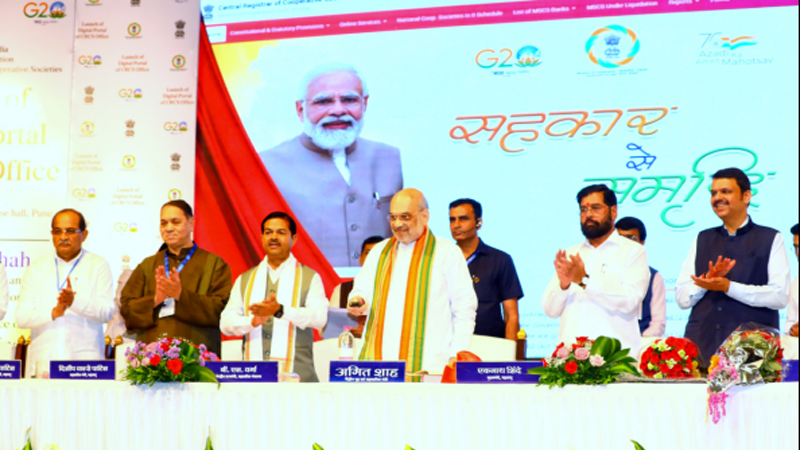
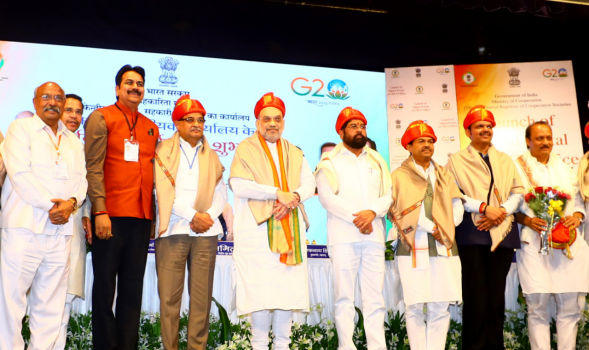
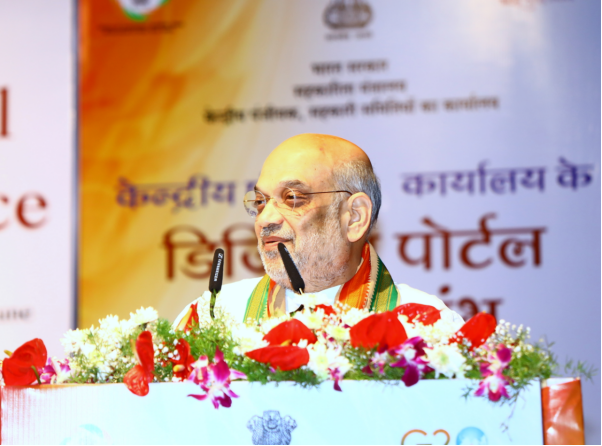
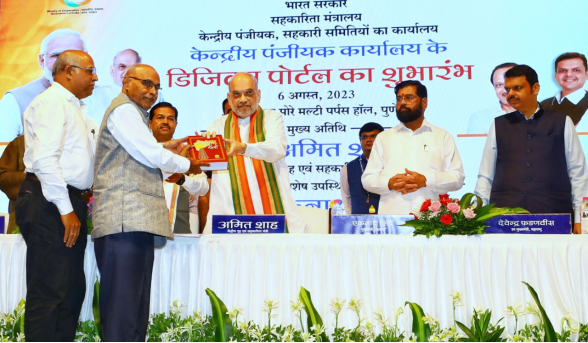
Union Home Minister and Minister of Cooperation Minister Shri Amit Shah launched the digital portal of the Central Registrar of Cooperative Societies (CRCS) office in Pune, Maharashtra today. Several dignitaries including Chief Minister of Maharashtra, Shri Eknath Shinde and Union Minister of State for Ministry of Cooperation, Shri B L Verma were present on the occasion.

In his address, Shri Amit Shah said that The culture of cooperatives spread across the country from Maharashtra only and Cooperative model of Maharashtra is taking the cooperative movement forward in the country. Shri Shah said that if we look at the direction of development of the cooperative movement today, then the cooperative movement has progressed and flourished only in Gujarat, Maharashtra and Karnataka, which is, the parts of the earlier Mumbai state. He said that it is absolutely relevant to start the work of complete digitization of the Central Registrar of Cooperative Societies in Pune, Maharashtra. Shri Shah added that The work of the Central Registrar (CRCS) office, which operates the Multi State Cooperatives, is becoming completely digital today, all the work of cooperative societies like opening new branches, expansion to other states or auditing, will be done online now. This portal has been created including all the activities of Registration, amendment of bylaws, auditing, monitoring of auditing by the Central Registrar, the entire process of election, development of Human Resources, vigilance and training and it is a kind of complete portal in itself.

The Union Minister of Cooperation said that Prime Minister Shri Narendra Modi has put forth the idea of “Sahkar Se Samriddhi” with immense thinking. He said that in the last 9 years, Prime Minister Modi has worked to provide basic facilities to crores of poor people of the country. He said that Shri Narendra Modi has provided houses, electricity, pure drinking water, gas cylinders, toilets, health insurance coverage up to Rs 5 lakh and 5 kg food grains per person per month free of cost to the poor and underprivileged. Shri Shah said that crores of poor people of the country were not linked with the country’s economy, but Shri Modi connected them with it by fulfilling their basic needs and opening their bank accounts. He said that If the poor people of the country lack the capital to start an enterprise then the cooperative movement is the right way for this thru which many people with small capital can come together to set up a big enterprise.

Shri Amit Shah said that meaning of “Sahakar se Samridhi” is to improve the life of poor people, give him a platform to contribute to the economic progress of the country and raise his standard of living through cooperatives. He said that Shri Modi established the Ministry of Cooperation to achieve this objective. Shri Shah said that 1555 multi-state cooperative societies of the country will be benefited by the portal launched today and 42% of these 1555 societies are in Maharashtra only, this shows the strength of cooperative movement in Maharashtra. He said that all the work of these 1555 societies will now be done through this portal. He added that on same lines, Modi Government is going to computerize the offices of registrar of cooperative societies of the states which will ease the communication with 8 lakh cooperative societies across the country.

The Union Home Minister and Minister of Cooperation said that the cooperative movement cannot move forward without modernity, transparency and accountability. He said that to increase the acceptance of cooperative movement, transparency has to be increased and accountability has to be fixed. He said that only such a transparent system can create a connect between crores of people of the country. Shri Shah said that India has given many success stories of cooperatives like Amul, IFFCO and KRIBHCO to the world, now we have to give new momentum to the cooperative movement by taking these along.

Shri Amit Shah said that recently the Multistate Cooperative Societies Act has also been amended. He said that under this law, we have made electoral reforms, set many new dimensions for cooperative governance, arrangements for financial discipline and supply of funds, arrangements for ease of business, an independent body like Election Commission for elections, changes in the rules of running the board and has fixed the responsibility of the Board of Directors and employees to bring transparency. The Multi-State Cooperative Societies Act, 2022 will fix the accountability of cooperatives and end nepotism so that young talent will be able to join the cooperative movement.

The Union Minister of Cooperation said that under the leadership and continuous guidance of Prime Minister Shri Narendra Modi, it has been decided to make PACS viable. He said that the Modi government has decided to take the cooperative movement to every village by creating 3 lakh new PACS across the country in the next 5 years. He said that 93000 PACS have been made in the last 70 years and 3 lakh new PACS will be made in the country in the next 5 years. Shri Shah said that the Modi government has completed the work of computerization of all PACS in the country. He said that PACS are now Common Service Centers (CSC) which can perform a wide range of activities. He said that the Union Cabinet under the leadership of Prime Minister Shri Narendra Modi has approved the world’s largest and multidimensional storage scheme. Shri Shah said that Maharashtra should take maximum advantage of this scheme and there should not be a single Tehsil left without cooperative storage facility.  He said that now cooperatives are also getting the benefit of GEM platform.

Shri Amit Shah said that 95% work of creating the National Cooperative Database has been completed. We are also coming up with a New Cooperative Policy. We are building a cooperative university through which the system of technical education of the cooperative and all its extensions will also be linked to it. He said that Shri Modi has created 3 new multistate cooperative societies. A society has been formed for the marketing of multi-state organic products, which will ensure the marketing of natural farming products with the Bharat Brand and sending its full profit to the farmer’s account. Similarly, small farmers are unable to produce seeds, but now even small farmers, who have small land, will be able to produce seeds. This society will take their seeds, give them certificates and sell them in India and in the world market under their own brand. He said that through these three multistate cooperative societies, the standard of living of more than 10 crore farmers across the country will improve and these societies will pave the way for the prosperity of crores of farmers in the country in the coming days.

The Union Home Minister and Minister of Cooperation said that earlier step-motherly treatment was given to cooperatives, but today, under the leadership of Shri Modi, this step-motherly treatment of cooperatives has ended. He said that today, the arrangements available to corporates are also available to all cooperatives. Shri Shah said that the double standard of income tax has also been abolished. Modi government has also solved the problem of sugar mills which was pending since last many years. He said that the concept of cooperative is that the government cannot tax the profit of the farmer. This principle has been accepted by the Ministry of Finance which is a very significant for the whole cooperative movement and this will be hugely beneficial for this sector in the coming days. Shri Shah said that earlier there was a limit on housing finance for urban cooperatives, it has also been doubled now. Rural cooperative banks have also been given permission to give loans for real estate. Urban Cooperative Banks did not have permission for doorstep banking that, too, has now been given. Urban Cooperative Banks can also open new branches now, One Time Settlement was restricted for Urban Cooperative Banks, for this also we have given rights to Urban Cooperative Banks by bringing them at par with nationalized banks.

Shri Amit Shah said that Prime Minister Shri Narendra Modi has set a target of making 5 trillion dollar economy and making India the third largest economy in the world, we should set a target for the contribution of the cooperative sector in achieving this goal. He said that under the vision of “Sahkar se Samridhi” of Shri Modi, the Ministry of Cooperation has made a new beginning today by launching this digital portal.