Chandrayaan-3 scripts a new chapter in India’s space odyssey: PM

| Published on:

The Prime Minister, Shri Narendra Modi has hailed the relentless dedication of India’s scientists on the launch of Chandrayaan-3.

Sharing a tweet by Indian Space Research Organisations, the Prime Minister tweeted;

“Chandrayaan-3 scripts a new chapter in India’s space odyssey. It soars high, elevating the dreams and ambitions of every Indian. This momentous achievement is a testament to our scientists’ relentless dedication. I salute their spirit and ingenuity!”

Successful launch of Chandrayaan-3 is a reiteration of India’s indigenous capabilities : Dr Jitendra Singh

| Published on:

Union Minister of State (Independent Charge) for Science and Technology, MoS PMO, Department of Space, Department of Atomic Energy, MoS Personnel, Public Grievances and Pensions, Dr Jitendra Singh today said the successful launch of Chandrayaan-3 reiterates India’s indigenous capabilities and vindicates the dream that Vikram Sarabhai saw six decades ago.

Speaking at Sriharikota after the launch, Dr Jitendra Singh said it is also vindication of the dream of Vikram Sarabhai, who might have been short of resources, but not short of confidence because he had faith in himself and in India’s inherent potential and inherent acumen.

“The launch is a reaffirmation of this faith in India’s potential and acumen”, he said.

Thanking the Team ISRO for making India proud, Dr Jitendra Singh thanked Prime Minister Narendra Modi for having made this possible by unlocking the gates of Sriharikota and enabling India’s Space sector.

Quoting PM Modi, the Minister said that “Sky is Not the Limit”, the Minister said, living up to PM’s words, Chandrayaan-3 has today gone beyond the limits of sky to discover the unexplored horizons of the universe beyond”.

Striking a poetic chord, Dr Jitendra Singh said, “It is a moment of glory for India and a moment of destiny for all of us over here at Sriharikota who are as part of the history in making”.

In his concluding sentence, Dr Jitendra Singh said, “As Mother India enters into the next 25 years of this Amritkaal, she pledges to play a leading global role in the emerging world scenario of 21st century.”

Later addressing a press conference, Dr Jitendra Singh said, the opening up of Space sector to private players by PM Modi has helped in creating an ecosystem which enables pooling of all assets and resources, and also enables synergy of knowledge and funds. Even the Chandrayaan-3 mission has a huge contribution by the industry, he said.

Earlier, the LVM3 M4 rocket lifted off from the 2nd Launch Pad at Satish Dhawan Space Centre (SDSC), SHAR, Sriharikota at 2:35 PM and successfully launched the Chandrayaan-3 into orbit. Chandrayaan-3, in its precise orbit, has begun its journey to the Moon. ISRO said the health of the spacecraft is normal.

Union Cooperation Minister inaugurates the National Mega Conclave on FPO

| Published on:

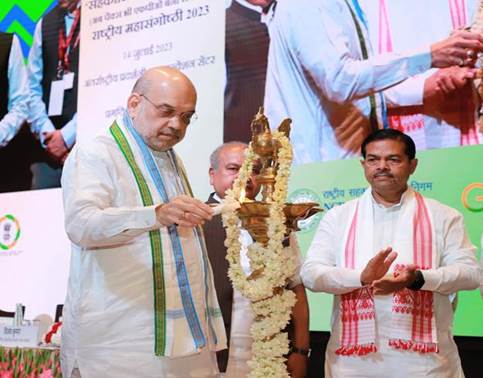
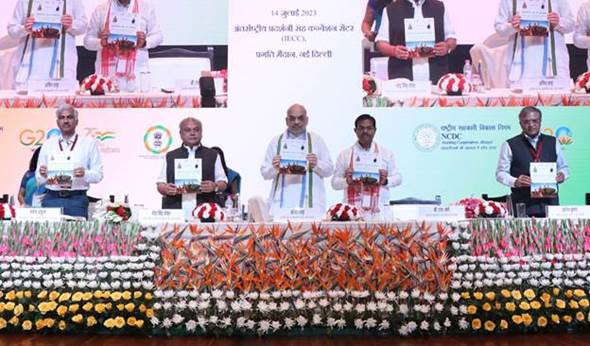
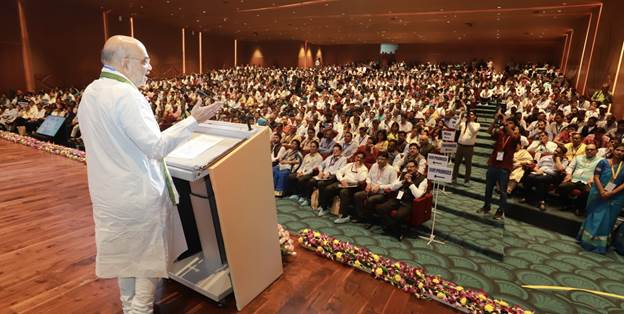
Union Home Minister and Minister of Cooperation, Shri Amit Shah inaugurated the National Mega Conclave on FPO in the cooperative sectorand released the action plan for formation of 1100 new FPOs by PACS in New Delhi today. On this occasion Union Minister of Agriculture and Farmers Welfare Shri Narendra Singh Tomar, Union Minister of State, Ministry of Cooperation, Shri BL Verma, Secretary, Ministry of Cooperation,  Shri Gyanesh Kumar and Secretary, Ministry of Agriculture and Farmers Welfare, Shri Manoj Ahuja were also present along with several dignitaries.

In his address, Shri Amit Shah said that Prime Minister Shri Narendra Modi took the decision to set up a separate Ministry of Cooperation with a different vision. He said that the cooperative movement in our country is very old, but after 75 years of independence, when we look back, it seems that the cooperative movement in the country got divided into many parts. He said that from the point of view of cooperatives, the country can be divided into three categories – states, where the cooperative movement has been successful in advancing and strengthening itself, states, where the cooperative movement is still going on, and States, where the cooperative movement is almost dead. Shri Shah said that in such a large country, where about 65 crore people are engaged in agriculture, it has become very essential to revive the cooperative movement, modernize it, bring transparency in it and aim to achieve new heights. He said in the field of agriculture and rural development through cooperatives movement only, every person can be made prosperous. Shri Shah said that it does not matter whether one has capital or not, but if one has the courage and passion to work hard and the ability to take oneself forward, then the cooperative movement is a great medium for making such people prosperous who lack capital. He said that the cooperative movement can make a significant contribution towards strengthening the country’s 65 crore people associated with agriculture and making them prosperous by combining their small capital through cooperatives and turning into a big capital.

Union Minister of Cooperation said that under the leadership of Prime Minister Shri Narendra Modi, the Ministry of Cooperation has taken several initiatives in the last two years. He said that under the leadership of Prime Minister Shri Narendra Modi and Minister of Agriculture and Farmers Welfare, Shri Narendra Singh Tomar, it was decided to form FPOs in the country. He said that after becoming the Prime Minister, Shri Narendra Modi took several steps to strengthen agriculture and make farmers prosperous and one of them is FPOs. Farmers have benefited a lot through these, but in the cooperative sector, FPO and its benefits have reached to very limited amount and this happened because we did not fix the targets to achieve the goal .Shri Shah said that he said that if PACS becomes an FPO, then the benefits of FPO will reach to all the farmers of PACS. He said that FPOs formed through PACS have the maximum potential to make the farmers prosperous. In the coming days, Ministry of Agriculture and the Ministry of Cooperation will work together with the mantra of three-pronged rural development and prosperity through PACS, FPOs and SHGs. He said that if PACS want to become FPO then NCDC can help them and there is no limit for this and this conclave will further speed up the cooperative movement in the country.

Shri Amit Shah said that agriculture, animal husbandry and fisheries-based economic activities are the strength of the Indian economy, but they are never discussed in the country. He said that today these three sectors together make up 18 percent of India’s GDP. Shri Shah said that in a way agriculture, animal husbandry and fisheries are the backbone of the country’s economy and strengthening them means strengthening the country’s economy. He said that if GDP increases through manufacturing, then the employment figures do not increase that much, but if agriculture, animal husbandry and fisheries are strengthened through cooperatives, then along with GDP, employment opportunities will also increase.

The Union Home Minister and Minister of Cooperation said that about 65 percent of the people in India are engaged in agriculture and allied activities directly and about 55 percent of the workforce is engaged in agriculture and allied activities. He said that all other services are also indirectly dependent on agriculture in rural areas. Shri Shah said that today 86 percent of the farmers of the country are small and marginal farmers, who have less than one hectare of land. He said that India is the only country in the whole world which did not allow small farmers to become laborers and they are the owners of their land. He said that in order to modernize agriculture, get good prices for agricultural produce and make agriculture profitable, we have to move out of traditional methods and adopt today’s contemporary methods and this PACS as FPOs is a new beginning in this series.

Shri Amit Shah said that it is the In Toto responsibility of the government and the cooperative sector to ensure that the life of all those associated with agriculture is as comfortable as that of the people involved in the service sector. He said that FPO was conceived in 2003 by Yogendra Alag Committee during the time of Prime Minister Shri Atal Bihari Vajpayee. He said that when Shri Narendra Modi became the Prime Minister of the country, he decided to implement the suggestion of  FPO. Shri Shah said that the magnitude of this initiative is that today 11,770 FPOs are working in the country and through these and through these, lakhs of farmers of the country have been successful in increasing their income. He said that it was announced in the budget to set up 10,000 FPOs and the target is to achieve this by the year 2027. He said that under the leadership of Shri Modi, the Government of India has allocated Rs 6900 crore to achieve this goal. Shri Shah said that Prime Minister Shri Narendra Modi has come with up such concept that entire system from input to output, from manufacturing to processing and grading and from packaging to marketing and storage, that is the entire system from agricultural production to marketing should be under FPO. Shri Shah said that procurement of inputs, market information, dissemination of technology and innovation, aggregation of inputs for production, facilities for storage, drying, cleaning and grading have been done by FPOs. FPOs have also made arrangements for brand building as well as packaging, labeling and standardization processes, quality control, getting higher price to the farmer by associating with institutional buyers and corporate houses. FPOs havealso become the medium for dissemination of the schemes by informing the farmers about all the government schemes.

Union Home Minister and Minister of Cooperation called upon all the FPOs of the country to continue working in the same manner, but also to keep integrating PACS alongside. He said that a new hybrid model should be designed so that a completer system for information exchange, profit sharing and marketing based on the arrangement between the PACS and the FPO can be put in place. Shri Shah said that the government under the leadership of Prime Minister Shri Narendra Modi has provided loans of over Rs. 127 crore to FPOsso far, which is in addition to Rs. 6,900 crores. In tribal districts, 922 FPOs have been formed for work related to the forest produce. This showcases the meticulous way in which the Modi government and Minister of Agriculture and Farmers Welfare, Shri Narendra Singh Tomar, have moved forward. He said that the states of Gujarat, Maharashtra, Uttar Pradesh, Rajasthan and Punjab have done excellent work in the field of FPOs.

Shri Amit Shah said that we have to establish amongst youth that agriculture is a profitable business, and it needs to be practiced in a modern way with proper marketing. He said that if such a confidence is instilled in the 12 crore farmers of the nation, then not only agricultural production will increase, but the contribution of agriculture to the GDP will increase. It will also make not only make these 12 crore farmers self-reliant but the nation will also become self-reliant. Shri Shah said that Prime Minister Shri Narendra Modi has taken many initiatives in this regard and now through cooperative- FPO, the Modi government will move forward in the direction of making farmers into businessmen and entrepreneurs.

Minister of Cooperation said that during the tenure of Prime Minister Shri Narendra Modi, the budget allocation for agriculture sector has increased by 5.6 times. He said that while in the year 2013-14, the agriculture budget was of Rs 21,000 crore, under the leadership of Prime Minister Shri Narendra Modi, it has increased to Rs 1.15 lakh crore in the year 2023-24. He said that earlier the combined budget was Rs 21,000 crore, but now the budget of Ministry of Agriculture alone is Rs 1.15 lakh crore. This showcases the priority given by the Prime Minister and the government to agriculture.

Shri Amit Shah said that the country produced 265 million tonnes of food grains in 2013-14 and 324 million tonnes in 2022-23. He said that some farmers want to talk about MSP and the government is ready to discuss it. Shri Shah said that there has been an increase of 55% in MSP of Paddy and 51% of MSP of Wheat in 10 years. He said that the present government under the leadership of Shri Modi is the first government after independence which has fixed at least50% more profit than the cost incurred by the farmers. He said that the Modi government has increased paddy procurement by 88% which means almost double paddy has been procured and wheat procurement has increased by around two-thirds, that is, 72%. He said that the work of purchasing 251 lakh metric tonnes of wheat has been done by the Modi government and the number of beneficiaries has almost doubled. He said that this shows how much work has been done by the Modi government for the welfare of the farmers. Along with this, organic farming has been promoted, 60 lakh farmers are covered through micro irrigation of 72 lakh hectares, created micro irrigation fund, created National Edible Oil Mission, created agricultural infrastructure fund of Rs .24000 crore, created fund for agricultural mechanization and the work of connecting about 1260 mandis through e-NAM has also been done by the government under the leadership of Prime Minister Shri Narendra Modi.

The Union Home Minister and Minister of Cooperation said that there has been a radical change in the agriculture sector during the Modi government and now the Ministry of Cooperation has been created so that its benefits reach the farmers. He said that according to the mantra of cooperative, the profit goes to the one who does hard work in fields and this has been ensured by the Ministry of Cooperation.

Shri Amit Shah said that the Modi government has done many things in the cooperative sector. Bylaws of PACS have been made which have been accepted by 26 states. Now, PACSwill be able to function as Dairy and fishermen committee, will also be able to run petrol pump, gas agency, CSC,cheaper medicine shop  and cheaper grain shop, will be able to do storage work. Not only this PACS will be able to perform commercial work in water management under Har Ghar Jal committee of the village. Shri Shah said that the Modi government has decided to link 22 different works with PACS. He said that unless PACS is strong, APACS can never be strong. If FPOs, PACS and Self Help Groups complement each other, then a new era of rural development and agricultural development will begin in the coming days.

Jyotiraditya M. Scindia inaugurates 4th Runway and elevated Taxiway at Delhi Airport

| Published on:

Shri Jyotiraditya M. Scindia, Union Minister for Civil Aviation and Steel inaugurated a new runway and a dual-way elevated taxiway at New Delhi International Airport today. With this, the IGI Airport, New Delhi has become the first airport in the country to have four runways and becomes the first airport in the country to have an elevated taxiway. During the event, General (Dr.) Vijay Kumar Singh (Retd.) Union Minister of State for Civil Aviation, and Road Transport and Highways, Shri Sanjeev Kumar, Chairman, Airport Authority of India, Shri G. M. Rao, Group Chairman, GMR were also present.

Eastern Cross Taxiway (ECT) will help in enhancing the passenger experience by reducing time spent on the tarmac by flyers after landings and before take-offs. Furthermore, four runway operations and the ECT will significantly increase capacity at IGIA – making it capable of handling 1700+ movements.

Speaking on the occasion, Shri Jyotiraditya M. Scindia said “Under the leadership of Prime Minister Narendra Modi, the Civil Aviation sector is not only contributing to the transportation sector but also becoming a key enabler in the rise of the economic power of India. Today is a landmark day for Indian civil aviation, both on infrastructure side and services side. The Eastern Cross Taxiway is the first of its kind in India. Also, this elevated Eastern Cross Taxiway (ECT) will see a reduction of almost 55 thousand tons of CO2 Emission on annual basis. Also, this ECT, along with the fourth runway and the new integrated Terminal 1, will make Delhi Airport future-ready and fulfil the dream of creating a major International Hub. Capacity along with Technological intervention will further enhance the passenger experience. The northern part of the airfield and the southern part of the airfield will be conveniently connected by this. It means an 8 to 9 minute reduction in taxi time. This runway makes Delhi Airport, the only airport in the country to have 4 runways.  This runway along with the terminal expansion will add to creating capacity to serve more than 109 million people throughput which would crest and beat even Atlanta in its capability. With that capacity in place, we would be well positioned both on an infrastructure side and a capability side for creating the international civil aviation hub in India.” 

Prime Minister conferred with the Grand Cross of the Legion of Honour

| Published on:

Prime Minister Shri Narendra Modi was conferred with the Grand Cross of the Legion of Honour, France’s highest award today by H.E. Mr. Emmanuel Macron, President of the Republic of France.

Prime Minister thanked President Macron for this singular honour on behalf of the people of India.

The award ceremony took place at the Elysee Palace in Paris.

PM’s interaction with the Indian Community in Paris

| Published on:

Prime Minister Shri Narendra Modi addressed the Indian community at La Seine Musicale in Paris.

​During his address, Prime Minister highlighted the multi-faceted India-France Strategic Partnership, which is celebrating its 25th anniversary.

Prime Minister also announced about opening of new consulate in Marseille, France.

​Prime Minister highlighted the contribution of the Indian community in France, who form a strong foundation of the India-France partnership.

PM’s meeting with the Prime Minister of the Republic of France

| Published on:

Prime Minister Shri Narendra Modi met H.E. Ms. Elisabeth Borne, Prime Minister of France on 13 July 2023.

The leaders discussed furthering cooperation in various areas such as economic and trade, energy, environment, education, mobility, railways, digital public infrastructure, museology and people to people ties.

Both sides reiterated their desire to further deepen the multifaceted cooperation between India and France.

Union Home Minister addresses G-20 Conference on Crime and Security in the Age of NFTs, AI and the Metaverse 

| Published on:

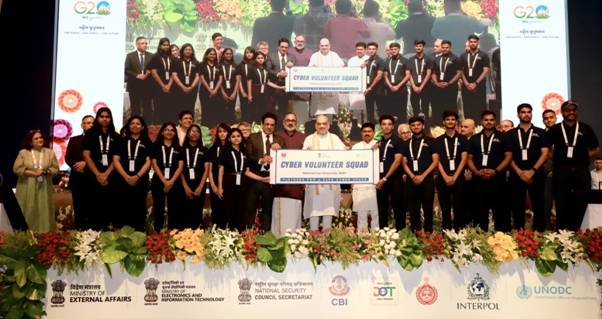
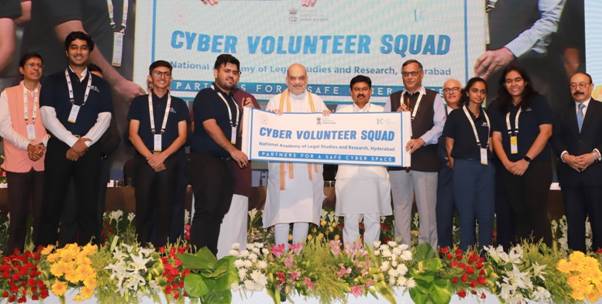
Union Home Minister and Minister of Cooperation, Shri Amit Shah addressed the inaugural session G-20 Conference on Crime and Security in the Age of NFTs, AI and the Metaverse, in Gurugram, Haryana, today. Home Minister flagged off the Cyber Volunteer Squads from 7 premier educational institutions of India. Shri Amit Shah also inaugurated an exhibition and released Conference Medallion. The Inaugural session of the Conference was attended by Minister of State for Home Affairs, Shri Ajay Kumar Mishra, Minister of State for Electronics and IT, Shri Rajiv Chandrasekhar, Union Home Secretary and other dignitaries. Over 900 participants from G20 countries, 9 special invitee countries, international bodies and technology leaders and domain experts from India and across the world are attending the two-day conference.
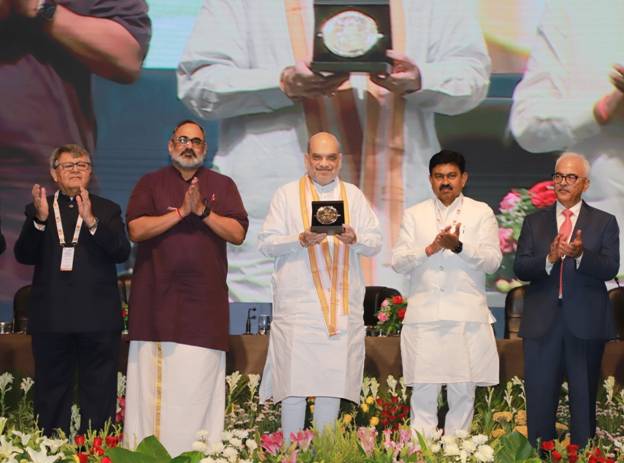
In his address, shri Amit Shah emphasised on the urgent need for cooperation, both at the national and international levels, to build cyber resilience in an increasingly connected world. He said that that this year, India is presiding over the G-20, and, theme of India’s G-20 presidency is “Vasudhaiva Kutumbakam“ or “One Earth–One Family–One Future”, which reflects our cultural heritage. He noted that the theme is perhaps the most relevant in today‘s ‘Digital World’.

Union Home Minister said that technology has transcended all conventional geographical, political and economic boundaries and today, we live in a big global digital village. He said that although, technology is a positive development in bringing human beings, communities and countries closer, there are also some anti-social elements and global forces, that are using technology to cause economic and social harm to citizens and governments. He said that, therefore, this conference becomes all the more important as it can be an important global initiative towards coordinated action to make the digital world safer for all.
Shri Amit Shah said that Prime Minister Shri Narendra Modi believes that “Cyber security is no longer confined to the digital world only. It has become a subject of national security – global security.”. He said that Prime Minister Modi has emphasized the humane aspect of technology. Shri Shah said that Modi ji has integrated the “Internet of Things“ with “Emotions of Things“ to ensure ‘compassion’ and ‘sensitivity’ in the use of technology.

Union Home Minister and Minister of Cooperation said that under leadership of Prime Minister Shri Narendra Modi, India has been at the forefront of adopting emerging technologies at the grassroots level and we aim to make modern technology more accessible and affordable to all sections of society. The Home Minister said that today, 840 million Indians have an online presence, and by 2025 another 400 million Indians will enter the digital world. He said that internet connections in India have increased by 250% in last 9 years and that the cost of per GB of Data has been reduced by 96%. He said that under Pradhan Mantri Jan-Dhan Yojana, 500 million new bank accounts have been opened, and, 330 million RuPay Debit Cards have been distributed. Shri Shah said that India leads in global digital payments with 90 million transactions in 2022 and UPI transactions in India to date are worth Rs.35 trillion. He said that 46% of global digital payments are done in India and there has been 50 times increase in transaction volume since year 2017-18. Shri Shah said that through Direct Benefit Transfer (DBT), covering over 300 schemes across 52 ministries, an amount of Rs.300 million has been directly transferred to the bank accounts of beneficiaries. He said that DigiLocker stores around 6 billion documents. Under BharatNet, 600,000 kilometers of Optical Fiber Cable (OFC) has been laid in the country. Shri Shah said that UMANG App – Unified Mobile Application for New Age Governance – has been launched with 53 million Registrations. Initiatives for ‘digital delivery of services’ have transformed India into a ‘Digital Nation’ within a decade.
Shri Amit Shah said that at the same time, the possibilities of cyber threats have also increased. He quoted Interpol’s ‘Global Trend Summary Report’ for the year 2022, that some of the cybercrime trends such as ransomware, phishing, online scams, online child sexual abuse and hacking are posing serious threats across the globe and there is a possibility that these cyber crimes will increase manifold in the future. Shri Shah said that in this context, this summit is a new and unique initiative of the G-20 Presidency and this is the first conference on cyber security in the G-20. He said that the G-20 has so far focused on digital transformation and data flow from an economic perspective, but now it is very important to understand the aspects of crime and security and find a solution. He said that it is our endeavor to stay ahead in the era of NFTs, AI, Metaverse and other emerging technologies by responding in a timely manner to new and emerging threats in a coordinated and cooperative approach.

Union Home Minister said that a greater focus on cyber security at the G-20 forum can make a positive contribution to ensure the security and integrity of critical ‘information infrastructure’ and ‘digital public platforms’. He said that discussion on cyber space security and cyber crime on the platform of G-20 will help in the development of ‘the Intelligence and Information Sharing Network’ and will give a boost to ‘Global Cooperation’ in this field. Shri Shah said that the objective of this conference is to promote a secure and efficient international framework for empowering and securing ‘digital public goods’ and ‘digital public infrastructure’ as well as optimally harnessing the power of technology.

Shri Amit Shah said that during the six sessions of the two-day conference, there will be meaningful discussion on International Cooperation Framework in subjects such as,

  • Internet Governance,
  • Security of Digital Public Infrastructure,
  • Legal and Regulatory Issues related to Digital Ownership,
  • Responsible use of AI and International Cooperation Framework for Dark Net.

Shri Shah expressed happiness that the international community has wholeheartedly supported this conference. He said that apart from G-20 members, 9 guest countries and 2 major international organizations, INTERPOL and UNODC, as well as various international speakers are participating in this conference.

Union Home Minister and Minister of Cooperation said that in the wake of this digital age, cyber security has become an essential aspect of global security, that requires adequate attention on its economic and geo-political implications. He said that it is essential to strengthen the capabilities of nations and international organizations to deal with new and emerging, traditional and non-traditional challenges, including terrorism, terror financing, radicalization, narco, narco-terror links, and misinformation in a better way. Shri Shah noted that the transformation of our security challenges from ‘Dynamite to Metaverse, and, conversion of ‘Hawala to Crypto Currency’ is a matter of concern for the countries of the world, and, all of us together, have to devise a common strategy against it. Shri Shah said that terrorists are finding new ways to perpetrate violence, radicalize youth and raise financial resources and that the new methods in the form of virtual assets are being used by terrorists for financial transactions. He said that terrorists are using dark-net to hide their identity and spread radical material. Shri Shah stated that we have to understand the pattern of these activities running on the dark-net, and find solutions for the same. He said that to create a “robust and efficient operational system, we need to think coherently to crack down on the use of various virtual assets.

Shri Amit Shah said that the Metaverse, once a science fiction idea, has now stepped into the real world and it may create new opportunities for terrorist organizations, primarily for propaganda, recruitment and training. He noted that this will make it easier for terrorist organizations to select and target vulnerable people and prepare material according to their vulnerabilities. He said that the metaverse also creates opportunities for true imitation of a user‘s identity, known as “deep-fakes”, and, by using better biometric information about individuals, criminals will be able to impersonate users and steal their identities. Shri Shah said that incidents ranging from ransomware attacks, sale of critical personal data, online harassment and child abuse to fake news and mis-information campaigns with ‘toolkits’, are being carried out by cybercriminals. He said that at the same time, there is also a growing tendency to strategically target critical information and financial systems. Such activities are a matter of national concern, as their activities have a direct impact on national security, law and order and the economy. He emphasised that if such crimes and criminals have to be stopped, then we have to think and act by rising above the conventional geographic boundaries. Shri Shah pointed out that the targets in digital warfare are not our physical resources, but our ability to act online and disruption of online network even for a few minutes, can be fatal.

Union Home Minister said that today, all the governments of the world are promoting digital means in governance and public welfare and in this direction, it is necessary that citizens have faith in digital platforms. He said that insecurity in the digital space also raises questions about the legitimacy and sovereignty of the nation-state. Shri Shah said that our Internet vision should neither be one of excessive freedom threatening the very existence of our nations nor one of isolationist structures such as  digital firewalls. He said that India has set up certain ‘open-access digital public infrastructure’ models, which have become examples in the world today. India has developed Aadhaar model for digital identity, UPI model of real-time fast payment, Open Network for Digital Commerce (ONDC), and, Open Health Service Network in the field of health. Shri Shah said that the world today needs a model for digital public infrastructure to facilitate the flow of information and finance and this will facilitate the countries of the world to digitally empower their citizens.

Shri Amit Shah said that many countries of the world have become victims of cyber attacks and this threat is hovering over all the major economies of the world. He stated that, according to World Bank estimates, cyber- attacks could have caused losses of around $5.2 trillion to the world during the years 2019-2023. The use of crypto currency by malicious threat actors further complicates its detection and prevention. Shri Shah said that the Government of India, under the leadership of Prime Minister Shri Narendra Modi, has worked towards outlining a uniform cyber strategy, Real-time reporting of cyber-crimes, capacity building of Law Enforcement Agencies, designing analytical tools, and setting up a national network of forensic laboratories, ensuring cyber hygiene, and spreading cyber awareness to every citizen. Shri Shah said that the Crime and Criminal Tracking Network and System (CCTNS) has been implemented in all the police stations of the country. He said that the Government of India has established the Indian Cyber-Crime Coordination Center (I-4C) to ensure a comprehensive response against cybercrime. The government of India has also created a massive open online courses platform called the ‘CyTrain’ portal, which perhaps, will be the world’s largest training program in the field of cyber security.

The Union Home Minister and Minister of Cooperation drew the attention of the participants to a few points, to ensure a Safe and secure Cyberspace. He said, there must be efforts to bring some uniformity in the laws of all countries made to counter digital crimes. Keeping in mind the borderless nature of cybercrimes, we must put in place a response mechanism under different laws of the countries. Global cooperation in this area will help in harmonizing cyber security benchmarks, best practices and regulations. Shri Shah expressed hope that this conference will provide a concrete action plan in this direction. He said that an integrated and stable approach to cyber security policies will facilitate interoperability, increase trust in information sharing and reduce the agency protocols and resources gaps. He said that the need of the hour is to share ‘real- time cyber threat intelligence’ among member countries with active support from industry and academia to secure the nation’s critical infrastructure. There should be greater coordination among cyber agencies of all countries in reporting and action on cyber incidents. Cooperation in the investigation of cross-border cyber crimes through joint efforts to build a ‘peaceful, secure, deterrent and open’ information and communication technology environment is extremely necessary today. In line with the United Nations Convention on the Criminal Use of Information and Communication Technology, speedy preservation, investigation and co-ordination of evidences is essential. Computer Emergency Response Teams (CERTs) must be strengthened to deal with emerging threats due to emerging technologies. There should be a 24×7 cyber security mechanism in place for an effective ‘predictive – preventive – protective and recovery’ action. The nature of the Cyber Threat Landscape has spread across national boundaries, necessitating cooperation and sharing of information by nations, organizations and stakeholders to effectively combat cybercrimes. Time has come to build a ‘Transparent and Accountable AI and Emerging Technologies Governance Framework’ to ensure responsible use. Given the rise in cybercrime involving digital currency, there is a need for a ‘dedicated common channel’ among the nations to prevent such financial irregularities. Third-party verification of NFT platforms will increase trust and curb criminal activities.

Concluding his address, the Union Home Minister and Minister of Cooperation, Shri Amit Shah once again emphasized that no single country or organization can combat cyber threats alone – it requires a united front. He said that our future has given us the opportunity to remain steadfast in our commitment to ‘using technology with sensitivity’ and ‘ensuring public safety and security’, and, this task cannot be handled by the governments alone. Shri Shah said that we aim to create a ‘Cyber Success World’ and not a ‘Cyber Failure World’. He said that together, we can harness the potential of these technologies while ensuring a ‘secure and prosperous digital future’ for all.

Nitin Gadkari lays Foundation stone of 3 NH projects worth Rs 2,900 Crore in Tirupati, AP

| Published on:

Union Minister for Road Transport and Highways Shri Nitin Gadkari laid the foundation stone for 3 NH Projects in the presence at Tirupati ,Andhra Pradesh today.

These projects encompass a combined length of 87 kilometers and carry a total cost of Rs 2,900 Crore.

The first undertaking is the Naidupate-Turpu Kanupur Section of NH-71, spanning 35 Km and requiring an investment of ₹1,399 Crore. The second project is the Chillakuru Cross-Krishnapatnam Port South Gate Section via Turpu Kanupur on NH-516W, covering a distance of 36 Km and valued at ₹909 Crore. Lastly, the Thamminapatnam-Narikellapalle Section involves an extension of the Dedicated Port Road from Eupuru to Krishnapatnam Port on NH-516W and NH-67, length of 16 Km and valued at ₹610 Crore.

Shri Gadkari said these endeavors aim to provide seamless and secure connectivity to Krishnapatnam Port, enabling faster accessibility to National Master Plan Nodes, Industrial Nodes, and SEZ at Nellore. Additionally, they will enhance the safety and convenience of devotees traveling to religious destinations such as the Shri Balaji Temple in Tirupati and the Shri Shiva Temple in Srikalahasti. He said under the dynamic leadership of Hon’ble PM Shri Narendra Modi  we remain fully committed to ensuring swift, seamless, and energy-efficient mobility across the entire nation.

Shri Gadkari said  these projects will bolster tourism by establishing connections to popular attractions like the Nelapatu Bird Sanctuary and SHAR at Sriharikota. Importantly, they are also expected to generate substantial employment opportunities.

PM holds talks with Secretary General of Muslim World League

| Published on:

The Prime Minister, Shri Narendra Modi held talks with the Secretary General of Muslim World League, H.E. Sheikh Dr Mohammad bin Abdulkarim Al-Issa on furthering inter-faith dialogue, countering extremist ideologies, promoting global peace, and deepening the partnership between India and Saudi Arabia.

Replying to a tweet by H.E. Sheikh Dr Mohammad bin Abdulkarim Al-Issa about the meeting, the Prime Minister tweeted;

“Pleased to have met H.E. Sheikh Dr Mohammad bin Abdulkarim Al-Issa, Secretary General of Muslim World League and Chairman of the Organisation of Muslim Scholars. We had a great exchange of views on furthering inter-faith dialogue, countering extremist ideologies, promoting global peace, and deepening partnership between India and Saudi Arabia.”

Piyush Goyal holds talks with Secretary of State for Trade of the UK, discusses FTA and trade relations

| Published on:

Commerce and Industry Minister (CIM) of India, Piyush Goyal, concluded a productive visit to London from July 10 to July 12, during which he engaged with several highly placed politicians, govt. officials and industry leaders and had crucial discussions to strengthen the India-UK trade relationship. The visit was strategically timed, coinciding with the critical stage of ongoing negotiations, and proved to be instrumental in moving the discussions forward.

During his visit, Minister Goyal met with the Secretary of State for Trade of the United Kingdom, Kemi Badenoch, to discuss the Free Trade Agreement (FTA) and explore opportunities for enhanced collaboration between the two nations.

Recognizing India’s vast population of 1.4 billion and its remarkable economic growth, both ministers acknowledged the immense potential of the Indian market for the United Kingdom. Encouragingly, considerable progress was achieved during their frank and open discussions on various difficult issues.

The meeting between Minister Goyal and Secretary Badenoch was marked by a shared understanding and a commitment to advancing mutual interests. The ministers identified and focused on low-hanging fruits, which included the closure of several chapters in the negotiations. This pragmatic approach aimed at resolving issues where negotiators had encountered challenges. The visit proved to be critical in overcoming crucial obstacles and charting a path forward towards an ambitious and mutually beneficial trade deal.

Furthermore, Minister Goyal had a productive discussion with Douglas McNeill, the Chief Economic Advisor to the UK Prime Minister. The meeting highlighted the joint efforts of India and the UK in giving a new dimension to their relationship and promoting trade between the two nations. Both parties acknowledged the positive outcomes achieved through collaborative initiatives and expressed optimism for the future. It is noteworthy that Mr. McNeil had visited New Delhi during the last Round and had meeting with senior officers and ministers.

During the visit he also interacted with businesses and industry and had a Business Roundtable involving stakeholders of various sectors of mutual interest for India and the UK. He urged the businesses in India and the UK to take advantages of various initiatives of Government of India. He also interacted with the members of UK chapter of Institute of Chartered Accountants of India.

The discussions held during this visit reflected a strong commitment from both sides to forge a closer partnership and explore avenues for trade promotion. The progress made during the visit sets a solid foundation for further strengthening bilateral relations and achieving mutually beneficial outcomes.

Nitin Gadkari launches Nation-wide Plantation Drive in Tirupati, Andhra Pradesh

| Published on:

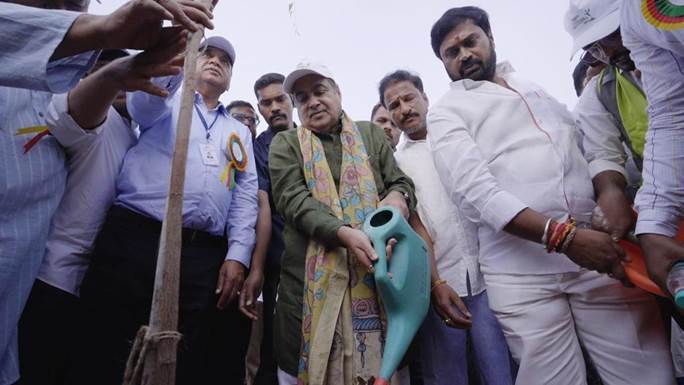
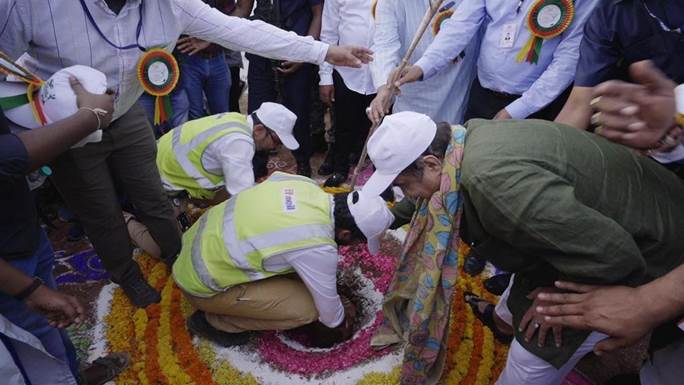
Union Minister for Road Transport & Highways Shri Nitin Gadkari, launched a nationwide plantation drive in Tirupati, Andhra Pradesh today.

Under the aegis of ‘Azadi Ka Amrit Mahotsav’, NHAI organized this drive  to undertake plantation of over 2.75 lakh saplings in one day through simultaneous plantations at more than 300 identified locations, along the National Highways including NHAI land parcels, toll plazas and Amrit Sarovars.  Spreading the message of environment sustainability the drive witnessed participation from public representatives, Civil society, NGOs and students.

In his address Shri Gadkari  said this initiative aligns with the Green India Mission (GIM) led by Prime Minister Shri Narendra Modi Ji, aiming to convert our National Highways into environmentally sustainable Green Highways. He said our commitment to this cause is unwavering as we diligently strive to compensate for every tree felled during road projects by planting twice the number of trees. Furthermore, we have achieved success in relocating fully grown and large trees, he added.

Shri Gadkari said this initiative serves as a concrete response to the challenges posed by climate change, as it simultaneously reduces carbon emissions and fosters the development of environmentally friendly infrastructure. He said that plantation and transplantation of trees has become an integral part of National Highway development. He said a lot of emphasis is also given to geotagging of trees, so that the progress and growth of these plants can be monitored. He also called upon people to come forward and participate in the program to have a sustainable and long-lasting impact of the plantation drive.

Minister of State for Road Transport & Highways and Civil Aviation Gen. (Retd) Dr. V.K. Singh and NHAI Chairman Shri Santosh Kumar Yadav also planted saplings near Eastern Peripheral Expressway Interchange at Dasna, Ghaziabad.

The plantation action plan is the focus area of highway development program under which the local indigenous shrubs and trees are planted on surplus land of roadside avenue and median land or ROW.  MoRTH promulgated Green Highway policy-2015, under this mandate, NHAI has planted 3.46 crore saplings from 2016-17 to 2022-23 as part of Annual Plantation Action Plan. In current year, over 56 lakh saplings are proposed to be planted which have started from monsoon season only.

The plantation and other allied activities which NHAI undertakes is in sync with the vision of Hon’ble Prime Minister viz. Mission LiFE ,Lifestyle For Environment, which entails to bring individual human behavior at the forefront of global climate action narrative. Through its sustainable endeavor, NHAI plans to contribute for the creation of an ecosystem that will reinforce and enable environment friendly behaviour to be self-sustainable.

NHAI has been organizing plantation drives from time to time to develop eco-friendly National Highways. The vision is to saturate plantations along the National Highways collectively by involving concessionaires, State Government agencies, private plantation agencies, Self-Help Group through State Rural Livelihood Missions (SRLMs) and Forest and Horticulture experts.