PM flags off two Vande Bharat Trains from Gorakhpur Railway Station in UP

| Published on:

The Prime Minister, Shri Narendra Modi flagged off two Vande Bharat Express trains from Gorakhpur Railway Station in Uttar Pradesh today. The two Vande Bharat trains are Gorakhpur – Lucknow Vande Bharat Express and Jodhpur – Ahmedabad (Sabarmati) Vande Bharat Express. The Prime Minister also laid the foundation stone for the redevelopment of Gorakhpur Railway Station at the cost of around Rs. 498 crores and inspected the model of the proposed Gorakhpur Railway Station.

The Prime Minister was accompanied by the Governor of Uttar Pradesh, Smt Anandiben Patel, the Chief Minister of Uttar Pradesh, Shri Yogi Adityanath, and Member of Parliament from Gorakhpur, Shri Ravi Kishan.

Background

Gorakhpur – Lucknow Vande Bharat Express will pass through Ayodhya and improve connectivity to important cities of the state while providing a fillip to tourism. Jodhpur – Sabarmati Vande Bharat Express will enhance the connectivity to famous places such as Jodhpur, Abu Road, and Ahmedabad while boosting socio-economic development in the region.

The foundation stone for the redevelopment of Gorakhpur Railway Station at the cost of around Rs 498 crores will provide world-class amenities to the passengers.

PM addresses closing ceremony of centenary celebrations of Gita Press in Gorakhpur, UP

| Published on:

The Prime Minister, Shri Narendra Modi addressed the closing ceremony of the centenary celebrations of the historic Gita Press in Gorakhpur, Uttar Pradesh today and released the Chitramaya Shiva Purana Granth. The Prime Minister also visited Leela Chitra temple in the Gita Press and paid floral tribute to the portrait of Lord Shri Ram.

Addressing the gathering, the Prime Minister remarked that in the pious month of Sravan, and with the blessings of Indradev, he has got the opportunity to be present at Gita Press in Gorakhpur which is the worshiping place of Shiva Avtar Guru Gorakhnath and the workplace of many saints. Referring to his visit to Gorakhpur, the Prime Minister said that it is a wonderful example of development and heritage going hand in hand. He informed that he will head to Gorakhpur Railway Station to lay the foundation stone for the redevelopment of Gorakhpur Railway Station and flag off two Vande Bharat Express Trains after the completion of the program at Gita Press. He also mentioned that the pictures of the proposed railway station have created a buzz of excitement among the citizens. Referring to the Vande Bharat Express, the Prime Minister stated that it has elevated the levels of convenience for the middle class. Recalling the time when Ministers had to write letters to add a halt for a train in their region, the Prime Minister said that today Ministers are writing letters to flag off Vande Bharat Trains. “Vande Bharat Trains have become a craze”, he added. Shri Modi congratulated the people of Gorakhpur and India for today’s projects.

“Gita Press is not just a printing press but a living faith”, the Prime Minister said as he remarked that the office of Gita Press is no less than a shrine for crores of people. He said that with Gita comes Krishna, with Krishna, there is compassion and ‘karma’,  and there is a sense of knowledge as well as scientific research. The Prime Minister said quoting the Gita, “Vasudeva Sarvam i.e. Everything is, from and in Vasudev.”

The Prime Minister emphasized that the spiritual light that lit up in the form of Gita Press in 1923 has become the guiding light of the entire humanity today. He thanked the good fortune for being able to witness the golden century of this humanitarian mission. On this historic occasion, the Prime Minister said, the government has conferred the Gandhi Peace Prize to Gita Press. Referring to Mahatma Gandhi’s emotional attachment to Gita Press, the Prime Minister informed that Gandhiji once used to write for Gita Press through Kalyan Patrika. He further added that it was Gandhiji who suggested that advertisements should not be published in the Kalyan Patrika and the suggestion is still being followed. The Prime Minister expressed delight that the country paid its respects to Gita Press by conferring the Gandhi Peace Prize as it honors the contribution and its 100-year-old legacy. In these 100 years, the Prime Minister continued, Gita Press has published crores of books which are sold at a price less than the cost and delivered door-to-door. He noted the spiritual and intellectual satisfaction that this flow of knowledge must have provided to so many readers while also creating many dedicated citizens for society at the same time, The Prime Minister congratulated the personalities who have been contributing and cooperating in this Yagya selflessly without the need for any publicity and also paid tributes to personalities like Sethji Jayadayal Goyandka and Bhaiji Shri Hanuman Prasad Poddar.

The Prime Minister underlined that an organization like Gita Press is not only associated with religion and work but also has a national character. “Gita Press connects India, strengthens India’s solidarity”, Shri Modi said as he informed about its 20 branches across the country. The Prime Minister mentioned that one can find Gita Press stalls at every railway station in the country. He informed that the Gita Press publishes 1600 titles in 15 different languages and propagates the basic thoughts of India to the masses in different languages. “Gita Press in a way represents the spirit of ‘Ek Bharat, Shreshtha Bharat”, he asserted.

The Prime Minister pointed out that it is no coincidence that Gita Press has completed its journey of 100 years at a time when the country is celebrating 75 years of its independence. Highlighting the time before 1947 when  India continuously made efforts in different fields for its renaissance, the Prime Minister said that different institutions took shape to awaken the soul of India. As a result, he continued, by 1947, India was completely ready to break the shackles of slavery with mind and soul. He noted that the establishment of Gita Press also became a major base for it. The Prime Minister lamented the time when centuries of slavery had tarnished India’s consciousness a hundred years ago and foreign invaders burnt India’s libraries. “The Gurukul and the Guru tradition were almost destroyed during the British period,” he said. He also threw light on the beginning of the disappearance of India’s sacred texts as the printing presses at the time were beyond the reach of the common man due to the high cost. “How would our society run without Gita and Ramayana? When the sources of values and ideals start drying up, the flow of society stops automatically”, the Prime Minister exclaimed.

The Prime Minister emphasized that the Bhagavad Gita has always become a source of inspiration when unrighteousness and terror have become strong, and the truth has been clouded with danger. Quoting the Gita, the Prime Minister explained that whenever there is a crisis on the authority of religion and truth, then God appears on earth to protect it. Referring to the tenth chapter of the Gita which explains about God appearing in any form, the Prime Minister said that sometimes organizations like Gita Press are born to revive human values and ideals. He said that Gita Press accelerated the flow of consciousness and thinking for India as soon as its establishment in 1923. He mentioned that our scriptures, including the Gita, once again started resonating in every household and our minds mixed with the mind of India. “Family traditions and new generations started connecting with these books, and our holy books started becoming the base for generations to come”, he added.

“Gita Press is proof that when your objectives are pure, your values are pure then success becomes synonymous”, the Prime Minister said. He underlined that Gita Press as an institution has always enriched social values and shown the path of duty to the people, He gave examples of cleanliness of the river Ganges, science of Yoga, publication of Patanjali Yoga Sutra, ‘Arogya Ank’ associated with Ayurveda, ‘Jeevancharya Ank’ to introduce people to the Indian lifestyle, ideals of service to the society, ‘Seva Ank’ and ‘Dan Mahima’. “Behind all these efforts, the inspiration of serving the nation has been attached, and there has been a resolve to build the nation”, Shri Modi added.

“The penance of saints never fails, their resolutions are never empty!”, Shri Modi said. Recalling his address from the Red Fort about freedom from the mentality of slavery and taking pride in our heritage, the Prime Minister said that the nation is moving forward while taking along both development and heritage. On the one hand, India is making new records in digital technology, while at the same time,  the divine form of Vishwanath Dham in Kashi has also emerged after the redevelopment of Kashi Corridor. The Prime Minister mentioned building world-class infrastructure, while also witnessing the magnificence of pilgrimages like Kedarnath and Mahakal Mahalok. The Prime Minister also drew attention to the fact that the dream of the grand Ram Temple in Ayodhya is also going to be fulfilled after centuries. The Prime Minister also mentioned the new Naval Ensign showing the mark of the time of Chhatrapati Shivaji Maharaj. The Prime Minister also touched upon renaming the Rajpath to the Kartavya Path to inspire the spirit of duty, development of Museums across the country to honor the tribal traditions and tribal freedom fighters, and restoring sacred ancient idols which were stolen and sent outside the country.

Concluding the address, the Prime Minister said that the idea of a developed and spiritual India was given to us by our sages, and today one can see it becoming meaningful. The Prime Minister expressed confidence that the spiritual practice of our saints and sages will continue to give such energy to the all-round development of India. “We will build a new India, and make our vision of world welfare a success”, the Prime Minister concluded.

Governor of Uttar Pradesh, Ms Anandiben Patel, Chief Minister of Uttar Pradesh, Shri Yogi Adityanath, Member of Parliament from Gorakhpur, Shri Ravi Kishan, General Secretary Shri Vishnu Prasad Chandgothia and Chairman Keshoram Agarwal of Trust Board of Gita Press were present on the occasion among others.

PM lays foundation stone and dedicates to nation various development projects worth around Rs 7500 crores in Chhattisgarh

| Published on:

The Prime Minister, Shri Narendra Modi laid the foundation stone and dedicated to the nation various development projects worth around Rs 7500 crores in Raipur, Chhattisgarh today. He dedicated and laid the foundation stone for 5 National Highway projects worth around Rs 6,400 crores. The Prime Minister also dedicated to the nation the doubling of 103 km long Raipur – Khariar Road Rail Line which has been completed at a cost of Rs 750 crores, a 17 km long new railway line connecting Keoti – Antagarh developed at a cost of Rs 290 crores. Further, the Prime Minister dedicated to the nation a bottling plant of the Indian Oil Corporation with a capacity of 60 thousand metric ton per annum at Korba constructed at a cost of over Rs 130 crores. He also flagged off Antagarh – Raipur Train via video link. Further, the Prime Minister initiated the distribution of 75 lakh cards to the beneficiaries under the Ayushman Bharat.

Addressing the gathering, the Prime Minister remarked that today’s occasion is extremely significant for the development journey of Chhattisgarh as the state is receiving development projects worth more than 7000 crores in the sectors like infrastructure and connectivity. He underlined that the projects of today will make the lives of the people easier and strengthen the healthcare system in the state. He also emphasized that these projects will give rise to employment opportunities in the state while also benefiting the paddy farmers, mineral industry and tourism industry of Chhattisgarh. “The projects of today will mark a new journey of development and convenience in the tribal areas of Chhattisgarh”, the Prime Minister said as he congratulated the people of the state for the projects.

The Prime Minister emphasized that the delay in the development of any given region is directly related to the lack of infrastructure, Hence, the Prime Minister continued, the government is prioritizing infrastructure development in those specific regions which have lagged behind in terms of development. “Infrastructure means ease of living and ease of doing business. Infrastructure means employment opportunities and fast-paced development”, the Prime Minister asserted. He said that modern infrastructure development can also be witnessed in Chhattisgarh where in the last 9 years, road connectivity has expanded to thousands of tribal villages of the state under the Pradhan Mantri Gramin Sadak Yojana. He noted that the Government has approved projects of about 3,500 km long National Highway where about 3000 km have also been completed. The Prime Minister also mentioned that Raipur-Kodebod and Bilaspur-Pathrapali highways have been inaugurated today. “Be it rail, road, telecom, the Government has done unprecedented work in Chhattisgarh in the last 9 years to boost all forms of connectivity”, he added

The Prime Minister highlighted that modern infrastructure is also related to social justice and mentioned that the projects of today including the roads and railway lines that are connecting the settlements of the poor, Dalits, backward and tribals will improve connectivity to the hospitals for patients and women. He also highlighted that nine years ago, more than 20 percent of the villages in Chhattisgarh did not have any kind of mobile connectivity whereas today the number has come down to about 6 percent, and the farmers and laborers of the region are the biggest beneficiaries of this. He also pointed out that most of these tribal villages where connectivity has improved were the ones once affected by Naxalite violence. The Prime Minister informed that the Government is installing more than 700 mobile towers to ensure good 4G connectivity. He also stated that about 300 towers have already started functioning. The tribal villages that once fell silent can now hear the buzzing of the ringtones”, he added. The Prime Minister underlined that the advent of mobile connectivity has aided the people of the village in many tasks. “This is social justice. And this is Sabka Saath, Sabka Vikas” the Prime Minister said.

“Today Chhattisgarh is connecting with two economic corridors”, the Prime Minister remarked as he asserted that the Raipur – Dhanbad Economic Corridor and Raipur – Vishakhapatnam Economic Corridor are going to change the fortunes of the entire region. He noted that the economic corridors are passing through aspirational districts that were once called backward, and where violence and anarchy once prevailed. He said that the Raipur-Vishakhapatnam Economic Corridor whose foundation stone has been laid today will become a new lifeline of this region as the journey between Raipur and Visakhapatnam will be reduced to half. He also mentioned that the 6-lane road will connect the paddy belt of Dhamtari, the bauxite belt of Kanker and the richness of handicrafts of Kondagaon to other parts of the country. The Prime Minister also appreciated the construction of tunnels and animal passes for the convenience of wildlife as this road will pass through the wildlife region. “The rail line from Dalli Rajhara to Jagdalpur and direct train service from Antagarh to Raipur will also make it easier to travel to far-flung areas”, Shri Modi added.

“The Government is committed to creating new opportunities and setting up more industries in areas of natural wealth”, the Prime Minister said as he highlighted the efforts in this direction in the last 9 years which have given new energy to industrialization in Chhattisgarh. He informed that due to the policies of the Government, Chhattisgarh witnessed an increase in funds in the form of revenue. He noted that Chhattisgarh has started getting more funds in the form of royalty, especially after the change in the Mines and Mineral Act. In the four years before 2014, the Prime Minister informed that Chhattisgarh had received Rs 1300 crore as royalty whereas the state received about Rs 2800 crore between 2015-16 to 2020-21. He said that the work of development has been accelerated in districts with mineral wealth as a result of an increase in the District Mineral Fund. “Be it schools for children, libraries, roads, water arrangements, now the District Mineral Fund Money is being spent in many such developmental works”, he added.

Highlighting that more than Rs 6000 crores are deposited today in more than 1 crore 60 lakh Jan Dhan bank accounts that have been opened in Chhattisgarh, the Prime Minister said that it belongs to the poor families, farmers and laborers who were once forced to keep it elsewhere. He also highlighted that the Jan Dhan accounts are assisting the poor in availing direct help from the government. The Prime Minister said that the Government is continuously working for the youth of Chhattisgarh towards creating employment and self-employment opportunities and informed that more than Rs 40,000 crores have been given to the youth of Chhattisgarh  under the Mudra Yojana, that has come to the aid of a large number of tribal youths and youths from poor families. He also mentioned that the Government has launched a special scheme worth lakhs of crores to help the small industries of the country during the Corona period where about 2 lakh enterprises of Chhattisgarh got assistance of about Rs 5000 crores.

The Prime Minister also touched upon PM Swanidhi Yojana which provides loans without guarantee to street vendors and mentioned that more than 60 thousand beneficiaries hailed from Chhattisgarh. He informed that the Government has provided more than Rs 25000 crores to Chhattisgarh for providing adequate employment under MNREGA in the villages.

Noting that the distribution of Ayushman cards to 75 lakh beneficiaries is already underway, the Prime Minister emphasized the guarantee of free treatment up to Rs 5 lakh every year in more than 1500 big hospitals of  the state for the poor and tribal families. He expressed satisfaction that Ayushman Yojana is coming to the aid of the lives of poor, tribal, backward and Dalit families. Concluding the address, the Prime Minister assured to serve every family of Chhattisgarh with the same spirit of service.

Governor of Chhattisgarh, Shri Biswabhusan Harichandan, Chief Minister of Chhattisgarh, Shri Bhupesh Baghel, Deputy Chief Minister of Chhattisgarh, Shri T S Singh Deo, Union Minister for Road Transport and Highways, Shri Nitin Gadkari, Union Minister for Health and Family Welfare Dr Mansukh Mandaviya, and Members of Parliament among others were present on the occasion.

Background

In a major push towards infrastructure development, the Prime Minister dedicated and laid the foundation stone for 5 National Highway projects worth around Rs 6,400 crores. The projects that will be dedicated to the nation include the 33 km long 4-laning of the Raipur to Kodebod section on the Jabalpur-Jagdalpur National Highway. Besides boosting tourism, the section is integral for the movement of raw goods, finished products of Steel plants near Jagdalpur and provides connectivity to iron ore-rich areas. The Prime Minister also dedicated to the nation the 53 km long 4-lane Bilaspur-Pathrapali stretch of Bilaspur to Ambikapur section of NH-130. It will help improve the connectivity of Chhattisgarh with Uttar Pradesh and will boost the movement of coal by providing connectivity to coal mines in adjoining areas.

The Prime Minister also laid the foundation stone for 3 National Highway projects for the Chhattisgarh Section of the 6-lane Greenfield Raipur – Visakhapatnam corridor. These include the development of a 43 km long six-lane Jhanki-Sargi section on NH 130 CD; a 57 km long six-lane Sargi-Basanwahi section on NH 130 CD; and a 25 km long six-lane Basanwahi-Marangpuri section of NH-130 CD.  A key component is a 6-Lane tunnel of 2.8 km in length which comprises 27 animal passes and 17 monkey canopies for unrestricted wildlife movement in the Udanti Wildlife Sanctuary area. These projects will provide better connectivity to rice mills in Dhamtari and bauxite-rich areas in Kanker and also benefit the handicraft industry in Kondagaon. Overall, these projects will give a major thrust to the socio-economic development of the region.

The Prime Minister also dedicated to the nation the doubling of 103 km long Raipur – Khariar Road Rail Line which has been completed at a cost of Rs 750 crores. It will ease transportation of coal, steel, fertilizers and other commodities from ports for industries in Chhattisgarh. He also dedicated to the nation a 17 km long new railway line connecting Keoti – Antagarh developed at a cost of Rs 290 crores. The new railway line will provide connectivity to Bhilai Steel Plant with Iron Ore Mines of Dalli Rajhara and Rowghat areas and will link remote areas of southern Chhattisgarh passing through dense forests.

The Prime Minister also dedicated to the nation a bottling plant of the Indian Oil Corporation with a capacity of 60 thousand metric tons per annum at Korba, constructed at a cost of over Rs 130 crores. He also flagged off Antagarh – Raipur Train via video link. Further, the Prime Minister initiated the distribution of 75 lakh cards to the beneficiaries under the Ayushman Bharat.

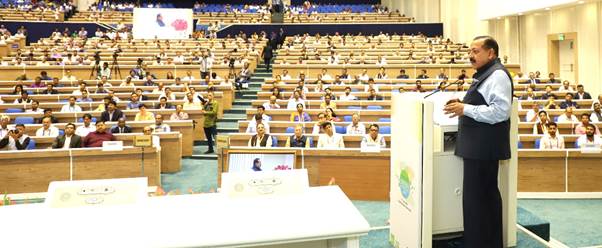
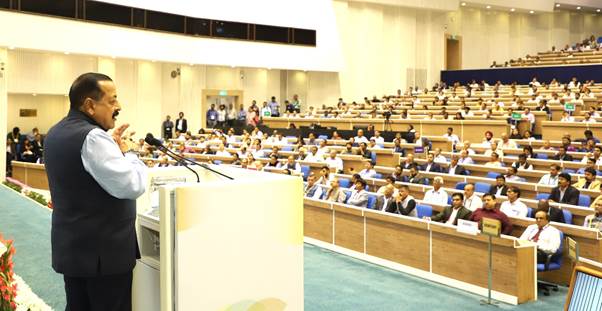
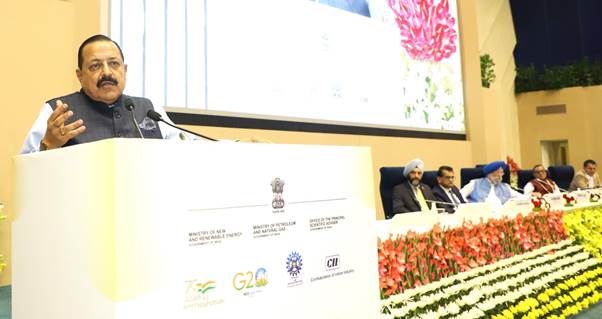
India has the potential to be a Green Hydrogen exporter: Dr Jitendra Singh

| Published on:

Union Minister of State (Independent Charge) Science & Technology; MoS PMO, Personnel, Public Grievances, Pensions, Atomic Energy and Space, Dr Jitendra Singh today said that India has the potential to be a Green Hydrogen exporter.

Addressing the International Conference of Green Hydrogen 2023, Dr Jitendra Singh said, Prime Minister Shri Narendra Modi approved the launch of the National Green Hydrogen Mission with a budgetary outlay of about 2.4 billion dollars and it reflects India’s firm resolve address the difficult challenges of de-carbonization on our pathways to Net Zero in 2070.

Dr Jitendra Singh pointed out the painstaking efforts undertaken over the last two years since the Prime Minister had announced India’s intention to create a dedicated mission for Green Hydrogen culminating in the announcement of the National Green Hydrogen Mission in January this Year.

The Minister said, India has been at the forefront of the global narrative for fighting climate change and has done far more than what would be a commensurate response that would be called for on account of our historical or even our current per capita carbon emissions.

Dr Jitendra Singh said, India is uniquely poised to emerge as a prominent global leader in production of Green Hydrogen not just on the basis of its abundant renewable energy resources and the benefits of one of the world’s lowest costs of regeneration, but also because of its R&D ecosystem and the framework designed for R&D in cross-cutting sectors of hydrogen production, transport, electrolyze manufacturing, support infrastructure, fuel cell EVs, storage and utilisation.

Dr Jitendra Singh said, as Minister for Science and Technology, it’s wonderful to see the positive synergy between the private sector and academic institutions and he hoped that this translates into effective collaboration in every field of research required in the expansion of possibilities of Green Hydrogen.

Dr Jitendra Singh also pointed out that Hydrogen Mission has great potential for job generation through the Startup ecosystem as India has emerged number three in the world with about one lakh startups and 100 odd Unicorns in various sectors including in cutting edge science frontiers. He said, Indian Startup system proposed to create a mechanism for harnessing proactive support of Banking Finances.

Dr Jitendra Singh informed that a draft R&D Roadmap for Green Hydrogen Ecosystem in India has been released and thanked Professor Ajay Sood, Principal Scientific Advisor and his team and the Ministry of New and Renewable Energy For this milestone. A public-private partnership framework for R&D called the Strategic Hydrogen Innovation Partnership or SHIP will be facilitated under the Mission. The Framework will entail creating a dedicated R&D fund, with contributions from Industry and Government institutions, the Minister added.

The R&D programme under the Mission will seek to develop globally competitive technologies in various segments. Consortium-based approach and leveraging the strengths of each institution/industry will be encouraged.

The Minister said India will also leverage the inherent strengths and technological experience of institutions such as BARC, ISRO, CSIR, IITs, IISc and many more and expressed confidence that this will see some path breaking research that will come out of the exercise and create huge multiplier effects on the domestic green hydrogen manufacturing sector in this decade and the next.

Dr Jitendra Singh said, it is encouraging to see that the Conference has provided a platform for all stakeholders to come together and deliberate on the great global challenges facing humanity in the form of climate change and to discuss one of the most promising pathways for decarbonizing hard to abate sectors through green hydrogen.

The variety of speakers was an excellent mix of technical experts, scientists and private sector practitioners, as well as public policy experts, internationally reputed innovators and offtake industries and it brought to fore the exemplary need to create such platforms for industry academia collaboration.

In his address, Professor Ajay Sood said, Green Hydrogen is here to stay and informed that so far 16 nations have announced Green Hydrogen Mission Plans. He said, an integrated approach is needed to minimise failure to this Mission and it should be looked at from five viewpoints-technical, commercial, regulatory, product integration and logistics.

Diplomatic Advisor to the President of France calls on PM

| Published on:

Diplomatic Advisor to the President of France, Mr. Emmanuel Bonne, called on Prime Minister Shri Narendra Modi today.

Mr. Bonne briefed PM on the progress in various areas of bilateral cooperation in the context of PM’s forthcoming visit to France.

PM conveyed his gratitude to President Macron for his invitation to participate in the Bastille Day celebrations as Guest of Honour on July 14.

Recalling his recent meeting with President Macron in Hiroshima, PM said that he looked forward to continuing their conversation in Paris that would further strengthen India-France Strategic Partnership.

PM met Yoshihide Suga, Chairman, JIA and former PM of Japan 

| Published on:

Prime Minister Shri Narendra Modi met H.E. Mr. Yoshihide Suga,  Chairman, Japan-India Association (JIA) and former Prime Minister of Japan today. Mr. Suga is on a visit to India with a delegation of over 100 members comprising government officials, Keidanren (Japan Business Federation), and members of “Ganesha no Kai” group of Parliamentarians.

Prime Minister welcomed Mr. Suga on his maiden visit to India as the Chairman of JIA. The leaders exchanged views on further deepening Special Strategic and Global Partnership between India and Japan, including  in the areas of  investment and economic cooperation, railways, people-to-people linkages, skill development partnership.

Prime Minister had fruitful interaction with accompanying members of “Ganesha no Kai” Parliamentary group on strengthening Parliamentary linkages between the two countries. They welcomed the growing popularity of Yoga and Ayurveda in Japan and discussed ways to further strengthen cultural ties between India and Japan.

PM welcomed Keidanren members to India and highlighted widespread reforms undertaken in the country to improve the business ecosystem. He invited Japanese investors to expand their existing investments and explore new avenues of cooperation.

Raksha Mantri chairs day-long MoD ‘Chintan Shivir’ in New Delhi

| Published on:

Raksha Mantri Shri Rajnath Singh chaired a ‘Chintan Shivir’ of Ministry of Defence in New Delhi on July 06, 2023, where several innovative proposals emerged to enhance indigenisation content in domestic defence manufacturing; provide better health & pension services & re-settlement to the ex-servicemen; more collaboration of DRDO with other research bodies; performance audit; bringing more efficiency in the functioning Ministry of Defence and future roadmap of different organisations.

The Raksha Mantri sat through the day-long deliberations, which were spread over six sessions, covering important issues pertaining to Department of Defence (DoD), Department of Defence Production (DDP), MoD (Finance), Department of Military Affairs (DMA), Department of Ex-Servicemen Welfare (DESW) and Defence Research & Development Organisation (DRDO).

Raksha Rajya Mantri Shri Ajay Bhatt, Chief of Defence Staff General Anil Chauhan, Chief of the Army Staff General Manoj Pande, Defence Secretary Shri Giridhar Aramane, Secretary (Ex Servicemen Welfare) Shri Vijoy Kumar Singh, Secretary, Department of Defence R&D & Chairman DRDO Dr Samir V Kamat and other civil & military officials of MoD from all ranks attended the meeting.

Presentations were made by each department which were followed by frank and free exchange of ideas.

Tweeting after the meeting, the Raksha Mantri said: “Had extensive discussions during the day-long ‘MoD Chintan Shivir’ today. Several important issues pertaining to strengthening India’s Defence capabilities and the welfare of our Ex-Servicemen were discussed. I have directed all the concerned departments to prepare a time bound action plan and make a presentation on the Action Taken Report within 15 days.”

Union Finance Minister chairs meeting to review performance of Public Sector Banks

| Published on:

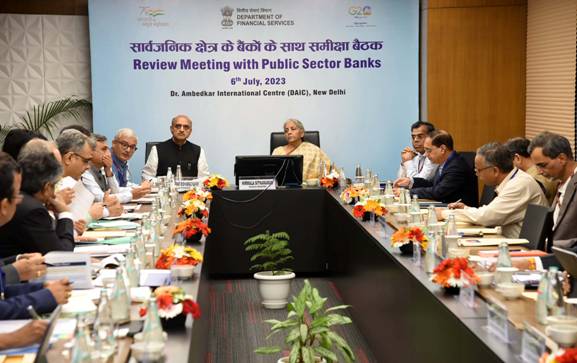
Union Minister for Finance and Corporate Affairs Smt. Nirmala Sitharaman chaired a meeting today to review the performance of Public Sector Banks (PSBs) on various financial health parameters for the financial year 2022-23.

The meeting was also attended by Union Minister of State for Finance Dr Bhagwat KisanraoKarad; Finance Secretary and Secretary Expenditure Dr T.V. Somanathan; Secretary, D/o Financial Services (DFS) Dr Vivek Joshi; Secretary, DIPAM, Shri TuhinKanta Pandey; Secretary D/o Public Enterprises Shri Ali Raza Rizvi; Secretary, M/o Corporate Affairs Shri Manoj Gohil; Secretary, D/o Revenue Shri Sanjay Malhotra; Secretary, M/o Housing and Urban Affairs, Shri Manoj Joshi; Chief Economic Advisor, Ministry of Finance, Dr V. Anantha Nageswaran; Chairman, State Bank of India, Shri Dinesh Khara; and MDs & CEOs of Public Sector Banks #PSBs besides senior officials of DFS.

During the review meeting, discussionswere held with the heads of PSBs on the positive macro trends, improved business sentiments, ‘Twin balance sheet advantage’and performance of PSBs.

All the major financial parametersviz., credit deployment, profitability, asset quality, capital adequacy etc. indicate that the performance of PSBs has significantly improved. They’re adequately capitalised, resilient, and have sound financial health.

It was noted that the Asset quality of PSBs has improved significantly with gross NPAs at 4.97% and net NPAs at 1.24% in March 2023. During FY 2022-23, PSBs earned a record aggregate net profit of around ₹1.05 lakh crore, almost triplefrom net profits earned in FY 2013-14. Strengthened by high capital adequacy of 15.53%CRAR (comparable to major economies of the world), clean balance sheets supported by a healthy provision coverage (90.68%), and improved resilience, PSBs are well positioned to support the credit needs of the productive sectors of thegrowing economy.

In their assessment of the overall situation, bankers were of the view that with strong financial health, they are comfortably placed to withstand any macroeconomic shock.

Smt. Sitharaman emphasised banks’ adherence to the regulatory framework by focusing on risk management, and diversification of business base. The business outlook is progressively improving in spite of the headwinds from recent global banking sector developments.

The Union Finance Minister noted that while the overall Priority Sector Lending (PSL) have exceeded the mandated target, the PSL targetsin the sub-categories should also be met, including, interaliaagriculture — particularly the small & marginal farmers, and the micro enterprises.

The Union Finance Minister said that she will also chair meetings in the month of July-August 2023,in different regions of the country to review the functioning of the Regional Rural Banks (RRBs) along with their sponsor banks, with a special focus on the status of technological upgradation of the RRBs. The review of the RRBs would commence from 21stJuly 2023 at Tripura, in which the Union Finance Minister will conduct a review of the functioning of the RRBs in the NortheastMeetings to review the functioning of the RRBs, along with the corresponding sponsor bank, will then be held by the Union Finance Minister region-wise in the North, West, South, East, and Central parts of the country.

Secretary,MoHUA, highlighted the progress on PMSVANidhi Scheme through a presentation. He said that efforts are being taken to improve the adoption of digital payment tools and around 33 lakh beneficiaries are digitally active. Union Finance Minister asked the banks to lead a special campaign to ensure the onboarding of the PMSVANidhi beneficiaries on digital payment systems.

On improving lending under PMSVANidhi, it was decided that Union Minister of State (Finance), Dr Bhagwat KishanraoKarad will ensure a special drive for expanding the coverage of PMSVANidhi, with the assistance of the Urban Local Bodies (ULBs). Dr Karad will visit different regions of the country in 6 phases before 1st September 2023 for the special credit outreach drive on PMSVANidhi.

The Union Finance Minister further advisedPSBs to—

  1. Ensure an increase in rural, agriculture and sectoral credit to meet the Priority Sector Lending (PSL) norms and further ensure that the PSL targets are achieved across all sub-categories.
  2. Meet the targets for the credit to street vendors under PMSVANidhi and the momentum of disbursals gained under PMSVANidhi should be sustained.
  3. Ensure that there is a fair and transparent recognition of NPAs as per the extant guidelines of the regulator and banks should periodically review it internally to ensure that there is proper recognition&reporting of the stressed assets.
  4. The sponsor banks of the Regional Rural Banks (RRBs) should ensure a time-bound technological upgradation of the RRBs and continuously monitor their functioning to make them more efficient and effective, which will immensely benefit the people living in rural areas.
  5. Address associated business model risk with robust risk management practices and have efficient and optimum Asset Liability Management;
  6. Take steps to improve the deposits and adopt a focussed approach on ease of services and customer protection.

PM pays tributes to Dr Syama Prasad Mukherjee on his birth anniversary

| Published on:

The Prime Minister, Shri Narendra Modi has paid tributes to Dr Syama Prasad Mukherjee on his birth anniversary.

The Prime Minister tweeted;

“महान राष्ट्रवादी चिंतक, शिक्षाविद् और भारतीय जनसंघ के संस्थापक डॉ. श्यामा प्रसाद मुखर्जी को उनकी जन्म-जयंती पर शत-शत नमन। एक सशक्त भारतवर्ष के निर्माण के लिए उन्होंने अपना जीवन समर्पित कर दिया। उनके आदर्श और सिद्धांत देश की हर पीढ़ी को प्रेरित करते रहेंगे।”

BJP National President interactes with a group of Head of Missions to India under “Know BJP” initiative

| Published on:

Hon’ble Bharatiya Janata Party National President Shri Jagat Prakash Nadda interacted with a  group of diplomatic mission heads to India at BJP HQ on 5th July 2023.

Along with the Hon’ble National President, National Media In-charge shri Anil Baluni and Dr. Vijay Chauthaiwale, in-charge of the party’s foreign affairs department, were also present. Head of Missions to India from Bangladesh, Egypt, Germany, Greece, Guyana, Lebanon, Malaysia, Mozambique, South Korea, Suriname, Sweden and acting H.E. of Tanzania were present in this interaction.

In today’s discussion the participants asked queries about BJP’s phenomenal growth in the last 9 years, party’s  membership drive, use of technology, as well as about BJP’s strategy in expanding its presence in various States. Shri J P Nadda  has elaborated in detail on all the issues.

The BJP president has also made two significant announcements. First, the BJP delegation will be  participating in  “BRICS  political parties plus dialogue in South Africa which is being convened  by the African National Congress. He also announced that the delegation from the ruling party of Bangladesh, Awami league  as well as Communist Party of Nepal (Maoist Centre) will visit India on the invitation of BJP in the near future.

The interaction is part of the “KNOW BJP” Initiative launched by the national President on the 42nd foundation day of BJP. During this event, Shri Nadda will elaborate on the history, struggles, successes, ideology and contribution of the Bharatiya Janata Party and BJP governments in nation building. In addition to strengthening bilateral ties, KNOW BJP initiative provides an opportunity to global stakeholders to engage in varied fruitful discussions vital for mutual understanding.

Piyush Goyal appreciates efforts of States and UTs at the National Conference of Food Ministers

| Published on:

Union Minister of Consumer Affairs, Food & Public Distribution, Commerce & Industry and Textiles, Shri Piyush Goyal today appreciated the efforts of the State and UT governements for procuring and distribution of foodgrains and said that all the States/UTs should work together with the Government of India in the spirit of cooperative federalism. He said this while chairing the ‘National Conference of Food Ministers of States/UTs’ organized by the Department of Food and Public Distribution (DFPD), in New Delhi today. The Minister requested all States/UTs to submit their pending claims on dues with the union government expeditiously so that they can be settled at the earliest.

The conference was graced by Union Ministers of State for Consumer Affairs, Food & Public Distribution Ms. Sadhvi Niranjan Jyoti and Shri Ashwini Kumar Choubey, 17 Food Ministers and officials from 35 States/UTs and officials of the Department of Food and Public Distribution, Govt of India.

In the presentation, the Department highlighted the scale of, and reforms in, procurement process of foodgrains which is key to providing food security and stability to domestic prices of foodgrains.

During the conference, Shri Piyush Goyal also launched a new Sugar-Ethanol portal.

A demonstration of the Automated Multi-Commodity Grain Dispensing Machine – ‘Annapurti’ developed by the UN World Food Programme (UN-WFP) and Automatic Grain Analyzers developed for automated quality checking of grains was conducted as part of the Conference.  In addition, a millet exhibition showcasing various millet products was held on the side-lines of the Conference.

During the first half of the Conference, a comprehensive strategy to increase the procurement of coarse grains was discussed and formulated. This strategic focus on coarse grains/millets reflects a broader objective to strengthen the nutritional security of the beneficiaries. It is projected that a total of 26.14 Lakh Metric Tonnes (LMT) of coarse grains would be procured in Kharif Marketing Season (KMS) 2023-2024, while the expected distribution would be 22.31 LMT.

Some of the other key topics that were discussed extensively during the conference included grading of procurement centres to ensure uniformity and quality, effective implementation of Pradhan Mantri Garib Kalyan Anna Yojana (PMGKAY), implementation of the SMART–PDS scheme for end-to-end computerization of procurement and distribution of foodgrains, transformation of Fair Price Shops (FPS), action plan for the implementation of Route Optimization study to bring down the distance involved in intra-State distribution, diversification of food basket through distribution of coarse grains/millets, among others.

Additionally, best practices of States/UTs were showcased to foster cross-learning on various topics including construction of Model FPS through MGNREGA funds by Uttar Pradesh, e-KYC & de-duplication of ration cards by Assam, Supply Chain Automation by Gujarat and quality assurance of Rice fortification by Andhra Pradesh.

We stand committed to advancing global research and innovation for a better tomorrow: Dr Jitendra Singh

| Published on:

Union Minister of State (Independent Charge) Science & Technology; MoS PMO, Personnel, Public Grievances, Pensions, Atomic Energy and Space, Dr Jitendra Singh today asked the G20 countries to “rise above differences” and address the global challenges confronting the world and also act as G20 member responsive for global well-being in the spirit of one family.

In his inaugural address at the G20 Science Ministers meeting here, Dr Jitendra Singh said, India recognizes the significance of global collaboration and knowledge sharing in addressing the complex challenges of our times and Prime Minister Narendra Modi has been repeatedly reiterating this from time to time at every international forum.
The Minister called upon to leverage the collective wisdom, expertise, and resources to foster a culture of innovation, promote sustainable development, and ensure a prosperous future for all. The Minister urged the G20 nations to move ahead with a profound agenda to excel in inclusive, equitable and sustainable growth.

Referring to the fact that a number of Member States are represented at the highest level in their national science hierarchy, Dr Jitendra Singh said, this group has potential to address major global challenges, as we did recently while combating Covid pandemic. He emphasized that during India’s G20 Presidency, we stand committed to advancing global research and innovation for a better tomorrow.

Dr Jitendra Singh said, in recent times, Scientists and Researchers have been at the forefront of cutting-edge discoveries and advancements across multiple disciplines like space exploration to artificial intelligence, from biotechnology to nanotechnology and have pushed the boundaries of scientific understanding and have fostered innovation that benefits humanity as a whole.

Dr Jitendra Singh said, as the world grapples with the challenges of climate change and depleting natural resources, it becomes imperative to harness renewable energy sources efficiently. He emphasized that G-20 members should remain committed to our Net Zero goals and continue to work on sustainable development and renewable energy and expressed satisfaction that the world has witnessed substantial growth in solar and wind power installations in recent years. Our scientists have been working tirelessly to discover and create materials that can revolutionise the energy sector, making it cleaner, more affordable, and accessible for all, the Minister added.

Dr Jitendra Singh underscored that G20 nations must harness the power of technology and innovation to drive the transition towards cleaner energy sources and promote eco-innovations, such as smart grids, energy-efficient buildings, and sustainable transportation systems, as these initiatives not only mitigate environmental impact but also foster economic growth and create new avenues for job creation.

Dr Jitendra Singh also pointed out that G-20 community has advanced space technologies to predict and monitor various natural hazards, like cyclone, tsunami, landslides, forest fire, space technologies also help a lot in communication. He underlined the need to share products of these technologies to countries, outside G-20 also, so that they can better prepare themselves against such calamities.

India’s Science Minister told the delegates that developing quantum technologies, exploring quantum communication, cryptography, and quantum algorithms are our next level of G-20 research agenda. We aim to scale up scientific and industrial R&D, for accelerating Quantum Technology-led economic growth and leverage several economies into a leading nation supporting sustainable development, he added.

Dr Jitendra Singh said, Scientists have made significant contributions to genetic research and biotechnology and researchers focused on studying the genetic basis of diseases, developing personalized medicine approaches, and advancing genetic engineering techniques. He said, these efforts hold immense potential for improving healthcare outcomes and addressing genetic disorders. The Minister also pointed out that as immunity is directly linked to our health and food, several systems encourage us to develop immunity through food we eat instead of medication.

Dr Jitendra Singh highlighted that FinTech ecosystems of the world have grown in a tremendous way. Few economies have adopted virtual currencies, whereas few others are using virtual transactions to a large extent. He said, as the world is witnessing rapid digital transformation, cyber-security has become a critical focus and called upon the scientific community to develop algorithms which are difficult for hackers to break. We need to strengthen our cyber-security infrastructure, developing advanced systems to protect critical digital assets and data, he added.
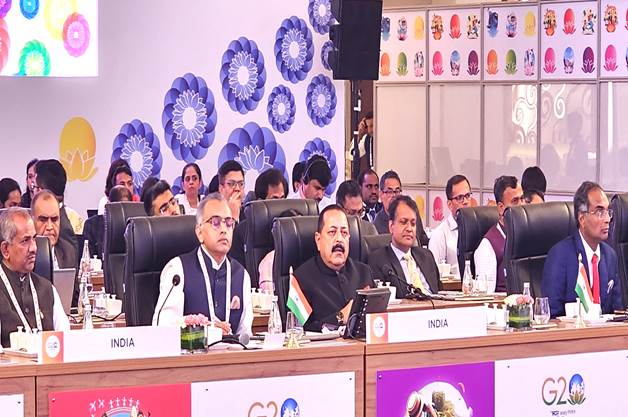
Dr Jitendra Singh said, during these testing times, the world also witnessed rise of several technologies-based startups and these companies excelled in developing AI-based solutions for various sectors, including healthcare, finance, agriculture, and education. He added that the integration of AI and data analytics has helped improve decision-making processes, enhance productivity, and drive innovation in diverse industries.

Dr Jitendra Singh drew the attention of G20 delegates towards the immense potential of our oceans and seas, in terms of mineral resources, energy solutions and marine food and asserted that all are committed to promoting sustainable practices in fisheries, marine research, coastal tourism, and renewable energy generation. He said, by harnessing the potential of the Blue Economy, we can ensure the well-being of our oceans while driving economic development in a sustainable and responsible manner. We are also concerned about increased plastics and microplastics in our oceans, another important area to focus as it enters into our food chain as several marine organisms consume them.

Dr Jitendra Singh expressed concern that while some of the G20 members are facing water scarcity and challenge of water quality, some others are moving in that direction. He said, Precision irrigation, Innovative clean water technologies, such as water purification systems, desalination techniques, and wastewater treatment technologies are to be further augmented and implemented.

The Minister added that as we move towards a more sustainable future, it is crucial to explore innovative approaches that minimise waste generation and maximise resource efficiency. We recognize the importance of adopting circular economy principles in the bio sector, which focuses on reducing waste, recycling valuable materials, and promoting a sustainable and regenerative approach to economic growth. He said, we also recognize the role of research and innovation in the adoption of Lifestyle for the Environment (LiFE) as accelerators that can advance the progress towards achieving the Sustainable Development Goals (SDGs) and commit to support actions in promoting the same.

In his concluding remarks at G20 Research Ministers Meeting, Dr Jitendra Singh expressed satisfaction that during the RIIG meetings, member states discussed various topics including, challenges related to energy materials & devices, solar energy utilisation and photovoltaic technology and materials and processes for green energy; and policy issues like role of research, development & innovation in creating new resource-efficient, sustainable and more circular bio-based technologies, products and services; understanding the blue economy science & services; blue economy sectors and opportunities; observation data and information services; marine ecosystems & pollution; blue economy management and perspectives; coastal and marine spatial planning; marine living resources and biodiversity; deep sea ocean technology; and blue economy policy perspectives.

Dr Jitendra Singh thanked G20 delegates for their constructive and fruitful deliberations, which marked the end of series of RIIG meetings and conferences which India hosted during last 5-6 months, starting from Kolkata to Ranchi to Dibrugarh to Dharamshala to Diu and now to Mumbai under India’s G20 main theme of Vasudhaiva-Kutumbakam or One-Earth One-Family One-Future. We identified Research and Innovation for an Equitable Society, as the main theme of RIIG-2023, he informed.

The Minister thanked the members for their active participation and supporting India’s RIIG agenda with valuable inputs and comments on our priority areas. India is fully committed to contribute in attaining the UN SDG-2023 by way of Research and Innovation through International collaboration and partnerships.

India hosted a total of 5 meetings and conferences across India under priority topics of i) Materials for sustainable energy; ii) Circular bio-economy; iii) Eco-innovations for energy transition; and iv) Scientific challenges and opportunities towards achieving sustainable blue-economy, which signifies the importance of Research and Innovation for inclusive societal development and growth.