Delegation of Special Envoys from the Republic of Korea meets PM

| Published on:

A delegation of Special Envoys from the Republic of Korea (ROK), led by Mr. Kim Boo Kyum, met the Prime Minister, Shri Narendra Modi in New Delhi today.

Recalling his recent positive meeting with ROK President Mr. Jaemyung Lee, Prime Minister, Shri Modi reaffirmed India’s commitment to advancing the India–ROK Special Strategic Partnership, which marks its 10th year. He highlighted the partnership’s continued growth across key sectors including innovation, defence, shipbuilding, and skilled mobility.

In a post on X, he wrote:

“Delighted to receive the delegation of Special Envoys from the Republic of Korea led by Mr. Kim Boo Kyum. Recalled my positive meeting with President @Jaemyung_Lee last month. India–ROK Special Strategic Partnership, which completes 10 years, continues to grow from innovation and defence to shipbuilding and skilled mobility. Close collaboration between the democracies contributes to peace, stability, and prosperity in the Indo-Pacific region.”

Union Home Minister addresses ‘Sahkar & Rojgar Utsav’ in Jaipur, Rajasthan

| Published on:

Union Home Minister and Minister of Cooperation, Shri Amit Shah, today addressed the ‘Sahkar & Rojgar Utsav’ in Jaipur, Rajasthan, as the Chief Guest on the occasion of the International Year of Cooperatives – 2025. On this occasion, several dignitaries including Rajasthan Chief Minister Shri Bhajan Lal Sharma, Union Minister of Culture Shri Gajendra Singh Shekhawat, former Rajasthan Chief Minister Smt. Vasundhara Raje Scindia, and Secretary of the Ministry of Cooperation, Dr. Ashish Kumar Bhutani, were present.

Addressing the ‘Sahkar & Rojgar Utsav,’ Shri Amit Shah said that the celebration of the International Year of Cooperatives – 2025 began from India. He said that when the United Nations General Assembly (UNGA) declared 2025 as the International Year of Cooperatives, it was Prime Minister Shri Narendra Modi who inaugurated its first event. Shri Shah said that during the program organized on the occasion of the International Year of Cooperatives today, the virtual inauguration of 24 grain storage warehouses and 64 millet outlets took place, loans were distributed under the Gopal Credit Card scheme, micro-ATMs were distributed to dairy producer societies, and two outstanding Primary Agricultural Credit Societies (PACS) were honored. Along with this, the launch of the White Revolution 2.0 – Primary Dairy Cooperative Society (PDCS) online registration platform took place, and the compilation of success stories under the Pandit Deendayal Upadhyay Gareebi Mukt Gram Yojana as well as under the Vande Ganga Water Conservation Campaign was released. In addition to this, 100 new vehicles given to Rajasthan Police and armed forces were also flagged off.

Shri Amit Shah said that Prime Minister Shri Narendra Modi has established an independent Union Ministry of Cooperation with the goal of extending cooperation to every village, poor person, and farmer. He said that today, cooperation plays an active role in 98 percent of rural areas, and the next 100 years will belong to cooperation. Shri Shah said that cooperatives contribute approximately 20 percent to the country’s procurement of paddy and wheat, while 35 percent of fertilizers and 30 percent of sugar production is done through cooperatives. More than 20 percent of fair price shops are also run through cooperatives. He added that 31 crore people are connected to cooperation through 8.5 lakh cooperative bodies.

Union Minister of Cooperation said that within four years of the establishment of the Ministry of Cooperation, we have worked to strengthen the cooperatives through 61 initiatives. He said, we are aiming to create two lakh new PACS out of which 40 thousand PACS have been created. The computerization of all PACS has been completed and all the states have accepted the model bylaws of PACS, warehouses are also being built. New cooperative institutions have been created for organic products, export and seed promotion. Shri Shah said that PM Modi has guaranteed the purchase of pulses, oilseeds and maize of farmers registering on the NAFED and NCCF app at the Minimum Support Price (MSP) and if the price being received in the market is more than the MSP, then the farmers are free to sell their produce in the market.

Shri Amit Shah said that today Rajasthan is making a huge contribution to the agricultural development of the country. More than 90 per cent of the country’s Gwar (Cluster Beans) is being produced in the state. He said that 46 per cent of mustard, 44 per cent of pearl millets (Bajra), 22 per cent of oilseeds and 15 per cent of millets are being produced in Rajasthan itself. Rajasthan ranks first in the country in the production of these crops. 18 per cent of groundnut is being produced in Rajasthan and it ranks second in the country in its production, whereas Rajasthan ranks third in the production of jowar, gram, pulses and soyabean. He said that in past 11 years, PM Modi has increased the MSP of wheat by 73 per cent, gram by 82 per cent, and mustard by 95 per cent and groundnut by 82 per cent.

Union Minister of Cooperation said that the entire country knows Rajasthan as the land of camels. He said that we have started research on conservation of camel breed and testing the medicinal properties of camel milk using cooperatives. He said that due to this there will be no threat to the existence of camels in the coming days.

Shri Amit Shah said that the present government of Rajasthan has done a lot of work in a very short time. He said that earlier the entire state was plagued by paper leak cases, but the Rajasthan government has sent a strong message to the paper leak mafia by forming an SIT. At the Global Investment Summit, MoUs worth Rs 35 lakh crore were signed under the leadership of Chief Minister Bhajan Lal and work has also started on MoUs worth Rs 3 lakh crore. He said that the Value Added Tax (VAT) on petrol and diesel was reduced, LPG cylinder was given for Rs 450. Along with this, DPR of Yamuna was approved to bring water from Ram Jal Setu Link Project, Navnera Barrage, Tajewala Barrage and under Jal Jeevan Mission, tap water supply was started in many villages.

Union Home Minister and Minister of Cooperation Shri Amit Shah said that in its 11-year tenure, the Modi government provided houses, toilets, electricity, gas, five kg free food grains, treatment up to five lakh rupees and free medicines to 60 crore poor people. He said that all these schemes are being implemented very well in Rajasthan. Shri Shah said that Chief Minister Shri Bhajan Lal has made Rajasthan one of the top states in the country in implementing all the initiatives of the Ministry of Cooperation and due to his efforts, cooperation has strengthened in Rajasthan.

Shri Amit Shah said that under the leadership of Prime Minister Modi, the country has jumped from the 11th position to become the fourth largest economy in the world. PM Modi has worked to bring 27 crore people above the poverty line. He said that the biggest work done by Modi Ji is to secure the country. Home Minister said that during the previous government, the country was plagued by terrorist attacks. But when the attack took place in Uri, PM Modi did a surgical strike, when there was an attack in Pulwama, he did an Air Strike and in response to the attack in Pahalgam, under Operation Sindoor, we went inside Pakistan and blew up the hideouts of the terrorists. He said that a strong message has been given to the whole world that no one should mess with the citizens of India, the Indian Army and the Indian border, otherwise they have to face the consequences. By giving this message, Modi Ji has worked to make the dream of a prosperous, secure and developed India come true.

Union Home Minister and Minister of Cooperation Shri Amit Shah said that the Government of India and the Government of Rajasthan will together strengthen the cooperative movement in Rajasthan. He expressed hope that in the year 2047, when India celebrates the centenary of independence, the cooperative sector of Rajasthan will be at the first position in the entire country.

Shri Amit Shah said that the land of Rajasthan gave birth to brave warriors like Veer Rana Sanga, Maharana Pratap, Durgadas Rathore, Prithviraj Chauhan, Maharani Padmini, Panna Dhai and Bhamashah. He said that Rajasthan has an important contribution in the security of the country and a large number of people from here join the army. Remembering Param Vir Chakra awardee Nirmal Singh Sekhon on his birth anniversary, Shri Shah said that Nirmal Singh Sekhon displayed unparalleled valour and sacrifice to protect his motherland.

Union Agriculture Minister attends the 4th convocation ceremony at Dr. Rajendra Prasad Central Agricultural University, Pusa

| Published on:

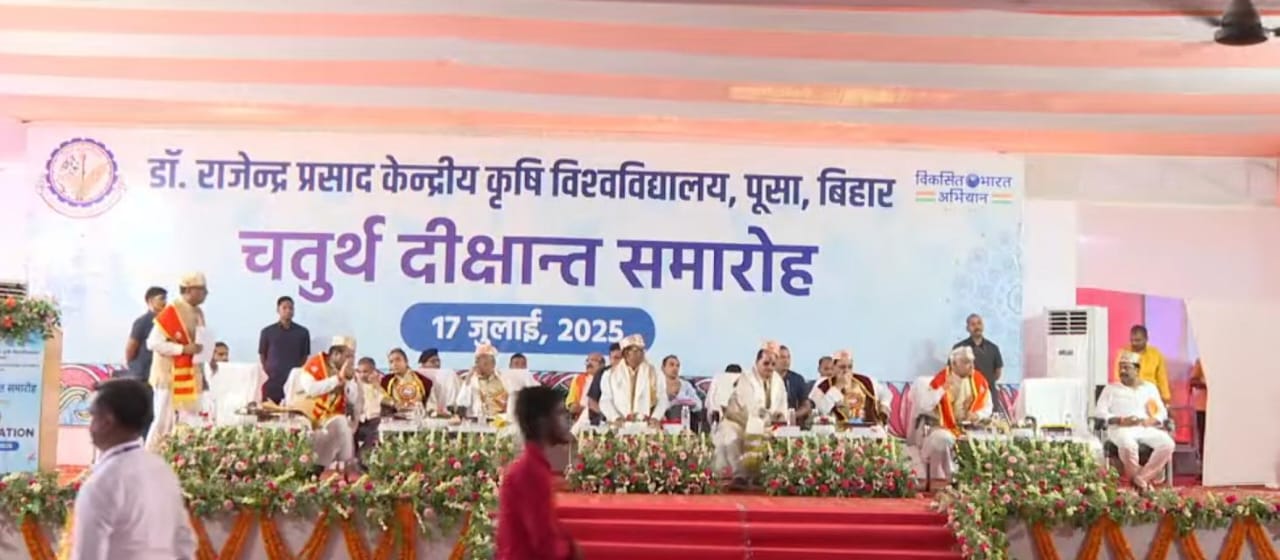
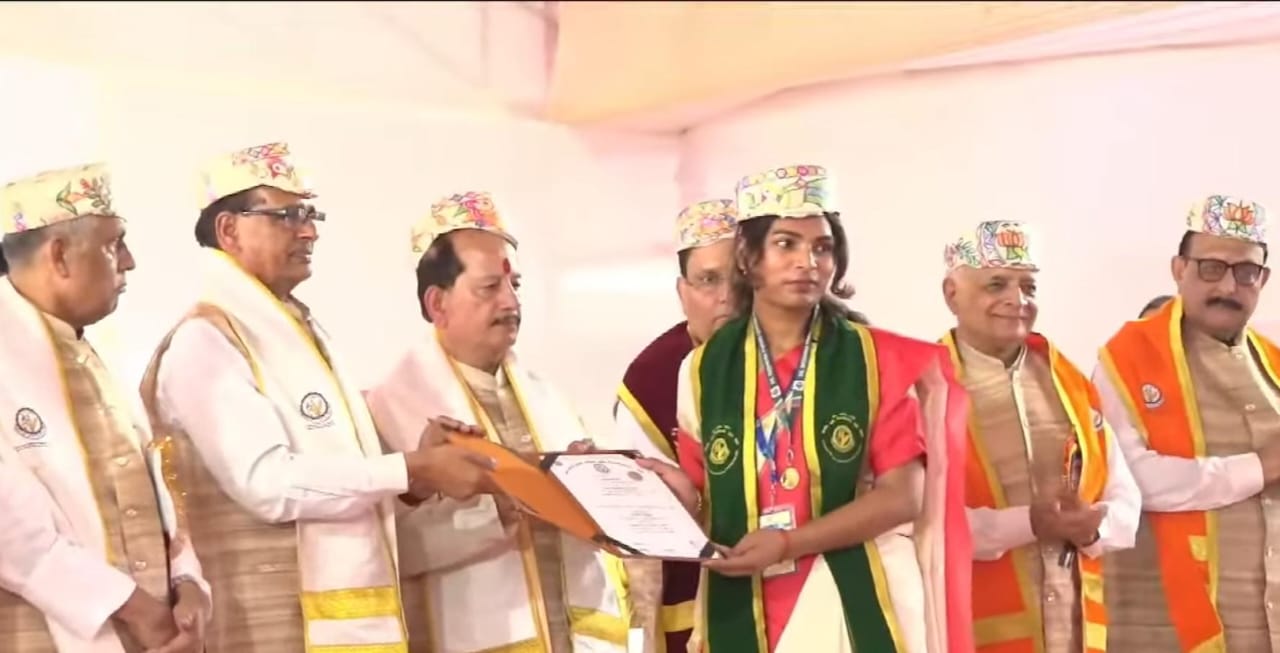
Union Minister of Agriculture and Farmers Welfare Shri Shivraj Singh Chouhan today attended the 4th convocation ceremony of Dr. Rajendra Prasad Central Agricultural University, Pusa, Bihar. On this occasion, he inaugurated the newly constructed Vikramshila Hostel and Aryavart International Guest House. Shri Chouhan also released two important books – Pusa Bihar: The Birthplace of Agricultural Research and Education, and Textbook on Natural Farming.

In his address, Shri Chouhan praised Bihar’s rich cultural and historical legacy and said, “Samastipur is the gateway to Mithilanchal, the sacred land of King Janak and Goddess Sita, who is an inspiration to women in India.” Remembering Bharat Ratna Dr. Rajendra Prasad and Karpoori Thakur, Shri Chouhan expressed his gratitude and said that Bihar is a land of talent and hard work, which has given the message of Buddha to the world.

Encouraging the graduating students, Shri Chouhan said, “You are a reservoir of infinite potential, as Swami Vivekananda once said. Work hard, aim high, and apply your knowledge to revolutionise the agricultural sector. Take Indian agriculture to new heights with the education attained from Pusa University.”

He highlighted the achievements over the past 11 years, including a 40% increase in agricultural production, free food grains to 80 crore people, and Basmati rice exports worth ₹50,000 crore. Appreciating the remarkable growth in maize, litchi, and makhana production in Bihar, he thanked Prime Minister Narendra Modi for forming the Makhana Board.

Calling agriculture the backbone of India’s economy, he said, “Farmers are the soul of the Indian economy, and serving them is our duty. We need to increase per-hectare yield, promote mechanisation through small equipment, and boost modernisation through startups.”

Emphasising the importance of natural farming, he said that it is essential for the health of the soil. He also mentioned the recently launched Pradhan Mantri Dhan-Dhanya Yojana, under which 100 districts have been identified to increase agricultural output. He urged students to apply their knowledge and research into practical solutions, and contribute to ensuring India’s food security.

Concluding his address, Shri Chouhan praised the university’s contribution and said, “Dr. Rajendra Prasad Agricultural University can play a vital role in shaping the future of Indian agriculture. I am always eager to hear new ideas.” He congratulated all the faculty members, students, and the university community for their achievements.

Dr. Rajendra Prasad Central Agricultural University, Pusa, was established on October 7, 2016, when the then Rajendra Agricultural University (established in 1970 by the Government of Bihar) was converted into a central university. Today, it stands among the leading institutions promoting research in the field of agriculture.

The convocation ceremony was also attended by Ramnath Thakur, Union Minister of State for Agriculture; Vijay Sinha, Deputy Chief Minister and Agriculture Minister of Bihar; Maheshwar Hazari, Minister of Information and Public Relations, Bihar; and Samastipur MP Shambhavi.

PM welcomes Group Captain Shubhanshu Shukla on return to Earth from his historic mission to Space

| Published on:

The Prime Minister today extended a  welcome to Group Captain Shubhanshu Shukla on his return to Earth from his landmark mission aboard the International Space Station. He remarked that as India’s first astronaut to have journeyed to the ISS, Group Captain Shukla’s achievement marks a defining moment in the nation’s space exploration journey.

In a post on X, he wrote:

“I join the nation in welcoming Group Captain Shubhanshu Shukla as he returns to Earth from his historic mission to Space. As India’s first astronaut to have visited International Space Station, he has inspired a billion dreams through his dedication, courage and pioneering spirit. It marks another milestone towards our own Human Space Flight Mission – Gaganyaan.”

Dr. Jitendra Singh inspects and Reviews Progress of first -of -its-kind upcoming ‘Medical Research Centre’ at THSTI

| Published on:

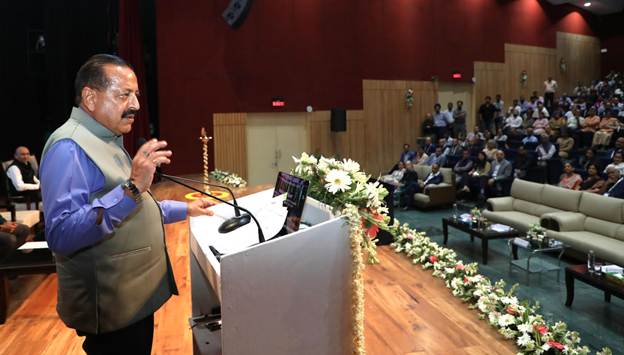
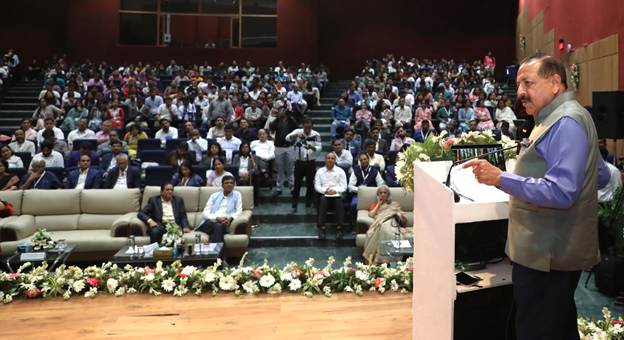
Union Minister of State (Independent Charge) for Science and Technology, Dr. Jitendra Singh, today visited the Translational Health Science & Technology Institute (THSTI) here, on the occasion of its 16th Foundation Day and took stock of the ongoing work at the first-of- its- kind upcoming “Medical Research Centre” (MRC), a key infrastructure project aimed at strengthening India’s clinical research capabilities.

THSTI, an autonomous institute under the Department of Biotechnology, is in the final stages of establishing the Medical Research Centre—a multi-storeyed facility designed to support advanced clinical studies with separate exclusive sections dedicated to the study of Enteric infections, respiratory infections etc.

During his visit, Dr. Jitendra Singh inspected the building, which has now been completed, and reviewed the status of equipment installation and operational readiness.

The new centre will house specialized sections for research on enteric and respiratory infections, among other focus areas. Once operational, it is expected to facilitate clinical observation studies and trials, including work on diagnostics and therapeutics. The MRC will also feature a Controlled Human Infection Facility—one of the few in the region—aimed at accelerating infectious disease research.

Addressing the THSTI community, Dr. Jitendra Singh commended the institute’s progress and consistent contributions to public health innovation. “Each year, I am more impressed by the strides you make in translational health science,” he said, adding that THSTI exemplifies how research institutions can bridge the gap between scientific discovery and real-world application.

The Minister recalled THSTI’s pivotal role during the COVID-19 pandemic, particularly in vaccine development and immunological studies. The institute played a key part in early DNA vaccine trials and contributed significantly to understanding the virus and its transmission patterns through well-coordinated scientific studies. These efforts, in partnership with the industry, were instrumental in informing India’s public health response, he said.

Dr. Jitendra Singh also highlighted several recent achievements by THSTI over the past year. These include the development of potent monoclonal antibodies against the Nipah virus—marking a significant advance from a low- and middle-income country—and the institute’s selection by CEPI as a Pre-clinical Network Laboratory, the first in Asia and ninth globally. This recognition underlines THSTI’s capacity to handle high-risk pathogens and contribute to global epidemic preparedness.

The Minister noted the expansion of the Experimental Animal Facility, now among the largest in the country, and the creation of the Genetically Defined Human Associated Microbial Culture Collection (Ge-HuMiC), a resource that will support research in human microbiome and infectious diseases.

Looking ahead, Dr. Jitendra Singh spoke about the role of the upcoming Medical Research Centre and the adjoining Translational Research Facility (TRF) in boosting India’s scientific and medical research infrastructure. The TRF will support work on vaccines, monoclonal antibodies, diagnostics, and biotherapeutics, and is expected to host multiple Centres of Excellence through partnerships with industry and academia.

The Minister acknowledged THSTI’s emphasis on public-private collaboration, referencing the SYNCH-N 2025 event held yesterday where approximately 18 Letters of Intent and agreements were signed. He said these collaborations would be instrumental in translating research into accessible healthcare solutions.

Reiterating the importance of an integrated and collaborative approach, Dr. Jitendra Singh said, “Your work is directly contributing to a healthier, more resilient India.”

As THSTI marks its 16th Foundation Day, the completion of the Medical Research Centre signals a new chapter for the institute. With enhanced infrastructure and a continued focus on translational science, THSTI remains a vital part of India’s effort to advance healthcare through research and innovation.

Chief Minister of Uttarakhand meets Prime Minister

| Published on:

Chief Minister of Uttarakhand, Shri Pushkar Singh Dhami met Prime Minister, Shri Narendra Modi in New Delhi today.

The Prime Minister’s Office posted on X;

“CM of Uttarakhand, Shri @pushkardhami, met Prime Minister @narendramodi.

Union Home Minister addresses the 63rd Foundation Day celebration of the Bharat Vikas Parishad in New Delhi 

| Published on:

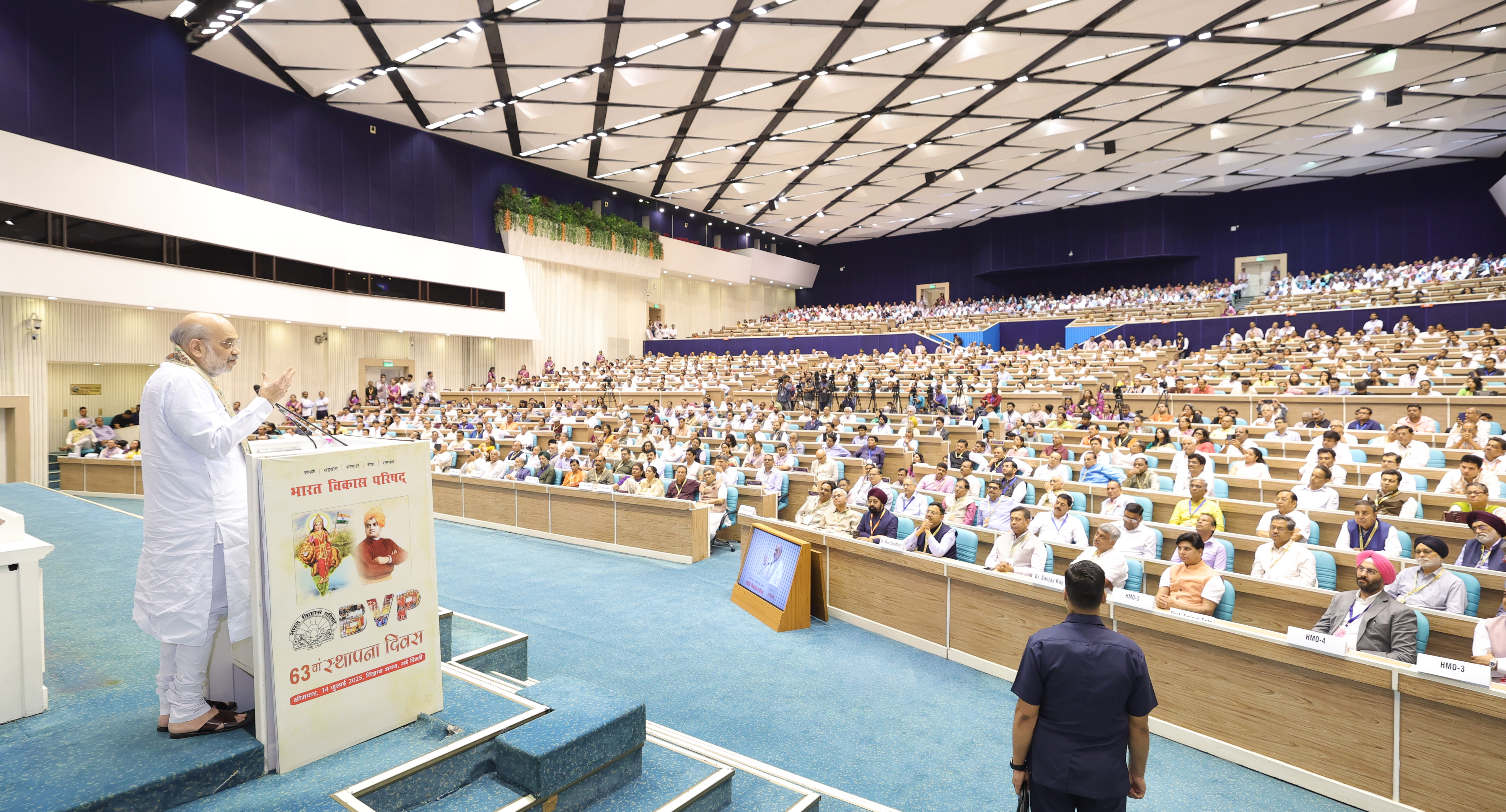
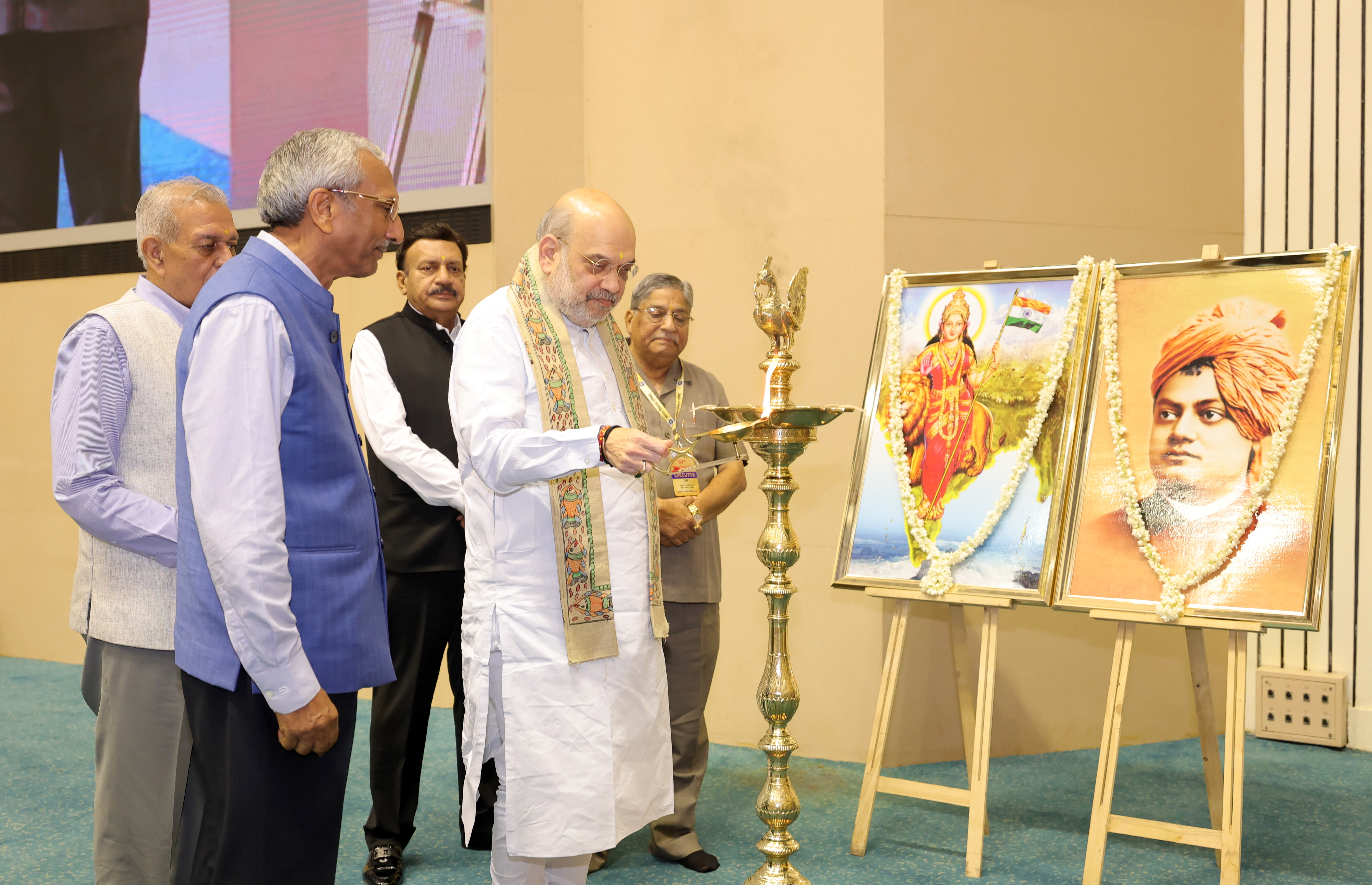
Union Home Minister and Minister of Cooperation, Shri Amit Shah, today addressed the 63rd Foundation Day celebration of the Bharat Vikas Parishad (BVP) in New Delhi as the chief guest. On this occasion, former Supreme Court Judge and National President of the Bharatiya Vikas Parishad, Retired Justice Shri Adarsh Kumar Goyal, along with many other dignitaries, were present.

Addressing the programme, Union Home Minister and Minister of Cooperation, Shri Amit Shah, said that the 63rd Foundation Day of the Bharat Vikas Parishad is a very important day for those who desire India’s development from an Indian perspective. He said that if any organization runs undisputedly for 63 years, it is a significant achievement in itself. However, when an organization dedicated to service of the people with creative energy runs for 63 years and beyond, then there is immense dedication and sacrifice of countless devoted individuals behind it. Shri Shah said that while 63 years is considered an advanced age in an individual’s life, for a well-organized and effective institution, 63 years represents its youth.

Shri Amit Shah said that the Bharat Vikas Parishad has been guided by the life and ideals of Swami Vivekananda. The Parishad has embraced the three qualities of dedication (Samarpan), organization (Sangathan), and values (Sanskar) to harness the creative energy of society. He said that the energy generated through organizational strength has brought light into the lives of millions of Indians and has touched the lives of those who most need the power of social organization. Shri Shah added that the Bharat Vikas Parishad has worked as a bridge between those who serve and those who need service. The Bharat Vikas Parishad is not just an organization, but an idea. It is an effort to connect every Indian with the essence of India.

Union Home Minister said that even after six decades since its establishment, the Bharat Vikas Parishad continues to work with relevance and appropriateness. The organization has developed a remarkable work culture that links service to organization, organization to values, and values to nation-building. He stated that the Bharat Vikas Parishad has served the needy for 63 years without any desire for fame, and the world today needs such organizations.

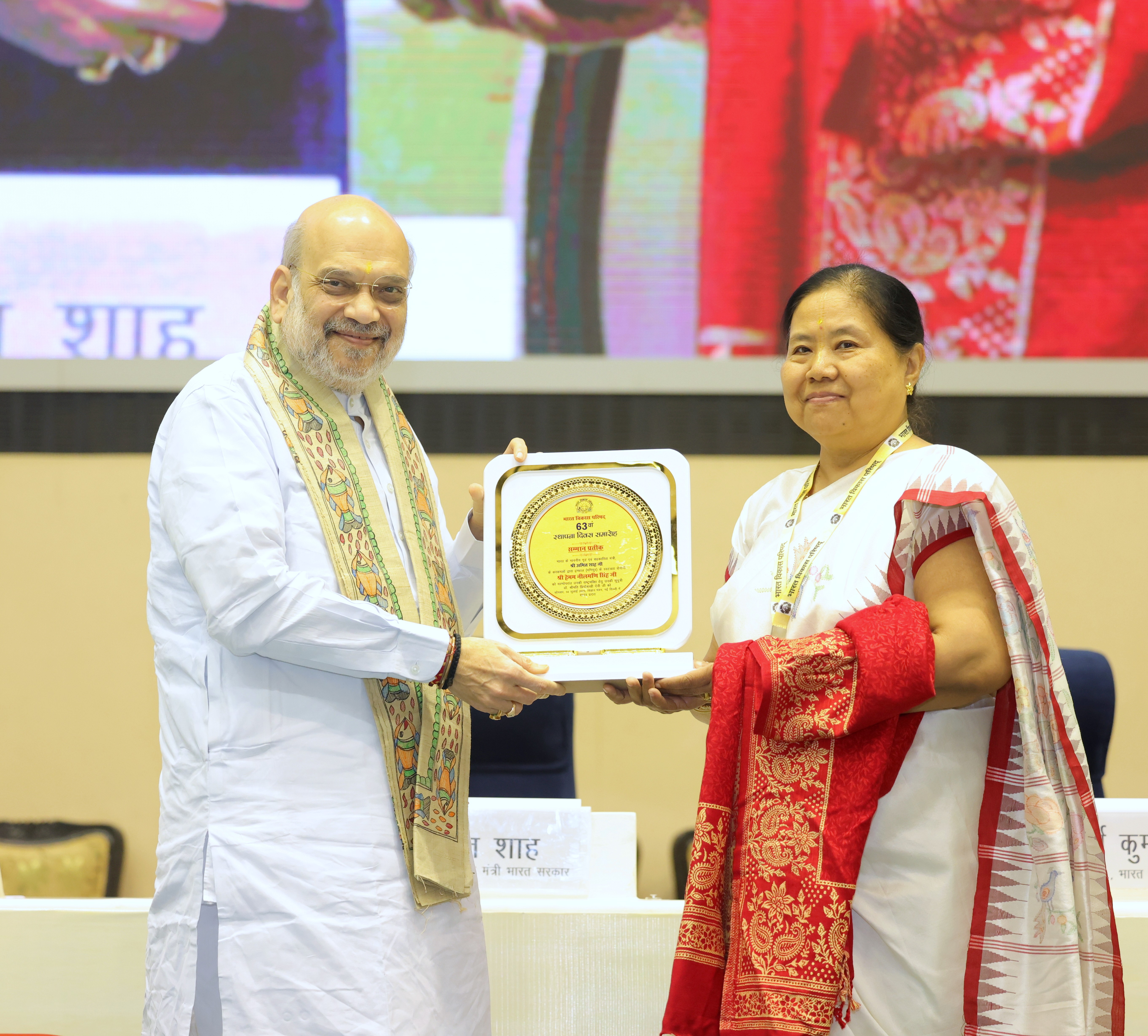
Shri Amit Shah said that at today’s event, freedom fighter Shri Hemam Nilamani Singh from Manipur was posthumously honoured. He shared that Hemam Nilamani Singh was inspired by the call of Netaji Subhash Chandra Bose in 1944 and joined the Indian National Army (Azad Hind Fauj). He dedicated all his resources to Netaji and was not arrested until 1945. In 1946, after being released from jail, he returned to Moirang and later made service, education, and cooperation the foundation of his life. Shri Shah recalled that when he first visited Manipur, he saw the youth there speaking fluently in Hindi. When he asked the youth how they spoke Hindi so well, they credited Shri Hemam Nilamani Singh for it. The Home Minister said that Shri Hemam Nilamani Singh worked his entire life for linguistic unity.

Union Home Minister said that today the Bharat Vikas Parishad has become a very large organization. It has more than 1,600 branches across 412 districts of the country, and over 84,000 families are associated with this service. He said that the organization has provided a platform to those who work with a spirit of service, fostering a strong connection with them. Shri Shah said that the workers of the Bharat Vikas Parishad come forward to provide relief during disasters, organize blood donation camps to help patients, conduct values-based camps in villages, and light the lamp of values in many schools.

Shri Amit Shah said that Prime Minister Shri Narendra Modi has pledged before the countrymen to make India a Viksit Bharat by the year 2047 and leader in the world in every field. This pledge has imagination and resolve as well as an action plan to prove the pledge. He said that Modi Ji has placed five goals before everyone, which include the goal of a Viksit Bharat, freedom from every form of slavery, pride in our heritage, a sense of unity and solidarity and building a sense of duty among citizens. Shri Shah said that Bharat Vikas Parishad has been working like a ‘Sevak’ on these five goals for a long time.

Union Home Minister and Minister of Cooperation said that this is the 11th year of Shri Narendra Modi as the Prime Minister. Historians will write about these 11 years of Modi Ji’s tenure in golden letters. He said that in the past 11 years, bank accounts of more than 55 crore people were opened, pure drinking water was provided to 15 crore houses, toilets were constructed in more than 12 crore houses. Shri Shah said that gas cylinders were provided to more than 10 crore houses and more than 4 crore people were given their own houses. Crores of loans were given under the Mudra Yojana, out of which two-thirds of the loans were given to women power to connect them with the development of the country. He said that women power is being promoted through ‘Lakhpati Didi’.

Shri Amit Shah said that in the last 11 years, Prime Minister Modi’s government has worked quietly like a ‘Sevak’ without giving big slogans, with a sense of service and a resolve to serve. He said that Modi Ji has done a lot of work to get rid of the colonial legacy. By renaming Rajpath as Kartavya Path, it reminds crores of citizens of the duties mentioned in the Constitution of India. Shri Shah said that in a democracy, if someone reminds of duty among those who make rights a means of their politics, then the spirit of the Constitution comes down to earth. He said that when the country’s Navy replaces the symbol of the British Army with the symbol of Shivaji Maharaj, then every Indian feels proud. After independence, a war memorial was built in the memory of the soldiers who were martyred. Through the establishment of Sengol in the Parliament, a vision has been put forward about the direction in which India is moving forward. Shri Shah said that when the Sengol was being installed in the Parliament by the hands of Prime Minister Modi Ji, it came to the minds of crores of Indians that we have moved ahead on the path of the India that our sages had envisioned.

Union Home Minister said that the names given by the British to the Andaman-Nicobar Islands were changed to Subhash Dweep and Shaheed Dweep. Also, renaming Race Course Road to Lok Kalyan Marg is also indicative of a big change. He said that Modi ji has taken forward both heritage and development together without any conflict. Shri Shah said that people of leftist ideology ask what good will the country gets by building the Ram temple. He said that he understands that they will not understand what good will it do. But Modi ji built the Ram temple and also worked to bring 5G. Along with this, he has worked to make the digital payment system reach the vegetable seller on the street.

Shri Amit Shah said that on one hand, temples have been renovated in Kashi, Ujjain, Shardapith and the Kartarpur corridor has been built, while on the other hand, the number of IIMs, IITs and AIIMS has also increased three times. While the new education policy has given support to education in mother tongue, India is also ready to be at the forefront in the field of artificial intelligence and cyber security today. He said that while on the one hand the Modi government has given global recognition to yoga, on the other hand India has adopted many space technologies including green hydrogen, drones. By celebrating Azadi Ka Amrit Mahotsav, we remind 140 crore Indians of the concept of leadership of the freedom movement and also make a master plan of PM Gatishakti. We work to free Kashmir from terrorism by ending Article 370, bring CAA and are on the verge of freeing the country from Naxalism. Along with this, by starting the Ministry of Cooperation, we also move forward in the direction of working for small farmers and the poor of the village.

Union Home Minister said that the time has come to move ahead on the basis of development without forgetting our heritage and build the India that all our freedom fighters envisioned. He said that governments alone cannot solve all the problems unless the service organisations follow this path with the same goal. Shri Shah said that Bharat Vikas Parishad has been following this path since before the beginning of the current era, is following it even today and will continue to do so in the future.

Dr. Mansukh Mandaviya Chairs High Level Meeting of State Labour and Industry Ministers on ELI Scheme

| Published on:

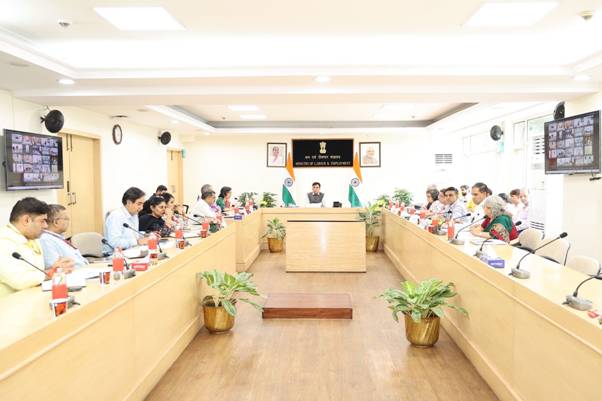
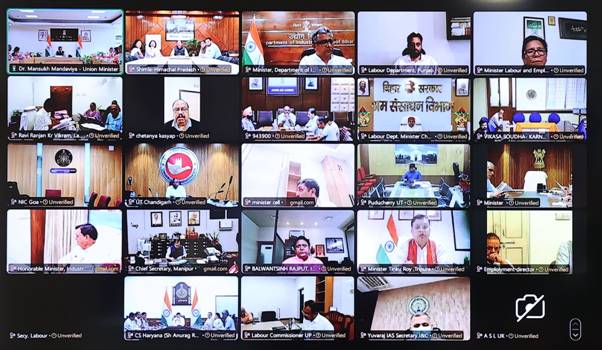
A high-level virtual meeting of State Labour Ministers and State Industry Ministers was convened under the chairpersonship of the Union Minister of Labour & Employment and Youth Affairs and Sports, Dr Mansukh Mandaviya in New Delhi today. The objective of the meeting was to deliberate on the implementation modalities and explore collaborative strategies for the effective rollout of the Employment Linked Incentive (ELI) Scheme.

Addressing the gathering, Dr. Mandaviya, underscored that the ELI Scheme represents the second step after the PLI Scheme in the direction of building an Atmanirbhar Bharat. He stated that the scheme will provide financial support to employers, enabling them to generate additional employment, particularly for the youth. He described the initiative as a win-win for both employers and job seekers.

Dr. Mandaviya cited KLEMS data published by the Reserve Bank of India (RBI), highlighting that over 17 crore employment opportunities were generated during the last decade. This, he noted, is a reflection of the significant economic progress made by the country, particularly driven by robust growth in sectors such as construction, manufacturing, and services. He emphasized that this momentum must be sustained and further accelerated through schemes like ELI, which are designed to create quality jobs, deepen formalization, and support inclusive development.

“Labour and industry are two sides of the same coin,” the Minister said, adding that both must work in close coordination for the greater good of the nation’s workforce and economy. He assured participants that procedural formalities under the scheme have been kept simple to ensure ease of access and encourage wide participation.

Union Minister also urged State Ministers to actively promote the scheme through media briefings, television and radio interviews, and other outreach platforms. He emphasized the importance of comprehensive planning and awareness-building at the grassroots level.

The Secretary (L&E) welcomed all participants and highlighted that the scheme is designed to support employment generation, improve employability, and extend social security across all sectors—particularly focusing on the manufacturing sector. She informed that with a total outlay of Rs. 99,446 crore, the ELI Scheme aims to create over 3.5 crore jobs across the country over a two-year period. She further emphasized that sustainable employment is a key goal of the scheme, as the first instalment of incentives will be disbursed only after six months of continuous employment. Director (L&E), delivered a presentation outlining the scheme’s framework.

Labour and Industry Ministers from Gujarat, Assam, Bihar, Chhattisgarh, Arunachal Pradesh, Madhya Pradesh, Jharkhand and several other states appreciated the initiative and assured their full cooperation in ensuring its successful implementation across their respective regions. Acknowledging the scheme’s potential to boost employment opportunities, the Ministers emphasized the importance of collaborative efforts between the Centre and States. They also proposed that dedicated events, awareness programmes, and conferences may be organized at the district level in collaboration with state governments for local industries/industry chambers/industry associations etc. These efforts would help disseminate comprehensive information about the scheme, promote its adoption, and ensure that its benefits reach the grassroots level and last-mile beneficiaries. During the discussions, Dr. Mandaviya emphasized that States may consider linking of their respective employment-oriented schemes with the objectives of the ELI Scheme.

Joint Secretary (L&E) concluded the meeting by thanking all participants and reiterated the Ministry’s commitment to ensuring the effective implementation of the ELI Scheme through focused and coordinated efforts to generate meaningful employment across the country.

Sarbananda Sonowal inaugurates 2nd BIMSTEC Ports Conclave in Visakhapatnam

| Published on:

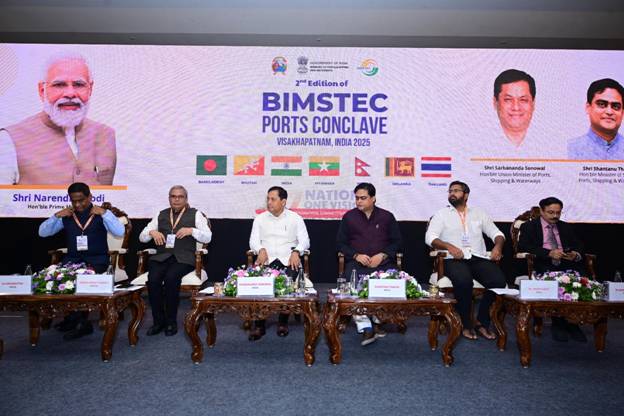
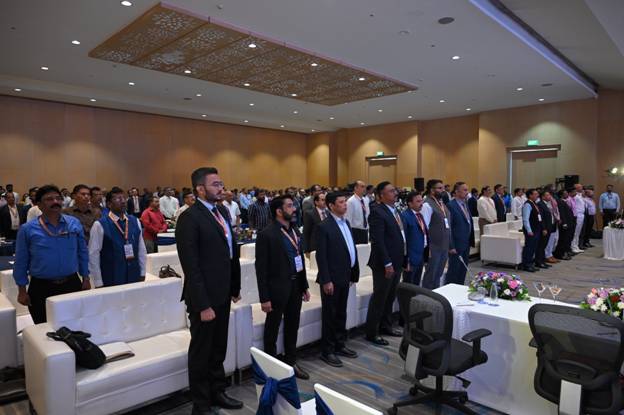
The Union Minister of Ports, Shipping & Waterways (MoPSW), Sarbananda Sonowal inaugurated the second edition of BIMSTEC Ports Conclave here today. The two days event has played a critical role in strengthening regional maritime connectivity, ports cooperation and sustainable development in the Bay of Bengal region. The event is being attended by policymakers, high end officials, maritime experts, port authorities, private sector stakeholders, and academic scholars  from all seven BIMSTEC nations, I.e. Bangladesh, Bhutan, India, Myanmar, Nepal, Sri Lanka & Thailand.

Envisaging the role of BIMSTEC Ports Conclave as the springboard for sustainable development of port led industrial clusters, the Union Minister Sarbananda Sonowal shared his vision and said, “The BIMSTEC Ports Conclave stands as a springboard to unlock the immense potential of Blue Economy from the Bay of Bengal region. Under the dynamic leadership of Prime Minister Shri Narendra Modi ji, India has a”Neighbourhood First” Policy and in this sees BIMSTEC nations as key partners in regional prosperity. We want this platform to enhance collaboration among all member nations for strengthening port led industrialisation, digital integration and skill development which in turn boost cruise tourism, and foster coastal economic zones. Together, we aim to create a seamless and efficient network of ports that can serve as engines of growth. Through joint feasibility studies, PPP, and skill development of our maritime workforce, we can transform our region into a thriving hub of global trade, tourism, and sustainable economic progress.”

Building upon the momentum of the 1st BIMSTEC Ports Conclave, the meet aims to operationalise the recently signed BIMSTEC Agreement on Maritime Transport Cooperation (AMTC), facilitate dialogue on port-led development, and foster deeper integration in maritime trade, logistics, cruise tourism, and skill development. The Conclave is designed to chart a common path towards a sustainable, resilient, and integrated maritime future for the Bay of Bengal, promoting robust economic growth while ensuring environmental stewardship. India was first to ratify the agreement. The Union Minister called upon its speedy ratification of AMTC and implementation.

Sarbananda Sonowal announced that a BIMSTEC Sustainable Maritime Transport Centre is going to be established under the Indian Ocean Centre of Excellence for Sustainable Maritime Transport (IOCE-SMarT) at the Maritime Training Institute in Powai, Mumbai. Underlining the role of this centre to operationalise AMTC BIMSTEC, Sarbananda Sonowal said, “The centre marks a significant step forward in operationalising the BIMSTEC AMTC pact. This Centre will act as a catalyst for harmonising maritime policies, advancing digital and green transformation, and building the skills and capacity of our maritime workforce. By fostering collaboration and innovation, it will help reduce trade costs, enhance connectivity, and position the Bay of Bengal as a vibrant, sustainable hub of regional and global trade.”

The Conclave featured two key sessions shaping BIMSTECs maritime future. The first focused on boosting private sector investment and PPPs to overcome outdated infrastructure and limited coordination, proposing a regional PPP facilitation platform and harmonised laws. The second explored opportunities from shifting global supply chains, highlighting prospects to attract manufacturing hubs in shipbuilding, logistics, electronics, and renewables. Both sessions stressed the need for coordinated strategies, improved connectivity, and policy reforms to unlock the Bay of Bengals potential as a resilient trade and industry hub.

Speaking on the occasion, the Union Minister of State for MoPSW, Shantanu Thakur said, Under the dynamic leadership of Prime Minister Shri Narendra Modi ji, India, through the BIMSTEC platform, has laid out a bold & collaborative roadmap to transform the Bay of Bengal into a vibrant hub of trade, tourism, and industry. By harmonising maritime transport policies, integrating digital logistics platforms, and unlocking private sector investment, we aim to build seamless regional connectivity. Equally important is our focus on skill development and green innovation, ensuring that our maritime workforce is future-ready and our growth remains sustainable. Together, these efforts will strengthen BIMSTECs shared prosperity and resilience in the evolving global landscape.

The Conclaves sessions focused on operationalising the BIMSTEC Maritime Transport Agreement, harmonising customs and logistics to boost intra-regional trade, and unlocking cruise tourisms potential through PPPs and joint branding. Panels explored plans for port-linked industrial zones, digital integration, and sustainable cruise routes, alongside proposals for a BIMSTEC Ports Coordination Centre and a regional Port Community System. Emphasis was placed on joint investment in multimodal logistics parks, SEZs, and enhancing hinterland connectivity. The need to upskill the maritime workforce through cross-border training, industry-academia ties, and green shipping innovation was highlighted as crucial to the regions future. Collectively, these discussions charted a strategic roadmap to transform the Bay of Bengal into a resilient trade, tourism, and logistics hub.

Speaking about Kaladaan project, which is being discussed at the event, the Union Minister Sarbananda Sonowal said, “The Kaladan Multi-Modal Transit Transport Project stands as a transformative gateway connecting Indias Northeast to the Bay of Bengal, dramatically reducing transit time and trade costs while unlocking new economic opportunities for the region. As envisioned by our dynamic Prime Minister Shri Narendra Modi ji, under Indias Act East Policy, Kaladan is not just a bilateral initiative with Myanmar, but a model for seamless regional connectivity across BIMSTEC. By linking ports, trade corridors, and value chains, it has the potential to catalyse inclusive growth, deepen integration with our neighbours, and bring the Northeast closer to the global marketplace. Through collaborative planning and policy alignment, Kaladan can truly become a cornerstone of our shared vision for prosperity and sustainable development in the Bay of Bengal.

At the inaugural session, the Union Minister Sarbananda Sonowal was joined by the Union Minister of State for MoPSW, Shantanu Thakur, the MP of Visakhapatnam, M Sribharat; the Secretary General of BIMSTEC, Mani Pandey; the Secretary of MoPSW, TK Ramachandran; the Chairman of Visakhapatnam Port Authority (VPA) & Dredging Corporation of India (DCI), Dr M Angamuthu along with 28 delegates from all the BIMSTEC member nations.

Prime Minister addresses Rozgar Mela

| Published on:

The Prime Minister Shri Narendra Modi addressed the Rozgar Mela and distributed more than 51,000 appointment letters to newly appointed youth in various Government departments and organizations via videoconferencing today. Addressing the gathering, he emphasized that today marks the beginning of new responsibilities for these youth in different departments of the Government of India. He congratulated the young individuals on beginning their service in various departments, emphasizing that despite different roles, their common goal is national service, guided by the principle of “Citizen First.”

The Prime Minister emphasized  the unmatched strengths of India’s demographic and democratic foundations. He underlined that India, with the world’s largest youth population and the largest democracy, holds unique potential to shape the future both domestically and on the global stage. The Prime Minister noted that this vast youth power is India’s greatest capital, and the government is steadfast in its efforts to convert this capital into a catalyst for long-term prosperity.

“Just two days ago, I returned from a visit to five countries. In every nation I visited, the strength of India’s youth echoed strongly. The agreements signed during this tour will benefit Indian youth both within the country and abroad”, Shri Modi said. He further stated that the various agreements signed during this tour on critical sectors such as defence, pharmaceuticals, digital technology, energy, and rare earth minerals will create far-reaching benefits. “These initiatives will not only strengthen India’s global economic standing but also generate meaningful opportunities for young Indians in both manufacturing and services”, Shri Modi added.

Addressing the evolving landscape of employment, the Prime Minister highlighted that the nature of jobs is undergoing rapid transformation in the 21st century. Emphasizing the importance of innovation, startups, and research, he spoke of the growing ecosystem in India that empowers young people to dream big. He shared his personal pride and confidence in the new generation, expressing joy at seeing youth stepping forward with ambition, vision, and a strong desire to create something new.

Shri Modi stated that the Government of India is also focusing on creating new employment opportunities in the private sector. Recently, the government has approved a new scheme called the Employment Linked Incentive Scheme. Under this scheme, the government will provide ₹15,000 to young individuals who get their first job in the private sector. “In other words, the government will contribute to the first salary of their first job.For this, the government has allocated a budget of approximately ₹1 lakh crore.This scheme is expected to help in the creation of about 3.5 crore new jobs”, Shri Modi added.

The Prime Minister emphasized the transformative power of India’s manufacturing sector in driving national growth, generating employment, and accelerating India’s journey toward becoming the world’s third-largest economy. The Prime Minister noted that in recent years there has been significant strengthening of the Make in India initiative. Through the PLI (Production Linked Incentive) scheme alone, more than 1.1 million jobs have been created across the country. There has been an unprecedented expansion in the mobile phone and electronics sector. “Today, electronics manufacturing in India is worth nearly ₹11 lakh crore, marking more than a fivefold increase over the past 11 years. Earlier, there were only 2 to 4 units manufacturing mobile phones in the country. Today, India is home to nearly 300 units related to mobile phone manufacturing, employing lakhs of young people”, Shri Modi stated.

The Prime Minister also spoke of India’s rise as a global leader in defence manufacturing, with output exceeding ₹1.25 lakh crore. He praised India’s emergence as the largest locomotive producer in the world, and the country’s strong export performance in locomotives, rail coaches, and metro coaches. The automobile sector, he added, has attracted $40 billion in FDI in just five years, resulting in new factories, new job opportunities, and record vehicle sales.

The Prime Minister underscored the far-reaching impact of India’s welfare initiatives, citing a recent International Labour Organization (ILO) report which confirms that over 90 crore Indian citizens have been covered under government welfare schemes over the past decade. These schemes, he noted, are not limited to welfare benefits alone, but have played a crucial role in generating large-scale employment, particularly in rural India.

The Prime Minister elaborated on flagship programs such as the PM Awas Yojana, under which 4 crore permanent houses have been built and 3 crore more are under construction. The construction of 12 crore toilets under Swachh Bharat has led to employment for plumbers and construction workers, while over 10 crore LPG connections provided under the Ujjwala Yojana have driven expansion in bottling infrastructure and delivery networks, resulting in the creation of thousands of distribution centres and lakhs of new jobs.

“The PM Surya Ghar Muft Bijli Yojana, which offers over ₹75,000 per household for rooftop solar installations, is reducing household electricity bills and creating job opportunities for technicians, engineers, and solar panel manufacturers. Namo Drone Didi, has empowered rural women by training them as drone pilots”, Shri Modi added.

Shri Modi remarked that the country is also progressing with its mission to create 3 crore Lakhpati Didis, and 1.5 crore women have already achieved this milestone. Various schemes like Bank Sakhi, Bima Sakhi, Krishi Sakhi, and Pashu Sakhi have enabled women to find sustainable employment.He mentioned that the PM SVANidhi scheme has extended formal assistance to street vendors and hawkers, bringing millions into mainstream economic activity. Simultaneously, the PM Vishwakarma Scheme is revitalizing traditional artisans, craftsmen, and service providers through access to training, tools, and credit.

The Prime Minister emphasised that it is the impact of these numerous schemes that, in just the past ten years, 25 crore people have come out of poverty. “Without employment opportunities, such a transformation would not have been possible.This is why today, major global institutions like the World Bank are praising India. India is now being counted among the top nations in the world with the highest levels of equality”, Shri Modi stated.

The Prime Minister described the current phase as a Mahayagya of development, a national mission dedicated to poverty eradication and employment generation and called on the country’s youth and new government appointees to take this mission forward with renewed energy and dedication.

Concluding his address, the Prime Minister invoked the guiding ethos of “Nagrik Devo Bhava” of  treating every citizen as divine, and extended his heartfelt congratulations and best wishes to the new appointees for a bright and meaningful future in public service.

Background

In line with the Prime Minister’s commitment to accord highest priority to employment generation, the 16th Rozgar Mela will be held at 47 locations across the country. The Rozgar Mela will play a significant role in providing meaningful opportunities to the youth for their empowerment and participation in nation building. More than 10 lakh recruitment letters have been issued so far through the Rozgar Melas across the country.

The new recruits, selected from across the country, will be joining the Ministry of Railways, Ministry of Home Affairs, Department of Posts, Ministry of Health & Family Welfare, Department of Financial Services, Ministry of Labour & Employment among other departments and ministries.

Chief Minister of Odisha meets Prime Minister

| Published on:

Chief Minister of Odisha, Shri Mohan Charan Majhi met Prime Minister, Shri Narendra Modi in New Delhi today.

The Prime Minister’s Office posted on X;

“CM of Odisha, Shri @MohanMOdisha, met Prime Minister @narendramodi.

@CMO_Odisha”

PM lauds the inscription of ‘Maratha Military Landscapes of India’ on the UNESCO World Heritage List

| Published on:

The Prime Minister, Shri Narendra Modi has expressed immense pride and joy over the inclusion of the Maratha Military Landscapes of India in the prestigious UNESCO World Heritage List.

He noted that the inscribed heritage comprises 12 majestic forts- 11 located in Maharashtra and 1 in Tamil Nadu.

Highlighting the significance of the Maratha Empire, the Prime Minister remarked, “When we speak of the glorious Maratha Empire, we associate it with good governance, military strength, cultural pride and emphasis on social welfare. The great rulers inspire us with their refusal to bow to any injustice.”

He urged citizens to visit these forts to learn about the rich history of the Maratha Empire.

The Prime Minister also shared cherished memories from his 2014 visit to Raigad Fort, including a photograph where he paid tribute to Chhatrapati Shivaji Maharaj.

Responding to the X post of UNESCO about aforesaid recognition, the Prime Minister said;

“Every Indian is elated with this recognition.

These ‘Maratha Military Landscapes’ include 12 majestic forts, 11 of which are in Maharashtra and 1 is in Tamil Nadu.

When we speak of the glorious Maratha Empire, we associate it with good governance, military strength, cultural pride and emphasis on social welfare. The great rulers inspire us with their refusal to bow to any injustice.

I call upon everyone to go visit these forts and learn about the rich history of the Maratha Empire.”

“Here are pictures from my visit to Raigad Fort in 2014. Had the opportunity to bow to Chhatrapati Shivaji Maharaj. Will always cherish that visit.”