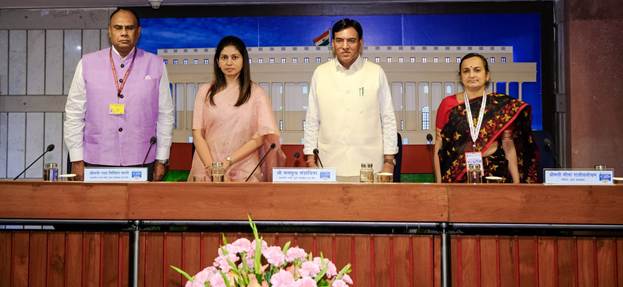
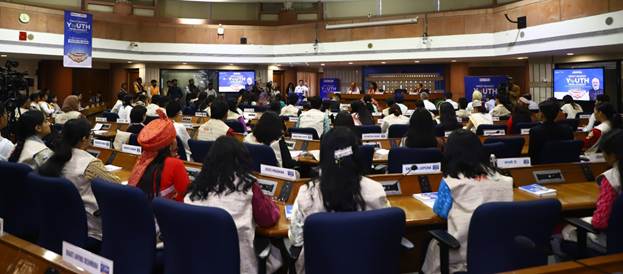
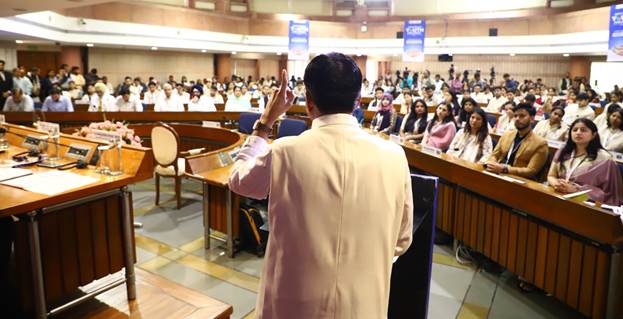
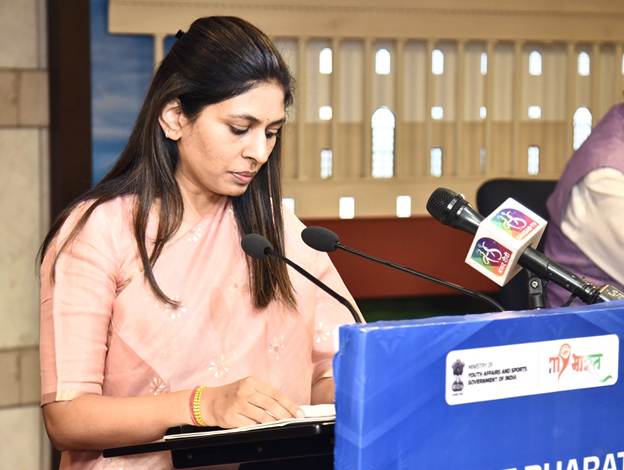
Dr. Mansukh Mandaviya Inaugurates Viksit Bharat Youth Parliament 2025

| Published on:

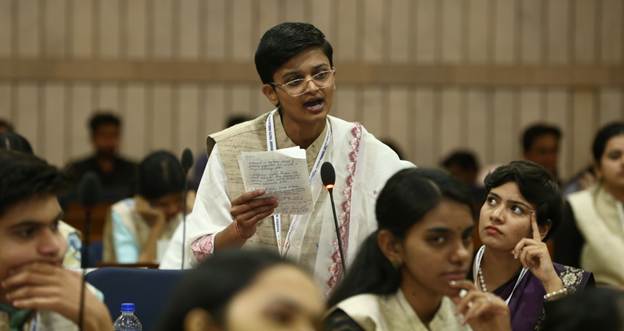
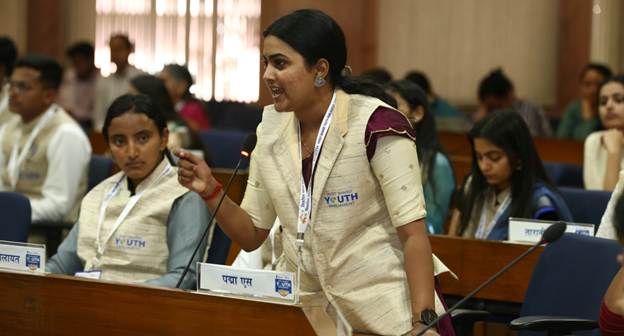
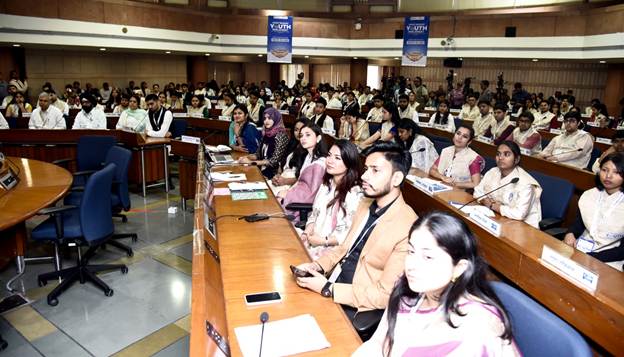
Dr. Mansukh Mandaviya inaugurated the National Round of the 2-day Viksit Bharat Youth Parliament Festival 2025 in New Delhi today. Union Minister of State for Youth Affairs & Sports, Smt. Raksha Khadse was also present on the occasion. The journey to this grand event began when the District Youth Parliament was organized from 16th March 2025 to 27th March, 2025. The winners of the District Youth Parliament-2025 participated in the State Youth Parliament from 23rd – 31st March, 2025 which were organised in many State Legislative Assemblies. A total of 105 State-level winners from across the country earned their place at the national stage.

Union Minister Dr. Mansukh Mandaviya, in his inaugural speech, highlighted that this year’s Youth Parliament has been integrated with the vision of Viksit Bharat. He emphasized the enthusiasm of the youth, noting that over 75,000 young individuals submitted one-minute videos to be part of this initiative. After rigorous selection at the district and state levels, the participants are finally gathered in the prestigious Parliament, a place where leaders and policymakers have shaped India’s present, he added.

Dr. Mandaviya encouraged young participants to adopt a ‘Nation First’ mindset, regardless of their profession. He spoke about the Viksit Bharat Youth Parliament as a platform that nurtures future leaders, allowing young individuals to engage in meaningful discussions. He emphasized that democracy thrives not on arguments but on winning the hearts of citizens through constructive conversations.

Union Minister praised India’s diversity, stating that despite its differences, the Parliament stands as a symbol of unity. Expressing hope for the future, he wished that many of the youth present today would return to Parliament as Members of Parliament or Ministers. He also underscored the strength of democracy, which provides equal opportunities to all, noting that in India, even a person from humble background can become the Prime Minister.

Dr. Mandaviya advised young people to focus on taking a pledge towards Viksit Bharat and moving forward without worrying about the results. Concluding his address, he encouraged the participants to remain open to learning, stating that these two days would be highly enriching for those willing to receive knowledge and experience.

Union Minister of State for Youth Affairs & Sports, Smt. Raksha Khadse highlighted that the dialogues led by these young minds during Viksit Bharat Youth Parliament 2025 will pave the way for India’s future. She emphasized the significance of this year’s Youth Parliament, aligning with Prime Minister Modi’s vision of making India a Viksit Bharat, where the youth will not only contribute but also lead the nation toward progress.

In her welcome address, Secretary, Department of Youth Affairs, Smt. Meeta Rajivlochan emphasized that Viksit Bharat Youth Parliament 2025 represents our collective commitment to democracy and serves as a forum where young people from across the country can actively contribute to public policy.

The day began with a powerful Inaugural Ceremony, followed by opening remarks by the participants, which was judged by a jury comprising of Dr. Mansukh Mandaviya and Sushri Shambhavi Chaudhary, Member of Parliament.

The event proceeded with the two Question Hour sessions, which formed the heart of the Youth Parliament experience. Each Question Hour session featured 18 teams participating: 9 teams representing MPs and 9 teams representing Ministers. The youth MPs raised insightful, policy-based questions, and the ministers responded with structured and detailed answers.

During Question Hour 1, teams discussed One Nation, One Election (ONOE), examining governance, administrative feasibility, political stability, and legal challenges, with insights from a distinguished jury, including Smt. Raksha Khadse, Minister of State for Youth Affairs and Sports, and Dr. Bhagwat Kishanrao Karad, MP. Question Hour 2 focused on Viksit Bharat, where youth MPs debated youth empowerment, education, skill development, and sustainability, assessed by a jury comprising MPs Shri Satnam Singh Sandhu, Shri Dhaval Laxmanbhai Patel, and Shri Nitesh Kumar Mishra, Joint Secretary, Ministry of Youth Affairs and Sports.

This was followed by an insightful master class on oratory skills by Dr. Sudhanshu Trivedi, Member of Parliament. This master class provided participants with valuable insights into the art of effective public speaking, a crucial skill for leadership and parliamentary debates.

The Viksit Bharat Youth Parliament on Day 1 was a resounding success, which concluded on an inspiring note, setting the stage for an engaging and impactful second day of discussions, debates, and policymaking exercises.

The Day 2 will be followed with a visit to the new Parliament building, where they will witness live proceedings and experience the legislative process firsthand. This will be followed by a focused discussion on the One Nation, One Election, examining its potential implementation models, electoral dynamics, and implications for Centre-State relations. The agenda also includes a deliberation session led by a team representing the Ministry of Law and Justice, who will be initiating a motion in the house for voting. Later in the day, the National Youth Awards for the years 2021-22 and 2022-23 will be presented, celebrating exceptional contributions to youth leadership along with the Viksit Bharat Youth Parliament Awards, 2025.

India – Chile Joint Statement

| Published on:

At the invitation of Prime Minister of India, Shri Narendra Modi, the President of the Republic of Chile, H.E. Mr. Gabriel Boric Font is on a State visit to India from 1-5 April, 2025, commemorating the completion of 76 years of diplomatic relations between the two countries. President Boric is accompanied by Ministers of Foreign Affairs, Agriculture, Mining, Women and Gender Equality and Cultures, Arts and Heritage, Members of Parliament, Senior Officials and a large number of business leaders. Apart from New Delhi, President Boric will visit Agra, Mumbai and Bengaluru. This is the first visit of President Boric to India. Both President Boric and Prime Minister Modi had first met on the sidelines of the G20 Summit in Rio de Janeiro in November 2024.

President Boric was accorded a warm and ceremonial welcome on arrival at Air Force Station Palam. Prime Minister Modi held bilateral talks with President Boric at Hyderabad House on 1 April 2025. He met President Droupadi Murmu who also hosted a Banquet in his honour and his accompanying delegation. Dr S Jaishankar, External Affairs Minister of India called on President Boric.

President Boric and Prime Minister Modi recalled the historic diplomatic ties that were established in 1949, growing trade linkages, people-to-people linkages, cultural ties and also the warm and cordial bilateral relations between both countries. They expressed desire for further expanding and deepening of the multifaceted relationship between the two countries in all areas of mutual interests.

During their meeting, the two leaders comprehensively reviewed the entire gamut of bilateral relations spanning a wide range of sectors, including trade and investment, health and pharmaceuticals, defence and security, infrastructure, mining and mineral resources, agriculture and food security, green energy, ICT, digitization, innovation, disaster management, cooperation in science and technology, education and people-to-people linkages. The two sides agreed to continue regular exchanges at various levels to give further momentum to the bilateral relationship.

The two leaders noted that trade and commerce has been a strong pillar of the bilateral relations. While highlighting the positive effects generated by the expansion of the India-Chile Preferential Trade Agreement in May 2017, which has resulted in substantial increase in bilateral trade, the two leaders emphasized the need for further strengthening of bilateral trade mechanisms that could open new opportunities for expansion of bilateral trade. The two leaders expressed satisfaction at the recent increase in visits of business delegations from both sides, which is strengthening trade and economic relations between the two countries. Prime Minister Modi thanked President Boric for bringing in a large business delegation, which will help in intensifying business interaction between the two countries. Both agreed to continue the discussions for further enhancement of the trade relations.

President Boric conveyed that India is a priority partner for Chile in the global economy and stressed the need to explore strategies for enhanced and diversified trade between the two countries. The President and the Prime Minister acknowledged signing of the mutually agreed Terms of Reference and welcomed the launch of a Comprehensive Economic Partnership Agreement (CEPA) negotiations for a balanced, ambitious, comprehensive, and mutually beneficial agreement to achieve a deeper economic integration. The CEPA will aim at unlocking the full potential of the trade and commercial relationship between India and Chile, boosting employment, bilateral trade, and economic growth.

To further promote trade relations as well as people-to-people interactions, President Boric announced Chile’s decision to grant a Multiple Entry Permit for Indian businesspersons which will streamline the visa process. Prime Minister Modi welcomed and valued this measure, as it reflects the willingness of both parties to facilitate trade and investment and the shared commitment to deepening bilateral relations between Chile and India. Acknowledging the people-to-people linkages as an important pillar to promote bilateral ties and to facilitate business, tourism, student and academic exchanges, Indian side has already put in place a flexible visa regime, including by extending e-visa facility for Chilean travellers to India.

Both leaders recognised the strategic importance of critical minerals for emerging technologies, advanced manufacturing, and clean energy transitions, both leaders agreed to accelerate collaboration in exploration, mining and processing along with research and development to promote investment across the entire critical mineral value chain for mutual benefit. They stressed on the need for building trusted and resilient supply chains including for critical minerals and advanced materials. The two sides agreed to work together on initiatives to strengthen supply chains and local value chains by fostering mutually beneficial partnerships and understandings in mining and minerals, including the possibility of long-term supply of minerals and materials from Chile to India.

Both leaders agreed to explore the opening up of new avenues for cooperation in health and pharmaceuticals, space, ICT, agriculture, green energy, traditional medicine, Antarctica, Science & Technology, management of natural disasters, sports, Startups, cooperatives, and audiovisual co-production, through the exchange of experiences and good practices among the agencies responsible for these matters.

President Boric acknowledged the role of the Indian pharmaceutical industry as one of the world leaders, and an important partner for Chile in the supply of affordable and high-quality products. Both sides agreed to facilitate private sectors of the two countries to increase trade in pharmaceuticals, vaccines, and medical devices. Both sides agreed to work on enhancing cooperation in healthcare and pharmaceuticals sectors and address market access issues for Indian pharmaceuticals, as well as advancing in the recognition of Indian Pharmacopoeia by Chile.

The two leaders noted the importance of traditional medicines and Yoga in preserving health and wellbeing of people and directed their officials for an early conclusion of the Memorandum of Understanding on Traditional Medicines to promote a more sustainable lifestyle. Towards this, both countries agreed to collaborate and intensify the promotion and use of evidence-based, integrative, Traditional Medicine, Homeopathy, and Yoga by signing an MoU.

Both sides agreed to work on promoting investments in infrastructure projects in each other’s countries. Chilean side welcomed Indian companies to participate in infrastructure projects including in railway sector.

The two leaders encouraged the two sides to work together to explore substantial areas for bilateral defence cooperation, including capacity building and defence industrial collaboration. Both agreed to share knowledge in developing and enhancing each other’s capabilities under the existing formal defence cooperation agreement in place. Indian side highlighted that Chile has been kept on priority while offering opportunities in training at Defence Services Staff College, NDC, NDA and HDMC, apart from slots for specialised courses in mountain warfare and peacekeeping operations previously made available. Indian side expressed its desire to receive and train Chilean military in areas of mutual interests.

Both leaders expressed their happiness on signing of the Letter of Intent to strengthen existing Antarctic cooperation, which will further facilitate partnership in Conservation of Antarctic Marine Living Resources agendas bilateral dialogues, joint initiatives and academic exchanges related to Antarctica and Antarctic policy. Both India and Chile are Consultative Parties to the Antarctic Treaty and reaffirmed their commitment to deepen scientific understanding of Antarctic for the benefit of both parties and the global community.

The two sides welcomed the adoption and opening for signature of the Agreement on Marine Biodiversity of Areas beyond National Jurisdiction (BBNJ), as a key legal framework for the conservation and sustainable use of marine biodiversity in areas beyond national jurisdiction and reiterated the resolve of their respective countries to preserve, protect and promote biodiversity, from land to sea, and agreed to work together and support each other in international forums dealing with these issues. Both countries reaffirmed their intention to strengthen a vision from the Global South in multilateralism, through cooperation and joint efforts, based on the principle of Common but Differentiated Responsibilities and the right to development.

Recalling the two countries’ decades-long partnership in space, the two leaders noted the ongoing engagements in the space sector between the two countries, including the launching of a satellite belonging to Chile (SUCHAI-1) by India in 2017 as a co-passenger under a commercial arrangement. Both leaders emphasized the importance of further cooperation to promote training and capacity building and research in space and astrophysics. In this regard, they welcomed the constitution of Space Executive Committee by Chile to work on cooperation including in the areas of exploration in space, R&D, training, satellite building, launch and operation and peaceful use of outer space with ISRO, IN-SPACe (Indian National Space Promotion and Authorization Centre) and Startups.

Both leaders noted their respective dynamic information and digital technology sectors and stressed the need to explore synergies to enhance cooperation in this field. They expressed mutual interest in growth of investment, joint ventures, technological development and markets in the IT and digital space, including promoting collaboration in Digital Public Infrastructures (DPI), thereby democratizing access to digital services for people and businesses. Both leaders acknowledged the efforts by the two sides in exploring early implementation of cooperation in the digital payments sectors. They committed to work for developing closer cooperation between the vibrant Startup ecosystems of the two countries. Both leaders expressed their desire for advancing on signing of an understanding on cooperation in the areas of Digital Transformation to facilitate deeper engagement between tech communities of both countries.

The leaders reaffirmed their commitment to reformed multilateralism and for comprehensive reforms of the UN Security Council, including its expansion in both permanent and non-permanent categories of membership to make it more representative, accountable, transparent, inclusive and effective, reflecting the geopolitical realities of the 21st Century. The Chilean side reiterated its support for India’s candidature for a permanent membership in a reformed and expanded UN Security Council. The two sides agreed to work together for promotion of democratic principles and human rights to strengthen the world peace stressing the importance of resolving all disputes through peaceful dialogue.

Both leaders reaffirmed their unequivocal condemnation of terrorism in all its forms and manifestations, including cross border terrorism and shared their resolve to stand together in common fight against global terrorism. They agreed that terrorism must be combated through concerted global actions.

The two leaders called upon all UN member countries to implement the UNSC Resolution 1267 and work towards eliminating terrorist safe havens and infrastructure and disrupt terrorist networks and all terror financing channels. Both reiterated their commitment to work together in Financial Action Task Force (FATF), No Money For Terror (NMFT) and other multilateral platforms to combat terrorism. The two leaders also reiterated the importance of early finalization of Comprehensive Convention on International Terrorism.

The two leaders committed themselves to the vision of a rules-based international order that respects sovereignty and territorial integrity of nations, ensures freedom of navigation and overflight as well as unimpeded lawful commerce, and that seeks peaceful resolution of disputes in accordance with universally recognized principles of international law, notably the UNCLOS.

Prime Minister Modi appreciated the participation of Chile in all the three editions of the “Voice of Global South” Summits, reflecting the commitment in bringing together countries of the Global South to share their development perspectives and priorities. Prime Minister Modi thanked President Boric for sharing his valuable perspectives and ideas at the 3rd Voice of Global South Summit held in August 2024 and noted that both countries have strong convergence on several contemporary global issues, including on the need for effective global governance reforms and equitable access for Global South countries to clean and green technologies. President Boric welcomed India’s leadership in strengthening engagements between countries of Global South.

President Boric appreciated India’s leadership in G20 which brought the development agenda to centre stage and acknowledged the transformative and inclusive role of technology, with a focus on unlocking the potential of digital public infrastructure (DPI). Both Leaders recognized that India’s G20 Presidency has championed Voice of the Global South by bringing to fore key initiatives and outcomes, such as inclusion of African Union in G20, promotion of Lifestyles for sustainable development (LiFE), advancements in Digital Public Infrastructure (DPI), reforms of Multilateral Development Banks (MDBs) and focus on women-led development. In this regard, and with the aim of promoting greater integration and representativeness within the G20, India will support the inclusion of Chile and Latin American countries in the discussions as G20′ guest countries.

The two sides recognized the challenges for their economies presented by climate change and the transition to low emissions climate resilient economies. Accordingly, they expressed keen desire to promote clean energy and sustainable development through development of more efficient energy technologies. The two leaders called for increased joint investments in renewable energy, green hydrogen, utilization and storage technologies, energy efficiency, and other low-carbon solutions that will have the potential to accelerate sustainable economic growth and foster job creation.

President Boric welcomed India’s leadership in the International Solar Alliance (ISA) and reiterated strong support as a member since November 2023. Prime Minister Modi appreciated Chile joining the Coalition for Disaster Resilient Infrastructure (CDRI) in January 2021 aiming to make systems and infrastructure resilient to achieve the objectives of Sustainable Development Goals (SDGs). Additionally, both leaders valued Chile’s offer of hosting the 7th Meeting of the ISA Regional Committee for Latin America and the Caribbean.

Recognizing the growing significance of technology enabled learning solutions, skills development, and institutional capacity building, India and Chile reaffirmed their commitment to expanding bilateral cooperation in these areas. Both countries have agreed to facilitate partnerships between EdCIL (India) Limited and key Chilean institutions, including the Council of Rectors of Chilean Universities (CRUCH), the Chilean Ministry of Education, and technical training centres (CFTs), thereby focusing on digital learning, research exchanges, smart education infrastructure, and vocational training programs, leveraging the strengths of both nations to drive innovation and knowledge-sharing in education.

Prime Minister Modi, highlighting the transformational changes taking place in education sector in India under National Education Policy (NEP) 2020, encouraged leading Chilean universities to strengthen academic and research partnerships with Indian institutions and build institutional linkages through joint/dual degree and twinning arrangements. Given mutual strengths of both countries in astronomy and astrophysics, both leaders agreed to strengthen institutional engagements in these domains. The two leaders welcomed the proposal for establishment of an ICCR Chair on Indian Studies in one of the universities in Chile and directed the officials to examine the feasibility for an early implementation.

Both leaders welcomed the ongoing cooperation in training and capacity building in the field of diplomacy and noted the potential for further enhancement for cooperation in this area, in line with global diplomatic endeavours and new technology making diplomacy more efficient.

The two leaders acknowledged the role of cultural ties in bringing the people of the two countries closer to each other. They lauded the rich and diverse cultural heritage of India and Chile and appreciated the long-standing cultural exchanges between the two nations. The leaders applauded the growing interest in the study of the cultures and languages in both countries with Spanish being among the popular foreign languages in India. They stressed the mutual interest in further strengthening India – Chile cultural cooperation and the reinforcement of cooperation among cultural institutions of the two countries. They welcomed the signing of new Cultural Exchange Program to promote bilateral exchanges in music, dance, theatre, literature, museums and festivals.

The two leaders expressed satisfaction on the progress made to finalise the agreement on cooperation and mutual assistance in customs matters which will lead to strengthening linkages between the relevant agencies to counter illicit trafficking of narcotic drugs and psychotropic substances and, in general, to investigate, prevent and suppress contraventions of Customs laws, as well as sharing of best practices and capacity building. They also welcomed the efforts by two sides to sign an agreement on cooperation in the disability sector which would contribute to a more humane and just society where no one is left behind. The two leaders directed their officials to conclude these documents at an early date.

Both leaders agreed on the importance of maintaining regular interaction on matters of mutual interest. They reiterated their willingness to build on opportunities to promote and expand the bonds of cooperation and understanding that characterizes the bilateral relationship.

President Gabriel Boric thanked Prime Minister Narendra Modi for warmth and hospitality accorded to him and his delegation during the visit and invited him to pay an official visit to Chile at a mutually convenient time.

Press Statement by Prime Minister during Joint Press Statement with President of Chile

| Published on:

Your Excellency, President Boric,

Delegates from both the countries,

Friends from the media,

Namaskar! Hola!

This is President Boric’s first visit to India. His strong sense of friendship toward India and his commitment to strengthen our relations is truly amazing. For this, I extend my heartfelt felicitations to him, and warmly welcome him and his distinguished delegation.

Friends,

Chile is a valued friend and partner country for India in Latin America. In our discussions today, we identified several new initiatives to further strengthen our cooperation in the coming decade.

We welcome the expansion of mutual trade and investment and we agree that there is untapped potential for further collaboration. Today, we have instructed our teams to initiate discussions on a mutually beneficial Comprehensive Economic Partnership Agreement.

Partnerships in the field of Critical Minerals will be emphasized. Efforts will be made to establish resilient supply and value chains. In agriculture, we will collaborate to enhance food security by leveraging each other’s strengths.

India is ready to share its positive experience with Chile in the areas of Digital Public Infrastructure, Renewable Energy, Railways, Space and more.

We see Chile as the gateway to Antarctica. We welcome today’s agreement on the Letter of Intent to strengthen cooperation in this vital region.

India has been a trusted partner in supporting Chile’s health security, and we have agreed to further strengthen this collaboration. It is a matter of joy that the people of Chile have adopted Yoga as part of a healthy lifestyle. The declaration of November 4 as National Yoga Day in Chile is truly inspiring. We also explored opportunities to enhance cooperation in Ayurveda and traditional medicine in Chile.

Increasing cooperation in the field of defence is a symbol of our deep mutual trust. In this area, we will move forward to create defence industrial manufacturing and supply chains as per each other’s needs. We will increase cooperation between the agencies of both the countries to face common challenges like organized crime, drug trafficking, and terrorism.

Globally, India and Chile agree that all tensions and disputes should be resolved through dialogue. We are unanimous in saying that to face global challenges, reform of the United Nations Security Council and other institutions is necessary. Together we will continue to contribute to global peace and stability.

Friends,

Even though India and Chile are at different ends of the world map, separated by vast oceans, we still share some unique natural similarities.

The Himalayas of India and the Andes mountains of Chile have shaped the way of life in both countries for thousands of years. The waves of the Indian Ocean flow in India with the same energy with which the waves of the Pacific Ocean touch the shores of Chile. Both the countries are not only connected by nature, but our cultures have also been close to each other, embracing this diversity.

The great Chilean poet and Nobel Laureate “Gabriela Mistral” found inspiration in the ideas of Rabindranath Tagore and Aurobindo Ghosh. Similarly, Chilean literature has been appreciated in India too. The growing interest among the Chilean people towards Indian films, cuisine, and classical dances is a living example of our cultural ties.

Today, around four thousand people of Indian origin, who consider Chile their home, are the custodians of our shared heritage. I extend my heartfelt gratitude to President Boric and his government for their care and support.

We welcome the consensus reached today on the cultural exchange program between the two countries. We also discussed simplification of the visa process between the two countries. We will continue to work towards increasing student exchanges between India and Chile.

Excellency,

Your visit has brought new energy and enthusiasm in our relations. This energy will give new impetus and direction to our bilateral relations as well as to our cooperation in the entire Latin American region.

I wish you a pleasant journey and stay in India.

Thank you very much!

Gracias!

DISCLAIMER – This is the approximate translation of Prime Minister’s remarks. Original remarks were delivered in Hindi.

PM condoles the loss of lives in the explosion at a firecracker factory in Banaskantha, Gujarat

| Published on:

Prime Minister Shri Narendra Modi today condoled the loss of lives in the explosion at a firecracker factory in Banaskantha, Gujarat. He announced an ex-gratia of Rs. 2 lakh from PMNRF for the next of kin of each deceased and Rs. 50,000 to the injured.

The Prime Minister’s Office handle in post on X said:

“Deeply saddened by the loss of lives in the explosion at a firecracker factory in Banaskantha, Gujarat. Condolences to those who lost their loved ones. May the injured recover soon. The local administration is assisting those affected.

An ex-gratia of Rs. 2 lakh from PMNRF would be given to the next of kin of each deceased. The injured would be given Rs. 50,000: PM @narendramodi”

Modi government is determined to uproot Naxalism: Amit Shah

| Published on:

Union Home Minister and Minister of Cooperation Shri Amit Shah said that taking a giant stride towards building a Naxal-free Bharat, our nation achieved a new milestone by significantly reducing the number of districts most affected by Left-Wing Extremism to just 6 from 12.

In a post on X platform, Shri Amit Shah said that the Modi government is building a Sashakt, Surakshit and Samriddh Bharat with a ruthless approach to Naxalism and relentless efforts for all-pervasive development. Bharat is determined to uproot Naxalism for good by 31st March 2026.

Total number of districts affected by Naxalism in the country was 38. Among these, the number of most affected districts has reduced to 6 from 12, number of District of Concern has also come down to 6 from 9 and number of Other LWE-affected Districts has also been reduced from 17 to 6.

Out of total naxalism-affected districts, number of most affected districts has been reduced from 12 to 6, which include 4 districts from Chhattisgarh (Bijapur, Kanker, Narayanpur, and Sukma), 1 from Jharkhand (West Singhbhum), and 1 from Maharashtra (Gadchiroli).

Similarly, out of the total 38 affected districts, the number of Districts of Concern, where additional resources need to be intensively provided beyond the severely affected districts, has reduced from 9 to 6. These 6 districts are: Andhra Pradesh (Alluri Sitarama Raju), Madhya Pradesh (Balaghat), Odisha (Kalahandi, Kandhamal, and Malkangiri), and Telangana (Bhadradri-Kothagudem).

Due to persistent action against Naxalism, number of Other LWE-affected Districts has also decreased from 17 to 6. These include districts from Chhattisgarh (Dantewada, Gariaband, and Mohla-Manpur-Ambagarh Chowki), Jharkhand (Latehar), Odisha (Nuapada), and Telangana (Mulugu).

The most affected Districts and Districts of Concern are given financial assistance of Rs. 30 crore and Rs. 10 crore respectively by the Government of India under a special scheme, Special Central Assistance (SCA) to fill the gaps in public infrastructure.  Apart from this, special projects are also provided for these districts as per the need.

The rapid improvement in the LWE scenario in the last one year is primarily due to the establishment of new security camps in the insurgency-affected core areas and development-oriented works such as expansion of roads, transport facilities, water, electricity and other welfare schemes of the government reaching the villagers.

PM lays foundation stone, inaugurates development works in Bilaspur, Chhattisgarh

| Published on:

In line with his commitment to enhance infrastructure development and sustainable livelihood, Prime Minister Shri Narendra Modi laid the foundation stone, initiated commencement of work and dedicated to the nation multiple development projects worth over Rs 33,700 crore in Bilaspur, Chhattisgarh today. Marking the auspicious beginning of the New Year today and the first day of Navratri, he emphasized the significance of Chhattisgarh as the land of Mata Mahamaya and the maternal home of Mata Kaushalya. He highlighted the special importance of these nine days dedicated to feminine divinity for the state. He expressed his privilege to be in Chhattisgarh on the first day of Navratri and congratulated everyone on the recent issuance of a postal stamp in honor of Bhakt Shiromani Mata Karma. He further remarked that the Navratri festival will conclude with the celebration of Ram Navami, highlighting the unique devotion to Lord Ram in Chhattisgarh, particularly the extraordinary dedication of the Ramnami Samaj, which has devoted their entire being to the name of Lord Ram. He extended his heartfelt wishes to the people of Chhattisgarh, referring to them as the maternal family of Lord Ram.

With the blessings of Mohbhatta Swayambhu Shivling Mahadev on this auspicious occasion, Shri Modi highlighted the opportunity to accelerate development in Chhattisgarh. He noted the inauguration and foundation laying of projects worth over ₹33,700 crore, which include housing for the poor, schools, roads, railways, electricity, and gas pipelines. He stressed that these projects are aimed at enhancing convenience for Chhattisgarh’s citizens and creating new employment opportunities. He extended his congratulations to all for the progress achieved through these development initiatives.

Emphasizing the cultural significance of providing shelter, calling it a great virtue, the Prime Minister said that it was an unparalleled joy of fulfilling someone’s dream of owning a home. On the auspicious occasion of Navratri and the New Year, he highlighted that three lakh poor families in Chhattisgarh are entering their new homes. He extended his heartfelt wishes to these families for a new beginning. He credited the realization of these homes to the trust placed in his leadership, noting that the dream of permanent housing for lakhs of families in Chhattisgarh was previously lost in bureaucratic files. He recalled the Government’s commitment to fulfilling this dream. He remarked that under Shri Vishnu Deo’s leadership, the first Cabinet decision was to construct 18 lakh houses, of which three lakh have been completed. He expressed happiness that many of these homes are in tribal areas, benefiting families in Bastar and Surguja, acknowledging the transformative impact of these homes for families who have endured generations of hardship in makeshift shelters, calling it a significant gift.

“While the Government provided assistance in building these homes, the beneficiaries themselves decided how their dream homes would be designed”, said Shri Modi, emphasising that these homes are not just four walls but a transformation of lives. He highlighted the efforts to equip these homes with essential facilities such as toilets, electricity, Ujjwala gas connections, and piped water. He noted the significant presence of women at the event and remarked that most of these homes are owned by women. He acknowledged the milestone achieved by thousands of women who, for the first time, have property registered in their names. He expressed his gratitude for the joy and blessings reflected on the faces of these women, calling it his greatest asset.

Highlighting the broader impact of constructing lakhs of homes which not only created the employment opportunities for local artisans, masons, and laborers in villages, the Prime Minister said that the materials used for these homes are sourced locally, benefiting small shopkeepers and transport operators. He noted that these housing projects have generated significant employment in Chhattisgarh, contributing to the livelihoods of many.

Underlining that their Government is fulfilling every promise made to the people of Chhattisgarh, Shri Modi highlighted the presence of a large number of beneficiaries from various schemes, emphasizing the swift implementation of government guarantees. He noted that the promises made to the women of Chhattisgarh have been honored, including the disbursement of two years’ pending bonuses to paddy farmers and the procurement of paddy at increased MSP rates. These measures have provided thousands of crores of rupees to millions of farming families. The Prime Minister criticized the previous Government for recruitment exam scams and highlighted their Government’s transparent investigations and fair conduct of examinations. He emphasized that these honest efforts have strengthened public trust with growing support, evident from its victories in Assembly, Lok Sabha, and now municipal elections in Chhattisgarh. He expressed gratitude for the overwhelming support of the people for their Government’s initiatives.

Shri Modi noted that this year was 25th anniversary of Chhattisgarh’s statehood, celebrating it as the state’s Silver Jubilee Year was coinciding as this year also marked the birth centenary of Atal Bihari Vajpayee. He said that the Chhattisgarh Government is observing 2025 as “Atal Nirman Varsh” and reaffirmed the commitment, “We built it, and we will nurture it.” He emphasized that the infrastructure projects inaugurated and launched today are part of this resolution.

Mentioning that Chhattisgarh had to be formed as a separate state because the benefits of development were not reaching the region, the PM criticized the previous Government for its failure to deliver development and for corruption in the projects that were undertaken. He underscored that their Government has prioritized the well-being of the people, focusing on improving their lives, facilities, and opportunities for their children. He highlighted the efforts to bring development schemes to every village in Chhattisgarh.

Underlining the progress in remote tribal areas, where quality roads are now reaching for the first time, Shri Modi mentioned the introduction of train services to several regions, including the flagging off of a new train earlier in the event. He also highlighted the arrival of electricity, piped water, and mobile towers in previously underserved areas. He remarked on the construction of new schools, colleges, and hospitals, emphasizing that these initiatives are transforming the landscape of Chhattisgarh.

Highlighting Chhattisgarh’s achievement of becoming one of the states with a fully electrified rail network, calling it a significant milestone, the Prime Minister noted that approximately ₹40,000 crore worth of rail projects are currently underway in the state, with ₹7,000 crore allocated in this year’s budget to improve rail connectivity in various regions and neighboring states. Stressing that development requires both budgetary support and honest intentions, Shri Modi criticized the previous Government for its corruption and inefficiency, which hindered progress in tribal areas. He cited the example of coal, noting that despite Chhattisgarh’s abundant reserves, the state faced electricity shortages due to the neglect of power plants by previous dispensations. He remarked that under their Government, new power plants are being established to address these issues and ensure reliable electricity for the state.

Highlighting the Government’s focus on solar energy and introduction of the ‘PM Suryagarh Muft Bijli Scheme,’ which aims to eliminate electricity bills and enable households to generate income by producing electricity, the Prime Minister noted that the Government is providing ₹78,000 assistance per household for installing solar panels. He added  that over two lakh families in Chhattisgarh have already registered for the scheme and encouraged others to join for significant benefits.

Stressing on the Government’s efforts to address the challenge of delivering gas pipelines to Chhattisgarh, a landlocked state, Shri Modi criticized the previous Government for neglecting necessary investments in gas infrastructure and highlighted the ongoing work to lay gas pipelines in the region. He noted that these pipelines will reduce dependency on truck transportation for petroleum products, lower costs for consumers, and enable the use of CNG vehicles. He remarked that households will benefit from piped cooking gas, with a target of reaching over two lakh homes. He also emphasized that the availability of gas will facilitate the establishment of new industries in Chhattisgarh, creating significant employment opportunities.

Criticizing the previous dispensation’s policies over the decades, stating that they contributed to the rise of Naxalism in Chhattisgarh and other states, the Prime Minister said that Naxalism thrived in areas lacking development and resources, and instead of addressing these issues, such districts were declared as backward, shirking their responsibility. He highlighted the neglect faced by the most underprivileged tribal families in many districts of Chhattisgarh under previous Government’s rule. In contrast, he emphasized their Government’s efforts to address the needs of poor tribal communities. He noted the initiatives undertaken, such as the Swachh Bharat Abhiyan to provide toilets, the Ayushman Bharat scheme offering free treatment up to ₹5 lakh, and the establishment of PM Jan Aushadhi Kendras, which provide medicines at an 80% discount.

The Prime Minister criticized those who falsely claim to champion social justice while neglecting the tribal community. He emphasized his Government’s commitment to the development of tribal societies, highlighting the launch of the “Dharti Aaba Janjatiya Utkarsh Abhiyan,” under which approximately ₹80,000 crore is being invested in tribal areas, benefiting nearly 7,000 tribal villages in Chhattisgarh. Noting the unique challenges faced by particularly vulnerable tribal groups, Shri Modi mentioned the introduction of the “PM Janman Yojana,” the first initiative of its kind for these communities. He remarked that under this scheme, over 2,000 settlements in 18 districts of Chhattisgarh are being developed. He highlighted the approval of 5,000 kilometers of roads for tribal settlements across the country, with nearly half—2,500 kilometers—being constructed in Chhattisgarh under the PM Janman Yojana. He also noted that many beneficiaries have received permanent homes under this initiative.

Highlighting the rapid transformation of Chhattisgarh under the Union and State governments, Shri Modi remarked on the renewed confidence brought by achievements such as Sukma district’s health center receiving a national quality certificate and the reopening of a health center in Dantewada after several years. He emphasized that these efforts are ushering in a new era of lasting peace in Naxal-affected areas. Referring to the Bastar Olympics, discussed during his “Mann Ki Baat” program in December 2024, as evidence of the positive changes in Chhattisgarh, he noted the enthusiastic participation of thousands of youth in the event, reflecting the state’s progress. He expressed optimism about the bright future of Chhattisgarh’s youth and praised the state’s effective implementation of the New Education Policy. He highlighted the establishment of over 12,000 modern PM Shri Schools across the country, including approximately 350 in Chhattisgarh, which will serve as models for other schools and elevate the state’s education system.

The Prime Minister acknowledged the excellent work being done by Eklavya Model Schools in Chhattisgarh and the reopening of schools in Naxal-affected areas. He also inaugurated the Vidya Samiksha Kendra in the state, calling it a significant step for the nation’s education system. He emphasized that this initiative will enhance the quality of education, providing real-time support to teachers and students in classrooms.

Mentioning the fulfillment of another promise under the New National Education Policy, which enables medical and engineering studies in Hindi, Shri Modi emphasized that this initiative will remove language barriers for the youth from villages, underprivileged, and tribal families, helping them achieve their dreams. He acknowledged the strong foundation laid by Shri Raman Singh in previous years and reiterated the current Government’s efforts to strengthen it further. He envisioned building a grand structure of development on this foundation over the next 25 years.

Remarking on Chhattisgarh’s abundance of resources, dreams, and potential, setting the goal for the state to become one of the leading states in the country by the time it celebrates its 50th anniversary, the Prime Minister concluded by assuring that the Government will leave no stone unturned to ensure that the benefits of development reach every family in Chhattisgarh.

The Governor of Chhattisgarh, Shri Ramen Deka, Chief Minister Shri Vishnu Deo Sai, Union Ministers, Shri Manohar Lal and Shri Tokhan Sahu, Chhattisgarh Assembly Speaker, Shri Raman Singh were present amongst other dignitaries at the event.

Background

Prime Minister has been committed to improving the power sector across the country. In line with this, multiple steps were undertaken in providing affordable and reliable power and making Chhattisgarh self-reliant in power generation. He laid the foundation stone of NTPC’s Sipat Super Thermal Power Project Stage-III (1x800MW), located in Bilaspur district, worth over Rs 9,790 crore. This pit head project is based on the latest state of the art Ultra-Supercritical Technology with high power generation efficiency. He initiated the commencement of work of First Super Critical Thermal Power Project (2X660MW) of Chhattisgarh State Power Generation Company Limited (CSPGCL) worth over Rs 15,800 crore. He also dedicated to the nation three Power Transmission projects of POWERGRID under Western Region Expansion Scheme (WRES) worth over Rs 560 crore.

In line with India’s net-zero emission goals, reducing air pollution and providing cleaner energy solutions, Prime Minister laid the foundation stone of City Gas Distribution (CGD) project of Bharat Petroleum Corporation Ltd (BPCL) in Korea, Surajpur, Balrampur and Surguja districts. It includes over 200 km high pressure pipeline and over 800 km MDPE (Medium Density Polyethylene) pipeline and multiple CNG dispensing outlets worth over Rs 1,285 crore. He also laid the foundation stone of Visakh-Raipur Pipeline (VRPL) Project of Hindustan Petroleum Corporation Ltd (HPCL) spanning 540 km worth over Rs 2210 crore. This multiproduct (Petrol, Diesel, Kerosene) pipeline will have a capacity of over 3 Million Metric Tonne Per Annum.

With a focus on improving connectivity in the region, Prime Minister laid the foundation stone of seven railway projects with a total length of 108 km and dedicated to the nation three railway projects with a total length of 111 km, worth over Rs 2,690 crore. He flagged off the MEMU train service in the Abhanpur- Raipur section via Mandir Hasaud. He will also dedicate 100% electrification of the rail network of Indian Railways in Chhattisgarh. These projects will reduce congestion, improve connectivity, and enhance social and economic growth across the region.

Enhancing the road infrastructure in the region, Prime Minister dedicated to the nation the upgraded Jhalmala to Sherpar section of NH-930  (37 Km) and Ambikapur-Pathalgaon section of NH-43 (75 Km) to 2 Laning with paved shoulder. Prime Minister also laid the foundation stone for the upgradation of Kondagaon- Narayanpur section of NH-130D(47.5Km) to 2 Lane with paved shoulder. These projects worth over Rs 1,270 crore will significantly improve accessibility to tribal and industrial regions leading to holistic development of the region.

In line with his commitment to ensure education for all, Prime Minister dedicated two flagship educational initiatives, 130 PM SHRI Schools across 29 districts in the state and Vidya Samiksha Kendra (VSK) at Raipur. 130 schools will be upgraded under the PM Schools for Rising India scheme. These schools will help in providing high-quality education through well-structured infrastructure, smart boards, modern laboratories, and libraries. VSK in Raipur will enable online monitoring and data analysis of various education related government schemes.

Fulfilling the commitment to ensure access to proper housing for rural households and improving their health, security, and overall quality of life, Griha Pravesh of 3 lakh beneficiaries under the Pradhan Mantri Awas Yojana – Gramin (PMAY-G) will be held and Prime Minister handed over the keys to some beneficiaries under the scheme.

PM lays foundation stone of Madhav Netralaya Premium Centre in Nagpur, Maharashtra

| Published on:

The Prime Minister laid the foundation stone of Madhav Netralaya Premium Centre in Nagpur, Maharashtra today. Addressing the gathering, he highlighted the significance of Chaitra Shukla Pratipada, marking the beginning of the sacred Navratri festival. He noted that across the country, festivals such as Gudi Padwa, Ugadi, and Navreh are being celebrated today. He emphasized the importance of the day as it coincides with the birth anniversaries of Bhagwan Jhulelal and Guru Angad Dev. He also acknowledged the occasion as the birth anniversary of the inspirational Dr. K B Hedgewar and the centenary year of the Rashtriya Swayamsevak Sangh’s (RSS) illustrious journey. He expressed his honor in visiting the Smruti Mandir to pay homage to Dr. Hedgewar and Shri Golwalkar Guruji on this momentous day.

Highlighting the celebration of 75 years of the Indian Constitution during this period and the upcoming birth anniversary of its architect, Dr. Babasaheb Ambedkar, next month, Shri Modi remarked on paying homage to Dr. Ambedkar at Deekshabhoomi and seeking his blessings. He extended greetings to the citizens on Navratri and all other festivals being celebrated.

Emphasising the significance of Nagpur as a sacred center of service and acknowledging the expansion of a noble initiative, Shri Modi remarked on the inspiring anthem of Madhav Netralaya, which reflects spirituality, knowledge, pride, and humanity. He highlighted Madhav Netralaya as an institution that has been serving millions for decades, following the ideals of Pujya Guruji, and restoring light to countless lives.

He noted the foundation stone laying of the new campus of Madhav Netralaya and expressed confidence that this expansion will accelerate its service activities, bringing light to thousands of new lives and dispelling darkness from their lives. He appreciated the efforts of everyone associated with Madhav Netralaya and extended his best wishes for their continued service.

Reiterating the emphasis laid on ‘Sabke Prayas’ from the Red Fort and highlighting the significant strides made by the country in the healthcare sector, the Prime Minister noted that Madhav Netralaya is complementing these efforts. “Government’s priority is to ensure better healthcare facilities for all citizens, even the poorest should have access to the best possible treatment”, he emphasised, mentioning that no citizen should be deprived of the dignity of life, and senior citizens who have dedicated their lives to the nation should not live in worry about medical treatment. He highlighted the impact of Ayushman Bharat, which has provided free treatment to millions of people. Shri Modi also noted the thousands of Jan Aushadhi Kendras across the country, offering affordable medicines to the poor and middle-class families, saving citizens thousands of crores of rupees. He remarked on the establishment of lakhs of Ayushman Arogya Mandirs in villages over the past decade, providing primary health care through telemedicine to people. He emphasized that these facilities have eliminated the need for citizens to travel hundreds of kilometers for medical tests.

Underlining the doubling of medical colleges in the country and the tripling of operational AIIMS institutions, Shri Modi said that the number of medical seats has also doubled to ensure the availability of more skilled doctors to serve the people in the future. He emphasized the Government’s efforts to provide opportunities for students to study medicine in their native languages, enabling them to become doctors. He noted that alongside advancements in modern medical science, the country is also promoting its traditional knowledge. He remarked on the global recognition being achieved by India’s yoga and Ayurveda, which are enhancing the nation’s prestige on the world stage.

Mentioning that the existence of any nation depends on the expansion of its culture and consciousness across generations, the Prime Minister highlighted India’s history of centuries of slavery and invasions, which attempted to dismantle its social structure, yet India’s consciousness remained alive and resilient. “Even during the toughest times, new social movements in India kept this consciousness awakened”, he emphasised, citing the Bhakti movement as an example, where saints like Guru Nanak Dev, Kabir Das, Tulsidas, Surdas, and Maharashtra’s Sant Tukaram, Sant Eknath, Sant Namdev, and Sant Dnyaneshwar infused life into India’s national consciousness with their original ideas. He remarked that these movements broke the chains of discrimination and united society. Underscoring the contributions of Swami Vivekananda, who shook a despairing society, reminded it of its true essence, instilled self-confidence, and ensured that India’s national consciousness remained undimmed, the Prime Minister noted the role of Dr. Hedgewar and Guruji in energizing this consciousness during the final decades of colonial rule. He remarked on the seed of thought sown 100 years ago for the preservation and promotion of national consciousness, which has now grown into a great tree. He highlighted that the principles and ideals give height to this great tree, with lakhs of volunteers as its branches. “Rashtriya Swayamsevak Sangh is the modern Akshay Vat of the immortal culture of India, this Akshay Vat is continuously energizing Indian culture and the consciousness of our nation”, he added.

Remarking on the natural connection between vision and direction as the new campus of Madhav Netralaya begins its journey, Shri Modi highlighted the significance of vision in life, quoting the Vedic aspiration, “Pashyema Sharadah Shatam,” which means “May we see for a hundred years.” He emphasized the importance of both external vision and inner vision. Recalling the great saint of Vidarbha, Shri Gulabrao Maharaj, known as “Prajnachakshu”, the Prime Minister said, “despite losing his eyesight at a young age, Shri Gulabrao Maharaj authored numerous books”. He noted that while he lacked physical sight, he possessed profound vision, which stems from wisdom and manifests through discernment. He emphasized that such vision empowers both individuals and society. He remarked that the RSS is a sacred endeavor working towards both external and inner vision. He highlighted Madhav Netralaya as an example of external vision and noted that the inner vision has made the Sangh synonymous with service.

The Prime Minister quoted scriptures, emphasizing that the purpose of life is service and altruism. He remarked that when service becomes ingrained in values, it transforms into a form of devotion, which is the essence of every RSS volunteer’s life. He highlighted that this spirit of service inspires generations of volunteers to dedicate themselves tirelessly. He noted that this devotion keeps volunteers constantly active, never allowing them to tire or stop. Recalling Guruji’s words that the significance of life lies not in its duration but in its utility, Shri Modi emphasized the commitment to duty, guided by the principles of “Dev to Desh” and “Ram to Rashtra.” He remarked on the selfless work of volunteers in various fields, whether in border villages, hilly regions, or forest areas. He highlighted their involvement in initiatives like Vanvasi Kalyan Ashrams, Ekal Vidyalayas for tribal children, cultural awakening missions, and Seva Bharati’s efforts to serve the underprivileged. Lauding the exemplary work of volunteers during the Prayag Mahakumbh, where they assisted millions through the Netra Kumbh initiative, he emphasized that wherever there is a need for service, volunteers are present. He remarked on the disciplined response of volunteers during disasters like floods and earthquakes, highlighting their selflessness and dedication to service. “Seva is a sacrificial fire, and we burn like offerings, merging into the ocean of purpose”, he quoted.

Sharing an inspiring anecdote about Guruji, who was once asked why he referred to the Sangh as all-pervasive, Shri Modi said that Guruji compared the Sangh to light, emphasizing that while light may not perform every task itself, it dispels darkness and shows others the way forward. He remarked that Guruji’s teaching serves as a life mantra, urging everyone to become a source of light, remove obstacles, and pave the way for progress. He highlighted the essence of selflessness with the principles, “Not I, but you,” and “Not mine, but for the nation.”

Emphasising the importance of prioritizing “we” over “I” and placing the nation first in all policies and decisions, the Prime Minister said that such an approach yields visible positive impacts across the country. He highlighted the need to break the chains that have held the nation back, stressing the importance of moving beyond a colonial mindset. He noted that India is now replacing remnants of colonialism, carried for 70 years with inferiority, with new chapters of national pride. He remarked on the replacement of outdated British laws designed to demean Indians with the new Bharatiya Nyay Sanhita. He highlighted the transformation of Rajpath into Kartavya Path, symbolizing duty over colonial legacy. He also noted the removal of colonial symbols from the Navy’s flag, which now proudly features the emblem of Chhatrapati Shivaji Maharaj. He further acknowledged the renaming of islands in the Andaman region, where Veer Savarkar endured hardships for the nation and Netaji Subhas Chandra Bose sounded the bugle of freedom, to honor the heroes of India’s independence.

“India’s guiding principle of “Vasudhaiva Kutumbakam” is reaching every corner of the world and is being reflected in India’s actions”, exclaimed Shri Modi, highlighting India’s efforts during the COVID-19 pandemic, providing vaccines to the world as a family. He noted India’s prompt response to natural disasters, including the recent earthquake in Myanmar under “Operation Brahma,” as well as assistance during earthquakes in Türkiye and Nepal and the water crisis in the Maldives. He emphasized India’s role in evacuating citizens of other countries during conflicts and noted that India’s progress is amplifying the voice of the Global South. He remarked that this spirit of global brotherhood stems from India’s cultural values. Highlighting India’s youth as the nation’s greatest asset, brimming with confidence and an enhanced capacity for risk-taking, Shri Modi noted their contributions to innovation, startups, and their pride in India’s heritage and culture. He cited the participation of lakhs of young people in the Prayag Mahakumbh as an example of their connection to India’s eternal traditions. He remarked on the youth’s focus on national needs, their role in the success of “Make in India,” and their vocal support for local products. He emphasized their determination to live and work for the nation, excelling from sports fields to space exploration, driven by a spirit of nation-building. He expressed confidence that India’s youth will lead the nation toward the goal of Viksit Bharat by 2047. The PM highlighted the synergy of organization, dedication, and service as the driving force behind this journey. He remarked that the decades of effort and dedication by the RSS are bearing fruit, writing a new chapter in India’s development.

The Prime Minister remarked on the contrasting circumstances during the establishment of the RSS in 1925, a time marked by struggle and the overarching goal of independence. He highlighted the significance of the Sangh’s 100-year journey and noted that the period from 2025 to 2047 presents new, ambitious goals for the nation. He recalled Guruji’s inspiring words from a letter, expressing the desire to be a small stone in the foundation of a grand national edifice. He emphasized the need to keep the commitment to service ignited, maintain relentless effort, and realize the dream of a developed India. He reiterated his vision, as shared during the construction of Shri Ram’s temple in Ayodhya, to lay the foundation for a strong India for the next thousand years. The Prime Minister expressed confidence that the guidance of luminaries like Dr. Hedgewar and Guruji will continue to empower the nation. He concluded by affirming the resolve to fulfill the vision of a developed India and honor the sacrifices of generations.

Maharashtra Chief Minister Shri Devendra Fadnavis, Union Minister Shri Nitin Gadkari, RSS Sarsanghchalak Dr. Mohan Bhagwat, Swami Govind Devgiri Maharaj, Swami Avdheshanand Giri Maharaj, Dr. Avinash Chandra Agnihotri, and other distinguished guests were present during the occasion.

PM reaffirms commitment to Dr. Babasaheb Ambedkar’s vision during his visit to Deekshabhoomi in Nagpur

| Published on:

Hailing the Deekshabhoomi in Nagpur as a symbol of social justice and empowering the downtrodden, the Prime Minister, Shri Narendra Modi today reiterated the Government’s commitment to work even harder to realise the India which Dr. Babasaheb Ambedkar envisioned.

In a post on X, he wrote:

“Deekshabhoomi in Nagpur stands tall as a symbol of social justice and empowering the downtrodden.

Generations of Indians will remain grateful to Dr. Babasaheb Ambedkar for giving us a Constitution that ensures our dignity and equality.

Our Government has always walked on the path shown by Pujya Babasaheb and we reiterate our commitment to working even harder to realise the India he dreamt of.”

NDA will once again form the government in Bihar with a resounding majority: Amit Shah

| Published on:

Hon’ble Union Home Minister & Minister Cooperation and Senior BJP leader Shri Amit Shah addressed a public rally in Gopalganj, Bihar on Sunday. In his address, Shri Shah highlighted the Modi government’s developmental efforts for the people and youth of Bihar over the past decade. He also took a sharp dig at the RJD’s rule, criticizing its governance. Shri Shah stated that while Lalu Yadav focused solely on promoting his own family, pushing Bihar into darkness, Hon’ble Prime Minister Shri Narendra Modi Ji has been working towards the state’s progress. During the event, Bihar BJP President Dr. Dilip Kumar Jaiswal, BJP National General Secretary Shri Vinod Tawde, Deputy Chief Ministers Shri Samrat Choudhary and Shri Vijay Kumar Sinha, Rajya Sabha MP Shri Deepak Prakash, MPs Dr. Sanjay Jaiswal, Shri Radha Mohan Singh, and Shri Janardan Singh Sigriwal, and BJP National Media Co-Head Dr. Sanjay Mayukh, among others were present.

Shri Shah extended his heartfelt wishes on the occasion of the Hindu New Year, celebrating Gudi Padwa, Varsh Pratipada, and Navratri. During his visit, he offered prayers at several revered temples, including Belan Banwa Temple, Ganesh Temple, Dhaneshwar Mahadev Temple, Gopal Temple, Maa Nakko Bhavani Temple, and Kartanath Temple. He underscored Bihar’s historical significance, particularly that of Gopalganj and its surrounding regions, in shaping the nation’s trajectory. Highlighting the area’s pivotal role in the freedom struggle and Jayaprakash Narayan’s movement for democracy, he paid homage to the great freedom fighters of the 1917 Champaran Satyagraha, including Babu Ganga Vishnu Rai, Sundarlal Ji, and Bhopal Pandit Ji.

Union Home Minister highlighted that the 2025 Bihar elections will be a decisive moment for the state, determining whether it moves forward on the path of development under Hon’ble PM Shri Narendra Modi and Shri Nitish Kumar or reverts to the ‘Jungle Raj’ of the Lalu-Rabri era. Since the formation of the NDA government in Bihar, the pace of development has accelerated. Every time Shri Narendra Modi sought votes for the Bharatiya Janata Party, the people of Bihar overwhelmingly supported the ‘Lotus’ symbol. In return, Shri Modi has ensured uninterrupted progress in the state over the past ten years.

Union Home Minister asserted that while the Congress party failed to achieve in 65 years, Shri Narendra Modi has successfully accomplished it in just a decade. The 2024-25 budget allocates ₹26,000 crore for key road projects, including the Patna-Purnima Expressway, Buxar-Bhagalpur Expressway, Bodh Gaya-Rajgir-Vaishali-Darbhanga Expressway, and a bridge over the Ganga River in Buxar. An additional ₹21,000 crore has been sanctioned for a 2,400 MW power plant in Pirpainti, along with ₹11,500 crore for the Koshi-Mechi link flood control and irrigation project. Speaking from the sacred land of Gopalganj, it was affirmed that if the NDA government returns to power, Bihar will be permanently freed from floods. Financial assistance has also been extended for the Western Koshi Canal, which will irrigate 5,000 hectares of land.

Shri Shah stated that under the leadership of Hon’ble Prime Minister Shri Narendra Modi ji, India has witnessed significant fundamental development while also ensuring the preservation and honor of Bihar’s rich cultural heritage and legacy. While the Bhavya Ram Mandir in Ayodhya, which was awaited for centuries, has been completed despite obstacles created by Lalu and his allies, the focus now shifts to constructing a magnificent temple for Mata Sita in Bihar. This temple will draw global attention and symbolize the power of motherhood. The Ayodhya-Janakpur Ramayan Circuit is set to boost Bihar’s tourism, along with the development of circuits around Bodh Gaya, Nalanda, and Vikramshila. Efforts are underway to revive Vikramshila University, while Nalanda University has already been inaugurated by Hon’ble PM Shri Narendra Modi ji. The Vaishali Mahotsav has been initiated. Key cultural milestones such as the inclusion of the Maithili language in the Eighth Schedule by Shri Atal Bihari Vajpayee. Hon’ble Prime Minister Shri Narendra Modi ji gave GI tag to Madhubani painting. Additionally, BJP-led states are working to establish Chhath Puja as a nationwide festival. Events like the Shashwat Mithila Mahotsav in Gujarat, the revival of Rajgir Mahotsav, and the relaunch of the Sonpur Mela further reflect the commitment to Bihar’s cultural heritage. In recognition of Bihar’s artistic contributions, renowned singer Sharda Sinha was honored with the Padma Bhushan, followed by a posthumous Padma Vibhushan.

Union Home Minister questioned Lalu Yadav, asking what he had done for Bihar despite ruling the state for 15 years and serving as a minister in the Sonia-Manmohan government for 10 years. He pointed out that in 2004-05, Bihar’s budget was merely ₹23,000 crore, whereas the NDA government has increased it 13 times to ₹3,23,000 crore. He further highlighted that the per capita income, which was ₹8,000, has now risen to ₹66,000, while the population below the poverty line has been brought down from 56% to 33%.

Shri Shah stated that when Lalu Yadav was a minister at the Centre, he had 10 years in power. Lalu Yadav provided only ₹2,80,000 crore to the people of Bihar, whereas they have elected Hon’ble PM Shri Narendra Modi Ji as Prime Minister for the third time. Comparing the 10 years of RJD-Congress with the 10 years of BJP-NDA, the NDA government has given ₹9,23,000 crore to the people of Bihar. Additionally, ₹4,00,000 crore has been invested in road and infrastructure development, and ₹1,00,000 crore in railway expansion. ₹2,000 crore has been allocated for new airports, and the BJP government has taken up the construction of 13 green field expressways. Seven bridges are being built at a cost of ₹8,000 crore, while the Detailed Project Report (DPR) for four more bridges worth ₹12,400 crore is in progress.

Union Home Minister stated that several key infrastructure projects have been completed, including a new bridge parallel to Mahatma Gandhi Setu, another alongside Bhagalpur Vikramshila Setu, a ₹2,000 crore bridge connecting Manihari-Sahibganj-Jharkhand, an additional bridge near Mokama, and a four-lane bridge near Pullod over the Kosi River. A 5,000-kilometer railway network has been expanded with an investment of ₹31,000 crore. To support Bihar’s farmers, the government established a Makhana Board and ensured an annual transfer of ₹6,000 to every farmer. Under the leadership of Hon’ble Prime Minister Shri Narendra Modi Ji, ₹1,100 crore was invested in a maize processing center to enable MSP-based procurement of maize. Additionally, Hindustan Urvarak & Rasayan Limited in Barauni has been developed at a cost of ₹10,000 crore. Every year, ₹6,000 has been provided to 87 lakh farmers. Under the Jal Jeevan Mission, tap water was supplied to 1.6 crore households. Healthcare benefits of up to ₹5 lakh were extended to 3.52 crore people. Additionally, 1.5 crore toilets were built, and 9 crore people received 5 kg of food grains every month. The BJP government also distributed gas cylinders to 1.17 crore women and constructed 40 lakh houses.

Shri Shah remarked on the state of Bihar during the RJD government, highlighting issues like extortion, lawlessness, criminal dominance, dacoities, kidnappings, and ransom demands, which had left the state in turmoil. Multiple scams had taken place, including the Alkatra scam, flood relief scam, railway hotel scam, soil scam, and the fodder scam.  He questioned whether Bihar would want to return to an era of fear, crime, and corruption, urging people to remember incidents like the fodder scam, booth capturing, and the land-for-jobs controversy.  

Union Home Minister further suggested that Lalu Prasad Yadav had primarily worked to establish his own family in politics. Both of Lalu Yadav’s sons are preparing for the Chief Minister’s position, while one daughter is serving as a Rajya Sabha MP and another has contested the Lok Sabha elections. Rabri Devi had been a former Chief Minister, her brothers had held MP and MLA positions, and other family members had been placed in significant political roles.  While Lalu Yadav had secured a future for his own family, the development of Bihar’s youth had been neglected which is was now being undertaken by Hon’ble Prime Minister Shri Narendra Modi Ji.

 Shri Shah stated that Hon’ble PM Shri Narendra Modi Ji has undertaken several transformative initiatives across the country, unmatched in post-independence politics. While Lalu Yadav focused solely on securing his family’s future, Hon’ble Shri Narendra Modi Ji worked to uplift 60 crore poor people. With the abrogation of Article 370, Kashmir was permanently integrated with India. Naxalism and terrorism are now on the verge of extinction. When Shri Atal Bihari Vajpayee Ji introduced the IT revolution, Lalu Yadav dismissed it, questioning, ‘What is IT? Can a computer produce milk?’ But today, every individual in Bihar has a mobile phone, affordable internet, and access to online education, enabling even a child from Gopalganj to aspire for top positions globally. This progress has been made possible by Hon’ble PM Shri Narendra Modi Ji.  

Union Home Minister highlighted that through cooperative initiatives, Hon’ble PM Shri Narendra Modi Ji has also strengthened animal husbandry, agriculture, and rural development. CM Shri Nitish Kumar has played a key role in Bihar’s transformation, and now, the NDA is once again ready to seek the people’s support. Shri Shah urged that as the elections approach at the end of this year, the public must press the button on the ‘lotus’ symbol and ensure the return of the NDA government.

PM’s address in the 120th Episode of ‘Mann ki Baat’

| Published on:

My dear countrymen, Namaskar. Today, on a very auspicious day, I have got the opportunity to talk to you through ‘Mann Ki Baat’. Today is the Pratipada Tithi of the Shukla Paksha of the Chaitra month. Chaitra Navratri is beginning from today. The Indian New Year is also commencing from this day. This is also the start of Vikram Samvat 2082. At the moment, I have many of your letters in front of me. Some are from Bihar, some from Bengal, some from Tamil Nadu & some from Gujarat. In these, people have expressed their inner most thoughts in a very interesting way. Many letters also comprise good wishes and congratulatory messages. But today I feel like sharing some messages with you –

Prime Minister (Sarvarigu Yugadi Habbadaa Shubhaashegadu) – Happy Ugadi festival to all


The next message is –

Prime Minister (Andariki Ugadi Shubhaakaankshalu) – Happy Ugadi festival to all

Now in another letter it is written –

Prime Minister (Saunsaar Paadvyaachi Parbi) – Greetings on Saunsaar Padwa

Inscribed in the next message is –

Prime Minister (Gudipaadwya Nimitta Haardik Shubhechhaa) – Heartiest greetings on the occasion of Gudi Padwa

One of our friends has written –

Prime Minister (Illaavarakkum Vishu Aashamshagal) – Happy Vishu festival to all

Another message is –

Prime Minister (Inniy Puttaand Nalla Vaazhathukkal) – Happy New Year to all

Friends, you must have understood that the messages have been sent in different languages. But do you know the reason behind this? This exactly is the special thing that I want to share with you today. New Year is starting today and during the next few days in different states of our country. And all these messages are of greetings for New Year and various festivals. That is why people have sent me greetings in different languages.

Friends, today the festival of Ugadi is being celebrated with great fervour in Karnataka, Andhra Pradesh, Telangana. Today itself, Gudi Padwa is being celebrated in Maharashtra. In our country full of diversity, during the next few days, in different states, ‘Rongali Bihu’ will be celebrated in Assam, ‘Poila Boishakh’ in Bengal, ‘Navreh’ in Kashmir. Similarly, between 13th and 15th April, there will be joyous celebration of festivals in different parts of the country. There is an atmosphere of excitement about this too and the festival of Eid is also there. That means this whole month is of festivals; of festivities. I extend my greetings to the people of the country on these festivals. These festivals of ours may be in different regions, but they show how unity is woven into the diversity of India. We have to keep reinforcing this spirit of unity, on our way ahead.

Friends, at the advent of exams, I have a discussion, ‘Pariksha Pe Charcha’, with young friends. Now the exams are over. In many schools, preparations are on to resume the classes. After this, summer vacations are also round the corner. Children eagerly await this time of the year. I am reminded of my childhood days when my friends and I used to play one prank or the other all day long. But simultaneously, we used to do something constructive and learn too. Summer days are long and children have a lot to do during the time. This is the time to inculcate a new hobby as well as hone your skills. Today, there is no dearth of platforms for children where they can learn a lot.

For example, if an organization is running a technology camp, children can learn about open-source software along with developing apps. Be it environment, be it theatre or be it leadership, courses on various subjects are being conducted… they can join them as well. There are many schools that teach speech or drama, which are very useful for children. Apart from all this, you also have the opportunity to join volunteer activities and service endeavours going on at many places during these holidays. I specially urge you regarding such programs… If any organisation, school or social institution or science centre is organising such summer activities, do share it with #MyHolidays. This will help children and their parents from across the country to get information about these easily.

My young friends, today I would also like to discuss with you the special calendar of MY-Bharat, which has been prepared for this summer vacation. At the moment, copy of this calendar is kept in front of me. I want to share some unique efforts through this calendar. For example, in the study tour of MY-Bharat, you can know how our ‘Jan Aushadhi Kendras’ function. You can undergo a unique experience in the border villages by becoming a part of the vibrant village campaign. Along with this, you can definitely become a part of the cultural and sports activities there. At the same time, by participating in the padyatra on Ambedkar Jayanti, you can also spread awareness about the values ​​of the Constitution.

I specially urge children and their parents as well to share their holiday experiences with #HolidayMemories. I will try to include your experiences in the upcoming ‘Mann Ki Baat’.

My dear countrymen, as soon as the summer season approaches, preparations for saving water begin in many cities and villages. In many states, works related to water harvesting and water conservation have gained new momentum. The Ministry of Jal Shakti and numerous NGOs are working in that direction. Thousands of artificial ponds, check dams, borewell recharge and community soak pits are being constructed in the country. Like every year, this time too, preparations have been made on a war footing for the ‘catch the rain’ campaign. This campaign too, is not of the government… but of the society, of the Janata-Janaardan; the people. Jal Sanchay-Jan Bhagidari Abhiyan is also being run to connect more and more people with water conservation. The endeavour is to safely pass on the natural resources that we have, to the next generation.

Friends, by conserving raindrops, we can save a lot of water from getting wasted. Over the last few years, under this campaign, unprecedented tasks related to water conservation have been undertaken in many parts of the country. I will give you an interesting figure. During the last 7-8 years, over 11 billion cubic metres of water has been conserved through newly built tanks, ponds and other water recharge structures. You must now be wondering how much 11 billion cubic metres of water is?

Friends, you must have seen the pictures of the water that gets accumulated in the Bhakra Nangal dam. This water forms the Govind Sagar lake. The length of this lake is more than 90 kilometres. Even in this lake, not more than 9-10 billion cubic metres of water can be conserved. Only 9-10 billion cubic metres! And the countrymen, through their tiny efforts, have managed to conserve 11 billion cubic meters of water in different parts of the country – isn’t that a great effort!

Friends, in this direction, the people of Gadag district of Karnataka have also set an example. A few years ago, the lakes of two villages dried up completely. There came a time when there was no water left even for the animals to drink. Gradually, the lake got covered with weeds and bushes. But some villagers decided to revive the lake and started working on it. And as they say, ‘where there is a will there is a way’. Noticing the efforts of the villagers, the social organizations in the vicinity also joined them. All of them, together cleaned the garbage and mud and after some time the lake area became completely clean. Now people are waiting for the rainy season. Indeed, this is a great example of the ‘catch the rain’ campaign. Friends, you can also join such efforts at the community level. You must make a plan from now on to take this mass movement forward, and you have to remember one more thing. If possible, keep cold water in an earthen pot in front of your house during summers. Keep water for birds on the roof of the house or even in the verandah. See how blessed you will feel after doing this punya karma (pious deed).

Friends, in ‘Mann Ki Baat’ we will now talk about adding wings to your zeal… About displaying passion despite challenges. In the Khelo India Para Games that concluded a few days ago, the players surprised everyone with their dedication and talent, once again. This time more players participated in these games than earlier. This shows how popular Para Sports is becoming. I congratulate all the players participating in the Khelo India Para Games for their sterling efforts. My best wishes for the players of Haryana, Tamil Nadu and UP for securing the first, second and third positions, respectively. During these games, our divyang players also set 18 national records. Out of which 12 were in the name of our women players. Arm wrestler Joby Mathew who won a Gold Medal in this year’s Khelo India Para Games has written a letter to me. I would like to read out an excerpt of his letter. He has written-

“Winning a medal is very special, but our struggle is not limited to just standing on the podium. We fight a battle every day. Life tests us in many ways… very few people understand our struggle. Despite this, we move forward with courage. We work towards fulfilling our dreams. We believe that we are no less than anyone else.”

Great! Joby Mathew, you have written an amazing, wonderful letter. I thank you for this letter. I want to tell Joby Mathew and all our Divyang friends that your efforts are a great inspiration for us.

Friends, another grand event in Delhi has inspired people a lot; filled them with enthusiasm. Fit India Carnival was organized for the first time as an innovative idea. About 25 thousand people from different fields participated in it. All of them had the same goal – to stay fit and spread awareness about fitness. People involved in this event got information related to their health as well as nutrition. I urge you to organize such carnivals in your area as well. MY-Bharat can be of great help to you in this initiative.

Friends, our indigenous games are now becoming a part of popular culture. You all must be knowing the famous rapper Hanumankind. His new song “Run It Up” is becoming quite famous these days. Our traditional Martial Arts like Kalaripayattu, Gatka and Thang-Ta have been included in it. I congratulate Hanumankind that due to his efforts people of the world are getting to know about our traditional Martial Arts.

My dear countrymen, every month I get a lot of messages from you on MyGov and NaMo App. Many messages touch my heart, while others fill me with pride. Many a time, these messages provide unique information about our culture and traditions. This time, I want to share with you the message that caught my attention.

Atharva Kapoor from Varanasi, Aaryash Leekha and Atrey Maan from Mumbai have written about their feelings on my recent visit to Mauritius. They have written that they greatly enjoyed the performance of “Geet Gawai” during this visit. I have felt similar sentiments in many letters received from eastern Uttar Pradesh and Bihar. What I felt during the wonderful performance of Geet Gawai in Mauritius was truly amazing.

Friends, when we stay connected to our roots, no matter how big the storm, it cannot uproot us. Just imagine, about 200 years ago, many people from India went to Mauritius as indentured labourers. Nobody knew what would happen next. But with the passage of time, they settled there. They carved a niche identity for themselves in Mauritius. They preserved their heritage and remained connected to their roots. Mauritius is not the only such example. Last year when I went to Guyana, the Chowtaal performance there impressed me a lot.

Friends, let me now play an audio for you.

#(Clip)#

You must be wondering that this must be about some part of our country. But you will be surprised to know that it is related to Fiji. This is the very popular ‘Phagwa Chowtaal’ of Fiji. This song and music fills everyone with fervour. Let me play another audio for you.

#(Clip)#

This audio is the ‘Chowtaal’ of Suriname. The countrymen watching this program on TV can see the President of Suriname and my friend Chan Santokhi Ji enjoying it. This tradition of coming together & singing is also very popular in Trinidad and Tobago. In all these countries, people read Ramayan a lot. Phagwa is very popular here and all Indian festivals are celebrated with full enthusiasm. Many of their songs are in Bhojpuri, Awadhi or mixed language; at times Braj and Maithili are also used. All those who preserve our traditions in these countries deserve appreciation.

Friends, there are many such organizations in the world, which have been working to conserve Indian culture for years. One such organization is – ‘Singapore Indian Fine Arts Society’. This organization, engaged in preserving Indian dance, music and culture, has completed its glorious 75 years. In the program related to this occasion, the President of Singapore, Shriman Tharman Shanmugaratnam Ji was the Guest of Honour. He praised the efforts of this organization. I extend my best wishes to this team.

Friends, in ‘Mann Ki Baat’, along with the achievements of the countrymen, we often raise social issues as well. Many a time, challenges are also discussed. This time in ‘Mann Ki Baat’, I want to talk about a challenge that is directly related to all of us. This challenge is of ‘textile waste’. You must be wondering, what is this new problem of textile waste?

Actually, textile waste has become a major cause of worry for the whole world. Nowadays, the trend of getting rid of old clothes as soon as possible and buying new ones is increasing all over the world. Have you ever thought what happens to the old clothes that you stop wearing? This becomes textile waste. A lot of global research is being done on this subject. It has come to light in a research that only less than one percent of textile waste is recycled into new clothes… less than even one percent. India is the third country in the world where the maximum textile waste is generated. This means that we also face a huge challenge. But I am happy that many commendable efforts are being undertaken in our country to deal with this challenge. Many Indian start-ups have started working on textile recovery facilities.

There are many such teams that are also working for the empowerment of our ragpicker brothers and sisters. Many young friends are involved in the efforts towards sustainable fashion. They recycle old clothes and footwear and distribute them to the needy. Many items like decorative pieces, handbags, stationery and toys are being made from textile waste. Many organizations are engaged in popularizing the ‘circular fashion brands’ these days. New rental platforms are also coming up, where designer clothes are available on rent. Some organizations collect old clothes, make them reusable and distribute them to the poor.

Friends, some cities are also carving a new identity for themselves in dealing with textile waste. Panipat in Haryana is emerging as a global hub for textile recycling. Bengaluru is also creating a distinct identity for itself with innovative tech solutions. More than half of the textile waste is collected here, which is an example for our other cities as well. Similarly, Tirupur in Tamil Nadu is engaged in textile waste management through wastewater treatment and renewable energy.

My dear countrymen, today along with fitness, count is also playing a big role. Count of the number of steps taken in a day, count of the number of calories eaten in a day, count of the number of calories burnt… amidst all these counts, another countdown is about to begin. The countdown to the International Yoga Day. Now less than 100 days are left for Yoga Day. If you have not yet included yoga in your life, do it now… it is not too late yet. The first International Yoga Day was celebrated 10 years ago on the 21st of June, 2015. Now this day has taken the shape of a grand festival of yoga. This is such a priceless gift from India to humanity, which is going to be very useful for future generation. The theme of Yoga Day 2025 has been kept as ‘Yoga for One Earth One Health’. That is, we wish to make the whole world healthy through yoga.

Friends, it is a matter of pride for all of us that today the curiosity about our yoga and traditional medicine is rising, all over the world. A large number of youths are adopting yoga and Ayurveda as an excellent medium for wellness.

For example, there is a South American country, Chile. Ayurveda is rapidly becoming popular there. Last year, during my visit to Brazil, I met the President of Chile. We had a lot of discussions about the popularity of Ayurveda. I have come to know about a team named ‘Somos India’. In Spanish, it means – ‘We are India’. This team has been promoting yoga and Ayurveda for almost a decade. Their focus is on treatment as well as educational programmes. They are also getting information related to Yog and Ayurveda translated into the Spanish language. If we talk about last year alone, about 9 thousand people participated in their myriad events and courses. I congratulate all the people associated with this team for their efforts.

My dear countrymen, now an interesting yet strange question in ‘Mann Ki Baat’! Have you ever wondered about the journey of flowers? Some flowers that bloom on trees and plants travel to temples. Some flowers beautify the house, some dissolve in perfume and spread fragrance everywhere. But today I will tell you about another journey of flowers. You certainly must have heard about Mahua flowers. People of our villages and especially the tribal community know very well about its importance. The journey of Mahua flowers in many parts of the country has now embarked upon a new path. Cookies are being made from Mahua flowers in Chhindwara district of Madhya Pradesh. These cookies are becoming very popular due to the efforts of four sisters of Rajakhoh village.

Observing the passion of these women, a big company trained them to work in a factory. Inspired by them, many women of the village have joined them. The demand for Mahua cookies made by them is increasing rapidly. In the Adilabad district of Telangana also, two sisters have carried out a new experiment with Mahua flowers. They make various types of dishes with them, which people like very much. There is also the sweetness of tribal culture in their dishes.

Friends, I want to tell you about another wonderful flower and its name is ‘Krishna Kamal’. Have you visited the Statue of Unity in Ekta Nagar, Gujarat? You will see these Krishna Kamal in large numbers around the Statue of Unity. These flowers captivate the tourists. These Krishna Kamal have become the centre of attraction in Arogya Van, Ekta Nursery, Vishwa Van and Miyawaki forest of Ekta Nagar. Lakhs of Krishna Kamal plants have been planted here in a planned manner. If you look around you, you will notice interesting journeys of flowers. Do write to me about such unique journeys of flowers in your area.

My dear friends, keep sharing your thoughts, experiences and information with me as always. It is possible that something may be happening around you which may seem normal, but for others that topic might be very interesting and new. We will meet again next month and discuss those things of countrymen which fill us with inspiration. Thank you very much to all of you, Namaskar.

Prime Minister addresses TV9 Summit 2025

| Published on:

The Prime Minister Shri Narendra Modi participated in the TV9 Summit 2025 in the Bharat Mandapam, New Delhi today. Addressing the gathering, he extended his best wishes to the entire team of TV9 and its viewers. He said that TV9 had a wide regional audience and added that  now there is a global audience also getting ready. He also welcomed and greeted the Indian diaspora who had connected over teleconference to the event.

“Today, the World’s eyes are on India”, remarked the Prime Minister, highlighting that people around the globe are curious about India. He noted that India, which was the 11th largest economy in the world after 70 years of independence, rose to become the 5th largest economy in a span of 7-8 years. Citing a report of the IMF, Shri Modi said that India was the only major economy in the world which had doubled its GDP in the last 10 years. Emphasizing that India had added USD two lakh crore to its economy in the last decade, adding that doubling of the GDP was not just about numbers but had major impacts like moving 25 crore people out of poverty forming a ‘Neo-Middle Class’. He further added that the Neo-middle class was beginning a new life with dreams and aspirations along with contributing to the economy and making it vibrant. “India has the world’s largest youth population”, exclaimed the Prime Minister, noting that the youth were rapidly becoming skilled, thereby accelerating innovation. “India First has become the mantra of India’s foreign policy”, highlighted the Prime Minister. He remarked that while India once followed a policy of maintaining equal distance from all nations, the current approach emphasizes being equally close to all—an “Equi-Closeness” policy. The Prime Minister underscored that the global community now values India’s opinions, innovations, and efforts like never before. He emphasized that the world is keenly observing India today and is eager to understand “What India Thinks Today.”

Prime Minister highlighted that India is not merely participating in the world order but is actively contributing to shaping and securing the future.  He remarked about India’s vital role in global security, especially during the COVID-19 pandemic. Defying doubts, India developed its own vaccines, ensured rapid inoculation, and supplied medicines to over 150 countries, he added. He emphasized that in times of global crisis, India’s values of service and compassion resonated worldwide, showcasing the essence of its culture and traditions.

Reflecting on the global context post-World War II, noting how most international organizations were dominated by a few nations, Shri Modi remarked that India’s approach has always prioritized humanity over monopoly, striving for an inclusive and participatory global order. He added that in line with this vision, India has led the way in establishing global institutions for the 21st century, ensuring collective contribution and cooperation. Shri Modi remarked that addressing the challenge of natural disasters, which cause immense damage to infrastructure worldwide, India took the initiative to establish the Coalition for Disaster Resilient Infrastructure (CDRI). CDRI represents a global commitment to strengthening disaster preparedness and resilience, he added. The Prime Minister also highlighted India’s efforts to promote the construction of disaster-resilient infrastructure, including bridges, roads, buildings, and power grids, ensuring they can withstand natural calamities and safeguard communities across the world.

Emphasising the importance of global collaboration to tackle future challenges, particularly in energy resources, Shri Modi highlighted India’s initiative of the International Solar Alliance (ISA) as a solution to ensure sustainable energy access for even the smallest nations. He remarked that this effort not only positively impacts the climate but also secures the energy needs of Global South countries. He proudly noted that over 100 countries have joined this initiative. Talking about  the global challenges of trade imbalances and logistics issues, Shri Modi highlighted India’s collaborative efforts with the world to launch new initiatives, including the India–Middle East–Europe Economic Corridor (IMEC). He remarked that this project will connect Asia, Europe, and the Middle East through commerce and connectivity, boosting economic opportunities and providing alternative trade routes. He underscored that this initiative will strengthen the global supply chain.

Underlining India’s efforts to make global systems more participative and democratic, the Prime Minister remarked on the historic step taken during the G-20 Summit at Bharat Mandapam, where the African Union was made a permanent member of the G-20. He emphasized that this long-standing demand was fulfilled under India’s presidency. Shri Modi underscored India’s role as the voice of Global South countries in global decision-making institutions, highlighting India’s significant contributions in various fields, including International Yoga Day, the WHO Global Centre for Traditional Medicine, and the development of a global framework for Artificial Intelligence. He remarked that these efforts have established India’s strong presence in the new world order. “This is just the beginning, as India’s capabilities on global platforms continue to reach new heights”, he added.

Noting that 25 years of the 21st century have passed, out of which 11 years have been dedicated to serving the nation under his government, Shri Modi emphasized the importance of reflecting on past questions and answers to understand “What India Thinks Today.” He highlighted the transformation from dependency to self-reliance, aspirations to achievements, and desperation to development. He recalled that a decade ago, the issue of toilets in villages left women with limited options, but today, the Swachh Bharat Mission has provided a solution. He noted that in 2013, discussions about healthcare revolved around expensive treatments, but today, Ayushman Bharat offers a solution. Similarly, he highlighted that kitchens of the poor, once associated with smoke, now benefit from the Ujjwala Yojana. The Prime Minister pointed out that in 2013, women often remained silent when asked about bank accounts, but today, over 30 crore women have their own accounts due to the Jan Dhan Yojana. He also mentioned that the struggle for drinking water, which once required reliance on wells and ponds, has been addressed through the Har Ghar Nal Se Jal Yojana. He emphasized that it is not just the decade that has changed but also the lives of people. He remarked that the world is recognizing and accepting India’s development model. “India is no longer just a ‘Nation of Dreams’ but a ‘Nation That Delivers’”, he added.

Shri Modi said that when a nation values the convenience and time of its citizens, it transforms the nation’s trajectory. He highlighted that this is precisely what India is experiencing today. He provided an example of the significant changes in the passport application process. He noted that earlier, obtaining a passport was a cumbersome task, involving long waiting times, complex documentation, and limited passport centers, mostly located in state capitals. He emphasized that people from smaller towns often had to arrange for overnight stays to complete the process. The Prime Minister highlighted that these challenges have now been completely transformed. He shared that the number of passport service centers in the country has increased from just 77 to over 550. Additionally, he remarked that the waiting time for obtaining a passport, which used to be as long as 50 days, has now been reduced to just 5-6 days.

Remarking on the transformation witnessed in India’s banking infrastructure, Shri Modi highlighted that while banks were nationalized 50-60 years ago with the promise of accessible banking services, lakhs of villages still lacked such facilities. He emphasized that this situation has now been changed. The Prime Minister noted that online banking has reached every household, and today, there is a banking touchpoint within every 5-kilometer radius in the country. He stated that the government has not only expanded banking infrastructure but also strengthened the banking system. He highlighted that banks’ Non-Performing Assets (NPA) have significantly reduced, and their profits have reached a record high of ₹1.4 lakh crore. He added that those who looted public money are now being held accountable, sharing that the Enforcement Directorate (ED) has recovered over ₹22,000 crore, which is being legally returned to the victims from whom it was taken.

Stressing that efficiency leads to effective governance, the Prime Minister highlighted the importance of achieving more in less time, utilizing fewer resources, and avoiding unnecessary expenditures. He remarked that prioritizing “red carpet over red tape” reflects respect for a nation’s resources. He noted that for the past 11 years, this has been a major priority of his government.

Mentioning the past practice of accommodating more individuals in ministries, which often led to inefficiencies, Shri Modi highlighted that his government, during its first term, merged several ministries to prioritize the nation’s resources and needs over political compulsions. He provided examples, noting that the Urban Development Ministry and the Housing and Urban Poverty Alleviation Ministry were merged to form the Housing and Urban Affairs Ministry. Similarly, the Ministry of Overseas Affairs was integrated with the Ministry of External Affairs. He also mentioned the merger of the Water Resources and River Development Ministry with the Drinking Water Ministry to create the Jal Shakti Ministry. He emphasized that these decisions were driven by the country’s priorities and the efficient use of resources.

Underlining the government’s efforts to simplify and reduce rules and regulations, the Prime Minister mentioned that approximately 1,500 outdated laws, which had lost their relevance over time, were abolished by his government. Additionally, around 40,000 compliances were removed. He emphasized that these measures achieved two significant outcomes: relief from harassment for the public and conservation of energy within the government machinery. The Prime Minister provided another example of reform through the introduction of GST. He noted that over 30 taxes were consolidated into a single tax, resulting in substantial savings in terms of processes and documentation.

Underscoring the inefficiencies and corruption that plagued government procurement in the past, often reported by the media, the Prime Minister said that his government introduced the Government e-Marketplace (GeM) platform to address these issues. He explained that government departments now list their requirements on this platform, vendors place bids, and orders are finalized transparently. This initiative has significantly reduced corruption and saved the government over ₹1 lakh crore. The Prime Minister also emphasized the global recognition of India’s Direct Benefit Transfer (DBT) system. He noted that DBT has prevented over ₹3 lakh crore of taxpayers’ money from falling into the wrong hands. He further highlighted that more than 10 crore fake beneficiaries, including non-existent individuals, who were exploiting government schemes, have been removed from official records.

Emphasising the government’s commitment to the honest utilization of every taxpayer’s contribution and its respect for taxpayers, Shri Modi highlighted that the tax system has been made more taxpayer-friendly. He remarked that the process of filing Income Tax Returns (ITR) is now much simpler and faster compared to earlier times. He noted that previously, filing ITR without the help of a Chartered Accountant was challenging. Today, individuals can file their ITR online within a short time, and refunds are credited to their accounts within days of filing. The Prime Minister also highlighted the introduction of the Faceless Assessment Scheme, which has significantly reduced the hassles faced by taxpayers. He remarked that such efficiency-driven governance reforms have provided the world with a new governance model.

Highlighting the transformation India has undergone in the past 10-11 years across every sector and field, the Prime Minister emphasized the significant shift in mindset that has taken place. He remarked that for decades after independence, a mindset was promoted in India that considered foreign goods superior. He noted that shopkeepers would often begin by saying, “This is imported!” when selling products. He emphasized that this situation has now changed and today, people proactively ask, “Is this Made in India?”

Underscoring India’s remarkable progress in manufacturing excellence, emphasizing the recent achievement of developing the country’s first indigenous MRI machine, Shri Modi said that this milestone will significantly reduce the cost of medical diagnostics in India. He underscored the transformative impact of the ‘Aatmanirbhar Bharat’ and ‘Make in India’ initiatives, which have infused new energy into the manufacturing sector. He noted that while the world once viewed India as a global market, it now recognizes the nation as a major manufacturing hub. The Prime Minister pointed out the success of India’s mobile phone industry, stating that exports have surged from less than one billion dollars in 2014-15 to over twenty billion dollars within a decade. He highlighted India’s emergence as a power center in the global telecom and networking industry. Discussing the automotive sector, the Prime Minister remarked on India’s growing reputation in exporting components. He noted that while India previously imported motorcycle parts in large quantities, today, parts manufactured in India are reaching countries like the UAE and Germany. Shri Modi also highlighted the achievements in the solar energy sector, stating that imports of solar cells and modules have decreased while exports have increased by 23 times. He further emphasized the growth in defense exports, which have risen 21 times over the past decade. He stated that these accomplishments showcase the strength of India’s manufacturing economy and its ability to create new jobs across various sectors.

The Prime Minister remarked on the significance of the TV9 Summit, emphasizing the detailed discussions and deliberations on various topics that will take place. He highlighted that the ideas and visions shared during the summit will define the nation’s future. He recalled the pivotal moment of the past century when India embarked on a new journey towards independence with renewed energy. He noted India’s achievement in gaining independence in 1947 and stated that, in this decade, the nation is striving towards the goal of a developed India. He emphasized the importance of realizing the dream of a developed India by 2047 and reiterated his statement from the Red Fort that collective efforts are essential to achieve this vision. The Prime Minister commended TV9 for organizing this summit, acknowledging their positive initiative and extended his best wishes for the success of the summit. He lauded the TV9 network for involving over 50 thousand youth in various interactions in mission mode and training the selected youth. He concluded by expressing confidence that the youth will be the biggest beneficiaries of Viksit Bharat in 2047.

Cabinet approves NBS rates for Kharif, 2025 on Phosphatic and Potassic (P&K) fertilizers

| Published on:

The Union Cabinet chaired by Prime Minister Shri Narendra Modi approved the proposal of the Department of Fertilizers for fixing the Nutrient Based Subsidy (NBS) rates for KHARIF Season, 2025 (from 01.04.2025 to 30.09.2025) on Phosphatic and Potassic (P&K) fertilizers.

The budgetary requirement for Kharif season 2024 would be approximately Rs. 37,216.15 cr. This is approximate Rs. 13,000 crore more than the budgetary requirement for Rabi seasons 2024-25.

Benefits:

·        Availability of fertilizers to farmers at subsidized, affordable and reasonable prices will be ensured.

·        Rationalization of subsidy on P&K fertilizers in view of recent trends in the international prices of fertilizers and inputs.

Implementation Strategy and targets:

The subsidy on P&K fertilizers including NPKS grades will be provided based on approved rates for Kharif 2025 (applicable from 01.04.2025 to 30.09.2025) to ensure smooth availability of these fertilizers to the farmers at affordable prices.

Background:

Government is making available 28 grades of P&K fertilizers to farmers at subsidized prices through fertilizer manufacturers/importers. The subsidy on P&K fertilizers is governed by NBS Scheme w.e.f. 01.04.2010. In accordance with its farmer friendly approach, the Government is committed to ensure the availability of P&K fertilizers to the farmers at affordable prices. In view of the recent trends in the international prices of fertilizers & inputs i.e. Urea, DAP, MOP and Sulphur, Government has decided to approve the NBS rates for Kharif 2025 effective from 01.04.25 to 30.09.25 on Phosphatic and Potassic (P&K) fertilizers including NPKS grades. The subsidy would be provided to the fertilizer companies as per approved and notified rates so that fertilizers are made available to farmers at affordable prices.