Today, the people of Delhi are filled with enthusiasm and relief: PM 

| Published on:

In a landmark victory, the BJP emerged victorious in the national capital after 27 years. Addressing enthusiastic Karyakartas at the BJP headquarters, PM Modi hailed the triumph as a win for development, vision and trust. “Today, the people of Delhi are filled with both enthusiasm and relief. The enthusiasm is for victory, and the relief is from freeing Delhi from the AAP-da”, PM Modi declared, emphasising that Delhi has chosen progress over an era of chaos.

With heartfelt gratitude, PM Modi praised Delhi’s rich diversity, calling it a ‘Mini India.’ He emphasised that the city’s vote represents the unity of various regions and communities, expressing his appreciation to the people for placing their trust in the BJP’s leadership.

Addressing the previous governance, PM Modi criticised AAP-da’s politics of protests and chaos, saying, “Delhi faced roadblocks in metro expansion, housing for the poor, and healthcare. With BJP’s win, we promise stable governance and development.”

PM Modi reiterated that wherever the NDA has been in power, there has been good governance. “From UP to Gujarat, to Bihar, and Haryana, our governments have consistently delivered on their promises and we will do the same for Delhi.” He also mentioned the BJP’s win in Ayodhya’s Milkipur.

The PM commended the BJP’s approach to serving the poor and middle class and acknowledged the support of Delhi’s women. “Nari Shakti has always been our backbone. Delhi’s women have placed their trust in me, and I assure them, every promise will be fulfilled. This is Modi ki Guarantee!”

“With BJP in power, Delhi will be transformed into a modern city. Our focus will be on mobility, infrastructure, and providing new opportunities to the youth”, he reassured. He reaffirmed his commitment to restoring the Yamuna River to its pristine glory. PM Modi quoted ancient scriptures and emphasised, “We bow to Maa Yamuna, the giver of prosperity and well-being. But those in power insulted this faith, letting pollution and negligence take over.”

Coming down heavily on AAP, PM Modi said that the AAP-da leaders entered politics claiming they would transform it, but they turned out to be utterly corrupt. “Today, I was listening to Anna Hazare Ji’s statement. For a long time, he had been enduring the pain caused by the misdeeds of these ‘disaster’ people. Today, even he must have felt relieved,” he added.

Listing the corruption charges against AAP-da leaders, the PM said, “The party that was born out of a movement against corruption has now been consumed by it. This is the only party in the country whose Chief Ministers and Ministers have gone to jail on corruption charges. Those who once certified themselves as honest and labelled others as corrupt have been exposed as the real culprits. This was a massive betrayal of Delhi’s trust. But now, Delhi’s verdict is in.”

PM Modi guaranteed that in the very first Assembly session, the CAG report would be tabled in the House. “Every corruption link will be investigated, and those who looted will have to return what they stole. This too is Modi’s Guarantee,” he added.

Slamming Congress for devouring its allies, PM Modi remarked, “Once again, the people have sent a strong message to Congress. In Delhi’s elections, Congress has scored a double hat-trick of zeroes. The country’s oldest party has failed to open its account in the national capital for six consecutive elections. Earlier, I said that Congress had become a parasitic party. It doesn’t just sink itself, it takes its allies down with it.”

Furthermore, he added, “Congress steals the language of its allies, hijacks their issues, and then eats into their vote banks. In Uttar Pradesh, Congress is trying to snatch the vote bank that SP and BSP believed was theirs. In Tamil Nadu, Congress mimics DMK’s rhetoric to woo its voters. In Bihar, Congress is poisoning politics with casteism to weaken its ally, RJD. The same story repeats in Jammu & Kashmir, Bengal, and elsewhere.”

Exposing Congress for its ties to Urban Naxal ideology, PM Modi proclaimed, “Those who align with Congress are doomed because Congress no longer represents national interest – it serves Urban Naxal interests. Congress leaders openly say they are fighting against Bharat, against the Indian state. This is the language of Naxalites. It is the language of anarchy. And in Delhi, AAP was pushing this same Urban Naxal ideology.”

Encouraging the youth to join politics, PM Modi stated, “I have called upon one lakh youth to enter politics because India needs a genuine political transformation. A developed India requires new energy, fresh ideas, and innovative thinking in 21st-century politics. I say this because if capable youth do not enter politics, the wrong people will take over. To build a developed India, we need fresh leadership and innovation at every level.”

Concluding the speech, PM Modi asserted that this victory comes with new responsibilities. He emphasised that the BJP guarantees reform and performance, and with the participation of every Delhi resident, transformation will happen at an even faster pace. He called for collective efforts toward Delhi’s development and working together to make Delhi the developed capital of Viksit Bharat.

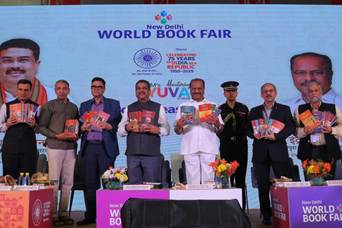
Dharmendra Pradhan launches 41 books under PM YUVA 2.0 at NDWBF 2025

| Published on:

Union Minister for Education, Shri Dharmendra Pradhan, launched 41 new books under the PM YUVA 2.0 scheme at the New Delhi World Book Fair 2025 today. The Governor of Tripura, Shri Indrasena Reddy Nallu, graced the event as the guest of honour.

Image

While addressing the gathering, Shri Dharmendra Pradhan congratulated the 41 young authors whose books were unveiled. Expressing confidence in their potential, he stated that their writings and creativity would enrich the literary landscape and provide a new direction to intellectual discourse.

The Minister expressed his gratitude to Prime Minister Shri Narendra Modi for conceptualizing the PM YUVA Scheme, highlighting its transformation into a national movement. He emphasized its significant impact on mentoring and nurturing budding authors, fostering proud ambassadors of Indian culture, heritage, history, languages, and literature, and bringing to light the stories of unsung heroes of the freedom struggle.

Image

Shri Pradhan further underscored that promoting books in Indian languages across the country is a national mission. He described initiatives like PM YUVA as groundbreaking steps in this direction. He also emphasized that the recently announced ‘Bharatiya Bhasha Pustak Scheme’ in this year’s budget would add momentum to this national endeavour.

Acknowledging the pivotal role of the National Book Trust (NBT) in making books and literature accessible in Indian languages, he urged the institution to embrace technology and collaborate with domestic and international publishers to take India’s rich literary heritage and linguistic traditions to a global audience.

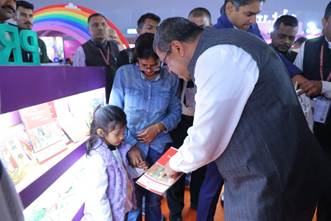
The Minister also visited the Exhibition Halls and congratulated NBT for organizing one of the world’s largest book fairs. Calling it a “Gyan-Kumbh” of literature, languages, knowledge, people, and cultures, he described the fair as a reader’s paradise—an ideal platform to discover new books, immerse in literature, meet authors, and connect with fellow book lovers.

Additionally, Shri Pradhan released the Hindi version of The Saga of Kudopali: The Unsung Story of 1857. He announced that the book would soon be available in 12 Indian and two foreign languages, ensuring a wider reach and deeper impact. He also released Sangama Madhavante Randu Krithikal, the Malayalam translation of the works of 14th-century mathematician and astronomer Sri Madhava.

The event was attended by Dr. Vineet Joshi, Secretary, Department of Higher Education, Ministry of Education; Shri Sanjay Kumar, Secretary, Department of School Education and Literacy; Prof. Milind Sudhakar Marathe, Chairman, NBT; Prof. M. Jagdeesh Kumar, Chairperson, UGC; and Shri Yuvraj Malik, Director, NBT.

PM’s reply to the Motion of Thanks on the President’s Address in Rajya Sabha

| Published on:

The Prime Minister, Shri Narendra Modi replied to the Motion of Thanks on the President’s Address to Parliament in the Rajya Sabha today. Addressing the House, the Prime Minister remarked that the President’s address covered India’s achievements, global expectations from India, and the confidence of the common man in building a developed India. He remarked that the President’s speech was inspiring, impactful, and provided guidance for future work. He expressed his gratitude to the President for the address.

Shri Modi said that over 70 honorable MPs have enriched the motion of thanks with their valuable thoughts. He noted that discussions took place from both sides, with everyone explaining the President’s address based on their understanding. The Prime Minister mentioned that a lot has been said about Sabka Saath, Sabka Vikas, and he found it difficult to understand the complexities involved. He emphasized that Sabka Saath, Sabka Vikas is our collective responsibility, and that’s why the country has given them the opportunity to serve.

Thanking the people of India for giving them the opportunity to serve them continuously since 2014, Shri Modi said this was a testimony to our model of development which has been tested, understood and supported by the people. He added the phrase ‘Nation First’ signified their model of development and this was exemplified in the policies, schemes and actions of the Government.  Noting that there was a need of alternate model of governance and administration after a long hiatus of 5 – 6 decades after independence, Shri Modi said that country has received an opportunity to witness a new model of development, since 2014, based on satisfaction (Santushtikaran) over appeasement (Tushtikaran).

“It has been our earnest effort to ensure optimum utilization of the resources in India”, said the Prime Minister. He added that to ensure that the time of India was also not wasted but utilized for the development of the nation and the welfare of the people. Therefore, he added, “We have adopted the Saturation Approach”. He remarked that the motive behind the approach was to ensure 100% benefits to the true beneficiaries of the scheme. Highlighting that the true spirit of “Sabka Saath, Sabka Vishwas” has been implemented on the ground in the past decade, Shri Modi said that it is now evident as the efforts have led to the fruition in the form of development and progress. “Sabka Saath, Sabka Vishwas is the main mantra of our Governance”, he added. The Prime Minister emphasized that the Government had shown its commitment by strengthening the SC, ST Act which would empower the poor and the tribals by enhancing their respect and security.

Lamenting that there is a lot of effort being made in today’s time to spread the poison of casteism, the Prime Minister reminded that  for the past three decades, OBC MPs from various parties of both houses have been demanding constitutional status for the OBC Commission. He added that it was their Government that granted constitutional status to the OBC Commission. He highlighted that the respect and honour of the Backward Classes was also important for their Government as they worship 140 crore Indians.

Remarking that whenever the topic of reservation has arisen in the country, efforts to solve the problem in a robust manner have not been undertaken, Shri Modi highlighted that in every instance, methods to divide the country, create tension, and foster enmity against each other were adopted. He emphasized that similar approaches were used even after the country attained independence. The Prime Minister highlighted that for the first time, his government presented a model inspired by the mantra of Sabka Saath, Sabka Vikas, providing nearly 10% reservation for the economically weaker sections without any tension or deprivation. He stated that this decision was welcomed by the SC, ST, and OBC communities, with no one expressing any discomfort. The Prime Minister noted that the implementation method, based on the principle of Sabka Saath, Sabka Vikas, was carried out in a healthy and peaceful manner, leading to nationwide acceptance of the decision.

Highlighting that Divyangs or specially-abled individuals in the country have not received the attention they deserve, the Prime Minister highlighted that under the mantra of Sabka Saath, Sabka Vikas, his Government has extended reservation for the differently-abled and worked in mission mode to provide facilities for them. He mentioned that numerous welfare schemes have been created and implemented for the benefit of specially-abled individuals. Furthermore, Shri Modi emphasized the efforts made for the legal rights of the transgender community, highlighting the commitment to ensuring their rights through robust legal measures. He remarked that the Government’s approach to Sabka Saath, Sabka Vikas is demonstrated through their compassionate consideration towards marginalized sections of society.

“India’s progress is powered by Nari Shakti”, exclaimed Shri Modi. He highlighted that if women are given opportunities and become part of policy-making, it can accelerate the country’s progress. He remarked that this is why the Government’s first decision in the new Parliament was dedicated to the honor of Nari Shakti. Shri Modi pointed out that the new Parliament will be remembered not just for its appearance but for its first decision, which was a tribute to the Nari Shakti. He stated that the new Parliament could have been inaugurated differently for the sake of praise, but instead, it was dedicated to the honor of women. He highlighted that the Parliament has commenced its work with the blessings of Nari Shakti.

Remarking that Dr. Babasaheb Ambedkar was never considered worthy of the Bharat Ratna by the previous Governments, Shri Modi highlighted that despite this, the people of the country have always respected Dr. Ambedkar’s spirit and ideals. He emphasized that due to this respect from all sections of society, everyone from all parties are now compelled to say “Jai Bhim,” albeit reluctantly.

Shri Modi said that Dr. Babasaheb Ambedkar deeply understood the fundamental challenges faced by the SC and ST communities, having personally experienced the pain and suffering. He highlighted that Dr. Ambedkar presented a clear roadmap for the economic upliftment of these communities. Reading a quote from Dr. Ambedkar, stating that “While India is an agrarian country, agriculture cannot be the main livelihood for Dalits”, the Prime Minister noted that Dr. Ambedkar identified two reasons: first, the inability to purchase land, and second, even with money, there were no opportunities to buy land. He emphasized that Dr. Ambedkar advocated for industrialization as a solution to this injustice faced by Dalits, tribals, and marginalized groups. He highlighted that Dr. Ambedkar believed in promoting skill-based jobs and entrepreneurship for economic self-reliance. He mentioned that the vision of Dr. Ambedkar was not considered and completely dismissed for many decades after independence. He emphasized that Dr. Ambedkar aimed to eliminate the economic hardships of the SC and ST communities.

Pointing out that in 2014, his Government prioritized skill development, financial inclusion, and industrial growth, the Prime Minister highlighted the introduction of the PM Vishwakarma Yojana, aimed at traditional artisans and craftsmen like blacksmiths and potters, who are essential to society’s foundation and scattered across villages. He emphasized that for the first time, there was concern for this section of society, providing them with training, technological upgrades, new tools, design assistance, financial support, and market access. He remarked that his government launched a special campaign to focus on this neglected group, acknowledging their significant role in shaping society.

“Our Government introduced the MUDRA scheme to invite and encourage first-time entrepreneurs”, said Shri Modi and highlighted the large-scale campaign of providing loans without guarantees to help a significant section of society achieve their dreams of Atmanirbharta (self-reliance), which has seen great success. He also mentioned the Stand Up India scheme, aimed at providing loans of up to ₹1 (one) crore without guarantees to SC, ST, and women from any community, to support their enterprises. He noted that this year, the budget for this scheme has been doubled. The Prime Minister observed that millions of young people from marginalized communities and many women have started their businesses under the MUDRA scheme, not only securing employment for themselves but also creating jobs for others. He highlighted the empowerment of every artisan and every community, fulfilling Dr. Babasaheb Ambedkar’s dream through the MUDRA scheme.

Emphasising his commitment to the welfare of the poor and marginalized, stating that those who were ignored are now being prioritized, Shri Modi highlighted that the current budget has touched upon various small sectors such as the leather and footwear industries, benefiting the poor and marginalized communities. Citing an example, the Prime Minister mentioned the toy industry, noting that many people from marginalized communities are involved in toy making. The Government has focused on this sector, providing various forms of assistance to poor families. The result is a significant increase in toy exports, which have tripled, benefiting the underprivileged communities that rely on this industry for their livelihood.

Highlighting the significant contribution of the fishing community in India, the Prime Minister remarked that the Government has established a separate ministry for fishermen and extended the benefits of the Kisan Credit Card to them. He noted that around ₹40,000 crore have been included in the fisheries sector. He emphasized that these efforts have doubled fish production and exports, directly benefiting the fishing community. The Prime Minister reiterated the Government’s priority to work for the welfare of the most neglected sections of society.

Remarking that there are new efforts to spread the poison of casteism, which affects our tribal communities in various levels, the Prime Minister highlighted that some groups have very small populations, spread across 200-300 places in the country, and are highly neglected. He expressed gratitude for the guidance from the President, who has close knowledge of these communities. Shri Modi noted that special efforts have been made to include these particularly vulnerable tribal groups in specific schemes. He mentioned the introduction of the PM Janman Yojana, with an allocation of ₹24,000 crore, to provide facilities and welfare measures for these communities. The goal is to elevate them to the level of other tribal communities and eventually bring them on par with the entire society.

“Our Government has also focused on different regions of the country that face significant backwardness, such as border villages”, said Shri Modi. He highlighted the psychological shift brought about by the Government, ensuring that border villagers are prioritized. He emphasized that these villages, where the first and last rays of the sun touch, have been given special status as “first villages” with specific development plans. The Prime Minister noted that ministers were sent to remote villages to stay for 24 hours, even in extreme conditions like minus 15 degrees, to understand and address the villagers’ problems. He mentioned that village leaders from these border areas are invited as guests on national celebrations like Independence Day and Republic Day. He stressed on the Government’s commitment to Sabka Saath, Sabka Vikas and the ongoing efforts to reach every neglected community. Shri Modi highlighted the importance and utility of the Vibrant Villages program for the nation’s security, emphasizing the government’s continued focus on it.

The Prime Minister noted that the President in her address, on the occasion of 75 years of the Republic, urged everyone to take inspiration from the constitution makers. He expressed satisfaction that the Government is moving forward with respect and inspiration from the sentiments of the constitution makers. Addressing the topic of the Uniform Civil Code (UCC), Shri Modi remarked that those who read the debates of the Constituent Assembly would understand the efforts to bring forth those sentiments. He acknowledged that some might have political objections, but the Government is committed to fulfilling this vision with courage and dedication.

Emphasizing the importance of respecting the constitution makers and drawing inspiration from their words, the Prime Minister expressed regret that the sentiments of the constitution makers were disregarded immediately after independence. He highlighted that an interim arrangement, which was not an elected government, made amendments to the constitution without waiting for an elected Government to do so. He remarked that the freedom of speech was curbed and restrictions were imposed on the press while claiming to uphold democracy, by the then Government. He stated that this was a complete disregard for the spirit of the constitution.

Shri Modi highlighted that during the tenure of the first government of independent India, led by Prime Minister Jawaharlal Nehru, there were instances of suppression of freedom of speech. He mentioned that during a workers’ strike in Mumbai, renowned poet Shri Majrooh Sultanpuri sang a poem criticizing the Commonwealth, which led to his imprisonment. He also pointed out that famous actor Shri Balraj Sahni was jailed merely for participating in a protest march.  He further highlighted that Lata Mangeshkar’s brother, Shri Hridaynath Mangeshkar, faced repercussions for planning to present a poem by Veer Savarkar on All India Radio. He remarked that merely for this reason, Hridaynath Mangeshkar was permanently dismissed from All India Radio.

Touching upon the experiences in the country during the period of Emergency, during which the constitution was crushed and its spirit trampled upon for the sake of power, Shri Modi emphasized that the nation remembers this. He highlighted that during the Emergency, the renowned senior actor Shri Dev Anand was requested to publicly support the Emergency. Shri Dev Anand showed courage and refused to support it, leading to a ban on all his films on Doordarshan. The Prime Minister criticized those who talk about the constitution but have kept it in their pockets for years, showing no respect for it. He highlighted that Shri Kishore Kumar refused to sing for the then ruling party and as a consequence, all of his songs were banned on All India Radio.

Remarking that he cannot forget the days of the Emergency, the Prime Minister emphasized that those who talk about democracy and human dignity are the same people who, during the Emergency, handcuffed and chained great personalities of the country, including Shri George Fernandes. He highlighted that even members of Parliament and national leaders were bound in chains and handcuffs during this period. He stated that the word “constitution” does not suit them.

Shri Modi remarked that, for the sake of power and the arrogance of a royal family, millions of families in the country were devastated, and the nation was turned into a prison. He emphasized that a long struggle ensued, forcing those who considered themselves invincible to bow down to the people’s strength. The Prime Minister noted that the Emergency was lifted due to the democratic spirit embedded in the veins of the Indian people. Remarking that he holds senior leaders in high regard and respects their long public services, the Prime Minister noted the achievements of leaders like Shri Mallikarjun Kharge and former Prime Minister Shri Deve Gowda.

Highlighting that the empowerment of the poor and their upliftment has never been as extensive as it has been during his Government’s tenure, Shri Modi remarked that the Government has designed schemes aimed at empowering the poor and enabling them to overcome poverty. He expressed his faith in the potential of the country’s poor, stating that given the opportunity, they can overcome any challenge. He emphasized that the poor have demonstrated their capability by taking advantage of these schemes and opportunities. “Through empowerment, 25 crore people have successfully risen out of poverty, which is a matter of pride for the Government”, he added. The Prime Minister noted that those who have emerged from poverty have done so through hard work, trust in the Government, and leveraging the schemes and today, they have formed a neo-middle class in the country.

Emphasising the Government’s strong commitment to the neo-middle class and middle class, the Prime Minister remarked that their aspirations are a driving force for the country’s progress, providing new energy and a solid foundation for national development. He highlighted efforts to enhance the capabilities of the middle class & neo-middle class. He noted that a significant portion of the middle class has been exempted from taxes in the current budget. In 2013, the income tax exemption limit was up to ₹2 lakh, but it has now been increased to ₹12 lakh. The Prime Minister mentioned that individuals over 70 years of age, from any class or community, are benefiting from the Ayushman Bharat scheme, with significant advantages for the elderly in the middle class.

“We have built four crore houses for citizens, with over one crore houses constructed in cities”, said Shri Modi. He remarked that there used to be significant fraud affecting home buyers, making it essential to provide protection. He emphasized that the enactment of the Real Estate (Regulation and Development) (RERA) Act in this Parliament has become a crucial tool in overcoming obstacles to the dream of home ownership for the middle class. The Prime Minister noted that the current budget includes the SWAMIH initiative, which allocates ₹15,000 crore to complete stalled housing projects, where the middle class’s money and facilities were stuck. He highlighted that this initiative aims to fulfill the dreams of the middle class.

Pointing to the startup revolution, which has gained global recognition, the Prime Minister said that these startups are primarily driven by young people from the middle class. He remarked that the world is increasingly attracted to India, especially due to the G20 meetings held in 50-60 locations across the country. He emphasized that this has revealed the vastness of India beyond Delhi, Mumbai, and Bengaluru. He pointed out that the growing global interest in Indian tourism brings numerous business opportunities, greatly benefiting the middle class by providing various income sources.

“The middle class today is filled with confidence, which is unprecedented and greatly strengthens the nation”, said Shri Modi. He expressed his firm belief that the Indian middle class is determined and fully prepared to realize the vision of a developed India, standing strong and moving forward together.

Highlighting that the youth play a crucial role in building a developed India, the Prime Minister emphasized the demographic dividend, noting that students currently in schools and colleges will be the primary beneficiaries of a developed nation. He remarked that as the youth age, the country’s development journey will progress, making them a significant foundation for a developed India. He underscored that, over the past decade, strategic efforts have been made to strengthen the youth base in schools and colleges. He pointed out that for the past 30 years, there was little thought given to 21st-century education, and the previous attitude was to let things continue as they were. Shri Modi highlighted that the new National Education Policy (NEP) was introduced after almost three decades to address these issues. He mentioned that various initiatives under this policy, including the establishment of PM Shri Schools, aim to revolutionize education. He noted that approximately 10,000 to 12,000 PM Shri Schools have already been established, with plans to create more in the future. He also emphasized an important decision regarding the changes in the education policy which now includes provisions for education and examinations to be conducted in the mother tongue. Underlining the lingering colonial mindset regarding language in India, he stressed the injustice faced by children from poor, Dalit, tribal, and marginalized communities due to language barriers. The Prime Minister remarked on the necessity of education in one’s mother tongue, enabling students to pursue careers as doctors and engineers irrespective of their proficiency in English. He emphasized the significant reforms undertaken to ensure that children from all backgrounds can dream of becoming doctors and engineers. Furthermore, the Prime Minister underscored the expansion of Eklavya Model Residential Schools for tribal youth, noting the increase from around 150 schools a decade ago to 470 schools today, with plans to establish over 200 more.

Further elaborating on the education reforms, Shri Modi said major reforms in Sainik Schools, introducing provisions for girls’ admission were undertaken. Emphasizing the importance and capability of these schools, he highlighted that hundreds of girls are currently studying in this patriotic environment, naturally fostering a sense of devotion to the country.

Highlighting the significant role of the National Cadet Corps (NCC) in youth grooming, the Prime Minister remarked that those who have been associated with NCC know that it provides a golden opportunity for comprehensive development and exposure at a crucial age. He emphasized the unprecedented expansion of NCC in recent years, noting that the number of cadets has increased from approximately 14 lakh in 2014 to over 20 lakh today.

Emphasising the enthusiasm and eagerness of the country’s youth to achieve something new, even beyond routine tasks, Shri Modi remarked on the Swachh Bharat Abhiyan, observing that youth groups in many cities continue to advance the cleanliness campaign with their self-motivation. He noted that some young individuals work towards education in slums and various other initiatives. Seeing this, the Prime Minister highlighted the need to provide organized opportunities for the youth, leading to the launch of the “MY Bharat” or Mera Yuva Bharat movement. Today, over 1.5 crore youths have registered and are actively participating in discussions on contemporary issues, raising awareness in society, and pursuing positive actions with their own capabilities, without the need for spoon-feeding, he added.

Touching upon the importance of sports in fostering sportsmanship and how a nation’s spirit flourishes where sports are widespread, the Prime Minister remarked that numerous initiatives have been launched to support sports talent, including unprecedented financial support and infrastructure development. He highlighted the transformative power of the Target Olympic Podium Scheme (TOPS) and the Khelo India initiative on the sports ecosystem. He added that over the past decade, Indian athletes have showcased their prowess in various sports events, with India’s youth, including young women, demonstrating the country’s strength on the global stage.

Prime Minister emphasized the significance of infrastructure in transforming a developing nation into a developed one. He highlighted that both welfare schemes and infrastructure are crucial for a country’s growth, and underscored the need for timely completion of infrastructure projects. He noted that delays lead to wastage of taxpayers’ money and deprive the nation of benefits. Criticising the previous dispensations for its culture of delays and political interference in project execution, Shri Modi mentioned the establishment of the PRAGATI platform, which he personally reviews, for detailed monitoring of infrastructure projects, including real-time videography using drones and live interaction with stakeholders. He stated that projects worth approximately ₹19 lakh Crore were stalled due to coordination issues between the state and central governments or different departments. He highlighted a study by Oxford University that praised PRAGATI and suggested other developing countries could benefit from its experiences. Citing an example from Uttar Pradesh to illustrate past inefficiencies, the Prime Minister mentioned the Saryu Canal Project, approved in 1972, which remained stalled for five decades until it was completed in 2021. Highlighting the completion of the Udhampur-Srinagar-Baramulla railway line in Jammu and Kashmir, the Prime Minister remarked that the project was approved in 1994 but remained stalled for decades. Finally, after three decades, it was completed in 2025, he added. Shri Narendra Modi highlighted the completion of the Haridaspur-Paradip railway line in Odisha. He remarked that the project was approved in 1996 but remained stalled for years which was finally completed in 2019 during the current administration’s tenure. Elaborating further, the Prime Minister highlighted the completion of the Bogibeel Bridge in Assam, approved in 1998 and completed by his Government in 2018. He remarked that he could provide hundreds of examples illustrating the detrimental culture of delays prevalent in the past. He emphasized the need for a change in culture to ensure the timely completion of such vital projects and said that the significant setbacks caused by this culture during the previous dispensation, depriving the nation of its rightful progress. Underscoring the importance of proper planning and timely execution of infrastructure projects, the Prime Minister said to address this, the PM Gati Shakti National Master Plan was introduced. He encouraged states to utilize the PM Gati Shakti platform, which includes 1,600 data layers, to streamline decision-making and accelerate project implementation. The platform has become a vital foundation for expediting infrastructure work in the country, he added.

Emphasising the necessity for today’s youth to understand the hardships their parents faced and the reasons behind the nation’s past condition, the Prime Minister remarked that without proactive decisions and actions over the past decade, the benefits of Digital India would have taken years to materialize. He highlighted that proactive decision-making and actions have enabled India to be timely and, in some cases, ahead of time. He further noted that 5G technology is now more widely available in India at one of the fastest rates globally.

Shri Modi drew attention to past experiences, highlighting that technologies such as computers, mobile phones, and ATMs reached many countries well before India, often taking decades to arrive. He remarked that even in the health sector, vaccines for diseases like smallpox and BCG were available globally while India lagged due to systemic inefficiencies.  The Prime Minister attributed these delays to poor governance of the past, where critical knowledge and implementation were tightly controlled, resulting in a “license permit raj” that stifled progress. He emphasized to the youth the oppressive nature of this system, hindering the nation’s development.

Remarking on the early days of computer imports, highlighting that obtaining a license to import computers was a lengthy process that took years, the Prime Minister noted that this requirement significantly delayed the adoption of new technology in India.

Pointing to the bureaucratic challenges of the past, the Prime Minister said that even obtaining cement for house construction required permission and during weddings, even getting sugar for tea required a license. He emphasized that these challenges occurred in post-independence India and pointed that the youth of today can understand the implications, questioning who was responsible for the bribes and where the money went.

Highlighting the bureaucratic hurdles of the past, noting that purchasing a scooter required booking and payment, followed by a wait of 8-10 years, the Prime Minister remarked that even selling a scooter needed government permission. He emphasized the inefficiency in obtaining essential items, such as gas cylinders, which were distributed through coupons to MPs, and the long queues for gas connections. He noted the lengthy process for obtaining a telephone connection, stressing that today’s youth should be aware of these challenges. He remarked that those delivering grand speeches today should reflect on their past governance and its impact on the nation.

“The restrictive policies and license raj that pushed India into one of the slowest economic growth rates globally”, said Shri Modi. He remarked that this weak growth rate came to be known as the “Hindu rate of growth,” which was an insult to a large community. He emphasized that the failure was due to the incompetence, lack of understanding, and corruption of those in power, which led to the mislabeling of an entire society as responsible for the slow growth.

Criticizing the economic mismanagement and flawed policies of the past, which led to blaming and tarnishing an entire society, the Prime Minister remarked that historically, India’s culture and policies did not include restrictive license raj while Indians believed in openness and were among the first to engage in free trade globally. Shri Modi highlighted that Indian merchants traveled to distant lands for trade without any restrictions, which was part of India’s natural culture. He noted that the current global recognition of India’s economic potential and rapid growth brings pride to every Indian. “India is now seen as one of the fastest-growing countries, and the nation’s economy is expanding significantly”, he emphasised.

Underlining that the nation is now breathing easy and soaring high after breaking free from the clutches of restrictive license raj and flawed policies, the Prime Minister remarked on the promotion of the “Make in India” initiative, aimed at boosting manufacturing in the country. He mentioned the introduction of the Production Linked Incentive (PLI) scheme and reforms related to Foreign Direct Investment (FDI). He emphasized that India has become the world’s second-largest mobile phone producer, transitioning from being predominantly an importer to an exporter of mobile phones.

Emphasising India’s achievements in defense manufacturing, noting that defense product exports have increased tenfold over the past decade, the Prime Minister also highlighted the tenfold increase in solar module manufacturing. He stated “India is now the world’s second-largest steel producer” while machinery and electronic exports have seen rapid growth over the past decade. He also noted that toy exports have more than tripled, and agrochemical exports have increased significantly. “During the COVID-19 pandemic, India supplied vaccines and medicines to over 150 countries under the “Made in India” initiative”, said Shri Modi. He highlighted the rapid growth in exports of AYUSH and herbal products as well.

Remarking on the lack of efforts by the previous Government to promote Khadi, stating that even the movement started during the freedom struggle was not advanced, the Prime Minister highlighted that the turnover of Khadi and Village Industries has surpassed ₹1.5 lakh Crore for the first time. He noted that production has quadrupled in the last decade, significantly benefiting the MSME sector and creating numerous employment opportunities across the country.

Underscoring that all elected representatives are servants of the people, Shri Modi remarked that the mission of the country and society is paramount for public representatives, and it is their duty to work with a spirit of service.

Stressing on the collective responsibility of all Indians to embrace the vision of a developed India, the Prime Minister remarked that this is not just the resolve of a government or an individual but the commitment of 140 crore citizens. He warned that those who remain indifferent to this mission will be left behind by the nation. He highlighted the unwavering determination of India’s middle class and youth to propel the country forward.

Underlining the importance of everyone’s role in the nation’s progress as it reaches new heights of development, Shri Modi remarked that opposition in Government is natural and essential in a democracy, as is opposition to policies. However, he warned that extreme negativism and attempts to diminish others instead of enhancing one’s own contributions could hinder the development of India. He stressed the need to free ourselves from such negativity and engage in continuous self-reflection and introspection. He expressed confidence that the discussions in the House would yield valuable insights that will be taken forward. He concluded by acknowledging the continuous inspiration derived from the President’s address and expressed heartfelt gratitude to the President and all honorable Members of Parliament.

‘Pariksha Pe Charcha’ is back and that too in a fresh and livelier format!: PM

| Published on:

Urging all Exam Warriors, their parents and teachers to watch the Pariksha Pe Charcha 2025, the Prime Minister Shri Narendra Modi in a post on X wrote,:

‘Pariksha Pe Charcha’ is back and that too in a fresh and livelier format!

Urging all #ExamWarriors, their parents and teachers to watch #PPC2025, consisting of 8 very interesting episodes covering different aspects of stress free exams!”

Raksha Mantri holds telecon with new US Secretary of Defense

| Published on:

Raksha Mantri Shri Rajnath Singh, on February 06, 2025, congratulated Mr Pete Hegseth, in their first telephonic conversation after his confirmation as the US Secretary of Defense. The two Ministers reviewed the extensive India-US defence cooperation activities covering multiple domains in land, air, maritime and space. They appreciated the ongoing and remarkable expansion of the bilateral defence partnership, and reaffirmed their commitment to deepen the ties.

In particular, the two Ministers decided to work together on technology cooperation, integration of defence industrial supply chains, enhanced interoperability, logistics & information sharing and joint military exercises. They also agreed to provide enhanced support to the growing defence innovation collaboration between the governments, start-ups, businesses and academic institutions. India and US agreed to work together to draft a comprehensive framework on defence cooperation, aimed at structuring the bilateral collaboration for the period 2025-2035.

Acharya Vidyasagar Ji’s life was dedicated to religion, culture and to the nation: Amit Shah

| Published on:

Union Home Minister and Minister of Cooperation, Shri Amit Shah addressed the first Samadhi Smriti Mahotsav of Shri Vidyasagar Ji Maharaj at Rajnandgaon, Chhattisgarh. Shri Shah also participated in Shri 1008 Siddhachakra Vidhan Vishwa Shanti Mahayagya. During the event, Union Home Minister Shri Amit Shah released a commemorative coin of ₹100, a special postal envelope of ₹5, 108 footprints and portrait of Acharya Shri Vidyasagar Ji and laid the foundation stone of the proposed Samadhi Smarak ‘Vidyayatan’. Chief Minister of Chhattisgarh Shri Vishnu Deo Sai, Deputy Chief Minister Shri Vijay Sharma and Pujya Muni Shri Samta Sagar Ji Maharaj were present on the occasion, among other dignitaries.

In his address, Shri Amit Shah said that Acharya Shri Vidyasagar Ji Maharaj was not just a saint or a ‘Jainacharya’, but a visionary who ushered in a new ideology and a new era. He said that Acharya Guruvar Shri Vidyasagar Ji Maharaj, who was born in Karnataka, propagated Indian culture, Indian languages, Indian identity and the country as a whole like a ‘Jyotirdhar’ through his deeds. Shri Shah said that it is very rare for a religious saint to have worked towards propagation of the national identity along with interpretation of the religion across the world. Shri Amit Shah said, Acharya Vidyasagar Ji’s life was dedicated to religion, culture and to the nation.

Union Home Minister and Minister of Cooperation Shri Amit Shah said that he had the privileged of meeting Acharya Shri Vidyasagar Ji many times. He said that Acharya Ji always emphasized on promotion and preservation of Indian languages, spread of India’s glory and identity globally, and that our nation should be preferably called ‘Bharat’ instead of ‘India’.

Shri Amit Shah said that by writing ‘Prime Minister of Bharat’ on the invitation card of the G-20 Summit, Modi ji the ideas of Vidyasagar Ji into action. He said that Prime Minister Shri Narendra Modi rendered Acharya Ji’s vision without any political motive and followed his message in practice.

Union Home Minister said that Acharya Ji did not leave the path of austerity till the last breath of his life. Shri Shah said that Acharya Ji showed the path of salvation not only to Jain follower but also to the non-Jain followers with his spiritual energy.

Shri Amit Shah said that there are many people, who say that every moment of life should be dedicated to religion, nation and society, but people who live their whole life like this are rarely seen and Acharya Ji’s life was a true embodiment of this dedication. He said Acharya Ji interpreted the principle of “Ahimsa Paramo Dharma” in a way that was time-appropriate and established it globally. He also mentioned that Acharya Vidyasagar Ji Maharaj ensured that his disciples lived their lives in accordance with the principles of Jainism.

Union Home Minister and Minister of Cooperation Shri Amit Shah said that under the leadership of Prime Minister Shri Narendra Modi, India is propagating the principles of ‘Vasudhaiva Kutumbakam’ and ‘Ahimsa Parmo Dharma’. He said he was grateful to PM Modi for giving approval to the commemorative coin and the special envelope. He said that this tribute to Acharya Ji is a tribute to the saint tradition. He said that Acharya Ji’s proposed Samadhi Smarak ‘Vidyayatan’ will remain a place of propagation of Acharya Ji’s principles, messages and teachings for ages. Shri Shah said that the name of the samadhi of the saint who spent his entire life in the worship of ‘Vidya’ (knowledge) cannot be anything other than ‘Vidyayatan’.

Shri Amit Shah said that, on the occasion, foundation stone of a girl’s school where education is imparted free of cost, has also been laid in the Dindori district of Madhya Pradesh. He mentioned that this school would incorporate both skill development and employment opportunities, with teaching conducted in the mother tongue. He also stated that the inauguration of Acharya Ji’s 108 footprints took place, which would serve as a symbol of a life dedicated to renunciation, penance, and discipline.

Union Home Minister said that India’s saint tradition is very rich. He said that whenever the nation needed a particular role to be fulfilled, saints rose to the occasion.  He said that saints created knowledge, tied the country in the thread of unity and before independence, the saints kept the flame of national consciousness burning through ‘Bhakti’. He said that when the governance and the country started getting influenced by Western ideas after independence, Vidyasagar Ji Maharaj was the only Acharya who remained firmly connected to Bharat, Indian identity, and Indian culture.

Shri Amit Shah said that Jain saints have made their significant contribution in uniting the entire country. He said that from Hastinapur in Uttar Pradesh to Shravanabelagola in Karnataka, from Rajgir in Bihar to Girnar in Gujarat, he walked everywhere and spread his message. He said that Acharya Ji taught us that our identity is rooted in our culture.

Union Home Minister said that Acharya Vidyasagar Ji Maharaj wrote a Hindi epic called ‘Mookmati’, on which many people have done research and written essays. Following Acharya Ji’s message of preservation and promotion of all Indian languages, his followers have translated ‘Mookamati’ into many languages. He said that religion, philosophy, ethics and spirituality have been explained in great depth in ‘Mookamati’ and it also has a description of the transience of the body and a message of love for the nation.

Shri Amit Shah said that Acharya Vidyasagar Ji Maharaj believed that the linguistic diversity of our country is our true strength. He said that a country with many languages, scripts and dialects and different types of grammars and ballads is considered to be culturally rich.

Union Home Minister Shri Amit Shah said that there existed a very cordial relation between Modi ji and Acharya ji. He said that Acharya Ji’s teachings, works, writings and discourses are not only the heritage of Jain followers but of the entire country.

Blessed to be at the Maha Kumbh in Prayagraj: PM

| Published on:

The Prime Minister Shri Narendra Modi visited the Maha Kumbh in Prayagraj and took a holy dip in the Sangam today.

In separate posts on X, he wrote:

“Blessed to be at the Maha Kumbh in Prayagraj. The Snan at the Sangam is a moment of divine connection, and like the crores of others who have taken part in it, I was also filled with a spirit of devotion.

May Maa Ganga bless all with peace, wisdom, good health and harmony.”

“प्रयागराज महाकुंभ में आज पवित्र संगम में स्नान के बाद पूजा-अर्चना का परम सौभाग्य मिला। मां गंगा का आशीर्वाद पाकर मन को असीम शांति और संतोष मिला है। उनसे समस्त देशवासियों की सुख-समृद्धि, आरोग्य और कल्याण की कामना की। हर-हर गंगे!”

“प्रयागराज के दिव्य-भव्य महाकुंभ में आस्था, भक्ति और अध्यात्म का संगम हर किसी को अभिभूत कर रहा है।”

Union Home Minister chairs a high-level review meeting on the security situation in J&K in New Delhi

| Published on:

Union Home Minister and Minister of Cooperation, Shri Amit Shah chaired a high-level review meeting on the security situation in Jammu and Kashmir in New Delhi today. The meeting was attended by the Lieutenant Governor of Jammu and Kashmir, Shri Manoj Sinha, the Union Home Secretary, the Director of the Intelligence Bureau, the Chief Secretary and the Director General of Police of Jammu and Kashmir, along with senior officials of the Ministry of Home Affairs and the Jammu and Kashmir administration. Union Home Minister, Shri Amit Shah, yesterday also held an important review meeting on the security situation in Jammu and Kashmir, which was attended by the Chief of the Army Staff, General Upendra Dwivedi, the Home Secretary and other senior officers of MHA and Army.

Addressing the meeting, Union Home Minister and Minister of Cooperation said that the government under the leadership of Prime Minister Shri Narendra Modi is committed to completely wipe out terrorism from Jammu and Kashmir. He said that due to the sustained and coordinated efforts of the Modi government, the terrorism ecosystem in Jammu and Kashmir has been significantly weakened. The Home Minister directed all security agencies to step up the fight against terrorism by aiming for the ‘zero infiltration’ goal. He asked all security agencies to take more stringent action on infiltration and acts of terror with a ruthless approach. He said that it should be our goal to uproot the existence of terrorists.

Shri Amit Shah said that the narco network is providing support to infiltrators and terrorists to carry out their activities. He said that there is a need to take prompt action against terror funding from the proceeds of the narcotics trade with alacrity and rigour.

Shri Amit Shah directed the agencies to make new appointments in the posts of Forensic Science Laboratory (FSL) in view of the timely implementation of the new criminal laws.

Shri Amit Shah emphasised the Modi government’s ‘policy of zero tolerance’ against terrorism to achieve the goal of a terrorism-free Jammu and Kashmir. He directed all security agencies to remain vigilant and continue to work in synergy to eliminate terrorism in Jammu and Kashmir.

Union Home Minister appreciated the efforts of the security agencies for significant improvement in all parameters of the security scenario in Jammu and Kashmir.

PM’s reply to the Motion of Thanks on the President’s Address in Lok Sabha

| Published on:

The Prime Minister, Shri Narendra Modi replied to the Motion of Thanks on the President’s Address to Parliament in the Lok Sabha today. Addressing the House, the Prime Minister appreciated the contributions of all honorable MPs who participated in the discussions yesterday and today, noting that the tradition of democracy includes both praise where necessary and some negative remarks where needed, which is natural. Highlighting the great privilege of being given the opportunity by the people to express gratitude for the President’s address for the 14th time, he extended his respectful thanks to the citizens and acknowledged all participants in the discussion for enriching the proposal with their thoughts.

Remarking that as of 2025, a quarter of the 21st century has passed, Shri Modi noted that time will judge the achievements of the post-independence 20th century and the first 25 years of the 21st century. He emphasized that a detailed study of the President’s address reveals that it instills new confidence in the future 25 years and the vision of a developed India. The Prime Minister highlighted that the President’s address strengthens the resolve for a Viksit Bharat, creates new confidence, and inspires the general public.

The Prime Minister highlighted that in the last 10 years, 25 crore people had moved out of poverty, as revealed by many studies. He remarked that this effort was possible due to effective implementation of the schemes with devotion and utmost sensitivity by the Government towards the poor and the needy. He added that when people who are grounded and who know the ground reality, work for the people at the ground level, then change is inevitable and certain  on the ground. “Our Government has not given false slogans to the poor, but true development”, said Shri Modi. He added that his was a Government that has worked for all sections of society by understanding the pain of the poor and aspirations of the middle-class with utmost passion, which was lacking in some people.

Noting that it was truly a despair to live in kachcha houses and huts during the monsoons, the Prime Minister said four crore houses were distributed to the poor till now by the Government. Highlighting the difficulties faced by women to defecate in the open, he added that the Government had built more than 12 crore toilets to alleviate the difficulties of women. Emphasising that the Government was focused on ensuring water in the taps of every house through the Har Ghar Jal scheme, the Prime Minister said that even after 75 years of Independence, around 75% or more than 16 crore houses lacked tap-water connections. He added that the Government had ensured 12 crore families tap water connection in the last 5 years and the work was progressing rapidly. Underlining the details of the work done for the poor in the President’s address, Shri Modi said while identifying a problem was not sufficient but was necessary to work with utmost devotion to ensure that a solution was found. He added that his Government, as seen in their work over the last 10 years as well as the President’s address, worked with devotion to ensure solution to the problems.

Highlighting the previous situation when out of every rupee spent, only 15 paise reaches the intended destination, the Prime Minister underscored that the Government’s model of “Bachat bhi, Vikas bhi”, meaning progress with savings, to ensure that the people’s money is used for the welfare of the people. He added that with the JanDhan-Aadhar-Mobile (JAM) Trinity, the Government started Direct Benefit Transfer (DBT) and deposited around ₹40 lakh Crore  in the bank accounts of the people. Underlining that around 10 crore Ghost beneficiaries were benefiting from the welfare schemes of the Government, the Prime Minister said that during the last 10 years, ghost beneficiaries were eliminated to ensure social justice and the actual beneficiaries were added through various schemes. He added that this had saved around ₹3 lakh crore from reaching the wrong hands. Shri Modi highlighted that the Government had extensively utilized technology in public procurement, bringing in transparency through the GeM (Government e-Marketplace) portal, which is now also being used by state Governments. The procurement made through the GeM portal has been more cost-effective compared to traditional procurement methods, resulting in a savings of ₹1,15,000 crore for the Government.

Shri Modi highlighted that the Swachh Bharat Abhiyan was initially ridiculed, with many treating it as a mistake or a sin. Despite the criticism, he proudly stated that due to these cleanliness efforts, in recent years, the Government has earned ₹2,300 crore by selling scrap from Government offices. The Prime Minister invoked Mahatma Gandhi’s principle of trusteeship, emphasizing that they are trustees of the public’s property and are committed to saving every paisa and using it properly.

Highlighting that the Government made a significant decision on ethanol blending, the Prime Minister acknowledged that India is not energy independent and relies on external sources. He said that the introduction of ethanol blending reduced the expenditure on petrol and diesel, resulting in savings of ₹1 Lakh crore. The Prime Minister emphasized that this amount has directly benefited the farmers, putting nearly ₹1 lakh crore into their pockets.

The Prime Minister remarked that while he talks about savings, newspapers used to be filled with headlines about scams worth lakhs and crores. He noted that it has been ten years since such scams have occurred, highlighting that the absence of these scams has saved the country lakhs of crores of rupees. These savings have been directed towards serving the public.

Emphasising that the various steps taken have resulted in savings of lakhs of crores of rupees, Shri Modi clarified that these funds were not used to build grand palaces but were instead invested in nation-building. He noted that the infrastructure budget was ₹1.8 lakh crore ten years ago before their tenure while today, the infrastructure budget stands at ₹11 lakh crore which the President in her address described how India’s foundation is being strengthened. The Prime Minister highlighted that strong foundations have been laid for development in areas like roads, highways, railways, and rural roads.

“Savings in the Government treasury are essential, as emphasized through the principle of trusteeship. However, it is equally important that common citizens also benefit from such savings”, said the Prime Minister. He highlighted that schemes should be designed to ensure public savings. Citing the Ayushman Bharat scheme, he mentioned that the expenses borne by citizens due to illnesses have significantly reduced. He stated that the Ayushman Bharat scheme has saved approximately ₹1.2 lakh crore for the people. Underscoring the importance of Jan Aushadhi Kendras, Shri Modi noted that for families with elderly members aged 60-70, medical expenses can be substantial and the Jan Aushadhi Kendras, providing an 80% discount on medicines, have helped families save around ₹30,000 crore on medical expenses.

Shri Modi highlighted UNICEF’s estimation that families with proper sanitation and toilets save approximately ₹70,000 annually. He emphasized the significant benefits that initiatives like the Swachh Bharat Abhiyan, toilet construction, and access to clean water have brought to ordinary families.

Emphasizing that the “Nal se Jal” initiative has been praised by the WHO, the Prime Minister remarked that according to the WHO report, access to clean water through the initiative has saved families an average of ₹40,000 annually on medical expenses related to other diseases. He highlighted that there are many such schemes that have helped common citizens save on their expenses.

Highlighting that the distribution of free grain to millions of citizens has resulted in significant savings for families, Shri Modi said the PM Suryagarh free electricity scheme has saved families an average of ₹25,000 to ₹30,000 annually on electricity expenses. Additionally, any excess electricity generated can be sold for income. The Prime Minister emphasized the significant savings for common citizens through various initiatives. He mentioned the LED bulb campaign, noting that before their tenure, LED bulbs were sold for ₹400 each. Due to the campaign, the price dropped to ₹40, resulting in electricity savings and increased illumination. He added that this campaign has saved citizens approximately ₹20,000 crore. The Prime Minister highlighted that farmers who have scientifically utilized the Soil Health Card have benefited significantly, with savings of ₹30,000 per acre.

Touching upon the Income tax, the Prime Minister highlighted that over the past ten years, the Government has reduced income tax rates, thereby increasing savings for the middle class. He highlighted that in 2013-14, only ₹2 lakh was exempted from income tax while today, ₹12 lakh is completely exempt from income tax. The Prime Minister noted that throughout 2014, 2017, 2019, and 2023, the Government has continuously worked on providing relief and with the addition of a standard deduction of ₹75,000, salaried individuals will not have to pay any income tax on earnings up to ₹12.75 lakh from April 1st onwards.

Criticizing the previous dispensations for being disconnected from the ground realities and engaging in lofty talks, the Prime Minister further pointed out that the leaders who spoke about the 21st century were not even able to fulfill the needs of the 20th century. He expressed his pain at realizing that the country is 40-50 years late in accomplishing tasks that should have been completed decades ago. Shri Modi added that since 2014, when the public gave the opportunity to serve, the Government has focused extensively on the youth, emphasizing their aspirations and creating numerous opportunities for them. As a result, the youth are now proudly showcasing their talents and achievements. The Prime Minister highlighted the opening of the space sector, defense sector, and the launch of the Semiconductor Mission. To promote innovation, several new schemes have been introduced, and the Startup India ecosystem has been fully developed. Additionally, he highlighted that a significant decision in the current budget is the income tax exemption on incomes up to ₹12 lakh, which has garnered much attention. Furthermore, the Prime Minister announced the opening of the nuclear energy sector, which will have long-term positive impacts and outcomes for the nation.

Emphasizing the importance of AI, 3D printing, robotics, and virtual reality, and underscoring the efforts in the gaming sector, Shri Modi encouraged the nation’s youth to make India the capital of creative gaming worldwide, noting the rapid progress in this area. The Prime Minister remarked that for him, AI stands for not just Artificial Intelligence but also Aspirational India. He highlighted the initiation of 10,000 Atal Tinkering Labs in schools, where students are astonishing others with their robotics creations. The current budget includes provisions for 50,000 Atal Tinkering Labs. The Prime Minister also noted that India’s AI Mission has generated global optimism, and India’s presence on the world AI platform has become significant.

Underlining that this year’s budget includes investment in the domain of Deep Tech, the Prime Minister emphasized that to progress rapidly in the 21st century, which is entirely technology-driven, it is essential for India to advance quickly in the field of deep tech. He remarked that the Government is continuously working with the future of the youth in mind. However, he criticized certain political parties for deceiving the youth with promises of allowances during elections which they fail to fulfill. He stated that these parties have become a disaster for the future of the youth.

Remarking on the recent developments in Haryana, noting that the promise of providing jobs without any cost or intermediaries was fulfilled immediately upon forming the Government, the Prime Minister highlighted this as a testament to their commitment. He celebrated Haryana’s historic third consecutive victory, marking it as a significant achievement in the state’s history. Similarly, the Prime Minister acknowledged the historic results in Maharashtra, noting the unprecedented number of seats held by the ruling party, attributing this success to the blessings of the people.

The Prime Minister referenced the President’s address, which extensively discussed the completion of 75 years of the Constitution. He emphasized that in addition to the articles of the Constitution, its spirit must be lived and we stand by it. Shri Modi remarked that it is a tradition for the President to outline the Government’s activities of the past year in their address, similar to how Governors present the activities of their respective states in their speeches. He emphasized that the true spirit of the Constitution and democracy was demonstrated when Gujarat celebrated its 50th anniversary, and he was serving as the Chief Minister. He added that during the Golden Jubilee year, he made a significant decision to compile all the speeches given by Governors in the assembly over the past 50 years into a book, which is now available in all libraries. He noted that his administration took pride in publishing these speeches. He underscored their commitment to living by, dedicating themselves to, and understanding the spirit of the Constitution.

The Prime Minister remarked that in 2014, when they came to power, there was no recognized opposition party, as none had secured the required number of seats. Many laws allowed the Government to operate independently, and several committees stipulated the inclusion of the Leader of the Opposition, but there was none. The Prime Minister highlighted that, in adherence to the spirit of the Constitution and the values of democracy, they decided to invite the leader of the largest party in the meetings, despite the absence of a recognized opposition. This demonstrated their commitment to the essence of democracy. Shri Modi remarked that in the past, Prime Ministers would handle files independently. However, his administration has included the Leader of the Opposition in these processes and even enacted laws to ensure their participation. The Prime Minister noted that when the Election Commission is formed, the Leader of the Opposition will be part of the decision-making process, demonstrating their commitment to living by the Constitution.

Highlighting that in Delhi, several places have private museums created by families, Shri Modi noted that when it comes to utilizing public funds, it is important to live by the spirit of democracy and the Constitution. He mentioned the creation of the PM Museum, which showcases the lives and work of all Prime Ministers, from the first to his predecessors. The Prime Minister expressed his desire for the families of the great leaders featured in the PM Museum to visit and suggest additions to enrich the museum further, inspiring the younger generation. He emphasized that living for oneself is common, but living for the Constitution is a higher calling that they are committed to.

“When power is used for service, it leads to nation-building, but when power becomes a legacy, it destroys people”, said the Prime Minister. He emphasized that they adhere to the spirit of the Constitution and do not engage in divisive politics. He highlighted the importance of national unity and recalled the creation of the world’s tallest statue, the Statue of Unity, dedicated to Sardar Vallabhbhai Patel as their commitment to living by the Constitution drives their actions.

Expressing his concern that it is unfortunate that some people are openly using the language of urban Naxals, Shri Modi highlighted that those who speak this language and challenge the Indian State can neither understand the Constitution nor the unity of the country.

Highlighting that for seven decades, Jammu & Kashmir and Ladakh were deprived of constitutional rights, the Prime Minister noted that this was an injustice to both the Constitution and the people of Jammu & Kashmir and Ladakh. By revoking Article 370, the Prime Minister highlighted that the people of these regions now receive the same rights as other citizens of the country. He emphasized that they understand and live by the spirit of the Constitution, which is why they make such strong decisions.

Stressing that the Constitution does not allow for discrimination, Shri Modi criticized those who live with a biased mindset, pointing out the difficulties imposed on Muslim women. By abolishing triple talaq, the Prime Minister stated that they have given Muslim daughters their rightful equality as per the Constitution.

Emphasizing that whenever their Government has been in power, they have worked with a long-term vision, the Prime Minister expressed concern over the divisive language used by some, driven by despair and hopelessness. He noted that their focus has always been on those who are left behind, as envisioned by Mahatma Gandhi. Shri Modi highlighted the creation of separate ministries, such as for the Northeast and for tribal affairs under Atal Bihari Vajpayee’s leadership, demonstrating their commitment to inclusive development.

Highlighting that India’s southern and eastern coastal states have significant fishing communities, Shri Modi emphasized the importance of considering the well-being of these communities, including those in small inland water areas. The Prime Minister highlighted that it is their Government that created a separate ministry for fisheries to address the needs of fishermen and support their livelihoods.

Pointing out the potential within the marginalized sections of society, the Prime Minister remarked that by focusing on skill development, new opportunities can be created, leading to a new life for their aspirations. This led to the creation of a separate Ministry for Skill Development. He also highlighted that the primary duty of democracy is to provide opportunities to even the most ordinary citizens. To enhance and strengthen India’s cooperative sector, which connects crores of people, the Government has created a separate Ministry for Cooperatives. The Prime Minister noted that this demonstrates their vision.

The Prime Minister remarked that discussing caste has become fashionable for some people and for the past 30-35 years, OBC MPs from various parties have been demanding constitutional status for the OBC Commission. He added that it was their Government that granted constitutional status to the OBC Commission. He highlighted that the Backward Classes Commission is now part of the constitutional framework.

The Prime Minister remarked that they have worked steadfastly to provide maximum opportunities for SC, ST, and OBC communities in every sector. He posed important questions to the nation, asking if there has ever been a time when three MPs from the same SC family served in Parliament simultaneously, or three MPs from the same ST family at the same time. He highlighted the stark difference between the words and actions of some individuals, indicating a vast gap between their promises and reality.

The Prime Minister highlighted there is a need for the empowerment of SC and ST communities while noting the importance of maintaining unity without creating social tensions. He provided an example by noting that before 2014, there were 387 medical colleges in the country. Today, the number has increased to 780, resulting in a rise in available seats. He pointed out that before 2014, there were 7,700 MBBS seats for SC students. After ten years of work, the number has increased to 17,000, thereby significantly improving opportunities for the Dalit community to become doctors, without creating social tensions and while respecting each other’s dignity. Shri Modi highlighted that before 2014, there were 3,800 MBBS seats for ST students. Today, this number has increased to approximately 9,000. He also noted that before 2014, there were fewer than 14,000 MBBS seats for OBC students. Today, this number has risen to approximately 32,000, enabling 32,000 OBC students to become doctors. The Prime Minister highlighted that over the past ten years, a new university has been established every week, a new ITI has been opened every day, and a new college has been inaugurated every two days. He emphasized the significant increase in opportunities for SC, ST, and OBC youth.

“We are committed to ensuring 100% saturation of all schemes so that no beneficiary is left out”, exclaimed Shri Modi. He highlighted that everyone who is entitled to benefits should receive them, rejecting the outdated model where only a few are favored. The Prime Minister criticized the politics of appeasement and stated that to build a developed India, the country must move away from appeasement to a path of satisfaction. He stressed that every section of society should receive their due without any discrimination. According to him, achieving 100% saturation means true social justice, secularism, and respect for the Constitution.

Stressing that the spirit of the Constitution is to ensure better health for all, Shri Modi noted that today is Cancer Day, and health is being discussed extensively across the country and the world. He remarked that some individuals, driven by political selfishness, are obstructing the provision of healthcare services to the poor and elderly. The Prime Minister noted that 30,000 hospitals, including specialized private hospitals, are connected to the Ayushman Bharat scheme, offering free treatment to Ayushman cardholders. However, certain political parties, due to their narrow mindset and flawed policies, have closed the doors of these hospitals to the poor, affecting cancer patients. Citing a recent study by the public health journal Lancet, which stated that timely cancer treatment has begun under the Ayushman scheme, Shri Modi emphasized the Government’s seriousness in cancer screening and treatment, highlighting that early diagnosis and treatment can save cancer patients. The Lancet credited the Ayushman scheme, noting significant progress in this direction in India.

Highlighting the significant step taken in this budget to make cancer medicines more affordable, Shri Modi mentioned it was an important decision that will benefit cancer patients, especially on Cancer Day. He urged all honorable MPs to utilize this benefit for patients in their constituencies. He noted the challenges faced by patients due to the limited number of hospitals and announced the decision to establish 200 daycare centers. These centers will provide substantial relief to both patients and their families.

Touching upon the discussions on foreign policy addressed during the President’s speech, the Prime Minister noted that some individuals feel the need to speak on foreign policy to appear mature, even if it harms the country. He suggested that those truly interested in foreign policy should read the book “JFK’s Forgotten Crisis” by a renowned foreign policy scholar. The book details important events and discussions between India’s first Prime Minister, Pandit Jawaharlal Nehru, and then US President John F. Kennedy during challenging times.

The Prime Minister expressed his disappointment at the disrespect shown towards the President, a woman from a poor family, following her address. He emphasized that he understands political frustration, but questioned the reasons behind such disrespect towards the President. Remarking that India is moving forward by embracing the mantra of women-led development, leaving behind regressive mindsets, Shri Modi emphasized that if women, who constitute half of the population, are given full opportunities, India can progress at twice the speed. His conviction has only strengthened after 25 years of working in this field. He highlighted that in the past ten years, 10 crore women, primarily from marginalized and rural backgrounds, have joined self-help groups (SHGs). These women’s capabilities have increased, their social status has improved, and the Government has enhanced their assistance up to ₹20 lakh to help them further their work. The Prime Minister noted that these efforts have had a highly positive impact on the rural economy.

Highlighting the discussion of the Lakhpati Didi campaign in the President’s address, the Prime Minister noted that since the formation of the new Government for the third time, over 50 lakh Lakhpati Didis have been registered. He remarked that since the inception of this initiative, approximately 1.25 crore women have become Lakhpati Didis, and the goal is to make three crore women Lakhpati Didis through economic programs. The Prime Minister noted the significant psychological shift in villages, where women operating drones, known as Namo Drone Didis, have changed the community’s perception of women. These Drone Didis are earning lakhs of rupees by working in fields. He also highlighted the role of the Mudra Yojana in empowering women, with crores of women entering the industrial sector for the first time and taking on entrepreneurial roles.

Emphasising that out of the 4 crore homes provided to families, approximately 75% have been registered in the names of women, the Prime Minister emphasized “this change is laying the foundation for a strong and empowered 21st-century India”. “The goal of a developed India cannot be achieved without strengthening the rural economy”, exclaimed the Prime Minister. He emphasized the importance of agriculture in the rural economy and noted that farmers are a strong pillar of developed India. Over the past decade, the agriculture budget has increased tenfold since 2014, marking a significant jump.

The Prime Minister remarked that before 2014, farmers faced difficulties and even police action when demanding urea. He added that they had to stand in long queues overnight, and fertilizer meant for farmers often ended up in black markets. Shri Modi said today, farmers receive ample fertilizer. He added that during the COVID-19 crisis, supply chains were disrupted, and global prices soared. Shri Modi said that despite India’s dependency on imported urea, the Government managed to bear the cost. He added that a bag of urea costing the Government ₹3,000 is provided to farmers at less than ₹300. He highlighted that their continuous efforts ensure maximum benefits for farmers.

“In the past ten years, ₹12 lakh crore has been spent to ensure affordable fertilizer for farmers and through the PM Kisan Samman Nidhi, about ₹3.5 lakh crore has been directly transferred to farmers’ accounts”, said Shri Modi. He highlighted the record increase in MSP and stated that procurement has tripled over the past decade. He noted that farmer loans have been made more accessible and affordable, with a threefold increase in the amount of credit provided. Shri Modi emphasized that during natural disasters, farmers were previously left to fend for themselves, but under the PM Fasal Bima Yojana, ₹2 lakh crore has been disbursed to farmers. He highlighted the unprecedented steps taken in irrigation over the past decade, referencing Dr. Babasaheb Ambedkar’s comprehensive and inclusive vision for water management. He mentioned that over 100 major irrigation projects, pending for decades, have been completed to ensure water reaches farmers’ fields. The Prime Minister noted that Dr. Ambedkar advocated for river linking, a vision that went unfulfilled for years. Today, projects like the Ken-Betwa Link Project and the Parvati-Kalisindh-Chambal Link Project have commenced. He also shared his successful experience in Gujarat with similar river-linking initiatives.

“Every Indian should dream of seeing Made in India food packets on dining tables around the world”, said the Prime Minister. He expressed joy that Indian tea and coffee are now gaining popularity globally, and turmeric has seen a surge in demand post-COVID period. He noted that in the coming times, Indian processed seafood and Bihar’s makhana will also make their mark worldwide. The Prime Minister highlighted that India’s millets, known as Shri Anna, will enhance India’s reputation in international markets.

Stressing the importance of Future Ready cities for a developed India, Shri Modi noted that the country is rapidly urbanizing, which should be seen as an opportunity rather than a challenge. He highlighted that the expansion of infrastructure leads to the creation of opportunities, as increased connectivity boosts possibilities. The Prime Minister mentioned the inauguration of the first Namo Rail connecting Delhi and Uttar Pradesh and expressed his experience of traveling on it. He stressed the need for such connectivity and infrastructure to reach all major cities in India, reflecting the nation’s future direction. He remarked that Delhi’s metro rail network has doubled, and now metro networks are expanding to Tier-2 and Tier-3 cities. The Prime Minister proudly highlighted that India’s metro network has surpassed 1,000 kilometers, with an additional 1,000 kilometers currently under development, showcasing the rapid progress. He highlighted several initiatives taken by the Indian Government to reduce pollution, including the introduction of 12,000 electric buses across the country, providing a significant service to Delhi as well.

Mentioning the expansion of the Gig Economy in major cities, with lakhs of young people joining, the Prime Minister announced the registration of gig workers on the e-Shram portal and the provision of an ID card upon verification. He also stated that gig workers would benefit from the Ayushman scheme, ensuring they have access to healthcare. He estimated that there are currently around one crore gig workers in the country and emphasized the Government’s ongoing efforts to support this sector.

The Prime Minister highlighted the significant job opportunities presented by the MSME sector, emphasizing its potential for employment. He remarked that small industries symbolize a self-reliant India and contribute immensely to the country’s economy. The Government’s policy focuses on simplicity, convenience, and support for MSMEs, with an emphasis on Mission Manufacturing to boost the manufacturing sector and create jobs for young people through skill development.

Mentioning that several initiatives have been launched to improve the MSME sector, Shri Modi said that the MSME criteria established in 2006 were updated twice in the past decade, with significant upgrades in 2020 and in this budget. He highlighted the financial support provided to MSMEs, addressing the challenge of formal financial resources, and the special support given to the MSME sector during the COVID crisis. The Prime Minister noted the focus on industries like the toy and textile sectors, ensuring cash flow and providing loans without collateral, resulting in job creation and job security. He mentioned the introduction of customized credit cards and credit guarantee coverage to ease the business operations of small industries. He proudly shared that before 2014, India imported toys, but today, Indian toy manufacturers are exporting toys worldwide, with a significant reduction in imports and a 239% increase in exports. The Prime Minister highlighted that various sectors operated by MSMEs are gaining global recognition, with Made in India products like clothing, electronics, and electrical goods becoming part of daily life in other countries.

The Prime Minister emphasized that the dream of a developed India is not just a dream of the Government but the dream of 140 crore Indians. He highlighted that India is moving forward with great confidence and urged everyone to contribute their energy towards realizing this dream. He noted that there are global examples of countries becoming developed within 20-25 years, and India, with its demographic advantage, democracy, and demand, can achieve the same by 2047, when India celebrates 100 years of independence.

The Prime Minister stressed the need to achieve greater goals and remain committed to creating a modern, capable, and developed India for many years to come. He called on all political parties, leaders, and citizens to prioritize the nation above all and work together towards the dream of a developed India. Concluding his address, the Prime Minister expressed his gratitude and thanked the President for the address and extended his appreciation to the members of the House.

Chief Operations Officer, Royal Bhutan Army calls on Raksha Mantri

| Published on:

Chief Operations Officer (COO), Royal Bhutan Army (RBA) Lt Gen Batoo Tshering called on Raksha Mantri Shri Rajnath Singh in New Delhi on February 04, 2025, and held discussions encompassing a variety of issues on bilateral relations. During the talks, Raksha Mantri reaffirmed India’s readiness to support Bhutan in capability enhancement for defence preparedness, including provisioning of defence equipment and assets to augment capacities of Bhutan, as per its national priorities and in line with India’s ‘Neighbourhood First’ policy.

On his part, Lt Gen Batoo Tshering appreciated Government of India’s continued support and thanked India in assisting Bhutan in augmenting its modern defence capacities and training of RBA. He also reaffirmed RBA’s firm commitment to work closely with India in realising the shared vision for peace and prosperity in the region.

A person holding a plaque with a flag behind himDescription automatically generated

COO, RBA is on an official visit to India from February 02-05, 2025. The visit is part of continued high-level engagements between the two sides and has provided an opportunity to further deepen the bilateral defence & security relations.

G. Kishan Reddy Meets Saudi Minister to Strengthen Cooperation in Critical Minerals Sector

| Published on:

Union Minister of Coal & Mines, Shri G. Kishan Reddy, today held a high-level meeting with Saudi Arabia’s Minister of Industry and Mineral Resources, Mr. Bandar Ibrahim Alkhorayef, in New Delhi. The meeting aimed at strengthening cooperation in the critical minerals sector and exploring new avenues for investment and technological collaboration.

A significant development during the discussion is related to the designation of Geological Survey of India Training Institute (GSITI) as a Centre of Excellence under the Future Minerals Forum. This initiative will facilitate specialized training programs for geologists from Saudi Arabia, Africa and Central Asia, contributing to capacity building in the global mining sector.

Key points of the meeting included:

Resilient Mineral Supply Chains: Both leaders emphasized the need to establish reliable and secure mineral supply chains to reduce dependency on imports.

Investment in Value-Added Processing: Focus was laid on promoting joint ventures for processing critical minerals to support clean energy technologies.

Technological Collaboration: Discussions also explored cooperation in adopting advanced mining technologies and innovation for sustainable mineral exploration and extraction.

The dialogue builds on India’s engagement at the Future Minerals Forum (FMF) 2025 in Riyadh, where Shri Reddy highlighted India’s commitment to securing critical minerals essential for the energy transition and clean energy systems. At the FMF 2025, Shri Reddy also held discussions with representatives from Brazil, Italy, and Morocco to foster global partnerships.

This meeting marks a significant step in India’s efforts to develop international partnerships for mineral security and sustainable development, aligned with the National Critical Minerals Mission (NCMM).

AAP-da leaders sought votes on the same false promises, but now Delhi will no longer tolerate these lies: PM

| Published on:

Prime Minister Modi addressed a massive and spirited rally in Delhi’s RK Puram, energizing the crowd with his vision for a Viksit Delhi and exposing the failures of the AAP-da government. He reaffirmed his commitment to fulfilling every promise and ensuring the city’s holistic development.

The PM pointed out how, ahead of the elections, the AAP-da government is crumbling as its own leaders are leaving, realizing the growing discontent among Delhiites. “For 10 years, they have sought votes on the same false promises. But now, Delhi will no longer tolerate these lies,” he declared.

PM Modi spoke about the recently presented Union Budget, calling it a people-centric budget that strengthens four key pillars – Garib, Kisan, Yuva, and Nari Shakti. He reiterated how Modi Ki Guarantee ensures free ration, healthcare, and pucca houses for the poor, “unlike past governments that squandered national resources in scams.” The budget also boosts the Make in India initiative, making essential goods like clothing, shoes, TVs, and mobile phones more affordable.

Recognizing the vital contribution of the middle class to India’s growth, PM Modi emphasized how the BJP respects honest taxpayers and rewards them. “For the first time in history, individuals earning up to ₹12 lakh will pay zero income tax, saving them thousands of rupees,” he announced.

PM Modi assured the crowd that the BJP stands with the urban poor, introducing new initiatives to uplift them. Under the PM SVANidhi Yojana, street vendors will now be provided with a special ₹30,000 credit card to expand their businesses.

Hitting out at the AAP-da leaders for spreading lies, PM Modi affirmed, “AAP-da government spreads rumours, but I assure you, not a single slum will be demolished in Delhi. The BJP will ensure that the schemes being run for public welfare will not be stopped.”

As an MP from a Purvanchal region, PM Modi expressed his gratitude to the people of Bihar and Eastern UP for their overwhelming support. He highlighted the establishment of a Makhana Board, which will boost employment and empower farmers in Bihar. “AAP-da and Congress cannot tolerate Purvanchal’s progress, but the BJP will continue to support its people,” he stated.

The PM underscored the crucial role of women in shaping the nation’s future and reiterated the BJP’s commitment to their empowerment. The budget introduces a new scheme to support women entrepreneurs with easy loans of up to ₹2 crore, along with training programmes. “Delhi BJP has also promised ₹2,500 per month for women. This is Modi Ki Guarantee,” he assured.

PM Modi sharply criticized the AAP-da government for its misgovernance and betrayal of Delhi’s citizens. He cited how their failures have resulted in rising pollution, deteriorating health conditions, and economic losses for shopkeepers due to traffic restrictions. “Every year, Delhiites lose crores of rupees because of AAP-da’s negligence,” he said, vowing that the BJP would transform Delhi into a world-class city.

PM Modi urged every Delhiite to come out and vote on February 5 to free the capital from AAP-da’s misrule. In conclusion, he reaffirmed, “With Modi Ki Guarantee, we will make Delhi a shining symbol of a Viksit Bharat,” as the crowd roared in support.