PM’s remarks during Maha Kumbabhishegam of Shri Sanathana Dharma Aalayam in Jakarta, Indonesia

| Published on:

The Prime Minister Shri Narendra Modi delivered his remarks during Maha Kumbabhishegam of Shri Sanathana Dharma Aalayam in Jakarta, Indonesia via video message today. He extended warm greetings to His Excellency, President Prabowo Subianto, Chairman of the Murugan Temple Trust Pa Hashim, Managing Trustee Dr. Kobalan, dignitaries, priests and Acharyas of Tamil Nadu and Indonesia, members of the Indian diaspora, all the citizens from Indonesia and other nations who were part of the auspicious occasion, and all the talented artists who had turned this divine and magnificent temple into reality.

Expressing his fortune to be part of the ceremony, Shri Modi remarked that the presence of His Excellency President Prabowo made the event even more special for him. Although physically distant from Jakarta, the Prime Minister said, he felt emotionally close to the event, reflecting the strong India-Indonesia relationship. He highlighted that President Prabowo recently carried the love of 140 crore Indians to Indonesia, and he believed that through him, everyone in Indonesia could feel the best wishes of every Indian. He extended his congratulations to all devotees of Lord Murugan in Indonesia and around the world on the occasion of the Maha Kumbhabhishegam of the Jakarta Temple. The Prime Minister expressed his wish for the continued praise of Lord Murugan through the hymns of Tiruppugazh and the protection of all people through the mantras of Skanda Shasti Kavacham. He congratulated Dr. Kobalan and his team for their hard work in realizing the dream of constructing the temple.

“The relationship between India and Indonesia is not just geo-political but is rooted in thousands of years of shared culture and history”, exclaimed the Prime Minister. He emphasized that the bond between the two nations is based on heritage, science, faith, shared beliefs, and spirituality. This connection includes Lord Murugan, Lord Ram, and Lord Buddha. He highlighted that when someone from India visits the Prambanan Temple in Indonesia, they experience the same spiritual feeling as in Kashi and Kedarnath. He noted that the stories of Kakawin and Serat Ramayana evoke the same emotions as Valmiki Ramayana, Kamba Ramayana, and Ramcharitmanas in India. He mentioned that Indonesian Ramleela is also performed in Ayodhya, India. Shri Modi stated that hearing “Om Swasti-Astu” in Bali reminds Indians of the Vedic scholars’ blessings in India. He pointed out that the Borobudur Stupa in Indonesia reflects the same teachings of Lord Buddha as seen in Sarnath and Bodh Gaya in India. The Prime Minister mentioned that the Bali Jatra festival in Odisha celebrates the ancient maritime voyages that once connected India and Indonesia culturally and commercially. He added that even today, when Indians travel by Garuda Indonesia Airlines, they see the shared cultural heritage.

Prime Minister remarked that the relationship between India and Indonesia is woven with many strong threads. He mentioned that during President Prabowo’s recent visit to India, they cherished many aspects of this shared heritage. He highlighted that the new grand Murugan Temple in Jakarta adds a new golden chapter to the centuries-old heritage. He expressed confidence that this temple will become a new center for both faith and cultural values.

Noting that the Murugan Temple in Jakarta houses not only Lord Murugan but also various other deities, Shri Modi emphasized that this diversity and plurality form the foundation of our culture. In Indonesia, this tradition of diversity is called “Bhinneka Tunggal Ika,” while in India, it is known as “Unity in Diversity”, he said. The Prime Minister highlighted that this acceptance of diversity is the reason why people of different faiths live with such harmony in both Indonesia and India. He stated that this auspicious day inspires us to embrace Unity in Diversity.

“The cultural values, heritage, and legacy are enhancing people-to-people connections between India and Indonesia”, said Shri Modi. He highlighted the joint decision to preserve the Prambanan Temple and the shared commitment to the Borobudur Buddhist Temple. He mentioned the Indonesian Ramleela in Ayodhya and emphasized the need to promote more such programs. The Prime Minister expressed confidence that, with President Prabowo, they will advance rapidly in this direction. He stated that the past will form the foundation of a golden future. He concluded by extending his gratitude to President Prabowo and congratulating everyone on the Maha Kumbhabhishegam of the temple.

Prime Minister’s remarks on Union Budget 2025-26

| Published on:

The Prime Minister Shri Narendra Modi delivered his remarks on the Union Budget 2025-26 via video message today. Highlighting that today marked an important milestone in the journey of India’s development, Shri Modi remarked that this budget reflects the aspirations of 140 crore Indians and fulfills the dreams of every citizen. He highlighted that several sectors were opened up for the youth, and the common citizen will drive the mission of Viksit Bharat (Developed India). The Prime Minister emphasized that this budget is a force multiplier which would increase the savings, investment, consumption, and growth. He congratulated the Union Minister for Finance and Corporate Affairs, Smt. Nirmala Sitharaman and her team for this ‘People’s Budget’.

Prime Minister remarked that typically, the focus of the budget is on how to fill the Government’s treasury. However, he said this budget focused on how to fill the pockets of the citizens, increase their savings, and make them partners in the country’s development. He emphasized that this budget lays the foundation for these goals.

“Significant steps have been taken towards reforms in this budget”, said Shri Modi and highlighted the historic decision to promote the private sector in nuclear energy. He added that civil nuclear energy will ensure a significant contribution to the country’s development in the future. He emphasized that all employment sectors were given priority in the budget. Pointing out two major reforms that will bring significant changes in the coming time, Shri Modi said that  granting infrastructure status to shipbuilding will boost the construction of large ships in India, accelerating the Atmanirbhar Bharat Abhiyaan and including hotels at 50 tourist destinations under the infrastructure category will significantly boost tourism, providing new energy to the hospitality sector, which is the largest employment sector. The Prime Minister stated that the country was progressing with the mantra of “Vikas bhi, Virasat bhi” (Development and Heritage). He mentioned that significant steps were taken in this budget to preserve one crore manuscripts through the launch of the Gyan Bharatam Mission. Additionally, a National Digital Repository inspired by Indian knowledge traditions will be created.

Remarking that the announcements made in the budget for farmers will lay the foundation for a new revolution in the agricultural sector and the entire rural economy, Shri Modi highlighted that under the PM Dhan-Dhanya Krishi Yojana, irrigation and infrastructure development will take place in 100 districts. He emphasized that increasing the limit of the Kisan Credit Card from ₹3 lakh to ₹5 lakh will provide greater assistance to farmers.

Highlighting that the budget has exempted income up to ₹12 lakh from tax, the Prime Minister said tax reductions were made for all income groups, which will greatly benefit the middle class and those who have been newly employed.

“The budget has a 360-degree focus on manufacturing to strengthen entrepreneurs, MSMEs, and small businesses, creating new jobs”, emphasised the Prime Minister. He highlighted that sectors like clean tech, leather, footwear, and the toy industry had received special support under the National Manufacturing Mission. He stressed that the goal was clear to ensure Indian products to shine in the global market.

Pointing that the budget places special emphasis on creating a vibrant and competitive investment environment in the states, Shri Modi  highlighted the announcement to double the credit guarantee for MSMEs and startups. He mentioned the introduction of a scheme to provide loans up to ₹2 crore without guarantee for SC, ST, and women first- time entrepreneurs. He emphasized the significant announcement for gig workers, with their registration on the e-Shram portal for the first time, enabling them to access healthcare and other social security schemes. The Prime Minister stated that this reflects the Government’s commitment to the dignity of labor. He highlighted that regulatory and financial reforms, such as Jan Vishwas 2.0, will strengthen the commitment to minimum government and trust-based governance.

Concluding his address, the Prime Minister remarked that this budget not only addresses the current needs of the country but also helps in preparing for the future. He highlighted the initiatives for startups, including the Deep Tech Fund, Geospatial Mission, and Nuclear Energy Mission. He extended his congratulations to all citizens for this historic budget.

HIGHLIGHTS OF UNION BUDGET 2025-26

| Published on:

Union Minister for Finance and Corporate Affairs Smt Nirmala Sitharaman presented Union Budget 2025-26 in the Parliament today. The highlights of the budget are as follows:

Budget Estimates 2025-26

  • The total receipts other than borrowings and the total expenditure are estimated at ₹ 34.96 lakh crore and ₹ 50.65 lakh crore respectively.
  • The net tax receipts are estimated at ₹ 28.37 lakh crore.
  • The fiscal deficit is estimated to be 4.4 per cent of GDP.
  • The gross market borrowings are estimated at ₹ 14.82 lakh crore.
  • Capex Expenditure of ₹11.21 lakh crore (3.1% of GDP) earmarked in FY2025-26.

AGRICULTURE AS THE 1ST ENGINE OF DEVELOPMENT

Prime Minister Dhan-Dhaanya Krishi Yojana – Developing Agri Districts Programme

  • The programme to be launched in partnership with the states, covering 100 districts with low productivity, moderate crop intensity and below-average credit parameters, to benefit 1.7 crore farmers.

Building Rural Prosperity and Resilience

  • A comprehensive multi-sectoral programme to be launched in partnership with states to address under-employment in agriculture through skilling, investment, technology, and invigorating the rural economy.
  • Phase-1 to cover 100 developing agri-districts.

Aatmanirbharta in Pulses

  • Government to launch a 6-year “Mission for Aatmanirbharta in Pulses” with focus on Tur, Urad and Masoor.
  • NAFED and NCCF to procure these pulses from farmers during the next 4 years.

Comprehensive Programme for Vegetables & Fruits

  • A comprehensive programme to promote production, efficient supplies, processing, and remunerative prices for farmers to be launched in partnership with states.

Makhana Board in Bihar

  • A Makhana Board to be established to improve production, processing, value addition, and marketing of makhana.

National Mission on High Yielding Seeds

  • A National Mission on High Yielding Seeds to be launched aiming at strengthening the research ecosystem, targeted development and propagation of seeds with high yield, and commercial availability of more than 100 seed varieties.

Fisheries

  • Government to bring a framework for sustainable harnessing of fisheries from Indian Exclusive Economic Zone and High Seas, with a special focus on the Andaman & Nicobar and Lakshadweep Islands.

Mission for Cotton Productivity

  • A 5-year mission announced to facilitate significant improvements in productivity and sustainability of cotton farming, and promote extra-long staple cotton varieties.

Enhanced Credit through KCC

  • The loan limit under the Modified Interest Subvention Scheme to be enhanced from ₹ 3 lakh to ₹ 5 lakh for loans taken through the KCC.

Urea Plant in Assam

  • A plant with annual capacity of 12.7 lakh metric tons to be set up at Namrup, Assam.

MSMEs AS THE 2ND ENGINE OF DEVELOPMENT

Revision in classification criteria for MSMEs

  • The investment and turnover limits for classification of all MSMEs to be enhanced to 2.5 and 2 times respectively.

Credit Cards for Micro Enterprises

  • Customized Credit Cards with ₹ 5 lakh limit for micro enterprises registered on Udyam portal, 10 lakh cards to be issued in the first year.

Fund of Funds for Startups

  • A new Fund of Funds, with expanded scope and a fresh contribution of ₹ 10,000 crore to be set up.

Scheme for First-time Entrepreneurs

  • A new scheme for 5 lakh women, Scheduled Castes and Scheduled Tribes first-time entrepreneurs to provide term-loans upto ₹ 2 crore in the next 5 years announced.

Focus Product Scheme for Footwear & Leather Sectors

  • To enhance the productivity, quality and competitiveness of India’s footwear and leather sector, a focus product scheme announced to facilitate employment for 22 lakh persons, generate turnover of ₹ 4 lakh crore and exports of over ₹ 1.1 lakh crore.

Measures for the Toy Sector

  • A scheme to create high-quality, unique, innovative, and sustainable toys, making India a global hub for toys announced.

Support for Food Processing

  • A National Institute of Food Technology, Entrepreneurship and Management to be set up in Bihar.

Manufacturing Mission – Furthering “Make in India”

  • A National Manufacturing Mission covering small, medium and large industries for furthering “Make in India” announced.

INVESTMENT AS THE 3RD ENGINE OF DEVELOPMENT

  1. Investing in People

Saksham Anganwadi and Poshan 2.0

  • The cost norms for the nutritional support to be enhanced appropriately.

Atal Tinkering Labs

  • 50,000 Atal Tinkering Labs to be set up in Government schools in next 5 years.

Broadband Connectivity to Government Secondary Schools and PHCs

  • Broadband connectivity to be provided to all Government secondary schools and primary health centres in rural areas under the Bharatnet project.

Bharatiya Bhasha Pustak Scheme

  • Bharatiya Bhasha Pustak Scheme announced to provide digital-form Indian language books for school and higher education.

National Centres of Excellence for Skilling

  • 5 National Centres of Excellence for skilling to be set up with global expertise and partnerships to equip our youth with the skills required for “Make for India, Make for the World” manufacturing.

Expansion of Capacity in IITs

  • Additional infrastructure to be created in the 5 IITs started after 2014 to facilitate education for 6,500 more students.

Centre of Excellence in AI for Education

  • A Centre of Excellence in Artificial Intelligence for education to be set up with a total outlay of ₹ 500 crore.

Expansion of medical education

  • 10,000 additional seats to be added in medical colleges and hospitals next year, adding to 75000 seats in the next 5 years.

Day Care Cancer Centres in all District Hospitals

  • Government to set up Day Care Cancer Centres in all district hospitals in the next 3 years, 200 Centres  in 2025-26.

Strengthening urban livelihoods

  • A scheme for socio-economic upliftment of urban workers to help them improve their incomes and have sustainable livelihoods announced.

PM SVANidhi

  • Scheme to be revamped with enhanced loans from banks, UPI linked credit cards with ₹ 30,000 limit, and capacity building support.

Social Security Scheme for Welfare of Online Platform Workers

  • Government to arrange for identity cards, registration on e-Shram portal and healthcare under PM Jan Arogya Yojna, for gig-workers.

  1. Investing in the Economy

Public Private Partnership in Infrastructure

  • Infrastructure-related ministries to come up with a 3-year pipeline of projects in PPP mode, States also encouraged.

Support to States for Infrastructure

  • An outlay of ₹1.5 lakh crore proposed for the 50-year interest free loans to states for capital expenditure and incentives for reforms.

Asset Monetization Plan 2025-30

  • Second Plan for 2025-30 to plough back capital of ₹ 10 lakh crore in new projects announced.

Jal Jeevan Mission

  • Mission to be extended until 2028 with an enhanced total outlay.

Urban Challenge Fund

  • An Urban Challenge Fund of ₹ 1 lakh crore announced to implement the proposals for ‘Cities as Growth Hubs’, ‘Creative Redevelopment of Cities’ and ‘Water and Sanitation’, allocation of ₹ 10,000 crore proposed for 2025-26.

Nuclear Energy Mission for Viksit Bharat

  • Amendments to the Atomic Energy Act and the Civil Liability for Nuclear Damage Act to be taken up.
  • Nuclear Energy Mission for research & development of Small Modular Reactors (SMR) with an outlay of ₹20,000 crore to be set up, 5 indigenously developed SMRs to be operational by 2033.

Shipbuilding

  • The Shipbuilding Financial Assistance Policy to be revamped.
  • Large ships above a specified size to be included in the infrastructure harmonized master list (HML).

Maritime Development Fund

  • A Maritime Development Fund with a corpus of ₹ 25,000 crore to be set up, with up to 49 per cent contribution by the Government, and the balance from ports and private sector.

UDAN – Regional Connectivity Scheme

  • A modified UDAN scheme announced to enhance regional connectivity to 120 new destinations and carry 4 crore passengers in the next 10 years.
  • Also to support helipads and smaller airports in hilly, aspirational, and North East region districts.

Greenfield Airport in Bihar

  • Greenfield airports announced in Bihar, in addition to the expansion of the capacity of Patna airport and a brownfield airport at Bihta.

Western Koshi Canal Project in Mithilanchal

  • Financial support for the Western Koshi Canal ERM Project in Bihar.

Mining Sector Reforms

  • A policy for recovery of critical minerals from tailings to be brought out.

SWAMIH Fund 2

  • A fund of ₹ 15,000 crore aimed at expeditious completion of another 1 lakh dwelling units, with contribution from the Government, banks and private investors announced.

Tourism for employment-led growth

  • Top 50 tourist destination sites in the country to be developed in partnership with states through a challenge mode.

  1. Investing in Innovation

Research, Development and Innovation

  • ₹20,000 crore to be allocated to implement private sector driven Research, Development and Innovation initiative announced in the July Budget.

Deep Tech Fund of Funds

  • Deep Tech Fund of Funds to be explored to catalyze the next generation startups.

PM Research Fellowship

  • 10,000 fellowships for technological research in IITs and IISc with enhanced financial support.

Gene Bank for Crops Germplasm

  • 2nd Gene Bank with 10 lakh germplasm lines to be set up for future food and nutritional security.

National Geospatial Mission

  • A National Geospatial Mission announced to develop foundational geospatial infrastructure and data.

Gyan Bharatam Mission

  • A Gyan Bharatam Mission for survey, documentation and conservation of our manuscript heritage with academic institutions, museums, libraries and private collectors to be undertaken to cover more than 1 crore manuscripts announced.

EXPORTS AS THE 4TH ENGINE OF DEVELOPMENT

Export Promotion Mission

  • An Export Promotion Mission, with sectoral and ministerial targets, driven jointly by the Ministries of Commerce, MSME, and Finance to be set up.

BharatTradeNet

  • ‘BharatTradeNet’ (BTN) for international trade to be set-up as a unified platform for trade documentation and financing solutions.

National Framework for GCC

  • A national framework to be formulated as guidance to states for promoting Global Capability Centres in emerging tier 2 cities.

REFORMS AS FUEL: FINANCIAL SECTOR REFORMS AND DEVELOPMENT

FDI in Insurance Sector

  • The FDI limit for the insurance sector to be raised from 74 to 100 per cent, for those companies which invest the entire premium in India.

Credit Enhancement Facility by NaBFID

  • NaBFID to set up a ‘Partial Credit Enhancement Facility’ for corporate bonds for infrastructure.

Grameen Credit Score

  • Public Sector Banks to develop ‘Grameen Credit Score’ framework to serve the credit needs of SHG members and people in rural areas.

Pension Sector

  • A forum for regulatory coordination and development of pension products to be set up.

High Level Committee for Regulatory Reforms

  • A High-Level Committee for Regulatory Reforms to be set up for a review of all non-financial sector regulations, certifications, licenses, and permissions.

Investment Friendliness Index of States

  • An Investment Friendliness Index of States to be launched in 2025 to further the spirit of competitive cooperative federalism anounced.

Jan Vishwas Bill 2.0

  • The Jan Vishwas Bill 2.0 to decriminalize more than 100 provisions in various laws.

PART B

DIRECT TAX

  • No personal income tax payable upto income of Rs 12 lakh (i.e. average income of Rs 1 lakh per month other than special rate income such as capital gains) under the new regime.
  • This limit will be Rs 12.75 lakh for salaried tax payers, due to standard deduction of Rs 75,000.
  • The new structure will substantially reduce the taxes of the middle class and leave more money in their hands, boosting household consumption, savings and investment.
  • The new Income-Tax Bill to be clear and direct in text so as to make it simple to understand for taxpayers and tax administration, leading to tax certainty and reduced litigation.
  • Revenue of about ₹ 1 lakh crore in direct taxes will be forgone.

  • Revised tax rate structure

  • In the new tax regime, the revised tax rate structure will stand as follows:

0-4 lakh rupees Nil
4-8 lakh rupees 5 percent
8-12 lakh rupees 10 percent
12-16 lakh rupees 15 percent
16-20 lakh rupees 20 percent
20- 24 lakh rupees 25 percent
Above 24 lakh rupees 30 percent

  • TDS/TCS rationalization for easing difficulties

  • Rationalization of Tax Deduction at Source (TDS) by reducing number of rates and thresholds above which TDS is deducted.
  • The limit for tax deduction on interest for senior citizens doubled from the present Rs 50,000 to Rs 1 lakh.
  • The annual limit of Rs 2.40 lakh for TDS on rent increased to Rs 6 lakh.
  • The threshold to collect tax at source (TCS) on remittances under RBI’s Liberalized Remittance Scheme (LRS) increased from Rs 7 lakh to Rs 10 lakh.
  • The provisions of the higher TDS deduction will apply only in non-PAN cases.
  • Decriminalization for the cases of delay of payment of TCS up to the due date of filing statement.

  • Reducing Compliance Burden

  • Reduction of compliance burden for small charitable trusts/institutions by increasing their period of registration from 5 years to 10 years.

  • The benefit of claiming the annual value of self-occupied properties as nil will be extended for two such self-occupied properties without any condition.

  • Ease of Doing Business

  • Introduction of a scheme for determining arm’s length price of international transaction for a block period of three years.
  • Expansion of the scope of safe harbour rules to reduce litigation and provide certainty in international taxation.
  • Exemption of withdrawals made from National Savings Scheme (NSS) by individuals on or after the 29th of August, 2024.
  • Similar treatment to NPS Vatsalya accounts as is available to normal NPS accounts, subject to overall limits.

  • Employment and Investment

Tax certainty for electronics manufacturing Schemes

  • Presumptive taxation regime for non-residents who provide services to a resident company that is establishing or operating an electronics manufacturing facility.
  • Introduction of a safe harbour for tax certainty for non-residents who store components for supply to specified electronics manufacturing units.

Tonnage Tax Scheme for Inland Vessels

The benefits of existing tonnage tax scheme to be extended to inland vessels registered  under the Indian Vessels Act, 2021 to promote inland water transport in the country.

  • Extension for incorporation of Start-Ups

Extension of the period of incorporation by 5 years to allow the benefit available to start-ups incorporated before 1.4.2030.

  • Alternate Investment Funds (AIFs)

Certainty of taxation on the gains from securities to Category I and Category II AIFs which are undertaking investments in infrastructure and other such sectors.

  • Extension of investment date for Sovereign and Pension Funds

Extension of the date of making investments in Sovereign Wealth Funds and Pension Funds by five more years, to 31st March, 2030, to promote funding from them to the infrastructure sector.

INDIRECT TAX

Rationalisation of Customs Tariff Structure for Industrial Goods

Union Budget 2025-26 proposes to:

  1. Remove seven tariff rates. This is over and above the seven tariff rates removed in 2023-24 budget. After this, there will be only eight remaining tariff rates including ‘zero’ rate.
  2. Apply appropriate cess to broadly maintain effective duty incidence except on a few items, where such incidence will reduce marginally.
  3. Levy not more than one cess or surcharge. Therefore Social Welfare Surcharge on 82 tariff lines that are subject to a cess, exempted.

Revenue of about ₹ 2600 crore in indirect taxes will be forgone.

Relief on import of Drugs/Medicines

  • 36 lifesaving drugs and medicines fully exempted from Basic Customs Duty (BCD).
  • 6 lifesaving medicines to attract concessional customs duty of 5%.
  • Specified drugs and medicines under Patient Assistance Programmes run by pharmaceutical companies fully exempted from BCD; 37 more medicines added along with 13 new patient assistance programmes.

Support to Domestic Manufacturing and Value addition

  • Critical Minerals :
    • Cobalt powder and waste, the scrap of lithium-ion battery, Lead, Zinc and 12 more critical minerals fully exempted from BCD.
  • Textiles:
    • Two more types of shuttle-less looms fully exempted textile machinery.
    • BCD rate on knitted fabrics revised from “10% or 20%” to “20% or ` 115 per kg, whichever is higher.
  • Electronic Goods:
    • BCD on Interactive Flat Panel Display (IFPD) increased from 10% to 20% .
    • BCD reduced to 5% on Open Cell and other components.
    • BCD on parts of Open Cells exempted.
  • Lithium Ion Battery:
    • 35 additional capital goods for EV battery manufacturing, and 28 additional capital goods for mobile phone battery manufacturing exempted.
  •  Shipping Sector:
    • Exemption of BCD on raw materials, components, consumables or parts for the manufacture of ships extended for another ten years.
    • The same dispensation to continue for ship breaking.
  • Telecommunication:
    • BCD reduced from 20% to 10% on Carrier Grade ethernet switches.

Export Promotion

  • Handicraft Goods:
    • Time period for export extended  from six months to one year, further extendable by another three months, if required.
    • Nine items added to list of duty-free inputs.
  • Leather sector:
    • BCD on Wet Blue leather fully exempted.
    • Crust leather exempted from 20% export duty.
  • Marine products:
    • BCD reduced from 30% to 5% on Frozen Fish Paste (Surimi) for manufacture and export of its analogue products.
    • BCD reduced from 15% to 5% on fish hydrolysate for manufacture of fish and shrimp feeds.
  • Domestic MROs for Railway Goods:
    • Railways MROs to benefit similar to the aircraft and ships MROs in terms of import of repair items.
    • Time limit extended for export of such items from 6 months to one year and made further extendable by one year.

Trade facilitation

  • Time limit for Provisional Assessment:
    • For finalising the provisional assessment, time-limit of two years fixed, extendable by a year.
  • Voluntary Compliance:
    • A new provision introduced to enable importers or exporters, after clearance of goods, to voluntarily declare material facts and pay duty with interest but without penalty.
  • Extended Time for End Use:
    • Time limit for the end-use of imported inputs in the relevant rules extended from six months to one year.
    • Such importers to file only quarterly statements instead of a monthly statement.

We will take strict action against AAP-da’s corruption: PM

| Published on:

Addressing the huge rally in New Delhi’s Dwarka, PM Modi said, “Delhi needs a double-engine government at both the Centre and the state. You gave Congress years to govern, then the AAP-da took over Delhi. Now, give me the chance to serve Delhi with a double-engine government. I guarantee you that the BJP will leave no stone unturned in Delhi’s development. If this AAP-da continues, Delhi will keep falling behind in development. Delhi needs a government that believes in coordination, not confrontation.”

PM Modi tore into AAP-da, calling it a ‘disaster of loot and lies.’ He accused them of siphoning off public money to fuel their politics elsewhere. He vowed a BJP-led crackdown, pledging to expose AAP’s buried scams by tabling the CAG report in the first Assembly session. “AAP-da’s misdeeds won’t stay hidden for long,” he warned.

PM Modi exposed AAP-da’s intentions, calling them masters of misinformation who spread lies, especially in slum clusters. He asserted that the Modi government is building permanent homes where jhuggis exist – complete with toilets, taps, water supply, and free gas connections. Modi, who himself has no personal home, said his dream is to ensure ‘pucca’ homes for the poor. He slammed the AAP leader for living in Sheesh Mahal while denying basic housing to the poor.

Fearing defeat, the rattled AAP-da is resorting to desperate measures, PM Modi stated, “Water shortage, dirty water, and Yamuna’s cleanliness have become major issues in Delhi. Everyone knows AAP harbors hatred for Haryana, and in their desperation, they are sinking lower by the day. When Delhi faces pollution, they blame Haryana’s farmers. Now, they have gone to the extent of accusing Haryana’s people of poisoning Delhi’s water, a vile accusation against the very land that gave the world the wisdom of the Gita.”

PM Modi roasted AAP for wasting taxpayer money on flashy ads while Delhi suffers. From broken roads to unfinished sewers, he showed how AAP’s promises during the Anna movement were nothing but lies. Despite claiming they would change politics, AAP has only prioritized their image over development. The PM called out AAP’s betrayal of public trust, urging them to stop wasting resources on advertising and focus on real issues.

Highlighting the BJP’s Sankalp Patra with guarantees aimed at benefiting the poor and middle class, PM Modi reiterated, “With the goal of helping poor and middle-class families, the Delhi BJP has made incredible guarantees that will benefit every section of society.” He urged Delhi’s women to link their phone numbers to bank accounts to receive updates on financial transfers and assured that ₹2,500 would be deposited into women’s accounts during the first cabinet meeting of the BJP government.

“Additional benefits for women working in other households include up to ₹10 lakh insurance and scholarships for their children’s education. The BJP also promised subsidized gas cylinders, offering double benefits for women under a double-engine government,” he added.

Coming down heavily on Congress-AAP, PM Modi asserted, “The Congress and AAP are both symbols of arrogance at its peak. The AAP folks think they own Delhi while the Congress believes they own the entire country. Today, the nation witnessed the arrogance of the Congress royal family once again. President Droupadi Murmu addressed Parliament today. She spoke about the achievements of the people of this country, and shared the vision for a developed India. Hindi may not be her first language, but her speech was outstanding.”

He added, “However, the Congress royal family couldn’t resist disrespecting the President. One member called the speech boring, while another went even further, calling her a ‘poor thing,’ ‘tired.’ To them, a tribal woman’s words are boring. This is an insult to the 10 crore tribal brothers and sisters of this country.”

Furthermore, PM Modi exposed their agenda. He said, “They find economic progress, farmers’ prosperity, infrastructure, and athletes’ achievements boring. What they enjoy is insulting people, defaming India abroad, and talking about urban Naxals. Delhi must be cautious of these two arrogant parties, which have united out of fear of defeat. You just need to press the button in front of the lotus symbol.”

Concluding his speech, PM Modi said, “February 5th is the day to settle the score with AAP-da. To make Delhi the world’s most magnificent city, you need to cast your vote. If you want to bring change to Delhi, all voting records must be broken. There should be the maximum number of votes on the lotus symbol. Remember – ‘AAP-da nahi sahenge, Badal ke rahenge’!”

SUMMARY OF ECONOMIC SURVEY 2024-25

| Published on:

“The global economy grew by 3.3 per cent in 2023. The International Monetary Fund (IMF) projects global growth to average around 3.2 per cent over the next five years, which is modest by historical standards”, says the Economic Survey 2024-25 tabled by Union Minister of Finance and Corporate Affairs Smt. Nirmala Sitharaman, in the Parliament today.

As per the Survey, the global economy exhibited steady yet uneven growth across regions in 2024. A notable trend was the slowdown in global manufacturing, especially in Europe and parts of Asia, due to supply chain disruptions and weak external demand. In contrast, the services sector performed better, supporting growth in many economies. Inflationary pressures eased in most economies. However, services inflation has remained persistent, notes the Survey.
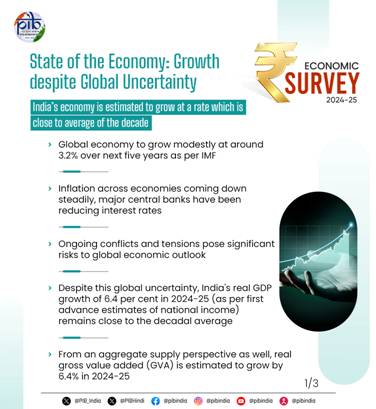


The Survey highlights that, despite global uncertainty, India has displayed steady economic growth. India’s real GDP growth of 6.4 per cent in FY25 remains close to the decadal average.

From an aggregate demand perspective, private final consumption expenditure at constant prices is estimated to grow by 7.3 per cent, driven by a rebound in rural demand.

On the supply side, the real gross value added (GVA) is estimated to grow by 6.4 per cent. The agriculture sector is expected to rebound to a growth of 3.8 per cent in FY25. The industrial sector is estimated to grow by 6.2 per cent in FY25. Strong growth rates in construction activities and electricity, gas, water supply and other utility services are expected to support industrial expansion. Growth in the services sector is expected to remain robust at 7.2 per cent, driven by healthy activity in financial, real estate, professional services, public administration, defence, and other services.
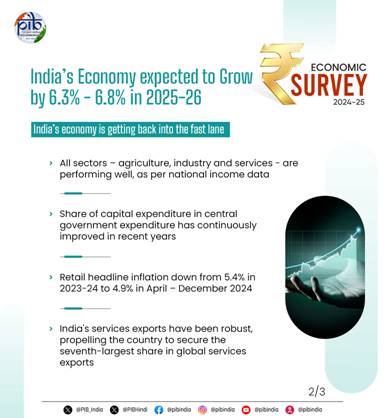


Keeping in mind the upsides and downsides to growth, the Survey expects the real GDP growth in FY26 to be between 6.3 and 6.8 per cent.

The Chapter on the Medium-Term Outlook elaborates on the global factors and the importance of strengthening the levers of domestic growth in the context of heightened risks due to global concerns about economic policies and trade policy uncertainties.

To realize the aspirations of Viksit Bharat by 2047, it is important that the medium-term growth outlook of India be assessed in the context of emerging global realities of Geo-Economic Fragmentation (GEF), Chinese manufacturing prowess, and global dependency on China for energy transition efforts. The Survey puts forth a way forward to reinvigorate the internal engines and domestic levers of growth by focusing on one central element of systemic deregulation, which will enable a paradigm of economic freedom to businesses of individuals and organizations to pursue legitimate economic activity with ease. The Survey stresses that the reforms and economic policy must now be on systematic deregulation under Ease of Doing Business 2.0 so that it encourages creation of a viable Mittelstand, i.e. India’s SME sector.

The Economic Survey 2024-25 notes that agriculture growth remained steady in first half of FY25, with Q2 recording a growth rate of 3.5 per cent, marking an improvement over the previous four quarters. Healthy Kharif production, above-normal monsoons, and an adequate reservoir level supported agricultural growth. The total Kharif food grain production is estimated at a record 1647.05 lakh metric tonnes (LMT) in 2024-25, higher by 5.7 per cent compared to 2023-24 and 8.2 per cent higher than the average food grain production in the past five years.

The industrial sector grew by 6 per cent in first half of FY25, and is estimated to grow by 6.2 per cent in FY25. Q1 saw a strong growth of 8.3 per cent, but growth moderated in Q2 due to three key factors. First, manufacturing exports slowed significantly due to weak demand from destination countries, and aggressive trade and industrial policies in major trading nations. Second, the above average monsoon had mixed effects – while it replenished reservoirs and supported agriculture, it also disrupted sectors like mining, construction, and, to some extent, manufacturing. Third, the variation in the timing of festivities between September and October in the previous and current years led to a modest growth slowdown in Q2 FY25.

Despite various challenges, India continues to register the fastest growth in manufacturing PMI, stated the Survey. The latest Manufacturing PMI for December 2024 remained well within the expansionary zone, driven by new business gains, robust demand, and advertising efforts.

The services sector continues to perform well in FY25, emphasizes the Survey. A notable growth in Q1 and Q2 resulted in 7.1 per cent growth in first half of FY25. Across sub-categories, all the sub-sectors have performed well. India’s services export growth surged to 12.8 per cent during April–November FY25, up from 5.7 per cent in FY24.

The Economic Survey states that growth process has been ably supported by stability on fronts such as inflation, fiscal health, and external sector balance. On inflation, the Survey states that retail headline inflation has softened from 5.4 per cent in FY24 to 4.9 per cent in April – December 2024. Food inflation, measured by the Consumer Food Price Index (CFPI), has increased from 7.5 per cent in FY24 to 8.4 per cent in FY25 (April-December), primarily driven by a few food items such as vegetables and pulses. India’s consumer price inflation will gradually align with the target of around 4 per cent in FY26 as per RBI and IMF.
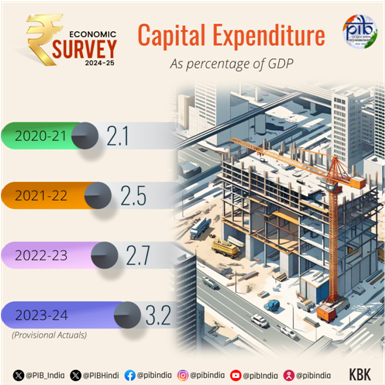


Capital expenditure (capex), as a per cent of the total expenditure of the union, has continuously improved from FY21 to FY24. After the general elections, union government capex has grown by 8.2 per cent during July – November 2024 YoY, the Survey says.

Despite the gross tax revenue (GTR) increasing by 10.7 per cent YoY during April-November 2024, the tax revenue retained by the Union, net of devolution to the states, hardly increased, says the Survey. As of November, the deficit indicators of the union were comfortably placed, leaving ample room for developmental and capital expenditure in the rest of the year.
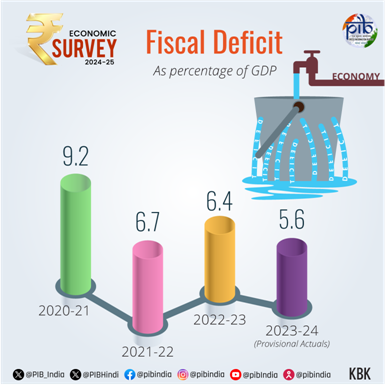
 

According to the Survey, the GTR of the union and own tax revenue (OTR) of the states have increased at comparable pace during the period April – November 2024. The revenue expenditure of the states grew at 12 per cent (YoY) during April to November 2024, with subsidies and committed liabilities registering a growth of 25.7 per cent and 10.4 per cent, respectively.


The Survey observes that stability in the banking sector is underscored by declining asset impairments, robust capital buffers, and strong operational performance. The gross non-performing assets (NPAs) in the banking system have declined to a 12-year low of 2.6 per cent of gross loans and advances. The capital-to-risk-weighted assets ratio (CRAR) for Schedule Commercial Banks stands at 16.7 per cent as of September 2024, well above the norm, says the Survey.

Emphasizing that the external sector stability is safeguarded by services trade and record remittances, the Economic Survey quotes that India’s merchandise exports grew by 1.6 per cent YoY in April – December 2024. Merchandise imports rose by 5.2 per cent. India’s robust services exports have propelled the country to secure the seventh-largest share in global services exports, underscoring its competitiveness.

In addition to the services trade surplus, remittances from abroad led to a healthy net inflow of private transfers. India was the top recipient of remittances in the world, driven by an uptick in job creation in OECD economies. These two factors combined to ensure that India’s current account deficit (CAD) remains relatively contained at 1.2 per cent of GDP in Q2 FY25, as per the Survey.

Gross Foreign Direct Investment inflows recorded a revival in FY25, increasing from USD 47.2 billion in the first eight months of FY24 to USD 55.6 billion in the same period of FY25, a YoY growth of 17.9 per cent, says the Survey. Foreign portfolio investment (FPI) flows have been volatile in the second half of 2024, primarily on account of global geopolitical and monetary policy developments.

The Economic Survey states that as a result of stable capital flows, India’s foreign exchange reserves increased from USD 616.7 billion at the end of January 2024 to USD 704.9 billion in September 2024 before moderating to USD 634.6 billion as on 3 January 2025. India’s forex reserves are sufficient to cover 90 per cent of external debt and provide an import cover of more than ten months, thereby safeguarding against external vulnerabilities.

The Economic Survey highlights continued good performance on the employment front. It states that India’s labour market growth in recent years has been supported by post-pandemic recovery and increased formalisation. The unemployment rate for individuals aged 15 years and above has steadily declined from 6 per cent in 2017-18 to 3.2 per cent in 2023-24. The labour force participation rate (LFPR) and the worker-to-population ratio (WPR) have also increased.

The Survey also mentions that for India, a services-driven economy with a youthful and adaptable workforce, the adoption of AI offers the potential to support economic growth and improve labour market outcomes. Prioritising education and skill development will be crucial to equipping workers with the competencies needed to thrive in an AI-augmented landscape. The Survey brings out the fact that there are at present barriers to large-scale AI adoption, leading to a window for policymakers to act. The Economic Survey calls upon for collaborative effort between government, private sector, and academia to minimise the adverse societal effects of AI-driven transformation in the labour sector.

On infrastructure front, the Economic Survey highlights the need for continued step-up of infrastructure investment over next two decades to sustain a high growth. Under railway connectivity, 2031 km of railway network was commissioned between April and November, 2024, and 17 new pairs of Vande Bharat trains were introduced between April and October 2024. Port capacity improved significantly in FY25, leading to improvements in operational efficiency and reduction in average container turnaround time in major ports from 48.1 hours in FY24 to 30.4 hours during FY25 (Apr-Nov).

The Economic Survey underscores the government of India’s efforts to boost renewable energy in the country and green investments through schemes, policies, financial incentives and regulatory measures such as PM – Surya Ghar: Muft Bijli Yojana, National Bioenergy Programme, National Green Hydrogen Mission and PM-KUSUM. The capacity addition in solar and wind power has lead to a 15.8 per cent year-on-year increase in renewable energy capacity by December 2024.

The Government social services expenditure has witnessed an increase of compounded annual growth rate of 15% (combined for centre and states) from FY 21 to FY 25. The Gini coefficient, which is a measure of inequality in consumption expenditure, has been declining in recent years (For rural areas it declined to 0.237 in 2023-24 from 0.266 in 2022-23 and for urban areas, it fell to 0.284 in 2023-24 from 0.314 in 2022-23), reflecting positive impact of Government’s initiatives in reshaping income distribution. On the school education front, the government is working toward meeting the objectives of National Education Policy 2020 through a range of programmes and schemes. These interalia include the Samagra Shiksha Abhiyan, DIKSHA, STARS, PARAKH, PM SHRI, ULLAS, PM POSHAN, etc, as per the Survey.

In the total health expenditure of the country between FY15 and FY22, the Survey quotes the share of government health expenditure has increased from 29.0 per cent to 48.0 per cent. During the same period, the share of out-of-pocket expenditure in total health expenditure declined from 62.6 per cent to 39.4 per cent.

Micro, Small and Medium Enterprises (MSME) sector has emerged as a highly vibrant sector of the Indian economy, noted the Survey. To provide equity funding to MSMEs with the potential to scale up, the government launched the Self-Reliant India Fund with a corpus of ₹50,000 crore.

The Survey, says that reducing excessive regulatory burdens, governments can help businesses become more efficient, reduce costs, and unlock new growth opportunities. Regulations increase the cost of all operational decisions in firms, the Economic Survey adds. It has outlined a three-step process for states to systematically review regulations for their cost-effectiveness. The steps include identifying areas for deregulation, thoughtfully comparing the regulations with other states and countries and estimating the cost of each of these regulations on individual enterprises. The Survey highlights that Ease of Doing Business (EoDB) 2.0 should be a state government-led initiative focused on fixing the root causes behind the unease of doing business. It mentions that in the next phase for EoDB, states must break new ground on liberalizing standards and controls, setting legal safeguards for enforcement, reducing tariffs and fees, and applying risk-based regulation.

As the Survey underscores, looking ahead, India’s economic prospects for FY26 are balanced. Headwinds to growth include elevated geopolitical and trade uncertainties and possible commodity price shocks. Domestically, the translation of order books of private capital goods sector into sustained investment pick-up, improvements in consumer confidence, and corporate wage pick-up will be key to promoting growth. Rural demand backed by a rebound in agricultural production, an anticipated easing of food inflation and a stable macro-economic environment provides an upside to near-term growth. Overall, India will need to improve its global competitiveness through grassroots-level structural reforms and deregulation to reinforce its medium-term growth potential.
PM’s remarks at beginning of the Budget Session of 2025

| Published on:

The Prime Minister Shri Narendra Modi addressed the media before the start of the Budget Session of 2025 at the Parliament premises today. Paying homage to Goddess Lakshmi, the deity of prosperity, the Prime Minister remarked that today on the occasion of the start of the Budget Session, it is customary to remember Goddess Lakshmi, who bestows wisdom, prosperity, and welfare. He prayed to Goddess Lakshmi for her special blessings on every poor and middle-class community in the country.

Remarking that India has completed 75 years of its Republic, which is a matter of immense pride for every citizen, Shri Modi emphasized that this achievement also holds a special place in the democratic world, showcasing India’s strength and significance.

Expressing his gratitude to the people of the country who have entrusted him with the responsibility of forming Government for the third time, the Prime Minister highlighted that this was the first full budget session of his third term and expressed confidence that by 2047, when India celebrates 100 years of independence, the nation will have achieved its goal of becoming a developed country. He emphasized that this budget session will instill new confidence and energy, ensuring that 140 crore citizens will collectively fulfill this resolution. The Prime Minister stated that in the third term, the Government was moving forward in mission mode towards comprehensive development, be it geographically, socially, or economically. He highlighted that innovation, inclusion, and investment have consistently been the foundation of the country’s economic roadmap. Shri Modi mentioned that several historic bills and proposals will be discussed in this session, leading to laws that will strengthen the nation. He emphasized the importance of re-establishing the dignity of women, ensuring equal rights for every woman, free from religious and sectarian differences. He stated that significant decisions will be made in this session to achieve this goal. The Prime Minister highlighted the importance of reform, perform, and transform in achieving rapid development. He noted that the State and Central governments must work together to perform, and public participation will lead to transformation.

Emphasising that India is a young nation with immense youth power, the Prime Minister said that the youth aged 20-25 today will be the biggest beneficiaries of a developed India when they reach the age of 45-50. They will be in key positions in policy-making and will proudly lead a developed India into the next century. The Prime Minister emphasized that the efforts to fulfill the resolution of a developed India will be a significant gift for the current teenage and young generation. He compared this to the youth who fought for independence in the 1930s and 1940s, whose efforts led to the celebration of independence 25 years later. Similarly, the next 25 years will be dedicated to achieving a prosperous and developed India, he added. The Prime Minister called on all MPs to contribute to strengthening the vision of a developed India during this budget session. He emphasized that this is a golden opportunity for young MPs, as their active participation and awareness in the House will allow them to witness the fruits of a developed India.

Prime Minister expressed hope that the budget session will meet the aspirations of the nation. He noted that this is perhaps the first parliamentary session since 2014 where there has been no attempt to create disturbances from foreign sources just before the session. The Prime Minister remarked that for the past 10 years, there have always been attempts to create trouble before each session, with no shortage of people willing to fan the flames. However, he added that this is the first session in the last decade where no such disturbances have occurred from any foreign corner.

PM condoles loss of lives in the tragic collision in Washington DC

| Published on:

The Prime Minister, Shri Narendra Modi has condoled loss of lives in the tragic collision in Washington DC. Shri Modi also extended heartfelt condolences to the families of the victims and said that we stand in solidarity with the people of the United States.

In a X post, the Prime Minister said;

“Deeply saddened by loss of lives in the tragic collision in Washington DC.

Our heartfelt condolences to the families of the victims.

We stand in solidarity with the people of the United States. @realDonaldTrump”

Kejriwal’s claim that poison is being mixed in the water from Haryana is an extremely irresponsible and shameful statement: JP Nadda

| Published on:

Bharatiya Janata Party National President Shri Jagat Prakash Nadda addressed a public meeting in Krishnanagar, Delhi on Thursday. Shri Nadda criticized AAP convenor Arvind Kejriwal for denying Delhiites BJP’s welfare schemes and promoting George Soros’ anti-national agenda. During the program, Delhi State Vice President Shri Dinesh Pratap Singh, former MP Shri Harshvardhan, Gandhi Nagar Assembly candidate Shri Arvinder Singh Lovely, Krishnanagar candidate Dr. Anil Goyal, National Media Co-in-charge Shri Sanjay Mayukh and other leaders were present on the stage.

Shri Nadda stated that the excitement and enthusiasm on the faces of the people of Kishnanagar indicate that they have made up their minds to form a BJP government in Delhi. This election is not just an ordinary one; it’s not merely about electing BJP candidates. It’s about changing the future and the image of Delhi through these candidates. This election is about liberating Delhi from ‘AAP-da‘ and freeing its people from the hardships they have endured. The AAP-da party has done nothing in the last 10 years except hold press conferences, abuse the central government, blame others, and do nothing to address its failures. The AAP government denied the people of Delhi the benefits of central government schemes for 10 years, which have been provided under the leadership of the Hon’ble Prime Minister Shri Narendra Modi Ji. Their only work was to abuse Modi Ji, blame the central government, mislead the public, incite division, and then retreat to their ‘Sheesh Mahal. AAP formed its government on the principles of eradicating corruption, but instead left no stone unturned in committing it.

BJP National President stated that AAP leaders called themselves ‘Kattar Imaandar’  but turned out to be ‘Kattar Beimaan,’ with their Chief Minister, Deputy Chief Minister, Minister, and 5 MLAs all going to jail. These people once spoke of an education revolution and claimed global recognition, but instead of focusing on education, they were embroiled in a ₹2800 crore liquor scam. An audio is going viral in which an AAP MLA is speaking against the liquor policy, and then Manish Sisodia said that to contest elections in other states, money would be needed, which would come from scams in the liquor policy. AAP did not even allow the audit of the Jal Board to take place and committed a scam of ₹28,000 crores. The tanker mafia is operating in Delhi and both the High Court and Supreme Court have told the AAP government that if it is unable to control the mafia, Delhi Police will be given the responsibility. Contaminated water is being supplied to households, all under the rule of the ‘AAP-da’ government. In the health sector, these ‘AAP-da’ leaders promoted Mohalla Clinics, but those clinics conducted fake tests and embezzled ₹65,000 crore. They deprived the poor of their rights, misappropriated ₹300 crore meant for medicines, and awarded tenders to their close aides. 

Shri Nadda stated that an RTI has revealed that two-thirds of schools do not even teach science. There was a ₹500 crore scam in panic buttons, but the real need for a panic button was in the ‘Sheesh Mahal,’ where women were being misbehaved with. Hon’ble PM Shri Narendra Modi Ji is providing free ration to 4 crore people, but AAP committed a ₹5,400 crore scam in ration cards and a ₹4,500 crore scam in the purchase of buses in Delhi. Moreover, the tender for bus maintenance was awarded at a cost higher than the price of the buses themselves. AAP had promised to install CCTV cameras in every lane, but to this day, no CCTV has been installed and instead ₹571 crore was embezzled in the CCTV project. Aam Aadmi Party leaders Manish Sisodia, Arvind Kejriwal, Satyendra Jain, Naresh Yadav, Amanatullah Khan, Durgesh Pathak and Sanjay Singh have all been in jail, and they are so shameless that they celebrate after being released. But they should know that they have only come out on bail, and jail is where they truly belong. They will end up back in jail in the future. Kejriwal once visited Ghazipur and shouted about the garbage heap there, but now he has turned all of Delhi into the same. Garbage is scattered all across Delhi.

BJP National President stated that Arvind Kejriwal’s claim that poison is being mixed in the water from Haryana is an extremely irresponsible and shameful statement. Such leaders have no place in politics. He is trying to incite animosity between two states, which is an anti-national act and aligns with the agenda of Soros. They are urban Naxals attempting to weaken the nation and create panic. Such leaders must be defeated on February 5th. Kejriwal had promised to clean the Yamuna 10 years ago, but instead of cleaning it, they embezzled ₹8000 crore under the guise of its cleaning. Even today, the Yamuna is covered in foam, and during Chhath, it becomes difficult to offer Arghya. During the COVID-19 pandemic, Kejriwal had spoken about driving the people from the Purvanchal community out of Delhi. Kejriwal had said that people from Purvanchal come to Delhi with a ₹500 ticket and spend lakhs on treatment. Now, he is pretending to be an advocate for the Purvanchal community. While the roads of Delhi are in poor condition under Kejriwal’s rule, the Hon’ble Prime Minister Shri Narendra Modi Ji has constructed the Eastern Peripheral Expressway and Western Peripheral Expressway. All the development work in Delhi today has been carried out only by the Hon’ble Prime Minister Shri Narendra Modi Ji. In the last 10 years, no new colleges have been opened, no new roads have been built, and no new flyovers have been constructed in Delhi. Congress is afraid to debate in Parliament, obstructs the proceedings, and when Parliament ends, it goes abroad to criticize India. Kejriwal had questioned the capabilities of the country’s youth by demanding proof of the Indian Army’s surgical strike.

Shri Nadda said that Hon’ble Prime Minister Shri Narendra Modi Ji has provided 300 electric buses in Delhi, and after the formation of the BJP government in Delhi, 2026 more electric buses will be introduced by December 2025. The BJP-led central government has expanded the Delhi Metro network from 190 km to 400 km over the past 10 years, constructed 135 new metro stations, and inaugurated an 82 km long Rapid Rail costing ₹30,000 crore, which will connect Delhi to Meerut in just 40 minutes. Additionally, ₹8,000 crore has been allocated for the Delhi-Meerut Expressway, ₹3,600 crore for the Urban Extension Road from Alipur to Mahipalpur, ₹7,500 crore for the Dwarka Expressway from Dwarka to Khirki, ₹920 crore for the Integrated Transit Corridor at Pragati Maidan, ₹9,000 crore for the Western Peripheral Expressway, and ₹11,000 crore for the Eastern Peripheral Expressway. Under the Pradhan Mantri Garib Kalyan Anna Yojana, 5 kg of free food grains are being provided to 80 crore people across the country, including 72 lakh people in Delhi. As a result, 25 crore people have risen above the poverty line. Under the Pradhan Mantri Awas Yojana, 4 crore homes have been built across the country, including 30,000 in Delhi. Additionally, under the “Jhuggi Wahan Makaan” initiative, 6,500 homes have been constructed. “Jhuggi Wahan Makaan” is the promise of the Bharatiya Janata Party. Kejriwal has spent ₹52 crore to build a ‘Sheesh Mahal,’ which includes ₹5 crore curtains, ₹10 crore in decorations, ₹1.5 crore worth of marble and ₹9 lakh refrigerators. While cases of diarrhea and typhoid are increasing in Delhi, Kejriwal has been involved in a scam under the name of Mohalla Clinics, where medicines and fake lab tests were used to deceive the poor. Under the Pradhan Mantri Ayushman Bharat Yojana, free health insurance of up to ₹5 lakh per year has been provided to 61 crore poor people. 

BJP National President highlighted that more than 3 lakh people have received treatment for stones, over 60 thousand people have undergone bypass surgeries, 1 lakh 64 thousand people have had knee replacements and 7 lakh 40 thousand people have received cancer treatment. These poor people would never have been able to afford such major surgeries, but it is Hon’ble PM Shri Narendra Modi Ji who has worked to provide them the gift of life. On the other hand, Arvind Kejriwal has kept 51 lakh people in Delhi deprived of the Ayushman Bharat Yojana benefits. Kejriwal, who praises Mohalla Clinics, has been involved in scams related to medicines and tests, committing a huge fraud with the poor and carrying out inhuman actions, going against humanity. Under the BJP’s Ayushman Bharat scheme, if any individual from Delhi goes to Tata Memorial in Delhi for cancer treatment, they will receive treatment there. As soon as the treatment begins, Hon’ble PM Shri Narendra Modi Ji will directly transfer the money to the hospital, ensuring free treatment for the poor.

Shri Nadda appealed to the people to press the ‘Lotus’ symbol, and once the BJP forms the government in Delhi, the people of Delhi will receive ₹5 lakh under the Ayushman Bharat Yojana from the central government. Additionally, ₹5 lakh will be provided by the Delhi government from the very first Cabinet meeting, totaling ₹10 lakh for treatment to the people of Delhi. The 51 lakh people who have been deprived will also be included in this scheme, and arrangements will be made for their treatment up to ₹10 lakh. ‘Modi Ki Guarantee’ is a guarantee that will be fulfilled. Kejriwal says that he will give ₹2100 to women, but has he implemented this in Punjab? However, when the BJP makes a promise, it delivers. In Madhya Pradesh, Rajasthan, Chhattisgarh and Odisha, the BJP promised to give financial assistance to women, and that promise has been fulfilled. After 5th February, women in Delhi will also receive ₹2500 as financial aid. A ₹500 LPG cylinder will be provided, and free gas cylinders will be given during Diwali and Holi. But did the women in Punjab receive the ₹500 cylinder?

BJP National President remarked that Arvind Kejriwal has broken the world record for lying. He is a machine for spreading lies. The way Kejriwal has misled the people is evident to all. However, after the BJP forms the government, those above 60 years of age will see an increase in the old age pension scheme from ₹2000 to ₹2500. And for those above 70 years of age, the pension of ₹2500 will be increased to ₹3000 per month. Nutritious meals will be provided at just ₹5 through Atal Canteens in slums. Free education will be provided from KG to PG. A Welfare Board will be established for auto and taxi drivers and domestic helpers, offering ₹10 lakh life insurance and ₹5 lakh accident insurance, along with scholarships for their children. Gig workers will also be offered ₹10 lakh life insurance and ₹5 lakh accident insurance. Textile workers will be provided with ₹10 lakh life insurance and ₹5 lakh accident insurance, and toolkits will be given to enhance their skills. 50,000 people will be provided government jobs, and at the same time, 20 lakh people will be given employment opportunities. The Yamuna will be cleaned, and by the next election, there will be no more discussions about the Yamuna, as clean water will flow there. 

Shri Nadda appealed to the people to go door to door and send Hon’ble PM Shri Narendra Modi Ji’s ‘Ram Ram’ greetings and wishes. The time has come for Delhi to reject a government that makes excuses and creates conflicts. Delhi needs a government that doesn’t obstruct the nation’s pride during the Republic Day parade on Kartavya Path, like Kejriwal’s government did. Delhi should not have a government that tarnishes the country’s image when foreign dignitaries visit. The people of Delhi deserve a government that ensures access to clean drinking water through Hon’ble PM Shri Narendra Modi Ji’s ‘Har Ghar Nal, Har Ghar Jal’ initiative, instead of being deprived of it. Delhi should not have a government that denies its people the benefits of free healthcare, while PM Shri Narendra Modi Ji ensures treatment for the entire nation. Delhi deserves a government that provides free medicines, not one that deprives the people of essential services. Now, the time has come for a double-engine government in Delhi. If Hon’ble PM Shri Narendra Modi Ji can run metro rail, build the Western Peripheral Road, and construct express highways, then Delhi needs a BJP government. BJP will ensure that Delhi’s roads are smooth and well-maintained. Clean water will be delivered to every home, healthcare facilities will be provided, waste management will be organized and Delhi will be kept clean. Shri Nadda appealed to the people to go door-to-door and tell everyone that the time for change has come, saying, “Ab Nahin Sahege AAP-da Aur Banaege BJP Ki Sarkar.”

AAP is a party known for breaking promises: Amit Shah

| Published on:

Union Home Minister & Minister of Cooperation and Senior BJP Leader Shri Amit Shah public meetings in Rohini, Wazirpur and News Delhi assembly constituencies, Delhi on Thursday. After this, Shri Shah did a road show in Shalimar Bagh Assembly, in which thousands of people participated. During rallies, Shri Shah strongly criticized Arvind Kejriwal for spreading lies and accused him of corruption. Shri Shah pointed out that Kejriwal, who once claimed during Anna Hazare’s movement that he would never form a political party, ended up doing so. Kejriwal has broken his promise of not taking a government vehicle or bungalow; instead, he has demolished five bungalows to build his ‘Sheesh Mahal’. On February 5, the people of Delhi will remove AAP and elect BJP, bringing a double-engine government to Delhi. During the event,  Delhi LoP and BJP candidate from Rohini, Shri Vijender Gupta, Wazirpur candidate Smt. Poonam Sharma, among other leaders were present.

Shri Shah stated that the people of Rohini must cast their votes on 5th February and remove the ‘AAP-da’ government to form a BJP government in Delhi. Removing ‘AAP-da‘ means answering for 10 years of misgovernance, Kejriwal’s corruption, appeasement and the injustice done to Rohini for 10 years. On the 5th, the people of Delhi have a chance to remove AAP and form a double-engine government under the leadership of Hon’ble PM Shri Narendra Modi ji. The people of Rohini must press the button on the ‘Lotus’ symbol with such force that it shatters the glass of Kejriwal’s ‘Sheesh Mahal.’ Arvind Kejriwal has turned Delhi into a garbage dump in the last 10 years. In the history of Delhi, never have more than 35 people died due to rain. Arvind Kejriwal kept making excuses. If Kejriwal is removed from power in Delhi, the BJP will show how to transform the city. After Shri Vijender Gupta’s victory, Rohini will be made the top constituency of Delhi. BJP will beautify Delhi, eliminate garbage heaps, free it from corruption, clean the streets and lanes, and strengthen water management.

Union Home Minister stated that Arvind Kejriwal should stop lying to win the elections. He is falsely claiming that the BJP has mixed poison in the Yamuna water from Haryana to trouble the people of Delhi. Arvind Kejriwal should clarify who has mixed the poison in the Yamuna water. He should name the people responsible and tell us which laboratory tested the Yamuna water. Kejriwal also claimed that they had stopped the poisonous water, but he must note that if the Yamuna’s water had been stopped, villages would have flooded, which didn’t happen, proving his claims to be nothing but false statements. Kejriwal is seeing his evident defeat in the elections, which is why he is resorting to such cheap politics. Kejriwal has polluted the Yamuna water and forced the people of Delhi to drink contaminated water. The funds allocated for water purification have been misappropriated by the AAP. However, if a BJP government is formed, there will be no room for excuses, and Delhi will be transformed into the world’s leading capital city.

Shri Shah remarked that the Aam Aadmi Party stands for lies, deceit, and betrayal. The AAP had promised to shut liquor shops in residential areas, but instead, Kejriwal opened liquor shops near schools and temples. He is involved in a liquor scam worth thousands of crores, even went to jail, and now people associate him more with liquor bottles than as a human.

Union Home Minister criticized Arvind Kejriwal for failing to deliver on his promises, including making the Yamuna as clean as the Thames in London and taking a dip in it. Why hasn’t Kejriwal taken the promised dip? Despite promises to double hospital rooms, not a single bed was added, and even Kejriwal blocked the ₹5 lakh free treatment provided by Hon’ble PM Shri Narendra Modi Ji. As the BJP forms the government in Delhi, it will provide free treatment, including surgeries, up to ₹10 lakh to the people of Delhi. AAP has worsened Delhi’s pollution, raising the pollution index from over 400 to 1,200 instead of reducing it.

Shri Shah criticized AAP for failing to fulfill its promises, including making Delhi garbage-free and building a sports university. Kejriwal’s Aam Aadmi Party is a party of deception. Shri Shah reminded the public that during Anna Hazare’s movement in 2010-11, Kejriwal had vowed not to form a political party, but before Anna Hazare even reached Ralegan Siddhi, Kejriwal had already done so. Kejriwal promised to imprison Sheila Dikshit and pledged never to align with Congress, yet sought Congress’ support in the very first election. Kejriwal had promised not to take a government vehicle or bungalow, yet he took a vehicle and built a ‘Sheesh Mahal’ after destroying five bungalows. In his bungalow, Kejrwal has installed sound-activated electricity, doors that open with applause, remote-controlled curtains, and a golden commode. All of this was funded by the money of the voters in Rohini, and Kejriwal showed no shame in doing so.

Union Home Minister criticized Arvind Kejriwal for awarding himself a certificate of being ‘Kattar Imandar’. Shri Shah emphasized that certificates are given by the people, and on the 8th, when the ballot box opens, AAP will be wiped out from Delhi. Kejriwal has been involved in several scams, including the liquor policy scam, a ₹28,400 crore Jal Board scam, a ₹5,400 crore ration distribution scam, a ₹4,500 crore DTC bus scam, a ₹1,300 crore classroom scam, a ₹500 crore panic button scam, constructing a ₹52 crore ‘Sheesh Mahal’ and a ₹65,000 fake medical test scam, among others, and this list is never-ending. Kejriwal, who once promised to fight corruption, is now involved in massive corruption, looting Delhi. The people of Delhi will not vote for such liars and promise-breakers. In contrast, BJP’s manifesto under the leadership of Hon’ble Prime Minister Shri Narendra Modi Ji is unwavering, Modi ki guarantee means a guarantee of its fulfillment. (Modi ki guarantee matlab, guarantee pura hone ki guarantee hoti hai)

Shri Shah mentioned that in 2014, BJP promised to build Ram Mandir in Ayodhya. For 550 years, Ram Lalla resided in a tent, enduring all kinds of weather without a proper home. When the people re-elected Hon’ble Prime Minister Shri Narendra Modi Ji for the second time, he not only won the Ram Mandir case but also performed the ‘Bhoomi Pujan’ ceremony and the ‘Pran Pratishtha’ of Ram Lalla. Today, Ram Lalla is residing in his grand temple. At that time, AAP suggested building toilets instead of a temple. Kejriwal does filthy politics, but BJP has already built 12 crore toilets. BJP has developed the Kashi Vishwanath Corridor, is working on gold plating the Somnath Temple, abolished triple talaq, and will present the Waqf Bill in this budget session, fulfilling that promise too.

Union Home Minister emphasized that Hon’ble Prime Minister Shri Narendra Modi Ji had pledged to eliminate terrorism and Naxalism from the country. Pakistan, considering the India of pre-2014, dared to carry out attacks in Uri and Pulwama. However, within 10 days, Hon’ble Prime Minister Shri Narendra Modi Ji took decisive action with airstrikes and surgical strikes, delivering a strong response by entering Pakistan’s territory. Since then, incidents of bomb blasts have significantly reduced. By March 31, 2026, Naxalism will be entirely eradicated from India. Hon’ble PM Shri Narendra Modi Ji has worked tirelessly to make the country both secure and prosperous. Prior to 2014, India’s economy ranked 11th in the world. In just 10 years, the Modi government propelled India’s economy from 11th to 5th place globally. By 2027, India will become the world’s third-largest economy. BJP had promised to bring global respect to the country. Hon’ble Prime Minister Shri Narendra Modi Ji hosted the G-20 summit, where the heads of all nations bowed in reverence at Mahatma Gandhi’s memorial, a moment of immense pride for the entire nation. 

Shri Shah highlighted that once the BJP government is formed in Delhi, ₹2,500 will be transferred to the bank accounts of every woman in Delhi before the 5th of every month, and ₹21,000 will be given to each pregnant woman. Women in Delhi will receive gas cylinders for ₹500, and one cylinder will be provided free during Diwali and Holi each. In the first cabinet meeting, the BJP government will make medical treatment for surgeries free up to ₹10 lakh. The pension for senior citizens will be raised to ₹2,500, and widows’ pensions will increase to ₹3,000. At J.J. Cluster Centers, Atal Canteens will be set up to provide meals for the poor at just ₹5. Free education will be provided to needy students from KG to PG. Taxi and auto drivers will be given ₹10 lakh life insurance and ₹15 lakh accident insurance. Residents of 1,700 unauthorized colonies will be granted ownership rights. The shops of traders sealed by Kejriwal and the AAP government will be reopened within six months. Refugees who settled in Delhi in 1947 will receive ownership of their homes. 50,000 youth will be given government jobs, and twenty lakh new employment opportunities will be created. A Mahabharat circuit connecting Uttar Pradesh and Delhi will be established to boost tourism. After the BJP government is formed in Delhi, within 5 years, a river front like the Sabarmati River Front will be built on Yamuna ji too.

Union Home Minister emphasized that the people of Delhi should understand that BJP’s promises are not false like those of Kejriwal. While AAP members make promises and break them, BJP works tirelessly to keep its commitments. Every promise made by Hon’ble PM Shri Narendra Modi Ji is a firm resolution, unlike Kejriwal, who spreads falsehoods, claiming that BJP will stop free welfare schemes for the poor. BJP assures that no public welfare scheme in Delhi will be halted, and the promises made by the party will be fulfilled. Shri Amit Shah called on the people of Delhi to support BJP in the upcoming assembly elections and make it victorious.

PM pays tributes to Mahatma Gandhi on his death anniversary

| Published on:

The Prime Minister Shri Narendra Modi today paid tribute to Mahatma Gandhi on his death anniversary. Shri Modi also paid tributes to all those martyred for our nation and recalled their service as well as sacrifices.

The Prime Minister posted on X;

“Tributes to Pujya Bapu on his Punya Tithi. His ideals motivate us to build a developed India. I also pay tributes to all those martyred for our nation and recall their service as well as sacrifices.”

In 25 years, Congress, AAP have ruined two of your generations: PM

| Published on:

PM Modi today, addressed a massive crowd in Kartar Nagar, declared that Delhi had rejected excuses, fake promises, and deception. He asserted that the city demanded a double-engine BJP government focused on welfare and development, ensuring housing, modernization, piped water, and an end to the tanker mafia. Confident of victory, he proclaimed, “On February 5th, AAP-da Jayegi, BJP Aayegi!”

He also lauded Delhi BJP’s Sankalp Patra, promising it would uplift women, youth, students, the middle class, and workers guaranteeing its fulfillment under BJP rule. Targeting AAP and Congress, the PM stated, “The world recognizes the 21st century belongs to India, with millions of Indians working towards a developed Bharat. But does Delhi reflect a modern capital? After 14 years of Congress and 11 years of AAP, Delhi still struggles with traffic, filth, broken roads, overflowing sewage, waterlogging, pollution, and a water crisis.”

He added, “It’s time for change. BJP has a track record of delivering on promises. Under BJP, rural areas saw progress – from toilets and electricity to tap water in 12 crore homes. If we can bring tap water to remote villages, why can’t we ensure clean water for every home in Delhi?”

Holding the AAP-da government accountable which has left Delhi vulnerable to the water mafia. PM Modi said, “They asked for votes three times promising to clean the Yamuna, yet now accuse Haryana of poisoning Delhi’s water. This is pure dishonesty and malice. AAP-da wants Delhi to suffer, forcing our Purvanchali brothers to celebrate Chhath Puja in filth every year.”

Unveiling the Kejriwal government’s failure, PM Modi declared, “AAP-da leaders have no interest in working. Over the last five years, the Delhi Assembly sat for just 74 days, the shortest working period in its history. While Delhi’s problems intensified, only 14 laws were passed, and 5 of those were only about the legislators’ own salaries and pensions. This shows AAP-da’s lack of concern for the people. Instead of resolving issues, they turned the Assembly into a space for insults and petty arguments.”

Addressing the huge rally, PM Modi said, “We must give 21st-century Delhi a unique, special identity. The world should recognize Delhi not just as India’s capital, but as a model city for a developed India. Only the BJP can achieve this.”

“The BJP is making Delhi the city with the largest metro network, the city with India’s first NAMO rail connectivity, and the most connected city with expressways. The BJP is building modern railway stations and airports in Delhi, making it a city full of electric buses and cars,” he added.

Talking about providing a pucca home for everyone, PM Modi stated, “To those living in jhuggis, I assure you that your home will be built too. Modi doesn’t have a home of his own, but my dream is for every poor person to have their own home. Those who build Sheesh Mahal and waste millions of public money can never think about the homes of the poor.”

PM Modi debunked AAP’s malicious rumors, saying, “They’re claiming that BJP will end welfare schemes. But BJP never stopped any schemes that were for the benefit of the people, even if they came from Congress. For example, MGNREGA wasn’t shut down, it was freed from corruption and now operates efficiently. Similarly, in Delhi, no projects funded by taxpayer money for the poor will be stopped. The BJP will ensure transparency and eliminate corruption.”

Slamming AAP-da for their corruption, PM Modi said, “They once waved the CAG report, accusing Congress leaders of corruption, but now they are hiding it. They fear the truth about the liquor, Sheesh Mahal, education, and hospital scams coming out. Elect BJP-NDA, and the CAG report will be tabled in the first Assembly session. AAP-da has stopped pensions for the elderly, causing immense harm. Under BJP, elderly pensions will be restored to ₹2,500, up from ₹2,000.”

Highlighting BJP’s commitment, the Prime Minister asserted, “Delhi BJP will deposit ₹2,500 monthly into every sister’s account and provide ₹21,000 during pregnancy for nutritious food. For those working in homes cleaning, cooking, childcare, and driving – BJP will set up a welfare board with ₹10 lakh insurance. This includes many poor families, especially sisters in slums. Scholarships will be given to their children, and BJP promises free education from KG to PG, eliminating concerns over school fees.”

Alerting everyone to their trick, PM Modi iterated, “Be cautious of their latest scheme. AAP-da and Congress have secretly formed an alliance. AAP-da is trying to ensure either their own or Congress’s MLA wins, so they can later form a government together. If that happens, Delhi will face double the AAP-da. That’s why you must go door-to-door and tell everyone to vote for the lotus symbol, and the arrow symbol for Burari. On February 5, Delhi must break all voting records. Keep in mind, ‘AAP-da nahi sahenge, Badal ke rahenge’.”

Cabinet Approves ‘National Critical Mineral Mission’ with an outlay of Rs.34,300 crore

| Published on:

The Union Cabinet, chaired by the Prime Minister Shri Narendra Modi, has approved the launch of the National Critical Mineral Mission (NCMM) with an expenditure of Rs.16,300 crore and expected investment of Rs.18,000 crore by PSUs, etc.

As part of the Atmanirbhar Bharat initiative, and recognizing the indispensable role of critical minerals in high-tech industries, clean energy, and defense, the Government of India has undertaken several initiatives over the past two years to address challenges in the critical minerals sector.

There is a need to establish an effective framework for India’s self-reliance in the critical mineral sector. In line with this vision, the Finance Minister announced the setting up of the Critical Mineral Mission in the Union Budget for 2024-25 on 23rd July 2024.

The National Critical Mineral Mission, approved by the Union Cabinet, will encompass all stages of the value chain, including mineral exploration, mining, beneficiation, processing, and recovery from end-of-life products. The mission will intensify the exploration of critical minerals within the country and in its offshore areas. It aims to create a fast track regulatory approval process for critical mineral mining projects. Additionally, the mission will offer financial incentives for critical mineral exploration and promote the recovery of these minerals from overburden and tailings.

The mission aims to encourage Indian PSUs and private sector companies to acquire critical mineral assets abroad and enhance trade with resource-rich countries. It also proposes development of stockpile of critical minerals within the country.

The mission includes provisions for setting up of mineral processing parks and supporting the recycling of critical minerals. It will also promote research in critical mineral technologies and proposes setting up Centre of Excellence on Critical Minerals.

Adopting a whole-of-government approach, the Mission will work closely with relevant ministries, PSUs, private companies, and research institutions to achieve its objectives.

Mines and Minerals (Development and Regulation) Act, 1957, has been amended in 2023 to increase exploration and mining of critical minerals. Consequently, the Ministry of Mines has auctioned 24 blocks of strategic minerals. Further, Geological Survey of India (GSI) has undertaken 368 exploration projects for critical minerals over the past three years, with 195 projects currently underway in FS 2024-25. Further, for FY 2025-26, GSI is going to take up 227 projects for various critical minerals. To foster innovation, the Ministry launched the Science and Technology – Promotion of Research and Innovation in Start-ups and MSMEs (S&T  PRISM) program in 2023, funding start-ups and MSMEs to bridge the gap between R&D and commercialization. Moreover, KABIL, a JV of Ministry of Mines, has acquired an area of about 15703 Ha in the Catamarca province of Argentina, for exploration and mining of Lithium. Government of India has already eliminated customs duties on the majority of critical minerals in Union budget 2024-25. This will increase the availability of critical mineral in the country and will encourage the industry to set up processing facilities in India. These initiatives highlight India’s commitment to securing critical mineral supplies.