PM condoles the passing of former PM Dr. Manmohan Singh

| Published on:

The Prime Minister Shri Narendra Modi expressed deep sorrow over the passing of former Prime Minister Dr. Manmohan Singh in a video message from New Delhi today. He remarked that Dr. Singh’s demise is a significant loss for the nation. The Prime Minister said that achieving success in every field of life is not an ordinary feat and Dr. Singh was an achiever despite having lost much after he came to India during the partition. He added that Dr. Singh’s life teaches future generations how to rise above adversity and achieve great heights.

Shri Modi emphasized that Dr. Singh will always be remembered as a kind person, a learned economist, and a leader dedicated to reforms and highlighted Dr. Singh’s numerous contributions to the Indian government at various levels as an economist. The Prime Minister lauded Dr. Singh’s role as the Governor of the Reserve Bank of India during challenging times.

The Prime Minister noted that as Finance Minister in the government of former Prime Minister and Bharat Ratna Shri P.V. Narasimha Rao, Dr. Manmohan Singh guided the country out of a financial crisis and onto a new economic path. He emphasized that Dr. Singh’s contributions to the nation’s development and progress as Prime Minister will always be remembered. He added that Dr. Singh’s commitment to the people and the country’s development was always held in high regard.

Shri Modi underscored that Dr. Singh’s life was a reflection of his honesty and simplicity. He highlighted Dr. Singh’s distinguished parliamentary career was marked by his humility, gentleness, and intellect. The Prime Minister recalled that even at the end of Dr. Singh’s tenure in the Rajya Sabha earlier this year, he had praised Dr. Singh’s dedication as an inspiration to all. Despite his physical challenges, Dr. Singh attended important sessions in a wheelchair, fulfilling his parliamentary duties.

The Prime Minister remarked that despite receiving education from prestigious global institutions and holding top government positions, Dr. Singh never forgot the values of his humble background. He added that Dr. Singh always rose above party politics, maintaining contact with individuals from all parties and being easily accessible to everyone. The Prime Minister fondly remembered his open discussions with Dr. Singh on national and international issues during his tenure as Chief Minister and later in Delhi. He expressed his condolences to Dr. Singh’s family and paid tribute to him on behalf of all citizens.

PM pay tributes to the Former Prime Minister Dr. Manmohan Singh

| Published on:

The Prime Minister, Shri Narendra Modi has paid tributes to the former Prime Minister, Dr. Manmohan Singh Ji at his residence, today. “India will forever remember his contribution to our nation”, Prime Minister Shri Modi remarked.

The Prime Minister posted on X:

“Paid tributes to Dr. Manmohan Singh Ji at his residence. India will forever remember his contribution to our nation.”

Union Home Minister pay floral tributes to former PM Dr. Manmohan Singh in New Delhi

| Published on:

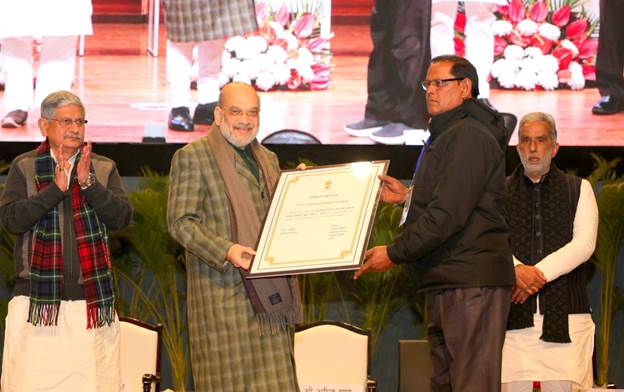
Union Home Minister and Minister of Cooperation Shri Amit Shah paid floral tributes to the former Prime Minister, Dr. Manmohan Singh in New Delhi.

In his post on ‘X’ Shri Amit Shah said, paid floral tributes to the former Prime Minister of India, Dr. Manmohan Singh Ji. A distinguished economist Manmohan Singh Ji, will always be remembered for his vast knowledge of finance and public policy.

PM participates in Veer Baal Diwas programme in New Delhi

| Published on:

The Prime Minister, Shri Narendra Modi participated in Veer Baal Diwas today at Bharat Mandapam, New Delhi. Addressing the gathering on the occasion of the 3rd Veer Baal Diwas, he said their Government had started the Veer Baal diwas in memory of the unparalleled bravery and sacrifice of the Sahibzades. He added that this day had now become a festival of national inspiration for crores of Indians. He further added this day had worked to inspire many children and youth with indomitable courage. Shri Modi lauded the 17 children who were conferred with  Veer Baal awards in the fields of bravery, innovation, science and technology, sports and arts today. He added that today’s awardees symbolised the capability of the children and youth of India to excel in various fields. The Prime Minister paid his tributes to the Gurus and the brave Sahibzades on the occasion and also congratulated the awardees and their families.

Recalling the sacrifice of the brave Sahibzades, Shri Modi said it was imperative for today’s youth to know about their saga of bravery and therefore, it was important to recall those events too. He added that it was over three centuries ago on this day the courageous Sahibzades had sacrificed their lives at tender ages. The Prime Minister noted that despite the tender ages of Sahib Zorawar Singh and Sahib Fateh Singh, their courage knew no bounds. He added that the Sahibzades rejected all the temptations of the Mughal Sultanate, endured all the atrocities and chose to embrace the death sentence ordered by Wazir Khan with utmost bravery. Shri Modi remarked that the Sahibzadas reminded him of the valor of Guru Arjan Dev, Guru Tegh Bahadur, and Guru Gobind Singh and this bravery was the spiritual strength of our faith. He added that the Sahibzadas chose to sacrifice their lives but never wavered from the path of faith. The Prime Minister emphasized that Veer Bal Diwas teaches us that no matter how difficult the circumstances, nothing is greater than the nation and national interest. He said “Every act done for the country is an act of bravery and every child and youth living for the country is a Veer Balak”.

“This year’s Veer Bal Diwas is even more special as it marks the 75th year of the establishment of the Indian Republic and our Constitution”, said the Prime Minister. He emphasized that in this 75th year of Indian Constitution, every citizen of the country is drawing inspiration from the brave Sahibzadas to work for the unity and integrity of the nation. Shri Modi highlighted that the strong democracy of India was proud that this day was built on the bravery and sacrifice of the Sahibzadas. He underscored that our democracy inspires us towards the upliftment of the last person in society. “The Constitution teaches us that no one is small or big in the country”, said Shri Modi. He added that this principle aligns with the teachings of our Gurus, who advocated for the welfare of all. The Prime Minister stressed that the life of the Sahibzadas teaches us not to compromise on the integrity and ideals of the nation and similarly, the Constitution upholds the principle of India’s sovereignty and integrity. He added that the magnitude of our democracy embodies the teachings of the Gurus, the sacrifice of the Sahibzadas, and the mantra of national unity.

“From past till present, the energy of the youth has played a significant role in India’s progress”, said Shri Modi. He highlighted that from the fight for independence to the 21st-century movements, Indian youth have contributed to every revolution. The Prime Minister stressed that the world looks at India with hope and expectations because of the power of the youth. He remarked that today, from start-ups to science, sports to entrepreneurship, youth power is driving new revolutions. Hence, he added, the government’s biggest focus in policy is empowering the youth. He stressed that all policies, whether for the start-up ecosystem, the future of the space economy, the sports and fitness sector, the fintech and manufacturing industry, or skill development and internship schemes, are youth-centric and aimed at benefiting young people. He further underscored that in every sector related to the country’s development, young people are getting new opportunities while their talent and self-confidence was receiving support from the Government. The Prime Minister remarked that in today’s rapidly changing world, new needs, expectations, and future directions were emerging. He stressed on the importance of making our youth futuristic, given the shift from traditional software to AI and the rise of machine learning. Shri Modi highlighted that the country started preparing for this long ago with the new National Education Policy, which modernized education and provided an open sky for learning. He emphasized that over 10,000 Atal Tinkering Labs have been set up to foster innovation among young children. Shri Modi stated that the ‘Mera Yuva Bharat’ campaign aims to provide practical opportunities along with education, increase the sense of duty towards society among youth.

Stressing on the importance of staying fit, noting that a healthy youth will lead to a capable nation, Shri Modi said that the ‘Fit India’ and ‘Khelo India’ movements aimed to increase fitness awareness among the younger generation. The Prime Minister announced the launch of the ‘Suposhit Gram Panchayat Abhiyan’, which will promote a healthy competition among village panchayats to eliminate malnutrition and form the basis of a developed India.

“Veer Bal Diwas fills us with inspiration and motivates us for new resolutions”, remarked the Prime Minister. He emphasized that our standard should now be the best. He urged the youth to work towards making their respective sectors the best. Shri Modi said “If we work on infrastructure, our roads, rail network, and airport infrastructure should be the best in the world. If we work on manufacturing, our semiconductors, electronics, and auto vehicles should be the best globally. If we work in tourism, our destinations, travel amenities, and hospitality should be the best. If we work in the space sector, our satellites, navigation technology, and astronomy research should be the best”. The Prime Minister remarked that the inspiration for setting such high goals comes from the bravery of the Sahibzadas. He stressed that big goals are now our resolutions. Shri Modi remarked that the country had complete confidence in the capabilities of its youth and underscored that the youth of India, who can lead the world’s largest companies, innovate to guide the modern world, and prove their mettle in every major country and field, can achieve anything for their nation when given new opportunities. Therefore, he said, that the goal of a developed India was assured and the success of Atmanirbhar Bharat was certain.

Remarking that every era gave the youth of a country the opportunity to change its destiny, Shri Modi highlighted that during the freedom struggle, Indian youth broke the arrogance of foreign rule and achieved their goals while today, the youth have the goal of a developed India. He stressed that in this decade, we must lay the foundation for rapid development over the next 25 years. The Prime Minister urged the youth to make the most of this time, advance in every sector, and propel the nation forward. He emphasized his vision of bringing one lakh youth into politics, whose families have never been involved in active politics. He added that this initiative was crucial for the next 25 years and encouraged the youth to be part of this campaign to bring a new generation into politics. Shri Modi announced that the ‘Viksit Bharat Young Leaders Dialogue’ would be held at the beginning of next year on Swami Vivekananda’s birth anniversary. He added that millions of youth from villages, towns, and cities across the country will participate, discussing the vision and roadmap for a developed India.

The Prime Minister emphasized that the in the upcoming decade, especially the next five years, would be crucial for fulfilling the resolutions of Amrit Kaal’s 25 years. He highlighted the need to harness the entire youth power of the country. The Prime Minister expressed confidence that the support, cooperation, and energy of the youth will take India to great heights. He concluded by paying homage to the Gurus, the brave Sahibzadas, and Mata Gujri ji.

The Union Minister of Women and Child Development, Smt Annapurna Devi was present among other dignitaries at the event.

Background

Veer Baal Diwas is a nationwide celebration honouring children as the foundation of India’s future. Prime Minister Shri Narendra Modi participated in the event and launched ‘Suposhit Gram Panchayat Abhiyan’. The programme aims at improving the nutritional outcomes and well-being by strengthening implementation of nutrition related services and by ensuring active community participation.

Various initiatives will also be run across the nation to engage young minds, promote awareness about the significance of the day, and foster a culture of courage and dedication to the nation. A series of online competitions, including interactive quizzes, will be organized through the MyGov and MyBharat Portals. Interesting activities like storytelling, creative writing, poster-making among others will be undertaken in schools, Child Care Institutions and Anganwadi centres.

Awardees of Pradhan Mantri Rashtriya Bal Puraskar (PMRBP) were also present during the programme.

PM chairs 45th PRAGATI Interaction

| Published on:

Prime Minister Shri Narendra Modi earlier today chaired the meeting of the 45th edition of PRAGATI, the ICT-based multi-modal platform for Pro-Active Governance and Timely Implementation, involving Centre and State governments.

In the meeting, eight significant projects were reviewed, which included six Metro Projects of Urban Transport and one project each relating to Road connectivity and Thermal power. The combined cost of these projects, spread across different States/UTs, is more than Rs. 1 lakh crore.

Prime Minister stressed that all government officials, both at the Central and State levels, must recognize that project delays not only escalate costs but also hinder the public from receiving the intended benefits.

During the interaction, Prime Minister also reviewed Public Grievances related to the Banking & Insurance Sector. While Prime Minister noted the reduction in the time taken for disposal, he also emphasized on the quality of disposal of the grievances.

Considering more and more cities are coming up with Metro Projects as one of the preferred public transport systems, Prime Minister advised conducting workshops for experience sharing for cities where projects are under implementation or in the pipeline, to capture the best practices and learnings from experiences.

During the review, Prime Minister stressed on the importance of timely Rehabilitation and Resettlement of Project Affected Families during implementation of projects. He further asked to ensure ease of living for such families by providing quality amenities at the new place.

PM also reviewed PM Surya Ghar Muft Bijli Yojana. He directed to enhance the capacity of installations of Rooftops in the States/UTs by developing a quality vendor ecosystem.  He further directed to reduce the time required in the process, starting from demand generation to operationalization of rooftop solar. He further directed states to adopt a saturation approach for villages, towns and cities in a phased manner.

Up to the 45th edition of PRAGATI meetings, 363 projects having a total cost of around Rs. 19.12 lakh crore have been reviewed.

Union Cooperation Minister chairs a review meeting of Bhartiya Beej Sahkari Samiti in New Delhi

| Published on:

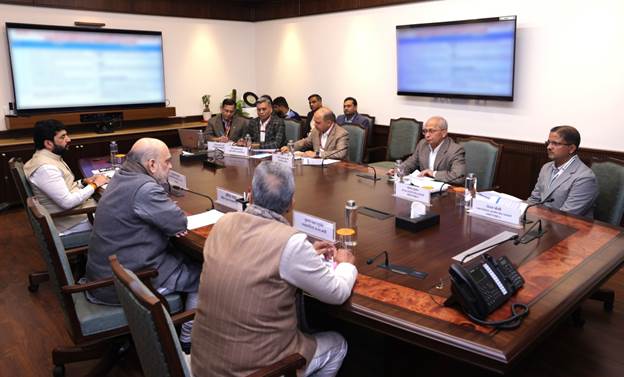
Union Home Minister and Minister of Cooperation Shri Amit Shah chaired a review meeting of Bhartiya Beej Sahkari Samiti Limited (BBSSL) in New Delhi. The meeting was attended by the Union Ministers of State for Cooperation Shri Krishna Pal and Shri Murlidhar Mohol. Secretary, Ministry of Cooperation, Dr. Ashish Kumar Bhutani, Additional Secretary, Ministry of Cooperation, Shri Pankaj Kumar Bansal and Chairman and Managing Director of BBSSL were present on the occasion.

Addressing the meeting, Shri Amit Shah said that the Bhartiya Beej Sahkari Samiti Limited (BBSSL) has a crucial role in realizing Prime Minister Shri Narendra Modi’s vision of “Sehkar Se Samriddhi” and empowering farmers. He emphasized that BBSSL should focus on the collection and preservation of India’s traditional seeds. In the meeting, Shri Amit Shah set a target for BBSSL to connect with an additional 20,000 cooperatives by the year 2025-26. Shri Shah said that BBSSL should focus more on such seed production that require less water and pesticides. He also emphasized that efforts should be made to ensure that small farmers achieve the highest possible yields and that the maturity period of their crops is extended.

Union Home Minister and Minister of Cooperation said that BBSSL is working rapidly towards the collection and preservation of India’s traditionally nutritious seeds. He emphasized that IFFCO and KRIBHCO should evaluate the nutritional value of our indigenous and hybrid seeds. Shri Shah added that, priority of BBSSL is to promote and preserve traditionally nutritious seeds which are now in less usage along with increasing the production of pulses and oilseeds without reducing their nutritional value.

Union Minister of Cooperation noted that IFFCO and KRIBHCO should strive to make their laboratories exemplary and the best in the field. He also mentioned that all cooperative institutions should encourage farmers to practice farming with certified seeds.

Shri Amit Shah highlighted that more than 20,000 different cooperative societies from 34 states and union territories across the country are shareholders of BBSSL. He added that BBSSL should utilize the scientists and laboratories of all government universities working towards seed production, research and promotion. Union Minister of Cooperation stressed on preparing a 10-year roadmap and its regular review to achieve the goals related to increasing seed production.

During Rabi 2024, BBSSL is producing foundation and certified seeds over an area of 5,596 hectares across 6 states. Under this program, an estimated production of 1,64,804 quintals of seeds from 49 varieties of 8 crops is expected. BBSSL has set an ambitious target of achieving a total turnover of ₹18,000 crore by the year 2032-33. Since its operations began, BBSSL has sold/distributed 41,773 quintals of seeds, primarily from four crops—wheat, groundnut, oats, and berseem—which have a market value of approximately ₹41.50 crore.

PM lays foundation stone of Ken-Betwa River Linking National Project in Khajuraho, Madhya Pradesh

| Published on:

On the occasion of the 100th birth anniversary of former Prime Minister Shri Atal Bihari Vajpayee, the Prime Minister Shri Narendra Modi inaugurated and laid the foundation stone of multiple development projects in Khajuraho,Madhya Pradesh. Addressing the gathering, Shri Modi greeted the people of Christian Community of India and World a merry Christmas. Recalling that the Government under the leadership of Chief Minister Dr. Mohan Yadav had completed a year of its formation, Shri Modi congratulated the people of Madhya Pradesh for the same. He added that the developmental works had gained pace along with the implementation of new infrastructure projects worth over thousands of crores of rupees in the last one year. The Prime Minister remarked that today the foundation stone was laid for the historic Ken-Betwa river linking project, the Daudhan dam and the Omkareshwar floating solar project – MP’s first solar power plant. He congratulated the people of Madhya Pradesh for the same.

Terming today as a remarkably inspirational day on the occasion of the birth centenary of Bharatratna Shri Atal Bihari Vajpayee, the Prime Minister said today marked the festival of good governance and good service serving as an inspiration to all of us.  Remembering Shri Vajpayee while releasing the commemorative stamp and coin the Prime Minister said that Shri Vajpayee had nurtured and mentored many foot soldiers like him over the years. The Prime Minister said that the service of Atalji towards the development of the nation will always remain indelible in our memory. Shri Modi underlined that work on more than 1100 Atal Gram Sushan Sadan will be underway from today and the first installment has been released for the same. He remarked that the Atal Gram Seva Sadan will propel the development of the villages.

Emphasising that the Good Governance day was not a one day affair, Shri Modi said “Good Governance is the identity of our Governments”. Thanking the people for giving the opportunity to serve for the third consecutive time at the Center and continuously giving opportunity to serve at Madhya Pradesh, the Prime Minister said that Good Governance was the strongest factor behind this. The Prime Minister urged the intellectuals, political analysts and other noted academicians to evaluate the country after having completed 75 years of Independence on the parameters of development, public welfare and Good Governance. He highlighted that their Government had been successful in ensuring People’s Welfare and  developmental works whenever they had the opportunity to serve the people. Shri Modi said “If we are evaluated on certain parameters, the country will see how dedicated we are towards the common people”. He added that the Government worked tirelessly to realise the dreams of our freedom fighters who had shed their blood for our nation. The Prime Minister underlined that good governance requires not only good schemes but also their effective implementation and highlighted that the measure of good governance is the extent to which government schemes benefit the people. The Prime Minister noted that during previous governments which made announcements, the benefits did not reach the people due to a lack of intent and seriousness in implementation. He emphasized the benefits of schemes like the PM Kisan Samman Nidhi, where farmers in Madhya Pradesh receive ₹12,000 and said that this was made possible by opening Jan Dhan bank accounts. The Prime Minister highlighted the Ladli Behna Yojana in Madhya Pradesh, noting that it would not have been possible without linking bank accounts to Aadhaar and mobile numbers. He remarked that while cheap ration schemes existed before, the poor had to struggle to get ration while today, the poor receive free ration with complete transparency, thanks to the introduction of technology that eliminated fraud and nationwide facilities like One Nation, One Ration Card.

Shri Modi remarked that good governance means that citizens should not have to beg the government for their rights or run around government offices. He highlighted that their policy is to connect 100% of beneficiaries with 100% of benefits, which sets their governments apart from others. The Prime Minister noted that the entire country is witnessing this, which is why they repeatedly gave them the opportunity to serve.

Emphasizing that good governance addressed both current and future challenges, the Prime Minister said that unfortunately the people of Bundelkhand suffered greatly for decades because of misgovernance of previous governments. He emphasized that many generations of farmers and women in Bundelkhand struggled for every drop of water due the lack of effective governance and thought of a permanent solution to the water crisis by erstwhile dispensations.

Remarking that Dr. B.R. Ambedkar was one of the first to understand the importance of river water for India, Shri Modi highlighted that the major river valley projects in India were based on Dr. Ambedkar’s vision, and the Central Water Commission was also established due to his efforts. The Prime Minister expressed anguish that previous governments never gave  Dr.Ambedkar the due credit for his contributions to water conservation and large dam projects, and they were never serious about these efforts. Emphasizing that even after seven decades, many states in India still have water disputes, the Prime Minister remarked that lack of intent and misgovernance of previous dispensations prevented any concrete efforts.

Highlighting that Shri Vajpayee’s government in the past had seriously begun addressing water-related challenges, but were sidelined after 2004, the Prime Minister stressed that his government was now accelerating the campaign to link rivers across the country. He added that the Ken-Betwa Link Project is about to become a reality, opening new doors of prosperity and happiness in the Bundelkhand region. Emphasizing the benefits of Ken-Betwa Link Project which would provide irrigation facilities to 10 districts in Madhya Pradesh, including Chhatarpur, Tikamgarh, Niwari, Panna, Damoh, and Sagar, Shri Modi  remarked that the project will also benefit the Bundelkhand region in Uttar Pradesh, including the districts of Banda, Mahoba, Lalitpur, and Jhansi.

“Madhya Pradesh has become the first state in the country to initiate two projects under the grand campaign of river linking” said Shri Modi. He highlighted that during his recent visit to Rajasthan, the linking of several rivers through the Parbati-Kalisindh-Chambal and Ken-Betwa Link Projects was confirmed. The Prime Minister noted that this agreement will significantly benefit Madhya Pradesh as well.

“Water Security is one of the biggest challenges of the 21st century”, exclaimed Shri Modi. He highlighted that only those countries and regions with sufficient water will progress and  water is essential for prosperous fields and thriving industries. The Prime Minister said that coming from Gujarat, where most parts experience drought for most of the year, he understood the importance of water and remarked that the blessings of the Narmada River from Madhya Pradesh changed Gujarat’s fate. He stressed that it was his responsibility to free the drought-affected areas of Madhya Pradesh from the water crisis. The Prime Minister noted that he had promised the people of Bundelkhand, especially the farmers and women, to work sincerely to reduce their difficulties. He highlighted that under this vision, a ₹45,000 crore water-related plan was created for Bundelkhand. The Prime Minister emphasized that their governments in Madhya Pradesh and Uttar Pradesh were continuously encouraged, leading to the foundation stone laying of the Daudhan Dam under the Ken-Betwa Link Project. He remarked that this dam will have a canal stretching hundreds of kilometers, providing water to approximately 11 lakh hectares of land.

“The past decade will be remembered in the history of India as an unprecedented decade of water security and conservation”, said Shri Modi. He added that previous governments had divided water-related responsibilities among different departments, but it was his Government which created the Ministry of Jal Shakti to address this issue. Shri Modi emphasized that for the first time, a national mission was launched to provide tap water to every household. Highlighting that in the seven decades after independence, only 3 crore rural families had tap connections, Shri Modi said that in the past five years, they have provided tap water to 12 crore new families, spending over ₹3.5 lakh crore on this scheme. The Prime Minister highlighted the  water quality testing, another aspect of the Jal Jeevan Mission that doesn’t receive as much attention, and said that 2,100 water quality labs have been established across the country, and 25 lakh women have been trained to test drinking water in villages. He emphasized that this initiative had freed thousands of villages from the compulsion of drinking contaminated water, protecting children and people from diseases.

Remarking that before 2014, there were around 100 major irrigation projects in the country that had been incomplete for decades, Shri Modi highlighted that his Government spent thousands of crores to complete these old irrigation projects and increased the use of modern irrigation techniques. He noted that in the past 10 years, nearly One Crore hectare of land was connected by micro-irrigation facilities, including around Five lakh hectares in Madhya Pradesh. Shri Modi emphasized that continuous efforts are being made to utilize every drop of water effectively and highlighted the campaign to create 75 Amrit Sarovars in each district to mark 75 years of independence, resulting in the creation of over 60,000 Amrit Sarovars across the country. The Prime Minister noted the launch of the Jal Shakti Abhiyan and Catch the Rain campaign, with over three lakh recharge wells being constructed nationwide. He highlighted that the leadership of these campaigns was being taken by the people, with active participation from both urban and rural areas. He emphasized that the Atal Bhujal Yojana is being implemented in states with the lowest groundwater levels, including Madhya Pradesh.

“Madhya Pradesh has always been a leader in tourism”, said Shri Modi and stressed that tourism is a sector that provides employment to the youth and strengthens the country’s economy. Adding that India is set to become the world’s third-largest economic power, he said that global curiosity about India was increasing and the world wanted to know and understand India, which will greatly benefit Madhya Pradesh. The Prime Minister highlighted a recent report in an American newspaper that named Madhya Pradesh as one of the world’s top ten most attractive tourist destinations.

Underscoring that the central government was continuously working to enhance facilities for both domestic and international tourists to make travel easier, the Prime Minister said the Government had introduced e-visa schemes for foreign tourists as well as taken steps to expand heritage and wildlife tourism in India. Emphasising the exceptional potential for tourism in Madhya Pradesh, Shri Modi said that the Khajuraho region was rich in historical and spiritual heritage, with sites like Kandariya Mahadev, Lakshman Temple, and Chausath Yogini Temple. He added that to promote tourism in India, G-20 meetings were held across the country, including one in Khajuraho with construction of a state-of-the-art international convention center in Khajuraho for this purpose.

Deliberating further on the tourism sector, Shri Modi remarked that under the central government’s Swadesh Darshan scheme, hundreds of crores was allocated to Madhya Pradesh to develop eco-tourism facilities and new amenities for tourists. He highlighted that Sanchi and other Buddhist sites were being connected through the Buddhist Circuit while Gandhi Sagar, Omkareshwar Dam, Indira Sagar Dam, Bhedaghat, and Bansagar Dam were part of the Eco Circuit. He further added that sites like Khajuraho, Gwalior, Orchha, Chanderi, and Mandu were being connected as part of the Heritage Circuit. The Prime Minister remarked that Panna National Park is also included in the Wildlife Circuit and noted that around 2.5 lakh tourists visited Panna Tiger Reserve last year. He expressed happiness that the link canal being constructed will consider the wildlife in Panna Tiger Reserve.

Remarking that efforts to boost tourism significantly strengthen the local economy, the Prime Minister explained that tourists would purchase local goods, use the facilities like auto and taxi services, hotels, dhabas, homestays, and guest houses. He added that farmers also would benefit as they receive better prices for products like milk, curd, fruits, and vegetables.

Lauding Madhya Pradesh for having made remarkable progress in various areas in the past two decades, Shri Modi remarked that in the coming decades, Madhya Pradesh will be one of the top economies in the country, with Bundelkhand playing a significant role. Concluding his speech, Shri Modi assured that the governments at the Center and the State will continue to work sincerely towards making Madhya Pradesh a developed state for a developed India.

The Governor of Madhya Pradesh, Shri Mangubhai C. Patel, the Chief Minister of Madhya Pradesh, Dr. Mohan Yadav, Union Minister of Agriculture and Farmers’ welfare, Shri Shivraj Singh Chouhan, Minister of Social Justice and Empowerment Shri Virendra Kumar, Union Minister of Jal Shakti, Shri C.R Patil were present among other dignitaries at the event.

Background

The Prime Minister laid the foundation stone of Ken- Betwa river linking national project, country’s first interlinking of rivers project under national perspective plan. This project will provide irrigation facilities to various districts in Madhya Pradesh and Uttar Pradesh benefitting lakhs of farmer families. The project will also provide drinking water facilities to the people of the region. Along with this, the hydropower projects will contribute more than 100 MW in green energy. The project will also create many employment opportunities as well as strengthen the rural economy.

The Prime Minister also laid the foundation stone of 1153 Atal Gram Sushasan buildings. These buildings will play an important role in the practical conduct of work and responsibilities of Gram Panchayats leading to good governance at local level.

In line with his commitment to energy sufficiency and promoting green energy, Prime Minister inaugurated the Omkareshwar Floating Solar Project established at Omkareshwar in Khandwa district of Madhya Pradesh. The project will reduce carbon emissions and contribute to the Government’s mission of net zero carbon emission by 2070. It will also help in water conservation by reducing water evaporation.


Union Minister of Cooperation inaugurates 10,000 newly established M-PACS along with Dairy and Fisheries Cooperative Societies, in New Delhi

| Published on:

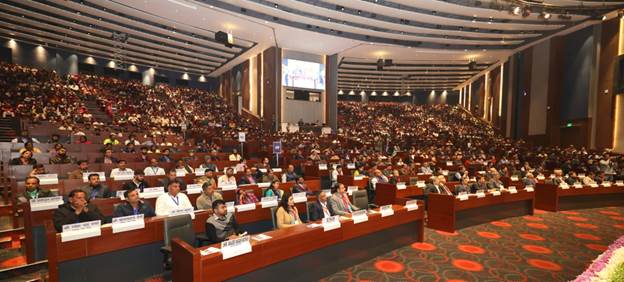
Union Home Minister and Minister of Cooperation, Shri Amit Shah, inaugurated 10,000 newly established Multipurpose Primary Agricultural Credit Societies (MPACS), along with Dairy and Fisheries Cooperative Societies, in New Delhi today. The event witnessed the presence of several dignitaries, including Union Minister for Fisheries, Animal Husbandry, and Dairying Shri Rajiv Ranjan Singh, alias Lalan Singh, Union Ministers of State for Cooperation Shri Krishan Pal and Shri Murlidhar Mohol, as well as the Secretary of the Ministry of Cooperation.

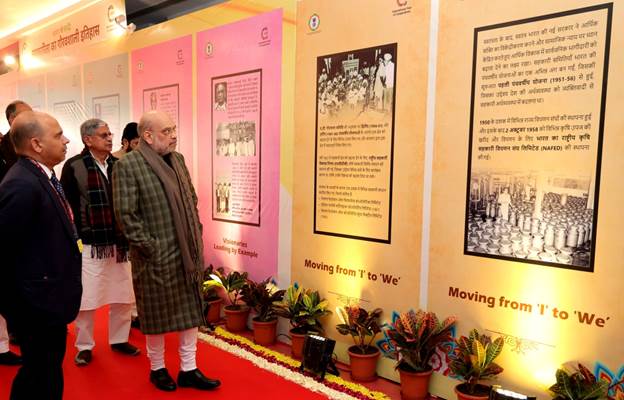
Shri Amit Shah began his address by paying homage to two eminent figures—Pandit Madan Mohan Malviya and former Prime Minister Shri Atal Bihari Vajpayee—on their birth anniversaries. He lauded Pandit Malviya as a leading figure in India’s freedom struggle who dedicated his life to promoting the nation’s independence, culture, and Indianness, as well as upholding the values of Hinduism. Speaking about Shri Atal Bihari Vajpayee, Shri Shah highlighted his remarkable contribution as the voice of India and its culture in Parliament for over five decades. He credited Atal Ji’s visionary leadership as Prime Minister, which laid the foundation for India’s rise, including the establishment of nuclear power capabilities and steadfast leadership during the Kargil War. Shri Shah also noted Atal Ji’s transformative initiatives, such as the creation of a separate ministry for tribal affairs, the development of the ‘Golden Quadrilateral’ highways, and the launch of the Pradhan Mantri Gram Sadak Yojana (PMGSY) to connect villages with state highways. Shri Shah further observed that the day also marks the death anniversary of Shri C. Rajagopalachari, a revered freedom fighter and scholar of Vedic and ancient Indian literature. He praised Rajagopalachari’s significant contributions to the drafting of India’s Constitution and his enduring legacy in the nation’s history.

2.JPG

Union Home Minister and Minister of Cooperation announced the launch of 10,000 new Multipurpose Primary Agricultural Credit Societies (MPACS), along with Dairy and Fisheries Cooperative Societies, coinciding with the birth centenary of Shri Atal Bihari Vajpayee. He emphasized that this milestone is deeply symbolic, as it was during Atal Ji’s tenure that the 97th Constitutional Amendment was enacted, highlighting his commitment to revitalizing the long-overlooked cooperative sector.

Shri Amit Shah highlighted that on September 19, 2024, an SOP was established, and within just 86 days, the registration of 10,000 PACS was successfully completed. He noted that Prime Minister Shri Narendra Modi, upon establishing the Ministry of Cooperation, introduced the motto ‘Sahkar Se Samriddhi’ (Prosperity through Cooperation). Shri Shah emphasized that achieving this vision requires the presence of cooperatives in every Panchayat, actively contributing in some capacity. He explained that primary cooperative societies are the foundation of India’s three-tier cooperative structure, which is why the Modi government has set an ambitious target to establish 2 lakh new PACS.

3.JPG

Union Minister of Cooperation acknowledged the crucial role of NABARD, NDDB, and NFDB in facilitating the registration of 10,000 PACSs. He highlighted that one of the most significant initiatives after the establishment of the Ministry of Cooperation was the computerization of all PACS. This modernization has enabled the integration of PACS with 32 diverse activities, including storage, manure, gas, fertilizer, and water distribution, making them more versatile and effective. Shri Amit Shah noted that these advancements require skilled manpower, which led to the launch of a comprehensive training module. This module aims to equip PACS members and employees with the necessary knowledge and skills. He emphasized that district cooperative registrars must take responsibility for implementing the training program effectively, ensuring the secretaries and executive members of PACS receive quality training.

4.JPG

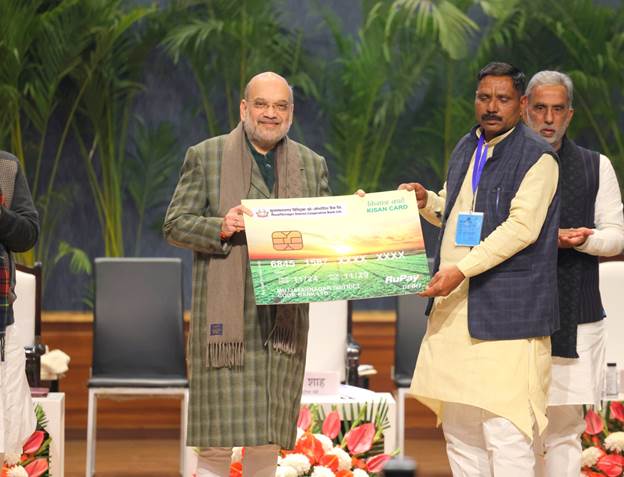
Union Home Minister and Minister of Cooperation Shri Amit Shah distributed the RuPay Kisan Credit Cards and Micro-ATMs to 10 cooperative societies, marking a significant step towards empowering farmers. He stated that every primary dairy will soon be equipped with a Micro-ATM as part of the ongoing campaign. These tools will enable farmers to access low-cost loans, facilitating financial inclusion and support. Shri Shah highlighted that the expansion of PACS is guided by four key principles: visibility, relevance, viability, and vibrancy. By integrating 32 different functions into PACS, their visibility and viability have been significantly enhanced. He explained that transforming Common Service Centres (CSC) into PACS in villages ensures that every citizen benefits from their services, increasing their relevance. Furthermore, PACS’ involvement in activities such as gas distribution, storage, and petrol distribution adds vibrancy and sustainability to their operations. Shri Shah described the initiative as a comprehensive program aimed at strengthening farmers and the rural economy, ensuring the long-term impact and multi-faceted growth of PACS.

Shri Amit Shah emphasized that the integration of computerization and technology will enhance transparency within PACS, enabling their expansion at the grassroots level. This modernization will not only improve operational efficiency but also create employment opportunities for women and youth. He highlighted that PACS will play a vital role in ensuring the easy availability of essential agricultural resources for farmers. Shri Shah further noted that the establishment of three new national-level cooperatives—NCOL, BBSSL, and NCEL—will unlock new opportunities for farmers by promoting organic products, quality seeds, and exports. Additionally, he stressed that the adoption of new model bylaws ensures the active participation of women, Dalits, backward communities, and tribals, fostering social and economic equality and enhancing social harmony.

5.JPG

Union Minister of Cooperation shared that the Modi government has set an ambitious target of establishing 2 lakh new PACS within the next five years and expressed confidence that this goal will be achieved ahead of schedule. He detailed the phased approach for this initiative, with NABARD forming 22,750 PACS in the first phase and 47,250 in the second. Similarly, NDDB will establish 56,500 new societies while strengthening 46,500 existing ones, and NFDB will create 6,000 new fisheries cooperative societies while empowering 5,500 existing ones. Additionally, state cooperative departments will contribute by forming 25,000 PACS. Shri Shah highlighted that, to date, 11,695 new primary cooperative societies have been registered under the new model bylaws, marking a significant milestone. He emphasized that once the target of 2 lakh PACS is achieved, it will greatly facilitate the seamless integration of farmers’ produce into global markets through robust forward and backward linkages.

Dr. Jitendra Singh Launches ‘Viksit Panchayat Karmayogi’ Initiative to Empower Grassroots Governance

| Published on:

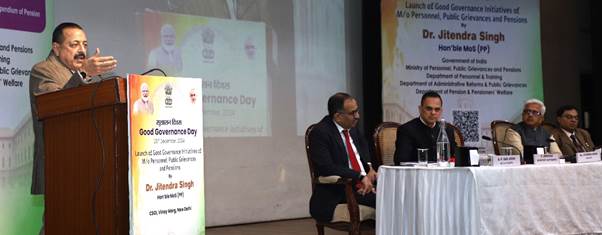
In a significant step towards strengthening grassroots governance, Union Minister of State (Independent Charge) for Science and Technology; Earth Sciences and Minister of State for PMO, Department of Atomic Energy, Department of Space, Personnel, Public Grievances and Pensions, Dr. Jitendra Singh launched the ‘Viksit Panchayat Karmayogi’ initiative on Good Governance Day, celebrated to mark the 100th birth anniversary of former Prime Minister Atal Bihari Vajpayee.

The initiative, which is part of the broader ‘Prashasan Gaon Ki Aur’ campaign, aims to enhance the capacity and competence of Panchayati Raj Institutions (PRIs) by equipping elected representatives and officials with the tools and knowledge required for effective governance and participatory planning.

Speaking at the event, Dr. Jitendra Singh emphasized that governance reforms must begin at the grassroots to bring about long-lasting and meaningful change as well as to fill up the capacity gaps. The “Viksit Panchayat Karmayogi” initiative focuses on strengthening Panchayati Raj Institutions (PRIs) through innovative tools and capacity-building frameworks.

Piloted in Odisha, Assam, Gujarat, and Andhra Pradesh, the initiative leverages e-learning platforms, AI-powered chatbots, and mobile apps to bridge knowledge gaps and enhance service delivery” said the Minister. Dr. Jitendra Singh emphasized that this program aligns with the government’s broader mission to decentralize governance and foster participatory decision-making at the grassroots level. The initiative is expected to create scalable models of citizen-centric governance, enabling PRIs to drive equitable and sustainable development across rural India.

Marking Good Governance Day Dr. Jitendra Singh launched a series of other transformative initiatives aimed at enhancing efficiency, transparency, and citizen-centric governance. These initiatives, rooted in leveraging technology and fostering collaboration, underscore the government’s commitment to inclusive and accountable administration.

The first initiative unveiled by Dr. Jitendra Singh was the launch of a new dashboard on the iGOT Karmayogi platform, along with the milestone introduction of the 1600th e-learning course. The enhanced dashboard is designed to empower ministries, departments, and state administrators with advanced tools to monitor user registrations, course completions, and overall progress in capacity-building efforts. With customizable views and robust data filtration capabilities, the dashboard provides detailed insights to improve decision-making and optimize training initiatives. Additionally, the introduction of the 1600th course on the platform underscores the government’s commitment to fostering a diverse and comprehensive learning ecosystem. These courses, curated in collaboration with government and private ecosystem partners, aim to equip officials with the skills and knowledge needed to address dynamic challenges in governance. Together, these developments represent a significant stride toward building a capable, future-ready civil service aligned with the vision of Mission Karmayogi.

The second was the launch of Viksit Panchayat Karmayogi initiative.

A group of men sitting at a tableDescription automatically generated

The third initiative, the launch of CPGRAMS Annual Report 2024, provides a comprehensive review of the Centralized Public Grievance Redress and Monitoring System. As the world’s largest citizen interface platform, CPGRAMS has redefined grievance redressal by integrating advanced technologies, multilingual support, and comprehensive tracking mechanisms. The report showcases key achievements, including the resolution of over 25 lakh grievances annually and the implementation of the Grievance Redressal Assessment and Index (GRAI). By fostering transparency, accountability, and best practices, CPGRAMS has significantly improved public service delivery and government responsiveness, solidifying its role as a cornerstone of governance reforms.

The fourth initiative, the Single Simplified Pension Application Form, revolutionizes pension processing for retiring officials. Combining nine separate forms into one streamlined digital format, the new system ensures end-to-end digitization through the integration of e-HRMS with Bhavishya. Dr. Jitendra Singh highlighted the initiative’s benefits, including real-time tracking of pension applications, Aadhaar-based e-signatures, and seamless verification through e-Service Books. This innovation reduces processing time and costs, ensuring timely disbursement of pensions while enhancing user experience through a pensioner-friendly interface.

Another significant initiative launched during the event was the Compendium of Pension Related Instructions, 2024, a comprehensive document consolidating all updated rules, procedures, and guidelines related to pensions. This compendium serves as a single-window reference for pensioners and administrative personnel, eliminating ambiguities and ensuring clarity in pension-related processes. Dr. Jitendra Singh highlighted that this initiative aligns with the government’s vision to simplify and streamline pension systems, making them more accessible and user-friendly. By integrating the latest amendments, including digital innovations and procedural reforms, the compendium is expected to enhance the ease of living for pensioners and promote efficient pension administration across the country.

A person standing at a podiumDescription automatically generated

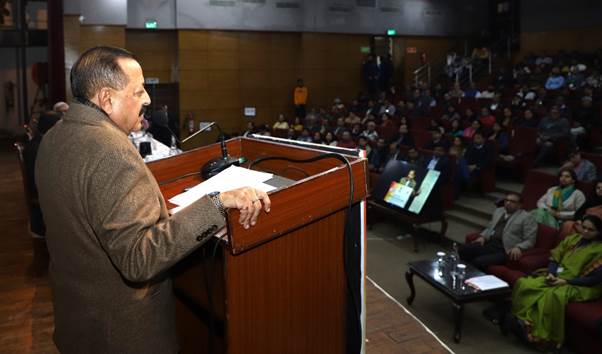
Dr. Jitendra Singh reflected on the progress made in governance reforms under the Modi administration since 2014, focusing on inclusive and participatory governance as a cornerstone of the government’s approach. He remarked that Good Governance Day, institutionalized by Prime Minister Narendra Modi, serves as a reminder of the government’s commitment to initiatives that directly impact citizens’ lives.

The Minister pointed to several governance milestones achieved in recent years. Among these, he highlighted the liberalization of childcare leave and the extension of maternity benefits to women delivering stillborn babies, which he described as measures that promote equity and address long-standing societal issues. He highlighted the introduction of face recognition technology for digital life certificates for pensioners, a significant step in simplifying processes for elderly citizens. Recalling the hardships faced by pensioners in the past, he shared how the government has moved from paper-based to biometric and now to face recognition technology, ensuring ease and accessibility for all.

Reflecting on India’s journey towards its centenary as an independent nation in 2047, Dr. Jitendra Singh outlined the need to prepare for a future where citizens can independently manage governance processes with minimal reliance on bureaucratic systems. He shared his experience of introducing AI-driven mobile health clinics in rural areas, highlighting how technology not only facilitates governance but also captivates and engages communities.

Dr. Jitendra Singh also paid tribute to Atal Bihari Vajpayee, whose vision for good governance inspired the institutionalization of this day. He stated that each year, the government strives to introduce new initiatives that add value to governance and reflect its dynamic and evolving nature.

Dr. Jitendra Singh lauded the efforts of the Secretary and other senior officials of the Ministry of Personnel, Public Grievances and Pensions for their relentless commitment to driving transformative governance reforms. He commended their innovative approach and dedication to making citizen-centric administration a reality.

Concluding his address, Dr. Jitendra Singh remarked that initiatives like ‘Viksit Panchayat Karmayogi’ exemplify the government’s commitment to inclusivity, transparency, and technological innovation. By empowering panchayats and ensuring participatory governance, the government aims to lay the foundation for a future-ready India where citizens are active partners in shaping their destinies.

The launch event witnessed the participation of Shri V. Srinivas, Secretary, DoPT, DARPG and Pension; Dr. R Balasubramaniam, Member, Capacity Building Commission; Sri Avinash Joshi, Additional Secretary, DoPT; Sri Manoj Kumar Dwivedi, Additional Secretary, DoPT, along with other senior officials, reflecting the collaborative spirit behind these transformative initiatives.

PM pays tribute to former PM Atal Bihari Vajpayee on his 100th birth anniversary

| Published on:

The Prime Minister, Shri Narendra Modi, paid tribute to former Prime Minister Shri Atal Bihari Vajpayee on his 100th birth anniversary today.

The Prime Minister posted on X:

“पूर्व प्रधानमंत्री भारत रत्न अटल बिहारी वाजपेयी जी को उनकी 100वीं जन्म-जयंती पर आदरपूर्ण श्रद्धांजलि। उन्होंने सशक्त, समृद्ध और स्वावलंबी भारत के निर्माण के लिए अपना जीवन समर्पित कर दिया। उनका विजन और मिशन विकसित भारत के संकल्प में निरंतर शक्ति का संचार करता रहेगा।”

Union Home Minister pays tributes to former PM Atal Bihari Vajpayee ji on his birth centenary at ‘Sadaiv Atal’ in New Delhi

| Published on:

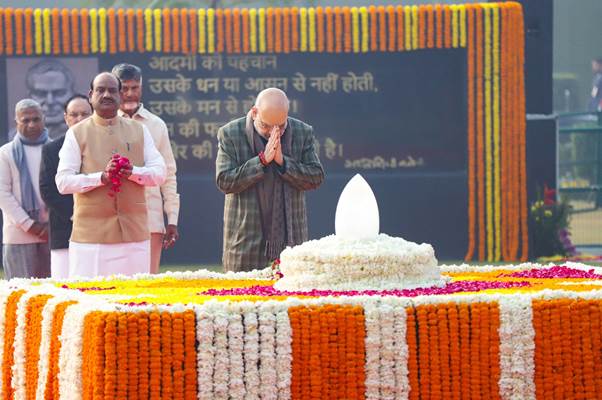
Union Home Minister and Minister of Cooperation Shri Amit Shah pays tributes to former Prime Minister late Shri Atal Bihari Vajpayee ji on his birth centenary at his Smriti Sthal ‘Sadaiv Atal’ in New Delhi

In his posts on X platform, Shri Amit Shah said that Atal ji’s dedication towards good governance and public welfare will continue to guide future generations. Bowing before Shri Atal Bihari Vajpayee ji on his birth anniversary, Shri Shah said that Atal ji ushered in a new era of development and good governance in the country with his dedication towards ideology and value-based politics. He said that Vajpayee ji made cultural nationalism a work culture and always kept the country’s security and public welfare paramount. He said that Atal ji will continue to guide the countrymen on the path of national service till eternity like the Pole Star.

PM meets eminent economists at NITI Aayog

| Published on:

Prime Minister Shri Narendra Modi interacted with a group of eminent economists and thought leaders in preparation for the Union Budget 2025-26 at NITI Aayog, earlier today.

The meeting was held on the theme “Maintaining India’s growth momentum at a time of Global uncertainty”.

In his remarks, Prime Minister thanked the speakers for their insightful views. He emphasised that Viksit Bharat can be achieved through a fundamental change in mindset which is focused towards making India developed by 2047.

Participants shared their views on several significant issues including navigating challenges posed by global economic uncertainties and geopolitical tensions, strategies to enhance employment particularly among youth and create sustainable job opportunities across sectors, strategies to align education and training programs with the evolving needs of the job market, enhancing agricultural productivity and creating sustainable rural employment opportunities, attracting private investment and mobilizing public funds for infrastructure projects to boost economic growth and create jobs and promoting financial inclusion and boosting exports and attracting foreign investment.

Multiple renowned economists and analysts participated in the interaction, including Dr. Surjit S Bhalla, Dr. Ashok Gulati, Dr. Sudipto Mundle, Shri Dharmakirti Joshi, Shri Janmejaya Sinha, Shri Madan Sabnavis, Prof. Amita Batra, Shri Ridham Desai, Prof. Chetan Ghate, Prof. Bharat Ramaswami, Dr. Soumya Kanti Ghosh, Shri Siddhartha Sanyal, Dr. Laveesh Bhandari, Ms. Rajani Sinha, Prof. Keshab Das, Dr. Pritam Banerjee, Shri Rahul Bajoria, Shri Nikhil Gupta and Prof. Shashwat Alok.