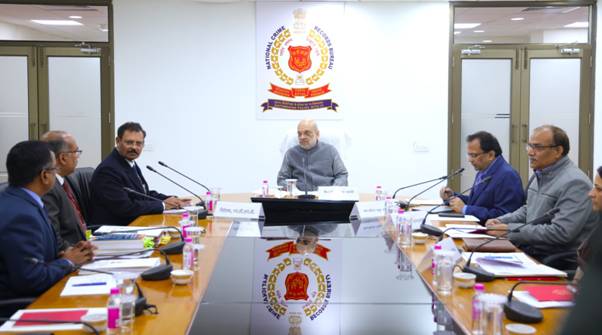
Union Home Minister chairs a review meeting with NCRB on implementation of three New Criminal Laws

| Published on:

Union Home Minister and Minister of Cooperation Shri Amit Shah chaired a review meeting on the implementation of three new criminal laws with National Crime Records Bureau (NCRB) in New Delhi. The meeting reviewed the implementation of integration of CCTNS 2.0, NAFIS, Prisons, Courts, Prosecution and Forensics with ICJS 2.0 at all India level. Union Home Secretary, Director NCRB and several senior officials of the Ministry of Home Affairs, NCRB and NIC were present in the meeting.

During the discussion in the meeting, the Union Home Minister asked NCRB to facilitate complete implementation of new criminal laws in the ICJS 2.0. Shri Amit Shah emphasised on using of applications like eSakshya, Nyaya Shruti, eSign and eSummons in every state / UT.

While emphasizing on the use of technology, Union Home Minister and Minister of Cooperation said that alerts should be generated for all the criminal cases at predefined stages and timelines right from registration to disposal of the case to benefit victims and complainants. Alerts to Investigation Officers as well as senior officers as per pre-define timelines will help in expediting the process of investigation. He emphasized that a team of officers of MHA, NCRB should visit the States/UTs to increase the adoption of technical projects and assist them in all possible ways.

Shri Amit Shah emphasised to have regular interaction with senior police formations of State/UTs to monitor the progress of Crime and Criminal Tracking Network & Systems (CCTNS) and Inter-Operable Criminal Justice System (ICJS) on regular basis and provide impetus to the project. He added that use of biometric technology should be adopted to identify unidentified dead bodies and unidentified found persons.

0I9A6552.JPG

Union Home Minister said that NCRB should create a data rich platform to benefit the Investigation Officers and other stakeholder of Criminal Justice System. He appreciated efforts of NCRB in the technical implementation of New Criminal Laws and National Automated Fingerprint Identification System (NAFIS).

PM distributes more than 71,000 appointment letters under Rozgar Mela

| Published on:

he Prime Minister Shri Narendra Modi addressed the Rozgar Mela and distributed more than 71,000 appointment letters to newly appointed youth in Government departments and organizations via videoconferencing today. Rozgar Mela highlights the Prime Minister’s commitment to prioritizing employment generation. It will empower the youth by providing them with meaningful opportunities to contribute to nation-building and self empowerment.

Addressing the gathering, the Prime Minister stated that he had  returned from Kuwait late last night, where he had extensive discussions with Indian youth and professionals.  And this is a very pleasant coincidence that after returning, his first program is with the youth of the country. “Today marks a new beginning for thousands of youth in the country. Your years of dreams have come true, years of hard work have paid off. This outgoing year of 2024 is bringing new happiness to you. I extend my heartfelt congratulations to all of you and your families”, the Prime Minister said.

The Prime Minister emphasised that the government is prioritizing the full utilization of India’s youth talent through initiatives like Rozgar Melas. Over the past 10 years, there has been a concerted effort to provide government jobs across various ministries and departments. Today more than 71,000 youth have been handed their appointment letters, the Prime Minister highlighted. Shri Modi underlined that in the last one and a half years, around 10 lakh permanent government jobs have been offered, setting a remarkable record. These jobs are being provided with complete transparency, and the new recruits are serving the nation with dedication and integrity.

The Prime Minister underscored that the development of a country relies on the hard work, capability, and leadership of its youth. India is committed to becoming a developed nation by 2047 as the country’s policies and decisions focus on empowering its talented youth. He said over the past decade, initiatives such as Make in India, Atmanirbhar Bharat, Startup India, Stand-Up India, and Digital India have placed youth at the forefront.

Shri Modi noted that India is now the world’s fifth-largest economy and the third-largest startup ecosystem. Today, Indian youth are brimming with new confidence. They are excelling in every sector. Young entrepreneurs launching startups today benefit from a robust support system. Similarly, youth pursuing careers in sports have confidence that they will not fail because they now are supported by  modern training facilities and tournaments. The Prime Minister noted that the country is undergoing a transformation across various sectors, becoming the second-largest in mobile manufacturing. India is also making strides in renewable energy, organic farming, space, defense, tourism, and wellness, creating new opportunities and reaching new heights in each area.

The Prime Minister underscored that to drive the country’s progress and to build a new India, nurturing young talent is crucial, and this responsibility lies with the education system. The National Education Policy (NEP) is guiding India toward a modern education system that offers students new opportunities. Shri Modi said previously, the system was restrictive, but now it fosters innovation through initiatives like Atal Tinkering Labs and PM-SHRI schools. “The government has also addressed language barriers for rural youth and marginalized communities by allowing learning and exams in the mother tongue, and providing recruitment exams in 13 languages. Additionally, quotas for youth from border areas have been increased, with special recruitment rallies for permanent government jobs. Today, over 50,000 youth received appointment letters for the Central Armed Police Forces, marking a significant achievement”, the Prime Minister added.

Talking about the birth anniversary of Chaudhary Charan Singh Ji today, the Prime Minister said the government feels privileged to honor him with the Bharat Ratna this year. “We also celebrate this day as Farmers’ Day, paying tribute to the farmers who provide us with food. Chaudhary Sahib believed that India’s progress depends on the progress of rural India. Our government’s policies have created new employment and self-employment opportunities in rural areas, especially for youth in agriculture”,  the Prime Minister added.

Shri Modi reiterated that initiatives like the Gobar-Dhan Yojana, which established biogas plants, have generated jobs while producing energy. The e-NAM scheme connecting agricultural markets has opened new employment avenues, and the increase in ethanol blending has benefited farmers and created jobs in the sugar sector. The Prime Minister underlined how the establishment of nearly 9,000 Farmer Producer Organizations (FPOs) has improved market access and created rural jobs. Also, the government is implementing a massive scheme to build thousands of grain storage warehouses, which will provide significant employment and self-employment opportunities.

The Prime Minister stated that  the government launched the Bima Sakhi Yojana to provide insurance coverage to every citizen, creating numerous employment opportunities in rural areas. Initiatives like Drone Didi, Lakhpati Didi, and Bank Sakhi Yojana are also generating jobs in agriculture and rural sectors. “Today, thousands of women have received appointment letters, and their success will inspire others. The government is committed to making women self-reliant in every field. The introduction of 26 weeks of maternity leave has safeguarded the careers of millions of women”, Shri Modi added.

The Prime Minister highlighted how the Swachh Bharat Abhiyan has removed the obstacles in women’s advancement, as many girl students had to drop out of school due to the lack of separate toilets. He said the Sukanya Samriddhi Yojana has ensured financial support for girls’ education. Also, 30 crore Jan Dhan accounts for women have provided direct benefits from government schemes. “Through the Mudra Yojana, women can now access collateral-free loans. The Pradhan Mantri Awas Yojana has ensured that most houses allotted are in women’s names. Initiatives like Poshan Abhiyaan, Surakshit Matritva Abhiyaan, and Ayushman Bharat offer better healthcare to women”, Shri Modi added.

Prime Minister Shri Modi emphasised that the Nari Shakti Vandan Adhiniyam has ensured reservations for women in assemblies and the Lok Sabha which will  advance women-led development in the nation.

The Prime Minister  remarked that the young individuals receiving appointment letters today are joining a newly transformed government system. Over the last decade, government offices have seen significant improvements in efficiency and productivity because of the dedication and hard work of government employees.

The Prime Minister stated that the new appointees had reached this goal because of their eagerness to learn and grow, and it’s important to maintain this attitude throughout their life. He highlighted the availability of various courses for government employees on the iGOT Karmayogi platform and encouraged them to utilize this digital training module at their convenience. “Once again, I congratulate the candidates receiving their appointment letters today”, the Prime Minister concluded.

Background

Rozgar Mela is a step towards fulfilment of the commitment of the Prime Minister to accord highest priority to employment generation. It will provide meaningful opportunities to the youth for their participation in nation building and self empowerment.

Rozgar Mela will be held at 45 locations across the country. The recruitments are taking place for various Ministries and Departments of the Central Government. The new recruits, selected from across the country will be joining various Ministries/Departments including Ministry of Home Affairs, Department of Posts, Department of Higher Education, Ministry of Health and Family Welfare, Department of Financial Services, among others.

PM participates in Christmas Celebrations hosted by the Catholic Bishops’ Conference of India

| Published on:

The Prime Minister Shri Narendra Modi  participated in the Christmas Celebrations hosted by the Catholic Bishops’ Conference of India (CBCI) at the CBCI Centre premises, New Delhi, today. This is the first time a Prime Minister has attended such a programme at the Headquarters of the Catholic Church in India. The Prime Minister also interacted with key leaders from the Christian community, including Cardinals, Bishops and prominent  leaders of the Church.

Wishing the citizens of the country, and the Christian community worldwide a very Merry Christmas, the Prime Minister stated that a few days ago he had attended  Christmas celebration at  Union Minister George Kurian’s residence, and today, he is  honored to join all for this event organized by the Catholic Bishops’ Conference of India (CBCI). This occasion is particularly special as it marks the 80th anniversary of the CBCI. Shri Modi congratulated the CBCI and everyone associated with it on this remarkable milestone.

The Prime Minister reminisced the last time he celebrated Christmas with CBCI was  at the Prime Minister’s residence, and today all are gathered at the CBCI campus. “I have also visited the Sacred Heart Cathedral Church during Easter, and I am grateful for the warmth I receive from all of you. I feel the same affection from His Holiness Pope Francis, whom I met earlier this year during the G7 summit in Italy—our second meeting in three years.  I invited him to visit India”, Shri Modi added.  The Prime Minister said that during his trip to New York in September, he had met Cardinal Pietro Parolin. These spiritual encounters inspire and strengthen the commitment to service.

The Prime Minister  recalled his recent meeting with  His Eminence Cardinal George Koovakad, who was recently conferred the title of Cardinal by His Holiness Pope Francis. The Prime Minister said that the Indian government, led by Union Minister George Kurian, sent a high-level delegation to this event. “When an Indian achieves such success, the entire country takes pride. I once again congratulate Cardinal George Kwakad on this remarkable accomplishment”, Shri Modi added.

The Prime Minister also recollected many memories, particularly the fulfilling moments when  Father Alexis Prem Kumar was rescued from war-torn Afghanistan a decade ago.  Shri Modi highlighted that Father Alexis Prem Kumar had been held hostage for eight months, and despite the difficult situation, the government made every effort to bring him home safely. “I will never forget the joy in his family’s voices when we succeeded. Similarly, when Father Tom was taken hostage in Yemen, we also worked tirelessly to bring him back, and I had the honor of inviting him to my home. Our efforts to rescue nurse sisters in crisis in the Gulf were equally relentless and successful”, the Prime Minister added.  Shri Modi reiterated that these efforts were not just diplomatic missions but emotional commitments to bring back family members. Today’s India, no matter where an Indian is, considers it its duty to rescue them in times of crisis.

The Prime Minister emphasised that India’s foreign policy prioritizes human interests alongside national ones, as demonstrated during the COVID-19 pandemic. While many countries focused on their own interests, India selflessly helped over 150 countries, sending medicines and vaccines. This had a positive global impact, with nations like Guyana expressing deep gratitude. Many island nations, Pacific nations, and Caribbean countries also praise India for its humanitarian efforts. India’s human-centric approach is set to elevate the world in the 21st century.

The Prime Minister underscored that the teachings of Lord Christ emphasize love, harmony, and brotherhood. And it saddens him when violence and disruption spreads in society, as seen recently at a Christmas market in Germany and during the 2019 Easter bombings in Sri Lanka, where he paid tribute to the victims.

Shri Modi stated that this Christmas is more special as it marks the beginning of the Jubilee Year, focused on hope. “The Holy Bible sees hope as a source of strength and peace. We are also guided by hope and positivity. Hope for humanity Hope for a better world and Hope for peace, progress and prosperity”, Shri Modi added.

The Prime Minister highlighted that in the past 10 years, 250 million people in India have overcome poverty, fueled by the hope that victory over poverty is possible. India has also risen from the 10th to the 5th largest economy, a testament to our self-belief and perseverance. This period of development has brought new hope for the future, with opportunities for youth in various fields such as start-ups, science, sports, and entrepreneurship. “The self-confident youth of India are driving the country toward progress, giving us hope that the dream of a developed India will be realized”, the Prime Minister added.

The Prime Minister emphasised that in the past 10 years, women in India have achieved remarkable empowerment, excelling in fields such as entrepreneurship, drones, aviation, and the Armed Forces. Their progress highlights that no country can advance without empowering women. Shri Modi said as more women join the workforce and professional labor force, it brings new hope for India’s future.

The Prime Minister stressed that in the past 10 years, India has made significant progress in under-explored sectors like mobile and semiconductor manufacturing, positioning itself as a global tech hub. He said the country is empowering the poor through technology and fintech while building infrastructure at an unprecedented pace, with new expressways, rural road connections, and metro routes. These achievements inspire hope and optimism for India’s future, and the world is now viewing India with the same confidence in its rapid growth and potential.

The Prime Minister said that the Bible teaches us to carry each other’s burdens, encouraging us to care for one another and take responsibility for each other’s well-being. With this mindset, institutions and organizations play a crucial role in social service, whether through establishing new schools, uplifting communities through education, or implementing health initiatives to serve the public. He said hese efforts are seen as collective responsibilities.

The Prime Minister reiterated that Jesus Christ showed the world the path of compassion and selfless service. We celebrate Christmas and remember Jesus so that we can incorporate these values into our lives and always prioritize our duties. This is not only our personal responsibility but also a social duty. “Today, the nation is advancing with this spirit, through the resolution of ‘Sabka Saath, Sabka Vikas, Sabka Prayas’. There were many subjects that were never thought of before, but they were the most necessary from a human perspective. We made them our priority.  We took the government out of rigid rules and formalities. We set sensitivity as a parameter. Ensuring every poor person gets a permanent house, every village gets electricity, removing darkness from people’s lives, providing clean drinking water, ensuring no one is deprived of treatment due to a lack of money. We created a sensitive system that can guarantee such services and such governance”, Shri Modi added.

The Prime Minister underscored that the government’s initiatives have significantly uplifted various communities. Under the PM Awas Yojana, when homes are built in the name of women, it empowers them. The Nari Shakti Vandan Act has increased women’s participation in Parliament. Shri Modi said the differently-abled community, once marginalized, is now prioritized in every field, from public infrastructure to employment.He said sensitivity in governance is crucial for economic growth, as seen with the creation of a separate fisheries ministry and programs like the Kisan Credit Card and Matsya Sampada Yojana, which have improved the lives of millions of fishermen and boosted the economy.

The Prime Minister said “From the ramparts of the Red Fort, I spoke of “Sabka Prayas,” or collective effort, highlighting the importance of each individual’s role in shaping the nation’s future. Socially conscious Indians are driving significant movements, such as Swachh Bharat, which has improved cleanliness and health outcomes for women and children”. Initiatives like promoting millets (Shree Anna), supporting local artisans, and the “Ek Ped Maa ke naam” campaign, which honors both Mother Nature and our mothers, are gaining momentum. Many from the Christian community are also active in these efforts. These collective actions are essential to building a developed India.

The Prime Minister said that he is confident that the collective efforts will propel the country forward. “A developed India is our shared goal, and together, we will achieve it. It is our responsibility to ensure that we leave a brighter India for future generations. Once again, I extend my heartfelt wishes to all of you for Christmas and the Jubilee Year”, Shri Modi concluded.

Union Home Minister delivers the ‘37th Intelligence Bureau Centenary Endowment Lecture’ in New Delhi

| Published on:

Union Home Minister and Minister of Cooperation, Shri Amit Shah, delivered the ‘37th Intelligence Bureau Centenary Endowment Lecture’ in New Delhi today. On this occasion, Union Home Secretary, Director of the Intelligence Bureau, former Directors of the Intelligence Bureau, Directors General of Central Police Forces and Central Armed Police Forces, and senior officials from the Intelligence Bureau and the Ministry of Home Affairs were present.
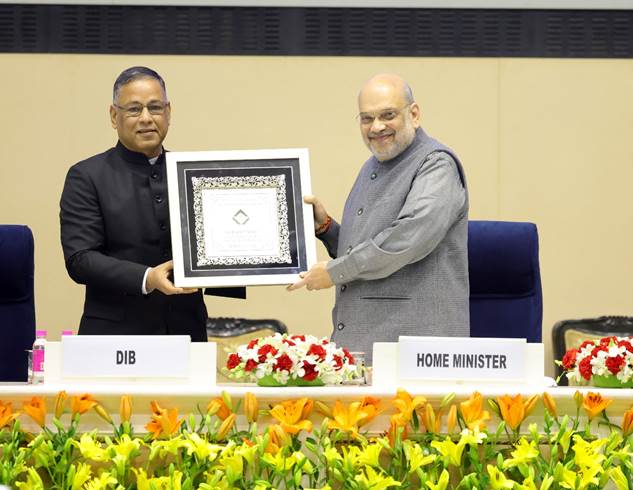
In his address, the Union Home Minister said that under the leadership of Prime Minister Shri Narendra Modi, our security agencies have established dominance over various threats to the nation by fighting a decisive battle over the last 5 years. He highlighted that till five years ago, the country faced three long-standing issues – the Northeast, Left-Wing Extremism, and Kashmir, that challenged its peace, law and order, security, and future. He added that due to the strict policies and tough decisions of the Modi government, the upcoming generations no longer need to worry about these three threats, as we have achieved almost decisive victory over them. Shri Shah mentioned that violent incidents in these three regions have dropped by 70%, and fatalities have reduced by approximately 86%.

Shri Amit Shah said that the working methodology of the Intelligence Bureau, its vigilance, proactiveness, decisive role, and the tradition of sacrifice and dedication—where credit is often passed on to others—have kept the country safe today. He remarked that over the past 10 years, there has been significant improvement in the Intelligence Bureau’s alertness, sharpness, and capability to deliver results. He further noted that the Bureau has not only maintained its tradition of integrity, courage, sacrifice, and dedication but has also taken it forward. He said that in the face of modern challenges and difficult circumstances, the Intelligence Bureau has kept the country safe over the past five years. He further emphasized that the ecosystem of any intelligence agency is not just the foundation of security, but also a fundamental necessity for the future and development of the country. He added that no country can progress without a robust intelligence ecosystem, as without it, the sovereignty and economic development of the nation is not possible.
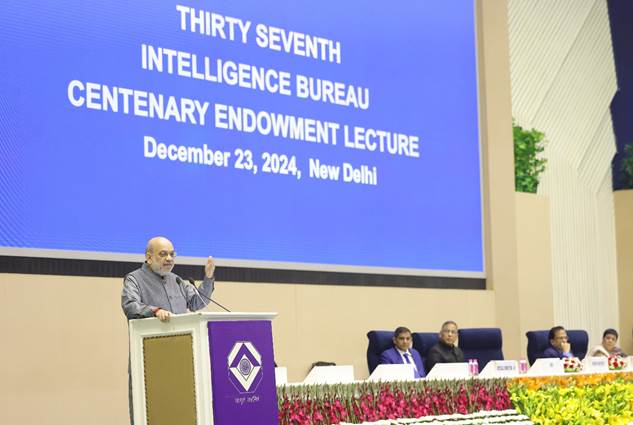
Union Home Minister and Minister of Cooperation, mentioned that in the current scenario, the impact of the intelligence ecosystem can be divided into four dimensions—society, sovereignty, security, and vigilance. He emphasized that seamless communication among these dimensions is essential to ensure the safety of the entire country. He highlighted that only a secure society is capable of laying the foundation for economic and social development. By identifying and eliminating threats in a timely manner, the intelligence ecosystem helps maintain trust and stability within society. Shri Shah remarked that if we are to fully control challenges such as Naxalism, terrorism, organized crime, divisive forces, communalism, narcotics, and antisocial elements, ensuring the security of society is of paramount importance.

Shri Amit Shah stated that in today’s era, the scope of sovereignty is no longer limited to territorial boundaries. He emphasized that if we do not include innovation, technology, the economy, resources, and research and development processes within the definition of sovereignty, we cannot ensure the safety of the country. He warned that even the slightest lapse in securing these areas would harm our sovereignty, and therefore, it is our duty to protect them. He further explained that security is no longer just about the protection of borders and citizens; we must now expand the definition of security to include new dimensions. He pointed out that with just one click of a computer, any country’s critical and digital infrastructure can be damaged. Shri Shah stressed that we need to broaden the Intelligence Bureau’s concept of security and prepare for the challenges of the future.

Union Home Minister stated that we must increase our vigilance regarding the rapid changes happening in areas like Artificial Intelligence (AI), Machine Learning (ML), and cyberspace. He emphasized that simply being alert to anti-national elements causing physical damage is no longer sufficient. In today’s context, the meaning of vigilance must evolve. He highlighted that information and data are powerful tools for development, and we must protect them by making radical changes to our traditional methods, modes, and mechanisms. Shri Shah further mentioned that in the coming days, the responsibility of preparing and equipping the Intelligence Bureau with the necessary technology will fall on young officers.

Shri Amit Shah stated that under the leadership of Prime Minister Modi, India will become the world’s third-largest economy by 2027. He pointed out that as we progress, competition intensifies, threats increase, and obstructive forces emerge. He emphasized that building a robust infrastructure to counter these threats, from headquarters to police stations and constables, with a unified sense of purpose is the responsibility of young officers. He further said that, in line with Prime Minister Modi’s vision, to achieve a fully developed India by 2047, we must visualize all potential threats and prepare a comprehensive roadmap to safeguard the nation from them. He remarked that inclusive development, along with peace and stability in the country, is only possible if we reshape our work in accordance with this expanded definition, prepare anew, and remain vigilant.

Union Home Minister and Minister of Cooperation highlighted that over the past 10 years under the Modi government, significant successes have been achieved in combating terrorism, Naxalism, insurgency, narcotics, and anarchic elements. He highlighted that since 2014, the Central Government has enhanced and strengthened anti-terrorism capabilities through a “Whole of Government Approach.” He noted that the Modi government has undertaken numerous initiatives to empower agencies and expand their capabilities. A major focus has also been placed on improving coordination between states and agencies. Shri Shah further mentioned that the government has strengthened these agencies by providing them with the backing of the law and amending several legislations to enhance their effectiveness.
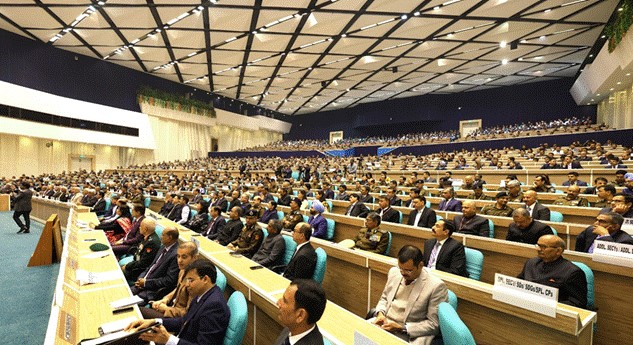
Shri Amit Shah said that the Modi government introduced three new criminal laws starting from July 1 this year. He said that after discussing with all the stakeholders in many meetings for 5 years, we have come up with these laws. He said that he himself was involved in the entire process of making these laws. Home Minister expressed confidence that, once these laws are fully implemented, India’s criminal justice system will become the most modern in the world. He stated that after the implementation of these laws, justice will be delivered within 3 years for any FIR registered in the country, right up to the Supreme Court. Shri Shah emphasized that by practicing these new laws, they can be used in various matters related to national security. Home Minister pointed out that these three laws contain provisions that will address security needs in the future. He stressed the need to form a team and make arrangements for training at all levels to ensure their effective implementation.

Union Home Minister stated that under the leadership of Prime Minister Modi, India has successfully transitioned from being a regional leader to a global leader in the past 10 years. He highlighted that India, once considered an outsider at international conferences, now not only hosts significant events but has also gained the power to determine the direction and course of diplomacy, economics, and security. He emphasized that it is our responsibility to maintain this achievement.

Shri Amit Shah said that divisive forces are still active in the country today. He emphasized that disinformation, misinformation, mal-information, and fake news have such power that they are always ready to disrupt the social fabric of our society with the help of new technology. Home Minister remarked that a country where social unity does not exist cannot progress in any meaningful way. He added that the responsibility of addressing these challenges and preparing the entire police force to tackle them now lies with the country’s information warriors.

Shri Amit Shah noted that attacks on critical infrastructure, cyberattacks, information warfare, psychological warfare, chemical warfare, and the radicalization of youth have emerged as intensified challenges before us. Home Minister expressed confidence that, just as the country’s security agencies have faced all challenges until now, they will be able to confront these threats with the same readiness and vigilance.

He pointed out that challenges such as using misinformation to provoke separatism, communal riots, drug trade via social media, cyber espionage, and cryptocurrency-related issues have now emerged as unique challenges. He emphasized that in order to tackle these challenges, we must prepare our agencies with new methods, stepping beyond traditional approaches. He stressed that we need to think “out of the box” to find solutions, because as the challenges evolve, our strategies must also change.

Shri Amit Shah stated that in the coming days, we must increase the use of Artificial Intelligence and Machine Learning. He emphasized the need to develop an intelligence coordination strategy with friendly nations to detect anti-India organizations and networks, and this strategy must include offensive measures as well. He mentioned that merely sharing information is not enough; we must also ensure that we receive vital intelligence from them. Home Minister further noted that the time has come to use block chain analysis tools for crypto currency. He also highlighted the need to take prompt and decisive action against hoax calls and fake emails, as enemies of the country are successfully creating an atmosphere of fear and terror among the public through these means.

Union Home Minister and Minister of Cooperation, Shri Amit Shah, stated that for the Intelligence Bureau (IB) to realize the vision of a developed India, it must prepare itself to become a cutting-edge intelligence agency. He emphasized that young officers must step forward to achieve this goal. He explained that the success of any security agency is based on its workforce and its ability to train its personnel. Home Minister also highlighted the need to build a robust ecosystem to counter misinformation. He stressed that to reduce the spread of propaganda to zero, we need to have a strategy, technology, and readiness in place.

Dr. Jitendra Singh addresses “Good Governance” workshop

| Published on:

Addressing at the National Workshop on Good Governance Practices, Union Minister of State (Independent Charge) for Science and Technology; Earth Sciences and Minister of State for PMO, Department of Atomic Energy, Department of Space, Personnel, Public Grievances and Pensions, Dr. Jitendra Singh highlighted the transformative initiatives that have reshaped governance under Prime Minister Narendra Modi’s leadership.

Speaking at the event inaugurating Good Governance Week, Dr. Jitendra Singh praised the “whole-of-government” approach as a key driver of these reforms. The week, running from December 19 to 25, coincides with the 100th birth anniversary of former Prime Minister Atal Bihari Vajpayee, who is celebrated for his legacy in governance.

Dr. Jitendra Singh commended the collaborative efforts across government departments and ministries, which have advanced both administrative efficiency and social welfare. “The whole-of-government approach has harmonized efforts to implement governance reforms that are efficient, inclusive, and impactful,” he remarked. A significant aspect of his address focused on innovations in waste management and the prioritization of cleanliness, which have evolved into models of economic and environmental sustainability.

The Union Minister lauded the Swachhata Campaign, calling it a landmark initiative that has reshaped governance. Over ₹2,364 crores were generated in just four years through the systemic clearance and monetization of scrap and obsolete materials from government offices. “Governance practices have evolved from reducing file journey time and promoting digitalization to creating wealth from waste,” Dr. Jitendra Singh noted.

The Minister further highlighted the financial success of this initiative by comparing it to the cost of Chandrayaan, India’s lunar mission. “While Chandrayaan cost ₹600 crore, we earned four times that by monetizing waste—resources that had been dormant for decades,” he explained. The initiative has also cleared over 643 lakh square feet of office space, creating opportunities for repurposing these areas.

Dr. Jitendra Singh recalled the Prime Minister’s call for building toilets during his 2014 Independence Day speech, a pivotal moment that led to the construction of over 4 lakh women’s toilets, addressing a critical societal need. This grassroots initiative demonstrated how governance could drive transformational change.

In discussing pioneering waste management steps, the Minister pointed to initiatives like converting household waste into fuel and recycling used cooking oil into biofuel. A pilot project was undertaken in Dehradun, which  curtailed harmful reuse practices and promoted recycling. “Every bit of waste is wealth,” he emphasized, highlighting India’s leadership in the global movement towards a circular economy.

Dr. Jitendra Singh also spoke about mobile waste conversion vans, which are equipped to turn waste into usable resources on-site, reducing reliance on centralized facilities. “These technologies make waste management more accessible and efficient,” he stated.

Positioning waste management and sustainability as central to India’s economic ambitions, the Minister declared, “The next industrial revolution will be driven by recycling.” He pointed to innovations in biotechnology and material sciences at government and private research institutes that are transforming waste into fuel, fertilizers, and industrial raw materials.

Dr. Jitendra Singh stressed the importance of extending good governance practices to the grassroots level, engaging districts, panchayats, and local communities. Drawing inspiration from the success of the Swachh Bharat Mission, he urged greater civil society involvement. “When governance aligns with people’s participation, it becomes a mass movement,” he observed.

Looking ahead, the Minister announced plans to integrate public and private sector efforts more thoroughly in future campaigns, suggesting that public sector practices could benefit from the efficiency and waste-eliminating practices of the private sector.

During the event, Dr. Jitendra Singh released the assessment report of Special Campaign 4.0, which showcased significant milestones in advancing cleanliness and efficiency across government offices. The report highlighted the clearance of thousands of pending files, monetization of scrap materials, and optimization of office spaces. Additionally, the Minister inaugurated an exhibition featuring “waste to wealth” products created by various government departments, underscoring the government’s commitment to sustainability and resource efficiency.

Concluding his address, Dr. Jitendra Singh reiterated the government’s commitment to fostering innovative, inclusive, and sustainable governance. “Good governance is not just about policies and reforms; it’s about creating a system where nothing goes to waste. We are building a New India where governance transforms challenges into opportunities,” he stated.

As Good Governance Week continues, the Minister called for ongoing collaboration and innovation, with the lessons learned from this event set to inspire future campaigns. “The integration of administrative reforms, technological solutions, and societal participation is the cornerstone of New India’s governance model,” he concluded.

The event was attended by distinguished dignitaries, including Shri V. Srinivas, Secretary, DARPG; Smt. Vandita Kaul, Secretary, Posts; Shri R. Rajagopal, DG(HR), Railway Board; and Shri Arun Singhal, DG, National Archives of India.

PM remembers former PM Chaudhary Charan Singh on his birth anniversary

| Published on:

The Prime Minister, Shri Narendra Modi, remembered the former PM Chaudhary Charan Singh on his birthday anniversary  today.

The Prime Minister posted on X:
“गरीबों और किसानों के सच्चे हितैषी पूर्व प्रधानमंत्री भारत रत्न चौधरी चरण सिंह जी को उनकी जयंती पर विनम्र श्रद्धांजलि। राष्ट्र के प्रति उनका समर्पण और सेवाभाव हर किसी को प्रेरित करता रहेगा।”

Prime Minister meets with Crown Prince of Kuwait

| Published on:

​Prime Minister Shri Narendra Modi met today with His Highness Sheikh Sabah Al-Khaled Al-Hamad Al-Mubarak Al-Sabah, Crown Prince of the State of Kuwait. Prime Minister fondly recalled his recent meeting with His Highness the Crown Prince on the margins of the UNGA session in September 2024.

Prime Minister conveyed that India attaches utmost importance to its bilateral relations with Kuwait. The leaders acknowledged that bilateral relations were progressing well and welcomed their elevation to a Strategic Partnership. They emphasized on close coordination between both sides in the UN and other multilateral fora. Prime Minister expressed confidence that India-GCC relations will be further strengthened under the Presidency of Kuwait.

Prime Minister invited His Highness the Crown Prince of Kuwait to visit India at a mutually convenient date.

His Highness the Crown Prince of Kuwait hosted a banquet in honour of Prime Minister.

Prime Minister meets the Amir of Kuwait

| Published on:

Prime Minister Shri Narendra Modi met today with the Amir of Kuwait, His Highness Sheikh Meshal Al-Ahmad Al-Jaber Al-Sabah. This was the first meeting between the two leaders. On arrival at the Bayan Palace, he was given a ceremonial welcome and received by His Highness Ahmad Al-Abdullah Al-Ahmad Al-Sabah, Prime Minister of the State of Kuwait.

The leaders recalled the strong historical and friendly ties between the two countries and re-affirmed their full commitment to further expanding and deepening bilateral cooperation. In this context, they agreed to elevate the bilateral relationship to a ‘Strategic Partnership’.

Prime Minister thanked His Highness the Amir for ensuring the well-being of over one million strong Indian community in Kuwait. His Highness the Amir expressed appreciation for the contribution of the large and vibrant Indian community in Kuwait’s development.
Prime Minister appreciated the new initiatives being undertaken by Kuwait to fulfill its Vision 2035 and congratulated His Highness the Amir for successful holding of the GCC Summit earlier this month. Prime Minister also expressed his gratitude for inviting him yesterday as a ‘Guest of Honour’ at the opening ceremony of the Arabian Gulf Cup. His Highness the Amir reciprocated Prime Minister’s sentiments and expressed appreciation for India’s role as a valued partner in Kuwait and the Gulf region. His Highness the Amir looked forward to greater role and contribution of India towards realisation of Kuwait Vision 2035.

⁠Prime Minister invited His Highness the Amir to visit India

Prime Minister conferred with the highest national award of Kuwait

| Published on:

His Highness Sheikh Meshal Al-Ahmad Al-Jaber Al-Sabah, the Amir of Kuwait conferred upon Prime Minister Shri Narendra Modi The Order of Mubarak Al- Kabeer, the highest national award of Kuwait. His Highness Sheikh Ahmed Al-Abdullah Al-Ahmad Al-Sabah, the Prime Minister of Kuwait also graced the occasion.

Prime Minister dedicated the award to the long-standing friendship between India and Kuwait, to the Indian community in Kuwait and to the 1.4 billion people of India.

The conferment of the award on this historic visit of a Prime Minister of India to Kuwait after 43 years added a special meaning to the occasion.

The award was instituted in 1974 and has since been conferred on select global leaders.

PM addresses Indian Community at ‘Hala Modi’ event in Kuwait

| Published on:

The Prime Minister Shri Narendra Modi today addressed a large gathering of the Indian community in Kuwait in a special event ‘Hala Modi’ at the Sheikh Saad Al-Abdullah Indoor Sports Complex in the city. Indian nationals representing a cross-section of the community in Kuwait attended the event.

​The Prime Minister was welcomed by the community with exceptional warmth and enthusiasm. Addressing the gathering, the Prime Minister noted that the India-Kuwait relationship has been profoundly enriched by the Indian community, which plays a pivotal role in fostering the ties between the two nations. Thanking His Highness the Amir of Kuwait for his gracious invitation, he stated that it was after 43 years that an Indian Prime Minister was visiting Kuwait to strengthen and solidify the age-old friendship.

The Prime Minister appreciated the hard work, achievement and contribution of the community to the development of Kuwait, which he said was widely recognized by the local government and society. He thanked the leadership of Kuwait for the welfare of the Indian community. Reflecting on India’s strong commitment to support Indian workers in Kuwait and elsewhere in the Gulf, he talked about technology-based initiatives undertaken by the Government such as the E-Migrate portal among others.

​The Prime Minister outlined India’s approach as a “Vishwabandhu”, a friend to the world. He elaborated upon India’s rapid progress and transformation, especially in the fields of technology, infrastructure and sustainability. He noted that apart from being the 5th largest economy in the world, India was the global leader in fintech, the third largest global player in the start-up space and among the most digitally connected societies worldwide. He highlighted achievements such as financial inclusion, women-led development and inclusive growth. Reflecting on the shared aspirations of the two countries, of Viksit Bharat and New Kuwait, he underlined that there were huge opportunities for India and Kuwait to work together. India’s skill capacities and innovation could foster new partnerships between the two countries.

The Prime Minister extended an invitation to diaspora members to participate in Pravasi Bharatiya Divas and Maha Kumbh to be held in India in January 2025.

PM attends Arabian Gulf Cup as Guest of Honour of His Highness the Amir of Kuwait

| Published on:

On the invitation of His Highness Sheikh Meshal Al-Ahmad Al-Jaber Al-Sabah, the Amir of Kuwait, Prime Minister Shri Narendra Modi attended the opening ceremony of the 26th Arabian Gulf Cup in Kuwait as his ‘Guest of Honour’. The Prime Minister joined His Highness the Amir, His Highness the Crown Prince, and His Highness the Prime Minister of Kuwait in witnessing the grand opening ceremony. The event also provided an opportunity for an informal interaction of the Prime Minister with the leadership of Kuwait.

​Kuwait is hosting the biennial Arabian Gulf Cup with participation from eight countries, including GCC nations, Iraq, and Yemen. This football tournament is one of the most prominent sporting events in the region. Kuwait has won the tournament maximum times among the participating countries. Prime Minister conveyed his best wishes to all the participating countries.

Prime Minister visits Labour Camp in Kuwait

| Published on:

As the first program of his visit to Kuwait, Prime Minister Shri Narendra Modi visited a labour camp in Mina Abdullah area of Kuwait with a workforce of around 1500 Indian nationals. Prime Minister interacted with a cross-section of Indian workers from different States of India and enquired about their well-being.

The visit to the labour camp is symbolic of the importance attached by the Prime Minister to the welfare of Indian workers abroad. In the last few years, the Government has undertaken several technology-based initiatives such as E-Migrate portal, MADAD portal and upgraded Pravasi Bharatiya Bima Yojana for the welfare of Indian workers abroad.