Union Home Minister releases ‘Jammu Kashmir & Ladakh Through The Ages : A Visual Narrative of Continuities and Linkages’ book in New Delhi

| Published on:

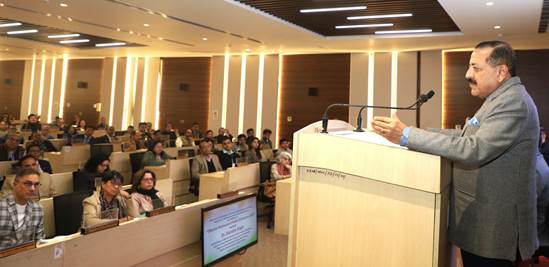
Union Home Minister and Minister of Cooperation, Shri Amit Shah, released the book ‘Jammu Kashmir & Ladakh Through the Ages: A Visual Narrative of Continuities and Linkages’ in New Delhi today. Many dignitaries including Union Minister of Education Shri Dharmendra Pradhan and Chairman of the Indian Council of Historical Research (ICHR) and Editor of the book Prof. Raghuvendra Tanwar were present on the occasion.

In his address, the Union Home Minister and Minister of Cooperation emphasized that the National Book Trust (NBT), through its latest publication, has effectively dismantled a long-standing myth about India by presenting facts and evidence, thereby establishing historical truths. He said that there was a myth that India was never united and the idea of ​​independence for this country was meaningless — a misconception that many had come to accept as truth. The Union Home Minister highlighted that while for most of the countries geo-politics have defined their boundaries, India’s case is unique where this nation has been defined by its geo-cultural expanse, and whose borders are made up of from cultural unity. He elaborated that India’s essence lies in its geo-cultural identity, with its cultural fabric binding the nation from Kashmir to Kanyakumari and from Bengal to Gujarat. He argued that interpreting India solely as a geo-political entity overlooks its true nature. Instead, a deep understanding of India requires viewing it through the lens of its geo-cultural identity. He stressed the importance of historical research and academic institutions in promoting this perspective to the world, as it is crucial to understanding the elements that culturally unify the country.
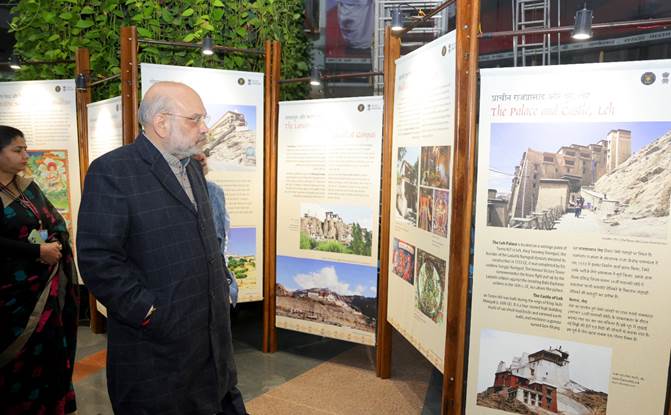
Shri Amit Shah highlighted the similar distortions that have affected the history of Jammu, Kashmir, and Ladakh. He asserted that interpreting the history of these regions by manipulating facts is both futile and misleading. Such distortions, he remarked, could only stem from the works of historians with a myopic vision. Those who know about India’s illustrious past will never commit such mistakes. Shri Shah pointed out that the book demonstrates, with evidence, that the culture, languages, scripts, spiritual philosophies, art forms, pilgrimage traditions, and trade practices found throughout India have been present in Kashmir for at least thousand years. He emphasized that once this historical truth is established, questioning Kashmir’s union with India becomes irrelevant. Shri Shah added that this book proves that our rich heritage, scattered across every corner of the country, has been present in Kashmir for thousands of years. The book draws upon references to Kashmir from texts as old as 8,000 years, reaffirming its integral role in the nation’s history. The Home Minister firmly stated that Kashmir always has been and will continue to remain an inseparable part of India. He stressed that no legal provision could ever sever this bond, and while there were attempts to separate Kashmir from India in the past, time itself has nullified those efforts. He said that Modi government is committed to revive the historic and cultural heritage of Kashmir, and we will soon reclaim what has been lost.

Union Home Minister remarked that the relationship between Kashmir, Ladakh, Shaivism, and Buddhism has been eloquently captured in this book and exhibition. He commended the documentation of scripts, knowledge systems, spirituality, culture, and languages, emphasizing the meticulous effort that went into presenting this rich heritage. The book vividly chronicles the journey of Buddhism—from Nepal to Bihar via Kashi, and onward to Afghanistan through Kashmir. He highlighted that Kashmir was the birthplace of the refined principles of Buddhism that emerged after Lord Buddha, as well as the foundation for many of the teachings that shape modern Buddhism. The book also features sculptures from Drass and Ladakh, discussions and images of stupas, depictions of temple ruins destroyed by invaders, and references to the use of Sanskrit in Jammu and Kashmir, as described in Rajatarangini. Covering Kashmir’s 8,000-year history, he likened this comprehensive effort to encapsulating the sacred Ganga within a vessel. The Home Minister reflected on the vast and, at times, challenging nature of history. He noted that for 150 years, some people’s understanding of history was confined to narrow geographies—from Dariba to Ballimaran or Lutyens to Gymkhana. He stressed that history cannot be written from a distance but requires engaging directly with the people and understanding their lived experiences.
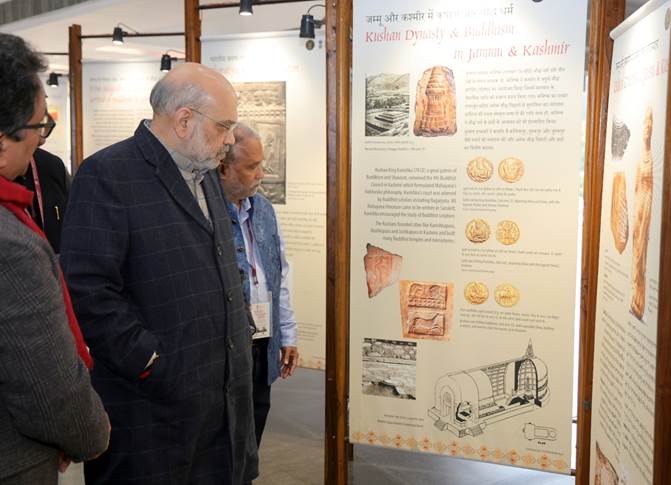
Shri Amit Shah emphasized that the time has come to move beyond history written to appease past rulers. He urged historians to confidently document India’s history using evidence, facts, and the perspective of its rich, millennia-old culture, and to present it to the world with pride. He remarked that today, India stands as an independent nation with a government committed to upholding the values and ideas rooted in its heritage. Shri Shah highlighted that Kashmir and Ladakh have historically served as centres of civilization, fostering creation, preservation, and cultural promotion. Numerous examples of this rich legacy are detailed in the book. He noted that Kashmir has always been a land of inclusivity, embracing and nurturing diverse faiths. Whether it is Buddhism, Sufism, or Shaivism, each tradition has found the freedom to thrive on Kashmiri soil. Shri Shah also pointed out that Kashmir is often referred to as the land of Kashyap, underscoring its historical and spiritual significance.

Union Home Minister and Minister of Cooperation highlighted the linguistic diversity of India as one of its greatest strengths, which is particularly evident in Kashmir. He noted that Prime Minister Shri Narendra Modi has revitalized regional languages by forming two Union Territories and recognizing their official languages. While Hindi, English, and Sanskrit have retained their importance, Prime Minister Modi has ensured the survival and growth of languages like Kashmiri, Balti, Dogri, Ladakhi, and Zanskari by incorporating them into governance. Shri Shah emphasized that this effort reflects Prime Minister Modi’s sensitivity and commitment to preserving the cultural and linguistic heritage of the nation, especially for languages spoken by small number of populations. Shri Shah remarked that Kashmir has long suffered under the onslaught of fundamentalists, invaders, and plunderers with expansionist ambitions.

Shri Amit Shah said that Articles 370 and 35A were obstacles, preventing Kashmir from being fully integrated with our country. Shri Shah noted that Prime Minister Modi’s resolute determination led to the abrogation of Article 370 on August 5, 2019. He further said that by abolishing Article 370, Modi ji ended a tainted chapter of post-independence history and initiated a new chapter of Kashmir’s development in tandem with the rest of India.

Union Home Minister and Minister of Cooperation said that Article 370 had sowed the seeds of separatism in the minds of the youth of the Kashmir Valley. He questioned why terrorism has not arisen in many parts of the country that have significant Muslim populations. He pointed out that states like Gujarat and Rajasthan also share borders with Pakistan, yet terrorism did not emerge there. He said that Article 370 created the misconception that the connection between India and Kashmir was temporary, which sowed the seeds of separatism that eventually turned into terrorism. He expressed regret over the unfortunate fact that more than 40,000 people fell victim to terrorism and that Kashmir’s development was set back by decades. He further remarked that for years, terrorism wreaked havoc in the region, while the nation stood by as a silent spectator.

Shri Amit Shah highlighted that after the abrogation of Article 370, there has been a reduction of over 70 per cent in terrorist incidents in Kashmir, which proves that Article 370 was a facilitator of terrorism. He mentioned that in 2018, there were 2,100 incidents of stone-pelting in Kashmir, whereas in 2023, not a single such incident occurred. He highlighted that over 25,000 panchayat members, including sarpanches, block panchayat members, and district panchayat members, were elected and are actively working for the development of their areas, thereby strengthening the roots of democracy in Kashmir. Shri Shah pointed out that there was a record turnout in the Lok Sabha and Assembly elections in 33 years. He further added that industries are now setting up in the region, and last year 2 crore 11 lakh tourists visited Kashmir. In 2023 alone, 324 serials or films were shot in the region. For the first time in 33 years, theaters in the Kashmir Valley held night shows, processions for Tazia were organized, and a Krishna Janmashtami tableau was seen at Lal Chowk in Srinagar. He emphasized that all these developments have taken place in the five years since the abrogation of Article 370.

Union Home Minister said that today, Kashmir is home to the world’s largest railway arch bridge, Asia’s largest tunnel, and a cable-stayed rail bridge. He highlighted that Kashmir now has an IIT, an IIM, two AIIMS, nine government medical colleges, two nursing institutes, two state cancer institutes’, eight colleges that are already operational, while 24 more are under construction. He added that 59 colleges have been accredited, and highway tunnels are being built—all of this achieved during the tenure of the Modi government. Shri Amit Shah questioned previous governments, asking why even 10 per cent of these developments did not occur during their 70 years of governance, and said they owe an explanation to both the nation and the people of Kashmir. He also mentioned that Prime Minister Modi implemented ₹80,000 crore development package for Jammu, Kashmir, and Ladakh. Furthermore, 4G and 5G networks have now been extended to approximately 87 per cent of the villages in the region.
Shri Amit Shah stated that the Modi government has not only brought terrorism under control but has also completely dismantled its ecosystem in the Kashmir Valley. He emphasized that the government has done everything for this land, which has made a significant contribution to the civilizations of the country and the world. Shri Shah said that due to the efforts of the Modi government, Kashmir has once again become an integral part of India’s geo-cultural nation and is moving forward on the path of development along with the rest of the country, with democracy firmly established there. He expressed confidence that whatever has been lost will soon be regained, including not only development but also the cultural heights and ancient glory of Kashmir. He remarked that the people of Kashmir will create and realize those immortal chapters of history on the ground. Home Minister further quoted Dr. Syama Prasad Mookerjee, who had said that Jammu and Kashmir is not just a part of India but an inseparable part of India’s soul. Shri Shah asserted that this has now been firmly established, and no one can deny it anymore.

Raksha Mantri meets senior scientists & officials of DRDO in New Delhi

| Published on:

Raksha Mantri Shri Rajnath Singh, on January 02, 2025, visited DRDO Headquarters in New Delhi, and interacted with senior scientists & officials to mark the 67th Foundation Day of the organisation. Raksha Rajya Mantri Shri Sanjay Seth also attended the meeting. In his address, Shri Rajnath Singh commended DRDO for developing the indigenous capabilities of the country by equipping the Armed Forces with state-of-the-art technologies/equipment, and bolstering the defence sector through collaboration with the private sector.

On 2025 being declared as the ‘Year of Reforms’, Raksha Mantri asserted that DRDO will play a crucial role in achieving the set objectives. He called upon DRDO to continue moving ahead in sync with the rapidly-evolving technological ecosystem, and keep coming out with products that are relevant to the changing times. He urged the scientists to keep an eye on the products & processes being adopted by the technologically-advanced countries, and develop niche technologies with the aim to make DRDO one of the strongest R&D organisations in the world. He also expressed his view that each lab of DRDO should identify 2-3 critical projects, which should be completed by 2025. “By the next foundation year, we should have 100 such projects completed,” he said.

Shri Rajnath Singh appreciated the efforts of DRDO towards increasing the collaboration with the private sector, including providing its technologies and free access to its patents. He urged the organisation to identify more such areas, which can enhance the participation of the private sector, emphasising that a nation can only progress when all stakeholders work together.

Raksha Mantri called upon DRDO to explore the possibility of including start-ups in its R&D efforts. This would promote valuable exchange of ideas and provide an opportunity for the Indian defence sector to come out with innovative technologies according to the changing times. He expressed that each lab should organise two open days every month for interaction with the industry. He also suggested that laboratories can raise awareness about the works being carried out by DRDO and motivate the youth to contribute to nation building.

“DRDO can play the role of a catalyst for other similar organisations, academia, industry, etc., which can help in bringing a technological revolution in the country. A new ecosystem can be created, which focusses on defence as well as dual-technology areas, that can bring about a transformative change for civilian users,” added Shri Rajnath Singh.

During the meeting, Secretary, Department of Defence R&D and Chairman DRDO Dr Samir V Kamat briefed Raksha Mantri about the ongoing R&D activities, achievements of DRDO in 2024, various initiatives of DRDO in promoting industry, start-ups & academia and the roadmap of DRDO for 2025. He said, so far 1,950 Transfer of Technologies (ToTs) on DRDO-developed systems have been handed over to Indian Industries, of which, 256 Licensing Agreements for ToTs were signed with Indian industries in 2024.

The DRDO Chairman added that more than 19 Development cum Production Partners/Production Agencies were chosen last year for Mission Mode projects. The DRDO test facilities have been opened to the industries for utilisation and over 18,000 tests have been carried out for private industries/DPSUs in the past three years with more than 5,000 tests in 2024 itself.

Shri Rajnath Singh also felicitated the design team of Long Range Hypersonic Anti Ship Missile on the occasion. DRDO celebrates its foundation day on 1st January every year.

Prime Minister wishes everyone a happy 2025

| Published on:

The Prime Minister Shri Narendra Modi today wished everyone a happy 2025.

In a post on X, he wrote:

“Happy 2025!

May this year bring everyone new opportunities, success and endless joy. May everybody be blessed with wonderful health and prosperity.”

We are determined to work even harder in 2025 and realise our dream of a Viksit Bharat: PM

| Published on:

Pleased by the feats achieved in 2024, the Prime Minister Shri Narendra Modi reiterated that Government was determined to work even harder in 2025 and realise the dream of a Viksit Bharat.

Responding to a video post by MyGovIndia on X, Shri Modi said:

“Collective efforts and transformative outcomes!

2024 has been marked by many feats, which have been wonderfully summed up in this video. We are determined to work even harder in 2025 and realise our dream of a Viksit Bharat.”

https://x.com/mygovindia/status/1873939565939163364


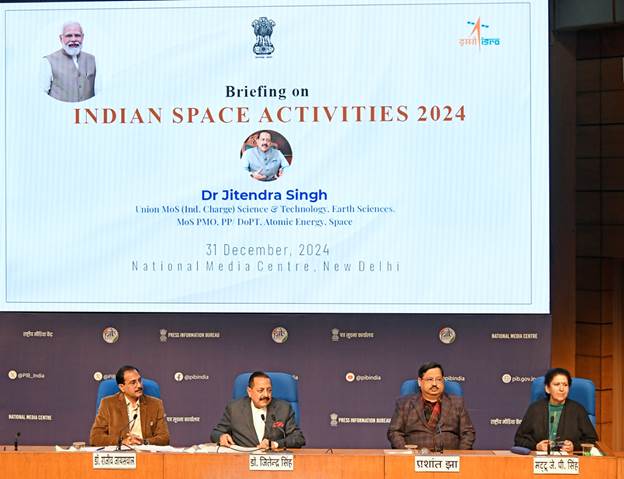
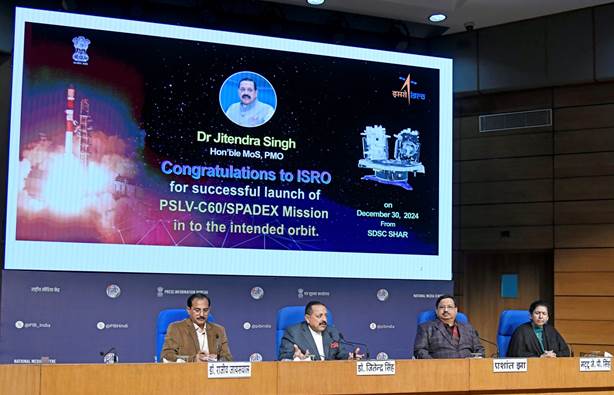
ISRO’s SPADEX Mission- A Giant Leap for India in Space Technology: Dr. Jitendra Singh

| Published on:

ISRO’s Space Docking Experiment (SPADEX) marks a groundbreaking achievement, placing India on par with global leaders in space docking technology. Union Minister Dr. Jitendra Singh hailed the mission as a milestone while addressing the media today in New Delhi following the successful launch of PSLV-C60 from Sriharikota on December 30.

Dr Jitendra Singh said, the SPADEX mission is a pivotal project by ISRO aimed at developing and demonstrating technologies for spacecraft rendezvous, docking, and undocking using two small satellites. These capabilities are critical for future missions, including satellite servicing, space station operations, and interplanetary exploration, he said.

The primary objectives of SPADEX, said the Minister, include Demonstrating technology for spacecraft rendezvous and docking, Showcasing controllability in docked conditions to extend the life of target spacecraft and Testing power transfer between docked satellites.

The mission also includes post-docking activities, with spacecraft conducting independent payload operations. According to Dr. Jitendra Singh the docking is expected to occur on January 7, 2025, at noon.

Dr. Jitendra Singh highlighted a significant collaboration between the Department of Biotechnology and ISRO to explore the application of biology in Space.

“Under PM Narendra Modi’s leadership, India will lead in ‘Space-Biology’ by studying physiological changes in space environments,” he stated.

_DSC9778.JPG

Reflecting on the transformation of India’s space journey, Dr. Jitendra Singh credited Prime Minister Modi for liberating the sector from a “veil of secrecy” that limited resources and innovation for decades. He noted the pivotal role of the 2023 New Space Policy, which for the first time allowed private sector participation in ISRO’s activities.

This policy has led to a surge in space startups, growing from a single-digit count in 2021 to nearly 300 in 2023. Notable startups include AgniKul Cosmos, which established a private launchpad on ISRO premises, and Skyroot, which executed India’s first private sub-orbital launch. “These startups are reinforcing ISRO’s infrastructure and attracting global attention from companies like SpaceX,” Dr. Singh remarked.

_DSC9762.JPG

According to Dr. Singh, the space economy—valued at $8.4 billion in 2023—is projected to grow to $44 billion by 2033. Investments in the sector reached ₹1000 crore in 2023 alone, placing India as a frontline player globally.

Dr. Singh outlined an ambitious timeline:January 2025: NAVIC advancements and the launch of a US satellite for mobile communication in February 2025: Vyommitra, a female robot, will undertake astronaut-like tasks for the Gaganyaan mission.2026: First crewed Gaganyaan mission.2035: India’s own space station, Bharat Antariksh.2047: First Indian astronaut to land on the moon.

He also highlighted achievements in 2024, such as the Aditya L1 solar mission and the launch of satellites for international clients.

India’s space sector has emerged as a significant foreign exchange earner. Of the €220 million earned through launching foreign satellites, €187 million—85% of the total—was generated in the last eight years. Countries benefiting from ISRO’s services include the USA, France, Japan, and more.

Dr. Jitendra Singh emphasized the diverse applications of space technologies in agriculture, defense, water resource management, smart cities, and infrastructure development. Initiatives like Mission Mausam for weather forecasting demonstrate the impact of India’s growing space capabilities.

Concluding the briefing, Dr. Jitendra Singh expressed optimism for India’s space sector. “Under Prime Minister Narendra Modi’s leadership, India’s space and science capabilities are at their peak. The upcoming years will witness unparalleled achievements and contributions to global space exploration,” he stated.

Shivraj Singh Chouhan reviews rural development works in Tamil Nadu

| Published on:

Union Minister for Rural Development, Agriculture & Farmers’ Welfare, Shri Shivraj Singh Chouhan reviewed the rural development works being carried out by the Central Government in Tamil Nadu in Chennai today. During this, Shri Shivraj Singh said that Tamil Nadu is a very ancient and great state of the country and Prime Minister Shri Narendra Modi’s resolve is the overall development of Tamil Nadu, hence from the point of view of rural development also, the Central Government has given assistance to Tamil Nadu in every scheme.

Union Minister Shri Shivraj Singh Chouhan informed during the review meeting that under the MGNREGA scheme in Tamil Nadu, the Central Government has given wages worth Rs. 12 thousand 603 crores to the laborers in the year 2023-24. This year also, 7 thousand 220 crore rupees have been released so far, so that no worker remains unemployed here, everyone has work. He told that we have given 10,352 roads and 214 bridges to Tamil Nadu under the Pradhan Mantri Gram Sadak Yojana. Out of these, 9,681 roads have been built, along with 150 bridges have also been built. Work is going on on 671 roads, it is expected that this work will also be completed on time.

Shri Shivraj Singh said that under the Pradhan Mantri Awas Yojana, our target is to build 8 lakh 15 thousand 771 houses in Tamil Nadu. Prime Minister Shri Modi’s target is that every poor person should get a permanent house, hence Pradhan Mantri Awas Yojana is being run. Out of 8 lakh 15 thousand 771 houses in Tamil Nadu, 7 lakh 47 thousand 542 houses have been approved so far and the first installment of 7 lakh 33 thousand 359 has also been released, out of which 6 lakh 31 thousand 512 houses have been completed. We have asked the Tamil Nadu government to complete the work of the remaining houses soon.

Union Minister Shri Chouhan said that this year too we have proposed to give 1 lakh 42 thousand 59 houses to Tamil Nadu for the poor, so that if the Tamil Nadu government wants, we will give houses here to the poor by March in this financial year, the first installment of which will be released. The construction of houses is going on, the remaining houses will be completed soon.

Shri Shivraj Singh said that apart from the Pradhan Mantri Awas Yojana, there is another ambitious scheme, the Women Empowerment Scheme, through which we are providing livelihood to poor sisters by forming self-help groups through the Livelihood Mission. The Prime Minister has given two targets to the country. One, two crore houses are to be built for the poor in rural areas and second, three crore Lakhpati Didis are to be created. Shri Chouhan expressed happiness that Lakhpati Didi program is also running in Tamil Nadu and about 10 lakh didis have become lakhpatis, Lakhpati Didi means a sister should earn more than one lakh rupees in a year, we are engaged in this campaign.

Union Minister Shri Shivraj Singh after reviewing all the schemes today has told all the colleagues of Tamil Nadu Government that under the leadership of Prime Minister Shri Narendra Modi, we will provide all possible support to Tamil Nadu under the schemes and the expectation is that the Government of Tamil Nadu should also complete all these schemes at a fast pace and serve its people better.

PM condoles the passing of former USA President Mr. Jimmy Carter

| Published on:

The Prime Minister, Shri Narendra Modi today condoled the passing of former USA President Mr. Jimmy Carter.

In a post on X, he wrote:

“Deeply saddened by the passing of former USA President Mr. Jimmy Carter. A statesman of great vision, he worked tirelessly for global peace and harmony. His contributions to fostering strong India-U.S. ties leave a lasting legacy. My heartfelt condolences to his family, friends and the people of the US.”

Mastering frontier technologies is need of the hour: Raksha Mantri

| Published on:

“Mastering frontier technologies in today’s constantly-evolving times is the need of the hour, and the military training centres are playing a crucial role in equipping & readying our soldiers to deal with future challenges,” said Raksha Mantri Shri Rajnath Singh while addressing the officers at the Army War College (AWC) in Mhow, Madhya Pradesh on December 30, 2024. Highlighting the radical changes being witnessed in the ways of warfare, he stated that unconventional methods like information warfare, Artificial Intelligence (AI)-based warfare, proxy warfare, electro-magnetic warfare, space warfare and cyber attacks are posing a big challenge in today’s times.

Raksha Mantri stressed on the need for the military to remain well-trained and equipped to deal with such challenges, lauding the training centres in Mhow for their valuable contribution in these efforts. He commended the centres for constantly improving their training curriculum, in sync with the changing times, and striving to make the personnel fighting fit for every kind of challenge.

Shri Rajnath Singh highlighted Prime Minister Shri Narendra Modi-led Government’s vision of making the country Viksit Bharat by 2047, describing the current phase as a transition period. “India is constantly moving on the path of development and is rapidly emerging as a manufacturing hub. From a military point of view, we are getting equipped with modern weapons. We are also exporting Made-in-India equipment to other countries. Our defence exports, which were around Rs 2,000 crores a decade ago, have crossed the record figure of Rs 21,000 crore today. We have set an export target of Rs 50,000 crore by 2029,” he added.

Raksha Mantri reasserted the Government’s resolve to strengthen integration and jointness among the three services, exuding confidence that, in the times to come, the Armed Forces will be able to face challenges together in a better and more efficient way. He appreciated the fact that high-level training is provided to officers of all wings in Mhow Cantonment. He urged the officers to explore the possibility of promoting integration through training in areas such as weapons training in Infantry School; AI & Communication Technology in Military College of Telecommunication Engineering (MCTE); and Leadership – Junior and Senior Command in AWC.

Shri Rajnath Singh added that some officers will work as defence attaches in the future, and they should strive to secure national interests at the global level. “When you take up this post of Defence Attaches, you should imbibe the Government’s vision of ‘Aatmanirbhar Bharat’. Only through self-reliance can India strengthen its defence capabilities and gain more respect on the world stage,” he added.

Raksha Mantri voiced the Government’s unwavering commitment to make India one of the strongest economic and military powers in the world. “Economic prosperity is possible only when full attention is paid to security. Similarly, the security system will be robust only when the economy is strong. Both complement each other. By 2047, we will not only become a developed nation, but our Armed Forces will also be one of the most modern and strongest militaries in the world,” he said.

Shri Rajnath Singh also urged the officers to internalise Dr BR Ambedkar’s values of dedication and spirit. He described Baba Saheb as not just the architect of the Indian constitution, but also a visionary guide, reiterating the Government’s commitment to introduce his values and ideals to the people, especially the youth.

Commending the Armed Forces for securing the borders & being the first responders during natural disasters, Raksha Mantri said: “This dedication to protect the nation and this spirit to keep ourselves updated in a constantly-changing world can take us ahead of others.”

At AWC, Shri Rajnath Singh was briefed by Commandant Lt Gen HS Sahi on the role and significance of the institute towards training and empowering military leaders for warfighting across the entire spectrum of conflict. He was briefed upon the significant steps in training methodology through jointness in multi-domain operations, infusion of technology in training curriculum and exchange programmes being undertaken with academia, universities and industries alongwith training of CAPF officers. He was also briefed on the global footprints of the institute achieved through training the officers from friendly countries and contributing immensely towards military diplomacy. Chief of the Army Staff General Upendra Dwivedi and other senior officials of the Indian Army were present on the occasion.

Earlier, Raksha Mantri laid a wreath and paid homage to the bravehearts at the Infantry Memorial.

On December 29, 2024, Raksha Mantri visited AWC, MCTE, Infantry School and the Army Marksmanship Unit in Mhow. He stated that all these establishments together create a confluence of the country’s golden past and a strong, prosperous & bright future. He described the Quantum Technology Lab and AI lab operating in MCTE as a positive step towards achieving the objective of Adaptive Warfare.

Dr. Jitendra Singh Chairs Year-End Review of Effective redressal of Public Grievances 2024

| Published on:

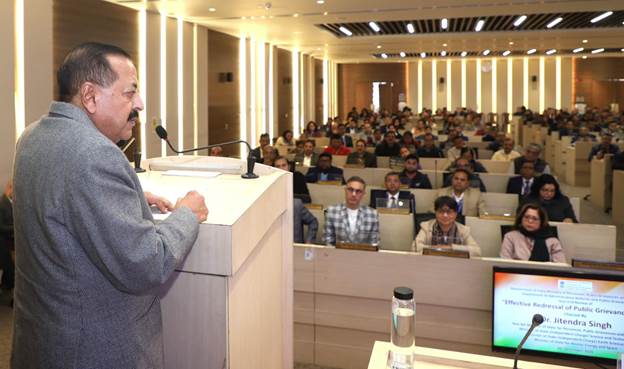
In a comprehensive year-end review held at the Indian Institute of Public Administration, Union Minister Dr. Jitendra Singh, Minister of State (Independent Charge) for Science and Technology, Earth Sciences, and Personnel, Public Grievances and Pensions, emphasized the transformative strides made in public grievance redressal under the Department of Administrative Reforms & Public Grievances (DARPG).

The Minister called for the integration of the “Whole of Government” and “Whole of Nation” approaches as envisioned by Prime Minister Narendra Modi, aiming to enhance effective governance outcomes and citizen satisfaction.

Dr. Singh highlighted the advanced capabilities of the Intelligent Grievance Monitoring System (IGMS) 2.0, developed with IIT Kanpur as the knowledge partner. This cutting-edge system incorporates Artificial Intelligence (AI) and Machine Learning (ML) to revolutionize grievance management on the CPGRAMS platform. By enabling predictive analyses and systemic insights, IGMS 2.0 facilitates informed policy interventions, ensuring better outcomes for citizens.

Underscoring the commitment to technology-driven reforms, Dr. Singh announced a government sanction of ₹270 crores for next-generation improvements in the CPGRAMS portal. Recognized as the world’s largest citizen interface platform, CPGRAMS has been equipped with advanced multilingual support, robust tracking, and efficient feedback mechanisms, drastically reducing grievance redressal time.

The Union Minister, Dr. Singh noted a remarkable reduction in grievance redressal time to just 12 days, with citizen satisfaction levels reaching 44% in 2024. Over 28 lakh citizens are now registered on the CPGRAMS platform as of November 2024. Dr. Singh lauded the establishment of the Human Desk in 2022, which has played a pivotal role in ensuring personalized responses and heightened citizen satisfaction.

Since April 2022, Dr. Singh has chaired 18 review meetings to evaluate and enhance grievance redressal mechanisms. Additionally, five monthly review meetings with stakeholders have institutionalized best practices and promoted a culture of continuous learning.

The year-end review witnessed participation from over 500 senior officers, including representatives from Central Ministries, State Governments, Administrative Training Institutes, and key departments such as Financial Services, Posts, EPFO, Railways, Health and Family Welfare, CBDT, Agriculture, and Rural Development. Shri S.N. Tripathi, IAS, DG IIPA, and Shri V. Srinivas, Secretary DARPG, shared insights and outlined the roadmap for further advancements in grievance redressal and public service delivery. Smt. Jaya Dubey, Joint Secretary DARPG, also contributed to the review.

Dr. Jitendra Singh emphasized the need to set higher targets for the coming year, reinforcing the government’s dedication to making grievance redressal systems more robust, efficient, and citizen-friendly. He reiterated that the integration of technology and stakeholder collaboration would remain central to achieving these goals, ensuring seamless and satisfactory public service delivery.

The review concluded with a shared commitment to strengthening citizen trust through transparent, accountable, and efficient governance practices.

PM’s address in the 117th Episode of ‘Mann Ki Baat’

| Published on:

My dear countrymen, Namaskar. 2025 has just about arrived; it is knocking at the door. On the 26th of January 2025, our Constitution is completing 75 years. It is a matter of great honour for all of us. The Constitution, handed over to us by our Constitution makers, has stood the test of time in every sense of the term. The Constitution is our guiding light, our guide. It is on account of the Constitution of India that I am here today, being able to talk to you. This year, on Constitution Day, the 26th of November, many activities have commenced that will go on for a year. A special website named constitution75.com has also been created to connect the citizens of the country with the legacy of the Constitution. In this, you can read the Preamble of the Constitution and upload your video. You can read the Constitution in myriad languages; you can also ask questions pertaining to the Constitution. I urge the listeners of Mann Ki Baat, school going children, college going youth, to visit this website and become a part of it.

Friends, The Maha Kumbh is also going to be held in Prayagraj from the 13th of next month. At this time, mammoth preparations are going on at the Sangam banks there. I remember, just a few days ago when I went to Prayagraj, my heart was filled with joy after viewing the entire Kumbh area from a helicopter. It’s so huge! So beautiful! Such grandeur!

Friends, the specialty of the Maha Kumbh is not only in its vastness. The specialty of the Kumbh is also in its diversity. Crores of people congregate for this event. Lakhs of saints, thousands of traditions, hundreds of sects, many Akharas, everyone becomes a part of this event. There is no discrimination anywhere, no one is big, no one is small. Such a scene of unity in diversity will not be seen anywhere else in the world. Therefore, our Kumbh is also the Maha Kumbh of unity. This time’s Maha Kumbh will also bolster the mantra of Maha Kumbh of unity. Let me tell all of you; when we participate in the Kumbh, let us bring along this resolve of unity with us. Let us also make a resolve to annihilate the feeling of division and hatred in the society. If I have to say it in a few words, then I will say… Mahakumbh Ka Sandesh, Ek Ho Poora Desh… The message of the Mahakumbh, let the whole country be united. and putting it in another way, I will express… Ganga Ki Aviral Dhara, Na Bante Samaj Hamara… Like the uninterrupted flow of the Ganga, let our society be undivided. Friends, this time in Prayagraj, devotees from the country and the world will also be witness to the digital Maha Kumbh.

With the help of digital navigation, you will be able to reach different ghats, temples, and akharas of sadhus. The same navigation system will also help you reach parking spaces. For the first time, an AI chatbot will be used in the Kumbh event. All kinds of information related to Kumbh will be available in 11 Indian languages ​​through the AI ​​chatbot. Anyone can ask for any kind of help through this chatbot, either by typing text or by speaking in. The entire Fair area is being covered with AI-powered cameras. If someone gets separated from one’s kith and kin during the Kumbh, these cameras will help in finding them. Devotees will also get the facility of a digital lost & found center. Devotees will also be provided information about government-approved tour packages, accommodation and homestay on their mobile phones. If you too go to the Mahakumbh, then avail of these facilities… and yes, do upload your selfie with #EktaKaMahakumbh.

Friends, now in ‘Mann Ki Baat’ i.e. MKB, we will talk about KTB. Many of the elderly may not know about KTB. But just ask children, KTB is a superhit among them. KTB means Krish, Trish and Baltiboy. You might know that the favourite animation series of children is called KTB – Bharat Hain Hum and now its second season is also out. These three animation characters tell us about those heroes and bravehearts; men and women associated with the Indian freedom struggle who are not discussed much. Recently, its season-2 was launched in a very special way at the International Film Festival of India, Goa.

The best thing is that this series is broadcast not only in many Indian languages ​​but also in foreign languages. It can be watched on Doordarshan as well as other OTT platforms.

Friends, the popularity of our animation films, regular films, TV serials shows how much potential India’s creative industry has. This industry is not only contributing to the country’s progress but is also taking our economy to new heights. Our film and entertainment industry is very vast. Films are made in many languages ​​of the country; creative content is produced. I also congratulate our film and entertainment industry because it has strengthened the sentiment of ‘Ek Bharat – Shreshtha Bharat’.

Friends, in the year 2024, we are celebrating the 100th birth anniversary of many great personalities of the film world. These personalities have accorded Indian cinema recognition at the world level. Raj Kapoor ji introduced the world to the soft power of India through films. Rafi sahab’s voice had that magic which touched every heart. His voice was amazing. Be it devotional songs or romantic songs, sad songs, he brought every emotion alive with his voice. His greatness as an artiste can be gauged from the fact that even today the young generation listens to his songs with the same passion – this is the distinct mark of timeless art. Akkineni Nageswara Rao Garu has taken Telugu cinema to new heights. His films presented Indian traditions and values ​​very well. Tapan Sinha ji’s films gave a new vision to the society.

Their films always carried the message of social consciousness and national unity. The lives of these personalities are an inspiration for our entire film industry.

Friends, I want to give you a piece of another good news. A great opportunity is on the way to showcase India’s creative talent to the world. Next year, for the first time, the World Audio Visual Entertainment Summit i.e. WAVES summit is going to be organised in our country. All of you must have heard about Davos, where the world’s economic giants gather. Similarly, in the WAVES summit, giants from the media and entertainment industry and people from the creative world will come to India. This summit is an important step towards making India a hub of global content creation. I feel proud informing you that the young creators of our country are also joining with full enthusiasm in the preparations for this summit. When we are moving towards a 5 trillion dollar economy, our creator economy is bringing in a new energy.

I would urge the entire entertainment and creative industry of India – whether you are a young creator or an established artist, associated with Bollywood or regional cinema, a professional from the TV industry, an expert in animation, gaming or an innovator in entertainment technology – to be a part of the WAVES summit.

My dear countrymen, all of you know how the radiance of Indian culture is spreading to every nook & corner of the world today. Today I will tell you about such efforts from three continents, which are witness to the global reach of our cultural heritage. All of them are miles apart from each other. But their eagerness to know India and learn from our culture is the same.

Friends, the more the world of paintings is filled with colors, the more beautiful it is. Those of you who are connected to ‘Mann Ki Baat’ through TV can watch some paintings on TV right now. You will immensely like watching our Gods and Goddesses, dance forms and great personalities in these paintings. You will get to see many things, besides the flora and fauna found in India in these paintings. These include a splendid painting of Taj Mahal which has been made by a 13 year old girl. You will be surprised to know that this Divyang girl has made this painting with her mouth. The most interesting thing is that the people who made these paintings are not from India but are students from Egypt. Just a few weeks ago, around 23 thousand students from Egypt participated in a painting competition. There, they had to prepare paintings depicting Indian culture and the historical relations between the two countries. I appreciate all the youth who participated in this competition. No amount of praise for their creativity would be enough.

Friends, there is a country in South America called Paraguay. The number of Indians living there would not be more than one thousand. A wonderful effort is being done in Paraguay. At the Indian Embassy there, Erica Huber offers Ayurved Consultation. These days, a large number of local people are reaching out to her to get Ayurved based advice. Erica Huber might have studied engineering, but her heart lies in Ayurveda. She did courses related to Ayurveda and over time, she became proficient in it.

Friends, it is a matter of great pride for us that Tamil is the oldest language in the world and every Indian is proud of it. The number of people learning it is constantly rising in countries around the world. At the end of last month, a Tamil Teaching Programme was started in Fiji with the support of the Government of India. This is the first time in the last 80 years that trained Tamil teachers are teaching the language in Fiji. I am happy to know that today the students of Fiji are taking a lot of interest in learning the Tamil language and culture. Friends, these things, these incidents, are not just success stories. These are also the saga of our cultural heritage. These examples fill us up with pride. From Art to Ayurveda and from language to music, there is so much in India, which is making its mark in the world.

Friends, in this winter season, several activities related to sports and fitness are being organised across the country. I am happy that people are making fitness a part of their daily routine.

From Skiing in Kashmir to kite flying in Gujarat, enthusiasm for sports can be seen everywhere. Campaigns like #SundayOnCycle and #CyclingTuesday are promoting cycling.

Friends, I now want to tell you something unique which is a symbol of the changes taking place in our country and the zeal and enthusiasm of young friends. Do you know that a unique Olympic has started in our Bastar! Yes, a new revolution is coming into being in Bastar through the first Bastar Olympics. It is a matter of great joy for me that the dream of Bastar Olympics has come true. You will also be happy to know that this is taking place in the region which was once a witness to Maoist violence. The mascot of the Bastar Olympics is – ‘Wild Water Buffalo’ and ‘Hill Myna’. It reflects the rich culture of Bastar. The defining Mantra of this sports Mahakumbh is –

‘Karsay Ta Bastar Barsaye Ta Bastar’

i.e. ‘Bastar will play – Bastar will win’.

In the very first instance, one lakh 65 thousand players from 7 districts have participated in the Bastar Olympics. This is not just a statistic – it is the proud story of the resolve of our youth.

Athletics, Archery, Badminton, Football, Hockey, Weightlifting, Karate, Kabaddi, Kho-Kho and Volleyball – our youth have gloriously displayed their talent in every sport. Kari Kashyap ji’s story inspires me a lot. Kari ji, who hails from a small village, has won a silver medal in archery.

She says – “Bastar Olympics has given us not just a playground but an opportunity to move ahead in life”. What Payal Kawasi ji from Sukma says is no less inspiring. Payal ji, who won a gold medal in Javelin Throw, says – “With discipline and hard work, no goal is impossible”. The story of Punem Sanna ji from Dornapal in Sukma is an inspiring tale of New India. Punem ji, who was once under Naxal influence, is today winning medals by racing on a wheelchair. His courage and zeal is an inspiration for everyone. Archer Ranju Sori from Kodagaon has been chosen as the ‘Bastar youth icon’. She believes that Bastar Olympics is giving the youth from remote areas an opportunity to reach the national stage.

Friends, Bastar Olympics is not just a sports event. It is a platform where development and sports are merging together, where our youth are honing their talent and building a new Bharat. I urge all of you to:

– Encourage such sports events in your area

– Share stories of sports talents from your area with #KhelegaBharat – JeetegaBharat

– Give local sports talents an opportunity to progress

Remember, sports not only lead to physical development, but is also a powerful medium to connect society with the sportsman spirit. So play well and bloom well. My dear countrymen, two big achievements of India are attracting the attention of the world today. You will also feel proud to hear about them.

Both these successes have been achieved in the field of health. The first achievement has been in the fight against malaria. Malaria has been a big challenge confronting humanity for four thousand years. Even at the time of Independence, it was one of our biggest health challenges. Malaria ranks third among all infectious diseases that kill children between one month and five years of age. Today, I can say with satisfaction that the countrymen have collectively, strongly fought this challenge. The report of the World Health Organization – WHO mentions – “In India, there has been an 80 percent reduction in the number of malaria cases and deaths due to it between 2015 & 2023.“ This is no mean achievement. The most heartening thing is that this success has been achieved through everyone’s participation. Everyone from every corner of India, from every district, became a part of this campaign. In the tea gardens of Jorhat in Assam, malaria used to be a major cause of concern for people until four years ago.

But when the tea garden dwellers united to eradicate it, they started getting success to a great extent. In this effort, they have made full use of technology as well as social media. Similarly, Kurukshetra district of Haryana has presented a very good model for controlling malaria. Here, public participation for monitoring Malaria has been quite successful. Through street plays and radio, emphasis was laid on messages which helped a lot in reducing the breeding of mosquitoes. It is only through such efforts across the country that we have been able to take the war against malaria forward more rapidly.

Friends, another example of what we can achieve with our awareness and determination is the fight against cancer. A study of the world-renowned Medical Journal Lancet indeed raises a lot of hope. According to this Journal, now the chances of starting cancer treatment on time in India have increased a lot. Timely treatment means starting the treatment of a cancer patient within 30 days and the ‘Ayushman Bharat Yojana’ has played a big role in this. Because of this scheme, 90 percent of cancer patients have been able to start their treatment on time. This has happened because earlier, due to lack of money, poor patients used to shy away from getting tested for cancer and its treatment. Now, the Ayushman Bharat Yojana has become a big support for them. Now they are coming forward to get themselves treated. The Ayushman Bharat Yojana has reduced the financial problems in cancer treatment to a great extent.

It is equally good that today, people have become more aware than ever before about timely treatment of cancer. This achievement is as much of our healthcare system, doctors, nurses and technical staff as it is of all of you, my citizen brothers and sisters. With everyone’s efforts, the resolve to defeat cancer has become even stronger. The credit for this success goes to all those who have contributed significantly in spreading awareness.

There is only one mantra to fight cancer – Awareness, Action and Assurance. Awareness means awareness of cancer and its symptoms, Action means timely diagnosis and treatment, Assurance means the belief that every help is available for patients. Come, let us together take this fight against cancer forward rapidly and help as many patients as possible.

My dear countrymen, today I want to tell you about an effort in Kalahandi, Odisha, which is writing a new story of success despite a paucity of water and resources. This is the ‘vegetable revolution’ of Kalahandi. Where once farmers were forced to migrate; today, Golamunda block of Kalahandi has become a vegetable hub. How did this change come about? It started with a small group of just 10 farmers. This group together established an FPO – ‘Kisan Utpad Sangh’, started using modern technology in farming, and today their FPO is doing business worth crores. Today more than 200 farmers are associated with this FPO, including 45 women farmers.

Together, these people are cultivating tomatoes in 200 acres and bitter gourd in 150 acres. Now the annual turnover of this FPO has also risen to more than 1.5 crores. Today, vegetables from Kalahandi are reaching not only various districts of Odisha, but also other states, and the farmers there are now learning new techniques of potato and onion cultivation.

Friends, this success of Kalahandi teaches us what all can be done with determination and collective effort. I urge all of you to:-

• Encourage FPO in your area

• Join farmer producer organizations and strengthen them.

Remember – big changes are possible even through small beginnings. We just need determination and team spirit.

Friends, in today’s ‘Mann Ki Baat’ we heard how our India is moving ahead with unity in diversity. Be it the sports field or the field of science, health or education – India is touching new heights in every field. We have faced every challenge together like a family and achieved new successes. In the 116 episodes of ‘Mann Ki Baat’ that commenced in 2014, I have seen that ‘Mann Ki Baat’ has become a living document of the collective power of the country.

All of you have welcomed this programme; made it your own. Every month you have shared your thoughts and efforts. Sometimes the idea of ​​a young innovator has impressed me, and sometimes the achievement of a daughter has made me proud. It is the participation of all of you that brings together positive energy from every corner of the country. ‘Mann Ki Baat’ has become a platform for the amplification of this positive energy, and now, 2025 is knocking at the door. In the coming year, we will share more inspiring efforts through ‘Mann Ki Baat’. I am confident that with positive thinking and spirit of innovation of the countrymen, India will touch new heights.

Keep sharing the unique efforts around you with #Mannkibaat. I know that in every Mann ki Baat next year, we will have a lot to share with each other. Best wishes to all of you for 2025. Stay healthy, stay happy, join the Fit India Movement, keep yourself fit. Keep progressing in life. Thank you very much.

Raksha Mantri lauds the efforts of Indian Army training institutes

| Published on:

Raksha Mantri Shri Rajnath Singh has lauded the valuable contribution of the training institutions of the Indian Army in making the personnel proficient in military strategies and skills of warfare. He was on a visit to the three Premier Training Institutes of the Indian Army – Army War College (AWC), Infantry School and Military College of Telecommunication & Engineering (MCTE) – in Mhow, Madhya Pradesh on December 29, 2024, accompanied by Chief of the Army Staff General Upendra Dwivedi and other senior officers of the Indian Army.

Shri Rajnath Singh was briefed by the Officiating Commandant on the establishment of Advanced Incubation & Research Centre and the various MoUs towards enabling absorption & transformation of technologies. He visited the Army Marksmanship Unit to witness their contribution towards national sports. Raksha Mantri also visited the Infantry Museum, where he was briefed on the history of Infantry as well as the induction of modernised equipment into the Infantry.

Raksha Mantri also interacted with all ranks of the three institutes at AWC. Addressing the troops, he commended the courage & vigilance of the Indian Army personnel in safeguarding the borders and ensuring national security. “Your dedication and devotion to duty are an inspiration to all of us. It is due to your hard work & commitment that our country and its borders are becoming increasingly secure & strong,” he said.

Shri Rajnath Singh called upon the Armed Forces to continue keeping a vigilant eye on the current geopolitical scenario, and always remain alert & ready to deal with any kind of threats. He emphasised that there are times when India faces challenges on the borders as well as on the internal front, which makes it imperative for the soldiers to keep a close eye on the activities of the adversaries & take timely and effective steps against them.

Raksha Mantri asserted that Prime Minister Shri Narendra Modi-led Government’s aim is to make India a developed & self-reliant nation by 2047, and the Armed Forces will play a crucial role in achieving this goal. “You are the protectors of our borders, and the forerunners in nation building. I am sure that you will continue securing our borders with courage & dedication, and contribute in realising the vision of Viksit Bharat by 2047,” he said.

Earlier, Shri Rajnath Singh visited the Bhim Janm Bhoomi, a memorial dedicated to Dr BR Ambedkar in Mhow, and paid homage to the Bharat Ratna & the architect of the Indian constitution at his birthplace. He described Dr BR Ambedkar as an epitome of selfless service, who dedicated his life for social equality and empowerment.

Dr Jitendra Singh chairs the DISHA meeting at Ramban

| Published on:

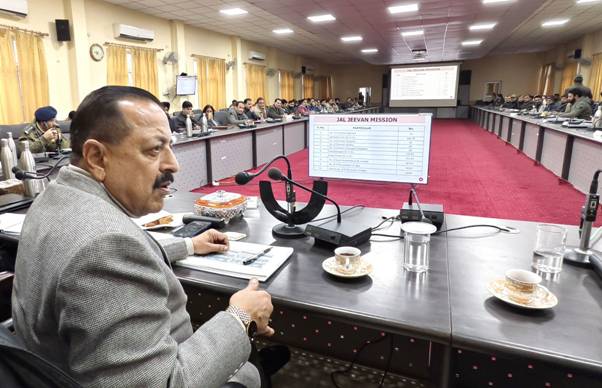
Union Minister Dr Jitendra Singh chaired the District Development Coordination and Monitoring Committee Meeting (DISHA) here today in the office of Deputy Commissioner to review the status of ongoing projects and public welfare schemes. Speaking on the occasion, Dr. Jitendra Singh called for maximising awareness at the local level about the salient features of the schemes, namely PM Surya Ghar Muft Bijili Yojana, PM Vishwakarma Yojana and Ayushman Bharat Pradhan Mantri Jan Arogya Yojana, with focus on providing health coverage to all senior citizens aged 70 years and above.

He said the former has twin objectives of providing free electricity to households by facilitating the installation of rooftop solar panels, and incentivising the beneficiaries to sell surplus power.

Underscoring the importance of PM Vishwakarma Yojana, Dr Jitendra Singh said that it aims to uplift individuals skilled in various traditional crafts, thereby preserving India’s rich cultural heritage. He said the initiative is also aimed at improving the quality and reach of handicraft products as well as ensuring that craftspersons are integrated with the domestic and global value chains.

The Minister directed the officials and PRIs to work in close coordination for effective implementation of the schemes related to water, electricity, housing and other civic amenities. He said all out efforts must be made for ensuring ease of living for inhabitants of far-flung areas of the district. Dr Singh stated that that the government is taking more steps to improve the educational infrastructure and medical facilities for the local populace.

A person sitting at a table with microphonesDescription automatically generated

The DISHA meting was attended by DDC, Chairperson, Dr Shamshad Shan, MLA,  Ramban, Sh. Arjun Singh Raju, Deputy Commissioner, Ramban, Sh. Baseer-Ul-Haq Chaudhary, DDC Councillors, and SSP, Sh. Kulbir Singh, ADDC, Sh. Roshan Lal, ADC, Sh. Varunjeet Singh Charak, ACR, Sh. S. Harpal Singh and CPO Dr. Shakeeb Ahmed Rather.