Prime Minister extends greetings on World Sanskrit Day

| Published on:

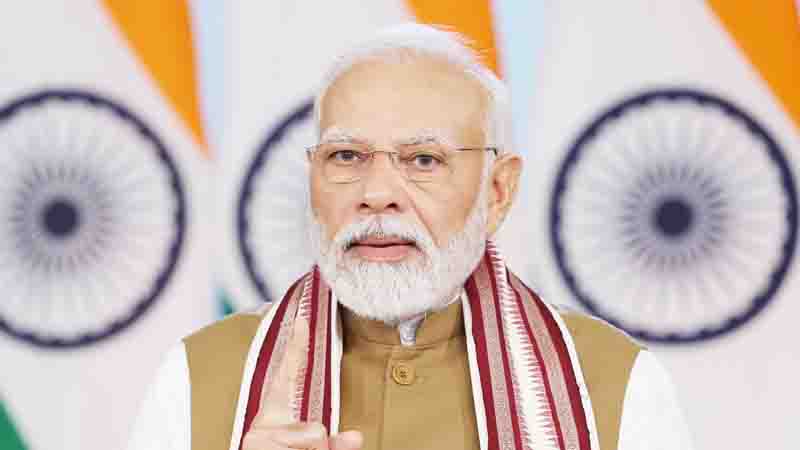
The Prime Minister, Shri Narendra Modi has extended greetings on the occasion of World Sanskrit Day. Shri Modi also lauded all those who are passionate about Sanskrit. To celebrate this, the Prime Minister has urged all to share one sentence in Sanskrit.

In a series of X posts, the Prime Minister said;

“विश्वसंस्कृतदिवसे मम शुभकामनाः। अहं सर्वान् अभिनन्दामि ये एतदर्थं भावुकाः सन्ति। संस्कृतेन सह भारतस्य संबन्धः विशिष्टः।”

“Greetings on World Sanskrit Day. I laud all those who are passionate about it. India has a very special relation with Sanskrit. To celebrate this great language, I urge you all to share one sentence in Sanskrit. In the post below, I will also share a sentence. Don’t forget to use #CelebratingSanskrit.”

“अग्रिमदिनेषु भारतं G20 संमेलनस्य आतिथ्यं करिष्यति। संपूर्णविश्वतः जनाः भारतम् आगमिष्यन्ति, अस्माकं श्रेष्ठसंस्कृतिं ज्ञास्यन्ति च। #CelebratingSanskrit”

PM celebrates Raksha Bandhan with children

| Published on:

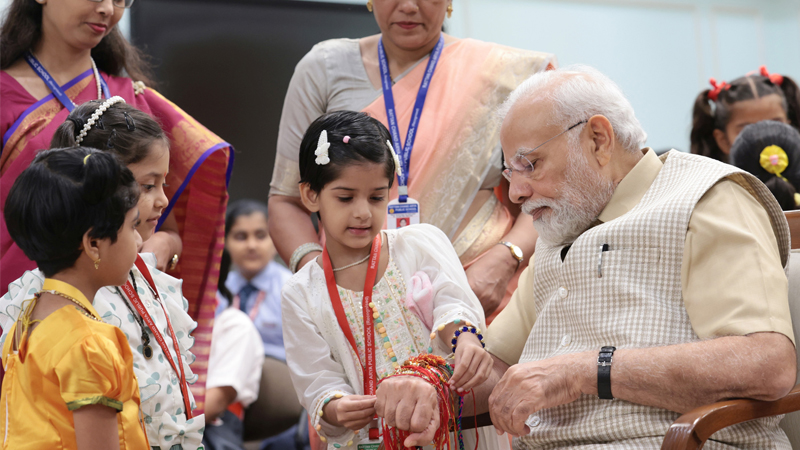
Prime Minister Shri Narendra Modi celebrated Raksha Bandhan with children at 7, Lok Kalyan Marg today.

The children tied Rakhi to the Prime Minister, who interacted with them on various issues. The children shared their positive feelings on the recent success of Chandrayaan-3 mission and expressed their enthusiasm about the upcoming Aditya L-1 mission.

The children also recited poems and sang songs during the interaction. Impressed by their articulation, the Prime Minister encouraged them to explore writing poems on different various topics including government schemes for the benefit of the public. Explaining the importance of Aatmanirbharta, Prime Minister also advised the children to use Made in India products.

Various students, accompanied by their teachers, participated in the celebration. Representatives of NGOs, widows from Vrindavan,  as well as other individuals were also present.

Union Finance Minister chairs review meeting of Regional Rural Banks of Northern Region

| Published on:

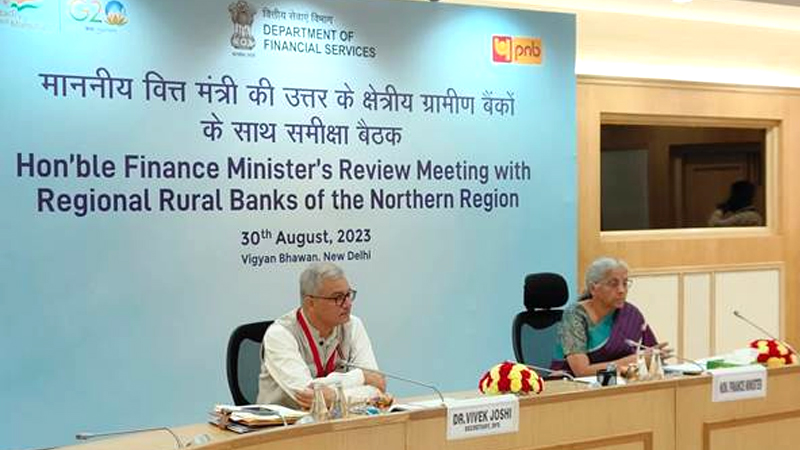
Union Finance Minister Smt. Nirmala Sitharaman chaired a review meeting of Regional Rural Banks of Northern Region in New Delhi, today.

During the review meeting, the Union Finance Minister emphasised on digital capability upgradation of RRBs and instructed Managing Director & CEO, Punjab National Bank (PNB) to ensure that all RRBs with PNB acquire digital onboarding capability by 1st November 2023.

Finance Minister Smt. Sitharaman urged the RRBs to undertake removal of duplication of Pradhan Mantri Jan Dhan Yojana (PMJDY) accounts and facilitate storage facility for apple growers particularly in J&K and Himachal Pradesh.

The Union  Finance Minister also said that banks should map RRBs with MSME clusters and put greater thrust on increasing network of rural branches in cluster areas identified by the Ministry of Micro, Small and Medium Enterprises.

Finance Minister Smt. Sitharaman further emphasised on increasing penetration under Pradhan Mantri Mudra Yojana (PMMY) and Financial Inclusion and stated that a roadmap has to be prepared for completing the designated activities in a timebound manner.

Also present during the meeting were Secretary, Department of Financial Services (DFS), Additional Secretary, other senior DFS officials, representatives of RBI, respective State Governments, NABARD, sponsor Banks and RRBs.

PM hails progress in Mission Net Zero as solar capacity increases 54x in the last 9 years

| Published on:

The Prime Minister, Shri Narendra Modi has lauded the the strides made in the direction of Mission Net Zero.

The Railways had posted on X that solar capacity increased 54x in the last 9 years. They informed that the solar power capacity commissioned till March 2014 was 3.68 MW whereas during 2014-23, 200.31 MW were commissioned.

The Prime Minister replied :

“Shows commendable progress in our commitment towards a greener future. In just 9 years, we have enhanced our capacity significantly, taking significant strides towards #MissionNetZero Carbon Emission. Let us continue this journey, ensuring a brighter and sustainable tomorrow for India.”

Nitin Gadkari launches world’s first prototype of the BS 6 Stage II ‘Electrified Flex Fuel Vehicle’

| Published on:

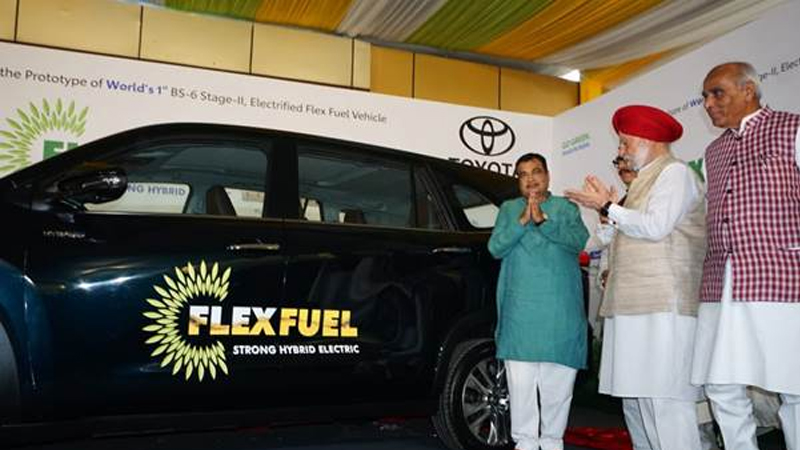
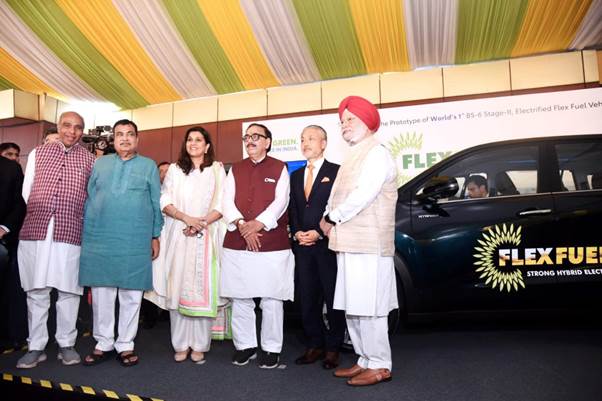
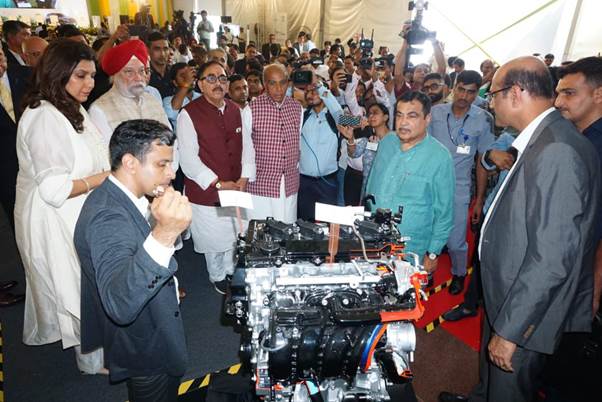
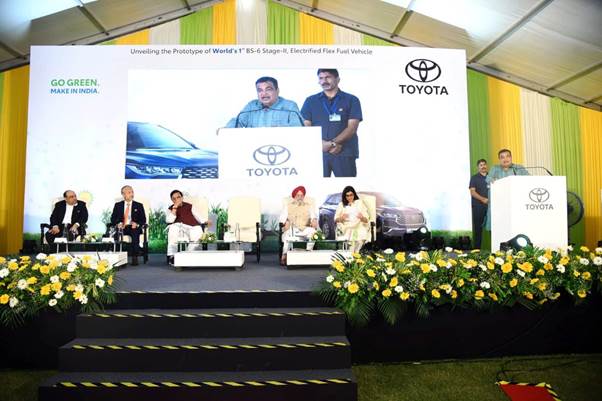
Union Minister for Road Transport and Highways Shri Nitin Gadkari launched the world’s first prototype of the BS 6 Stage II ‘Electrified Flex Fuel Vehicle’, developed by Toyota Kirloskar Motor in the presence of  Union Minister Shri Hardeep Singh Puri , Union Minster Shri Mahendra Nath Pandey , MD & CEO of Toyota Shri Masakazu Yoshimura , MD & CEO of Kirloskar Systems Limited Geetanjali Kirloskar , Ambassador, Diplomats from Japan Embassy, higher officials and advisors in New Delhi today.

Speaking on the occasion Shri Gadkari said Ethanol being an indigenous, eco-friendly, and renewable fuel holds promising prospects for India. He said the emphasis of the Modi Government on ethanol aligns with objectives of attaining energy self-sufficiency, doubling farmers’ income, transitioning them to Urjadata while continuing to support them as Annadata, and positively impacting the environment. He said the day ethanol economy becomes of 2 lakh crores  agricultural growth rate will reach 20% from the current 12%.  Talking about innovations in biofuels Shri Gadkari spoke of refinery in Numaligarh in Asssam of Indian Oil Corporation where bamboo is being used for manufacturing bio ethanol.

Shri Gadkari said this innovative vehicle is based on the Innova Hycross and is engineered to adhere to India’s stricter emission standards, marking it as the first-ever BS 6 (Stage II) Electrified Flex Fuel Vehicle prototype globally. He said the forthcoming stages for this prototype encompass meticulous refinement, homologation, and certification processes.

PM joins ISRO team via VC to witness landing of Chandrayaan 3

| Published on:

The Prime Minister, Shri Narendra Modi joined the ISRO team via Video Conferencing to witness the the landing of Chandrayaan 3 on the Moon’s surface today. Immediately after the successful landing, the Prime Minister addressed the team and congratulated them for the historic achievement.

The Prime Minister, addressing the team as family members, said that such historic events become the eternal consciousness of a nation. “This moment is unforgettable, unprecedented. It is the moment of the clarion call of ‘Viksit Bharat’, a victory call for India, this is a moment of crossing the ocean of difficulties and walking on the ‘Chandrapath’ of victory. This is a moment of the capability of the 140 crore heartbeats and the confidence of the new energy of India. This is a moment of invoking the rising fortune of India”, the Prime Minister told a jubilant nation. “In the first light of ‘Amrit Kaal’ this is ‘Amrit Varsha’ of success”, a visibly elated Prime Minister added. The Prime Minister quoted the scientists and said, “India is now on the moon!” He stated that we have just witnessed the first flight of the new India.

The Prime Minister informed that he is currently in Johannesburg attending the BRICS Summit but his mind was also focussed on Chandrayaan 3 like every other citizen. He said that every Indian has immersed themselves in celebration and it is a day of festivity for every family as he is connected with every citizen with enthusiasm on this special occasion. The Prime Minister congratulated Team Chandrayaan, ISRO and all the scientists of the country who have worked tirelessly for years and also congratulated the 140 crore countrymen for this wonderful moment filled with enthusiasm, joy and emotion!

“India has reached the South Pole of the Moon where no country in the world could reach to date with the dedication and talent of our scientists”, the Prime Minister remarked. He underlined that all the myths and stories related to the Moon will now change and the proverbs will find a new meaning for the new generation. Referring to the Indian folklore where the Earth is considered ‘Maa’ and the Moon, ‘Mama’, the Prime Minister said that the Moon is also considered very distant and referred to as ‘Chanda Mama dur ke’, but the time is not far when the children would say ‘Chanda Mama ek tour ke’ i.e. the moon is only a tour away.

The Prime Minister, addressing the people of the world, every country and region, said “India’s successful moon mission is not India’s alone. This is a year in which the world is witnessing India’s G-20 presidency. Our approach of ‘One Earth, One Family, One Future’ is resonating across the globe. This human-centric approach that we represent has been welcomed universally. Our moon mission is also based on the same human-centric approach. Therefore, this success belongs to all of humanity. And it will help moon missions  by other countries  in the future.” Shri Modi added. “I am confident that all countries in the world, including those from the Global South are capable of achieving such feats. We can all Aspire for the moon and beyond.”

The Prime Minister expressed confidence that the achievements of Chandrayaan Maha Abhiyan will take India’s flight beyond the lunar orbits. “We’ll test the limits of our solar system, and work to realize the infinite possibilities of the universe for humans”, Shri Modi asserted. The Prime Minister highlighted setting ambitious goals for the future and informed that ISRO is soon going to launch the ‘Aditya L-1’ mission for a detailed study of the Sun. He also touched upon Venus being one of ISRO’s goals. “India is proving again and again that the sky is not the limit”, the Prime Minister said as he highlighted Mission Gaganyaan where India is fully prepared for its first human space flight mission.

The Prime Minister emphasized that science and technology are the basis of the bright future of the country. He said that this day will inspire all of us to move towards a bright future and will show the way to the realization of resolutions. “This day signifies how victory is achieved from the lessons of defeat”, the Prime Minister concluded wishing all the success to the scientists in all their future endeavours.

Chandrayaan-3’s triumph mirrors the aspirations and capabilities of 140 crore Indians: PM

| Published on:

The Prime Minister, Shri Narendra Modi has remarked that Chandrayaan-3’s triumph mirrors the aspirations and capabilities of 140 crore Indians.

Sharing a post on X by Indian Space Research Organisation, the Prime Minister said:

“Chandrayaan-3’s triumph mirrors the aspirations and capabilities of 140 crore Indians.

To new horizons and beyond!

Proud moment for 🇮🇳.”

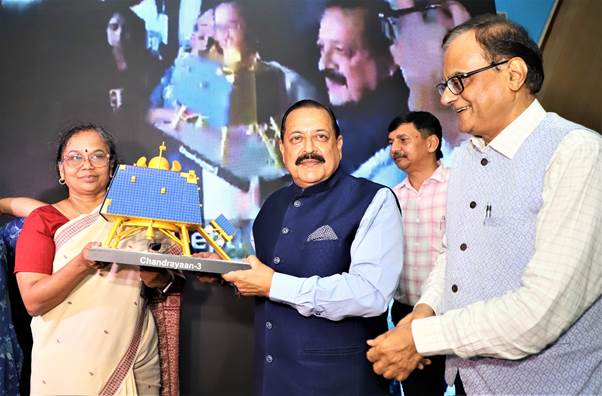
Dr Jitendra Singh hails ‘India on Moon’, narrates further sequence of activities

| Published on:

“Hail India on Moon! Hail ISRO!”.

This was the opening sentence of Union Minister of State (Independent Charge) Science & Technology; MoS PMO, Personnel, Public grievances, Pensions, Atomic Energy and Space, Dr Jitendra Singh, who is also MoS Incharge Space, soon after the successful soft landing of Chandrayaan3 on the surface of Moon in the South Pole area, this evening.

Simultaneously, in a tweet which exactly coincided with the precise moment of the landing of Chandrayaan-3, Dr Jitendra Singh said, “While others fantasize Moon, we have felt the Moon. While others stuck in flight of dreams, Chandrayaan3 has actualised the dream. Tricolour flies high in lunar skies affirming India’s resolve, as articulated by PM Modi, ‘Sky is not the limit’”.

In a brief statement to the media, Dr Jitendra Singh complimented ISRO Chairman, Shri S. Somanath, Mission Director, Shri Mohan Kumar and the entire Team ISRO for having placed India’s national pride on the Moon in the virgin terrain of South Polar area, not accessed by any other space mission so far. He said, it is difficult for common citizens to understand how much consistent labour, hard work, commitment and passion have been put in while working day and night for months and years together to ensure meticulous planning and minutest details for the success of the mission.

After today’s successful feat, Dr Jitendra Singh said, India has reaffirmed its position as a world’s frontline leading nation in the Space sector. He gave full credit to Prime Minister Shri Narendra Modi for enabling India’s Space scientists to vindicate the dream of their founding father Vikram Sarabhai by “unlocking” India’s Space sector and providing a milieu in which India’s huge potential and talent could find an outlet and prove itself to the rest of the world.

Dr Jitendra Singh further informed that the Vikram has landed in a hazard-free location with the help of its algorithm and instruments and the tilt to the Lander is very small as measured by the inclinometers onboard. While the cameras onboard the Vikram have beamed the pictures of the moon and confirmed the touchdown, the confirmation is available from other sensors as well, he added.

Narrating the further sequence of activities from this moment onwards, Dr Jitendra Singh said, the experiments onboard Vikram and Pragyan will be happening on all days and as much data will be collected from all instruments until the Moon’s Day lasts for the next 14 days.

On the Lander, the Minister informed that the instruments in operation include CHASTE (Chandra’s Surface Thermo-Physical Experiment) to carry out the measurements of thermal properties of the lunar surface near the polar region, LRA (Laser Retroreflector Array), RAMBHA-LP- a Langmuir Probe to measure surface plasma density, a laser reflector mounted on the corner of the Vikram for accurate positioning measurement of Lander on the Lunar surface by future orbiters, ILSA – Instrument for Lunar Seismic Activity to measure seismicity around the landing site and to understand the structure of the lunar crust and mantle, LIBS- Laser Induced Breakdown Spectroscopy to determine the elemental composition (Mg, Al, Si, K, Ca,Ti, Fe) of Lunar soil and rocks around the lunar landing site, APXS – Alpha Particle X-Ray Spectrometer to measure the chemical composition and mineralogical composition to further enhance our understanding of Lunar-surface and SHAPE – Spectro-polarimetry of HAbitable Planet Earth to study the spectro-polarimetric signatures of the habitable planet Earth in the near-infrared (NIR) wavelength range (1 – 1.7 μm).

Dr Jitendra Singh said, at the end of next 14 days followed by night and extreme cold conditions when the day breaks again, solar power generation for Vikram and Pragayaan is expected to start again. Meanwhile, the orbiter is designed to withstand long periods of life, he said.

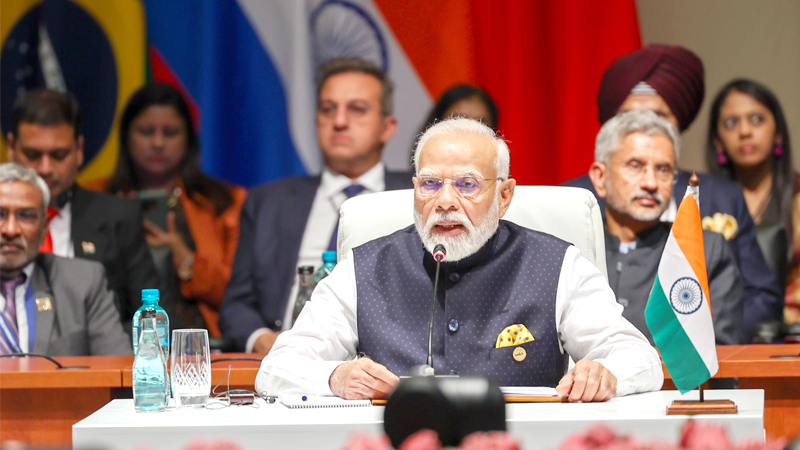
Prime Minister’s remarks at the 15th BRICS Summit

| Published on:

Excellency President Ramaphosa,
Excellency President Lula da Silva,
Excellency President Putin,
Excellency President Xi,
Ladies and Gentlemen,

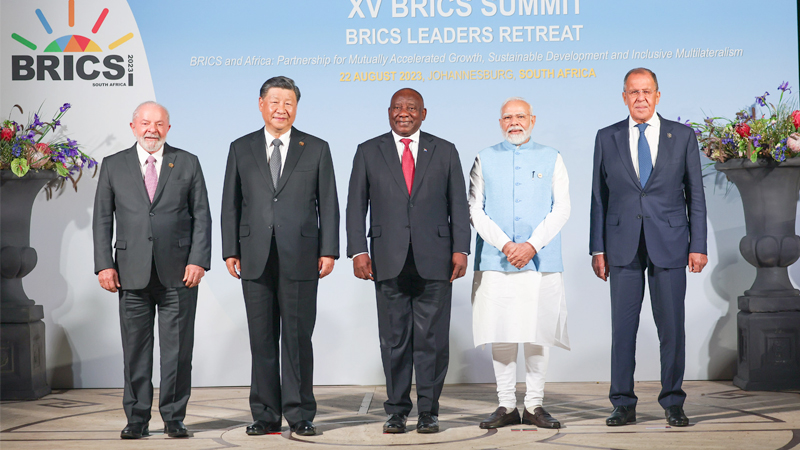
I once again congratulate and thank my dear friend President Ramaphosa for the grand organization of the 15th BRICS Summit and the warm hospitality extended to us.

It is a matter of great pleasure for me and my delegation to be once again in the beautiful city of Johannesburg.

This city has a very deep connection with the people of India and the history of India.

Tolstoy Farm, at some distance from here, was built by Mahatma Gandhi 110 years ago.

By combining the great ideas of India, Eurasia and Africa, Mahatma Gandhi had laid a strong foundation of our unity and mutual harmony.

Excellencies,

In the last nearly two decades, BRICS has completed a very long and wonderful journey.

We have made many achievements in this journey.

Our New Development Bank is playing an important role in the development of the countries of the Global South.

We have created a financial safety net through the Contingency Reserve Arrangement.

With initiatives like BRICS satellite constitution, Vaccine R&D Centre, mutual recognition of pharma products, we are bringing positive changes in the lives of common citizens of BRICS countries.

Through initiatives like Youth Summit, BRICS Games, Think Tanks Council, we are strengthening people-to-people ties between all countries.

Railway Research Network, closer cooperation between MSMEs, online BRICS database, Startup Forum were some of the suggestions given by India to give a new direction to the BRICS agenda.

I am glad that significant progress has been made on these subjects.

Excellencies,

I would like to put forward some suggestions for further broadening our close cooperation.

The first is cooperation in the field of space. We are already working on the BRICS satellite constellation.

Taking it a step further, we can consider creating a BRICS Space Exploration Consortium.

Under this, we can work for global good in areas like space research, weather monitoring.

My second suggestion is cooperation in education, skill development and technology.

To make BRICS a future ready organization, we have to make our societies future ready. Technology will play an important role in this.

In India, we have created DIKSHA i.e. Digital Infrastructure for Knowledge Sharing platform to provide education to the children of remote and rural areas.

Also, to promote innovation among school students, we have created 10,000 Atal tinkering labs across the country.

Bhashini, an AI-based language platform, is being used in India to remove language barriers.

CoWIN platform has been created for vaccination.

Public service delivery is being revolutionized through Digital Public Infrastructure i.e. India Stack.

Diversity is a great strength of India.

The solution to any problem in India comes out at the test of this diversity.

That’s why these solutions can be easily implemented in any corner of the world.

In this context, we will be happy to share all these platforms developed in India with BRICS partners.

My third suggestion is that we can do skills mapping together to identify each other’s strengths.

Through this we can complement each other in the journey of development.

My fourth suggestion is regarding big cats.

A large number of big cats of different species are found in all the five countries of BRICS.

Under the International Big Cat Alliance, we can make joint efforts for their protection.

My fifth suggestion is about traditional medicine.

We all have ecosystems of traditional medicine in our countries.

Can we together create a repository of traditional medicine?

Excellencies,

The countries of the Global South have been given a special importance in BRICS, under the chairmanship of South Africa.

We heartily welcome it.

This is not only the expectation of the present time, but also the need.

India has given top priority to this topic under its G-20 presidency.

Our effort is to move forward together with all the countries on the motto of “One Earth, One Family, One Future”.

125 countries participated in the Voice of Global South summit held in January this year, sharing their concerns and priorities.

We have also proposed to give permanent membership of G-20 to the African Union.

I am sure all the BRICS partners are also together in the G20. And all will support our proposal.

Giving special place to all these efforts in BRICS will increase the self-confidence of the countries of the Global South.

Excellencies,

India fully supports the expansion of the BRICS membership. And welcomes moving forward with consensus in this.

In 2016, during India’s chairmanship, we defined BRICS as Building Responsive, Inclusive, and Collective Solutions.

After seven years, we can say that, BRICS will be – Breaking barriers, Revitalizing economies, Inspiring Innovation, Creating opportunities, and Shaping the future.

Together with all the BRICS partners, we will continue to contribute actively in making this new definition meaningful.

Thank you very much.

DISCLAIMER – This is the approximate translation of Prime Minister’s Press Statement. Original Press Statement were delivered in Hindi.

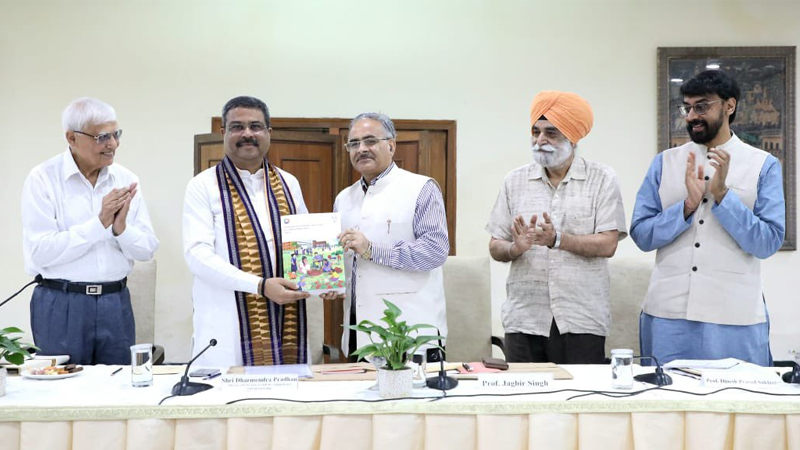
Dharmendra Pradhan releases National Curriculum Framework for School Education in New Delhi

| Published on:

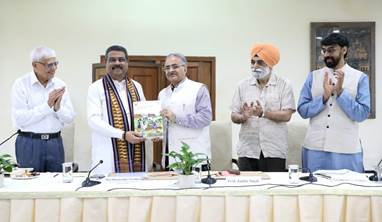
Union Minister for Education and Skill Development & Entrepreneurship, Shri Dharmendra Pradhan today released National Curriculum Framework for School Education (NCF-SE), marking an important and transformative step towards the implementation of National Education Policy. The Minister addressed the 1st Joint workshop of the National Curriculum Framework Oversight Committee and the National Syllabus and Teaching-Learning Material Committee today. The development of the NCF-SE was guided by a vision to align education with the demands of the 21st century and the ethos of the Indian knowledge system. Under the stewardship of Prof. K Kasturirangan, a Steering Committee was formed to create a curriculum aligned with the National Education Policy 2020, emphasizing the 5+3+3+4 design of schooling. This framework addresses the entire educational journey from foundational to secondary stages. The framework introduces multidisciplinary education, nurturing values, fostering creative pedagogies, and preparing students for practical problem-solving.

Speaking on the occasion Shri Dharmendra Pradhan said that the world has high expectations from India. In order to live up to our global responsibilities, we have to develop technology-driven educational system that meets expectations of the world’s community alongside India, he added. He highlighted the framework’s role in shaping a holistic, contemporary, and Indian-rooted educational landscape. He further said that it is a momentous boost to implementation of NEP with release of National Curriculum Framework for School Education and efforts are on to make new textbooks available from next academic year. The textbooks for class 3-12 to be aligned with 21st Century requirements, making them rooted and futuristic, he added.

The NCF-SE’s comprehensive nature ensures that it covers all stages of schooling. It sets clear learning standards and competencies, enabling teachers to foster critical thinking, creativity, and genuine understanding. The framework empowers educators, encourages engaging pedagogies, and emphasizes the importance of school culture and values.

Art Education, Physical Education & Well-being, Environmental Education, and Vocational Education are reinvigorated under the NCF-SE. Multilingualism, conceptual understanding in Mathematics, and capacities for scientific inquiry also receive renewed attention. The curriculum’s interdisciplinary approach encourages students to study the relationships between individuals, society, and the environment.

The National Curriculum Framework for School Education (NCF-SE) is the curriculum framework for the 5+3+3+4 design of schooling as proposed by the National Education Policy 2020 (NEP 2020). It also recommended the formulation of a new and comprehensive National Curriculum Framework for School Education (NCF-SE) to respond to this four-stage school design. The entire curriculum framework for all the four stages – Foundational Stage, Preparatory Stage, Middle Stage, and Secondary Stage – was released. Some of the key related points:

  • Comprehensive curriculum framework covering all 4 stages of schooling. The NCF-SE comprehensively covers all the four stages of schooling. The NCF-SE has articulated the learning standards to be achieved and the principles for selection of content, pedagogy, and assessments for achieving the learning standards.
  • Enable real improvement in practise of education in the country. The NCF-SE is designed to enable and help actual change in practise on the ground. The NCF-SE has made conscious and deliberate effort to communicate to all stakeholders in school education including Curriculum and Syllabus developers, so that it is useable in practical circumstances. Teachers and parent community can also comprehend the intention of the curricula that is developed on the basis of the NCF-SE.
  • Learning Standards with clear, specific, and rigorous flow-down. It articulates specific learning standards for all school subjects that gives clear direction for action for all stakeholders in the school system, particularly Teachers. The Learning Standards have defined specific competencies to be achieved at the end of each stage for each school subject. There is a clear, specific, and rigorous flow-down of curricular logic from the broad aims of school education to specific curricular aims of each subject, resulting in curricular goals and competencies for a specific stage in that subject.
  • Development of Knowledge, Capacities, and Values. The curriculum focuses on development of knowledge with genuine understanding, fundamental capacities such as critical thinking and creativity, and constitutional and human values.
  • Empowering teachers and schools. The NCF-SE designed to enable and empower teachers and schools for the full flowering of their creativity and enhanced engagement.
  • Engaging and effective pedagogy. It enables the entire range of age and context appropriate pedagogy, from play-based, activity-based, inquiry-based, dialogue based, and more. This would also use effective, widely available, and highly engaging teaching-learning-material, including textbooks.
  • Transforming assessment including exams. Assessment and exams at all levels to be transformed, to enable genuine learning and reduce stress, including the Board exams.
  • Importance of School Culture. School culture and practises are to be developed as an integral and important part of the curriculum.
  • Rooted in India. The curriculum is rooted in India and is informed by the wealth of Indian knowledge and thought on education. Contributions to the knowledge in various disciplines by Indians from the ancient to contemporary times have been integrated into the curricular goals of all school subjects.
  • Multidisciplinary education. All children to go through multidisciplinary education to develop an integrated and holistic perspective and learning.
  • Equity and inclusion. The NCF-SE is informed by principles to ensure equity and inclusion in all its aspects, from content and pedagogy, to, school culture and practises.
  • Renewed emphasis on Art, and, Physical Education & Well-being. The school subjects of Art Education and Physical Education & Well-being are given a renewed emphasis in the curriculum by defining specific learning standards to be achieved and recommended time allocation in the school timetables. Art Education encompasses both visual arts and performing arts and has equal emphasis on making, thinking about, and appreciating artwork. Physical Education and Well-being gives emphasis to sports, mind-body wellness through practices like Yoga, and ideas on incorporating traditional Indian games and sports into the curriculum.
  • Environmental Education. Responding to the triple challenge of climate change, biodiversity loss, and pollution, and the criticality of environmental awareness and sustainability in today’s world, Environmental Education is given due emphasis across all stages of schooling culminating in a separate area of study in the Secondary Stage.
  • Vocational Education. The NEP 2020 has made strong recommendations for Vocational Education to be an integral part of school education and the NCF-SE has included specific learning standards, content, pedagogy, and assessments for Vocational Education for all stages of schooling. The curriculum proposes engagement in the three different forms of work – work with life forms (agriculture, animal husbandry), work with materials and machines, and work in human services.
  • Multilingualism and Indian Languages. The NCF-SE has given the necessary emphasis on multilingualism and on learning languages native to India. Given the rich multilingual heritage of India, it expects all students to be proficient in at least three languages, at least two of which are native to India. It expects students to achieve a “literary level” of linguistic capacity in at least one of these Indian languages.
  • Conceptual understanding and procedural fluency in Mathematics. The school subject of Mathematics & Computational Thinking has emphasis on conceptual understanding along with procedural fluency – with a goal to appreciate the beauty and universality of mathematics and reduce fear of the subject. Higher order curricular goals such as problem solving, mathematical thinking, coding, and communication are given due importance.
  • Capacities for Scientific Inquiry. Science Education emphasises the development of capacities for scientific inquiry along with acquiring knowledge of fundamental theories, laws, and conceptual structures of science in disciplines such as Biology, Chemistry, Physics, and Earth Science.
  • Interdisciplinary understanding of Social Science through themes. The social science curriculum expects students to systematically study human societies and explore the relationships between individuals, society, the natural environment, social institutions, and organizations. This is to be studied through themes in an interdisciplinary manner in the Middle Stage and developing disciplinary depth in the Secondary Stage.
  • Flexibility and Choice in Secondary Stage. The Secondary Stage has been significantly redesigned to offer more flexibility and choice for students. There are no hard separations between academic and vocational subjects, or between science, social science, art, and physical education. Students can choose interesting combinations of subjects for receiving their school-leaving certificates.
  • Interdisciplinary Areas of Study. Interdisciplinary Areas of Study has been introduced as a separate subject of study in the Secondary Stage. In this subject, students develop the ability to reason about contemporary challenges using knowledge from multiple disciplines including moral and ethical concerns. They are expected to use these abilities to understand and respond effectively to the concerns of environmental degradation that include climate change and biodiversity loss.

The NCF-SE is organised into five parts.

  • Part A articulates the broad aims of school education, and the desirable values and dispositions, capacities and skills, and knowledge that are required for achieving these aims. It also lays down the principles and approaches for content selection, pedagogy, and assessment and gives the rationale and design principles for the four stages of schooling.
  • Part B focuses on some of the important cross-cutting themes of NCF-SE, viz., rootedness in India, education for values, learning and caring about the environment, inclusive education, guidance and counselling, and use of educational technology.
  • Part C has separate chapters for each school subject. Each of these chapters have Learning Standards defined for all the relevant stages of schooling along with specific guidelines for content selection, pedagogy, and assessments appropriate for that subject. The part also has a chapter on the Foundational Stage and one on design and range of subjects in Grades 11 and 12.
  • Part D handles school culture and processes that enable a positive learning environment and inculcate desirable values and dispositions.
  • The last part, Part E, outlines the requirements for an overall ecosystem of schooling that would enable the achievement of the aims of the NCF-SE. This includes aspects of teacher capacities and service conditions, physical infrastructure requirements, and the role of the community and family.

Prime Minister’s participation in the BRICS Business Forum Leaders’ Dialogue

| Published on:

Prime Minister Shri Narendra Modi participated in the BRICS Business Forum Leaders’ Dialogue in Johannesburg on 22 August 2023.

The Leaders were briefed on the deliberations of the BRICS Business Forum.

Prime Minister highlighted the various reforms being undertaken by India to improve the ease of doing business, including technology-based solutions to address the social and economic challenges. Prime Minister invited BRICS business leaders to participate in India’s developmental journey.

Prime Minister noted that Covid had highlighted the importance of resilient and inclusive supply chains, and emphasized the importance of mutual trust and transparency for this.

He also stressed that together BRICS can contribute significantly to global welfare, particularly of the Global South.

English translation of Prime Minister’s remarks at the BRICS Business Forum Leaders’ Dialogue

Excellencies,
Leaders of the BRICS business community,
Namaskar!

I am pleased that as soon as we set foot on the land of South Africa, the beginning of our program is being made through the BRICS Business Forum.

First of all, I would like to thank President Ramaphosa for his invitation and for organizing this meeting.

On the occasion of the 10th anniversary of the BRICS Business Council, I extend my heartfelt congratulations and best wishes.

Over the past ten years, the BRICS Business Council has played a very important role in enhancing our economic cooperation.

When the first BRICS summit was held in 2009, the world was coming out of a major economic crisis.

At that time, BRICS was seen as a ray of hope for the global economy.

In the present time as well, amid the COVID pandemic, tensions, and conflicts, the world is grappling with economic challenges.

In such times, the BRICS nations once again have a significant role to play.

Friends,

Despite the turmoil in the global economy, India is currently the fastest-growing major economy in the world.

Soon, India will become a five trillion-dollar economy.

There is no doubt that in the coming years, India will be the Growth Engine of the world.

This is because India has transformed times of adversity and challenges into an opportunity for economic reforms.

In the past few years, the reforms we have undertaken in mission mode have led to consistent improvement in the ease of doing business in India.

We have reduced the compliance burden.

We are replacing red tape with a red carpet.

The implementation of GST (Goods and Services Tax) and the Insolvency and Bankruptcy Code has boosted investor confidence.

Sectors such as defense and space, which were previously restricted, have now been opened up for the private sector.

We have particularly focused on public service delivery and good governance.

Through the use of technology, India has made a significant leap in financial inclusion.

The greatest benefit of this has been received by our rural women.

Today, millions of people in India receive Direct Benefit Transfers with just a click.

Over 360 billion dollars worth of such transfers have been made so far.

This has increased transparency in service delivery, reduced corruption, and minimized middlemen.

India has the most affordable per gigabyte data prices.

Today, from street vendors to large shopping malls, the Unified Payments Interface (UPI) is used for transactions.

Today, India stands as the country with the highest number of digital transactions in the world.

Countries like the UAE, Singapore, and France are also joining this platform.

There are numerous possibilities to work on this with BRICS countries as well.

The large scale investments being made in India’s infrastructure are changing the country’s landscape.

In this year’s budget, we have allocated around 120 billion dollars for infrastructure.

Through this investment, we are laying a strong foundation for a new India of the future.

Transformations are taking place rapidly in rail, road, waterways, and airways.

New highways are being built in India at a pace of ten thousand kilometers per year.

The number of airports has doubled in the last 9 years.

To boost investment and production, we have introduced the Production Linked Incentives scheme.

The reduction in logistics costs is making India’s manufacturing sector more competitive.

In the field of renewable energy, India is one of the world leaders.

We are actively taking steps to make India a global manufacturing hub in sectors such as solar energy, wind energy, electric vehicles, green hydrogen, and green ammonia.

It is natural that this will create a substantial market for renewable technology in India.

Today, India has the world’s third-largest startup ecosystem.

There are more than a hundred unicorns in India.

In sectors like IT, Telecom, FinTech, AI, and semiconductors, we are promoting the vision of “Make in India, Make for the World.”

All these efforts have had a direct positive impact on the lives of the common people.

Over the past nine years, there has been a nearly threefold increase in people’s incomes.

Women have been a significant contributor to India’s economic development.

From IT to space, banking to healthcare, women are contributing shoulder-to-shoulder with men towards the progress of the nation.

The people of India have pledged to build a developed nation by 2047.

Friends,

I invite all of you to be a part of India’s journey of development.

The COVID pandemic has taught us the importance of resilient and inclusive supply chains.

Mutual trust and transparency are crucial for this.

By combining each other’s strengths, we can contribute significantly to the well-being of the entire world, especially the Global South.

Excellencies,

Once again, I extend my congratulations to the leaders of the BRICS business community for their contributions.

I also express my gratitude to my friend President Ramaphosa for hosting this outstanding event.

Thank you.

DISCLAIMER – This is the approximate translation of Prime Minister’s Press Statement. Original Press Statement were delivered in Hindi.

Chandrayaan-3 mission  is attracting wider international collaborations for India: Dr Jitendra Singh

| Published on:

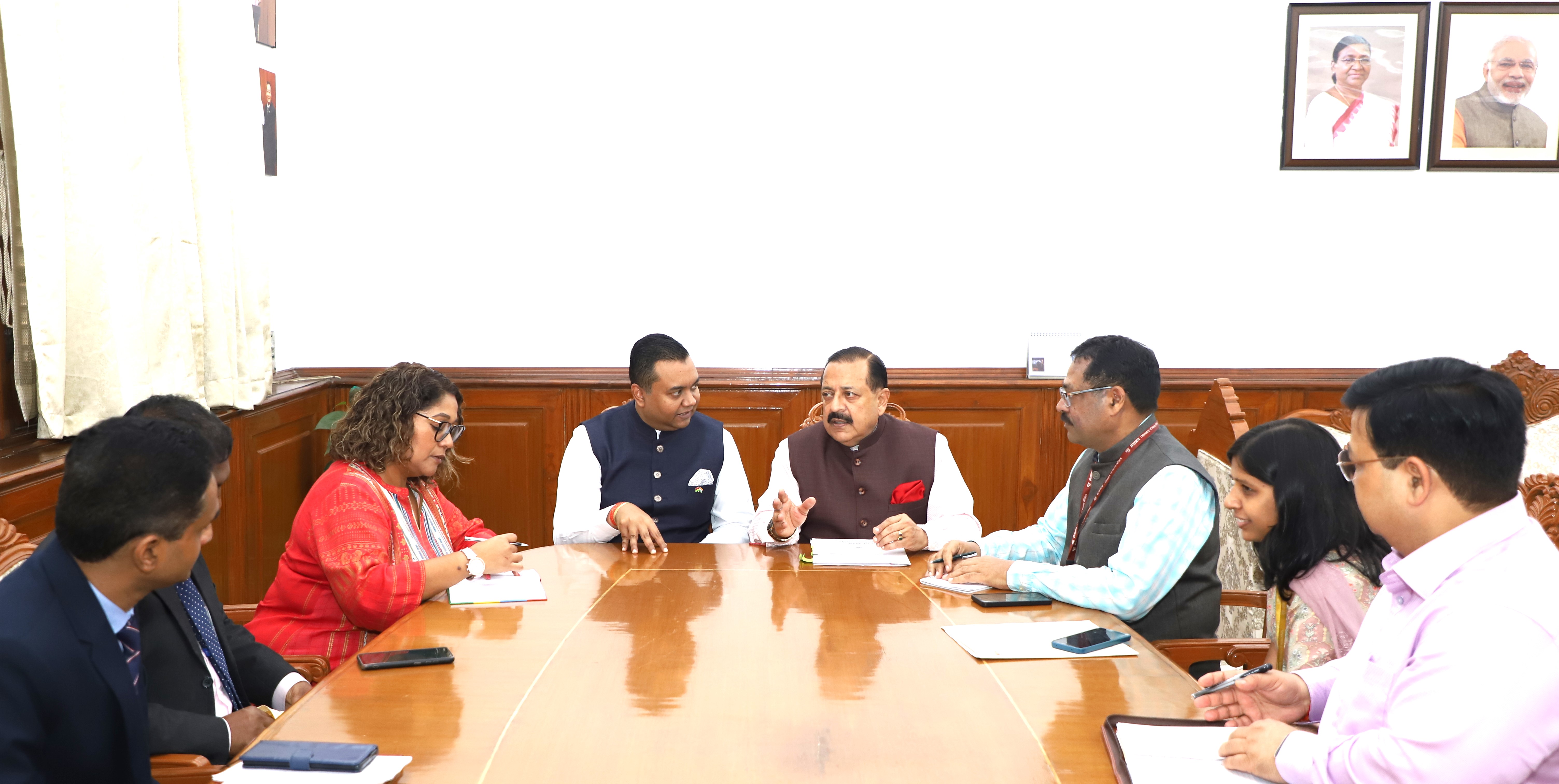
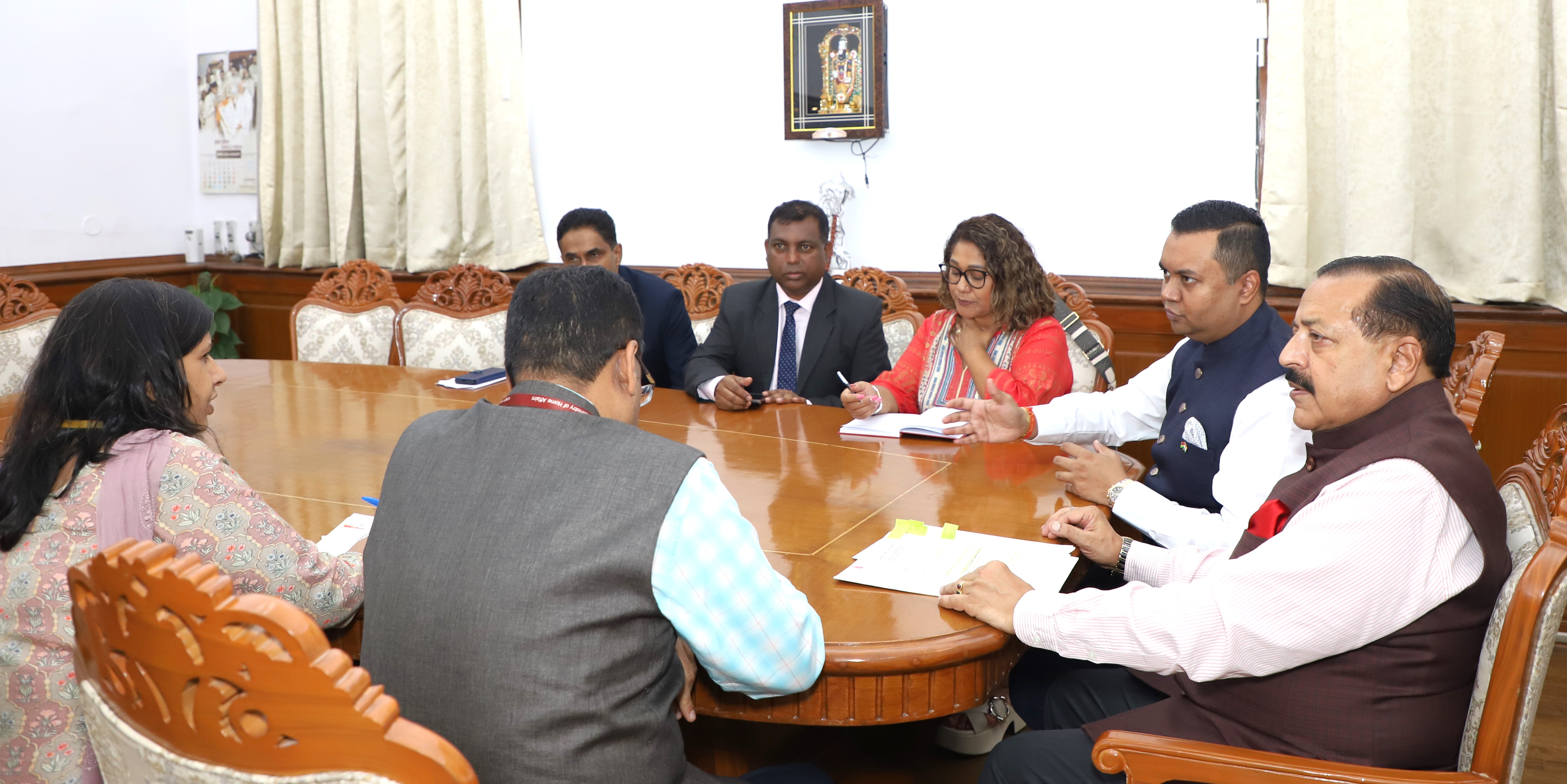
Union Minister of State (Independent Charge) Science & Technology; MoS PMO, Personnel, Public Grievances, Pensions, Atomic Energy and Space, Dr Jitendra Singh today said, Chandrayaan-3 mission is attracting wider international collaborations for India.

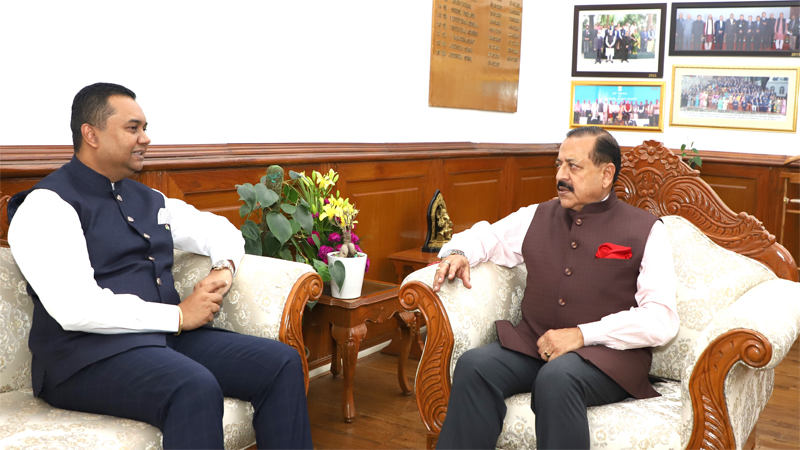
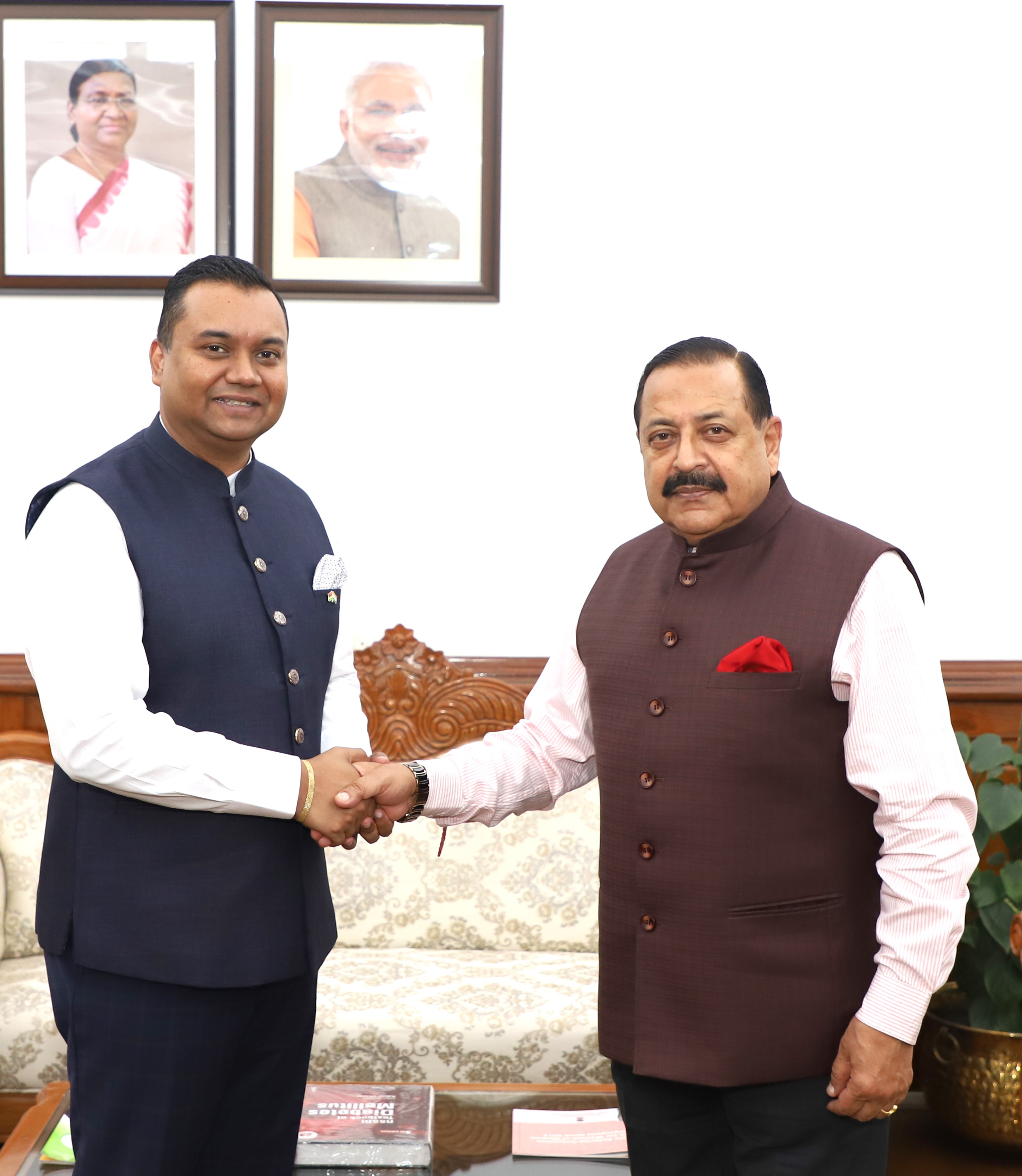
The Minister was speaking  after a high-level Mauritius delegation led by  Minister for Information Technology, Communication and Innovation (MITCI), Mr. Darsanand Deepak Balgobin called on him in New Delhi today to discuss the proposal for a Joint India-Mauritius Satellite.

India and Mauritius have  also agreed to utilize ISRO’s ground station in Mauritius to offer support to third party missions.

By signing up the Artemis Accords during the landmark visit of Prime Minister Shri Narendra Modi to the United States, India has demonstrated its capability to collaborate in the Space sector with other  nations of the world  as an equal partner, said Dr Jitendra Singh.

Mr. Balgobin earlier visited ISRO facilities in Bengaluru on August 17, 2023. ISRO presented technical details and application potentials of the proposed India – Mauritius joint satellite to the Minister.

The two ministers agreed on expanding the scope of ISRO’s Ground Station set up in Mauritius to include third party missions including the European Space Agency and an amendment to the existing MoU is planned to be signed to facilitate such collaboration.

Mauritius has hosted ISRO’s ground station for tracking satellite and launch vehicles for more than 3 decades and currently this ground station is continuously manned with two antennas (of 11 m diameter) operated in Mauritius.

Dr Jitendra Singh said, India has supported Mauritius by establishing a remote sensing centre in 1999 and also by providing satellite data pertaining to Mauritius territory and officials from Mauritius have benefited from the training courses offered by Indian institutes on space technology applications.

Dr Jitendra Singh and Mr. Balgobin also discussed areas like space cooperation through: (i) sharing of earth observation satellite data; (ii) Developing an ‘India-Mauritius space portal’ with satellite data, geospatial layers and value-added services pertaining to Mauritius; (iii) Initiating discussion for space industry level collaboration.